TIVOLI.
Reading edition
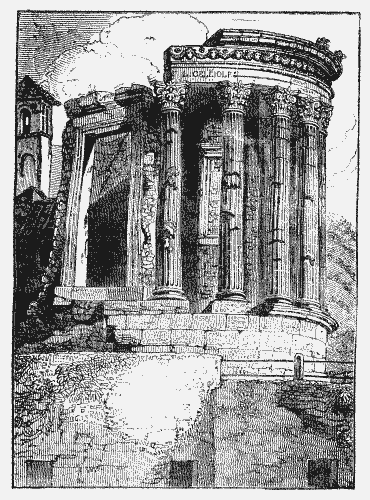
[Temple of the Sibyl at Tivoli.]
Of all the hilly spots in the neighbourhood to which foreign residents or the natives repair to avoid the great heat and malaria of Rome during the summer, none is so beautiful and otherwise remarkable as Tivoli. It is situated at the distance of about twenty English miles from Rome, on the ridge of a high romantic hill, whose sides are covered with olive groves, dotted here and there with convents and villas, and masses of ancient Roman ruins. The still loftier summits of Monte Catily, and a semicircular range of the Sabine mountains shelter it on one side, whilst the other side commands an open and extensive view of the Campagna, or great plain in which Rome is situated; and beyond the Campagna the eye reposes on the blue waves of the Mediterranean Sea. Tivoli is a considerable town, having a population of nearly ten thousand souls. It contains some fine stately mansions, but the mass of the habitations being mean and dirty, it cannot be called a handsome town. The transition, however, to it from the magnificence of Rome during the sultry weather is most delightful; and the visitor’s enjoyment is increased by seeing around him, in spite of their idleness, poverty, and rags, a rosy-cheeked, healthy-looking population, altogether different from the inhabitants of the city and the plain he has left. The journey from Rome is performed in good part, and can be performed in its whole length, over an ancient road, whose pavement is in many places in as perfect preservation as when, two thousand years ago, the poet Horace loitered along it on his way to his pleasant Sabine farm. Objects of antiquity and historical interest are crowded on this route; and when the traveller reaches Tivoli, where traditional names identify the sites of the villas of Piso, Varus, Lepidus, Cassius, the poet Catullus, and other great men of old Rome, he is conducted to an inn called “Of the Sibyl,” from the windows of which his eye embraces a magnificent cascade, and the elegant antique temples of the Sibyl and of Vesta. The two temples and the cascade just mentioned are the principal ornaments of Tivoli. The cascade is produced by the river Anio, now called the Teverone, which after winding through the Sabine vales, glides smooth and silently through Tivoli till it reaches the brink of a precipice, where it throws itself in one mighty mass of waters down a deep and dark chasm in the rocks:—there it roars and foams in a narrow channel, till finding an opening in the rocks it rushes headlong through it, and descends into caverns and abysses “deeper and deeper still.” The view of the double fall which is obtained by descending into the narrow dale through which the river flows after the cascade is one of the finest that can be conceived. The whole height of the cataract is about two hundred feet. The rocks that resist this tremendous and never-ceasing lashing of the waters are disposed in a narrow semicircular form; they are in part clothed with shrubs and foliage, and indented with romantic caverns; and in one place the river has worked its way through a rock and formed a natural bridge, which, whether seen from below, or in passing over it, is a most peculiar and striking object in the scene.
On the summit of the lofty and precipitous rock that flanks this gulf on the right, stands the temple traditionally, and most probably correctly, called of the Sibyl, though some antiquaries have chosen to dedicate it to the goddess Vesta. This truly beautiful pile is circular. It was formed of eighteen pillars in the finest style of the graceful Corinthian order, but of these pillars ten only remain with their entablature. Nothing can be more striking and felicitous than its situation, which even surpasses the intrinsic beauty of its structure. The contrast of its placid gracefulness with the turbulence and fury of the water immediately beneath it, also adds to the exquisite effect it produces. “This singular ruin, the most beautiful of them all,” says the acute Forsyth, “has been too often engraved to need any details: yet, though prints may combine it with the immediate landscape, what pencil can reach into the black gulf below?”
The other temple of Tivoli stands very near to that of the Sibyl, whose name it frequently usurps; but time and man have been less merciful to its beauty. Only four pillars are left, and they are embedded in the walls of a parish church, which is itself abandoned and now becoming a ruin.