THE DIVING BELL.
Reading edition
The Diving-bell is an apparatus extensively employed by the engineer in many difficult operations connected with his arduous pursuits. Not only are rocks blasted by the force of gunpowder above the water, but below; and the spirit-level of the plumb-line, and the nicely fitted joints of the stone-mason, are quite as much attended to at any reasonable depth below the surface of the sea, as in the mightiest works on the land. Low water-mark is no longer a limit to the operations of the engineer; and he now lays his foundations on the edge of a sub-marine precipice, with the same security and precision as characterise his noblest operations on the ground.
The diving-bell commonly in use resembles nearly a large box deprived of its bottom. Its ordinary length is about six feet, its breadth five and a half, and its height four feet and a half. To avoid the necessity of fastening weights to make it descend, it is formed of cast-iron; and being made in one piece, and very thick, there is no danger of the water forcing itself through the sides or top. It is also air-tight. The thickness of the sides of the bell prevents also its being fractured, should it by any accident receive a heavy blow.
In the top of the diving-bell is a round aperture, communicating by a number of small circular holes with the interior, where the holes are all covered and closed by a piece of thick leather, which acts as a valve, and admits air. A strong leather hose is screwed on to the external aperture, and from two holes near its sides rise two strong chains, uniting in a ring, by which the whole machine is to be suspended. In the top also are cemented twelve very thick lenses, for the purpose of admitting light. At the ends of the bell are two seats, placed at such a height, that the top of the head is but a few inches below the upper part of the bell; and in the middle, about six inches above the lower edge, is placed a narrow board, on which the feet of the divers rest. On one side, nearly on a level with the shoulders, is a small shelf, with a ledge, to contain a few tools, chalk for writing messages, and a ring, to which a small rope is tied. A board is connected with this rope; and after writing any orders on the board with a piece of chalk, on giving it a pull, the superintendent above, round whose arm the other end is fastened, will draw it up to the surface, and, if necessary, return an answer by the same conveyance. “Our compliments to our friends above water,” was the little memorandum written by the author of this brief notice, when he formed one of a happy party at the bottom of the sea. “Health and prosperity to the ladies and gentlemen inhabiting the region of fishes,” was the answer which was received to it in less than three minutes.
On the top of the bell, on the inner side, it is usual to have some contrivance, by which stone or other bodies may, if necessary, be suspended from the bell. The weight of the whole apparatus is about four tons. The leather hose is connected with a double condensing pump, usually worked by four men. In order to give motion to the bell, it is suspended by a windlass purchase-tackle, which is fixed on a moveable platform, having four wheels; these wheels move along an iron railway, which is itself fixed on another platform, having by the same means a motion in a direction transverse to the former, at right angles to each other. Thus by two iron railways, established on beams and supported by piles the lower being fixed in the direction of the length of the wall, and the upper being on the lower moveable plane, it is possible to give the bell any position that may be required.
There are many prejudices against diving-bells, just as there were once against stage-coaches, steam-boats, and travelling by the power of vapour on rail-roads Some of our readers, who have possibly misgivings respecting the safety of a descent in a diving-bell may be induced to enter one, after they have read the following account by Mr. Babbage of his descent with Mr. Harvey in a diving-bell at Plymouth:—“To enter the bell, it is raised about three or four feet above the surface of the water; and the boat, in which the persons who propose descending are seated, is brought immediately under it. The bell is then lowered, so as to enable them to step upon the footboard within it; and having taken their seats, the boat is removed, and the bell gradually descends to the water.
“On touching the surface, and thus cutting off the communication with the external air, a peculiar sensation is perceived in the ears; it is not, however, painful. The attention is soon directed to another object. The air rushing in through the valves at the top of the bell overflows, and escapes with a considerable bubbling noise, under the sides. The motion of the bell proceeds slowly, and almost imperceptibly; and on looking at the glass lenses close to the head, when the top of the machine just reaches the surface of the water, it may be perceived, by means of the little impurities which float about in it, flowing into the recesses containing the glasses. A pain now begins to be felt in the ears, arising from the increased external pressure; this may sometimes be removed by the act of yawning, or by closing the nostrils and mouth, and attempting to force air through the ears. As soon as the equilibrium is established the pain ceases, but recommences almost immediately by the continuance of the descent. On returning, the same sensation of pain is felt in the ears; but it now arises from the dense air which had filled them endeavouring, as the pressure is removed, to force its way out.
“If the water is clear, and not much disturbed, the light in the bell is very considerable; and, even at the depth of twenty feet, was more than is usual in many sitting-rooms. Within the distance of eight or ten feet, the stones at the bottom began to be visible. The pain in the ears still continued at intervals, until the descent of the bell terminated by its resting on the ground.
“Signals are communicated by the workmen in the bell to those above, by striking against the side of the bell with a hammer. Those most frequently wanted are indicated by the fewest number of blows; thus a single stroke is to require more air. The sound is heard very distinctly by those above.”
Considering the extensive employment of the diving-bell, few serious accidents have occurred. Some years since, the bell at Sheerness rested on the top of an old pile. The men within repeatedly gave the signal to lower instead of to raise the bell. This being obeyed, it fell over, and two out of three who were in it, were drowned; the third came to the surface, and was saved. On another occasion at Blackwall, a bell, of which trial was being made on ship-board, was mismanaged. There were three persons below when the water began to fill it. One of them, with great presence of mind, dived underneath the edge, came to the surface, gave the alarm, and saved his companions.
Several diving-bells have been constantly employed during the last five or six years at Plymouth, at every variety of depth, and no accident whatever has happened with them. The truth is, the whole apparatus is now so admirably constructed, and the mode of applying it so perfectly understood, that nothing but the grossest ignorance and mismanagement could produce inconvenience. The workmen constantly enter it without fear, and remain several hours at the bottom of the sea, adjusting stones of enormous weight, with the same accuracy and precision as they would do above. There is even a rivalry among the men who shall descend on account of the very small extra pay allowed for working in it. In South America, a large proportion of the treasure sunk in the Thetis has been recovered by means of the diving-bell.
276The following is a description, abridged from Brewster’s Cyclopædia, of Spalding’s Diving Bell, which is represented in the following cut:—
A, B, C, D, represents the body of the bell, which is suspended by four ropes, a, a, uniting together at their junction with the great rope E. b, b, ballast weights; these keep the mouth of the bell, C, D, always parallel to the surface of the water. By these weights alone, however, the bell would not sink; another is therefore added, F, which by means of a pully can be raised or lowered at pleasure. In descending, this balance weight hangs considerably below the bell. In case the edge of the bell is caught by any obstacle, the balance weight is immediately lowered down, so that it may rest upon the bottom. By this means the bell is lightened, and all danger of oversetting is removed; for being lighter without the balance weight than an equal bulk of water, it is evident that the bell will rise as far as the length of rope affixed to the balance weight will permit. This weight, therefore, will serve as a kind of anchor, to keep the bell at any desired depth. Instead of wooden seats, ropes are used suspended by hooks across the bottom of the bell; and on these the diver stands. Two windows, made of strong thick glass, are fixed near the top of the bell, G, H, two air-casks with their tackle, and c, c, the flexible pipe, through which air is admitted to the bell; each cask contains forty gallons. I, is a cock by which hot air is discharged as often as it becomes troublesome, and a fresh supply is obtained from the air-casks.
By another ingenious contrivance, Mr. Spalding rendered it possible for the divers to raise the bell with all its weights to the surface, or to stop at any particular depth, as they think proper; and thus they could be safe, even though the rope for pulling up the bell was broken. This was accomplished by affixing a second bell of smaller dimensions over the large one as shown at K, K; it contains twenty-five gallons. In the top of it is a cock, d, which can be opened by the diver to permit the air to escape from the upper bell. Its handle comes down into the great bell through the top at d. There is also another cock, e, in the top, which permits the air to pass out of the great bell, and rise into the small one. There is so much space left between the two bells, that the water has free entrance into the upper as well as into the lower bell. When the bell is first let down, the cock, d, in the top of the upper one is opened, and therefore the air escapes from it, and the water fills it. In this state the bell is lighter than an equal bulk of water without the balance weight, though, with the addition of it, it is heavier. Now if the divers wish to raise themselves, they turn the small cock, e, by which a communication is made between the bells. The consequence of this is, that a quantity of air from the lower immediately rushes into the upper bell, and forces out a quantity of the water contained there. The air which is thus let out from the lower bell must be immediately replaced from the air-barrel, and thus renders the bell lighter by the whole weight of water which is displaced. The air is to be let out slowly, otherwise the bell will rise to the top with so great violence, that the divers will be in danger of being shaken out of their seats. The quantity let into the upper bell will determine the rate of its ascent. Thus, if a certain quantity of air is admitted into the upper cavity, the bell with the balance weight will descend very slowly; if a greater quantity, it will neither ascend nor descend; and if a larger quantity of air is still admitted, it will rise to the top.
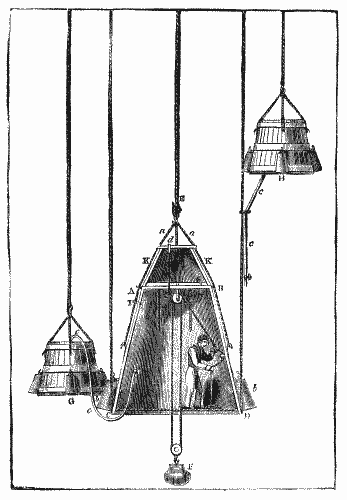
[Spalding’s improved Diving-Bell, with the Air-Barrels.]
277