VENOMOUS SERPENTS.
Reading edition
⁂ We have received the following interesting communication from a gentleman who has spent much of a valuable life in Africa.
The serpents of South Africa, commonly accounted the most dangerous, are the Cobra-Capello, (or hooded snake,) the Puff-Adder, and the Berg-Adder (or mountain snake.) The first of these is exceedingly fierce and active, and sometimes, it is said, attains the formidable length of ten feet; I have, however, never met with any of much more than half that size. The Cobra has been known to spring at a man on horseback, and to dart himself with such force as to overshoot his aim. The Puff-Adder, on the other hand, is a heavy and sluggish animal, very thick in proportion to its length, and incapable, when attacked in front, of projecting itself upon its enemy. To make amends, however, it possesses the faculty of throwing itself backward with perilous and unexpected effect; but its disposition is inert, and unless accidentally trod upon or otherwise provoked, it will seldom attack mankind. The Berg-Adder, though much smaller in size than either of the preceding, is generally considered not less deadly, and it is the more dangerous from its being less easily discovered and avoided.
During a residence of six years in the interior of the Cape Colony, and in the course of various journeys through the interior, (extending to upwards of three thousand miles,) I have met with a considerable number of snakes; yet I do not recollect of ever being exposed, except in one instance, to any imminent hazard of being bit by any of them. On the occasion referred to I was superintending some Hottentots, whom I had employed to clear away a patch of thicket from a spot selected for cultivation, when one of the men, suddenly recoiling, with signs of great alarm, exclaimed that there was a Cobra-Capello in the bush. Not being at that time fully aware of the dangerous character of this species of snake, I approached to look at him. The Hottentots called out to me to take care, for he was going to spring. Before they had well spoken, or I had caught a view of the reptile, I heard him hiss fiercely, and then dart himself towards me amidst the underwood. At the same instant, instinctively springing backward to avoid him, I fell over a steep bank into the dry stony bed of a torrent; by which I suffered some severe bruises, but fortunately escaped the more formidable danger to which I had too incautiously exposed myself. The Hottentots then assailed the snake with sticks and stones, and forced him (though not before he had made another spring and missed one of them still more narrowly than myself) to take refuge up a mimosa tree. Here he became a safe and easy mark to their missiles, and was speedily beaten down, with a broken back, and consequently rendered incapable of farther mischief. The Hottentots having cut off his head, carefully buried it in the ground, a practice which they never omit on such occasions, and which arises from their apprehension of some one incautiously treading on the head of the dead snake, and sustaining injury from its fangs; for they believe that the deathful virus, far from being extinguished with life, retains its fatal energy for weeks, and even months afterwards. This snake measured nearly six feet in length, and was the largest Cobra I have met with.
My little Hottentot corporal, Piet (or Peter) Spandilly, who assisted in killing this Cobra, had a still narrower escape from a small but venomous snake of which I have forgotten the colonial appellation. Piet and his men (six soldiers of the Cape corps, placed at that time under my direction for the protection of our remote settlement against the Caffres) slept in a tent adjoining to mine, pitched in a grove of mimosas on the brink of the Bavian’s river; and one morning when he rose from his couch of dry grass, Piet felt some living creature moving about his thigh in the inside of his leathern trowsers. Thinking it was only one of the harmless lizards which swarm in every part of South Africa, he did not at first much mind it, but came out to the open air laughing, and shaking his limb to dislodge the vermin. But when a black wriggling snake came tumbling down about his naked ancles, poor Spandilly uttered a cry of horror, kicked the reptile off, springing at the same moment nearly his own height from the ground; and though he had in reality sustained no injury, could scarcely for some time be persuaded that he was not “a gone man.”
It is, in fact, from apprehensions of danger, or the instinct of self-defence, far more than from any peculiar fierceness or innate malignity, that the serpent race ever assail man or any of the larger animals. They turn, of course, against the foot that tramples or the hand that threatens them; but happily nature has not armed them, in addition to their formidable powers of destruction, with the disposition of exerting these powers from motives of mere wanton cruelty, or for purposes unconnected with their own subsistence or security. Were it otherwise, countries like the Cape would be altogether uninhabitable. As it is, the annoyance experienced from the numerous poisonous snakes is not such as, on the whole, to affect in any considerable degree the comfort of those accustomed to them.
Conversing on this subject one day with my friend Captain Harding, who had been for many years a resident and magistrate in the interior, I inquired whether he had ever, in the course of his campaigns on the Caffer and Bushman frontiers, and when necessarily obliged to sleep in the desert or jungle in the open air, suffered injury or incurred danger from serpents—he replied, that the only occasion he recollected of incurring any great hazard of this sort, was the following:—
“Being upon a military expedition across the frontier,” said he, “I had slept one night, as usual, wrapt in my cloak, beneath a tree. On awaking at daybreak, the first object I perceived on raising my head from the saddle, which served for my pillow, was the tail of an enormous Puff-Adder lying across my breast, the head of the reptile being muffled under the folds of the cloak close to my body, whither it had betaken itself, apparently for warmth, during the chillness of the night. There was extreme hazard that if I alarmed it by moving, it might bite me in a vital part;—seizing it therefore softly by the tail, I pulled it out with a sudden jerk, and threw it violently to a distance. By this means I escaped without injury; but had I happened to have unwittingly offended this uninvited bedfellow before I was aware of his presence, I might in all probability have fatally atoned for my heedlessness.”
It is not very unusual for snakes of various sorts to be found in the houses at the Cape, nor does it, in ordinary cases, excite any violent alarm when such inmates are discovered. They make their way both through the roofs and under the walls, in search of food and shelter, and especially in pursuit of mice, which many of them chiefly subsist upon. During my residence in the interior, however, I recollect only two instances of their being found in my own cabin. On one of these occasions I had sent a servant girl (a bare-legged Hottentot) to bring me some article from a neighbouring hut. It was after night-fall; and on returning with it, she cried out before entering the cabin—“Oh, Mynheer! Mynheer! what shall I do? A snake has twined itself round my ancles, and if I open the door he will come into the house.” “Never mind,” I replied. “open the door, and let him come if he dare.” She obeyed, and in glided the snake, luckily without having harmed the poor girl. I stood prepared and instantly smote him dead; and afterwards found him to be one of the very venomous sort called Nachtslang.
People get used to these things, and even Europeans by degrees come to regard them with much indifference. 236Just before leaving the colony, I spent a week or two with my friend Major Pigot, at his residence near Graham’s Town; and going one day to take a book from some shelves in the drawing-room, I found a beautiful yellow snake, about five feet long, lying asleep upon the uppermost range of books. It lay so still that I at first thought it was a stuffed specimen; but perceiving a slight movement in its tail, I lent him such a thwack with a quarto volume as broke the poor fellow’s back, and enabled me to demolish him at my leisure. I afterwards learned that another snake had been killed a few days previously in the very same spot, and a third in Major P.’s dressing-room. They had all entered through a loop-hole which had casually been left open, and apparently had no other object in coming there (mousing apart) than literary seclusion.
Such as these are no very uncommon occurrences, and as such pass even for subjects of jocularity amidst the adventures of a wild country. Instances, however, both frightful and revolting, sometimes occur.
It is well known that the Bushmen, a tribe of wild Hottentots who inhabit the mountains and deserts of South Africa, imbue the points of their arrows in a strong and subtle poison, and that the venom of the most dangerous serpents to be found in that country forms a principal ingredient in its composition. The boldness and dexterity displayed by these wild huntsmen, and by many also of the colonial Hottentots, in searching out and seizing alive the formidable Cobra-Capello and Puff-Adder, are truly astonishing. Still more surprising is it to witness the snake-hunter extracting from the yet living and writhing reptile, held fast by his naked foot planted on its neck, the little bag containing the secreted venom, which the rage of the animal injects into the wound made by its fangs at the moment it strikes its victim—to see him take this, and fearlessly drink its contents, as school-boys in England would suck the blob of the honey-bee! The swallowing of this venom, they conceive, renders them in time proof against its deleterious effects, when it is brought into immediate contact with the blood, whether by the bite of a snake or the barb of an arrow.
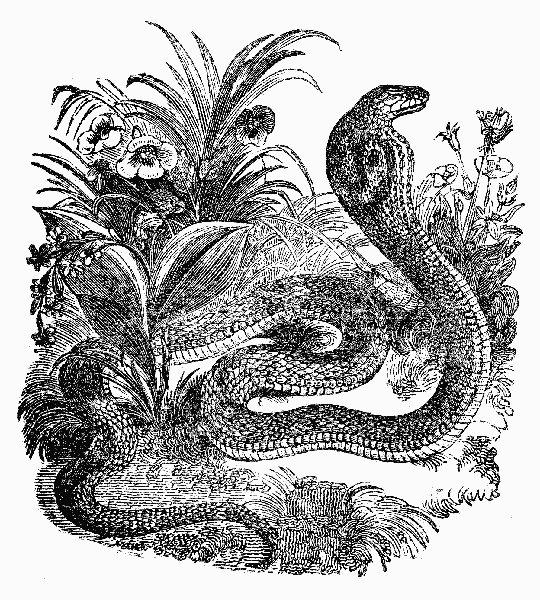
[Cobra-Capello.]
Several of the most respectable Dutch colonists assured me, as a fact which had come within their own knowledge, that there are to be found among the wandering Bushmen persons whom they term slang-meesters (snake-masters,) who actually possess the power of charming the fiercest serpents, and of readily curing their bite; and who pretend that they can communicate to others their mysterious powers and invulnerability, by putting them through a regular course of poison-eating.
The more usual object, however, of the Bushman in catching serpents (exclusive of their value to him as an article of food,) is to procure poison for his arrows. The animal venom, too thin and volatile to preserve its efficacy long unimpaired when used alone, is skilfully concocted into a black glutinous consistency, by the admixture of powerful vegetable and mineral poisons; the former being generally the juice of the root of a species of amaryllis, called by the boors, from this circumstance, the gift-bol, or poison-bulb; the latter, a bituminous or unctuous substance which is said to exude from certain rocks and caverns. With this deadly mixture the dwarfish and despised African anoints the desperate weapons with which he resists (though unavailingly) the aggressions of the colonists, and sometimes cruelly revenges the injuries they have inflicted.