FINGAL’S CAVE.
Reading edition
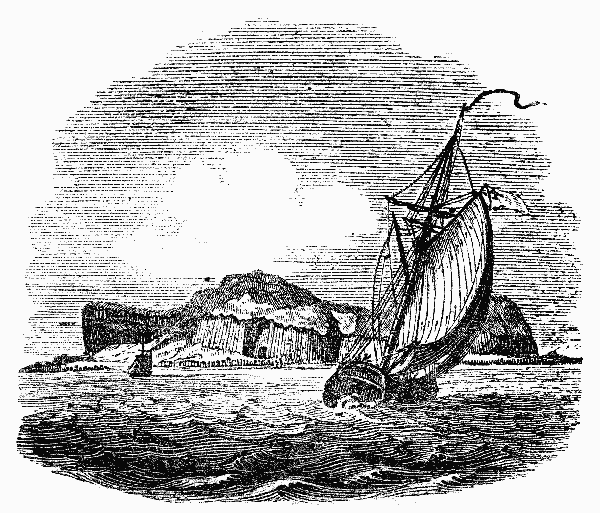
[Distant View of Staffa.]
Staffa, one of the Hebrides, or Western Isles of Scotland, lies a few miles to the west of Mull, within a sort of bay formed by the two projecting extremities of that island, and a short distance to the north-east of the more celebrated islet of the same group, Iona, or Icolmkill. It forms part of the county of Argyle, and of the parish of Kilninian, the principal portion of which is in Mull. Staffa is a very small island, scarcely a mile in length from north to south, and about half that extent at its greatest breadth from east to west. Although one of the most wonderful natural curiosities in the world, and lying so near our own shores, this island appears to have remained almost entirely unnoticed till a comparatively very recent period. It is said, in most of the late accounts of it (which are in great part copied from one another,) that its columns and caverns are shortly described by Buchanan. In point of fact, however, that historian merely mentions its name. It is not, we believe, so much as named by Martin in his account of the Western Isles, published in the beginning of last century. Its existence was first made generally known by Sir Joseph Banks who visited it in August, 1772, and whose account was printed in the second volume of ‘Pennant’s Tour in Scotland.’ Banks, in the course of a voyage to Iceland, in company with Dr. Uno von Troil (afterwards Archbishop of Upsal,) was induced to put in at a port in Mull, where he was very hospitably received by Mr. Maclean, the principal proprietor of the island. At Mr. Maclean’s the travellers 237met with a Mr. Leach, an Irish gentleman, who told them that the day before, in the course of a fishing excursion, he had fallen in with what, in his opinion, was one of the greatest wonders in the world, though none of his Highland acquaintances seemed ever to have had their attention attracted to it. His account so greatly excited the curiosity of Banks and his friend, that it was resolved forthwith to make an expedition to the island. They reached it, and found it to be by far the most stupendous example of that striking production of nature, basaltic architecture, of which they had ever heard.
At that time the Giant’s Causeway in Ireland was the chief collection of pillars of basalt which was generally known either to the public or among scientific inquirers. Since then, many other specimens of the same phenomenon have been described by travellers and geologists in Wales, Iceland, Germany, Italy, France, and other countries. Various theories have been suggested to account for the origin and formation of these pillars. They may be described generally as consisting of a greyish or brownish stone, of finer or coarser grain, formed into clusters of angular columns, having each from three or four to six or seven sides or faces, and in many cases so regularly cut, if we may so express ourselves, as to rival the symmetry of human architecture. Sometimes these columns are found as it were chopped down into fragments, and lying scattered and in confusion like a heap of ruins; in other instances, although the several blocks which compose each shaft still adhere firmly together, the inclination of the whole from the perpendicular is so considerable as to present at best only the appearance of an edifice half fallen down; but in some rare specimens the magnificent pile stands almost as erect as any work of human hands, thus forming a structure in which all the regularity of art is combined with a grandeur which art never reached. From the circumstance of lava being always an accompaniment of these basaltic formations, it is now commonly held that they are a volcanic product, or in other words have been thrown up from the earth by the action of internal fire. It does not, however, seem so easy to explain how the fused stone, in the process of cooling, crystallized into the regular shapes which it now exhibits. This effect can only be supposed to have taken place in virtue of certain affinities or mutual tendencies naturally belonging to the atoms of which the material consists.
The island of Staffa is a mere mass of lava and basalt. The columns of the latter substance, which compose the chief part of it, are generally hidden beneath a thin layer of soil; but in many places, even of the surface of the island, they are to be found shooting out through this acquired covering; and the stone is every where come at on digging a few feet down. Around almost the whole circumference of the island the rock stands bare to the view. The grassy top of the isle seems to be supported nearly all round on a range of pillars, in some places indeed so low as to be almost on a level with the surface of the water, but for the greater part elevated far above it, and in some places rising into the air to the lofty height of 150 feet. The name of this extraordinary isle, accordingly, describes it by its most remarkable feature. Staffa is a Norse term, meaning staffs or columns.
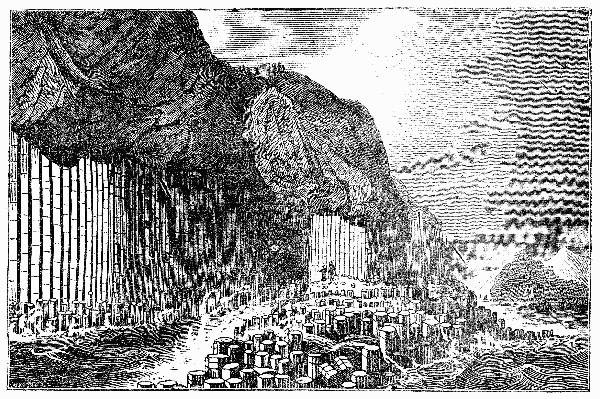
[Entrance to Fingal’s Cave.]
The highest part of the line of pillars is at the southern end of the island; and it is here that the celebrated natural excavation called Fingal’s Cave is situated. Its opening is very near the south-east corner, and it extends nearly due north. The name by which it is commonly known, we may remark in passing, would rather appear to be merely a modern and accidental designation. Sir Joseph Banks states, that upon asking his Highland guide what it was called, the boy answered in Gaelic, the Cave of Finlin; and in reply to a second question, explained Finlin to be Finlin-Mac-Coul; or, as he had been called by the English translator of Ossian’s poems, Fingal. This fragment of criticism, however, we may fairly suppose to have been really the remark, not of the guide, but of the interpreter. A subsequent visitor of Staffa, the French geologist, M. Faujas Saint Fond, says, that on making minute and careful inquiry into the matter, on the spot and in the neighbourhood, he could not learn that any person there knew the cave by the name which Banks had given it. It was universally 238called Uamh an Binn, that is, the Cave of Music. And the explanation which he received of Banks’s error, or rather that of his interpreter, was, that binn being pronounced vinn, and Finlin being in the genitive Fin, of which the sound is nearly the same, the one word had been mistaken for the other. This is a curious and not an uninstructive example of the degree of certainty that belongs to information thus obtained. However, it is not impossible, whatever be the common name of the cave, that there may be also a tradition of its having been the work of the great Fingal, to whom other such stupendous miracles of nature in various other parts of the Highlands of Scotland are popularly ascribed, and who has also, we believe, the credit of being the architect of the Giant’s Causeway in the sister island. This conjecture is rather confirmed by an anecdote which is related by another traveller among the Hebrides, Dr. Thomas Garnett, who has also given us an account of Staffa. “Our interpreter,” says he, “on hearing me express my admiration of this wonder of nature, told me that it was generally considered as the work of Fion-macool, but that for his part he thought it had been built by St. Columba!”
The excavation in question, at all events, is a vast opening, 42 feet in width at the mouth, extending 227 feet in depth, and gradually diminishing from nearly 100 to about 50 feet in height, supported throughout on both sides by perpendicular columns of extraordinary regularity. The opening is surmounted by a noble arch, and from this to the farther extremity of the cave the roof extends in an unbroken surface, composed in some parts of smooth and unvariegated rock, in others at the ends of pillars stuck together in groups or bunches, and with the stalagmitic substance which fills up the interstices, displaying a species of mosaic work of great regularity and beauty. On the west side the wall of pillars is 36 feet in height; but on the east, although the roof is of the same elevation, they spring from a much higher base, and are themselves only 18 feet in length. Along this side is a narrow footpath, raised above the water which covers the floor, along which it is possible for an expert climber to make his way to the farther end of the cave, although the attempt is rather hazardous. The proper and usual mode of viewing the cave is by entering it in a boat; but even this can only be done with safety when the weather is tolerably calm. From the opening being so spacious there is abundance of light to the extremity; and from the same cause the waves, when there is a heavy sea, roll into it with great force. Dr. von Troil, who has given us a description of it in his Letters on Iceland, states that, very far in, there is a hole in the rock below the water, which makes a singularly agreeable sound on the flux and reflux of the tide. It is this melodious murmur of the waters passing into it, which has doubtless given origin to its common name of the Cave of Music.
According to Dr. Macculloch, who, in his Description of the Western Islands, has given the latest and most accurate account of Staffa that has appeared, the basaltic pillars of this cave are “of one ingredient only, which is a granular splintery material resembling clinkstone, highly coloured with iron, but of a greenish black hue.” Between the several pillars has exuded a yellowish substance, producing everywhere a deep contrast of two distinctly defined colours, which admirably relieves what would otherwise be the sombre aspect of the cave. The stone, according to Dr. Garnett, is in many places richly coloured with light green, yellow, and orange, produced by different species of lichen growing on it. Dr. Macculloch says, in concluding his account, “It would be no less presumptuous than useless to attempt a description of the picturesque effect of that to which the pencil itself is inadequate. But if this cave were even destitute of that order and symmetry, that richness arising from multiplicity of parts, combined with greatness of dimensions and simplicity of style, which it possesses; still the prolonged length, the twilight gloom, half concealing the playful and varying effects of reflected light, the echo of the measured surge as it rises and falls, the transparent green of the water, and the profound and fairy solitude of the whole scene, could not fail strongly to impress a mind gifted with any sense of beauty in art or in nature. If to those be added that peculiar sentiment with which nature perhaps most impresses us when she allows us to draw comparisons between her works and those of art, we shall be compelled to own it is not without cause that celebrity has been conferred on the Cave of Fingal.”