THE PREFACE VNTO the Theoremes.
Reading edition
Doubt not gentle reader, but as my argument is straunge and vnacquainted with the vulgare toungue, so shall I of many men be straungly talked of, and as straungly iudged. Some men will saye peraduenture, I mighte haue better imployed my tyme in some pleasaunte historye, comprisinge matter of chiualrye. Some other wolde more haue preised my trauaile, if I hadde spente the like time in some morall matter, other in deciding some controuersy of religion. And yet some men (as I iudg) will not mislike this kind of mater, but then will they wishe that I had vsed a more certaine order in placinge bothe the Propositions and Theoremes, and also a more exacter proofe of eche of theim bothe, by demonstrations mathematicall. Some also will mislike my shortenes and simple plainesse, as other of other affections diuersely shall espye somwhat that they shall thinke blame worthy, and shal misse somewhat, that thei wold with to haue bene here vsed, so that euerie manne shall giue his verdicte of me according to his phantasie, vnto whome ioinctly, I make this my firste answere: that as they ar many and in opinions verie diuers, so were it scarse possible to please them all with anie one argumente, of what kinde so euer it were. And for my seconde aunswere, I saye thus. That if annye one argumente mighte please them all, then should thei be thankfull vnto me for this kind of matter. For nother is there anie matter more straunge in the englishe tungue, then this whereof neuer booke was written before now, in that tungue, and therefore oughte to delite all them, that desire to vnderstand strange matters, as most men commonlie doo. And againe the practise is so pleasaunt in vsinge, and so profitable in appliynge, that who so euer dothe [a.ii.v] soner, by this blunte delineacion afore hande to them taughte. For I dare presuppose of them, that thing which I haue sette in my selfe, and haue marked in others, that is to saye, that it is not easie for a man that shall trauaile in a straunge arte, to vnderstand at the beginninge bothe the thing that is taught and also the iuste reason whie it is so. And by experience of teachinge I haue tried it to bee true, for whenne I haue taughte the proposition, as it is imported in meaninge, and annexed the demonstration with all, I didde perceaue that it was a greate trouble and a painefull vexacion of mynde to the learner, to comprehend bothe those thinges at ones. And therfore did I proue firste to make them to vnderstande the sence of the propositions, and then afterward did they conceaue the demonstrations muche soner, when they hadde the sentence of the propositions first ingrafted in their mindes. This thinge caused me in bothe these bookes to omitte the demonstrations, and to vse onlye a plaine forme of declaration, which might best serue for the firste introduction. Whiche example hath beene vsed by other learned menne before nowe, for not only Georgius Ioachimus Rheticus, but also Boetius that wittye clarke did set forth some whole books of Euclide, without any demonstration or any a.iij. t the theoremes be put after the cõclusions is this, whã I wrote these first cõnclusions (which was .iiiij. yeres passed) I thought not then to haue added any theoremes, but next vnto ye cõclusiõs to haue taught the order how to haue applied thẽ to work, for drawing of plottes & such like vses. But afterward cõsidering the great cõmoditie yt thei serue for, and the light that thei do geue to all sortes of practise geometricall, besyde other more notable benefites, whiche shall be declared more specially in a place conuenient, I thoughte beste to geue you some taste of theym, and the pleasaunt contemplation of suche geometrical propositions, which might serue diuerselye in other bookes for the demonstrations and proofes of all Geometricall woorkes. And in theim, as well as in the propositions, I haue drawen in the Linearie examples many tymes more lynes, than be spoken of in the explication of them, whiche is doone to this intent, that yf any manne lyst to learne the demonstrations by harte, (as somme [a.iii.v]
And thus for this tyme I wyll make an ende without any larger declaration of the commoditiees of this arte, or any farther answeryng to that may bee obiected agaynst my handelyng of it, wyllyng them that myslike it, not to medle with it: and vnto those that will not disdaine the studie of it, I promise all suche aide as I shall be able to shewe for their farther procedyng both in the same, and in all other commoditees that thereof maie ensue. And for their incouragement I haue here annexed the names and brefe argumentes of suche bookes, as I intende (God willyng) shortly to sette forth, if I shall perceaue that my paynes maie profyte other, as my desyre is.
The brefe argumentes of suche bokes as ar appoynted shortly to be set forth by the author herof.
The seconde part of Arithmetike, teachyng the workyng by fractions, with extraction of rootes both square and cubike: And declaryng the rule of allegation, with sundrye plesaunt exaumples in metalles and other thynges. Also the rule of false position, with dyuers examples not onely vulgar, but some appertaynyng to the rule of Algeber, applied vnto quantitees partly rationall, and partly surde.
The arte of Measuryng by the quadrate geometricall, and the disorders committed by vsyng the same, not only reueled but reformed also (as muche as to the instrument pertayneth) by the deuise of a new quadrate newely inuented by the author hereof.
The arte of measuryng by the astronomers staffe, and by the astronomers ryng, and the form of makyng them both.
The arte of makyng of Dials, bothe for the daie and the nyght, with certayn new formes of fixed dialles for the moon [a.iiii.]
The makyng and vse of an instrument, wherby you maye not onely measure the distance at ones of all places that you can see togyther, howe muche eche one is from you, and euery one from other, but also therby to drawe the plotte of any countreie that you shall come in, as iustely as maie be, by mannes diligence and labour.
The vse bothe of the Globe and the Sphere, and therin also of the arte of Nauigation, and what instrumentes serue beste thervnto, and of the trew latitude and longitude of regions and townes.
Euclides woorkes in foore partes, with diuers demonstrations Arithmeticall and Geometricall or Linearie. The fyrst parte of platte formes. The second of numbres and quantitees surde or irrationall. The third of bodies and solide formes. The fourthe of perspectiue, and other thynges thereto annexed.
BESIDE these I haue other sundrye woorkes partely ended, and partely to bee ended, Of the peregrination of man, and the originall of al nations, The state of tymes, and mutations of realmes, The image of a perfect common welth, with diuers other woorkes in naturall sciences, Of the wonderfull workes and effectes in beastes, plantes, and minerals, of whiche at this tyme, I will omitte the argumentes, beecause thei doo appertaine littel to this arte, and handle other matters in an other sorte.
To haue, or leaue, Nowe maie you chuse, No paine to please, Will I refuse.
b.i.
I.
That frõ any pricke to one other, there may be drawen a right line.
s for example A. being the one pricke, and B. the other, you maye drawe betwene them from the one to the other, that is to say, frome A. vnto B, and from B. to A.

II.
That any right line of measurable length may be drawen forth longer, and straight.

Example of A.B, which as it is a line of measurable lengthe, so may it be drawen forth farther, as for example vnto C, and that in true streightenes without crokinge.
III.
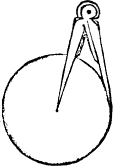
That vpon any centre, there may be made a circle of anye quãtitee that a man wyll.
Let the centre be set to be A, what shal hinder a man to drawe a circle aboute it, of what quantitee that he lusteth, as you se the forme here: other bygger or lesse, as it shall lyke him to doo:
[b.i.
v
]
That all right angles be equall eche to other.

Set for an example A. and B, of which two though A. seme the greatter angle to some men of small experience, it happeneth only bicause that the lines aboute A, are longer thẽ the lines about B, as you may proue by drawing them longer, for so that B. seme the greater angle yf you make his lines longer then the lines that make the angle A. And to proue it by demonstration, I say thus. If any ij. right corners be not equal, then one right corner is greater then an other, but that corner which is greatter then a right angle, is a blunt corner (by his definition) so must one corner be both a right corner and a blunt corner also, which is not possible: And againe: the lesser right corner must be a sharpe corner, by his definition, bicause it is lesse then a right angle. which thing is impossible. Therefore I conclude that all right angles be equall.
Yf one right line do crosse two other right lines, and make ij. inner corners of one side lesser thẽ ij. righte corners, it is certaine, that if those two lines be drawen forth right on that side that the sharpe inner corners be, they wil at lẽgth mete togither, and crosse on an other.
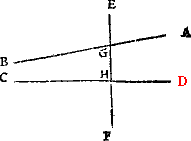
The ij. lines beinge as A.B. and C.D, and the third line crossing them as dooth heere E.F, making ij inner cornes (as ar G.H.) lesser then two right corners, sith ech of b.ij. A.B. and C.D. be drawen in lengthe on that side that G. and H. are, the will at length meet and crosse one an other.
Two right lines make no platte forme.
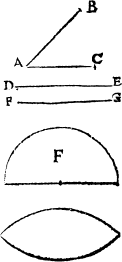
A platte forme, as you harde before, hath bothe length and bredthe, and is inclosed with lines as with his boundes, but ij. right lines cannot inclose al the bondes of any platte forme. Take for an example firste these two right lines A.B. and A.C. whiche meete togither in A, but yet cannot be called a platte forme, bicause there is no bond from B. to C, but if you will drawe a line betwene them twoo, that is frome B. to C, then will it be a platte forme, that is to say, a triangle, but then are there iij. lines, and not only ij. Likewise may you say of D.E. and F.G, whiche doo make a platte forme, nother yet can they make any without helpe of two lines more, whereof the one must be drawen from D. to F, and the other frome E. to G, and then will it be a longe rquare. So then of two right lines can bee made no platte forme. But of ij. croked lines be made a platte forme, as you se in the eye form. And also of one right line, & one croked line, maye a platte fourme bee made, as the semicircle F. doothe sette forth.
[b.ii.
v
]