GEOMETRY.
Reading edition
eometry teacheth the drawyng, Measuring and proporcion of figures. but in as muche as no figure can bee drawen, but it muste haue certayne boũdes and inclosures of lines: and euery lyne also is begon and ended at some certaine prycke, fyrst it shal be meete to know these smaller partes of euery figure, that therby the whole figures may the better bee iudged, and distincte in sonder.
A poincte. A Poynt or a Prycke, is named of Geometricians that small and vnsensible shape, whiche hath in it no partes, that is to say: nother length, breadth nor depth. But as their exactnes of definition is more meeter for onlye Theorike speculacion, then for practise and outwarde worke (consideringe that myne intent is to applye all these whole principles to woorke) I thynke meeter for this purpose, to call a poynt or prycke, that small printe of penne, pencyle, or other instrumente, whiche is not moued, nor drawen from his fyrst touche, and therfore hath no notable length nor bredthe: as this example doeth declare. ∴
Where I haue set .iij. prickes, eche of them hauyng both lẽgth and bredth, thogh it be but smal, and thefore not notable.
Nowe of a great numbre of these prickes, is made a Lyne, as you may perceiue by this forme ensuyng. ············ where as I haue set a numbre of prickes, so if you with your pen will set in more other prickes betweene euerye two of these, A lyne. then wil it be a lyne, as here you may see and this lyne, is called of Geometricians, Lengthe withoute breadth.
But [A.i.v]
Of lynes there bee two principall kyndes. The one is called a right or straight lyne, and the other a croked lyne.
A streghte lyne. A Straight lyne, is the shortest that maye be drawenne between two prickes.
A crokyd lyne. And all other lines, that go not right forth from prick to prick, but boweth any waye, such are called Croked lynes as in these examples folowyng ye may se, where I haue set but one forme of a straight lyne, for more formes there be not, but of crooked lynes there bee innumerable diuersities, whereof for examples sum I haue sette here.
A right lyne.

Croked lynes.
Croked lines.
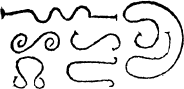
So now you must vnderstand, that euery lyne is drawen betwene twoo prickes, wherof the one is at the beginning, and the other at the ende.

Therefore when soeuer you do see any formes of lynes to touche at one notable pricke, as in this example, then shall you A ij croked lyne, but rather twoo lynes: an Angle. in as muche as there is a notable and sensible angle by .A. whiche euermore is made by the meetyng of two seuerall lynes. And likewayes shall you iudge of this figure, whiche is made of two lines, and not of one onely.

So that whan so euer any suche meetyng of lines doth happen, the place of their metyng is called an Angle or corner.
Of angles there be three generall kindes: a sharpe angle, a square angle, and a blunte angle. A righte angle. The square angle, whiche is commonly named a right corner, is made of twoo lynes meetyng together in fourme of a squire, whiche two lines, if they be drawen forth in length, will crosse one an other: as in the examples folowyng you maie see.
Right angles.
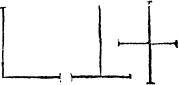
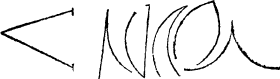
A sharpe corner. A sharpe angle is so called, because it is lesser than is a square angle, and the lines that make it, do not open so wide in their departynge as in a square corner, and if thei be drawen crosse, all fower corners will not be equall.
A blunte angle. A blunt or brode corner, is greater then is a square angle, and his lines do parte more in sonder then in a right angle, of whiche all take these examples.
And these angles (as you see) are made partly of streght lynes, partly of croken lines, and partly of both together. Howbeit in right angles I haue put none example of croked lines, because it would [A.ii.v]
Sharpe angles. Blunte or brode angles.
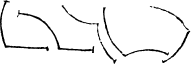
But now as of many prickes there is made one line, so of diuerse lines are there made sundry formes, figures, and shapes, whiche all yet be called by one propre name, A platte forme. Platte formes, and thei haue bothe length and bredth, but yet no depenesse.
And the boundes of euerie platte forme are lines: as by the examples you maie perceiue.
Of platte formes some be plain, and some be croked, and some parly plaine, and partlie croked.
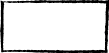
A plaine platte. A plaine platte is that, whiche is made al equall in height, so that the middle partes nother bulke vp, nother shrink down more then the bothe endes.
A crooked platte. For whan the one parte is higher then the other, then is it named a Croked platte.
And if it be partlie plaine, and partlie crooked, then is it called a Myxte platte, of all whiche, these are exaumples.
A plaine platte. A croked platte. A myxte platte.
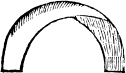
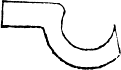
And as of many prickes is made a line, and of diuerse lines one platte forme, A bodie. so of manie plattes is made a bodie, whiche conteigneth Lengthe, bredth, and depenesse. Depenesse. By Depenesse I vnderstand, not as the common sort doth, the holownesse of any thing, as of a well, a diche, a potte, and suche like, but I meane the massie thicknesse A iii
Now all bodies haue platte formes for their boundes, Cubike. so in a dye (whiche is called a cubike bodie) by geomatricians, Asheler. and an ashler of masons, there are .vi. sides, whiche are .vi. platte formes, and are the boundes of the dye.
A globe. But in a Globe, (whiche is a bodie rounde as a bowle) there is but one platte forme, and one bounde, and these are the exaumples of them bothe.
A dye or ashler. A globe.
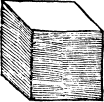
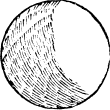
But because you shall not muse what I dooe call a bound, A bounde. I mean therby a generall name, betokening the beginning, end and side, of any forme.
Forme, Fygure. A forme, figure, or shape, is that thyng that is inclosed within one bond or manie bondes, so that you vnderstand that shape, that the eye doth discerne, and not the substance of the bodie.
Of figures there be manie sortes, for either thei be made of prickes, lines, or platte formes. Not withstandyng to speake properlie, a figure is euer made by platte formes, and not of bare lines vnclosed, neither yet of prickes.
Yet for the lighter forme of teachyng, it shall not be vnsemely to call all suche shapes, formes and figures, whiche ye eye maie discerne distinctly.
And first to begin with prickes, there maie be made diuerse formes of them, as partely here doeth folowe.
[A.iii.
v
]
A lynearic numbre.

Trianguler numbres

Longsquare nũbre.

Iust square numbres

a threcornered spire.

A square spire.

And so maie there be infinite formes more, whiche I omitte for this time, cõsidering that their knowledg appertaineth more to Arithmetike figurall, than to Geometrie.
But yet one name of a pricke, whiche he taketh rather of his place then of his fourme, maie I not ouerpasse. And that is, when a pricke standeth in the middell of a circle (as no circle can be made by cõpasse without it) then is it called a centre. A centre And thereof doe masons, and other worke menne call that patron, a centre, whereby thei drawe the lines, for iust hewyng of stones for arches, vaultes, and chimneies, because the chefe vse of that patron is wrought by findyng that pricke or centre, from whiche all the lynes are drawen, as in the thirde booke it doeth appere.
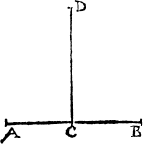
Lynes make diuerse figures also, though properly thei maie not be called figures, as I said before (vnles the lines do close) but onely for easie maner of teachyng, all shall be called [A.iiii.] A ground line. the ground line) and an other commeth downe on it, and is called A perpendicular. A plume lyne. a perpendiculer or plũme lyne, as in this example you may see. where .A.B. is the grounde line, and C.D. the plumbe line.
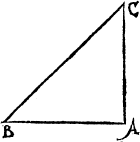
And A.B. the plumme line that is A.C. and the bias line, whiche goeth from the one of thẽ to the other, and lieth against the right corner in such a figure whiche is here .C.B.
But
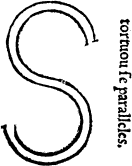
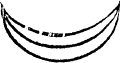
Parallelys Gemowe lynes. Paralleles, or gemowe lynes be suche lines as be drawen foorth still in one distaunce, and are no nerer in one place then in an other, for and if they be nerer at one ende then at the other, then are they no paralleles, but maie bee called bought lynes, and loe here exaumples of them bothe.
[A.iiii.
v
]
parallelis. bought lines

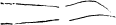
parallelis: circular. Concen- trikes.
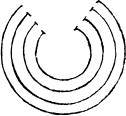
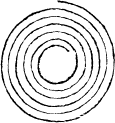
I haue added also paralleles tortuouse, whiche bowe cõtrarie waies with their two endes: and paralleles circular, whiche be lyke vnperfecte compasses: for if they bee whole circles, Concentrikes then are they called cõcentrikes, that is to saie, circles drawẽ on one centre.
Here Albert Durer, which affirmeth that no perpendicular lines can be paralleles. which errour doeth spring partlie of ouersight of the difference of a streight line, and partlie of mistakyng certain principles geometrical, which al I wil let passe vntil an other tyme, and wil not blame him, which hath deserued worthyly infinite praise.
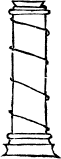
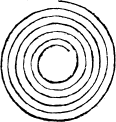
And to returne to my matter. A twine line. an other fashioned line is there, which is named a twine or twist line, and it goeth as a wreyth about some other bodie. A spirall line. And an other sorte of lines is there, that is called a spirall line, A worme line. or a worm line, whiche representeth an apparant forme of many circles, where there is not one in dede: of these .ii. kindes of lines, these be examples.
A twiste lyne. A spirail lyne
B
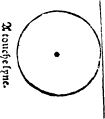
A tuch line.
A touche lyne, is a line that runneth a long by the edge of a circle, onely touching it, but doth not crosse the circumference of it, as in this exaumple you maie see.
A corde,
And when that a line doth crosse the edg of the circle, thẽ is it called a cord, as you shall see anon in the speakynge of circles.
Matche corners
In the meane season must I not omit to declare what angles bee called matche corners, that is to saie, suche as stande directly one against the other, when twoo lines be drawen a crosse, as here appereth.
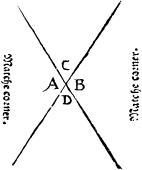
Where A. and B. are matche corners, so are C. and D. but not A. and C. nother D. and A.
Nowe will I beginne to speak of figures, that be properly so called, of whiche all be made of diuerse lines, except onely a circle, an egge forme, and a tunne forme, which .iij. haue no angle and haue but one line for their bounde, and an eye fourme whiche is made of one lyne, and hath an angle onely.
A circle.
A circle circumference are equall all in length, as here you see.
Circumference.
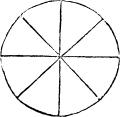
And the line that encloseth the whole compasse, is called the circumference.
A diameter. And all the lines that bee drawen crosse the circle, and goe by the centre, are named diameters, whose halfe, I meane from the center to the circumference [B.i.v] Semidiameter. is called the semidiameter, or halfe diameter.
A cord, or a stringlyne.
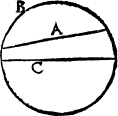
But and if the line goe crosse the circle, and passe beside the centre, then is it called a corde, or a stryng line, as I said before, and as this exaumple sheweth: where A. is the corde. And the compassed line that aunswereth to it, An archline is called an arche lyne, A bowline. or a bowe lyne, whiche here marked with B. and the diameter with C.
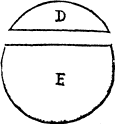
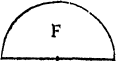
But and if that part be separate from the rest of the circle (as in this exãple you see) then ar both partes called cãtelles, A cantle the one the greatter cantle as E. and the other the lesser cantle, as D. And if it be parted iuste by the centre (as you see in F.) A semyecircle then is it called a semicircle, or halfe compasse.
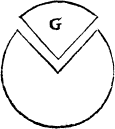
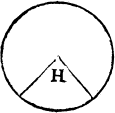
Sometimes it happeneth that a cantle is cutte out with two lynes drawen from the centre to the circumference (as G. is) A nooke cantle and then maie it be called a nooke cantle, and if it be not parted from the reste of the circle (as you see in H.) A nooke. then is it called a nooke plainely without any addicion. And the compassed lyne in it is called an arche lyne, as the exaumple here doeth shewe.
B ij
An arche.
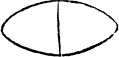
Nowe haue you heard as touchyng circles, meetely sufficient instruction, so that it should seme nedeles to speake any more of figures in that kynde, saue that there doeth yet remaine ij. formes of an imperfecte circle, for it is lyke a circle that were brused, and thereby did runne out endelong one waie, whiche forme Geometricians dooe call an An egge fourme. egge forme, because it doeth represent the figure and shape of an egge duely proportioned (as this figure sheweth) hauyng the one ende greate then the other.
A tunne or barrel form
A tunne forme.
An egge forme
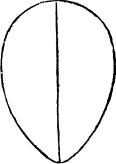
For if it be lyke the figure of a circle pressed in length, and bothe endes lyke bygge, then is it called a tunne forme, or barrell forme, the right makyng of whiche figures, I wyll declare hereafter in the thirde booke.
An other forme there is, whiche you maie call a nutte forme, and is made of one lyne muche lyke an egge forme, saue that it hath a sharpe angle.
And it chaunceth sometyme that there is a right line drawen crosse these figures, An axtre or axe lyne. and that is called an axelyne, or axtre. Howe be it properly that line that is called an axtre, whiche gooeth throughe the myddell of a Globe, for as a diameter is in a circle, so is an axe lyne or axtre in a Globe, [B.ii.v] polis, wch you may call aptly in englysh, tourne pointes: of whiche I do more largely intreate, in the booke that I haue written of the vse of the globe.
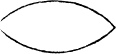
But to returne to the diuersityes of figures that remayne vndeclared, the most simple of them ar such ones as be made but of two lynes, as are the cantle of a circle, and the halfe circle, of which I haue spoken allready. Likewyse the halfe of an egge forme, the cantle of an egge forme, the halfe of a tunne fourme, and the cantle of a tunne fourme, and besyde these a figure moche like to a tunne fourne, saue that it is sharp couered at both the endes, and therfore doth consist of twoo lynes, where a tunne forme is made of one lyne, An yey fourme and that figure is named an yey fourme.
A triangle

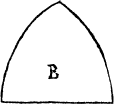
The nexte kynd of figures are those that be made of .iij. lynes other be all right lynes, all crooked lynes, other some right and some crooked. But what fourme so euer they be of, they are named generally triangles. for a triangle is nothinge els to say, but a figure of three corners. And thys is a generall rule, looke how many lynes any figure hath, so mannye corners it hath also, yf it bee a platte forme, and not a bodye. For a bodye hath dyuers lynes metyng sometime in one corner.
Now to geue you example of triangles, there is one whiche is all of croked lynes, and may be taken fur a portiõ of a globe as the figur marked wt A.
An other hath two compassed lines and one right lyne, and is as the portiõ of halfe a globe, example of B.
An other hath but one compassed B.iii C. Otherlesse then it as you se D, whose right lines make a sharpe corner, or greater then a quadrate, as is F, and then the right lynes of it do make a blunt corner.

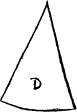
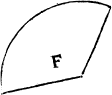
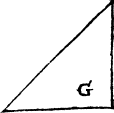
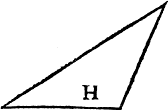
Also some triangles haue all righte lynes and they be distincted in sonder by their angles, or corners. for other their corners bee all sharpe, as you see in the figure, E. other ij. sharpe and one blunt, as is the figure G. other ij. sharp and one blunt as in the figure H.
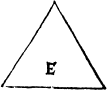
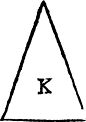
There is also an other distinction of the names of triangles, according to their sides, whiche other be all equal as in the figure E, and that the Greekes doo call Isopleuron, ἰσόπλευρομ. and Latine men æequilaterum: and in english it may be called a threlike triangle, other els two sydes bee equall and the thyrd vnequall, which the Greekes call Isosceles, ισόσκελεσ. the Latine men æquicurio, and in english tweyleke may they be called, as in G, H, and K. For, they may be of iij. kinds that is to say, with one square angle, as is G, or with a blunte corner as H, or with all in sharpe korners, as you see in K.
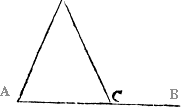
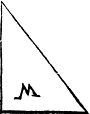
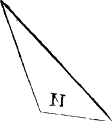
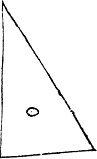
Further more it may be yt they haue neuer a one syde equall to an other, and they be in iij kyndes also distinct lyke the twilekes, as you maye perceaue by these examples .M. N, and O. where M. hath a right angle, N, a blunte angle, and O, all sharpe angles σκαλενὄμ. these the Greekes and latine men do [B.iii.v] scalena and in englishe theye may be called nouelekes, for thei haue no side equall, or like lõg, to ani other in the same figur. Here it is to be noted, that in a triãgle al the angles bee called innerãgles except ani side bee drawenne forth in lengthe, for then is that fourthe corner caled an vtter corner, as in this exãple because A.B, is drawen in length, therfore the ãgle C, is called an vtter ãgle.
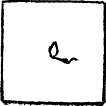
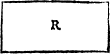
Quadrãgle And thus haue I done with triãguled figures, and nowe foloweth quadrangles, which are figures of iiij. corners and of iiij. lines also, of whiche there be diuers kindes, but chiefely v. that is to say, A square quadrate. a square quadrate, whose sides bee all equall, and al the angles square, as you se here in this figure Q. A longe square. The second kind is called a long square, whose foure corners be all square, but the sides are not equall eche to other, yet is euery side equall to that other that is against it, as you maye perceaue in this figure .R.
[B.iiii.]
A losenge
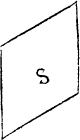
The thyrd kind is called losenges A diamõd. or diamondes, whose sides bee all equall, but it hath neuer a square corner, for two of them be sharpe, and the other two be blunt, as appeareth in .S.
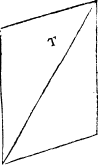
The iiij. sorte are like vnto losenges, saue that they are longer one waye, and their sides be not equal, yet ther corners are like the corners of a losing, and therfore ar they named A losenge lyke. losengelike or diamõdlike, whose figur is noted with T. Here shal you marke that al those squares which haue their sides al equal, may be called also for easy vnderstandinge, likesides, as Q. and S. and those that haue only the contrary sydes equal, as R. and T. haue, those wyll I call likeiammys, for a difference.
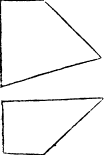
The fift sorte doth containe all other fashions of foure cornered figurs, and ar called of the Grekes trapezia, of Latin mẽ mensulæ and of Arabitians, helmuariphe, they may be called in englishe borde formes, Borde formes. they haue no syde equall to an other as these examples shew, neither keepe they any rate in their corners, and therfore are they counted vnruled formes, and the other foure kindes onely are counted ruled formes, in the kynde of quadrangles. Of these vnruled formes ther is no numbre, they are so mannye and so dyuers, yet by arte they may be changed into other kindes of figures, and therby be brought to measure and proportion, as in the thirtene conclusion is partly taught, but more plainly in my booke of measuring you may see it.
[B.iiii.
v
]
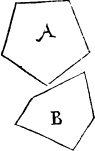
And nowe to make an eande of the dyuers kyndes of figures, there dothe folowe now figures of .v. sydes, other .v. corners, which we may call cink-angles, whose sydes partlye are all equall as in A, and those are counted ruled cinkeangles, and partlye vnequall, as in B, and they are called vnruled.
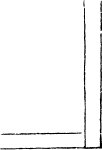
Likewyse shall you iudge of siseangles, which haue sixe corners, septangles, whiche haue seuen angles, and so forth, for as mannye numbres as there maye be of sydes and angles, so manye diuers kindes be there of figures, vnto which yow shall geue names according to the numbre of their sides and angles, of whiche for this tyme I wyll make an ende, A squyre. and wyll sette forthe on example of a syseangle, whiche I had almost forgotten, and that is it, whose vse commeth often in Geometry, and is called a squire, is made of two long squares ioyned togither, as this example sheweth.
The globe as is before.
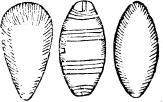
And thus I make an eand to speake of platte formes, and will briefelye saye somwhat touching the figures of bodeis which partly haue one platte forme for their bound, and yt iust roũd as a globe hath, or ended long as in an egge, and a tunne fourme, whose pictures are these.
Howe be it you must marke that I meane not the very figure of a tunne, when I saye tunne form, but a figure like a tunne, for a tune fourme, C tunne hath thre platte formes, and is flatte at eche end, as partly these pictures do shewe.
Bodies of two plattes, are other cantles or halues of those other bodies, that haue but one platte forme, or els they are lyke in foorme to two such cantles ioyned togither as this A. doth partly expresse: A rounde spier. or els it is called a rounde spire, or stiple fourme, as in this figure is some what expressed.


Nowe of three plattes there are made certain figures of bodyes, as the cantels and halues of all bodyes that haue but ij. plattys, and also the halues of halfe globys and canteles of a globe. Lykewyse a rounde piller, and a spyre made of a rounde spyre, slytte in ij. partes long ways.
But as these formes be harde to be iudged by their pycturs, so I doe entende to passe them ouer with a great number of other formes of bodyes, which afterwarde shall be set forth in the boke of Perspectiue, bicause that without perspectiue knowledge, it is not easy to iudge truly the formes of them in flatte protacture.
And thus I made an ende for this tyme, of the defi- nitions Geometricall, appertayning to this parte of practise, and the rest wil I prosecute as cause shall serue.
[C.i.
v
]