HILAIRE BELLOC (continued 6)
Reading edition
Then suddenly the sky grew lighter upon every side. That cheating gloom (which I think the clouds in purgatory must reflect) lifted from the valley as though to a slow order given by some calm and good influence that was marshalling in the day. Their colours came back to things; the trees recovered their shape, life, and trembling; here and there, on the face of the mountain opposite, the mists by their movement took part in the new life, and I thought I heard for the first time the tumbling water far below me in the ravine. That subtle barrier was drawn which marks to-day from yesterday; all the night and its despondency became the past and entered memory. The road before me, the pass on my left (my last ridge, and the entry into Tuscany), the mass of the great hills, had become mixed into the increasing light, that is, into the familiar and invigorating Present which I have always found capable of opening the doors of the future with a gesture of victory.
My pain either left me, or I ceased to notice it, and seeing a little way before me a bank above the road, and a fine grove of sparse and dominant chestnuts, I climbed up thither and turned, standing to the east.
There, without any warning of colours, or of the heraldry that we have in the north, the sky was a great field of pure light, and without doubt it was all woven through, as was my mind watching it, with security and gladness. Into this field, as I watched it, rose the sun.
The air became warmer almost suddenly. The splendour and health of the new day left me all in repose, and persuaded or compelled me to immediate sleep.
I found therefore in the short grass, and on the scented earth beneath one
192
THE PASS INTO TUSCANY
of my trees, a place for lying down; I stretched myself out upon it, and lapsed into a profound slumber, which nothing but a vague and tenuous delight separated from complete forgetfulness. If the last confusion of thought, before sleep possessed me, was a kind of prayer--and certainly I was in the mood of gratitude and of adoration--this prayer was of course to God, from whom every good proceeds, but partly (idolatrously) to the Sun, which, of all the things He has made, seems, of what we at least can discover, the most complete and glorious.
Therefore the first hours of the sunlight, after I had wakened, made the place like a new country; for my mind which received it was new. I reached Collagna before the great heat, following the fine highroad that went dipping and rising again along the mountain side, and then (leaving the road and crossing the little Secchia by a bridge), a path, soon lost in a grassy slope, gave me an indication of my way. For when I had gone an hour or so upwards along the shoulder of the hill, there opened gradually before me a silent and profound vale, hung with enormous woods, and sloping upwards to where it was closed by a high bank beneath and between two peaks. This bank I knew could be nothing else than the central ridge of the Apennines, the watershed, the boundary of Tuscany, and the end of all the main part of my journey. Beyond, the valleys would open on to the Tuscan Plain, and at the southern limit of that, Siena was my mark; from Siena to Rome an eager man, if he is sound, may march in three long days. Nor was that calculation all. The satisfaction of the last lap, of the home run, went with the word Tuscany in my mind; these cities were the approaches and introduction of the end.
When I had slept out the heat, I followed the woods upward through the afternoon. They stood tangled and huge, and the mosses under them were thick and silent, because in this last belt of the mountains height and coolness reproduced the north. A charcoal burner was making his furnace; after that for the last miles there was no sound. Even the floor of the vale was a depth of grass, and no torrent ran in it but only a little hidden stream, leafy like our streams at home.
At last the steep bank, a wall at the end of the valley, rose immediately above me. It was very steep and bare, desolate with the many stumps of trees that had been cut down; but all its edge and fringe against the sky was the line of a deep forest.
After its laborious hundreds of feet, when the forest that crowned it evenly was reached, the Apennines were conquered, the last great range was passed, and there stood no barrier between this high crest and Rome.
The hither side of that bank, I say, had been denuded of its trees; the roots
193
THE FURTHER SIDE
of secular chestnuts stood like graves above the dry steep, and had marked my last arduous climb. Now, at the summit, the highest part was a line of cool forest, and the late afternoon mingled with the sanctity of trees. A genial dampness pervaded the earth beneath; grasses grew, and there were living creatures in the shade.
Nor was this tenanted wood all the welcome I received on my entry into Tuscany. Already I heard the noise of falling waters upon every side, where the Serchio sprang from twenty sources on the southern slope, and leapt down between mosses, and quarrelled, and overcame great smooth dark rocks in busy falls. Indeed, it was like my own country in the north, and a man might say to himself--'After so much journeying, perhaps I am in the Enchanted Wood, and may find at last the fairy Melisaunde.'
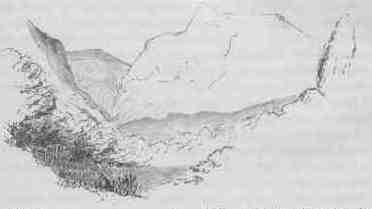
A glade opened, and, the trees no longer hiding it, I looked down the vale, which was the gate of Tuscany. There--high, jagged, rapt into the sky--stood such a group of mountains as men dream of in good dreams, or see in the works of painters when old age permits them revelations. Their height was evident from the faint mist and grey of their hues; their outline was tumultuous, yet balanced; full of accident and poise. It was as though these high walls of Carrara, the western boundary of the valley, had been shaped expressly for man, in order to exalt him with unexpected and fantastic shapes, and to expand his dull life with a permanent surprise. For a long time I gazed at these great hills.
Then, more silent in the mind through their influence, I went down past the speech and companionship of the springs of the Serchio, and the chestnut trees were redolent of evening all round. Down the bank to where the streams met in one, down the river, across its gaping, ruinous bridge (which some one, generations ago, had built for the rare travellers--there were then no main roads across the Apennine, and perhaps this rude pass was in favour); down
194
SILLANO
still more gently through the narrow upper valley I went between the chestnut trees, and calm went with me for a companion: and the love of men and the expectation of good seemed natural to all that had been made in this blessed place. Of Borda, where the peasants directed me, there is no need to speak, till crossing the Serchio once more, this time on a trestle bridge of wood, I passed by a wider path through the groves, and entered the dear village of Sillano, which looks right into the pure west. And the peaks are guardians all about it: the elder brothers of this remote and secluded valley.
An inn received me: a great kitchen full of men and women talking, a supper preparing, a great fire, meat smoking and drying in the ingle-nook, a vast timbered roof going up into darkness: there I was courteously received, but no one understood my language. Seeing there a young priest, I said to him--
'Pater, habeo linguam latinam, sed non habeo linguam Italicam. Visne mi dare traductionem in istam linguam Toscanam non nullorum verborum?'
To this he replied, 'Libenter,' and the people revered us both. Thus he told me the name for a knife was cultello; for a room, camera par domire; for 'what is it called?' 'come si chiama?'; for 'what is the road to?' 'quella e la via a ...?' and other phrases wherein, no doubt, I am wrong; but I only learnt by ear.
Then he said to me something I did not understand, and I answered, 'Pol-Hercle!' at which he seemed pleased enough.
Then, to make conversation, I said, 'Diaconus es?'
And he answered me, mildly and gravely, 'Presbyter sum.'
And a little while after he left for his house, but I went out on to the balcony, where men and women were talking in subdued tones. There, alone, I sat and watched the night coming up into these Tuscan hills. The first moon since that waning in Lorraine--(how many nights ago, how many marches!)--hung in the sky, a full crescent, growing into brightness and glory as she assumed her reign. The one star of the west called out his silent companions in their order; the mountains merged into a fainter confusion; heaven and the infinite air became the natural seat of any spirit that watched this spell. The fire-flies darted in the depths of vineyards and of trees below; then the noise of the grasshoppers brought back suddenly the gardens of home, and whatever benediction surrounds our childhood. Some promise of eternal pleasures and of rest deserved haunted the village of Sillano.
In very early youth the soul can still remember its immortal habitation, and clouds and the edges of hills are of another kind from ours, and every scent and colour has a savour of Paradise. What that quality may be no language can tell, nor have men made any words, no, nor any music, to recall it--only in a transient way and elusive the recollection of what youth was, and purity, flashes
195
ON ANYTHING
on us in phrases of the poets, and is gone before we can fix it in our minds--oh! my friends, if we could but recall it! Whatever those sounds may be that are beyond our sounds, and whatever are those keen lives which remain alive there under memory--whatever is Youth--Youth came up that valley at evening, borne upon a southern air. If we deserve or attain beatitude, such things shall at last be our settled state; and their now sudden influence upon the soul in short ecstasies is the proof that they stand outside time, and are not subject to decay.
This, then, was the blessing of Sillano, and here was perhaps the highest moment of those seven hundred miles--or more. Do not therefore be astonished, reader, if I now press on much more hurriedly to Rome, for the goal is almost between my hands, and the chief moment has been enjoyed, until I shall see the City.
Now I cry out and deplore me that this next sixty miles of way, but especially the heat of the days and the dank mists of the night, should have to be told as of a real journey in this very repetitive and sui-similar world. How much rather I wish that being free from mundane and wide-awake (that is to say from perilously dusty) considerations and droughty boredoms, I might wander forth at leisure through the air and visit the regions where everything is as the soul chooses: to be dropped at last in the ancient and famous town of Siena, whence comes that kind of common brown paint wherewith men, however wicked, can produce (if they have but the art) very surprising effects of depth in painting: for so I read of it in a book by a fool, at six shillings, and even that was part of a series: but if you wish to know anything further of the matter, go you and read it, for I will do nothing of the kind.
Oh to be free for strange voyages even for a little while! I am tired of the road; and so are you, and small blame to you. Your fathers also tired of the treadmill, and mine of the conquering marches of the Republic. Heaven bless you all!
But I say that if it were not for the incredulity and doubt and agnostico-schismatical hesitation, and very cumbersome air of questioning-and-peering-about, which is the bane of our moderns, very certainly I should now go on to tell of giants as big as cedars, living in mountains of precious stones, and drawn to battle by dragons in cars of gold; or of towns where the customs of men were remote and unexpected; of countries not yet visited, and of the gods returning. For though it is permissible, and a pleasant thing (as Bacon says), to mix a little falsehood with one's truth (so St Louis mixed water with his wine, and so does Sir John Growl mix vinegar with his, unless I am greatly mistaken, for if not,
196
THE GARFAGNANA
how does he give it that taste at his dinners? eh? There, I think, is a question that would puzzle him!) yet is it much more delectable, and far worthier of the immortal spirit of man to soar into the empyrean of pure lying--that is, to lay the bridle on the neck of Pegasus and let him go forward, while in the saddle meanwhile one sits well back, grips with the knee, takes the race, and on the energy of that steed visits the wheeling stars.
This much, then, is worth telling of the valley of the Serchio, that it is narrow, garrulous with water brawling, wooded densely, and contained by fantastic mountains. That it has a splendid name, like the clashing of cymbals--Garfagnana; that it leads to the Tuscan plain, and that it is over a day's march long. Also, it is an oven.
Never since the early liars first cooked eggs in the sand was there such heat, and it was made hotter by the consciousness of folly, than which there is no more heating thing; for I think that not old Championnet himself, with his Division of Iron, that fought one to three and crushed the aged enormities of the oppressors as we would crush an empty egg, and that found the summer a good time for fighting in Naples, I say that he himself would not have marched men up the Garfagnana in such a sun. Folly planned it, Pride held to it, and the devils lent their climate. Garfagnana! Garfagnana! to have such a pleasant name, and to be what you are!
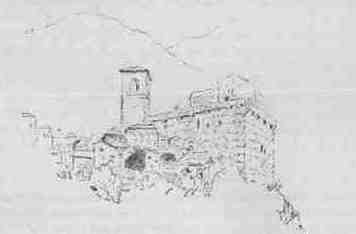
Not that there were not old towers on the steep woods of the Apennine, nor glimpses of the higher peaks; towns also: one castle surrounded by a fringe of humble roofs--there were all these things. But it was an oven. So imagine me, after having passed chapels built into rocks, and things most curious, but the
197
THE BRIDGES OF CASTEL-NUOVO
whole under the strain of an intolerable sun, coming, something after midday, to a place called Castel-Nuovo, the first town, for Campogiamo is hardly a town.
At Castel-Nuovo I sat upon a bridge and thought, not what good men think (there came into my memory no historical stuff; for all I know, Liberty never went by that valley in arms); no appreciation of beauty filled me; I was indifferent to all save the intolerable heat, when I suddenly recognized the enormous number of bridges that bespattered the town.
'This is an odd thing,' I mused. 'Here is a little worriment of a town up in the hills, and what a powerful lot of bridges!'
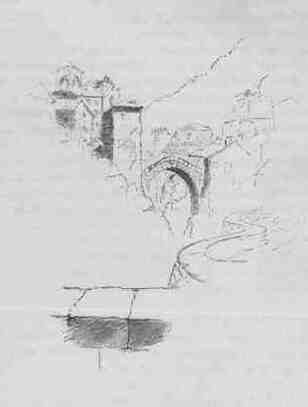
I cared not a fig for the thousand things I had been told to expect in Tuscany; everything is in a mind, and as they were not in my mind they did not exist. But the bridges, they indeed were worthy of admiration!
198
THE BRIDGE-GOD
Here was a horrible little place on a torrent bank. One bridge was reasonable for by it went the road leading south to Lucca and to Rome; it was common honour to let men escape. But as I sat on that main bridge I counted seven others; indeed there must have been a worship of a bridge-god some time or other to account for such a necklace of bridges in such a neglected borough.
You may say (I am off hard on the road to Borgo, drooping with the heat, but still going strongly), you may say that is explicable enough. First a thing is useful, you say, then it has to become routine; then the habit, being a habit, gets a sacred idea attached to it. So with bridges: e.g. Pontifex; Dervorguilla, our Ballici saint that built a bridge; the devil that will hinder the building of bridges; cf. the Porphyry Bridge in the Malay cosmogony; Amershickel, Brùckengebildung im kult-Historischer. Passenmayer; Durât, Le pont antique, étude sur les origines Toscanes; Mr Dacre's The Command of Bridges in Warfare; Bridges and Empire, by Captain Hole, U.S.A. You may say all this; I shall not reply. If the heat has hindered me from saying a word of the fine open valley on the left, of the little railway and of the last of the hills, do you suppose it will permit me to discuss the sanctity of bridges? If it did, I think there is a little question on 'why should habit turn sacred?' which would somewhat confound and pose you, and pose also, for that matter, every pedant that ever went blind and crook-backed over books, or took ivory for horn. And there is an end of it. Argue it with whom you will. It is evening, and I am at Borgo (for if many towns are called Castel-Nuovo so are many called Borgo in Italy), and I desire to be free of interruption while I eat and sleep and reflect upon the error of that march in that heat, spoiling nearly thirty miles of road, losing so many great and pleasurable emotions, all for haste and from a neglect of the Italian night.
And as I ate, and before I slept, I thought of that annotated Guide Book which is cried out for by all Europe, and which shall tell blunt truths. Look you out 'Garfagnana, district of, Valley of Serchio' in the index. You will be referred to p. 267. Turn to p. 267. You will find there the phrase -
'One can walk from the pretty little village of Sillano, nestling in its chestnut groves, to the flourishing town of Borgo on the new Bagni railway in a day.'
You will find a mark [1] after that phrase. It refers to a footnote. Glance (or look) at the bottom of the page and you will find:
[1] But if one does one is a fool.
So I slept late and uneasily the insufficient sleep of men who have suffered, and in that uneasy sleep I discovered this great truth: that if in a southern
199
WHY 'DECIMO'?
summer you do not rest in the day the night will seem intolerably warm, but that, if you rest in the day, you will find coolness and energy at evening.
The next morning with daylight I continued the road to Lucca, and of that also I will say nothing.
LECTOR. Why on earth did you write this book?
AUCTOR. For my amusement.
LECTOR. And why do you suppose I got it?
AUCTOR. I cannot conceive ... however, I will give up this much, to tell you that at Decimo the mystery of cypress trees first came into my adventure
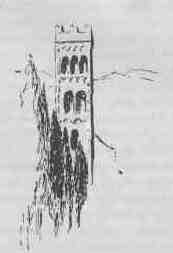
and pilgrimage: of cypress trees which henceforward were to mark my Tuscan road. And I will tell you that there also I came across a thing peculiar (I suppose) to the region of Lucca, for I saw it there as at Decimo, and also some miles beyond. I mean fine mournful towers built thus: In the first storey one arch, in the second two, in the third three, and so on: a very noble way of building.
And I will tell you something more. I will tell you something no one has yet heard. To wit, why this place is called Decimo, and why just below it is another little spot called Sexta.
LECTOR.. ..
AUCTOR. I know what you are going to say! Do not say it. You are going to say: 'It is because they were at the sixth and tenth milestones from Lucca on
200
BECAUSE OF THIS
the Roman road.' Heaven help these scientists! Did you suppose that I thought it was called Decimo because the people had ten toes? Tell me, why is not every place ten miles out of a Roman town called by such a name? Eh? You are dumb. You cannot answer. Like most moderns you have entirely missed the point. We all know that there was a Roman town at Lucca, because it was called Luca, and if there had been no Roman town the modern town would not be spelt with two c's. All Roman towns had milestones beyond them. But why did this tenth milestone from this Roman town keep its name?
LECTOR. I am indifferent.
AUCTOR. I will tell you. Up in the tangle of the Carrara mountains, overhanging the Garfagnana, was a wild tribe, whose name I forget (unless it were the Bruttii), but which troubled the Romans not a little, defeating them horribly, and keeping the legionaries in some anxiety for years. So when the soldiers marched out north from Luca about six miles, they could halt and smile at each other, and say 'At Sextant... that's all right. All safe so far!' and therefore only a little village grew up at this little rest and emotion. But as they got nearer the gates of the hills they began to be visibly perturbed, and they would say: 'The eighth mile! cheer up!' Then 'The ninth mile! Sanctissima Madonna! Have you seen anything moving on the heights?' But when they got to the tenth milestone, which stands before the very jaws of the defile, then indeed they said with terrible emphasis, 'Ad Decimam!' And there was no restraining them: they would camp and entrench, or die in the venture: for they were Romans and stern fellows, and loved a good square camp and a ditch, and sentries and a clear moon, and plenty of sharp stakes, and all the panoply of war. That is the origin of Decimo.
For all my early start, the intolerable heat had again taken the ascendant before I had fairly entered the plain. Then, it being yet but morning, I entered from the north the town of Lucca, which is the neatest, the regularest, the exactest, the most fly-in-amber little town in the world, with its uncrowded streets, its absurd fortifications, and its contented silent houses--all like a family at ease and at rest under its high sun. It is as sharp and trim as its own map, and that map is as clear as a geometrical problem. Everything in Lucca is good.
I went with a short shadow, creeping when I could on the eastern side of the street to save the sunlight; then I came to the main square, and immediately on my left was the Albergo di Something-or-other, a fine great hotel, but most
201
THE BANQUET
unfortunately right facing the blazing sky. I had to stop outside it to count my money. I counted it wrong and entered. There I saw the master, who talked French.
'Can you in an hour,' said I, 'give me a meal to my order, then a bed, though it is early day?' This absurd question I made less absurd by explaining to him my purpose. How I was walking to Rome and how, being northern, I was unaccustomed to such heat; how, therefore, I had missed sleep, and would find it necessary in future to walk mainly by night. For I had now determined to fill the last few marches up in darkness, and to sleep out the strong hours of the sun.
All this he understood; I ordered such a meal as men give to beloved friends returned from wars. I ordered a wine I had known long ago in the valley of the Saône in the old time of peace before ever the Greek came to the land. While they cooked it I went to their cool and splendid cathedral to follow a late Mass. Then I came home and ate their admirable food and drank the wine which the Burgundians had trodden upon the hills of gold so many years before. They showed me a regal kind of a room where a bed with great hangings invited repose.
All my days of marching, the dirty inns, the forests, the nights abroad, the cold, the mists, the sleeplessness, the faintness, the dust, the dazzling sun, the Apennines--all my days came over me, and there fell on me a peaceful weight, as his two hundred years fell upon Charlemagne in the tower of Saragossa when the battle was done; after he had curbed the valley of Ebro and christened Bramimonde.
So I slept deeply all day long; and, outside, the glare made a silence upon the closed shutters, save that little insects darted in the outer air.
When I woke it was evening. So well had they used me that I paid what they asked, and, not knowing what money remained over, I left their town by the southern gate, crossed the railway and took the road.
My way lay under the flank of that mountain whereby the Luccans cannot see Pisa, or the Pisans cannot see Lucca--it is all one to me, I shall not live in either town, God willing; and if they are so eager to squint at one another, in Heaven's name, cannot they be at the pains to walk round the end of the hill? It is this laziness which is the ruin of many; but not of pilgrims, for here was I off to cross the plain of Arno in one night, and reach by morning the mouth
202
NOTHING PARTICULAR
and gate of that valley of the Elsa, which same is a very manifest proof of how Rome was intended to be the end and centre of all roads, the chief city of the world, and the Popes' residence--as, indeed, it plainly is to this day, for all the world to deny at their peril, spiritual, geographical, historical, sociological, economic, and philosophical.
For if some such primeval and predestinarian quality were not inherent in the City, how, think you, would the valley of the Serchio--the hot, droughty, and baking Garfagnana--lead down pointing straight to Rome; and how would that same line, prolonged across the plain, find fitting it exactly beyond that plain this vale of the Elsa, itself leading up directly towards Rome? I say, nowhere in the world is such a coincidence observable, and they that will not take it for a portent may go back to their rationalism and consort with microbes and make their meals off logarithms, washed down with an exact distillation of the root of minus one; and the peace of fools, that is the deepest and most balmy of all, be theirs for ever and ever.
Here again you fall into errors as you read, ever expecting something new; for of that night's march there is nothing to tell, save that it was cool, full of mist, and an easy matter after the royal entertainment and sleep of the princely Albergo that dignifies Lucca. The villages were silent, the moon soon left the sky, and the stars could not show through the fog, which deepened in the hours after midnight.
A map I had bought in Lucca made the difficulties of the first part of the road (though there were many cross-ways) easy enough; and the second part, in midnight and the early hours, was very plain sailing, till--having crossed the main line and having, at last, very weary, come up to the branch railway at a slant from the west and north, I crossed that also under the full light--I stood fairly in the Elsa valley and on the highroad which follows the railway straight to Siena. That long march, I say, had been easy enough in the coolness and in the dark; but I saw nothing; my interior thoughts alone would have afforded matter for this part; but of these if you have not had enough in near six hundred miles of travel, you are a stouter fellow than I took you for.
Though it was midsummer, the light had come quickly. Long after sunrise the mist dispersed, and the nature of the valley appeared.
It was in no way mountainous, but easy, pleasant, and comfortable, bounded by low, rounded hills, having upon them here and there a row of cypresses against the sky; and it was populous with pleasant farms. Though the soil was baked and dry, as indeed it is everywhere in this south, yet little regular streams (or canals) irrigated it and nourished many trees--- but the deep grass of the north was wanting.
203
THE TEMPTATION
For an hour or more after sunrise I continued my way very briskly; then what had been the warmth of the early sun turned into the violent heat of day, and remembering Merlin where he says that those who will walk by night must sleep by day, and having in my mind the severe verses of James Bayle, sometime Fellow of St Anne's, that 'in Tuscan summers as a general rule, the days are sultry but the nights are cool' (he was no flamboyant poet; he loved the quiet diction of the right wing of English poetry), and imagining an owlish habit of sleeping by day could be acquired at once, I lay down under a tree of a kind I had never seen; and lulled under the pleasant fancy that this was a picture-tree drawn before the Renaissance, and that I was reclining in some background landscape of the fifteenth century (for the scene was of that kind), I fell asleep.
When I woke it was as though I had slept long; but I doubted the feeling. The young sun still low in the sky, and the shadows not yet shortened, puzzled me. I looked at my watch, but the dislocation of habit which night marches produce had left it unwound. It marked a quarter to three, which was absurd. I took the road somewhat stiffly and wondering. I passed several small white cottages; there was no clock in them, and their people were away. At last in a Trattoria, as they served me with food, a woman told me it was just after seven; I had slept but an hour.
Outside, the day was intense; already flies had begun to annoy the darkened room within. Through the half-curtained door the road was white in the sun, and the railway ran just beyond.
I paid my reckoning, and then, partly for an amusement, I ranged my remaining pence upon the table, first in the shape of a Maltese cross, then in a circle (interesting details!). The road lay white in the sunlight outside, and the railway ran just beyond.
I counted the pence and the silver--there was three francs and a little over; I remembered the imperial largesse at Lucca, the lordly spending of great sums, where, now in the pocket of an obsequious man, the pounds were taking care of themselves. I remembered how at Como I had been compelled by poverty to enter the train for Milan. How little was three francs for the remaining twenty-five miles to Siena! The road lay white in the sunlight, and the railway ran just beyond.
I remembered the pleasing cheque in the post-office of Siena; the banks of Siena, and the money changers at their counters changing money at the rate of change.
'If one man,' thought I, 'may take five per cent discount on a sum of money in the exchange, may not another man take discount off a walk of over seven
204
THE FALL
hundred miles? May he not cut off it, as his due, twenty-five miserable little miles in the train?' Sleep coming over me after my meal increased the temptation. Alas! how true is the great phrase of Averroes (or it may be Boa-ed-din: anyhow, the Arabic escapes me, but the meaning is plain enough), that when one has once fallen, it is easy to fall again (saving always heavy falls from cliffs and high towers, for after these there is no more falling).... Examine the horse's knees before you buy him; take no ticket-of-leave man into your house for charity; touch no prospectus that has founders' shares, and do not play with firearms or knives and never go near the water till you know how to swim. Oh! blessed wisdom of the ages! sole patrimony of the poor! The road lay white in the sun, and the railway ran just beyond.
If the people of Milo did well to put up a statue in gold to the man that invented wheels, so should we also put one up in Portland stone or plaster to the man that invented rails, whose property it is not only to increase the speed and ease of travel, but also to bring on slumber as can no drug: not even poppies gathered under a waning moon. The rails have a rhythm of slight falls and rises ... they make a loud roar like a perpetual torrent; they cover up the mind with a veil.
Once only, when a number of men were shouting 'POGGI-BON-SI,' like a war-cry to the clank of bronze, did I open my eyes sleepily to see a hill, a castle wall, many cypresses, and a strange tower bulging out at the top (such towers I learned were the feature of Tuscany). Then in a moment, as it seemed, I awoke in the station of Siena, where the railway ends and goes no farther.
It was still only morning; but the glare was beyond bearing as I passed through the enormous gate of the town, a gate pierced in high and stupendous walls that are here guarded by lions. In the narrow main street there was full shade, and it was made cooler by the contrast of the blaze on the higher storeys of the northern side. The wonders of Siena kept sleep a moment from my mind. I saw their great square where a tower of vast height marks the guildhall. I heard Mass in a chapel of their cathedral: a chapel all frescoed, and built, as it were, out of doors, and right below the altar-end or choir. I noted how the city stood like a queen of hills dominating all Tuscany: above the Elsa northward, southward above the province round Mount Amiato. And this great mountain I saw also hazily far off on the horizon. I suffered the vulgarities of the main street all in English and American, like a show. I took my money and changed it; then, having so passed not a full hour, and oppressed by weariness, I said to myself:
205
A REFERENCE
'After all, my business is not with cities, and already I have seen far off the great hill whence one can see far off the hills that overhang Rome.'
With this in my mind I wandered out for a quiet place, and found it in a desolate green to the north of the city, near a huge, old red-brick church like a barn. A deep shadow beneath it invited me in spite of the scant and dusty grass, and in this country no one disturbs the wanderer. There, lying down, I slept without dreams till evening.
AUCTOR. Turn to page 94.
LECTOR. I have it. It is not easy to watch the book in two places at once; but pray continue.
AUCTOR. Note the words from the eighth to the tenth lines.
LECTOR. Why?
AUCTOR. They will make what follows seem less abrupt.
Once there was a man dining by himself at the Cafe Anglais, in the days when people went there. It was a full night, and he sat alone at a small table, when there entered a very big man in a large fur coat. The big man looked round annoyed, because there was no room, and the first man very courteously offered him a seat at his little table. They sat down and ate and talked of several things; among others, of Bureaucracy. The first maintained that Bureaucracy was the curse of France.
'Men are governed by it like sheep. The administrator, however humble, is a despot; most people will even run forward to meet him halfway, like the servile dogs they are,' said he.
'No,' answered the Man in the Big Fur Coat, 'I should say men were governed just by the ordinary human sense of authority. I have no theories. I say they recognize authority and obey it. Whether it is bureaucratic or not is merely a question of form.'
At this moment there came in a tall, rather stiff Englishman. He also was put out at finding no room. The two men saw the manager approach him; a few words were passed, and a card; then the manager suddenly smiled, bowed, smirked, and finally went up to the table and begged that the Duke of Sussex might be allowed to share it. The Duke hoped he did not incommode these gentlemen. They assured him that, on the contrary, they esteemed his presence a favour.
206
STORY OF THE DUKE OF SUSSEX
'It is our prerogative,' said the Man in the Big Fur Coat, 'to be the host Paris entertaining her Guest.'
They would take no denial; they insisted on the Duke's dining with them, and they told him what they had just been discussing. The Duke listened to their theories with some morgue, much spleen, and no little phlegm, but with perfect courtesy, and then, towards the coffee, told them in fluent French with a strong accent, his own opinion. (He had had eight excellent courses; Yquem with his fish, the best Chambertin during the dinner, and a glass of wonderful champagne with his dessert.) He spoke as follows, with a slight and rather hard smile:
'My opinion may seem to you impertinent, but I believe nothing more subtly and powerfully affects men than the aristocratic feeling. Do not misunderstand me,' he added, seeing that they would protest; 'it is not my own experience alone that guides me. All history bears witness to the same truth.'
The simple-minded Frenchmen put down this infatuation to the Duke's early training, little knowing that our English men of rank are the simplest fellows in the world, and are quite indifferent to their titles save in business matters.
The Frenchmen paid the bill, and they all three went on to the Boulevard.
'Now,' said the first man to his two companions, 'I will give you a practical example of what I meant when I said that Bureaucracy governed mankind.'
He went up to the wall of the Credit Lyonnais, put the forefinger of either hand against it, about twenty-five centimetres apart, and at a level of about a foot above his eyes. Holding his fingers thus he gazed at them, shifting them slightly from time to time and moving his glance from one to the other rapidly. A crowd gathered. In a few moments a pleasant elderly, short, and rather fat gentleman in the crowd came forward, and, taking off his hat, asked if he could do anything for him.
'Why,' said our friend, 'the fact is I am an engineer (section D of the Public Works Department) and I have to make an important measurement in connexion with the Apothegm of the Bilateral which runs to-night precisely through this spot. My fingers now mark exactly the concentric of the secondary focus whence the Radius Vector should be drawn, but I find that (like a fool) I have left my Double Refractor in the cafe hard by. I dare not go for fear of losing the place I have marked; yet I can get no further without my Double Refractor.'
'Do not let that trouble you,' said the short, stout stranger; 'I will be delighted to keep the place exactly marked while you run for your instrument.'
207
STORY OF THE DUKE OF SUSSEX
The crowd was now swelled to a considerable size; it blocked up the pavement, and was swelled every moment by the arrival of the curious. The little fat elderly man put his fingers exactly where the other's had been, effecting the exchange with a sharp gesture; and each watched intently to see that it was right to within a millimetre. The attitude was constrained. The elderly man smiled, and begged the engineer not to be alarmed. So they left him with his two forefingers well above his head, precisely twenty-five centimetres apart, and pressing their tips against the wall of the Credit Lyonnais. Then the three friends slipped out of the crowd and pursued their way.
'Let us go to the theatre,' said the experimenter, 'and when we come back I warrant you will agree with my remarks on Bureaucracy.'
They went to hear the admirable marble lines of Corneille. For three hours they were absorbed by the classics, and, when they returned, a crowd, now enormous, was surging all over the Boulevard, stopping the traffic and filled with a noise like the sea. Policemen were attacking it with the utmost energy, but still it grew and eddied; and in the centre--a little respectful space kept empty around him--still stretched the poor little fat elderly man, a pitiable sight. His knees were bent, his head wagged and drooped with extreme fatigue, he was the colour of old blotting-paper; but still he kept the tips of his two forefingers exactly twenty-five centimetres apart, well above his head, and pressed against the wall of the Credit Lyonnais.
'You will not match that with your aristocratic sentiment!' said the author of the scene in pardonable triumph.
'I am not so sure,' answered the Duke of Sussex. He pulled out his watch. 'It is midnight,' he said, 'and I must be off; but let me tell you before we part that you have paid for a most expensive dinner, and have behaved all night with an extravagant deference under the impression that I was the Duke of Sussex. As a fact my name is Jerks, and I am a commercial traveller in the linseed oil line; and I wish you the best of good evenings.'
'Wait a moment,' said the Man in the Big Fur Coat; 'my theory of the Simple Human Sense of Authority still holds. I am a detective officer, and you will both be good enough to follow me to the police station.'
And so they did, and the Engineer was fined fifty francs in correctional, and the Duke of Sussex was imprisoned for ten days, with interdiction of domicile for six months; the first indeed under the Prefectorial Decree of the 18th of November 1843, but the second under the law of the 12th germinal of the year VIII.
208
ST AUGUSTINE CENSURED
In this way I have got over between twenty and thirty miles of road which were tramped in the dark, and the description of which would have plagued you worse than a swarm of hornets.
Oh, blessed interlude! no struggling moon, no mist, no long-winded passages upon the genial earth, no the sense of the night, no marvels of the dawn, no rhodomontade, no religion, no rhetoric, no sleeping villages, no silent towns (there was one), no rustle of trees--just a short story, and there you have a whole march covered as though a brigade had swung down it. A new day has come, and the sun has risen over the detestable parched hillocks of this downward way.
No, no, Lector! Do not blame me that Tuscany should have passed beneath me unnoticed, as the monotonous sea passes beneath a boat in full sail. Blame all those days of marching; hundreds upon hundreds of miles that exhausted the powers of the mind. Blame the fiery and angry sky of Etruria, that compelled most of my way to be taken at night. Blame St Augustine, who misled me in his Confessions by talking like an African of 'the icy shores of Italy'; or blame Rome, that now more and more drew me to Herself as She approached from six to five, from five to four, from four to three--now She was but three days off. The third sun after that I now saw rising would shine upon the City.
I did indeed go forward a little in the heat, but it was useless. After an hour I abandoned it. It was not so much the sun, though that was intemperate and deadly; it was rather the inhuman aspect of the earth which made me despair. It was as though the soil had been left imperfect and rough after some cataclysm; it reminded me of those bad lands in the west of America, where the desert has no form, and where the crumbling and ashy look of things is more abhorrent than their mere desolation. As soon march through evil dreams!
The north is the place for men. Eden was there; and the four rivers of Paradise are the Seine, the Oise, the Thames, and the Arun; there are grasses there, and the trees are generous, and the air is an unnoticed pleasure. The waters brim up to the edges of the fields. But for this bare Tuscany I was never made.
How far I had gone I could not tell, nor precisely how much farther San Quirico, the neighbouring town, might be. The imperfect map I had bought at Siena was too minute to give me clear indications. I was content to wait for evening, and then to go on till I found it. An hour or so in the shade of a row of parched and dusty bushes I lay and ate and drank my wine, and smoked, and then all day I slept, and woke a while, and slept again more deeply. But
209
SAN QUIRICO
how people sleep and wake, if you do not yet know it after so much of this book you never will.
It was perhaps five o'clock, or rather more, when I rose unhappily and took up the ceaseless road.
Even the goodness of the Italian nature seemed parched up in those dry hollows. At an inn where I ate they shouted at me, thinking in that way to make me understand; and their voices were as harsh as the grating of metal against stone. A mile farther I crossed a lonely line of railway; then my map told me where I was, and I went wearily up an indefinite slope under the declining sun, and thought it outrageous that only when the light had gone was there any tolerable air in this country.
Soon the walls of San Quirico, partly ruinous, stood above the fields (for the smallest places here have walls); as I entered its gate the sun set, and as though
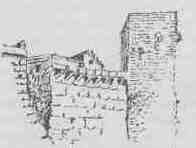
the cool, coming suddenly, had a magic in it, everything turned kinder. A church that could wake interest stood at the entry of the town; it had stone lions on its steps, and the pillars were so carved as to resemble knotted ropes. There for the first time I saw in procession one of those confraternities which in Italy bury the dead; they had long and dreadful hoods over their heads, with slits for the eyes. I spoke to the people of San Quirico, and they to me. They were upstanding, and very fine and noble in the lines of the face. On their walls is set a marble tablet, on which it is registered that the people of Tuscany, being asked whether they would have their hereditary Duke or the House of Savoy, voted for the latter by such and such a great majority; and this kind of tablet I afterwards found was common to all these small towns. Then passing down
210
THE VALLEY LIKE A WAVE
their long street I came, at the farther gate, to a great sight, which the twilight still permitted me to receive in its entirety.
For San Quirico is built on the edge of a kind of swell in the land, and here where I stood one looked over the next great wave; for the shape of the view was, on a vast scale, just what one sees from a lonely boat looking forward over a following sea.
The trough of the wave was a shallow purple valley, its arid quality hidden by the kindly glimmer of evening; few trees stood in it to break its sweep, and its irregularities and mouldings were just those of a sweep of water after a gale. The crest of the wave beyond was seventeen miles away. It had, as have also such crests at sea, one highest, toppling peak in its long line, and this, against the clear sky, one could see to be marked by buildings. These buildings were the ruined castle and walls of Radicofani, and it lay straight on my way to Rome.
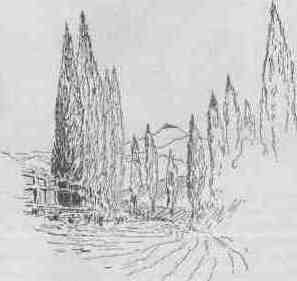
It is a strange thing, arresting northern eyes, to see towns thus built on summits up into the sky, and this height seemed the more fantastic because it was framed. A row of cypress trees stood on either side of the road where it fell from San Quirico, and, exactly between these, this high crest, a long way off, was set as though by design.
THE SILHOUETTE
With more heart in me, and tempted by such an outline as one might be by the prospect of adventure, I set out to cross the great bare run of the valley. As I went, the mountain of Amiato came more and more nearly abreast of me in the west; in its foothills near me were ravines and unexpected rocks; upon one of them hung a village. I watched its church and one tall cypress next it, as they stood black against the last of daylight. Then for miles I went on the dusty way, and crossed by old bridges watercourses in which stood nothing but green pools; and the night deepened.
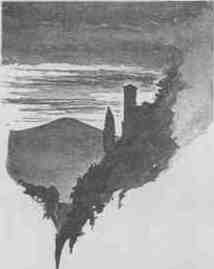
It was when I had crossed the greater part of the obscure plain, at its lowest dip and not far from the climb up to Radicofani, that I saw lights shining in a large farmhouse, and though it was my business to walk by night, yet I needed companionship, so I went in.
There in a very large room, floored with brick and lit by one candle, were two fine old peasants, with faces like apostles, playing a game of cards. There also was a woman playing with a strong boy child, that could not yet talk: and the child ran up to me. Nothing could persuade the master of the house but that I was a very poor man who needed sleep, and so good and generous was this old man that my protests seemed to him nothing but the excuses and shame of poverty. He asked me where I was going. I said, 'To Rome.' He came out with a lantern to the stable, and showed me there a manger full of hay,
THE HORN SONG
indicating that I might sleep in it... His candle flashed upon the great silent oxen standing in rows; their enormous horns, three times the length of what we know in England, filled me with wonder ... Well! (may it count to me as gain!), rather than seem to offend him I lay down in that manger, though I had no more desire to sleep than has the flittermouse in our Sussex gloamings; also I was careful to offer no money, for that is brutality. When he had left me I took the opportunity for a little rest, and lay on my back in the hay wide-awake and staring at darkness.
The great oxen champed and champed their food with a regular sound; I remembered the steerage in a liner, the noise of the sea and the regular screw, for this it exactly resembled. I considered in the darkness the noble aspect of these beasts as I had seen them in the lantern light, and I determined when I got to Rome to buy two such horns, and to bring them to England and have them mounted for drinking horns--great drinking horns, a yard deep--and to get an engraver to engrave a motto for each. On the first I would have -
King Alfred was in Wantage born He drank out of a ram's horn. Here is a better man than he, Who drinks deeper, as you see.
Thus my friends drinking out of it should lift up their hearts and no longer be oppressed with humility. But on the second I determined for a rousing Latin thing, such as men shouted round camp fires in the year 888 or thereabouts; so, the imagination fairly set going and taking wood-cock's flight, snipe-fashion, zigzag and devil-may care-for-the-rules, this seemed to suit me -
Salve, cornu cornuum! Cornutorum vis Boûm. Munus excellent Deûm! Gregis o praesidium! Sitis desiderium! Dignum cornuum cornu Romae memor salve tu! Tibi cornuum cornuto--
LECTOR. That means nothing
AUCTOR. Shut up!
Tibi cornuum cornuto Tibi clamo, te saluto Salve cornu cornuum! Fortunatam da Domunt!
213
RADICOFANI
And after this cogitation and musing I got up quietly, so as not to offend the peasant: and I crept out, and so upwards on to the crest of the hill.
But when, after several miles of climbing, I neared the summit, it was already beginning to be light. The bareness and desert grey of the distance I had crossed stood revealed in a colourless dawn, only the Mont' Amiata, now somewhat to the northward, was more gentle, and softened the scene with distant woods. Between it and this height ran a vague river-bed as dry as the stones of a salt beach.
The sun rose as I passed under the ruined walls of the castle. In the little town itself, early as was the hour, many people were stirring. One gave me good-morning--a man of singular character, for here, in the very peep of day, he was sitting on a doorstep, idle, lazy and contented, as though it was full noon. Another was yoking oxen; a third going out singing to work in the fields.
I did not linger in this crow's nest, but going out by the low and aged southern gate, another deeper valley, even drier and more dead than the last, appeared under the rising sun. It was enough to make one despair! And when I thought of the day's sleep in that wilderness, of the next night's toil through it--
LECTOR. What about the Brigand of Radicofani of whom you spoke in Lorraine, and of whom I am waiting to hear?
AUCTOR. What about him? Why, he was captured long ago, and has since died of old age. I am surprised at your interrupting me with such questions. Pray ask for no more tales till we get to the really absorbing story of the Hungry Student.
Well, as I was saying, I was in some despair at the sight of that valley, which had to be crossed before I could reach the town of Acquapendente, or Hanging-water, which I knew to lie somewhere on the hills beyond. The sun was conquering me, and I was looking hopelessly for a place to sleep, when a cart drawn by two oxen at about one mile an hour came creaking by. The driver was asleep, his head on the shady side. The devil tempted me, and without one struggle against temptation, nay with cynical and congratulatory feelings, I
214
SECOND FALL
jumped up behind, and putting my head also on the shady side (there were soft sacks for a bed) I very soon was pleasantly asleep.
We lay side by side for hour after hour, and the day rose on to noon; the sun beat upon our feet, but our heads were in the shade and we slept heavily a good and honest sleep: he thinking that he was alone, but I knowing that I was in company (a far preferable thing), and I was right and he was wrong. And the heat grew, and sleep came out of that hot sun more surely than it does out of the night air in the north. But no dreams wander under the noon.
From time to time one or the other of us would open our eyes drowsily and wonder, but sleep was heavy on us both, and our minds were sunk in calm like old hulls in the dark depths of the sea where there are no storms.
We neither of us really woke until, at the bottom of the hill which rises into Acquapendente, the oxen stopped. This halt woke us up; first me and then my companion. He looked at me a moment and laughed. He seemed to have thought all this while that I was some country friend of his who had taken a lift; and I, for my part, had made more or less certain that he was a good fellow who would do me no harm. I was right, and he was wrong. I knew not what offering to make him to compensate him for this trouble which his heavy oxen had taken. After some thought I brought a cigar out of my pocket, which he smoked with extreme pleasure. The oxen meanwhile had been urged up the slow hill, and it was in this way that we reached the famous town of Acquapendente. But why it should be called famous is more than I can understand. It may be that in one of those narrow streets there is a picture or a church, or one of those things which so attract unbelieving men. To the pilgrim it is simply a group of houses. Into one of these I went, and, upon my soul, I have nothing to say of it except that they furnished me with food.
I do not pretend to have counted the flies, though they were numerous; and, even had I done so, what interest would the number have, save to the statisticians? Now as these are patient men and foolish, I heartily recommend them to go and count the flies for themselves.
Leaving this meal then, this town and this people (which were all of a humdrum sort), and going out by the gate, the left side of which is made up of a church, I went a little way on the short road to San Lorenzo, but I had no intention of going far, for (as you know by this time) the night had become my day and the day my night.
I found a stream running very sluggish between tall trees, and this sight sufficiently reminded me of my own country to permit repose. Lying down there I slept till the end of the day, or rather to that same time of evening which had now become my usual waking hour ... And now tell me, Lector, shall I
215
HOW TO WRITE
leave out altogether, or shall I give you some description of, the next few miles to San Lorenzo?
LECTOR. Why, if I were you I would put the matter shortly and simply, for it is the business of one describing a pilgrimage or any other matter not to puff himself up with vain conceit, nor to be always picking about for picturesque situations, but to set down plainly and shortly what he has seen and heard, describing the whole matter.
AUCTOR. But remember, Lector, that the artist is known not only by what he puts in but by what he leaves out.
LECTOR. That is all very well for the artist, but you have no business to meddle with such people.
AUCTOR. How then would you write such a book if you had the writing of it?
LECTOR. I would not introduce myself at all; I would not tell stories at random, nor go in for long descriptions of emotions, which I am sure other men have felt as well as I. I would be careful to visit those things my readers had already heard of (AUCTOR. The pictures! the remarkable pictures! All that is meant by culture! The brown photographs! Oh! Lector, indeed I have done you a wrong!), and I would certainly not have the bad taste to say anything upon religion. Above all, I would be terse.
AUCTOR. I see. You would not pile words one on the other, qualifying, exaggerating, conditioning, superlativing, diminishing, connecting, amplifying, condensing, mouthing, and glorifying the mere sound: you would be terse. You should be known for your self-restraint. There should be no verbosity in your style (God forbid!), still less pomposity, animosity, curiosity, or ferocity; you would have it neat, exact, and scholarly, and, above all, chiselled to the nail. A fig (say you), the pip of a fig, for the rambling style. You would be led into no hilarity, charity, vulgarity, or barbarity. Eh! my jolly Lector? You would simply say what you had to say?
LECTOR. Precisely; I would say a plain thing in a plain way.
AUCTOR. So you think one can say a plain thing in a plain way? You think that words mean nothing more than themselves, and that you can talk without ellipsis, and that customary phrases have not their connotations? You think that, do you? Listen then to the tale of Mr Benjamin Franklin Hard, a kindly merchant of Cincinnati, O., who had no particular religion, but who had accumulated a fortune of six hundred thousand dollars, and who had a horror of breaking the Sabbath. He was not 'a kind husband and a good father,' for he was unmarried; nor had he any children. But he was all that those words connote.
This man Hard at the age of fifty-four retired from business, and determined
216
STORY OF MR HARD
to treat himself to a visit to Europe. He had not been in Europe five weeks before he ran bang up against the Catholic Church. He was never more surprised in his life. I do not mean that I have exactly weighed all his surprises all his life through. I mean that he was very much surprised indeed--and that is all that these words connote.
He studied the Catholic Church with extreme interest. He watched High Mass at several places (hoping it might be different). He thought it was what it was not, and then, contrariwise, he thought it was not what it was. He talked to poor Catholics, rich Catholics, middle-class Catholics, and elusive, wellborn, penniless, neatly dressed, successful Catholics; also to pompous, vain Catholics; humble, uncertain Catholics; sneaking, pad-footed Catholics; healthy, howling, combative Catholics; doubtful, shoulder-shrugging, but devout Catholics; fixed, crabbed, and dangerous Catholics; easy, jovial, and shone-upon-by-the-heavenly-light Catholics; subtle Catholics; strange Catholics, and (quod tibi manifeste absurdum videtur) intellectual, pince-nez, jejune, twisted, analytical, yellow, cranky, and introspective Catholics: in fine, he talked to all Catholics. And when I say 'all Catholics' I do not mean that he talked to every individual Catholic, but that he got a good, integrative grip of the Church militant, which is all that the words connote.
Well, this man Hard got to know, among others, a certain good priest that loved a good bottle of wine, a fine deep dish of poulet à la casserole, and a kind of egg done with cream in a little platter; and eating such things, this priest said to him one day: 'Mr Hard, what you want is to read some books on Catholicism.' And Hard, who was on the point of being received into the Church as the final solution of human difficulties, thought it would be a very good thing to instruct his mind before baptism. So he gave the priest a note to a bookseller whom an American friend had told him of; and this American friend had said:
'You will find Mr Fingle (for such was the bookseller's name) a hard-headed, honest, business man. He can say a plain thing in a plain way?
'Here,' said Mr Hard to the priest, 'is ten pounds. Send it to this bookseller Fingle and he shall choose books on Catholicism to that amount, and you shall receive them, and I will come and read them here with you.'
So the priest sent the money, and in four days the books came, and Mr Hard and the priest opened the package, and these were the books inside:
Auricular Confession: a History. By a Brand Saved from the Burning.
Isabella; or, The Little Female Jesuit. By 'Hephzibah'.
Elisha MacNab: a Tale of the French Huguenots.
England and Rome. By the Rev. Ebenezer Catchpole of Emmanuel, Birmingham.
217
STORY OF MR HARD
Nuns and Nunneries. By 'Ruth', with a Preface by Miss Carran, lately rescued from a Canadian Convent.
History of the Inquisition. By Llorente.
The Beast with Seven Heads; or, the Apocalyptical Warning.
No Truce with the Vatican.
The True Cause of Irish Disaffection.
Decline of the Latin Nations.
Anglo-Saxons the Chosen Race, and their connexion with the Ten Lost Tribes: with a map.
Finally, a very large book at the bottom of the case called Giant Pope.
And it was no use asking for the money back or protesting. Mr Fingle was an honest, straightforward man, who said a plain thing in a plain way. They had left him to choose a suitable collection of books on Catholicism, and he had chosen the best he knew. And thus did Mr Hard (who has recently given a hideous font to the new Catholic church at Bismarckville) learn the importance of estimating what words connote.
LECTOR. But all that does not excuse an intolerable prolixity?
AUCTOR. Neither did I say it did, dear Lector. My object was merely to get you to San Lorenzo where I bought that wine, and where, going out of the gate on the south, I saw suddenly the wide lake of Bolsena all below.
It is a great sheet like a sea; but as one knows one is on a high plateau, and as there is but a short dip down to it; as it is round and has all about it a rim of low even hills, therefore one knows it for an old and gigantic crater now full of pure water; and there are islands in it and palaces on the islands. Indeed it was an impression of silence and recollection, for the water lay all upturned to heaven, and, in the sky above me, the moon at her quarter hung still pale in the daylight, waiting for glory.
I sat on the coping of a wall, drank a little of my wine, ate a little bread and sausage; but still song demanded some outlet in the cool evening, and companionship was more of an appetite in me than landscape. Please God, I had become southern and took beauty for granted.
Anyhow, seeing a little two-wheeled cart come through the gate, harnessed to a ramshackle little pony, bony and hard, and driven by a little, brown, smiling, and contented old fellow with black hair, I made a sign to him and he stopped.
This time there was no temptation of the devil; if anything the advance was from my side. I was determined to ride, and I sprang up beside the driver. We raced down the hill, clattering and banging and rattling like a piece of ordnance, and he, my brother, unasked began to sing. I sang in turn. He sang of Italy, I
218
THE MIGHTY DRIVE
of four countries: America, France, England, and Ireland. I could not understand his songs nor he mine, but there was wine in common between us, and salami and a merry heart, bread which is the bond of all mankind, and that prime solution of ill-ease--I mean the forgetfulness of money.
That was a good drive, an honest drive, a human aspiring drive, a drive of Christians, a glorifying and uplifted drive, a drive worthy of remembrance for ever. The moon has shone on but few like it though she is old; the lake of Bolsena has glittered beneath none like it since the Etruscans here unbended after the solemnities of a triumph. It broke my vow to pieces; there was not a shadow of excuse for this use of wheels: it was done openly and wantonly in the face of the wide sky for pleasure. And what is there else but pleasure, and to what else does beauty move on? Not I hope to contemplation! A hideous oriental trick! No, but to loud notes and comradeship and the riot of galloping, and laughter ringing through old trees. Who would change (says Aristippus of Pslinthon) the moon and all the stars for so much wine as can be held in the cup of a bottle upturned? The honest man! And in his time (note you) they did not make the devilish deep and fraudulent bottoms they do now that cheat you of half your liquor.
Moreover if I broke my vows (which is a serious matter), and if I neglected to contemplate the heavens (for which neglect I will confess to no one, not even to a postulate sub-deacon; it is no sin; it is a healthy omission), if (I say) I did this, I did what peasants do. And what is more, by drinking wine and eating pig we proved ourselves no Mohammedans; and on such as he is sure of, St Peter looks with a kindly eye.
Now, just at the very entry to Bolsena, when we had followed the lovely lake some time, my driver halted and began to turn up a lane to a farm or villa; so I, bidding him good-night, crossed a field and stood silent by the lake and watched for a long time the water breaking on a tiny shore, and the pretty miniatures of waves. I stood there till the stars came out and the moon shone fully; then I went towards Bolsena under its high gate which showed in the darkness, and under its castle on the rock. There, in a large room which was not quite an inn, a woman of great age and dignity served me with fried fish from the lake, and the men gathered round me and attempted to tell me of the road to Rome, while I in exchange made out to them as much by gestures as by broken words the crossing of the Alps and the Apennines.
Then, after my meal, one of the men told me I needed sleep; that there were no rooms in that house (as I said, it was not an inn), but that across the way he would show me one he had for hire. I tried to say that my plan was to walk by night. They all assured me he would charge me a reasonable sum. I insisted
219
MONTEFIASCONE
that the day was too hot for walking. They told me, did these Etruscans, that I need fear no extortion from so honest a man.
Certainly it is not easy to make everybody understand everything, and I had had experience already up in the mountains, days before, of how important it is not to be misunderstood when one is wandering in a foreign country, poor and ill-clad. I therefore accepted the offer, and, what was really very much to my regret, I paid the money he demanded. I even so far fell in with the spirit of the thing as to sleep a certain number of hours (for after all, my sleep that day in the cart had been very broken, and instead of resting throughout the whole of the heat I had taken a meal at Acquapendente). But I woke up not long after midnight--perhaps between one and two o'clock--and went out along the borders of the lake.
The moon had set; I wish I could have seen her hanging at the quarter in the clear sky of that high crater, dipping into the rim of its inland sea. It was perceptibly cold. I went on the road quite slowly, till it began to climb, and when the day broke I found myself in a sunken lane leading up to the town of Montefiascone.
The town lay on its hill in the pale but growing light. A great dome gave it dignity, and a castle overlooked the lake. It was built upon the very edge and lip of the volcano-cup commanding either side.
I climbed up this sunken lane towards it, not knowing what might be beyond, when, at the crest, there shone before me in the sunrise one of those unexpected and united landscapes which are among the glories of Italy. They have changed the very mind in a hundred northern painters, when men travelled hither to Rome to learn their art, and coming in by her mountain roads saw, time and again, the set views of plains like gardens, surrounded by sharp mountain-land and framed.
The road did not pass through the town; the grand though crumbling gate of entry lay up a short straight way to the right, and below, where the road continued down the slope, was a level of some eight miles full of trees diminishing in distance. At its further side an ample mountain, wooded, of gentle flattened outline, but high and majestic, barred the way to Rome. It was yet another of those volcanoes, fruitful after death, which are the mark of Latium: and it held hidden, as did that larger and more confused one on the rim of which I stood, a lake in its silent crater. But that lake, as I was to find, was far smaller than the glittering sea of Bolsena, whose shores now lay behind me.
The distance and the hill that bounded it should in that climate have stood clear in the pure air, but it was yet so early that a thin haze hung over the earth, and the sun had not yet controlled it: it was even chilly. I could not catch the
220
THE GREAT WALLS
towers of Viterbo, though I knew them to stand at the foot of the far mountain. I went down the road, and in half-an-hour or so was engaged upon the straight line crossing the plain.
I wondered a little how the road would lie with regard to the town, and looked at my map for guidance, but it told me little. It was too general, taking in all central Italy, and even large places were marked only by small circles.
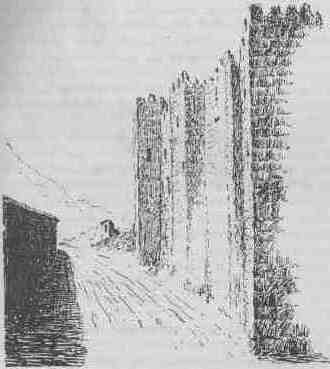
When I approached Viterbo I first saw an astonishing wall, perpendicular to my road, untouched, the bones of the Middle Ages. It stood up straight before one like a range of cliffs, seeming much higher than it should; its hundred feet or so were exaggerated by the severity of its stones and by their sheer fall. For they had no ornament whatever, and few marks of decay, though many of age. Tall towers, exactly square and equally bare of carving or machicolation, stood at intervals along this forbidding defence and flanked its curtain. Then nearer by, one saw that it was not a huge castle, but the wall of
I ENTER VITERBO
a city, for at a corner it went sharp round to contain the town, and through one uneven place I saw houses. Many men were walking in the roads alongside these walls, and there were gates pierced in them whereby the citizens went in and out of the city as bees go in and out of the little opening in a hive.
But my main road to Rome did not go through Viterbo, it ran alongside of the eastern wall, and I debated a little with myself whether I would go in or no. It was out of my way, and I had not entered Montefiascone for that reason. On the other hand, Viterbo was a famous place. It is all very well to neglect Florence and Pisa because they are some miles off the straight way, but Viterbo right under one's hand it is a pity to miss. Then I needed wine and food for the later day in the mountain. Yet, again, it was getting hot. It was past eight, the mist had long ago receded, and I feared delay. So I mused on the white road under the tall towers and dead walls of Viterbo, and ruminated on an unimportant thing. Then curiosity did what reason could not do, and I entered by a gate.
The streets were narrow, tortuous, and alive, all shaded by the great houses, and still full of the cold of the night. The noise of fountains echoed in them, and the high voices of women and the cries of sellers. Every house had in it something fantastic and peculiar; humanity had twined into this place like a natural growth, and the separate thoughts of men, both those that were alive there and those dead before them, had decorated it all. There were courtyards with blinding whites of sunlit walls above, themselves in shadow; and there were many carvings and paintings over doors. I had come into a great living place after the loneliness of the road.
There, in the first wide street I could find, I bought sausage and bread and a great bottle of wine, and then quitting Viterbo, I left it by the same gate and took the road.
For a long while yet I continued under the walls, noting in one place a thing peculiar to the Middle Ages, I mean the apse of a church built right into the wall as the old Cathedral of St Stephen's was in Paris. These, I suppose, enemies respected if they could; for I have noticed also that in castles the chapel is not hidden, but stands out from the wall. So be it. Your fathers and mine were there in the fighting, but we do not know their names, and I trust and hope yours spared the altars as carefully as mine did.
The road began to climb the hill, and though the heat increased--for in Italy long before nine it is glaring noon to us northerners (and that reminds me: your fathers and mine, to whom allusion has been made above {as they say in the dull history books--[LECTOR. How many more interior brackets are we to have? Is this algebra? AUCTOR. You yourself, Lector, are responsible for the
THE SILENT OLD MAN
worst.]} your fathers and mine coming down into this country to fight, as was their annual custom, must have had a plaguy time of it, when you think that they could not get across the Alps till summer-time, and then had to hack and hew, and thrust and dig, and slash and climb, and charge and puff, and blow and swear, and parry and receive, and aim and dodge, and butt and run for their lives at the end, under an unaccustomed sun. No wonder they saw visions, the dear people! They are dead now, and we do not even know their names.)--Where was I?
LECTOR. You were at the uninteresting remark that the heat was increasing.
AUCTOR. Precisely. I remember. Well, the heat was increasing, but it seemed far more bearable than it had been in the earlier places; in the oven of the Garfagnana or in the deserts of Siena. For with the first slopes of the mountain a forest of great chestnut trees appeared, and it was so cool under these that there was even moss, as though I were back again in my own country where there are full rivers in summer-time, deep meadows, and all the completion of home.
Also the height may have begun to tell on the air, but not much, for when the forest was behind me, and when I had come to a bare heath sloping more gently upwards--a glacis in front of the topmost bulwark of the round mountain--- I was oppressed with thirst, and though it was not too hot to sing (for I sang, and two lonely carabinieri passed me singing, and we recognized as we saluted each other that the mountain was full of songs), yet I longed for a bench, a flagon, and shade.
And as I longed, a little house appeared, and a woman in the shade sewing, and an old man. Also a bench and a table, and a tree over it. There I sat down and drank white wine and water many times. The woman charged me a halfpenny, and the old man would not talk. He did not take his old age garrulously. It was his business, not mine; but I should dearly have liked to have talked to him in Lingua Franca, and to have heard him on the story of his mountain: where it was haunted, by what, and on which nights it was dangerous to be abroad. Such as it was, there it was. I left them, and shall perhaps never see them again.
The road was interminable, and the crest, from which I promised myself the view of the crater-lake, was always just before me, and was never reached. A little spring, caught in a hollow log, refreshed a meadow on the right. Drinking there again, I wondered if I should go on or rest; but I was full of antiquity, and a memory in the blood, or what not, impelled me to see the lake in the crater before I went to sleep: after a few hundred yards this obsession was satisfied.
223
THE POND OF VENUS
I passed between two banks, where the road had been worn down at the crest of the volcano's rim; then at once, far below, in a circle of silent trees with here and there a vague shore of marshy land, I saw the Pond of Venus: some miles of brooding water, darkened by the dark slopes around it. Its darkness recalled the dark time before the dawn of our saved and happy world.
At its hither end a hill, that had once been a cone in the crater, stood out all covered with a dense wood. It was the Hill of Venus.
There was no temple, nor no sacrifice, nor no ritual for the Divinity, save this solemn attitude of perennial silence; but under the influence which still remained and gave the place its savour, it was impossible to believe that the gods were dead. There were no men in that hollow; nor was there any memory of men, save of men dead these thousands of years. There was no life of visible things. The mind released itself and was in touch with whatever survives of conquered but immortal Spirits.
Thus ready for worship, and in a mood of adoration; filled also with the genius which inhabits its native place and is too subtle or too pure to suffer the effect of time, I passed down the ridge-way of the mountain rim, and came to the edge overlooking that arena whereon was first fought out and decided the chief destiny of the world.
For all below was the Campagna. Names that are at the origin of things attached to every cleft and distant rock beyond the spreading level, or sanctified the gleams of rivers. There below me was Veii; beyond, in the Wall of the Apennines, only just escaped from clouds, was Tibur that dignified the ravine at the edge of their rising; that crest to the right was Tusculum, and far to the south, but clear, on a mountain answering my own, was the mother of the City, Alba Longa. The Tiber, a dense, brown fog rolling over and concealing it, was the god of the wide plain.
There and at that moment I should have seen the City. I stood up on the bank and shaded my eyes, straining to catch the dome at least in the sunlight; but I could not, for Rome was hidden by the low Sabinian hills.
Soracte I saw there--Soracte, of which I had read as a boy. It stood up like an acropolis, but it was a citadel for no city. It stood alone, like that soul which once haunted its recesses and prophesied the conquering advent of the northern kings. I saw the fields where the tribes had lived that were the first enemies of the imperfect state, before it gave its name to the fortunes of the Latin race.
Dark Etruria lay behind me, forgotten in the backward of my march: a furnace and a riddle out of which religion came to the Romans--a place that has left no language. But below me, sunlit and easy (as it seemed in the cooler
224
THE ARENA
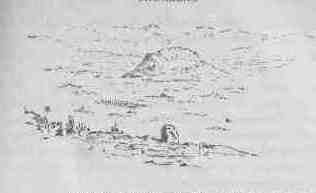
air of that summit), was the arena upon which were first fought out the chief destinies of the world.
And I still looked down upon it, wondering.
Was it in so small a space that all the legends of one's childhood were acted? Was the defence of the bridge against so neighbouring and petty an alliance? Were they peasants of a group of huts that handed down the great inheritance of discipline, and made an iron channel whereby, even to us, the antique virtues could descend as a living memory? It must be so; for the villages and ruins in one landscape comprised all the first generations of the history of Rome. The stones we admire, the large spirit of the last expression came from that rough village and sprang from the broils of that one plain; Rome was most vigorous before it could speak. So a man's verse, and all he has, are but the last outward appearance, late and already rigid, of an earlier, more plastic, and diviner fire.
'Upon this arena,' I still said to myself, 'were first fought out the chief destinies of the world'; and so, played upon by an unending theme, I ate and drank in a reverie, still wondering, and then lay down beneath the shade of a little tree that stood alone upon that edge of a new world. And wondering, I fell asleep under the morning sun.
But this sleep was not like the earlier oblivions that had refreshed my ceaseless journey, for I still dreamt as I slept of what I was to see, and visions of action without thought--pageants and mysteries--surrounded my spirit; and across the darkness of a mind remote from the senses there passed whatever is wrapped up in the great name of Rome.
When I woke the evening had come. A haze had gathered upon the plain. The road fell into Ronciglione, and dreams surrounded it upon every side. For the energy of the body those hours of rest had made a fresh and enduring
225
TOO MANY PEASANTS
vigour; for the soul no rest was needed. It had attained, at least for the next hour, a vigour that demanded only the physical capacity of endurance; an eagerness worthy of such great occasions found a marching vigour for its servant.
In Ronciglione I saw the things that Turner drew; I mean the rocks from which a river springs, and houses all massed together, giving the steep a kind of crown. This also accompanied that picture, the soft light which mourns the sun and lends half-colours to the world. It was cool, and the opportunity beckoned. I ate and drank, asking every one questions of Rome, and I passed under their great gate and pursued the road to the plain. In the mist, as it rose, there rose also a passion to achieve.
All the night long, mile after mile, I hurried along the Cassian Way. For five days I had slept through the heat, and the southern night had become my daytime; and though the mist was dense, and though the moon, now past her quarter, only made a vague place in heaven, yet expectation and fancy took more than the place of sight. In this fog I felt with every step of the night march the approach to the goal.
Long past the place I had marked as a halt, long past Sette Vene, a light blurred upon the white wreaths of vapour; distant songs and the noise of men feasting ended what had been for many, many hours--for more than twenty miles of pressing forward--an exaltation worthy of the influence that bred it. Then came on me again, after the full march, a necessity for food and for repose. But these things, which have been the matter of so much in this book, now seemed subservient only to the reaching of an end; they were left aside in the mind.
It was an inn with trellis outside making an arbour. In the yard before it many peasants sat at table; their beasts and waggons stood in the roadway, though, at this late hour, men were feeding some and housing others. Within, fifty men or more were making a meal or a carousal.
What feast or what necessity of travel made them keep the night alive I neither knew nor asked; but passing almost unobserved amongst them between the long tables, I took my place at the end, and the master served me with good food and wine. As I ate the clamour of the peasants sounded about me, and I mixed with the energy of numbers.
With a little difficulty I made the master understand that I wished to sleep till dawn. He led me out to a small granary (for the house was full), and showed me where I should sleep in the scented hay. He would take no money for such a lodging, and left me after showing me how the door latched and unfastened; and out of so many men, he was the last man whom I thanked for a service until I passed the gates of Rome.
226
ROME CALLS ME
Above the soft bed which the hay made, a square window, unglazed, gave upon the southern night; the mist hardly drifted in or past it, so still was the air. I watched it for a while drowsily; then sleep again fell on me.
But as I slept, Rome, Rome still beckoned me, and I woke in a struggling light as though at a voice calling, and slipping out I could not but go on to the end.
The small square paving of the Via Cassia, all even like a palace floor, rang under my steps. The parched banks and strips of dry fields showed through the fog (for its dampness did not cure the arid soil of the Campagna). The sun rose and the vapour lifted. Then, indeed, I peered through the thick air--but still I could see nothing of my goal, only confused folds of brown earth and burnt-up grasses, and farther off rare and un-northern trees.
I passed an old tower of the Middle Ages that was eaten away at its base by time or the quarrying of men; I passed a divergent way on the right where a wooden sign said 'The Triumphal Way', and I wondered whether it could be the road where ritual had once ordained that triumphs should go. It seemed lonely and lost, and divorced from any approach to sacred hills.
The road fell into a hollow where soldiers were manoeuvring. Even these could not arrest an attention that was fixed upon the approaching revelation. The road climbed a little slope where a branch went off to the left, and where there was a house and an arbour under vines. It was now warm day; trees of great height stood shading the sun; the place had taken on an appearance
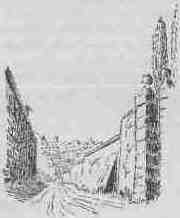
227
FAREWELL TO ALL MEN
of wealth and care. The mist had gone before I reached the summit of the rise.
There, from the summit, between the high villa walls on either side--at my very feet I saw the City.
And now all you people whatsoever that are presently reading, may have read, or shall in the future read, this my many-sided but now-ending book; all you also that in the mysterious designs of Providence may not be fated to read it for some very long time to come; you then I say, entire, englobed, and universal race of men both in gross and regardant, not only living and seeing the sunlight, but dead also under the earth; shades, or to come in procession afterwards out of the dark places into the day for a little, swarms of you, an army without end; all you black and white, red, yellow and brown, men, women, children and poets--all of you, wherever you are now, or have been, or shall be in your myriads and deka myriads and hendeka myriads, the time has come when I must bid you farewell--
Ludisti satis, edisti satis, atque bibisti; Tempus abire tibi est....
Only Lector I keep by me for a very little while longer with a special purpose, but even he must soon leave me; for all good things come to an end, and this book is coming to an end--has come to an end. The leaves fall, and they are renewed; the sun sets on the Vexin hills, but he rises again over the woods of Marly. Human companionship once broken can never be restored, and you and I shall not meet or understand each other again. It is so of all the poor links whereby we try to bridge the impassable gulf between soul and soul. Oh! we spin something, I know, but it is very gossamer, thin and strained, and even if it does not snap time will at last dissolve it.
Indeed, there is a song on it which you should know, and which runs--
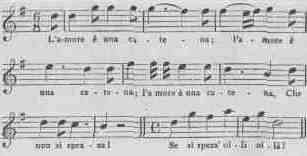
228
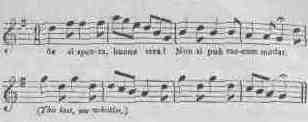
So my little human race, both you that have read this book and you that have not, good-bye in charity. I loved you all as I wrote. Did you all love me as much as I have loved you, by the black stone of Rennes I should be rich by now. Indeed, indeed, I have loved you all! You, the workers, all puffed up and dyspeptic and ready for the asylums; and you, the good-for-nothing lazy drones; you, the strong silent men, who have heads quite empty, like gourds; and you also, the frivolous, useless men that chatter and gabble to no purpose all day long. Even you, that, having begun to read this book, could get no further than page 47, and especially you who have read it manfully in spite of the flesh, I love you all, and give you here and now my final, complete, full, absolving, and comfortable benediction.
To tell the truth, I have noticed one little fault about you. I will not call it fatuous, inane, and exasperating vanity or self-absorption; I will put it in the form of a parable. Sit you round attentively and listen, dispersing yourselves all in order, and do not crowd or jostle.