HILAIRE BELLOC (continued 3)
Reading edition
For in the crossing of this bridge there was nothing in itself perilous. The sleepers lay very close together--I doubt if a man could have slipped between them; but, I know not how many hundred feet below, was the flashing of the torrent, and it turned my brain. For the only parapet there was a light line or pipe, quite slender and low down, running from one spare iron upright to another. These rather emphasized than encouraged my mood. And still as I resolutely put one foot in front of the other, and resolutely kept my eyes off the abyss and fixed on the opposing hill, and as the long curve before me was diminished by successive sharp advances, still my heart was caught half-way in every breath, and whatever it is that moves a man went uncertainly within me, mechanical and half-paralysed. The great height with that narrow unprotected ribbon across it was more than I could bear.
I dared not turn round and I dared not stop. Words and phrases began repeating themselves in my head as they will under a strain: so I know at sea a man perilously hanging on to the tiller makes a kind of litany of his instructions. The central part was passed, the three-quarters; the tension of that enduring effort had grown intolerable, and I doubted my ability to complete the task. Why? What could prevent me? I cannot say; it was all a bundle of imaginaries. Perhaps at bottom what I feared was sudden giddiness and the fall--
At any rate at this last supreme part I vowed one candle to Our Lady of Perpetual Succour if she would see that all went well, and this candle I later paid in Rome; finding Our Lady of Succour not hung up in a public place and known to all, as I thought She would be, but peculiar to a little church belonging to a Scotchman and standing above his high altar. Yet it is a very famous picture, and extremely old.
80
SAFETY BEYOND
Well, then, having made this vow I still went on, with panic aiding me, till I saw that the bank beneath had risen to within a few feet of the bridge, and that dry land was not twenty yards away. Then my resolution left me and I ran, or rather stumbled, rapidly from sleeper to sleeper till I could take a deep breath on the solid earth beyond.
I stood and gazed back over the abyss; I saw the little horrible strip between heaven and hell--the perspective of its rails. I was made ill by the relief from terror. Yet I suppose railway-men cross and recross it twenty times a day. Better for them than for me!
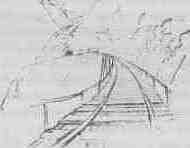
There is the story of the awful bridge of the Mont Terrible, and it lies to a yard upon the straight line--quid dicam--- the segment of the Great Circle uniting Toul and Rome.
The high bank or hillside before me was that which ends the gorge of the Doubs and looks down either limb of the sharp bend. I had here not to climb but to follow at one height round the curve. My way ran by a rather ill-made lane and passed a village. Then it was my business to make straight up the farther wall of the gorge, and as there was wood upon this, it looked an easy matter.
But when I came to it, it was not easy. The wood grew in loose rocks and the slope was much too steep for anything but hands and knees, and far too soft and broken for true climbing. And no wonder this ridge seemed a wall for
81
THE COMMON FIELD
steepness and difficulty, since it was the watershed between the Mediterranean and the cold North Sea. But I did not know this at the time. It must have taken me close on an hour before I had covered the last thousand feet or so that brought me to the top of the ridge, and there, to my great astonishment, was a road. Where could such a road lead, and why did it follow right along the highest edge of the mountains? The Jura with their unique parallels provide twenty such problems.
Wherever it led, however, this road was plainly perpendicular to my true route, and I had but to press on my straight line. So I crossed it, saw for a last time through the trees the gorge of the Doubs, and then got upon a path which led down through a field more or less in the direction of my pilgrimage.
Here the country was so broken that one could make out but little of its general features, but of course, on the whole, I was following down yet another southern slope, the southern slope of the third chain of the Jura, when, after passing through many glades and along a stony path, I found a kind of gate between two high rocks, and emerged somewhat suddenly upon a wide down studded with old trees and also many stunted yews, and this sank down to a noble valley which lay all before me.
The open down or prairie on which I stood I afterwards found to be called the 'Pasturage of Common Right', a very fine name; and, as a gallery will command a great hall, so this field like a platform commanded the wide and fading valley below.
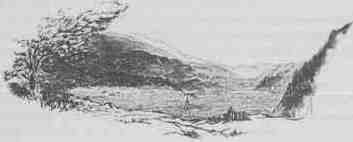
It was a very glad surprise to see this sight suddenly unrolled as I stood on the crest of the down. The Jura had hitherto been either lonely, or somewhat awful, or naked and rocky, but here was a true vale in which one could imagine a spirit of its own; there were corn lands and no rocks. The mountains on either
82
THE HUMAN TIDE
side did not rise so high as three thousand feet. Though of limestone they were rounded in form, and the slanting sun of the late afternoon (all the storm had left the sky) took them full and warm. The valley remaining wide and fruitful went on out eastward till the hills became mixed up with brume and distance. As I did not know its name I called it after the village immediately below me for which I was making; and I still remember it as the Valley of Glovelier, and it lies between the third and fourth ridges of the Jura.
Before leaving the field I drew what I saw but I was much too tired by the double and prodigious climb of the past hours to draw definitely or clearly. Such as it is, there it is. Then I went down over the smooth field.
There is something that distinguishes the rugged from the gracious in landscape, and in our Europe this something corresponds to the use and presence of men, especially in mountainous places. For men's habits and civilization fill the valleys and wash up the base of the hills, making, as it were, a tide mark. Into this zone I had already passed. The turf was trodden fine, and was set firm as it can only become by thousands of years of pasturing. The moisture that oozed out of the earth was not the random bog of the high places but a human spring, caught in a stone trough. Attention had been given to the trees. Below me stood a wall, which, though rough, was not the haphazard thing men pile up in the last recesses of the hills, but formed of chosen stones, and these bound together with mortar. On my right was a deep little dale with children playing in it--and this' I afterwards learned was called a 'combe': delightful memory! All our deeper hollows are called the same at home, and even the Welsh have the word, but they spell it cwm; it is their mountain way. Well, as I was saying, everything surrounding me was domestic and grateful, and I was therefore in a mood for charity and companionship when I came down the last dip and entered Glovelier. But Glovelier is a place of no excellence whatever, and if the thought did not seem extravagant I should be for putting it to the sword and burning it all down.
For just as I was going along full of kindly thoughts, and had turned into the sign of (I think it was) the 'Sun' to drink wine and leave them my benediction--
LECTOR. Why your benediction?
AUCTOR. Who else can give benedictions if people cannot when they are on pilgrimage? Learn that there are three avenues by which blessing can be bestowed, and three kinds of men who can bestow it.
(1) There is the good man, whose goodness makes him of himself a giver of blessings. His power is not conferred or of office, but is inhaerens persona; part of the stuff of his mind. This kind can confer the solemn benediction, or
THEORY OF BLESSINGS
Benedictio major, if they choose; but besides this their every kind thought, word, or action is a Benedictio generalise and even their frowns, curses, angry looks and irritable gestures may be called Benedictiones minores vel incerti. I believe I am within the definitions. I avoid heresy. All this is sound theology. I do not smell of the faggot. And this kind of Benedictory Power is the fount or type or natural origin, as it were, of all others.
(2) There is the Official of Religion who, in the exercise of his office--
LECTOR. For Heaven's sake--
AUCTOR. Who began it? You protested my power to give benediction, and I must now prove it at length; otherwise I should fall under the accusation of lesser Simony--that is, the false assumption of particular powers. Well, then, there is the Official who ex officio, and when he makes it quite clear that it is qua sponsus and not sicut ut ipse, can give formal benediction. This power belongs certainly to all Bishops, mitred Abbots, and Archimandrates; to Patriarchs of course, and a fortiori to the Pope. In Rome they will have it that Monsignores also can so bless, and I have heard it debated whether or no the same were not true in some rustic way of parish priests. However this may be, all their power proceeds, not from themselves, but from the accumulation of goodness left as a deposit by the multitudes of exceptionally good men who have lived in times past, and who have now no use for it.
(3) Thirdly--and this is my point--any one, good or bad, official or non-official, who is for the moment engaged in an opusfaustum can act certainly as a conductor or medium, and the influence of what he is touching or doing passes to you from him. This is admitted by every one who worships trees, wells, and stones; and indeed it stands to reason, for it is but a branch of the well-known 'Sanctificatio ex loco, opere, tactu vel conditione.' I will admit that this power is but vague, slight, tenuous, and dissipatory, still there it is: though of course its poor effect is to that of the Benedictio major what a cat's-paw in the Solent is to a north-east snorter on Lindsey Deeps.
I am sorry to have been at such length, but it is necessary to have these things thrashed out once for all. So now you see how I, being on pilgrimage, could give a kind of little creeping blessing to the people on the way, though, as St Louis said to the Hascisch-eaters, 'May it be a long time before you can kiss my bones.'
So I entered the 'Sun' inn and saw there a woman sewing, a great dull-faced man like an ox, and a youth writing down figures in a little book. I said--
'Good morning, madam, and sirs, and the company. Could you give me a little red wine?' Not a head moved.
84
THE RUDE PEASANTS
True I was very dirty and tired, and they may have thought me a beggar, to whom, like good sensible Christians who had no nonsense about them, they would rather have given a handsome kick than a cup of cold water. However, I think it was not only my poverty but a native churlishness which bound their bovine souls in that valley.
I sat down at a very clean table. I notice that those whom the Devil has made his own are always spick and span, just as firemen who have to go into great furnaces have to keep all their gear highly polished. I sat down at it, and said again, still gently--
'It is, indeed, a fine country this of yours. Could you give me a little red wine?'
Then the ox-faced man who had his back turned to me, and was the worst of the lot, said sulkily, not to me, but to the woman--
'He wants wine.'
The woman as sulkily said to me, not looking me in the eyes--
'How much will you pay?'
I said, 'Bring the wine. Set it here. See me drink it. Charge me your due.'
I found that this brutal way of speaking was just what was needed for the kine and cattle of this pen. She skipped off to a cupboard, and set wine before me, and a glass. I drank quite quietly till I had had enough, and asked what there was to pay. She said 'Threepence,' and I said 'Too much,' as I paid it. At this the ox-faced man grunted and frowned, and I was afraid; but hiding my fear I walked out boldly and slowly, and made a noise with my stick upon the floor of the hall without. Neither did I bid them farewell. But I made a sign at the house as I left it. Whether it suffered from this as did the house at Dorchester which the man in the boat caused to wither in one night, is more than I can tell.
The road led straight across the valley and approached the further wall of hills. These I saw were pierced by one of the curious gaps which are peculiar to limestone ranges. Water cuts them, and a torrent ran through this one also. The road through it, gap though it was, went up steeply, and the further valley was evidently higher than the one I was leaving. It was already evening as I entered this narrow ravine; the sun only caught the tops of the rock-walls. My fatigue was very great, and my walking painful to an extreme, when, having come to a place where the gorge was narrowest and where the two sides were like the posts of a giant's stile, where also the fifth ridge of the Jura stood up beyond me in the further valley, a vast shadow, I sat down wearily and drew what not even my exhaustion could render unremarkable.
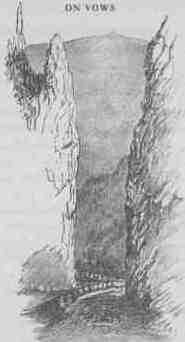
While I was occupied sketching the slabs of limestone, I heard wheels coming up behind me, and a boy in a waggon stopped and hailed me.
What the boy wanted to know was whether I would take a lift, and this he said in such curious French that I shuddered to think how far I had pierced into the heart of the hills, and how soon I might come to quite strange people. I was greatly tempted to get into his cart, but though I had broken so many of my vows one remained yet whole and sound, which was that I would ride upon no wheeled thing. Remembering this, therefore, and considering that the Faith is rich in interpretation, I clung on to the waggon in such a manner that it did all my work for me, and yet could not be said to be actually carrying me. Distinguo. The essence of a vow is its literal meaning. The spirit and intention are for the major morality, and concern Natural Religion, but when upon a point of ritual or of dedication or special worship a man talks to you of the Spirit and Intention, and complains of the dryness of the Word, look at him askance. He is not far removed from Heresy.
I knew a man once that was given to drinking, and I made up this rule for him to distinguish between Bacchus and the Devil. To wit: that he should never drink what has been made and sold since the Reformation--I mean especially
86
LITERAL VOW
spirits and champagne. Let him (said I) drink red wine and white, good beer and mead--if he could get it--liqueurs made by monks, and, in a word, all those feeding, fortifying, and confirming beverages that our fathers drank in old time; but not whisky, nor brandy, nor sparkling wines, not absinthe, nor the kind of drink called gin. This he promised to do, and all went well. He became a merry companion, and began to write odes. His prose clarified and set, that had before been very mixed and cloudy. He slept well; he comprehended divine things; he was already half a republican, when one fatal day--it was the feast of the eleven thousand virgins, and they were too busy up in heaven to consider the needs of us poor hobbling, polyktonous and betempted wretches of men--I went with him to the Society for the Prevention of Annoyances to the Rich, where a certain usurer's son was to read a paper on the cruelty of Spaniards to their mules. As we were all seated there round a table with a staring green cloth on it, and a damnable gas pendant above, the host of that evening offered him whisky and water, and, my back being turned, he took it. Then when I would have taken it from him he used these words--
'After all, it is the intention of a pledge that matters;' and I saw that all was over, for he had abandoned definition, and was plunged back into the horrible mazes of Conscience and Natural Religion.
What do you think, then, was the consequence? Why, he had to take some nasty pledge or other to drink nothing whatever, and become a spectacle and a judgement, whereas if he had kept his exact word he might by this time have been a happy man.
Remembering him and pondering upon the advantage of strict rule, I hung on to my cart, taking care to let my feet still feel the road, and so passed through the high limestone gates of the gorge, and was in the fourth valley of the Jura, with the fifth ridge standing up black and huge before me against the last of the daylight. There were as yet no stars.
There, in this silent place, was the little village of Undervelier, and I thanked the boy, withdrew from his cart, and painfully approached the inn, where I asked the woman if she could give me something to eat, and she said that she could in about an hour, using, however, with regard to what it was I was to have, words which I did not understand. For the French had become quite barbaric, and I was now indeed lost in one of the inner places of the world.
A cigar is, however, even in Undervelier, a cigar; and the best cost a penny. One of these, therefore, I bought, and then I went out smoking it into the village square, and, finding a low wall, leaned over it and contemplated the glorious clear green water tumbling and roaring along beneath it on the other side; for a little river ran through the village.
ON THE FAITH
As I leaned there resting and communing I noticed how their church, close at hand, was built along the low banks of the torrent. I admired the luxuriance of the grass these waters fed, and the generous arch of the trees beside it. The graves seemed set in a natural place of rest and home, and just beyond this churchyard was that marriage of hewn stone and water which is the source of so peculiar a satisfaction; for the church tower was built boldly right out into the stream and the current went eddying round it. But why it is that strong human building when it dips into water should thus affect the mind I cannot say, only I know that it is an emotion apart to see our device and structure where it is most enduring come up against and challenge that element which we cannot conquer, and which has always in it something of danger for men. It is therefore well to put strong mouldings on to piers and quays, and to make an architecture of them, and so it was a splendid thought of the Romans to build their villas right out to sea; so they say does Venice enthrall one, but where I have most noticed this thing is at the Mont St Michel--only one must take care to shut one's eyes or sleep during all the low tide.
As I was watching that stream against those old stones, my cigar being now half smoked, a bell began tolling, and it seemed as if the whole village were pouring into the church. At this I was very much surprised, not having been used at any time of my life to the unanimous devotion of an entire population, but having always thought of the Faith as something fighting odds, and having seen unanimity only in places where some sham religion or other glozed over our tragedies and excused our sins. Certainly to see all the men, women, and children of a place taking Catholicism for granted was a new sight, and so I put my cigar carefully down under a stone on the top of the wall and went in with them. I then saw that what they were at was vespers.
All the village sang, knowing the psalms very well, and I noticed that their Latin was nearer German than French; but what was most pleasing of all was to hear from all the men and women together that very noble good-night and salutation to God which begins--
Te, lucis ante terminum.
My whole mind was taken up and transfigured by this collective act, and I saw for a moment the Catholic Church quite plain, and I remembered Europe, and the centuries. Then there left me altogether that attitude of difficulty and combat which, for us others, is always associated with the Faith. The cities dwindled in my imagination, and I took less heed of the modern noise. I went out with them into the clear evening and the cool. I found my cigar and lit it again, and musing much more deeply than before, not without tears, I considered the nature of Belief.
STILL ON FAITH
Of its nature it breeds a reaction and an indifference. Those who believe nothing but only think and judge cannot understand this. Of its nature it struggles with us. And we, we, when our youth is full on us, invariably reject it and set out in the sunlight content with natural things. Then for a long time we are like men who follow down the cleft of a mountain and the peaks are hidden from us and forgotten. It takes years to reach the dry plain, and then we look back and see our home.
What is it, do you think, that causes the return? I think it is the problem of living; for every day, every experience of evil, demands a solution. That solution is provided by the memory of the great scheme which at last we remember. Our childhood pierces through again ... But I will not attempt to explain it, for I have not the power; only I know that we who return suffer hard things; for there grows a gulf between us and many companions. We are perpetually thrust into minorities, and the world almost begins to talk a strange language; we are troubled by the human machinery of a perfect and superhuman revelation; we are over-anxious for its safety, alarmed, and in danger of violent decisions.
And this is hard: that the Faith begins to make one abandon the old way of judging. Averages and movements and the rest grow uncertain. We see things from within and consider one mind or a little group as a salt or leaven. The very nature of social force seems changed to us. And this is hard when a man has loved common views and is happy only with his fellows.
And this again is very hard, that we must once more take up that awful struggle to reconcile two truths and to keep civic freedom sacred in spite of the organization of religion, and not to deny what is certainly true. It is hard to accept mysteries, and to be humble. We are tost as the great schoolmen were tost, and we dare not neglect the duty of that wrestling.
But the hardest thing of all is that it leads us away, as by a command, from all that banquet of the intellect than which there is no keener joy known to man.
I went slowly up the village place in the dusk, thinking of this deplorable weakness in men that the Faith is too great for them, and accepting it as an inevitable burden. I continued to muse with my eyes upon the ground ...
There was to be no more of that studious content, that security in historic analysis, and that constant satisfaction of an appetite which never cloyed. A wisdom more imperative and more profound was to put a term to the comfortable wisdom of learning. All the balance of judgement, the easy, slow convictions, the broad grasp of things, the vision of their complexity, the pleasure in their innumerable life--all that had to be given up. Fanaticisms were no longer entirely to be despised, just appreciations and a strong grasp of reality no longer entirely to be admired.
89
ON STYLE
The Catholic Church will have no philosophies. She will permit no comforts; the cry of the martyrs is in her far voice; her eyes that see beyond the world present us heaven and hell to the confusion of our human reconciliations, our happy blending of good and evil things.
By the Lord! I begin to think this intimate religion as tragic as a great love. There came back into my mind a relic that I have in my house. It is a panel of the old door of my college, having carved on it my college arms. I remembered the Lion and the Shield, Haec fuit, Haec almae janua sacra domus. Yes, certainly religion is as tragic as first love, and drags us out into the void away from our dear homes.
It is a good thing to have loved one woman from a child, and it is a good thing not to have to return to the Faith.
They cook worse in Undervelier than any place I was ever in, with the possible exception of Omaha, Neb.
LECTOR. Why do you use phrases like 'possible exception'?
AUCTOR. Why not? I see that all the religion I have stuck into the book has no more effect on you than had Rousseau upon Sir Henry Maine. You are as full of Pride as a minor Devil. You would avoid the cliché and the commonplace, and the phrase toute faite. Why? Not because you naturally write odd prose--contrariwise, left to yourself you write pure journalese; but simply because you are swelled and puffed up with a desire to pose. You want what the Martha Brown school calls 'distinction' in prose. My little friend, I know how it is done, and I find it contemptible. People write their articles at full speed, putting down their unstudied and valueless conclusions in English as pale as a film of dirty wax--sometimes even they dictate to a typewriter. Then they sit over it with a blue pencil and carefully transpose the split infinitives, and write alternative adjectives, and take words away out of their natural place in the sentence and generally put the Queen's English--yes, the Queen's English--on the rack. And who is a penny the better for it? The silly authors get no real praise, not even in the horrible stucco villas where their clique meet on Sundays. The poor public buys the Marvel and gasps at the cleverness of the writing and despairs, and has to read what it can understand, and is driven back to toshy novels about problems, written by cooks. 'The hungry sheep,' as some one says somewhere, 'look up and are not fed;' and the same poet well describes your pipings as being on wretched straw pipes that are 'scrannel'--a good word.
Oh, for one man who should write healthy, hearty, straightforward English! Oh, for Cobbett! There are indeed some great men who write twistedly simply
90
THE GERMAN
Because they cannot help it, but their honesty is proved by the mass they turn out. What do you turn out, you higglers and sticklers? Perhaps a bad triolet every six months, and a book of criticism on something thoroughly threadbare once in five years. If I had my way--
LECTOR. I am sorry to have provoked all this.
AUCTOR. Not at all! Not at all! I trust I have made myself clear.
Well, as I was saying, they cook worse at Undervelier than any place I was ever in, with the possible exception of Omaha, Neb. However, I forgave them, because they were such good people, and after a short and bitter night I went out in the morning before the sun rose and took the Moutier road.
The valley in which I was now engaged--the phrase seems familiar--was more or less like an H. That is, there were two high parallel ranges bounding it, but across the middle a low ridge of perhaps a thousand feet. The road slowly climbed this ridge through pastures where cows with deep-toned bells were rising from the dew on the grass, and where one or two little cottages and a village already sent up smoke. All the way up I was thinking of the surfeit of religion I had had the night before, and also of how I had started that morning without bread or coffee, which was a folly.
When I got to the top of the ridge there was a young man chopping wood outside a house, and I asked him in French how far it was to Moutier. He answered in German, and I startled him by a loud cry, such as sailors give when they see land, for at last I had struck the boundary of the languages, and was with pure foreigners for the first time in my life. I also asked him for coffee, and as he refused it I took him to be a heretic and went down the road making up verses against all such, and singing them loudly through the forest that now arched over me and grew deeper as I descended.
And my first verse was--
Heretics all, whoever you be, In Tarbes or Nimes, or over the sea, You never shall have good words from me. Caritas non conturbat me.
If you ask me why I put a Latin line at the end, it was because I had to show that it was a song connected with the Universal Fountain and with European culture, and with all that Heresy combats. I sang it to a lively hymn-tune that I had invented for the occasion.
I then thought what a fine fellow I was, and how pleasant were my friends when I agreed with them. I made up this second verse, which I sang even more loudly than the first; and the forest grew deeper, sending back echoes--
HERETICS
But Catholic men that live upon wine Are deep in the water, and frank, and fine; Wherever I travel I find it so, Benedicamus Domino.
There is no doubt, however, that if one is really doing a catholic work, and expressing one's attitude to the world, charity, pity, and a great sense of fear should possess one, or, at least, appear. So I made up this third verse and sang it to suit--
On childing women that are forlorn, And men that sweat in nothing but scorn: That is on all that ever were born, Miserere Domine.
Then, as everything ends in death, and as that is just what Heretics least like to be reminded of, I ended thus--
To my poor self on my deathbed, And all my dear companions dead, Because of the love that I bore them, Dona Eis Requiem.
I say 'I ended.' But I did not really end there, for I also wrote in the spirit of the rest a verse of Mea Culpa and Confession of Sin, but I shall not print it here.
So my song over and the woods now left behind, I passed up a dusty piece of road into Moutier, a detestable town, all whitewashed and orderly, down under the hills.
I was tired, for the sun was now long risen and somewhat warm, and I had walked ten miles, and that over a high ridge; and I had written a canticle and sung it--- and all that without a sup or a bite. I therefore took bread, coffee, and soup in Moutier, and then going a little way out of the town I crossed a stream off the road, climbed a knoll, and, lying under a tree, I slept.
I awoke and took the road.
The road after Moutier was not a thing for lyrics; it stirred me in no way. It was bare in the sunlight, had fields on either side; and in the fields stood houses. In the houses were articulately-speaking mortal men.
There is a school of Poets (I cannot read them myself) who treat of common things, and their admirers tell us that these men raise the things of everyday
92
EVERYDAY LIFE, HORRORS THEREOF
life to the plane of the supernatural. Note that phrase, for it is a shaft of light through a cloud revealing their disgusting minds.
Everyday life! As La Croix said in a famous leading article: 'La Presse?' POOH!' I know that everyday life. It goes with sandals and pictures of lean ugly people all just like one another in browny photographs on the wall, and these pictures are called, one 'The House of Life', or another, 'The Place Beautiful', or yet again a third, 'The Lamp of the Valley', and when you complain and shift about uneasily before these pictures, the scrub-minded and dusty-souled owners of them tell you that of course in photographs you lose the marvellous colour of the original. This everyday life has mantelpieces made of the same stuff as cafe-tables, so that by instinct I try to make rings on them with my wine-glass, and the people who suffer this life get up every morning at eight, and the poor sad men of the house slave at wretched articles and come home to hear more literature and more appreciations, and the unholy women do nothing and attend to local government, that is, the oppression of the poor; and altogether this accursed everyday life of theirs is instinct with the four sins crying to heaven for vengeance, and there is no humanity in it, and no simplicity, and no recollection. I know whole quarters of the towns of that life where they have never heard of Virtus or Verecundia or Pietas.
LECTOR. Then--
AUCTOR. Alas! alas! Dear Lector, in these houses there is no honest dust. Not a bottle of good wine or bad; no prints inherited from one's uncle, and no children's books by Mrs Barbauld or Miss Edgeworth; no human disorder, nothing of that organic comfort which makes a man's house like a bear's fur for him. They have no debts, they do not read in bed, and they will have difficulty in saving their souls.
LECTOR. Then tell me, how would you treat of common things?
AUCTOR. Why, I would leave them alone; but if I had to treat of them I will show you how I would do it. Let us have a dialogue about this road from Moutier.
LECTOR. By all means.
AUCTOR. What a terrible thing it is to miss one's sleep. I can hardly bear the heat of the road, and my mind is empty!
LECTOR. Why, you have just slept in a wood!
AUCTOR. Yes, but that is not enough. One must sleep at night.
LECTOR. My brother often complains of insomnia. He is a policeman.
AUCTOR. Indeed? It is a sad affliction.
LECTOR. Yes, indeed.
AUCTOR. Indeed, yes.
93
PLAYS WITHOUT WORDS
LECTOR. I cannot go on like this.
AUCTOR. There. That is just what I was saying. One cannot treat of common things: it is not literature; and for my part, if I were the editor even of a magazine, and the author stuck in a string of dialogue, I would not pay him by the page but by the word, and I would count off 5 per cent for epigrams, 10 per cent for dialect, and some quarter or so for those stage directions in italics which they use to pad out their work.
So. I will not repeat this experiment, but next time I come to a bit of road about which there is nothing to say, I will tell a story or sing a song, and to that I pledge myself.
By the way, I am reminded of something. Do you know those books and stories in which parts of the dialogues often have no words at all? Only dots and dashes and asterisks and interrogations? I wonder what the people are paid for it? If I knew I would earn a mint of money, for I believe I have a talent for it. Look at this--
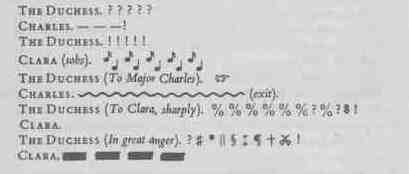
There. That seems to me worth a good deal more money than all the modern 'delineation of character', and 'folk' nonsense ever written. What verve! What terseness! And yet how clear!
LECTOR. Let us be getting on.
AUCTOR. By all means, and let us consider more enduring things.
After a few miles the road going upwards, I passed through another gap in the hills and--
LECTOR. Pardon me, but I am still ruminating upon that little tragedy of yours. Why was the guardian a duchess?
AUCTOR. Well, it was a short play and modern, was it not?
94
THE ACOLYTE OF RHEIMS
LECTOR. Yes. And therefore, of course, you must have a title in it. I know that. I do not object to it. What I want to know is, why a duchess?
AUCTOR. On account of the reduction of scale: the concentration of the thing. You see in the full play there would have been a lord, two baronets, and say three ladies, and I could have put suitable words into their mouths. As it was I had to make absolutely sure of the element of nobility without any help, and, as it were, in one startling moment. Do you follow? Is it not art?
I cannot conceive why a pilgrimage, an adventure so naturally full of great, wonderful, far-off and holy things should breed such fantastic nonsense as all this; but remember at least the little acolyte of Rheims, whose father, in 1512, seeing him apt for religion, put him into a cassock and designed him for the Church, whereupon the youngling began to be as careless and devilish as Mercury, putting beeswax on the misericords, burning feathers in the censer, and even going round himself with the plate without leave and scolding the rich in loud whispers when they did not put in enough. So one way with another they sent him home to his father; the archbishop thrusting him out of the south porch with his own hands and giving him the Common or Ferial Malediction, which is much the same as that used by carters to stray dogs.
When his father saw him he fumed terribly, cursing like a pagan, and asking whether his son were a roysterer fit for the gallows as well as a fool fit for a cassock. On hearing which complaint the son very humbly and contritely said--
'It is not my fault but the contact with the things of the Church that makes me gambol and frisk, just as the Devil they say is a good enough fellow left to himself and is only moderately heated, yet when you put him into holy water all the world is witness how he hisses and boils.'
The boy then taking a little lamb which happened to be in the drawing-room, said--
'Father, see this little lamb; how demure he is and how simple and innocent, and how foolish and how tractable. Yet observe!' With that he whipped the cassock from his arm where he was carrying it and threw it all over the lamb, covering his head and body; and the lamb began plunging and kicking and bucking and rolling and heaving and sliding and rearing and pawing and most vigorously wrestling with the clerical and hierarchically constraining garment of darkness, and bleating all the while more and more angrily and loudly, for all the world like the great goat Baphomet himself when the witches dance about him on All-hallowe'en. But when the boy suddenly plucked off the cassock again, the lamb, after sneezing a little and finding his feet, became quite gentle once more, and looked only a little confused and dazed.
95
THE MILLS OF GOD
'There, father,' said the boy, 'is proof to you of how the meekest may be driven to desperation by the shackles I speak of, and which I pray you never lay upon me again.'
His father finding him so practical and wise made over his whole fortune and business to him, and thus escaped the very heavy Heriot and Death Dues of those days, for he was a Socage tenant of St Remi in Double Burgage. But we stopped all that here in England by the statute of Uses, and I must be getting back to the road before the dark catches me.
As I was saying, I came to a gap in the hills, and there was there a house or two called Gansbrunnen, and one of the houses was an inn. Just by the inn the road turned away sharply up the valley; the very last slope of the Jura, the last parallel ridge, lay straight before me all solemn, dark, and wooded, and making a high feathery line against the noon. To cross this there was but a vague path rather misleading, and the name of the mountain was Weissenstein.
So before that last effort which should lead me over those thousands of feet, and to nourish Instinct (which would be of use to me when I got into that impenetrable wood), I turned into the inn for wine.
A very old woman having the appearance of a witch sat at a dark table by the little criss-cross window of the dark room. She was crooning to herself, and I made the sign of the evil eye and asked her in French for wine; but French she did not understand. Catching, however, two words which sounded like the English 'White' and 'Red', I said 'Yaw' after the last and nodded, and she brought up a glass of exceedingly good red wine which I drank in silence, she watching me uncannily.
Then I paid her with a five-franc piece, and she gave me a quantity of small change rapidly, which, as I counted it, I found to contain one Greek piece of fifty lepta very manifestly of lead. This I held up angrily before her, and (not without courage, for it is hard to deal with the darker powers) I recited to her slowly that familiar verse which the well-known Satyricus Empiricius was for ever using in his now classical attacks on the grammarians; and without any Alexandrian twaddle of accents I intoned to her--

and so left her astounded to repentance or to shame.
Then I went out into the sunlight, and crossing over running water put myself out of her power.
96
BETWEEN THE TREES
The wood went up darkly and the path branched here and there so that I was soon uncertain of my way, but I followed generally what seemed to me the most southerly course, and so came at last up steeply through a dip or ravine that ended high on the crest of the ridge.
Just as I came to the end of the rise, after perhaps an hour, perhaps two, of that great curtain of forest which had held the mountain side, the trees fell away to brushwood, there was a gate, and then the path was lost upon a fine open sward which was the very top of the Jura and the coping of that multiple wall which defends the Swiss Plain. I had crossed it straight from edge to edge, never turning out of my way.
It was too marshy to lie down on it, so I stood a moment to breathe and look about me.
It was evident that nothing higher remained, for though a new line of wood--firs and beeches--stood before me, yet nothing appeared above them, and I knew that they must be the fringe of the descent. I approached this edge of wood, and saw that it had a rough fence of post and rails bounding it, and
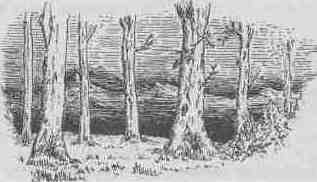
as I was looking for the entry of a path (for my original path was lost, as such tracks are, in the damp grass of the little down) there came to me one of those great revelations which betray to us suddenly the higher things and stand afterwards firm in our minds.
There, on this upper meadow, where so far I had felt nothing but the ordinary gladness of The Summit, I had a vision.
What was it I saw? If you think I saw this or that, and if you think I am inventing the words, you know nothing of men.
97
THE VISION OF THE ALPS
I saw between the branches of the trees in front of me a sight in the sky that made me stop breathing, just as great danger at sea, or great surprise in love, or a great deliverance will make a man stop breathing. I saw something I had known in the West as a boy, something I had never seen so grandly discovered as was this. In between the branches of the trees was a great promise of unexpected lights beyond.
I pushed left and right along that edge of the forest and along the fence that bound it, until I found a place where the pine-trees stopped, leaving a gap, and where on the right, beyond the gap, was a tree whose leaves had failed; there the ground broke away steeply below me, and the beeches fell, one below the other, like a vast cascade, towards the limestone cliffs that dipped down still further, beyond my sight. I looked through this framing hollow and praised God. For there below me, thousands of feet below me, was what seemed an illimitable plain; at the end of that world was an horizon, and the dim bluish sky that overhangs an horizon.
There was brume in it and thickness. One saw the sky beyond the edge of the world getting purer as the vault rose. But right up--a belt in that empyrean--ran peak and field and needle of intense ice, remote, remote from the world. Sky beneath them and sky above them, a steadfast legion, they glittered as though with the armour of the immovable armies of Heaven. Two days' march, three days' march away, they stood up like the walls of Eden. I say it again, they stopped my breath. I had seen them.
So little are we, we men: so much are we immersed in our muddy and immediate interests that we think, by numbers and recitals, to comprehend distance or time, or any of our limiting infinities. Here were these magnificent creatures of God, I mean the Alps, which now for the first time I saw from the height of the Jura; and because they were fifty or sixty miles away, and because they were a mile or two high, they were become something different from us others, and could strike one motionless with the awe of supernatural things. Up there in the sky, to which only clouds belong and birds and the last trembling colours of pure light, they stood fast and hard; not moving as do the things of the sky. They were as distant as the little upper clouds of summer, as fine and tenuous; but in their reflection and in their quality as it were of weapons (like spears and shields of an unknown array) they occupied the sky with a sublime invasion: and the things proper to the sky were forgotten by me in their presence as I gazed.
To what emotion shall I compare this astonishment? So, in first love one finds that this can belong to me.
Their sharp steadfastness and their clean uplifted lines compelled my
THE ALPS, THEIR PICTURE
adoration. Up there, the sky above and below them, part of the sky, but part of us, the great peaks made communion between that homing creeping part of me which loves vineyards and dances and a slow movement among pastures, and that other part which is only properly at home in Heaven. I say that this kind of description is useless, and that it is better to address prayers to such things than to attempt to interpret them for others.
These, the great Alps, seen thus, link one in some way to one's immortality. Nor is it possible to convey, or even to suggest, those few fifty miles, and those few thousand feet; there is something more. Let me put it thus: that from the height of Weissenstein I saw, as it were, my religion. I mean, humility, the fear of death, the terror of height and of distance, the glory of God, the infinite potentiality of reception whence springs that divine thirst of the soul; my aspiration also towards completion, and my confidence in the dual destiny. For I know that we laughers have a gross cousinship with the most high, and it is this contrast and perpetual quarrel which feeds a spring of merriment in the soul of a sane man.
Since I could now see such a wonder and it could work such things in my mind, therefore, some day I should be part of it. That is what I felt.
This it is also which leads some men to climb mountain-tops, but not me, for I am afraid of slipping down.
Then you will say, if I felt all this, why do I draw it, and put it in my book, seeing that my drawings are only for fun? My jest drags down such a memory and makes it ludicrous. Well, I said in my beginning that I would note down whatever most impressed me, except figures, which I cannot draw (I mean figures of human beings, for mathematical figures I can draw well enough), and I have never failed in this promise, except where, as in the case of Porrentruy, my drawing was blown away by the wind and lost--- if anything ever is lost. So I put down here this extraordinary drawing of what I saw,
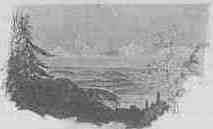
99
THE CLIFF
which is about as much like it as a printed song full of misprints is to that same song sung by an army on the march. And I am consoled by remembering that if I could draw infinitely well, then it would become sacrilege to attempt to draw that sight. Moreover, I am not going to waste any more time discussing why I put in this little drawing. If it disturbs your conception of what it was I saw, paste over it a little bit of paper. I have made it small for the purpose; but remember that the paper should be thin and opaque, for thick paper will interfere with the shape of this book, and transparent paper will disturb you with a memory of the picture.
It was all full of this, as a man is full of music just after hearing it, that I plunged down into the steep forest that led towards the great plain; then, having found a path, I worked zig-zag down it by a kind of gully that led through to a place where the limestone cliffs were broken, and (so my map told me) to the town of Soleure, which stands at the edge of the plain upon the river Aar.
I was an hour or more going down the enormous face of the Jura, which is here an escarpment, a cliff of great height, and contains but few such breaks by which
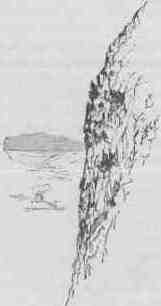
100
SOLEURE
men can pick their way. It was when I was about half-way down the mountain side that its vastness most impressed me. And yet it had been but a platform as it were, from which to view the Alps and their much greater sublimity.
This vastness, even of these limestone mountains, took me especially at a place where the path bordered a steep, or rather precipitous, lift of white rock to which only here and there a tree could cling.
I was still very high up, but looking somewhat more eastward than before, and the plain went on inimitably towards some low vague hills; nor in that direction could any snow be seen in the sky. Then at last I came to the slopes which make a little bank under the mountains, and there, finding a highroad, and oppressed somewhat suddenly by the afternoon heat of those low places, I went on more slowly towards Soleure.
Beside me, on the road, were many houses, shaded by great trees, built of wood, and standing apart. To each of them almost was a little water-wheel, run by the spring which came down out of the ravine. The water-wheel in most cases worked a simple little machine for sawing planks, but in other cases it seemed used for some purpose inside the house, which I could not divine; perhaps for spinning.
All this place was full of working, and the men sang and spoke at their work in German, which I could not understand. I did indeed find one man, a young hay-making man carrying a scythe, who knew a little French and was going my way. I asked him, therefore, to teach me German, but he had not taught me much before we were at the gates of the old town and then I left him. It is thus, you will see, that for my next four days or five, which were passed among the German-speaking Swiss, I was utterly alone.
This book must not go on for ever; therefore I cannot say very much about Soleure, although there is a great deal to be said about it. It is distinguished by an impression of unity, and of civic life, which I had already discovered in all these Swiss towns; for though men talk of finding the Middle Ages here or there, I for my part never find it, save where there has been democracy to preserve it. Thus I have seen the Middle Ages especially alive in the small towns of Northern France, and I have seen the Middle Ages in the University of Paris. Here also in Switzerland. As I had seen it at St Ursanne, so I found it now at Soleure. There were huge gates flanking the town, and there was that evening a continual noise of rifles, at which the Swiss are for ever practising. Over the church, however, I saw something terribly seventeenth century, namely, Jaweh in great Hebrew letters upon its front.
THE REMOTE INN
Well, dining there of the best they had to give me (for this was another milestone in my pilgrimage), I became foolishly refreshed and valiant, and instead of sleeping in Soleure, as a wise man would have done, I determined, though it was now nearly dark, to push on upon the road to Burgdorf.
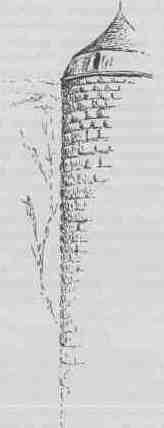
I therefore crossed the river Aar, which is here magnificently broad and strong, and has bastions jutting out into it in a very bold fashion. I saw the last colourless light of evening making its waters seem like dull metal between the gloomy banks; I felt the beginnings of fatigue, and half regretted my determination. But as it is quite certain that one should never go back, I went on in the darkness, I do not know how many miles, till I reached some cross roads and an inn.
102
THE GOOD SAVAGES
This inn was very poor, and the people had never heard in their lives, apparently, that a poor man on foot might not be able to talk German, which seemed to me an astonishing thing; and as I sat there ordering beer for myself and for a number of peasants (who but for this would have me their butt, and even as it was found something monstrous in me), I pondered during my continual attempts to converse with them (for I had picked up some ten words of their language) upon the folly of those who imagine the world to be grown smaller by railways.
I suppose this place was more untouched, as the phrase goes, that is, more living, more intense, and more powerful to affect others, whenever it may be called to do so, than are even the dear villages of Sussex that lie under my downs. For those are haunted by a nearly cosmopolitan class of gentry, who will have actors, financiers, and what not to come and stay with them, and who read the paper, and from time to time address their village folk upon matters of politics. But here, in this broad plain by the banks of the Emmen, they knew of nothing but themselves and the Church which is the common bond of Europe, and they were in the right way. Hence it was doubly hard on me that they should think me such a stranger.
When I had become a little morose at their perpetual laughter, I asked for a bed, and the landlady, a woman of some talent, showed me on her fingers that the beds were 50c., 75c., and a franc. I determined upon the best, and was given indeed a very pleasant room, having in it the statue of a saint, and full of a country air. But I had done too much in this night march, as you will presently learn, for my next day was a day without salt, and in it appreciation left me. And this breakdown of appreciation was due to what I did not know at the time to be fatigue, but to what was undoubtedly a deep inner exhaustion.
When I awoke next morning it was as it always is: no one was awake, and I had the field to myself, to slip out as I chose. I looked out of the window into the dawn. The race had made its own surroundings.
These people who suffocated with laughter at the idea of one's knowing no German, had produced, as it were, a German picture by the mere influence of years and years of similar thoughts.
Out of my window I saw the eaves coming low down. I saw an apple-tree against the grey light. The tangled grass in the little garden, the dog-kennel, and the standing butt were all what I had seen in those German pictures which they put into books for children, and which are drawn in thick black lines: nor did I see any reason why tame faces should not appear in that framework. I
103
ISOLATION
expected the light lank hair and the heavy unlifting step of the people whose only emotions are in music.
But it was too early for any one to be about, and my German garden, si j'ose m'exprimer ainsi, had to suffice me for an impression of the Central Europeans. I gazed at it a little while as it grew lighter. Then I went downstairs and slipped the latch (which, being German, was of a quaint design). I went out into the road and sighed profoundly.
All that day was destined to be covered, so far as my spirit was concerned, with a motionless lethargy. Nothing seemed properly to interest or to concern me, and not till evening was I visited by any muse. Even my pain (which was now dull and chronic) was no longer a subject for my entertainment, and I suffered from an uneasy isolation that had not the merit of sharpness and was no spur to the mind. I had the feeling that every one I might see would be a stranger, and that their language would be unfamiliar to me, and this, unlike most men who travel, I had never felt before.
The reason being this: that if a man has English thoroughly he can wander over a great part of the world familiarly, and meet men with whom he can talk. And if he has French thoroughly all Italy, and I suppose Spain, certainly Belgium, are open to him. Not perhaps that he will understand what he hears or will be understood of others, but that the order and nature of the words and the gestures accompanying them are his own. Here, however, I, to whom English and French were the same, was to spend (it seemed) whole days among a people who put their verbs at the end, where the curses or the endearments come in French and English, and many of whose words stand for ideas we have not got. I had no room for good-fellowship. I could not sit at tables and expand the air with terrible stories of adventure, nor ask about their politics, nor provoke them to laughter or sadness by my tales. It seemed a poor pilgrimage taken among dumb men.
Also I have no doubt that I had experienced the ebb of some vitality, for it is the saddest thing about us that this bright spirit with which we are lit from within like lanterns, can suffer dimness. Such frailty makes one fear that extinction is our final destiny, and it saps us with numbness, and we are less than ourselves. Seven nights had I been on pilgrimage, and two of them had I passed in the open. Seven great heights had I climbed: the Forest, Archettes, the Ballon, the Mont Terrible, the Watershed, the pass by Moutier, the Weissenstein. Seven depths had I fallen to: twice to the Moselle, the gap of Belfort, the gorge of the Doubs, Glovelier valley, the hole of Moutier, and now this plain of the Aar. I had marched 180 miles. It was no wonder that on this eighth day I was oppressed and that all the light long I drank no good wine,
104
DESOLATION
met no one to remember well, nor sang any songs. All this part of my way was full of what they call Duty, and I was sustained only by my knowledge that the vast mountains (which had disappeared) would be part of my life very soon if I still went on steadily towards Rome.
The sun had risen when I reached Burgdorf, and I there went to a railway station, and outside of it drank coffee and ate bread. I also bought old newspapers in French, and looked at everything wearily and with sad eyes. There was nothing to draw. How can a man draw pain in the foot and knee? And that was all there was remarkable at that moment.
I watched a train come in. It was full of tourists, who (it may have been a subjective illusion) seemed to me common and worthless people, and sad into the bargain. It was going to Interlaken; and I felt a languid contempt for people who went to Interlaken instead of driving right across the great hills to Rome.
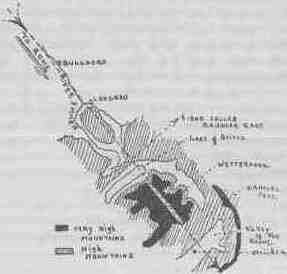
After an hour, or so of this melancholy dawdling, I put a map before me on a little marble table, ordered some more coffee, and blew into my tepid life a moment of warmth by the effort of coming to a necessary decision. I had (for the first time since I had left Lorraine) the choice of two roads; and why this was so the following map will make clear.
Here you see that there is no possibility of following the straight way to Rome, but that one must go a few miles east or west of it. From Burgundy one has to strike a point on the sources of the Emmen, and Burgdorf is on the
105
A DAY WITHOUT SALT
Emmen. Therefore one might follow the Emmen all the way up. But it seemed that the road climbed up above a gorge that way, whereas by the other (which is just as straight) the road is good (it seemed) and fairly level. So I chose this latter Eastern way, which, at the bifurcation, takes one up a tributary of the Emmen, then over a rise to the Upper Emmen again.
Do you want it made plainer than that? I should think not. And, tell me--what can it profit you to know these geographical details? Believe me, I write them down for my own gratification, not yours.
I say a day without salt. A trudge. The air was ordinary, the colours common; men, animals, and trees indifferent. Something had stopped working.
Our energy also is from God, and we should never be proud of it, even if we can cover thirty miles day after day (as I can), or bend a peony in one's hand as could Frocot, the driver in my piece--a man you never knew--or write bad verse very rapidly as can so many moderns. I say our energy also is from God, and we should never be proud of it as though it were from ourselves, but we should accept it as a kind of present, and we should be thankful for it; just as a man should thank God for his reason, as did the madman in the Story of the Rose, who thanked God that he at least was sane though all the rest of the world had recently lost their reason.
Indeed, this defaillance and breakdown which comes from time to time over the mind is a very sad thing, but it can be made of great use to us if we will draw from it the lesson that we ourselves are nothing. Perhaps it is a grace. Perhaps in these moments our minds repose ... Anyhow, a day without salt.
You understand that under (or in) these circumstances--
When I was at Oxford there was a great and terrible debate that shook the Empire, and that intensely exercised the men whom we send out to govern the Empire, and which, therefore, must have had its effect upon the Empire, as to whether one should say 'under these circumstances' or 'in these circumstances'; nor did I settle matters by calling a conclave and suggesting Quae quum ita sint as a common formula, because a new debate arose upon when you should say sint and when you should say sunt, and they all wrangled like kittens in a basket.
Until there rose a deep-voiced man from an outlying college, who said, 'For my part I will say that under these circumstances, or in these circumstances, or in spite of these circumstances, or hovering playfully above these circumstances, or--
106
IN ALL THESE CIRCUMSTANCES
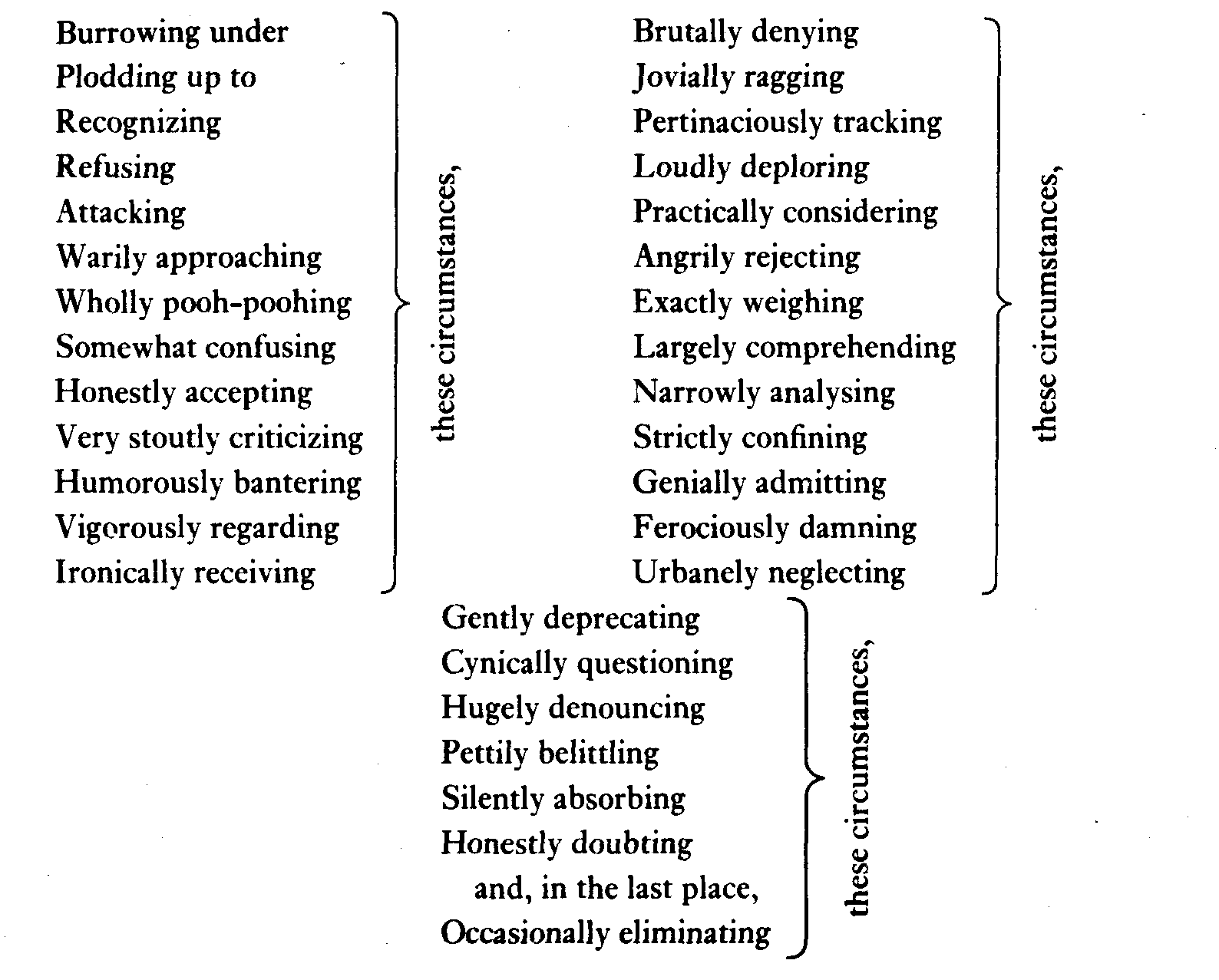
I take you all for Fools and Pedants, in the Chief, in the Chevron, and in the quarter Fess. Fools absolute, and Pedants lordless. Free Fools, unlanded Fools, and Fools incommensurable, and Pedants displayed and rampant of the Tierce Major. Fools incalculable and Pedants irreparable; indeed, the arch Fool-pedants in a universe of pedantic folly and foolish pedantry, O you pedant-fools of the world!'
But by this time he was alone, and thus was this great question never properly decided.
Under these circumstances, then (or in these circumstances), it would profit you but little if I were to attempt the description of the Valley of the Emmen, of the first foot-hills of the Alps, and of the very uninteresting valley which runs on from Langnau.
I had best employ my time in telling the story of the Hungry Student.
LECTOR. And if you are so worn-out and bereft of all emotions, how can you tell a story?
AUCTOR. These two conditions permit me. First, that I am writing some time after, and that I have recovered; secondly, that the story is not mine, but taken straight out of that nationalist newspaper which had served me so long
107
THE HUNGRY STUDENT FAILS TO APPEAR
to wrap up my bread and bacon in my haversack. This is the story, and I will tell it you.
Now, I think of it, it would be a great waste of time. Here am I no farther than perhaps a third of my journey, and I have already admitted so much digression that my pilgrimage is like the story of a man asleep and dreaming, instead of the plain, honest, and straightforward narrative of fact. I will therefore postpone the Story of the Hungry Student till I get into the plains of Italy, or into the barren hills of that peninsula, or among the over-well-known towns of Tuscany, or in some other place where a little padding will do neither you nor me any great harm.
On the other hand, do not imagine that I am going to give you any kind of description of this intolerable day's march. If you want some kind of visual Concept (pretty word), take all these little châlets which were beginning and make what you can of them.
LECTOR. Where are they?
AUCTOR. They are still in Switzerland; not here. They were overnumerous as I maundered up from where at last the road leaves the valley and makes over a little pass for a place called Schangnau. But though it is not a story, on the contrary, an exact incident and the truth--a thing that I would swear to in the court of justice, or quite willingly and cheerfully believe if another man told it to me; or even take as historical if I found it in a modern English history of the Anglo-Saxon Church--though, I repeat, it is a thing actually lived, yet I will tell it you.
It was at the very end of the road, and when an enormous weariness had begun to add some kind of interest to this stuffless episode of the dull day, that a peasant with a brutal face, driving a cart very rapidly, came up with me. I said to him nothing, but he said to me some words in German which I did not understand. We were at that moment just opposite a little inn upon the right hand of the road, and the peasant began making signs to me to hold his horse for him while he went in and drank.
How willing I was to do this you will not perhaps understand, unless you have that delicate and subtle pleasure in the holding of horses' heads, which is the boast and glory of some rare minds. And I was the more willing to do it from the fact that I have the habit of this kind of thing, acquired in the French manoeuvres, and had once held a horse for no less a person than a General of Division, who gave me a franc for it, and this franc I spent later with the men of my battery, purchasing wine. So to make a long story short, as the publisher
108
STORY OF THE HORSE
said when he published the popular edition of Pamela, I held the horse for the peasant; always, of course, under the implicit understanding that he should allow me when he came out to have a drink, which I, of course, expected him to bring in his own hands.
Far from it. I can understand the anger which some people feel against the Swiss when they travel in that country, though I will always hold that it is monstrous to come into a man's country of your own accord, and especially into a country so free and so well governed as is Switzerland, and then to quarrel with the particular type of citizen that you find there.
Let us not discuss politics. The point is that the peasant sat in there drinking with his friends for a good three-quarters of an hour. Now and then a man would come out and look at the sky, and cough and spit and turn round again and say something to the people within in German, and go off; but no one paid the least attention to me as I held this horse.
I was already in a very angry and irritable mood, for the horse was restive and smelt his stable, and wished to break away from me. And all angry and irritable as I was, I turned around to see if this man were coming to relieve me; but I saw him laughing and joking with the people inside; and they were all looking my way out of their window as they laughed. I may have been wrong, but I thought they were laughing at me. A man who knows the Swiss intimately, and who has written a book upon 'The Drink Traffic: The Example of Switzerland', tells me they certainly were not laughing at me; at any rate, I thought they were, and moved by a sudden anger I let go the reins, gave the horse a great clout, and set him off careering and galloping like a whirlwind down the road from which he had come, with the bit in his teeth and all the storms of heaven in his four feet. Instantly, as you may imagine, all the scoffers came tumbling out of the inn, hullabooling, gesticulating, and running like madmen after the horse, and one old man even turned to protest to me. But I, setting my teeth, grasping my staff, and remembering the purpose of my great journey, set on up the road again with my face towards Rome.
I sincerely hope, trust, and pray that this part of my journey will not seem as dull to you as it did to me at the time, or as it does to me now while I write of it. But now I come to think of it, it cannot seem as dull, for I had to walk that wretched thirty miles or so all the day long, whereas you have not even to read it; for I am not going to say anything more about it, but lead you straight to the end.
Oh, blessed quality of books, that makes them a refuge from living! For in
109
THE UPPER EMMEN
a book everything can be made to fit in, all tedium can be skipped over, and the intense moments can be made timeless and eternal, and as a poet who is too little known has well said in one of his unpublished lyrics, we, by the art of writing--
Can fix the high elusive hour And stand in things divine.
And as for high elusive hours, devil a bit of one was there all the way from Burgdorf to the Inn of the Bridge, except the ecstatic flash of joy when I sent that horse careering down the road with his bad master after him and all his gang shouting among the hollow hills.
So. It was already evening. I was coming, more tired than ever, to a kind of little pass by which my road would bring me back again to the Emmen, now nothing but a torrent. All the slope down the other side of the little pass (three or four hundred feet perhaps) was covered by a village, called, if I remember right, Schangnau, and there was a large school on my right and a great number of children there dancing round in a ring and singing songs. The sight so cheered me that I determined to press on up the valley, though with no definite goal for the night. It was a foolish decision, for I was really in the heart of an unknown country, at the end of roads, at the sources of rivers, beyond help. I knew that straight before me, not five miles away, was the Brienzer Grat, the huge high wall which it was my duty to cross right over from side to side. I did not know whether or not there was an inn between me and that vast barrier.
The light was failing. I had perhaps some vague idea of sleeping out, but that would have killed me, for a heavy mist that covered all the tops of the hills and that made a roof over the valley, began to drop down a fine rain; and, as they sing in church on Christmas Eve, 'the heavens sent down their dews upon a just man'. But that was written in Palestine, where rain is a rare blessing; there and then in the cold evening they would have done better to have warmed the righteous. There is no controlling them; they mean well, but they bungle terribly.
The road stopped being a road, and became like a Californian trail. I approached enormous gates in the hills, high, precipitous, and narrow. The mist rolled over them, hiding their summits and making them seem infinitely lifted up and reaching endlessly into the thick sky; the straight, tenuous lines of the rain made them seem narrower still. Just as I neared them, hobbling, I met a man driving two cows, and said to him the word, 'Guest-house?' to which he said 'Yaw!' and pointed out a clump of trees to me just under the precipice
THE BRIENZER GRAT, HOW IT LIES
and right in the gates I speak of. So I went there over an old bridge, and found a wooden house and went in.
It was a house which one entered without ceremony. The door was open, and one walked straight into a great room. There sat three men playing at cards. I saluted them loudly in French, English, and Latin, but they did not understand me, and what seemed remarkable in an hotel (for it was an hotel rather than an inn), no one in the house understood me--neither the servants nor any one; but the servants did not laugh at me as had the poor people near Burgdorf, they only stood round me looking at me patiently in wonder as cows do at trains. Then they brought me food, and as I did not know the names of the different kinds of food, I had to eat what they chose; and the angel of that valley protected me from boiled mutton. I knew, however, the word Wein, which is the same in all languages, and so drank a quart of it consciously and of a set purpose. Then I slept, and next morning at dawn I rose up, put on my thin, wet linen clothes, and went downstairs. No one was about. I looked around for something to fill my sack. I picked up a great hunk of bread from the dining-room table, and went out shivering into the cold drizzle that was still falling from a shrouded sky. Before me, a great forbidding wall, growing blacker as it went upwards and ending in a level line of mist, stood the Brienzer Grat.
To understand what I next had to do it is necessary to look back at the little map on page 105.
You will observe that the straight way to Rome cuts the Lake of Brienz rather to the eastward of the middle, and then goes slap over Wetterhorn and strikes the Rhone Valley at a place called Ulrichen. That is how a bird would do it, if some High Pope of Birds lived in Rome and needed visiting, as, for instance, the Great Auk; or if some old primal relic sacred to birds was connected therewith, as, for instance, the bones of the Dodo.... But I digress. The point is that the straight line takes one over the Brienzer Grat, over the lake, and then over the Wetterhorn. That was manifestly impossible. But whatever of it was possible had to be done, and among the possible things was clambering over the high ridge of the Brienzer Grat instead of going round like a coward by Interlaken. After I had clambered over it, however, needs must I should have to take a pass called the Grimsel Pass and reach the Rhone Valley that way. It was with such a determination that I had come here to the upper waters of the Emmen, and stood now on a moist morning in the basin where that stream rises, at the foot of the mountain range that divided me from the lake.
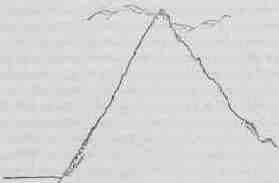
The Brienzer Grat is an extraordinary thing. It is quite straight; its summits are, of course, of different heights, but from below they seem even, like a ridge: and, indeed, the whole mountain is more like a ridge than any other I have
THE FOG
seen. At one end is a peak called the 'Red Horn', the other end falls suddenly above Interlaken, and wherever you should cut it you would get a section like this, for it is as steep as anything can be short of sheer rock. There are no precipices on it, though there are nasty slabs quite high enough to kill a man--I saw several of three or four hundred feet. It is about five or six thousand feet high, and it stands right up and along the northern shore of the lake of Brienz. I began the ascent.
Spongy meads, that soughed under the feet and grew steeper as one rose, took up the first few hundred feet. Little rivulets of mere dampness ran in among the under moss, and such very small hidden flowers as there were drooped with the surfeit of moisture. The rain was now indistinguishable from a mist, and indeed I had come so near to the level belt of cloud, that already its gloom was exchanged for that diffused light which fills vapours from within and lends them their mystery. A belt of thick brushwood and low trees lay before me, clinging to the slope, and as I pushed with great difficulty and many turns to right and left through its tangle a wisp of cloud enveloped me, and from that time on I was now in, now out, of a deceptive drifting fog, in which it was most difficult to gauge one's progress.
Now and then a higher mass of rock, a peak on the ridge, would show clear through a corridor of cloud and be hidden again; also at times I would stand hesitating before a sharp wall or slab, and wait for a shifting of the fog to make sure of the best way round. I struck what might have been a loose path or perhaps only a gully; lost it again and found it again. In one place I climbed
112
THE HALT IN THE FOG
up a jagged surface for fifty feet, only to find when it cleared that it was no part of the general ascent, but a mere obstacle which might have been outflanked. At another time I stopped for a good quarter of an hour at an edge that might have been an indefinite fall of smooth rock, but that turned out to be a short drop, easy for a man, and not much longer than my body. So I went upwards always, drenched and doubting, and not sure of the height I had reached at any time.
At last I came to a place where a smooth stone lay between two pillared monoliths, as though it had been put there for a bench. Though all around me was dense mist, yet I could see above me the vague shape of a summit looming quite near. So I said to myself--
'I will sit here and wait till it grows lighter and clearer, for I must now be within two or three hundred feet of the top of the ridge, and as anything at all may be on the other side, I had best go carefully and knowing my way.'
So I sat down facing the way I had to go and looking upwards, till perhaps a movement of the air might show me against a clear sky the line of the ridge, and so let me estimate the work that remained to do. I kept my eyes fixed on the point where I judged that sky line to lie, lest I should miss some sudden gleam revealing it; and as I sat there I grew mournful and began to consider the folly of climbing this great height on an empty stomach. The soldiers of the Republic fought their battles often before breakfast, but never, I think, without having drunk warm coffee, and no one should attempt great efforts without some such refreshment before starting. Indeed, my fasting, and the rare thin air of the height, the chill and the dampness that had soaked my thin clothes through and through, quite lowered my blood and left it piano, whimpering and irresolute. I shivered and demanded the sun.
Then I bethought me of the hunk of bread I had stolen, and pulling it out of my haversack I began to munch that ungrateful breakfast. It was hard and stale, and gave me little sustenance; I still gazed upwards into the uniform meaningless light fog, looking for the ridge.
Suddenly, with no warning to prepare the mind, a faint but distinct wind blew upon me, the mist rose in a wreath backward and upward, and I was looking through clear immensity, not at any ridge, but over an awful gulf at great white fields of death. The Alps were right upon me and before me, overwhelming and commanding empty downward distances of air. Between them and me was a narrow dreadful space of nothingness and silence, and a sheer mile below us both, a floor to that prodigious hollow, lay the little lake.
My stone had not been a halting-place at all, but was itself the summit
THE LIFE-QUALM
of the ridge, and those two rocks on either side of it framed a notch upon the very edge and skyline of the high hills of Brienz.
Surprise and wonder had not time to form in my spirit before both were swallowed up by fear. The proximity of that immense wall of cold, the Alps, seen thus full from the level of its middle height and comprehended as it cannot be from the depths; its suggestion of something never changing throughout eternity--yet dead--was a threat to the eager mind. They, the vast Alps, all wrapped round in ice, frozen, and their immobility enhanced by the delicate, roaming veils which (as from an attraction) hovered in their hollows, seemed to halt the process of living. And the living soul whom they thus perturbed was supported by no companionship. There were no trees or blades of grass around me, only the uneven and primal stones of that height. There were no birds in the gulf; there was no sound. And the whiteness of the glaciers, the blackness of the snow-streaked rocks beyond, was glistening and unsoftened. There had come something evil into their sublimity. I was afraid.
Nor could I bear to look downwards. The slope was in no way a danger. A man could walk up it without often using his hands, and a man could go down it slowly without any direct fall, though here and there he would have to turn round at each dip or step and hold with his hands and feel a little for his foothold. I suppose the general slope, down, down, to where the green began was not sixty degrees, but have you ever tried looking down five thousand feet at sixty degrees? It drags the mind after it, and I could not bear to begin the descent.
However I reasoned with myself. I said to myself that a man should only be afraid of real dangers. That nightmare was not for the daylight. That there was now no mist but a warm sun. Then choosing a gully where water sometimes ran, but now dry, I warily began to descend, using my staff and leaning well backwards.
There was this disturbing thing about the gully, that it went in steps, and before each step one saw the sky just a yard or two ahead: one lost the comforting sight of earth. One knew of course that it would only be a little drop, and that the slope would begin again, but it disturbed one. And it is a trial to drop or clamber down, say fourteen or fifteen feet, sometimes twenty, and then to find no flat foothold but that eternal steep beginning again. And this outline in which I have somewhat, but not much, exaggerated the slope, will show what I mean. The dotted line is the line of vision just as one got to a 'step'. The little figure is AUCTOR. LECTOR is up in the air looking at him. Observe the perspective of the lake below, but make no comments.
114
THE STEEP
I went very slowly. When I was about half-way down and had come to a place where a shoulder of heaped rock stood on my left and where little parallel ledges led up to it, having grown accustomed to the descent and easier in my mind, I sat down on a slab and drew imperfectly the things I saw: the lake below me, the first forests clinging to the foot of the Alps beyond, their higher slopes of snow, and the clouds that had now begun to gather round them and that altogether hid the last third of their enormous height.
Then I saw a steamer on the lake. I felt in touch with men. The slope grew easier. I snapped my fingers at the great devils that haunt high mountains. I sniffed the gross and comfortable air of the lower valleys, I entered the
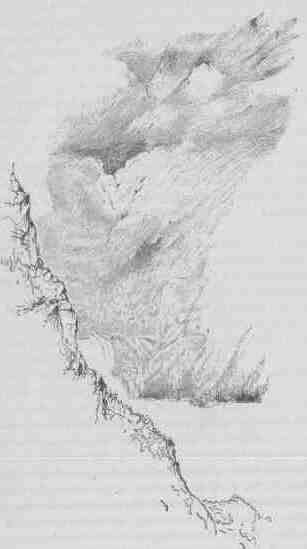
BAD GEOGRAPHY
belt of wood and was soon going quite a pace through the trees, for I had found a path, and was now able to sing. So I did.
At last I saw through the trunks, but a few hundred feet below me, the highroad that skirts the lake. I left the path and scrambled straight down to it. I came to a wall which I climbed, and found myself in somebody's garden. Crossing this and admiring its wealth and order (I was careful not to walk on the lawns), I opened a little private gate and came on to the road, and from there to Brienz was but a short way along a fine hard surface in a hot morning sun, with the gentle lake on my right hand not five yards away, and with delightful trees upon my left, caressing and sometimes even covering me with their shade.
I was therefore dry, ready and contented when I entered by mid morning the curious town of Brienz, which is all one long street, and of which the population is Protestant. I say dry, ready and contented; dry in my clothes, ready for food, contented with men and nature. But as I entered I squinted up that interminable slope, I saw the fog wreathing again along the ridge so infinitely above me, and I considered myself a fool to have crossed the Brienzer Grat without breakfast. But I could get no one in Brienz to agree with me, because no one thought I had done it, though several people there could talk French.
The Grimsel Pass is the valley of the Aar; it is also the eastern flank of that great massif, or bulk and mass of mountains called the Bernese Oberland. Western Switzerland, you must know, is not (as I first thought it was when I gazed down from the Weissenstein) a plain surrounded by a ring of mountains, but rather it is a plain in its northern half (the plain of the lower Aar), and in its southern half it is two enormous parallel lumps of mountains. I call them 'lumps', because they are so very broad and tortuous in their plan that they are hardly ranges. Now these two lumps are the Bernese Oberland and the Pennine Alps, and between them runs a deep trench called the valley of the Rhone. Take Mont Blanc in the west and a peak called the Crystal Peak over the Val Bavona on the east, and they are the flanking bastions of one great wall, the Pennine Alps. Take the Diablerets on the west, and the Wetterhorn on the east, and they are the flanking bastions of another great wall, the Bernese Oberland. And these two walls are parallel, with the Rhone in between.
Now these two walls converge at a point where there is a sort of knot of mountain ridges, and this point may be taken as being on the boundary
117
A DOUBTFUL MAP
between Eastern and Western Switzerland. At this wonderful point the Ticino, the Rhone, the Aar, and the Reuss all begin, and it is here that the simple arrangement of the Alps to the west turns into the confused jumble of the Alps to the east.
When you are high up on either wall you can catch the plan of all this, but to avoid a confused description and to help you to follow the marvellous, Hannibalian and never-before-attempted charge and march which I made, and which, alas! ended only in a glorious defeat--to help you to picture faintly to yourselves the mirific and horripilant adventure whereby I nearly achieved superhuman success in spite of all the powers of the air, I append a little map which is rough but clear and plain, and which I beg you to study closely, for it will make it easy for you to understand what next happened in my pilgrimage.
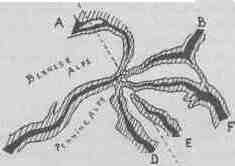
The dark strips are the deep cloven valleys, the shaded belt is that higher land which is yet passable by any ordinary man. The part left white you may take to be the very high fields of ice and snow with great peaks which an ordinary man must regard as impassable, unless, indeed, he can wait for his weather and take guides and go on as a tourist instead of a pilgrim.
You will observe that I have marked five clefts or valleys. A is that of the Aar, and the little white patch at the beginning is the lake of Brienz. B is that of the Reuss. C is that of the Rhone; and all these three are north of the great watershed or main chain, and all three are full of German-speaking people.
On the other hand, D is the valley of the Toccia, E of the Maggia, and