THE PASTON LETTERS Henry VI
Reading edition
6 INFORMATION AGAINST WALTER ASLAK12.1
1424
Be it remembred that where, on the nyght next biforne the feste of the Circumcision of owre Lord Jesu, the [second]12.2 yeer of the regne of Kyng Henry the Sexte, certeyns maffaisours, felons, and brekeres of the kynges peas vnknowyn, to the noumbre of iiijxx [four score] and more by estimacion, of malice and imaginacion forne thowght felonowsly, the dwellyng place of John Grys of Wyghton, in Wyghton, in the shyre of Norffolk, brokyn, and with carpenteres axes the yates and the dores of the seyd place hewen, and the seyd John Grys, and hys sone, and a servaunt man of hese by here bodyes tokyn, and fro the seyd dwellyng place by the space of a myle to a payre gawles ledden, there hem for to have hangyd; and by cause hem fayled ropes convenient to here felonowse purpos, the seyd John Grys, hese sone, and hys man there felonowsely slowen and mordered in the most orrible wyse that ever was herd spoken of in that cuntre. Wher up on Walter Aslak, purposyng and imaginyng to putte William Paston in drede and intollerable fere to be slayn and mordered in the seyd forme with force and ageyn the kinges peas, on the shyre day of Norffolk, halden at Norwiche, the xxviij day of August, in the seyd secunde yeer, beyng there thanne a grete congregacion of poeple by cause of the seyd shyre, in hese owne persone, and by Richard Kyllynworth, that tyme hese servaunt, to the seyd William Paston swiche and so many manaces of deth and dismembryng maden and puttyn by certeyns Englische billes rymed in partye, and up on the yates of the Priorie of the Trinite chirche of Norwiche, and on the yates of the chyrche of the Freres Menures of Norwiche, and the yates of the same Cite called Nedeham yates and Westewyk yates, and in othre places wyth inne the seyd Cite by the seyd Walter and Richard sette, makyng mension and berying this undyrstondyng that the seyd William, and hese clerkes, and servauntes schuld be slayn and mordered in lyke forme as the seyd John Grys in the seyd forme was slayne and mordered: conteyning also these too words in Latyn, et cetera, by which wordes communely it was undyrstandyn that the forgeers and makers of the seyd billes imagyned to the seyd William, hese clerkes and servauntes, more malice and harm than in the seyd billes was expressed. Wherfore the seyd William, hese seyd clerkes and servauntz, by longe tyme aftyr were in gret and intolerable drede and fere by the sayd maffaisours and felons to be slayn and mordered. Wherfore the seyd William, hese clerkes and servauntes, ne durst not at here fredom nothyr goon ne ryde.
Wher up on the seyd William, for hese owyn persone, affermyd a pleynt of trespas ageyn the seyd Walter and Richard, processe contynued ther up on til the seyd Walter and Richard were founden gilty of the seyd trespas by an iniquisicion ther of takyn in dwe and lawefull forme, by whiche inquisicion the damages of the seyd William for the seyd trespas were taxed to cxxli [£120]. Aftyr which pleynte affermyd, and to fore ony plee up on the seyd pleynt pleded, the seyd Walter and William, by Thomas Erpyngham, Knyght, a myghty and a gret supportour of the seyd Walter in alle these matiers and circumstaunces ther of ageyn the seyd William, were induced to trete in the same matier in the forme that folwith: That is to seyne, that the seyd William schuld sue forth the seyd pleynt and the execucion ther of at hese owne will, and the seyd Walter schuld defende hym self in the seyd pleynt at hese owne will, except that he schuld no benefice take by noon proteccion, ne wrytte of corpus cum causa, ne of no lordes lettres up on the seyd sute. And what so ever fortunyd in the seyd pleynt, the proces, execucion, or the sute ther of, the seyd Walter and William schuld stonde and obeye to the ordinaunce of certeyns persones by the seyd William and Walter arbitratores that tyme named, if thei myghten accordyn, and ellys of anoonpier also that same tyme named, of alle the seyd trespas, pleynt, and sute, and alle the circumstaunces ther of, so that the seyd arbitrement and ordinaunce of the seyd arbitratores, or ellys of the seyd nounpier, were made withinne xl. dayes next folwyng aftyr the jugement geven in the seyd pleynt.
And aftyrward, the Thursday next biforn Pentecost, the thrydde yeer of the regne of the seyd kyng, at London, in the presence of the right excellent, high and myghty prynce, the Duc de Gloucestre,14.1 and by hese commaundement, atte sute and instaunce of the seyd Thomas Erpyngham, it was accordyd bytwen the seyd William and Walter that thei schuld stande and obeye to the ordinaunce and award of alle the seyed matiers of twenye of these iiij. persones, William Phelip, Knyght, Henry Inglose, Knyght, Oliver Groos, and Thomas Derham, chosen on the partye of the seyd William Paston, and tweyne of those iiij. persones, Symond Felbrygge, Knyght, Bryan Stapilton, Knyght, Roberd Clyfton, Knyght, and John of Berneye of Redeham, chosen on the partie of the seyd Water, and elles the decree and jugement of a nounpier to be chosen by the same arbitrores. The whiche William Phelip, Bryan Stapilton, Roberd Clyfton, Oliver Groos, John of Berneye, and Thomas Derham, takyng up on hem the charge of the makyng of the seyd award and ordinaunce by the assent of the seyd Thomas Erpyngham, the Fryday next aftyr the feste of the Assumpcion of Owre Lady, in the seyd thrydde yeer, at Norwiche, tokyn ensurans of the seyd William and Walter by here fayth and here trowthez to stande and obeye to here ordinaunce of alle the seyd matiers, and the same day biforne noon, maden here full ordinaunce and arbitrement of alle the same matiers in the chyrche of the Greye Freyrys at Norwich; and aftyrward, up on the same award and ordinaunce mad, hadden a communicacion ther of with the seyd Thomas Erpyngham; and aftyr the same communicacion, the same day aftyr noon, the same ordinaunce and award wretyn was red byforn the seyd arbitrores and the seyd Walter and William, and examyned, agreed, and assented, and by the seales of the same vj. arbitrores and the seyd Walter and William, was affermed and ensealed and left in the handes of the seyd Sir Bryan, saveliche to be kept in playne remembraunce of the seyd award and ordinaunce; the whiche award and ordinaunce the seyd William was at all tymes redy to obeye and performe, on to the seyd feste of Michelmesse, that the seyd Walter to holde or performe the seyd award pleynly refused.
And where the seyd Walter, by jugement of the Chaunceller of Inglond, the xvj. day of Jull’ the seyd thrydde yeer, was remytted to the kynges prison at Norwich by cause of the seyd sute, the seyd Walter yede at large owt of warde fro the seyd xvj. day of Jull’ to the seyd day of the makyng of the seyd arbitrement and award, and fro that day in to Michelmesse thanne next aftyr; the seyd William that meene tyme evermore supposyng that the seyd Walter wolde have holde and performyd the sayd ordinaunce, arbitrement, and award. And at the comyng of the right high and myghty prynce the Duc of Norfolk fro his Castell of Framyngham to the Cetie of Norwyche, aftyr the seyd day of the makyng of this arbitrement and ordinaunce, and to fore the feste of Michelmesse than next folwyng, the seyd Walter by hese sotill and ungoodly enformacion caused the seyd Duke to be hevy lord to the seyd William. Where the seyd William the tyme of the seyd enformacion was with Sir John Jermy, Knyght, and othre of the counseill of the seyd Duk of Norffolk in hys lordshipes in Norffolk and Suffolk, thanne to hym falle [fallen] by the deth of the right worthy and noble lady hys modyr, occupied abowte the dwe service of wryttes of diem clausit extremum16.1 aftyr the deth of the seyd lady. And where as the seyd William Paston, by assignement and commaundement of the seyd Duk of Norffolk, at hese fyrst passage over the see in to Normandye, in the kynges tyme Henry the Fyfte, was the Styward of the seyd Duc of Norffolk, of alle hese lordshipes in Norffolk and Suffolk fro hys seyd passage un to the seyd feste of Michelmesse; [And16.2 over that as sergeaunt of lawe, thow he be unworthy, withholdyn with the seyd Duc of Norffolk alle the tyme that he was sergeaunt bifore the same feste of Michelmesse. And all be it that the fees and the wages of the seyd William for hys seyd service unpayed draweth a gret some to hys pouere degree, if the seyd Duk of Norffolk lyked, of hys noble and plentifous grace, to graunte to the seyd William, in right, ony part of the favour of hese good lordship, the seyd William wolde evere be hys pouere and trewe bedeman, and evere in hys herte thenke alle hys seyd service, and alle the service that ever he dede to the seyd [Duke] of Norfolk, plentefeousely weell rewarded.16.3]
And where the seyd Walter, the tyme of the seyd trespas and of the seyd bylles makyng ne long to fore, ne never aftyr biforn the seyd comyng of the seyd Duc of Norffolk to Norwich, ne no tyme hangyng the seyd sute, ne the tyme of makyng of the said arbitrement and ordinaunce, never was servaunt to the seyd Duc of Norffolk at fees, ne at wages, ne wythhaldyn in hese service, ne to hym sued to be supported by hese high Lordship in this seyd matier, to the knowleche of the seyd William, ne to no commune knowleche, in the shyres of Norffolk, Suffolk, ne Norwiche; the sute that the seyd Walter made for supportacion in this seyd matier was be the meene of the seyd Thomas Erpyngham to the seyd Duk of Gloucestre, by whose reule and commaundemente the seyd arbitrement and award was mad in the forme aforn seyd. And not with stondying the seyd trespas and grevaunce by the seyd Walter doon the seyd William, ne that the seyd William ne is not satisfied of the seyd cxxli., ne no peny therof, and hath absteyned hym of al maner of execucion, sewyng of godes or catelles, that by force of the seyd processe, or ony othyr, he myght have had ageyn the seyd Walter or hese borwes [sureties], ne that the seyd William hath suffred the seyd Walter to gon at large by long tyme whan he myght have had hys body in warde in lawfull forme: The seyd Walter, be billes in the too last parlementz holden at Westminster and at Leycestre, and at divers tymes in divers other maneres hath noysed and skaundered the seyd William ungoodly and othyr wyse than othyr [either] gentilnesse or trowthe wolde; and, overmore, caused the seyd William orribly to be manassed of hys deth, betyng and dismembryng of hys persone by certeyns servauntz of the Lordes Fitz Wauter and othre persones, and by ferefull and overe felle lettres and sondes. Wherfore the seyd William, nothyr hese frendes, ne hese servauntz in hys companye, at here fredam sithen the seyd parlement at Leycestre durſt not, ne yet ne dar not rydyn ne goo abowte swyche occupacion as he arn used and disposed, to here grete and unportable drede and vexacion in here spirites, and gret harme and damage and losse of here pouere goodes.
[Overmore,17.1 the seyd Walter hath sued, and yet rigorously suethe a wrytte of decies tantum17.2 ageyns x. persones of the seyd Inquisicion and ij. of the servauntz of the seyd William and iiij. othre persones; supposyng by hese seyd sute hem to have taken of the seyd William in hys seyd syte lxijli [£62] and more of moneye. The whiche sute of decies tantum the seyd Walter, betwyx God and hym, knewith verraly is untrewe. And also the seyd Walter hath sued, and yet persuyth Adam Aubre, on of the seyd Inquisicion in the court of the said Duc of Norffolk of hys manoir of Fornsete, by cause and occasion of the seyd matiers, in whiche sute in the seyd court it is proceded ageyn the seyd Adam in other maner thanne othyr lawe, conscience, or good fayth wolde.18.1]
Overmore the seyd William, atte commaundement of the seyd Duc of Norffolk, hath submytted hym to stonde to the ordinaunce of divers persones of alle the seyd matiers: ones at Leyceetre, the Wednesday next biforn Palm Soneday, the iiij. yeer of the regne of the syd kyng; anothyr tyme at Reed clyf in Aprill the same iiij. yeer, aftyr the forme of certeyns billes endented ther of made. The whiche submission, with alle the circumstaunces ther of, the seyd William hath be at alle tymes redy to obeye. The cause why the seyd Walter, by the seyd Englishe bylles, and in othyr forme, putte and sette the seyd William, and hys seyd clerkes and servauntz, in drede and fere intollerable to be slayn and mordered, and to hem trespaced in the forme aforn seyd, was onely for as moche as the seyd William was with the prior of Norwiche of counseille in hese trewe defence ageyn the entent of the seyd Walter in a sute that he made ageyn the seyd priour of a voweson of the chyrche of Sprouston in the counte of Norffolk, wher to the seyd Walter hath nothyr title suffisaunt ne right in no maner wyse by ony matier by hym declared byforn thys tyme.
This scrowe is mad only for the informacion of the worthy and worshipfull lordes the arbitrores; savyng evere to the maker the benefice reasonably to adde and amenuse, his ignoraunce in swiche occupation and defaute of leyser also tendrely considered.
and ellys of anoonpier also that same tyme named text unchanged: error for “a noonpier”?
othyr wyse than othyr [either] gentilnesse or trowthe wolde “either” printed in roman (non-italic) type
the seyd parlement at Leycestre durſt not anomalous long s in original
ones at Leyceetre text unchanged: error for “Leycestre”?
7 WILLIAM PASTON TO JOHN STAYNFORD19.1
To my weel beloved John Staynford of Furnyvales Inne.
1425
The instruccion to comune of to John Robynson of Carleton bysyde Snayth.
To enquerre and wyte whether the stoon may be sawed or nought. Whether it wille chippe or chynne or affraye with frost or weder or water.
Also that every pece of the stoon be iij. foote longe, and that xv. tunne tyght of the stoon be every stoon weel bedded into the walle and a foote thikke that it ryse in heighte a foote in the walle; and x. stones of the stoan must be ii. foote broad, and at the lest a foote and an half thikke. A stoon wil drawe the wighte of a pipe, as I suppose; the gret stones and nought the smallere stones shuld be sawed, so that every pece sawed shud holde the seid lengthe of iij. foote, and the seid brede of ij. foote, and to be, after it is sawed, half a fote or lesse on thikkenesse, and thenne the brode sawed stones shulde evere stond in the werk betwen the seid weel bedded stonys that shuld ryse but a fote in the walle and ben ankered iche of hem with other; and this werk shal be strong j nowe, as werkmen seyn, and drawe but litill cariage. I wold have swiche stoan a xxti tunne tight caried to Moneslee19.2 in Norffolk between Crowmere and Bromholm, and but a myle from Bromholm.
To reporte plein answere of this bylle writen and how sone I myght have the seid stone caried to Monesle aforn seid, and for what price.
This werk is for a . . . W. Paston.
On the back is written, also in the Judge’s hand:—
‘Sount due a mon sieur Will. Bardolf de ses gages en les lyueres a ... de mon tres honneure seigneur le Count de Warrwick, capitayn illeoqes, iusques al iiij.e jour de febr. lan de Roy Henri Sysme tierce, ccccxiiili. xvjs. xd. qa.’
Below this is written in Fenn’s hand: ‘14 Feby 3 H. 7. 1487’—a great misreading of the date.
8 NICHOLAS PRIOR OF BROMHOLM TO WILLIAM PASTON20.1
A Will’ Paston soit donne.
1425 JULY 5
Dere Syre and weel be loved, I grete yow weel, and do yow to wetyn that Dawn John Pastone was atte Norwiche on Munday last passed, and dede settyn on Cryste Chyrche gates divers litteres, a lytyl tyme, and ij. copiis wheche stondyn ther yet, for somounnyn me to the curt of Rome. And we supposyn to have hym at Bromholm, or sum man in hys name wyth inne a lytyl tyme; for dawn Robert of Yorke was atte Norwiche be sendynge of my lady of Murlee, and spak wythe hym in hyre hous on Munday afornseyd, and ther he told the forseyd dawn Robert that he wolde nedys ben Priour of Bromholm, to levyn and deyin ther upon. Also he seyde, as for the composissioun of Bromholm, he hadde do sherchyd att Clunye; and ther inne he standyth clere as he seythe; and as for provisyoun, he seyde he hadde spokyn wyth the Chaunceler and the chef Justyse and Ascam, and thei demptyne hym clere as ther inne, and he seyth; and other dowte is ther none inne be hys tale. And after this the forseyd dawn John askyd obedience of the forseyd dawne Robert in my ladyis presens, and dawn Robert seyde agayne he xulde noghte done that atte that tyme, but he badde hym provyn owt hys purpos as for the composissioun and provisioun to an hende, and than he wolde do hys dever to hym; and thus he departyd. Where for, yif ony thing may be don whyl ye arn now atte Londone for oure helpe and his lettyng, gode Syre, helpythe atte this tyme if it maybe godely, we be seche yow. Dawn Thomas of Cane was atte my lord of Norwiche for helpe in this matier, and he seyde he was inhibytyd and alle hys clerkes be the curt of Rome in this matier, and he seyde by yowre advys, yif it lyke yow, wryttes may ben taken agens hym, and that is best remedye ther inne; j. [one] wrytte is ne ingrediatur manu forti. The Holy Trinite have yow in governaunce. Wretyn atte Bromholm the v. day of July, per Nich. Priorem de Bromholm.
9 ABSTRACT21.1
1425 SEPT. 24
Bill witnessing a concord made 24 Sept. 4 Hen. VI. between John Kertelyng, clerk, general attorney to Sir John Fastolf, on the one part, and Richard Boson, Esq., on the other, viz.: That Fastolf shall have in fee-simple the manor of the said Richard in Castre called Bosons of the gift of the said Richard before Easter next, and that the said Richard shall have Fastolf’s manor in Titeleshale called Peekhalle, in fee-simple, of the gift of Fastolf, paying to Fastolf £60 within the next four years.
10 WILLIAM PASTON TO ——21.2
1425 NOV. 5
Right worthy and worshepefull Sir, I recommaunde me to yow, and thank yow for the good, trew, and diligent labour ye have hadde for the matier betwen the Priour of Bromholme21.3 and his commoigne21.4 apostata, Johne Wortes, that namythe hym self Paston, and affermith hym untrewely to be my cousyn. [I have many pouere men of my kyn, but so fals, and so pouere,—but he was nevere of my kyn.]22.1 God defende that any of my saide kyn shuld be of swyche governaunce as he is of! Maister John Ixworthe told me that he hadde lettres fro a frende of yowres in the courtt of Rome, that is of the seyd prioures counseill in this mater as ye be, whos name I knowe nought, specifyeng that the seyd John Wortes adversarius prioris desperat in causa et concordiam quærit. It is told me sithen that the seyd John Wortes is in the cite of Rome, sacred a bysshop of Irland, videlicet episcopus Corcagensis, wherby it is seyd here that his pretense of his title to the priourie of Bromholme is adnulled, and voide in your lawe. The seyd John Wortes, and a contreman of myne in the seyd court, Maister John Urry, have sent me lettres, wherof I sende yow copies and a trewe instruccion of the seyd matier closed with this bille, the whiche lettres and the matier ther of me semyth mervaillous and straunge. A prest of Norffolk, that spak with yow in Julie or August last passed, told me that he yede with yow to the cardinales hous, Trikaricensis,22.2 to espie if any swyche processe were sued ageyn me as the seyd lettres specifien, and that ye told the same prest at alle tymes ther was than no swiche processe sued, ne had; the whiche relacion I trust and beleve bettre than the seyd lettres. I have, by advys of counseill, in makyng a procuracie ad agendum, defendendum, provocandum, et appellandum to yow and the seyd Maister John Urry and the Wynsalaw (?) de Swysto; and also a general appelle, the engrossyng of wyche the messager of this bill myght nought abide; the whiche procuracie and appelle I shal sende to yowr persone, tantummodo [cum pecuniis],22.3 with moneye onward, on trust. My will is, ye have the chief governaunce of this matier, and that this article be counseille [i.e., secret]; wher upon I prey yow hertily to be saddely avysed in these matiers, and, as nede is, so to governe hem by your wysdom, that the seyd prioures estat and honeste, and myn also, to yowr worshepe be saved; and that, in alle haste resonable, ye lyke to sende me redes lettres of alle the seyd matier, and the circumstances ther of, and who ye wil I be governed in this mater. I was nevere somouned, ne never hadde tydynges of this matier but by seyd lettres and other fleyng tales that I heve herd sithen, ne nevere hadde to do more with the seyd John Wortes than is specified in the seyd instruccion. Al myghty God have yow in His governaunce. Writen at London, the v. day of Novembre. Yowre frend unknowen.23.1
A Instruccion and Information of the verray trewe matier betwen the Priour and the Covent of Bromholm and the seyd John and me, as I am enformed, and as I knowe touchant my persone and the23.2 ——.
Ista litera missa non fuit.
Right worthy and worshepefull Sir, I recomaunde to yow, preyeng yow to wite that I have resceyved yowr goodly lettres makyng mencion that Sir John Paston,23.3 ut asserit, hath optyned me condempnyd to hym in CCC[vij.]23.4 marcz and C.s.; and that the same John, atte reverence of your right worthy persone, hathe cesed of his sute of certeins processes ageyns me up on the seyd condempnacion, takyng continuance23.5 of the same matier unto Cristemasse next comyng; by which lettres ye conseille me to make ende with the seyd John, ne deterius inde contingat. I [s]end yow, closed with this bille, [the]23.6 copie of un frendly lettre that the seyd John hathe sent to me late, touchant the same matier. The seyd priour hath sent also to yow, and to Mayster William Swan, whiche longe hathe be his procurator, a procuracie for my person, and v. marcz of moneye onward. Wher up, in the seyd prioures name, and in myn own also, I prey yow hertily to sette al these matieres in continuaunce un to yowr comyng in to Ingeland; and because ye arn here beneficed, owr cuntreman, and of worshepe and cunnyng worthyly endowed, the seyd priour and his brether, and I also, willen gladdely in these matieres be treted by yow; and if this mesure be accepted, and we may have knowyng here ther of, it shall cause the attemptacion of diverses matieres a geyn summe frendes of the seyd John to cese. And if this continuance be refused, I prey yow, with al my power, that of your wysdom and good discrecion ye wille, in the seyd prioures name, and myn, defenden the seyd sutes, and alle other that the seyd Johne sueth ageyn the seyd priour and me, in your best maner, and to be of owr counseill in these matieres; and as ye lyke resonablely to write to us, so we wil be governed in yowre rewarde, and al other circumstaunces of the same matieres.24.1 I conceyve by your seyd lettres that the grece of the matier conteigned in the same ye have of the informacion and assercion of the seyd John, and as he hath enformed yow, I wot weel ye trewely writen; but I hope and trust verrayly the matier of his informacion is untrewe [for he hathe no cause to swe to me, ne I was nevre somouned ne cited].24.2 The priour of Bromholm sued ageyn the seyd John and other in Ingeland a wryt of præmunire facias, and I was therin of the same prioures counseill as the lawe of Ingelond and myn office willen, and more I have nought hadde to do with the seyd Johne, and I can nought beleve that in this cas the same Johne myght by your lawe any swich sute have ageyn me as your lettre specifieth. Also William, the prest specified in yowr [letter],24.3 told me that he, after that ye told hym of this matier, lyke as yewrce (?), he comuned with Maister William Swan, and he told the seyd prest ther no processe in the courte ageyn me in no maner ——.24.4
The above two documents are from a corrected draft, written on one side of a broad sheet of paper. On the other side is a long Latin pleading, also much corrected, relative to the Abbey of Bermondsey; prefixed to which are the following words, in the same hand as the preceding letters:—
‘Sir, do writen ij. copies of this note in papier, wyde writen, and gete a copie of the writte in the Eschekyr ageyn.’
The pleading referred to is in a different hand, and begins as follows:—
‘Et prædictus abbas dicit quod ipse de præmissis domino Regi compotum reddere non debet; quia dicit quod diu ante erectionem, fundationem sive erectionem prioratus de Bermundeseye qui nunc erectus est in prædictam Abbatiam, Willielmus Rufus filius Willelmi Conquestoris nuper Rex Angliæ fuit seisitus de manerio de Bermundeseye,’ etc.
fuit seisitus de manerio de Bermundeseye text has “d emanerio”
11 JOHN PASTON ALIAS WORTES25.1
Venerables et discretes persones les courtesans demorans en l’ostel du Templebar en la cité de Londres, Mes treschiers et treshonnourés seigneurs et amis.
1426
Treschiers et treshonnourés seigneurs et grans amis, toutte recommendation premise, plaisir vous soit de scavoir que je vous notifie et avertich pour le present que Wilhelmus Paston le Sargant est denunciés escommuniés, que plus plainement poes perchevoir per Instrument que vous envoye. Et pour tant, mez treschiers seigneurs, que je disire moult le salut de votre ames et l’onneur de cascun de vous, comme faire le doy, affin que vous u [ou] aucun de vous n’ayes aucune conversation u participation auvecquels le dit Wilhelmus, car il est aggrevés a cloquettes sonans, et tant que pour faire cesser en touttes eglises leur il voldroit aler. Mais jou qui suy homme d’eglise et sur touttes choses desire et convoite l’onneur et le bien dou Royaulme, car gy suy tenus, je ne envoye point pour le present les dittes aggravances, ne ossi voillans faire si grand mal que poroye jusquels a che que j’aray certaines novelles et responses comment li dis Wilhelmes se voldra ordonner en mes affaires, car nous avons en le loy que nuls os excumeniés ne puet et ne doit estre admis devant juge quelcunque. Mes treschiers seigneurs, se aucune chose vo plaise que faire puisse, mande le me et le feray de bon cuer. E le sancte Dieuls qui vous ait tous et cascun de vous en sa sancte garde. Et osy, mes treschiers et treshonourés seigneurs, plaise vous scavoir que encelle meyme cause li dis Wilhelmes est redevaules et enquews envers moy, par sentence diffinitive que j’ay obtenu pour moy, en mille deuls cens et trente ducas, et que li dis Wilhelmes ne puet yestre jamays absols sy non qu’il soit d’acort auvecquels moy. Escript a en la ville de Bruges le xxiije jour de Jenvier.
Johannes Paston,26.1 en temps passé Priour de Broholm, et pour le present evesquels de Corkagen, le tout vostre.
12 WILLIAM PASTON TO WILLIAM WORSTED AND OTHERS26.2
A mez treshonnourés Meistres Will’m Worstede, John Longham, et Meistre Piers Shelton soit donné.
1426 MARCH 1
Right worthy and worshepefull sires and maistres, I recomand me to yow, and thank yow with al my herte, of the gret tendrenesse ye lyke to have of the salvacion of my symple honeste, preying yow evermore of your good continuance. I have, after the advys of your lettre, doon dewely examyned the instrument by the wysest I coude fynde here, and in especial by on Maister Robert Sutton,27.1 a courtezane of the Court of Rome, the which is the chief and most chier man with my Lord of Gloucestre, and his matier in the said court for my lady, his wyff;27.2 and here aunswere is that al this processe, though it were in dede preceded as the instrument specifieth, is not suffisant in the lawe of Holy Cherche, and that hem semyth, by the sight of the instrument and by the defautes [that] ye espied in the same and other, and in maner by the knowelech of the notarie, that the processe, in gret part ther of, is fal[se and un]trewe. I have taken advys of Maister Robert Bruus, chauncellor with my Lord of Cantirbury,27.3 and Maister Nicholl Billesdon,27.4 cha[uncellor] of my Lord of Wynchestre,27.5 and Maister John Blodwelle,27.6 a weel lerned man holden, and a suffisant courtezan of the seyd court, and all these acorden to the seyd Maister Robert Sutton. Nought with stondyng that I herde nevere of this matier no maner lykly ne credible evidence unto that I sey your lettre and the instrument, yet I made an appell and a procuracie, and also a provocacion, at London, longe biforn Cristemasse, by the a[dvys] of Maister David Aprys, Maister Symond Kempston, and Maister James Cole, and sent al this, with an instruccion of al the matier, w[ith] my procuratours to Rome by your frere, my Maister Suppriour, and geff hym gold that he was content: and, evermore, nowe here by advys I make this day a newe appelle and a newe procuracion, and upon this alle the seyd worthy men here seyn and informe me pleynly I have no maner cause in lawe ne in conscience to drede aught in this matier. Myn adversarie27.7 is become Bysshop of Cork in Irland, and ther arn ij. other persones provided to the same bysshopriche yet lyvyng, beforn my seyd adversarie; and by this acceptacion of this bysshopriche, he hath pryved hym self of the title that he claymed in Bromholm, and so adnulled the ground of his processe ageyn me, and also the tyme of his grevaunce pretendid, and the tyme of his sute he was apostata, and I trowe is yet, and so unable to sue any swich processe. I purpose me to come homward be London, to lerne more in this matier, if I may. I prey the Holy Trinite, lord of your cherche and of alle the werld, delyvere me of my iij. adversaries, of this cursed bysshop for Bromholm, Aslak for Sprouston,28.1 and Julian Herberd for Thornham. I have nought trespassed ageyn noon of these iij., God knowing, and yet I am foule and noysyngly vexed with hem, to my gret unease, and al for my lordes and frendes matieres, and nought for myn owyn. I wot not whether it were best in any sermon or other audience, in your cherche or elles where, to declare aught of this matier in stoppyng of the noyse that renneth in this case. I submitte me and alle this matier to your good discrecion; and evere gremercy God, and ye, who ever have yow and me in His gracious governance. I suppose to see yow on Palm Sunday. Writen at Leycestre, the Friday the thredde wyke of Lente.
Alle the seyd lerned men telle me trewely ther is nother perill ne doubte in the takyng doun of the instrument and the bille to no creature. Which instrument and bille I send yow ageyn by the berare of this, which I prey you to kepe as pryve as ye may. Yowr man, W. Paston.
I have preyed my Maister Hammond to write yow tydyngges, and smale (?) lesynges among.
13 ABSTRACTS29.1
1426
(1) Capias against William Stayard of Great Yarmouth, late lieutenant of Thomas Chaucer,29.2 chief butler of Henry V., for debts to the Crown.
(2) Release by William Steyard of Great Yarmouth, to Elizabeth, widow of John Rothenhale, Knight, of all personal actions against her as her husband’s executor. 7 April, 4 Hen. VI.
14 ABSTRACT29.3
John Paston alias Wortes.
1426 DEC. 1
i. Draft writ to the Sheriff of Norwich to attach and bring before the Council John Paston alias Wortes and others for violation of the statutes of Provisors 25 Edw. III. and 16 Ric. II., on the complaint of John Brundale, prior of Bromholm that although he, Brundale, was canonically elected prior, the said Paston or Wortes had crossed the sea without royal license, obtained a provision of the said priory in the Court of Rome, and got himself installed as prior, and the other expelled. Also the said John Paston or Wortes, and John Gees, a Carmelite friar of Norwich, Edmund Alderford, late of Norwich, clerk, Barth. Waryn, parson of Trunche, William Cuttyng of Worsted, clerk, John Gees of Crowemer, merchant, and Ralph Gunton of Norwich, scrivener, received the said instruments at Bakton, and put them into execution.—Dated 1 Dec.
ii. On the back of the preceding is another draft writ of the same date against the same parties for endeavouring to draw the prior out of the kingdom by a suit in the Court of Rome.
The paper is endorsed—’S. (?) Billæ vis. Veneris prox. post diem antedictum (?) Anno H. vj. vto, et non necessario festinant’. Iterum supervidendum.’
Endorsed in a later hand— ‘Towchynge Sir John Fastolffes landes in Norffolk and Surrye.’
Barth. Waryn, parson of Trunche text has Barth, for Barth.
15 ABSTRACT30.1
—— —— to William Paston.
1426(?)
‘Dear and well-beloved Cousin.’—Is in good health, but ill at ease, being informed that she is in debt to Steyard for my lord’s debt, whose soul God assoil, £7 and a pipe of wine. Knew nothing of it in my lord’s life, except of 2 pipes for herself, and one for her mother-in-law, of which she has paid 20s. Since my Lord’s death, Steyard has never asked her for it. ‘For which time, as I was at Jernemouth abiding in the Frere Carmes the time of the pestilence, his wife came unto me,’ asking the writer to be good lady to him; and he asked no more then than the above 3 pipes. He asked no more last harvest when he was sick and like to die, when John of Berneye was present. Thinks, therefore, his asking is untrue. My Lord would have made me or some of his council privy to such a debt. Hopes Paston, whom my Lord made one of his feoffees, will see ‘that ye and I be discharged anemps the King as for the debt of Steyard.’—Dated Castre, the day after the Conversion of St. Paul. Addressed, ‘A mon tres cher et bien ame cousin, Will’m Paston soit donné.’
[This letter is endorsed in another hand, ‘W. Paston, j. feoffatorum et executorum Johannis Rothnale per lit’ Cz. (?)’ It seems, therefore, to have been written by the Lady Elizabeth, widow of Sir John Rothenhale, whose name occurs in No. 13 in connection with William Steyard of Great Yarmouth. She was the daughter of Sir Philip Branch, Kt., and had been previously married to John Clere of Ormesby. She died at Caister, the place from which this letter is dated, in 1440; and by her will, which was dated at Caister, 16th October 1438, she bequeathed all her goods at Ormesby to her son Robert Clere, and all her goods at Horning Hall, in Caister, to her son Edmund.—See Blomefield’s Norfolk, iv. 35, vi. 392, xi. 210.]
whose name occurs in No. 13 corrected by editor from “No. 8”
16 ABSTRACT30.2
1426–7
Depositions on the —— day of ——, 5 Hen. VI., by Richard Wyoth, executor of Margery, daughter and heir of Edmund Bakon, touching the manor of Gressam which Bakon purchased, temp. Edw III. After the death of two brothers, Margery became sole possessor, and gave it to Wyoth and other executors to perform her will, with proviso that Philip Vache and Eliz., his wife, should have it during their lives, but that the reversion of it should be sold, giving William, son of Robert Moleyns, the first option of purchase. It was accordingly offered to him, but he refused to buy. On the death of said Eliz., however, he bought the manor for 420 marks, and held it two years, when Wyoth re-entered because part of the purchase-money was unpaid. W. Moleyns’s wife, however, induced him to accept security from Thos. Fawkoner, merchant of London, whose daughter the said William agreed that his son should marry, when he came of age; and it was arranged that meanwhile Fawkoner and Wyoth should be jointly enfeoffed of the manor, which was to be given in jointure, if the marriage took effect. The marriage did not take effect, and Fawkoner re-entered upon the manor according to the enfeoffment, but paid Wyoth nothing, till Thos. Chawsers,31.1 Esq., a kinsman of the said Margery, made him understand that Wyoth might enter on his own portion, and had even a prior right to himself. At length Fawkoner sold his right to Chaucers and Wyoth, and released the manor on security for the payment. Wyoth then said he should have little advantage by the bargain, except in having easy days of payment; ‘et quod dictus Thomas Chaucers, pro bona voluntate quod (sic) erga dictum Willelmum Paston gessit, episcopum Londoni de emptione ejusdem manerii per longum tempus dilatavit, intentione ut idem Willelmus illud emeret si voluerit.’
17 ABSTRACT31.2
Rauf, Parson of Cressyngham, to William Paston, Justice.
1427–43
Is he to deliver to John Halleman Paston’s evidences belonging to the manor of Wodhalle in Pagrave, and under what form? Hopes to see him at Norwich, on Tuesday or Wednesday after Michaelmas-day. Cressingham, 20 Sept.
On the back are written, in William Paston’s hand, some notes of a case touching ‘Frater Kensale.’
[Ralph Wolman alias Harple was incumbent of Cressingham from 1427 to 1460; but this letter could not have been written later than 1443, as William Paston died in August of the following year.]
18 ABSTRACT31.3
Mutilated Letter in French, from John Vaux, Parson of Edythorp, to ——.
1426
Only the right-hand half of the letter remains. Names mentioned—Richard de Causton, William Coule. Date lost.
[John Vaux was Rector of Edingthorp in Norfolk, in 1388. His successor was John Prentys, who was presented to the living in 1429 by the feoffees of the duchy of Lancaster.—Blomefield, xi. 29.]
19 ABSTRACT32.1
1426 DEC. 7
‘A grant of the Monastery of Bury to make William Paston, justice, brother of the Chapter-House.’ Day of St. Ambrose 1429.
[The description is taken from an endorsement. The document itself is printed in Yates’s Bury St. Edmunds, p. 156.]
20 WILLIAM PASTON TO THE VICAR OF THE ABBOT OF CLUGNY32.2
1430(?)
My ryghte worthy and worshopeful lord, I recomaunde me to yow. And for as meche [as I] conseyve verrayly that ye arn Vicar general in Inggelond of the worthy Prelate, the Abbot of Clunie, and have hys power in many grete articles, and mong other in profession of monkes in Inggelond of the seyd ordere. And in my cuntre, but a myle fro the place where I was born, is the poure hous of Bromholm of the same ordre, in wheche arn divers vertuous yongge men, monkes clad and unprofessyd, that have abedyn there.... Abbyte ix. or x. yeer; and be lenger delaye of here profession, many inconvenientez arne lyke to falle. And also the priour of ... hath resigned in to your worthy handes by certeins notables and resonables causes, as it apperyth by an instrument, and a symple lettre under the comune seal of the seyd hous of Bromholm, which the berare of this hath redy to shewe yow, wher up on I prey yow wyt al my herte, and as I evere may do yow service, that it lyke to your grace to graunte of your charite, by yowr worthy lettres to the priour of Thetford in Norfolk, of the seyde ordre of Clunye, autorite and power as your ministre and depute to professe in dwe forme the seyd monkes of Bromholm unprofessed. And that it lyke yow evermore to accepte and admitte the seyd resygnacion by your seyd autoritie and power, wyth the favour of your good lordshepe in comfort and consolacion of your pouere prestes, the monkes of the seyd hous of Bromholm, and there up to graunte your worthy lettres, wittenessyng the same acceptacion and admyssion of the seyd resignacion, and al your seyd lettres to delyvere to my clerke, to wham I prey yow to gyve feith and credence touchant this matier, and to delivere it hym in alle the hast resonable. And I am your man, and evere will be by the grace of God, which evere have yow in his kepyng. Writen at Norwich the 33.1 of Aprill. Yowres, Will. Paston.
21 ABSTRACT33.2
1429–30
A Memorandum, dated 8 Henry VI., that Sir Simon Felbrigge, William Paston, &c., recovered certain land in Edithorp, Bakton, and Northwalsham, against Richard, Abbot of St. Benet’s, Hulme, John Roys, and others.
22 ABSTRACT33.3
Robert, Lord of Willughby and Beaumesnil, to William Paston, Esq.
1431 JAN. 8
Notifying that he has granted to Sir William Oldhall and Margaret, our sister, his wife, for moneys which Oldhall has lent and paid for him at need, an annuity of 120 marks on lands in Norfolk and Suffolk, in which ye (William Paston, Esq.) stand enfeoffed, to our behoof. Pont de l’Arche, 8 Jan. 1430, 9 Hen. VI.—Signed. Fine seal, mutilated.
23 ABSTRACT34.1
1432 MAY 1
Deed Poll, whereby Robert York, Prior of the church of St. Andrew of Broomholme, and the Convent of the same place, grant to Sir Simon Felbrygg, Knt., William Paston of Paston, and others, certain lands in Bacton Wood, &c., 1 May, 10 Henry VI. (Fragment of seal.)
24 EDUCATION OF HENRY VI34.2
1432 NOV. 9
For the goode reule, demesnyng and seuretee of the Kynges persone, and draught of him to vertue and connyng, and eschuyng of eny thing that mighte yeve empeschement or let therto, or cause eny charge, defaulte, or blame to be leyd upon the Erle of Warrewyk at eny tyme withouten his desert, he, considering that perill and besinesse of his charge aboute the Kinges persone groweth so that that auctoritee and power yeven to him before suffiseth him nought without more therto, desireth therfor thees thinges that folowen.
Furst, that considering that the charge of the reule, demesnyng, and governance, and also of nourture of the Kinges persone resteth upon the said Erle whiles it shal like the king, and the perille, daunger, and blame if eny lak or defaulte, were in eny of thees, the whiche lak or defaulte mighte be caused by ungodely or unvertuous men, if eny suche were aboute his persone; he desireth therfore, for the goode of the King, and for his owne seuretee, to have power and auctoritee to name, ordeigne, and assigne, and for cause that shal be thought to him resonable to remoeve thoo that [shal] be aboute the Kinges persone, of what estate or condicion that thei be, not entending to comprehende in this desir the Stuard, Chamberlein, Tresoror, Contrerollor, ne Sergeantz of offices, save suche as serve aboute the Kinges persone and for his mouth.
Responsio. As toward the namyng, ordeignance, and assignacion beforesaid, it is agreed, so that he take in noon of the iiij. knightes ne squyers for the body without th’advis of my Lord of Bedford,35.1 him being in England, and him being out, of my Lord of Gloucestre35.2 and of the remenant of the Kinges Counsail.
Item, the said Erle desireth that where he shal have eny persone in his discrecion suspect of mysgovernance, and not behoveful nor expedient to be aboute the King, except th’estates of the hous, that he may putte hem from excercise and occupacion of the Kinges service till that he shal mowe have speche with my Lordes of Bedford or of Gloucestre, and with the other Lordes of the Kinges Counsaile, to that ende that, the defaulte of eny suche persone knowen unto him, shal mowe ordeigne therupon as theim shel thenke expedient and behoveful.
Responsio. It is agreed as it is desired.
Item, the said Erle desireth that, for sikenesse and other causes necessaries and resonables, he may, by warnyng to my Lordes of Bedford or Gloucestre and the Kinges Counsail, be and stande freely descharged of the saide occupacion and besinesse about the Kinges persone, under the favour and goode grace of the King, my Lordes of Bedford and Gloucestre, and other Lordes of the Kinges Counsail.
Responsio. It is agreed as it is desired.
Item, that considering howe, blessed be God, the King is growen in yeers, in stature of his persone, and also in conceite and knouleche of his hiegh and royalle auctoritee and estat, the whiche naturelly causen him, and from day to day as he groweth shul causen him, more and more to grucche with chastising, and to lothe it, so that it may resonably be doubted leste he wol conceive ayeins the said Erle, or eny other that wol take upon him to chastise him for his defaultes, displesir, or indignacion therfore, the whiche, without due assistence, is not easy to be born: It like, therfore, to my Lord of Gloucestre, and to alle the Lordes of the Kinges Counsail, to promitte to the said Erle, and assure him, that thei shul fermely and trewely assisten him in the excercise of the charge and occupacion that he hathe aboute the Kinges persone, namely in chastising of him for his defaultes, and supporte the said Erle therinne; and if the King at eny tyme wol conceyve for that cause indignacion ayeins the said Erle, my said Lord of Gloucestre, and Lordes, shul do alle her [i.e. their] trewe diligence and power to remoeve the King therfro.
Responsio. It is agreed as it is desired.
Item, the said Erle desireth that for asmuche as it shal be necessarie to remoeve the Kinges persone at diverse tymes into sundry places, as the cases mowe require, that he may have power and auctoritee to remoeve the King, by his discrecion, into what place him thenketh necessarie for the helthe of his body and seuretee of his persone.
Responsio. It is agreed as it is desired.
Item, sith the said Erle hath take upon him the governance of the Kinges persone, he desireth that alle th’estates, officers, and servantz of the Kinges hous, of what estate and condicion thei be, have special commandement and charge yeven by my Lordes of Bedford and Gloucestre, and by the Lordes of the Kinges Counsail, that in alle manere thinges seyn and advised by the said Erles descrecion, that is, for the Kinges estate, worship, helthe, and profit, by his commandement and ordeignance, thei be attendant and obeissant in accomplisshing therof.
Responsio. It is agreed as it is desired.
Item, for asmuche as the said Erle hath knouleche that in speche that hath be had unto the King at part and in prive, not hering the said Erle nor eny of the knightes set aboute his persone, nor assigned by the said Erle, he hath be stured by summe from his lernyng, and spoken to of diverse materes not behovefull, the seid Erle doubting the harme that mighte falle to the King, and the inconvenientz that mighte ensue of suche speche at part if it were suffred, desireth that in al speche to be had with the King, he or oon of the iiij. knightes, or sum persone to be assigned by the said Erle, be present and prive to it.
Responsio. This article is agreed, excepting suche persones as for nieghnesse of blood, and for their estate, owe of reson to be suffred to speke with the King.
Item, to th’entent that it may be knowen to the King that it procedeth of th’assent, advis, and agreement of my Lord of Gloucestre, and alle my Lordes of the Kinges Counsail, that the King be chastised for his defaultes or trespasses, and that for awe therof he forbere the more to do mys, and entende the more besily to vertu and to lernyng, the said Erle desireth that my Lord of Gloucestre, and my said other Lords of the Counsail, or great part of hem, that is to say, the Chanceller and Tresorer, and of everych estate in the Counsail, spirituell and temporell, summe come to the Kinges presence, and there to make to be declared to him theire agreement in that behalve.
Responsio. Whan the King cometh next to London, all his Counsail shal come to his presence, and there this shal be declared to him.
Item, the said Erle, that all his dayes hath, aboven alle other erthely thinges, desired, and ever shal, to kepe his trouthe and worship unblemysshed and unhurt, and maye not for all that lette malicious and untrewe men to make informacions of his persone, suche as thei may not, ne dare not, stand by, ne be not trewe, besecheth therfore my Lord of Gloucestre, and alle my said Lords of the Counsail, that if thei, or eny of hem, have be enformed of eny thing that may be or soune to his charge or defaulte, and namely in his occupacion and reule aboute the Kinges persone, that the said Erle may have knowleche therof, to th’entent that he may answer therto, and not dwelle in hevy or synistre conceit or opinion, withoute his desert and without answere.
Responsio. It is agreed.
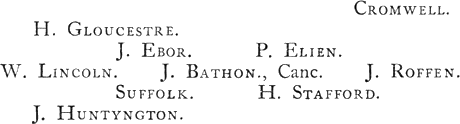
The foregoing document is written on a skin of parchment docqueted with the words printed in italics at the head. The following memorandum is also endorsed— ‘xxixº die Novembris anno undecimo apud Westm. lecti fuerunt præsentes articuli coram dominis infra et subscribentibus et ad eosdem Responsiones dabantur secundum quod infra patet, præsentibus dominis infrascriptis.’ There are also other endorsements, but of a later date.
Names in signature
25 DALLING’S PETITION38.1
1433(?)
Prefixed to this document in Fenn is the following title:— ‘A Petition to the Commons of England against Sir William Paston, Knight, a Judge of the Common Pleas, by William Dalling.’ This heading, however, has been taken from a more modern endorsement. No contemporaneous document, so far as I am aware, gives Judge Paston the designation of knight, or speaks of him as Sir William. In this petition itself he is called simply William Paston, one of the Justices; and although his name occurs frequently on the Patent Rolls, in commissions of the peace, of gaol delivery, and the like, down to the year of his death, the word ‘miles’ is never appended to it.
The original commencement of this document has been crossed out. It was in these words:—
Plesit to the righte sage and wyse Communes of this present Parlement, that wher every Justice of the Kyng is sworne that he shulde not take no fees ne reward for to be of councell with noo man, but oonly wyth our Soverayne Lorde the Kyng, and therto thei be swore. And ther is oon Will’ Paston, one of the Justice of our Soverayne Lorde in the Comene Place, taketh fees and rewarde.
On the back of the original document is written, in a hand of the time, ‘Falsa billa Will’i Dalling, ad Parliamentum tempore quo Henr. Grey fuit vicecomes ante annum terciodecimum Regis Henr. vjti.’ Henry Grey was sheriff of Norfolk in 1430, and again in 1433–4. The Parliament referred to must either have been that of 8 Hen. VI. (1429–30) or that of 12 Hen. VI. (1433), which sat till 21st December. Probably the latter.
1434(?)
Plese it to Commines of the present Parlement, that William Paston, on of the Justice of oure Saverayne Lorde Kyng, takyth diverse fees and rewardes of diverses persones withinne the shir of Norffolk and Suffolk, and is with holde with every matere in the sayde contrees, that is for to sey:—Of the Toune of Yernemuth, 1s. yerly; of the Abot of Seyn Benetys. xxvjs. viijd.; of the Prior of Seyn Feithes, xxs.; ‘and of my Lady Rothenhale,39.1 xxs’; and of the Prior of Norwich, xs.; and of the Prior of Penteney, xxs.; and of the Toun of Lenn, xls.; and of the Prior of Walsyngham, xxs.; and of Katherine Shelton,39.2 x. mrc. ayeins the Kyng for to be of hir councell for to destroye the right of the Kyng and of his warde, that is for to sey, Raf,39.3 soon and eyer of John Shelton.
26 ABSTRACT39.4
1435 SEPT. 26
Lease made at Castre, on Monday before Michaelmas 14 Henry VI., by Geoffrey Walle, surveyor of the manors of Sir John Fastolf, to John Rakesond, son of Geoffrey Rakesond of Ormesby, of a messuage of Fastolf’s in Ormesby, called Reppes Place, etc.
27 ABSTRACT40.1
1435 SEPT. 30
A vidimus or official attestation of two indentures relative to the custody of the castle of Le Mans between Sir John Fastolf, governor of Anjou and Maine, and captain of Le Mans under the Duke of Bedford, and Matthew Goth [Gough] and Thomas Gower as his lieutenants. The first indenture is for the quarter from 1st October to 31st December 1434, the second for the three quarters following, to 30th September 1435. A retinue is to be maintained of twenty-four lances and the ‘archiers de la personne dudit Mathieu,’ viz., sixty mounted and fourteen on foot, and 222 archers besides. Mounted archers to have 12d. a day, etc.
The document is authenticated by the garde du scel des obligations de la Viconté de Rouen, on the 8th March 1448 (i.e. 1449).
28 NOTE40.2
1432–5
Building accounts of William Granere, master of the works at Caistre in 11, 12, and 13 Henry VI.
29 JOHN GYNE TO JOHN PASTON40.3
To the worthy and worshipful sir and my good maister, John Paston of Trynyte hall in Cambrigge
1435–6
Right worthy and worshipfull sir, and my good maister, I comaund me to yow. Like it yow to witte that on the Soneday next after the Ascencion of oure Lord, in the high weye betwex Cambrigge and the Bekyntre toward Newmarket, I fonde a purs with money ther inne. Th’entent of this my symple lettre is this, that it please to your good Maistership by weye of charite, and of your gentilnesse, to witte if ony of youre knowleche or ony other, swich as yow semeth best in your discrecion, have lost swich a purs, and, the toknes ther of told, he shal have it ageyn, what that ever he be, by the grace of oure Lord, Who ever have yow in his blissed kepyng. Wretyn at Sneylewell the Moneday next after the seid Soneday. By youre pover servaunt, John Gyn.
30 WILLIAM PASTON TO LORD ——41.1
1436
Paston recomaund hym to youre good lordeship, willyng with all his herte to doo yow servise to his symple power. And as touching the maner of Walsham he seyth that at your comaundement he wille be redy to shewe yow and preve that the seid maner and all the vesture and crop therof this yeer by trewe title in lawe and conscience is his owen trewly, bowth and in gret party payed for, and that John Roys never hadde non estate in the seid maner, but oonly occupied it by suffraunce of the seid Paston and other feffes in the seid maner, and that be bargayn of the seid maner th’estate that the seid Roys shuld have hadde in the seid maner and in stoor therof shul have be condicionel to be voide and nought for defaute of payement, and that the seid John Roys ne kept not his dayes of the payementz, &c.; and that the seid William Paston, in the lyve of the seid John Roys, for defaute of payment entred in the seid maner with the seid the crop and the vesture of this yeer therof than therupon, and that the seid John Roys never at noo tyme payed to the seid John Baxtere sith the seid bargeyn, nother for the seid bargeyn ne for the dette he aught to hym, more thaune an C. and xl. marcz, wherof he borwed ageyn of the seid John Baxtere xlli.; and over that he oweth and beforn the seid bargeyn aught by his obligacion to the seid John Baxtere, of trew dette of mony borwed, other xlli., and hath hadde and taken the profitz of the seid maner by iij. hool yer before his deth to the value of xxxli. and more, and that he receyved in his said bargayn of the seid John Baxtere xl. marcz worth of stoor; the which iiiixxli. of dette and xxxli. of the profitz of the seid maner, and xl. marcz worth of stoor, maketh the somme of Cxxxvili. xiijs. iiijd. Wherof, thogh the lawe wille it not, were abated, if conscience required it, Cxl. marcz payed by the seid John Roys and xli. for the value of the seid crop, over the value of the verray ferme of the seid maner for this yeer, yet remanyneth dwe to the executoures of the seid John Baxter liijli. vjs. viijd., and all the title and interesse of the seid John Roys his heyres and assignes in the seid maner lawfully and in conscience extincted and adnulled. Wher upon the said Paston lowly besecheth your good lordeship that if it may be preved this mater be trew that ye wille not be displesed thogh he desire to have his fre disposicion of the seid maner.
On the back of this letter are the following memoranda:—
‘Hæc billa . . . . . . [testatur]42.1 quod Johannes Baxtere vendidit Johanni Roys mesuagium suum [vocatum]42.1 Walccham place, cum toto stauro ibidem vivo et mortuo in Bryanes, cum omnibus aliis terris et tenementis suis, liberis et nativis, cum pertinentiis, ex parte occidentali ecclesiæ North Walsham, et molendinum ventriticum et mesuagium nuper Rogeri atte Hille, cum omnibus redditibus et servitiis pertinentibus dictis mesuagio et tenemento ubicumque fuerint in comitatu Norffolk, pro iijC. marcis et l. marcis; unde dictus Johannes Roys solvit dicto Johanni Baxtere die Jovis proximo ante festum Apostolorum Simonis et Judæ anno regni regis Henrici VI. xij., C. m., et habet diem solvendi residuum, videlicet ad festum Nativitatis Domini et festum sancti Michaelis proximo futurum xl. marcas annuatim, quousque dictæ CCC. marcæ et l. marcæ plenarie persolvantur. Datum die Jovis prædicto. Hæc prædicta de manu Thomæ Whitewelle.’
Then after two further imperfect entries relating to the same matter:—
‘Memorandum, quod licet esset concordatum quod W. Roys haberet barganium, &c., quod, ut credo, non ita erit, tunc in festo Nativitatis Domini anno regni regis Henrici VI. xvº debentur executoribus de eodem barganio C. marcæ præter et ultra Cxl. marcas per Johannem Roys in vita sua solutas et xlli. de antiquo per dictum Johannem Roys Johanni Baxter debitas, videlicet per obligacionem suam xxxvli. inde, et ex mutua sua obligacione vli. de Perey Noble (?), ut patet per papirum dicti Baxter, et ultra xlli. per dictum Johannem Baxter post dictum barganium dicti Johanni Roys per obligacionem . . . ejusdem Johannis Roys præstitas. Memorandum eciam quod dictus Johannes Roys nec uxor ejus unquam protulerunt aliquem denarium solvendum dictis . . . dicti Johannis Baxter nec Willelmo Paston post mortem dicti Baxter. Set circa Nativitatem Domini anno regni dicti regis xiiijº et in quadragesima tunc proximo sequente uxor dicti Roys apud Paston dixit quod habuit xx. marcas paratas ad solvendum. Et sic dixit Johannes Roys tempore quo Domina Skales fuit apud Paston, videlicet ix. die Januarii dicto anno xiiijº et sic omnibus temporibus quibus dictus J. Roys et uxor ejus ut prædicitur dixerunt quod habuerunt xx. marcas paratas ad solvendum semper fuerunt arretro xlli. absque dictis xlli. novi debiti et xlli. antiqui debiti.’
31 NOTE
1436 MAY 19
Fenn mentions an indenture, dated 19th May 1436, 14 Henry VI., and signed by the Earl (afterwards Duke) of Suffolk, from which he has given a facsimile of Suffolk’s signature. See vol. i. p. 36.—The original of this indenture I have not met with.
32 ABSTRACT43.1
1438 AUG. 18
Sir H. Inglose notifies his agreement with John Topy of Wyndham, jun., in an action for trespass done to him at Stalham. Dilhams, Monday after the Assumption of Our Lady, 16 Henry VI.
33 JOHN WILLOUGHBY TO LORD BEAUMONT44.1
To my ryght noble and ryght [dra]dde lord, my Lord Beaumont.
1432–40
Ryght wursshipfull sire, my ryghte noble, and ryghte dradde lorde, after dyw recommendacion to yowr reverens, please hit yow to know that yowr lordesship luste to empointe me to abyde yowr noble avys touching the landis of Latemer, which my Lorde Latemer holdith ate this day. My lord, I muste, and owe of dywte, abyde yowre empoyntement, and shall; how be hit I have be confortid to complaine me to my lordis and yow of the grete wronge that I have. But, sir, y have soe verray truste one yowre lordesship that I refuse all counsaille, abyding yowre empointemente and rewell, as my diwte is to doo; byseching yow, my lord, to remembre yow and compasse of yowre servaunt, and that ye lust of yowr grace to comyne with my Lord of Salisbury, and to fele him in the mater, and as ye fele him, hit please yowre lordesship I may have knowlege; and whate yowre pore bedman may do to yowre plesire, I ame redy ate yowre comaundement ate all howris, which knowith God, Hoe have yow, my ryghte noble lord, in His blessid gouvernauns.
Write ate Broke, the v. day of Marche.
Your pore bedman and servant,
John Wylughby.
34 AGNES PASTON TO WILLIAM PASTON45.1
To my worshepefull housbond, W. Paston, be this letter takyn
1440(?)
Dere housbond, I recomaunde me to yow, &c. Blessyd be God I sende yow gode tydynggs of the comyng, and the brynggyn hoom, of the gentylwomman45.2 that ye wetyn of fro Redham, this same nyght, acordyng to poyntmen [appointment] that ye made ther for yowr self.
And as for the furste aqweyntaunce be twhen John Paston45.3 and the seyde gentylwomman, she made hym gentil cher in gyntyl wise, and seyde, he was verrayly your son. And so I hope ther shall nede no gret trete be twyxe hym.
The parson of Stocton45.4 toold me, yif ye wolde byin her a goune, here moder wolde yeve ther to a godely furre. The goune nedyth for to be had; and of colour it wolde be a godely blew, or erlys a bryghte sangueyn.
The Holy Trinite have you in governaunce.
Wretyn at Paston, in hast, the Wednesday next after Deus qui errantibus,45.7 for defaute of a good secretarye. Yowres, Agn. Paston.
35 ABSTRACT46.1
About 1440
Draft Lease by Sir Simon Felbrygge; Oliver Groos, Esq.; John Berney of Redham, Esq.; William Paston of Paston; Thomas Stodhagh; Roger Taillour of Stafford Bernyngham; and Thomas Newport of Runham, executors of Robert Mawteby and John his son, to Margery, widow of the said John, of ‘two parts of manors, &c.’ and the reversion, &c., which they lately held along with Sir Miles Stapleton, Sir William Argenten, Sir John Hevenyngham, Sir John Carbonell, Sir William Calthorpe, John Boys, Esq., and William Caston, Esq., now deceased, by deed of Robert Mawteby. The remainder, after Margery’s death, is to go to Margaret, daughter of the said John and Margery, and the heirs of her body; then to Peter Mauteby, son of Robert and uncle of Margaret; then to Alianora, widow of Robert; then to Alianora, widow of William Calthorp and sister of Robert Mawteby, with reversion to the trustees to fulfil the will.
[This paper is addressed to John Berney of Reedham, and appears, by an endorsement, to have been transmitted along with a letter of William Paston. The date is fixed by the contents within pretty narrow limits, for it is after the death of John Boys, Esq., which was in August 1439 (Inquis. post mortem, 18 Hen. VI., No. 2), and before that of Sir Simon Felbrigg in 1442 (Inquis. p. m., 21 Hen. VI., No. 33). It is easy to see, in fact, that the document had something to do with the marriage settlement of John Paston and Margaret Mauteby, which was about 1440.]
36 ROBERT REPPS TO JOHN PASTON46.2
A mon tresreverent et treshonerable Maister John Paston soit doné.
1440 NOV. 1
Salvete, &c. Tytyngs, the Duk of Orlyawnce46.3 hath made his oath upon the Sacrement, and usyd it, never for to bere armes ayenst Englond, in the presence of the Kyng and all the Lordes, except my Lord of Gloucestre.46.4 And proving my seyde Lord of Gloucestre agreyd never to hys delyveraunce, qwan the masse began he toke his barge, &c.
God yef grace the seide Lord of Orlyaunce be trewe, for this same weke shall he to ward Fraunce.
Also Freynchmen and Pykardes, a gret nowmbre, kome to Arfleet,47.1 for to arescuyd [have rescued] it; and our Lordes wyth here smal pusaunce manly bytte [beat] them, and pytte hem to flyte, and, blyssyd be our Lord, have take the seide cite of Arflet; the qwych is a great juell to all Englond, and in especiall to our cuntre.
Moreover there is j. [i.e. one] kome in to Englond, a Knyght out of Spayne, wyth a kercheff of plesaunce i wrapped aboute hys arme; the qwych Knyght wyl renne a cours wyth a sharpe spere for his sovereyn lady sake; qwom other [either] Sir Richard Wodvyle47.2 or Sir Christofore Talbot47.3 shall delyver, to the wyrchip of Englond and of hem selff, be Goddes grace.
Ferthermore, ye be remembryd that an esquyer of Suffolk, callyd John Lyston, recoveryd in assisa novæ disseisinæ47.4 vijc [700] marc in damages ayenst Sir Robert Wyngfeld, &c. In avoydyng of the payement of the seid vij. c. marc, the seide Sir Robert Wyngfeld sotylly hath outlaywed the seide John Lyston in Notyngham shir, be the vertue of qwch outlagare, all maner of chattell to the seide John Lyston apperteynyng, arn acruwyd on to the Kyng, &c. And anon as the seide utlagare was certyfyed, my Lord Tresorer47.5 graunted the seid vij. c. marc to my Lord of Norffolk, for the arrerag of hys sowde [pay] qwyl he was in Scotland; and, acordyng to this assignement forseide, taylles [tallies] delyvered. And my Lord of Norffolk hath relesyd the same vij. c. marc to Sir Robert Wyngfeld. And here is greet hevyng an shovyng be my Lord of Suffolk and all his counsell for to aspye hough this mater kam aboute, &c.
Sir, I beseche recomende me on to my mastres your modyr, to my mastres your wyff, and to my mastres your suster, et omnibus alijs quorum interest, &c.
Sir, I pray you, wyth all myn hert, hold me excusyd that I wryte thus homly and briefly on to you, for truly convenable space suffycyd me nowt.
No more atte this tyme, butte the Trynyte have you in proteccion, &c.; and qwan your leysyr is, resorte ageyn on to your college, the Inner Temple, for ther ben many qwych sor desyr your presence, Welles and othyr, &c.
Wretyn in le fest de touts Seynts, entre Messe et Mateyns, calamo festinante, &c. Yours, Rob. Reppes.
37 ABSTRACT48.1
—— —— to Friar Brackley (?).
About 1440 (?)
Touching a suit of Reynold Rowse against William Burgeys. This suit was instituted originally for 5s. 4d. of rent; but when Rouse found he could not prevail by right, he maliciously sued the other for trespass in having fished his water, and driven him away by force. He afterwards got him arrested for treachery upon an obligation (i.e., a bond). Burgeys complained to Justice Paston, who counselled him not to plead; ‘For zyf thu do, he seyd, thu xalte hafe the werse, be thi case never so trewe, for he is feid with my Lord of [N]orthfolke, and mech he is of he [sic] counsel; and also, thu canst no man of lawe in Northfolke ne in Sowthfolke to be with the azens hym; and, for [s]othe no more myth I qwan I had a ple azens hym; and therfor myn counsel is, that thu make an end qwat so ever the pay, for he xal elles on do the and brynge the to nowte.’
[This letter is mutilated, and in part defaced. It is addressed on the back— ‘Be this take to Mayster Brele (?) of the Greye Freres.’ Although the name seems to be written Brele, it was probably intended for Friar Brackley of Norwich, of whom we have several letters of a later period. The date must be between the year 1429, when William Paston was made a judge, and 1444, when he died; and as the name of Reginald Rows occurs in Blomefield (Hist. of Norfolk, ix. 441) ‘about 1440,’ this letter will probably not be far out of its true place if inserted in that year.]
38 MARGARET PASTON TO JOHN PASTON49.1
To my worshepfull husbond, John Paston, abidyng at Petyrhous in Cambrigg.
After 1440
Ryth reverent and worsepful husbon, I recomawnde me to zow with alle myn sympyl herte, and prey zow to wete that there come up xi. hundyr Flemyns at Waxham, quereof wer takyn, and kylte, and dronchyn [drowned] viij. hundryte. And thei had nowte a be, ze xul a be atte home this Qwesontyde, and I suppose that ze xul be atte home er owte long be.
I thanke yow hertely for my lettyr, for I hadde none of zow syn I spooke with zow last of for the matyr of Jon Mariot; the qwest passyd nowte of that day, for my Lorde of Norfolke was in towne for Wedyrbys matyr,49.2 qwer for he wolde nowt latyd pase off, for further (?) of I kowe [know?] Fynch ne Bylbys makethe no purwyans for hys gode.
No mor I wryte to zow atte this tyme, but the Holy Trenyte hawe zow in kepyng. Wretyn in Norweche, on Trenyte Sune day. Yowr, Markaryte Paston.
39 SIR JOHN FASTOLF TO HENRY INGLOSE AND JOHN BERNEY50.1
To my ryght wel belovyd cosyns, Herry Inglese and Johan Berney, Escuiers.
After 1440 (?)
Ryght wel belovyd cosyns, I comaund me to yow. And please you to hafe in knoulege that at whyche tyme ye were delyvered out of pryson by the moyen of ij. prysonners that y delyvered yow, whyche, as ye know wel, one was Burd Vynollys and the other Johan de Seint Johan dit Dolot, and in lyke wyse I boughte anothyr prysonner clepyt Johan Villers for the delyveraunce of Mautbye50.2 Sqwyer, whyche mater ye knowythe welle. And for as moche as my wrytynges that makyth mencion of that delyveraunce of the said Mautbye be not in my warde, y pray you that ye wolle undre your seelys certyffye me the trouthe how the said Mautbye was delyveryd by my moyen. Y hafe found a cedule that makyth mencion of that prysonner, of whyche I sende you a double, to be better avertysed of the mater. And therfor, as my trust ys yn yow that ye sende me your gode remembraunce in as goodly haste as ye may. And our Lord kepe you. Wryt at Londone the v. day of November. John Fastolf, Chevalier.
my ryght wel belovyd cosyns, Herry Inglese and text unchanged: normal spelling is “Inglose”
40 ABSTRACT50.3
1441 MAY 7
Letters Patent, dated 7th May 19 Henry VI., by which Richard, Duke of York, Earl of March, etc., lieutenant and governor of France, grants to his beloved councillor, Sir John Fastolf, an annuity of £20.
41 ABSTRACT51.1
1441 OCT. 14
Sir Thomas Keryell, lieutenant of Calais, notifies that his servant, John à Bekkes, mariner, master of his ship Bonaventure, has sold it to Sir John Fastolf, and that he agrees to the sale. Calais, 14th October 1441. Signed ‘R. Wenlok.’ (Fine seal, mutilated.)
42 NOTE
1442
A proviso occurs for William Paston and Robert and Esmond Clere in an Act of Parliament 20 Henry VI., securing to them certain copyhold lands with two mansions thereon in Paston and Edithorp, Norfolk, held by the feoffees of the duchy of Lancaster, in exchange for other lands, called Charterhold, with two mansions thereon, in the same places.—Rolls of Parliament, v. 59.
43 ABSTRACT51.2
John and Margaret Paston.
1442 APRIL 15
Indenture tripartite, whereby Sir Simon Felbrigge, Oliver Groos, Esq., and William Paston, feoffees of Robert Mauteby, Esq., deceased, at the request of Margaret, wife of John Paston, daughter and heir of John Mauteby, son and heir of said Robert, and in consideration that the said John Paston and Margaret now have issue a son, John, whereby John Paston the father is by the law of England, for term of his life of the inheritance of his said wife, —— grant and confirm to the said John Paston the manors of Mauteby, Sparham, Basyngham, Westbekham, Matelask, and Briston, the manor of Salle called Kirkehalle, and the manor called Fleghalle in Wynterton, Somerton, Ormesby, Martham, Horseye, Waxstonesham, and Pallyng, and 100s. rent in Castre by Norwich and Merkeshale, Norfolk; and the manor of Freton in Suffolk; with certain reversions on the death of Eleanor, wife of Thomas Chambre, Esq., formerly wife of the said Robert Mauteby, Margery, wife of Ralph Garneys, Esq., mother of the said Margaret, formerly wife of John Mauteby, and of Edward Mauteby, Esq., and Thomas Mauteby, Esq., sons of the said Robert. To hold to the said John Paston, with remainder to Margaret and the heirs of her body; with contingent remainders in tail to Edw. Mauteby, Thomas Mauteby, &c.
Dated Mauteby, 15 April, 20 Hen. VI.
44 ABSTRACT52.1
1442 APRIL 20
Grant by John, Duke of Norfolk, to William Berdewell, Esq., of an annuity of 10 marks out of Stonham, Suffolk. Framlingham, 20th April 20 Henry VI.
45 ABSTRACT52.2
Eleanor Chambre To William Paston.
About 1442
Thanks him for what he did for her at Sparham at their last interview. He then expected to have more leisure to attend to her affairs at London after this Hallowmass, when he would ordain that she should have lawful estate for life in the partition made ‘betwixt you and me, to for such that was there for my husband and for me at that time.’ Begs him to do it now, and deliver it to her brother, John Chambre, or her servant, John Coke, the bearer. Sends the deed of annuity under her husband’s signet and hers, which she must pay to Paston’s children.
Welouby, Sunday after St. Martin.
[Alianore, widow of Robert Mauteby, Esq., remarried Thomas Chambers, Esq., lord of Sparham in her right, in 20 Henry VI. Her son, John Mauteby, was the father of Margaret, wife of John Paston.—See Blomefield, xi. 228.]
46 DEPOSITION AGAINST JOHN HAWTEYN52.3
1443 SEPT. 8
Primo suggessit Sanctissimo Papæ mentiendo quod coactus et constrictus [fuisset] metu parentum ordinem52.4 intrare; secundo quod in insufficienti et prohibita ætate et in eodem ordine invite esset professus; Et tertio, quod ita fuerat invallatus et inclusus in ordinis arctitudine ut sibi tempus opportunum exeundi acquirere nequiret. Contra quæ sic depono, non per ficta et fantastice ymaginata, sed per visa et audita a fide dignis denunciata. Et primo, contra primum articulum, viz., quod metu parentum etc. quia, ut asserunt fide media quam plures fide digni quorum nomina perlongum esset enarrare, quod alter parentum, suple pater, neci submersionis suffocatus fuerat in Themisia diu antequam ordinem ingressus est prænotatus Johannes; ergo, dissonum videtur quod metu parentum ingressus est, sed tantum alterius parentis. Secundo, contra secundum articulum, scilicet quod ex insufficienti etc., quia per vere visa et audita a fide dignis personis contra illud testimonium perhibere volentibus verum est asserere quod xiiijcim annorum fuerat ætatis antequam indutus esset; quod sic evidet, quia natus erat in Swapham Markett, in loco qui Delgate dicitur, ubi parentes ejus commorabantur, quando primo intraverant villam antedictam pro annuali stipendio dato Thomæ Delgate, cujus erat ipsa mansio, et istud ad testimonium Adæ Ram, Roberti Sergaunte, Agnetis Ymay commatris53.1 sæpedicti Johannis Hawteyn et Katerinæ Gannok, uxoris compatris53.1 Johannis Hawteyn prædicti, viz. Johannis Gannok qui obiit anno Domini mccccxxxiiijº. Istis transactis, parentes dicti Johannis, viz. Haymundus Hawteyn, pater ejus, et Claricia Hawteyn mater ejus, conjunctim emerunt mansionem in eadem villa, viz. Swapham Markett, a Martino Waron anno regni Regis Ricardi Secundi post conquestum xxijº, quod datum, suple Regis Ricardi, præcessit nativitas Johannis Hawteyn in Delgate per testimonia præallegata. De facili ergo, probatur quod sit ætatis annorum xliiijºr ad minus, enumerando a xxijº anno regni Regis Ricardi Secundi post conquestum usque ad annum xxjm Henrici Sexti.
Omnia in hac cedula quo ad Hawteyn dicta fuerunt Jacobo Gresham viijº die Septembris anno Regis Henrici vjti xxijº, prout scribuntur. Frater Johannes Alburugh dicit quod hoc medio intravit Johannes Hawteyn in ordinem. Circa xij. annum ætatis suæ missus fuit London’ essend’ cum quodam Thoma Brown modo apprenticii; quod actum fuit, quodque sibi non bene complacuit, et cucurrit ad Fratres et dixit quod fuit nepos Alburugh, et ea de causa Reverendus Magister Walden54.1 interrogavit eum si vellet esse frater, et dixit quod vellet et humiliter rogavit ex caritate. Et veraciter scit quod fuit ætatis xiiij. annorum et amplius tempore professionis suæ et moram traxit ibidem per iij. vel iiij. annos. Et postea fuit apud Maldon per duos annos, et ab illo loco exiit. Deinde captus et Norwico incarceratus per dimidium annum. Et postea in domo de Blakney per iiijºr annos mansit, et ibidem fuit terminarius et hospes; et cucurrit ab inde cum vestibus officii de domo hospicii furtive et cepit librum (?) Alburugh avunculi sui et canciavit illum apud Aylesham pro iiij. marcis et dimidia, quas dictus Alburugh solvit pro libro rehabendo.
Et addidit idem Johannes Hawteyn vel Alburugh frater et avunculus dicti Johannis Hawteyn quod Johannes Hawteyn apostata fuit natus apud Swafham Market circa iiij. annum post transitum patris sui a Scheryngton usque Swafham. Et dicit quod Robertus frater ejus fuit pluris ætatis quam Johannes fuit per iiijºr annos, et dictus Robertus fuit natus apud Scherynton.
Et serviens Daubeney dicit quod Hamond Hawteyn transivit a Scheryngton usque Swafham tempore quo Thomas Erpyngham custodivit Regem R. in Turre London.54.2
Stephanus Plattyng de Aylesham pro vero dicit quod ad Festum Purificationis Beatæ Mariæ anno regni Regis Henrici vjti xxjº elapsi fuerunt xxviijº anni postquam ipse primo habitavit in dicta villa de Aylesham; quo tempore Claricia quæ fuit uxor Hamonis Hawteyn fuit vidua et commorans in messuagium nunc Johannis Draper de Aylesham, et postea nupta fuit Petro Fysch, cæco, qui insimul vixerunt vj. vel vij. annos, et post obitum dicti Petri dicta Claricia cepit in virum Willelmum Punyant de Aylesham. Et ad dictum festum Purificationis Beatæ Mariæ dicto anno xxjº dicti Ponyant et Claricia insimul in matrimonio cohabitaverunt per xxij. annos. Hoc de Pounyant cum Claricia affirmant. Et dicit idem Ponyant quod frater Johannes Hawteyn professus fuit post matrimonium inter ipsum et præfatam Clariciam et quod ipse ad ultimum exitum suum de ordine prædicto dimisit capam suam in domo dicti Ponyant apud Aylesham.
Willelmus Barbour dicit quod quo ad nativitatem Johannis Hawteyn penitus ignorat, sed dicit quod habet quendam (sic) filiam ætatis xliiijºr annorum, et ultra vel circa, et dicit quod Johannes Hawteyn est talis ætatis. Et dicit quod Tiphania soror Hawteyn est manens in villa ultra London vocata Hawehunte, sed in quo comitatu ignorat.
This paper is endorsed, ‘Hauteyn, Oxened.’
47 MARGARET PASTON TO JOHN PASTON55.1
To my rygth worchepful husbond, John Paston, dwellyng in the Inner Temple at London, in hast.
1443 SEPT. 28
Ryth worchipful hosbon, I recomande me to yow, desyryng hertely to her of yowr wilfar, thanckyng God of yowr a mendyng of the grete dysese that ye have hade; and I thancke yow for the letter that ye sent me, for be my trowthe my moder and I wer nowth in hertys es fro the tyme that we woste of yowr sekenesse, tyl we woste verely of your a mendyng. My moder be hestyd a nodyr ymmage of wax of the weytte of yow to oyer Lady of Walsyngham, and sche sent iiij. nobelys to the iiij. Orderys of Frerys at Norweche to pray for yow, and I have be hestyd to gon on pylgreymmays to Walsingham, and to Sent Levenardys55.2 for yow; be my trowth I had never so hevy a sesyn as I had from the tyme that I woste of yowr sekenesse tyl I woste of yowr a mendyng, and zyth myn hert is in no grete esse, ne nowth xal be, tyl I wott that ze ben very hal. Your fader56.1 and myn was dysday sevenyth [this day se’nnight] at Bekelys for a matyr of the Pryor of Bromholme, and he lay at Gerlyston that nyth, and was ther tyl it was ix. of the cloke, and the toder day. And I sentte thedyr for a goune, and my moder seyde that I xulde have dan [then], tyl I had be ther a non, and so thei cowde non gete.
My fader Garneyss56.2 senttee me worde that he xulde ben her the nexch weke, and my emme [uncle] also, and pleyn hem her with herr hawkys, and thei xulde have me hom with hem; and so God help me, I xal exscusse me of myn goyng dedyr yf I may, for I sopose that I xal redelyer have tydyngys from yow herr dan I xulde have ther. I xal sende my modyr a tokyn that sche toke me, for I sopose the time is cum that I xulde sendeth her, yf I kepe the be hest that I have made; I sopose I have tolde yow wat it was. I pray yow hertely that [ye] wol wochesaf to sende me a letter as hastely as ze may, yf wryhyn be non dysesse to yow, and that ye wollen wochesaf to sende me worde quowe your sor dott. Yf I mythe have had my wylle, I xulde a seyne yow er dystyme; I wolde ye wern at hom, yf it wer your ese, and your sor myth ben as wyl lokyth to her as it tys ther ze ben, now lever dan a goune zow [though] it wer of scarlette. I pray yow yf your sor be hol, and so that ze may indur to ryde, wan my fader com to London, that ze wol askyn leve, and com hom wan the hors xul be sentte hom a zeyn, for I hope ze xulde be kepte as tenderly herr as ze ben at London. I may non leyser have to do wrytyn half a quarter so meche as I xulde sey [say] to yow yf I myth speke with yow. I xall sende yow a nothyr letter as hastely as I may. I thanke yow that ze wolde wochesaffe to remember my gyrdyl, and that ze wolde wryte to me at the tyme, for I sopose that wrytyng was non esse for yow. All myth God have yow in his kepyn, and sende yow helth. Wretyn at Oxenede, in ryth grete hast, on Sent Mikyllys Evyn. Yorys, M. Paston.
My modyr grette yow wel, and sendyth yow Goddys blyssyng and hers; and sche prayeth yow, and I pray yow also, that ye be wel dyetyd of mete and drynke, for that is the grettest helpe that ye may have now to your helthe ward. Your sone57.1 faryth wel, blyssyd be God.
yf wryhyn be non dysesse to yow text unchanged: error for “wrytyn”?
48 ABSTRACT57.2
Land in Paston.
1443 OCT. 17
Warrant to Sir Roger Frenles, Knight, Chief Steward of the Duchy lands in Norfolk and other counties, and Sir Thomas Tudenham, particular Steward of the lordship and manor of Gymyngham, to demise (dimittere et tradere) to the undertenants (bassis tenentibus) specified in an act of Parliament, certain charterhold land in Paston and Edithorp granted to the King by William Paston, Robert Clere, and Edmund Clere in exchange for certain parcels of copyhold land, in accordance with an act of the last Parliament holden at Westminster. The copyhold land granted to them consisted of 36½ acres 9 perches 1½ qr. of a perch and 1 pekke of land, pasture, heath, and marsh, with two houses built on certain parcels thereof, with 1/4 of a rood of waste land [not belonging to the Duchy?] in Paston; and it was given in recompense for 36½ acres 26½ perches and half a quarter of a perch, half a ‘pekke’ and one ‘naylle’ of land, pasture, and heath, called ‘Chartrehold,’ with two houses built on certain parcels thereof, in Paston and Edithorp, which are to be annexed to the Duchy. These parcels are specified in an inquisition dated 18 May 18 Hen. VI., remaining in the treasury of the Duchy, which was taken by virtue of letters of the Cardinal to Lord Bardolf and others.
17 Oct. 22 Hen. VI.
49 WILLIAM PASTON AND WILLIAM JOYE58.1
1444
Hec sunt hostilmenta et vutensilia domus, bona et catalla, que Willelmus Paston, in indentura presentibus annexa nominatus, tradidit et dimisit Willelmo Joye in eadem indentura nominato, secundum formam ejusdem indenture, ex communi assensu eorundem Willelmi et Willelmi, per Robertum Gynne, Johannem Albon de Paston et alios appreciata, assignata et specificata, modo subsequenti, videlicet: tres equi precii quinque marcarum; quatuor vacce, quelibet precii vijs. vjd.; una juvenca brendyt precii vs.; unus tauriculus, precii iiijs.; una juvencula dowet precii iijs.; due sues, quelibet precii iijs. iiijd.; tres porculi, quilibet precii xvjd.; tres porcelli, quilibet precii xijd.; quatuor alii porcelli, quilibet precii viijd.; una carecta, precii vjs. viijd.; apparatus carette, videlicet una sella, unum par des stroppys; duo paria dez trayses, precii ijs.; due caruce cum les hokys et stappilles; unum par rotarum; due herpice, precii vs.; quatuor paria dez trayses ad aratrum, precii viijd.; due furse fimose, precii vjd.; una vanga, precii iijd.; unus tribulus, precii iijd.
Hec sunt blada et alia hostilmenta et utensilia domus, bona et catalla, per predictum Willelmum Paston predicto Willelmo Joye secundum formam dicte indenture similiter dimissa et non appreciata, videlicet: sex quarteria frumenti; xxv. quarteria ordei; viij. quarteria avenarum; quidam tassus pisarum in fine australi antique grangie messuagii predicti, qui est altitudinis iij. virgarum et iij. quarteriorum unius virge, et quidam alius tassus vescarum in boriali fine ejusdem grangie, altitudinis iij. virgarum et j. quarterii unius virge; qui quidem duo tassi fuerunt vesture xij. acrarum et dimidii, et dimidii rode terre; iij. vasa vocata Kelerys; j. Gilyngsat; iiij. stondes pro servitio; j. stonde in coquina; ij. patelle cum ligaminibus ferreis; j. parva patella cum ligamine ferreo; j. magna olla ennea [ænea]; alia olla ennea minor; j. parva olla ennea; j. tabula; j. par des trostelles; j. longum hostium jacens in boteria; j. par des trestelles, j. trow, ij. bolles, j. morter, j. thede, j. temse, j. mashsterell, j. tankard cum ligamine ferreo; j. bultyngpoke, j. magna trow pro farina, cista pro farina, j. fleshoke, j. tripes ferreum, j. veru ferreum; j. aunderun, j. par de tongys, j. lach’gres ennua, j. seturis, j. magnum lavacrum pendens, j. kynderkyn, ij. soos leeke, j. par de belwes, j. magnum planke super mensam coquine hargour; iij. perapsides; iij. disci; iij. sauserys de pewter; iij. perapsides; iij. disci; j. magnus discus, vj. sissorn, iij. ciphi de ligno, j. chayer; duo longa scanna, j. scannum mediocre longitudinis; ij. scanna vocata buffet stoles; ij. bankar; j. gladius, ij. ferra vocata aplates; j. chirne; j. chyrnyng staf; j. curta falx; j. candelabrum ferreum; j. parvum salerium; j. beryngsceppes, unum par dez pepyrquens, ij. uteri, j. cadus cum vergous; j. parva cista in boteria; j. selura supra servisiam; j. metesetell; j. pykforke; iij. longa bordclothis; j. towayll, j. san . . . et j. walet pro autumpno; j. lucerna; ij. vomeri et ij. cultri que ponderant xvij. li. et dim.; j. carectula, Anglice, a carre; j. sunvectorium (?); ij. novi rowintrees et j. curtum lignum in le carthows; ij. veteres bige; j. par rotarum ferratarum; ij. kemell cum hopys ferreis; j. frena, j. pelvis; viij. sacci; iiij. longa ligna fraxinora in pistrina; j. fetyrlok.
In dorso—
Summa catall’ infrascriptorum et appreciat’, vli. 19s. 8d.
Summa granorum infrascriptorum ultra persas (?) et vesias, iiijli. xviijs. iiijd.
Quarterium frumenti ad iiijs., quarterium ordei ijs. iiijd., et querterium avenarum ad ijs.
Item, vestura xij. acrarum et di., et di. rod. pisarum et vescar’.
Item, dicta vestura piseii et vescar. ad ls., lacr’ ad iiijs. de xij. acr’ et di. rod. non lax.
Summa totalis, xiiijli. viijs.
50 OXNEAD AND FRIAR HAWTEYN60.1
1443–9
This day at x. of the clok Edmund Paston and the parson of Oxened went owth of the Manor doun to Wantown Gapp, for thei herd tydynges that the freyr60.2 was comyng; and with the seyd frier came John Cates and on Whalter Herman of Wheytte, and Wylliam Yemmys of Burgh, the frieres man. And Edmund Paston seyd to John Cates Welcome, and he askyd hem what here60.3 cause was in commyng. The Frier seyd he cam for to speke with the gode lady, and Edmund seyd that he shuld speke with her. At this tyme sche was so ocupied he myth not speke with her. And he seyd that he shuld assay; and he cam redyng fro Wantown Gappe to the grete Cate; and there he lyted and knokkyd on the gate; and we folwyd as yarn as we myth; and ther was with in John Jaallere and John Edmundes, and asked the friere what he wold; and he seyd that he wuld comyn inne for to speke with the gode ladi of the hows. And thei seyd nay, he shuld not come in. And than cam on Edmund Paston and the parson, and asked hym what was cause of his comyng at this tyme. And he seyd for to entre in the maner of Oxened, the which his fader was possessid of and his auncestres from kyng Edward the thred on to Colbys tyme, and that he had fownd a tayll ther of in the kynges bokes. And than Edmund Paston answeryd hym and seyd that it wher best declaryng of his evydence in Westminster hall. And he seyd a geyn, so he shuld whan he myth. And he seyd to hem that come with hym, ‘Serys, I chargge yow ber record how that I am kept owth with stronge hand, and may not take poscession.’ And evyn forth with he presyd to the gate ward to a leyd hand on the gate. And than the seyd Edmund put hym fro the gate and seyd, ‘Ne wer for reverence of thy lord and myn, and thow leyst any hand on the gate I xall sey thye hert blod or thow myn.’ And than the seyd frier seyd scornfully that he myth thanke his mayster. And than the seyd Edmund seyd that he myth sey his lord ryght wele; and than he stowpyd doun and toke up herd and delivered to his man, seying to hem that come with hym, ‘I charge yow all of the kynges behalffe ye bere record that I take here poscession of myn inheritance.’ And Edmund seyd that this takyng of poscession skylled nowgt. And than the friere seyd that sen he myth not have it nowe, he shuld come a geyn a nothir tyme. Edmund is rede forth to Heydon. It was told us this afternon that ther wer iij. men come fro Skeyton and mette with the frier in the feld and spoke with hym a gode while, and than redyn the same wey that they come.
fro Wantown Gappe to the grete Cate text unchanged: error for “Gate”?
51 JAMES GRESHAM TO WILLIAM PASTON61.1
To my right worthy and worshepfull Lord, William Paston, Justice, in hast.
1444 JAN. 29
Please it your good Lordship to wete that the Chief Justice of the Kynggs Benche61.2 recomaundeth hym to yow, and is right sory of the matier that is cause of your noun comyng hedir, but he wole do al that he can or may for yow. He hath hadde a cyetica [sciatica] that hath letted hym a gret while to ride, and dar not yet come on non horses bak, and ther for he hath spoke to the Lordes of the Conseill, and enformed hem of your sekenesse and his also, that he may not ride at these next assizes to Estgrynsted; and though thoe assizes discontynue puer noun venue dez Justicez, he hopeth to be excused and ye also. And as for the remenant of the assizes, he shall purvey to be ther by water. And Almyghty Jesu make yow heyle and strong.
Wretyn right simply the Wednesseday next to fore ye Fest of the Purificacion of Our Lady at London. By your most symple servaunt, Jamys Gresham.
52 JOHN GYNEY TO WILLIAM PASTON62.1
To the worthy and worshipfull Sir and good Lord and Maister, William Paston, on of the Justices of oure Sovereign Lord, of his Commone Benche at Westminster.
Not later than 1444
Right worthy and worshipfull Sir, and my good Lord and Maister, I recomaund me to yow. And where as ye, by your lettre direct to my Lady, your wyf, wold that my seid Lady shuld have Robert Tebald and me to geder, as sone as she myght, and the evidences which the seid Robert receyved of yow at your last beyng at Norwich, and that I shuld amende the defautes therinne, and that that doon there shuld of Baxteres Place of Honyng be taken estate to yow and to other, as your seid lettre requireth: Prey and beseche yow to witte that, on the Friday next after your departyng fro Paston, Thomas Walysh and William Burgh, in his owen persone, and the seid Thomas by William Inges and William Walsyngham, his attornies, by his lettre under his seal, where [were] at Honyng, and delyvred to my Lady Scarlet seson [seisin] in the seid place, and Colbyes and Donnynges in Walsham. And the seid Thomas Walyssh, as the seid Tebald told me, wold not enseale the seid lettre of attornie til the parson of Ingeworth come to hym therfore, and required hym to don it. Wychyngham in his owen persone in the nyght next beforn the seid Friday, as the seid Tebald infourmeth me, come to the same Tebaldes hows, and desired hym to enseale acquytaunce, as he seid, and the same Robert refused to don it.
Nertheless, whether it were acquytaunce or were not, the same Robert kan not seye, for he myght noo sight have there of. And the seid Wychyngham the same nyght rood to John Willyot, and desired of hym the same, and refused also to don it. What is the best to be don in this matier my seid Lady, your wyf, kan not thynke with owt your advis and counseile. Wherfore as touchyng the takyng of th’estate to yow and other, as in your seid lettre is conteigned, is yet right nought doon.