Front matter (continued 3)
Reading edition
This method of catching pigeons was much the best when they were to be preserved alive. It was rather a late invention in the pigeon-netting business. We have caught with one net in the same way as many as four hundred at one time. With a net set on the ground we have taken from three to five hundred a great many times. In this latter manner, a brother of mine caught 556 with one net. Without help, in one day I have caught from thirteen to fourteen hundred out of a flock as they were flying over.
We have two ways of pigeoning. One is catching out of flocks as they are flying over; the other is catching baited pigeons. One way of bringing the flocks out of the air was by using live pigeons kept for that purpose. These we called "fliers" and "stool-pigeons;" generally from three to five fliers and two stool-pigeons. For the "fliers" and "stools" we made what we called "boots" of soft leather. These were slipped on the leg a little above the foot. To the boots of the fliers were fastened small stout cords from two to four rods long, on the other end of which was fastened a small bush. If the birds were flying high, we used a longer string.
The stool-pigeons were fastened to stools and set on the "bed"; when the net was sprung the birds were under it. The bed over which the net was sprung was the same size as the net, or from thirty to forty feet long by twelve to fifteen feet wide. It was made by clearing the ground of all rubbish, and making it as clean as a garden. Before the net was set it covered the bed. We tied a rope to each of the front corners. On the front side we used two spring stakes fastened in the ground at the ends of the ropes, which were tied to the stake about five feet from the ground. At one of the stakes we built a bough house so that the rope from the net would pass through the house. The back corners were fastened with small, notched stakes which were driven in the ground so that the notches faced the bough house. We used what we called "flying staffs"—small stakes about four feet long and the thickness of a broom handle, with a notch cut in one end. We also used two more small stakes to set the flying staffs against, to hold the net when set. It took two to properly set a net. Each one took a staff, stepped in front, one at each corner, caught hold of the rope, and crowded the front edge back of the back edge about six inches. Then the flying staffs were placed against the small stakes, notch end against the ropes. The net was now crowded to the ground and the staffs slipped into the notches of the stakes to hold the net in place. The slack of the net was laid alongside the rope on the ground. By crowding the net back, it sprung the stakes over, which sprung the net. The stool-pigeons were made to hover by pulling a line reaching into the bough house, where the pigeoner awaited them with his fliers.
When a flock of pigeons came near enough to spy the fliers, the pigeoner threw the tethered birds into the air. They quickly flew the length of the line and then hovered near the ground. They had the appearance of feeding on the bed, which, of course, has been supplied with food. The wild flock alighted and began feeding. The net rope passing through the bough house was pulled by the pigeoner, and this drew the flying staffs from under the hooks, the staffs raised the front edge of the net up about four feet, and over it went as quick as a flash, covering or catching perhaps five hundred at once.
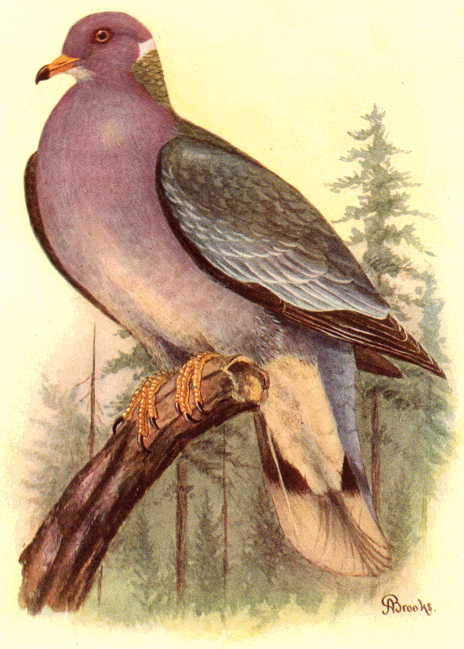
BAND-TAILED PIGEON (Columba fasciata)
Often mistaken for Passenger Pigeon
Letter from James B. Purdy, of Plymouth, Mich.:
November, 1894.
Oscar B. Warren, Palmer, Mich.
Dear Sir:—Yours of November 24 received, asking me to send notes on the Passenger Pigeon. In the beginning I would say that I am now fifty-one years of age, and I am writing this under the roof of the old homestead where I was born, hence my memory of the passenger pigeon for this locality extends back to my early boyhood, when millions of pigeons visited this locality on their spring and fall migrations, and during their spring migrations comparatively few halted with us to feed, but the great majority of them winged their way in a high-flying flock of unbroken columns, sometimes half a mile in length, to the north and west, probably to their breeding grounds; but on their return, from the first to the fifteenth of September, they would swarm down on our newly sowed wheat fields until acres of ground would be blue, and when they arose they would darken the air and their wings would sound like distant thunder. They were not so shy at this time of the year, as part of them were young birds, which were easily distinguished from the old ones by their speckled breasts; and I would here state that, during both spring and fall migrations, their greatest flight seemed to be from sunrise until about nine or ten o'clock A.M.
My father was an old pigeon catcher, and it was during these fall migrations that he would go out in the middle of a wheat field, build his bough house, set his net, and prepare for the finest sport in which it was ever my good fortune to participate; and many a time have I been with him when he has caught hundreds of them in a single morning. You may ask, What did you do with so many pigeons? Well, I will tell you. We skinned out the breasts, pickled them for two or three days in weak brine, and then strung them on strings, from one hundred and fifty to two hundred on a string, and hung them up to dry in the same manner as dried beef (I mean the breasts). Of course the remainder of the carcasses we cooked for immediate use, or as much of them as we needed for the family. Let me tell you that those pigeon breasts were a dainty morsel, and would last as long as dried beef and was far its superior in taste.
While rummaging through the attic a few days since, I came across the old pigeon stool upon which the stool-pigeon was tied, which my father used so many years ago, and it carried me back to my boyhood and conveyed to my mind vivid memories of the past.
The pigeons continued to visit us in great abundance for a number of years, although there would be an occasional season when there would not be so many. As the years rolled by they became fewer in number until in the fall of 1876, when I saw my last Passenger Pigeons (a small flock of ten or fifteen), I tried hard to procure some for my cabinet, but failed.
One peculiar habit of the Passenger Pigeons was that during their migrations, should they alight and their crops were filled with inferior food, they would vomit it up in order to fill themselves with something better should they find it.
F. N. Lawrence stated in Forest and Stream of February 18, 1899, that when a boy, in the late forties, he spent most of his time on his grandfather's country seat at Manhattanville, on the North River. In those years the wild pigeon flew south on both sides of the North River by the thousands in the fall, and in lesser numbers flew north in the spring.
He also wrote: "These migrations occurred with the utmost regularity. The first easterly storm after September 1st, clearing up with a strong northwest wind, was as surely followed by a flight of wild pigeons as the sun was to rise. During such storms, I have passed many a sleepless night watching to catch the first change of wind, and when it veered northwest, daybreak found me on the river bank watching for the flight that never failed. Ah! how my heart jumped as flock after flock of wild pigeons came flying over Fort Washington like small clouds. I have shot a great many of them, but alas, like the buffalo, they are almost exterminated."
I have run across what was evidently my first diary, dated 1872, when I was fourteen years old. I make the following extracts from it:
April 6th. "Pigeon flew this morning."
Then on April 8th I mention 9 pigeons shot in the afternoon by my father, and say "they flew very thick in the morning."
The record, like most boys' diaries, seems to have many skips, for the next item about pigeons is on the 11th of May, saying that I shot 2 that day and on the 1st of June I mention that I killed 3 pigeons in the morning, "the most I ever have shot at one time."
My marksmanship seems to have improved after that, for on the 7th of June I mention shooting 7, and on the 8th 8 (I used to go every morning), and on the 10th I got 8 again and on the 11th 12, and so on with varying success. On June 11 I mention that the young ones were beginning to fly plentifully.
W. B. M.
Extract from a letter written by the late Alexander McDougall of Duluth, February 8, 1905:
I have been about Lake Superior since 1863. Have never known any rookery near the lake or in Lake Superior Basin, although I think they did breed near Lake Superior, for they were in such great quantities about the lake during the whole summer. In 1871 when this town (Duluth) was first building, there were millions of them about here. In the Lake Superior region there are lots of berries but no beech nuts, except near Grand Island, 40 miles east of Marquette. It is likely if there was any roosting on Lake Superior, this would be the most favorable place. . . . The pigeon was numerous on Lake Superior in 1872, for I have recollections of catching some that year while captain of the Steamer Japan. During foggy weather and at night, they would alight on the boat in great numbers, tired out. On foggy mornings, the blowing of our whistle would start them up. Often, when they would light on the eave of our overhanging deck, we could sneak along under the deck and quickly snatch one. I remember having caught several in that way. As clearly as I can remember, they left all at once along about 1875. I have seen a few here along about 1882, and one fall in October, I think, of 1884, I saw two or three, the last I remember of them.
Kalamazoo, Mich., June 13th, 1905.
Wm. B. Mershon, Saginaw, Mich.:
* * * * *
It seems too bad that this noble bird should have been blotted out. The last flock, a small one, that I ever saw was in 1891. I saw pigeons in 1883, 1885 and 1886.
I have been in their nesting grounds. The males and the females sit on the nest on alternate days. When their big nesting was near South Haven in this State, the birds used to fly over this town every day in their quest for food, some of them going fully seventy-five miles in an air line from their nesting. One day it would be a continuous stream of male birds and the next day it would be the females.
How the netters did massacre them and ship them away by thousands and thousands. Many were kept alive and shipped all over the country for pigeon shoots. The last wild pigeons ever used for this purpose that I know of was at John Watson's Grand Grossing, Chicago, Illinois, in 1886. I asked Watson, in February last, where he got those birds, and he said from Indian Territory, so I think the netters finally cleaned up what was left of the big flight that perished from the sleet and fog at their last nesting in Michigan, near Petoskey, in 1881.
Their nests were built and eggs laid in late April. A big wind and storm of sleet came up just at dusk and the birds left; there was a big fog on Lake Michigan, and the birds were swallowed up by the storm; anyhow they disappeared then and there. I have heard tell of the beach being strewn for miles with dead pigeons, and I heard an old woodsman tell of the stench arising from dead pigeons in the woods.
It was that storm of ice that surely wiped them out.
I was at Petoskey in 1882, and no pigeons showed up that year.
What a host of memories of boyhood days are recalled, when one thinks of the wild pigeons. I can see myself a boy again, equipped with a long, single barrel shot gun, shot pouch and powder flask a-dangling, a box of G. D. caps in my pocket, and I a-sneakin' and a-sneakin' up for a shot at an old cock pigeon perched away up on a dead limb at the top of a tall tree. How handsome is that old cock with neck outstretched and tail a-streamin', the richness of his coloring, the red of the breast, the metallic sheen of that outstretched neck is of marvelous luster as bathed in the glories of the morning sunlight. He turns his head! He is onto that boy who is sneaking so carefully along the old rail fence. Carefully the gun is raised and aimed; the trigger is pressed. "Ker-whang" in a cloud of smoke is the loud report. The old cock, startled, flies away. "Missed him, by gosh!" is the boy's lament as he starts to reload, whilst in unison with the rattle of the grains of powder in the flask, there comes drifting down on the morning breeze, slowly wafting here and there, a long tail feather from that noble bird to show that though missed, yet the aim was true.
Yours truly,
Ben O. Bush.
Kalamazoo, Mich., June 17th, 1905.
Dear Mershon:
Do not understand me as to my assertion, that in nesting time the wild pigeons in feeding, the males always alternate with the females, each having a day off and a day on throughout the period of incubation and the rearing of the young. It depended upon the amount of food and the distance that they had to go to get it, and they changed their habit according to the conditions. If they had to make a long flight, as was the case when they passed over here, then they alternated; but I will agree with you that their habit in nesting time when food was plenty and not far away, was for the males to sit first in the morning, then the females, and sometimes the males a second time, all in the same day. Pigeons require a great deal of water, and sometimes their crops would show that they had been to water prior to their return flight, while at other times the food in their crops would be dry.
Some other boys and I had a lot of wild birds that we bought alive from a netter. We put the birds in the loft of a big barn where there was a lot of beans that had not been threshed. We would put in a big trough of water for them every day. The way those birds threshed out those bean pods was a caution. They became very fat and fairly tame. What wouldn't I give to hear the call note of Tete! Tete! Tete! of the pigeons once more.
Yours truly,
Ben O. Bush.
J. S. Van Cleef of Poughkeepsie, N. Y., wrote in Forest and Stream of May 20, 1899, as follows:
For many years up to about 1850, flocks of wild pigeons in the fall were quite abundant, and were very often taken with nets, which was a very favorite way of capturing them at that time, but very few, if any, have been taken in this manner since that time. A few small flocks appeared in the fifties, but not to such an extent that an attempt was made to capture them through the aid of pigeon nets, and I find upon inquiry that the experience of others agrees with my own.
The last flight of pigeons of which I have any knowledge occurred in the seventies, where they nested in the mountain range south of the Beaverkill in the lower part of Ulster County. There were two flights about this time, one small one, and in the course of two or three years this was followed by a flight where the pigeons appeared in great numbers.
This flock had nested in Missouri in the month of April, and the most of the squabs were killed by those who were in the business of furnishing squabs for the market.
When the nesting was over the entire flock went to Michigan, where they nested again, and they were followed there by the same persons who again destroyed most of the squabs. When they left Michigan they took their flight eastward, and telegrams were sent all over that part of the country where the pigeons would be likely to nest a third time, and as soon as they settled in the Catskills these persons were apprised of the location and very soon appeared on the scene.
The party, about thirty strong, stopped at Monson's, whose house was located on the upper Beaverkill, about three miles from the nest.
This nest was a mile from the Willewemoc Lodge, where I happened to be during the whole time that the pigeons were in their roost. It was claimed at the time that the squabs were sent down to New York by the ton, but as to this I have no personal knowledge, though I do know that during the nesting all, or nearly all, of the squabs were destroyed, and this was done by invading the grounds at night and striking the trunks of the trees with a heavy axe or sledge hammer, upon which the squabs would tumble out of the nests on the ground, and be picked up and carried to Monson's and shipped to New York the next day.
I do know, however, that from a natural ice house and the ice house belonging to our club, these persons obtained not less than fifteen tons of ice for the purpose of preserving the squabs.
This is the last flight of pigeons that has ever taken place in this part of the country, so far as I have any knowledge, and I am very sure that if there had been any I would have known it.
Poughkeepsie, N. Y., May 12.
CHAPTER XII
The Last of the Pigeons
From "The Auk," July, 1897, under the title "Additional Records of the Passenger Pigeon (Ectopistes migratorius.)"
M
MOST of the notes on the Passenger Pigeon recorded in the past year have referred to single birds or pairs. It is with much pleasure that I now call attention to a flock of some fifty, observed in southern Missouri. I am not only greatly indebted to Mr. Chas. H. Holden, Jr., for this interesting information, but for the present of a beautiful pair which he sent me in the flesh, he having shot them as they flew rapidly overhead. Mr. Holden was, at the time (December 17, 1896), hunting quail in Attie, Oregon County, Mo. The residents of this hamlet had not seen any pigeons there before in some years.
Simon Pokagon, Chief of the remaining Pottawattamie tribe, and probably the best posted man on the wild pigeon in Michigan, writes me under date of October 16, 1896: "I am creditably informed that there was a small nesting of pigeons last spring not far from the headwaters of the Au Sable River in Michigan." Mr. Chase S. Osborn, State Game and Fish Warden of Michigan, under date, Sault Ste. Marie, March 2, 1897, writes: "Passenger Pigeons are now very rare indeed in Michigan, but some have been seen in the eastern parts of Chippewa County, in the upper peninsula, every year. As many as a dozen or more were seen in this section in one flock last year, and I have reason to believe that they breed here in a small way. One came into this city last summer and attracted a great deal of attention by flying and circling through the air with the tame pigeons. I have a bill in the Legislature of Michigan, closing the season for killing wild pigeons for ten years."
Ruthven Deane, Chicago, Ill.
From "The Auk," April, 1898, Vol. 15, Page 184, under the title, "The Passenger Pigeon (Ectopistes migratorius) in Wisconsin and Nebraska."
Our records of this species during the past few years have referred in most instances, to very small flocks and generally to pairs or individuals. In The Auk for July, 1897, I recorded a flock of some fifty pigeons from southern Missouri, but such a number has been very unusual. It is now very gratifying to be able to record still larger numbers and I am indebted to Mr. A. Fugleberg of Oshkosh, Wis., for the following letter of information, under date of September 1, 1897: "I live on the west shore of Lake Winnebago, Wis. About 6 o'clock on the morning of August 14, 1897, I saw a flock of wild pigeons flying over the bay from Fisherman's Point to Stony Beach, and I assure you it reminded me of old times, from 1855 to 1880, when pigeons were plentiful every day. So I dropped my work and stood watching them. This flock was followed by six more flocks, each containing about thirty-five to eighty pigeons, except the last, which only contained seven. All these flocks passed over within half an hour. One flock of some fifty birds flew within gunshot of me, the others all the way from one hundred to three hundred yards from where I stood." Mr. Fugleberg is an old hunter and has had much experience with the wild pigeon. In a later letter dated September 4, 1897, he writes: "On Sept. 2, 1897, I was hunting prairie chickens near Lake Butte des Morts, Wis., where I met a friend who told me that a few days previous he had seen a flock of some twenty-five wild pigeons and that they were the first he had seen for years." This would appear as though these birds were instinctively working back to their old haunts, as the Winnebago region was once a favorite locality. We hope that Wisconsin will follow Michigan in making a close season on wild pigeons for ten years, and thus give them a chance to multiply, and, perhaps, regain, in a measure, their former abundance.
In Forest and Stream of Sept. 25, 1897, appeared a short notice of "Wild Pigeons in Nebraska," by "W. F. R." Through the kindness of the editor he placed me in correspondence with the observer, W. F. Rightmire, to whom I am indebted for the following details given in his letter of Nov. 5, 1897: "I was driving along the highway north of Cook, Johnson County, Neb., on August 17, 1897. I came to the timber skirting the head stream of the Nemaha River, a tract of some forty acres of woodland lying along the course of the stream, upon both banks of the same, and there feeding on the ground or perched upon the trees were the Passenger Pigeons I wrote the note about. The flock contained seventy-five to one hundred birds. I did not frighten them, but as I drove along the road the feeding birds flew up and joined the others, and as soon as I had passed by they returned to the ground and continued feeding. While I revisited the same locality, I failed to find the pigeons. I am a native of Tompkins County, N. Y., and have often killed wild pigeons in their flights while a boy on the farm, helped to net them, and have hunted them in Pennsylvania, so that I readily knew the birds in question the moment I saw them." I will here take occasion to state that in my record of the Missouri flock (Auk, July, 1897, p. 316) the date on which they were seen (Dec. 17, 1896) was, through error, omitted.
Ruthven Deane, Chicago, Ill.
From "The Auk," January, 1896, under the title, "Additional Records of the Passenger Pigeon (Ectopistes migratorius) in Wisconsin and Illinois."
I am indebted to my friend, Mr. John L. Stockton, of Highland Park, Ill., for information regarding the occurrence of this pigeon in Wisconsin. While trout fishing on the Little Oconto River in the Reservation of the Menominee Indians, Mr. Stockton saw, early in June, 1895, a flock of some ten pigeons for several consecutive days near his camp. They were first seen while alighting near the bank of the river, where they had evidently come to drink. I am very glad to say that they were not molested.
Mr. John F. Ferry of Lake Forest, Ill., has kindly notified me of the capture of a young female pigeon which was killed in that town on August 7, 1895. The bird was brought to him by a boy who had shot it with a rifle ball, and although in a mutilated condition he preserved it for his collection.
I have recently received a letter from Dr. H. V. Ogden, Milwaukee, Wis., informing me of the capture of a young female pigeon which was shot by Dr. Ernest Copeland on the 1st of October, 1895. These gentlemen were camping at the time in the northeast corner of Delta County, Mich. (Northern Peninsula), in the large hardwood forest that runs through that part of the State. They saw no other of the species.
Ruthven Deane, Chicago, Ill.
From "The Auk," July, 1895, under the title, "Additional Records of the Passenger Pigeon in Illinois and Indiana."
The occurrence of the wild pigeon (Ectopistes migratorius) in this section of the country, and, in fact, throughout the West generally, is becoming rarer every year, and such observations and data as come to our notice should be of sufficient interest to record.
I have, in the past few months, made inquiry of a great many sportsmen who are constantly in the field and in widely distributed localities, regarding any observations on the wild pigeon, and but few of them have seen a specimen in the past eight or ten years. N. W. Judy & Co., of St. Louis, Mo., dealers in poultry, and the largest receivers of game in that section, wrote as follows: "We have had no wild pigeons for two seasons; the last we received were from Siloam Springs, Ark. We have lost all track of them, and our netters are lying idle."
I have made frequent inquiry among the principal game dealers in Chicago and cannot learn of a single specimen that has been received in our markets in several years. I am indebted to the following gentlemen for notes and observations regarding this species, which cover a period of eight years. I have various other records of the occurrence of the pigeon in Illinois and Indiana, but do not consider them sufficiently authentic to record, as to the casual observer this species and the Carolina dove are often confounded.
A fine male pigeon was killed by my brother, Mr. Chas. E. Deane, April 18, 1887, while shooting snipe on the meadows near English Lake, Ind. The bird was alone and flew directly over him. I have the specimen now in my collection.
In September, 1888, while teal shooting on Yellow River, Stark County, Ind., I saw a pigeon fly up the river and alight a short distance off. I secured the bird which proved to be a young female.
On Sept. 17, 1887, Mr. John F. Hazen and his daughter Grace, of Cincinnati, Ohio, while boating on the Kankakee River near English Lake, Ind., observed a small flock of pigeons feeding in a little oak grove bordering the river. They reported the birds as quite tame and succeeded in shooting eight specimens.
Mr. Frank M. Woodruff, Assistant Curator, Chicago Academy of Sciences, informs me that on Dec. 10, 1890, he received four Passenger Pigeons in the flesh, from Waukegan, Ill., at which locality they were said to have been shot. Three of the birds were males and one was a female. One pair he disposed of, the other two I have recently seen in his collection. In the fall of 1891, Mr. Woodruff also shot a pair at Lake Forest, Ill., which he mounted and placed in the collection of the Cook County Normal School, Englewood, Ill.
In the spring of 1893, Mr. C. B. Brown, of Chicago, Ill., collected a nest of the wild pigeon containing two eggs at English Lake, Ind., and secured both parent birds. Mr. Brown describes the nest as being placed on the horizontal branch of a burr oak about ten feet from the trunk and from forty to fifty feet from the ground. He did not preserve the birds, but the eggs are still in his collection. The locality where this nest was found was a short distance from where the Hazens found their birds six years before.
Mr. John F. Ferry informs me that three pigeons were seen near the Des Plaines River in Lake County, Ill., in September, 1893. One of these was shot by Mr. F. C. Farwell.
In an article which appeared in the Chicago Tribune Nov. 25, 1894, entitled "Last of His Race," Mr. E. B. Clark related his experience in observing a fine male wild pigeon in Lincoln Park, Chicago, Ill., in April, 1893. I quote from the article: "He was perched on the limb of a soft maple and was facing the rising sun. I have never seen in any cabinet a more perfect specimen. The tree upon which he was resting was at the southeast corner of the park. There were no trees between him and the lake to break from his breast the fullness of the glory of the rising sun. The pigeon allowed me to approach within twenty yards of his resting place and I watched him through a powerful glass that permitted as minute an examination as if he were in my hand. I was more than astonished to find here, close to the pavements of a great city, the representative of a race which always loved the wild woods, and, which I thought had passed away from Illinois forever."
Mr. R. W. Stafford of Chicago, Ill., who has shot hundreds of pigeons in former years within the present city limits of Chicago, informs me that in the latter part of September, 1894, while shooting at Marengo, Ill., he saw a flock of six flying swiftly over and apparently alight in a small grove some distance off.
The above records will show that while in this section of the country large flocks of Passenger Pigeons are a thing of the past, yet they are still occasionally observed in small detachments or single birds.
A. B. Covert of Ann Arbor, Mich., wrote under date of Oct. 27, 1894: "Prior to the spring of 1881 the wild pigeon was everywhere a common bird of passage throughout the southern part of Michigan and nested commonly in the northern part. My home, in 1880, and for a few years after, was at Cadillac, Mich., and there was at that time a nesting place near Muskrat Lake in Missaukee County. Thousands of the birds were killed there. In the spring of 1881 the birds failed to make their appearance, and since then have been very rare. Nov. 23, 1892, I secured one male and two young females; these were killed in Scio, Washtenaw County, Oct. 9, 1893; one male near Ypsilanti, Mich., Sept. 27, 1894; one female killed at Honey Brook, Scio, Washtenaw County. There is also a female bird in this city that was killed in Livingston County in October, 1892."
In a bulletin of the Michigan Ornithological Club, Vol. II, No. 3-4, July to December, 1898, Mr. A. B. Covert, the club's president, tells of seeing a flock of about two hundred pigeons. On Oct. 1, 1898, in Washtenaw County, Mich., he watched a large number of them all day.
Mr. Stewart E. White writes from Ann Arbor under date of Feb. 9, 1894: "My notebooks are not here so I cannot give exact dates, but I can remember distinctly every specimen I ever saw. I observed one flock of about sixty in Kent County in the fall, the last of October or first of November, 1890. At Mackinac Island at various times in September of 1889 I saw parts of a large flock, of say two hundred. My field experience in the western part of Michigan has been quite extensive and thorough, but these two flocks are all I ever recorded."
F. M. Falconer of Hillsdale, Mich., on Dec. 3, 1904, writes to Mr. Warren as follows: "During the last week of March, 1892, one of the students here shot a nice male. There were two together, but only one was secured. That summer I saw a small flock feeding in some thick woods along the banks of a stream in which I was fishing, in Chautauqua County, N. Y. There were eight or ten birds at least, and perhaps many more, as they scattered along in spots."
Mr. T. E. Douglas of Grayling, Mich., reports that in the year 1900 he saw three Passenger Pigeons on the East Branch of Au Sable River, Michigan, and about five years previous to that date a flock of ten was seen around George's Lake, which is eight miles southwest of West Branch, Michigan.
I also have a record of one pigeon taken by Mr. John H. Sage, in Portland, Conn., in October, 1889.
In May, 1904, Hon. Chase S. Osborn wrote:
Dear Mr. Mershon: I haven't much information relating to the pigeons in this section of the country. In fact, the pigeon was practically gone from the north when I first visited the country in 1880. I remember seeing a flock of about three hundred in Florence County, Wis., which would probably be on a line fifty miles south of here, in 1883. In 1884 I saw a flock in that same section, in the woods northwest of Florence, of about fifty. In 1890 I six of these birds near the mouth of the Little Munoskong River in this county. This river empties into Munoskong Bay, about thirty miles southeast of here. In 1897 I saw a single wild pigeon, flying with the tame pigeons around this town. It was a remarkable sight and attracted the attention of many local bird lovers. There is no doubt that it was a pigeon, and it was absolutely alone as far as we could discover.
Upon inquiry here among old residents, I am told that there was quite a large roost on a beech ridge about forty miles west of here, which would be at a point north of the present station of Eckerman. I have been unable to learn just when this roosting place was discontinued, but as near as I can make out from comparing statements and records, it must have been in '78, '79, or '80.
I have heard of a large roosting place in northern Wisconsin which was used as late as 1874 by vast numbers of birds. It was located to the south and a little west of Lac Vieux Desert. At the head of the Pike River in Wisconsin, a point probably sixty-five miles south of here, and west into that State, the pigeons were seen in large numbers until 1872. As I understand it, in the early days they were very likely to frequent the same section year after year when not too much disturbed.
Mr. Newell A. Eddy of Bay City, Mich., under date of Aug. 7, 1905, wrote me as follows:
I find that I have but few notes regarding this species. On Sept. 13, 1880, I took a single bird near the city of Bangor, Maine. The sex was not determined. This was an unusual capture for the place and the time. A few years previous to that time, on a canoeing trip to the headwaters of the Penobscot River, I fell in with a small flock of a dozen or more in an old burnt-over swamp, but was unable to secure any of them.
I presume that you have an abundance of notes on the Passenger Pigeon in this section of the country at the time it was so abundant here, as such information is readily obtainable from any of the old inhabitants of this locality. I had a very interesting interview the other day with Mr. C. E. Jennison of this city, who was one of our earliest settlers, and he gave me a great deal of information about this bird in the earlier days of Bay City. He also stated, which was quite interesting, that six or seven years ago he saw a few birds at Thunder Bay Island, near Alpena. This appears to be his last record of this species.
The most interesting information I have was obtained from Mr. Birney Jennison, his son, who advised me a few days ago while we were on our way to Point Lookout, Saginaw Bay, that about the 15th of July, this year, he saw a pair of these birds in a swale at Point Lookout while roaming through the woods. He and I visited the same locality about two weeks after that, but saw nothing of them. Of course there is some likelihood that the birds Mr. Jennison saw may have been the common Carolina doves. Mr. Birney Jennison also had a great deal of experience with this bird in his younger days about Bay City, and there would appear to be no question as to his ability to accurately identify the bird.
From Mr. Neal Brown, Warsaw, Wis., May 20, 1904:
Mr. W. B. Mershon, Saginaw, Mich.
Dear Sir:—Your favor at hand with reference to the wild pigeon. It was, I think, three or four years ago that, in hunting with Mr. Emerson Hough near Babcock in this State in September, we killed an unmistakable wild pigeon. I saw a few pigeons in the woods in Forest County, in this State, about fifteen years ago. About seven years ago I saw three near Wausau and shot one of them. There was a pigeon roost for many years in Wood County, in this State, but it has long since disappeared.
When I was a boy in southern Wisconsin in the 60's and 70's, wild pigeons were so numerous as to almost darken the air. In the early 70's there was a small roost on Bark River, near Ft. Atkinson, in this State.
The wild pigeon had practically disappeared in southern Wisconsin as early as 1880, in fact, it was two or three years before that that I saw the last of them.
Charles W. Ward of Queens, L. I., New York, reports that in October, 1883, he saw a flock of at least one hundred Passenger Pigeons along the Manistee River in Township 26-5 and the following year about one dozen nested in a Spruce swamp near Orchard Lake on his old homestead. He often saw the nest and the birds. He remembers the time as being the season of the year when huckleberries were ripe, for he was berry-picking when he first observed them.
The writer of the following newspaper clipping of recent date is emphatically skeptical regarding the present-day existence of even an isolated pigeon:
LAST PIGEON FLIGHT IN IOSCO IN 1880
MILLIONS PASSED THROUGH THEN, BUT THEY HAVE NEVER BEEN THERE SINCE
Tawas, Mich., July 27.—John Sims, county game and fish warden, ridicules the idea of flocks of wild pigeons being found in Iosco County, as was reported in some of the State papers. He says: "There are no wild pigeons in Iosco County; nor have there been any here since April 1, 1880. There fell about six inches of snow on that day, then the weather cleared and the sun rose bright and clear, but it was but for a short time, as the air was clouded with pigeons going westward. That was the first time they had been here for a number of years, and, although it was Sunday, everyone who had a gun was shooting or trying to shoot, and there were lots of pigeons killed that day in nearly all the streets of Tawas. There were simply millions of them going westward, and those that were killed were picked up out of the snow. Since that day there have been no wild pigeons here. We have lots of mourning doves here, and the writer has probably seen these. There is a certain magazine that offers $50 for a pair of wild pigeons, and I think the sportsmen would add another $50 to it to have the wild pigeons with us again."
In the report of the Massachusetts commissioners on fisheries and game for the year ending December 31, 1903, is to be found the following:
The occurrence of the wild pigeon is a matter of public and scientific interest, and for this reason, and not because it is a game bird, reference to it is introduced here. Deputy Samuel Parker, who is perfectly familiar with the wild pigeon, makes mention of its appearance at Wakefield this year as follows: "In September a flock of wild pigeons, twenty-five or thirty in number, came over Crystal Lake." This notice of the presence of a species believed to be extinct is interesting and must be important to ornithologists. [C]
George King, guide and trapper, living in Otsego County, Michigan, told me in 1904 that four years before he had seen along Black River a flock of wild pigeons, a dozen or more birds. He said there is no mistake about it, because he was familiar with the wild pigeon early in life. These alighted in a tree near him. He said that in 1902, also, he heard the call of two wild pigeons, although he hunted for the birds and did not find them.
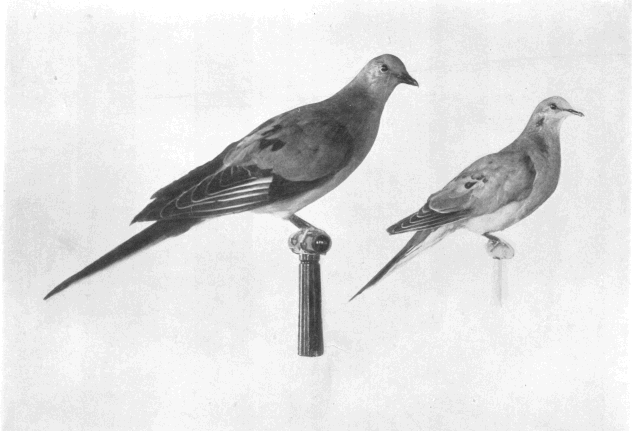
COMPARATIVE SIZE OF PIGEON AND DOVE
From photo furnished by Prof W. B. Burrows, of the Michigan Agricultural College
I believe that six wild pigeons were actually seen in the latter part of April of 1905 near Vanderbilt, Mich., by this George King. I have tested his honesty and truthfulness time and time again. He told me he was seated in the branches of an apple tree when he saw six wild pigeons alight in another tree near him. He kept perfectly still and watched their movements for about thirty minutes. They flew from the old tree in which they had alighted, underneath a beech tree and began feeding on beech nuts from the ground. He says he heard them call and they made the same old crowing call of the wild pigeon. He was close to them; he is perfectly familiar with the dove and knows that these six were Passenger Pigeons. King has for many years lived in the section that formerly was the great pigeon nesting and feeding ground of northern Michigan.
Michigan Agricultural College,
July 14, '05.
Dear Sir:—I have been away for the past three weeks and find your letter of June 27 here on my return. The photographs sent you were those of the Passenger Pigeon and the Carolina dove, the one of the two birds being intended to show relative size and appearance. It was taken from two of the best specimens in the museum, placed at exactly the same distance from the camera so that the picture shows the comparative size exactly. The birds being so similar in general appearance, the smaller one looks as if it were further away than the larger, and this, I think, shows clearly how impossible it is for the ordinary observer to discriminate between these two species when seen separately in the field. Of course a mixed flock would be a different proposition, but so far as I know the two species never mingle, and, at least in this State, it is an unusual thing to find the Carolina dove in large compact flocks such as are characteristic of the Passenger Pigeon. In several cases, however, during August and September I have seen large scattered flocks of the Carolina dove which were feeding on weed seeds and grain in open fields, and which when disturbed, gathered into small bands of twenty to fifty each and flew and perched very much like Passenger Pigeons. In one case I saw at least five hundred Carolina doves acting this way, and had hard work to convince a sportsman friend of mine that they were not Passenger Pigeons. Finally, after getting directly under a small tree on which a dozen or more were perched, he was able to see that characteristic black dot on the side of the neck, and was also able to estimate more correctly the actual size of the birds.
Yours very truly,
Walter B. Burrows, Professor of Zoology.
Agricultural College,
Ingham Co., Mich., June 17, 1905.
Mr. W. B. Mershon, Saginaw, Mich.
Dear Sir:—Yours of the 16th is at hand and in reply I would say that the Carolina dove is rarely found north of the Au Sable River, and I should not expect ever to see it there in flocks in the spring; on the other hand it is just as likely to be found early in the season as the Passenger Pigeon, since the Carolina dove winters regularly in southern Michigan and is one of the first birds to appear in the spring in this county, in fact not infrequently staying here through the winter. On the whole, however, I think there can be little doubt that Mr. King's report relates to the Passenger Pigeon and not to the dove. I have had some photographs taken of the Carolina dove and Passenger Pigeon together, and will ask my assistant, Mr. Myers, to mail you prints of these within a few days as soon as he has time to make some good ones. If these do not show what you desire we will try again.
Yours very truly,
Walter B. Burrows, Professor of Zoology.
Mr. George E. Atkinson, to whom I am indebted for much valuable data in this book, writes from Portage La Prairie, Manitoba, July 21, 1905, as follows:
I was on a holiday trip on the Assiniboia River last week, and a pair of birds flew by me at a few yards' distance, flashing the pigeon color to all appearances in the sun and alighting on the bank. I turned my boat and until after I shot the bird, I would have sworn it was a pigeon, but it proved to be a large, bright plumaged dove. Atmospheric conditions considerably affected the size so that I am convinced that it is possible for even the best of us to be deceived, and a scientific record must not be formed on any supposition.
Iron Mountain, Mich.,
May 30, 1904.
Mr. W. B. Mershon, Saginaw, Mich.
Dear Sir:—In reply to your letter of inquiry respecting the Passenger Pigeon, I will say that my knowledge of it is very limited except from hearsay, but I am credibly informed that it nested at the east end of Deerskin Lake, Sec. 30, N44 W31, as late as 1888. Mr. Armstrong, a timber cruiser, late a resident of this city, gave me this information. He said there was a small colony of less than a hundred birds then. Fire has since destroyed the timber there and he doubted if they were still there when he told me about them. Mr. A. was a keen observer and thoroughly reliable; had been familiar with the species when abundant in lower Michigan, and I have great confidence in the accuracy of his reports. I used to see them as late as 1883 in this vicinity. They were shot in the summer of 1883 during the blueberry season. I should estimate that as many as fifty birds were taken that summer. I cannot imagine why they should have disappeared from this region. I have no reports concerning the birds from the north shore.
In 1897 a young bird was taken in the neighboring town of Norway with a broken wing and identified by hunters who had known the species in the day of its abundance.
Dr. J. D. Cameron of this city informs me that he saw a flock of about fifty birds flying over the St. George Hospital of this place on the 28th of October, 1900. He was positive that he was not mistaken, as the birds were flying low, and he had formerly been well acquainted with the species in Canada. You can take this latter for what it is worth. Dr. C's. veracity is beyond question, but whether he could have mistaken some other birds for the pigeons I am not prepared to say. He is not interested in ornithology and I would not expect him to recognize ordinary birds, but he may have hunted the wild pigeon in his younger days and so be familiar with its manner of flight. I cannot imagine any other birds that he could mistake for them.
I have an idea that I may have seen one myself in the summer of 1900, but am not sufficiently well acquainted with it to recognize it at sight. I fired at it with a .22 rifle, and the peculiar maneuvers which it executed in the air as the bullet passed, attracted my attention. I was afterward told that the wild pigeon tumbled in the air that way when fired at. I thought at first that it was hit.
Yours truly,
E. E. Brewster.
CHAPTER XIII
What Became of the Wild Pigeon?
By Sullivan Cook, from "Forest and Stream," March 14, 1903. [D]
W
WHEN a boy and living in northern Ohio, I often had to go with a gun and drive the pigeons from the newly sown fields of wheat. At that time wheat was sown broadcast, and pigeons would come by the thousands and pick up the wheat before it could be covered with the drag. My father would say, "Get the gun and shoot at every pigeon you see," and often I would see them coming from the woods and alighting on the newly sowed field. They would alight until the ground was fairly blue with these beautiful birds.
I would secrete myself in a fence corner, and as these birds would alight on the ground they would form themselves in a long row, canvassing the field for grain, and as the rear birds raised up and flew over those in front, they reminded one of the little breakers on the ocean beach, and as they came along in this form, they resembled a windrow of hay rolling across the field.
I would wait until the end of this wave was opposite my hiding place and then arise and fire into this windrow of living, animated beauty, and I have picked up as many as twenty-seven dead birds killed at a single shot with an old flintlock smooth bore. Later in the fall these birds would come in countless millions to feed on the wild mast of beech nuts and acorns, and every evening they would pass over our home, going west of our place to what was known as Lodi Swamp.
Many and many a time have I seen clouds of birds that extended as far as the eye could reach, and the sound of their wings was like the roar of a tempest. And for those who are not acquainted with the habits and flight of these birds, I wish to say that once in the month of November, while these pigeons were going from their feeding grounds to this roost in the Lodi Swamp, they were met with a storm of sleet and snow. The wind blew so hard that they could not breast it and were compelled to alight in a sugar orchard near our place. This orchard consisted of twenty acres, where the timber had all been cut out, except the maples, and when they commenced alighting, the trees already partially loaded with snow and ice, and the vast flock of pigeons being attracted by those alighting, all sought the same resting place.
Such vast numbers alighted that in a short time the branches of the trees were broken and as fast as one tree gave way those birds would alight on the already loaded tree adjoining, and, that, too, was stripped of its long and limber branches. Suffice it to say that in a half hour's time this beautiful sugar orchard was entirely ruined by the loads of birds which had attempted to rest from the storm.
About this time I enjoyed my first pigeon hunt in a roost. Being a boy about sixteen years of age, having a brother about thirteen, and as we had seen the pigeons going by to their roost for hours and knowing that many people went there every night to shoot pigeons on the roost, my brother and I were seized with a desire to go and enjoy this exciting sport. Then arose the difficulty of a gun suitable for the occasion. As we had nothing but a small-bore rifle and not owning a shotgun, we appealed to father as to what we should do for a gun. We had previously gained his consent to our going. He suggested that we take the old horse pistol; one of the Revolutionary time, which had been kept in the family as a reminder of troublesome years.
Let the young man of to-day, who hunts with the improved breechloader, think of two boys starting pigeon hunting, their only outfit consisting of a horse pistol, barrel twelve inches long, caliber 12-gauge, flintlock, one pound of No. 4 shot, a quarter of a pound of powder, a pocket full of old newspaper for wadding, a two-bushel bag to carry game in, and a tin lantern. Thus equipped, we started for the pigeon roost a little after dark. Although three miles from the roost when we started from home, we could hear the sullen roar of that myriad of birds, and the sound increased in volume as we approached the roost, till it became as the roar of the breakers upon the beach.
As we approached the swamp where the birds roosted, a few scattered birds were frightened from the roost along the edge of the swamp. These scattering birds we could not shoot, but kept advancing further into the swamp. As we approached this vast body of birds, which bent the alders flat to the ground, we could see every now and then ahead of us a small pyramid which looked like a haystack in the darkness, and as we approached what appeared to be this haystack, the frightened birds would fly from the bended alders, and we would find ourselves standing in the midst of a diminutive forest of small trees of alders and willows.
We now found these apparent haystacks were only small elms or willows completely loaded down with live birds. My brother suggested that I shoot at the next "haystack." So we advanced along very carefully among the now upright alders till we came to where it was a perfect roar of voices and wings, and just ahead of us we saw one of those mysterious objects which so resembled a haystack.
My brother suggested that I aim at the center of it and let the old horse pistol go. I instantly obeyed his suggestion, pointing as best I could in the dim light at the center of that form, and pulled. There was a flash and a roar, and the very atmosphere seemed to be alive with flying, chattering birds. The old tin lantern was lighted. The horse pistol was hunted for, as it had recoiled with such force I had lost hold of it. The gun being found, we then approached as nearly as we could the place where I had shot at the stack. From this discharge we picked up eighteen pigeons and saw some hobbling away into thick brush, from which we could not recover them. After an hour of this kind of hunting our bag was full of pigeons, and our tallow candle in the lantern nearly consumed. We retraced our steps out of the swamp, and about 11 o'clock at night arrived home well satisfied with the night's hunt in the pigeon roost. We had had acres of enjoyment and had brought home bushels of pigeons.
This is only to give an idea of what pigeons were in northern Ohio in the days of my boyhood. This was in the years of 1844 to 1846. In 1854, having grown to man's estate, I moved to Michigan and settled in Cass County, where I built a log house and began clearing up a farm. After having cleared three or four fields around my house, one morning one of my girls came running in from out of doors and said: "Pa, come out and see the pigeons."
I went to the door and saw scooting across my fields, as it seemed skimming the surface of the earth, flock after flock of the birds, one coming close upon the heels of another. I hastened into the house and grasped my double barreled shotgun, powder flask and shot pouch; my little girl, then a miss of twelve summers, following me. I took a stand on a slight rise in the middle of a five-acre field and commenced shooting, you might say, at wads of pigeons, so closely huddled were they as they went by. Letting the birds get opposite me and firing across the flock, I was enabled to kill from three to fifteen pigeons at a shot. And my girl was wildly excited, picking up the dead birds and catching the winged ones and bringing them to me.
You never saw two mortals more busy than we were for a half hour. At this time my wife called for breakfast, as we were near the house, and I found my stock of ammunition nearly exhausted. We went into the house for our breakfast and when we came out the birds were flying as thickly as ever. She says, let us count the pigeons and see how many we have. We found we had killed and picked up in this short time twenty-three dozen. My wife said I had better take them to Three Rivers, which was our nearest town, and sell them. And as my ammunition was about exhausted, I hitched up my team, took twenty dozen of the birds and drove ten miles to the station, sold my birds for sixty-five cents a dozen and returned home well satisfied with my day's work, and having on hand a good supply of ammunition for the next morning's flight.
Now I wish to pass along, the lapse of time being about sixteen years. During this time I had removed from Cass County to Van Buren County, where I had located in the beautiful village of Hartford. In the year 1869 or 1870, the pigeoners, a class of men who lived in Hartford, made a business of netting pigeons, and they are living here yet, and not one of them feels any pride in the part he took in the destruction of these beautiful birds. In March, 1869, word was received that a large flight of pigeons were coming north through the State of Indiana. These men, who had followed the pigeons for years, said, "As we have snow on the ground they will be sure to nest near here, and as we have had a big crop of beech nuts and acorns last fall they will be sure to stop to get the benefit of this mast." A queer thing about the pigeon was that he always built his nest on the borders of the snow, that is, where the ground underneath was covered with snow.
Sure enough, as predicted, in two days after receiving notice of the flight of the birds from Indiana, myriads of pigeons were passing north along the east shore of Lake Michigan, and soon scattering flocks were seen going south towards the bare ground. In a few days word was received that pigeons had gone to nesting in what was then called Deerfield Township, a vast body of hardwood and hemlock timber. Then it was that the pigeon killers, with their nets, stool birds and flyers commenced making preparations for the slaughter of the beautiful birds when they began laying their eggs. This takes place only three or four days after they commence nesting, as a pigeon's nest is the simplest nest ever built by a bird seen in a tree. It consists of a few little twigs laid crosswise, without moss or lining of any kind, and the lay of eggs is but one. As soon as one egg is laid, they commence sitting, and the male pigeon is quite a gentleman in his way, taking his turn and sitting one-half of the time.
In about twelve or fourteen days—some claim twenty—the young pigeon is hatched. As soon as hatched the male and female birds commence feeding on what is known as marsh feed, that is, on low, springy ground. And from this feed is supplied to both the male and female bird what is known as pigeon's milk, forming inside of the crop a sort of curd, on which the young pigeon is fed by both father and mother, who supply this food. The young bird is gorged with this food, and in a few days becomes as heavy as the parent bird. Another singular thing about the wild pigeon is that as the snow melts and the ground is left bare where the nesting is, the old birds never eat the nuts in the nesting, but leave them for the benefit of the young one, and so when he comes off the nest he always finds an abundance of food at his very door, as it were. As soon as the young birds are able to leave the nest and begin feeding on the ground in the nesting, the old birds immediately forsake them, move again on to the borders of the snow and start another nesting. In five or ten days the young birds will follow in the direction of the old birds.
When the young birds first come off the nest and commence feeding on the ground, they are fat as balls of butter, but in ten days from this time, when they start on their northern flight to follow their mother bird, they are poor as snakes, and almost unfit to eat, while, when they first leave the nest they are the most palatable morsel man ever tasted. However, in about forty days from the time they began nesting to the time they took their northern flight, there were shipped from Hartford and vicinity, three carloads a day of these beautiful meteors of the sky. Each car containing 150 barrels with 35 dozen in a barrel, making the daily shipment 24,750 dozen.
Young men who are now hunting for something to shoot and wondering what has become of our game, must hear with anger and regret such reports as this from western Michigan in the days gone by: "In three years' time there were caught and shipped to New York and other eastern cities 990,000 dozen pigeons, and in the two succeeding years it was estimated by the same men who caught the pigeons at Hartford that there were one-third more shipped from Shelby than from Hartford; and from Petoskey, Emmett County, two years later, it is now claimed by C. H. Engle, a resident of this town, who was a participant in this ungodly slaughter, that there were shipped five carloads a day for thirty days, with an average of 8,250 dozen to the carload. Now, when one asks you what has become of the wild pigeons, refer them to C. H. Engle, Stephen Stowe, Chas. Sherburne, and Hiram Corwin, and a man by the name of Miles from Wisconsin, Mr. Miles having caught 500 dozen in a single day. And when you are asked what has become of the wild pigeons, figure up the shipping bills, and they will show what has become of this, the grandest game bird that ever cleft the air of any continent."
My young friends, I want to humbly ask your forgiveness for having taken a small part in the destruction of this, the most exciting of sport. And there is not one of us but is ashamed of the slaughter which has robbed you of enjoyment. If we had been restrained by laws of humanity, you, too, could have enjoyed this sport for years to come.
CHAPTER XIV
A Novel Theory of Extinction
By C. H. Ames and Robert Ridgway
Boston, March 8, 1906.
Mr. W. B. Mershon:
Dear Sir:—Thank you for your note of the third in reply to mine of the first, in regard to your book on the Passenger Pigeon. I note that you say:
"There is room to make additions if you think you have something that would be interesting, and would like to submit it to me for my consideration."
Thanking you for your courtesy in the matter, I beg to say that I have long had great interest in the problem of the so sudden and complete destruction of this great species, and have from the first been quite unable to believe that the ordinarily assigned agencies for the destruction of the pigeon were adequate, or anywhere near adequate, to make a destruction so sudden and complete.
Several accounts which have come to my notice have strengthened my view. I know well that the attack of man and beast upon the pigeons in their rookeries, or breeding places, was fierce, persistent and enormously destructive, and that at these breeding places the destroyers gathered in great numbers, but, with my vivid recollection of the tremendous flights of pigeons which I myself saw in the '60's in northern Illinois, the wide distribution of the bird, and what I know of its migratory habits (I wish I knew very much more about these habits), I cannot think that in so few years the practical destruction of the species could be effected by the means referred to.
Years ago—I cannot tell how many, but I am confident it must have been at about the time of the disappearance of the great pigeon flights—I read an account, either in or quoted from a New Orleans newspaper, giving the stories of several ship captains and sailors who had arrived in New Orleans from the Gulf of Mexico. They stated that they had, in crossing the Gulf, sailed over leagues and leagues of water covered, and covered thickly, with dead pigeons. The supposition was that an enormous flight of the pigeons crossing the waters of the Gulf had been overwhelmed by a cyclone, or some such atmospheric disturbance, and that the birds had been whirled into the surf and drowned.
I have been told by competent ornithologists connected with the Boston Society of Natural History that Pigeon Cove, a well-known and much frequented extremity of Cape Ann, near Gloucester, Mass., received its name from the fact that a large flight of pigeons was similarly overwhelmed in flying along the Atlantic near that place, and that their bodies covered the shore in "windrows."
Not more than two years ago, if so long, I read a lengthy and signed account in a Montreal paper of a similar catastrophe to a great flight of pigeons in attempting to cross Lake Michigan, and similar statement was made that for miles the beach above Milwaukee was heaped and piled with "windrows" of dead pigeons.
Within two or three years several accounts have reached us, bearing every mark of believability, that considerable flights of geese, swans and ducks have been drowned in the surf off the New Jersey and Maryland shores. These flights of birds have been overwhelmed in a sudden storm or gale of wind, which beat them down into the surf where they were drowned, their bodies drifting about, and some of them being thrown up on the shore.
These accounts have come from fishermen, sportsmen and others, and I see no reason whatever to doubt that a flight of birds of any species known could easily be destroyed if caught off shore in some of the wind storms of which we have so many instances. I have frequently in Forest and Stream propounded my theory and asked for information about it before it became too late. The whole theory stands or falls, as it seems to me, with the ascertainment of the southern limit of the migration of the great pigeon flight. If the birds did not cross the Gulf of Mexico there is far less likelihood of my theory being the correct one, though my inquiries in Forest and Stream elicited one very circumstantial account of an enormous destruction of pigeons on the Gulf Coast, the birds being blown into the Gulf and destroyed by a fierce "norther" which beat down the coast for two or three days. Persons familiar with this phenomena of the Texas "norther" need no help to their imaginations in seeing how a pigeon flight, being caught on the shores of the Gulf by such a wind could be practically destroyed.
I do not know that you will think my theory worth any consideration, but I have finally interested a number of ornithologists who share my view that the final and sudden wiping out of the great bulk of the pigeon flight must have been by some cataclysmic agency. It seems to me that the question is one of great interest from the point of view of the naturalist and biologist, and well worth serious investigation by all who care for these things. I shall be pleased to know if what I have said seems to you of interest and to have any weight.
Wishing you all success in your admirable undertaking, and anticipating with great pleasure the results of your studies in your proposed book, I am,
Yours very truly,
C. H. Ames.
Memorandum prepared by Mr. Robert Ridgway, Curator of the Division of Birds, U. S. National Museum, to accompany letter to Mr. W. B. Mershon, Saginaw, Mich.
If Mr. Mershon will communicate on the subject of Passenger Pigeons with Mr. William Brewster, [E] 145 Brattle Street, Cambridge, Mass., he may get some data which will (or ought to) dismiss from consideration the idea that the passenger pigeon could have been exterminated in the manner suggested by Mr. Ames. During a visit to northern Michigan, Mr. Brewster talked with a great many pigeon netters. I have forgotten the figures, and may be very inexact in my recollection of them, but my recollection is that at one "roost" there were one hundred netters who averaged one thousand (it may have been ten thousand) pigeons per day. When it is considered that this was the rate of destruction at one locality in one State only, that the same was going on in other States, and that tens of thousands were being killed by hunters and others, and this year after year, I cannot see anything surprising in the eventual extermination of the species, no matter how numerously represented originally.
Nothing in the history of the Passenger Pigeon is more certainly known than the fact that its range to the southward did not extend beyond the United States. There is a single Cuban record, but the occurrence was purely accidental. The migrations of the Passenger Pigeon were wholly different in their character from those of true emigrants, that is to say, they were influenced or controlled purely by the matter of food supply, as in the case of the robin and some other birds, and the flights were as often from west to east and vice versa as from south to north or north to south; in short, the flocks moved about in various directions in their search for food or nesting places. For myself, I do not believe in the story of drowning in the Gulf of Mexico for two reasons. In the first place the birds are extremely unlikely to have been there, a hurricane from the northward being absolutely necessary to explain their presence in that quarter, and, in the second place, no such explanation is needed in view of what is known to be the facts concerning their wholesale destruction by human agency alone.
The range of the Passenger Pigeon was limited to the mixed hardwood forest region of the eastern United States and Canada, and any that occurred beyond were stragglers, pure and simple. Consequently it was not found, except as stragglers, in the long-leaf pine belt of the Gulf Coast, but only on the uplands from northern or middle Alabama, Mississippi, and Louisiana, northward.
CHAPTER XV
News from John Burroughs
W
WHEN the following report from so high an authority as John Burroughs appeared in Forest and Stream it seemed too important to be overlooked. I therefore ventured to open a correspondence with this famous naturalist, even suggesting that his informants might have mistaken some other species of migratory bird for a flight of wild pigeons. I had once made a similar mistake in Texas when the northern migration of the curlews was in full flight. Countless flocks of them were streaming past at a considerable distance from me, and I could have sworn they were wild pigeons until I was lucky enough to see them at much closer range. Even now the newspapers east and west contain an annual crop of wild pigeon reports, most of which are to be found fake reports upon careful investigation. It has happened often that hunters and woodsmen mistake the wild dove for the pigeon, and refuse to believe otherwise. The correspondence explains itself, however, and is a valuable contribution to the subject in hand.
W. B. M.
A FLOCK OF WILD PIGEONS [F]
West Park, N. Y., May 11th.
Editor Forest and Stream:
I have received evidence which is to me entirely convincing that a large flock of Passenger Pigeons was seen to pass over the village of Prattsville, Greene County, this State, late one afternoon about the middle of April. The fact was first reported in the local paper, the Prattsville News. An old boyhood schoolmate of mine, Charles W. Benton, was, with others, reported to have seen them. I have corresponded with Mr. Benton and have no doubt the pigeons were seen as stated. Mr. Benton saw pigeons, clouds of them, in his boyhood, and could not well be mistaken. He says it was about 5 o'clock, and that the flock stretched out across the valley about one-half mile and must have contained many hundreds. It came from the southeast, and went northwest. Mr. Benton says that a large flock was reported last year as having passed over the village of Catskill, and that a wild pigeon was shot near Prattsville last fall. A friend of mine saw two pigeons in the woods at West Point a year or so ago.
I have no doubt, therefore, that the wild pigeon is still with us, and that if protected we may yet see them in something like their numbers of thirty years ago.
John Burroughs.
West Park, N. Y., May 27, 1906.
To W. B. Mershon:
Dear Sir:—I can give you no more definite information about that flock of pigeons than I reported to Forest and Stream. I have no doubt about the fact. If you will write to C. W. Benton, Prattsville, N. Y., he can put you in communication with several people who saw the flock.
I am just about to write to Forest and Stream of another very large flock of pigeons that was seen to pass over the city of Kingston, N. Y., on the morning of the 15th. I have written to Judge A. T. Clearwater of that city, who replies that he has talked with many persons who saw the pigeons and who had seen the pigeons years ago. The flock is described as a mile long. I am going up to Kingston soon to question the persons who saw the flock. If I learn anything to discredit the story I will let you know. We never have a flight of any birds here that could be mistaken for pigeons by any one who had ever seen the latter. If these flocks were pigeons, where have they been hiding all these years?
Very sincerely yours,
John Burroughs.
Prattsville, N. Y., June 9, 1906.
W. B. Mershon, Saginaw, Mich.:
Dear Sir:—Yours of the 6th inst. is before me and I hasten to reply. Now, in the first place, you speak of John Burroughs. Mr. Burroughs and I went to school together when we were boys, and, as you say, he is a good authority on natural history, and I have had some communication with him on the pigeon question. I live in the heart of the Catskill Mountains, which was once a great resort for wild pigeons, and I have seen a vast number of them, dating back as far as 1848, when this country was literally covered with them, and for some years after. Now in regard to the wild pigeons I saw this spring. I was going to my home in the village of Prattsville, in company with a man by the name of M. E. Kreiger, one Sunday afternoon, and when near my house we stopped to talk a few minutes, when, on looking up, we saw the flock of pigeons. They were coming from the southeast and went to the northwest. The flock was about one-half mile long and flew in the same manner as pigeons of old. There were thousands of them. Now in regard to ducks, teal and plover, we never see any of them here in the mountains, though once in a while a few ducks, but only in small flocks of seven or eight in a bunch; and there are no birds that gather in flocks here but crows in the fall, but never at any other time. Wild geese fly over here in the fall.
The Daily Leader, a daily paper published in Kingston, Ulster County, N. Y., contained an item a few weeks since stating that a flock of wild pigeons passed over the city a short time ago. The flock was about one mile long and contained many thousands. And in the spring of 1905, the Catskill Recorder, a newspaper published in this county, reported seeing a flock similar to the one seen at Kingston.
Wishing you success on your fishing trip, I am,
Yours truly,
C. W. Benton.
THE SULLIVAN COUNTY PIGEONS
West Park, N. Y., June 30th.
Editor Forest and Stream:
Since I wrote you a few weeks ago, I have been looking up the men who were reported to have seen wild pigeons recently. I have seen six men who are positive they have seen flocks of wild pigeons—some of them two years ago, and some of them this past spring. As these men were all past middle age and had been familiar with the pigeon thirty and forty years ago and were, moreover, men reported truthful and sober by their neighbors, and who impressed me as being entirely reliable, I feel bound to credit their several statements. At De Bruce, Sullivan County, Mr. Cooper, the postmaster and village blacksmith, said he had seen a large flock of pigeons in the fall two years ago. They were about a buckwheat field. He pointed out the hill about which they were flying. Mr. Cooper had shot and trapped a great many pigeons years ago, and was sure he could not mistake any other bird for a pigeon. A farmer, whose name I do not now remember and who heard Mr. Cooper's statement, said he saw a large flock last fall about a buckwheat field, in the same town. This man was reported to me as perfectly reliable, and he gave me that impression.
At Port Ewen, I met a Hudson River shad fisherman, Mr. Van Vliet, who said he had seen early one morning in April or May, two years ago, a flock of wild pigeons over the Hudson. He estimated the flock as containing seventy or eighty birds. Mr. Van Vliet is a man nearly seventy years old, and one cannot look into his face and have him speak and doubt for a moment the truth of what he is saying. When I asked him if he knew the wild pigeon, he smiled good-humoredly and said he knew them as well as he knew anything; he had lived in the time of pigeons, and had killed hundreds of them.
Another man, one of the leading grocerymen of Port Ewen, said he had seen a very large flock of pigeons between 4 and 5 o'clock on May 15 last, flying over as he was on his way to open his store. His hired man, who was with him, also saw them. Mr. Van Leuven had also seen pigeons in his youth and described to me accurately their manner of flight and the form of the flock against the sky. A neighbor of his told me he had seen a flock of fifteen or twenty pigeons on a foggy morning only a few days before. The rush of their wings overhead first attracted his attention to them. But he had never seen wild pigeons, and might have been deceived, though he was sure they were pigeons by their speed and general look.
None of these men could have had any motive in trying to deceive me, and I feel bound to credit their stories. Their statements, taken in connection with the statement of my old schoolfellow at Prattsville, N. Y., of whom I wrote you, makes me believe that there is a large flock of wild pigeons that still at times frequents this part of the State, and perhaps breeds somewhere in the wilds of Sullivan or Ulster County. But they ought to be heard from elsewhere—from the south or southwest in winter.
John Burroughs.
P. S.—Just as I finished the above, I came upon the following in the Poughkeepsie Sunday Courier:
"We noticed recently an item asking whether wild pigeons are returning. Sullivan County people seem to be taking the lead in answering the question, but a Dutchess County farmer named David Rosell, living near Fishkill Plains, who was familiar with the aforesaid birds in old days, reports having seen a flock of about thirty feeding on his buckwheat patch one morning last week, which gives evidence that the birds are not extinct as supposed, but a flock may merely be taking a tour around the world like Magellan of old. Mr. Rosell stated that he had not seen any before in about forty years. At first sight, he could hardly believe his eyes, but he was not long in becoming convinced of their identity."
CHAPTER XVI
The Pigeon in Manitoba [G]
By George E. Atkinson
W
WHILE the biological history of any country records the decrease and disappearance of many forms of life due to just or unjust circumstances, it remains for the historical records of North America to reveal a career of human selfishness which may be considered the paragon. Within four centuries of North American civilization (or modified barbarism) we can be credited with the wiping into the past of at least three species of animal life originally so phenomenally abundant and so strikingly characteristic in themselves as to evoke the wonder and amazement of the entire world. And, sad to relate, so effectual has been the extermination, that it is doubtful if our descendants a few generations hence will be able to learn anything whatever about them save through the medium of books. While herein again we shall be just subjects of their censure for having manifestly failed to preserve in history's archives any material amount of specific information.
The early settlers landing upon the Atlantic coast between Newfoundland and the Carolinas found them in possession of armies of great auks, and the few scraps of authenticated history which we now possess disclose a most iniquitous course of wanton slaughter and destruction which ended in the complete extinction of the bird over sixty years ago. Yet in the face of this destruction there remain but four mounted specimens and two eggs in the collections of North America to-day, while but seventy skins remain in the collections of the entire world.
If possible, more ruthless and inhuman was the carnage waged against the noble buffalo, the countless thousands of which roaming over virgin prairies excited the wonder and amazement of the entire sporting and scientific world, and which, to-day, are represented only in the zoölogical parks, where all individuality will eventually be lost in domestication.
Coincident almost with the passing of the buffalo we have to record the decline and fall of the Passenger Pigeon, a bird which aroused the excitement and wonder of the entire world during the first half of the last century because of its phenomenal numbers; a bird also which stood out unique in character and individuality among the 300 described pigeons of the world and which won the admiration of every ornithologist who was fortunate enough to have experience with it living or dead. Yet it was not exempt from the oppression of its human foe, who has been instrumental, through interference with the breeding and feeding grounds and through a continued persecution and ruthless slaughter for the market, in reducing the species almost beyond the hope of salvation.
The Passenger Pigeon, the species under observation, was first described under the genus Columba, or type pigeons, but subsequently Swainson separated it from these and placed it under the genus Ectopistes because of the greater length of wing and tail.
Generically named Ectopistes, meaning moving about or wandering, and specifically named Migratoria, meaning migratory, we have a technical name implying not only a species of migrating annually to and from their breeding ground, but one given to moving about from season to season, selecting the most congenial environment for both breeding and feeding.
. . . With all the knowledge we have possessed of the inestimable multitudes which existed during the early part of the last century, and with their decline, begun and noted generally in the later sixties and early seventies, we still find that no steps whatever were taken to prevent their possible depletion, and few records of any value are made of the continuance or speed of this decrease; and not until the last decade of the century do we awake to the fact that the pigeons are gone beyond the possibility of a return in any numbers. When a few years later reports are made that pigeons still exist and are again increasing, scientific investigation shows that the mourning dove has been mistaken for the pigeon or that the band-tailed pigeon of California is taken for the old Passenger Pigeon, and so we have continued since the early nineties investigating rumors of their appearance from all over America, north and south, and the West India Islands, but all reports point us to the past for the pigeon and some other species under suspicion. . . . I doubt very much if the historian desirous of compiling any historical work would find himself confronted with such a decided blank in historical records during an important period as that confronted in the compilation of a historical record of the Passenger Pigeon within any district which it formerly frequented during the period from about 1870, when the decline was first noticed, to 1890, when the birds had practically passed away. . . .
In this matter, Mr. J. H. Fleming of Toronto, in writing me, says: "The pigeons seem to have gone off like dynamite. Nobody expected it and nobody prepared a series of skins"; and to this I can add that no one seems to have made any series of records of the birds from year to year. Since their disappearance, however, things have changed: everybody is alert for pigeons, and everybody has a theory; but beyond offering subject of social conversation, or awakening a recital of old pigeon experiences from the old timers, these rumors and theories seem to return to the winds from whence they came.
The latest theory advanced to me by a correspondent is the possibility of some disturbance of the elements in the shape of a cyclone, or a storm striking a migrating host in crossing the Gulf of Mexico and destroying them almost completely. This is a plausible theory, but I am unable to conceive how such immense hosts of pigeons as are recorded up to 1865 could possibly have met with sudden disaster in this manner, even in the center of the Gulf, without leaving some wreckage to tell the story, and such is not recorded. While again I do not think that the entire host would cross the Gulf, but that a large portion of the migrating birds would take an overland route through Mexico and Central America to the southern boundary of their flight. Personally I am inclined to cherish my original contentions that the continued disturbance of the breeding and feeding grounds, both by the slaughter of the birds for market and by the dissipating of the original immense colonies by the clearing of the hardwood and pine forests of the United States and eastern Canada, compelling these sections of the main column to travel farther in search of congenial environment, curtailing the breeding season, and, I have no doubt, frequently preventing many from breeding for several seasons.
While the persistent persecution and destruction for the market was in no way proportionately lessened in the vicinity of these smaller colonies as long as a sufficient number of the birds remained to make the traffic profitable, it can at once be seen that this continued drain upon these smaller colonies, when other conditions were becoming more difficult for the birds to contend with, would be instrumental in depleting the entire former main column to a point when netting and shooting were no longer profitable; and, the remnant of these colonies having to run a gantlet of persecution over their entire course of migration to and from winter quarters, there could be but one result to such proceeding, and that one we now face; extermination.
Of these records made during the pigeons' day, as we might call it, the earliest we have are those made by a Mr. T. Hutchins, who was a Hudson's Bay Company trader, operating for some twenty-five years in the district adjacent to Hudson's Bay, during which time he made copious notes of the birds frequenting that district, which were afterwards published by Pennant in his "Arctic Zoölogy" in 1875. He says in part:
"The first pigeon I shall take note of is one I received at Severn in 1771; and, having sent it home to Mr. Pennant, he informed me that it was the migratoria species. They are very numerous inland and visit our settlement in the summer. They are plentiful about Moose Factory and inland, where they breed, choosing an arboreous situation. The gentlemen number them among the many delicacies the Hudson's Bay affords our tables. It is a hardy bird, continuing with us until December. In summer their food is berries, but after these are covered with snow, they feed upon the juniper buds. They lay two eggs and are gregarious. About 1756 these birds migrated as far north as York Factory, but remained only two days."
In a report issued in 1795, Samuel Hearne also reports the birds being abundant inland from the southern portion of Hudson's Bay, but states that, though good eating, they were seldom fat.
The first provincial record is that made by Sir John Richardson in 1827, in which he says: "A few hordes of Indians who frequent the low floods districts at the south end of Lake Winnipeg subsist principally on the pigeons during the period when the sturgeon fishing is unproductive and the wild rice is still unripened, but farther north the birds are too few in numbers to furnish material diet."
I presume that he means farther up the Lake Winnipeg shores, since Hutchins and Hearne both reported them common nearer Hudson's Bay.
The early records of the birds in eastern Canada in later years corroborate the earlier statements of Wilson and Audubon in almost every particular; and one acquainted with the timbered conditions of the country to the immediate west of the Red River Valley and north of the American boundary line can readily appreciate the utter inadequacy of an acceptable food supply for these countless millions of pigeons; and we can also readily understand how very soon the breaking up of the original hardwood forests of eastern Canada would tend to decrease the visible food supply and cause these hungry millions to seek new pastures.
The breaking of these feeding grounds would first be instrumental in scattering or breaking up the largest flocks, and even the very long distances the bird was able to fly from breeding to feeding ground would be exceeded, necessitating next the nesting in smaller colonies, where careless nesting habits with continued changing conditions would tend to continue to decline their numbers, while the tenacity with which even the smaller roosts were clung to by man, like leeches to a frog, and the hapless victim shot, netted and stolen from the nest before maturity, was but another effectual and not the least responsible agent in the relegation of the pigeon to that past from which none return.
When I decided to attempt the preparation of a review history of the pigeon in Manitoba, I felt that, having had practically no experience with the bird myself, I should have to depend upon the reports of representative pioneers of the country for my facts as to the numbers of the birds formerly found here, and the period of their decline and disappearance. I accordingly drafted a series of questions which I submitted to these gentlemen, and I have to tender them all my sincere thanks, as well as that of the scientific world, for the ready responses and the conciseness of the information received.
One of the earliest residents of Portage la Prairie, Mr. George A. Garrioch, informs me:
"I was born in Manitoba and came to Portage la Prairie about 1853. I was then only about six years old, and as far back as I can remember pigeons were very numerous.
"They passed over every spring, usually during the mornings, in very large flocks, following each other in rapid succession.
"I do not think they bred in any numbers in the province, as I only remember seeing one nest; this contained two eggs.