Front matter (continued 2)
Reading edition
"Our principal informant was Mr. S. S. Stevens, of Cadillac, a veteran pigeon netter of large experience, and, as we were assured by everyone whom we asked concerning him, a man of high reputation for veracity and carefulness of statement. His testimony was as follows: 'Pigeons appeared that year in numbers near Cadillac, about the 20th of April. He saw fully sixty in one day, scattered about in beech woods near the head of Clam Lake, and on another occasion about one hundred drinking at the mouth of the brook, while a flock that covered at least 8 acres was observed by a friend, a perfectly reliable man, flying in a north-easterly direction. Many other smaller flocks were reported."
"The last nesting of any importance in Michigan was in 1881, a few miles west of Grand Traverse. It was only of moderate size, perhaps 8 miles long. Subsequently, in 1886, Mr. Stevens found about fifty dozen pairs nesting in a swamp near Lake City. He does not doubt that similar small colonies occur every year, besides scattered pairs. In fact, he sees a few pigeons about Cadillac every summer, and in the early autumn young birds, barely able to fly, are often met with singly or in small parties in the woods. Such stragglers attract little attention, and no one attempts to net them, although many are shot.
"The largest nesting he ever visited was in 1876 or 1877. It began near Petoskey, and extended northeast past Crooked Lake for 28 miles, averaging 3 or 4 miles wide. The birds arrived in two separate bodies, one directly from the south by land, the other following the east coast of Wisconsin, and crossing at Manitou Island. He saw the latter body come in from the lake at about 3 o'clock in the afternoon. It was a compact mass of pigeons, at least 5 miles long by 1 mile wide. The birds began building when the snow was 12 inches deep in the woods, although the fields were bare at the time. So rapidly did the colony extend its boundaries that it soon passed literally over and around the place where he was netting, although when he began, this point was several miles from the nearest nest. Nestings usually start in deciduous woods, but during their progress the pigeons do not skip any kind of trees they encounter. The Petoskey nesting extended 8 miles through hardwood timber, then crossed a river bottom wooded with arborvitæ, and thence stretched through white pine woods about 20 miles. For the entire distance of 28 miles every tree of any size had more or less nests, and many trees were filled with them. None were lower than about 15 feet above the ground.
"Pigeons are very noisy when building. They make a sound resembling the croaking of wood frogs. Their combined clamor can be heard 4 or 5 miles away when the atmospheric conditions are favorable. Two eggs are usually laid, but many nests contain only one. Both birds incubate, the females between 2 o'clock P.M. and 9 o'clock or 10 o'clock the next morning; the males from 9 or 10 o'clock A.M. to 2 o'clock P.M. The males feed twice each day, namely, from daylight to about 8 o'clock A.M. and again late in the afternoon. The females feed only during the forenoon. The change is made with great regularity as to time, all the males being on the nest by 10 o'clock A.M.
"During the morning and evening no females are ever caught by the netters; during the forenoon no males. The sitting bird does not leave the nest until the bill of its incoming mate nearly touches its tail, the former slipping off as the latter takes it place.
"Thus the eggs are constantly covered, and but few are ever thrown out despite the fragile character of the nests and the swaying of the trees in the high winds. The old birds never feed in or near the nesting, leaving all the beech mast, etc., there for their young. Many of them go 100 miles each day for food. Mr. Stevens is satisfied that pigeons continue laying and hatching during the entire summer. They do not, however, use the same nesting place a second time in one season, the entire colony always moving from 20 to 100 miles after the appearance of each brood of young. Mr. Stevens, as well as many of the other netters with whom we talked, believes that they breed during their absence in the South in the winter, asserting as proof of this that young birds in considerable numbers often accompany the earlier spring flights.
"Five weeks are consumed by a single nesting. Then the young are forced out of their nests by the old birds. Mr. Stevens has twice seen this done. One of the pigeons, usually the male, pushes the young off the nest by force. The latter struggles and squeals precisely like a tame squab, but is finally crowded out along the branch, and after further feeble resistance flutters down to the ground. Three or four days elapse before it is able to fly well. Upon leaving the nest it is often fatter and heavier than the old birds; but it quickly becomes much thinner and lighter, despite the enormous quantity of food it consumes.
"On one occasion an immense flock of young birds became bewildered in a fog while crossing Crooked Lake, and descending struck the water and perished by thousands. The shore for miles was covered a foot or more deep with them. The old birds rose above the fog, and none were killed.
"At least five hundred men were engaged in netting pigeons during the great Petoskey nesting of 1881. Mr. Stevens thought that they may have captured on the average 20,000 birds apiece during the season. Sometimes two carloads were shipped south on the railroad each day. Nevertheless he believed that not one bird in a thousand was taken. Hawks and owls often abound near the nesting. Owls can be heard hooting there all night long. The cooper's hawk often catches the stool-pigeon. During the Petoskey season Mr. Stevens lost twelve stool birds in this way.
"There has been much dispute among writers and observers, beginning with Audubon and Wilson, and extending down to the present day, as to whether the wild pigeon has two eggs or one. I questioned Mr. Stevens closely on this point. He assured me that he had frequently found two eggs or two young in the same nest, but that fully half the nests which he had examined contained only one.
"Our personal experience with the pigeon in Michigan was as follows:
"During our stay at Cadillac we saw them daily, sometimes singly, usually in pairs, never more than two together. Nearly every large tract of old growth mixed woods seemed to contain at least one pair. They appeared to be settled for the season, and we were convinced that they were preparing to breed. In fact, the oviduct of a female, killed May 10, contained an egg nearly ready for the shell.
"At Oden we had a similar experience, although there were perhaps fewer pigeons there than about Cadillac.
"On May 24, Mr. Dwight settled any possible question as to their breeding in scattered pairs, by finding a nest on which he distinctly saw a bird sitting. The following day I accompanied him to this nest, which was at least 50 feet above the ground, on the horizontal branch of a large hemlock, about 20 feet out from the trunk. As we approached the spot an adult male pigeon started from a tree near that on which the nest was placed, and a moment later a young bird, with stub tail and barely able to fly, fluttered feebly after it. This young pigeon was probably the bird seen the previous day on the nest, for on climbing to the latter, Mr. Dwight found it empty, but fouled with excrement, some of which was perfectly fresh. A thorough investigation of the surrounding woods, which were a hundred acres or more in extent, and composed chiefly of beeches, with a mixture of white pines and hemlocks of the largest size, convinced us that no other pigeons were nesting in them.
"All the netters with whom we talked believe firmly that there are just as many pigeons in the West as there ever were. They say the birds have been driven from Michigan and the adjoining States, partly by persecution, and partly by the destruction of the forests, and have retreated to uninhabited regions, perhaps north of the Great Lakes in British North America. Doubtless there is some truth in this theory; for, that the pigeon is not, as has been asserted so often recently, on the verge of extinction, is shown by the flight which passed through Michigan in the Spring of 1888. This flight, according to the testimony of many reliable observers, was a large one, and the birds must have formed a nesting of considerable extent in some region so remote that no news of its presence reached the ears of the vigilant netters. Thus it is probable that enough Pigeons are left to restock the West, provided that laws sufficiently stringent to give them fair protection be at once enacted. The present laws of Michigan and Wisconsin are simply worse than useless, for, while they prohibit disturbing the birds within the nesting, they allow unlimited netting only a few miles beyond its outskirts during the entire breeding season. The theory is, that they are so infinitely numerous that their ranks are not seriously thinned by catching a few millions of breeding birds in a summer, and that the only danger to be guarded against is that of frightening them away by the use of guns or nets in the woods where their nests are placed. The absurdity of such reasoning is self-evident, but, singularly enough, the netters, many of whom struck me as intelligent and honest men, seem really to believe in it. As they have more or less local influence, and, in addition, the powerful backing of the large game dealers in the cities, it is not likely that any really effectual laws can be passed until the last of our Passenger Pigeons are preparing to follow the great auk and the American bison."
In order to show a little more clearly the immense destruction of the Passenger Pigeon in a single year and at one roost only, I quote the following extract from an interesting article "On the Habits, Methods of Capture, and Nesting of the Wild Pigeon," with an account of the Michigan nesting of 1878, by Prof. H. B. Roney, in the Chicago Field (Vol. X, pp. 345-347):
"The nesting area, situated near Petoskey, covered something like 100,000 acres of land, and included not less than 150,000 acres within its limits, being in length about 40 miles by 3 to 10 in width. The number of dead birds sent by rail was estimated at 12,500 daily, or 1,500,000 for the summer, besides 80,352 live birds; an equal number was sent by water. We have," says the writer, "adding the thousands of dead and wounded ones not secured, and the myriads of squabs left dead in the nest, at the lowest possible estimate, a grand total of one billion pigeons sacrificed to Mammon during the nesting of 1878."
The last mentioned figure is undoubtedly far above the actual number killed during that or any other year, but even granting that but a million were killed at this roost, the slaughter is enormous enough, and it is not strange that the number of these pigeons are now few, compared with former years.
Capt. B. F. Goss, of Peewaukee, Wisconsin, writes me: "Ten years ago the wild pigeon bred in great roosts in the northern parts of Wisconsin, and it also bred singly in this vicinity; up to six or eight years ago they were plenty. The nest was a small, rough platform of twigs, from 10 to 15 feet from the ground. I have often found two eggs in a nest, but one is by far the more common. These single nests have been thought by some accidental, but for years they bred in this manner all over the county, as plentifully as any of our birds. I also found them breeding singly in Iowa. These single nests have not attracted attention like the great roosts, but I think it is a common manner of building with this species."
Mr. Frank J. Thompson, in charge of the Zoölogical Gardens at Cincinnati, Ohio, gives the following account of the breeding of the wild pigeon in confinement: "During the spring of 1877, the society purchased three pairs of trapped birds, which were placed in one of the outer aviaries. Early in March, 1878, I noticed that they were mating, and procuring some twigs, I wove three rough platforms, and fastened them up in convenient places, at the same time throwing a further supply of building material on the floor. Within twenty-four hours two of the platforms were selected; the male carrying the material, whilst the female busied herself in placing it. A single egg was soon laid in each nest and incubation commenced. On March 16, there was quite a heavy fall of snow, and on the next morning I was unable to see the birds on their nests on account of the accumulation of the snow piled on the platforms around them. Within a couple of days it had all disappeared, and for the next four or five nights a self-registering thermometer, hanging in the aviary, marked from 14° to 10°. In spite of these drawbacks both of the eggs were hatched and the young ones reared. They have since continued to breed regularly, and now I have twenty birds, having lost several eggs from falling through their illy-contrived nests and one old male."
The Passenger Pigeon has been found nesting in Wisconsin and Iowa during the first week in April, and as late as June 5 and 12 in Connecticut and Minnesota. Their food consists of beech nuts, acorns, wild cherries, and berries of various kinds, as well as different kinds of grain. They are said to be very fond of, and feed extensively on, angle worms, vast numbers of which frequently come to the surface after heavy rains, also on hairless caterpillars.
Their movements, at all seasons, seem to be very irregular, and are greatly affected by the food supply. They may be exceedingly common at one point one year, and almost entirely wanting the next. They generally winter south of latitude 36°.
Their notes during the mating season are said to be a short "coo-coo," and the ordinary call note is a "kee-kee-kee," the first syllable being louder and the last fainter than the middle one.
Opinions differ as to the number of broods in a season; while the majority of observers assert that but one, a few others say that two, are usually raised. The eggs vary in number from one to two in a set, and incubation lasts from eighteen to twenty days, both sexes assisting. These eggs are pure white in color, slightly glossy, and usually elliptical oval in shape; some may be called broad elliptical oval.
The average measurements of twenty specimens in the U. S. National Museum collection is 37.5 by 26.5 millimetres. The largest egg measures 39.5 by 28.5, the smallest 33.5 by 26 millimetres.
CHAPTER VII
Netting the Pigeons
By William Brewster, from "The Auk," a Quarterly Journal of Ornithology, October, 1889.
I
IN the spring of 1888 my friend, Captain Bendire, wrote to me that he had received news from a correspondent in central Michigan to the effect that wild pigeons had arrived there in large numbers and were preparing to nest. Acting on this information I started at once, in company with Mr. Jonathan Dwight, Jr., to visit the expected "nesting" and learn as much as possible about the habits of the breeding birds, as well as to secure specimens of their skins and eggs.
. . . Pigeon netting in Michigan is conducted as follows: Each netter has three beds; at least two, and sometimes as many as ten "strikes" are made on a single bed in one day, but the bed is often allowed to "rest" for a day or two. Forty or fifty dozen birds are a good haul for one "strike." Often only ten or twelve dozen are taken. Mr. Stevens' highest "catch" is eighty-six dozen, but once he saw one hundred and six dozen captured at a single "strike." If too large a number are on the bed, they will sometimes raise the net bodily and escape. Usually about one-third are too quick for the net and fly out before it falls. Two kinds of beds are used, the "mud" bed and the "dry" bed. The former is the most killing in Michigan, but, for unknown reason, it will not attract birds in Wisconsin.
It is made of mud, kept in a moist condition and saturated with a mixture of saltpeter and anise seed. Pigeons are very fond of salt and resort to salt springs wherever they occur. The dry bed is simply a level space of ground carefully cleared of grass, weeds, etc., and baited with corn or other grain. Pigeons are peculiar, and their habits must be studied by the netter if he would be successful. When they are feeding on beech mast, they often will not touch grain of any kind, and the mast must be used for bait.
A stool bird is an essential part of the netter's outfit. It is tied on a box, and by an ingenious arrangement of cords, by which it can be gently raised or lowered, is made to flap its wings at intervals. This attracts the attention of passing birds which alight on the nearest tree, or on a perch which is usually provided for that purpose. After a portion of the flock has descended to the bed, they are started up by "raising" the stool bird, and fly back to the perch. When they fly down a second time all or nearly all the others follow or accompany them and the net is "struck."
The usual method of killing pigeons is to break their necks with a small pair of pincers, the ends of which are bent so that they do not quite meet. Great care must be taken not to shed blood on the bed, for the pigeons notice this at once and are much alarmed by it. Young birds can be netted in wheat stubble in the autumn, but this is seldom attempted. When just able to fly, however, they are caught in enormous numbers near the "nestings" in pens made of slats. A few dozen old pigeons are confined in the pens as decoys, and a net is thrown over the mouth of the pen when a sufficient number of young birds have entered it.
Mr. Stevens has known over four hundred dozen young pigeons to be taken at once by this method. The first birds sent to market yield the netter about one dollar a dozen. At the height of the season the price sometimes falls as low as twelve cents a dozen. It averages about twenty-five cents.
CHAPTER VIII
Efforts to Check the Slaughter
By Prof. H. B. Roney, East Saginaw, Mich.
The following article appeared in "American Field," of Chicago, Jan. 11, 1879. Parts omitted here referred to an ineffectual attempt on the part of the Saginaw and Bay City Game Protection Clubs to put a stop to the illegal netting and shooting of pigeons. The Michigan law was a bungling piece of business, working rather in the interest of the netters than of the birds. Prof. Roney and Mr. McLean accompanied the two representatives of the Game Protective Clubs sent North on this mission. I make this explanation as certain parts of the article I reproduce would otherwise not be as well understood.
F
FOR many years Passenger Pigeon nestings have been established in Michigan, and by a noticeable concurrence, only in even alternate years, as follows: 1868, 1870, 1872, 1874, 1876, 1878. In 1876 there were no less than three nestings in the State, one each in Newaygo, Oceana, and Grand Traverse counties.
Large numbers of professional "pigeoners," as they term themselves, devote their whole time to the business of following up and netting wild pigeons for gain and profit. These men carefully study the habits and direction of flight of the birds, and in the spring of the year can tell with considerable accuracy in about what locality a nesting is to form. The indications are soon known throughout the fraternity and the gathering of the clans commences. The netters follow up the pigeons in their flight for hundreds of miles. The past year there have been nestings in Pennsylvania, Ohio and Michigan, though in the former two States they were of short duration, as they soon broke up and the birds turned their flight to the northwest. The flight of a pigeon is, under favorable conditions, sixty to ninety miles an hour, and these birds of passage leaving the Pennsylvania forests at daybreak can reach the Michigan nesting grounds by sunset.
Many of the little travellers came from the westward, crossing the stormy waters of the lake with the speed of a dart. From the four quarters of the globe, seemingly, they gather. Over the mountains, lakes, rivers, and prairies they speed their aërial flight, through storm, in sunshine and rain. Actuated as if by a common impulse toward the same object, their swift wings soon reach the summer nursery, to which they are drawn from points hundreds of miles distant by an instinct which surpasses human comprehension.
No less remarkable is the wisdom with which the nesting places are chosen, they being always in the densest woods, not in large and heavy timber, but generally in smaller trees with many branches, cedars, and saplings. The presence of large quantities of mast, which is the principal food of these birds, especially beech nuts, is a prominent consideration in the selection of a nesting ground. As the feed in the vicinity of the nesting becomes exhausted, the birds are compelled to go daily farther and farther for food, even as high as seventy-five or one hundred miles, and these trips, which are taken twice a day, are known as the morning and evening flights.
The apparatus for the capture of wild pigeons consists of a net about six feet wide and twenty to thirty feet long. The operator first chooses the location for setting his net, which, it is needless to add, is in utter disregard of the State law, which prescribes certain limits within which nets must not be placed. A bed of a creek or low marshy spot is chosen, if possible at a natural salt lick, or a bed of muck, upon which the birds feed. The ground is cleared of grass and weeds, and to allure the birds the bed is "baited" with salt and sulphur several days before the net is to be placed. A bough house is made about twenty feet from the end of the bed, and all is ready for the net and its victims. A bird discovers the tempting spot, and with the instinct of the honey-bee, returns and brings several others, while these in turn bring a multitude, and in less than two days the bed is fairly blue with birds feeding on the seasoned muck.
The net is then set by an adjustment of ropes and a powerful spring pole, the net being laid along one side of the bed, and the operator retires to his bough house, through which the ropes run, where he waits concealed for the flights.
Many trappers use two nets ranged along opposite sides of the bed, which are thrown toward each other and meet in the center. When enough birds are gathered upon the beds to make a profitable throw, the operator gives a quick jerk upon the rope, the net flies over in an instant, while in its meshes struggle hundreds of unwilling prisoners.
After pinching their necks the trapper removes the dead victims, resets the trap, and is ready for another haul. To lure down the birds from their flight overhead, most netters use "fliers" or "stool-pigeons." The former are birds held captive by a cord, tied to the leg, being thrown up into the air when a flight is observed approaching, and drawn fluttering down when the "flier" has reached its limit. The latter is a live pigeon tied to a small circular framework of wood or wire attached to the end of a slender and elastic pole, which is raised and lowered by the trapper from his place of concealment by a stout cord and which causes constant fluttering. A good stool-pigeon (one which will stay upon the stool) is rather difficult to obtain, and is worth from $5 to $25. Many trappers use the same birds for several years in succession.
The number of pigeons caught in a day by an expert trapper will seem incredible to one who has not witnessed the operation. A fair average is sixty to ninety dozen birds per day per net and some trappers will not spring a net upon less than ten dozen birds. Higher figures than these are often reached, as in the case of one trapper who caught and delivered 2,000 dozen pigeons in ten days, being 200 dozen, or about 2,500 birds per day. A double net has been known to catch as high as 1,332 birds at a single throw, while at natural salt licks, their favorite resort, 300 and 400 dozen, or about 5,000 birds have been caught in a single day by one net.
The prices of dead birds range from thirty-five cents to forty cents per dozen at the nesting. In Chicago markets fifty to sixty cents. Squabs twelve cents per dozen in the woods, in metropolitan markets sixty cents to seventy cents. In fashionable restaurants they are served as a delicious tid-bit at fancy prices. Live birds are worth at the trapper's net forty cents to sixty cents per dozen; in cities $1 to $2. It can thus be easily seen that the business, when at all successful, is a very profitable one, for from the above quotations a pencil will quickly figure out an income of $10 to $40 per day for the "poor and hard-working pigeon trapper." One "pigeoner" at the Petoskey nesting was reported to be worth $60,000, all made in that business. He must have slain at least three million pigeons to gain this amount of money.
For several years violations of the laws protecting pigeons in brooding time have been notorious in the Michigan nestings. Professional "pigeoners" did not for an instant pretend to observe the law, and a lax and indifferent public opinion permitted the illegal slaughter to go on without let or hindrance, while itinerant pigeon trappers from all parts of the United States, grew rich at the expense of the commonwealth, and in intentional violation of its laws. Each succeeding year the news has been spread far and wide until it became useless to conceal the fact that pigeon trapping was a profitable business, the year of 1876 witnessing a magnitude in the traffic which exceeded anything heretofore known in the country.
In the early part of March last, a pigeon nesting formed just north of Petoskey, Michigan. Not many days had passed before information was conveyed to the game protection clubs of East Saginaw and Bay City, that enormous quantities of pigeons were being killed in open and defiant violation of the law. On reaching Petoskey we found the condition of affairs had not been magnified; indeed, it exceeded our gravest fears. Here, a few miles north, was a pigeon nesting of irregular dimensions, estimated by those best qualified to judge, to be forty (40) miles in length, by three to ten in width, probably the largest nesting that has ever existed in the United States, covering something like 100,000 acres of land, and including not less than 150,000 acres within its limits.
At the hotel we met one we were glad to see, in the person of "Uncle Len" Jewell, of Bay City, an old woodsman and "land-looker." Len had for several weeks been looking land in the upper peninsula, and was on his return home. At our solicitation he agreed to remain for two or three days, and co-operate with us. In the village nothing else seemed to be thought of but pigeons. It was the one absorbing topic everywhere. The "pigeoners" hurried hither and thither, comparing market reports, and soliciting the latest quotations on "squabs." A score of hands in the packing-houses were kept busy from daylight until dark. Wagon load after wagon load of dead and live birds hauled up to the station, discharged their freight, and returned to the nesting for more. The freight house was filled with the paraphernalia of the pigeon hunter's vocation, while every train brought acquisitions to their numbers, and scores of nets, stool-pigeons, etc.
The pigeoners were everywhere. They swarmed in the hotels, postoffice, and about the streets. They were there, as careful inquiry and the hotel registers showed, from New York, Wisconsin, Pennsylvania, Michigan, Maryland, Iowa, Virginia, Ohio, Texas, Illinois, Maine, Minnesota, and Missouri.
Hiring a team, we started on a tour of investigation through the nesting. Long before reaching it our course was directed by the birds over our heads, flying back and forth to their feeding grounds. After riding about fifteen miles, we discovered a wagon-track leading into the woods, in the direction of the bird sounds which came to our ears. Three of the party left the wagon and followed it; the twittering grew louder and louder, the birds more numerous, and in a few minutes we were in the midst of that marvel of the forest and Nature's wonderland—the pigeon nesting.
We stood and gazed in bewilderment upon the scene around and above us. Was it indeed a fairyland we stood upon, or did our eyes deceive us. On every hand, the eye would meet these graceful creatures of the forest, which, in their delicate robes of blue, purple and brown, darted hither and thither with the quickness of thought. Every bough was bending under their weight, so tame one could almost touch them, while in every direction, crossing and recrossing, the flying birds drew a network before the dizzy eyes of the beholder, until he fain would close his eyes to shut out the bewildering scene.
This portion of the nesting was the first formed, and the young birds were just ready to leave the nests. Scarcely a tree could be seen but contained from five to fifty nests, according to its size and branches. Directed by the noise of chopping and falling trees, we followed on, and soon came upon the scene of action.
Here was a large force of Indians and boys at work, slashing down the timber and seizing the young birds as they fluttered from the nest. As soon as caught, the heads were jerked off from the tender bodies with the hand, and the dead birds tossed into heaps. Others knocked the young fledglings out of the nests with long poles, their weak and untried wings failing to carry them beyond the clutches of the assistant, who, with hands reeking with blood and feathers, tears the head off the living bird, and throws its quivering body upon the heap.
Thousands of young birds lay among the ferns and leaves dead, having been knocked out of the nests by the promiscuous tree-slashing, and dying for want of nourishment and care, which the parent birds, trapped off by the netter, could not give. The squab-killers stated that "about one-half of the young birds in the nests they found dead," owing to the latter reason. Every available Indian, man and boy, in the neighborhood was in the employ of buyers and speculators, killing squabs, for which they received a cent apiece.
Early in the morning, Len, with his land-looker's pack and half-ax, and the writer, started out to "look land." Taking the course indicated by the obliging small boy, we soon struck into an old Indian trail which led us through another portion of the nesting, where the birds for countless numbers surpassed all calculation. The chirping and noise of wings were deafening and conversation, to be audible, had to be carried on at the top of our voices. On the shores of the lake where the birds go to drink, when flushed by an intruder, the rush of wings of the gathered millions was like the roar of thunder and perfectly indescribable. An hour's walk brought us to a ravine which we cautiously approached.
Directed by the commotion in the air, we soon discovered the bough house and net of the trapper. Evidence being what we sought, we stood concealed behind some bushes to await the spring of the trap. The black muck bed soon became blue and purple with pigeons lured by the salt and sulphur, when suddenly the net was sprung over with a "whiz," retaining hundreds of birds beneath it, while those outside its limits flew to adjacent trees. We now descended from the brink of the hill to the net, and there beheld a sickening sight not soon forgotten.
On one side of the bed of a little creek was spread the net, a double one, covering an area when thrown, of about ten by twenty feet. Through its meshes were stretched the heads of the fluttering captives vainly struggling to escape. In the midst of them stood a stalwart pigeoner up to his knees in the mire and bespattered with mud and blood from head to foot. Passing from bird to bird, with a pair of blacksmith's pincers, he gave the neck of each a cruel grip with his remorseless weapon, causing the blood to burst from the eyes and trickle down the beak of the helpless captive, which slowly fluttered its life away, its beautiful plumage besmeared with filth and its bed dyed with its crimson blood. When all were dead, the net was raised, many still clinging to its meshes with beak and claws in their death grip and were shaken off. They were then gathered, counted, deposited behind a log with many others and covered with bushes, and the death trap set for another harvest.
Scarcely able to conceal our indignation, we sat upon the bank and questioned this hero, learning that he had pursued the business for years, and had caught as high as 87 dozen in one day, learning later that he caught and killed upon that day, 82 dozen, or 984 birds. This outrage was perpetrated within 100 rods of the nests and in plain hearing of the nesting sounds, instead of two miles away, as the law prescribes. After gaining some further information, the old gray-headed land-looker and his companion withdrew, bidding the pigeon pirate good-day, and leaving him none the wiser for the visit. Out of sight we worked our way back to the road, overtook the stage and returned to Petoskey. The next day the writer swore out a warrant and caused the arrest of the offender, who could not do otherwise than plead guilty, and had the satisfaction of seeing him pay over his fine of $50 for his poor knowledge of distances.
The shooting done at the nesting was in the most flagrant violation of the protective laws. The five-mile limit was a dead letter. The shotgun brigade went where they listed, and shot the birds in the nesting as they sat in rows on the trees or passed in clouds overhead. Before we arrived, a party of four men shot 826 birds in one day and then only stopping from sheer fatigue. Other parties continued the fusillade until the guns became so foul they could not be used, and would return to the village with a wagon-box full of birds. Scores of dead pigeons were left on the grounds to decay, and the woods were full of wounded ones. H. Frayer, a justice of the peace, informed us that a few days previously he had picked up fifteen maimed birds, his neighbor, a Mr. Green, twenty, and a Mr. Crossman, thirty-six, all in one day, after a shooting party had passed through.
The news of the formation of the nesting was not long in reaching the various Indian settlements near Petoskey, and the aborigines came in tens and fifties and in hordes. Some were armed with guns, but the majority were provided with powerful bows, and arrows with round, flat heads two or three inches in diameter. With these they shot under or into the nests, knocked out the squabs to the ground, and raked the old birds which loaded the branches. For miles the roads leading to the nesting were swarming with Indians, big and little, old and young, squaws, pappooses, bucks and young braves, on ponies, in carts and on foot. Each family brought its kit of cooking utensils, axes, a stock of provisions, tubs, barrels and firkins to pack the birds in, and came intending to carry on the business until the nesting broke up. In some sections the woods were literally full of them.
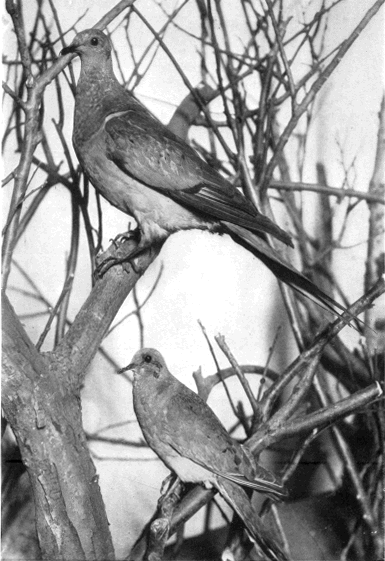
UPPER SPECIMEN, PASSENGER PIGEON (Ectopistes Migratoria) LOWER SPECIMEN, MOURNING DOVE (Zenaidura Macroura)
Frequently mistaken for Passenger Pigeon
With the aid of Sheriff Ingalls, who spoke their language like a native, we one day drove over 400 Indians out of the nesting, and their retreat back to their farms would have rivaled Bull Run. Five hundred more were met on the road to the nesting and turned back. The number of pigeons these two hordes would have destroyed would have been incalculable. Noticing a handsome bow in the hands of a young Indian, who proved to a son of the old chief, Petoskey, a piece of silver caused its transfer to us, with the remark, "Keene, kensau, mene sic" (now you can go and shoot pigeons), which dusky joke seemed to be appreciated by the rest of the young chief's companions.
There are in the United States about 5,000 men who pursue pigeons year after year as a business. Pigeon hunters with whom we conversed incognito stated that of this number there were between 400 and 500 at the Petoskey nesting plying their vocation with as many nests, and more arriving upon every train from all parts of the United States. When it is remembered that the village was alive with pigeoners, that nearly every house in the vast area of territory covered by the nesting sheltered one to six pigeon men, and that many camped out in the woods, the figures will not seem improbable. Every homesteader in the country who owned or could hire an ox team or pair of horses, was engaged in hauling birds to Petoskey for shipment, for which they received $4 per wagon load. To "keep peace in the family" and avoid complaint, the pigeon men fitted up many of the settlers with nets, and instructed them in the art of trapping.
Added to these were the buyers, shippers, packers, Indians and boys, making not less than 2,000 persons (some placed it at 2,500) engaged in the traffic at this one nesting. Fully fifty teams were engaged in hauling birds to the railroad station. The road was carpeted with feathers, and the wings and feathers from the packing-houses were used by the wagon load to fill up the mud holes in the road for miles out of town. For four men to attempt to effect a work, having for opponents the entire country, residents and non-residents included, was no slight task.
The majority of the pigeoners were a reckless, hard set of men, but their repeated threats that they would "buckshot us" if we interfered with them in the woods failed to inspire the awe that was intended. It was four against 2,000. What was accomplished against such fearful odds may be seen by the following:
The regular shipments by rail before the party commenced operations were sixty barrels per day. On the 16th of April, just after our arrival, they fell to thirty-five barrels, and on the 17th down to twenty barrels per day, while on the 22d the shipments were only eight barrels of pigeons. On the Sunday previous there were shipped by steamer to Chicago 128 barrels of dead birds and 108 crates of live birds. On the next Sabbath following our arrival the shipments were only forty-three barrels and fifty-two crates. Thus it will be seen that some little good was accomplished, but that little was included in a very few days of the season, for the treasury of the home clubs would not admit of keeping their representatives longer at the nesting, the State clubs, save one, did not respond to the call for assistance, and the men were recalled, after which the Indians went back into the nesting, and the wanton crusade was renewed by pigeoners and all hands with an energy which indicated a determination to make up for lost time.
The first shipment of birds from Petoskey was upon March 22, and the last upon August 12, making over twenty weeks, or five months, that the bird war was carried on. For many weeks the railroad shipments averaged fifty barrels of dead birds per day—thirty to forty dozen old birds and about fifty dozen squabs being packed in a barrel. Allowing 500 birds to a barrel, and averaging the entire shipments for the season at twenty-five barrels per day, we find the rail shipments to have been 12,500 dead birds daily, or 1,500,000 for the summer. Of live birds there were shipped 1,116 crates, six dozen per crate, or 80,352 birds.
These were the rail shipments only, and not including the cargoes by steamers from Petoskey, Cheboygan, Cross Village and other lake ports, which were as many more. Added to this were the daily express shipments in bags and boxes, the wagon loads hauled away by the shotgun brigade, the thousands of dead and wounded ones not secured, and the myriads of squabs dead in the nest by trapping off of the parent birds soon after hatching (for a young pigeon will surely die if deprived of its parents during the first week of its life), and we have at the lowest possible estimate a grand total of 1,000,000,000 pigeons sacrificed to Mammon during the nesting of 1878.
The task undertaken in behalf of justice and humanity was a Herculean one, but backed up by such true sportsmen as A. H. Mershon and Wm. J. Loveland, of East Saginaw, and Judge Holmes, S. A. Van Dusen, D. H. Fitzhugh, Jr., and others of Bay City, as well as by the sentiment of every humane citizen of the State, we could not do other than follow the advice of Davy Crockett, and being sure we were right, we decided to "go ahead." The question of a wise protection to the game and fish of our State is one in which the writer holds a deep and fervent interest, and in serving this cause, he will swerve from no duty, nor shrink from consequences in the discharge of that duty.
The foregoing article is the result of an honest conviction that the best interests of the State demanded a full exposure of the methods by which the pigeon is threatened with extinction.
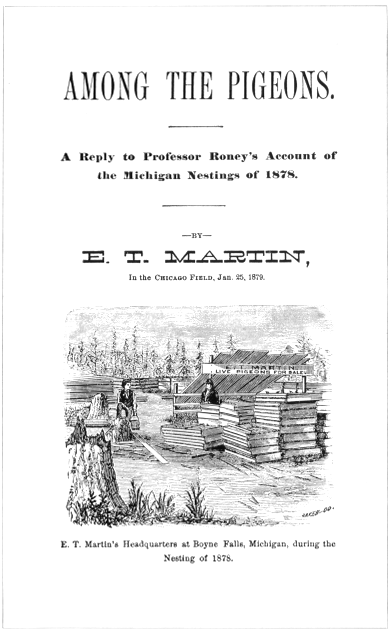
Click here for tanscription.
Fac-simile reproduction of circular, issued 1879, showing E. T. Martin's pigeon headquarters at Boyne Falls, Mich.
CHAPTER IX
The Pigeon Butcher's Defense
By E. T. Martin, from the "American Field," Chicago, January 25, 1879.
The preceding chapter by Prof. H. B. Roney in American Field, was answered by E. T. Martin, a game dealer of Chicago, who afterwards issued a pamphlet, the first page of which is herewith reproduced, and I make quite extensive extracts from the body of the circular, which incidentally advertises Martin as "the largest dealer in live pigeons for trap shooting in the world, also a dealer in guns, glass balls, traps, nets, etc."
I call the reader's attention to the following:
In the table given of the shipments from Petoskey and Boyne Falls, etc., during 1878, Martin estimates the number shipped alive from Cheboygan as 89,730, yet H. T. Phillips of Detroit, shows from his records that he alone shipped from that point 175,000 that year. So if Martin's estimates are all as far wrong as this one, he should account for a total shipment of over 2,000,000 pigeons.
In Martin's circular, he seems to take offense at some remarks Prof. Roney has made in this article that reflect upon the character of these netters, for Martin uses in quotation marks the following: "A reckless, hard set of men, pirates, etc.," which seems to have some foundation in fact, as Martin says: "In proof of the pigeons feeding squab indiscriminately, I may mention the fact that one of the men in my employ this year, while at the Shelby nesting in 1876 in one afternoon shot and killed six hen pigeons that came to feed the one squab in the same nest." Further comment is unnecessary.—W. B. M.
A
A LITTLE after the middle of March a body of birds began nesting some twelve miles north of Petoskey, near Pickerel Lake. About April 8 another and larger body "set in" along Maple and Indian Rivers, and Burt Lake, and near Cross Village, there being in all some seven or eight distinct nestings, covering perhaps, of territory actually occupied by the nesting, a tract some fifteen miles long and three of average width, or forty-five square miles.
The principal catch was made from the Crooked and Maple rivers nestings, and when the former "broke," which was about May 25, the pigeoners pulled up and left, many going home, and others to the Boyne Falls nesting, some thirty miles south, which "set in" at about the same time. This gave a duration of two and one-third months to the Petoskey nesting proper, though it is true that, feed being abundant, some very few birds remained around, roosting for a little longer.
The Boyne Falls nesting lasted something over a month and broke early in July; from this the catch was very light. After that, the only catch was a few young birds taken "on bait."
Besides these nestings, there was one further south on the Manistee River, some twenty-six miles long by five average width, or 130 square miles, in which the birds hatched three times, and from which not a bird was caught, as it was an impenetrable swamp, and the putting of birds on the market would be attended with such expense as to destroy the profit. There were also one or two smaller ones, east of this one. These comprised the Michigan nestings, in addition to which, at Sheffield, Pa., there was fully as large a body, and fully as large a catch as at the Crooked and Maple nestings, the birds hatching there, I think, three times, each hatching taking four weeks, from the beginning of nest building to the time the old birds leave the young.
It is true, however, that birds were shipped from Petoskey the middle of August, but they were birds belonging to me that I was holding there for a market, my Chicago pens being full. Every bird of them had been in my possession for a month previous, and many for six weeks. So the actual pigeon business lasted not five months, as Prof. Roney says, but about three; part of which time the total catch was not fifty dozen per day.
* * * * *
They (Prof. Roney et al.) came to Petoskey with a great flourish of trumpets, hired expensive livery rigs to ride around the country in, made one or two arrests, secured one conviction by default, were defeated in every case that came to trial, had one of the party play the rôle of "terrible example" in the trout case, and then went home, and in the face of the fact that they had eaten, or known of having been eaten, hundreds of pigeons, and of the certainty that the report was false, had published in the Saginaw paper a report that the pigeons then being caught in Michigan were feeding on poisoned berries, and the using them for food had caused much sickness, and in one or two instances loss of life.
This was not only published in the home papers, but was telegraphed to New York, Boston, Chicago, St. Louis and Cincinnati, and marked copies of the notice sent to the press of neighboring cities, the avowed object being to cause such a decline in price as to force the netters to quit. It was based on the idea that most of them were men of small means, and that unless ready market offered for their birds, they must give out. The effect was to cause a drop in price of fifty cents a dozen in New York and Boston in a single day, to cause the price in Chicago to decline to twenty cents per dozen, and to take the last cent out of the pockets of a hundred netters, leaving many who became discouraged and had to walk long distances to their homes, dependent on chance for even a mouthful to eat. Many, though, held out. Telegrams of denial were sent, and the market in a week or two rallied somewhat, though it was a month before prices in the East touched the same figure as when the "poison-berry" telegrams were received. During the week when prices were lowest I refused to buy many dead birds offered me at five cents per dozen, preferring to lend the netter money, or to advance it on his next catch to be saved alive.
And, by the way, let me say that killing the pigeons by pincers is an instantaneous and painless death, the neck being broken by a single movement, and the fluttering spoken of being the same seen in any bird shot through the head, or with the head cut off. But had the market remained unbroken, had this infamous poisoned berry story never been started, no such net results in way of profit would have been reached as Prof. Roney says. Under very favorable circumstances, a good netter in such a season as we had in 1878, would make from $100 to $200, but by far the larger portion would not reach $100 over expenses.
At the Crooked and Maple nestings day in and day out the average catch was about twenty dozen per day to each net and two men. These sold, except immediately after the "poisoned berry story," at from twenty to thirty cents per dozen head, at the net, or if the catcher was saving alive, in which case his catch would be one-third smaller, owing to the trouble of handling the live birds, he would get from thirty-five to forty-five cents.
The principal object in saving them alive was that no birds spoiled from warm weather, and at my pens close by the nesting they would be received at any hour, while to sell dead birds it was necessary to depend on some chance buyer or to haul to Petoskey, fourteen miles distant. At Boyne Falls prices were a little higher, say twenty-five for dead and fifty cents for live, but the average catch was not five dozen per day to each net. There were exceptions both ways, which went of course to make up the average, the most notable being that of the 2,000 dozen caught by one party, not in ten days, but in twenty, employing two nets and six men. This I know, for I was at the net and saw part of the catching, while Prof. Roney never got that far. This 2,000 dozen was shipped East and netted the catchers just fifteen cents a dozen at the net, or $300 for twenty days' work for six men and two nets, while on the other hand, during the same time, many better catchers who had not been lucky in location hadn't made enough to pay for board. Names, locations, etc., can be furnished if Prof. Roney desires.
The Professor then goes on to lament his failure before our Emmett County jury. The reason why is very simple, he never proved his case. This whole pigeon trade was a perfect Godsend to a large portion of Emmett County. The land outside of Petoskey is taken up by homesteaders, who, between clearing their land, scanty crops, poor soil, large families, and small capital, are poorer than Job's turkey's prodigal son, and in years past have had all they could do fighting famine and cold, and but a year or so since all Michigan was sending relief to keep them from starving, thousands of dollars being contributed, and then most harrowing tales being told of need and destitution.
The "pirates and bummers" left some $35,000 in good greenbacks right among the most needy of these people. Many were enabled to buy a team, others to clear more land, more to increase their crops, and all to lay in provisions and clothing to meet the bitter winter we are now passing through, and this money did more to open up Emmett County than years of ordinary work. It put scores of honest, hard-working homesteaders on their feet; it increased trade, and, if sent by a special act of Providence, could not have done more good. Such being the case, can any blame be given an Emmett County jury if they required evidence direct and to the point before convicting? And in no case that came to trial was direct evidence given. So the four true "sportsmen" there in behalf of justice and humanity, had such a cold reception from all, that they concluded strategy beat that kind of work all to death, pulled up stakes and hurried home, and worked up the poisoned berry business.
* * * * *
Now, about the merciless slaughter. Prof. Roney estimates 1,500,000 dead and 80,000 live birds as the shipments, and then goes on to say that one billion birds have been destroyed! What logic.
I have official figures before me, and they show that the shipments from Petoskey and Boyne Falls were:
Petoskey, dead, by express 490,000
Petoskey, alive, by express 86,400
Boyne Falls, dead 47,100
Boyne Falls, alive 42,696
Petoskey, dead, by boat, estimated 110,000
Petoskey, alive, by boat, estimated 33,640
Cheboygan, dead, by boat, estimated 108,300
Cheboygan, alive, by boat, estimated 89,730
Other points, dead and alive, estimated 100,000
Total 1,107,866
This may be set down as accurate or nearly so, and 1,500,000 will cover the total destruction of birds by net, gun and Indians. The total number of nesting squabs taken by the Indians would not reach 100,000 and not over fifty barrels of these ever reached a market, the Indians smoking the remainder for winter use. No one knows how many birds 1,500,000 are until they see them, and handle a few. As an illustration: To buy and sell 125,000 birds in four months, it took myself, two men and a boy all our time, working from daylight until after dark every day.
I doubt if there were a billion birds in all the Crooked and Maple nestings. I am certain that there were not at any one time. I am also certain that more than double as many young birds left those nestings than all the birds caught, killed or destroyed. The morning that the Crooked nesting broke, I was out at daylight, and at the net to see and help one of my men make a strike; for an hour and a half a continuous body of birds half a mile wide and very thick was going out; our strike was twenty-nine dozen, twenty-five dozen young and four dozen old, about the same proportion as the other catchers. This showed that of the immense body over five-sixths were young birds, barely old enough ones remaining to guide the body of young, and this was out of the nesting from which the bulk of the birds had been caught, where the destruction had been the greatest. When it is considered that the Manistee birds hatched three times unmolested, that there was a body several times larger there, than at the Crooked and Maple, and that many from each body went further north entirely out of reach and nested at least once, possibly twice again, some idea may be formed of the immense addition to the army of pigeons from the Michigan nestings of 1878. Many more young birds left the Crooked River nesting alone, than all, old or young, destroyed during the entire season's pigeoning.
Prof. Roney's lament about the young dying when deprived of the parent bird, and his addition to the number "sacrificed to Mammon" from that source, compares favorably with the poisoned berry story, or the attack on Turner. Admitting that 1,500,000 birds were caught and killed, not more than half of these would be old birds, some of which would not be nesting, and from some of which the young had left the nest. If for every one of the 750,000 old birds caught and killed, the squab had died, this would make a total slaughter of 2,250,000, or about one four hundred and fiftieth of the number he says.
I don't believe Prof. Roney knows what a billion is. However, there were not 750,000, no, nor 100,000 squabs killed by losing their parents. It is a well-proved fact that the old bird coming in will stop and feed any squab heard crying for food, that in this way they look out for one another's young, and the orphans or half-orphans are cared for. It is rare, however, for both old birds to be caught or killed, since the toms and hens when nesting always fly separately, and the chance of both the parents of the squab falling a "victim to Mammon," particularly in a large nesting, is small. As proof of the pigeons feeding squabs indiscriminately, I may mention that one of the men in my employ this year, at the Shelby nesting in 1876, in one afternoon shot and killed six hen pigeons that came to feed the one squab in the same nest.
* * * * *
Why, Prof. Roney, the catch went on all the same, your party made no difference of note, but the weather was rough and somewhat stormy; the birds didn't "stool" well, and during the days mentioned the catch was very small, hence the decrease in shipments. Now, regarding the law, it is well enough as it is; one shotgun near a nesting is more destructive than a dozen nets; the report of the gun causes the birds to rise in thousands, and, when repeated, to leave in a body, regardless of nest or squab, and never to return; as an example, may be mentioned, the Minnesota nesting of 1877, when the birds were driven entirely away.
The net is silent; its work occasions no alarm; it makes no cripples, consequently it can be admitted nearer to the nests than its more noisy partner. Protect the pigeons entirely, and a law forbidding catching during nesting time is equivalent to entire protection, and you have northern Michigan overrun with a pest that will destroy the farmer's seed as fast as sown, and when harvest time approaches, pounce upon a wheat field ready for the reaper and in an hour not leave even enough for the gleaner. Their increase would be more rapid, their stay longer, and in four years not only would the law be repealed, but inducements to slaughter would be held out to rid the State of the rapidly increasing and destructive pests.
The pigeon never will be exterminated so long as forests large enough for their nestings and mast enough for their food remain.
In conclusion, the pigeons are as much an article of commerce as wheat, corn, hogs, beeves, or sheep. It is no more cruel to kill them for market by the thousand, than it is to countenance the killing at the stock yards in this or any other large commercial center. The paper to-night shows that in six cities over four million hogs have been killed since Nov. 1, 1878, or two and a half months, a larger slaughter than, during the same time, of pigeons at the nestings by nearly threefold. Yet this is not "sacrificing to Mammon." A farmer can market his poultry dead or alive at any time of the year, and the slaughter, the country over, is larger than that of pigeons, yet no one in the interest of "justice and humanity" interferes.
The pigeon is migratory, it can care for itself. It nests in the impenetrable wilds of Arkansas, the Indian Territory, Canada and British America, as often as in the land of civilization where it can be reached for market. It is a source of profit to the poor, or pleasure to the rich. Its benefits to the Emmett County homesteaders, as felt through the cold of this winter alone, are enough to compensate for evils even as black as our Prof. Roney paints, and Emmett County is but a sample of whatever location the birds may settle in.
Let the law, in regard to distance, stand as it is. Enforce it against all alike; make no exceptions; let the rule of supply and demand govern the catchings, and you will have something better than all the professors in Michigan suggest. Let the supply be so large that prices are low and wages can't be made, and law or no law, the catching will stop. But don't make a law that will take bread out of the homesteader's mouth, and work from hundreds of poor and honest men; no, not even if the birds should be sacrificed, to a certain extent, for man is above the beasts, and the "beasts of the field and the birds of the air" are given unto him for his benefit and his profit.
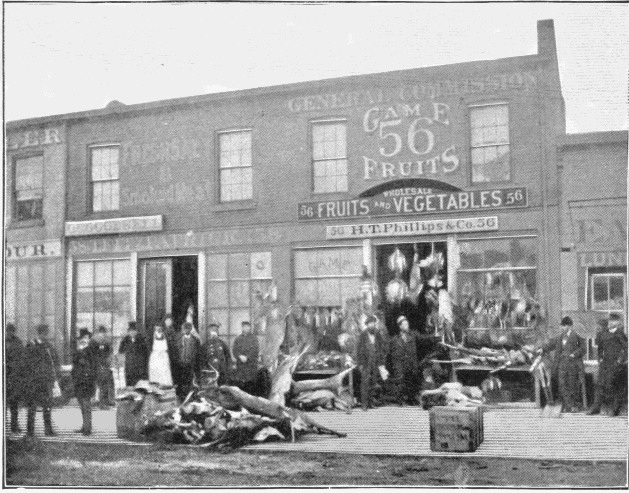
H. T. PHILLIPS' STORE
A typical game store of the early 70's
CHAPTER X
Notes of a Vanished Industry
I have corresponded with many men who were actively interested in hunting and observing the Passenger Pigeon when its flocks still numbered uncounted millions of birds. Some of the data supplied in kind response to my queries is in the form of hastily jotted notes, which, when they are brought together, include more or less repetition of personal experiences. They have a certain value, however, when taken en masse, for they are the testimony of eye-witnesses who will soon be gone, after which the Passenger Pigeon will become as much a matter of written history and tradition as the auk or the buffalo.
I am under obligation to Mr. Henry T. Phillips, of Detroit, for much practical information regarding the capture of pigeons, and the business of marketing them as he knew it in those earlier days. There follows a portion of a letter written me by Mr. Phillips in October, 1904.—W. B. M.
I
I AM in receipt of your letter asking for information about the wild pigeon, but I do not know that I can be of much benefit to you, though I will give you what information I can.
I began business in Cheboygan, Mich., in May, 1862, as a dealer in groceries and produce and added the commission business a little later, as I was fond of shooting, and I began advertising the sale of game. I have been credited by dealers in New York with being the largest shipper of venison in the United States. In 1864 (I think it was) I had a shipment of live wild pigeons which we brought down the Cheboygan River from Black Lake in crates holding six dozen each. All of these crates were made by hand by one E. Osborn, who was then one of the traveling pigeon catchers, the firm being Osborn & Thompson, well known by all men who traveled then. From that time I have handled live pigeons in quantities up to 175,000 per year until they left the country. The last nesting in Michigan was up on Crooked Lake near Petoskey in 1878, I believe, from which I shipped 150,000.
In 1866, they nested in the town of Vassar, Tiscola County, Mich., and usually each alternate year, as the mast crop was every second season, beech nuts being their choice food. The other years they nested in Wisconsin on acorns, or in Minnesota, feeding on spring wheat. New York sometimes held them, and Pennsylvania often, for a nesting; but being a hard place they never caught many there, Michigan being the favorite trapping ground. 1874 there was a nesting at Shelby, Oceana County, Mich., on which it was estimated they made the heaviest catches I have ever known of: 100 barrels daily on an average of thirty days of dead birds, besides the live ones, of which I shipped 175,000.
There were five nestings that year in the State, three going on at the same time, but all not heavily worked. That year I shipped by the steamer Fountain City, from Frankfort, 478 coops, six dozen each, one shipment going to Oswego, N. Y., for the Leather Stocking Club Tournament.
I bought from Dr. Slyfield 600 dozen at $1 per dozen, agreeing to pay only in one-hundred-dollar bills. He traveled two days to get twelve dozen to make up the shortage. The pigeons at that time wintered in southern Missouri and the Indian Nation, and were shot at night by natives and marketed in St. Louis. As they fed on pine-oak acorns, which tainted the meat, the market was poor and prices low. The traveling netters usually worked at something else while South.
The pigeons started north about the last of March, and usually located the last of May, according to weather. If food was plentiful they nested in large bodies; if not, they divided and nested in fewer numbers. In Wisconsin I have seen a continual nesting for 100 miles, with from one to possibly fifty nests on every oak scrub.
In Michigan usually the feeding grounds were across the straits, where blueberries were abundant, until fall, when the birds scattered back in small bodies, feeding on stubble and elm seed. Frequently they would go into a roosting place, and make it a home for weeks before leaving for the South. Traveling north, they usually flew until about ten or eleven in the morning and again in the evening. I have known of large quantities being drowned in Lake Huron, crossing from Canada on the way north, and have had lake captains tell me of passing for three hours through dead birds, which had been caught in a fog.
In 1874 there were over six hundred professional netters, and when the pigeons nested north, every man and woman was either a catcher or a picker. They used to catch them in different ways. What was known as flight-catching was in the early morning and evening, a spot being cleared of usually twelve to sixteen feet wide and twenty to twenty-four feet long, large enough for a net. This was known as the bed. About fifty feet from the bed a brush house was built and the net was staked down, two spring poles were set to spring the net out straight, but loose enough to fall easy and cover the full size of the bed. The front line of the net was tied to these stakes and they were sprung or set back as if all of the net was in a roll. A short stake with a line attached to the outside edge ran to the bough house, a stick about three feet long was placed under a catch called the hub, and the other end of this stick was placed against another peg driven in the ground. When the short stick was pulled from underneath the crotch, the spring poles forced the net over the bed; the short sticks raised the net about three feet; and of course it was all done very quickly.
Another method was employed later in the season; a place was baited with buckwheat, sometimes with broomcorn seed, or wheat, for a week or two, and, when a large body of birds was collected, the net was set. A much larger net is used now. Then is when we got our live birds for shooting matches. In the spring time is money, and the netters could save many more dead than alive.
I knew of a man paying $300 for the privilege of netting on one salt spring near White River. It was a spring dug for oil, boarded up sixteen feet square. He cut it down a little and built a platform, and caught once or twice each week. He got 300 dozen at one haul in this house. He said they were piled there three feet deep.
I once pulled a net on a bait bed and we saved 132 dozen alive, but many got out from underneath the net, there being too many on the bed. The net used was 28 × 36 feet. I have lost 3,000 birds in one day because the railroad did not have a car ready on the date promised. I threw away what cost me $250 in eight hours, fat birds, because the weather was too hot. I have bought carloads in Wisconsin at 15 and 25 cents per dozen, but in Michigan we usually paid from 50 cents to $1 a dozen. I have fed thirty bushels of shelled corn daily at $1.20 per bushel, and paid out from $300 to $600 per day for pigeons.
I never allowed game to be shipped to me out of season; if it came, I never paid for it.
About two years ago I was told by a man who just got back from the Northwest, Calgary, that the birds were so thick in the north that they darkened the sun. They were probably nesting, as he said they were seen every morning. . . . Up to ten years ago I was shooting on the Mississippi bayous for twenty-five years, and used to see and kill some pigeons nearly every spring, from the middle of March to the middle of April. We have shot seventy-two pounds of powder in my camp in thirty days, the party consisting of three men; and two of us have killed twelve barrels of ducks (Mallards) in four days. On the Detroit River I have shot, in one week, mostly redheads, the following on different days: 102, 119, 142, 155. . . .
[I have quoted from the latter part of Mr. Phillips' letter to show how plentiful other kinds of birds were in the old days.]
Under date of Nov. 1, 1904, Mr. Phillips writes as follows:
"In regard to dates, would say that the last nesting of birds set in at about 5 P.M., May 5, 1878, on the southeast side of Crooked Lake. Express charges on barrels to New York from Michigan were $6.50, from Wisconsin $8; on live birds $3 per cwt."
Mr. Phillips also incloses a letter written to him by Mr. Osborn, of Alma, Mich., under date of February 23, 1898, which reads:
Alma, Mich., February 23, 1898.
Friend H. T. Phillips:
Yours with the questions to be answered received, and will say:
. . . There have been several bodies nesting in Michigan at the same time, and I will give the years and places that I was out. In 1861 a large body of birds were in Ohio roosting in the Hocking Hills, my first year out. We were at Circleville, and my company shipped over 225 barrels, mostly to New York and Boston. The birds fed on the corn fields. In 1862 the birds nested at Monroe, Wis. We commenced in May and remained until the last of August. The several companies put up some ten thousand dozen for stall feeding after the freight shipment. Express charges on each barrel were from $7 to $9. In the fall of 1862 we had fine sport shooting birds in the roost at Johnstown, Ohio (now Ada), some four weeks. Then the birds moved to Logan County. After two weeks the birds skipped South, it being December and snow on the ground.
In 1863 the birds nested in Pennsylvania. We had some fine sport at Smith Port and at Sheffield. We located at Cherry Grove, six miles from Sheffield. The birds fed on hemlock mast. There were other nestings in Pennsylvania at the same time. In 1864, at St. Charles, Minn., we had some fine sport, but our freights were high to New York, so we came to Leon, Wis. A heavy body was nesting in the Kickapoo woods, and several companies of hunters located here. In 1865 a heavy nesting was in Canada, near Georgian Bay. We were at Angus Station on the Northern Railroad, and the snow was two feet under the nesting. We next went to Wisconsin, where a heavy snowstorm broke up the roosts. We were at Afton, Brandon and Appleton. We then went to Rochester, Minn., the end of the railroad. At that time birds nested in the Chatfield timber. We then went to Marquette in the Upper Peninsula and camped on Dead River. A heavy body had got through nesting, but worlds of birds were feeding on blueberries.
This was the year the Pewabic sunk. Mr. George Snook had 1,400 barrels of trout and whitefish on her. We went up on the Old Traveler and came down on the Meteor. In 1866 the birds nested in a heavy body near Martinsville, Ind. We caught some birds at Cartersburg. After we closed up in Indiana we went to Pennsylvania. There was a heavy nesting near Wilcox, at Highlands. In gathering squabs five of us got a barrel apiece, which netted us $75 to $100 per barrel in New York. They struck a bare market.
In July we had a big time with young birds at Fort Gratiot, near Port Huron, from the Forestville nesting. Mr. H. T. Phillips of Detroit was chief of a party which had fine shooting on a Mr. Palmer's place. In six days I shipped thirteen barrels to Tremain & Summer, New York, and received a check for over $400. They returned me about one-half what they sold for.
In 1867 we were in Ohio, Wisconsin and Minnesota, and caught more or less birds on bait. The birds were broken up by shooting and deep snow. In 1868 there was a large nesting near Manistee, and we did some big catching, shipped by steamer to Grand Haven, then via rail. In April and May was also at Mackinac and North Port and in June did some catching at Cheboygan, and here I made our crates of split cedar and floated the birds down the river six miles on two canoes lashed together, and had to transfer over the dam before reaching the little steamer to Mackinac, twelve miles, and then transferred to the Detroit boat. The birds were shipped to H. T. Phillips & Co. At Cheboygan I fed over one hundred bushels of corn and wheat for bait.
In 1869 the birds were in Canada, Michigan, Indiana and Wisconsin, all at the same time, and shooters broke them up. We located a body at Oakfield, Wis., and had a big catch until the farmers broke them up. The birds were pulling wheat badly; other feed was gone. The birds nested in Michigan, up from Mt. Pleasant, but too far inland to get them out. In 1870 the birds nested near Goderich, Can. Did not do much there. We then went to Glen Haven and caught some birds. Then we went to Cheboygan; sent more or less live birds to H. T. Phillips & Co., of Detroit. In 1871 we located a large body at Tomah, Wis., and did some heavy shipping. We used three tiers of ice from a large icehouse, and the express per barrel was $12 to New York and Boston. We also shipped from Augusta, Wis., express, $13.50 per barrel. A nesting at Eau Claire, but we could not get to do much with them there. In 1872 a large nesting near South Haven, Mich. We located at Bangor and had a big catch in some big snowstorms. Another body near Clam Lake, end of railroad. In 1873 we did baiting in Ohio and Wisconsin, but located no nesting. In 1874 the birds nested at Shelby in two different locations and another at Stanton, Mich.; small body at Stanton. We did heavy shipping at Shelby, from one to three cars per day, both alive and dead. The birds nested this year at Shelby, two places, and at Stanton, and one at Mill Brook and at Frankfort and at Leeland, and probably at other points we did not learn of. In 1875 was not out, only baiting near St. Johns, Mich. In 1876 a heavy nesting at Shelby, Mich., and at Frankfort. I caught at Shelby and at Glen Haven heavy shipments. In 1877 was not out, but did some baiting at Eureka. In 1878 a heavy nesting between Petoskey and Cheboygan. H. T. Phillips located at Cheboygan. I caught at several points between the two cities.
The above is part of my experience with the birds, since which time I have kept no record of the movements, but will say that during the winter season birds have nested in large numbers in the southern States; in Virginia, Tennessee, Arkansas and Missouri. For a great many years the birds have been moving west. Last winter I was in Southern California, and a body of pigeons were west of Los Angeles, among the acorn timber. There are worlds of feed in the foothills, for thousands of miles, to feed the birds. They are a greedy bird and will eat everything from a hemlock seed to an acorn. I have known them to nest on hemlock mast alone in Pennsylvania, and in Michigan on the pine mast after the beech mast was gone. Most of the nesting in Michigan happens March to July, and then they skip farther north and return in wheat seeding.
Alma, Mich., February 24, 1898.
Friend H. T. Phillips:
I will give you a few catches. In 1862, at Monroe, Wis., George Paxon, of Evans Center, N. Y., and myself made one haul of 250 dozen five miles south of the city on corn bait in a pen 32 × 64 feet with nets sprung across the top. We fed at this bed over five hundred bushels of corn at 25 cents per bushel, and at our other beds nearly as much. After the flight-birds were over, with a single net sprung on the ground we have taken 100 dozen at a time.
At Augusta, Wis., in 1871, Charles Curtin, then of Indiana (dead now), over one hundred dozen; William W. Cone of Masonville, N. Y., Samuel Schook of Circleville, Ohio, and some other boys, 100 dozen and over. L. G. Parker of Camden, N. Y., C. S. Martin, the Rocky Mountain hunter of Wisconsin, E. G. Slayton of Chetek, Wis., are old trappers and could tell of big catches. In 1868, at Cheboygan, I took over six hundred fat birds before sunrise. I sold to the United States officers at Mackinac for trap shooting, also to Island House. In 1861 there were only a few professionals: Dr. E. Osborn of Saratoga, N. Y; William N. Cone, Masonville, N. Y; John Ackerman, Columbus, Ohio; L. G. Parke, Camden, N. J.; James Thompson, Hookset, N. H.; S. K. Jones, Saratoga, N. Y.; George and Charles Paxon of Evans Center, N. Y., and maybe a few others. After this time, trappers increased fast. More salt was used in Michigan for bait than any other State. I paid at Shelby $4 per barrel. Big bodies of pigeons were drowned off Sleeping Bear Point because of fog and wind, while trying to cross Lake Michigan. I have seen them.
In the Logan County roost, Ohio, I killed with two barrels, of a six-bore shoulder gun, 144 birds. The other boys killed nearly as many with smaller guns; we shot on the roost in the dark. Our plan was to fire one barrel on the roost and the other as the pigeons flew. The highest price paid per dozen was in New York City—$3—by Trimm & Summer from Pennsylvania.
For a good many years the birds were in the eastern States, with heavy catching in Massachusetts and New York, also Pennsylvania, and the hunters worked into Canada, then into Ohio, and so on to Michigan and Indiana, long before they took in Wisconsin and Minnesota, after they left the eastern country for the west. A big body was at Grand Rapids in 1858 or 1859, before I joined the band.
The trappers at Grand Rapids were Dr. Osborn, Cone, Ackerman, the two Paxons, Latimer, and a few others, who did some heavy shipping, catching the birds on the salt marshes. I have no earlier records for Michigan.
I kept no record of the amounts shipped from different points. The old books of the express will show if they have kept them. I wait to see your report, and remain,
Yours truly,
E. Osborn.
Detroit, Mich., November 2, 1904.
W. B. Mershon:
Dear Sir:—Last evening I looked over some old papers and found a few memoranda that lead to my making some changes in my notes to you in regard to the date of last nestings in our State. I also find my later surmise confirmed by a letter from one of the first traveling pigeon-catchers in the business, Ephraim Osborn, whose uncle, Dr. Osborn of Saratoga, N. Y., was one of the original catchers. You will note by Mr. Osborn's letter that he has been a shipper of mine for a long time. I am well acquainted with him and knew all the men he mentioned (with many others) at the Shelby nesting. There were nearly six hundred names in the register book of pigeoners in Wisconsin. Nearly every one of the farmers, and their wives and daughters, were pigeon catchers.
In regard to the dates of last nesting: 1878 was the last year that the catch amounted to enough to keep men in the business. I find I was at Cheboygan part of the time, and got only a small number of birds in 1880, but some few nested (small body) that year.
Yours truly,
H. T. Phillips.
CHAPTER XI
Recollections of "Old Timers"
M
MR. OSCAR B. WARREN, now of Houghton, Mich., has been interested for years in collecting data about the Passenger Pigeon, and kindly turned over to me his entire budget. Among his letters is the following from Mr. H. T. Blodgett, Superintendent of Public Schools, Ludington, Mich., dated November 19, 1904:
. . . Your pigeon is a stranger to me, or rather has been a stranger for six or more years. I can distinctly remember clouds of them, darkening the sky, almost, in Pennsylvania, thirty years ago. Later, in Michigan, they were abundant, coming to this part of the State as soon as the snow was gone, picking up the beech nuts and "shack" of the woods. After a few weeks' flying about and feeding they would disappear; reappearing again in June, young pigeons, fat, and the choicest eating. They would stay a few weeks, not more than about three weeks, going about July 1. During this visit the birds haunted the thick woods, and would call from the shade of the leaves of beech, maple, and hemlock trees through the heat of the day, feeding mornings and evenings on the sprouted beech nuts under the leaves.
There would often be a third appearance in September, when I have seen buckwheat fields blue with them. Also fall-sowed wheat fields would be so covered with them that the farmer had to watch his fields to save the seed he had sowed.
During the spring and also the fall visit, flocks searching for feeding ground could be called down from flight and induced to light on trees near where the call was sounded. The call was one in imitation of the pigeon's own call, given either as a peculiar throat sound (liable to make the throat sore if too often repeated) or with a silk band between two blocks of wood, like this
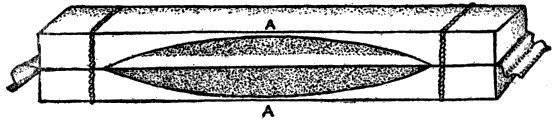
The pigeon call
held between the lips and teeth and blown like a blade of grass between the thumbs. By biting or pressing with the teeth at (A) (A) the tension upon the silk band would be increased, raising the tone of the call or relaxing for a lower note. Cleverly used, it was very successful in calling pigeons feeding in small flocks to alight.
Much to my regret I have seen none of the beautiful birds for about six years. The savage warfare upon them, from nesting place to nesting place by pot-hunters and villainous fellows who barreled them for market, with nets and every brutal means for wholesale destruction, has driven them, I know not whither. If there are considerable flocks of them anywhere, I should be glad to know it.
I wish I might help you. Such things as are here hastily recalled and written will not be likely to afford anything of interest, but if there is any thought or anything in it, it is cheerfully given.
On the great sand bluffs which line our shores in many places, flocks of pigeons in passing would fly so low that a man with a club could knock them down. At Lincoln, three miles north of here, nets were put on the top of the hills, like gill nets, to catch them in their flight.
They were never very successful.
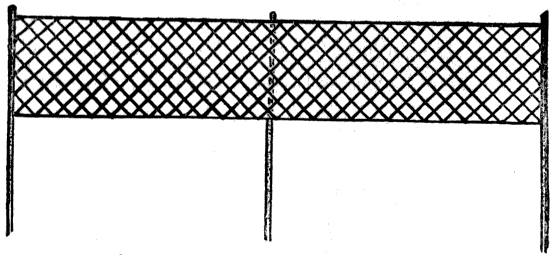
Showing the method of placing pigeon net
(Notes by the Allen Brothers, Joseph and Isaac, of Manchester, Mich. A copy of their letter was received through kindness of L. Whitney Watkins, of Manchester, Mich.)
We have had about fifty years' experience in the business [pigeon catching], as we used to help our father as long ago as we can recollect, he being one of the best pigeoners in his day, working a great deal at the business in the summer season. Until we were twenty years old we lived on the shores of Lake Ontario in Wayne County, N. Y.
The pigeons used to have a flying course along the shore of the lake on their way to the Montezuma marshes after salt. Pigeons are very fond of salt, or, rather, brine. It seems to be a necessary article for them. Their course was generally from west to east. They seldom flew west by the same route. How far they came, we could not tell; perhaps from this State or perhaps farther west. Sometimes they would go west by the same route. If so, they were much easier to catch than when going east. When going east they were looking for salt; when west, for food.
They used to commence to fly about the 1st of April and keep it up until the middle of June. After that time they would scatter over the country, and did not fly in large flocks as in the spring.
It would be hard to make any estimate of their numbers that people would believe at this late day. I was going to say that a thousand million could have been seen in the air all at once. There would be days and days when the air was alive with them, hardly a break occurring in a flock for half a day at a time. Flocks stretched as far as a person could see, one tier above another. I think it would be safe to say that millions could have been seen at the same time.
In the year 1854 we moved to Michigan, settling near Adrian, where we found pigeons quite plentiful. When they were flying here (Adrian) they seemed to scatter over the State, having no regular course.
The supply of pigeons kept very regular here for about twenty-five or thirty years. About the time we came west the pigeons became scarce in New York, and very few have been seen there since. It is five years (1890) since we have seen or heard of any being seen in this State (Michigan) or in any other.
Our "pigeoning" was more for sport than profit, and we liked a nice broiled pigeon for breakfast about as well as anything we could have, especially when they were worth $6.00 per dozen. If the pigeons had been sent to the New York market they could have been sold for big prices, as pigeons sold for larger and better prices than any other game in that market. Our father did not like the idea of sending pigeons to New York for a market.
After we came to where we now live (Cambridge), and when I was going to Adrian, I stopped at father's on my road. He had been out catching pigeons that morning and had secured 600 by 10 o'clock. He said to me:
"I wish you would take these pigeons to Adrian and sell them if you can. Take them to the depot and sell them for 10 cents per dozen. If you cannot sell them, give them to the workingmen in the shops."
I thought 10 cents was pretty cheap, so I went to selling at 20 cents per dozen. When the men came out of the work-shops I sold them all at 25 cents per dozen. After I left for town, father caught 500 more, and took them to Adrian the same day and sold them for 10 cents per dozen. If the same lot of pigeons had been shipped to New York, they would probably have brought $2 or more per dozen.
About a year from that time we caught 600 in one day, and made up our minds we would ship them to New York. We took them to Adrian to ship. When we got to Adrian we saw father, who, after inquiring about our intentions concerning their shipment, said:
"It is foolish for you to send them, as they will never be heard from."
He advised us to dispose of them for 25 cents per dozen; this was the highest price pigeons were worth in Adrian. To please him we tried to sell them for that price, but could not, so, taking them to the express office, we shipped them. In about four days the returns came, netting us 70 cents per dozen, about the lowest price we ever got. They explained that the pigeons had been poorly handled or they would have brought more. This was thirty-five years ago, and these were probably the first pigeons shipped from this State to New York.
We have shipped thousands since. They would probably average $2 per dozen. We have sold them as high as $3.75 per dozen and have seen them quoted as high as $6 per dozen. A pigeoner from Pennsylvania told us he shipped two barrels at one time and got $5.50 per dozen. We caught 2,400 one week, having them all on hand at one time. We got a market report from New York where they were quoted at $6.50 per dozen. We packed and shipped ours as soon as possible. When they reached market they sold for $1.50 per dozen. The army of pigeoners had struck a big nesting in the State of Wisconsin the same week we caught ours, and they shipped them to market by the wholesale. The market dropped from $6.50 to $1.25 in one week.
The pigeon business was very profitable for men who were used to it, and there were probably from one to three hundred men in the trade. When the pigeons changed their location, the pigeoners would follow them, sometimes going over a thousand miles.
When this army of men had good luck they would ship them by the hundreds of barrels. Probably as many as five hundred barrels have been shipped to New York and Boston in one day. Our commission man in New York wrote us that 100 barrels a day could be sold there without affecting the market but very little.
I was at a pigeon nesting in the State of Pennsylvania where there were from three to five hundred men catching pigeons and squabs. It was a great sight to see the birds going back and forth after food. When nesting in such large bodies, they leave the food in the near vicinity for their young. If they can find plenty of food, they nest in large bodies; if not, they scatter over the country and nest in scattered colonies.
The nesting I mentioned in Pennsylvania was within one mile of the cleared lands. We camped within two miles of the nesting. The pigeons kept up a continual roaring by their combined twittering and cooing, so that it could be heard for miles away by night as well as day.
Sometimes it is almost impossible to catch the pigeons. At the nesting mentioned the most experienced hands found it impossible to take large numbers. The whole crowd of men could not catch more than one man ought to have caught under the circumstances.
The young pigeons (squabs) were much sought after in New York and Boston, and if sent in moderate numbers brought big prices, usually about two dollars per dozen. When the squabs were old enough to market, the army of pigeoners (estimated to be about five hundred) commenced taking them. Entering the woods in which the nesting was located, they cut down the trees right and left, cutting the timber over thousands of acres. When a tree fell, bringing with it the squabs, they picked the young birds up, sometimes getting as many as two dozen from one tree. The large trees, which might have yielded fifty or a hundred, were left standing. Our company of five took in two days thirteen barrels of squabs, averaging 400 to the barrel.
There were shipped from two stations on the Erie road in one day 200 barrels of these young pigeons. If they had been old birds, they would not have broken the market, but this was too many squabs, and the price dropped 25 to 45 cents per dozen.
Osborn told me that he once caught 3,500 at one catch. It was at a big nesting in the State of Wisconsin. He had an enormous flock baited. He said that he put out as high as forty bushels of shelled corn at one time on the bed where he caught this large number. For a trap, he had constructed a board pen built up from the ground four or five feet high. This pen was about one hundred feet long by twenty feet wide. He took three large-sized nets, and, tying them together, set them on this pen. He had feeding pens built by the side of the trap-pen, so when he made a catch he could drive the pigeons into the feeding pens and fatten them for market, these "stall-fed" birds bringing much higher prices than poor birds. This large catch filled all his feeding pens. He said he could have made another catch fully as large as the one just mentioned, in one-half hour afterward but, having no room, he could not take care of any more.