PART II. THE INTERIOR. (continued 2)
Reading edition
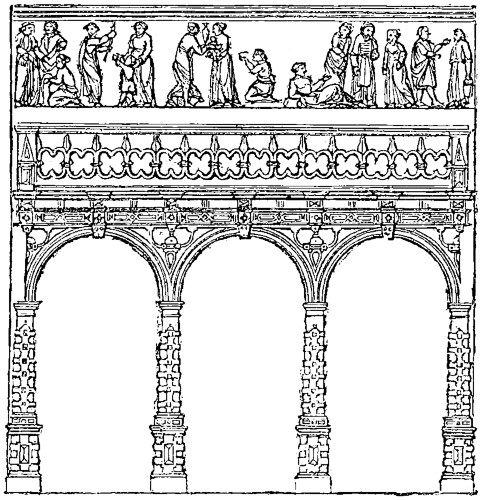
Façade from Elizabethan Court.
The kneeling effigies in the gallery at the back of this court are from the Hertford monument in Salisbury Cathedral, and represent the sons of the Countess of Norfolk, who lay on either side of her. The Court contains several tombs of the period. The first is that of Sir John Cheney, from Salisbury Cathedral: a soldier who distinguished himself in the wars of the Roses, and was attached to the party of Henry VII. The original effigy is in alabaster, a material much used during the early part of the 16th century. The next monument is that of Mary Queen of Scots from Westminster Abbey, executed in the beginning of the 17th century, and displaying in its treatment all the characteristics of the Elizabethan style. Under the arch in the centre is the bust of Shakspeare, from his monument in Stratford-on-Avon Church. The succeeding monument is that of Queen Elizabeth, also from Westminster, constructed at about the same period as that of Queen Mary; the original effigy is of white marble. The last monument is that of Margaret, Countess of Richmond and Derby (the mother of Henry VII.), at Westminster. It is the work of the Florentine sculptor Torrigiano; the original is in copper, and its date the early part of the 16th century; it is of unusual merit. Advancing a few paces, the visitor again reaches the Nave, and turning still southward, finds himself before
THE ITALIAN COURT,[17]
Which, as will be at once remarked, closely resembles the style of antique Roman art, on which, indeed, the modern is professedly founded. Although Brunelleschi, as we have before observed, revived the practice of antique architecture as early as the year 1420, yet various causes combined to delay a thorough investigation of the antique remains until the close of the century; and it even is not until the commencement of the 16th century that we find the Italian style, or modernised Roman, regularly systematised and generally received throughout Italy; from whence it gradually extended, first to Spain and to France, and at a somewhat later period into England and Germany. The power and excellence of the style are nobly exhibited in a large number of buildings, amongst which may be noted the ancient Library at Venice; St. Peter’s, at Rome; the Pitti Palace, Florence; the Basilica of Vicenza, the great Colonnade of the Louvre, Paris; St. Paul’s Cathedral, London; and the Escurial Palace, near Madrid.
In this style, architecture rests chiefly on its own intrinsic excellence, or on proportion, symmetry, and good taste. The arts of sculpture and painting, in a great measure, become independent of architecture; and their absence in buildings of a later period (the 17th and 18th centuries, for instance) led to a coldness of character, which happily promises at the present day to find its remedy.
The Court before which we stand is founded on a portion of the finest palatial edifice in Rome,—the Farnese Palace, commenced by the architect Antonio Sangallo, for Cardinal Farnese, and finished under the direction of Michael Angelo. A curious fact in connexion with the original building is, that the stones which compose it were taken from the ancient Coliseum, within whose mighty walls the early Christians suffered martyrdom; so that, in truth, the same stones which bore witness to the faith and courage of the early devotees, served afterwards to build for the faith triumphant a palace in which luxury, worldliness, and pride found a genial home.
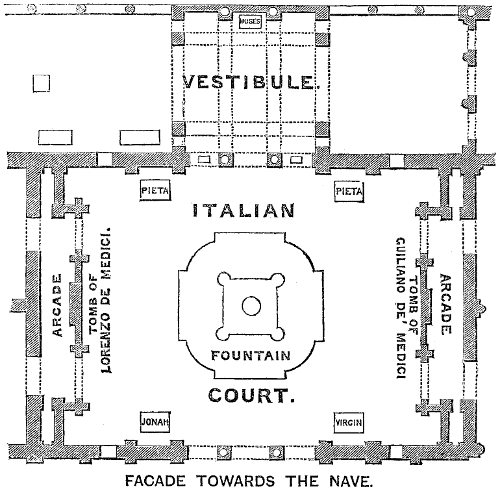
Ground Plan of Italian Court.
Prior to entering the Court, we may remark, in the niches, the bronze statues by Sansovino, from the Campanile Loggia at Venice, amongst which Apollo is conceived quite in the old Roman spirit. Passing beneath, the columns in the centre of the court, we see the fountain of the Tartarughe, or “of the Tortoises,” at Rome, designed by Giacomo della Porta: the copies of the bronze statues by Taddeo Landini belonging to it are, for the present, placed in front of the Vestibule of the Italian Court. Turning to the right, the first object that attracts our attention is a statue of the Virgin and Child, by Michael Angelo, the original of which is in the Church of Lorenzo, Florence. Advancing to the south side, we enter a loggia or arcade, the interior of which is richly ornamented with copies of Raffaelle’s celebrated frescoes in the Loggie of the Vatican palace at Rome. They consist of a most fanciful, yet tasteful, combination of landscape figures, architecture and foliage, founded on antique models, and bearing a close resemblance to the ornamental work discovered in various Roman ruins, having been imitated by Raffaelle from the baths of Titus, discovered about this time. The towns of Pompeii and Herculaneum, which have so much enlarged our knowledge of ancient arabesque ornament, were at that time unknown. In the centre of the arcade, towards the Court, is the monument of Giuliano de’ Medici, from San Lorenzo, Florence. On each side of his statue are the reclining figures Night and Day (part of the same monument). The face of the right-hand figure is left rough-hewn by the poet-sculptor to indicate the indistinct aspect of Night. The face of Twilight, on the opposite monument, though still in the rough, is more clearly expressed, as it should be. This is one of Michael Angelo’s masterpieces, and is remarkably characteristic of the sculptor’s style. At the back of it, in the Loggia, is a fine specimen of bronze casting, from the gates of the enclosure at the foot of the Campanile, Venice. On each side of the entrance to the gallery are two groups of a Virgin with the dead Christ, that to the right being by Bernini, the other to the left by Michael Angelo, both especially interesting as serving to indicate the state of art in the 16th and 17th centuries respectively. The remaining statues, viz.,—the Slave, now in the Louvre, the Christ in the Church of S. Maria Minerva, Rome, and the Pietà in St. Peter’s, Rome, are by Michael Angelo. The visitor may now enter the loggia, which, like its companion on the other side of the Court, is ornamented with copies of Raffaelle’s frescoes from the Vatican; in the centre of this side of the Court is placed Michael Angelo’s celebrated monument of Lorenzo de’ Medici, from the church of San Lorenzo at Florence; the reclining figures on each side of the statue of Lorenzo represent Dawn and Twilight. At the back of this monument within the arcade is the fine bronze door by Sansovino from St. Mark’s, Venice, on which he is said to have laboured from twenty to thirty years. The projecting heads are supposed to be portraits; amongst them are those of Titian, Aretino, and of the sculptor himself. Proceeding onwards, the beautiful composition of Jonah and the Whale, by Raffaelle, is from the Chigi Chapel at Rome. Passing into the gallery on the Garden side, we remark in the four angles portions of the pedestals of the Venetian standards, from the Piazza of St. Mark, Venice. The painted ceilings of this gallery deserve special attention. The first on entering the gallery is from an existing example at the “Old Library,” Venice; the last is from the “Camera della Segnatura,” by Raffaelle, at the Vatican; beneath which is the wonderful statue of Moses, by Michael Angelo,—a production the grandeur of which amounts to sublimity, expressing in every line, with, the noblest conception, the inspired lawgiver and appointed leader of a nation.
VESTIBULE TO THE ITALIAN COURT.[18]
The decoration of the vestibule is founded on the very elegant Casa Taverna at Milan, by Bernardino Luini, a pupil of Leonardo da Vinci, and affords an excellent idea of the peculiar painted mural ornament prevailing in Italy at the commencement of the 16th century. The doors are from the Palace of the Cancellaria at Rome, by Bramante, the famous designer of St. Peter’s in that city, and the immediate predecessor of the great architects of the 16th century. The vestibule itself is rich in very beautiful water-colour drawings after the old masters, by Mr. West. These drawings are well worthy of study, since they afford admirable specimens of the manner of many old masters, who are but poorly represented in the National Gallery.
Monument of Lancino Curzio.
Madonna della Scarpa.
Sacrarium of the Maddelena from Certosa.
Monument of Lancino Curzio.
Madonna della Scarpa.
Sacrarium of the Maddelena from Certosa.
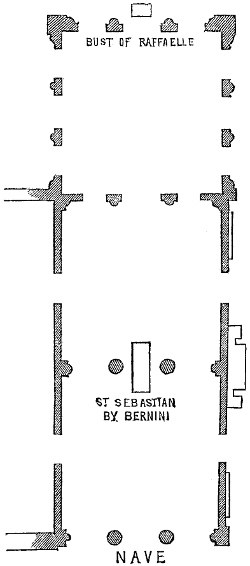
Ground Plan of Italian Vestibule.
We now pass out of the gallery into the Vestibule, by turning through the pillars to the right. The monuments on the external wall of the vestibule afford excellent examples of the later Renaissance style. Amongst them may be particularly noted the monument of Lancino Curzio (nearest the gallery), from Milan, by Agostino Busti, evincing that delicate execution for which the sculptor was famous; underneath is the tomb of St. Pelagius Martyr, from Genoa; and, in the centre of the wall, the central altar of La Madonna della Scarpa, from the Leno Chapel in the Cathedral of St. Mark, Venice—an elaborate specimen of bronze casting, completed early in the 16th century by Pietro Lombardo and others. The upper part of the monument nearest the Nave is an excellent example of the Renaissance style, being the Sacrarium of the Chapel of the Maddelena at the Certosa, Pavia; the bas-relief in the centre is by Donatello, and the remaining portions of the composition are from Sansovino.
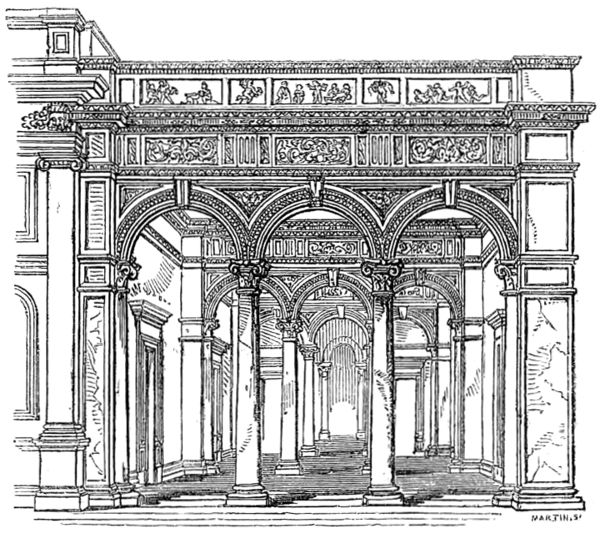
Façade of Italian Vestibule.
We have now completed our survey of one of the most interesting features of the Crystal Palace. We have performed our promise to guide the visitor through the various Fine Art Courts, bringing before his notice some of the principal objects that have adorned his road, and endeavouring, by our brief remarks, to heighten the pleasure he must necessarily have experienced from the sight of so noble an assemblage of architectural and sculptural examples. Much however requires patient examination and study—examination that will yield fresh beauty, and study that will be rewarded by permanent and useful knowledge. For guidance and help we refer the visitor to the handbooks of the several Courts. The mission of this little work, as far as the Fine Art Courts are concerned, is accomplished: and “The Guide Book” now only waits until the visitor has sufficiently recovered from his fatigue, in order to resume, in other parts of the building, the part of cicerone.
COURT OF MONUMENTS OF ART.
We enter this Court (which is formed in one angle of the Great Transept with the Nave), as with the other Courts, from the Nave. The first objects that attract our notice are some beautiful statues of the Italian school, amongst which will be found many of Canova’s, several beautiful works by Richard Wyatt, and some from the chisel of Gibson. The statues at the garden end of the Court are mostly French. Some of the most conspicuous objects however in the Court are the very interesting crosses of the early Irish Church, and the richly sculptured bronze column from Hildesheim Cathedral in Germany, a fine example of the Byzantine period. Also a very interesting cross, from Pocklington, in Yorkshire,—a fine example of the monumental art of the latter part of the 15th century. This specimen has been liberally presented by Samuel Leigh Sotheby, Esq.
Beyond these are monuments of the Gothic period, amongst which are conspicuous the Cantilupe shrine from Hereford Cathedral, and the effigy of Edward III., from Westminster; the central tombs, of Bishop Wakeman, from Tewkesbury, and of Bishop Bridport, from Salisbury (the last-named being that to the left).
The tomb of Henry VII., an interesting example of the Italian Renaissance style in England, at an early period of its introduction, and the fine bronze monument of Cardinal Zeno from Venice, occupy the further end; and the equestrian statue of Gattamelata, by Donatello, forms a conspicuous feature in this portion of the Court, where also is a fine bust of Cosmo de’ Medici, by Benvenuto Cellini. Under the gallery at the further end are two fine equestrian groups in bronze of Castor and Pollux, by San Giorgio of Milan. The originals stand in that beautiful city. Here also, in a corresponding position to the statue of Gattamelata, but nearer towards the nave, is the superb statue of Colleone. In the glass cases on the side next the Transept may be seen a most interesting collection of casts from ivory carvings, from the 2nd to the 15th century. These have been published by the Arundel Society.[19]
For minute and interesting information respecting the monuments, and all the statues on this side of the Palace, the visitor is referred to the Handbooks of the Mediæval and Italian Courts (by Messrs. M. D. Wyatt and J. B. Waring), where they are fully described.
Crossing the great transept to the west, we proceed towards the south end of the building, and, keeping to the right-hand, commence our pilgrimage through the Industrial Courts. The first that we arrive at is
THE STATIONERY COURT.[20]
In the formation of this and of the other Industrial Courts, the several architects have been solicitous to express, both in the construction and the decoration, as far as possible, the specific destination; with the view of maintaining some harmony between the objects exhibited and the building in which they are contained. The Stationery Court was designed and erected by Mr. J. G. Crace. The style of this Court is composite, and may be regarded as the application of cinque-cento ornamental decoration to a wooden structure. Externally the aim has been to furnish certain coloured surfaces, which shall harmonise with the plants around and with the general aspect of the Palace. In the interior of the Court, the colour on the lower level will be seen to serve as an admirable background to the objects exhibited; whilst the panels covered with cinque-cento decoration, combined with the elegant imitation of marquetrie work, produce an effect which deserves the highest praise. Over the opening through which we enter this Court, and between the stained glass windows let into the wall, have been introduced allegorical figures of the arts and sciences applied in the manufacture of the articles exhibited in the Court, and over the opening at the back the artist has depicted the Genii of Manufacture, Commerce, &c. In the centre of the panels throughout the Court representations are painted of the processes which the objects exhibited undergo during their manufacture.
As the visitor passes round this Court, let him step out at one of the entrances on the north side, close to which he will find erected “The Crystal Palace Medal Press.” This machine, which is official, and worked on behalf of the Company by Messrs. T. R. Pinches & Co., is employed from time to time in striking commemorative medals, designed by Mr. Pinches or other artists connected with the Palace. The machine is worked by four men, one of whom adjusts the metal to be stamped between the sunk dies: as soon as the metal is fixed, the other workmen swing the lever rapidly round, and the great pressure produces impressions of the dies on the metal, which is turned out sharp and distinct, and then put into a lathe and completed. In the glass cases placed near, the visitor will have an opportunity of inspecting numerous specimens of the medals produced by the machine, amongst which those in frosted silver deserve especial notice for the beauty of their appearance.
The visitor, proceeding round the Stationery Court, from right to left, will find amongst the works of industry exhibited, specimens of Bank-note Engraving and Medallion Line-engraving, book-binding, and printing, including the new art of Nature-printing, paper manufacture, and Artists’ colours, also stereoscopic views and other articles of the kind. Outside this Court, between it and the Birmingham Court, are some beautiful and interesting specimens of artistic printing in colours. At the back of this and of the Birmingham Court, or towards the west front of the building, is situated “The Hardware Court,” in which are placed household utensils, iron and zinc bronzes, gas-fittings, refrigerators, and numerous articles in metals.
Immediately behind the Hardware and Stationery Courts, is a Court dedicated to New Inventions. This very interesting department is filled with ingenious contrivances of all kinds, and is well worthy of a visit.
Beyond this Court again, and flanking the Hardware Court, is a large space extending in a southerly direction to the Pompeian Court (at which the visitor will presently arrive), divided into several large chambers which are devoted to the exhibition of furniture. Here will be found not only useful articles of household furniture, but specimens of tapestry work, wood carving, picture frames, and other ornamental articles which give grace to our rooms, and which, by means of our great mechanical excellence, are daily becoming more and more within the reach of the great body of the people. The visitor will do well, in examining these Courts, to view them in sections, so as not to miss those Industrial Courts which face the Nave.
Next in order of the Industrial establishments, comes
THE BIRMINGHAM COURT.[21]
This Court has been designed by Mr. Tite, and the architect has considered that the purpose to which the Court is applied might best be expressed by showing some of the principal ornamental uses of iron in architecture. With this intention, he has designed for the façade of the court a restoration, in modern work, of the English ornamental iron enclosures of the 17th century, which differed but slightly from those prevailing at the same time in France in the style of Louis XIV. The English, however, are generally richer in foliage, while the latter are more fanciful in scroll-work. At the period referred to, the whole of those enclosures were of wrought and hammered iron, cast-iron being at that time little known; but in the enclosure before us, although it has been executed on much the same principle as the old work, the ornaments are cast, in order to secure greater durability, cast-iron not being so easily destroyed as wrought iron, by the oxidation which proceeds with such enormous rapidity in this country. The castings have been most admirably executed, and so sharp and distinct were the outlines of the patterns, that they required but little after-finishing. The pilasters are of enamelled slate, excellent for their imitation of marble, surmounted by iron capitals. Entering through the gates in the centre, the visitor finds the interior of the court panelled in the style of the same period, and decorated by Mr. Sang with emblematical paintings and other appropriate ornamentation in encaustic.
In this Court will be found specimens of plate, articles in nickel silver, seal-presses, gilt toys, curious locks, and similar manufactured goods of universal use, from the multifarious productions of the busy town which gives its name to the Court. On leaving the court, we notice some splendid specimens of bronze casting, and other works of artistic metal manufacture, belonging to Messrs. Elkington & Co. Quitting this department, we approach next in succession,
THE SHEFFIELD COURT.[22]
The architect of this Court is Mr. G. H. Stokes, whose structure compels attention by the novelty of its design, and by its generally striking effect. Although there is a considerable admixture of styles in the Court, the parts have been so well selected, and their blending is so excellently contrived, that they yield a harmonious result in every way pleasing to the eye. The materials used in the construction are plate-glass and iron, an appropriate and happy selection for a court intended to receive the productions of Sheffield. The panels on the outer walls are of plate-glass, inclosed within gilt-mouldings; the pilasters and the frieze over the large panels are likewise of plate-glass. The iron columns above, forming an arcade, are in a composite Moresque-Gothic style, and elaborately ornamental in design. Entering the Court from the Nave, we find the interior decorations identical with those of the exterior—with two differences, viz., the large lower panels, instead of being of plate-glass, are of red cloth, which serves as a background to throw up and display the articles exhibited. The frieze or space above the columns is covered with painted decorations. The articles exhibited in this Court present an excellent representation of the important manufactures for which Sheffield is so celebrated, and which are sought by all the world. It is impossible not to extol the beauty and curiosity, as well as the completeness, of these manufactures.
Having made our way to the Nave, a step brings us at once before the exquisite restoration of
THE POMPEIAN COURT.[23]
Seventeen hundred and seventy-five years ago, the cities of Herculaneum and Pompeii, beautifully situated on the shores of the Bay of Naples, were buried beneath the lava and ashes vomited forth by Vesuvius. The horrors of this calamity are recorded in the writings of Pliny, and of other Roman historians of the period. So sudden was the outbreak and general convulsion that, as we learn, many of the inhabitants of those cities were caught in their terrible doom before the thought of escape occurred to them. The dread event completed, nature resumed her former aspect. The mountain flames ceased, the intense blue sky again looked down upon the dancing waters, and there was nothing to tell of the general havoc, but a vast desolate tract covered with white ashes, under which man and his works lay entombed.
For upwards of sixteen hundred years these cities remained buried. But about the middle of the last century, curiosity with respect to them was stirred, inquiry commenced, and excavations were attempted. As in the more recent case of Nineveh, but with still more satisfactory results, success at once crowned investigation. The material that had destroyed Herculaneum and Pompeii had also preserved them. That which had robbed them of life had also perpetuated their story in death. The cities were redelivered to man so far undecayed, that he obtained actual visible knowledge of the manner of life of one of the most remarkable people that ever governed the world. To the insight thus obtained, the visitor is indebted for the reproduction of the Pompeian house before which he now stands—a habitation of the time, complete in every respect. It is not asserted that the visitor beholds the actual ground-plan of any one specific house, but he sees the type of a Pompeian villa, made up of many fragments that have been found. The paintings and decorations are copies of originals found in the destroyed cities.
The doorway of this house stands fronting the Nave. Entering it, we pass through the narrow prothyrum or passage, on either side of which is a room devoted to the door-keeper and slaves, and on its pavement the representation in mosaic of a savage dog, and the words “cave canem”—beware of the dog—meet the eye. It is the usual notice found on the threshold of these Roman houses. Emerging from the passage, we are at once in the “atrium,” or outer court of the edifice. The eye is not attracted here, as in other restorations of the palace, by the architectural design alone; the attention is also secured and charmed by the decorations. The bright coloured walls, the light fanciful character of the ornaments, the variety of patterns, and the excellent method of colouring,—which at the lower part is dark, and graduates upwards, until it becomes white on the ceiling,—constitute some of the beautiful features that give individuality to Pompeian houses, and cause them to differ most essentially from every other style.
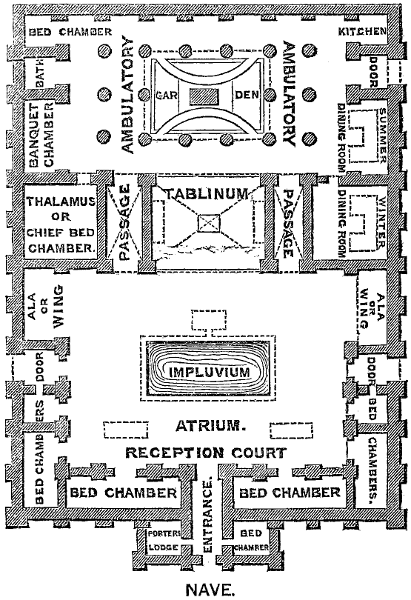
Ground Plan of Pompeian Court.
This entire court, or “atrium,” was the part of the building common to all visitors. The opening above is the “compluvium,” and the marble basin beneath, the “impluvium,” which received the rain that fell from the roof. In the actual houses at Pompeii, the size of the “impluvium” corresponds, of course, with the dimensions of the opening above. Here the “compluvium” has been widened in order to admit more light into the court. The flooring consists of tesselated pavement, and near the two other doorways leading into the “atrium” is inscribed the well-known word “Salve”—“welcome”—announcing the profuse hospitality of the owner. Two out of the three entrances mentioned are formed here for convenience of egress and ingress, and are not copied from actual buildings, in which there are sometimes to be found, however, a porta postica, or back door.
As soon as we have entered the Court, we turn to the right, and proceed round it, stepping into the “cubicula,” or bed-chambers, to admire the figures that seem to be suspended in the intensely fine atmosphere, and—with our English experiences—to wonder how, whether by day or by night, comfort could be attained in such close dormitories. We reach the side entrance, next to which is an open recess corresponding with a second recess on the other side of the “atrium.” These recesses were called “alæ” or wings, and were used for the transaction of business with visitors. On the central panel of the first recess is painted a scene from the story of “Perseus and Andromeda,” and on the side panel are again exquisite figures, painted not in the centre of the panel, producing a stiff formality, but nearer to the top than to the bottom, so that the forms still seem to float before us. Continuing our way, we turn into the large apartment opposite the door at which we entered. This is the “tablinum,” and was used for the reception of the family archives, pictures, and objects of art. Across the “tablinum” a curtain was sometimes drawn, to separate the private dwelling-house from the more public “atrium,” although it is a remarkable fact that no remains of hooks or rings, or of anything else, has been discovered to convey an idea of the means by which such a curtain could be attached. In order to enter within the “tablinum” a special invitation was required.
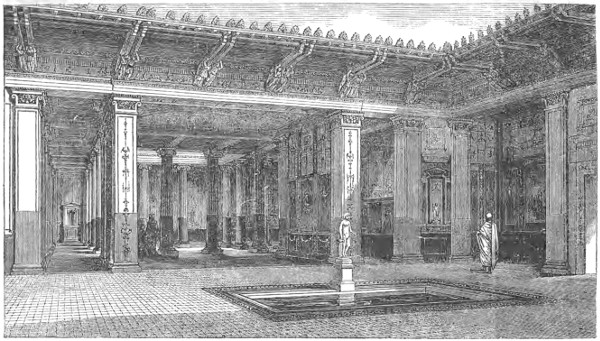
THE POMPEIAN COURT.
From this point, the “Peristyle” is also visible, with its columns coloured red some way up, a Xystus or flower-garden, and a back wall, upon which are curious specimens of perspective decoration, in which the Romans seem to have delighted. This court was always open to the sky in the middle. Passing through the “tablinum,” and turning to the right, we come to a small doorway which admits us into the “triclinium,” or winter dining-room. The Roman dining-room generally contained three couches, each large enough to hold three persons. In feeding, the Roman was accustomed to lie on his left side and to stretch out his hand towards the table in order to serve himself. Re-entering the “Peristyle,” we proceed on our way, still to the right, and pass a summer triclinium used in warm weather, on the walls of which fruits are painted, some hanging in golden clusters on a wreath of foliage, supported by Cupids. Next to this is the “porta postica,” or back door, and adjoining it a small recess, which served as kitchen. Crossing the “Peristyle,” near one end of which is the domestic altar, we turn to the left, and after passing a small chamber, the “vestiarium,” or dressing-room, reach the “balneum,” or bath-room—that chamber so essential to the luxurious Roman. Close to this is the æcus, or saloon, and beyond this again, and corresponding with the “triclinium,” is the “thalamus” or bed-chamber of the master of the house. Quitting this, we once more gain the “atrium” by means of narrow fauces, or passages, and return to the Nave, through the door of the house at which we originally entered. The visitor has seen the extremes of decorative art, when, after sating his eyes with the profuse and dazzling embellishment of the Alhambra, he has also dwelt upon the delicate work of colours gracing the walls of Pompeii. From the gallery above the visitor may see the form of the ancient tiled roof made of the peculiar tiles still occasionally used in Italy. This court was erected by Mr. Digby Wyatt. The paintings were executed under the superintendence of Sig. Giuseppe Abbate, of the Museum, at Naples. The mosaic floor was manufactured by Minton from drawings after antique Mosaic by Mr. Wyatt; and the bronze groups in the tablinum, and the Venus in the lararium, were electrotyped and presented by Messrs. Elkington and Co.
NATURAL HISTORY DEPARTMENT.
Upon quitting the Pompeian Court the visitor, still walking southwards, crosses the south transept and enters that division of the building which is devoted to geographical groupings of men, animals, and plants. The illustrations of the animal and vegetable kingdoms in the Crystal Palace have been arranged upon a specific principle and plan. Although the British Museum contains nearly all the examples of animals and birds known in the world, and Kew Gardens exhibit specimens of the majority of trees and plants known to botanists, still neither of these collections affords the visitor any accurate idea of the manner in which these numerous objects are scattered over the earth. Nor do they assist his conjectures as to the nature or the general aspect of their native countries. Here an attempt has been made to remove the confusion; and it is believed that the associations of those two branches of Natural Science, in groupings arranged in such a manner as the nature of the building will permit, coupled with illustrations of the human variety belonging to the same soil (a collection which has never before been attempted in any country), will prove both instructive and amusing, and afford a clearer conception than can be obtained elsewhere of the manner in which the varieties of man, animals, and plants, are distributed over the globe.
Zoology (from Zoön, an animal) is, strictly speaking, that science which investigates the whole animal kingdom, comprehending man as well as the inferior animals. Zoology, therefore, in a wide sense, includes Ethnology, or so much of that science as considers the different varieties or races of men in a physical point of view, instituting comparisons between them, and carefully pointing out the differences or affinities which characterise the physical structure of various branches of the great human family. In more confined use, the term zoology relates only to the consideration and study of the mammalia, or suckling animals; the requirements of scientific research having occasioned a new nomenclature in order to distinguish the different branches of the same study. Hence the natural history of birds is particularised as Ornithology, and that of fish as Ichthyology, whilst the investigation of those characters in man which serve to distinguish one race from another is, as previously remarked, called Ethnology (from the Greek Ethnos, “nation”). This last-named science is subdivided again into different branches, but, in a limited and inferior sense, and as illustrated by the various groups in the Palace, it may be described as that science which distinguishes the differences in skin, hair, bone, and stature that exist between the various races of men. This zoological branch of Ethnology relates to the physical history of man as opposed to his mental history, and, following up the course of his wanderings, endeavours by the above-mentioned physical peculiarities to ascend to the source from which the several migrating races have proceeded.
Within the Palace itself, we have been enabled to remark the works of man, and the gradual development of his ideas, especially in Art, leading to a variety of so-called “styles,” which answer in a measure to the varied species of Divinely created life. We have now an opportunity of attentively considering the more marvellous and infinite creations of the Deity in the organisation and development of that greatest of all mysteries—life itself; and of obtaining a vivid idea of those peculiar varieties of mankind, that have hitherto not fallen under our personal observation. If the visitor should feel astonishment in the presence of some of the phases of human existence here presented to him, he may do well to bear in mind, that they are representations of human beings endowed with immortal souls; to whose capabilities we may not place a limit, and that it is not yet two thousand years since the forefathers of the present European family tattooed their skins, and lived in so savage a state, that late archæological researches induce us to suspect they were not wholly free from one of the worst charges that is laid to savage existence; viz. the practice of cannibalism.[24]
Entering upon the path immediately before him, the visitor will commence the examination of the groups arranged on the western side of the nave. Turning up the right-hand path, we find on the right a general illustration of Australia. The men here represented are copied from living natives of Cape York, North Australia, and strike us at once, by their half-starved, lanky, and ill-proportioned bodies, curiously tattooed; they may be looked upon as savages, hunters, and inhabitants of the forest; they possess that excessive projection of the jaw, which ethnologists make one of the distinguishing traits in the most degraded forms of man. These figures were modelled from some living natives who were brought to England in 1853, and who were kept for some weeks by the Company on purpose that these portraits should be accurately rendered.
Amongst the animals will be noticed that most characteristic form, the Kangaroo, of which there are several species, and the Opossum, or Fox Phalangister, with a young one in its pouch. There are likewise specimens of the Duck-billed Platypus, Cook’s Phalangister, a Flying Opossum, an Emu, and a large rat called Hydromys. Some fine cases of Australian birds stand in the Transept close by. Here the visitor will find numerous plants, with which he is acquainted in conservatories; the Banksia, the Acacias, and the different kinds of Epacris and Eriostemon, are amongst the most conspicuous. He will see also specimens of three other kinds of Araucaria, the most elegant of which is the Norfolk Island Pine.
Nearer to the staircase, and adjoining the Australians, is a group of Papuans from the Louisiade Archipelago, remarkable by their curious frizzled hair; they are neither Malays nor Negroes, but a mixed race between these two, retaining the characteristics of the tribes from which they have sprung; hence they may be called Malay-Negroes. Behind them is a fine Cassowary, a curious bird, indigenous to the Indian Archipelago.
On the left-hand of the visitor, as he stands opposite the Australian figures, is arranged a group of Botocudos, inhabitants of that district in South America watered by the rivers Doce and Pardo. They have been regarded as the fiercest of American savages; they are yellow in colour, their hair is long and lank, their eyes are small, their cheek-bones prominent, the expression of their countenance excessively savage; and they give themselves a still wilder appearance by the insertion of pieces of hard wood in the under lip and in the ears, distending the flesh in a peculiar and strange manner. From this barbarous practice they derived their appellation of Botocudos, from the Portuguese. The operation of thus distending the lip is not, of course, carried out at once, but from infancy by the gradual increase in size of the piece of wood inserted. This may be noticed in the model of the child as compared with the adult natives. Missionary efforts, it is consolatory to think, have done something towards civilising these savages, who have been induced to become industrious, and to turn their attention to the cultivation of the soil. On the summit of the rockwork, over where three of the natives appear to be in council, are two fine specimens of the Black Jaguar and the Ocelot.
We now pass a case of birds belonging to North America, and at this point the illustrations of that country commence. In the centre of this case will be remarked a fine specimen of the Wild Turkey, from which our domestic breed is derived. On the left of this path is a group of North American Red Indians engaged in a war-dance, and surrounded by trees and shrubs indigenous to North America. The Indians of the valley of the Mississippi, and of the drainage of the Great Lakes, supply us with our current ideas of the so-called Red Man, or the Indian of the New World. In stature they are above the middle height, and exhibit great muscular force, their powers of endurance being very great; in temper they are harsh, stoical, and unsociable, whilst in warfare they are savage and cruel. The general physiognomy of the Red Indians is the same from the Rocky Mountains to the Atlantic. Between the Alleghanies and the Atlantic, the first-known country of these tribes, the variety is now nearly extinct. The most conspicuous plants are the American Rhododendrons, the Kalmias, the Andromedas, and the American Arbor Vitæ. Amongst the foliage we see the Black Bear, the Otter, the Beaver, the Grey Squirrel, and other animals indigenous to the country.
Passing now round the right-hand path, we find on our right the men, plants, and animals of Central America; amongst the latter, on the top of the rock-work, a fine male Puma grey with age. The Puma may be regarded as the American representative of the Lion of the old world, the distribution of both these animals throughout their respective hemispheres having originally been very general. Like most of the cat tribe, the Puma is a good climber, and usually chooses trees, rocks, and other elevated positions from which it can dart upon its prey. Before reaching this, the visitor will note a large specimen of Agave Americana, one of the most striking plants of Central America; he will also note that this is the land of the justly-admired Verbenas and Fuchsias, amongst which he will find a specimen of the large prehensile-tailed Porcupine. The men are representatives of the Indians of Mexico generally, rather than of any particular tribes.
On the left of the visitor are two groups of men; the two reclining figures are characteristic of Guiana, and beyond them is the Amazonian group. At the back, to the left of these two groups, is a large group of Caribs, some using blowpipes, others shooting fish with bows and arrows. These three are intended to serve as types of the northern varieties of South American Indians. And if we institute a comparison between the various races of North and South America, it will be found that the latter possess more delicate features, rounder forms, and are of smaller stature. Their habits and pursuits also differ. The Red Indian of North America gives himself up entirely to hunting, whilst the South American devotes his life to fishing, guiding his light canoe down the rapid-rolling rivers of his country, in search of the means of subsistence. In front of the Carib group are two Agoutis, and one unfortunate Marmoset Monkey in the clutches of a Skunk, while another is making his escape; also a small Fox, and a Tayra; and beyond the Amazon group is a little prehensile-tailed Porcupine.
The two cases of Birds which we now pass are especially brilliant, as they contain the Humming Birds and others of the splendid species of Tropical America. The specimens are not only remarkable for their magnificent plumage, but in many instances (as with the Toucan) for their peculiar conformation as fitted to their habits of subsistence. The long and slender bills of the Humming Birds, who probe the flowers in search of food, contrast with the apparent unwieldiness of the Toucan’s bill, adapted to tear from the branches the fruit upon which it feeds. Passing round, we notice a Jaguar about to devour a Brocket Deer. As the Leopard is found only in the Old World, so is the Jaguar peculiar to the New World, and each may be regarded as a representative of the other, on opposite sides of the Atlantic ocean; the Jaguar having greatly the advantage in size and muscular strength.
We now come to the Arctic illustrations, commencing with a case of Birds, many of which were collected by Captain Inglefield during one of the recent Arctic expeditions, and presented by him to the Crystal Palace. The specimens are arranged to represent some of the changes of plumage which, at various seasons of the year, are incident to the birds in these remote and extreme climates. The Snowy Owls, the Eider Duck, the Gannet, and various birds frequenting the sea-coast, are beautiful and prominent specimens in the collection.
It has been attempted in this illustration to present the visitor with some idea of the peculiar features of this region. It was necessary here, in the absence of all botanical specimens so attractive in the other departments, to attempt the representation of icebergs, and the snowy aspect of the country. The Ethnological group in the further recess is formed of two Samoiedes, or natives of Arctic Russia in their winter dresses of fur. The male native holds in his hand a pair of the very peculiar snow-shoes which are used by these people. The group nearest to the spectator consists of two males, a female, and child of the Lapland race, in their curious national dress. The scarlet costume of one of the male figures is, however, the summer dress, but is placed here for contrast with the other example, which is the kind of clothing adopted in the rigorous winter. On the right appears a Greenlander in his skin canoe, and armed with the implements of chase, by which he captures Whales, Seals, Birds, and other animals. The largest Polar or White Bear was killed by Captain Inglefield with a single pistol shot, when he was closely and dangerously attacked by the monster. The other animals consist chiefly of the Reindeer, Arctic Foxes, Esquimaux Dogs, Seals, &c. This illustration has been arranged and designed by Mr. A. D. Bartlett, under whose superintendence the Natural History Department is now placed.
Before leaving this side of the Palace to proceed in the examination of the Natural History Department on the other side of the Nave, we must not omit to particularly notice the interesting illustrations of aquatic natural history, which will be found in the various positions which are indicated. Most of these differ from the other objects in the department, inasmuch as they are living specimens; but they will all tend to give us some idea of how vast and how wonderful are the works of Nature, how various and how marvellously fitted each to its own function in the great universe. On the right-hand side of the path by which we entered the department from the Transept, is a case filled with West Indian sponges, arranged to represent, as far as may be, the aspect of the bottom of the sea in that region, and the form of growth of these curious marine productions. This rare collection of sponges is the property of J. S. Bowerbank, Esq., who has kindly lent them to the Crystal Palace Company, and arranged them himself.
We should now return to the staircase, near where the Botocudos and Australian illustrations are. Here two large tanks are fitted up as marine aquaria. The specimens are arranged in real sea-water. In the tank under the staircase, and nearest to the Botocudos, are placed specimens of the swimming fish most generally found on the coasts of Great Britain. It is not necessary here to particularise any of the various kinds, as a system has been adopted of affixing the specific names to the tank itself, for the readier and more effective identification of these interesting objects.
In the other tank, on the left-hand, those species of Crustaceæ which may be most properly designated active Crustaceæ are exhibited. A similar plan for the identification of the specimens is adopted as with the other tanks. Amongst these interesting specimens, the curious movements of the Soldier Crab, or, as called by some, the Hermit Crab, are very noticeable. This peculiar animal is not himself gifted with a shell upon his body, although his legs and claws are covered with the usual protection. To remedy this want, his habit is to attack some univalve, most generally the common Whelk, and having devoured the inmate, to adopt the shell as his own, moving about with it from place to place with great apparent convenience. He is not, however, always left in undisturbed possession of his stolen tenement, for the Actinea parasitica frequently attaches himself, with apparent purpose, to the shell, and thus, as it were, enslaves the inmate. The crab can, however, easily adapt himself to a new habitation, and may be frequently induced to the operation, if tempted by the introduction of a better shell. The tanks containing the Madrepores, Actineæ, and those species of Molluscous animals, which from their habits may be termed inactive, will be described in the proper positions on the other side of the Nave.
Crossing the Nave in front of the screen of Kings and Queens, we continue our examination of the various Natural History illustrations on the garden side of the Palace. Keeping then to the extreme right of this division, the first group we come to illustrates generally the Bushmen of South Africa. These have been variously designated by travellers as Bosjesmen and Earthmen, but are of one race. The group represents an entire family. This singular race of beings are persecuted and despised not only by Europeans but by the other tribes. They are migratory, and fix their abodes on unappropriated tracts of land, which frequently separate hostile tribes. The race is fast disappearing. The animals of this division (South Africa) are the Hippopotamus, the Bubaline Antelope, a large Crocodile, and on the rocks opposite to the Hippopotamus is the Cape Hyrax, or Rock Rabbit, a curious animal, much more nearly related to the Rhinoceros than to the Rabbit.
Further on we come to Eastern Africa, which is here represented by a group of Danakils, who inhabit the country between Abyssinia and the sea, leading a camel to water. The Danakils are a nomade or wandering tribe; they are of a chocolate-coloured complexion, and have long, coarse, wavy hair, which they often dress in a fantastic manner; they are of slender make, tall, and differ widely in appearance from the Negro. The Danakils are transitional between the Negro and the Arab, possess a Jewish physiognomy, and have acquired the Negro element from their intercourse with the neighbouring members of that race. The Negro form and physiognomy are much more strongly developed in the man on the right of the Dromedary, who belongs to the Msegurra tribe. In this district will also be found a fine natural historical group, representing a Leopard attacking a Duyker-bok.
On the right hand of the path in which we now are is a group of Zulu Kaffres. This fine people are far advanced before the rest of the South African races; they are in a measure civilised; some of them build houses and towns, and pay considerable attention to arts and manufactures. Thousands of them have lately entered the service of Europeans as farm-servants and labourers; in these capacities they are most honest and trustworthy. In general they are tall, strong, and well-proportioned; their skin is usually of a brown colour, but this varies in intensity; their hair is woolly; their foreheads high, and cheek-bones prominent. They are an active and warlike race, and of a predatory disposition. Having inspected this group, we should return and proceed down the path, then to our left. We shall pass, on our left, amongst other animals, three specimens of the Chimpanzee, the animal whose form most nearly resembles that of man (excepting the Gorilla). These are found on the western coast of Africa, though they may probably also exist in the far interior where no European as yet has penetrated. Though somewhat similar to the Ourang Outang of Sumatra in general form, the Chimpanzee is a smaller animal. It lives in woods, builds huts, or rather a protection from the sun and rain; uses clubs for attack as well as for defence; and in many ways exhibits an intelligence that presses with rather uncomfortable nearness upon the pride of the sole rational animal.
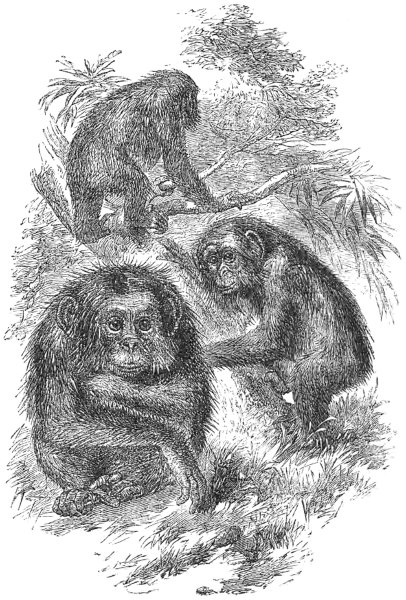
The Chimpanzees.
Turning then to the left, the first group we come to is one which illustrates an episode in the wild life of the savage. Two native Mexicans appear to have come suddenly upon a Jaguar, who has struck down a small deer for his prey, and to have attacked him with the bow and arrow; the wounded and infuriated animal is about to spring from the rock upon his adversary, whose footing has slipped, when the other native advances boldly with a spear to receive the attack and to rescue his companion.
Beyond this is represented a battle between two Leopards, forcibly reminding us of a quarrel between two cats, which, in fact, it is. Any one who has seen one cat advancing towards another, must have observed that there is always a desire to receive the assault lying on the back, with the four legs upwards. The motive is to be in a position to have free use of the claws of all the legs; and in the group before us, though the smaller animal appears to have the advantage both by position and by the grip he has taken on the throat of the other, yet the laceration he is receiving underneath from the hind legs of the larger animal will soon oblige him to release his hold. Close by are two Gazelles, as well as some Mediterranean animals, such as the Barbary Ape, the Corsican Goat, and two specimens of the Mouflon Sheep. The vegetation includes Orange and Lemon trees, the Date Palm, the Oleander, the Sweet Bay tree, and the Laurustinus. If the visitor here turns round to his right, a little further on, he will find a beautiful case, containing some superb specimens of the Game birds which are found in the Himalayan districts.
In this path he will pass, on his left, some illustrations of the most eastern part of temperate Asia. Two Tibetans represent the general physiognomy of the inhabitants. The animals are all rare: amongst them is the Chiru, a curious sheep-like Antelope; the Siberian Marmot; the Yaks, or grunting oxen, which are used by the Tartars for riding or driving, as well as for food or clothing; the tail being very much in request in India for brushing away flies, no less than as an emblem of authority; of these Yaks there are two specimens here, the largest being the animal in its wild state, the smaller one as it is domesticated by the Tartars; and the Ounce, a species of Leopard peculiar to the Himalayan Mountains, an animal which three hundred years ago was comparatively well known, but whose skin has since become so rare that the very existence of the animal has been questioned. European travellers have lately visited its haunts in Central Asia, and satisfactorily proved that it still lives. In the glass case further on, are two specimens of the great horned sheep of Chinese Tartary. The Botany here is from various sources: China, Siberia, Japan, and Nepaul have each contributed a few plants, amongst the most conspicuous of which are the Camellias and the Oriental Arbor Vitæ, which is the Asiatic representative of the similar plant in the new world. Amongst this botanical group will be found also specimens of the black and green Tea-plants.
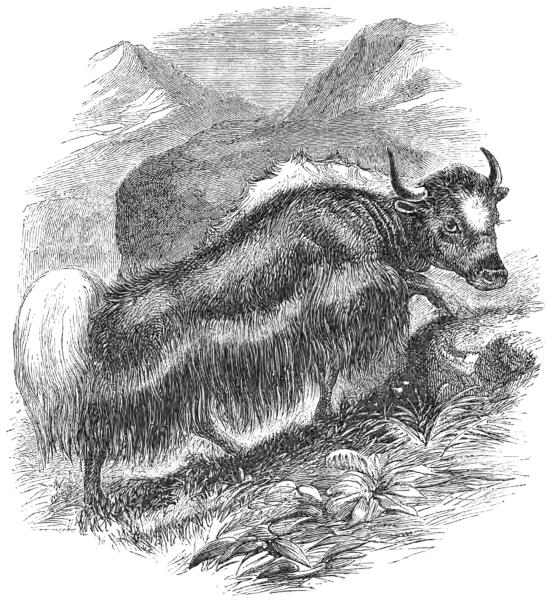
The Yak.
Facing the visitor at this point under the staircase, and in corresponding positions to those described on the other side of the building, are two more large sea-water tanks. Those classes of Molluscous animals, which, we have termed, for the sake of distinction, inactive, are located here. Several of these are beautiful Actineæ, more commonly called Sea Anemones, from their similitude both in form and colour to flowers. There are numerous species of these animals, and an endless variety of beautiful colouring may be noticed on them. They are found in every sea, but those in warm latitudes usually surpass in beauty the denizens of more temperate or colder waters. Here also are some Madrepores, which, however, must be spoken of more as an assemblage of multitudes of minute animals than as one. The curious little long-shaped shell, from which the inmate emerges like a scarlet blossom, and into which he darts when disturbed, must also be noticed.[25]
Near the carriages is a Case containing a Sun Fish, presented by Edmund Calvert, Esq., and the rest of the specimens (which are all British) are, like those in the two Australian Cases which stand outside the glass doors leading to the staircase, the property of J. S. Bowerbank, Esq., by whom they have been personally arranged to represent the appearance of the sea-bottom. The Birds in the two Cases at the foot of the stairs belong to Africa.
With these we complete our rapid survey of the Natural History department of the Crystal Palace. It remains to mention that the Ethnological section was formed under the direction of Dr. Latham; that the Zoological Collection was formed by Mr. G. R. Waterhouse; that Mr. Gould formed the Ornithological Collection, and that Sir Joseph Paxton supplied the plants to illustrate the Botany. The whole of the natural history arrangements were effected under the general direction of Professor Edward Forbes, and the personal superintendence of Mr. Wm. Thomson.
Turning now to the left, a few paces bring us to the first Industrial Court on this side.
FOREIGN GLASS MANUFACTURES.
This Court has been allotted for the exhibition and sale of Bohemian and Bavarian glass manufactures. The magnificent specimens which are ranged around worthily exemplify the rich taste and fancy which have long been considered a characteristic of these productions, and form a most interesting comparison with the contents of the two succeeding Courts in this series, where are displayed the similar productions of the English manufactories, and, in the Ceramic Court, the richest specimens of all ages.
BRITISH PORCELAIN MANUFACTURES.
The contents of this Court somewhat differ in character from the works we have just quitted, inasmuch as the English Ceramic Art-manufactures of the highest class, and Porcelain from the best English potteries, will be found, as well as glass. The Parian statuettes, a branch of Art-manufacture of comparatively recent introduction, and in which the English excel, form a very beautiful and interesting feature.
CERAMIC COURT.
The next Court is appropriated to a most valuable collection of Ceramic productions, illustrating the art of Pottery, from the earliest to the latest time. This art has always been esteemed as curious and instructive, as it is an enduring record of a nation. From the earliest times, specimens have come down to us, and they doubtless speak with singular accuracy of the phase of civilisation in which they were fashioned, and of the manners which required them. Thus a survey of the Ceramic Court will, it is thought, bear with it more than the mere inspection of curious, beautiful, or splendid objects affords. The specimens are mostly arranged in the glass cases round the walls. In these will be found some curious Mexican examples, early Greek and Etruscan, and early stone pottery, as well as articles in terra cotta. Many very fine pieces of Lustrous and Italian-painted Majolica ware are arranged in the cases on the garden side of the Court. Of Sèvres china there are several splendid pieces of the renowned jewelled ware, as well as modern productions. The Dresden, Berlin, Viennese, Chinese, and Oriental manufactures are worthily illustrated, while amongst the productions of our own country may be pointed out the specimens of early Worcester and Chelsea ware, as well as the splendid works of the most modern manufacturers. Several of the magnificent pieces of continental manufacture have been graciously lent for exhibition by Her Majesty the Queen.
FANCY MANUFACTURES.
This is the last Industrial Court of the series on this side. It will be found to contain a most varied and rich collection of all those essentials of use and ornament for which both the Continent and this country are famous, comprising articles of bijouterie, vertù, papier maché, and an endless variety of things for presents or mementos; all the articles being for sale on the spot.
Quitting this Court, and turning to the right towards the garden, we reach the Photographic Department, entrusted to Messrs. Negretti and Zambra, the photographers to the Crystal Palace Company. Photographic portraits are also taken here in a room fitted for the purpose.
At the back of the series of Courts on this side, and along the whole of this part of the garden front, is arranged an exhibition of Carriages by most of the best makers, as well as harness, and many new inventions in connection with these things.
The visitor, having explored all the Fine Art Courts as well as the several Courts of Manufacture, may now give his exclusive attention to the chefs-d’œuvre and valuable examples of ancient and modern sculpture, which he has not found in the Fine Art Courts; but which will arrest his eye from point to point, as he accompanies us in a walk through
THE NAVE AND TRANSEPTS.
Our starting-point shall be the screen of the kings and queens of England, at the south end of the building, containing casts of the regal statues at the new Houses of Parliament, Westminster, executed by Mr. John Thomas.
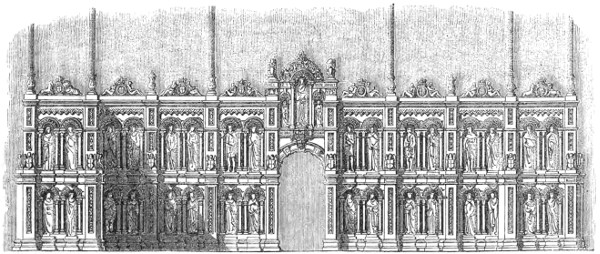
SCREEN OF THE KINGS AND QUEENS OF ENGLAND.
The screen itself is from the design of Mr. M. D. Wyatt, and is characterised by much originality and appropriateness of treatment. The series of monarchs is placed in chronological order, commencing, on the return side to the left (as we face the screen), with the kings of the Saxon heptarchy; and beneath them the Saxon kings, the first on the left being Egbert, by whom the greater number of the petty kingdoms were first consolidated. The Norman series commences, on the principal front, with William I. and his queen, above whom are the statues of St. George and St. Andrew. Amongst the various rulers of the state may be noticed as of great excellence, in that style of sculpture which has been termed the “Romantic,” Henry II., Berengaria, Henry V., Henry VI., Richard III., Edward VI., Charles I., Queen Henrietta, and Cromwell; this last was rejected by the Committee of the Houses of Parliament, but is clearly necessary for completing the historical series, which is concluded on the return side, to the right, with the royal personages of the reigning Guelph family, and a lower row of Saxon kings. An equestrian statue of her Majesty, by Baron Marochetti, stands here in the centre.
Quitting the screen, we are first attracted on our road by the Crystal Fountain, which occupied so conspicuous a place in the Great Exhibition in Hyde Park. We will now, however, proceed on our tour, entering first the western end of
THE SOUTH TRANSEPT.
It is preferable, in order not to overlook any of the important objects which are stored in the several Transepts, to examine each Transept completely, as we enter it on our interesting tour, and after passing round both ends to resume our walk in the Nave, advancing up toward the north end of the Palace on the left-hand side, and returning down the right-hand or garden side. Turning then to the left, we proceed round this Transept, from left to right, noticing on our course the statues and other objects which are placed in the open space at each end. The first conspicuous one of these which we find is, a cast of the well-known equestrian statue of Charles I., from the original at Charing Cross. It was designed and executed, in 1633, by Hubert Le Sueur, a French sculptor, pupil of the celebrated John of Bologna, but was not at the time raised on its intended site. During the civil wars, the Parliament, wanting men more than statues, sold it to John Rivet, a brazier, living in Holborn; by whom it was kept concealed until the restoration of Charles II., when it returned again into the hands of the government, and was finally erected at Charing Cross in 1674. The pedestal is a work of the celebrated sculptor, Grinling Gibbons.
Beyond the statue of Charles I. in the central line, is placed that of James II. by Grinling Gibbons, cast from the original now in the court at the back of Whitehall. It is an excellent example of a portrait-statue treated in the classical style; and affords us a proof of the higher reach of Gibbons’s genius; whose well-earned reputation in the seventeenth century, we may remark, rested more especially on his works in ornamental carving, of which the exquisitely cut fruits, flowers, wreaths, and other ornaments on the façade of St. Paul’s, London, are examples.
Between these two Royal Statues is a Mosaic picture of the Ruins of Pæstum, executed in modern Roman Mosaic, every shade and tint being composed of separate pieces of vitreous material; and in front of the statue of James, a model of a Chinese Junk carved in ivory, which is lent to the Crystal Palace Company by Her Majesty.
A selection from the best productions of various English sculptors surrounds this portion of the Transept. At the angle is a colossal statue of Peel by Marochetti, and between this and the Screen of Kings and Queens in the nave is the statue of the great Earl of Chatham (449), forming a portion of his monument in Westminster Abbey. It was executed by J. Bacon, R.A., a contemporary sculptor, who was celebrated for the truth and vigour of his portraits. Bacon should also be mentioned with honour, as one of the first native artists who founded the English school of sculpture in the last half of the 18th century. Amongst the statues in the Transept itself, we would notice Macdonald’s excellent compositions of Ulysses recognised by his Dog (48), and Andromeda (47); the very gracefully designed figure of a Bather (36), by Lawlor; and a group of Boys Contending for a Prize, with some other statues by the same artist.
The statues on the north side of this end of the Transept are by Spence and Theed; amongst them will be remarked the Highland Mary (58), and the statue of Flora (59), both by Spence; Narcissus at the Fountain (60), and Psyche (61), by Theed.
At the junction of the Transept and the Nave is placed the colossal statue of Dr. Johnson, from his monument at St. Paul’s, the first that was erected in that Cathedral. This portrait-statue, as well as that of Chatham, is by Bacon; but composed, as will be remarked, on a diametrically opposite principle; the great writer being half clad in a classic toga, whilst the great statesman is brought more vividly to our minds by being represented in the costume of his period and his order.
We now cross over to that junction of the Transept and Nave, which is marked by a colossal statue of Lessing, the great German writer; a noble and dignified portrait-statue by Rietschel of Dresden.
In this portion of the Transept are several works of the English School of Sculpture, amongst which may be particularly remarked a statue of Shakspeare (407), by John Bell; the Maid of Saragossa (6b), a very picturesque and vigorous ideal figure of a heroine who has also inspired the pencil of Wilkie; the Dorothea (5a), so well known to the public by small copies in Parian marble; a graceful statue of Andromeda (7), and Jane Shore (6a). All these specimens of Bell’s talents are on the north side of this part of the Transept. Opposite to them, or close by, will be found the Mercury (55), a Dancing Girl (50), by Calder Marshall, R.A.; the First Whisper of Love (49), Zephyr and Aurora (52), and an excellent portrait-statue of Geoffrey Chaucer (53), the father of the school of English Poetry, also by Marshall. Nearer the Nave is an ideal statue of Shakspeare by Roubilliac, cast from the original, still preserved in the vestibule of the British Museum. The colossal statue at the angle is that of William Huskisson (462), the first statesman to pioneer the way to free trade. It is a noble work in the classic style, by Gibson. Along the centre of the Transept are placed the Eagle Slayer (6), by Bell, a work remarkable for its vigorous treatment; the well-known and graceful composition, also by Bell, of Una and the Lion; and the fine monument erected by the good citizens of Frankfort to the memory of the first printers, Gutenberg, Faust, and Schœffer. The central statue represents Gutenberg, who rests with an arm on the shoulder of each of his fellow-workmen. The original is by Baron Launitz of Frankfort, and is a creditable instance of the public spirit, which does not, after the lapse of centuries, forget the originators of The Press—that mighty power, which performs at this day so grand a part in the governance and for the benefit of the civilised world, and by means of which the reader studies this record. On the right of the Gutenberg monument is a stately equestrian statue of Francis I. by Clesinger of Paris. The countenance is strikingly like the authentic portraits of the king, and well exemplifies the character of the man. In a corresponding position on the other side is Marochetti’s statue of Richard Cœur de Lion, calling to mind a curious contrast in the chivalry of the two kings.
Having now regained the Nave, we proceed along in front of the Pompeian Court, where will be found various works mostly illustrative of modern German sculpture; amongst which we notice a group of Minerva protecting a Warrior (162), by Blaeser, of Berlin; also a charming little composition, by Brugger, of a Centaur instructing the young Achilles (164). The original model of a Nymph, with an Urn (167), by Dannecker, executed as a fountain at Stuttgard. An allegorical figure of Medicine (171), by Hahnel of Dresden. A Violin Player, by Steinhauser (201*). Two seated statues, in the Greek style, of Thucydides and Homer (176), by Mayer. A statue of a Magdalen (261), by Wagner. A very spirited group of a Hunter defending his family against a Panther (264), by Widnmann of Munich. A statue of Hector (166), by Dannecker. Next to this is a pretty statue of Diana (270), by G. G. Wolff, and near it Telephus suckled by a Hind (266), with several other beautiful examples. The statue of a Hunter (263) is a chef-d’œuvre by Wittich. Opposite the Stationery Court are excellent life-size statues of stags (193*), by Professor Rauch, of Berlin, excellent examples of that difficult branch of the sculptor’s art—the study of animal nature; and near these, Debay’s exquisite group of the First Cradle (96), and a magnificent vase by Drake (169), with Thorwaldsen’s beautiful Venus (217) and Aurora (18), by John Gibson, R.A. The fine statues of Victory (184 to 188), by Professor Rauch, are characteristic examples of that great sculptor’s style, and of the successful variety of treatment in five designs for one and the same subject. And the statue of a Nymph holding a Basket of Fruits and Flowers (160), by Professor Drake, is a picturesque example of the “Romantic” school of sculpture. We now approach the Great Transept, before entering which we will turn to the left and explore the open Court which is formed at this point by the angle of the Transept with the Nave.
THE CANADIAN COURT.
This position has been appropriated for the display of a most interesting collection of the staple and manufacturing products of Canada. The colonial government have undertaken to form and maintain such a collection as shall completely represent the commercial resources of that important colony, and have voted a sum of money for its permanent maintenance. Such an exhibition presents invaluable information to the intending emigrant, and to all an interesting sign of the progress, polish, and prosperity of our brethren in the Atlantic colony.
A prominent object at the further end of this Court is the noble colossal head of Bavaria, by Ludwig Schwanthaler, of Munich, who enjoyed an European celebrity. The original bronze statue to which it belongs, erected outside the city of Munich, is fifty feet in height, the pedestal on which it stands being thirty feet high. For ten years did the great artist, weak and broken in health, still devote himself with a true artist’s love to the progress of his task: but he was not destined to witness its perfect completion; and when the statue of the Genius of Bavaria was cast in bronze, its author had passed from amongst us. The statue was first publicly exhibited in 1850.
Corresponding in position on the side next the Nave, is another example of those embodiments of towns and nations, which are so frequently to be found on the Continent. The present colossal statue allegorises Franconia, a province of Germany; it is characterised by much nobility of conception, and worthily sustains the reputation of the modern German sculptors. The original, by Professor Halbig, is erected at Kilheim, in Bavaria.
The south wall of the Court, and the passage from it through which we pass to the front of the Reading Room, will be found to be decorated by some beautiful bas-reliefs, amongst which may be particularised, Westmacott’s Paolo and Francesca (72); Lough’s Apotheosis of Shakspeare; some very interesting bas-reliefs by Rauch, from the tomb of Marshal Bulow; they will be found on the base of the colossal head of Bavaria; and the Triumph of Alexander (226), executed by Thorwaldsen to decorate the Pope’s palace for the reception of Napoleon I. in 1812,—one of the most celebrated works of the great sculptor. Chantrey’s beautiful group of Sleeping Children stands in the passage, and claims special attention.
THE LIBRARY READING ROOM.
Within the quadrangular area between the Canadian Court and the Central Transept, is to be found the Reading Room of the Library, which contains works of reference for those studies and Fine Arts which are exemplified in the Crystal Palace, as well as works of high class and general literature. The books are obtained for use in the Reading Room, by means of a small slip to be filled up from the catalogue. Round the room fit space is allotted to publishers, on which are exhibited the title-pages and announcements of new books, the new volumes themselves being exhibited during the season for immediate reference in an open book-case in the room. The publishers’ catalogues lie upon the table. The operation of the plan also extends to Continental literature, and the announcements of new books by Foreign publishers, as well as their catalogues, with the books themselves, will be noticed as an interesting feature not to be found elsewhere. A valuable Library has been already formed by the purchases of the Company, the free gifts of individuals, and by the addition of the new works which, having been exhibited by the publishers in the Room during the season, are then added to the catalogue. Amongst several very splendid works, the magnificent gifts of both Continental and British publishers, which enrich the Library, one deserves special notice on account of its very great rarity and value, as well as of its beauty. This is a copy of “Das Neue Testament” which was printed in 1851 for His Majesty the King of Prussia. As a specimen of Gothic typography the work is perhaps without a peer, while as a work of art, and a record of what can be achieved by the printing press in these days, it is to be highly valued. Five exquisite designs from the rich and original pencil of Kaulbach illustrate the volume; they represent the Deity, and the four Evangelists, severally, being single allegorical figures. There is also one illustration to the Revelations, by Peter Cornelius. These are printed from wood blocks. Twenty-five copies only of the book were printed when the type was broken up. Of these, five exist in England. One in the possession of Her Majesty the Queen, to whom the work is dedicated, one in the Bodleian Library at Oxford, one in the Syndicate Library at Cambridge, one presented to the Bishop of London, by Prince Frederick William, on the occasion of the recent Royal Marriage, and the present copy. This magnificent volume is the production of Herr Rudolf Decker of Berlin, Printer to the King of Prussia, by whom it was presented to the Company’s Library. In that portion of the room devoted to news, more than 100 newspapers can be found, upwards of fifty of which are London papers; the British country press is very completely represented, constituting a feature of the Room, and several leading Foreign Journals are supplied; there are 18 Magazines, and 7 Reviews (as well Foreign as English), besides Periodicals and Pamphlets, Directories, Gazetteers, Maps, &c. &c. The very latest news, by special telegraph, is exhibited immediately on its receipt, and a regular Daily Telegram is received from Paris, with the state of the French Funds, and Money Market. A Register for Appointments and Messages is kept, and a glass case in which unclaimed letters, and letters for visitors, are exhibited. There is a postage-box upon the reading-table, and one outside, from which letters are collected several times in the course of the day; and paper, envelopes, and postage-stamps can always be obtained from the attendants at a moderate charge.
THE GREAT CENTRAL TRANSEPT.
Passing along in front of the Reading Room, we return to the Nave, and enter the Transept, the arch of which rises nearly 175 feet high in a light and graceful span. From the first terrace, however, to the summit of the Transept is 197 feet 10 inches. There are five galleries here, one above the other, the topmost of which runs entirely round the Transept, and the third of which extends round the whole length of the building on each side. In the second of these galleries, on the garden side, is the Industrial Museum and Technological Collection, of which we shall treat presently.
Not far from the angle of the Transept and Nave, towards the Stationery Court, stands a cast from the colossal statue of Rubens, by Geefs, of Brussels, erected in the cathedral square at Antwerp, of which city Rubens was a native: the original is in bronze, and a fine example of the modern Romantic school of sculpture. Opposite the statue of Rubens, on the other side of the Nave, is placed a cast of the fine bronze statue, by Dantan, which has been erected at Dieppe, in honour of the great French Admiral Duquesne. It is remarkable for its noble expression, and the spirited romance of its treatment. The celebrated Farnese Hercules and the Farnese Flora, both colossal antique statues from the Museum at Naples, occupy the corresponding positions across the Transept. The Hercules is a fine and artistic example, characterised by a massive and somewhat exaggerated muscular development, not, however, altogether inappropriate to the hero of physical force. The whole of this the western end of the Great Transept is occupied by the great orchestra, capable of accommodating 4,000 performers, which has been erected for the Great Handel Festival. In the centre of the orchestra is the great organ which has been built by Messrs. Gray and Davison expressly for the position.[26] The eastern end of the Transept is occupied by a handsome orchestra for musical and choral performances. On the northern side of this end of the Great Transept are ranged some choice statues of the modern schools; the graceful Amalthæa by Julien (113); Psyche (103*); Veritas (150), a veiled figure by Monti; and Endymion (129), the Graces (125), and Paris (129), by the late famous sculptor Canova.
We must now cross over the Nave and enter the open court, which is close to the colossal Farnese Hercules, and which corresponds in position to the Canadian Court, which we examined before entering the Transept. This Court is filled with specimens of antique sculpture of the Greek and Roman schools. Among these we would draw attention to the colossal Velletri Pallas (351), so called from having been discovered at Velletri, near Rome, and now preserved in the Louvre, at Paris; the Dying Gladiator (309); a Boy with a Dolphin; a colossal head of Pallas (328). A Boy extracting a Thorn from his Foot, from the Capitoline Museum at Rome; and the fine head of Antoninus Pius (381).
A collection of Greek ideal and portrait-busts will also be noticed in this Court; amongst which the colossal heads of Vespasian (332), Trajan (354), Pertinax (379), Lucius Verus (361), and Titus (333), are particularly deserving of notice. The visitor should not quit this compartment without noticing the collection of antique vases which it contains, amongst which the Medicean Vase (343) is a peculiarly elegant example of antique art. The elegant tripod (211), and the antique fountain (357), are also worthy of attention. Here also we find the celebrated group known as the Toro Farnese, or Farnese Bull. The original of this beautiful group, which is now preserved in the Museum at Naples, was discovered in the Baths of Caracalla at Rome, and derives its name from having been placed in the Farnese Palace in that city. The subject is the revenge of Queen Antiope and her two sons, Zethus and Amphion, on Dirce, for seducing the affections of her husband, Syeres, King of Thebes. The sons, enraged at the insult offered to their mother, are represented as about to revenge themselves by tying the unfortunate Dirce to the horns of a bull, when their mother, moved with womanly pity, intercedes for her rival, and induces them to forego the intended punishment. According to Pliny, the Toro Farnese was the work of the Rhodian artists, Apollonius and Tauriseus.
Conspicuous also in this compartment, from its high position and great beauty, is the Choragic Monument of Lysicrates. This beautiful example of ancient Greek architecture is usually styled the Lantern of Demosthenes, on account of a tradition which ascribes its erection to that celebrated orator. No weight, however, can be attached to this supposition, although it may be, and in all probability is, due to the time of Demosthenes.
An inscription on the architrave informs us that this monument was erected by Lysicrates of Kikyna, at his own expense, in order to commemorate a musical triumph obtained by various members of his tribe or clan, the Akamantis. The ancient Greeks were in the habit of holding a species of musical tournament, in which the most celebrated masters of the art vied with each other; in this particular case, the palm was awarded to Theon, the flute-player, and the chorus of boys led by Lysiades; the magistrate for the year being Evanectus. It was to celebrate this triumph that the monument was erected. On the monument was sculptured the story of Bacchus transforming the Tyrrhenian pirates into dolphins, which was the subject of the music. A tripod was the usual prize granted in these contests, and the victor either placed it in one of the temples, or, as in the present instance, consecrated a monument specially for its reception. It was placed on the summit.
Retracing our steps, we once more regain the Nave, and as we advance, still keeping on the left side, past the front of the Egyptian Court, we remark several antique statues, including the Antinous as Mercury, from the Capitol at Rome (316), the Antinous as a Good Genius (314), and the Adonis, from Capua (213).
From this point, extending throughout the façade of the Greek Court, are ranged excellent examples of Greek sculpture, which the visitor may compare with the subsequent works of the Roman sculptors, or of Greeks settled at Rome, placed before the walls of the Roman Court. Amongst the Greek statues we select the group of Silenus and a youthful Bacchus (306), excellently treated and full of life; seated statues of Demosthenes the Philosopher (308), and of Posidonius (307), on each side of the first entrance to the Court; the Borghese Silenus (306); a Bacchus and Faun (305); the fine group of the Wrestlers, from Florence (304), the well-known Drunken Faun (295), from the Museum at Naples; and the Apollo Sauroctonos (298), from the Vatican. Nor must we omit the excellent seated statues (290, 291). On either side of the principal entrance to the Greek Court will be found the beautiful Ceres (130), a Vestal (142), the Amazon (302), and Polymnia (297).
In front of the Roman Court will be first noticed Meleager and his Dog (289); the celebrated Antinous (288); the fine Mercury, from the Vatican (287), and the same subject (288), from Naples. Before the first entrance to the Court are placed the seated statues of Trajan (286), and Agrippina (281).
The Mercury disguised as a Shepherd (285), and the Adonis (282), are characteristic specimens of the ordinary Roman style.
Passing the façade of the Alhambra Court, we arrive at the Fountains, which at this end of the Nave correspond to those of the south end in position, and generally with respect to the aquatic plants which live in the water of the long basin. The two fountains here are designed and executed by Monti the sculptor. The figures of Syrens, supporting the large shells, typify by their colour four races of men: the Caucasian, white; the Nubian, black; the North American Indian, red; and the Australian, olive. The smaller figures above these bear fruit indigenous to various soils. The design of the Fountains is most appropriate, and the entire composition very artistic. The bronze colour of these statues, and of many others in the building, is produced by means of the electrotype process, with signal success. In the water which surrounds this fountain many interesting plants will be found, in addition to the lilies and other varieties which adorn the basin of the Crystal Fountain at the south end of the Nave. The Papyrus plant will be recognised by its tall green stems topped with fibrous leaves. The manuscripts of the Egyptians and many ancient nations were inscribed upon sheets made from the stalks of this plant. Many of the Egyptian architectural ornaments are derived from the form of the Papyrus, which grows in large quantities along the banks of the Nile. Rice, sugar-canes, and other interesting plants, grow along the margin of the water; the most curious of which, as indeed it is one of the rarest in the whole collection, is the Lattice Plant. This specimen was but lately brought from Madagascar by the Rev. Mr. Ellis. The remarkable form of the plant, from which it is named, will ensure its easy recognition. The gold fish, of which there are many thousands in the fountain basins of the Nave, have all been bred there from a few fish which have now grown to a great size, and may often be noticed steadily sailing amongst their multitudinous progeny. The temperature of the water, which is heated by water pipes beneath the surface, is peculiarly favourable to the growth of these fish.
THE NORTH TRANSEPT, AND TROPICAL END OF THE BUILDING.
It has been found that the valuable collection of Palms and other specimens of Eastern vegetation, which have been collected in this Transept and beyond, could only be kept healthy by isolating the department devoted to them, and raising its temperature to a degree which would not be pleasant in all parts of the building, or favourable to the equable growth and seasonable cultivation of the other various botanical specimens. During the greater part of the season, a curtain divides this portion of the Palace from the more temperate regions. The temperature suits so well the plants that some, which on their arrival appeared not to grow well, have become quite acclimated, wearing a rich and luxuriant growth of verdure.
Having entered the North Transept, we find the whole of the western end occupied by the colossal Egyptian Figures from Aboo Simbel. We shall view these to the best advantage from the further end of the Transept, in front of the Mammoth Tree; we will, therefore, first make the circuit of the fountain, examining the surrounding objects, and inspect them from that point, and thence commence our return journey down the Nave.
The two semicircular extensions at this the upper end of the fountain basin have been separated from the main body of the water by a perforated partition, and contain some curious and interesting animals. In that to the right, or immediately in front of the Assyrian Court, sports one of the most remarkable of the animal creation—the Lepidosiren. It is remarkable as being an animal organised with both lungs and gills, which are generally assumed to be distinctive organizations in the reptile and the fish; but this, it will be seen, like most of such wonders in natural history, is a conformation of the animal to its habits of subsistence, place of residence, and the exigencies of its life. It is found in the river Gambia, in Western Africa. During a great portion of the year this river is dried up, and the mud in its bed is baked under an ardent tropical sun till it is of immense hardness, and shines when cut with a knife. When the river subsides, and parches up, the Lepidosiren burrows into the mud, where it remains during the dry period, till when the rains come, and the river swells, it issues from the softened mud and sports in the water again. It is considered by the most able naturalists to belong to the reptilia rather than the fish. The exact nature of its food is not accurately known, but it is a voracious feeder on animal substances; this specimen regales himself upon raw beef, frogs, and snails, with the occasional delicacy of a gold fish. He is himself eaten as a delicacy by people in Africa.
In the corresponding compartment on the other side of the basin are two species of fresh-water tortoises, Emys Caspia and Emys Gambiensis, one an European and one an African species, which may be identified by its larger size and lighter colour. The Emys Caspia is found commonly in the rivers of most of the warmer countries in Europe. When, after the Crimean war, the troops garrisoning the Ionian Islands returned to England, one of the officers brought with him two eggs of this variety; for safety he put them into his pistol-case. On his arrival in England the eggs were found to be hatched, and the two small animals were presented to the Crystal Palace Company, and placed in this basin. One has since died, after living some months; the other is still here.
The Visitor should not omit to inspect the Aviaries, of which there are several, in this end of the building. These contain Weaver Birds, Grenadiers, Grosbeaks, Mocking Birds, and Paroquets, most of them inhabitants of warm climates. There are also some Nightingales, whose rich song is frequently heard, even when the people crowd round them. The Weaver Birds, in the spring, may be seen constructing their curiously woven nests of grass, which hang from the branches like so many stockings; others of the feathered tribe build their habitations fearlessly in the presence of the visitor, with all the art of the basket-maker; here, indeed, bird-architecture of the most unique kind may be studied by the naturalist with delight and advantage. The Australian Paroquets have this spring again reared their young in these Aviaries with great success. It has been generally supposed that it was not possible to induce these birds to rear their young in this climate; but in 1856, the experiment was most successfully carried out in this Aviary. It has been repeated here since, each year; and in the present spring (1859), there are two healthy young birds which have been hatched in one nest, and there is promise of others. These observations more especially apply to the large species of Ground-paroquet (Platycercus hermalonotus), the smaller Shell-paroquet (Melopsittacus undulatus) having repeatedly bred in this country.
Besides the birds mentioned, there are several of the British varieties, as well as some others of greater rarity or interest which may be specially mentioned. There are several Canaries which should be noticed, as they have been trapped in the Islands and forwarded direct, in their wild state. These must not, however, be confounded with those of the tame varieties in the same Aviary; they may be distinguished readily not only by the general carriage of the bird, but by their green plumage. The collection of Sparrows is also interesting: there are the common house and tree Sparrows of England (this last, however, is not to be confounded with the Hedge-sparrow), the Rice-sparrow of Java, and the Diamond-sparrow of Australia. The Diamond and Java Sparrows have successfully constructed nests; which is an additional evidence of how suitable the Tropical end of the Crystal Palace is for the Tropical birds. Here also are two or three specimens of the Californian Quail (Ortyx Californicus). These birds were brought from the Zoological Gardens at Antwerp. They breed freely, and are well adapted to thrive in a wild state in this climate, rearing from fifteen to twenty young ones in a brood; they are a great table delicacy, and it is probable at no distant period may enrich the list of British Game birds.
In a glass case, on the right hand as we approach the Aviaries, are some beautiful and interesting Lizards (Lacerta agilis). These perfectly harmless little reptiles are found in all the warm parts of Europe, frequenting dry, stony places, and old ruined buildings. Their food is flies, beetles, moths, and other like insects. The present specimens are from Guernsey, in which island they greatly abound.
Near to these, in the centre of the Transept, are some of the most curious of the reptiles, and which are perhaps better known by repute than even the most common species daily under our feet. These are the Chameleons. The changes of colour in this animal, so often spoken of, are not generally so rapid as is supposed, nor do they possess so great distinctions as are popularly ascribed to them. In all their habits they are so slow as to be generally almost immovable, save in respect of their restless eyes, and the tongue, which is very long and adapted peculiarly to its purpose, which is to secure their food; they can dart it with almost invisible rapidity upon a passing fly or insect, which is immediately thus drawn into the mouth. They appear most generally to assimilate their colour to the objects on which they rest, or which surround them. This may be a means of protection to them, but it is most probably only a method of concealment for the more effectual capture of their prey. It, however, answers the double purpose.
If we now proceed by the extreme end of the building toward the eastern end of the North Transept, we shall find both on our right and left hand a complete set of casts from the Ægina Marbles.
These most interesting monuments of ancient Greek art are now in the Glyptothek at Munich.
They were discovered in the Island of Ægina, and are supposed to have ornamented the tympana of the east and west fronts of the temple of Minerva in that island. The group, representing the Contest over the Body of Patroclus, belonged to the western, and the five figures descriptive of the Battle of Hercules and Telamon against the Trojan king Laomedon, were in the eastern tympanum. They are most remarkable examples of Greek sculpture during its second period, or from the close of the 6th to the middle of the 5th century B.C.
The conception, the anatomy, and beauty of form found in these statues denote a highly cultivated artistic taste and power, to which the peculiar faces, the invariable smile on the mouth, and a certain stiff angularity of treatment, form a marked contrast. We observe in them that turning-point in the history of Greek sculpture, when the conventionalities of an earlier system were receding before that love of nature and extraordinary perception of the Beautiful, which subsequently rendered the Greeks so pre-eminent in art.
The originals, which had, as may be supposed, suffered considerably from the effects of time, were restored by Thorwaldsen, the Dane, whose conscientious spirit and thorough appreciation of the antique give assurance of the correctness of the interesting examples now before us.
THE LECTURE ROOM.
Through the doorway which is in the corner to the right of the first set of Ægina marbles, is fitted up a spacious Lecture Room, with every accommodation for Dissolving Views and other illustrations. It comprises the whole of the “Queen’s Corridor,” so called from the private apartments of Her Majesty, which are to the left.
Continuing onwards, we obtain a fine view of the North Transept, with its noble avenue of sphinxes and palm-trees, terminating with
THE COLOSSAL EGYPTIAN FIGURES,
which are from the temple of Rameses the Great at Aboo Simbel, in Nubia. These immense seated statues towering to the roof of the Transept afford us some adequate idea of the stupendous magnitude and passive grandeur which characterise the monuments of ancient Egyptian art. Their height is sixty-five feet.
It may be remembered that in the Egyptian Court we directed the attention of the visitor to a model of the temple at Aboo Simbel; on the façade of which were four statues of Rameses the Great. Two of these statues are here reproduced on the scale of the originals, the smaller figures around them representing the mother, wife, and daughter of the king.
The temple of Aboo Simbel, in Nubia, is excavated from the rock, and was first discovered by Burckhardt, the traveller; the accumulated sand of centuries, which then covered it, was removed by order of Belzoni, the first, with Captains Irby and Mangles, to pass its long-closed entrance. The interior was covered with paintings and hieroglyphics relating to Rameses the Great, and the date of the temple has been consequently placed at about 1560 B.C.
The sphinxes which formed the avenue are cast from one preserved in the Louvre, the writing engraved on which presents us with a curious but not uncommon instance of a custom that prevailed amongst the Egyptian monarchs, and to which we referred when describing the Egyptian Court. On one side of the shoulder the name “Pthalomen Miotph” is written in hieroglyphics, and on the other shoulder is the name of Shishak I. The last-named lived about 1000 B.C., and the first nearly two hundred years before him. Other instances occur where the name of the original founder has been erased altogether, in order to make way for the name of some comparatively modern king.
We are now standing at the foot of what represents one of the largest-known trees in the world. This tree grew, one of a group of such monsters, on the Sierra Nevada in California. When flourishing, it rose to the astounding height of nearly 400 feet. Several in the same district which are now standing are 300 feet in height. The bark of this tree has been arranged and fitted up as it grew, to give us some idea of its gigantic proportions by the view of a part. The wood is a particularly light cedar; and has been considered as of the same kind as that cedar of Lebanon employed by Solomon in the building of the Jewish temple. Dr. Lindley has named it the Wellingtonia gigantea, and has fixed its age at 4000 years. This then must have been a great tree before the ancient rock tombs of Aboo Simbel were hewn for the great Rameses.