Part 1 — PART I. ETHNOLOGY.
Reading edition
Ethnology is compounded of two Greek words, the latter of which scarcely requires explanation, because it already forms part of a numerous class of compounds with which the learned reader is well acquainted. The general reader, too, is perhaps equally familiar with them. We have them in such words as Geo-logy. Astro-logy, Physio-logy, and a long list besides. The Greek form of these would be Geo-logia, Astro-logia, &c. The basis of the term is the substantive logos, meaning a word. In its modified form, however, and in its application as the element of a compound word, it means the principles, or science, of the department (whatever it may be) that is denoted by the root which precedes it. In the word before us it means the principles of that department of human knowledge which is denoted by the form Ethno.
Ethnology means the science, not exactly of the different nations of the world, but of the different varieties of the human species.
It is not thought necessary to enlarge upon this further, since, it is hoped, that the groups to which the visitor is directed will sufficiently tell their own tale. The extent to which they differ from each other is manifest. Still more do they differ from such groups of Englishmen, Frenchmen, Germans, and other Europeans as may collect around them.
As a general rule the varieties that are especially illustrated are foreign to Europe; it being supposed that the character of most European populations is sufficiently understood. Hence, the Ethnology is that of Asia, Africa, and the New World. Of these, the most remarkable varieties are found under the extremes of heat and cold; under the tropics, and within the arctic circle. The intermediate and more temperate parts of the different continents, though by no means deficient in interesting and important varieties, supply fewer.
Of the populations within the arctic circle, it is only those of America that are illustrated (viz., in the Greenland group). The character, however, of the tribes thus far north, is pretty similar in all three continents—in Asia and Europe for the new, in America for the old, world.
The science of ethnology is, to a great extent, a new one, and this has been our excuse for enlarging upon the meaning, and entering into the origin of the word. Even ethnological museums are rare. The plan, however, of the groups under notice, is different from that of ordinary museums, and, at the same time, one which is, now, for the first time attempted. The trees, plants, animals, and human occupants of the different portions of the earth’s surface are grouped together—so that the allied sciences of botany, zoology, and ethnology illustrate each other. Hence, the arrangement is geographical.
The arrangement is so far geographical that, to a certain extent, the visitor is enabled to place himself in respect to the objects before him in the same relation as he would be to a map of the world. Here, the North lies in front of him, the East to his right, the West to his left. In like manner, the groups on his right belong to Europe, Asia, and Africa; those on his left to America. In other words—the Old World is on one side, the New on the other. The relations of North and South, however, are given with less nicety. As a general rule, however, the Southern parts of the two worlds (the old and new), are the parts nearest the entrance—and the Northern parts lie beyond them.
In the Indian Islands the plan of giving the exact botany of the country under notice has been departed from—owing to the difficulties of detail in the case of an inter-tropical vegetation, of which but few specimens are found in European collections.
GROUP I. TIBETANS. (FOR ZOOLOGY, &C. See p. 82.)
The figures here are Tibetans. The variety to which both belong is usually called the Mongolian; by which it is meant that the most remarkable examples of it are to be found in the Chinese province of Mongolia—to the west of the Great Wall. Here it is where the cheek-bones attain a greater breadth than is the case with even the figures before us, where the nose is more flattened, and where the distance between the eyes is greater. Here it is where one of the great conquerors of the world arose, Jinjiz-Khan, in the thirteenth century; under whom, and under whose successors, nearly half the world trembled at the terrible name of Mongol. However, at present, their character is a very different one. The Mongolians of the nineteenth century are quiet, peaceable men, subject to China and Russia—chiefly, however, to China.
Thus much has been said concerning the Mongolians, in order to explain the meaning of the term. It has two powers. It is used in a general and in a limited sense. When limited, it means the inhabitant of Mongolia; when general, it denotes any one of the numerous allied populations—allied in respect to their physical organisation.
Of all the Mongol populations, the Chinese are the most civilised; unless we make an exception in favour of the equally Mongolian Japanese.
The Tibetans are subject to the Chinese, similar to a great extent in form, similar to a great extent in creed, but dissimilar in habits.
The Tibetans are a pastoral, the Chinese an eminently agricultural population.
As the southern frontier of the Tibetan family comes in contact with the northern provinces of India—as some portion of the Tibetan area is absolutely under either the British or some other Indian government—we may expect to find the Mongolians on both sides of the Himalayan Mountains—in India, as well as in Chinese Tartary.
This prepares us for—
GROUP II. EAST INDIANS. (See p. 82.)
The Tibetan (the figure on the left) we have seen before. He differs from those of Group I. only in belonging to the southern side of the Himalayas;—to the parts drained by the Sutlej; to the water-system of the Indus.
In India Proper the languages fall into two divisions: those akin to the Tamul, spoken in the Dekhan, or Southern India, and those akin to the Hindúi, spoken along the northern bank of the Ganges; in Oude, &c.
There are also in India Proper two types of physical form; in one the colour is dark, or even black, the skin coarse, the face flattened, the lips thick; in the other the colour is brunette, the nose aquiline, the eyebrows arched, regular, and delicate, the lips of moderate thickness, the face oval, the features intelligent. Each is represented in the present group, though neither in the extreme form.
As a general, but by no means as an invariable, rule, the darker complexions preponderate over the lighter ones as we go southwards, except in the mountains, where the skin becomes fairer.
It is not considered necessary to enlarge upon what is called the system of caste in India. It means that the son follows the business of the father, so that the descendants of (say) a blacksmith will be blacksmiths, and so on. It also means that between individuals of different castes there are certain prejudices; certain points whereon there is a reluctance to intermix. Hence, individuals of a higher, refuse to intermarry with those of a lower caste. They refuse also to take their meals with them.
Now, as a general, but by no means as an invariable, rule, the higher the caste the greater the predominance of the second type of form, i.e., the finer the features, the clearer the complexion.
India and China, we must remember, are countries that have long been civilised—civilised after their own peculiar fashion. More than this, they are countries from which a civilisation has been diffused over districts more or less barbarous. On the other hand, the Mahometan creed has diffused, and is diffusing itself, over India, at the expense of the original (so-called) Braminical and Buddhist religions.
The extent to which Indian civilisation has (after first spreading itself abroad) been modified by a subsequent diffusion of Mahometanism, will be seen when we move from India to the Islands of the Indian Archipelago—Sumatra, Java, Borneo, &c.
Here the division of the human species to which the populations belong is the Malay—-just as that to which the Chinese and Tibetans were referred was the Mongolian.
Just, too, as the word Mongolian had a wider and a narrower signification, so has the term Malay. A true and proper Malay is a Mahometan, from either certain parts of Sumatra, or certain parts of the Malayan Peninsula—from Sincapore, from Malacca, from Penang, from Bencoolen, &c. On the other hand, a member of the Malay family, in the wider sense of the word, may be a Pagan in religion, an Indian in doctrine, or a native of Java or Borneo, in respect to his locality.
The Malays, in the wider sense of the word, whatever may be the minor differences between them, have the same general physiognomy; being short rather than tall, darker than the generality of Mongolians, though lighter than the southern Indians, and broadfaced, though less so than the more extreme Mongolians. When in contact with the sea, they exhibit decided maritime habits. Many other of their customs in detail deserve notice.
Bodily disfigurations under the idea of ornament.—The Malay dress is becoming; but the habit of permanently disfiguring parts of the body under the idea of ornament, is of sufficient prominence to take place amongst the characteristics of the branch.
a. Tattooing.—This is sometimes limited, sometimes general: sometimes over the whole body, sometimes confined to the arms only. In Africa the patterns vary with the tribe. In certain Malay districts, an approach to the distinction may be found; for instance, we hear in Borneo of some tribes that always tattoo, of others that partially tattoo, of others that do not tattoo at all. Nay more; the habit of tattooing seems in some cases to go along with certain other habits—by no means naturally connected with it. Thus certain of the Borneo non-tattooed tribes never use the Sumpitan, or blow-pipe; whilst others are tattooed, and use it.
So at least Sir J. Brooke was informed; although I think the careful peruser of his journal will find that the coincidence is not always complete.
b. Depilation.—Depilation is effected either by quick-lime or tweezers. Generally, I believe, the parts of the body which are meant to be kept smooth are rubbed with quick-lime; and the isolated hairs that afterwards appear, are plucked out carefully by tweezers in detail.
c. Filing the teeth, dyeing the teeth. This is a Malay habit, and there are not less than three varieties of this operation.
1. Sometimes the enamel, and no more, is filed off. This enables the tooth to receive and retain its appropriate dye.
2. Sometimes the teeth are merely pointed.
3. Sometimes they are filed down to the gums.
Dyeing may follow filing, or not, as the case may be.
In Sumatra, where a jetty blackness is aimed at, the empyreumatic oil of the cocoa-nut is used. Even, however, if no dyeing follow, the teeth will become black from the simple filing, if the chewing of the betel-nut be habitual.
d. Distension of the ears.—Many of the tribes that file their teeth, also distend their ears. Both are Malay habits. In some parts of Sumatra, when the child is young, the ear is bored, and rings are put in. In other parts, however, the rings are weighted, so as to pull down the lobe; or ornaments, gradually increased in diameter, are inserted; so that the perforation becomes enlarged.
Simple perforation may extend to a mere multiplication of the holes of the ear. In Borneo, the Sakarran tribes wear more earrings than one, and are distinguished accordingly; “when you meet a man with many rings distrust him” being one of their cautions. Mr. Brooke met a Sakarran with twelve rings in his ear.
e. Growth of the nails.—In parts of Borneo, the right thumbnail is encouraged to grow to a great length. So it is in parts of the Philippines.
Running-a-muck.—A Malay is capable of so far working himself into fury, of so far yielding to some spontaneous impulse, or of so far exciting himself by stimulants, as to become totally regardless of what danger he exposes himself to. Hence, he rushes forth as an infuriated animal, and attacks all who fall in his way, until having expended his morbid fury he falls down exhausted. This is called running-a-muck.
Gambling.—This habit, or rather passion, is shared by the Malays, the Indians, the Chinese, and the Indo-Chinese; quail-fighting and cock-fighting being the forms in which it shows itself. A Malay will lose all his property on a favourite bird; and, having lost that, stake his family; and after the loss of wife and children, his own personal liberty: being prepared to serve as a slave in case of losing.
Narcotic stimulants and masticatories.—Chewing the betel-nut is almost universal in some of the Malay countries; the use of opiates and tobacco being also common.
The nut of the Areca catechu, is wrapped in the leaf of the piper betel, the first being astringent, the second pungent. The addition of lime completes the preparation. This stimulates the salivary glands, tinges the saliva red, and discolours the teeth.
Of the chief islands occupied by the Malay family, the first two under notice are
Sumatra—and
Java.—These being taken together, give us
GROUP III. (p. 91.) A. SUMATRANS. B. JAVANESE (OPIUM SMOKERS).
A. The populations of Sumatra exhibit different degrees of civilisation to an extent found in few areas of equal size: the difference in their religious creeds being proportionately broad. There are the extreme forms of rude paganism; there are traces of the Indian forms of religion; and there is Mahometanism. The least clothed of the figures before us is a Lubu, one of the wildest, rudest, and weakest of all the populations. The position of the Lubus in Sumatra is that of the Bushmen of South Africa, for they are a fragmentary population, driven into the more inaccessible districts by tribes stronger than themselves; without arts, and without settled habitations.
The next are Battas, whose civilisation is some degrees above that of the Lubus. A great part of their present area belonged to this last named population, who are, probably, Battas in the very lowest stage of development. These require further notice. They belong to the northern half of Sumatra, though without reaching the northern extremity of the island.
At the very northern end we have the kingdom of Atshin, Achin, or Acheen, where the religion is Mahometan, and where the alphabet is the Arabic; Atshin being the part of Sumatra where the influence of the Arabian trade, Arabian religion, and Arabian language, have been the greatest.
South of Atshin is the Batta country. Here there is only an imperfect Mahometanism, with no use of the Arabic alphabet, and but little tincture of Arab cultivation.
The rivers in the Batta country are inconsiderable, so are the forests; for the country is an elevated platform—dry, exposed, and parched. The luxuriant vegetation of so many regions in this part of the world, finds no place here; and instead of it, we have sand, hardened clay, bare rocks swept by strong currents of wind and exposed to an equatorial sun.
The Battas are cannibals; they are also a lettered population. It is believed that this combination of rudeness and civilisation occurs nowhere else, a combination which, however, is beyond doubt.
In the Batta alphabet we have books, almanacks, &c.
On the Batta cannibalism, hear so competent an authority as Marsden. “They,” the Battas, “do not eat human flesh as the means of satisfying the cravings of nature, for there can be no want of sustenance to the inhabitants of such a country and climate, who reject no animal food of any kind; nor is it sought after as a gluttonous delicacy.
“The Battas eat it as a species of ceremony, as a mode of showing their detestation of certain crimes by an ignominious punishment, and as a savage display of revenge and insult to their unfortunate enemies. The objects of this barbarous repast are prisoners taken in war, especially if badly wounded, the bodies of the slain, and offenders condemned for certain capital crimes, especially for adultery. Prisoners unwounded (but they are not much disposed to give quarter) may be ransomed or sold as slaves, where the quarrel is not too inveterate; and the convicts, there is reason to believe, rarely suffer when their friends are in circumstances to redeem them by the customary equivalent of twenty binchangs, or eighty dollars. These are tried by the people of the tribe where the offence was committed, but cannot be executed until their own particular raja has been made acquainted with the sentence, who, when he acknowledges the justice of the intended punishment, sends a cloth to cover the head of the delinquent, together with a large dish of salt and lemons. The unhappy victim is then delivered into the hands of the injured party (if it be a private wrong, or, in the case of a prisoner to the warriors) by whom he is tied to a stake; lances are thrown at him from a certain distance by this person, his relatives, and friends; and when mortally wounded, they run up to him, as if in a transport of passion, cut pieces from the body with their knives, dip them in the dish of salt, lemon-juice, and red pepper, slightly broil them over a fire prepared for the purpose, and swallow the morsels with a degree of savage enthusiasm. Sometimes (I presume according to the degree of their animosity and resentment) the whole is devoured by the bystanders; and instances have been known where, with barbarity still more aggravated, they tear the flesh from the carcase with their teeth. To such a depth of depravity may man be plunged, when neither religion nor philosophy enlighten his steps! All that can be said in extenuation of the horror of this diabolical ceremony is, that no view appears to be entertained of torturing the sufferers, of increasing or lengthening out the pangs of death; the whole fury is directed against the corpse, warm, indeed, with the remains of life, but past the sensation of pain. A difference of opinion has existed with respect to the practice of eating the bodies of their enemies actually slain in war; but subsequent enquiry has satisfied me of its being done, especially in the case of distinguished persons, or those who have been accessories to the quarrel. It should be observed that their campaigns (which may be aptly compared to the predatory excursions of our Borderers) often terminate with the loss of not more than half-a-dozen men on both sides. The skulls of the victims are hung up as trophies in the open buildings in front of their houses, and are occasionally ransomed by their surviving relations for a sum of money.”—Marsden’s Sumatra, pp. 391-2.
The Battas have, probably, been more civilised than they are now—India being the source of their civilisation. This is shown in the following imperfect sketch of their creed—which is Indian, corrupted and degenerate.
“The inhabitants of this country have many fabulous stories, which shall be briefly mentioned. They acknowledge three deities as riders of the world, who are respectively named, Batara-guru, Sori-pada, and Mangallah-bulang. The first, say they, bears rule in heaven, is the father of all mankind, and partly, under the following circumstances, creator of the earth; which from the beginning of time had been supported on the head of Naga-padoha; but growing weary at length, he shook his head, which occasioned the earth to sink, and nothing remained in the world excepting water. They do not pretend to a knowledge of the creation of this original earth and water; but say that at the period when the latter covered every thing, the chief deity, Batara-guru, had a daughter named Puti-orla-bulan, who requested permission to descend to these lower regions, and accordingly came down on a white owl, accompanied by a dog; but not being able, by reason of the waters, to continue there, her father let fall from heaven a lofty mountain, named Bakarra, now situated in the Batta country, as a dwelling for his child; and from this mountain all other land gradually proceeded. The earth was once more supported on the three horns of Naga-padoha; and that he might never again suffer it to fall off, Batara-guhu sent his son, named, Layang-layang-mandi (literally ‘the dipping swallow’), to bind him hand and foot. But to his occasionally shaking his head they ascribe the effect of earthquakes. Puti-orla-bulan had afterwards, during her residence on earth, three sons and three daughters, from whom sprang the whole human race.
“The second of their deities has the rule of the air, betwixt earth and heaven; and the third that of the earth; but these two are considered as subordinate to the first. Besides these, they have as many inferior deities as there are sensible objects on earth, or circumstances in human society; of which some preside over the sea, others over rivers, over woods, over war, and the like. They believe, likewise, in four evil spirits, dwelling in four separate mountains; and whatever ill befalls them they attribute to the agency of one of these demons. On such occasions they apply to one of their cunning men, who has recourse to his art; and by cutting a lemon ascertains which of these has been the author of the mischief, and by what means the evil spirit may be propitiated; which always proves to be the sacrificing a buffalo, hog, goat, or whatever animal the wizard happens on that day to be most inclined to eat. When the address is made to any of the superior and beneficent deities for assistance, and the priest directs an offering of a horse, cow, dog, hog, or fowl, care must be taken that the animal to be sacrificed is entirely white.
“They have also a vague and confused idea of the immortality of the human soul, and of a future state of happiness or misery. They say that the soul of a dying person makes its escape through the nostrils, and is borne away by the wind; to heaven, if of a person who has led a good life; but if of an evil-doer, to a great cauldron, where it shall be exposed to fire until such time as Batara-guru shall judge it to have suffered punishment proportioned to its sins; and feeling compassion shall take it to himself in heaven: that finally the time shall come when the chains and bands of Naga-padoha shall be worn away, and he shall once more allow the earth to sink; that the sun will be then no more than a cubit’s distance from it, and that the souls of those who, having lived well, shall remain alive at the last day, shall in like manner go to heaven, and those of the wicked be consigned to the before-mentioned cauldron, intensely heated by the near approach of the sun’s rays, to be there tormented by a minister of Batara-guru, named Suraya-guru, until, having expiated their offences, they shall be thought worthy of reception into the heavenly regions.”
The remaining male figures represent two warriors from Pulo Nias, a small island on the Western coast of Sumatra; the cap and coat of one being made of the fibres from the leaf-stalk of the gumuti palm.
“The Nias people are remarkable for their docility and expertness in handy-craft work, and become excellent house-carpenters and joiners; and, as an instance of their skill in the arts, they practise that of letting blood by cupping, in a mode nearly similar to ours. They are industrious and frugal, temperate and regular in their habits, but, at the same time, avaricious, sullen, obstinate, vindictive, and sanguinary. Although much employed as domestic slaves (particularly by the Dutch) they are always esteemed dangerous in that capacity; a defect in their character which philosophers will not hesitate to excuse in an independent people torn by violence from their country and connexions. They frequently kill themselves when disgusted with their situation, or unhappy in their families, and often their wives at the same time, who appeared, from the circumstances under which they were found, to have been consenting to the desperate act. They were both dressed in their bed apparel (the remainder being previously destroyed), and the female, in more than one instance, that came under notice, had struggled so little, as not to discompose her hair, or remove her head from the pillow. It is said that in their own country they expose their children, by suspending them in a bag from a tree, when they despair of being able to bring them up. The mode seems to be adopted with the view of preserving them from animals of prey, and giving them a chance of being saved by persons in more easy circumstances.”—Marsden’s Sumatra, p. 476.
B. The three opium-smokers are Javanese of the lower orders.
Java differs from Sumatra in its higher standard of civilisation, and in the greater extent to which it has been acted upon by Indian influences. At one time, these were generally diffused over the island; not, perhaps, to the utter and absolute extinction of the original Paganism, but, still, largely and generally. At present, however, the prevailing influences are Arab, i.e., Mahometan; and Mahometanism has superseded Hindúism in all parts of the island, except one interesting locality—the range of the Tenggher Mountains.
“To the eastward of Surabáya, and on the range of hills connected with Gúnung Dasar, and lying partly in the district of Pasúruan, and partly in that of Probolingo, known by the name of the Teng’ger mountain, we find the remnant of a people still following the Hindu worship, who merit attention, not only on account of their being the sole depositaries of the rites and doctrines of that religion existing at this day on Java, but as exhibiting an interesting singularity and simplicity of character.
“These people occupy about forty villages, scattered along this range of hills, in the neighbourhood of what is termed the Sandy Sea. The site of their villages, as well as the construction of their houses, is peculiar, and differ entirely from what is elsewhere observed on Java. They are not shaded by trees but built on spacious open terraces, rising one above the other, each house occupying a terrace, and being in length from thirty to seventy, and even eighty feet. The door is invariably in one corner, at the end of the building opposite to that in which the fire-place is built. The building appears to be constructed with the ordinary roof, having along the front an enclosed veranda or gallery, about eight feet broad. The fire-place is built of brick, and is so highly venerated that it is considered a sacrilege for any stranger to touch it. Across the upper part of the building rafters are run, so as to form a kind of attic story, in which are deposited the most valuable property and implements of husbandry.
“The head of the village takes the title of Peting’ gi, as in the low-lands, and is generally assisted by a Kabâyan, both elected by the people from their own village. There are four priests who are here termed Dùkuns (a term elsewhere only applied to doctors and midwives), having charge of the state records and the sacred books.
“These Dùkuns, who are in general intelligent men, can give no account of the era when they were first established on these hills; they can produce no traditional history of their origin, whence they came, or who entrusted them with the sacred books, to the faith contained in which they still adhere. These, they concur in stating, were handed down to them by their fathers, to whose hereditary office of preserving them they have succeeded. The sole duty required of them is again to hand them down in safety to their children, and to perform the púja (praisegiving), according to the directions they contain. These records consist of three compositions, written on the lontar-leaf, detailing the origin of the world, disclosing the attributes of the Deity, and prescribing the forms of worship to be observed on different occasions. When a woman is delivered of her first child, the Dúkun takes a leaf of the alang grass, and scraping the skin of the hands of the mother and her infant, as well as the ground, pronounces a short benediction.
“When a marriage is agreed upon, the bride and bridegroom being brought before the Dúkun within the house, in the first place bow with respect towards the south, then to the fire-place, then to the earth, and lastly, on looking up, to the upper story of the house where the implements of husbandry are placed. The parties then, submissively bowing to the Dúkun, he repeats a prayer, while the bride washes the feet of the bridegroom. At the conclusion of this ceremony, the friends and family of the parties make presents to each of krises, buffaloes, implements of husbandry, &c.; in return for which the bride and bridegroom respectfully present them with betel-leaf.
“At the marriage-feast which ensues, the Dúkun repeats two púja. The marriage is not, however, consummated till the fifth day after the above ceremony. This interval between the solemnities and consummation of marriage is termed by them úndang mántu; and is in some cases still observed by the Javans in other parts of the island, under the name, únduh mántu.
“At the interment of an inhabitant of Teng’ger, the corpse is lowered into the grave with the head placed towards the south (contrary to the direction observed by the Mahometans), and is guarded from the immediate contact of the earth by a covering of bambus and planks. When the grave is closed, two posts are planted over the body: one erected perpendicularly on the breast, the other on the lower part of the belly; and between them is placed a hollowed bambu in an inverted position, into which, during successive days, they daily pour a vessel of pure water, laying beside the bambu two dishes, also daily replenished with eatables. At the expiration of the seventh day, the feast of the dead is announced, and the relations and friends of the deceased assemble to be present at the ceremony, and to partake of entertainments conducted in the following manner:
“A figure of about half a cubit high, representing the human form, made of leaves and ornamented with variegated flowers, is prepared and placed in a conspicuous situation, supported round the body by the clothes of the deceased. The Dúkun then places in front of the garland an incense-pot with burning ashes, together with a vessel containing water, and repeats the two púja to fire and water.
“The clothes of the deceased are then divided among the relatives and friends; the garland is burned; another púja is repeated; while the remains of the sacred water are sprinkled over the feast. The parties now sit down to the enjoyment of it, invoking a blessing from the Almighty on themselves, their houses, and their lands. No more solemnities are observed till the expiration of a thousand days; when, if the memory of the deceased is beloved and cherished, the ceremony and feast are repeated; if otherwise, no further notice is taken of him: and having thus obtained what the Romans call his justa, he is allowed to be forgotten.
“Being questioned regarding the tenets of their religion, they replied that they believed in a Déwa, who was all-powerful; that the name by which the Déwa was designated was Búmi Trúka Sáng’yáng Dewáta Bátur, and that the particulars of their worship were contained in a book called Pángláwu, which they presented to me.
“On being questioned regarding the ádat against adultery, theft, and other crimes, their reply was unanimous and ready—that crimes of this kind were unknown to them, and that consequently no punishment was fixed, either by law or custom; that if a man did wrong, the head of the village chid him for it, the reproach of which was always sufficient punishment for a man of Teng’ger. This account of their moral character is fully confirmed by the Regents of the districts, under whose authority they are placed, and also by the residents. They, in fact, seem to be almost without crime, and are universally peaceable, orderly, honest, industrious, and happy. They are unacquainted with the vice of gambling and the use of opium.
“The aggregate population is about twelve hundred souls; and they occupy, without exception, the most beautifully rich and romantic spots on Java; a region in which the thermometer is frequently as low as forty-two. The summits and slopes of the hills are covered with Alpine firs, and plants common to an European climate flourish in luxuriance.
“Their language does not differ much from the Javan of the present day, though more gutturally pronounced. Upon a comparison of about a hundred words with the Javan vernacular, two only were found to differ. They do not marry or intermix with the people of the lowlands, priding themselves on their independence and purity in this respect.”—Raffles’s History of Java.
GROUP IV. DYAKS OF BORNEO, A. MALES; B. FEMALES.
The native, and aboriginal tribes of Borneo, have no general name by which they designate themselves, neither have they a general name for their island; and this is a fact which occurs pretty generally throughout the Indian Archipelago. A mere islet, a piece of land visibly and palpably surrounded by water—takes the name of pulo (island); but the larger masses like Celebes, Borneo, Sumatra, and (as Mr. Craufurd writes) each and all of the islands with the single exception of Borneo, are treated as continents,—so narrow is the knowledge of the inhabitants and so limited their powers of comprehension and generalisation. Hence, Borneo is an European rather than a native term; taken from the name of a particular portion of the island and extended to the whole. It was first used by Pigafetta, a companion of Magalhan, during his voyage round the world in 1521. This gave it a currency in Europe which it has maintained ever since.
As to the different divisions of the population, they generally take their designation from the name of the stream on which they reside; so that when we hear of such tribes as the Sarebas, the Lundu, the Sakarran, &c., we may safely conclude that rivers so called form their several occupancies.
The natives, then, have no general name by which they designate themselves collectively. But we have. We—i.e., the Europeans—call them Dyaks. Dyak is a Malay word—much such a word as Savage, or Barbarian—so that expressions like Dyak, Sarebas (the savages of the Sarebas), &c., are only partially native—partially native and partially Malay.
The Malay origin of the word indicates the existence of a Malay population in, or in the neighbourhood of, the island; a Malay population as well as a native. And such is the case. Over and above the proper aborigines, we find in Borneo, Chinese from China, Bugis from the Island of Celebes, and (as aforesaid) Malays from the Malayan Peninsula and Sumatra.
It is the aborigines, however, who alone are represented in the group before us—the Dyaks as opposed to the Malays. And the particular Dyak division is not the one with which an Englishman is the most familiar. The Sarebas Dyaks, the Lundu Dyaks, the Sakarran Dyaks, &c., are the best known to us, inasmuch as it is those who come in contact with the Rajahship of Sarawak, and the parts under the influence of Sir James Brooke. But the Dyaks before us come from the south and the south-east, rather than from the north-west and west, and from the Dutch parts of the island rather than from the English.
The aborigines of Borneo belong to the great Malay family, so that they are essentially the same as the aborigines of Sumatra and Java, &c. But they have this important characteristic; they have been the least touched by either Indian or Arabic influences. They are the least Hindu, the least Mahometan, the most Pagan. Neither have they any alphabet; at the same time, some vestiges of Indian culture undoubtedly exist.
The Dyak of Borneo is the Malay in his most unmodified and primitive condition, and it is amongst the Dyaks of Borneo that the characteristic customs are to be found. They are divided into, probably, 100 different tribes, with, probably, 100 dialects; so far are they from the organisation of a concentrated political power. As some tribes, however, are more powerful than others, and as such tribes encroach and conquer, the tendency towards consolidation exists.
Of such tribes, the most important are the Kayans, occupants of the central part of the island, cultivators of the soil, domesticators of animals, forgers of iron. They are a dominant and encroaching population; the Kanawit, and the other tribes more immediately allied, being their tributaries. The names which they give to both the other Dyaks and the Malays, are derisive and insulting; and other circumstances besides this show the extent to which they are a proud, self-respecting population. Their dignity of manner and deportment is favourably contrasted with the comparative servility of the Malays. As to their morals, the accounts are conflicting. The utter absence of female chastity, affirmed by Mr. Law, is denied by Mr. Burns, whose opportunities for acquiring knowledge seem to have been the better, but who writes somewhat in the spirit of an advocate and admirer. The same author considers that their taste for head-hunting has been exaggerated; at any rate, the custom of handing down heads from generation to generation, as honourable heirlooms, wants confirmation, and besides this, has certain positive facts against it. When two of their chiefs changed their residence, an accumulation of 400 skulls was thrown away, instead of being removed with care and honour. Human sacrifices, on the other hand, are admitted by Mr. Burns to exist; with the reservation that the practice decreases, and that the victim is a member of some other tribe.
It was from the parts about the Kayan river that they began their conquests. Successful in holding their own, they suffer from disease rather than war. At intervals of twelve or fifteen years, the small-pox rages as an epidemic; whilst fever, ague, dysentery, and rheumatism, are endemic. To tattoo the body, to bore and stretch the ears, to wear pendant ear-rings of twenty ounces, so that the ears and breasts meet, are the more characteristic elements of the Kayan cosmesis. In the first of these operations the performer pricks the pattern with a needle, and then engrains the smoke of a dammer torch; so that the process is partially that of the simple tattoo, and partially that of inustion. Mutual friendships or brotherhoods, are ratified by the not unusual ceremony of mixing blood. This Mr. Burns considers as peculiar to the Kayan amongst the populations of Borneo. That of drawing omens from the flight of birds is common to them and the other tribes.
After death, the body is kept in the house from four to eight days. Torches are kept burning beside the coffin which contains it; and if one of them go out, bad luck is augured from its extinction. For four or five days, too, after the removal of the corpse, they are still kept alight. Previous, however, to the removal, a feast is prepared; some of the food being placed beside the coffin, whilst the remainder regales the relatives of the deceased. The mourning of the women is loud, passionate, and full of gesticulation. They hug the decomposing body; they inhale its odours, and finally, they attend it to the place of its ultimate disposal, which is the loft of a small wooden house, built on pillars, about twelve feet high.
The burial ceremonies are more elaborate than those which accompany the birth or naming of children; those of marriage are the simplest. To swim, to wrestle, to blow the sumpitan, to use the sword, and to throw the spear, are the chief elements in the training of the Kayan youth.[33]
This notice has contained some remarkable suggestions. What means the allusion to the head-hunting? No trophy is more honourable among the Dyaks of Borneo, than a human head; the head of a conquered enemy. These are preserved in the houses as tokens; so that the number of skulls is a measure of the prowess of the possessor. In tribes, where this feeling becomes morbid, no young man can marry before he has presented his future bride with a human head, cut off by himself. Hence, for a marriage to take place, an enemy must be either found or made.
It may easily be imagined that this engenders a chronic state of warfare between tribe and tribe; to which, we may add, as another of the scourges of the Dyak population, the piracy that is practised along the whole of the sea-coasts, and on the lower courses of the numerous rivers.
Cannibalism in Sumatra; head-hunting in Borneo—such are the characteristics of two of the more important branches of the Malay family, and they are practices which are manifestly condemnatory to the moral character of the nations in which they occur. We must, however, take the evidence to their existence as we find it. On the other hand, it is a good rule to receive with caution all accounts that violate the common feelings of human nature, and to allow ourselves to believe that causes, as yet imperfectly understood, modify and diminish practices so horrible. That it should be so general as the theory demands is incompatible with the proportions between the male and female populations, which are much the same in Borneo as elsewhere. So it is, also, with the express statement of Sir J. Brooke, who says, that the passion for heads has much diminished amongst certain of the Sarawak tribes. In one case, an offer of some was refused; the reason alleged being that it would revive fresh sorrows. The parties who thus declined, gave a favourable account of some of the customs by which the horrors of a Dyak war were abated:—
“If one tribe claimed a debt of another, it was always demanded, and the claim discussed. If payment was refused, the claimants departed, telling the others to listen to their birds, as they might expect an attack. Even after this, it was often the case, that a tribe friendly to each mediated between them, and endeavoured to make a settlement of their contending claims. If they failed, the tribes were then at war. Recently, however, more places than one have been attacked without due notice, and often by treachery. The old custom likewise was, that no house should be set on fire, no paddy destroyed, and that a naked woman could not be killed, nor a woman with child. These laudable and praiseworthy customs have fallen into disuse, yet they give a pleasing picture of Dyak character, and relieve, by a touch of humanity, the otherwise barbarous nature of their warfare. Then there is what is called the Babukid, bubukkid, or mode of defiance, which is appealed to as a final judgment in disputes about property, and usually occurs in families when the right to land and fruit-trees comes to be discussed. Each party then sallies forth in search of a head; if only one succeed, his claim is acknowledged; if both succeed, the property continues common to both. It is on these occasions that the Dyaks are dangerous; and perhaps an European, whose inheritance depended on the issue, would not be very scrupulous as to the means of success. It must be understood, however, that the individuals do not go alone, but a party accompanies each, or they may send a party without being present. The loss of life is not heavy from this cause, and it is chiefly resorted to by the Singé and Sows, and is about as rational as our trials by combat. This babukid must be a check of a permanent sort.
Houses.—“With certain of the Dyak tribes the houses are not huts, nor yet mere dwelling-houses of ordinary dimensions. They hold from one hundred to two hundred persons each; and are raised above the ground on piles.
Religion.—“The notions of the Dyaks respecting the spiritual world are in general much confused, and at variance with each other. They agree, however, in the belief in good and evil spirits. The good spirits are divided into two classes, viz., spirits of the world above, or of the higher regions, who come under the collective denomination of ‘Sengiang;’ and spirits of the lower regions, or more properly, such as have their dominion in the waters, in great rivers, and these are called ‘Jata.’ The collective name of the evil spirits is ‘Talopapa’ which word signifies, in general, all bad things.
“It is to be observed here that the Dyaks describe the aspect of the regions above as similar to the terrestrial world. Mountains, valleys, streams, lakes, &c. &c., are found there, as well as here beneath; and the dominions of various spirits are bounded by the different streams and branches of the rivers.”—From the Rev. T. F. Barker’s “Mythology of the Dyaks,” Journ. Ind. Archip., vol. iii. p. 162.
“In the interior, men are still occasionally sacrificed, principally on the death of chiefs, and other considerable persons. In Sirat, the furthest inhabited point of the Kapus River, where I some years ago made a journey of investigation, they had a short time before our arrival, sacrificed two women. An acquaintance who had been present, gave me the following account of the horrible event:—One morning at Sirat, there gathered a great number of people, who streamed in on all sides to celebrate a great feast. There was firing of guns—the open plain before the Kotta (fort) was prepared for the occasion, and adorned with branches, flowers, and cloths; a number of hogs were killed; and when, finally, by midday, everything had been arranged according to use and wont, the real objects of the festival were brought forward—two women, still young, who had been purchased for the purpose from another race. They had to seat themselves on the side of the ready-dug graves, and contemplate for some time the noisy rejoicings of the feasters. A lance of about thirty feet in length was then brought and laid on one of the victims. All now hurried to take a part in the impending detestable deed. A hundred hands seized the long lance, and the instant the customary sign was given, they threw themselves, amidst the loud acclamations of the multitude, on the unfortunate wretch, and pierced her through and through, even transfixing her to the ground. They then cut off the head of the fallen victim, and carried it during the rest of the day, dancing and singing round it. The same fate also befel her unfortunate companion. Those who are thus offered become, in their belief, in the other world, slaves of the deceased friend to whose memory they are offered.”—From “Some Remarks on the Dyaks of Banjarmassing,” in the Journ. of the Ind. Archip., vol. i., p. 30.
The blow-pipe, with which so many of the figures before us are furnished, is called, in the native language, sumpitan. It is made of the wood of the palm, bored with the greatest possible nicety. The arrows, which are from four to six inches long, fit the bore, and are poisoned—at least with some of the tribes. At twenty yards the sumpitan is sure to hit; at one hundred it attains its longest range. Since the ones before us have been in England, more than one amateur has tried them—both with the Dyak arrows, and with little pellets of clay. They have succeeded in bringing down sparrows from the house-tops with the latter. The aim is sure, and a little practice accomplishes it.
The male in the sailor’s dress is a Philippine Islander, who spoke the Iloco language. The female is a half-blood Spanish and Manilla-Indian.
GROUP V. A.—ISLANDERS OF THE LOUISIADE ARCHIPELAGO—PAPUANS. (p. 91) A. THE PAPUANS. B. AUSTRALIANS.
When we move eastwards from the more eastern of the Moluccas we reach New Guinea, of which the very name suggests the likelihood of a change in the character of the population. How did it arise? Much in the same way that such a term as West Indies did. There was something in the new country which reminded the discoverers of an old one. Now the large island under notice reminded the early voyagers of the coast of Guinea on the western side of Africa. Why? Because they found there a population of Blacks; a population that reminded them of the negro; a population unlike the Malay tribes of islands westward.
A. New Guinea. This is anything but a native name; indeed, it is a name that no New Guinea men know anything about.
Just what occurred in Borneo, occurs here. There is no general name at all; neither one for the island itself, nor one for the population of it—no native name at least.
There is, however, a Malay one. The word Papua means frizzly-haired. Originally and, more properly, applied to occupants of the north-west coast, it has since been extended—for the purposes of Ethnology at least—to a whole family. Hence, the Papuan stock contains, not only the inhabitants of New Guinea, but those of the islands to the east, and south thereof—the Louisiade Archipelago, New Britain, New Ireland, New Hanover, Solomon’s Isles, New Hebrides, Loyalty Isles, and New Caledonia.
No part of the world is less known than these Papuan islands—the interior of New Guinea being as much a mystery as the interior of Africa. There are certain points, however, on which attention has been concentrated. Thus—
a. The western coast of New Guinea itself has been described, more or less incompletely, by the Dutch.
b. The south-eastern part, along with the islands of Torres Straits, has been surveyed by H.M.S. the Fly.
c. The Louisiade Archipelago, &c., by H.M.S. Rattlesnake.
d. The parts about Tanna, Mallicollo, and New Caledonia, by Captain Erskine.
The figures before us are from drawings made on the spot by Mr. Huxley, naturalist to the Rattlesnake, and as they were from the pencil of an anatomist as well as an artist they may be relied on as characteristic. The chief notices are from Mr. M‛Gillivray’s “Voyage of the Rattlesnake.”
The Louisiade houses (or huts) in their simplest form consist of a roof of palm-leaves on four wooden uprights, each of which pierces a round piece of wood. This prevents rats and vermin from finding their way upwards and into the dwelling.
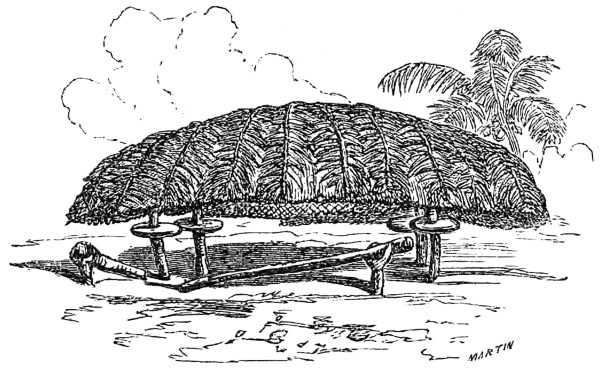
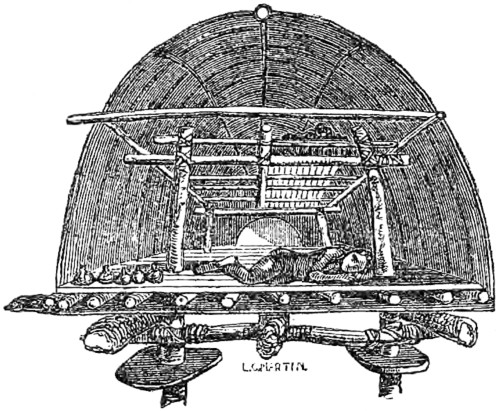
The larger and more elaborate contain several families—the following being a section of the part occupied. In parts subject to inundation they stand upon high props—upon piles as it were. This mode of building is common in New Guinea, on certain islands of the Indian Archipelago, the more swampy parts of inter-tropical America; like adaptations occurring in like localities.
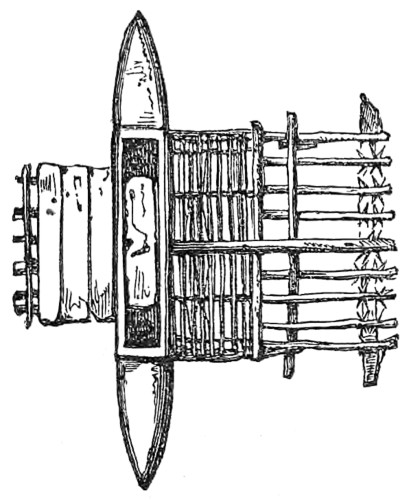
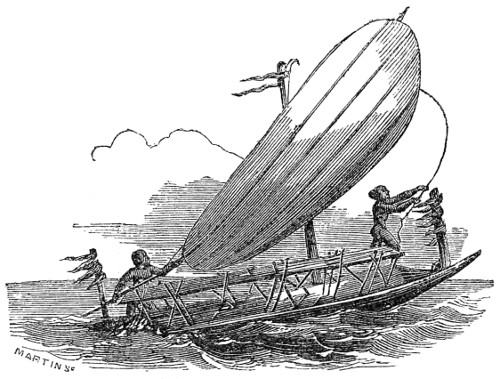
Next to the domestic architecture that of their canoes deserves attention. These, always, or almost always, are built without riggers—sometimes with a sort of stage or platform projecting from the sides, the structure of a raft being superadded to that of a boat. The sailing vessels take the following form. Less nautical than the Malays—the Papuan family is more so than the Australian.
With some varieties the hair is far more elaborately dressed than with those of the present group; being twisted into long curls, likened to the thrums of a mop, stiffened with oil, and washed in alkaline leys, which give a red tinge. When this kind of ornamentation attains its fullest development, the frizzled mass of strong and stiffened hair makes the owner unable to lie down without disarranging his head-dress. In this case a neck-pillow becomes necessary; just as it does with certain tribes of Africa, with whom the care of these head-gear is one of the primary employments of life.
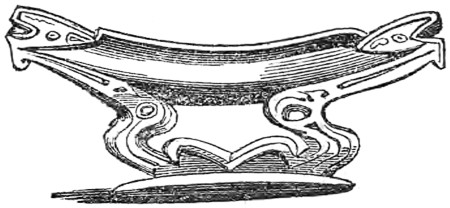
The chief weapons are the bow and arrow, their political organisation of the lowest and simplest kind; that of small tribes living in a state of chronic hostility with each other. Woven cloth they have none. On the other hand they show some skill in the art of pottery. In New Guinea, at least, they defend their soil with tenacity and resolution, eschewing European intercourse. In the more southern and smaller islands, however, this is less the case than in the more northern and larger ones. They contrast more favourably with the Australians than with the Malays.
But little is known of their languages.
The islands of Torres Strait, even when they lie nearest to the coast of Australia, are not Australian, but Papuan, so that the following extracts from the “Voyage of the Fly” apply to a population allied to one under notice—allied, but not identical.
In Darnley Island the natives “were fine, active, well-made fellows, rather above the middle height, of a dark brown or chocolate colour. They had frequently almost handsome faces, aquiline noses, rather broad about the nostril, well-shaped heads, and many had a singularly Jewish cast of features. The hair was frizzled, and dressed into long pipe-like ringlets, smeared sometimes with ochre, sometimes left of its natural black colour; others had wigs not to be distinguished from the natural hair, till closely examined. The septum narium was bored, but there was seldom anything worn in it. Most of their ears were pierced all round with small holes, in which pieces of grass were stuck, and in many the lobe was torn and hanging down to the shoulder. Their only scars were the faint oval marks on the shoulder. The hair of their bodies and limbs grew in small tufts, giving the skin a slightly woolly appearance. They were entirely naked, but frequently wore ornaments made of mother-of-pearl shells, either circular or crescent-shaped, hanging round their necks. Occasionally, also, we saw a part of a large shell, apparently a cassis, cut into a projecting shield-shape, worn in front of the groin. The women wore a petticoat round the waist, reaching nearly to the knees, formed of strips of leaves sewn on to a girdle. These formed a very efficient covering, as one or two were worn over each other. The grown-up woman’s petticoat, or nessoor, was formed, we afterwards found, of the inside part of the large leaves of a bulbous-rooted plant, called by them teggaer, of which, each strip was an inch broad. The girl’s nessoor was made of much narrower strips from the inside of the leaf of the plantain, which they called cabbow.
“The younger women were often gracefully formed, with pleasing expressions of countenance, though not what we should consider handsome features. The girls had their hair rather long, but the women had almost all their hair cut short, with a bushy ridge over the top, to which they, singularly enough, gave the same name as to pieces of tortoise-shells, namely, kaisu. Many of the elder women had their heads shaved quite smoothly, and we never saw a woman wearing a wig, or with the long ringlets of the men. At our first landing, all the younger women and girls kept in the back-ground, or hid themselves in the bush. On strolling to the back of the huts, we found a small native path, along which we went a short distance till we came to a rude fence in front of a plantain-ground, where the men objected to our going further, and we heard the voices of the women among the trees beyond.
“There were four huts at this spot, all bee-hive shaped, sixteen feet in diameter, and as much in height. They stood in small court-yards, partially surrounded by fences formed of poles of bamboo, stuck upright in the ground, close together, and connected by horizontal rails, to which they were tied by withies. Inside the huts were small platforms covered with mats, apparently bed-places; and over head were hung up bows and arrows, clubs, calabashes, rolls of matting, and bundles apparently containing bones, which they did not like our examining. Outside the huts were one or two small open sheds, consisting merely of a raised flat roof, to sit under in the shade, and a grove of very fine cocoa-nut trees surrounded the houses.”
The arms of the natives were the bow and arrow, and in holding the former, especial care was taken that the part of the wood which was uppermost as the tree grew, should be uppermost when used as a weapon. Rough imitations of the human figure were common; but whether they served as idols or not was uncertain. The use of tobacco was general. On the part of the females, the reserve and decorum of manner formed a striking contrast with the very different habits of the Polynesians.
B. The Australians.—These are taken from life; two natives of the parts about Cape York having been taken up in an English vessel and brought with it to England. They passed a fortnight under the same roof with Mr. Thomson, and were well observed by both the artists engaged on the figures, and the present writer. The thinness of the legs is by no means exaggerated. It is just what the plates of Dr. Prichard’s “Varieties of Man” make it. On the other hand, the chest was well developed, and the arms comparatively—though only comparatively—strong. They told the story of their being on board the ship that brought them over, in dumb show, but they told it in a way that the most consummate professional actor might admire. But this was about all the talent they showed.
They ran neither faster nor slower than the Englishman they came in contact with; but swam as adepts. By no means insensible to such kindnesses as they received, they evinced quite as much kindness to their English house-mates as they did to one another. So silent, indeed, were they, that until we took a vocabulary of their language, we thought that they belonged to two different tribes who had carried their hostility with them across the Pacific, and nourished it in Sydenham. Smoking, or rather swallowing smoke, was their chief delight.
Tom, the livelier and less saturnine of the two, has a throwing-stick in his hand, which he is about to project.
In the group of two he re-appears. When Dick, the gloomier, had a headache, Tom could scarcely be withheld from scarifying his temples with such pieces of glass or flint as he could pick up.
Dick and Tom are Northern Australians—Northern Australians from the parts about Cape York.
Observe the points of difference and likeness between them and the Louisiade Papuans. As both are dark-skinned, they have been dealt with as branches of one and the same family; for which a name (or rather a pair of names) derived from the Greek has been applied—Melanesian and Kelnonesian. Nesos means island; kelnos, dark; melas (melan-os), black. The latter compound is the better. They are certainly dark coloured; and it is equally certain that both New Guinea and Australia are islands. The exact relationship, however, is less certain. Nevertheless, the name Kelnonesian is adopted.
It has been said that the Papuan contrasts favourably with the Australian; the latter being the better known of the two.
The differences between the different Australian languages have long been known and definitely insisted upon.
Less marked differences in frame and physiognomy between the different Australian tribes, have also been long known and definitely insisted upon.
Differences of customs and manners have been similarly noticed and considered. Notwithstanding all this, however, there is no opinion more generally admitted than the fundamental unity of the Australian population from Swan River to Botany Bay, from the Gulf of Carpentaria to Bass’s Straits. Captain Grey, Schurman, Teichelman, and all who have devoted average attention to the language, have given their evidence to this; and they have supplied facts of various kinds, of their own collection, towards the proof of it. No man is less inclined to disturb this view than the present writer.
As to the physical conformation of the Australians, I believe that it is so uniform throughout the island, that it has never been made the basis of a division;—indeed I am inclined to believe that the similarity of external appearance has been over-rated; nevertheless, it is certain that there are deviations from the general slim and underfed condition of the body; and (which is of more importance), from the usual straight character of the hair. Such is the case, according to Mr. Earl, with the trepang fishers of Arnhem Bay. Then as to the hair—with the Jaako, or Croker Island tribe, it is coarse and bushy (the whiskers being thick, and curly) and so short, crisp, and abundant about the breast and shoulders as to conceal the skin; whereas, on the other hand, the Oitbo, or Bidjenelumbo, have straight silky hair, arched eyebrows, fair complexion, and occasionally the oblique eye.
The lowest form of humanity has been sought for in Australia, whilst the physical condition of the country and the absence of those animals and herbs that supply human food, have made it a likely quarter to exhibit it. Whether, however, so low a rank in the scale of human development be, upon the whole, a fact or exaggeration, it is certain that, upon several points, there has been considerable over-statement. One sample of this sort is the accredited opinion as to the absolute incapacity of the Australian of forming even the rudest elements of a mythology—an opinion which engenders the notion that their intellects are too sluggish for even the evolution of a superstition.
That this was not the case was indicated some years back by Captain Grey, and that there is some exponent of the religious feeling in the shape of a rude form of shamanism, has been shown in the account of the American Exploring Expedition; where the first published details of the Australian mythology, if so it may be called, are to be found:—“It is not true, however, as has been frequently asserted, that the natives have no idea of a Supreme Being, although they do not allow this idea to influence their actions. The Wellington tribes, at least, believe in the existence of a Deity called Baiamai, who lives on an island beyond the great sea to the East. His food is fish, which come up to him from the water when he calls them. Some of the natives consider him the maker of all things, while others attribute the creation of the world to his son Burambin. They say of him, that Baiamai spoke, and Burambin came into existence. When the missionaries first came to Wellington, the natives used to assemble once a year, in the month of February, to dance and sing a song in honour of Baiamai. This song was brought there from a distance by strange natives, who went about teaching it. Those who refused to join in the ceremony were supposed to incur the displeasure of the god. For the last three years the custom has been discontinued. In the tribe on Hunter’s River, there was a native famous for the composition of these songs or hymns; which, according to Mr. Threlkeld, were passed from tribe to tribe, to a great distance, till many of the words became at last unintelligible to those who sang them.
“Dararwirgal, a brother of Baiamai, lives in the far west. It was he who lately sent the small-pox among the natives, for no better reason than that he was vexed for want of a tomahawk. But now he is supposed to have obtained one, and the disease will come no more. The Bálumbal are a sort of angels, who are said to be of a white colour, and to live on a mountain at a great distance to the south-east: their food is honey, and their employment is to do good ‘like the Missionaries.’
“It is possible that some of these stories owe their origin to intercourse with the whites, though the great unwillingness which the natives always evince to adopt any customs or opinions from them, militates against such a supposition. But a being who is, beyond question, entirely the creation of Australian imagination, is one who is called in the Wellington dialect, Wandong; though the natives have learned from the whites to apply to him the name of devil. He is an object not of worship, but merely of superstitious dread. They describe him as going about under the form of a black man of superhuman stature and strength. He prowls at night through the woods around the encampments of the natives, seeking to entrap some unwary wanderer, whom he will seize upon; and, having dragged him to his fire, will there roast and devour him. They attribute all their afflictions to his malevolence. If they are ill, they say Wandong has bitten them. No one can see this being but the nújargir, or conjurors, who assert that they can kill him, but that he always returns to life. He may, however, be frightened away by throwing fire at him (though this statement seems inconsistent with that respecting his invisibility), and no native will go out at night without a firebrand to protect him from the demon.
“There is some difference in the accounts given of this character. By the tribe of Hunter’s River he is called Koin or Koen. Sometimes, when the Blacks are asleep, he makes his appearance, seizes upon one of them and carries him off. The person seized endeavours in vain to cry out, being almost strangled. At daylight, however, Koin disappears, and the man finds himself conveyed safely to his own fireside. From this it would appear that the demon is here a sort of personification of the nightmare,—a visitation to which the natives, from their habits of gorging themselves to the utmost when they obtain a supply of food, must be very subject.
“At the Muruya River the devil is called Túlugal. He was described to us, by a native, as a black man of great stature, grizzled with age, who has very long legs, so that he soon overtakes a man; but very short arms, which brings the contest nearer an equality. This goblin has a wife who is much like himself; but still more feared, being of a cruel disposition, with a cannibal appetite, especially for young children. It would hardly be worth while to dwell upon these superstitions, but they seem to characterise so distinctly the people, at once timid, ferocious, and stupid, who have invented them.
“Their opinions with regard to the soul vary: some assert that the whole man dies at once, and nothing is left of him; others are of opinion that his spirit still survives, but upon this earth, either as a wandering ghost, or in a state of metempsychosis, animating a bird or other inferior creature. But the most singular belief is one which is found at both Port Stephens and Swan River, places separated by the whole breadth of the Australian continent. This is, that white people are merely blacks who have died, passed to a distant country, and having there undergone a transformation, have returned to their original homes. When the natives see a white man who strongly resembles one of their deceased friends, they give him the name of the dead person, and consider him to be actually the same being.”
It is difficult to take an exact measure of the extent to which one superstition is grosser than another;—hence, all that can be said respecting the Pantheon, of which Baiamai and Wandong are portions, is that it is as low in the scale of mythologies as any that has fallen under the notice of the writer.
Incomplete Numeration of the Australians.—The import of an Australian having no more than the three, four, or five first numerals, and being thereby as unable to count the number of the fingers of his hands, as that of the hair of his head, is less equivocal. It speaks, at once, to a minimum amount of intellectual power. Nevertheless, the same inability occurs elsewhere; especially in certain languages of South America. The only vocabulary of Australia where the numerals run beyond five, is that of King George’s Sound, as given in Mitchell’s Australia.
The political constitution (if so it may be called) of the Australians is preeminently simple, exhibiting a society of families rather than of tribes; and of the facts connected with the evidence in favour of the unity of the Australian division of mankind is the remarkable distribution of families bearing the same name. The principal of these are the Ballaroke, the Tdondarup, the Ngotok, the Nagarnook, the Nogonyuk, the Mongalung, and the Narrangar. Now, persons bearing one or other of these names, may be found in parts of the country five hundred miles apart. Nor does this appear to be the effect of migration, since each tribe is limited by the jealousy of its neighbours to its own hunting-ground, beyond which it seldom passes.
Polygamy in Australia is what we find, and expect to find. The practice of circumcision is what we find, perhaps, without expecting it. The habit of the children taking the name of the mother, will occur again in the south of India. The rule that a man cannot marry a woman of his own family-name will also re-appear, and that amongst the Indians of North America.
The Kobong.—“Each family among the Australians adopts some animal or plant, as a kind of badge or armorial emblem, or, as they call it, its kobong. A certain mysterious connection exists between a family and its kobong, so that a member of the family will not kill an animal, or pluck any plant of the species to which his kobong belongs, except under particular circumstances. This institution again, which in some respects resembles the Polynesian tabú, though founded on a different principle, has its counterpart in the customs of the native Americans. Captain Gray observes, citing Mr. Gallatin, that among the Hurons, the first tribe is that of the bear; the two others, those of the wolf and turtle. The Iroquois have the same divisions, and the turtle family is divided into the great and little turtle. The Sioux are named on a similar principle. According to Major Long, one part of the superstitions of these savages consists in each man having some totem, or favourite spirit, which he believes to watch over him. The totem assumes the shape of some beast, and therefore they never kill or eat the animal whose form they suppose their totem to bear.”
The ceremony of initiation.—“When the boys arrive at the age of puberty (or about fourteen), the elders of a tribe prepare to initiate them into the duties and privileges of manhood. Suddenly, at night, a dismal cry is heard in the woods, which the boys are told is the Bubu calling for them. Thereupon all the men of the tribe (or rather of the neighbourhood) set off for some secluded spot previously fixed upon, taking with them the youths who are to undergo the ceremony. The exact nature of this is not known, except that it consists of superstitious rites, of dances representing the various pursuits in which men are engaged, of sham fights, and trials designed to prove the self-possession, courage, and endurance of the neophytes. It is certain, however, that there is some variation in the details of the ceremony, in different places; for among the coast tribes, one of these is the knocking out of an upper front tooth, which is not done at Wellington, and farther in the interior. But the nature and object of the institution appear to be everywhere the same. Its design unquestionably is, to imprint upon the mind of the young man the rules by which his future life is to be regulated; and some of these are so striking, and, under the circumstances, so admirable, that one is inclined to ascribe them to some higher state of mental cultivation than now prevails among the natives. Thus, the young men, from the time they are initiated, till they are married, are forbidden to approach or speak to a female. They must encamp at a distance from them at night, and if they see one in the way, must make a long detour to avoid her. Mr. Watson told me that he had often been put to great inconvenience in travelling through the woods, with a young man for his guide, as such a one could never be induced to approach an encampment where there were any women. The moral intent of this regulation is evident.
“Another rule requires the young men to pay implicit obedience to their elders. As there is no distinction of rank among them, it is evident that some authority of this kind is required, to preserve the order and harmony of social intercourse.
“A third regulation restricts the youth to certain articles of diet. They are not allowed to eat fish, or eggs, or the emu, or any of the finer kinds of opossum and kangaroo. In short, their fare is required to be of the coarsest and most meagre description. As they grow older, the restrictions are removed, one after another; but it is not till they have passed the period of middle age that they are entirely unrestrained in the choice of food. Whether one purpose of this law be to accustom the young men to a hardy and simple style of living may be doubted; but its prime objects and its result certainly are to prevent the young men from possessing themselves, by their superior strength and agility, of all the more desirable articles of food, and leaving only the refuse to the elders.
“The ceremony of marriage, which, amongst most nations, is considered so important and interesting, is with this people one of the least regarded. The woman is looked upon as an article of property, and is sold or given away by her relatives without the slightest consideration of her own pleasure. In some cases she is betrothed, or rather promised, to her future husband in the childhood of both; and in this case, as soon as they arrive at a proper age, the young man claims and receives her. Some of them have four or five wives, and in such a case, they will give one to a friend who may happen to be destitute. Notwithstanding this apparent laxity, they are very jealous, and resent any freedom taken with their wives. Most of their quarrels relate to women. In some cases, the husband who suspects another native of seducing his wife either kills or severely injures one or both of them. Sometimes the affair is taken up by the tribe, who inflict punishment after their own fashion. The manner of this is another of the singularities of their social system.
“When a native, for any transgression, incurs the displeasure of his tribe, their custom obliges him to ‘stand punishment,’ as it is called; that is, he stands with a shield, at a fair distance, while the whole tribe, either simultaneously or in rapid succession, cast their spears at him. Their expertness generally enables those who are exposed to this trial to escape without serious injury, though instances occasionally happen of a fatal result. There is a certain propriety even in this extraordinary punishment, as it is very evident that the accuracy and force with which the weapons are thrown will depend very much upon the opinion entertained of the enormity of the offence.
“When the quarrel is between two persons only, and the tribe declines to interfere, it is sometimes settled by a singular kind of duello. The parties meet in presence of their kindred and friends, who form a circle round them as witnesses and umpires. They stand up opposite one another, armed each with a club about two feet long. The injured person has the right of striking the first blow, to receive which the other is obliged to extend his head forward, with the side turned partially upwards. The blow is inflicted with a force commensurate with the vindictive feeling of the avenger. A white man, with an ordinary cranium, would be killed outright, but, owing to the great thickness of their skulls, this seldom happens with the natives. The challenged party now takes his turn to strike, and the other is obliged to place himself in the same posture of convenience. In this way the combat is continued; with alternate buffets, until one of them is stunned, or the expiation is considered satisfactory.
“What are called wars among them may more properly be considered duels (if this word may be so applied) between two parties of men. One or more natives of a certain part of the country, considering themselves aggrieved by the acts of others in another part, assemble their neighbours to consult with them concerning the proper course to be pursued. The general opinion having been declared for war, a messenger or ambassador is sent to announce their intention to the opposite party. These immediately assemble their friends and neighbours, and all prepare for the approaching contest. In some cases, the day is fixed by the messenger, in others not; but, at all events, the time is well understood.
“The two armies (usually from fifty to two hundred each) meet, and after a great deal of mutual vituperation, the combat commences. From their singular dexterity in avoiding or parrying the missiles of their adversaries, the engagement usually continues a long time without any fatal result. When a man is killed (and sometimes before), a cessation takes place; another scene of recrimination, abuse, and explanation ensues, and the affair commonly terminates. All hostility is at an end, and the two parties mix amicably together, bury the dead, and join in a general dance.
“One cause of hostility among them, both public and private, is the absurd idea which they entertain, that no person dies a natural death. If a man perishes of disease, at a distance from his friends, his death is supposed to have been caused by some sorcerer of another tribe, whose life must be taken for satisfaction. If, on the other hand, he dies among his kindred, the nearest relative is held responsible. A native of the tribe at Hunter’s River, who served me as a guide, had not long before beaten his own mother nearly to death, in revenge for the loss of his brother, who died while under her care. This was not because he had any suspicions of her conduct, but merely in obedience to the requirements of a senseless custom.”
Another fact connected with the decease of an Australian deserves notice. When one of them dies, those words which are identical with his name, or, in the case of compounds, with any part of it, cease to be used; and some synonym is adopted instead; just as if, in England, whenever a Mr. Smith departed this life, the parish to which he belonged should cease to talk of blacksmiths, and say forgemen, forgers, or something equally respectful to the deceased, instead. This custom reappears in Polynesia, and in South America; Dobrizhoffer’s account of the Apibonian custom being as follows:—“The Abiponian language is involved in new difficulties by a ridiculous custom which the savages have of continually abolishing words common to the whole nation, and substituting new ones in their stead. Funeral rites are the origin of this custom. The Abipones do not like that anything should remain to remind them of the dead. Hence appellative words bearing any affinity with the names of the deceased are presently abolished. During the first years that I spent among the Abipones, it was usual to say Hegmalkam kahamátek, when will there be a slaughtering of oxen? On account of the death of some Abipon, the word Kahamátek was interdicted, and, in its stead, they were all commanded by the voice of a crier to say, Hemalkam négerkatà? The word Nihirenak, a tiger, was exchanged for Apanigehak; Peú, a crocodile, for Kaeprhak, and Kaáma, Spaniards, for Rikil, because these words bore some resemblance to the names of Abipones lately deceased. Hence it is that our vocabularies are so full of blots occasioned by our having such frequent occasions to obliterate interdicted words, and insert new ones.”
GROUP VI. DANAKIL AND NEGRO OF THE EASTERN COAST OF AFRICA (THE DANAKIL LIGHT-COLOURED); FROM THE PARTS BETWEEN THE ENTRANCE TO THE RED SEA AND THE HIGHLANDS OF SOUTHERN ABYSSINIA.
Attention is directed to the Danakil figures. They are African; but they are not negro. They are Africans from one of the very hottest parts. They are other than negro, nevertheless. Their hair is longer than the negro’s; their lips thinner; their colour lighter; their nose more aquiline. Travellers who have been struck by their appearance have called them Caucasians, by which they mean that they approach the European type. Others have compared them with the Arabs—others with the Jews; and this has led them further. The coasts of Arabia are not far off; so why should there not be Arab blood amongst them? This has more than once been assumed. The assumption, however, is unnecessary—nay, it is incorrect. The negro of the next group—the negro from the Delta of the Niger, the negro in his most extreme form—is not more truly indigenous and aboriginal to the soil of Africa than are these Danakil; who are not only Africans, in the strictest sense of the term, but also members of a large family, falling into divisions and subdivisions. So far are they from being exceptional, or in any respect peculiar.
The other members of this family are (a) the Somauli, on the coast of the Pacific Ocean, about Cape Guardafui and (b) the Gallas, or Ilmorma, a pastoral people spread over a vast area to the south of Abyssinia, and who so encroach upon that country that they are in a fair way of reducing it altogether.
The Gallas, like the Danakil, and the Danakil, like the Somauli and Gallas, are a pastoral people—pastoral, locomotive, wild, and intractable—with manners that remind us of the Arab of Asia, the Kaffre of Southern Africa, or of the Berber of the Desert of Sahara; and it is these whom they resemble, more or less closely, in their forms—more or less closely in their social constitution. Like all such populations, they fall into numerous tribes, each under the influence of their chief; with the spirit of blood, or pedigree, running strong amongst them. Every man belongs to his tribe, or class, and is proud of being attached to it. Of the Danakil alone, more than fifty of these tribual divisions are known by name.
In respect to creed the Danakil are what the neighbourhood of Arabia leads us to expect, Mahometans, more or less incompletely converted; and this is the general rule for the eastern coast of Africa—the coast, but not the interior. In the interior we get amongst pagans. On the other hand, Abyssinia and some of the parts about it are Christian. Dr. Beke considered that he found traces of a corrupt and displaced Christianity among the Gallas.
The fact of the neighbourhood of Arabia having determined a large portion of the eastern coast of Africa to Mahometanism explains the meaning of the words Kaffre, and Caffraria, or Kafferland. Kaffre, in the mouth of an Arab, means Infidel. It means Infidel not only in the mouth of an Arab, but in that of any Mahometan. In different languages it takes different forms, and is applied to different populations. In Persia it expressed the old Fire-worshippers, since Guebre is but another form of it. In Cabul it denotes the occupants of a district to the north of Peshawur, wherein the natives still reject Mahometanism, and, so doing, are Kafirs, their country being Kaferistan. In Turkey it generally means a Christian—since Giaour is neither more nor less than Kafir in the mouth of a Turk.
But to return to Eastern Africa. Where the Arab influence ceases, the land of the Kaffres begins.
Of these Kaffres more may be seen in group VII.
The black figure (modelled from life) is evidently more negro than aught else. The hair is crisp, to say the least of it, and the skin black; the open and patulous character of the nostrils, and their lateral position, claim attention. They are by no means exaggerated.
The youth from whom the figure was taken belonged to the Msegurra tribe; of which I can only state that it is an occupant of some part of the back of the coast of Zanzibar, or Mozambique.
The present group prepares us for a Kaffre; let it also prepare us for a negro one. That all Africans are not negroes may be seen from the figures before us. The negro form is by no means universal—not even in the hottest parts of Africa—not even between the tropics: it is only in the lower levels that the true negro is to be found. Look for him amongst the high pastures of the mountains, look for him even on the hot but arid plateaus of the desert, and you search in vain. Tribes with dark skins you may find, tribes with hair more or less wavy, or frizzly, tribes with features heavy, massive, and coarse—but the true and typical negro, with his short woolly hair, and his thick projecting lips you will not find. Wherever he is the occupant, the soil is alluvial, and the heat of the atmosphere is combined with moisture. Wherever the land gets high and dry, the inhabitant is brown rather than black, and long-haired rather than frizzly headed. His features, too, become more prominent.
GROUP VII. NEGROES,—2. LIGHT-COLOURED. FROM THE LOWER NIGER.
In the Delta of the Niger we find the best opportunity for contrasting the negro with the European, the black man with the white; inasmuch as it is in the Delta of the Niger where the points wherein the African differs from the rest of the world are found in the most marked form. The climate is tropical (well nigh equatorial), the soil swampy and alluvial, the atmosphere surcharged with damp warm vapours. Under these conditions the negro is found in his most extreme form. Let us ask what it is. In the true and typical negro (the negro from whom the current notions of the black man are derived), over and above the colour of the skin, there is a woolly, cottony, or frizzy head of hair, there is a yellow tinge over the white of the eye (the sclerotica), and there are thick lips, with a projecting mouth—a muzzle rather than a mouth, in its more exaggerated form. This is because the teeth are set obliquely, i. e. they slant somewhat forward. Then there is the forehead, which is described as being narrow, and retiring, and receding, or sloping backwards. There is some exaggeration in this, though upon the whole the negro character is well marked; the hair, the skin, and the lips, being the chief points. To the notice of these it should be added that the nose is generally flat and depressed, with the nostrils thrown out, so to say, sideways. Rarely, very rarely indeed, is the bridge sufficiently curved to give what is called the Roman or aquiline nose; whilst it is almost as rare to find a Grecian one, i. e. one where the nasal bones are raised but straight. Then there is the proportion which the different parts of the face bear to each other. A [34]German writer of eminence as a naturalist, has lately been taking measurements from amongst the negroes of Brazil, and states that instead of the parts between the chin and nose (the nasal portion of the face), and the forehead forming a third, each, of the whole physiognomy, the forehead forms less than a third, the nasal part more than the forehead, and the chin, &c. more than the nasal; in other words, the lower we go the greater the mass of the several parts of the face, and the nearer we approach the brain, the smaller. I can neither verify nor deny this statement.
Other points, more or less characteristic, real or supposed, are to be found in the relations of the limbs to the trunk—the former being longer in proportion to the latter than is usual with Europeans.
It is more important, however, to investigate the amount of difference indicated by the difference of colour, and to do this we must look to the structure of the skin. The structure of the negro’s skin differs from that of the white man in degree only, the one containing much, the other but little colouring matter; this colouring matter being deposited in a particular layer, called the mucous layer, the stratum Malpighii, or the rete mucosum. The character of this mucous layer, or rete mucosum, is well given in the forthcoming plates, which, along with the description, is taken from [35]Kölliker’s Manual. It differs in some degree from the one which occurs in the ordinary works on Ethnology.
The external integument of all men alike consists of the cutis or true skin, and the epidermis, or scarf-skin, the latter consisting of cells only, the former of cells, vessels and nerves.
As far as the cutis is concerned, the blackest and whitest of mankind are alike; so that it is in the scarf-skin or epidermis that the difference lies. This consists of two layers, an external and an internal.
The internal layer is the rete mucosum. It lies immediately upon the true skin, and consists solely and wholly of cells, being equally destitute of vessels and nerves. Here begin the first discrepancies in the opinion of writers. Some deny that it belongs to the epidermis, looking upon it as a separate substantive tissue, neither skin nor scarf-skin, but intermediate to the two. Others find it only in the coloured families of mankind. It occurs, however, universally; being of a yellowish-white colour in Europeans, and dark brown or black in negroes, Indians, and the so-called dark races. Hence, the real difference is not in the existence of an additional tissue, but in a greater amount of colouring matter. Similar in respect to the two layers of their cutis, similar in respect to the two layers of their epidermis, the black man and the white differ in the extent to which the second layer of the scarf-skin is charged with a black deposit.
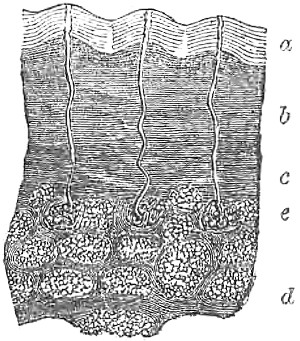
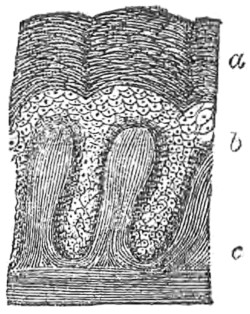
The accompanying figure represents a section through the skin and scarf-skin of the ball of the thumb; wherein a is the outer layer of the epidermis; b, the inner, or rete mucosum; c, and d, the cutis; e, glands, ducts, &c.
The next gives us the epidermis only—a, being the outer; b, the inner layer (rete mucosum;) c, the cutis, to the outline of which the rete mucosum adapts itself.
It is in the deepest parts of the inner layer, in the parts more immediately in contact with the true skin, that the most colouring matter is accumulated. Hence, the horny, or outer part of the epidermis is white or yellowish, all the world over. A blister, in popular language, raises the skin; in reality, it only raises the outer layer of the epidermis. Now blisters rise equally white with the African and with the European.
It is not until after birth that the colouring matter of the second layer of the scarf-skin becomes deposited. A negro child is born of somewhat deeper red colour than an European, but he is not born black. The edges of the nails and the nipple of the breast darken first; the body having darkened by the third day, there or thereabouts.
As the hue of the skin attains its deepest tinge with the groupe before us, the structure that exhibits it has been enlarged upon.
What is the moral and social state of these negroes of the Delta of the Niger? what their habits, customs, and creeds?
We cannot follow the account of any observer for these parts, without discovering that, overpowering as is the heat, and swampy as is the ground, unfavourable, in one word, as are the conditions of soil and climate, the whole of the low country represented by the groupe before us teems with human life; neither is there the absence of human industry. We first hear of villages of from twenty to thirty, from thirty to forty, from fifty to seventy huts; to each of which we may give, upon an average, some six occupants. Then there are large towns like Iboh and Iddah, wherein the inhabitants are counted by the thousand; where there are regular market-days, and where there is a king with his court, such as it is. It is with these kings that the treaties have to be made against the slave-trade, these kings who, as in the late case at Lagos, have disputes as to the “succession”; these kings who give licenses to trade, and who make the access to the interior part of the country practicable or the contrary. There are kings and viceroys—viceroys with kings over them, so that there is a sort of feudal chain of vassalage and sovereignty. King Emmery, for instance, was, at the time of the Niger Expedition, the chief of a village on the river Nun, himself being a subject to King Boy of Brass Town. Then there is the kingdom of Iddah, with its subordinate kingships, whilst Kakanda and Egga are the dependencies of a really consolidated monarchy at Sakkatu.
At best, however, the African monarch, except in the Mahometan kingdoms, is but a sorry potentate; a drunken, sensual, slave-dealing polygamist. When Drs. McWilliam and Stanger visited this same King Emmery, his dress was a uniform coatee that had belonged to a drummer[36] in some English regiment, a plain black hat, and a blue cotton handkerchief for the lower man—a blue cotton handkerchief for drawers, trowsers and stockings, collectively; the dress of the ordinary natives being limited to a simple shirt, with a cloth round the middle. In this we get one of the measures of the amount of English influence and trade.
The huts are of clay, arranged in squares rather than in rows, and when the soil is low and liable to be flooded, they are raised some feet from the ground on a foundation of wooden pillars, in which case a ladder leads to the principal opening. The King’s palace is an assemblage of such huts; a miniature town; one side of the square which they form being the “women’s quarters.” Here reside the numerous wives, half-wives, and ex-wives of the sovereign, the number of which is always considerable, since the rank of the man regulates it. The following table gives us, in the first column, the names of the different members of the Court of King Obi of Iboh in 1840; in the others, their age, and the numbers of their wives and families—
Age. Wives. Children.
Living. Dead. Living. Dead.
1. Ajeh, king’s brother 40 80 40 un- cer- tain. un- cer- tain.
2. Amorara, judge and king’s mouth 40 4 2 2 6
3. Ozama, headman 35 4 2 2 6