JAMES WOLFE, CONQUEROR OF CANADA.
Reading edition
“Wolfe, where’er he fought,
Put so much of his heart into his act
That his example had a magnet’s force,
And all were swift to follow whom all loved.”
Once more you see a young soldier advancing. He is a hero of heroes, yet never was the soul of a hero enshrined in a more unhero-like frame. His features are homely, his hair is fiery-red, his shoulders are narrow, and his limbs are veritable spindle-shanks. But look at his eyes, and you will instantly forget his plain features and his rickety body. They are bright, searching, brimful of intelligence and vivacity, and speak eloquently of the indomitable spirit within. This is James Wolfe, the man who gave us Canada—“eldest daughter of the Empire”—that vast land of fertile prairie, dense forest, widespreading pasture, rich mines, unrivalled waterways, fine cities, and, above all, of a sturdy nation, heart-warm towards the mother-country, and eager to give her tangible proofs of kinship and affection. Wolfe gave Canada to the Empire at the price of his heart’s blood. In one “crowded hour of glorious life” he gave us the heritage of this majestic land, already the greatest and most prosperous of all British lands beyond the seas, and yearly advancing towards a mighty destiny.
James Wolfe was a soldier from his youth. His father was an officer of distinction; his mother a woman of great sweetness and charm, deeply beloved by her two sons, of whom James was the elder. He was born on June 2, 1727, at Westerham in Kent. Of his brief boyhood’s days we know little—indeed, there are but meagre details of his whole life. We know, however, that he was a delicate, sensitive, highly-strung boy, who inherited his mother’s frailty though not her beauty. We know, too, that he saw little of his father, who was almost constantly absent from home on active service. Nevertheless, he was tenderly and judiciously reared by his devoted mother.
When a mere schoolboy—a little over fifteen years of age—he became an ensign, and carried the colours in one of his Majesty’s regiments. From the beginning of his career he set himself to study the art of war, and at sixteen he was adjutant of his regiment, then serving in Flanders. He discharged his duties with great intelligence, and very early demonstrated his capacity for leading men. Even though an adjutant, he had not lost his schoolboy tastes, for we find him writing to his mother warmly thanking her for a plum-cake which she had sent him.
At twenty-one he had seen seven campaigns, and was a major. He had been present at the victories of Dettingen and Culloden, and it is said that on the latter battlefield he proved the nobility of his nature by refusing to shoot a wounded Highlander when ordered to do so by “Butcher” Cumberland. It is also said that he recommended the enlistment of Highlanders as soldiers in the British army. This may or may not be true, but it is certain that the Highland regiments first began to win their great renown under his command.
At thirty years of age he had acquired the reputation of a capable, active, zealous officer, but so far he had given little indication of the great fame which was soon to be his. In 1758 he first crossed the Atlantic; and here we may interrupt the narrative in order to explain the condition of affairs at that time in America. By the middle of the eighteenth century the British had established themselves in thirteen colonies along the Atlantic coast from Florida to Nova Scotia. The French had chosen Quebec as their capital, and had occupied Acadia (now the provinces of Nova Scotia and New Brunswick) and the valley of the St. Lawrence from the Atlantic to the Great Lakes. A new England and a new France had thus grown up in the New World.
New England grew rapidly in population and wealth. New France also prospered, though in a lesser degree. Its progress was hindered by constant warfare with the Indians, by the trading enterprise of the British, and by the interference of the home government. The two white races constantly advanced their frontiers, and their outposts drew nearer and nearer to each other every year. Border strife between the rival nations soon became frequent. In 1690, for example, the British settlers invaded New France to revenge themselves for the plunder of certain frontier stations. The invaders were driven back, but for years afterwards the French and the British kept up an irregular warfare. During the War of the Spanish Succession a powerful British fleet which was protecting the colonies seized that part of Acadia now known as Nova Scotia.
Though Britain had colonized the whole Atlantic seaboard from Florida to Nova Scotia, her territories had not advanced inland beyond the great barrier of the Alleghany Mountains. France, in addition to Canada, possessed the colony of Louisiana at the mouth of the Mississippi. She claimed that Louisiana stretched to the head-waters of the Mississippi and its tributary the Ohio. Had this claim been allowed, the British seaboard colonies would have been shut in on the west, and prevented from extending to the rich plains of the interior. Already the British needed elbow-room, for they numbered some 2,000,000, while the French in all the vast territory which they claimed could only muster 180,000.
The French now proposed to link Louisiana with Canada by a chain of forts along the Mississippi and the Ohio. The three northern links in the chain were Fort Ticonderoga, at the end of Lake Champlain; Fort Niagara, near the great falls; and Fort Duquesne, on the Ohio River, where the great manufacturing town of Pittsburg now stands. The first and last of these forts were close to the English back settlements, which were constantly ravaged by Indians in the pay of France. In 1754, while Britain was ringing with the fame of Clive fresh from his great defence of Arcot, a party of Virginian militia made a dash at Fort Duquesne under the leadership of George Washington, soon to be the greatest name in American history. The attack, however, was unsuccessful. This was the beginning of the great struggle between the French and the British for the possession of North America.
Next year General Braddock, who had been sent out to be commander-in-chief in America, marched against the French at the head of 2,200 British regulars and American settlers. He cut his way through almost impenetrable forest, but when eight miles from the fort fell into an ambuscade. The Indians and French were hidden in bushes and behind trees, and they poured volley after volley into the British ranks. The settlers wished to fight in the Indian fashion, and take cover behind the trees; but Braddock thought this mode of warfare cowardly, and so they fought in the open until so many of the British were killed that a retreat had to be sounded. Soon the retreat became a flight, and but for Washington and his Virginians, Braddock’s little army would probably have been cut off to a man. The consequences of this defeat were terrible. The French let loose the Indians on the outlying British settlements, and the woods rang with the screams of tortured victims. For a time France was supreme on the American continent.
In 1758 the British outlook was black indeed, and at home men trembled in hourly expectation of a French invasion. England was in a very bad way indeed; but the hour found the man, and that man was William Pitt. He sketched out a bold plan of campaign in America. Simultaneous attacks were to be made on Fort Ticonderoga and Fort Niagara, and on Quebec, the key to New France. Pitt looked around for a general after his own heart. He found him in James Wolfe, a young soldier with the daring, skill, and determination to accomplish what the great statesman planned. Merit and merit alone decided Pitt’s choice, and a better choice was never made.
Wolfe had just returned from the capture of the chief fort in Acadia, where as brigadier under General Amherst he had covered himself with glory, and had earned the proud title of “hero of Louisbourg.” When Pitt offered the command of the new expedition to Wolfe he jumped at the chance. “Mr. Pitt,” he said, “may dispose of my slight carcass as he pleases.” The Duke of Newcastle, then Prime Minister, was shocked at Pitt’s choice. He told the king that Wolfe was mad. “Mad is he?” said George; “then I hope he will bite some others of my generals.”
On February 17, 1759, Wolfe sailed for Canada with a strong fleet and 9,000 troops. During the voyage he suffered tortures from sea-sickness. In May he was in the harbour of Louisbourg, and on the sixteenth of June he weighed anchor for Quebec, the troops cheering and the officers drinking this toast, “British colours on every French fort, port, and garrison in America.”
Quebec, the most historic spot in all the New World, has not inaptly been called the Gibraltar of America. It stands on the nose of a rocky peninsula shaped like a bull’s head and facing eastward. On the south and east sides it rises by steep cliffs to a rocky summit. On south, east, and north it is defended by rivers: to the south flows the great St. Lawrence River, which expands on the east into a broad basin upon which the navies of the world might ride; while on the north the peninsula is protected by the estuary of the river St. Charles. The town itself consists of two parts—a lower town, which huddles by the water side, and an upper town, which climbs the cliffs. High on the summit is the grim and frowning citadel. Let us ascend to this historic fortress and gaze in admiration on the scene which unfolds itself. The lower town, with its steep streets, its old gabled houses, its public buildings, and numerous churches with their tin-covered cupolas and minarets, rises sharply from the water’s edge. Opposite to us, on the other side of the river, is Point Levis, and to the east is the beautiful Isle of Orleans. On our left, across the basin, is the Montmorency River, which hurls itself over a precipice to mingle its waters with those of the great river. To our right extend the famous Plains of Abraham, now purchased and preserved as a national park consecrated to great historical memories. Such is the Quebec of to-day. In the year 1759 it presented a much ruder aspect, though it was then lively and important, and had been made almost impregnable by walls, bastions, and fortified gates.
Within this city Vaudreuil, its bombastic, corrupt governor, and his gang of unscrupulous officials kept up a feeble imitation of the luxurious court of France. They robbed the king, their master, and they robbed the Canadians committed to their protection. “Are the walls of Quebec made of gold?” asked Lewis when official after official returned to France bloated with wealth. New France was honeycombed with peculation and fraud, and there was but one honest, incorruptible man amongst the greedy horde. He was Lewis Joseph, Marquis of Montcalm, a soldier of unblemished repute and no mean scholar. His life was one long struggle with the governor, who thwarted him in every possible way, and arrogated to himself all the credit and honour which his noble colleague managed to win.
Montcalm had early news of Wolfe’s errand, and he hastily collected every able-bodied man and every boy who could hold a gun within the walls of the town. “Never,” said he, “was Canada in a state so critical and full of peril.” Quebec was already strong by nature, and Montcalm proceeded to make it stronger still by art. Redoubts, batteries, and lines of entrenchment were thrown up along the lofty, curving shores from the St. Charles River to the Montmorency, and a boom of logs and hulks mounted with cannon barricaded the former river. Fourteen thousand men lined the earthworks, and one or two thousand more manned the guns of the fortress. When Wolfe arrived on the 21st of June, Quebec was well-nigh impregnable.
Wolfe landed his men on the Isle of Orleans, and soon realized the desperate character of the task which he had undertaken. To take Quebec seemed impossible. The cliffs to his left were edged with palisades and capped with redoubts, while on his right was a far-extended line of entrenchments, ending at the foaming cataract of Montmorency. There seemed to be no chink in the wall of defence. For weeks Wolfe lay inactive, wearing himself to a shadow in the attempt to find a weak spot against which he might hurl his army.
He seized Point Levis, and from it bombarded the city, only a mile away. Fierce as his fire was, it did nothing to help him to capture the place. At length, tired of inactivity, he attempted on the 31st of July to gain a footing on the north shore of the St. Lawrence by landing his men at the Montmorency Falls and climbing to the plateau above. In this he was successful; but though his guns now played on the flank of Montcalm’s entrenchments, the city of his desire was as far off as ever. “You may demolish the town,” said the bearer of a flag of truce, “but you shall never get inside it.” “I will take Quebec,” replied Wolfe, “if I stay here until November.”
A frontal attack on the Beauport Heights was a complete failure, and Wolfe lost more than two hundred men. He was now almost worn out. His pale face and tall, lean form were no more seen going to and fro amongst his soldiers. He lay dangerously ill, and his life was almost despaired of. He felt his failure intensely, especially as news now arrived that the attacks on Ticonderoga and Niagara had been successful. Meanwhile the British fleet had accomplished a great feat. Despite a furious cannonade from the guns of Quebec, ship after ship had managed to sail up the river past the forts, and now were able to threaten the city from a position which the French believed to be unattainable by the enemy.
On the 20th of August the young general was about again, and was diligently searching the steep, rocky shore above Quebec for a possible landing-place. At last, about three miles from the city, at a place now called Wolfe’s Cove, he discovered a goat track that wound up the wooded precipice for two hundred and fifty feet above the St. Lawrence. A French guard was stationed at the top, but Wolfe thought it could easily be surprised. Had he known that the captain in charge had gained a reputation for cowardice, and had allowed his men to go home to dig up their potatoes, his hopes would have been higher. At any rate he was now resolved to climb the Heights of Abraham and meet Montcalm’s army at the very gates of Quebec.
Now let us pass on to the fateful night of September 13, 1759. Under cover of the darkness the British flotilla of boats moved silently with muffled oars towards the landing-place. Wolfe, who was in the leading boat, began in a low whisper to recite the beautiful lines of Gray’s “Elegy.” He came to the noble verse—
“The boast of heraldry, the pomp of power,
And all that beauty, all that wealth e’er gave,
Await alike the inevitable hour;
The paths of glory lead but to the grave.”
“Now, gentlemen,” he said, “I would rather have written those lines than take Quebec.”
The boats drifted on in death-like silence. Suddenly, as the tide bore them inshore and the mighty wall of rock loomed above them, they were sharply challenged by a sentry. “Qui vive?” he cried. A Highland officer replied in good French, “La France.” “Of what regiment?” demanded the sentry. “The Queen’s,” answered the Highlander, and the sentry was satisfied. A sigh of relief escaped from the commander, and the boats glided on. Presently another sentry challenged, but he too was deceived. In a few moments more the boats lightly ran aground in a little cove. The men disembarked silently and scrambled up the wooded precipice on their hands and knees. The French guard at the top was captured, and loud British huzzas proclaimed that at last a footing had been gained on the coveted spot. Before the day broke Wolfe had marshalled his men on the Heights of Abraham, and in the gray dawn they saw the city almost within their grasp. When they became visible, Montcalm was greatly alarmed. “This is a serious business,” he said. Bugles and mounted messengers called in his troops. To save the citadel he was obliged to abandon his entrenchments and give fight in the open.
The battle that followed was singularly brief in duration, yet it settled the fate of Canada. The French advanced, firing rapidly; but the British reserved their fire until the enemy was within close range. Then a fearful hail of bullets sped from their muskets. The French wavered, and as the British reloaded and advanced, they turned and fled. Wolfe was wounded in the wrist as he led the charge, but he wrapped a handkerchief about the wound and pushed on. Soon after another bullet struck him in the breast. “Don’t let my men see me drop,” he said as they carried him to the rear. Here he lay, his eyes glazed, and his life fast ebbing away. Suddenly one of the little group about him cried, “They run; see, they run!” The dying man roused himself as though from sleep. “Who run?” he asked. “The enemy, sir,” was the reply; “they give way everywhere.” The dying flame of life flickered up for a moment, and he gave a clear, emphatic order for cutting off the retreat. This done, he turned on his side, murmuring, “Now God be praised, I die happy.” Wolfe was dead.
His gallant foe, Montcalm, was also stricken down in the fight. “How long have I to live?” he asked of his surgeon. “Twelve hours, more or less,” was the reply. “So much the better,” said the dying man; “I shall not live to see the surrender of Quebec.” Before passing away, he wrote to the British commander beseeching him to show mercy to the townsfolk. “Do not let them perceive,” he said, “that they have changed masters. Be their protector, as I have been their father.” It is to Britain’s honour that she has observed this dying request of a great and good man with scrupulous care. The French Canadian of to-day would be the first to say that under the Union Jack he retains his faith and language, his old laws and cherished institutions, and that under British rule his liberty has been enlarged and his prosperity established.
On September 18, 1759, the British flag was hoisted on the citadel of Quebec. At home the news was received with rapturous joy. “The whole nation rose up and felt itself the stronger for Wolfe’s victory.” The scattered remnants of the French fell back on Montreal, and in the next autumn they were surrounded and forced to surrender. The victory of the British was complete; the destiny of Canada was fixed for ever.
A tribute to the joint memory of the two leaders who in death were not divided now stands in the public gardens of Quebec, and on the battlefield is a simple obelisk with the plain inscription, “Here died Wolfe, victorious.”
And here we leave James Wolfe “alone with his glory.” He died, as he wished to die, a soldier’s death, and he leaves to future ages a noble example of high honour, strict integrity, and noble devotion to duty.
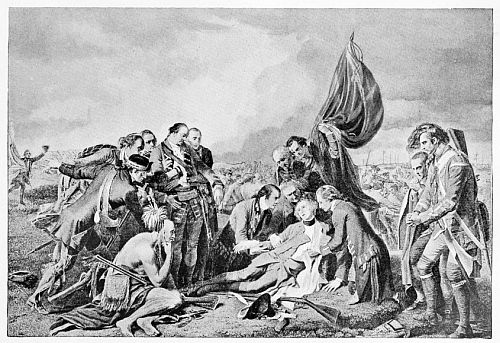
DEATH OF WOLFE. (From the picture by Benjamin West, P.R.A.)
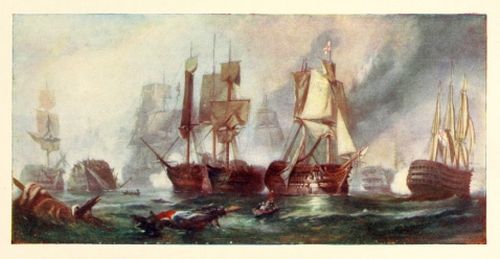
The Battle of Trafalgar, and the Victory of Lord Nelson over the French and Spanish Fleets, October 21, 1805. (From the picture by Clarkson Stanfield, R.A., in the National Gallery of British Art.)