Front matter
Reading edition
This ebook is made available at no cost and with very few restrictions. These restrictions apply only if (1) you make a change in the ebook (other than alteration for different display devices), or (2) you are making commercial use of the ebook. If either of these conditions applies, please contact a FP administrator before proceeding.
This work is in the Canadian public domain, but may be under copyright in some countries. If you live outside Canada, check your country's copyright laws. IF THE BOOK IS UNDER COPYRIGHT IN YOUR COUNTRY, DO NOT DOWNLOAD OR REDISTRIBUTE THIS FILE.
Title: The Pageant of British History
Date of first publication: 1908
Author: Sir (James) Edward Parrott (1863-1921)
Date first posted: Sep. 11, 2018
Date last updated: Sep. 11, 2018
Faded Page eBook #20180916
“History is a pageant,
and not a philosophy.”
Augustine Birrell.
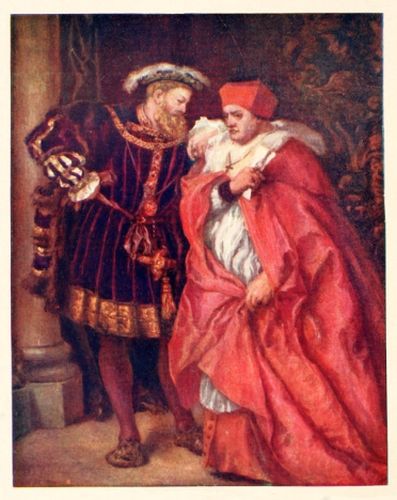
Henry the Eighth and Cardinal Wolsey. (From the picture by Sir John Gilbert, R.A., in the Guildhall Art Gallery, London.)
THE PAGEANT OF
BRITISH HISTORY
DESCRIBED BY
J. EDWARD PARROTT, M.A., LL.D.,
AND DEPICTED BY
THE FOLLOWING GREAT ARTISTS
J. M. W. Turner, G. F. Watts, Benjamin West, Lord Leighton,
Sir John Gilbert, Daniel Maclise, C. W. Cope, John Opie,
William Dyce, Sir L. Alma-Tadema, Sir John Millais,
Paul Delaroche, W. Q. Orchardson, E. M. Ward,
Stanhope Forbes, F. Goodall, Seymour Lucas,
Ford Madox Brown, W. F. Yeames,
Clarkson Stanfield,
etc., etc.

THOMAS NELSON AND SONS
London, Edinburgh, Dublin, and New York
1908
FOREWORD.
The Master of the Pageant spurs into the arena; he waves his baton, and the trumpets sound. In the distance you see a long procession begin to wind its way across the greensward, and as it draws nearer and nearer you recognize the form and fashion of men and women whose names are writ large in the annals of our land. Here they come—king and queen, statesman and priest, warrior and merchant, poet and man of law, shipman and craftsman, yeoman and peasant—a motley throng, all sorts and conditions of men and women, high and low, rich and poor, gentle and simple, noble and base, hero and craven; yet each in his or her several degree a maker of history. These are the “counterfeit presentments” of the men and women who through twice a thousand years have made us what we are, and our glorious land what it is.
As they troop by, let a humble chronicler—who prays that he may not be considered intrusive—recall the story of their heroisms, their trials, their sufferings, their glories, or, it may be, their failures, their treacheries, and their shames. Perchance ’twill be a twice-told tale, “familiar as household words” yet it is a recital that can never lack hearers while men love the land that bore them, and would fain find example and warning, inspiration and guidance, from the story of the past. The chronicler pretends to no philosophy save this—that since we have, under Providence, been created a “noble and puissant nation” and entrusted with a heritage without peer in the history of the world, we should be false to our sires, false to ourselves, and false to our destiny were we, by selfishness, sloth, or ignorance, to neglect to be great through “craven fears of being great.” And since the best and only true foundation of patriotism is knowledge, he would fain hope that these sketches may stimulate in some who are growing towards manhood and womanhood a humble pride in the greatness of their land and a fervent desire so to play their part that Britain may be what she was meant to be—the Vicegerent of the Almighty in the uplifting and ennoblement of the world. In this belief he echoes the prayer of the poet:—
“Land of Hope and Glory, Mother of the Free,
How shall we extol thee, who are born of thee?
Wider still, and wider, shall thy bounds be set;
God, who made thee mighty, make thee mightier yet.”
CONTENTS.
——••——
I.Britain before the Roman Conquest.
The Phœnicians9
The Ancient Britons12
The Druids17
The Coming of Cæsar20
II.The Shadow of Rome.
Caractacus27
A Warrior Queen30
The Iron Hand33
III.The Coming of the English.
King Arthur and the Knights of the Round Table41
Hengist and Horsa46
Ethelbert and Bertha50
The Singer of the First English Song55
IV.The Viking Invasions.
The Coming of the Sea-Kings57
Alfred the Great60
King Canute69
V.The Coming of the Normans.
Harold of England and William of Normandy74
The Eve of the Invasion79
The Battle of Hastings83
Hereward the Wake91
VI.England under the Normans.
William the Red96
Matilda, “Lady” of England100
The Great Archbishop106
Strongbow113
Richard of the Lion Heart118
King John and Magna Charta127
VII.The Three Edwards.
The First Prince of Wales135
William Wallace140
Robert the Bruce149
Merciful Queen157
The Black Prince163
VIII.On French Fields.
King Harry the Fifth169
Joan, the Maid176
IX.The Wars of the Roses.
The King-Maker184
The Little Princes in the Tower191
X.Tudor Times.
John and Sebastian Cabot195
King and Cardinal200
The New Worship207
XI.A Tragic Story.
Mary Queen of Scots210
XII.In the Spacious Days.
The Spanish Armada224
Sir Walter Raleigh232
XIII.The Great Rebellion.
Charles the First242
Oliver Cromwell252
Robert Blake258
XIV.From the Restoration to the Revolution.
The Restoration of Charles the Second268
James, Duke of Monmouth278
XV.After the Revolution.
William the Third292
The Great Duke of Marlborough297
XVI.Bonnie Prince Charlie.310
XVII.Makers of Empire.
Robert Clive, the Daring in War323
James Wolfe, Conqueror of Canada335
XVIII.Nelson of the Nile.347
XIX.Wellington.363
XX.Victoria the Good.376
XXI.Edward the Peacemaker.383
LIST OF ILLUSTRATIONS
———••———
IN COLOUR.
Henry the Eighth and Cardinal Wolsey,
Hunters and Traders,
Caractacus in Rome,
Sir Tristram at the Court of Arthur,
Augustine preaching to Ethelbert and Bertha,
Alfred in the Camp of the Danes,
Coronation of William the Conqueror,
Death of Becket,
Crusaders on the March,
King Richard and the Young Archer,
Hubert and Arthur,
The Trial of Wallace,
Edward the Third at the Siege of Calais,
The Black Prince being made a Knight of the Garter,
The Little Princes in the Tower,
The Departure of John and Sebastian Cabot on their First Voyage of Discovery, 1497,
Cardinal Wolsey on his Way to Westminster Hall,
The Murder of Rizzio,
The Armada in Sight,
Charles the First leaving Westminster Hall after his Trial,
Cromwell dictating Dispatches to Milton,
The Fall of Clarendon,
The Last Sleep of Argyll,
The Prince of Orange landing at Torbay,
The British Assault on the Village of Blenheim,
A Royal Fugitive,
The Battle of Trafalgar, and the Victory of Lord Nelson over the French and Spanish Fleets, October 21, 1805,
The Death of Nelson,
Napoleon on Board the Bellerophon,
The Meeting of Wellington and Blücher after the Battle of Waterloo,
Saving the Colours: An Incident of the Battle of Inkermann,
Jessie’s Dream,
IN BLACK AND WHITE.
The First Invasion of Britain by Julius Cæsar,
The Invasion of the Emperor Claudius,
The Emperor Hadrian visiting a Pottery in Britain,
Columba preaching,
A Great Viking,
The Death of Harold,
Hereward yielding to William,
“God Wills It!”
The First Prince of Wales,
The Battle of Bannockburn,
The Morning of Agincourt,
The Coronation of Charles the Seventh at Rheims,
Joan of Arc storming the “Bulwark” (Orleans),
Death of Warwick,
Richard the Third at the Battle of Bosworth,
Trial of Queen Catherine,
Henry the Eighth,
At Sea. “Farewell, France!”
Escape of Mary Queen of Scots from Loch Leven Castle,
Queen Elizabeth at Tilbury Fort,
The Boyhood of Sir Walter Raleigh,
Cromwell at Marston Moor,
Jane Lane helping Prince Charles to escape,
Rescued from the Plague, London, 1665,
The Arrest of Alice Lisle,
Bonnie Prince Charlie,
After Culloden: Royalist Soldiers searching for Jacobite Fugitives,
Clive at Bay,
Death of Wolfe,
Queen Victoria in her Coronation Robes,
Queen Victoria at St. Paul’s,
Edward the Seventh,