Orbis Sensualium Pictus,
Charles Hoole translation
A World of Things Obvious to the Senses drawn in Pictures.
I.
Invitation.
Invitatio.
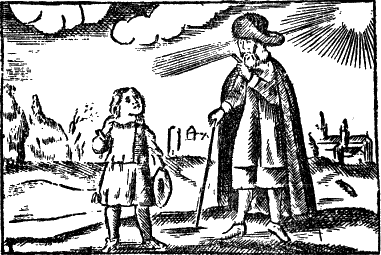
The Master and the Boy. Magister & Puer.
M. Come, Boy, learn to be wise. M. Veni, Puer, disce sapere.
P. What doth this mean, to be wise? P. Quid hoc est, Sapere?
M. To understand rightly, to do rightly, and to speak out rightly all that are necessary. M. Intelligere recte, agere recte, et eloqui recte omnia necessaria.
P. Who will teach me this? P. Quis docebit me hoc?
M. I, by God’s help. M. Ego, cum DEO.
P. How? P. Quomodo?
M. I will guide thee thorow all. M. Ducam te per omnia.
I will shew thee all. Ostendam tibi omnia.
I will name thee all. Nominabo tibi omnia.
P. See, here I am; lead me in the name of God. P. En, adsum; duc me in nomine DEI.
M. Before all things, thou oughtest to learn the plain sounds, of which man’s speech consisteth; which living creatures know how to make, and thy Tongue knoweth how to imitate, and thy hand can picture out. M. Ante omnia, debes discere simplices Sonos ex quibus Sermo humanus constat; quos Animalia sciunt formare, & tua Lingua scit imitari, & tua Manus potest pingere.
Afterwards we will go into the World, and we will view all things. Postea ibimus Mundum, & spectabimus omnia.
Here thou hast a lively and Vocal Alphabet. Hic habes vivum et vocale Alphabetum.
All pictures A-M, N-Z
Cornix cornicatur, à à The Crow crieth. A a
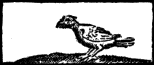
Agnus balat, b è è è The Lamb blaiteth. B b
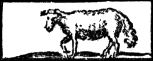
Cicàda stridet, cì cì The Grasshopper chirpeth. C c
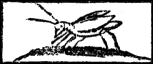
Upupa dicit, du du The Whooppoo saith. D d
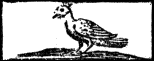
Infans ejulat, è è è The Infant crieth. E e
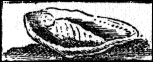
Ventus flat, fi fi The Wind bloweth. F f
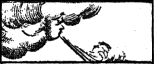
Anser gingrit, ga ga The Goose gagleth. G g
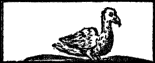
Os halat, hà’h hà’h The Mouth breatheth. H h
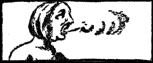
Mus mintrit, ì ì ì The Mouse chirpeth. I i
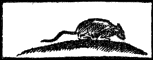
Anas tetrinnit, kha, kha The Duck quaketh. K k
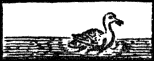
Lupus ululat, lu ulu The Wolf howleth. L
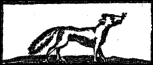
Ursus murmurat, mum mum The Bear grumbleth. M m
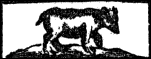
Felis clamat, nau nau The Cat crieth. N n
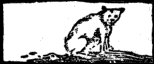
Auriga clamat, ò ò ò The Carter crieth. O o
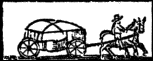
Pullus pipit, pi pi The Chicken peepeth. P p
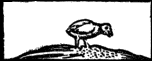
Cúculus cuculat, kuk ku The cuckow singeth. Q q
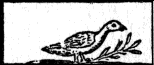
Canis ringitur, err The dog grinneth. R r
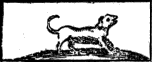
Serpens sibilat, si The Serpent hisseth. S s
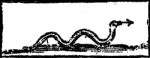
Graculus clamat, tac tac The Jay crieth. T t
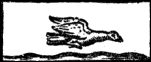
Bubo ululat, ù ù The Owl hooteth. U u
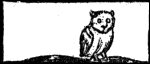
Lepus vagit, va The Hare squeaketh. W w
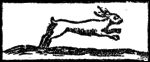
Rana coaxat, coax The Frog croaketh. X x
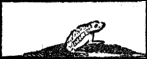
Asinus rudit, y y y The Asse brayeth. Y y
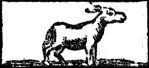
Tabanus dicit, ds ds The Breeze or Horse-flie saith. Z z
II.
God.
Deus.

God is of himself from everlasting to everlasting. Deus est ex seipso, ab æterno in æternum.
A most perfect and a most blessed Being. Perfectissimum & beatissimum Ens.
In his Essence Spiritual, and One. Essentiâ Spiritualis & unus.
In his Personality, Three. Hypostasi Trinus.
In his Will, Holy, Just, Merciful and True. Voluntate, Sanctus, Justus, Clemens, Verax.
In his Power very great. Potentiâ maximus.
In his Goodness, very good. Bonitate Optimus.
In his Wisdom, unmeasurable. Sapientiâ, immensus.
A Light inaccessible; and yet all in all. Lux inaccessa; & tamen omnia in omnibus.
Every where, and no where. Ubique & nullibi.
The chiefest Good, and the only and inexhausted Fountain of all good things. Summum Bonum, et solus et inexhaustus Fons omnium Bonorum.
As the Creator, so the Governour and Preserver of all things, which we call the World. Ut Creator, ita Gubernator et Conservator omnium rerum, quas vocamus Mundum.
III.
The World.
Mundus.
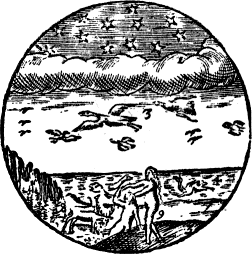
The Heaven, 1. hath Fire, and Stars. Cœlum, 1. habet Ignem & Stellas.
The Clouds, 2. hang in the Air. Nubes, 2. pendent in Aere.
Birds, 3. fly under the Clouds. Aves, 3. volant sub nubibus.
Fishes, 4. swim in the Water. Pisces, 4. natant in Aqua.
The Earth hath Hills, 5. Woods, 6. Fields, 7. Beasts, 8. and Men, 9. Terra habet Montes, 5. Sylvas, 6. Campos, 7. Animalia, 8. Homines, 9.
Thus the greatest Bodies of the World, the four Elements, are full of their own Inhabitants. Ita maxima Corpora Mundi, quatuor Elementa, sunt plena Habitatoribus suis.
IV.
The Heaven.
Cœlum.
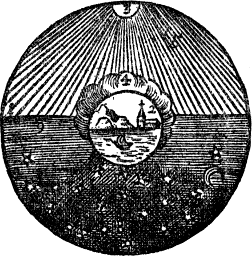
The Heaven, 1. is wheeled about, and encompasseth the Earth, 2. standing in the middle. Cœlum, 1. rotatur, & ambit Terram, 2. stantem in medio.
The Sun, 3. wheresoever it is, shineth perpetually, howsoever dark Clouds, 4. may take it from us; and causeth by his Rays, 5. Light, and the Light, Day. Sol, 3. ubi ubi est, fulget perpetuo, ut ut densa Nubila, 4. eripiant eum a nobis; facitque suis Radiis, 5. Lucem, Lux Diem.
On the other side, over against it, is Darkness, 6. and thence Night. Ex opposito, sunt Tenebræ, 6. inde Nox.
In the Night shineth the Moon, 7. and the Stars, 8. glister and twinkle. Nocte splendet Luna, 7. & Stellæ, 8. micant, scintillant.
In the Evening, 9. is Twilight: Vesperi, 9. est Crepusculum:
In the Morning, 10. the breaking, and dawning of the Day. Manè Aurora, 10. & Diluculum.
V.
Fire.
Ignis.
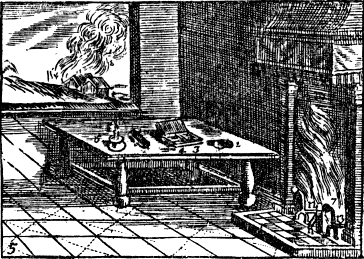
The Fire gloweth, burneth and consumeth to ashes. Ignis ardet, urit, cremat.
A spark of it struck out of a Flint (or Firestone), 2. by means of a Steel, 1. and taken by Tynder in a Tynder-box, 3. lighteth a Match, 4. and after that a Candle, 5. or stick, 6. and causeth a flame, 7. or blaze, 8. which catcheth hold of the Houses. Scintilla ejus elisa e Silice, (Pyrite) 2. Ope Chalybis, 1. et excepta a Fomite in Suscitabulo, 3. accendit Sulphuratum, 4. et inde Candelam, 5. vel Lignum, 6. et excitat Flammam, 7. vel Incendium, 8. quod corripit Ædificia.
Smoak, 9. ascendeth therefrom, which, sticking to the Chimney, 10. turneth into Soot. Fumus, 9. ascendit inde, qui, adhærans Camino, 10. abit in Fuliginem.
Of a Fire-brand, (or burning stick) is made a Brand, 11. (or quenched stick). Ex Torre, (ligno ardente,) fit Titio, 11. (lignum extinctum.)
Of a hot Coal (red hot piece of a Fire-brand) is made a Coal, 12. (or a dead Cinder). Ex Pruna, (candente particulâ Torris,) fit Carbo, 12. (Particula mortua.)
That which remaineth, is at last Ashes, 13. and Embers (or hot Ashes). Quod remanet, tandem est Cinis, 13. & Favilla (ardens Cinis.)
VI.
The Air.
Aër.
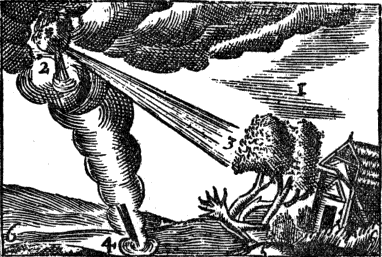
A cool Air, 1. breatheth gently. Aura, 1. spirat leniter.
The Wind, 2. bloweth strongly. Ventus, 2. flat valide.
A Storm, 3. throweth down Trees. Procella, 3. sternit Arbores.
A Whirl-wind, 4. turneth it self in a round compass. Turbo, 4. agit se in gyrum.
A Wind under Ground, 5. causeth an Earthquake. Ventus subterraneus, 5. excitat Terræ motum.
An Earthquake causeth gapings of the Earth, (and falls of Houses.) 6. Terræ motus facit Labes (& ruinas.) 6.
VII.
The Water.
Aqua.
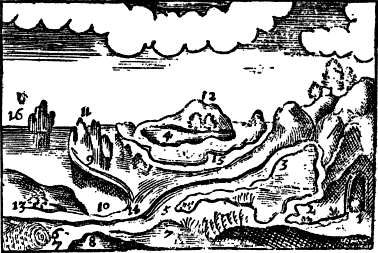
The Water springeth out of a Fountain, 1. floweth downwards in a Brook, 2. runneth in a Beck, 3. standeth in a Pond, 4. glideth in a Stream, 5. is whirled about in a Whirl-pit, 6. and causeth Fens, 7. Aqua scatet è Fonte, 1. defluit in Torrente, 2. manat in Rivo, 3. stat in Stagno, 4. fluit in Flumine, 5. gyratur in Vortice, 6. & facit Paludes, 7.
The River hath Banks, 8. Flumen habet Ripas.
The Sea maketh Shores, 9. Bays, 10. Capes, 11. Islands, 12. Almost Islands, 13. Necks of Land, 14. Straights, 15. and hath in it Rocks, 16. Mare facit Littora, 9. Sìnus, 10. Promontoria, 11. Insulas, 12. Peninsulas, 13. Isthmos, 14. Freta, 15. & habet Scopulos, 16.
VIII.
The Clouds.
Nubes.
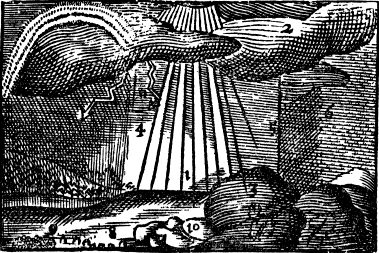
A Vapour, 1. ascendeth from the Water. Vapor, 1. ascendit ex Aquâ.
From it a Cloud, 2. is made, and a white Mist, 3. near the Earth. Inde Nubes, 2. fit, et Nebula, 3. prope terram.
Rain, 4. and a small Shower distilleth out of a Cloud, drop by drop. Pluvia, 4. et Imber, stillat e Nube, guttatim.
Which being frozen, is Hail, 5. half frozen is Snow, 6. being warm is Mel-dew. Quæ gelata, Grando, 5. semigelata, Nix, 6. calefacta, Rubigo est.
In a rainy Cloud, set over against the Sun the Rainbow, 7. appeareth. In nube pluviosâ, oppositâ soli Iris, 7. apparet.
A drop falling into the water maketh a Bubble, 8. many Bubbles make froth, 9. Gutta incidens in aquam, facit Bullam, 8. multæ Bullæ faciunt spumam, 9.
Frozen Water is called Ice, 10. Dew congealed, is called a white Frost. Aqua congelata Glacies, 10. Ros congelatus, dicitur Pruina.
Thunder is made of a brimstone-like vapour, which breaking out of a Cloud, with Lightning, 11. thundereth and striketh with lightning. Tonitru fit ex Vapore sulphureo, quod erumpens è Nube cum Fulgure, 11. tonat & fulminat.
IX.
The Earth.
Terra.
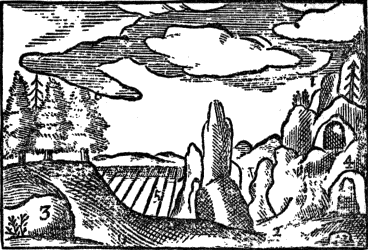
In the Earth are high Mountains, 1. Deep Vallies, 2. Hills rising, 3. Hollow Caves, 4. Plain Fields, 5. Shady Woods, 6. In Terra sunt Alti Montes, 1. Profundæ valles, 2. Elevati Colles, 3. cavæ Speluncæ, 4. Plani campi, 5. Opacæ Sylvæ, 6.
X.
The Fruits of the Earth.
Terræ Fœtus.
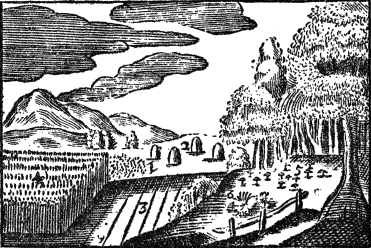
A meadow, 1. yieldeth grass with Flowers and Herbs, which being cut down, are made Hay, 2. Pratum, 1. fert Gramina, cum Floribus & Herbis quæ defecta fiunt Fænum, 2.
A Field, 3. yieldeth Corn, and Pot-herbs, 4. Arvum, 3. fert Fruges, & Olera, 4.
Mushrooms, 5. Straw-berries, 6. Myrtle-trees, &c. come up in Woods. Fungi, 5. Fraga, 6. Myrtilli, &c. Proveniunt in Sylvis.
Metals, Stones, and Minerals grow under the earth. Metalla, Lapides, Mineralia, nascuntur sub terra.
XI.
Metals.
Metalla.
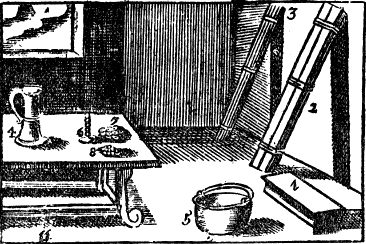
Lead, 1. is soft, and heavy. Plumbum, 1. est molle & grave.
Iron, 2. is hard, and Steel, 3. harder. Ferrum, 2. est durum, & Calybs, 3. durior.
They make Tankards (or Cans), 4. of Tin. Faciunt Cantharos, 4. e Stanno.
Kettles, 5. of Copper, Ahena, 5, e Cupro,
Candlesticks, 6. of Latin, Candelabra, 6. ex Orichalco,
Dollers, 7. of Silver, Thaleros, 7. ex Argento,
Ducats and Crown-pieces, 8. of Gold. Scutatos et Coronatos, 8. Ex, Auro.
Quick-silver is always liquid, and eateth thorow Metals. Argentum Vivum, semper liquet, & corrodit Metalla.
XII.
Stones.
Lapides.
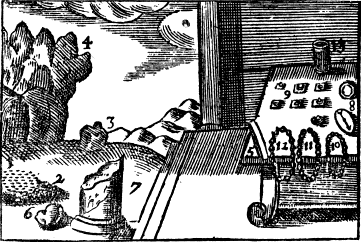
Sand, 1. and Gravel, 2. is Stone broken into bits. Arena, 1. & Sabulum, 2. est Lapis comminutus.
A great Stone, 3. is a piece of a Rock (or Crag) 4. Saxum, 3. est pars Petræ (Cautis) 4.
A Whetstone, 5. a Flint, 6. a Marble, 7. &c. are ordinary Stones. Cos, 5. Silex, 6. Marmor, 7. &c. sunt obscuri Lapides.
A Load-stone, 8. draweth Iron to it. Magnes, 8. adtrahit ferrum.
Jewels, 9. are clear Stones, as Gemmæ, 9. sunt pellucidi Lapilli,
The Diamond white ut Adamas candidus,
The Ruby red, Rubinus rubeus,
The Sapphire blue, Sapphirus cæruleus,
The Emerald green, Smaragdus viridis,
The Jacinth yellow, &c. Hyacynthus luteus, &c.
And they glister being cut into corners. et micant angulati.
Pearls and Unions, 10. grow in Shell-fish. Margaritæ & Uniones, 10. crescunt in Conchis.
Corals, 11. in a Sea-shrub. Corallia, 11. in Marinâ arbusculâ.
Amber, 12. is gathered from the Sea. Succinum, 12. colligitur è mari.
Glass, 13, is like Chrystal. Vitrum, 13. simile est Chrystallo.
XIII.
Tree.
Arbor.
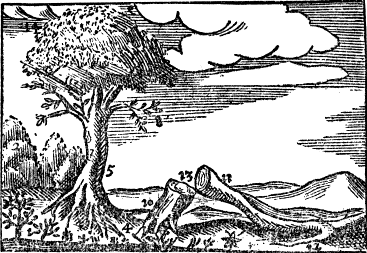
A Plant, 1. groweth from a Seed. Planta, 1. procrescit e Semine.
A plant waxeth to a Shoot, 2. Planta abit in Fruticem, 2.
A Shoot to a Tree, 3. Frutex in Arborem, 3.
The Root, 4. beareth up the Tree. Radix, 4. Sustentat arborem.
The Body or Stem, 5. riseth from the Root. Stirps (Stemma) 5. Surgit e radice.
The Stem divideth it self into Boughs, 6. and green Branches, 7. made of Leaves, 8. Stirps se dividit in Ramos, 6. & Frondes, 7. factas e Foliis, 8.
The top, 9. is in the height. Cacumen, 9. est in summo.
The Stock, 10. is close to the roots. Truncus, 10. adhærat radicibus.
A Log, 11. is the body fell’d down without Boughs; having Bark and Rind, 12. Pith and Heart, 13. Caudex, 11. est Stipes dejectus, sine ramis; habens Corticem & Librum, 12. pulpam & medullam, 13.
Bird-lime, 14. groweth upon the boughs, which also sweat Gumm, Rosin, Pitch, &c. Viscum, 14. adnascitur ramis, qui etiam sudant, Gummi, Resinam, Picem, &c.
XIV.
Fruits of Trees.
Fructus Arborum.
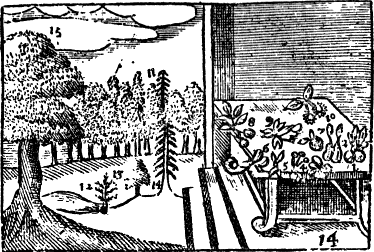
Fruits that have no shells are pull’d from fruit-bearing trees. Poma decerpuntur, a fructiferis arboribus.
The Apple, 1. is round. Malum, 1. est rotundum.
The Pear, 2. and Fig, 3. are something long. Pyrum, 2. & Ficus, 3. sunt oblonga.
The Cherry, 4. hangeth by a long start. Cerasum, 4. pendet longo Pediolo.
The Plumb, 5. and Peach, 6. by a shorter. Prunum, 5. & Persicum, 6. breviori.
The Mulberry, 7. by a very short one. Morum, 7. brevissimo.
The Wall-nut, 8. the Hazel-nut, 9. and Chest-nut, 10. are wrapped in a husk and a Shell. Nux Juglans, 8. Avellana, 9. & Castanea, 10. involuta sunt Cortici & Putamini.
Barren trees are 11. The Firr, the Alder, The Birch, the Cypress, The Beech, the Ash, The Sallow, the Linden-tree, &c., but most of them affording shade. Steriles arbores sunt 11. Abies, Alnus, Betula, Cupressus, Fagus, Fraxinus, Salix, Tilia, &c. sed pleræque umbriferæ.
But the Juniper, 12. and Bay-tree, 13. yield Berries. At Juniperus, 12. & Laurus, 13. ferunt Baccas.
The Pine, 14. Pine-apples. Pinus, 14. Strobilos.
The Oak, 15. Acorns and Galls. Quercus, 15. Glandes & Gallas.
XV.
Flowers.
Flores.
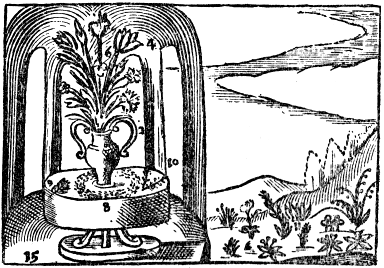
Amongst the Flowers the most noted, Inter flores notissimi,
In the beginning of the Spring are the Violet, 1. the Crow-toes, 2. the Daffodil, 3. Primo vere, Viola, 1. Hyacinthus, 2. Narcissus, 3.
Then the Lillies, 4. white and yellow and blew, 5. and the Rose, 6. and the Clove-gilliflowers, 7. &c. Tum Lilia, 4. alba & lutea, & cœrulea, 5. tandem Rosa, 6. & Caryophillum, 7. &c.
Of these Garlands, 8. and Nosegays, 9. are tyed round with twigs. Ex his Serta, 8. & Serviæ, 9. vientur.
There are added also sweet herbs, 10. as Marjoram, Flower gentle, Rue, Lavender, Rosemary. Hysop, Spike, Basil, Sage, Mints, &c. Adduntur etiam Herbæ odoratæ, 10. ut Amaracus, Amaranthus, Ruta, Lavendula, Rosmarinus, (Libanotis). Hypossus, Nard, Ocymum, Salvia, Menta, &c.
Amongst Field-flowers, 11. the most noted are the May-lillie, Germander, the Blew-Bottle, Chamomel, &c. Inter Campestres Flores, 11. notissimi sunt Lilium Convallium, Chamædrys, Cyanus, Chamæmelum, &c.
And amongst Herbs, Trefoil. Wormwood, Sorrel, the Nettle, &c. Et Herbæ, Cytisus (Trifolium) Absinthium, Acetosa, Urtica, &c.
The Tulip, 12. is the grace of flowers, but affording no smell. Tulipa, 12. est decus Florum, sed expers odoris.
XVI.
Potherbs.
Olera.
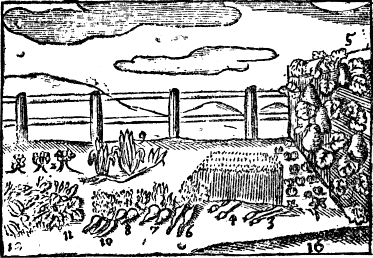
Pot-herbs grow in Gardens, as Lettice, 1. Colewort, 2. Onions, 3. Garlick, 4. Gourd, 5. The Parsnep, 6. The Turnep, 7. The Radish, 8. Horse-radish, 9. Parsly, 10. Cucumbers, 11. and Pompions, 12. Olera nascuntur in hortis, ut Lactuca, 1. Brassica, 2. Cepa, 3. Allium, 4. Cucurbita, 5. Siser, 6. Rapa, 7. Raphanus minor, 8. Raphanus major, 9. Petroselinum, 10. Cucumeres, 11. Pepones, 12.
XVII.
Corn.
Fruges.
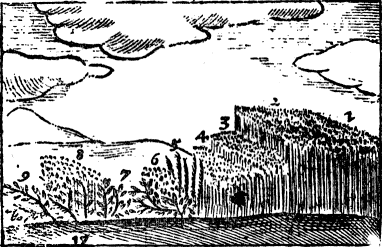
Some Corn grows upon a straw, parted by knots, as Wheat, 1. Rie, 2, Barley, 3. in which the Ear hath awnes, or else it is without awnes, and it nourisheth the Corn in the Husk. Frumenta quædam crescunt super culmum, distinctum geniculis, ut, Triticum, 1. Siligo, 2. Hordeum, 3. in quibus Spica habet Aristas, aut est mutica, fovetque grana in gluma.
Some instead of an ear, have a rizom (or plume) containing the corn by bunches, as Oats, 4. Millet, 5. Turkey-wheat, 6. Quædam pro Spica, habent Paniculam, continentem grana fasciatim, ut, Avena, 4. Milium, 5. Frumentum Saracenicum, 6.
Pulse have Cods, which enclose the corns in two Shales, as Pease, 7. Beans, 8. Vetches, 9. and those that are less than these Lentils and Urles (or Tares). Legumina habent Siliquas, quæ includunt grana valvulis, ut, Pisum, 7. Fabæ, 8. Vicia, 9. & minores his Lentes & Cicera.
XVIII.
Shrubs.
Frutices.
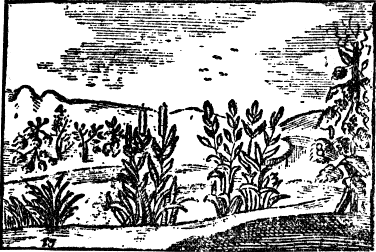
A plant being greater, and harder than an herb, is called a Shrub: such as are Planta major & durior herba, dicitur Frutex: ut sunt
In Banks and Ponds, the Rush, 1. the Bulrush, 2. or Cane without knots bearing Cats-tails, and the Reed, 3. which is knotty and hollow within. In ripis & stagnis, Juncus, 1. Scirpus, 2. [Canna] enodis ferens Typhos, & Arundo, 3. nodosa et cava intus.
Elsewhere, 4. the Rose, the Bastard-Corinths, the Elder, the Juniper. Alibi, 4. Rosa, Ribes, Sambucus, Juniperus,
Also the Vine, 5. which putteth forth branches, 6. and these tendrels, 7. Vine-leaves, 8. and Bunches of grapes, 9. on the stock whereof hang Grapes, which contain Grape-stones. Item Vitis, 5. quæ emittit Palmites, 6. et hi Capreolos, 7. Pampinos, 8. et Racemos, 9. quorum Scapo pendent Uvæ, continentes Acinos.
XIX.
Living-Creatures: and First, Birds.
Animalia: & primum, Aves
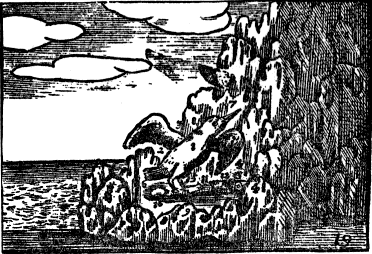
A living Creature liveth, perceiveth, moveth it self; is born, dieth, is nourished, and groweth: standeth, or sitteth, or lieth, or goeth. Animal vivit, sentit, movet se; nascitur, moritur, nutritur, & crescit; stat, aut sedet, aut cubat, aut graditur.
A Bird, (here the King’s Fisher, 1.* making her nest in the Sea.) is covered with Feathers, 2. flyeth with Wings, 3. hath two Pinions, 4. as many Feet, 5. a Tail, 6. and a Bill, 7. Avis, (hic Halcyon, 1. in mari nidulans.) tegitur Plumis, 2. volat Pennis, 3. habet duas Alas, 4. totidem Pedes, 5. Caudam, 6. & Rostrum, 7.
The Shee, 8. layeth Eggs, 10. in a nest, 9. and sitting upon them, hatcheth young ones, 11. Fæmella, 8. ponit Ova, 10. in nido, 9. et incubans iis, excludit Pullos, 11.
An Egg is cover’d with a Shell, 12. under which is the White, 13. in this the Yolk, 14. Ovum tegitur testa, 12. sub qua est Albumen, 13. in hoc Vitellus, 14.
XX.
Tame Fowls.
Aves Domesticæ.
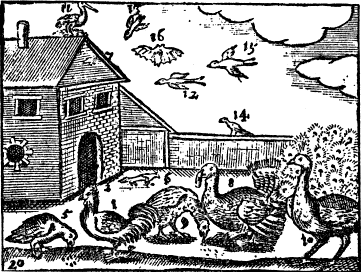
The Cock, 1. (which croweth in the Morning.) hath a Comb, 2. and Spurs, 3. being gelded, he is called a Capon, and is crammed in a Coop, 4. Gallus, 1. (qui cantat mane.) habet Cristam, 2. & Calcaria, 3. castratus dicitur Capo & saginatur in Ornithotrophico, 4.
A Hen, 5. scrapeth the Dunghil, and picketh up Corns: as also the Pigeons, 6. (which are brought up in a Pigeon-house, 7.) and the Turkey-cock, 8. with his Turkey-hen, 9. Gallina, 5. ruspatur fimetum, & colligit grana: sicut & Columbæ, 6, (quæ educantur in Columbario, 7.) & Gallopavus, 8. cum sua Meleagride, 9.
The gay Peacock, 10. prideth in his Feathers. Formosus Pavo, 10. superbit pennis.
The Stork, 11. buildeth her nest on the top of the House. Ciconia, 11. nidificat in tecto.
The Swallow, 12. the Sparrow, 13. the Mag-pie, 14. the Jackdaw, 15. and the Bat, 16. (or Flettermouse) use to flie about Houses. Hirundo, 12. Passer, 13. Pica, 14. Monedula, 15. & Vespertilio, 16. (Mus alatus) volitant circa Domus.
XXI.
Singing-Birds.
Oscines.
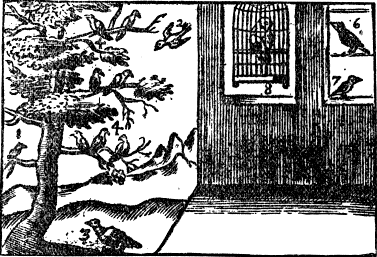
The Nightingal, 1. singeth the sweetlyest of all. Luscinia (Philomela), 1. cantat suavissime omnium.
The Lark, 2. singeth as she flyeth in the Air. Alauda, 2. cantillat volitans in aere;
The Quail, 3. sitting on the ground; Coturnix, 3. sedens humi;
others on the boughs of trees, 4. as the Canary-bird, the Chaffinch, the Goldfinch, the Siskin, the Linnet, the little Titmouse, the Wood-wall, the Robin-red-breast, the Hedge-sparrow, &c. Cæteræ, in ramis arborum, 4. ut Luteola peregrina. Fringilla, Carduelis, Acanthis, Linaria, parvus Parus, Galgulus, Rubecula, Curruca, &c.
The party colour’d Parret, 5. the Black-bird, 6. the Stare, 7. with the Mag-pie and the Jay, learn to frame men’s words. Discolor Psittacus, 5. Merula, 6. Sturnus, 7. cum Pica, & Monedula, discunt humanas voces formare
A great many are wont to be shut in Cages, 8. Pleræque solent includi Caveis, 8.
XXII.
Birds that haunt the Fields and Woods.
Aves Campestres & Sylvestres
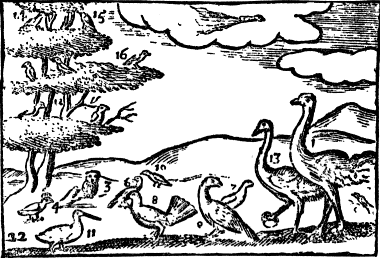
The Ostrich, 1. is the greatest Bird. Struthio, 1. ales est maximus.
The Wren, 2. is the least. Regulus, 2. (Trochilus) minimus.
The Owl, 3. is the most despicable. Noctua, 3. despicatissimus.
The Whoopoo, 4. is the most nasty, for it eateth dung. Upupa, 4. sordidissimus, vescitur enim stercoribus.
The Bird of Paradise, 5. is very rare. Manucodiata, 5. rarissimus.
The Pheasant, 6. the Bustard, 7. the deaf wild Peacock, 8. the Moor-hen, 9. the Partrige, 10. the Woodcock, 11. and the Thrush, 12. are counted Dainties. Phasianus, 6. Tarda (Otis), 7. surdus, Tetrao, 8. Attagen, 9. Perdix, 10. Gallinago (Rusticola), 11. & Turdus, 12, habentur in deliciis.
Among the rest, the best are, the watchful Crane, 13. the mournful Turtle, 14. the Cuckow, 15. the Stock-dove, the Speight, the Jay, the Crow, &c., 16. Inter reliquas, potissimæ sunt, Grus 13. pervigil. Turtur, 14. gemens. Cuculus, 15. Palumbes, Picus, Garrulus, Cornix, &c., 16.
XXIII.
Ravenous Birds.
Aves Rapaces.
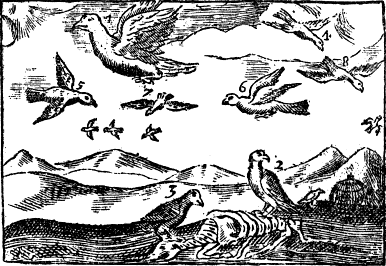
The Eagle, 1. the King of Birds looketh upon the Sun, Aquila, 1. Rex Avium, intuetur Solem.
The Vulture, 2. and the Raven, 3. feed upon Carrion. Vultur, 2. & Corvus, 3. pascuntur morticinis, [cadaveribus.]
The Kite, 4. pursueth Chickens. Milvus, 4. insectatur pullos gallinaceos.
The Falcon, 5. the Hobbie, 6. and the Hawk, 7. catch at little Birds. Falco, 5, Nisus, 6. & Accipiter, 7. captant aviculas.
The Gerfalcon, 8. catcheth Pigeons and greater Birds. Astur, 8. captat columbas & aves majores.
XXIV.
Water-Fowl.
Aves Aquaticæ.
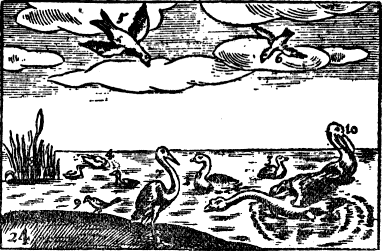
The white Swan, 1. the Goose, 2. and the Duck, 3. swim up and down. Oler, 1. candidus, Anser, 2. & Anas, 3. natant.
The Cormorant, 4. diveth. Mergus, 4. se mergit.
Add to these the water-hen, and the Pelican, &c., 10. Adde his Fulicam, Pelecanum, &c., 10.
The Osprey, 5. and the Sea-mew, 6. flying downwards use to catch Fish, but the Heron, 7. standing on the Banks. Haliæetus, 5. & Gavia, 6. devolantes, captant pisces, sed Ardea, 7. stans in ripis.
The Bittern, 8. putteth his Bill in the water, and belloweth like an Ox. Butio, 8. inferit rostrum aquæ, & mugit ut bos.
The Water-wagtail, 9. waggeth the tail. Motacilla, 9. motat caudam.
XXV.
Flying Vermin.
Insecta volantia.
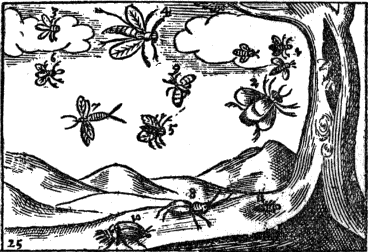
The Bee, 1. maketh honey which the Drone, 2. devoureth. Apis, 1. facit mel quod Fucus, 2. depascit
The Wasp, 3. and the Hornet, 4. molest with a sting; and the Gad-Bee (or Breese), 5. especially Cattel; but the Fly, 6. and the Gnat, 7. us. Vespa, 3. & Crabro, 4. infestant oculeo; & Oestrum (Asilus), 5. imprimis pecus. autem Musca, 6. & Culex, 7. nos.
The Cricket, 8. singeth. Gryllus, 8. cantillat.
The Butterfly, 9. is a winged Caterpillar. Papillio, 9. est alata Eruca.
The Beetle, 10. covereth her wings with Cases. Scarabæus, 10. tegit alas vaginis.
The Glow-worm, 11. shineth by night. Cicindela [Lampyris], 11. nitet noctu.
XXVI.
Four-Footed Beasts: and First those about the House.
Quadrupeda: & primum Domestica.
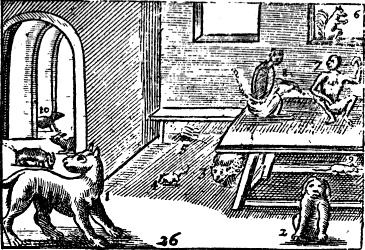
The Dog, 1. with the Whelp, 2. is keeper of the House. Canis, 1. cum Catello, 2. est custos Domûs.
The Cat, 3. riddeth the House of Mice, 4. which also a Mouse-trap, 5. doth. Felis (Catus) 3. purgat domum à Muribus, 4. quod etiam Muscipula, 5. facit.
A Squirrel, 6. The Ape, 7. and the Monkey, 8. are kept at home for delight. Sciurus, 6. Simia, 7. & Cercopithecus, 8. habentur domi delectamento.
The Dormouse, 9. and other greater Mice, 10. as, the Weesel, the Marten, and the Ferret, trouble the House, Glis, 9. & cæteri Mures majores, 10. ut, Mustela, Martes, Viverra, infestant domum.
XXVII.
Herd-Cattle.
Pecora.
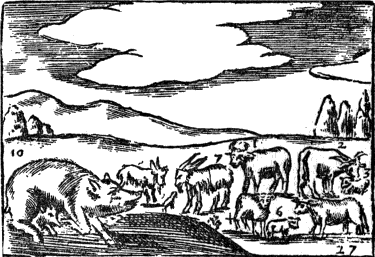
The Bull, 1. the Cow, 2. and the Calf, 3. are covered with hair. Taurus, 1. Vacca, 2. & Vitulus, 3. teguntur pilis.
The Ram, the Weather, 4. the Ewe, 5. and the Lamb, 6. bear wool. Aries, Vervex, 4. Ovis, 5. cum Agno, 6. gestant lanam.
The He-goat, the Gelt-goat, 7. with the She-goat, 8. and Kid, 9. have shag-hair and beards. Hircus, Caper, 7. cum Capra, 8. & Hædo, 9. habent. Villos & aruncos.
The Hog, the Sow, 10. and the Pigs, 11. have bristles, but not horns; but also cloven feet as those others (have.) Porcus, Scrofa, 10. cum Porcellis, 11. habent Setas, at non Cornua; sed etiam Ungulas bisulcas ut illa.
XXVIII.
Labouring-Beasts.
Jumenta.
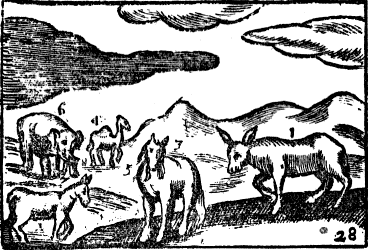
The Ass, 1. and the Mule, 2. carry burthens. Asinus, 1. & Mulus, 2. gestant Onera.
The Horse, 3. (which a Mane, 4. graceth) carryeth us. Equus, 3. (quam Juba, 4. ornat) gestat nos ipsos.
The Camel, 5. carryeth the Merchant with his Ware. Camelus, 5. gestat Mercatorem cum mercibus suis.
The Elephant, 6. draweth his meat to him with his Trunk, 7. Elephas, (Barrus) 6. attrahit pabulum Proboscide, 7.
He hath two Teeth, 8. standing out, and is able to carry full thirty men. Habet duos dentes, 8. prominentes, & potest portare etiam triginta viros.
XXIX.
Wild-Cattle.
Feræ Pecudes.
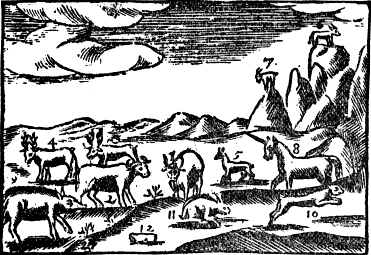
The Buff, 1. and the Buffal, 2. are wild Bulls. Urus, 1. & Bubalus, 2. sunt feri Boves.
The Elke, 3. being bigger than an Horse (whose back is impenetrable) hath knaggy horns as also the Hart, 4. Alces, 3. major equo (cujus tergus est impenetrabilis) habet ramosa cornua: ut & Cervus, 4.
but the Roe, 5. and the Hind-calf, almost none. Sed Caprea, 5. cum Hinnulo, ferè nulla.
The Stone-back, 6. huge great ones. Capricornus, 6. prægrandia;
The Wild-goat, 7. hath very little ones, by which she hangeth her self on a Rock. Rupicapra, 7. minuta, quibus suspendit se ad rupem.
The Unicorn, 8. hath but one, but that a precious one. Monoceros, 8. habet unum, sed pretiosum.
The Boar, 9. assaileth one with his tushes. Aper, 9. grassatur dentibus.
The Hare, 10. is fearful. Lepus, 10. pavet.
The Cony, 11. diggeth the Earth. Cuniculus, 11. perfodit terram;
As also the Mole, 12. which maketh hillocks. Ut & Talpa, 12. quæ facit grumos.
XXX.
Wild-Beasts.
Feræ Bestiæ.
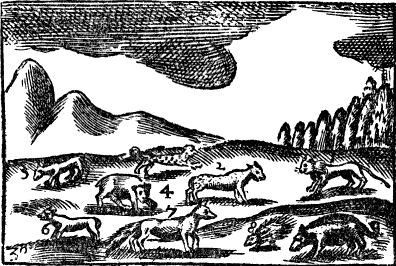
Wild Beasts have sharp paws, and teeth, and are flesh eaters. Bestiæ habent acutos ungues, & dentes, suntque carnivoræ,
As the Lyon, 1. the King of four-footed Beasts, having a mane; with the Lioness. Ut Leo, 1. Rex quadrupedum, jubatus; cum Leænâ.
The spotted Panther, 2. Maculosus, Pardo (Panthera) 2.
The Tyger, 3. the cruellest of all. Tygris, 3. immanissima omnium.
The Shaggy Bear, 4. Villosus Ursus, 4.
The ravenous Wolf, 5. Rapax Lupus, 5.
The quick sighted Ounce, 6. Lynx, 6. visu pollens,
The tayled fox, 7. the craftiest of all. Caudata Vulpes, 7. astutissima omnium.
The Hedge-hog, 8. is prickly. Erinaceus, 8. est aculeatus.
The Badger, 9. delighteth in holes. Melis, 9. gaudet latebris.
XXXI.
Serpents and Creeping things.
Serpentes & Reptilia.
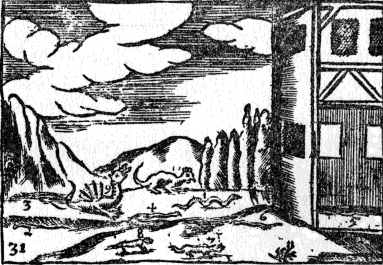
Snakes creep by winding themselves; Angues repunt sinuando se;
The Adder, 1. in the wood; Coluber, 1. in Sylvâ;
The Water-snake, 2. in the water; Natrix, (hydra) 2. in Aquâ;
The Viper, 3. amongst great stones. Vipera, 3. in saxis;
The Asp, 4. in the fields. Aspis, 4, in campis.
The Boa, (or Mild-snake) 5. in Houses. Boa, 5. in Domibus.
The Slow-worm, 6. is blind. Cæcilia, 6. est cœca.
The Lizzard, 7. and the Salamander, 8. (that liveth long in fire) have feet. Lacerta, 7. Salamandra, 8. (in igne vivax,) habent pedes.
The Dragon, 9. a winged Serpent, killeth with his Breath. Draco, 9. Serpens alatus, necat halitu.
The Basilisk, 10. with his Eyes; Basiliscus, 10. Oculis;
And the Scorpion, 11. with his poysonous tail. Scorpio, 11. venenatâ caudâ.
XXXII.
Crawling-Vermin.
Insecta repentia.
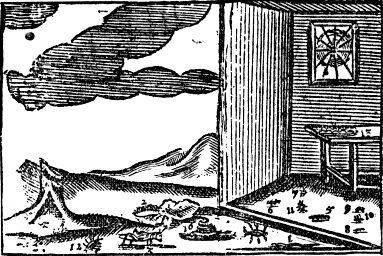
Worms gnaw things. Vermes, rodunt res.
The Earth-worm, 1. the Earth. Lumbricus, 1. terram.
The Caterpillar, 2. the Plant. Eruca, 2. plantam.
The Grashopper, 3. the Fruits. Cicada, 3. Fruges.
The Mite, 4. the Corn. Circulio, 4. Frumenta.
The Timber-worm, 5. Wood. Teredo, (cossis) 5. Ligna.
The Moth, 6. a garment. Tinea, 6. vestem.
The Book-worm, 7. a Book. Blatta, 7. Librum.
Maggots, 8. Flesh and Cheese. Termites, 8. carnem & caseum.
Hand-worms, the Hair. Acari, Capillum.
The skipping Flea, 9. the Lowse, 10. and the stinking Wall-louse, 11. bite us. Saltans Pulex, 9. Pediculus, 10. fœtans Cimex, 11. mordent nos.
The Tike, 12. is a blood-sucker. Ricinus, 12. sanguisugus est.
The Silk-worm, 13. maketh silk. Bombyx, 13. facit sericum.
The Pismire, 14. is painful. Formica, 14. est laboriosa.
The Spider, 15. weaveth a Cobweb, nets for flies. Aranea, 15. texit Araneum, retia muscis.
The Snail, 16. carrieth about her Snail-horn. Cochlea, 16. circumfert testam.
XXXIII.
Creatures that live as well by Water as by Land.
Amphibia.
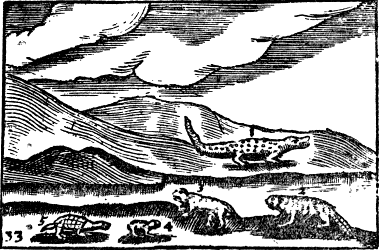
Creatures that live by land and by water, are Viventia in terrâ & aquâ, sunt
The Crocodile, 1. a cruel and preying Beast of the River Nilus; Crocodilus, 1. immanis & prædatrix bestia Nili fluminis;
The Castor or Beaver, 2. having feet like a Goose, and a scaly tail to swim. Castor, (Fiber) 2. habens pedes anserinos & squameam Caudam ad natandum.
The Otter, 3. Lutra, 3.
The croaking Frog, 4. with the Toad. & coaxans Rana, 4. cum Bufone.
The Tortoise, 5. covered above and beneath with shells, as with a target. Testudo, 5. Operta & infra, testis, ceu scuto.
XXXIV.
River Fish and Pond Fish.
Pisces Fluviatiles & Lacustres.
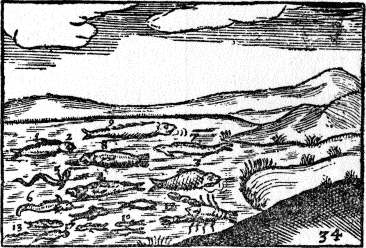
A Fish hath Fins, 1. with which it swimmeth, and Gills, 2. by which it taketh breath, and Prickles instead of bones: besides the Male hath a Milt, and the Female a Row. Piscis habet Pinnas, 1. quibus natat; & Branchias, 2. quibus respirat; & Spinas loco ossium: præterea, Mas Lactes, Fœmina Ova.
Some have Scales. as the Carp, 3. and the Luce or Pike, 4. Quidam habent Squamas, ut Carpio, 3. Lucius, (Lupus) 4.
Some are sleek as the Eel, 5. and the Lamprey, 6. Alii sunt glabri, ut, Anguilla, 5. Mustela, 6.
The Sturgeon, 7. having a sharp snout, groweth beyond the length of a Man. Accipenser (Sturio), 7. mucronatus, crescit ultra longitudinem viri.
The Sheath-fish, 8. having wide Cheeks, is bigger than he: Silurus, 8. bucculentus, major illo est:
But the greatest, is the Huson, 9. Sed maximus Antaseus (Huso,) 9.
Minews, 10. swimming by shoals, are the least. Apuæ, 10. natantes gregatim, sunt minutissimæ.
Others of this sort are the Perch, the Bley, the Barbel, the Esch, the Trout, the Gudgeon, and Trench, 11. Alii hujus generis sunt Perca, Alburnus, Mullus, (Barbus) Thymallus, Trutta, Gobius, Tinca, 11.
The Crab-fish, 12. is covered with a shell, and it hath Claws, and crawleth forwards and backwards. Cancer, 12. tegitur crusta, habetque chelas, & graditur porro & retrò.
The Horse-leech, 13. sucketh blood. Hirudo, 13. sugit sanguinem.
XXXV.
Sea-fish, and Shell-fish.
Marini pisces & Conchæ.
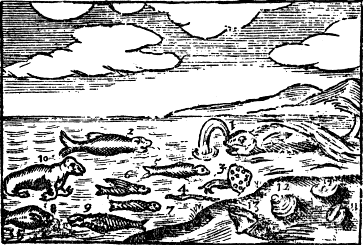
The Whale, 1. is the greatest of the Sea-fish. Balæna, (Cetus) 1. maximus Piscium marinorum.
The Dolphin, 2. the swiftest. Delphinus, 2. velocissimus.
The Scate, 3. the most monstrous. Raia, 3. monstrosissimus.
Others are the Lamprel, 4. the Salmon, or the Lax, 5. Alii sunt Murænula, 4. Salmo, (Esox) 5.
There are also fish that flie, 6. Dantur etiam volatiles, 6.
Add Herrings, 7. which are brought pickled, and Place, 8. and Cods, 9. which are brought dry; and the Sea monsters, the Seal. 10. and the Sea-horse, &c. Adde Haleces, 7. qui salsi, & Passeres, 8. cum Asellis, 9. qui adferuntur arefacti; & monstra marina, Phocam, 10. Hippopotamum, &c.
Shell-fish, 11. have Shells. Concha, 11. habet testas,
The Oyster, 12. affordeth sweet meat. Ostrea, 12. dat sapidam carnem.
The Purple-fish, 13. purple; Murex, 13. purpuram;
The others, Pearls, 14. Alii, 14. Margaritas.
XXXVI.
Man.
Homo.
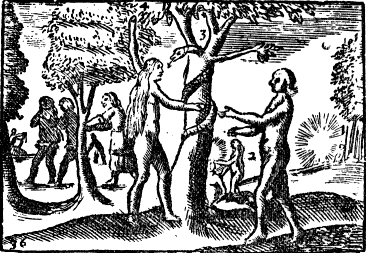
Adam, 1. the first Man, was made by God after his own Image the sixth day of the Creation, of a lump of Earth. Adamus, 1. primus Homo, formatus est a Deo ad Imaginem suam sextâ die Creationis, e Gleba Terræ.
And Eve, 2. the first Woman, was made of the Rib of the Man. Et Eva, 2. prima mulier, formata est e costâ viri.
These, being tempted by the Devil under the shape of a Serpent, 3. when they had eaten of the fruit of the forbidden Tree, 4. were condemned, 5. to misery and death, with all their posterity, and cast out of Paradise, 6. Hi, seducti à Diabolo sub specie Serpentis, 3. cum comederent de fructu vetitæ arboris, 4. damnati sunt, 5. ad miseriam & mortem, cum omni posteritate sua, & ejecti e Paradiso 6.
XXXVII.
The Seven Ages of Man.
Septem Ætates Hominis.
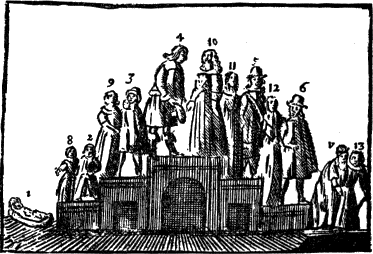
A Man is first an Infant, 1. then a Boy, 2. then a Youth, 3. then a Young-man, 4. then a Man, 5. after that an Elderly-man, 6. and at last, a decrepid old man, 7. Homo est primum Infans, 1. deinde Puer, 2. tum Adolescens, 3. inde Juvenis, 4. posteà Vir, 5. dehinc Senex, 6. tandem Silicernium, 7.
So also in the other Sex, there are, a Girl, 8. A Damosel, 9. a Maid, 10. A Woman, 11. an elderly Woman, 12. and a decrepid old Woman, 13. Sic etiam in altero Sexu, sunt, Pupa, 8. Puella, 9. Virgo, 10. Mulier, 11. Vetula, 12. Anus decrepita, 13.
XXXVIII.
The Outward Parts of a Man.
Membra Hominis Externa.
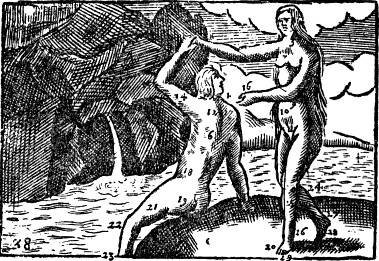
The Head, 1. is above, the Feet, 20. below. the fore part of the Neck (which ends at the Arm-holes, 2.) is the Throat, 3. the hinder part, the Crag, 4. Caput, 1. est supra, infra Pedes, 20. Anterior pars Colli (quod desit in Axillas, 2.) est Jugulum, 3. posterior Cervix, 4.
The Breast, 5, is before; the back, 6, behind; Women have in it two Dugs, 7. with Nipples, Pectus, 5. est ante; Dorsum, 6. retro; Fœeminis sunt in illo binæ Mammæ, 7. cum Papillis.
Under the Breast is the Belly, 9. in the middle of it the Navel, 10. underneath the Groyn, 11. and the privities. Sub pectore est Venter, 9. in ejus medio, Umbelicus, 10. subtus Inguen, 11. & pudenda.
The Shoulder-blades, 12. are behind the back, on which the Shoulders depend, 13. on these the Arms, 14. with the Elbow, 15. and then on either side the Hands, the right, 8. and the left, 16. Scapulæ, 12. sunt a tergo, â quibus pendent humeri, 13. ab his Brachia, 14. cum Cubito, 15. inde ad utrumque Latus, Manus, Dextera, 8. & Sinistra, 16.
The Loyns are next the Shoulders, with the Hips, 18. and in the Breech, the Buttocks, 19. Lumbi, 17. excipiunt Humeros, cum Coxis, 18. & in Podice, (culo) Nates, 19.
These make the Foot; the Thigh, 21. then the Leg, 23. (the Knee, being betwixt them, 22.) in which is the Calf, 24. with the Shin, 25. then the Ankles, 26. the Heel, 27. and the Sole, 28. in the very end, the great Toe, 29. with four (other) Toes. Absolvunt Pedem; Femur, 21. tum Crus, 23. (Genu, 22. intermedio.) in quo Sura, 24. cum Tilia, 25. abhinc Tali, 26. Calx, (Calcaneum) 27. & Solum, 28. in extremo Hallux, 29. cum quatuor Digitis.
XXXIX.
The Head and the Hand.
Caput & Manus.
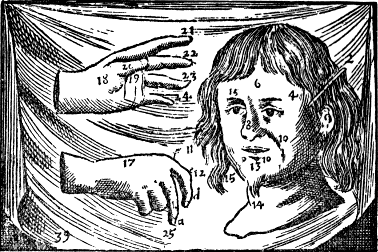
In the Head are the Hair, 1. (which is combed with a Comb, 2.) two Ears, 3. the Temples, 4. and the Face, 5. In Capite sunt Capillus, 1. (qui pectitur Pectine, 2.) Aures, 3. binæ, & Tempora, 4. Facies, 5.
In the Face are the Fore-head, 6. both the Eyes, 7. the Nose, 8. (with two Nostrils) the Mouth, 9. the Cheeks, 10. and the Chin, 13. In facie sunt Frons, 6. Oculus, 7. uterque, Nasus, 8. (cum duabus Naribus) Os, 9. Genæ, (Malæ) 10. & Mentum, 13.
The Mouth is fenced with a Mustacho, 11. and Lips, 12. A Tongue and a Palate, and Teeth, 16. in the Cheek-bone. Os septum est Mystace, 11. & Labiis, 12. Lingua cum Palato, Dentibus, 16. in Maxilla.
A Man’s Chin is covered with a Beard, 14. and the Eye (in which is the White and the Apple) with eye-lids, and an eye-brow, 15. Mentum virile tegitur Barba, 14. Oculos vero (in quo Albugo & Pupilla) palpæbris, & supercilio, 15.
The Hand being closed is a Fist, 17. being open is a Palm, 18. in the midst, is the hollow, 19. of the Hand. the extremity is the Thumb, 20. with four Fingers, the Fore-finger, 21. the Middle-finger, 22. the Ring-finger, 23. and the Little-finger, 24. Manus contracta, Pugnus, 17. est aperta, Palma, 18. in medio Vola, 19. extremitas, Pollex, 20. cum quatuor Digitis, Indice, 21. Medio, 22. Annulari, 23. & Auriculari, 24.
In every one are three joynts, a. b. c. and as many knuckles, d. e. f. with a Nail, 25. In quolibet sunt articuli tres, a. b. c. & totidem Condyli, d. e. f. cum Ungue, 25.
XL.
The Flesh and Bowels.
Caro & Viscera.
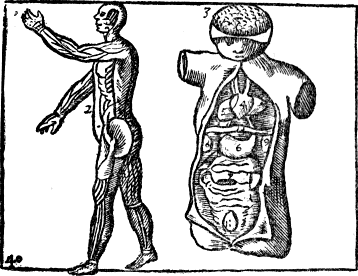
In the Body are the Skin with the Membranes, the Flesh with the Muscles, the Chanels, the Gristles, the Bones and the Bowels. In Corpore sunt Cutis cum Membranis, Caro cum Musculis, Canales, Cartilagines, Ossa & Viscera.
The Skin, 1. being pull’d off, the Flesh, 2. appeareth, not in a continual lump, but being distributed, as it were in stuft puddings, which they call Muscles, whereof there are reckoned four hundred and five, being the Chanels of the Spirits, to move the Members. Cute, 1. detractâ, Caro, 2. apparet, non continuâ massâ, sed distributa, tanquam in farcimina, quos vocant Musculos, quorum numerantur quadringenti quinque, canales Spirituum, ad movendum Membra.
The Bowels are the inward Members: Viscera sunt Membra interna:
As in the Head, the Brains, 3. being compassed about with a Skull, and the Skin which covereth the Skull. Ut in Capite, Cerebrum, 3. circumdatum Cranio, & Pericranio.
In the Breast, the Heart, 4. covered with a thin Skin about it, and the Lungs, 5. breathing to and fro. In Pectore, Cor, 4. obvolutum Pericardio, & Pulmo, 5. respirans.
In the Belly, the Stomach, 6. and the Guts, 7. covered with a Caul. The Liver, 8. and in the left side opposite against it, the Milt, 9. the two Kidneys, 10. and the Bladder, 11. In Ventre, Ventriculus, 6. & Intestina, 7. obducta Omento. Jecur, (Hepar) 8. & à sinistro oppositus ei Lien, 9. duo Renes, 10. cum Vesica, 11.
The Breast is divided from the Belly by a thick Membrane, which is called the Mid-riff, 12. Pectus dividitur à Ventre crassâ Membranâ, quæ vocatur Diaphragma, 12.
XLI.
The Chanels and Bones.
Canales & Ossa.
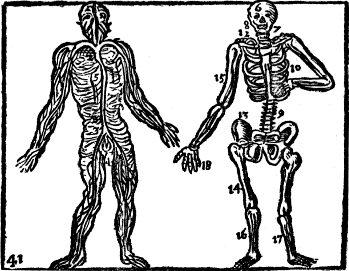
The Chanels of the Body are the Veins, carrying the Blood from the Liver; Canales Corporis sunt Venæ deferentes Sanguinem ex Hepate;
The Arteries (carrying) Heart and Life from the Heat; Arteriæ, Calorem & Vitam è Corde;
The Nerves (carrying) Sense and Motion throughout the Body from the Brain. Nervi, Sensum et Motum, per Corpus a Cerebro.
You shall find these three, 1. everywhere joined together. Invenies hæc tria, 1. ubique sociata.
Besides, from the Mouth into the Stomach is the Gullet, 2. the way of the meat and drink; and by it to the Lights, the Wezand, 5. for breathing; from the Stomach to the Anus is a great Intestine, 3. to purge out the Ordure; from the Liver to the Bladder, the Ureter, 4. for making water. Porrò, ab Ore in Ventriculum Gula, 2. via cibi ac potus; & juxta hanc, ad Pulmonem Guttur, 5. pro respiratione; à ventriculo ad Anum Colon, 3. ad excernendum Stercus; ab Hepate ad Vesicam, Ureter, 4. reddendæ urinæ.
The Bones are in the Head, the Skull, 6. the two Cheek-bones, 7. with thirty-two Teeth, 8. Ossa sunt in Capite, Calvaria, 6. duæ Maxillæ, 7. cum XXXII. Dentibus, 8.
Then the Back-bone, 9. the Pillar of the Body, consisting of thirty-four turning Joints, that the Body may bend it self. Tum, Spina dorsi, 9. columna Corporis, constans ex XXXIV. Vertebris, ut Corpus queat flectere se
The Ribs, 10. whereof there are twenty-four. Costæ, 10. quarum viginti quatuor.
The Breast-bone, 11. the two Shoulder-blades, 12. the Buttock-bone, 13. the bigger Bone in the Arm, 15. and the lesser Bone in the Arm. Os Pectoris, 11. duæ Scapulæ, 12. Os sessibuli, 13. Lacerti, 15. & Ulna.
The Thigh-bone, 14. the foremost, 16. and the hindmost Bone, in the Leg, 17. Tibia, 14. Fibula, 16. anterior, & posterior, 17.
The Bones of the Hand, 18. are thirty-four, and of the Foot, 19. thirty. Ossa Manûs, 18. sunt triginta quatuor, Pedis, 19. triginta.
The Marrow is in the Bones. Medulla est in Ossibus,
XLII.
The Outward and Inward Senses.
Sensus externi & interni.
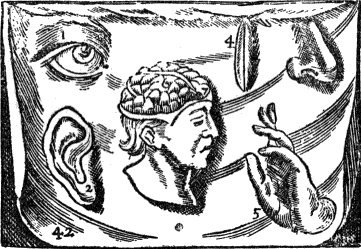
There are five outward Senses; Sunt quinque externi Sensus;
The Eye, 1. seeth Colours, what is white or black, green or blew, red or yellow. Oculus, 1. videt Colores, quid album vel atrum, viride vel cœruleum, rubrum aut luteum, sit.
The Ear, 2. heareth Sounds, both natural, Voices and Words; and artificial, Musical Tunes. Auris, 2. audit Sonos, tum naturales, Voces & Verba; tum artificiales, Tonos Musicos.
The Nose, 3. scenteth smells and stinks. Nasus, 3, olfacit odores & fœtores.
The Tongue, 4. with the roof of the Mouth tastes Savours, what is sweet or bitter, keen or biting, sower or harsh. Lingua, 4. cum Palato gustat Sapores, quid dulce aut amarum, acre aut acidum, acerbum aut austerum.
The Hand, 5. by touching discerneth the quantity and quality of things; the hot and cold, the moist and dry, the hard and soft, the smooth and rough, the heavy and light. Manus, 5. tangendo dignoscit quantitatem, & qualitatem rerum; calidum & frigidum, humidum & siccum, durum & molle, læve & asperum, grave & leve.
The inward Senses are three. Sensus interni sunt tres.
The Common Sense, 7. under the forepart of the head, apprehendeth things taken from the outward Senses. Sensus Communis, 7. sub sincipite apprehendit res perceptas a Sensibus externis.
The Phantasie, 6. under the crown of the head judgeth of those things, thinketh and dreameth, Phantasia, 6. sub vertice, dijudicat res istas, cogitat, somniat.
The Memory, 8. under the hinder part of the head, layeth up every thing and fetcheth them out: it loseth some, and this is forgetfulness. Memoria, 8. sub occipitio, recondit singula & depromit: deperdit quædam, & hoc est oblivio.
Sleep, is the rest of the Senses. Somnus, est requies Sensuum.
XLIII.
The Soul of Man.
Anima hominis.
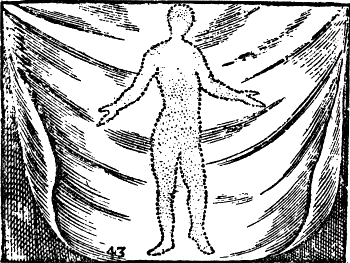
The Soul is the Life of the Body, one in the whole. Anima est vita corporis, una in toto.
Only Vegetative in Plants; Tantùm Vegetativa in Plantis;
Withal Sensitive in Animals; Simul Sensitiva in Animalibus;
And also rational in Men. Etiam Rationalis in Homine.
This consisteth in three things; Hæc consistet in tribus:
In the Understanding, whereby it judgeth and understandeth a thing good and evil, or true, or apparent. In Mente (Intellectu) quâ cognoscit, & intelligit, bonum ac malum, vel verum, vel apparens.
In the Will, whereby it chooseth, and desireth, or rejecteth, and misliketh a thing known. In Voluntate, quâ eligit, & concupiscit, aut rejicit, & aversatur cognitum.
In the Mind, whereby it pursueth the Good chosen or avoideth the Evil rejected. In Animo, quo prosequitur Bonum electum, vel fugit Malum rejectum.
Hence is Hope and Fear in the desire, and dislike. Hinc Spes & Timor, in cupidine, & aversatione:
Hence is Love and Joy, in the Fruition: Hinc Amor & Gaudium, in fruitione:
But Anger and Grief, in suffering. Sed Ira ac Dolor, in passione.
The true judgment of a thing is Knowledge; the false, is Error, Opinion and Suspicion. Vera cognitio rei, est Scientia; falsa, Error, Opinio, Suspicio.
XLIV.
Deformed and Monstrous People.
Deformes & Monstrosi.
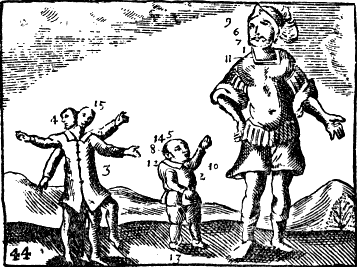
Monstrous and deformed People are those which differ in the Body from the ordinary shape, as the huge Gyant, 1. the little Dwarf, 2. One with two Bodies, 3. One with two Heads, 4. and such like Monsters. Monstrosi, & deformes sunt abeuntes corpore à communi formâ, ut sunt, immanis Gigas, nanus (Pumilio), 2. Bicorpor, 3. Biceps, 4. & id genus monstra.
Amongst these are reckoned, The jolt-headed, 5. The great nosed, 6. The blubber-lipped, 7. The blub-cheeked, 8. The goggle-eyed, 9. The wry-necked, 10. The great-throated, 11. The Crump-backed, 12. The Crump-footed, 13. The steeple-crowned, 15. add to these The Bald-pated, 14. His accensentur, Capito, 5. Naso, 6. Labeo, 7. Bucco, 8. Strabo, 9. Obstipus, 10. Strumosus, 11. Gibbosus, 12. Loripes, 13. Cilo, 15. adde Calvastrum, 14.
XLV.
The Dressing of Gardens.
Hortorum cultura.
We have seen Man: Now let us go on to Man’s living, and to Handy-craft-Trades, which tend to it. Vidimus hominem: Jam pergamus ad Victum hominis, & ad Artes Mechanicas, quæ huc faciunt.
The first and most ancient sustenance, were the Fruits of the Earth. Primus & antiquissimus Victus, erant Fruges Terræ.
Hereupon the first labour of Adam, was the dressing of a garden. Hinc primus Labor Adami, Horti cultura.
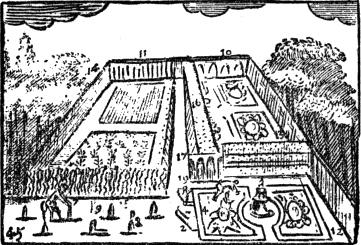
The Gardener, 1. diggeth in a Garden-plot, with a Spade, 2. or Mattock, 3. and maketh Beds, 4. and places wherein to plant Trees, 5. on which he setteth Seeds and Plants. Hortulanus (Olitor), 1. fodit in Viridario, Ligone, 2. aut Bipalio, 3. facitque Pulvinos, 4. ac Plantaria, 5. quibus inserit Semina & Plantas.
The Tree-Gardener, 6. planteth Trees, 7. in an Orchard, and grafteth Cyons, 8. in Stocks, 9. Arborator, 6. plantat Arbores, 7. in Pomario, inseritque Surculos, 8. Viviradicibus, 9.
He fenceth his Garden, either by care, with a mound, 10. or a Stone-wall, 11. or a rail, 12. or Pales, 13. or a Hedge, 14. made of Hedge-stakes, and bindings; Sepit hortum vel Cura, Muro, 10. aut Macerie, 11. aut Vacerra, 12. aut Plancis, 13. aut Sepe, 14. flexâ è sudibus & vitilibus;
Or by Nature, with Brambles and Bryers, 15. Vel Natura Dumis & Vepribus, 15.
It is beautified with Walks, 16. and Galleries, 17. Ornatur Ambulacris, 16. & Pergulis, 17.
It is watered with Fountains, 18. and a Watering-pot, 19. Rigatur Fontanis, 18. & Harpagio, 19.
XLVI.
Husbandry.
Agricultura.
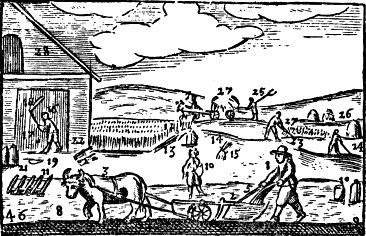
The Plow-man, 1. yoketh Oxen, 3. to a Plough, 2. and holding the Plow-stilt, 4. in his left hand, and the Plow-staff, 5. in his right hand, with which he removeth Clods, 6. he cutteth the Land, (which was manured afore with Dung, 8.) with a Share, 7. and a Coulter, and maketh furrows, 9. Arator, 1. jungit Boves, 3. Aratro, 2. & tenens Stivam, 4. lævâ, Rallum, 5. dextrâ, quâ amovet Glebas, 6. scindit terram (stercoratam antea Fimo, 8.) Vomere, 7. et Dentali, facitque Sulcos, 9.
Then he soweth the Seed, 10. and harroweth it in with a Harrow, 11. Tum seminat Semen, 10. & inoccat Occâ, 11.
The Reaper, 12. sheareth the ripe corn with a Sickle, 13. gathereth up the handfuls, 14. and bindeth the Sheaves, 15. Messor, 12. metit fruges maturas Falce messoris, 13. colligit Manipulos, 14. & colligat Mergetes, 15.
The Thrasher, 16. thrasheth Corn on the Barn-floor, 17. with a Flayl, 18. tosseth it in a winnowing-basket, 19. and so when the Chaff, and the Straw, 20. are separated from it, he putteth it into Sacks, 12. Tritor, 16. triturat frumentum in Area Horrei, 17. Flagello (tribula), 18. jactat ventilabro, 19. atque ita Paleâ & Stramine, 20. separatâ, congerit in Saccos, 21.
The Mower, 22. maketh Hay in a Meadow, cutting down Grass with a Sithe, 23. and raketh it together with a Rake, 24. and maketh up Cocks, 26. with a fork, 25, and carrieth it on Carriages, 27. into the Hay-barn, 28. Fœniseca, 22. facit Fœnum in Prato, desecans Gramen Falce fœnaria, 23. corraditque Rastro, 24. componit Acervos, 26. Furca, 25. & convehit Vehibus, 27. in Fœnile, 28.
XLVII.
Grasing.
Pecuaria.
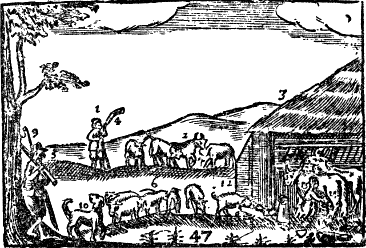
Tillage of ground, and keeping Cattle, was in old time the care of Kings and Noble-men; at this Day only of the meanest sort of People, Cultus Agrorum, & res pecuaria, antiquissimis temporibus, erat cura Regum, Heroum; hodie tantum infirmæ Plebis,
The Neat-heard, 1. calleth out the Heards, 2. out of the Beast-houses, 3. with a Horn, 4. and driveth them to feed. Bubulcus, 1. evocat Armenta, 2. è Bovilibus, 3. Buccina (Cornu), 4, & ducit pastum.
The Shepherd, 5. feedeth his Flock, 6. being furnished with a Pipe, 7. and a Scrip, 8. and a Sheep-hook, 9. having with him a great Dog, 10. fenced with a Collar, 11. against the Wolves. Opilio (Pastor), 5. pascit Gregem, 6. instructus Fistula, 7. & Pera, 8. ut & Pedo, 9. habens secum Molossum, 10. munitum Millo, 11. contra Lupos.
Swine, 12. are fed out of a Swine-Trough. Sues, 12. saginantur ex aqualiculo haræ.
The Farmer’s Wife, 13. milketh the Udders of the Cow, 15. at the Cratch, 15. over a milk-pale, 16. and maketh Butter of Cream in a Churn, 17. and Cheeses, 18. of Curds. Villica, 13. mulget Ubera vaccæ, 14. ad Præsepe, 15. super mulctra, 16. et facit Butyrum è flore lactis, in Vase butyraceo, 17. et Caseos, 18. è Coagulo.
The Wool, 19. is shorn from Sheep, whereof several Garments are made. Lana, 19. detondetur Ovibus, ex quà variæ Vestes conficiuntur.
XLVIII.
The making of Honey.
Mellificium.
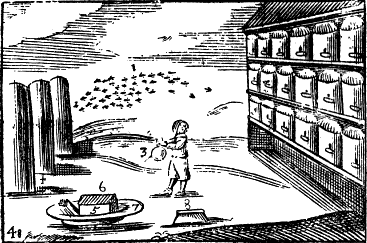
The Bees send out a swarm, 1. and set over it a Leader, 2. Apes emittunt Examen, 1. adduntque illi Ducem (Regem), 2.
That swarm being ready to fly away is recalled by the Tinkling of a brazen Vessel, 3. and is put up into a new Hive, 4. Examen illud, avolaturum, revocatur tinnitu Vasis ænei, 3. & includitur novo Alveari, 4.
They make little Cells with six corners, 5. and fill them with Honey-dew, and make Combs, 6. out of which the Honey runneth, 7. Struunt Cellulas sexangulares, 5. et complent eas Melligine, & faciunt Favos, 6. è quibus Mel effluit, 7.
The Partitions being melted by fire, turn into Wax, 8. Crates liquati igne abeunt in Ceram, 8.
XLIX.
Grinding.
Molitura.
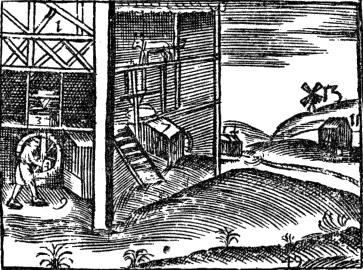
In a Mill, 1. a Stone, 2. runneth upon a stone, 3. In Mola, Lapis, 2. currit super lapidem, 3,
A Wheel, 4. turning them about and grindeth Corn poured in by a Hopper, 5. and parteth the Bran, 6. falling into the Trough, 7. from the Meal slipping through a Bolter, 8. Rota, 4. circumagente, et conterit grana infusa per Infundibulum, 5. separatque Furfurem, 6. decidentem in Cistam, 7. à Farina (Polline) elabente per Excussorium, 8.
Such a Mill was first a Hand-mill, 9. then a Horse-mill, 10. then a Water-mill, 11. then a Ship-mill, 12. and at last a Wind-mill, 13. Talis Mola primùm fuit Manuaria, 9. deinde Jumentaria, 10. tum Aquatica, 11. & Navalis, 12. tandem, Alata (pneumatica), 13.
L.
Bread-baking.
Panificium.
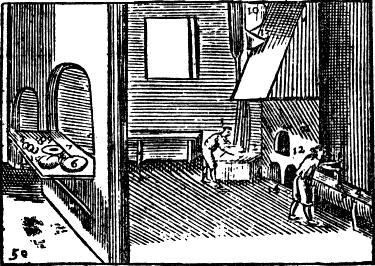
The Baker, 1. sifteth the Meal in a Rindge, 2. and putteth it into the Kneading-trough, 3. Pistor, 1. cernit Farinam Cribo, 2. (pollinario) & indit Mactræ, 3.
Then he poureth water to it and maketh Dough, 4. and kneadeth it with a wooden slice, 5. Tum affundit aquam, & facit Massam, 4. depsitque spatha, 5. ligneâ.
Then he maketh Loaves, 6. Cakes, 7. Cimnels, 8. Rolls, 9, &c. Dein format Panes, 6. Placentas, 7. Similas, 8. Spiras, 9. &c.
Afterwards he setteth them on a Peel, 10. and putteth them thorow the Oven-mouth, 12. into the Oven, 11. Post imponit Palæ, 10. & ingerit Furno, 11. per Præfurnium, 12.
But first he pulleth out the fire and the Coals with a Coal-rake, 13. which he layeth on a heap underneath, 14. Sed priùs eruit ignem & Carbones Rutabulo, 13. quos congerit infra, 14.
And thus is Bread baked, having the Crust without, 15. and the Crumb within, 16. Et sic Panis pinsitur habens extra Crustam, 15. intus Micam, 16.
LI.
Fishing.
Piscatio.
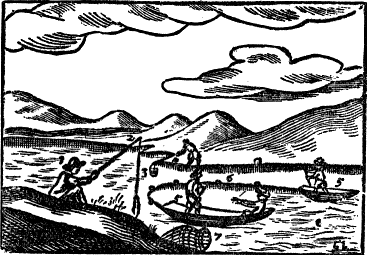
The Fisher-man, 1. catcheth fish, either on the Shoar, with an Hook, 2. which hangeth by a Line from the angling-rod, on which the Bait sticketh; or with a Cleek-net, 3. which hangeth on a Pole, 4. is put into the Water; or in a Boat, 5. with a Trammel-net, 6. or with a Wheel, 7. which is laid in the Water by Night. Piscator, 1. captat pisces, sive in littore, Hamo, 2. qui pendet filo ab arundine, & cui Esca inhæret; sive Fundâ, 3. quæ pendens Pertica, 4. immittitur aquæ; sive in Cymba, 5. Reti, 6. sive Nassa, 7. quæ demergitur per Noctem.
LII.
Fowling.
Aucupium.
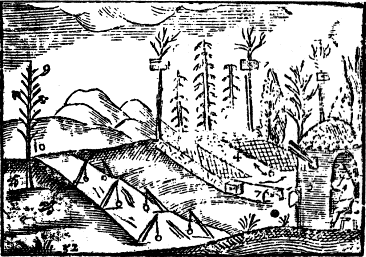
The Fowler, 1. maketh a Bed, 2, spreadeth a Bird-net, 3. throweth a Bait, 4. upon it, and hiding himself in a Hut, 5. he allureth Birds, by the chirping of Lurebirds, which partly hop upon the Bed, 6. and are partly shut in Cages, 7. and thus he entangleth Birds that fly over, in his net whilst they settle themselves down. Auceps, 1. exstruit Aream, 2. superstruit illi Rete aucupatorium, 3. obsipat Escam, 4. & abdens se in Latibulo, 5. allicit Aves, cantu Illicum, qui partim in Area currunt, 6. partim inclusi sunt Caveis, 7. atque ita obruit transvolantes Aves Reti, dum se demittunt:
Or he setteth Snares, 8. on which they hang and strangle themselves: Aut tendit Tendiculas, 8. quibus suspendunt & suffocant seipsas:
Or setteth Lime-twigs, 9. on a Perch, 10. upon which if they sit they enwrap their Feathers, so that they cannot fly away, and fall down to the ground. Aut exponit Viscatos calamos, 9. Amiti, 10. quibus si insident, implicant pennas, ut nequeant avolare, & decidunt in terram.
Or he catcheth them with a Pole, 11. or a Pit-fall, 12. Aut captat Perticâ, 11. vel Decipulâ, 12.
LIII.
Hunting.
Venatus.
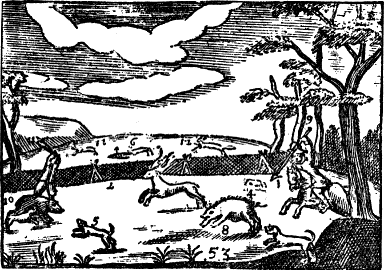
The Hunter, 1. hunteth wild Beasts whilst he besetteth a Wood with Toyls, 2. stretched out upon Shoars, 3. Venator, 1. venatur Feras, dum cingit Sylvam, Cassibus, 2. tentis super Varos, 3. (furcillas.)
The Beagle, 4. tracketh the wild Beast or findeth him out by the scent; the Tumbler, or Greyhound, 5. pursueth it. Canis sagax, 4. vestigat Feram, aut indagat odoratu; Vertagus, 5. persequitur.
The Wolf, falleth in a Pit, 6. the Stag, 7. as he runneth away, into Toyls. Lupus, incidit in Foveam, 6. fugiens Cervus, 7. in Plagas.
The Boar, 8. is struck through with a Hunting-spear, 9. Aper, 8. transverberatur Venabulo, 9.
The Bear, 10. is bitten by Dogs, and is knocked with a Club, 11. Ursus, 10. mordetur à Canibus, & tunditur Clavâ, 11.
If any thing get away, it escapeth, 12. as here a Hare and a Fox. Si quid effugit, evadit, 12. ut hic Lepus & Vulpes.
LIV.
Butchery.
Lanionia.
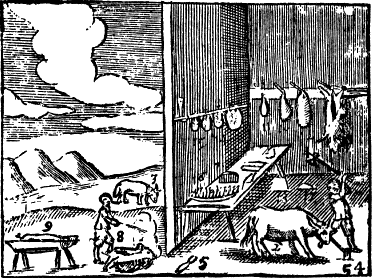
The Butcher, 1. killeth fat Cattle, 2. (The Lean, 3. are not fit to eat.) Lanio, 1. mactat Pecudem altilem, 2. (Vescula, 3. non sunt vescenda.)
He knocketh them down with an Ax, 4. or cutteth their Throat. with a Slaughter-knife, 5. he flayeth them, 6. and cutteth them in pieces, and hangeth out the flesh to sell in the Shambles, 7. Prosternit Clavâ, 4. vel jugulat. Cunaculo, 5. excoriat (deglubit,) 6. dissecatque & exponit carnes, venum in Macello, 7.
He dresseth a Swine, 8. with fire or scalding water, 9. and maketh Gamons, 10. Pistils, 11. and Flitches, 12. Glabrat Suem, 8. igne, vel aquâ fervidâ, 9. & facit Pernas, 10. Petasones, 11. & Succidias, 12.
Besides several Puddings, Chitterlings, 13. Bloodings, 14. Liverings, 15. Sausages, 16. Prætereà Farcimina varia, Faliscos, 13. Apexabones, 14. Tomacula, 15. Botulos, (Lucanicas) 16.
The Fat, 17. and Tallow, 18. are melted. Adeps, 17. & Sebum, 18. eliquantur.
LV.
Cookery.
Coquinaria.
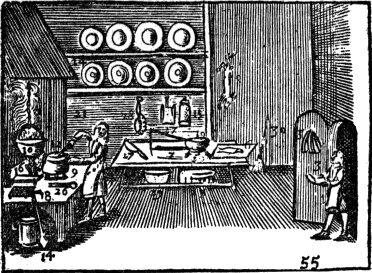
The Yeoman of the Larder, 1. bringeth forth Provision, 2. out of the Larder, 3. Promus Condus, 1. profert Obsonia, 2. è Penu, 3.
The Cook, 4. taketh them and maketh several Meats. Coquus, 4. accipit ea & coquit varia Esculenta.
He first pulleth off the Feathers and draweth the Gutts out of the Birds, 5. Prius deplumat, & exenterat Aves, 5.
He scaleth and splitteth Fish, 6. Desquamat & exdorsuat Pisces, 6.
He draweth some flesh with Lard, by means of a Larding-needle, 7. Trajectat quasdem carnes Lardo, ope Creacentri, 7.
He caseth Hares, 8. then he boileth them in Pots, 9. and Kettles, 10. on the Hearth, 11. and scummeth them with a Scummer, 12. Lepores, 8. exuit, tum elixat Ollis, 9. & Cacabis, 10. in Foco, 11. & despumat Lingula, 12.
He seasoneth things that are boyled with Spices, which he poundeth with a Pestil, 14. in a Morter, 13. or grateth with a Grater, 15. Condit elixata, Aromatibus, quæ comminuit Pistillo, 14. in Mortario, 13. aut terit Radulâ, 15.
He roasteth some on Spits, 16. and with a Jack, 17. or upon a Grid-iron, 18. Quædam assat Verubus, 16. & Automato, 17. vel super Craticulum, 18.
Or fryeth them in a Frying-pan, 19. upon a Brand-iron, 20. Vel frigit Sartagine, 19. super Tripodem, 20.
Kitchen utensils besides are, a Coal-rake, 21. a Chafing-dish, 22. a Trey, 23. (in which Dishes, 24. and Platters, 25. are washed), a pair of Tongs, 26. a Shredding-knife, 27. a Colander, 28. a Basket, 29. and a Besom, 30. Vasa Coquinaria præterea sunt, Rutabulum, 21. Foculus (Ignitabulum), 22. Trua, 23. (in quà Catini, 24. & Patinæ, 25. eluuntur) Forceps, 26. Culter incisorius, 27. Qualus, 28. Corbis, 29. & Scopa, 30.
LVI.
The Vintage.
Vindemia.
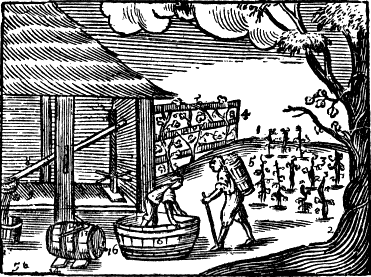
Wine groweth in the Vine-yard, 1. where Vines are propagated and tyed with Twigs to Trees, 2. or to Props, 3. or Frames, 4. Vinum crescit in Vinea, 1. ubi Vites propagantur, & alligantur viminibus ad Arbores, 2. vel ad Palos (ridicas), 3. vel ad Juga, 4
When the time of Grape-gathering is come, they cut off the Bunches, and carry them in Measures of three Bushels, 5. and throw them into a Vat, 6. and tread them with their Feet, 7. or stamp them with a Wooden-Pestil, 8. and squeeze out the juice in a Wine-press, 9. which is called Must, 11. and being received in a great Tub, 10. it is poured into Hogsheads, 12. it is stopped up, 15. and being laid close in Cellars upon Settles, 14. it becometh Wine. Cùm tempus vindemiandi adest, abscindunt Botros, & comportant Trimodiis, 5. conjiciuntque in Lacum, 6. calcant Pedibus, 7. aut tundunt Ligneo Pilo, 8. & exprimunt succum Torculari, 9. qui dicitur Mustum, 11. & exceptum Orcâ, 10. infunditur Vasis (Doliis), 12. operculatur, 15. & abditum in Cellis, super Cantherios, 14. abit in Vinum.
It is drawn out of the Hogshead, with a Cock, 13. or Faucet, 16. (in which is a Spigot) the Vessel being unbunged. Promitur e Dolio Siphone, 13. aut Tubulo, 16. (in quo est Epistomium) Vase relito.
LVII.
Brewing.
Zythopœia.
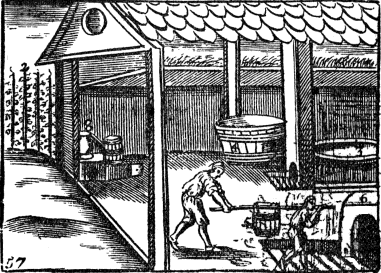
Where Wine is not to be had they drink Beer, which is brewed of Malt, 1. and Hops, 2. in a Caldron, 3. afterwards it is poured into Vats, 4. and when it is cold, it is carried in Soes, 5. into the Cellar, 6. and is put into Vessels. Ubi Vinum non habetur, bibitur Cerevisia (Zythus), quæ coquitur ex Byne, 1. & Lupulo, 2. in Aheno, 3. post effunditur in Lacus, 4. & frigefactum. defertur Labris, 5. in Cellaria, 6. & intunditur vasibus.
Brandy-wine, extracted by the power of heat from dregs of Wine in a Pan, 7. over which a Limbeck, 8. is placed, droppeth through a Pipe, 9. into a Glass. Vinum sublimatum, extractum vi Caloris e fecibus Vini in Aheno, 7. cui Alembicum, 8. superimpositum est. destillat per Tubum, 9. in Vitrum.
Wine and Beer when they turn sowre, become Vinegar. Vinum & Cerevisia, cum acescunt, fiunt Acetum.
Of Wine and Honey they make Mead. Ex Vino & Melle faciunt Mulsum.
LVIII.
A Feast.
Convivium.
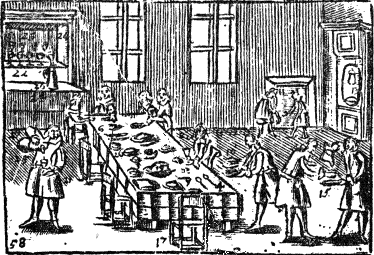
When a Feast is made ready, the table is covered with a Carpet, 1. and a Table-cloth, 2. by the Waiters, who besides lay the Trenchers, 3. Spoons, 4. Knives, 5. with little Forks, 6. Table-napkins, 7. Bread, 8. with a Salt-seller, 9. Cum Convivium apparatur, Mensa sternitur Tapetibus, 1. & Mappa, 2. à Tricliniariis, qui prætereà opponunt Discos (Orbes), 3. Cochlearia, 4. Cultros, 5. cum Fuscinulis, 6. Mappulas, 7. Panem, 8. cum Salino, 9.
Messes are brought in Platters, 10. a Pie, 19. on a Plate. Fercula inferuntur in Patinis, 10. Artocrea, 19. in Lance.
The Guests being brought in by the Host, 11. wash their Hands out of a Laver, 12. or Ewer, 14. over a Hand-basin, 13. or Bowl, 15. and wipe them on a Hand-towel, 16. then they sit at the Table on Chairs, 17. Convivæ introducti ab Hospite, 11. abluunt manus è Gutturnio, 12. vel Aquali, 14. super Malluvium, 13. aut Pelvim, 15. terguntque Mantili, 16. tum assident Mensæ per Sedilia, 17.
The Carver, 18. breaketh up the good Cheer, and divideth it. Structor, 18. deartuat dapes, & distribuit.
Sauces are set amongst Roast-meat, in Sawcers, 20. Embammata interponuntur Assutaris in Scutellis, 20.
The Butler, 21. filleth strong Wine out of a Cruise, 25. or Wine-pot, 26. or Flagon, 27. into Cups, 22. or Glasses, 23. which stand on a Cupboard, 24. and he reacheth them to the Master of the Feast, 28. who drinketh to his Guests. Pincerna, 21. infundit Temetum, ex Urceo, 25. vel Cantharo, 26. vel Lagena, 27. in Pocula, 22. vel Vitrea, 23. quæ extant in abaco, 24. & porrigit, Convivatori, 28. qui propinat Hospitibus.
LIX.
The Dressing of Line.
Tractatio Lini.
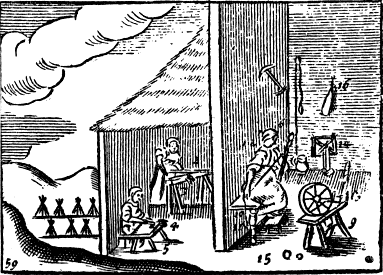
Line and Hemp being rated in water, and dryed again, 1. are braked with a wooden Brake, 2. where the Shives, 3. fall down, then they are heckled with an Iron Heckle, 4. where the Tow, 5. is parted from it. Linum & Cannabis, macerata aquis, et siccata rursum, 1. contunduntur Frangibulo ligneo, 2. ubi Cortices, 3. decidunt tum carminantur Carmine ferreo, 4. ubi Stupa, 5. separatur.
Flax is tyed to a Distaff, 6. by the Spinster, 7. which with her left hand pulleth out the Thread, 8. and with her right hand turneth a Wheel, 9. or a Spindle, 10. upon which is a Wharl, 11. Linum purum alligatur Colo, 6. à Netrice, 7. quæ sinistra trahit Filum, 8. dexterâ, 12. Rhombum (girgillum), 9. vel Fusum, 10. in quo Verticillus, 11.
The Spool receiveth the Thread, 13. which is drawn thence upon a Yarn-windle, 14. hence either Clews, 15. are wound up, or Hanks, 16. are made. Volva accipit Fila, 13. inde deducuntur in Alabrum, 14. hinc vel Glomi, 15. glomerantur, vel Fasciculi, 16. fiunt.
LX.
Weaving.
Textura.
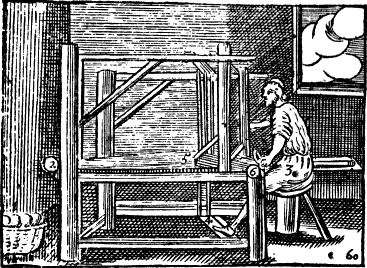
The Webster undoeth the Clews, 1. into Warp, and wrappeth it about the Beam, 2. and as he sitteth in his Loom, 3. he treadeth upon the Treddles, 4. with his Feet. Textor diducit Glomos, 1. in Stamen, & circumvolvit Jugo, 2. ac sedens in Textrino, 3. calcat Insilia, 4. pedibus.
He divideth the Warp, 5. with Yarn. and throweth the Shuttle, 6. through, in which is the Woofe, and striketh it close. with the Sley, 7. and so maketh Linen cloth, 8. Diducit Stamen, 5. Liciis, & trajicit Radium, 6. in quo est Trama, ac densat. Pectine, 7. atque ita conficit Linteum, 8.
So also the Clothier maketh Cloth of Wool. Sic etiam Pannifex facit Pannum è Lana.
LXI.
Linen Cloths.
Lintea.
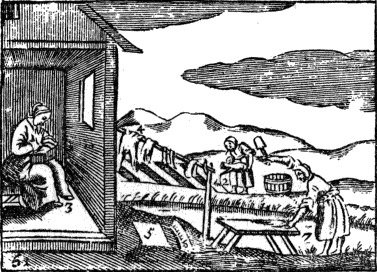
Linnen-webs are bleached in the Sun, 1. with Water poured on them, 2. till they be white. Linteamina insolantur, 1. aquâ perfusâ, 2. donec candefiant.
Of them the Sempster, 3. soweth Shirts, 4. Handkirchers, 5. Bands, 6. Caps, &c. Ex iis Sartrix, 3. suit Indusia, 4. Muccinia, 5. Collaria, 6. Capitia, &c.
These if they be fouled, are washed again by the Laundress, 7. in water, or Lye and Sope. Haec, si sordidentur lavantur rursum, a Lotrice, 7. aquâ, sive Lixivio ac Sapone.
LXII.
The Taylor.
Sartor.
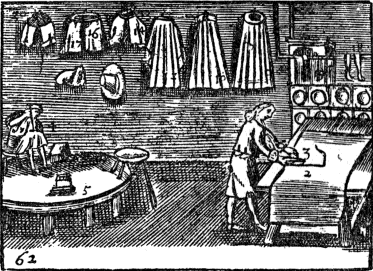
The Taylor, 1. cutteth Cloth, 2. with Shears, 3. and seweth it together with a Needle and double thread, Sartor, 1. discindit Pannum, 2. Forfice, 3. consuitque Acu & Filo duplicato, 4.
Then he presseth the Seams with a Pressing-iron, 5. Posteâ complanat Suturas Ferramento, 5.
And thus he maketh Coats, 6. with Plaits, 7. in which the Border, 8. is below with Laces, 9. Sicque conficit Tunicas, 6. Plicatas, 7. in quibus infra est Fimbria, 8. cum Institis, 9.
Cloaks, 10. with a Cape, 11. and Sleeve Coats, 12. Pallia, 10. cum Patagio, 11. & Togas Manicatas, 12.
Doublets, 13. with Buttons, 14. and Cuffs, 15. Thoraces, 13. cum Globulis, 14. & Manicis, 15.
Breeches, 16. sometimes with Ribbons, 17. Caligas, 16. aliquando cum Lemniscis, 17.
Stockins, 18. Tibialia, 18.
Gloves, 19. Muntero Caps, 20. &c. Chirothecas, 19. Amiculum, 20. &c.
So the Furrier maketh Furred Garments of Furs. Sic Pellio facit Pellicia è Pellibus.
LXIII.
The Shoemaker.
Sutor.
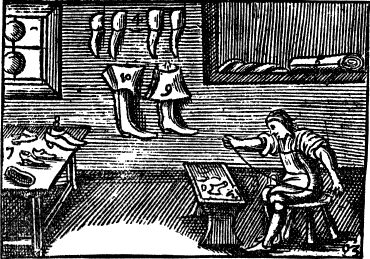
The Shoemaker, 1. maketh Slippers, 7. Shoes, 8. (in which is seen above, the Upper-leather, beneath the Sole, and on both sides the Latchets) Boots, 9. and High Shoes, 10. of Leather, 5. (which is cut with a Cutting-knife), 6. by means of an Awl, 2. and Lingel, 3. upon a Last, 4. Sutor, 1. conficit Crepidas (Sandalia,) 7. Calceos, 8. (in quibus spectatur superne Obstragulum, inferne Solea, et utrinque Ansæ) Ocreas, 9. et Perones, 10. e Corio, 5. (quod discinditur Scalpro Sutorio, 6.) ope Subulæ, 2. et Fili picati, 3. super Modum, 4.
LXIV.
The Carpenter.
Faber lignarius.
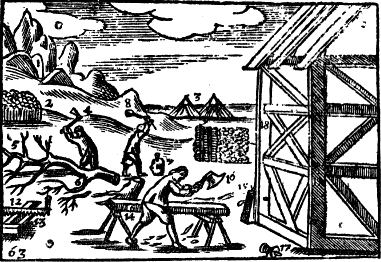
We have seen Man’s food and clothing: now his Dwelling followeth. Hominis victum & amictum, vidimus: sequitur nunc Domicilium ejus.
At first they dwelt in Caves, 1. then in Booths or Huts, 2. and then again in Tents, 3. at the last in Houses. Primò habitabant in Specubus, 1. deinde in Tabernaculis vel Tuguriis, 2. tum etiam in Tentoriis, 3. demum in Domibus.
The Woodman felleth and heweth down Trees, 5. with an Ax, 4. the Boughs, 6. remaining. Lignator sternit & truncat Arbores, 5. Securi, 4. remanentibus Sarmentis, 6.
He cleaveth Knotty Wood with a Wedge, 7. which he forceth in with a Beetle, 8. and maketh Wood-stacks, 9. Findit Nodosum, Lignum Cuneo, 7. quem adigit Tudite, 8. & componit Strues, 9.
The Carpenter squareth Timber with a Chip-Ax, 10. whence Chips, 11. fall, and saweth it with a Saw, 12. where the Saw-dust, 13. falleth down. Faber Lignarius ascit Ascia, 10. Materiem, unde Assulæ, 11. cadunt, & serrat Serrâ, 12. ubi Scobs, 13. decidit.
Afterwards he lifteth the Beam upon Tressels, 14. by the help of a Pully, 15. fasteneth it with Cramp-irons, 16. and marketh it out with a Line, 17. Post elevat Tignum super Canterios, 14· ope Trochleæ, 15. affigit Ansis, 16. & lineat Amussi, 17.
Thus he frameth the Walls together, 18. and fasteneth the great pieces with Pins, 19. Tum compaginat Parietes, 18. & configit trabes Clavis trabalibus, 19.
LXV.
The Mason.
Faber Murarius.
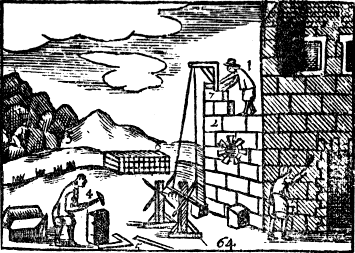
The Mason, 1. layeth a Foundation, and buildeth Walls, 2. Faber Murarius, 1. ponit Fundamentum, & struit Muros, 2.
Either of Stones which the Stone-digger getteth out of the Quarry, 3. and the Stone-cutter, 4. squareth by a Rule, 5. Sive è Lapidibus, quos Lapidarius eruit in Lapicidina, 3. & Latomus, 4. conquadrat ad Normam, 5.
Or of Bricks, 6. which are made of Sand and Clay steeped in water, and are burned in fire. Sive è Lateribus, 6. qui formantur, ex Arena & Luto, aquâ intritis & excoquuntur igne.
Afterwards he plaistereth it with Lime, by means of a Trowel, and garnisheth with a Rough-cast, 8. Dein crustat Calce, ope Trullæ, 7. & vestit Tectorio, 8.
LXVI.
Engines.
Machinæ.
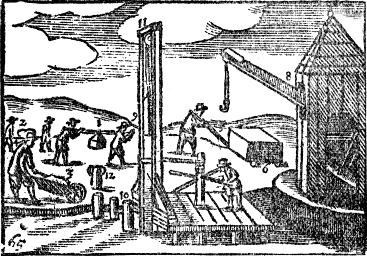
One can carry as much by thrusting a Wheel-barrow, 3. before him, (having an Harness, 4. hanging on his neck,) as two men can carry on a Colestaff, 1. or Hand-barrow, 2. Unus potest ferre tantum trudendo Pabonem, 3. ante se, (Ærumna, Suspensâ a Collo) quantum duo possunt ferre Palangâ, vel Feretro, 2.
But he can do more that rolleth a Weight laid upon Rollers, 6. with a Leaver, 5. Plus autem potest qui provolvit Molem impositam Phalangis (Cylindris, 6.) Vecte, 5.
A Wind-beam, 7. is a post, which is turned by going about it. Ergata, 7. est columella, quæ versatur circumeundo.
A Crane, 8. hath a Hollow-wheel, in which one walking draweth weights out of a Ship, or letteth them down into a Ship. Geranium, 8. habet Tympanum, cui inambulans quis extrahit pondera navi, aut demittit in navem.
A Rammer, 9. is used to fasten Piles, 10. it is lifted with a Rope drawn by Pullies, 11. or with hands. if it have handles, 12. Fistuca, 9. adhibetur ad pangendum Sublicas, 10. adtollitur Fune tracto per Trochleas, 11. vel manibus, si habet ansas, 12.
LXVII.
A House.
Domus.
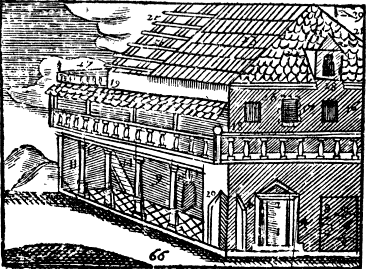
The Porch, 1. is before the Door of the House. Vestibulum, 1. est ante Januam Domûs.
The Door hath a Threshold, 2. and a Lintel, 3. and Posts, 4. on both sides. Janua habet Limen, 2. & Superliminare, 3. & Postes, 4. utrinque.
The Hinges, 5. are upon the right hand, upon which the Doors, 6. hang, the Latch, 7. and the Bolt, 8. are on the left hand. Cardines, 5. sunt a dextris, à quibus pendent Fores, 6. Claustrum, 7. aut Pessulus, 8. a sinistris.
Before the House is a Fore-court, 9. with a Pavement of square stones, 10. born up with Pillars, 11. in which is the Chapiter, 12. and the Base, 13. Sub ædibus est Cavædium, 9. Pavimento Tessellato, 10. fulcitum Columnis, 11. in quibus Peristylium, 12. & Basis, 13.
They go up into the upper Stories by Greeses, 14. and Winding-stairs, 15. Ascenditur in superiores contignationes per Scalas, 14. & Cochlidia, 15.
The Windows, 16. appear on the outside, and the Grates, 17. the Galleries, 18. the Watertables, 19. the Butteresses, 20. to bear up the walls. Fenestræ, 16. apparent extrinsecus, & Cancelli (clathra), 17. Pergulæ, 18. Suggrundia, 19. & Fulcra, 20. fulciendis muris.
On the top is the Roof, 21. covered with Tyles, 22. or Shingles, 23. which lie upon Laths, 24. and these upon Rafters, 25. In summo est Tectum, 21. contectum Imbricibus (tegulis), 22. vel Scandulis, 23. quæ incumbunt Tigillis, 24. hæc Tignis, 25.
The Eaves, 26. adhere to the Roof. Tecto adhæret Stillicidium, 26.
The place without a Roof is called an open Gallery, 27. Locus sine Tecto dicitur Subdiale, 27.
In the Roof are Jettings out, 28. and Pinnacles, 29. In Tecto sunt Meniana, 28. & Coronides, 29.
LXVIII.
A Mine.
Metallifodina.
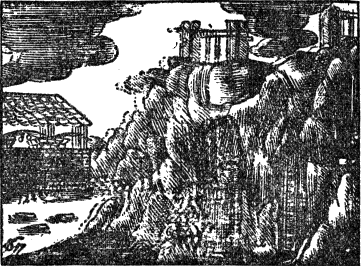
Miners, 1. go into the Grave, 2. by a Stick, 3. or by Ladders, 4. with Lanthorns, 5. and dig out with a Pick, 6. the Oar, which being put in Baskets, 7. is drawn out with a Rope, 8. by means of a Turn, 9. and is carried to the Melting-house, 10. where it is forced with fire, that the Metal may run out, 12. the Dross, 11. is thrown aside. Metalli fossores, 1. ingrediuntur Puteum fodinæ, 2. Bacillo, 3. sive Gradibus, 4. cum Lucernis, 5. & effodiunt Ligone, 6. terram Metallicam, quæ imposita Corbibus, 7. extrahitur Fune, 8. ope Machinæ tractoriæ, 9. & defertur in Ustrinam, 10. ubi urgetur igne, ut Metallum, 12. profluat Scoriæ, 11. abjiciuntur seorsim.
LXIX.
The Blacksmith.
Faber Ferrarius.
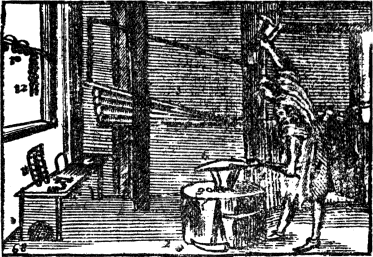
The Blacksmith, 1. in his Smithy (or Forge), 2. bloweth the fire with a pair of Bellows, 3. which he bloweth with his Feet, 4. and so heateth the Iron: Faber ferrarius, 1. in Ustrina (Fabricâ), 2. inflat ignem Folle, 3. quem adtollit Pede, 4. atq; ita candefacit Ferrum:
And then he taketh it out with the Tongs, 5. layeth it upon the Anvile, 6. and striketh it with an Hammer, 7. where the sparks, 8. fly off. Deinde eximit Forcipe, 5. imponit Incudi, 6. & cudit Malleo, 7. ubi Stricturæ, 8. exiliunt.
And thus are hammer’d out, Nails, 9. Horse-shoes, 10. Cart-strakes, 11. Chains, 12. Plates, Locks and Keys, Hinges, &c. Et sic excuduntur, Clavi, 9. Solea, 10. Canthi, 11. Catenæ, 12. Laminæ, Seræ cum Clavibus, Cardines, &c.
He quencheth hot Irons in a Cool-trough. Restinguit cadentia, Ferramenta in Lacu.
LXX.
The Box-maker and the Turner.
Scrinarius & Tornator.
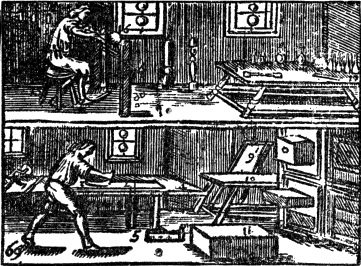
The Box-maker, 1. smootheth hewen Boards, 2. with a Plain, 3. upon a work-board, 4. he maketh them very smooth with a little-plain, 5. he boreth them thorow with an Augre, 6. carveth them with a Knife, 7. fasteneth them together with Glew and Cramp-Irons, 8. and maketh Tables, 9. Boards, 10. Chests, 11. &c. Arcularius, 1. edolat Asseres, 2. Runcina, 3. in Tabula, 4. deplanat Planula, 5. perforat (terebrat) Terebra, 6. sculpit Cultro, 7. combinat Glutine & Subscudibus, 8. & facit Tabulas, 9. Mensas, 10. Arcus (Cistas), 11. &c.
The Turner, 12. sitting over the Treddle, 13. turneth with a Throw, 15. upon a Turner’s Bench, 14. Bowls, 16. Tops, 17, Puppets, 18. and such like Turners Work. Tornio, 12. sedens in Insili, 13. tornat Torno, 15. super Scamno Tornatorio, 14. Globos, 16. Conos, 17. Icunculas, 18. & similia Toreumata.
LXXI.
The Potter.
Figulus.
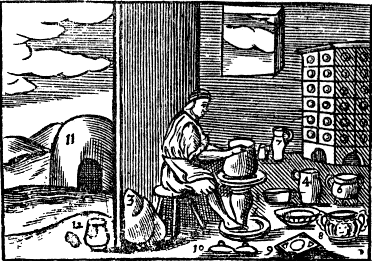
The Potter, 1. sitting over a Wheel, 2. maketh Pots, 4. Pitchers, 5. Pipkins, 6. Platters, 7. Pudding-pans, 8. Juggs, 9. Lids, 10. &c. of Potter’s Clay, 3. afterwards he baketh them in an Oven, 11. and glazeth them with White Lead. Figulus, 1. sedens super Rota, 2. format Ollas, 4. Urceos, 5. Tripodes, 6. Patinas, 7. Vasa testacea, 8. Fidelias, 9. Opercula, 10. &c. ex Argillâ, 3. postea excoquit in Furno, 11. & incrustat Lithargyro.
A broken Pot affordeth Pot-sheards, 1 Fracta Olla dat Testas, 12.
LXXII.
The Parts of a House.
Partes Domus.
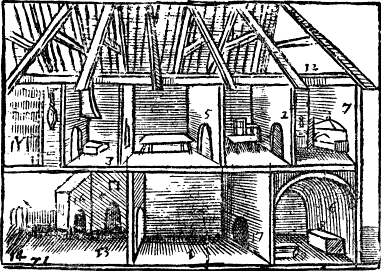
A House is divided into inner Rooms, such as are the Entry, 1. the Stove, 2. the Kitchen, 3. the Buttery, 4. the Dining Room, 5. the Gallery, 6. the Bed Chamber, 7. with a Privy, 8. made by it. Domus distinguitur in Conclavia, ut sunt Atrium, 1. Hypocaustum, 2. Culina, 3. Cella Penuaria, 4. Cœnaculum, 5. Camera, 6. Cubiculum, 7. cum Secessu (Latrina), 8. adstructo.
Baskets, 9. are of use for carrying things. and Chests, 10. (which are made fast with a Key, 11.) for keeping them. Corbes, 9. inserviunt rebus transferendis, Arcæ, 10. (quæ Clavâ, 11. recluduntur) adservandis illis.
Under the Roof, is the Floor, 12. Sub Tecto, est Solum (Pavimentum), 12.
In the Yard, 13. is a Well, 14. a Stable, 15. and a Bath, 16. In Area, 13. Puteus, 14. Stabulum, 15. cum Balneo, 16.
Under the House is the Cellar, 17. Sub Domo est Cella, 17.
LXXIII.
The Stove with the Bed-room.
Hypocaustum cum Dormitorio.
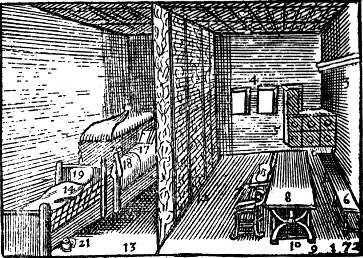
The Stove, 1. is beautified with an Arched Roof, 2. and wainscoted Walls, 3. Hypocaustum, 1. ornatur Laqueari, 2. & tabulatis Parietibus, 3.
It is enlightened with Windows, 4. Illuminatur Fenestris, 4.
It is heated with an Oven, 5. Calefit Fornace, 5.
Its Utensils are Benches, 6. Stools, 7. Tables, 8. with Tressels, 9. Footstools, 10. and Cushions, 11. Ejus Utensilia sunt Scamna, 6. Sellæ, 7. Mensæ, 8. cum Fulcris, 9. ac Scabellis, 10. & Culcitris, 11.
There are also Tapestries hanged, 12. Appenduntur etiam Tapetes, 12.
For soft lodging in a Sleeping-room, 13. there is a Bed, 14. spread on a Bed-sted, 15. upon a Straw-pad, 16. with Sheets, 17. and Cover-lids, 18. Pro levi cubatu, in Dormitorio, 13. est Lectus, (Cubile) 14. stratus in Sponda, 15. super Stramentum, 16. cum Lodicibus, 17. & Stragulis, 18.
The Bolster, 19. is under ones head. Cervical, 19. est sub capite.
The Bed is covered with a Canopy, 20. Canopeo, 20. Lectus tegitur.
A Chamber-pot, 21. is for making water in. Matula, 21. est vesicæ levandæ.
LXXIV.
Wells.
Putei.
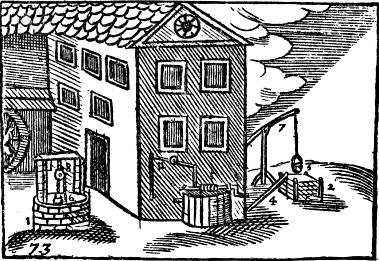
Where Springs are wanting, Wells, 1. are digged. and they are compassed about with a Brandrith, 2. lest any one fall in. Ubi Fontes deficiunt, Putei, 1. effodiuntur, & circumdantur Crepidine, 2. ne quis incidat.
Thence is water drawn with Buckets, 3. hanging either at a Pole, 4. or a Rope, 5. or a Chain, 6. and that either by a Swipe, 7. or a Windle, 8. or a Turn, 9. with a Handle or a Wheel, 10. or to conclude, by a Pump, 11. Inde aqua hauritur Urnis (situlis), 3. pendentibus vel Pertica, 4. vel Fune, 5. vel Catena, 6. idque aut Tollenone, 7. aut Girgillo, 8. aut Cylindro, 9. Manubriato. aut Rota (tympano), 10. aut denique Antliâ, 11.
LXXV.
The Bath.
Balneum.
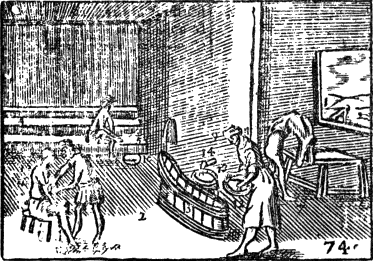
He that desireth to be wash’d in cold water, goeth down into a River, 1. Qui cupit lavari aquâ frigidâ, descendit in Fluvium, 1.
In a Bathing-house, 2. we wash off the filth either sitting in a Tub, 3. or going up into the Hot-house, 4. and we are rubbed with a Pumice-stone, 6. or a Hair-cloth, 5. In Balneario, 2. abluimus squalores, sive sedentes in Labro, 3. sive conscendentes in Sudatorium, 4. & defricamur Pumice, 6. aut Cilicio, 5.
In the Stripping-room, 7. we put off our clothes, and are tyed about with an Apron, 8. In Apodyterio, 7. exuimus Vestes, & præcingimur Castula (Subligari), 8.
We cover our Head with a Cap, 9. and put our feet into a Bason, 10. Tegimus caput Pileolo, 9. & imponimus pedes Telluvio, 10.
The Bath-woman, 11. reacheth water in a Bucket, 12. drawn out of the Trough, 13. into which it runneth out of Pipes, 14. Balneatrix, 11. ministrat aquam Situla, 12. haustam ex Alveo, 13. in quem defluit è Canalibus, 14.
The Bath-keeper, 15. lanceth with a Lancet, 16. and by applying Cupping-glasses, 17. he draweth the Blood betwixt the skin and the flesh, which he wipeth away with a Spunge, 18. Balneator, 15. scarificat Scalpro, 16. & applicando Cucurbitas, 17. extrahit Sanguinem subcutaneum, quem abstergit Spongiâ, 18.
LXXVI.
The Barbers Shop.
Tonstrina.
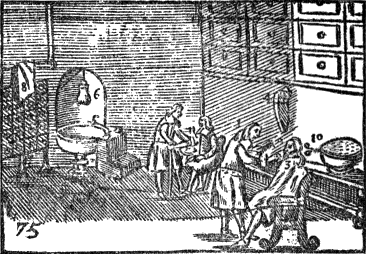
The Barber, 1. in the Barbers-shop, 2. cutteth off the Hair and the Beard with a pair of Sizzars, 3. or shaveth with a Razor, which he taketh out of his Case, 4. Tonsor, 1. in Tonstrina, 2. tondet Crines & Barbam Forcipe, 3. vel radit Novaculâ, quam depromit è Theca, 4.
And he washeth one over a Bason, 5. with Suds running out of a Laver, 6. and also with Sope, 7. and wipeth him with a Towel, 8. combeth him with a Comb, 9. and curleth him with a Crisping Iron, 10. Et lavat super Pelvim, 5. Lixivio defluente è Gulturnio, 6. ut & Sapone, 7. & tergit Linteo, 8. pectit Pectine, 9. crispat Calamistro, 10.
Sometimes he cutteth a Vein with a Pen-knife, 11. where the Blood spirteth out, 12. Interdum secat Venam Scalpello, 11. ubi Sanguis propullulat, 12.
The Chirurgeon cureth Wounds. Chirurgus curat Vulnera.
LXXVII.
The Stable.
Equile.
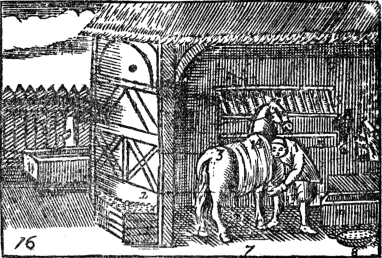
The Horse-keeper, 1. cleaneth the Stable from Dung, 2. Stabularius (Equiso), 1. purgat Stabulum a Fimo, 2.
He tyeth a Horse, 3. with a Halter, 4. to the Manger, 5. or if he apt to bite, he maketh him fast with a Muzzle, 6. Alligat Equum, 3. Capistro, 4. ad Præsepe, 5. aut si mordax constringit Fiscella, 6.
Then he streweth Litter, 7. under him. Deinde substernit Stramenta, 7.
He winnoweth Oats with a Van, 8. (being mixt with Chaff, and taken out of a Chest, 10.) and with them feedeth the Horse, as also with Hay, 9. Ventilat Avenam, Vanno, 8. (Paleis mixtam, ac depromptam à Cista Pabulatoria, 10.) eâque pascit equum, ut & Fœno, 9.
Afterwards he leadeth him to the Watering-trough, 11. to water. Postea ducit ad Aquarium, 11. aquatum.
Then he rubbeth him with a Cloth, 12. combeth him with a Curry-comb, 15. covereth him with an Housing-cloth, 14. and looketh upon his Hoofs whether the Shoes, 13. be fast with the Nails. Tum detergit Panno, 12. depectit Strigili, 15. insternit Gausape, 14. & inspicit Soleas, an Calcei ferrei, 13. firmis Clavis hæreant.
LXXVIII.
Dials.
Horologia.
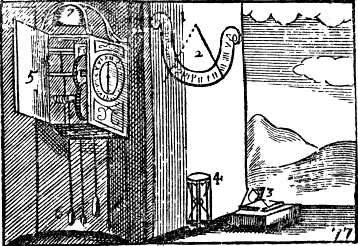
A Dial measureth Hours. Horologium dimetitur Horas.
A Sun-dial, 1. sheweth by the shadow of the Pin, 2. what a Clock it is; either on a Wall, or a Compass, 3, Solarium, 1. ostendit umbrâ Gnomonis, 2. quota sit Hora; sive in Pariete, sive in Pyxide Magnetica, 3.
An Hour-glass, 4. sheweth the four parts of an hour by the running of Sand, heretofore of water. Clepsydra, 4. ostendit partes horæ quatuor, fluxu Arenæ, olim aquæ.
A Clock, 5. numbereth also the Hours of the Night, by the turning of the Wheels, the greatest whereof is drawn by a Weight, 6. and draweth the rest. Automaton, 5. numerat etiam Nocturnas Horas, circulatione Rotarum, quarum maxima trahitur à Pondere, 6. & trahit cæteras.
Then either the Bell, 7. by its sound, being struck on by the Hammer, or the Hand, 8. without, by its motion about sheweth the hour. Tum vel Campana, 7. sonitu suo, percussâ a Malleolo, vel Index extra Circuitione sua indicat horam.
LXXIX.
The Picture.
Pictura.
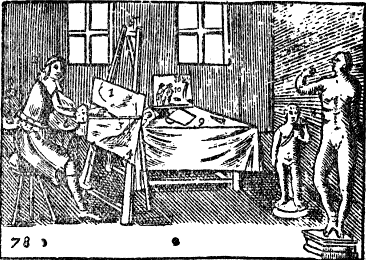
Pictures, 1. delight the Eyes and adorn Rooms. Picturæ, 1. oblectant Oculos & ornant Conclavia.
The Painter, 2. painteth an Image with a Pencil, 3. in a Table, 4. upon a Case-frame, 5. holding his Pollet, 6. in his left hand, on which are the Paints which were ground by the Boy, 7. on a Marble. Pictor, 2. pingit Effigiem Penicilio, 3. in Tabula, 4. super Pluteo, 5. tenens Orbem Pictorium, 6. in sinistra, in quo Pigmenta quæ terebantur à puero, 7. in marmore.
The Carver and Statuary carve Statues, 8. of Wood and Stone. Sculptor, & Statuarius exsculpunt Statuas, 8. è Ligno & Lapide.
The Graver and the Cutter grave Shapes, 10. and Characters with a Graving Chesil, 9. in Wood, Brass, and other Metals. Cœlator & Scalptor insculpit Figuras, 10. & Characteres, Cœlo, 9. Ligno, Æri, aliisque Metallis.
LXXX.
Looking-glasses.
Specularia.
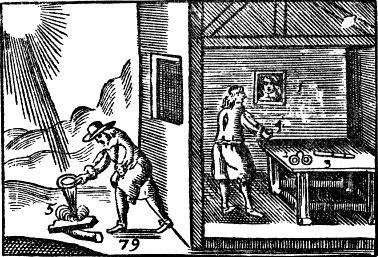
Looking-glasses, 1. are provided that Men may see themselves. Specularia, 1. parantur, ut homines intueantur seipsos.
Spectacles, 2. that he may see better, who hath a weak sight. Perspicilla, 2. ut cernat acius qui habet visum debilem.
Things afar off are seen in a Perspective Glass, 3. as things near at hand. Remota videntur per telescopium, 3. ut proxima.
A Flea appeareth in a muliplying-glass, 4. like a little hog. Pulex, 4. in Microscopio apparet ut porcellus.
The Rays of the Sun, burn wood through a Burning-glass, 5. Radii Solis accendunt ligna per Vitrum urens, 5.
LXXXI.
The Cooper.
Vietor.
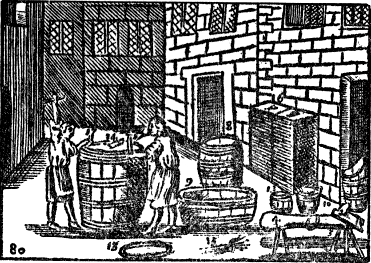
The Cooper, 1. having an Apron, 2, tied about him, maketh Hoops of Hazel-rods, 3. upon a cutting-block, 4. with a Spoke-Shave, 5. and Lags, 6. of Timber, Vietor, 1. amictus Præcinctorio, 2. facit Circulos, è Virgis Colurnis, 3. super Sellam incisoriam, 4. Scalpro bimanubriato, 5. & Assulas, 6. ex Ligno.
Of Lags he maketh Hogsheads, 7. and Pipes, 8. with two Heads; and Tubs, 9. Soes, 10. Flaskets, 11. Buckets, 12. with one Bottom. Ex Assulis conficit Dolia, 7. & Cupas, 8. Fundo bino; tum Lacus, 9. Labra, 10. Pitynas [Trimodia], 11. & Situlas, 12. fundo uno.
Then he bindeth them with Hoops, 13. which he tyeth fast with small Twigs, 15. by means of a Cramp-iron, 14. and he fitteth them on with a Mallet, 16. and a Driver, 17. Postea vincit Circulis, 13. quos ligat Viminibus, 15. ope Falcis vietoriæ, 14. & aptat Tudite, 16. ac Tudicula, 17.
LXXXII.
The Roper, and the Cordwainer.
Restio, & Lorarius.
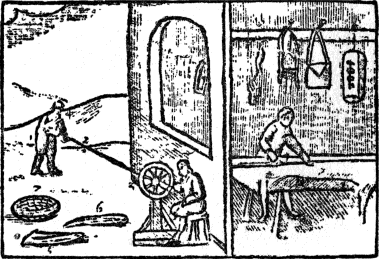
The Roper, 1. twisteth Cords, 2. of Tow, or Hemp, 4. (which he wrappeth about himself) by the turning of a Wheel, 3. Restio, 1. contorquet Funes, 2. è Stupa, 4. vel Cannabi, quam circumdat sibi agitatione Rotulæ, 3.
Thus are made first Cords, 5. then Ropes, 6. and at last, Cables, 7. Sic fiunt, primò Funiculi, 5. tum Restes, 6. tandem Rudentes, 7.
The Cord-wainer, 8. cutteth great Thongs, 10. Bridles, 11. Girdles, 12. Sword-belts, 13. Pouches, 14. Port-mantles, 15. &c. out of a Beast-hide, 9. Lorarius, 8. scindit Loramenta, 10. Fræna, 11. Cingula, 12. Baltheos, 13. Crumenas, 14. Hippoperas, 15., &c. de corio bubulo, 9.
LXXXIII.
The Traveller.
Viator.
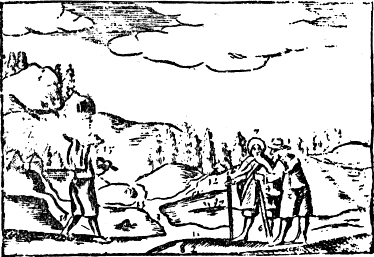
A Traveller, 1. beareth on his shoulders in a Budget, 2. those things which his Satchel, 3. or Pouch, 4. cannot hold. Viator, 1. portat humeris in Bulga, 2. quæ non capit Funda, 3. vel Marsupium, 4.
He is covered with a Cloak, 5. Tegitur Lacernâ, 5.
He holdeth a Staff, 6. in his hand wherewith to bear up himself. Tenet Baculum, 6. Manu quo se fulciat.
He hath need of Provision for the way, as also of a pleasant and merry Companion, 7. Opus habet Viatico, ut & fido & facundo Comite, 7.
Let him not forsake the High-road, 9. for a Foot-way, 8. unless it be a beaten Path. Non deserat Viam regiam propter Semitam, 8. nisi sit Callis tritus.
By-ways, 10. and places where two ways meet, 11. deceive and lead men aside into uneven-places, 12. so do not By-paths, 13. and Cross-ways, 14. Avia, 10. & Bivia, 11. fallunt & seducunt, in Salebras, 12. non æquè Tramites, 13. & Compita, 14,
Let him therefore enquire of those he meeteth, 15. which way he must go; and let him take heed of Robbers, 16. as in the way, so also in the Inn, 17. where he lodgeth all Night. Sciscitet igitur obvios, 15. quà sit eundum; & caveat Prædones, 16. ut in viâ, sic etiam in Diversorio, 17. ubi pernoctat.
LXXXIV.
The Horse-man.
Eques.
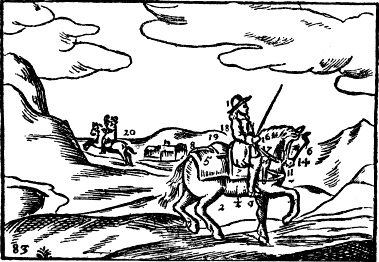
The Horse-man, 1. setteth a Saddle, 2. on his Horse, 3. and girdeth it on with a Girth, 4. Eques, 1. imponit Equo, 2. Ephippium, 3. idque succingit Cingulo, 4.
He layeth a Saddle-cloth, 5. also upon him. Insternit etiam Dorsuale, 5.
He decketh him with Trappings, a Fore-stall, 6. a Breast-cloth, 7. and a Crupper, 8. Ornat eum Phaleris, Frontali, 6. Antilena, 7. & Postilena, 8,
Then he getteth upon his Horse, putteth his feet into the Stirrops, 9. taketh the Bridle-rein, 10. 11. in his left hand, wherewith he guideth and holdeth the Horse. Deinde insilit in Equum, indit pedes Stapedibus, 9. capessit Lorum (habenam), 10. Freni, 11. sinistrâ quo flectit, & retinet Equum.
Then he putteth to his Spurs, 12. and setteth him on with a Switch, 13. and holdeth him in with a Musrol, 14. Tum admovet Calcaria, 12. incitatque Virgula, 13. & coërcet Postomide, 14.
The Holsters, 15. hang down from the Pummel of the Saddle, 16. in which the Pistols, 17. are put. Bulgæ, 15. pendent ex Apice Ephippii, 16. quibus Sclopi, 17. inseruntur.
The Rider is clad in a short Coat, 18. his Cloak being tyed behind him, 19. Ipse Eques induitur Chlamyde, 18. Lacernâ revinctâ, 19. à tergo.
A Post, 20. is carried on Horseback at full Gallop. Veredarius, 20. fertur Equo cursim.
LXXXV.
Carriages.
Vehicula.
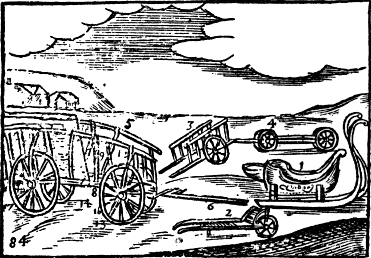
We are carried on a Sled, 1. over Snow and Ice. Vehimur Trahâ, 1. super Nivibus & Glacie.
A Carriage with one Wheel, is called a Wheelbarrow, 2. with two Wheels, a Cart, 3. with four Wheels, a Wagon, which is either a Timber-wagon, 4. or a Load-wagon, 5. Vehiculum unirotum, dicitur Pabo, 2. birotum, Carrus, 3. quadrirotum, Currus, qui vel Sarracum, 4. vel Plaustrum, 5.
The parts of the Wagon are, the Neep (or draught-tree), 6. the Beam, 7. the Bottom, 8. and the Sides, 9. Partes Currûs sunt, Temo, 6. Jugum, 7. Compages, 8. Spondæ, 9.
Then the Axle-trees, 10. about which the Wheels run, the Lin-pins, 11. and Axletree-staves, 12. being fastened before them. Tum Axes, 10. circa quos Rotæ currunt, Paxillis, 11. & Obicibus, 12. præfixis.
The Nave, 13. is the groundfast of the Wheel, 14. from which come twelve Spokes, 15. Modiolus, 13. est Basis Rotæ, 14. ex quo prodeunt duodecim Radii, 15.
The Ring encompasseth these, which is made of six Felloes, 16. and as many Strakes, 17. Hampiers and Hurdles, 18, are set in a Wagon. Orbile ambit hos, compositum è sex Absidibus, 16. & totidem Canthis, 17. Corbes & Crates, 18. imponuntur Currui.
LXXXVI.
Carrying to and fro.
Vectura.
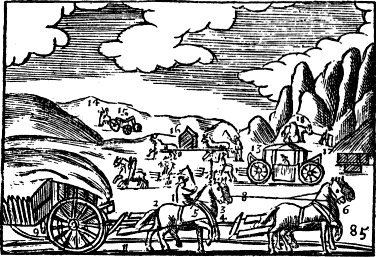
The Coach-man, 1. joineth a Horse fit to match a Saddle-horse, 2, 3. to the Coach-tree, with Thongs or Chains, 5. hanging down from the Collar, 4. Auriga, 1. jungit Parippum, 2. Sellario, 3. ad Temonem, Loris vel Catenis, 5. dependentibus de Helcio, 4.
Then he sitteth upon the Saddle-horse, and driveth them that go before him, 6. with a Whip, 7. and guideth them with a String, 8 Deinde insidet Sellario, agit ante se antecessores, 6. Scuticâ, 7. & flectit Funibus, 8.
He greaseth the Axle-tree with Axle-tree grease out of a Grease-pot, 9. and stoppeth the wheel with a Trigen, 10. in a steep descent. Ungit Axem Axungiâ, ex vase unguentorio, 9. & inhibet rotam Sufflamine, 10. in præcipiti descensu.
And thus the Coach is driven along the Wheel-ruts, 11. Et sic aurigatur per Orbitas, 11.
Great Persons are carryed with six Horses, 12. by two Coachmen, in a Hanging-wagon, which is called a Coach, 13. Magnates vehuntur Sejugibus, 12. duobus Rhedariis, Curru pensili, qui vocatur Carpentum (Pilentum), 13.
Others with two Horses, 14. in a Chariot, 15. Alii Bijugibus, 14. Essedo, 15.
Horse Litters, 16, 17. are carried by two Horses. Arceræ, 16. & Lacticæ, 17. portantur à duobus Equis.
They use Pack-Horses, instead of Waggons, thorow Hills that are not passable, 18. Utuntur Jumentis Clitellariis, loco Curruum, per montes invios, 18.
LXXXVII.
Passing over Waters.
Transitus Aquarum.
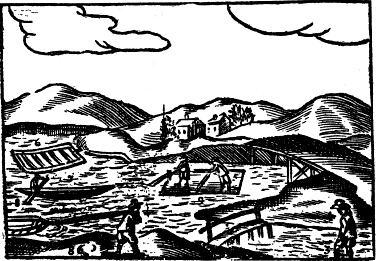
Lest he that is to pass over a River should be wet, Bridges, 1. were invented for Carriages, and Foot-bridges, 2. for Foot-men. Trajecturus flumen ne madefiat, Pontes, 1. excogitati sunt pro Vehiculis & Ponticuli, 2. pro Peditibus.
If a river have a Foord, 3. it is waded over, 4. Si Flumen habet Vadum, 3. vadatur, 4.
Flotes, 5. also are made of Timber pinned together; or Ferry-boats, 6. of planks laid close together for fear they should receive Water. Rates, 5. etiam struuntur ex compactis tignis: vel Pontones, 6. ex trabibus consolidatis, ne excipiant aquam.
Besides Scullers, 7. are made, which are rowed with an Oar, 8. or Pole, 9. or haled with an Haling-rope, 10. Porrò Lintres (Lembi), 7. fabricantur, qui aguntur Remo, 8. vel Conto, 9. aut trahuntur Remulco, 10.
LXXXVIII.
Swimming.
Natatus.
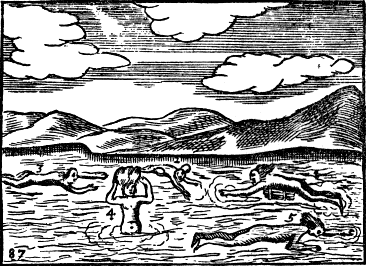
Men are wont also to swim over Waters upon a bundle of flags, 1. and besides upon blown Beast-bladders, 2. and after, by throwing their Hands and Feet, 3. abroad. Solent etiam tranare aquas super scirpeum fascem, 1. porrò super inflatas boum Vesicas, 2. deinde liberè jactatu Manuum Pedumque, 3.
And at last they learned to tread the water, 4. being plunged up to the girdle-stead, and carrying their Cloaths upon their head. Tandem didicerunt calcare aquam, 4. immersi cingulo tenus & gestantes Vestes supra caput.
A Diver, 5. can swim also under the water like a Fish. Urinator, 5. etiam natare potest sub aquâ, ut Piscis.
LXXXIX.
A Galley.
Navis actuaria.
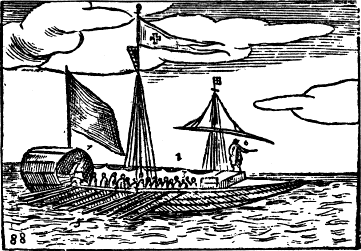
A Ship furnished with Oars, 1. is a Barge, 2. or a Foyst, &c. in which the Rowers, 3. sitting on Seats, 4. by the Oar-rings, row, by striking the water with the Oars, 5. Navìs instructa Remis, 1. est Uniremis, 2. vel Biremis, &c. in quâ Remiges, 3. considentes pre Transtra, 4. ad Scalmos, remigant pellendo aquam Remis,
The Ship-master, 6. standing in the Fore-castle, and the Steers-man, 7. sitting at the Stern, and holding the Rudder, 8. steer the Vessel. Proreta, 6. stans in Prora, & Gubernator, 7. sedens in Puppi, tenensque Clavum, 8. gubernant Navigium.
XC.
A Merchant-ship.
Navis oneraria.
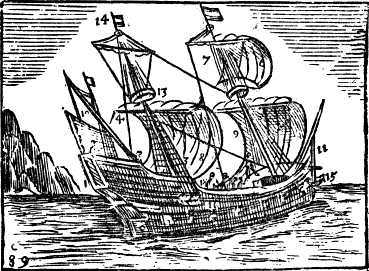
A Ship, 1. is driven onward not by Oars, but by the only force of the Winds. Navigium, 1. impellitur, non remis, sed solâ vi Ventorum.
In it is a Mast, 2. set up, fastened with Shrowds, 3. on all sides to the main-chains. to which the Sail-yards, 4. are tied, and the Sails, 5. to these, which are spread open, 6. to the wind, and are hoysed by Bowlings, 7. In illo Malus, 2. erigitur, firmatus Funibus, 3. undique ad Oras Navis, cui annectuntur Antennæ, 4. his, Vela, 5. quæ expanduntur, 6. ad Ventum & Versoriis, 7. versantur.
The Sails are the Main-sail, 8. the Trinket, or Fore-sail, 9. the Misen-sail or Poop-sail, 10. Vela sunt Artemon, 8. Dolon, 9. & Epidromus, 10.
The Beak, 11. is in the Fore-deck. Rostrum, 11. est in Prora.
The Ancient, 12. is placed in the Stern. Signum (vexillum), 12. ponitur in Puppi.
On the Mast is the Foretop, 13. the Watch-tower of the Ship and over the Fore-top a Vane, 14. to shew which way the Wind standeth. In Malo est Corbis, 13. Specula Navis & supra Galeam Aplustre, 14. Ventorum Index.
The ship is stayed with an Anchor, 15. Navis sistitur Anchorâ, 15.
The depth is fathomed with a Plummet, 16. Profunditas exploratur Bolide, 16.
Passengers walk up and down the Decks, 17. Navigantes deambulant in Tabulato, 17.
The Sea men run to and fro through the Hatches, 18. Nautæ cursitant per Foros, 18.
And thus, even Seas are passed over. Atque ita, etiam Maria trajiciuntur.
XCI.
Ship-wreck.
Naufragium.
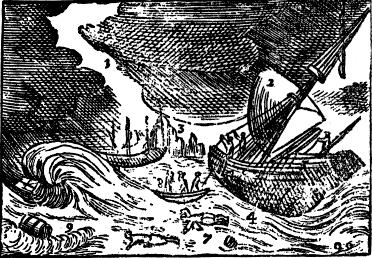
When a Storm, 1. ariseth on a sudden, they strike Sail, 2. lest the Ship should be dashed against Rocks, 3 or light upon Shelves, 4. Cum Procella, 1. oritur repentè contrahunt Vela, 2. ne Navis ad Scopulos, 3. allidatur, aut incidat in Brevia (Syrtes), 4.
If they cannot hinder her they suffer Ship-wreck, 5. Si non possunt prohibere patiuntur Naufragium, 5.
And then the men, the Wares, and all things are miserably lost. Tum Homines, Merces, omnia miserabiliter pereunt.
Nor doth the Sheat-anchor, 6. being cast with a Cable, do any good. Neque hic Sacra anchora, 6. Rudenti jacta quidquam adjuvat.
Some escape, either on a Plank, 7. and by swimming, or in the Boat, 8. Quidam evadunt, vel tabula, 7. ac enatando, vel Scapha, 8.
Part of the Wares, with the dead folks, is carried out of the Sea, 9. upon the Shoars. Pars Mercium cum mortuis a Mari, 9. in littora defertur.
XCII.
Writing.
Ars Scriptoria.
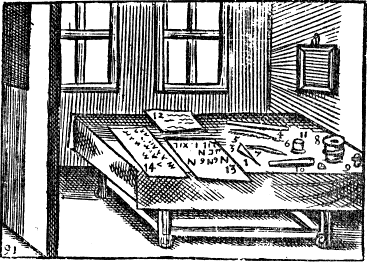
The Ancients writ in Tables done over with wax with a brazen Poitrel, 1. with the sharp end, 2. whereof letters were engraven and rubbed out again with the broad end, 3. Veteres scribebant in Tabellis ceratis æneo Stilo, 1. cujus parte cuspidata, 2. exarabantur literæ, rursum vero obliterabantur planâ.
Afterwards they writ Letters with a small Reed, 4. Deinde Literas pingebant subtili Calamo, 4.
We use a Goose-quill, 5. the Stem, 6. of which we make with a Pen-knife, 7. then we dip the Neb in an Ink-horn, 8. which is stopped with a Stopple, 9. and we put our Pens, into a Pennar, 10. Nos utimur Anserina Penna, 5. cujus Caulem, 6. temperamus Scalpello, 7. tum intingimus Crenam in Atramentario, 8. quod obstruitur Operculo, 9. & Pennas recondimus in Calamario, 10.
We dry a Writing with Blotting-paper, or Calis-sand out of a Sand-box, 11. Siccamus Scripturam Chartâ bibulâ, vel Arenâ scriptoria, ex Theca Pulveraria, 11.
And we indeed write from the left hand towards the right, 12. the Hebrews from the right hand towards the left, 13. the Chinese and other Indians, from the top downwards, 14. Et nos quidem scribimus â sinistra dextrorsum, 12. Hebræi â dextrâ sinistrorsum, 13. Chinenses & Indi alii, â summo deorsum, 14.
XCIII.
Paper.
Papyrus.
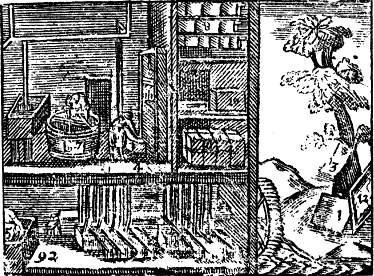
The Ancients used Beech-Boards, 1. or Leaves, 2. as also Barks, 3. of Trees; especially of an Egyptian Shrub, which was called Papyrus. Veteres utebantur Tabulis Faginis, 1. aut Foliis, 2. ut & Libris, 3. Arborum; præsertim Arbusculæ Ægyptiæ, cui nomen erat Papyrus.
Now Paper is in use which the Paper-maker maketh in a Paper-mill, 4. of Linen rags, 5. stamped to Mash, 6. which being taken up in Frames, 7. he spreadeth into Sheets, 8. and setteth them in the Air that they may be dryed. Nunc Charta est in usu, quam Chattopœus in mola Papyracea, 4. conficit è Linteis vetustis, 5. in Pulmentum contusis, 6. quod haustum Normulis, 7. diducit in Plagulas, 8. exponitque aëri, ut siccentur.