Orbis Sensualium Pictus, (continued 2)
Charles Hoole translation
Twenty-five of these make a Quire, 9. twenty Quires a Ream, 10. and ten of these a Bale of Paper, 11. Harum XXV. faciunt Scapum, 9. XX. Scapi Volumen minus, 10. horum X. Volumen majus, 11.
That which is to last long is written on Parchment, 12. Duraturum diu scribitur in Membrana, 12.
XCIV.
Printing.
Typographia.
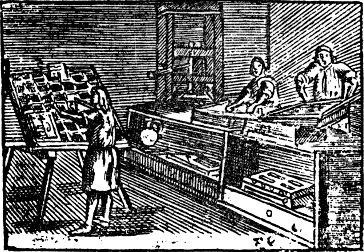
The Printer hath metal Letters in a large number put into Boxes, 5. Typographus habet Typos Metallos, magno numero distributos per Loculamenta, 5.
The Compositor, 1. taketh them out one by one and according to the Copy, (which he hath fastened before him in a Visorum, 2.) composeth words in a Composing-stick, 3. till a Line be made; he putteth these in a Gally, 4. till a Page, 6. be made, and these again in a Form, 7. and he locketh them up in Iron Chases, 8. with Coyns, 9. lest they should drop out, and putteth them under the Press, 10. Typotheta, 1. eximit illos singulatim, & secundum exemplar, (quod habet præfixum sibi Retinaculo, 2.) componit Verba Gnomone, 3. donec versus fiat; hos indit Formæ, 4. donec Pagina, 6. fiat; has iterum Tabulâ compositoriâ, 7. coarctaque eos Marginibus ferreis, 8. ope Cochlearum, 9. ne dilabantur, ac subjicit Prelo, 10.
Then the Press-man beateth it over with Printers Ink, by means of Balls, 11. spreadeth upon it the Papers put in the Frisket, 12. which being put under the Spindle, 14. on the Coffin, 13. and pressed down with a Bar, 15. he maketh to take impression. Tum Impressor illinit Atramento impressorio ope Pilarum, 11. super imponit Chartas inditas Operculo, 12. quas subditas Trochleæ, 14. in Tigello, 13. & impressas Suculâ, 15. facit imbibere typos.
XCV.
The Booksellers Shop.
Bibliopolium.

The Bookseller, 1 selleth Books in a Booksellers Shop, 2. of which he writeth a Catalogue, 3. Bibliopola, 1. vendit Libros in Bibliopolio, 2. quorum conscribit Catalogum, 3.
The Books are placed on Shelves, 4. and are laid open for use upon a Desk, 5. Libri disponuntur per Repositoria, 4. & exponuntur ad usum, super Pluteum, 5.
A Multitude of Books is called a Library, 6. Multitudo Librorum vocatur Bibliotheca, 6.
XCVI.
The Book-binder.
Bibliopegus.
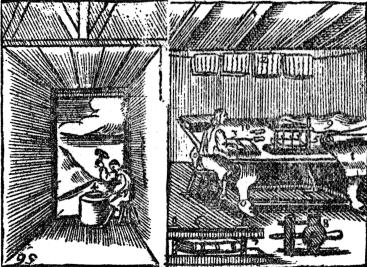
In times past they glewed Paper to Paper, and rolled them up together into one Roll, 1. Olim agglutinabant Chartam Chartæ, convolvebantque eas in unum Volumen, 1.
At this day the Book-binder bindeth Books, whilst he wipeth, 2. over Papers steept in Gum-water, and then foldeth them together, 3. beateth with a hammer, 4. then stitcheth them up, 5. presseth them in a Press, 6. which hath two Screws, 7. glueth them on the back, cutteth off the edges with a round Knife, 8. and at last covereth them with Parchment or Leather, 9. maketh them handsome, and setteth on Clasps, 10. Hodiè Compactor compingit Libros, dum tergit, 2. chartas maceratas aquâ glutinosâ, deinde complicat, 3. malleat, 4. tum consuit, 5. conprimit Prelo, 6. quod habet duos Cochleas, 7. conglutinat dorso, demarginat rotundo Cultro, 8. tandem vestit Membranâ vel Corio, 9. efformat, & affigit Uncinulos, 10.
XCVII.
A Book.
Liber.
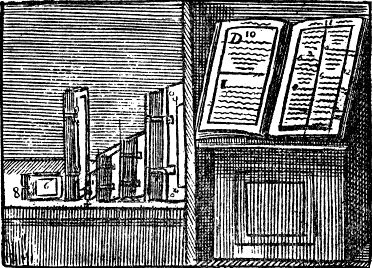
A Book as to its outward shape, is either in Folio, 1. or in Quarto, 2. in Octavo, 3. in Duodecimo, 4. either made to open Side-wise, 5. or Long-wise, 6. with Brazen Clasps, 7. or Strings, 8. and Square-bofles, 9. Liber, quoad exteriorem formam est vel in Folia, 1. vel in Quarto, 2. in Octavo, 3. in Duodecimo, 4. vel Columnatus, 5. vel Linguatus, 6. cum Æneis Clausuris, 7. vel Ligulis, 8. & angularibus Bullis, 9.
Within are Leaves, 10. with two Pages, sometimes divided with Columns, 11. and Marginal Notes, 12. Intùs sunt Folia, 10. duabis Paginis, aliquando Columnis, 11. divisa cumq; Notis Marginalibus, 12.
XCVIII.
A School.
Schola.
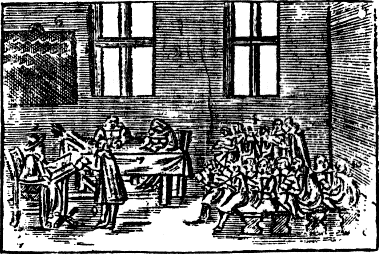
A School, 1. is a Shop in which Young Wits are fashion’d to vertue, and it is distinguish’d into Forms. Schola, 1. est Officina, in quâ Novelli Animi formantur ad virtutem, & distinguitur in Classes.
The Master, 2. sitteth in a Chair, 3. the Scholars, 4. in Forms, 5. he teacheth, they learn. Præceptor, 2. sedet in Cathedra, 3. Discipuli, 4. in Subselliis, 5. ille docet, hi discunt.
Some things are writ down before them with Chalk on a Table, 6. Quædam præscribuntur illis Cretâ in Tabella, 6.
Some sit at a Table, and write, 7. he mendeth their Faults, 8. Quidam sedent ad Mensam, & scribunt, 7. ipse corrigit Mendas, 8.
Some stand and rehearse things committed to memory, 9. Quidam stant, & recitant mandata memoriæ, 9.
Some talk together, 10. and behave themselves wantonly and carelessly; these are chastised with a Ferrula. 11. and a Rod, 12. Quidam confabulantur, 10. ac gerunt se petulantes, & negligentes; hi castigantur Ferulâ (baculo), 11. & Virgâ, 12.
XCIX.
The Study.
Museum.
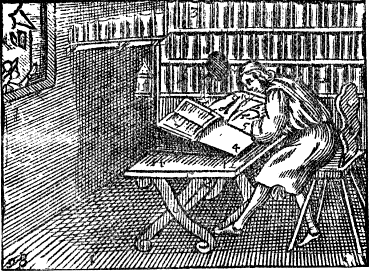
The Study, 1. is a place where a Student, 2. apart from Men, sitteth alone, addicted to his Studies, whilst he readeth Books, 3. which being within his reach he layeth open upon a Desk, 4. and picketh all the best things out of them into his own Manual, 5. or marketh them in them with a Dash, 6. or a little Star, 7. in the Margent. Museum, 1. est locus ubi Studiosus, 2. secretus ab Hominibus, sedet solus deditus Studiis, dum lectitat Libros, 3. quos penes se & exponit super Pluteum, 4. & excerpit optima quæque ex illis in Manuale suum, 5. notat in illis Liturâ, 6. vel Asterisco, 7. ad Margiem.
Being to sit up late, he setteth a Candle, 8. on a Candlestick, 9. which is snuffed with Snuffers, 10. before the Candle, he placeth a Screen, 11. which is green, that it may not hurt his eye-sight; richer Persons use a Taper, for a Tallow-candle stinketh and smoaketh. Lucubraturus, elevat Lychnum (Canelam), 8. in Candelabra, 9. qui emungitur Emunctorio, 10. ante Lynchum collocat Umbraculum, 11. quod viride est, ne hebetet oculorum aciem; opulentiores utuntur Cereo nam Candela sebacea fœtet & fumigat.
A Letter, 12. is wrapped up, writ upon, 13. and sealed, 14. Epistola, 12. complicatur, inscribitur, 13. & obsignatur, 14.
Going abroad by night, he maketh use of a Lanthorn, 15. or a Torch, 16. Prodiens noctu utitur Lanterna, 15. vel Face, 16.
C.
Arts belonging to Speech.
Artes Sermones.
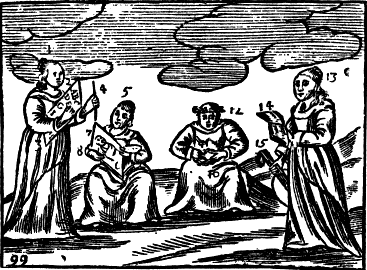
Grammar, 1. is conversant about Letters, 2. of which it maketh Words, 3. and teacheth how to utter, write, 4. put together and part them rightly. Grammatica, 1. versatur circa Literas, 2. ex quibus componit Voces, verba, 3. docetque eloqui, scribere, 4. construere, distinguere (interpungere) eas recte.
Rhetorick, 5. doth as it were paint, 6. a rude form, 7. of Speech with Oratory Flourishes, 8. such as are Figures, Elegancies, Adagies, Apothegms, Sentences, Similies, Hierogylphicks, &c. Rhetorica, 5. pingit, 6. quasi rudem formam, 7. Sermonis Oratoriis Pigmentis, 8. ut sunt Figuræ, Elegantiæ, Adagia (proverbia) Apothegmata, Sententiæ (Gnomæ) Similia, Hieroglyphica, &c.
Poetry, 9. gathereth these Flowers of Speech, 10. and tieth them as it were into a little Garland, 11. and so making of Prose a Poem, it maketh several sorts of Verses and Odes, and is therefore crowned with a Laurel, 12. Poesis, 9. colligit hos Flores Orationis, 10. & colligat quasi in Corallam, 11. atque ita, faciens è prosa ligatam orationem, componit varia Carmina & Hymnos (Odas) ac propterea coronatur Lauru, 12.
Musick, 13. setteth Tunes, 14. with pricks, to which it setteth words, and so singeth alone, or in Consort, or by Voice, or Musical Instruments, 15. Musica, 13. componit Melodias, 14. Notis, quibus aptat verba, atque ita cantat sola vel Concentu (Symphonia), aut voce aut Instrumentis Musicis, 15.
CI.
Musical Instruments.
Instrumenta musica.
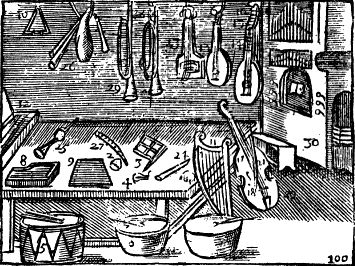
Musical Instruments are those which make a sound: Musica instrumenta sunt quæ edunt vocem:
First, when they are beaten upon, as a Cymbal, 1. with a Pestil, a little Bell, 2. with an Iron pellet within; or Rattle, 3. by tossing it about: a Jews-Trump, 4. being put to the mouth, with the fingers; a Drum, 5. and a Kettle, 6. with a Drum-stick, 7. as also the Dulcimer, 8. with the Shepherds-harp, 9. and the Tymbrel, 10. Primò, cum pulsantur, ut Cymbalum, 1. Pistillo, Tintinnabulum, 2. intus Globulo ferreo, Crepitaculum, 3. circumversando; Crembalum, 4. ori admotum, Digito; Tympanum, 5. & Ahenum, 6. Claviculâ, 7. ut & Sambuca, 8. cum Organo pastoritio, 9. & Sistrum (Crotalum), 10.
Secondly, upon which strings are stretched, and struck upon, as the Psaltery, 11. and the Virginals, 12. with both hands; the Lute, 13. (in which is the Neck, 14. the Belly, 15, the Pegs, 16. by which the Strings, 17. are stretched upon the Bridge, 18.) the Cittern, 19. with the right hand only, the Vial, 20. with a Bow, 21. and the Harp, 23. with a Wheel within, which is turned about: the Stops, 22. in every one are touched with the left hand. Secundò, in quibus Chordæ intenduntur & plectuntur ut Nablium, 11. cum Clavircordio, 12. utrâque manu; Testudo (Chelys), 13. (in quâ Jugum, 14. Magadium, 15. & Verticilli, 16. quibus Nervi, 17. intenduntur super Ponticulam, 18.) & Cythara, 19. Dexterâ tantum, Pandura, 20. Plectro, 21. & Lyra, 23. intus rotâ, quæ versatur: Dimensiones, 22. in singulis tanguntur sinistra.
At last, those which are blown, as with the mouth, the Flute, 24. the Shawm, 25. the Bag-pipe, 26. the Cornet, 27. the Trumpet, 28, 29. or with Bellows, as a pair of Organs, 30. Tandem quæ inflantur, ut Ore, Fistula (Tibia), 24. Gingras, 25. Tibia utricularis, 26. Lituus, 27. Tuba, 28. Buccina, 29. vel Follibus, ut Organum pneumaticum, 30.
CII.
Philosophy.
Philosophia.
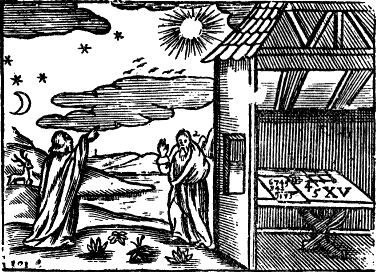
The Naturalist, 1. vieweth all the works of God in the World. Physicus, 1. speculatur omnia Dei Opera in Mundo.
The Supernaturalist, 2. searches out the Causes and Effects of things. Metaphysicus, 2. perscrutatur Causas, & rerum Effecta.
The Arithmetician, reckoneth numbers, by adding, subtracting, multiplying and dividing; and that either by Cyphers, 3. on a Slate, or by Counters, 4. upon a Desk. Arithmeticus computat numeros, addendo, subtrahendo, multiplicando, dividendo; idque vel Cyphris, 3. in Palimocesto, vel Calculis, 4. super Abacum.
Country people reckon, 5. with figures of tens, X. and figures of five, V. by twelves, fifteens, and threescores. Rustici numerant, 5. Decussibus, X. & Quincuncibus, V. per Duodenas, Quindenas, & Sexagenas.
CIII.
Geometry.
Geometria.
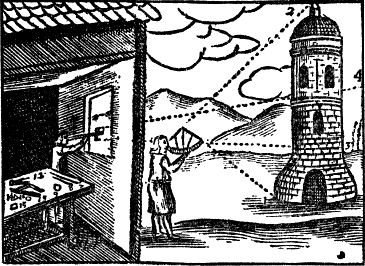
A Geometrician measureth the height of a Tower, 1....2. or the distance of places, 3....4. either with a Quadrant, 5. or a Jacob’s-staff, 6. Geometra metitur Altitudinem Turris, 1....2. aut distantiam Locorum, 3....4. sive Quadrante, 5. sive Radio, 6.
He maketh out the Figures of things, with Lines, 7. Angles, 8. and Circles, 9. by a Rule, 10. a Square, 11. and a pair of Compasses, 12. Designat Figuras rerum Lineis, 7, Angulis, 8. & Circulis, 9. ad Regulam, 10. Normam, 11. & Circinum, 12.
Out of these arise an Oval, 13. a Triangle, 14. a Quadrangle, 15. and other figures. Ex his oriuntur Cylindrus, 13. Trigonus 14. Tetragonus, 15. & aliæ figuræ.
CIV.
The Celestial Sphere.
Sphera cælestis.
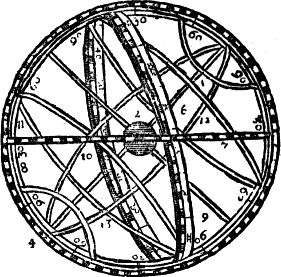
Astronomy considereth the motion of the Stars, Astrology the Effects of them. Astronomia considerat motus Astrorum, Astrologia eorum Effectus.
The Globe of Heaven is turned about upon an Axle-tree, 1. about the Globe of the Earth, 2. in the space of XXIV. hours. Globus Cæli volvitur super Axem, 1. circa globum terræ, 2. spacio XXIV. horarum.
The Pole-stars, or Pole, the Arctick, 3. the Antarctick, 4. conclude the Axle-tree at both ends. Stellæ polares, Arcticus, 3. Antarcticus, 4. finiunt Axem utrinque.
The Heaven is full of Stars every where. Cælum est Stellatum undique.
There are reckoned above a thousand fixed Stars; but of Constellations towards the North, XXI. towards the South, XVI. Stellarum fixarum numerantur plus mille; Siderum verò Septentrionarium, XXI. Meridionalium, XVI.
Add to these the XII. signs of the Zodiaque, 5. every one XXX. degrees, whose names are ♈ Aries ♉ Taurus, ♊ Gemini, ♋ Cancer, ♌ Leo, ♍ Virgo, ♎ Libra, ♏ Scorpius, ♐ Sagittarius, ♑ Capricorn, ♒ Aquarius, ♓ Pisces. Adde Signa, XII. Zodiaci, 5. quodlibet graduum, XXX, quorum nomina sunt ♈ Aries ♉ Taurus, ♊ Gemini, ♋ Cancer, ♌ Leo, ♍ Virgo, ♎ Libra, ♏ Scorpius, ♐ Sagittarius, ♑ Capricorn, ♒ Aquarius, ♓ Pisces.
Under this move the seven Wandring-stars which they call Planets, whose way is a circle in the middle of the Zodiack, called the Ecliptick, 6. Sub hoc cursitant Stellæ errantes VII. quas vocant Planetas, quorum via est Circulvs, in medio Zodiaci, dictus Ecliptica, 6.
Other Circles are the Horizon, 7. the Meridian, 8. the Æquator, 9. the two Colures, the one of the Equinocts, 10. (of the Spring when the ☉ entreth into ♈; Autumnal when it entreth in ♎) the other of the Solstices, 11. (of the Summer, when the ☉ entreth into ♋ of the Winter when it entreth into ♑) the Tropicks, the Tropick of Cancer, 12. the Tropick of Capricorn, 13. and the two Polar Circles, 14....15. Alii Circuli sunt Horizon, 7. Meridianus, 8. Equator, 9. duo Coluri, alter Æquinoxiorum, 10. (Verni, quando ☉ ingreditur ♈; Autumnalis, quando ingreditur ♎) alter Solsticiorum, 11. (Æstivi, quando ☉ ingreditur ♋; Hyberni, quando ingreditur ♑) duo Tropici, Tr. Cancri, 12. Tr. Capricorni, 13. & duo Polares, 14....15.
CIV.
The Aspects of the Planets.
Planetarum Aspectus.
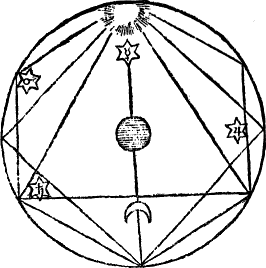
The Moon runneth through the Zodiack every Month. Luna percurrit Zodiacum singulis Mensibus.
The Sun, ☉ in a Year. Sol, ☉ Anno.
Mercury, ☿ and Venus, ♀ about the Sun, the one in a hundred and fifteen, the other in 585 days. Mercurius, ☿ & Venus, ♀ circa Solem, illa CXV., hæc DLXXXV. Diebus.
Mars, ♂ in two years; Mars, ♂ Biennio;
Jupiter, ♃ in almost twelve; Jupiter, ♃ ferè duodecim;
Saturn, ♄ in thirty years. Saturnus, ♄ triginta annis.
Hereupon they meet variously among themselves, and have mutual Aspects one towards another. Hinc conveniunt variè inter se & se mutuo adspiciunt.
As here the ☉ and ☿ are in Conjunction. ☉ and Moon in Opposition, ☉ and ♄ in a Trine Aspect, ☉ and ♃ in a Quartile, ☉ and ♀ in a Sextile. Ut hic sunt, ☉ & ☿ in Conjunctione, ☉ and Luna in Oppositione, ☉ & ♄ in Trigono, ☉ & ♃ in Quadratura, ☉ & ♀ in Sextili.
CV.
The Apparitions of the Moon.
Phases Lunæ.
The Moon shineth not by her own Light but that which is borrowed of the Sun. Luna, lucet non sua propria Luce, sed mutuatâ a Sole.
For the one half of it is always enlightned, the other remaineth darkish. Nam altera ejus medietas semper illuminatur, altera manet caliginosa.
Hereupon we see it in Conjunction with the Sun, 1. to be obscure, almost none at all; in Opposition, 5. whole and clear, (and we call it the Full Moon;) sometimes in the half, (and we call it the Prime, 3. and last Quarter, 7.) Hinc videmus, in Conjunctione Solis, 1. obscuram, imo nullam: in Oppositione, 5. totam & lucidam, (& vocamus Plenilunium;) alias dimidiam, (& dicimus Primam, 3. & ultimam Quadram, 7.)
Otherwise it waxeth, 2....4. or waneth, 6....8. and is said to be horned, or more than half round. Cæteroqui crescit, 2....4. aut decrescit, 6....8. & vocatur falcata, vel gibbosa.
CVI.
The Eclipses.
Eclipses.
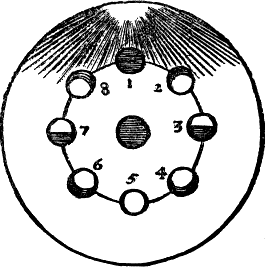
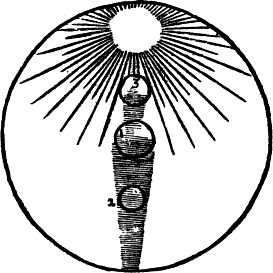
The Sun is the fountain of light, inlightning all things, but the Earth, 1. and the Moon, 2. being shady bodies, are not pierced with its rays, for they cast a shadow upon the place just over against them. Sol est fons Lucis, illuminans omnia; sed Terra, 1. & Luna, 2. Corpora opaca, non penetrantur ejus radiis, nam jaciunt umbram in locum oppositum.
Therefore, when the Moon lighteth into the shadow of the Earth, 2. it is darkened, which we call an Eclipse, or defect. Ideo cum Luna incidit in umbram Terræ, 2. obscuratur quod vocamus Eclipsin (deliquium) Lunæ.
But when the Moon runneth betwixt the Sun and the Earth, 3. it covereth it with its shadow; and this we call the Eclipse of the Sun, because it taketh from us the sight of the Sun, and its light; neither doth the Sun for all that suffer any thing, but the Earth. Cum vero Luna currit inter Solem & Terram, 3. obtegit illum umbrâ suâ; & hoc vocamus Eclipsin Solis, quia adimit nobis prospectum Solis, & lucem ejus; nec tamen Sol patitur aliquid, sed Terra.
CVII. a
The terrestial Sphere.
Sphera terrestris.
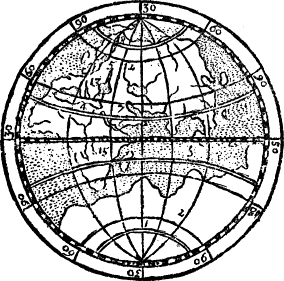
The Earth is round, and therefore to be represented by two Hemispheres, a..b. Terra est rotunda, fingenda igitur duobus Hemispheriis, a..b.
The Circuit of it is 360 degrees (whereof every one maketh 60 English Miles or 21600 Miles,) and yet it is but a prick, compared with the World, whereof it is the Centre. Ambitus ejus est graduum CCCLX. (quorum quisque facit LX. Milliaria Anglica vel 21600 Milliarium) & tamen est punctum, collata cum orbe, cujus Centrum est.
They measure Longitude of it by Climates, 1. and the Latitude by Parallels, 2. Longitudinem ejus dimetiuntur Climatibus, 1. Latitudinem, lineis Parallelis, 2.
The Ocean, 3. compasseth it about, and five Seas wash it, the Mediterranean Sea, 4. the Baltick Sea, 5. the Red Sea, 6. the Persian Sea, 7. and the Caspian Sea, 8. Oceanus, 3. ambit eam & Maria V. perfundunt Mediterraneum, 4. Balticum, 5. Erythræum, 6. Persicum, 7. Caspium, 8.
CVII. b
The terrestial Sphere.
Sphera terrestris.

It is divided into V. Zones, whereof the II. frigid ones, 9....9. are uninhabitable; the II. Temperate ones, 10....10. and the Torrid one, 11. habitable. Distribuitur in Zonas V., quarum duæ frigidæ, 9....9. sunt inhabitabiles; duæ Temperatæ, 10....10. & Torrida, 11. habitantur.
Besides it is divided into three Continents; this of ours, 12. which is subdivided into Europe, 13. Asia, 14. Africa, 15. America, 16....16. (whose Inhabitants are Antipodes to us;) and the South Land, 17....17. yet unknown. Ceterum divisa est in tres Continentes; nostram, 12. quæ subdividitur in Europam, 13. Asiam, 14. & Africam, 15. in Americam, 16....16. (cujus incolæ sunt Antipodes nobis;) & in Terram Australem, 17....17. adhuc incognitam.
They that dwell under the North pole, 18. have the days and nights 6 months long. Habitantes sub Arcto, 18. habent Dies Noctes semestrales,
Infinite Islands float in the Seas. Infinitæ Insulæ natant in maribus.
CVIII.
Europe.
Europa.
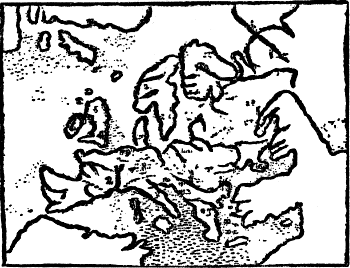
The chief Kingdoms of Europe, are Spain, 1. France, 2. Italy, 3. England, 4. Scotland, 5. Ireland, 6. Germany, 7. Bohemia, 8. Hungary, 9. Croatia, 10. Dacia, 11. Sclavonia, 12. Greece, 13. Thrace, 14. Podolia, 15. Tartary, 16. Lituania, 17. Poland, 18. The Netherlands, 19. Denmark, 20. Norway, 21. Swethland, 22. Lapland, 23. Finland, 24. Lisland, 25. Prussia, 26. Muscovy, 27. and Russia, 28. In Europâ nostrâ sunt Regna primaria, Hispania, 1. Gallia, 2. Italia, 3. Anglia (Britania), 4. Scotia, 5. Hibernia, 6. Germania, 7. Bohemia, 8. Hungaria, 9. Croatia, 10. Dacia, 11. Sclavonia, 12. Græcia, 13. Thracia, 14. Podolia, 15. Tartaria, 16. Lituania, 17. Polonia, 18. Belgium, 19. Dania, 20. Norvegia, 21. Suecia, 22. Lappia, 23. Finnia, 24. Livonia, 25. Borussia, 26. Muscovia, 27. Russia, 28.
CIX.
Moral Philosophy.
Ethica.
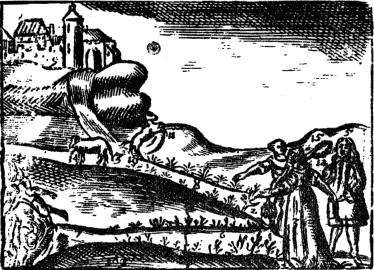
This Life is a way, or a place divided into two ways, like Pythagoras’s Letter Y. broad, 1. on the left hand track; narrow, 2. on the right; that belongs to Vice, 3. this to Vertue, 4. Vita hæc est via, sive Bivium, simile Litteræ Pithagoricæ Y. latum, 1. sinistro tramite angustum, 2. dextro; ille Vitii, 3. est his Virtutis, 4.
Mind, Young Man, 5. imitate Hercules: leave the left hand way, turn from Vice; the Entrance, 6. is fair, but the End, 7. is ugly and steep down. Adverte juvenis, 5. imitare Herculem; linque sinistram, aversare Vitium; Aditus speciosus, 6. sed Exitus, 7. turpis & præceps.
Go on the right hand, though it be thorny, 8. no way is unpassible to vertue; follow whither vertue leadeth through narrow places to stately palaces, to the Tower of honour, 9. Dextera ingredere, utut spinosa, 8. nulla via invia virtuti; sequere quâ viâ ducit virtus per angusta, ad augusta, ad Arcem honoris, 9.
Keep the middle and streight path, and thou shalt go very safe. Tene medium & rectum tramitem; ibis tutissimus.
Take heed thou do not go too much on the right hand, 10. Cave excedas ad dextram, 10.
Bridle in, 12. the wild Horse, 11. of Affection, lest thou fall down headlong. Compesce freno, 12. equum ferocem, 11. Affectûs ne præceps fias.
See thou dost not go amiss on the left hand, 13. in an ass-like sluggishness, 14. but go onwards constantly, persevere to the end, and thou shalt be crown’d, 15. Cave deficias ad sinistram, 13. segnitie asininâ, 14. sed progredere constanter pertende ad finem, & coronaberis, 15.
CX.
Prudence.
Prudentia.
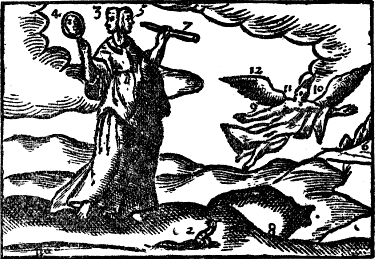
Prudence, 1. looketh upon all things as a Serpent, 2. and doeth, speaketh, or thinketh nothing in vain. Prudentia, 1. circumspectat omnia ut Serpens, 2. agitque, loquitur, aut cogitat nihil incassum.
She looks backwards, 3. as into a Looking-glass, 4. to things past; and seeth before her, 5. as with a Perspective-glass, 7. things to come, or the End, 6. and so she perceiveth what she hath done, and what remaineth to be done. Respicit, 3. tanquam in Speculum, 4. ad præterita; & prospicit, 5. tanquam Telescopio, 7. Futura, seu Finem, 6. atque ita perspicit quid egerit, & quid restet agendum.
She proposeth an Honest, Profitable and withal, if it may be done, a Pleasant End, to her Actions.* Actionibus suis* præfigit Scopum, Honestum, Utilem, simulque, si fieri potest, Jucundum.
Having foreseen the End, she looketh out Means, as a Way, 8. which leadeth to the End; but such as are certain and easie, and fewer rather than more, lest anything should hinder. Fine prospecto, dispicit Media, ceu Viam, 8. quæ ducit ad finem, sed certa & facilia; pauciora potiùs quàm plura, ne quid impediat.
She watcheth Opportunity, 9. (which having a bushy fore-head, 10. and being bald-pated, 11. and moreover having wings, 12. doth quickly slip away,) and catcheth it. Attendit Occasioni, 9. (quæ Fronte Capillata, 10. sed vertice calva, 11. adhæc alata, 12. facile elabitur) eamque captat.
She goeth on her way warily, for fear she should stumble or go amiss. In viâ pergit cautè (providè) ne impingat aut aberret.
CXI.
Diligence.
Sedulitas.
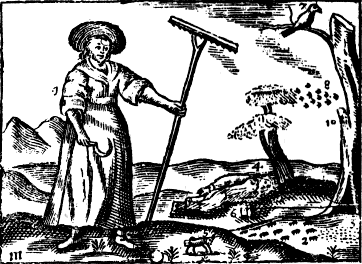
Diligence, 1. loveth labours, avoideth Sloth, is always at work, like the Pismire, 2. and carrieth together, as she doth, for herself, Store of all things, 3. Sedulitas, 1. amat labores, fugit Ignaviam, semper est in opere, ut Formica, 2. & comportat, ut illa, sibi, omnium rerum Copiam, 3.
She doth not always sleep, or make holidays, as the Sluggard, 4. and the Grashopper, 5. do, whom Want, 6. at the last overtaketh. Non semper dormit, ferias agit, aut ut Ignavus, 4. & Cicada, 5. quos Inopia, 6. tandem premit.
She pursueth what things she hath undertaken chearfully, even to the end; she putteth nothing off till the morrow, nor doth she sing the Crow’s song, 7. which saith over and over, Cras, Cras. Urget incepta alacriter ad finem usque; procrastinat nihil, nec cantat cantilenam Corvi, 7. qui ingeminat Cras, Cras.
After labours undergone, and ended, being even wearied, she resteth her self; but being refreshed with Rest, that she may not use her self to Idleness, she falleth again to her Business, Post labores exantlatos, & lassata, quiescit; sed recreata Quiete, ne adsuescat Otio, redit ad Negotia.
A diligent Scholar is like Bees, 8. which carry honey from divers Flowers, 9. into their Hive, 10. Diligens Discipulus, similis est Apibus, 8. qui congerunt mel ex variis Floribus, 9. in Alveare suum, 10.
CXII.
Temperance.
Temperantia.
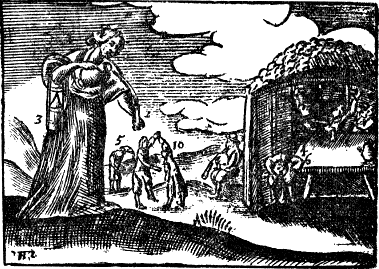
Temperance, 1. prescribeth a mean to meat and drink, 2. and restraineth the desire, as with a Bridle, 3. and so moderateth all things, lest any thing too much be done. Temperantia, 1. præscribit modum Cibo & Potui, 2. & continet cupidinem, ceu Freno, 3. & sic moderatur omnia ne quid nimis fiat.
Revellers are made drunk, 4. they stumble, 5. they spue, 6. and babble, 7.* Heluones (ganeones) inebriantur, 4. titubant, 5. ructant (vomunt), 6. & rixantur, 7.
From Drunkenness proceedeth Lasciviousness; from this a lewd Life amongst Whoremasters, 8. and Whores, 9. in kissing, touching, embracing, and dancing, 10. E Crapula oritur Lascivia; ex hâc Vita libidinosa inter Fornicatores, 8. & Scorta, 9. osculando (basiando), palpando, amplexando, & tripudiando, 10.
CXIII.
Fortitude.
Fortitudo.
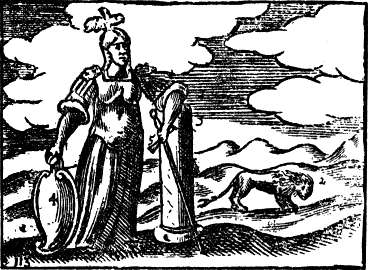
Fortitude, 1. is undaunted in adversity, and bold as a Lion, 2. but not haughty in Prosperity, leaning on her own Pillar, 3. Constancy, and being the same in all things, ready to undergo both estates with an even mind. Fortitudo, 1. impavida est in adversis, & confidens ut Leo, 2. at non tumida in Secundis, innixa suo Columini, 3. Constantiæ; & eadem in omnibus, parata ad ferendam utramque fortunam æquo animo.
She receiveth the strokes of Misfortune with the Shield, 4. of Sufferance: and keepeth off the Passions, the enemies of quietness with the Sword, 5. of Valour. Excipit ictus Infortunii Clypeo, 4. Tolerantiæ: & propellit Affectus, hostes Euthymiæ gladio, 5. Virtutis.
CXIV.
Patience.
Patientia.
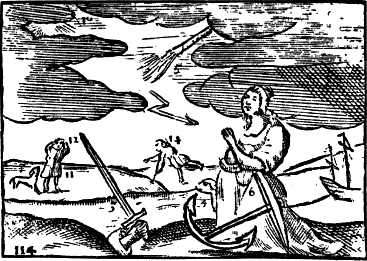
Patience, 1. endureth Calamities, 2. and Wrongs, 3. meekly like a Lamb, 4. as the Fatherly chastisement of God, 5. Patientia, 1. tolerat Calamitates, 2. & Injurias, 3. humiliter ut Agnus, 4. tanquam paternam ferulam Dei, 5.
In the meanwhile she leaneth upon the Anchor of Hope, 6. (as a Ship, 7. tossed by waves in the Sea) she prayeth to God, 8. weeping, and expecteth the Sun, 10. after cloudy weather, 9. suffering evils, and hoping better things. Interim innititur Spei Anchoræ, 6. (ut Navis, 7. fluctuans mari) Deo supplicat, 8. illacrymando, & expectat Phœbum, 10. post Nubila, 9. ferens mala, sperans meliora.
On the contrary, the impatient person, 11. waileth, lamenteth, rageth against himself, 12. grumbleth like a Dog, 13. and yet doth no good; at the last he despaireth, and becometh his own Murtherer, 14. Contra, Impatiens, 11. plorat, lamentatur, debacchatur, 12. in seipsum, obmurmurat ut Canis, 13. & tamen nil proficit; tandem desperat, & fit Autochir, 14.
Being full of rage he desireth to revenge wrongs. Furibundus cupit vindicare injurias.
CXV.
Humanity.
Humanitas.
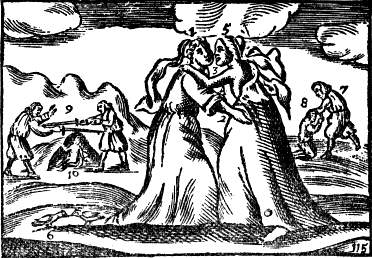
Men are made for one another’s good; therefore let them be kind. Homines facti sunt ad mutua commoda; ergò sint humani.
Be thou sweet and lovely in thy Countenance, 1. gentle and civil in thy Behaviour and Manners, 2. affable and true spoken with thy Mouth, 3. affectionate and candid in thy Heart, 4. Sis suavis & amabilis Vultu, 1. comis & urbanus Gestu ac Moribus, 2. affabilis & verax, Ore, 3. candens & candidus Corde, 4.
So love, and so shalt thou be loved; and there will be a mutual Friendship, 5. as that of Turtle-doves, 6. hearty, gentle, and wishing well on both parts. Sic ama, sic amaberis; & fiat mutua Amicitia, 5. ceu Turturum, 6. concors, mansueta, & benevola utrinque.
Froward Men are hateful, teasty, unpleasant. contentious, angry, 7. cruel, 8. and implacable, (rather Wolves and Lions, than Men) and such as fall out among themselves, hereupon they fight in a Duel, 9. Morosi homines, sunt odiosi, torvi, illepidi. contentiosi, iracundi, 7. crudeles, 8. ac implacabiles, (magis Lupi & Leones, quàm homines) & inter se discordes, hinc confligunt Duelle, 9.
Envy, 10. wishing ill to others, pineth away her self. Invidia, 10. malè cupiendo aliis, conficit seipsam.
CXVI.
Justice.
Justitia.
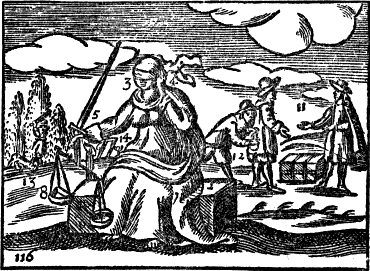
Justice, 1. is painted, sitting on a square stone, 2. for she ought to be immoveable; with hood-winked eyes, 3. that she may not respect persons; stopping the left ear, 4. to be reserved for the other party; Justitia, 1. pingitur, sedens in lapide quadrato, 2. nam decet esse immobilis; obvelatis oculis, 3. ad non respiciendum personas; claudens aurem sinistram, 4. reservandam alteri parti;
Holding in her right Hand a Sword, 5. and a Bridle, 6. to punish and restrain evil men; Tenens dextrâ Gladium, 5. & Frænum, 6. ad puniendum & coërcendum malos;
Besides, a pair of Balances, 7. in the right Scale, 8. whereof Deserts, and in the left, 9. Rewards being put, are made even one with another, and so good Men are incited to virtue, as it were with Spurs, 10. Præterea, Stateram, 7. cujus dextræ Lanci, 8. Merita, Sinistræ, 9. Præmia imposita, sibi invicem exequantur, atque ita boni incitantur ad virtutem, ceu Calcaribus, 10.
In Bargains, 11. let Men deal candidly, let them stand to their Covenants and Promises; let that which is given one to keep, and that which is lent, be restored: let no man be pillaged, 12. or hurt, 13. let every one have his own: these are the precepts of Justice. In Contractibus, 11. candidè agatur: stetur Pactis & Promissis; Depositum, & Mutuum, reddantur: nemo expiletur, 12. aut lædatur, 13. suum cuique tribuatur: hæc sunt præcepta Justitiæ.
Such things as these are forbidden in God’s 5th. and 7th. Cammandment, and deservedly punish’d on the Gallows and the Wheel, 14. Talia prohibentur, quinto & septimo Dei Præcepto, & merito puniuntur Cruce ac Rotâ, 14.
CXVII.
Liberality.
Liberalitas.
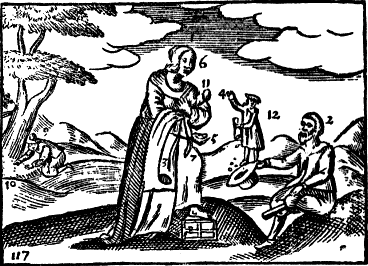
Liberality, 1. keepeth a mean about Riches, which she honestly seeketh, that she may have somewhat to bestow on them that want, 2. Liberalitas, 1. servat modum circa Divitias, quas honestè quærit ut habeat quod largiatur Egenis, 2.
She cloatheth, 3. nourisheth, 4. and enricheth, 5. these with a chearful countenance, 6. and a winged hand, 7. Hos vestit, 3. nutrit, 4. ditat, 5. Vultu hilari, 6. & Manu alatâ, 7.
She submitteth her wealth, 8. to her self, not her self to it, as the covetous man, 9. doth, who hath, that he may have, and is not the Owner, but the Keeper of his goods, and being unsatiable, always scrapeth together, 10. with his Nails. Subjicit opes, 8. sibi, non se illis, ut Avarus, 9. qui habet, ut habeat, & non est Possessor sed Custos bonorum suorum, & insatiabilis, semper corradit, 10. Unguibus suis.
Moreover he spareth and keepeth, hoarding up, 11. that he may always have. Sed & parcit & adservat, occludendo, 11. ut semper habeat.
But the Prodigal, 12. badly spendeth things well gotten, and at the last wanteth. At Prodigus, 12. malè disperdit benè parta, ac tandem eget.
CXVIII.
Society betwixt Man and Wife.
Societas Conjugalis.
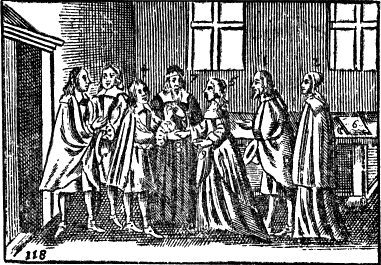
Marriage was appointed by God in Paradise, for mutual help, and the Propagation of mankind. Matrimonium institutum est à Deo in Paradiso, ad mutuum adjutorium, & propagationem generis humani.
A young man (a single man) being to be married, should be furnished either with Wealth, or a Trade and Science, which may serve for getting a living; that he may be able to maintain a Family. Vir Juvenis (Cœlebs) conjugium initurus, instructus sit aut Opibus, aut Arte & Scientiâ, quæ sit de pane lucrando; ut possit sustentare Familiam.
Then he chooseth himself a Maid that is Marriageable, (or a Widow) whom he loveth; nevertheless a greater Regard is to be had of Virtue, and Honesty, than of Beauty or Portion. Deinde eligit sibi Virginem Nubilem, (aut Viduam) quam adamat; ubi tamen major ratio habenda Virtutis & Honestatis, quàm Formæ aut Dotis.
Afterwards, he doth not betroth her to himself closely, but entreateth for her as a Woer, first to the Father, 1. and then the Mother, 2. or the Guardians, or Kinsfolks, by such as help to make the match, 3. Posthæc, non clam despondet sibi eam, sed ambit, ut Procus, apud Patrem, 1. & Matrem, 2. vel apud Tutores, & Cognatos, per Pronubos, 3.
When she is espous’d to him, he becometh the Bridegroom, 4. and she the Bride, 5. and the Contract is made. and an Instrument of Dowry 6. is written. Eâ sibi desponsâ, fit Sponsus, 4. & ipsa Sponsa, 5. fiuntque Sponsalia, & scribitur Instrumentum Dotale, 6.
At the last the Wedding is made, where they are joined together by the Priest, 7. giving their Hands, 8. one to another. and Wedding-rings, 9. then they feast with the witnesses that are invited. Tandem fiunt Nuptiæ ubi copulantur à Sacerdote, 7. datis Manibus, 8. ultrò citroque, & Annulis Nuptialibus, 9. tum epulantur cum invitatis testibus.
After this they are called Husband and Wife; when she is dead he becometh a Widower. Abhinc dicuntur Maritus & Uxor; hâc mortuâ ille fit Viduus.
CXIX.
The Tree of Consanguinity.
Arbor Consanguinitatis.
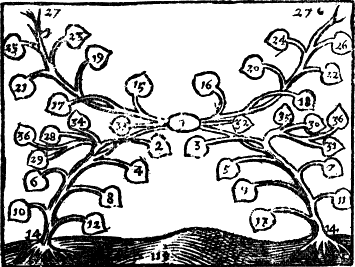
In Consanguinity there touch a Man, 1. in Lineal Ascent, the Father (the Father-in-law), 2. and the Mother (the Mother-in-law), 3. the Grandfather, 4. and the Grandmother, 5. the Great Grandfather, 6. and the Great Grandmother, 7. the great great Grandfather, 8. the great great Grandmother, 9. the great great Grandfather’s Father, 10. the great great Grandmother’s Mother, 11. the great great Grandfather’s Grandfather, 12. the great great Grandmother’s Grandmother, 13. Hominem, 1. Consanguinitate attingunt, in Linea ascendenti, Pater (Vitricus), 2. & Mater (Noverca), 3. Avus, 4. & Avia, 5. Proavus, 6. & Proavia, 7. Abavus, 8. & Abavia, 9. Atavus, 10. & Atavia, 11 Tritavus, 12. & Tritavia, 13.
Those beyond these are called Ancestors, 14....14. Ulteriores dicuntur Majores, 14....14.
In a Lineal descent, the Son (the son-in-law), 15. and the Daughter, (the Daughter-in-law), 16. the Nephew, 17. and the Neece, 18. the Nephews Son, 19. and the Nephews Daughter, 20. the Nephews Nephew, 21. and the Neeces Neece, 22. the Nephews Nephews Son, 23. the Neeces Neeces Daughter, 24. the Nephews Nephews Nephew, 25. the Neeces Neeces Neece, 26. In Linea descendenti, Filius (Privignus), 15. & Filia (Privigna), 16. Nepos, 17. & Neptis, 18. Pronepos, 19. & Proneptis, 26. Abnepos, 21. & Abneptis, 22. Atnepos, 23. & Atneptis, 24. Trinepos, 25. & Trineptis, 26.
Those beyond these are called Posterity, 27....27. Ulteriores dicuntur Posteri, 27....27.
In a Collateral Line are the Uncle by the Fathers side, 28. and the Aunt by the Fathers side, 29. the Uncle by the Mothers side, 30. and the Aunt by the Mothers side, 31. the Brother, 32. and the Sister, 33. the Brothers Son, 34. the Sisters Son, 35. and the Cousin by the Brother and Sister, 36. In Linea Collaterali sunt Patruus, 28. & Amita, 29. Avunculus, 30. & Matertera, 31. Frater, 32. & Soror, 33. Patruelis, 34. Sobrinus, 35. & Amitinus, 36.
CXX.
The Society betwixt Parents and Children.
Societas Parentalis.
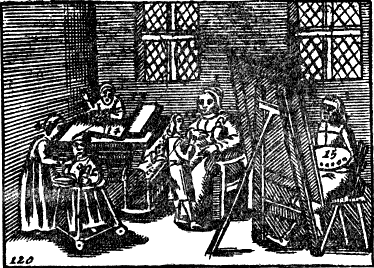
Married Persons, (by the blessing of God) have Issue, and become Parents. Conjuges, (ex benedictione Dei) suscipiunt Sobolem (Prolem) & fiunt Parentes.
The Father, 1. begetteth and the Mother, 2. beareth Sons, 3. and Daughters, 4. (sometimes Twins). Pater, 1. generat & Mater, 2. parit Filios, 3. & Filias, 4. (aliquando Gemellos).
The Infant, 5. is wrapped in Swadling-cloathes, 6. is laid in a Cradle, 7. is suckled by the Mother with her Breasts, 8. and fed with Pap, 9. Afterwards it learneth to go by a Standing-stool, 10. playeth with Rattles, 11. and beginneth to speak. Infans, 5. involvitur Fasciis, 6. reponitur in Cunas, 7. lactatur a matre Uberibus, 8. & nutritur Pappis, 9. Deinde discit incedere Seperasto, 10. ludit Crepundiis, 11. & incipit fari.
As it beginneth to grow older, it is accustomed to Piety, 12. and Labour, 13. and is chastised, 14. if it be not dutiful. Crescente ætate, adsuescit Pietati, 12. & Labori, 13. & castigatur, 14. si non sit morigerus.
Children owe to Parents Reverence and Service. Liberi debent Parentibus Cultum & Officium.
The Father maintaineth his Children by taking pains, 15. Pater sustentat Liberos, laborando, 15.
CXXI.
The Society betwixt Masters and Servants.
Societas herilis.
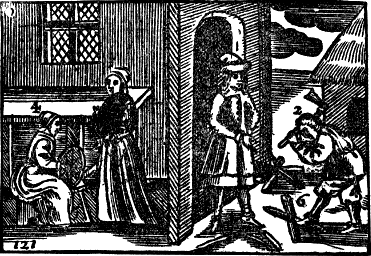
The Master (the goodman of the House), 1. hath Men-servants, 2. Herus (Pater familias), 1. habet Famulos (Servos), 2.
the Mistress (the good wife of the House), 3. Maidens, 4. Hera (Mater familias), 3. Ancillas, 4.
They appoint these their Work, 6. and divide them their tasks, 5. which are faithfully to be done by them without murmuring and loss: for which their Wages, and Meat and Drink is allowed them. Illi mandant his Opera, 6. & distribuunt Laborum Pensa, 5. quæ ab his fideliter sunt exsequenda sine murmure & dispendio; pro quo Merces & Alimonia præbentur ipsis.
A Servant was heretofore a Slave, over whom the Master had power of life and death. Servus olim erat Mancipium, in quem Domino potestas fuit vitæ & necis
At this day the poorer sort serve in a free manner, being hired for Wages. Hodiè pauperiores serviunt liberè, conducti mercede.
CXXII.
A City.
Urbs.
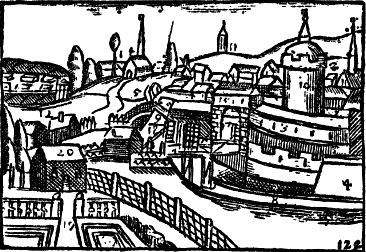
Of many Houses is made a Village, 1. or a Town, or a City, 2. Ex multis Domibus fit Pagus, 1. vel Oppidum, vel Urbs, 2.
That and this are fenced and begirt with a Wall, 3. a Trench, 4. Bulwarks, 5. and Pallisadoes, 6. Istud & hæc muniuntur & cinguntur Mœnibus (Muro), 3. Vallo, 4. Aggeribus, 5. & Vallis, 6.
Within the Walls is the void Place, 7. without, the Ditch, 8. Intra muros est Pomœrium, 7. extrà, Fossa, 8.
In the Walls are Fortresses, 9. and Towers, 10. Watch-Towers, 11. are upon the higher places. In mœnibus sunt Propugnacula, 9. & Turres, 10. Specula, 11. extant in editioribus locis.
The entrance into a City is made out of the Suburbs, 12. through Gates, 13. over the Bridge, 14. Ingressus in Urbem fit ex Suburbio, 12. per Portam, 13. super Pontem, 14.
The Gate hath a Portcullis, 15. a Draw-bridge, 16. two-leaved Doors, 17. Locks and Bolts, as also Barrs, 18. Porta habet Cataractas, 15. Pontem versatilem, 16. Valvas, 17. Claustra & Repagula, ut & Vectes, 18.
In the Suburbs are Gardens, 19. and Garden-houses, 20. and also Burying-places, 21. In Suburbiis sunt Horti, 19. & Suburbana, 20. ut & Cœmeteria, 21.
CXXIII.
The inward parts of a City.
Interiora Urbis.
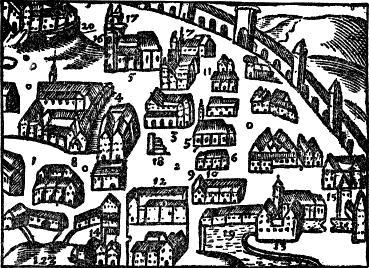
Within the City are Streets, 1. paved with Stones; Market-places, 2. (in some places with Galleries), 3. and narrow Lanes, 4. Intra urbem sunt Plateæ (Vici), 1. stratæ Lapidibus; Fora, 2. (alicubi cum Porticibus), 3. & Angiportus, 4.
The Publick Buildings are in the middle of the City, the Church, 5. the School, 6. the Guild-Hall, 7. the Exchange, 8. Publica ædificia sunt in medio Urbis, Templum, 5. Schola, 6. Curia, 7. Domus Mercaturæ, 8.
About the Walls and the Gates are the Magazine, 9. the Granary, 10. Inns, Ale-houses, Cooks-shops, 11. the Play-house, 12. and the Spittle, 13. Circa Mœnia, & Portas Armamentarium, 9. Granarium, 10. Diversoria, Popinæ, & Cauponæ, 11. Theatrum, 12. Nosodochium, 13.
In the by-places are Houses of Office, 14. and the Prison, 15. In recessibus, Foricæ (Cloacæ), 14. & Custodia (Carcer), 15.
In the chief Steeple is the Clock, 16. and the Watchmans Dwelling, 17. In turre primariâ est Horologium, 16. & habitatio Vigilum, 17.
In the Streets are Wells, 18. In Plateis sunt Putei, 18.
The River, 19. or Beck, runneth about the City, serveth to wash away the filth. Fluvius, 19. vel Rivus, interfluens Urbem, inservit eluendis sordibus.
The Tower, 20. standeth in the highest part of the City. Arx, 20. extat in summo Urbis.
CXXIV.
Judgment.
Judicium.
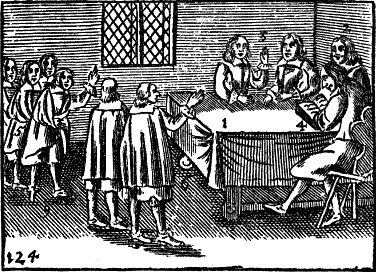
The best Law, is a quiet agreement, made either by themselves, betwixt whom the sute is, or by an Umpire. Optimum Jus, est placida conventio, facta vel ab ipsis, inter quos lis est vel ab Arbitro.
If this do not proceed, they come into Court, 1. (heretofore they judg’d in the Market-place; at this day in the Moot-hall) in which the Judge, 2. sitteth with his Assessors, 3. the Clerk, 4. taketh their Votes in writing. Hæc si non procedit, venitur in Forum, 1. (olim judicabant in Foro, hodiè in Prætorio) cui Judex (Prætor), 2. præsidet cum Assessoribus, 3. Dicographus, 4. excipit Vota calamo.
The Plaintiff, 5. accuseth the Defendant, 6. and produceth Witnesses, 7. against him. Actor, 5. accusat Reum, 6. & producit Testes, 7. contra illum.
The Defendant excuseth himself by a Counsellor, 8. whom the Plaintiff’s Counsellor, 9. contradicts. Reus excusat se per Advocatum, 8. cui Actoris Procurator, 9. contradicit.
Then the Judge pronounceth Sentence, acquitting the innocent, and condemning him that is guilty, to a Punishment, or a Fine, or Torment. Tum Judex Sententiam pronunciat, absolvens insontem, & damnans sontem ad Pœnam, vel Mulctam, vel ad Supplicium.
CXXV.
The Tormenting of Malefactors.
Supplicia Malefactorum.
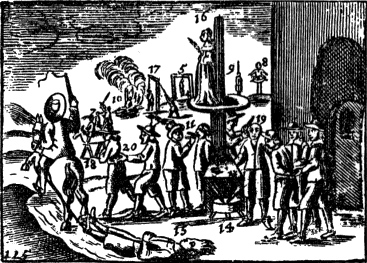
Malefactors, 1. are brought from the Prison, 3. (where they are wont to be tortured) by Serjeants, 2. or dragg’d with a Horse, 15. to place of Execution. Malefici, 1. producuntur, è Carcere, 3. (ubi torqueri solent) per Lictores, 2. vel Equo raptantur, 15. ad locum Supplicii.
Thieves, 4. are hanged by the Hangman, 6. on a Gallows, 5. Fures, 4. suspenduntur a Carnifice, 6. in Patibulo, 5.
Whoremasters are beheaded, 7. Mœchi decollantur, 7.
Murtherers and Robbers are either laid upon a Wheel, 8. having their Legs broken, or fastened upon a Stake, 9. Homicidæ (Sicarii) ac Latrones (Piratæ) vel imponuntur Rotæ crucifragio plexi, 8. vel Palo infiguntur, 9.
Witches are burnt in a great Fire, 10. Striges (Lamiæ) cremantur super Rogum, 10.
Some before they are executed have their Tongues cut out, 11. or have their Hand, 12. cut off upon a Block, 13. or are burnt with Pincers, 14. Quidam antequam supplicio afficiantur elinguantur, 11. aut plectuntur Manu, 12. super Cippum, 13. aut Forcipibus, 14. uruntur
They that have their Life given them, are set on the Pillory, 16. or strapado’d, 17. are set upon a wooden Horse, 18. have their Ears cut off, 19. are whipped with Rods, 20. are branded, are banished, are condemned to the Gallies, or to perpetual Imprisonment. Vitâ donati, constringuntur Numellis, 16. luxantur, 17. imponuntur Equuleo, 18. truncantur Auribus, 19. cæduntur Virgis, 20. Stigmate notantur, relegantur, damnantur ad Triremes, vel ad Carcerem perpetuum.
Traytors are pull’d in pieces with four Horses. Perduelles discerpuntur Quadrigis.
CXXVI.
Merchandizing.
Mercatura.
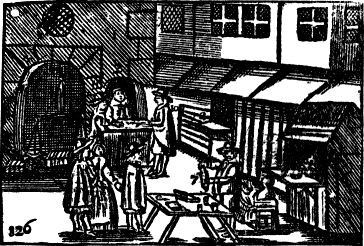
Wares brought from other places are either exchanged in an Exchange, 1. or exposed to sale in Warehouses, 2. and they are sold for Money, 3. being either measured with an Eln, 4. or weighed in a pair of Balances, 5. Merces, aliunde allatæ, aliunde vel commutantur in Domo Commerciorum, 1, vel exponuntur venum in Tabernis Mercimoniorum, 2. & venduntur pro Pecuniâ (monetâ), 3. vel mensuratæ Ulnâ, 4. vel ponderatæ Librâ, 5.
Shop-keepers, 6. Pedlars, 7. and Brokers, 8. would also be called Merchants, 9. Tabernarii. 6. Circumforanei, 7. & Scrutarii, 8. etiam volunt dici Mercatores, 9.
The Seller braggeth of a thing that is to be sold, and setteth the rate of it, and how much it may be sold for. Venditor ostentat rem promercalem, & indicat pretium, quanti liceat.
The Buyer, 10. cheapneth and offereth the price. Emptor, 10. licetur, & pretium offert.
If any one bid against him, 11. the thing is delivered to him that promiseth the most. Si quis contralicetur, 11. ei res addicitur qui pollicetur plurimum.
CXXVII.*
Measures and Weights.
Mensuræ & Pondera.
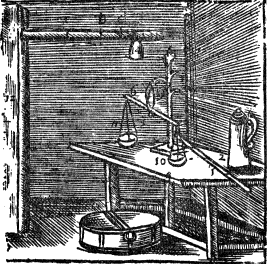
We measure things that hang together with an Eln, 1. liquid things with a Gallon, 2. and dry things by a two-bushel Measure, 3. Res continuas metimur Ulnâ, 1. liquidas Congio, 2. aridas Medimno, 3.
We try the heaviness of things by Weights, 4. and Balances, 5. Gravitatem rerum experimur Ponderibus, 4. & Librâ (bilance), 5.
In this is first the Beam, 6. in the midst whereof is a little Axle-tree, 7. above the cheeks and the hole, 8. in which the Needle, 9. moveth it self to and fro: on both sides are the Scales, 10. hanging by little Cords, 11. In hâc primò est Jugum (Scapus), 6. in cujus medio Axiculus, 7. superiùs trutina & agina, 8. in quâ Examen, 9. sese agitat: utrinque sunt Lances, 10. pendentes Funiculis, 11.
The Brasiers balance, 12. weigheth things by hanging them on a Hook, 13. and the Weight, 14. opposite to them which in (a) weigheth just as much as the thing, in (b) twice so much in (c) thrice so much, &c. Statera, 12. ponderat res, suspendendo illas Unco, 13. & Pondus, 14. ex opposito, quod in (a) æquiponderat rei, in (b) bis tantum, in (c) ter, &c.
CXXVIII.
Physick.
Ars Medica.
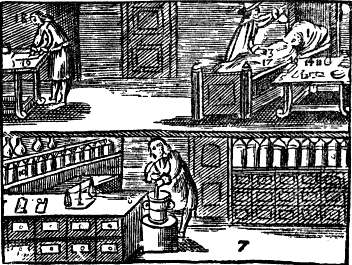
The Patient, 1. sendeth for a Physician, 2. who feeleth his Pulse, 3, and looketh upon his Water, 4. and then prescribeth a Receipt in a Bill, 5. Ægrotans, 1. accersit Medicum, 2. qui tangit ipsius Arteriam, 3. & inspicit Urinam, 4. tum præscribit Medicamentum in Schedula, 5.
That is made ready by an Apothecary, 6. in a Apothecaries Shop, 7. where Drugs are kept in Drawers, 8. Boxes, 9. and Gally-pots, 10. Istud paratur à Pharmacopæo, 6. in Pharmacopolio, 7. ubi Pharmaca adservantur in Capsulis, 8. Pyxidibus, 9. & Lagenis, 10.
And it is either a Potion, 11. or Powder, 12. or Pills, 13. or Trochisks, 14. or an Electuary, 15. Estque vel Potio, 11. vel Pulvis, 12. vel Pillulæ, 13. vel Pastilli, 14. vel Electuarium, 15.
Diet and Prayer, 16. is the best Physick. Diæta & Oratio, 16. est optima Medicina.
The Chirurgeon, 18. cureth Wounds, 17. and Ulcers, with Plasters, 19. Chirurgus, 18. curat Vulnera, 17. & Ulcera, Spleniis (emplastris), 19.
CXXIX.
A Burial.
Sepultura.
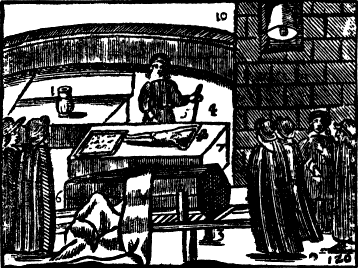
Dead Folks heretofore were burned, and their Ashes put into an Urn, 1. Defuncti olim cremabantur, & Cineres recondebantur in Urna, 1.
We enclose our dead Folks in a Coffin, 2. lay them upon a Bier, 3. and see they be carried out in a Funeral Pomp towards the Church-yard, 4. where they are laid in a Grave, 6. by the Bearers, 5. and are interred; this is covered with a Grave-stone, 7. and is adorned with Tombs, 8. and Epitaphs, 9. Nos includimus nostros Demortuos Loculo, (Capulo), 2. imponimus Feretro, 3. & curamus efferri Pompâ Funebri versus Cœmeterium, 4. ubi inferuntur, Sepulchro, 6, a Vespillonibus, 5. & humantur; hoc tegitur Cippo, 7. & ornatur Monumentis, 8. ac Epitaphiis, 9.
As the Corps go along Psalms are sung, and the Bells are rung, 10. Funere prodeunte, Hymni cantantur, & Campanæ, 10. pulsantur.
CXXX.
A Stage-play.
Ludus Scenicus.
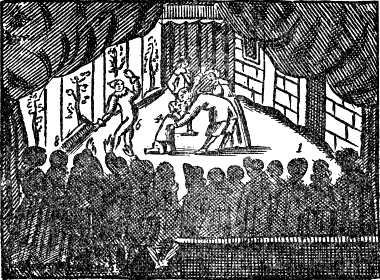
In a Play-house, 1. (which is trimmed with Hangings, 2. and covered with Curtains, 3.) Comedies and Tragedies are acted, wherein memorable things are represented; as here, the History of the Prodigal Son, 4. and his Father, 5. by whom he is entertain’d, being return’d home. In Theatro, 1. (quod vestitur Tapetibus, 2. & tegitur Sipariis, 3.) Comediæ vel Tragœdiæ aguntur, quibus repræsentantur res memorabiles ut hic, Historia de Filio Prodigo, 4. & Patre, 5. ipsius, à quo recipitur, domum redux.
The Players act being in disguise; the Fool, 6. maketh Jests. Actores (Histriones) agunt personati; Morio, 6. dat Jocos.
The chief of the Spectators sit in the Gallery, 7. the common sort stand on the Ground, 8. and clap the hands, if anything please them. Spectatorum primarii, sedent in Orchestra, 7. plebs stat in Cavea, 8. & plaudit, si quid arridet.
CXXXI.
Sleights.
Præstigiæ.
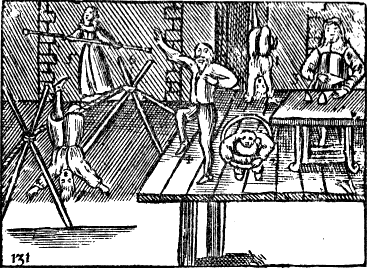
The Tumbler, 1. maketh several Shows by the nimbleness of his body, walking to and fro on his hands, leaping through a Hoop, 2. &c. Præstigiator, 1. facit varia Spectacula, volubilitate corporis, deambulando manibus, saliendo per Circulum, 2. &c.
Sometimes also he danceth, 4. having on a Vizzard. Interdum etiam tripudiat, 4. Larvatus.
The Jugler, 3. sheweth sleights, out of a Purse. Agyrta, 3. facit præstigias è Marsupio.
The Rope-dancer, 5. goeth and danceth upon a Rope, holdeth a Poise, 6. in his hand; or hangeth himself by the hand or foot, 7. &c. Funambulus, 5. graditur & saltat super Funem, tenens Halterem, 6. manu; aut suspendit se manu vel pede, 7. &c.
CXXXII.
The Fencing-School.
Palestra.
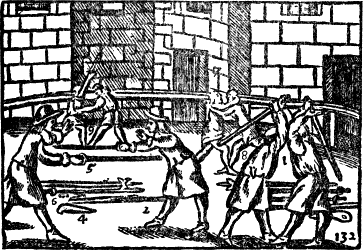
Fencers meet in a Duel in a Fencing-place, fighting with Swords, 1. or Pikes, 2. and Halberds, 3. or Short-swords, 4. or Rapiers, 5. having balls at the point (lest they wound one another mortally) or with two edged-Swords and a Dagger, 6. together. Pugiles congrediuntur Duello in Palestra, decertantes vel Gladiis, 1. vel Hastilibus, 2. & Bipennibus, 3. vel Semispathis, 4. vel Ensibus, 5. mucronem obligatis, (ne lædet lethaliter) vel Frameis & Pugione, 6. simul.
Wrestlers, 7. (among the Romans in time past were nayked and anointed with Oyl) take hold of one another and strive whether can throw the other, especially by tripping up his heels, 8. Luctatores, 7. (apud Romanos olim nudi & inuncti Oleo) prehendunt se invicem & annituntur uter alterum prosternere possit, præprimis supplantando, 8.
Hood-winked Fencers, 9. fought with their fists in a ridiculous strife, to wit, with their Eyes covered. Andabatæ, 9. pugnabant pugnis ridiculo certamine, nimirum Oculis obvelatis.
CXXXIII.
Tennis-play.
Ludus Pilæ.
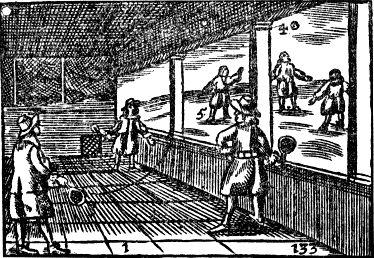
In a Tennis Court, 1. they play with a Ball, 2. which one throweth, and another taketh, and sendeth it back with a Racket, 3. and that is the Sport of Noble Men to stir their Body. In Sphæristerio, 1. luditur Pilâ, 2. quam alter mittit, alter excipit, & remittit Reticulo, 3. idque est Lusus Nobilium ad commotionem Corporis.
A Wind-ball, 4. being filled with Air, by means of a Ventil, is tossed to and fro with the Fist, 5. in the open Air. Follis (pila magna), 4. distenta Aere ope Epistomii, reverberberatur Pugno, 5. sub Dio.
CXXXIV.
Dice-play.
Ludus Aleæ.
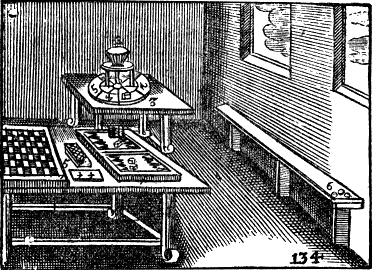
We play with Dice, 1. either they that throw the most take up all; or we throw them through a Casting-box, 2. upon a Board, 3. marked with figures, and this is Dice-players game at casting Lots. Tesseris (talis), 1. ludimus vel Plistobolindam; vel immittimus illas per Frittillum, 2. in Tabellam, 3. notatam numeris, idque est Ludas Sortilegii Aleatorum.
Men play by Luck and Skill at Tables. in a pair of Tables, 4. and at Cards, 5. Sorte & Arte luditur Calculis in Alveo aleatorio, 4. & Chartis lusoriis, 5.
We play at Chesse on a Chesse-board, 6. where only art beareth the sway. Ludimus Abaculis in Abaco, 6. ubi sola ars regnat.
The most ingenious Game is the Game of Chesse, 7. wherein as it were two Armies fight together in Battel. Ingeniosissimus Ludus est Ludus Latrunculorum, 7. quo veluti duo Exercitus confligunt Prælio.
CXXXV.
Races.
Cursus Certamina.
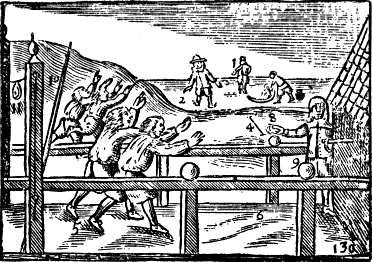
Boys exercise themselves by running, either upon the Ice, 1. in Scrick-shoes, 2. where they are carried also upon Sleds, 3. or in the open Field, making a Line, 4. which he that desireth to win, ought to touch, but not to run beyond it. Pueri exercent se cursu, sive super Glaciem, 1. Diabatris, 2. ubi etiam vehuntur Trahis, 3. sive in Campo, designantes Lineam, 4. quam qui vincere cupit debet attingere, at non ultrâ procurrere.
Heretofore Runners, 5. run betwixt Rails, 6. to the Goal, 7. and he that toucheth it first receiveth the Prize, 8. from him that gave the prize, 9. Olim decurrebant Cursores, 5. inter Cancellos, 6. ad Metam, 7. & qui primum contingebat eam, accipiebat Brabeum, (præmium), 8. à Brabeuta, 9.
At this day Tilting (or the quintain) is used, (where a Hoop, 11. is struck at with a Truncheon, 10.) instead of Horse-races, which are grown out of use. Hodie Hastiludia habentur, (ubi Circulus, 11. petitur Lancea, 10.) loco Equiriorum, quæ abierunt in desuetudinem.
CXXXVI.
Boys Sport.
Ludi Pueriles.
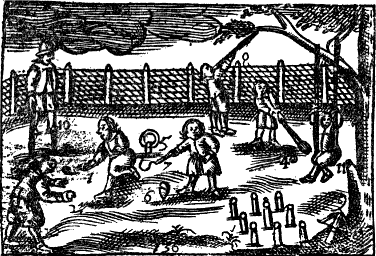
Boys use to play either with Bowling-stones 1. or throwing a Bowl, 2. at Nine-pins, 3. or striking a Ball, through a Ring, 5. with a Bandy, 4. or scourging a Top, 6. with a Whip, 7. or shooting with a Trunk, 8. and a Bow, 9. or going upon Stilts, 10, or tossing and swinging themselves upon a Merry-totter, 11. Pueri solent ludere vel Globis fictilibus, 1. vel jactantes Globum, 2. ad Conas, 3. vel mittentes Sphærulam per Annulum, 5. Clava, 4. versantes Turbinem, 6. Flagello, 7. vel jaculantes Sclopo, 8. & Arcu, 9. vel incidentes Grallis, 10. vel super Petaurum, 11. se agitantes & oscillantes.
CXXXVII.
The Kingdom and the Region.
Regnum & Regio.
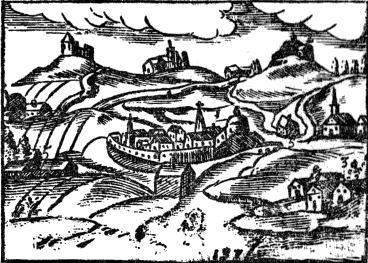
Many Cities and Villages make a Region and a Kingdom. Multæ Urbes & Pagi faciunt Regionem & Regnum.
The King or Prince resideth in the chief City, 1. the Noblemen, Lords, and Earls dwell in the Castles, 2. that lie about it; the Country People dwell in Villages, 3. Rex aut Princeps sedet in Metropoli. 1. Nobiles, Barones, & Comites habitant in Arcibus, 2. circumjacentibus; Rustici in Pagis, 3.
He hath his toll-places upon navigable Rivers, 4. and high-Roads, 5. where Portage and Tollage is exacted of them that sail or travel. Habet telonia sua juxta Flumina navigabilia, 4. & Vias regias, 5. ubi Portorum & Vectigal exigitur a navigantibus & iter facientibus.
CXXXVIII.
Regal Majesty.
Regia Majestas.
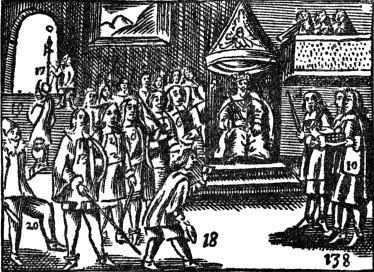
The King, 1. sitteth on his Throne, 2. in Kingly State, with a stately Habit, 3. crowned with a Diadem, 4. holding a Scepter, 5. in his Hand, being attended with a Company of Courtiers. Rex, 1. sedet in suo Solio, 2. in regio splendore, magnifico Habitu, 3. redimitus Diademate, 4. tenens Sceptrum, 5. manu, stipatus frequentiâ Aulicorum.
The chief among these, are the Chancellor, 6. with the Counsellors and Secretaries, the Lord-marshall, 7. the Comptroller, 8. the Cup-bearer, 9. the Taster, 10. the Treasurer, 11. the High Chamberlain, 12. and the Master of the Horse, 13. Inter hos primarii sunt Cancellarius, 6. cum Consiliariis & Secretariis, Præfectus Prætorii, 7. Aulæ Magister, 8. Pocillator (pincerna), 9. Dapifer, 10. Thesaurarius, 11. Archi-Cubicularius, 12. & Stabuli Magister, 13.
There are subordinate to these the Noble Courtiers, 14. the Noble Pages, 15. with the Chamberlains, and Lacquies, 16. the Guard, 17. with their Attendance. Subordinantur his Nobiles Aulici, 14. Nobile Famulitium, 15. cum Cubiculariis, & Cursoribus, 16. Stipatores, 17. cum Satellitio.
He solemnly giveth Audience to the Ambassadors of Foreign Princes, 18. Solemniter recipit Legatos exterorum, 18.
He sendeth his Vice-gerents, Deputies, Governors, Treasurers, and Ambassadors to other places, to whom he sendeth new Commissions ever and anon by the Posts, 19. Ablegat Vicarios suos, Administratores, Præfectos, Quæstores, & Legatos, aliorsum, quibus mittit Mandata nova subinde per Veredarios, 19.
The Fool, 20. maketh Laughter by his toysom Actions. Morio, 20. movet Risum ludicris Actionibus.
CXXXIX.
The Soldier.
Miles.
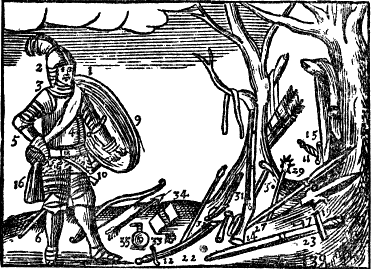
If we be to make War Soldiers are lifted, 1. Si bellandum est scribuntur Milites. 1.
Their Arms are a Head-piece, 2. (which is adorned with a Crest) and the Armour, whose parts are a Collar, 3. a Breast-plate, 4. Arm-pieces, 5. Leg-pieces, 6. Greaves, 7. with a Coat of Mail, 8. and a Buckler, 9. these are the defensive Arms. Horum Arma sunt, Galea (Cassis, 2.) (quæ ornatur Cristâ) & Armatura, cujus partes Torquis ferreus, 3. Thorax, 4. Brachialia, 5. Ocreæ ferreæ, 6. Manicæ, 7. cum Lorica, 8. & Scuto (Clypeo), 9. hæc sunt Arma defensiva.
The offensive are a Sword, 10. a two-edged Sword, 11. a Falchion, 12. which are put up into a Scabbard, 13. and are girded with a Girdle, 14. or Belt, 15. (a Scarf, 16. serveth for ornament) a two handed-Sword, 17. and a Dagger, 18. Offensiva sunt Gladius, 10. Framea, 11. & Acinaces, 12. qui reconduntur Vaginâ, 13. accinguntur Cingulo, 14. vel Baltheo, 15. (Fascia militaris, 16. inservit ornatui) Romphæa, 17. & Pugio, 18.
In these is the Haft, 19. with the Pummel, 20. and the Blade, 21. having a Point, 22. in the middle are the Back, 23. and the Edge, 24. In his est Manubrium, 19. cum Pomo, 20. & Verutum, 21. Cuspidatum, 22. in medio Dorsum, 23. & Acies, 24.
The other Weapons are a Pike, 25. a Halbert, 26. (in which is the Haft, 27. and the Head, 28.) a Club, 29. and a Whirlebat, 30. Reliqua arma sunt Hasta, 25. Bipennis, 26. (in quibus Hastile, 27. & Mucro, 28.) Clava, 29. & Cœstus, 30.
They fight at a distance with Muskets, 31. and Pistols, 32. which are charged with Bullets, 33. out of a Bullet-bag, 34. and with Gun-powder out of a Bandalier, 35. Pugnatur eminùs Bombardis (Sclopetis), 31. & Sclopis, 32. quæ onerantur Globis, 33. è Theca bombardica, 34. & Pulvere nitrato è Pyxide pulveraria, 35.
CXL.
The Camps.
Castra.
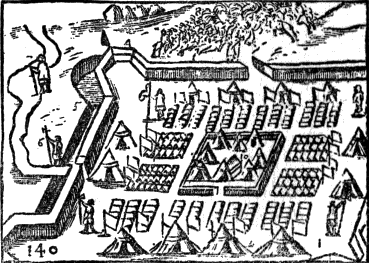
When a Design is undertaken the Camp, 1. is pitched and the Tents of Canvas, 2. or Straw, 3. are fastned with Stakes; and they entrench them about for security’s sake, with Bulwarks, 4. and Ditches, 5. Sentinels, 6. are also set; and Scouts, 7. are sent out. Expeditione susceptâ, Castra, 1. locantur & Tentoria Linteis, 2. vel Stramentis, 3. figuntur Paxillis; eaque circumdant, securitatis gratiâ Aggeribus, 4. & Fossis, 5. Excubiæ, 6. constituuntur; & Exploratores, 7. emittuntur.
Sallyings out, 8. are made for Forage and Plunder-sake, where they often cope with the Enemy, 9. in skirmishing. Excursiones, 8. fiunt Pabulationis & Prædæ causâ, ubi sæpius confligitur cum Hostibus, 9. velitando.
The Pavilion of the Lord General is in the midst of the Camp, 10. Tentorium summi Imperatoris est in medio Castrorum, 10.
CXLI.
The Army and the Fight.
Acies & Prœlium.
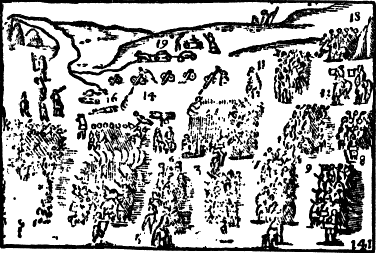
When the Battel is to be fought the Army is set in order, and divided into the Front, 1. the Rere, 2. and the Wings, 3. Quando Pugna committenda est, Acies instruitur, & dividitur in Frontem, 1. Tergum, 2. & Alas (Cornua), 3.
The Foot, 4. are intermixed with the Horse, 5. Peditatus, 4. intermiscetur Equitatui, 5.
That is divided into Companies, this into Troops. Ille distinguitur in Centurias, hic in Turmas.
These carry Banners, 6. those Flags, 7. in the midst of them. Illæ in medio ferunt Vexilla, 6. hæ Labara, 7.
Their Officers are, Corporals, Ensigns, Lieutenants, Captains, 8. Commanders of the Horse, 9. Lieutenant Colonels, Colonels, and he that is the chief of all, the General. Eorum Præfecti sunt, Decuriones, Signiferi, Vicarii, Centuriones, 8. Magistri Equitum, 9. Tribuni, Chiliarchæ, & summus omnium Imperator.
The Drummers, 10. and the Drumslades, 11. as also the Trumpeters, 12. call to Arms, and inflame the Soldier. Tympanistæ, 10. & Tympanotribæ, 11. ut & Tubicines, 12. vocant ad Arma & inflammant Militem.
At the first Onset the Muskets, 13. and Ordnance, 14. are shot off. Primo Conflictu, Bombardæ, 13. & Tormenta, 14. exploduntur.
Afterwards they fight, 15. hand to hand with Pikes and Swords. Postea pugnatur, 15. cominus Hastis & Gladiis.
They that are overcome are slain, 16. or taken prisoners, or run away, 17. Victi trucidantur, 16. vel capiuntur, vel aufugiunt, 17.
They that are for the Reserve, 18. come upon them out of their places where they lay in wait. Succenturiati, 18. superveniunt ex insidiis.
The Carriages, 19. are plundered. Impedimenta, 19. spoliantur.
CXLII.
The Sea-Fight.
Pugna Navalis.
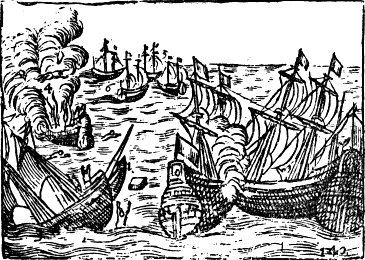
A Sea-fight is terrible, when huge Ships, like Castles, run one upon another with their Beaks, 1. or shatter one another with their Ordnance, 2. and so being bored thorow they drink in their own Destruction, and are sunk, 3. Navale prœlium terribile est, quum ingentes Naves, veluti Arces, concurrunt Rostris, 1. aut se invicem quassant Tormentis, 2. atque ita perforatæ, imbibunt perniciem suam & submerguntur, 3.
Or when they are set on fire and either by the firing of Gun-powder, 4. men are blown up into the air, or are burnt in the midst of the waters, or else leaping into the Sea are drowned. Aut quum igne corripiuntur, & vel ex incendio pulveris tormentarii, 4. homines ejiciuntur in ærem, vel exuruntur in mediis aquis, vel etiam desilientes in mare, suffocantur.
A Ship that flieth away, 5. is overtaken by those that pursue her, 6. and is taken. Navis fugitiva, 5. intercipitur ab insequentibus, 6. & capitur.
CXLIII.
The Besieging of a City.
Obsidium Urbis.
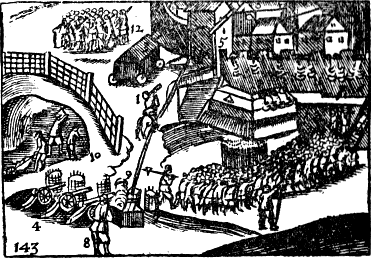
A City that is like to endure a Siege, is first summoned by a Trumpeter, 1. and persuaded to yield. Urbs passura Obsidionem, primum provocatur per Tubicinem, 1. & invitatur ad Depitionem.
Which if it refuseth to do, it is assaulted by the Besiegers, and taken by storm. Quod si abnuat facere, oppugnatur ab Obsidentibus & occupatur.
Either by climbing over the walls with Scaling-ladders, 2. or breaking them down with Battering-engins, 3. or demolishing them with great Guns, 4. or breaking through the Gates with a Petarr, 5. or casting Granadoes, 6. out of Mortar-pieces, 7. into the City, by Engineers, 8. (who lye behind Leagure-baskets, 9.) or overthrowing it with Mines by Pioneers, 10. Vel muros per Scalas, 2. transcendendo, aut diruendo Arietibus, 3. aut demoliendo Tormentis, 4. vel dirumpendo portas Exostra, 5. vel ejaculando Globos Tormentarios, 6. e Mortariis (balistis), 7. in Urbem per Balistarios, 8. (qui latitant post Gerras, 9.) vel subvertendo Cuniculis per Fossores, 10,
They that are besieged defend themselves from the Walls, 11. with fire and stones, &c, or break out by force, 12. Obsessi defendunt se de Muris, 11. ignibus, lapidibus, &c. aut erumpunt, 12.
A City that is taken by Storm is plundered, destroyed, and sometimes laid even with the ground. Urbs vi expugnata, diriditur, exciditur, interdum equatur solo.
CXLIV.
Religion.
Religio.
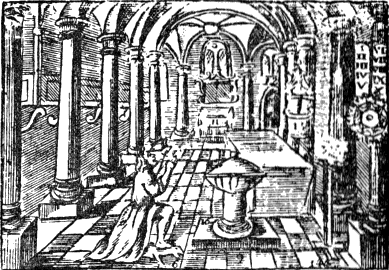
Godliness, 1. the Queen of Vertues, worshippeth God, 4. devoutly, the Knowledge of God being drawn either from the Book of Nature, 2. (for the work commendeth the Work-master) or from the Book of Scripture, 3. she meditateth upon his Commandments contained in the Decalogue, 5. and treading Reason under foot, that Barking Dog, 6. she giveth Faith, 7. and assent to the Word of God, and calleth upon him, 8. as a Helper in adversity. Pietas, 1. Regina Virtutum colit Deum, 4. humiliter, Notitiâ Dei, haustâ vel ex Libro Naturæ, 2. (nam opus commendat Artificem) vel ex Libro Scripturæ, 3. recolit Mandata ejus comprehensa in Decalogo, 5. & conculcans Rationem, oblatrantem Canem, 6. præbet Fidem, 7. & assensum Verbo Dei, eumque invocat, 8. ut Opitulatorem in adversis.
Divine Services are done in the Church, 9. in which are the Quire, 10. with the Altar, 11. the Vestry, 12. the Pulpit, 13. Seats, 14. Galleries, 15. and a Font, 16. Officia Divina fiunt in Templo, 9. in quo est Penetrale (Adytum, 10.) cum Altari, 11. Sacrarium, 12. Suggestus, 13. Subsellia, 14. Ambones, 15. & Baptisterium, 16.
All men perceive that there is a God, but all men do not rightly know God. Omnes homines sentiunt esse Deum, sed non omnes rectè nôrunt Deum.
Hence are divers Religions whereof IV. are reckoned yet as the chief. Hinc diversæ Religiones quarum IV. numerantur adhuc primariæ.
CXLV.
Gentilism.
Gentilimus.
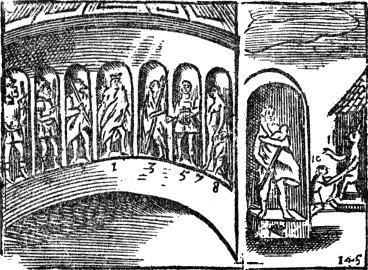
The Gentiles feigned to themselves near upon XIIM. Deities. Gentiles finxerunt sibi prope XIIM. Numina.
The chief of them were Jupiter, 1. President, and petty-God of Heaven; Neptune, 2. of the Sea; Pluto, 3. of Hell; Mars, 4. of War; Apollo, 5. of Arts; Mercury, 6. of Thieves, Merchants, and Eloquence; Vulcan, (Mulciber) of Fire and Smiths; Æolus, of Winds: and the most obscene of all the rest, Priapus. Eorum præcipua erant Jupiter, 1. Præses & Deaster cœli; Neptunus, 2. Maris; Pluto, 3. Inferni; Mars, 4. Belli; Apollo, 5. Artium; Mercurius, 6. Furum, Mercatorum, & Eloquentiæ; Vulcanus (Mulciber), Ignis & Fabrorum; Æolus, Ventorum; & obscænissimus, Priapus.
They had also Womanly Deities: such as were Venus, 7. the Goddess of Loves, and Pleasures, with her little son Cupid, 8. Minerva (Pallas), with the nine Muses of Arts; Juno, of Riches and Weddings; Vesta, of Chastity; Ceres, of Corn; Diana, of Hunting, and Fortune; and besides these Morbona, and Febris her self. Habuerant etiam Muliebria Numina; qualia fuerunt Venus, 7. Dea Amorum, & Voluptatum, cum filiolo Cupidine, 8. Minerva (Pallas), cum novem Musis Artium; Juno, Divitiarum & Nuptiarum; Vesta, Castitatis; Ceres, Frumentorum; Diana, Venationum; & Fortuna: quin & Morbona, ac Febris ipsa.
The Egyptians, instead of God worshipped all sorts of Beasts and Plants, and whatsoever they saw first in the morning. Ægyptii, pro Deo colebant omne genus Animalium & Plantarum, & quicquid conspiciebantur primum mane.
The Philistines offered to Moloch, 9. their Children to be burnt alive, Philistæi offerebant Molocho (Saturno), 9. Infantes cremandos vivos.
The Indians, 10. even to this day, worship the Devil, 11. Indi, 10. etiamnum venerantur Cacodæmona, 11.
CXLVI.
Judaism.
Judaismus.
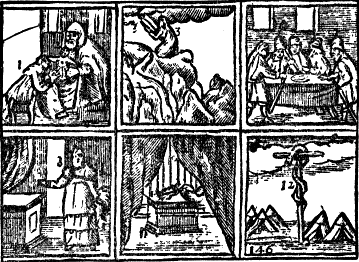
Yet the true Worship of the true God, remained with the Patriarchs, who lived before and after the Flood. Verus tamem Cultus veri Dei, remansit apud Patriarchas, qui vixerunt ante & post Diluvium.
Amongst these, that Seed of the Woman, the Messias of the World, was promised to Abraham, 1. the Founder of the Jews, the Father of them that believe: and he (being called away from the Gentiles) with his Posterity, being marked with the Sacrament of Circumcision, 2. made a peculiar people, and Church of God. Inter hos, Semen illud Mulieris, Messias Mundi, promissus est Abrahamo. 1. Conditori Judæorum, Patri credentium: & ipse (avocatus a Gentilibus) cum Posteris, notatus Sacramento Circumcisionis, 2. constitutus singularis populus, & Ecclesia Dei.
Afterwards God gave his Law, written with his own Finger in Tables of Stone, 5. to this people by Moses, 3. in Mount Sinai, 4. Postea Deus exhibuit Legem suam, scriptam Digito suo in Tabulis Lapideis, 5. huic Populo per Mosen, 3. in Monte Sinai, 4.
Furthermore, he ordained the eating the Paschal Lamb, 6. and Sacrifices to be offered upon an Altar, 7. by Priests, 8. and Incense, 9. and commanded a Tabernacle, 10. with the Ark of the Covenant, 11. to be made: and besides, a brazen Serpent, 12. to be set up against the biting of Serpents in the Wilderness. Porrò ordinavit manducationem Agni Paschalis, 6. & Sacrificia offerenda in Altari, 7. per Sacerdotes, 8. & Suffitus, 9. & jussit Tabernaculum, 10. cum Arca Fœderis, 11. fieri: præterea, æneum Serpentem, 12. erigi contra morsum Serpentum in Deserto.
All which things were Types of the Messias to come, whom the Jews yet look for. Quæ omnia Typi erant Messiæ venturi, quem Judæi adhuc expectant.
CXLVII.
Christianity.
Christianismus.
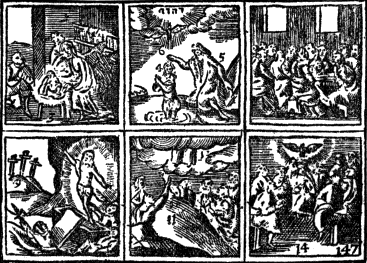
The only begotten eternal Son of God, 3. being promised to our first Parents in Paradise, at the last being conceived by the Holy Ghost, in the most Holy Womb of the Virgin Mary, 1. of the royal house of David and clad with humane flesh, came into the World at Bethlehem of Judæa, in the extream poverty of a Stable, 2. in the fullness of time, in the year of the world 3970, but pure from all sin, and the name of Jesus was given him, which signifieth a Saviour. Unigenitus æternus Dei Filius, 3. promissus Protoplastis in Paradiso, tandem conceptus per Sanctum Spiritum in sanctissimo utero Virginis Mariæ, 1. de domo regiâ Davidis, & indutus humanâ carne, prodiit in mundum Bethlehemæ Judæâ, in summâ paupertate Stabuli, 2. impleto tempore, Anno Mundi 3970, sed mundus ab omni peccato & nomen Jesu impositum fuit ei, quod significat Salvatorem.
When he was sprinkled with holy Baptism, 4. (the Sacrament of the new Covenant) by John his Forerunner, 5. in Jordan, the most sacred Mystery of the divine Trinity, appear’d by the Father’s voice, 6. (whereby he testified that this was his Son) and the Holy Ghost in the shape of a Dove, 7. coming down from Heaven. Hic, cum imbueretur sacro Baptismo, 4. (Sacramento novi Fœderis) à Johanne præcursore suo, 5. in Jordane apparuit sacratissimum Mysterium Divinæ Trinitatis, Patris voce, 6. (quâ testabatur hunc esse Filium suum) & Spiritu sancto in specie Columbæ, 7. delabente cœlitus.
From that time, being the 30th year of his Age, unto the fourth year, he declared who he was, his words and works manifesting his Divinity, being neither owned, nor entertained by the Jews, because of his voluntary poverty. Ab eo tempore, tricesimo anno ætatis suæ, usque an annum quartum, declaravit quis esset, verbis & operibus præ se ferentibus Divinitatem, nec agnitus, nec acceptus a Judæis, ob voluntariam paupertatem.
He was at last taken by these (when he had first instituted the Mystical Supper, 8. of his Body and Blood for a Seal of the new Covenant and the remembrance of himself) carried to the Judgment-seat of Pilate, Governour under Cæsar, accused and condemned as an innocent Lamb; and being fastned upon a Cross, 9. he dyed, being sacrificed upon the Altar for the sins of the World. Captus tandem ab his (quum prius instituisset Cœnam Mysticam, 8. Corporis & Sanguinis sui, in Sigillum novi Fœderis, & sui recordationem) raptus ad Tribunal Pilati, Præfecti Cæsarei, accusatus & damnatus est Agnus innocentissimus; actusque in Crucem, 9. mortem subiit, immolatus in arâ pro peccatis mundi.
But when he had revived by his Divine Power, he rose again the third day out of the Grave, 10. and forty days after being taken up from Mount Olivet, 11. into Heaven, 12. and returning thither whence he came, he vanished as it were, while the Apostles, 13. gazed upon him, Sed quum revixisset Divinâ suâ Virtute, resurrexit tertia die è Sepulchro, 10. & post dies XL. sublatus de Monte Oliveti, 11. in Cœlum, 12. & eo rediens unde venerat, quasi evanuit, Apostolis, 13. aspectantibus,
to whom he sent his Holy Spirit, 14. from Heaven, the tenth day after his Ascension, and them, (being filled with his power) into the World to preach of him; being henceforth to come again to the last Judgment, sitting in the mean time at the right hand of the Father, and interceding for us. quibus misit Spiritum Sanctum, 14. de Cœlo, decima die post Ascensum, ipsos vero, (hac virtute impletos) in Mundum prædicaturos; olim rediturus ad Judicium extremum, interea sedens ad dextram Patris, & intercedens pro nobis.
From this Christ we are called Christians, and are saved in him alone. Ab hoc Christo dicimur Christiani, inque eo solo salvamur.
CXLVIII.
Mahometism.
Mahometismus.
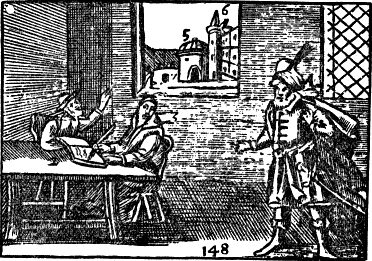
Mahomet, 1. a warlike Man, invented to himself a new Religion, mixed with Judaism, Christianity and Gentilism, by the advice of a Jew, 2. and an Arian Monk, 3. named Sergius; feigning, whilst he had the Fit of the Falling-sickness, that the Archangel Gabriel and the Holy Ghost, talked with him, using a Pigeon, 4. to fetch Meat out of his Ear. Mahomet, 1. Homo bellator, excogitabat sibi novam Religionem, mixtam ex Judaismo, Christianismo & Gentilismo, consilio Judæi, 2. & Monachi Ariani, 3. nomine Sergii; fingens, dum laboraret Epilepsia, Archangelum Gabrielem, & Spiritum Sanctum, secum colloqui, adsuefaciens Columbam, 4. petere Escam ex Aure sua.
His Followers refrain themselves from Wine; are circumcised, have many Wives; build Chapels, 5. from the Steeples whereof, they are called to Holy Service not by Bells, but by a Priest, 6. they wash themselves often, 7. they deny the Holy Trinity: they honour Christ, not as the Son of God, but as a great Prophet, yet less than Mahomet; they call their Law, the Alchoran. Asseclæ ejus abstinent se à Vino; circumciduntur, sunt Polygami; exstruunt Sacella, 5. de quorum Turriculis, convocantur ad sacra non a Campanis, sed a Sacerdote, 6. sæpius se abluunt, 7. negant SS. Trinitatem: Christum honorant, non ut Dei Filium, sed ut magnum Prophetam, minorem tamen Mahomete; Legem suam vocant Alcoran.
CXLIX.
Gods Providence.
Providentia Dei.
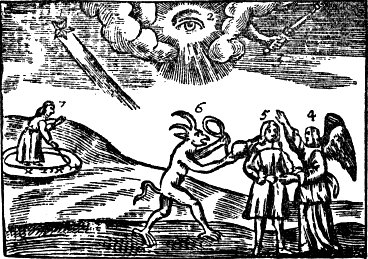
Mens States are not to be attributed to Fortune or Chance, or the Influence of the Stars, (Comets, 1. indeed are wont to portend no good) but to the provident Eye of God, 2. and to his governing Hand, 3. even our Sights, or Oversights, or even our Faults. Humanæ Sortes non tribuendæ sunt Fortunæ aut Casui, aut Influxui Siderum, (Cometæ, 1. quidem solent nihil boni portendere) sed provido Dei Oculo, 2. & ejusdem Manui rectrici, 3. etiam nostræ Prudentiæ, vel Imprudentiæ, vel etiam Noxæ.
God hath his Ministers and Angels, 4. who accompany a Man, 5. from his birth, as Guardians, against wicked Spirits, or the Devil, 6. who every minute layeth wait for him, to tempt and vex him. Deus habet Ministros suos, & Angelos, 4. qui associant se Homini, 5. à nativitate ejus, ut Custodes, contra malignos Spiritus, seu Diabolum, 6. qui minutatim struit insidias ei, ad tentandum vel vexandum.
Wo to the mad Wizzards and Witches who give themselves to the Devil, (being inclosed in a Circle, 7. calling upon him with Charms) they dally with him, and fall from God! for they shall receive their reward with him. Væ dementibus Magis & Lamiis qui Cacodæmoni se dedunt (inclusi Circulo, 7. eum advocantes Incantamentis) cum eo colludunt & à Deo deficiunt! nam cum illo mercedem accipient.
CL.
The Last Judgment.
Judicium extremum.
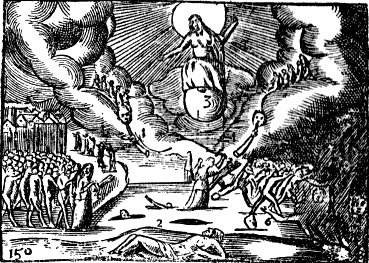
For the last day shall come which shall raise up the Dead, 2. with the sound of a Trumpet, 1. and summon the Quick with them to the Judgment-seat of Christ Jesus, 3. (appearing in the Clouds) to give an Account of all things done. Nam dies novissima veniet, quæ resuscitabit Mortuos, 2. voce Tubæ, 1. & citabit Vivos, cum illis ad Tribunal Jesu Christi, 3. (apparentis in Nubibus) ad reddendam rationem omnium actorum.
When the Godly & Elect, 4. shall enter into life eternal into the place of Bliss, and the new Hierusalem, 5. Ubi pii (justi) & Electi, 4. introibunt in vitam æternam, in locum Beatitudinis & novum Hierosolymam, 5.
But the Wicked and the damned, 6. shall be thrust into Hell, 8. with the Devils, 7. to be there tormented for ever. Impii vero, & damnati, 6. cum Cacodæmonibus, 7. in Gehennum, 8. detrudentur, ibi cruciandi æternum.
CLI.
The Close.
Clausula.
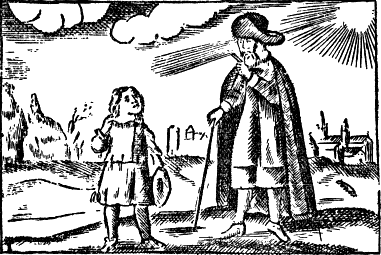
Thus thou hast seen in short, all things that can be shewed, and hast learned the chief Words of the English and Latin Tongue. Ita vidisti summatim res omnes quæ poterunt ostendi, & didicisti Voces primarias Anglicæ & Latinæ Linguæ.
Go on now and read other good Books diligently, and thou shalt become learned, wise, and godly. Perge nunc & lege diligenter alias bonos Libros, ut fias doctus, sapiens, & pius.
Remember these things; fear God, and call upon him, that he may bestow upon thee the Spirit of Wisdom. Memento horum; Deum time, & invoca eum, ut largiatur tibi Spiritum Sapientiæ.
Farewell. Vale.
Index
Index Titulorum.
See note on chapter numbering. The chapter number for Invitatio (1) was missing; there is no entry for Clausula (151). Chapter references 64–104 were off by one (printed as 63–103) and have been silently corrected. Only those with additional errors are individually marked.
Cap. A. Pag.
141 Acies & Prælium 178
6 Aer 10
46 Agricultura 58
33 Amphibia 40
43 Animi hominis 54
19 Animalia & primum Aves 24
7 Aqua 12
13 Arbor 17
119 Arbor Consanguinitatis 150
128 Ars Medica 163
Ars Scriptoria 112
Artes Sermonis 121
52 Aucupium 65
24 Aves Aquaticæ 30
22 Aves Campestres & Sylvestres 28
20 Aves Domesticæ 25
23 Aves Rapaces 29
B.
Balneum 91
Bibliopegus 117
Bibliopolium 116
C.
41 Canales & Ossa 50
39 Caput & Manus 47
40 Caro & Viscera 49
140 Castra 177
147 Christianismus 187
4 Cœlum 7
58 Convivium 72
55 Coquinaria 68
135 Cursus Certamina 171
D.
44 Deformes & Monstrosi 55
2 Deus 5
67 Domus 82
E.
106 Eclipses 131
Eques 102
Equile 194
109 Ethica 36
108 Europa 134
F.
Faber Ferrarius 85
Faber lignarius 79
Faber murarius 80
30 Feræ Bestiæ 36
29 Feræ Pecudes 35
Figulus 87
15 Flores 20
113 Fortitudo 141
14 Fructus Arborum 18
17 Fruges 22
18 Frutices 23
G.
145 Gentilismus 184
Geometria 126
H.
36 Homo 43
Horologia 95
45 Hortorum cultura 56
115 Humanitas 144
Hypocaustum cum Dormitorio 89
I.
5 Ignis 8
32 Insecta repentia 38
25 Insecta volantia 31
Instrumenta Musica 123
123 Interiora Urbis 156
1 Invitatio 1
146 Judaismus 186
124 Judicium 157
150 Jud’m extremum 193
28 Jumenta 34
116 Justitia 145
L.
12 Lapides 15
54 Lanionia 67
Liber 118
117 Liberalitas 147
61 Lintea 76
134 Ludus Aleæ 170
136 Ludi pueriles 172
133 Ludus Pilæ 169
130 Ludus Scenicus 166
M.
Machinæ 81
148 Mahometismus 190
35 Marinæ Pisces & Conchæ 42
48 Mellificium 61
38 Membra Hominis Externa 45
127 Mensuræ & Pondera 162
126 Mercatura 161
Metallifodina 84
11 Metalla 15
139 Miles 176
49 Molitura 62
3 Mundus 6
Museum 120
N.
88 Natatus 107
Naufragium 111
Navis actuaria 108
Navis oneraria 109
8 Nubes 12
O.
143 Obsidium Urbis 181
16 Olera 21
21 Oscines 27
P.
132 Palæstra 168
50 Panificium 63
Papyrus 113
Partes Domus 88
114 Patientia 142
27 Pecora 33
47 Pecuaria 59
105 Phases Lunæ 130
Philosophia 125
Pictura 96
51 Piscatio 64
34 Pisces Fluviatiles 41
104 Planet. Aspectus 129
131 Præstigiæ 167
149 Providentia Dei 191
110 Prudentia 137
142 Pugna Navalis 180
Putei 90
Q.
26 Quadrupedia & primum Domestica 32
R.
138 Regia Majestas 174
137 Regnum & Regio 173
144 Religio 183
Restio & Lorarius 99
S.
62 Sartor 77
Schola 119
Scriniarius & Tornator 86
111 Sedulitas 139
42 Sensus externi & interni 52
37 Septum Ætat. Hominis 44
129 Sepultura 165
31 Serpentes & Reptilia 37
118 Societas Conjugalis 144
121 Societas Herilis 153
120 Soc’tas Parentalis 152
Specularia 97
104 Sphæra cœlestis 127
107 Sphæra terrestris 132
125 Supplicia Maleficiorum 159
63 Sutor 78
T.
112 Temperantia 140
9 Terra 13
10 Terræ fœtus 14
60 Textura 75
Tonstrina 93
59 Tractio Lini 74
Transitus Aqua’m 106
Typographia 114
V.
Vectura 105
Vehicula 103
53 Venatus 66
Viator 100
Vietor 98
56 Vindemia 70
122 Urbs 144
Z.
57 Zythopœia 71
An Index of the Titles.
See note on chapter numbering. Chapter numbers for The Invitation (1) and The Close (151) were missing. Chapter references 64–104 were off by one (printed as 63–103) and have been silently corrected. Only those with additional errors are individually marked. Minor differences in spelling and hyphenization are not marked.
Chap. A. Page.
37 The Seven Ages of Man 44
6 The Air 10
33 Amphibious Creatures 40
105 The Apparitions of the Moon 130
141 The Army and the Fight 178
Arts belonging to Speech 121
104 The Aspects of the Planets 129
B.
The Bath 91
The Barbers Shop 93
28 Labouring Beasts 34
30 Wild Beasts 36
143 The Besieging of a City 181
19 Birds 24
22 Birds that live in the Fields and Woods 28
23 Ravenous Birds 29
21 Singing Birds 27
41 The Chanels and Bones 50
A Book 118
The Book-binder 117
The Book-sellers Shop 116
The Box-maker 86
136 Boys Sports 172
50 Bread-baking 63
57 Brewing 71
129 A Burial 165
54 Butchery 67
C.
104 The Celestial Sphere 127
140 The Camp 177
Carriages 103
Carrying to and fro 105
The Carpenter 79
27 Herd-Cattle 33
29 Wild-Cattle 35
41 The Chanels and Bones 50
147 Christianity 187
123 A City 154
143 The Besieging of a City 181
123 The Inward parts of a City 156
151 The Close 194
8 The Clouds 12
119 The Tree of Consanguinity 150
Cookery 68
The Cooper 98
The Cord-wainer 99
17 Corn 22
32 Crawling Vermin 38
33 Creatures that live as well by water as by land 40
31 Creeping things 37
D.
44 Deformed and monstrous People 55
Dials 95
134 Dice-play 170
111 Diligence 139
45 The Dressing of Gardens 56
E.
9 The Earth 13
106 The Eclipses 131
Engines 81
108 Europe 134
F.
58 A Feast 72
132 The Fencing-School 168
5 Fire 8
51 Fishing 64
34 River-fish and Pond-fish 41
35 Sea-fish and Shell-fish 43
40 The Flesh and Bowels 49
15 Flowers 20
25 Flying Vermin 31
113 Fortitude 141
26 Four footed Beasts about the House 32
52 Fowling 65
20 Tame-Fowl 25
24 Water-Fowl 30
10 The Fruits of the Earth 14
14 Fruits of Trees 18
G.
A Galley 108
145 Gentilism 184
Geometry 126
2 God 5
149 God’s Providence 191
47 Grasing 59
49 Grinding 62
H.
39 The Head and the Hands 47
16 Pot-herbs 21
27 Herd-Cattle 33
4 Heaven 7
48 The making of Honey 61
The Horseman 102
A House 82
The parts of a House 88
115 Humanity 144
53 Hunting 66
46 Husbandry 58
I.
1 The Invitation 1
Musical Instruments 123
146 Judaism 186
124 Judgment 157
150 The last Judgment 193
116 Justice 145
K.
137 The Kingdom and Region 173
L.
28 Labouring Beasts 34
117 Liberality 147
19 Living Creatures 24
59 The dressing of Line 74
61 Linen Cloaths 76
Looking-glasses 97
M.
148 Mahometism 190
138 Kingly Majesty 174
36 Man 43
37 The Seven Ages of Man 44
38 The outward parts of a Man 45
The Mason 80
127 Measures and Weights 162
126 Merchandizing 161
A Merchant Ship 109
11 Metals 15
A Mine 84
105 The Apparitions of the Moon 137
109 Moral Philosophy 136
Musical Inst’ments 123
P.
Paper 113
87 Passage over Waters 106
114 Patience 142
Philosophy 125
109 Moral Philosophy 136
128 Physick 163
The Picture 96
34 Pond-fish 41
16 Pot-herbs 21
The Potter 87
Printing 114
149 God’s Providence 191
110 Prudence 137
R.
135 Races 171
23 Ravenous Birds 29
144 Religion 183
34 River-fish 41
The Roper 99
138 Regal Majesty 174
S.
A School 119
142 The Sea-fight 180
35 Sea-fish and Shell-fish 42
42 The outward and inward Senses 52
31 Serpents 37
Shipwreck 111
63 The Shoe-maker 78
18 Shrubs 23
21 Singing Birds 27
131 Sleights 167
118 The Society betwixt Man and Wife 148
120 The Society betwixt Parents and Children 152
121 The Society betwixt Master and Servant 153
43 The Soul of Man 54
139 The Souldier 176
The Black-smith 85
136 Boys Sports 172
The Celestial Sphere 127
107 The Terrestial Sphere 132
Arts belonging to Speech 121
The Stable 94
130 A Stage-play 166
12 Stones 16
The Stove with the Bed-room 89
The Study 120
Swimming 107
T.
62 The Taylor 77
112 Temperance 140
133 Tennis play 169
107 The Terrestial Sphere 132
125 The Torments of Malefactors 159
The Travellor 100
13 A Tree 17
The Turner 86
U.
25 Flying Vermin 31
32 Crawling Vermin 38
56 The Vintage 70
W.
7 The Water 11
60 Weaving 75
Wells 90
29 Wild Cattle 35
30 Wild Beasts 36
3 The World 6
Writing 112
Trinuni Deo Gloria.
FINIS.
Original Title Page
Joh. Amos Comenii Orbis Sensualium Pictus: HOC EST Omnium principalium in Mundo Rerum, & in Vita Actionum, Pictura & Nomenclatura. Joh. Amos Comenius’s VISIBLE WORLD: OR, A Nomenclature, and Pictures OF ALL THE Chief Things that are in the World, and of Mens Employments therein; In above 150 Copper Cuts. WRITTEN By the Author in Latin and High Dutch, being one of his last Essays; and the most suitable to Childrens Capacity of any he hath hitherto made. Translated into English By Charles Hoole, M.A. For the Use of Young Latin Scholars. The Eleventh Edition Corrected, and the English made to answer Word for Word to the Latin. Nihil est in intellectu, quod non prius fuit in sensu. Arist. London; Printed for, and sold by John and Benj. Sprint, at the Bell in Little Britain, 1728.