BOOK II STUDIES AND STORIES
Reading edition
I
“A continuous chain of small actions, on the thread of character.”
IN reading the life stories of the five dogs whom I have chosen for special notice, we must, I think, be struck with the remarkable effect on each of the particular environment of his life. Is this not the very effect that the circumstances of his early years has on a child? When in later life we meet a man or a woman who has been reared in a home circle of culture and refinement, there are many subtle marks and intangible echoes of those early days that make themselves felt in spite, it may be, of rougher and less elevating conditions of later years. While the human character is individual and marked off as a personal attribute, the mind has responded to the influences of the surroundings in which the most impressionable part of the life was passed.
I believe that it is the same with dogs. The ego, the personal entity that gives to each member of the canine race his individual claim on our humanity, is made akin to us by his response to the mental training we give him. If the dog were nothing more than an automaton, such response would not, and could not, have the strong individual characteristics that bring the dog into such close union with us. The more we study dog life, and strive with all the disabilities that meet us at every turn to enter into the feelings and probe the motives of the dog’s conduct, the more, I am persuaded, we shall recognise the evidence of the sense of a personal entity that marks each dog off from his fellows. It is the individual dog, with his particular gifts of body, mind, and spirit,—the adumbration of the higher powers that in their full expansion are the heritage of the human race,—that claims our sympathy, and establishes his hold on our affections. This, for the true dog-lover, is the keynote to the study of his character, and the only light we can bring to bear on the inner workings of his mind.
It is from this standpoint, therefore, that I would refer to the salient features of the biographies.
The most cursory glance at the life stories of these dogs will show how unfitted each one was to play his part in the surroundings of any other. Bandy, who is perhaps the most remarkable instance of a dog living a corporate life with humans, had a large-hearted outlook that could only have been evolved in a member of a community. In his case the wideness of his sympathies and interests seemed to some extent to limit the range of his home affections. While loving and loyal, without a shadow of doubt, to his owner and his house companions, he had not the clinging, passionate devotion that was the keynote of the life of “The Child of the House.” The scope for the latter’s powers was smaller, and, his development being thus limited, the force of his nature seemed to find an outlet in the wealth of his affections. With different training Gubbins’s undoubted discrimination of character, and his subtle appreciation of his own rights, might well have been developed at the expense of the overflowing of love that necessarily brought some suffering as well as much joy into his little life. Then there was his innate love of sport, and his natural independence of character, that were repressed rather than brought out by the circumstances of his life. He was, in fact, the home bird, who was equally unfitted for the rougher give-and-take of school life or for the rousing adventures of “A Soldier of Fortune.”
Then the fascinating, pleasure-loving Jet could never have brought his skill in theft and mischief to the perfection of a fine art if it had not been for the tacit encouragement his lenient mistress gave him. He was the spoiled darling, whose good looks and taking manners carried him safely through his escapades. With a sterner view of moral discipline in his owner, Jet might have been a more exemplary, but must inevitably have become a much more commonplace, member of his kind.
In Bruce, “The Diplomatist,” many years of whose life were passed away from the care of his special friend, we see the independent settlement of his affairs that his position called for. When he had been used to take the first place, not even the loving guardianship of his temporary owners could reconcile him to being second. Though he conformed to circumstances with a good grace, in accordance with his love of decorum, he would choose a home for himself, when for the second time his master was leaving him. In this he could not have made a better choice. He reigned supreme, and had the most loving care lavished on him, not only for his own sake, but for that of his absent master, who was the eldest and much loved son of the house.
Jack, of fighting memory, was remarkable for the self-restraint and generosity that not all the brutal associations of his early life had been able to kill. Though he had given an intelligent response to his training, and understood that from his first owner’s point of view fighting was a business and not a pastime, he took no unholy pleasure in rousing up an antagonist. Rather, as he understood the grim realities of action, he shrank from provoking a combat, from which, even with the honours of war, he would take away many a wound as an unpleasant reminder. In fact, his experience had taught him to look on war from the standpoint of the soldier who knows that he takes his life in his hand every time he goes into action. And Jack had the marks of a true soldier in his relations to his superiors and his fellows. Obedient, staunch to the death, he would fight to the end, but he must have an antagonist worthy of his powers. An amateur was no match for him, and if in wanton play or ungoverned temper the unskilled fighter attacked him, Jack gave him a lesson for his presumption, but tempered his punishment to the powers of resistance arrayed against him. He was loyal to his friends, had a tender sympathy with suffering, and showed his gratitude for a good home in peaceful surroundings by a vigilant guardianship of his mistress.
The character of each dog as we study it stands out in plain relief, as the expression of that inner life which appeals to our own experience at every turn. To me it seems a monstrous thing to suppose that the care for his own life and those committed to his individual guardianship which the dog shows, can be any other than the visible expression of his consciousness of an ego, endowed with powers and duties which only he, in his own person, can perform. That he has a clear idea of responsibility is manifest by his conduct, and why should this be whittled away from its obvious significance till we are asked to believe that the dog’s behaviour is to be attributed to quite other motives than those that govern our own actions?
We know the strange and often inexplicable intuition that is shown by a child whose powers are as yet undeveloped in the choice of a friend or guardian. He seems to know by unerring instinct the one, among a number of friends, in whose heart he will find a response to the cravings of his own young affections. He shows his confidence in, and a clinging dependence on, the chosen one that bring their own reward. The same intuition was shown by my own Skye terrier when he was first brought to my house. The friend then staying with me, to whom he was given, is a true dog-lover, and she accepted the care of the shy little stranger with all her accustomed gentleness and consideration. It was to her that Gubbins looked for the first caresses that greeted him in his new home. He was looked upon, as indeed he was, as her property for the time being. She had no dog of her own with her, and Gubbins slept in her room at night and had all the privileges of a favoured friend.
On the other hand, I had two dogs almost always with me, and from one of them I was constantly receiving the most demonstrative tokens of affection. I refrained studiously from taking notice of Gubbins in the early days, partly from the fear of exciting the jealousy of the older inhabitants of the house, and partly because I did not wish to have my affection enlisted by the wild, shy little mortal, whose life seemed an unending round of rude shocks to his too sensitive nervous system.
Yet underneath all this there were causes at work which could not have been known to Gubbins, and yet which his conduct seemed to show he had appreciated almost at the first glance. His mistress had a favourite dog at home, whose rule could never have been disputed by another. She had nothing to give Gubbins but the temporary care and kindness that his forlorn condition demanded. On the other hand, the dogs I had then were not, and could never have been, more than friends of moderate claims. Only one indeed belonged to me, the other being the bulldog whose tragic outbreak I have recorded elsewhere. My own Basset hound, picturesque and deep-tongued, and pleasant to look on as she was, was one of the few canine idiots I have ever known. She seemed to be absolutely devoid of intelligence, and though on the show bench and elsewhere she would always give me an exuberantly loving welcome that was very impressive to strangers, I knew that to any one of her friends she would give an equally demonstrative greeting. Even a chance visitor to the house would, as likely as not, be distinguished in the same way. As Rica had no discrimination in her affections, so she had no power of responding to mental training. Every day of the week saw the same lesson of some simple matter of conduct given to her, and each day she would offend in the same way, not from obstinacy or love of wrong-doing, but because all memory of correction had passed completely from her mind. It was one of the funniest things I have ever seen with my dogs, to watch Rica take up her position in the winter close—too close, as she ought to have known from reiterated warnings—to a blazing fire, and there, sitting up with her great wrinkled head nodding in sleep, enjoy the warmth till she threatened to roll over into the fireplace. The blankness that looked out from her clear brown eyes, the lack of the nameless expression that speaks from a dog’s every movement and look, were utterly wanting to her, and told their own tale to the onlooker.
Such a dog was not one to engage her owner’s affections, and it has always seemed as if Gubbins must have had some strange intuition of the conditions that obtained among his new friends, in attaching himself to me as he did. In spite of my studied aloofness and the presence of my constant canine attendants, he showed a preference for my company from the first, and never rested till he had made good his right to a place in my bedroom. Yet in so doing he was thrown with the other dogs, whose noisy exuberance of spirits were, in his then state of cowed repression, an obvious trial to his nerves, and he would shrink away terrified into a corner at any outbreak from them. With my friend he would have had his own quiet place in her room, without shocks from stronger nerved companions; and everything seemed to point to his responding with gratitude to the advances she made to him. But Gubbins would have none of them; and as those who have read his life know, he won his future home by the determined selection he made.
While a tender living up to his position as a member of a small home party, lightened by moments of expansion when fun and mischief made a veritable child of him, was the distinguishing characteristic of Gubbins’s life, we find the same dominant note of personal character in each of the other dogs’ histories. With Bruce it was a strong sense of social obligations and a finished ease of manner in fulfilling them. An independent weighing of cause and effect in the case of his own requirements and in the carrying out of his plans was also seen in him. Of the matter of his independence in his mysterious visit to the railway station to meet his master, when the latter was expected by a train and route he seldom used, I have nothing further to say. I have elsewhere vouched for the truth of the facts as I have given them, but the explanation of his conduct I must leave to wiser heads than mine.
In Bandy a wonderful mastery of, and association of himself with, the complicated machinery of the daily routine of a large public school is the prevailing note. Times and seasons were known to him in a marvellous way, and in the many interests into which he threw himself with all the ardour of his nature he showed the wonderful development of his mind that was the result of his intimate fellowship with a large body of humans. The strength of his conviction as to his rights as a member of a body of free-born Englishmen is shown as well by his act of vengeance on his master when he thought he was unfairly treated as by the manner of his tragic death. Freedom to the free, was the motto Bandy lived up to in his life, and defended with his latest breath.
Jack, of less subtle mind, had the fearless outlook on life that is characteristic of the good soldier. A stern determination to do his duty, obedience to orders, whether of attack or restraint, and an open-hearted loyalty were the surprising results of a training that might well have left him a brutal exponent of his brutalised owners’ methods of training. But here we have a case of a good natural disposition unspoiled by early association with vicious men. As Jack was untouched by the evil of his masters’ methods, he, with simple faith in, and obedience rendered to the orders given, escaped the degradation of those who, with the free exercise of higher powers, were responsible for his early exploits.
A dainty enjoyment of the good things of this life, and an irresponsible method of attaining his ends, were the leading traits of Jet’s life. His appearance and manners aiding him, he took full advantage of the opportunities the circumstances of his life afforded him for the carrying out of his simple creed. His horizon was limited, and to Jet he himself was the god, whose smile or frown made or unmade the world in which he lived.
II
“The dogge, a natural, kind, and loving thing, As witnesseth our histories of old.”
IF we accept the fact that the powers of intelligence shown by the dog are of the same kind as, though of a lower degree of development than, those that form our own mental processes, we start with a premise that clears many difficulties from our path. But even so, if we would penetrate the secrets that lie behind the engaging variety of his actions, we must take into account many things that cause the dog’s outlook on life to be different from our own. We must ever bear in mind that it is only in considering our friend’s surroundings as they appear to him we can hope to grasp the effect of those surroundings on his mind. We are apt to conclude hastily that, because such and such a thing strikes us in a particular way, our dog will be affected by it in a precisely similar manner. And the delusion is fostered by the broad general characteristics of our mental resemblance to him. But if we would have more than a superficial understanding of our dogs, we must bring a sympathetic comprehension of life as it appears to them, to mark the differences, as well as grasp the affinities, of the mental and moral conditions that are in a general sense common to us both.
Yet with all the difficulties that lie in our path we can write the life history of the dog as we can of no other animal. More sympathetic than the cat, more constantly our companion than the horse, we can study him under conditions that obtain with no other of his kind. From the first days of his puppyhood to the closing hours of his life we can trace the gradual unfolding of his powers and the widening of his knowledge of life. This, too, we can do with but an ordinarily intelligent interest brought to bear on the little life that is at once so near our own, and yet cut off from us by the impassable barrier of want of human speech. “How much he could tell us if he could only speak,” a devoted attendant of a little dog used often to say, when in his own way and by his own limited powers of language the intelligent creature had made his friends understand that his surroundings were in some way not suited to the needs of the moment.
It is in the physical conditions of our life that we must seek for the first points of contact with the dog. In both our own and canine life we have, of course, the same foundation of bodily activity in the marvellous machinery of the nervous system. But this bond we have in common with all living creatures, and it has therefore no special value when we are studying our relations with the dog. Above this, we have the power of instinct, or, as it has been called, “material intelligence.”
Then we come face to face with a power in the dog that cannot be explained by the wonders of reflex action as we learn them in the study of physiology. The motive power of the action must be sought in the intangible essence of mind, and not in the material organs of the body. It is when this motive power has passed under the full sway of the mind, and we have advanced from the realm of instinct into the regions where the evidences of higher mental power are before us, that we recognise the dog as our fellow in the comradeship of life. For though in the dog we do not find the more highly differentiated powers of instinct, his inferiority in this respect to insects that come far lower in the scale of life is counterbalanced by his powers of mind, that in their higher expression we claim to be akin to our own. We hail the evidences of disinterested affection, of sympathy, of fortitude, and of trust, as links in the chain that binds our dog friend to us in a close mental and moral fellowship.
When “the one” among all dogs will give up his daily walk—the one delight that never fails—to watch by our sick-bed, or comfort us by his presence in our sorrow, the simple act of self-denial appeals to us as an evidence of the perfect comradeship of disinterested affection.
We do not need to be told of the dark hours that come to us when one whom we love has been taken from us, or of the craving for the companionship that is lost that takes possession of us. Our interest in our daily pursuits is gone, and a blank feeling of desolation saps our energies. When a dog shows grief in the same way, sitting alone and desolate, refusing food and all the joys of his daily life, the link of sympathy is strong between us, as we recognise that he is afflicted with a sense of loss akin to that which has saddened our own life.
My first dog came to me, and indeed made his place good in my affection, while he was suffering the keenest grief at the loss of his owner. In the many changes of life in India, Jell’s mistress was called to join her husband in a distant station and, the heat in the plains still being great, she did not wish to take her dog with her. Knowing that I was wanting a dog, she offered hers to me. But Jell was not prepossessing in appearance, and indeed well deserved the epithet of “thoroughbred mongrel.” As I have a predisposition in favour of well-bred dogs, I declined the proffered gift. But on the morning of my friend’s departure the large, white, leggy, and bullet-headed terrier—so called—made its appearance in my verandah, with a note explaining his presence. No home had offered for him, and he was thrown on my generosity to provide him with one. This I determined to do elsewhere, as soon as might be, but in the meantime I was confronted with the problem of reconciling Jell to his present quarters, so far at least as to preserve his life. In the first moment of my displeasure at his arrival, I had ordered him off to the compound in the charge of the mehtar who had brought him to me. But I distrusted a native’s methods with dogs, and something in the dejected appearance of Jell as he was being led away softened my heart so far that I decided to take charge of him myself.
He lay in my room, crying for hours together. He would take no interest in anything, showed a fine disregard of all attempts to win his favour, and refused to touch his food. At the end of the second day I began to wonder what I should do with him, and was heartily wishing that he had not been cast on my hands, when I became aware that two soft eyes were watching me from the far corner of the room. There was an expression of dawning confidence in the look, that gave me hope of better things in store. I waited, and in a little time Jell raised his head and sat up, with his gaze still fixed on my face. Presently he rose and came to my side, and made the first advances of friendship. To these he suffered my response with a far from flattering lack of eagerness. Nevertheless, the first step had been taken, and I was admitted to a place in his affections. This place I never forfeited; for Jell, in spite of his want of good looks, did not find another home, but remained my constant and devoted attendant to the day of his death.
With a small terrier named Floss a friend had a similar experience, though this little dog had a far more chequered history in her English life than Jell had in India. Floss came to her future mistress with only an announcement by telegraph that she might be expected on a certain day. The man who sent her promised her history later, and in due course both the terrier and the story of her deeds arrived. First, Floss reached her new home just as the house was being closed for the night. The basket, when opened in the kitchen, disclosed a small terrier with black and tan head and black spot and fiery eyes, of a most uncompromising expression of countenance. The little thing sat up, glared at the strangers round her, and defended herself with her teeth from all attempts to touch her. At last, in despair, the basket was turned over and Floss rolled on to the floor. She then put her back against the dresser, and showed that she still meant to keep off intruders. All thought of taming her was for the time given up, and her basket being righted, Floss was allowed to take possession of it, and both were then carried up to her new owner’s bedroom. As the little thing had been travelling for twenty-four hours, she was offered food and water; but she would have none of them, and continued to sit up straight in her basket, a very forlorn and vigilant little figure. Many times during the night her mistress roused herself to see how Floss was getting on, and always the same watchful and sad-looking terrier gazed back at her, showing by a low growl her displeasure at the interest displayed.
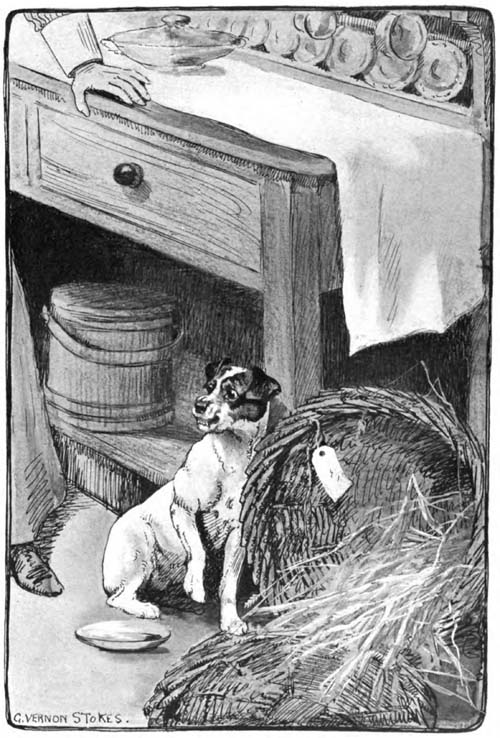
Suspicion FLOSS
In the morning things were no better. Floss refused all advances made to her, and would neither drink nor eat. Basket and all, she was carried down to the kitchen garden, from which she could not escape. Here she condescended to walk about a little, but whenever she met her mistress’s eye she marked her disapproval of the situation by a growl. Carried back to the bedroom, she sat in melancholy wrath for the rest of the day, and was as uncompromising as ever whenever her basket was touched or moved. The last thing at night her owner tried to soften her by turning her out on the foot of her bed; but Floss refused all advances, and only growled at every movement of her companion.
In the morning, when my friend awoke, she found Floss also awake and watching her. Without moving, she said in a low tone, “Floss;” and the dog immediately crawled up the bed and licked her face. Then Floss lay down and submitted to a good deal of stroking and petting; and when breakfast made its appearance she showed a gracious tolerance of things as they were by making a good meal. From the moment when she responded to her name dated Floss’s love for her mistress, which seemed to grow and strengthen with every year of her life.
The first use the latter made of the establishment of good relations between them was to attend to some ugly wounds on the face and head that Floss had brought with her. When the promised story of her life came, these wounds were explained. It appeared that the terrier had belonged to a miner in South Wales, and had taken part in badger baiting. It was the custom for the miners to meet on Sunday afternoon for this more than doubtful amusement. Each miner brought a dog, and the performance was to see which of the dogs could bring the badger out of his box in four minutes. But the badger was large and fierce, and one dog after another—bull-terriers among them—tried in vain to draw him. Then one of the miners opened his coat, and brought out the tiny Floss, who was only eighteen months old and weighed ten pounds. In less than four minutes the game little terrier drew her formidable opponent, and her exploit was so much talked of that she was bought and sent off to a home where good terriers are ever welcome, before the marks of her conflict had healed. Under gentler care Floss developed a touching devotion to her owner, and for many years was one of the reigning household pets in her new home.
How many similar instances of mourning for lost friends occur to us! Every one who knows anything of dogs can recall some touching story that tells at once of the love that flooded, and the pain of separation that darkened, the dog’s life as he passed from the secure confidence of requited affection to the desolate uncertainty of the care of strangers.
We cannot, however, remind ourselves too often that our attempts to understand the workings of the dog’s mind, and the explanations that commend themselves to us of the reasons for his methods of action, are all based on our own consciousness of cause and effect. And here we must take into account the difference in the outlook on life between the dog and ourselves. The effects of environment we know count for much with us. Change of scene and surroundings will give us fresh mental vigour as well as renewed bodily activity when both need recuperation. But the change of surroundings that will give to us advantages that go far to prolong our span of life is as nothing compared to the difference that separates our own normal outlook on life from that of the dog. The four-footed friend that trots at our side, or scampers at large in wild enjoyment of strength and freedom, is marked off from us by his mode of locomotion and the position and bearing of his head and body. His outlook is limited by his bodily structure, in spite of his strength of vision and his marvellous sense of smell. In the latter case, indeed, we look up to the dog from a lower plane, for our limited development of the sense of smell tells us but little of the power it gives him. That it not only differs in degree but in quality is shown by the delight with which a well-bred, cleanly house or sporting dog will roll in some evil-smelling refuse that fills us with disgust. The possession of such an organ, at once so different and so much more sensitive than our own, must make for much in the influence of his surroundings on the dog, and thus adds to the many difficulties we have in understanding and entering into his outlook on life.
Doubtless the sense was given him to enable him to hold his own in the battle of life. He retains it in the artificial conditions of domestic life, but in the days when he depended for his supply of food on the success that crowned his efforts in the chase, it was necessary to his existence. Without it he must have fallen a prey to his enemies in the jungle and the forest, instead of turning the tables on superior brute force by the delicacy of his organs and his superior powers of combination.
The traits that have come to our household friend from his wild forebears are often shown even in the most highly domesticated inhabitants of our home. How far these inherited qualities may influence the dog’s outlook on the surroundings of his present life, who can say? As we watch our favourite turn round and round on the hearthrug, and scratch at the unresponsive rug before he curls himself up to sleep, we know that he is doing what his progenitors did in the wilds, when the action had a use that is wanting to it now in securing the comfort of his rest.
A strange habit of the same nature was shown by a fox terrier that formed one of a pack of sporting dogs. This terrier, from the time she took her place in the kennels with the older dogs, was observed to turn round sharply whenever her food was put before her. The action aroused attention, though no one could say at what stage of her puppy life it had been developed. She was watched, and never did she omit the rapid turn round as on a pivot before she tasted her food. Her mistress, who had kept her pack of terriers for years, and who studies the characters of her little kennel friends as but few people do, made inquiries of her keeper, and found that when he fed the dogs, Amora always went through the same little performance as a preliminary to the business of eating. Up to the last day of her life it was continued, but so far as is known none of her children have shown the same peculiarity. Certainly those that I have known in my friends’ kennels have not had it, and no one has been able to give a satisfactory explanation of the habit.
A very charming reason for the unusual action was given by a little girl, the niece of the owner of the kennels. The child was delighted with the terrier’s performance, and always begged to be allowed to be present at feeding time, so as to enjoy the sight of Amora’s turn. Being of a thoughtful nature, she one day gave the result of her speculations on the matter. “Auntie,” she said, with the engaging directness of the youthful thinker, “I know why Amora turns round before her dinner. She means it for her grace.” With such a solution of the mystery who would venture to quarrel?
We might well bring the same gentle sympathy to bear on our own dealings with the dog. For we often forget that the patience we give as a matter of course to the as yet untrained intelligence of the child is doubly wanted when we have to do with the dog. Intelligent as the latter is, he never rises to our level of expansion of the powers of mind, and in reading our thoughts into his we must ever remember that the higher paths of reason’s play are closed to him.
That the dog has the dawning of a moral sense is clear to me, and the possession brings him near to us on the outskirts of the higher life, of which we alone have full enjoyment. But to give him credit for powers that in their full expansion are denied him is to bring discredit on the wonderful gifts that are undoubtedly his, and for the development of which he is dependent on his intercourse with us. The deeper the sympathetic insight we bring to bear on our study of his mental and bodily activities, the fuller will be his response to our training, and the greater our own delight in his companionship.
III
“La mas racional”—the one that reasons best.
THE nearest approach to the old tribal conditions of the ancestors of the dog we find in kennel life at the present day. Here we have the struggle for mastery, the sense of personal rights, the love and jealousy, sympathy and hate, cleverness and stupidity, that find their counterpart in our own social life, as they did in the communities of wolves and jackals that ranged the forests in bygone days. In a kennel of hounds we have the strongly marked individualities of character that divide off each one from the other, and give endless scope for study to those who have the patience and sympathy to devote to the task. It was in India, where many an early morning ride after jackal lives in my memory, that I first realised this wonderful individuality of hounds. The master of the pack with which I hunted one winter was a friend of mine, and often on non-hunting days the ride with which my day in the plains always began was in company with the master, who made a point of taking his hounds out for exercise himself. I soon came to know the hounds by sight, and heard from the master’s lips of their several traits and peculiarities. The knowledge gave me an added pleasure in watching their performances in the field; and what little I have of hound knowledge I owe in the first instance to this study of a scratch pack that was remarkable for neither looks nor symmetry, as these are understood in England to-day. Yet uneven as they were in size, and rough as many were in appearance, there was some of the best foxhound blood of our English kennels in their veins, and to each individual hound the very best of training was given. This was done by a careful study of the capacity, temper, and disposition of each hound in the pack, such as only an enthusiast in the matter of hound work would bring to bear on the subject.
The social life of the ancestors of our dogs was forced upon them by the necessity of protection against common enemies, and the need of mutual assistance in the capture of prey. In this life each member had to find and keep his own allotted place. The competition that is one of the marks by which each member of a community shows the best or worst of which he is capable, and finds his level accordingly, was not absent from the life of the dog’s forebears. Each dog must take the place he was fitted for in the common life, and doubtless that assigned to him he often won by fighting for it. For the dog is a quarrelsome animal, and Dr. Watts was not wrong in his natural history when he wrote of the “delight of dogs to bark and bite.” We may note, too, that he puts the greater and commoner pleasure, as we still see it exercised to-day, first; but fighting, among animals as among men, is a necessity of existence to the community while the conditions of life remain what they are.
This quarrelsomeness which we regret in our favourites, and that is a real source of danger in the kennels, is a survival of the old conditions, when each dog tried to work himself up to the position of master or leader of the pack, and, failing this, had perforce to take a lower place. Thus the leader, to whom the rest of the community looked for guidance, would be the strongest or the most capable of the tribe, or one that combined both these characteristics. We have only to watch a dog fight to-day to see that the combatants exercise a certain strategy. No doubt the first dog that learned to double his paws under him, and thus protect a vulnerable part, gained an advantage over a less intelligent, though it might be a heavier-built, rival. For one of the first methods of the canine tactician is to bite through the sensitive paw of his opponent; and the huntsman knows that if fighting in his kennels is not quelled promptly and sternly he will have many of his hounds lamed from this cause.
But even in kennel life, where there is such abundant material for the student of canine character, we only have the old conditions of primeval dog life faintly shadowed. Though to a great extent the dog in the kennels is living a social life among his fellows, the ruler to whom he looks is not a leader in the old sense, but a human master. In his earlier days, too, he is placed more or less in the conditions that obtain with our domestic dogs. When only a few months old he finds a home, it may be at a farmhouse, or at a neighbouring landowner’s, where he becomes the playmate and pet of the children of the house. If a hotel or the local butcher’s shop receives him, the puppy makes friends with the men and boys about the place, and often develops a special affection for his temporary master. In any case he lives the life of a free, and for the most part a petted, member of a household; and when he takes his place in the kennels he shows all the symptoms of grief for the good things he has lost and dislike for the restraints of his new life that a pampered boy will when he has his first taste of school discipline. No one who has seen a young hound, frightened, miserable, and homesick, sitting by himself in a corner of what for the time is to him a hated prison, can doubt his suffering. He has indeed an almost comic expression of misery on his naturally rather solemn countenance. He has not yet found his level in his new surroundings; he has lost his old friends and found no one to take their place; the joys of hunting days, which will go far to counterbalance the strictness of kennel discipline, are unknown to him. Henceforth he is to share in the social life of his fellows, in which all are bound by a common interest to a common occupation, broken only by interludes of companionship with man. He has therefore reversed the conditions of his life up to this point, in which companionship with man has been interspersed with interludes of society with other dogs.
He has now to conquer and keep the place in the pack that will hereafter be his by general consent. If he is masterful and resourceful, he will be deferred to, and, it may be, the warmest corner on the bench will be conceded to him when time and experience have come to aid him in the competition of life. In the matter of food the huntsman’s care will see that he gets no more than his due share, but we know how at the trough some hounds have always to be restrained, while others, who as a matter of course are ready to take the second place, have to be encouraged to secure their rights.
This competition, which is an integral part of community life, must, as it seems to me, give to each dog a consciousness of his own personality. His own interests and attainments are a thing apart from those of his fellows. In however dim a degree, he has a sense of personal rights and property, and recognises that a higher position can be won for himself individually by intelligence and courage combined.
But while in each dog will be seen the evidence of his own natural gifts, and he will show affection, sympathy, intelligence, or, on the other hand, will be morose, selfish, or incapable of striking out a line of action for himself, the general character of the pack will receive its impress from the hands of the huntsman. If he is at once firm and sympathetic in the government of the kennel, his hounds will be obedient and affectionate, and in their work will display an eagerness and anxiety to do their best that will be a tribute to the excellence of his rule.
Nowhere have we a more fertile field for tracing the effects of heredity than in a kennel. I am not concerned here with the many interesting questions that arise on the physiological side of the subject, but leaving make, shape, and speed as beyond our scope, we may confine ourselves to the consideration of mental characteristics. These do not always make their appearance at once, for the character of the dog, like that of man, develops with time. Many hounds do not show either their faults or their virtues till their second season. One experienced huntsman, indeed, used to say that he never knew what his hounds were going to do till their third season. While some hounds will enter at once, and never do wrong from the first day they go out cub-hunting, others can scarcely be induced to take an interest in the chase before their second season, while others again are never of any use at all, and do not seem to have any taste for hunting.
But from the first days of their return to the kennel, hounds show that they have a curious sympathy with those who are bound to them by the ties of relationship. Now in the old tribal pack we may suppose that these blood ties would be numerous, and that their recognition would tend to give a coherence to the community life by cementing the bonds of a common affection. It is no uncommon sight with us to see mother and daughter, father and son, running together in one of our packs, and while the old hounds take the lead, the young ones look to them for guidance and are quick to follow their example. This trait is strange when we consider that parents and children have seen nothing of one another since the latter were sent out to walk. The young ones have had all their early impressions of life, which must have gone far in forming their own mental outlook, apart from their parents’ influence. Yet the family tie has not been broken by the separation, though it is not possible that the young hounds at least can remember their elders. In the case of the mother we cannot say how far maternal affection may bridge the gulf. That she remembers her young long after their dependence on her has ceased, seems clear from a case of which I can vouch for the truth. A mother who had been separated from her puppies in the ordinary way would, long after there was a possibility of purely physical reasons coming into play, always trot down to the kennels immediately she was let out, and lick with affection the four little black noses that were thrust between the bars at her approach.
Very strong evidence of the tie being recognised between parents and children is given me by Miss Serrell, who, when her terrier puppies return from walk, never hesitates to put two generations of the same family together. She tells me that the puppies’ tricks and gambols, that cannot but be disturbing to the older dogs, will never be resented by the mothers, though no other dogs in the kennels would suffer them. As terriers have the character of being particularly quarrelsome, and certainly require the most judicious management to keep the peace among a number of them, no testimony to the recognition of the family tie could be more convincing.
Then, too, we see the same characteristics, mental and moral, appearing in members of the same family. How jealously this truth is acted upon by hound breeders, we have only to study the kennel registers to see. A somewhat curious instance of unusual traits of independent action by a litter brother and sister took place in the Blackmore Vale country.
The mother of these hounds was bred by Mr. Merthyr Guest, some ten years before he resigned the Mastership. She had a great influence in the kennels, and in 1894 Rama and her brother Raleigh, “hounds of very marked character,” were born to her. The account of their peculiarities I take verbatim as Miss Serrell has given it:[2]
“Rama, a bright tan and white with a very intelligent head, was a useful hound in the field, but she had a curious characteristic that was not so much to her credit. No power and no persuasion would induce her to come home with the pack after a day’s hunting. She would go to covert in the morning demurely enough, and she hunted in a most business-like manner, but directly the day’s sport was over her good conduct came to an end. The moment the hounds and whippers-in grouped together and the Master gave the word for ‘home,’ Rama would set off by herself and race up hill and down dale till she was out of sight. No whipper-in could turn her, no horn recall her, and it was not till some two hours after the Master had reached home that she generally made her appearance at Inwood. Sometimes, however, she would make her way leisurely back to the kennels and sneak in during the evening.
“Such unhoundlike conduct was not to be tolerated, so the order was given for her to be caught and coupled to another hound. She was then forced to trot home with the rest of the pack, but she did so with her stern down and an expression of unspeakable sadness upon her face. She soon showed that she had a soul above such tyranny, for after she had been captured once or twice, it was enough for the whipper-in to dismount and begin unbuckling the couples for her to make off. Indeed so sharp did she become that at last the Master did not dare to give the order for her to be caught, or to allow the jingling of the couples, but he arranged beforehand that she should be secured before the end of the day’s sport. It was not long before Rama was on her guard even against this early capture, and with a look at the hunt servants she would turn and gallop off before the last covert was drawn.
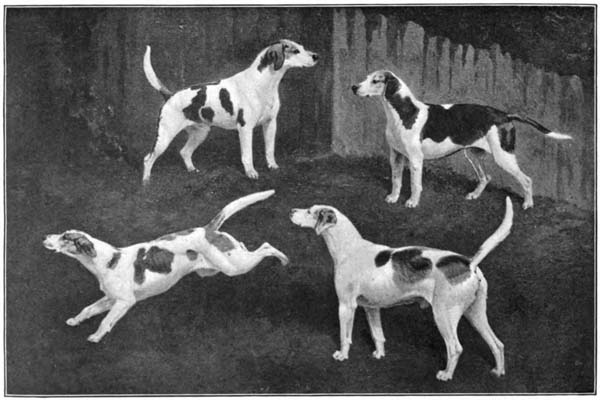
Raleigh Trial Rama Armiger MR. GUEST’S HOUNDS. 1900
“Raleigh, a brother of Rama, was also a peculiar hound, and in his first cub-hunting season showed an extraordinary objection to coming out of covert with the other hounds. He would follow to the side of the covert, and it was very funny to see him peeping out and disappearing again if he saw he was being waited for. Again and again he would do this, until at last, when the coast was clear, he would jump out and go on with the pack as if nothing had happened. Raleigh was very fond of looking into every cottage garden, but he was not such an inveterate cat-hunter as Rama, who would dash into and through every garden before she could be stopped, and woe betide the cat who was not quick enough to save herself in the nearest apple-tree.”
In a neighbouring country in the West, a curious trait was shown by one of the hounds. She would never go to covert with the rest of the pack or return home at night with them. When the work of the day began, she was always up and took her full share with her fellows. But on the way out from kennels in the morning, she always ran by herself at some distance from the others, though not too far off for her to be able to keep the line to the selected covert. The same thing happened as soon as the word for home was given, and the solitary figure, at some few hundred yards on one side or the other of the kennel party, would be seen flashing over the fields and hedges as if the hound was acting scout to the retiring force.
Another hound in the same kennels would only hunt with one of the Masters, who in turn acted as huntsman. With one of the huntsmen this hound would behave in normal fashion and do her work well in the field, but for the other she would not only not work, but she would not go out with the pack when it was in his hands.
Life in the kennels is far from being devoid of evidence of the finer virtues. The sight of a pack of hounds on their benches, each with his head pillowed on one of his fellows, tells of mutual love and trust, and the sympathy and pity with which one hound will lick a sore place on another are not to be mistaken. On the other hand, there are hatreds and enmities, and there are hounds that can never be trusted together. Something of the old spirit of tribal rule is also shown in the occasional ostracising of some one member of the pack. The hound thus treated as an outcast is not necessarily more stupid or less well inclined than are his judges, so far as can be seen, though I have heard that in one case, at least, the general award of condemnation was justified by unworthy conduct in the field. But, whatever the cause, from the verdict there is no appeal. A hound that has been sentenced by his fellows will have a short life and a bitter one if he does not find another home, for hound justice is rough and demands the death of the accused. In older times the method had its advantages in keeping up the level of the tribal band, for good feeling and good-will among its members were vital to its existence. Nowadays we give the outcast another chance in different surroundings, where the verdict of his former companions is by no means always endorsed. At the same time we may believe that no such verdict is ever given without a cause, with which, could we understand it in all cases, we should be in complete agreement.
IV
“The capacity to understand is as good a proof of vocal intelligence, though in an inferior degree, as the capacity to speak.”
FROM the kennel we will follow the hound into the field. Here he has definite work for which all the events of his life are one long preparation. That he delights in it, no one can doubt who watches him. If indeed there be anything to say against hunting, from the point of view of the fox and the hare, as there certainly is against some of the methods of man used in the chase, to the hound it is pure, unmixed enjoyment. As a lover of animals I hate to think of any unnecessary suffering caused in the hunting field. But when the excitement of the uncertain issue is over, the death, if it comes, is merciful and sudden, and though I have never but once actually seen the end—and then when I was surprised out of power of turning away—I was astounded at the instantaneous despatch of the hunted fox. That every man, and above all every woman, should set their faces sternly against the faintest touch of cruelty, I have no doubt at all. The most brilliant run of the season would be dearly bought if fox and hound were not pitted in fair and open warfare, and every one worthy the name of sportsman should blush to take an unfair advantage of the creature whose wiles it will tax all the intelligence of his followers, human and canine, to unravel.
Our very soul revolts from the tales of cruel maiming of which we have heard a good deal of late. That these are true of the practice of any but a few scattered countries, I do not believe. But, on the other hand, that they undoubtedly occur in some hunts is beyond question. Sport has to be shown; the followers at all costs must be given that for which they have come out. If hounds do not taste blood, they will become slack, and lose their interest in the chase. The hunt servants come from a class of which some members are incapable of understanding the sufferings of a lower order of life than their own. If they realised the agony of the broken or maimed limb with which the quarry is sometimes sent to make his last gallant bid for life, they would no more give the secret wrench that makes their own success assured than would the man whose wider outlook enables him to grasp the depth of suffering inflicted. In saying this, I would not for a moment imply that all, or nearly all, our hunt servants have the callous indifference to pain that such a course implies. On the contrary, the love of their hounds, so plainly shown both in the kennel and in the field, and their own innate love of all animal life, are a sufficient testimony to the humanity of the great body of those who show us sport. As a rule our huntsmen are of a far higher level of intelligence than others of their own class, or they would never have risen to the place they hold. But the danger comes from those who have the mental gifts without the moral background. With these the brilliant execution of their own work is everything; the rights of the lower creatures to humane treatment at their hands are non-existent. And this, as I have said, is because they do not, and cannot from their very nature, enter into the feelings of another order of beings.
But as the huntsman and his underlings are the servants of the Master, the responsibility for unsportsmanlike conduct in the field must ultimately rest with him. Not many, when spoken to on such a matter, will give the callous answer, worthy of a stage of civilisation left long ages behind, that one M. F. H. did: “I don’t care what they do, so long as they show sport, and don’t tell me how they do it.” But that such a view can be held, and that a man of such a type may have those under his orders who will be prompt to take advantage of the implied permission, is a direct danger to hunting, and one against which all true lovers of the sport should be on their guard. A careless master, and still more an indifferent one, may bring discredit on the national pastime that gives health and happiness to thousands of its followers, and causes the fox to be treated throughout his life as a favoured partner in the chase instead of as a noxious beast of prey.
About one thing there is no doubt. Any man or woman who continues to hunt in a country where cruelty is practised makes himself or herself responsible for what is done there. The reason of the cruelty is the desire to show sport, and the only check that can be imposed is that of public opinion. To this, Masters of Hounds and Hunt servants alike are peculiarly sensitive, the reputation of both, and the very livelihood of the latter, depending on it. If then such deeds of cruelty are passed over, or ignored as not being the business of those in whose interests they are done, the future of fox hunting will suffer from a deadly peril. If indeed the hunting field cannot be cleared from the reproach that must cling to it while cruelty in any form is practised, and the fight is not a fair and open one between hounds and their quarry, our many enemies will have a powerful weapon to use against us.
I am indeed far from thinking that Ruskin’s advice to gentlemen “to mow their own fields instead of riding over other people’s” can be followed. The words could only have been penned by one who was at once ignorant of the health-giving joys of the hunting-field, and of the natural sequence of country occupations. But though I lay myself open to the charge of cruelty from those who only see in hunting a relic of a bygone barbarism, and on the other hand may rouse the anger of those whose tastes I share, by pointing to the dark spots that tarnish the glories of our national pastime, I must e’en take a stand with the hounds in hoping for a continuance of their joy in sport, and with the fox in pleading that a fair and open fight is allowed him.
With the hounds, then, who at least are in no wise responsible for deeds of darkness done in secret, let us return to the field. The results of beneficent rule in the kennels is seen in their manner of hunting. If the huntsman and his whippers-in have won their confidence and love, the hounds have, beyond their own keenness in the chase, the desire to please those to whom they look as their natural guides and rulers. The hunt servants, and above all the huntsman, take the place of the old tribal leader, whose will was imposed on his followers. We all know how hounds when they have failed to recover the line of their hunted fox, will look up to the huntsman with an inquiring expression of countenance, that says as plainly as any words could tell us, they are asking him to help them: “We have done our part. Now it is your turn to come to our assistance.”
And how much the hounds will do for themselves, and how clearly the individual characteristics of each member of the pack is brought out in their common work! The hounds that are deferred to in the kennel will generally take the lead in the chase. Some naturally take the first place, and others as naturally follow. If we glance for a moment at the riders behind them, shall we not see exactly the same thing taking place? The man and woman whose observation is keen, decision prompt, and whose will is fearless, will be seen in front, while those of lesser gifts of courage and insight will follow in their wake. There is, of course, yet another partner in the chase, whose character and powers have to be reckoned with, but, even so, a bad horse will be at his best, or a good horse at his worst, according to the way in which he is handled. Certain I am that no stupid man or hound will ever lead in a good hunt.
But let us watch the hounds at work. No sooner does one touch the scent than he waves his stern and signals to the others. As he lashes his sides, those who are near enough to see the sign crowd round him; and each one, partly in emulation and partly in sympathy, works hard to find and identify the scent. Then an eager, exultant note comes from one of them, and now is the time when we shall learn much of the character the speaker bears. The other hounds will raise their heads quickly, but if the note comes from one whom they do not trust, they will resume their quest quietly and take no further notice of his call. But if the hound is one who is looked up to and respected, his fellow workers will fly to him from all parts of the covert, and a chorus of eager voices will corroborate his opinion and show that their trust was not misplaced.
They run on close together till once more they lose the scent, and there is a check. Now again we learn much of the dispositions and characters of the workers. The pack spreads out like a fan, and each hound works by and for himself. But not all in the same way. The slack and careless hound will gallop round aimlessly and then wait to see what the others do. The steady, persevering hound will, with a painstaking sense of duty, try every blade of grass. The hound of thoughtful mind will go to all the more likely places first; and the wise old hound, whose business has been fully mastered, will gallop unhesitatingly back to the place where he last had the scent. How often the rest are put right by such a leader! He gallops back to the gateway, through which he had been swept by the common impulse that will carry the best hound over the line sometimes. But as soon as he has time to think, he pauses. He knows he has not smelt fox since he came through the gate, and he knows, too, that a fox will often turn short under a wall or fence. So he goes back, turns up by the hedge, and hits off the line, and both hounds and huntsmen follow at his call.
Few more wonderful instances of reasoning power are, I suppose, ever shown in the field than by the stag-hounds when they have brought a wild stag to bay. Though I have never ridden with the Devon and Somerset, some of the most picturesque and thrilling moments of sport I have ever experienced have been with them. The stag, after bounding down the precipitous sides of a rocky combe, will plunge into the quick-flowing stream that divides the wooded depths of the valley. The hounds are close behind, but not within view. As they, too, reach the water, they divide, some following the stream on one side, some on the other, while others take to the bed of the water itself. The huntsman, it may be, has not yet threaded his way between the boulders and thickly planted trees that have impeded his progress. But the hounds work up to their stag, which stands at bay where the current is running strongest. Now the older hounds come to the front, with the wisdom learned of former encounters. They trot up the bank, past the spot where the stag is standing. Then they take to the water, and are carried almost without effort to him. If they had entered the stream sooner, they could not have reached him, for they were powerless to breast the current; and as the young hounds watch their strategy, they too learn the lesson they will put in practice later. Here, then, we have evidence of the natural lead of superior intelligence, and of the willingness of the younger and less experienced to learn from the example of their elders.
But the foundation of the powers of combination that show such an infinite variety in the field is laid in kennel life. The better the discipline and the greater the influence of the huntsman over his pack, the more readily will they work together. No better or quainter example of this was ever given than that of John Press, whose fame as a successful huntsman spread far and wide from the Blackmore Vale country. Here I will quote again from a book, with which my connection gives me the means of vouching for the absolute truth of its statements. It is Miss Serrell, one of the keenest of sportswomen and hound lovers, who tells the story.[3]
“A ... wonderful instance of perfect kennel discipline was that I once witnessed with terriers and foxhounds in the Blackmore Vale kennels. One day, not long before Press retired, I rode over to the kennels, and being told by the kennelman that Press was in the orchard with the hounds, I dismounted and went in search of him. The sight that met my eyes as I opened the gate I shall never forget. There was Press in his kennel coat, with only a slim white willow in his hands, surrounded by both packs of hounds, and seated on a low stool with his favourite little hound, Miranda, on his knees, while he was encouraging some nine or ten terriers to scratch at the rat-holes round an old apple-tree. Not one of the hounds ventured to interfere as they stood round watching the terriers’ efforts, and it was enough for Press to lift his little stick if one essayed to go too near them. Seating myself on a handy stump, I watched the performance, while the old man related anecdotes of his favourites, and assured me he could never have done what he did with them except for their home training. It was a common saying of his that you could teach more in kennel than out, and with this opinion I cordially agree.
“Perhaps the most curious part of that orchard scene was to come, for Press after a time rose and passed slowly back to the kennels, with the hounds following. Throwing open one of the doors, he turned, and, eyeing the hounds sternly, he raised his hand, and to my great amusement exclaimed in his gruff voice, ‘Ladies first!’ At this signal every ‘lady,’ with a little wave of her stern, trotted forward and went in; and as soon as all had disappeared the door was shut, not a dog-hound in the meantime offering to follow. As he threw open the other door, Press called out, ‘Now, then, gentlemen!’ and the dog-hounds marched majestically in.”
If slackness prevail in their home, hounds will be as ready to take advantage of it as are our own children. Some hounds are more inclined to mischief than others, but if one breaks out there is danger that all the others may follow. How often, again, is the counterpart seen in our playing-field or classroom. Idleness in all cases is the beginning of vice. Many of us know the story of the wild young hounds that once led a whole pack—and a good one—on the line of a donkey. It is said that for long afterwards the huntsman and whippers-in of these hounds regarded the very word “donkey,” uttered in their presence, as a personal insult.
That discipline must be tempered with affection, the conduct of hounds in the field shows clearly. For a man who is harsh to them, who is too ready with lash and hard words, hounds will have much the same relation that a schoolboy has to the tutor he detests, or the soldier to the officer he does not respect. The main-spring of good work is love, not harshness.
If every one from hunt servants to the master would take their duties in the way that one M. F. H. did, there would be no danger of unnecessary harshness, still less cruelty, being used towards any of our partners of the chase. The Master of whom I am speaking never overlooked a fault of this kind with any of his servants. If a man was too ready with the whip, or in any way too severe in the correction of kennel faults, he was sent away at once, without a character. As he was not fitted to have the care of animals, the Master would not help him to another situation. It is only by following such a line of conduct that unsuitable hunt servants can be kept from jeopardising the fair fame of those to whose good offices every hunting man and woman in the country owe so many of the pleasantest hours of their life.
V
“But why dost thou compare thee to a dog, In that for which all men despise a dog? I will compare thee better to a dog: Thou art as fair and comely as a dog, Thou art as true and honest as a dog, Thou art as kind and liberal as a dog, Thou art as wise and valiant as a dog.”
WHILE the foxhound and harrier and their brothers of the chase work in company, and—within the limits allowed by the guiding spirit of the huntsman—under the leadership of one or more of their own kind, in another branch of sport we find the perfection of a dog’s individual action in the field. If we watch the early training of the young pointer or setter we can trace the development of the dog’s powers of mind under the hand of his instructor. If the latter has the intelligence and the patience necessary for his task, and the ambition to make the most of the opening powers that give to his touch the unerring response of a musical instrument of varied strength and different tones, we shall see this under the most favourable circumstances.
In the first place, the natural characteristics of the young pupil, as they have been shown in puppy games and family intercourse, will be made due allowance for. The puppy of strong, decided character will have different treatment meted out to it from that given to one of timid mind, and, it may be, less robust physique, or results will show us clearly what is wanting. A harsh word or unrestrained action on the part of the instructor will in a moment turn a bright-eyed and eager dog into a cowed, and, it may be, sullen creature, who has for the time being, at least, lost all interest in the proceedings that promised so well. He must have perfect confidence in the justice of the man in whose hands he is. This confidence is the foundation on which the affection of later years will be built. Without the one it is impossible to have the other. If owners and, above all, keepers only knew it, the way in which their dogs respond to their treatment is the surest index of their own characters. If they are slovenly in their work, the want of thoroughness will surely be reflected in their dogs, and this in spite of any attempts to cover their own defects by unconsidered sternness to their charges. The man who only cares for his dogs as a necessary part of the accessories of a day’s shooting will never get more than eye service from them. As he knows nothing of the dog’s character, and treats him as if he had no special traits that mark him off as an individual, such a master cannot hope for any response but such as fear of punishment can give him. The dog, if he survives the training given under such circumstances—if, that is to say, he does not fall under the condemnation of being worthless in the field—will only work when directly under his master’s eye, and while he knows that chastisement prompt and severe will fall on any failure. In his work, as work, he will take little or no interest; and it is safe to say that such a dog will never show of what he might have been capable under more discriminating treatment.
The youngest dog that comes under training has the same instinctive knowledge of human character that a child has. Not all, perhaps, would show the nice appreciation of temperament displayed by an older dog that belonged to the father of one of my friends. Shot was a black and white pointer with a long head and ears, and a conformation of head nearer that of a foxhound than of an ordinary dog of his kind. He was a firstrate dog on birds, and conducted himself with the greatest decorum in the field. But one day his high spirits carried him out of his usual self-restraint. He was racing along at such a pace that he dashed into a covey of birds and flushed them. It did not need his master’s angry voice to bring home to him a sense of his misdeeds.
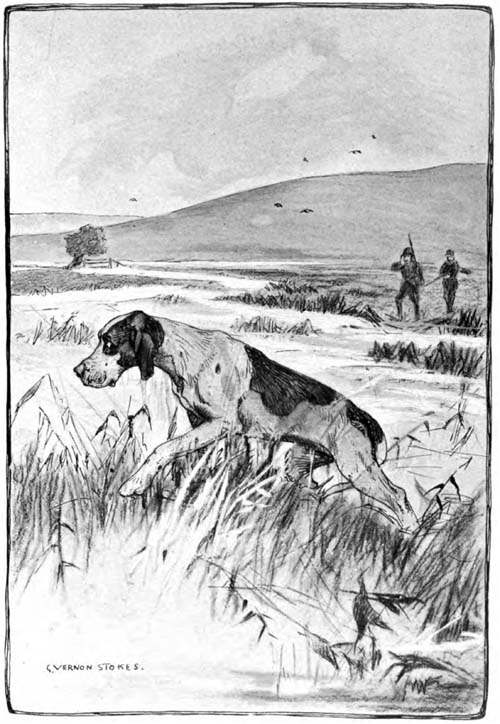
“Conscience makes Cowards of us” SHOT
As the birds rose, Shot stopped short, his tail went between his legs, and with only a momentary pause he set off wildly to save himself from chastisement. Making straight for a neighbouring bog he waded through it, up to his neck in mud, till he reached a dry spot. Then he sat up and regarded his master serenely, secure in the knowledge that he could not be followed. His owner, a man of quick temper, though much too fond of his dogs to give any of them more than a well merited reminder not to offend again, was not unnaturally angry at the turn affairs had taken. “Oh, you lop-eared cur, if I could only get at you!” were the words that travelled to Shot’s ears, as he sat entrenched in his fastness. He stayed quietly where he was, therefore, till the passing storm had blown over. As soon as his master turned his attention again to the birds, Shot knew he might return safely. He lost no time in leaving his island, and wading back through the mud he took up his duties as if nothing had happened. So well did he work that at the end of the day he received nothing but praise for the excellence of his conduct. The fault had faded from his master’s mind, and when it was recalled only excited admiration of the dog’s intelligence that had saved him from untoward chastisement. A beating, and still more a savage beating, at the end of a good day’s work, would have given Shot a new view of his master’s character that would have gone far to destroy the good fellowship existing between them.
But in a puppy, as in a young child, no fault should be overlooked. The great mistake so many commit in training, is in making the necessary correction of minor failings too severe. They are not always careful, either, to make the punishment follow immediately on the fault, but chastise, with a strength measured by their own impatience, the young creature from whose unformed mind all sense of delinquency has passed away. How can a puppy be expected to understand the reason of a harsh rating, or hard blow, for a lack of due response to such an outlandish sound, to untutored ears, as “Toho,” when all remembrance has passed in the excitement of watching some later action of his master that calls forth his keenest interest as he tries to fathom its meaning? Still less chance has he in these first essays of the business of life if other dogs are sharing his instructor’s attention with him. He is then being treated as a chattel, and yet expected to give the individual response that only an intelligent being can give. If he does not do like the others at the word of command, and the master’s first thought is given to continuing the exercise for those who respond rightly, what chance is there that the young dog will understand the meaning of his correction, after he has followed with fascinated gaze and possibly intelligent co-operation the later parts of the lesson? If the man would only think, he would recognise that he was asking from his pupil an effort of mind that is quite beyond his range. It is from the heart sickness caused by the knowledge of terrible acts of vengeance wreaked on defenceless pupils, by thoughtless and cruel masters, that I venture to speak thus plainly. The suffering that is sometimes crowded into the first twelve months of a puppy’s life is terrible to think of. And how many good dogs are thus ruined for life, and are condemned as worthless before they have even had a chance of showing their powers! If the owners of shooting dogs would only remember that the dogs which, under judicious treatment, will give the best result as workers are those which, from the possession of the very gifts that give them their value, will understand and resent most keenly any acts of oppression and injustice that cloud their young days, they would save their pockets by getting the services of many a good worker, whose life has been ended by a bullet through his brains.
But if the puppy’s training has been carefully and successfully carried out in the privacy that is such an important factor of success, the considerate and individual care meted out to him does not by any means end here. The dog has learned to obey the various words of command, and so far has responded to his training. But his experience up to this point has been free from conflicting interests. He has concentrated all his attention on the lessons with nothing to distract his mind. But when he takes his place in the field the case is very different. Yet how often do we hear a young dog rated, or see him beaten, for a fault that should have been corrected gently. He has, if he has been wisely treated, finished his education under the very conditions that obtain in the field when the shooting season begins. He has mastered every detail of his work, but how few owners make allowance for the excitement that takes possession of a dog when he first has part in a serious day’s shooting! If he is thrown with other dogs, his difficulties are increased tenfold, but supposing that he only accompanies his master for a quiet day among the turnips, and with no companion save a retriever, he knows as well as his owner does that the circumstances of his work are now quite different from all that has gone before. His master is intent on making a good bag, and if the pointer or setter was not capable of understanding the difference between serious business and the previous training foreshadowing it, he would be incapable of giving the intelligent co-operation that is expected of him. He is excited, therefore, and eager, it may well be too eager, to please, and if in the ardour of his own feelings the sportsman has no thought and consideration for his dog, the latter’s early training may very likely be spoilt after all.
It is, alas! well known that keepers and their masters will often give an erring dog a punishment with their gun, one of the most brutal forms of chastisement possible. Restraining their savage anger till the dog is at some thirty yards from them, they pepper the poor creature with shot in the hind quarters as he is hurrying forward. From the point of view of common sense, as well as of humane feeling, this is the most futile form in which the anger of the master can show itself. First and foremost, there is the suffering entailed on the dog, for to my own knowledge some animals have lost their lives from the injuries inflicted on them.
And yet what good and faithful work many dogs will give to careless and even cruel owners! A very handsome, upstanding black and white setter, who belonged to a farmer of morose temper, was one of these. The dog was not properly fed, and in spite of his thick coat he excited the commiseration of some people, a part of whose property adjoined the land rented by the farmer. The members of this family were lovers of sport in all its forms, and they often saw the setter at work, and knew that he was particularly staunch on game. One day Prince was following his master about the farm on agricultural interests bent, when, as they passed some heathland, the dog lighted on a covey of partridges. He instantly became rigid, but knowing well that sport was not at the moment the point of interest in his master’s mind, he looked round to see if he was being observed. The master’s hand was raised, and Prince obediently dropped. Then the farmer hurried home to fetch his gun. At the end of between twenty and thirty minutes he was back, and found Prince still at his post. At a word, the dog was up, and his master secured a brace of birds. Another time when Prince had been lent to the son of the neighbouring landowner, the dog retained his position for full fifteen minutes before the gun came up. It is sad to think that such a dog should have had more than his share of blows and curses, and but little of the affection that would have made his life happy.
But if the same gentle restraint is about the young dog in the field that has hitherto attended his training, the response he will give to his owner’s wishes will be little short of marvellous. For the most striking point about the dog’s work in the field is that he carries it out without any physical gain to himself, beyond his enjoyment of the exercise it gives him and the delight the scent of the game affords. The only reward he looks for is one that appeals to his imagination and affection only. While he ranges the field for the hidden game he must have a clear conception in his mind of the results that will follow his successful point. It will bring to his master the pleasure for which he has come out. But here his own share in the work ceases, and it is another dog that will dash in and carry the trophy to his owner. It is well known that many dogs show such a clear appreciation of the respective duties of the various partners in the sport that they will refuse to do their share if the gun does not account for a satisfactory number of birds. Could anything say more plainly that if their own part of the work is well done they expect equal skill to be shown by their fellow workers?
A setter who showed such nice discrimination belonged to a man who was a firstrate shot. This man had the generosity to lend his dog not infrequently to friends, and it was when the dog was working for an indifferent shot that he showed his disapproval of work to which he was not accustomed. If his temporary master missed two birds running, the setter always turned away and made straight for home. In no case was he ever known to condone such a failure. One miss he would overlook, but two in succession he could not and did not tolerate.
No more cutting reproach can be given to any indifferent sportsman than the silent turning away of a well trained and intelligent dog from the sport in which his master is not taking his due share. And what in many cases is the immediate result of an action on the part of the dog that shows such an amazing appreciation of things as they are? The insult is felt, only to give point to the man’s natural exasperation at his own failure. The dog is not made to feel that his exercise of intelligence is understood, but that to please his master he must go on with his work. He is instead rated, or even beaten, for the desire he has shown to give it up, and what wonder if, feeling the injustice of the punishment that has followed his own good service, the dog turns sulky and refuses to try again. If the man were not so absorbed in his own determination to have sport, good, bad, or indifferent, as to have no thought to give to the dog’s point of view, he would pursue a juster course and one more likely to give him the result he desires.
The field work of the pointer is differentiated from that of his near relation, the foxhound, in every essential detail. True, he has the same excitement that is the hound’s great joy in the field of hunting up to his game. But even here he has to be taught to seek for his birds with head well in air, instead of keeping his sensitive nose on the ground. For this part of his duty, he has to work out the problem before him entirely without help from his fellows. Then as soon as he signals to his master by the customary point that game is at hand, nothing but a passing glimpse of the birds as they rise comes to reward his work. Instead of the run for a kill that brings the successful chase of the hound to a close, the pointer or setter has to remain content with the knowledge that the physical enjoyment of touching the game has fallen to the retriever, and that the trophy itself has been taken possession of by his master.
We have all heard of the long discussion that from the days of Colonel Thornton’s celebrated pointer Dash has been carried on respecting the infusion of foxhound blood into the pointer kennel. With this matter I have no concern, but I am reminded of a very curious instance of hound work that more nearly resembled the pointer style than that of the foxhound. Yet Druid, the hound in question, was one of pure foxhound blood on both sides. He was a son of Rufford Denmark, and many of his brothers and sisters are to be found in the Hound lists of the late Mr. Merthyr Guest, which lists I have had the privilege of studying. The dam of Druid was Woodbine, a daughter of Mr. Garth’s Wildfire, and she strained back to the wonderful hound Ruby (1864), the mother of the Blackmore Vale pack, that was dispersed on Mr. Guest’s resignation of the Mastership, in the year 1900. One who hunted with the Blackmore Vale for many years, and was one of the hardest riders of a hard riding field, says of Druid,[4] he “had a curious way of catching a scent. He would stand on his hind legs with his nose high in the air, and sometimes even jump from the ground in his eagerness to catch it.” The hound was, this writer adds, “a most reliable hound” in his work.
Another incident in the pointer or setter’s duty when he is working with other dogs demands as much intelligent comprehension as his point, and an equal amount of self-control. This is the “back” he is expected to give, immediately one of his companions is at the point. He knows that his fellow is in the enjoyment of the “grateful steam” that is one of the few lawful pleasures he can hope for from the day’s sport. Yet he may not move a step towards the spot where the pleasure lies. He must too give up his own anticipations of a similar joy, and wait while others are having the fun. Now, if we think of this for a moment from the dog’s point of view, we shall see what a high exercise of self-control he must bring to bear on this part of his duty.
This has always seemed to me one of the most surprising results of the effects of training on the higher mental powers of the dog that has ever been achieved. Of course we know that pointers and setters may be taught to retrieve, and a setter may do the work of both pointer and retriever, but here I am only speaking of the special tasks allotted to the former. And with such intelligent co-operation as he is expected to give, has not the dog a right to the considerate and gentle treatment that will alone encourage him to give of his best? I would plead with every sportsman that takes a gun in hand not to cast a slur on his own manhood by unworthy conduct to a faithful worker, to the exercise of whose skill his pleasure owes so much.
From the point of view of the thinker, a nice psychological problem presents itself, as to the powers of the dog’s mind that are brought into play during a day’s shooting. There is, first of all, an intelligent response to the training that has been given him, when he is left to carry out his work by himself. For though a faint whistle may from time to time come to carry some direction from his master, the exigencies of the shooting field demand that he should be left in the main to his own resources. But far above this in intellectual effort is the imagination that must be brought into play to give him the conception, he undoubtedly has, of the different parts that go to make up the whole of the day’s sport. If he did not realise the parts of the work he does not see, as well as those that are the result of his own exertions, it would be impossible for him to show resentment at the sport not being brought to a successful termination. The report rings out when the birds rise, whether the shot is to bring success or failure. In any further steps, the dog has no share, but the mental picture that is imaged on his brain must not be marred, or he will take the very means to mark his sense of the disturbance that a human might do if he were put into the position of the dog.
A very extraordinary instance of intelligent co-operation with the work of the guns is told me by one who has had a life-long experience in the breeding and training of shooting dogs. In the course of a day’s grouse shooting in Caithness, two black pointers were out and working in their usual good style. But one bird could not be found. The keeper was at last joined by the guns in his search, but no efforts could discover the bird the dogs told them was there. When the search was given up in despair, the keeper noticed that only one of his dogs went to his work. The other went back and sitting down regarded her master anxiously. The man saw her take her point and go up to dead. Then she disappeared from view, but instantly reappearing, she drew herself up to her full height with the dead bird in her mouth. Holding it for a moment for her master to see, she then dropped it and sat down beside it. Hurrying up, the keeper found that the bird had crept into a narrow hole in the ground, where the efforts of all the party had been unable to find it.
Leaving thus the more serious aspects of the shooting dog’s life, let us turn to an amusing episode in which a retriever seemed to show a sense of humour. Cruiser, a curly coated dog, was one of those good tempered, easy natured creatures that are always ready to give a helping “paw” in anything that is on hand. The mistress of this dog could, on the occasion in question, well have dispensed with his assistance. Among the many animals she gathered round her in her country home was a troop of young ducklings. The aim of these little things’ lives was to get into a certain pond, from which, as it had deep walled sides, it was very difficult to get them out. Late one Sunday evening this lady discovered that the gate leading into the field where the pond was situated had been left open, and all the ducklings had made haste to take advantage of their opportunity. Usually when such a catastrophe occurred, half the household were summoned to take part in the work of rescue. But on Sunday evening no one was available, and with Cruiser at her side his mistress took up the business single-handed. With the help of the retriever and a long pole she collected the brood in a corner of the pond near the hatches, and then put the pole across behind them, to keep them from getting back into deep water. She then lay down on the bank, and by stretching her arm down could just reach the truants. Taking one of the fluffy heads gently in her hand, she swung the duckling up to the bank beside her. This she repeated again and again, till every limb ached. The ducklings seemed to be multiplied by tens, and at last in despair of ever getting them all out, she sat up to rest and count the number she had rescued. A glance showed her the reason of her unending work. As each duckling came up, Cruiser caught it skilfully and gently in his mouth, and carrying it to the side of the pond dropped it delicately in. When his mistress stopped working, his own amusement came to an end, and he too sat down to wait for better times, which in this case at least did not come to him.
VI
He has not lived in vain, whose magic art Portrays God’s creatures in the nobler part. He has not lived in vain, whose teaching tends To human sympathy with our dumb friends.
A FACT that is brought home to us very early in the house dog’s life, in which we see the dawning of a personal sense of responsibility in his mind, is the self-control he learns to exercise. As he responds to the training that is brought to bear on his undeveloped powers, he gives the first faint evidence of a moral sense, the violation of which causes him to feel shame, as well as fear of the consequences of his act.
A wild and wayward little being, he responds with ever increasing facility to the lessons that are to fit him for his position in life. He wrangles with his fellow puppies, and fights with them for a share of the food for which his appetite craves, and in his contests and his play shows to the attentive observer the dawning of the natural characteristics that go to make him a being distinct from all others of his kind. Little by little his innate love of mischief and the curiosity that prompts so many puppy crimes, are curbed and checked by the restraints imposed on him by the nature of his surroundings. He learns that disaster in the form of correction awaits him if he gives play to his natural cravings, and the dawn of his reasoning faculties is shown in his efforts—by no means always successful—to govern the impulses that his puppy mind learns to realise are not to be indulged in with impunity.