BOOK II STUDIES AND STORIES (continued 2)
Reading edition
A friend who was living with me in India had two well-bred fox-terrier puppies given to her when they were only a few weeks old. She undertook their training, and had a somewhat lively experience with them. Her Ayah was devoted to the playful little fat balls, but had no more idea of discipline for them than she had for her own children. By some needful lessons their owner had taught them that boots and sponges and other toilet accessories were not to be destroyed with impunity. When the puppies were with her, therefore, they soon left the forbidden things severely alone. During her absence they were not allowed in her bedroom, and if left alone were shut into the safe shelter of an Indian bathroom. But the Ayah was ready to give them anything they wanted, and one day, when they were between two and three months old, she admitted them to their mistress’s room, while she went off to her house to dinner.
Not long after their owner returned and found signs of havoc in the shape of a torn up sponge and a sadly mutilated shoe. Not a puppy, however, was to be seen, and the bathroom being empty, the Ayah was summoned to account for their disappearance. Then a search was instituted, and from different places of concealment two frightened and manifestly shame-stricken little animals were drawn. They were shown the results of their handiwork, and a lesson for future guidance was given them in the form of admonitory finger taps, though their mistress had hard work to preserve even a semblance of gravity, as she looked at their ridiculous little cowering forms. But the puppies had had a lesson, the severest of their young lives, that they did not forget. They learned to respect their owner’s belongings even in the freedom of solitude, and the shame they showed when brought face to face with the evidence of their misdeeds bore good fruit in the form of exemplary self-restraint even in the pursuit of mischief. For these puppies had never been beaten, and the dread of a stern word, or the touch of an admonishing finger, was not sufficient to account for their action in hiding themselves from their mistress. They must have had a sense of wrong-doing, mingled with the fear of reproof that showed their training had indeed been satisfactorily begun.
Independently of the love that young dogs show in puppyhood to their owners, their friendship for others of their own kind comes early in their stage of development. A friendship begun in puppyhood will often last through life. An instance of this was seen in two fox terriers, litter brothers, by name Rattler and Royal. These dogs were not sent out to walk, but spent their young days together in their home kennels. Their affection for each other was soon remarked, for contrary to the general conditions obtaining among young terriers, they were never known to fight together. When they arrived at years of discretion they took their place with the older dogs, in the sporting pack to which they belonged. Here the friendship of their younger days became even more marked. Neither Rattler nor Royal could be induced to go out, even for the delights of hunting, without the other. When they were at work in the field they were always together, and in company they would return. No day was ever too long for the brothers, and they were always to the fore in any work there was on hand. Often when hunting was over, Rattler would manage to slip away from the pack, and taking refuge in some handy covert, start working on his own account. Royal would soon notice his absence, and if not looked after would run back to find the truant. Then the two would have a royal time, and hunt the woods at their own sweet will till exhausted nature could do no more. It was believed that a hearty meal of rabbit not infrequently ended the day’s pleasures for them, and then under the shelter of a bramble bush they would curl up together and sleep the sleep of the worn-out hunter.
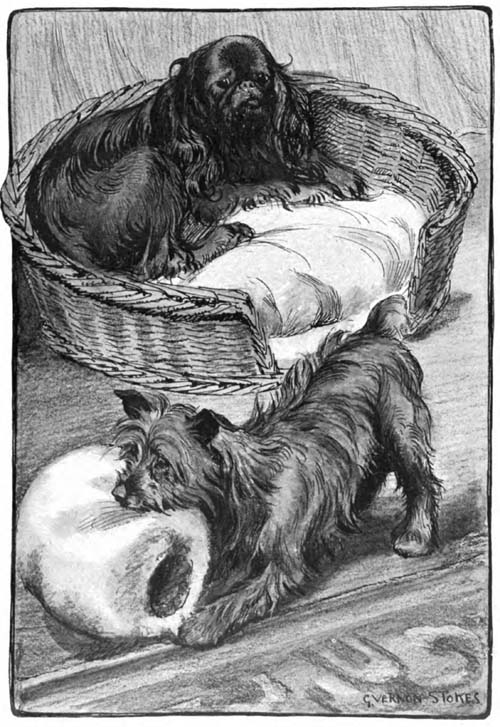
The Invalid and his New Friend ROY AND JACK
An instance of strong friendship between an older and a younger dog is seen with two pets, one a very handsome King Charles and the other a fascinating, most alert little Yorkshire terrier, who are members of a household where the dogs take no unimportant place. Roy, the King Charles, was an old and valued friend before the puppy Jack came to keep him company. At the time of the latter’s arrival Roy was suffering from a long and painful illness, and as an invalid he claimed and received more than his usual share of attention from his friends. The care with which Jack was prevented from disturbing the sufferer roused the puppy’s keenest interest in him, and it was observed that Roy himself showed no disposition to be offended at the new-comer’s presence. Little by little Jack was left free to go to Roy’s basket when he pleased, and no sooner was a cry of pain heard from the older dog than the puppy would rush to him and kiss him, and then look round for help for his suffering friend from those present. In return for these attentions Roy allowed Jack to play with his favourite toy without demur, though his friends were ready to protect his plaything from the other, while Roy was too suffering to take part in the games. The invalid would, however, show his disapproval of the too zealous attentions of his guardians by a low growl whenever Jack was deprived of the coveted toy, and from his basket would watch the games of the active puppy with a gentle interest.
Soon further signs of a good understanding between the dogs were shown. Roy, who is the autocrat of the household, spends the night with the cook, an old and valued servant, who has a quite passionate affection for the imperious little beauty. In the morning, the next step of Roy’s daily pleasures is a visit to his mistress, who being an invalid has her breakfast in bed. The little spaniel lies on her bed until she gets up, and when he is there, not even his friend Jane is allowed to interfere with him. But one day when Jack arrived in his mistress’s arms to pay a visit to the invalid, Roy was all anxiety for him to share his position with him. As this was the highest mark of favour he could show, it was felt that from henceforth the care in keeping Roy from the pressing attentions of the puppy might be relaxed.
With the exception of my own Skye, Roy has the most varied vocabulary in the way of language that I have ever heard from any dog. He makes his wants and wishes known to his friends with the greatest ease. Being a very determined as well as intelligent little person, it is but seldom that he does not get his own way. He has a large circle of friends and admirers outside his own family, and I think his devoted attendant, Jane, could scarcely be induced to accept an invitation out to tea, if Roy were not included in the party.
In the many severe illnesses that Roy has suffered, his life has undoubtedly been saved by the gentle patience with which he has submitted to remedies. He never resents anything that is done for his future comfort, and will submit quietly to handling that causes him great present pain with an evident appreciation of the reasons that dictate his friends’ efforts on his behalf. As Roy in his younger days had no home playfellow, he developed an amusing attachment to self-elected pets. The first object of his young affections as a plaything was a muff, that was shaken, tossed, and rolled about, till its comely proportions were reduced to bare skin. This with unwavering affection was always taken to bed to be slept on, till in an evil hour for him, the cook took the somewhat doubtful looking object in hand. She washed and mended it, with the laudable intention of making it a sweeter bedfellow; but for Roy its charm had gone, and he discarded it with a finality from which there was no appeal.
Now Roy, being as I have said, a privileged person, always has his chair put for him at the dining-room table, where he sits beside his mistress at mealtime, showing a decorous attention to the business in hand. His plate is before him, and at a certain point, his own portion of the food is put ready for him. Being an imaginative dog, Roy has many little “make-believes” with his playthings, and occasionally the ball that has succeeded the muff in his affections is carried into the dining room and put on the edge of his plate. The first time this happened, it was supposed to have been a mistake on Roy’s part, and the ball was removed from its position. But its owner had not brought it there without some unknown purpose in his little mind, and he prepared forthwith to rectify his friend’s blunder. Leaving his chair and the food that had just been put before him, he bustled off to recover the lost treasure, and having put it back in its former position he ate his dinner quietly. It is only now and then that the ball is thus honoured, but on these rare occasions its presence is necessary to Roy’s comfort, and his sense of the fitness of things must not be outraged by its removal.
Roy’s little housemate Jack, though still in his early youth, has already some well marked characteristics. He has a talent for collecting his family and keeping them together in a walk that is worthy of the powers of a sheep dog. His great accomplishment is begging, which he exercises on his own initiative and in a most effective manner. With him this habit takes the place of language. If he wants anything he sits up immediately on his hind legs, and with a wealth of expression in his eyes waits for his friends to attend to him. As the desired answer is sure to come, Jack’s faith in his method is unbounded. A little upright waiting form is not infrequently found in position before a closed door. Though the desired answer may be long in coming, Jack has every confidence that perseverance will win the day.
Between Whankey and Floss, the former a black and tan rough terrier and the latter a fox-terrier, who are both mentioned elsewhere, there existed the closest possible friendship. Though Whankey was an established favourite in her home before Floss arrived, a firm alliance soon sprang up between them. But the good feeling that marked their own relations was not extended to other dogs. No other of the many terriers owned by their mistress would they allow in the house. Even Jubilee, an older dog, who was passing her last years in the shelter of her owner’s home, was never permitted to pass the swing door that led from the kitchen regions into the front hall. If she ever appeared in the doorway, Whankey and Floss would be sure to spot her, and advance in warlike attitude, bristles up and uttering warning growls. Jubilee would respond in form, but would in the end give way to the superiority of numbers and withdraw to her own domains.
The two house favourites were always with their mistress, and both slept in her room at night. But each had her own allotted place on bed or chair, and they showed a nice sense of the social amenities, as a foundation of lasting friendship, by never taking a position belonging to the other. When Whankey died, Floss was inconsolable, and spent her time in looking for her lost friend. After a while she would pass hours together on a certain chair that used to be considered Whankey’s property. Here Floss would sit upright with an expression of misery on her little face that often induced her mistress to try and comfort her. But such efforts Floss resented, and she would snap and show marks of anger that she never displayed to her owner under other circumstances. Though Floss lived for some years, she still kept up the old embargo on the presence of other dogs in the house. Several times her mistress brought up some young puppies from the kennels, thinking that Floss would relent in favour of their youth and innocence. But Floss was unbending, and she was so unhappy at their presence that the young things were always sent away. To the end of her life Floss remembered Whankey. If the latter’s name was mentioned, she was immediately all attention, and if any one called “Whankey!” in a low voice, Floss would spring up and rush to the door, wagging her tail, and barking to be let out to look for her friend.
The highest form of disinterested affection we find in dogs, as in humans, in the love of a mother for her offspring. A friend, who was in South Africa with her husband during the late war, was at Ladysmith some months after the raising of the siege. She went out to Bulwana, and near the spot from which “Long Tom” had wrought such havoc among our people, she found a poor half-starved dog and her two puppies. The mother and one of the little things fled at the approach of strangers, but the other puppy, who was too weak to walk, clung to the kindly visitor who was probably the first human being she had ever seen. To leave the little thing in that desolate spot meant death for her, so the lady succeeded in getting down the steep side of the plateau with the puppy in her arms, and carried her all the way back to Ladysmith. Here she had no difficulty in finding a good home for the little stranger, as many people were anxious to have the care of a dog whose birth dated from the time of the siege. Efforts were made to find the starving mother and her other puppy, but these were unavailing. A short time after, however, another visitor to the scene of “Long Tom’s” exploits, found the younger dog, but the mother, who had managed to save her offspring, had lost her own life in the struggle.
Another instance of maternal love was given by a black pointer, one of those now known as the Black Prince breed. The dog was a very fine one and was much prized by her owners. In a litter of otherwise healthy puppies this dog had one weakling. The latter she would not allow to be with its stronger brethren. She was seen to carry the little one who was unable to hold her own in the rough and tumble of puppy life into a separate compartment. There she cared for it patiently and affectionately, and if it was put back with the others she instantly removed it from the dangers of companionship. This, I think, is the most touching example of motherly love in an animal that I have ever heard of. The poor dog’s care, however, was unavailing, and when the little sufferer died, she carried the dead body to a neighbouring hedgerow, and there dug a hole and buried it. The last scene of the tragedy was observed by a boy, who had taken the keenest interest in the efforts made to save the puppy’s life, and who is now the owner of the celebrated kennels of which the mother was an inmate.
VII
“Not hopeless round the calm, sepulchral spot, A wreath presaging life we twine: If God be love, what sleeps below was not Without a touch divine.”
OF the memory of past events and of recollection of places revisited after the lapse of years, we have many wonderful instances in dog life. Stella, a handsome well-bred fox-terrier, of strange experiences in the wilds of Africa, was a striking example of a memory that survived some thrilling adventures far from the bounds of civilisation. This little dog left her English home when she was only a few months old, and with her new master set sail for Africa. Stella was a smooth terrier with a bright tan head, and throughout life was a fat, comfortable looking little creature.
Stella’s evidence of memory of the place where she had spent the early months of her life was shown when she returned from the first of her adventurous journeys. She came home with her master after an absence of rather over a year, and accompanied him on a visit to her former mistress. It was a dark winter’s night when the travellers arrived at the station, from which a drive of three miles would take them to the house whither they were bound. The little dog’s only preoccupation was to keep with her master, and the first part of the last stage of their journey by road passed quietly. But as the carriage came within a short distance of the house, Stella grew restless, and showed such anxiety to get out that at last she was put down to run the rest of the way on foot. But neither the darkness, that to humans would have made the choice of a way a matter of difficulty, nor the time that had elapsed since Stella as a puppy had been in the country before, prevented her from recognising her old landmarks and the former conditions of her life. At the entrance to the drive she left the carriage, and, taking a short cut across the park, arrived at the front door and finding her way in, turned into the drawing room, and paying no attention for the moment to those who were waiting for the expected travellers, made straight for the water dish from which she had often quenched her thirst in early youth. Her mistress saw her dash in at the open door, and go as straight for the corner where the dogs’ dish always stood, as if it was only yesterday that she had found it there. Stella’s unexpected appearance was the signal to the waiting friends that her master was near at hand. In a few minutes the latter drove up, to find that his little favourite had shown her recollection of the scenes and surroundings of her youth, and was there in her old home to add her welcome to those of his other friends.
The so-called “Homing-instinct” of dogs I touch on with diffidence. Of the many truly wonderful instances of this power that we hear of from time to time, few are narrated in a manner to compel conviction of the facts being quite as they appear to the easy acceptance of the narrator. With these, however, I have nothing to do, though in a few cases I have come across examples of remarkable journeys over unknown countries made by different kinds of dogs. I think it is in such instances that we find evidence of a perfection of one or more of the senses, to which we have no parallel in our own experience. Yet what a strange difference there is in humans, in their power of finding their way when in unbeaten tracks! Here, as we know, a savage, untutored and guiltless of the faintest breath of civilisation, will succeed where the highest efforts of the white man’s powers of mind avail nothing. The lynx eye of the native will let nothing escape him. The turning of a leaf from its natural position, the all but imperceptible impress of a foreign body on the sandy soil, will tell him what may save the life of the representatives of a higher civilisation, whose fate is perchance confided to him. The powers of sight and smell, that tell so many things to the Indian as he follows the trail through the trackless forests of North America, and the unerring instincts that will carry a native of Central Africa, or of the desert lands of Asia over the sandy wastes, where to the European the unbroken desert gives no faintest clue to his position, are closer to those we find in our dog friends than any power we possess.
Yet among average men and women of normal intelligence and culture, the greatest possible difference will be found in their “sense of country” as it is often called.
In dogs there is at least as much difference in their power of reaching home. Some will be hopelessly lost within a mile or two, while others will make some wonderful, unaided effort to get back to their friends that is crowned with complete success. It is of hounds that such stories are generally told, and from the manner of their life, and the wide range of their work, this is not surprising. I have never, however, come across any well authenticated instance that will compare with the marvellous tales of common report. It is hard to explain how an unentered hound could have found her way over one hundred and twenty miles of unknown country. Yet this happened to a young dog that was sent by the Master of the Four Burrow Hunt to the kennels of the Devon and Somerset Staghounds. The hound was bred at the Scorrier kennels, and as his working days had not begun he had not learnt the country in the neighbourhood of his home. When he was sent to his new quarters he travelled by cart and train the whole way. On the night of his arrival at Exford he jumped over the kennel wall and disappeared. No one saw anything of him on the journey on which he started, so far as his friends could learn, but ten days later he was back at Scorrier.
A similar instance occurred with another hound that was brought to the Devon and Somerset country to hunt the wild red deer. When the late Master of the Eggesford country gave up his position, his pack was sent by train to Rugby to be sold. Here the Master of the Staghounds bought several couple, which were duly taken by train to Dulverton, and thence by cart to the kennels that are in the middle of Exmoor. On their arrival one hound escaped, and the next day she turned up at the Eggesford Kennels.
Another instance of the same kind, for the strict accuracy of which I can vouch, is told in Miss Serrell’s account of the Blackmore Vale Hounds.[5] “A remarkable instance of the homing instinct was displayed by a hound named Rakish, with whose wonderful feet and legs Mr. Guest was so much struck that he bought her. She came from the South Dorset kennels, of which hunt Mr. Featherstonhaugh Frampton was then the Master. At Moreton station Rakish was put into the Guard’s van with a collar and chain on, and she travelled twenty miles in a northeastern direction to Wimborne, and thence twenty-eight miles towards the northwest to Templecombe, her journey ending two and a half miles farther on, at Milborne Port. She was taken out at Milborne Port Station, but no sooner was she on the platform than she snapped her chain and made off. For a day or two she was seen occasionally near the place, but after that was neither seen nor heard of, until Mr. Guest received a letter from Mr. Frampton saying that Rakish had reappeared at her old kennels. Nothing was ever known of the manner in which she found her way home, a distance of twenty-two miles as the crow flies.”
The nature of the surroundings of a modern Skye terrier’s life do not give him the advantage of the knowledge of country possessed by working hounds. Yet a young Skye, only eight months old, and when taken to London for the first time, found his way from a crowded thoroughfare, across Hyde Park, which to him was unknown ground, to the home to which he had been taken on his arrival from the country. The dog’s mistress was staying in a flat at Albert Gate. A day or two after her arrival she took the Skye with her in her carriage, when she went on a shopping expedition. On leaving the carriage in Oxford Street she gave strict orders to her coachman not to let the puppy escape during her absence. The little thing had the brougham to himself, and no sound was heard from him. At last the man got down and opened the door to make sure that his charge was all right. Quick as thought the puppy slipped past him, and dashed off down the crowded pavement in the direction of the Marble Arch. When his mistress heard what had happened, she gave him up for lost. But that evening the house porter found a little waiting figure sitting at the door of the lift, for the lost terrier had found his way back.
A similar instance I know of in connection with a striking looking little dog, who passed many happy years in a good home at Bath. This little creature was a cross between a Maltese and a Pomeranian, and what gave him a very unusual appearance, was that in front he had the points of a Maltese, while behind he had the tightly curled, gaily carried tail and the form of his Pomeranian ancestors. Bobbie was only eight months old when he was lost in one of the crowded thoroughfares of London. As his then owner was living in a suburb, where he had recently changed houses, it seemed impossible that the little thing should find his way home. Nevertheless, on the following morning when the house was opened, the wanderer was found sitting on the doorstep. All through his life Bobbie was in the habit of going off for walks on his own account, and though at Bath, where his days were mostly spent, he was sometimes seen at a great distance from his home, he always found his way back.
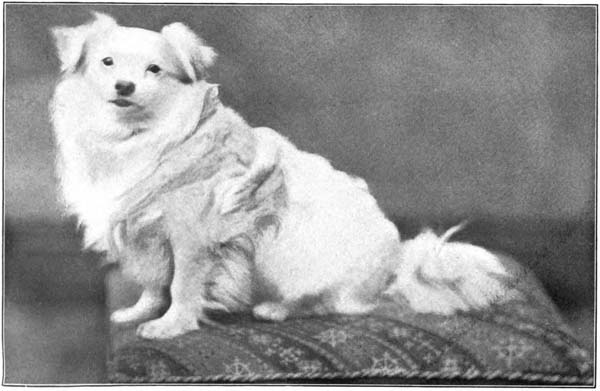
BOBBIE
He had many engaging little ways and was very devoted to his mistress, who showered love upon him. He always had a saucer of milk given to him by his owner at afternoon tea. But when she was out and any one else gave him the milk, he would not touch it. A very sad looking little figure would establish itself at a short distance from the saucer, and regard the dainty wistfully. It was not till his mistress returned and he had given her his usual warm welcome that Bobbie would fling himself upon the saucer and drink up the milk. When he wanted anything, Bobbie had a fascinating little way of making his wishes known. Taking up his position close to his mistress, he would sit upright and wave his paws quickly in the air until his wants were attended to. In many other ways he showed that he was a dog of character. It was the custom in his home for one of the maids to go to the post every evening, and it was Bobbie’s daily joy to accompany her. But he understood the business on which she went, and not even the delight of the walk would tempt him till he saw that she had the letters in her hand. Yet Bobbie’s evening run was considered good for him, and if there were no letters his mistress would put an envelope into the maid’s hand, saying, “There are the letters,” and Bobbie, satisfied that all was right, would spring up with a bark and rush downstairs with all his usual eagerness.
Pat, a Scotch terrier, once performed a mysterious journey on his own account, and though it has nothing to do with the “homing instinct,” well-directed determination, no slight amount of skill, and an intelligent comprehension of the situation were required for its success. Pat’s home was in an island off the coast of Argyll, and he was the special favourite of the nursery party. The island is a large one, and it was a fairly long drive from the house to the pier, at which steamers called. Every year the family went South, to spend a time at Bournemouth, or some other of the South-coast watering places. One or two of their dogs went with them, and one year the children pleaded for Pat to be of the selected travellers. But the elders decided against him, and Pat was consequently left behind when the family started. In the steamer the children and nurses took possession of the cabin allotted to them. No sooner had the boat moved off from the pier than a wriggling, apologetic little form came out from a dark corner of the cabin. Pat was greeted with tumultuous affection from his delighted playfellows, but how he had got there no one could say. The men servants had seen nothing of him with the luggage carts, and it was felt to be impossible that he could have concealed himself in the wagonette. There was, beside, the difficulty of his having boarded the steamer without being seen by any member of the crew or by his own family. Pat’s exploit could never be explained, though the success with which he carried it out made him dearer than ever to his young owners.
An instance of a similar kind of determination not to lose sight of his friends was shown by a powerful black lurcher, named Tip. This dog was a cross between a greyhound and a retriever, and belonged to a man whose home was at Fleet, in Hampshire. On the day when the Basingstoke market was held, Tip’s master was in the habit of getting a lift in a passing cart, that he might attend the market. His dog always ran under the cart and attended his master while he transacted his business. The return journey the man made by rail, from Basingstoke to Fleet, a distance of some ten or twelve miles. He left his dog to shift for himself when he took his own place in the train. Tip would stand on the platform and watch his master off. Then jumping down on to the line he set off in pursuit of the train. That he never left the line is proved by the fact that he did not come to grief by any train passing the opposite way, and Tip would pass Winchfield, the only intermediate station, without relaxing his speed. He performed the journey in a marvellously short time, and from Fleet Station he made his way to his home on the common, which he reached shortly after his master had arrived.
Some of these performances we must acknowledge to be beyond our range, without the aid of gifts that we feel are our own special prerogatives. If we could put ourselves into a bodily form similar to that of the dog, and at the same time divest ourselves of our higher powers of mind, we should have to acknowledge that some special canine sense was needed to get us out of our difficulties. We cannot set the dog’s solution down to mere cleverness, though doubtless the workings of his little mind often go far beyond what we attribute to it. Of simple “cleverness” so called, a small red greyhound was a striking example. The story has more than a flavour of poaching about it, but is an evidence of individual efforts of intelligence on the part of the hero. This dog, whose name was Rover, came into the possession of a friend of mine in a curious way. The lady was staying with her brother, who was a keen sportsman, and from him she heard the history of a poacher in the neighbourhood, who had been giving the keepers a very lively time. The man owned a little red dog, who was an extraordinarily clever night-worker, and the hares were sadly on the decrease in consequence. One evening, after dinner, an urgent message was brought to the master of the house that a man, who would not give his name, implored him to see him. The request was granted, and in a few minutes the servant returned to ask the lady to go out to her brother. Here she found him in conversation with a respectable looking young man, who was holding a small greyhound in a leash. Turning to her, her brother said, “This man has brought up the little varmint I was telling you about. He wants me to take him, but I tell him that he is no good to me.”
In appearance Rover was certainly not the sort of dog to appeal to a shooting man, but the sister’s sympathies were soon enlisted. She listened while the dog’s owner explained that he had got himself into such serious trouble that he was about to leave the country, and he was so fond of his dog Rover that he wanted to find a good home for him before he left. He added that he did not want anything for the dog, but only to get him into good quarters. My friend being what she was, it was a foregone conclusion that she should offer to take Rover, but she expressed a doubt of such a small creature being able to catch a hare single-handed. This implied slur of his favourite seemed to put the young man out greatly, and he declared that he had never seen the hare who could get away from Rover. The lady’s opinion, however, was not shaken, but she took the dog to an empty dog box and fastened him up for the night. The farewell between the dog and his master was very touching, for there was evidently the warmest affection between them. The poor little animal stood whining and tugging at his chain, while his master’s footsteps died away in the distance, and it was only when the last sound had faded that he retired disconsolately into his house and curled himself up.
The next morning his new owner went down into the yard early to see how her dog had fared. To her great astonishment she saw a large hare hanging on the wall above his box, and Rover securely fastened up, but looking very stiff and dirty, came slowly out to greet her. When this was reported to her brother, he was much amused. It seemed that the disbelief shown of the dog’s powers had so rankled in the poacher’s mind that he had come back in the middle of the night and taken Rover out for the last of their many midnight wanderings. A hare that the dog had caught was left in the yard as a testimony to his prowess.
Rover in due course went home with his mistress, and before long his owner determined to test his powers for herself. Taking Rover with her, she went to a neighbour on whose lands hares were said to be plentiful, to ask permission to try and find one. The permission was granted, but her friend added, “You will never catch one with that little thing.” Nothing daunted, however, Rover and his mistress took the field, with the land owner’s keeper and his old retriever. Field after field was tried unsuccessfully, and at last the word for home was given and Rover was put on his leash. In the middle of a large stubble field Rover’s mistress heard a shout behind her, and, turning, saw the keeper waving his hat frantically, and pointing with his stick to a hare that was coming straight towards her.
Rover spotted it at once, and struggled and strained so violently to get away that it was a matter of some difficulty to release him. Off he started in hot pursuit, and followed his quarry across the field at racing pace, till the hare began to near the hedge. This the dog, by cutting off a corner cleverly, managed to reach before her, and turned her back. Away they went again the full length of the field, Rover repeating his manœuvre at the end and cutting the hare off from her refuge. Back once more they raced, until the hare finding herself baulked every time she was within reach of her smeuse, grew desperate. The next time Rover tried to intercept her she made a frantic effort to pass him. But Rover was too quick for her, and making his rush, rolled her over and killed her.
His owner and the keeper meanwhile had been rushing up and down the field, with the old retriever at their heels, till they had run themselves to a standstill. They then had perforce to wait and watch the issue. When the long struggle was over, the keeper ran up and picked up the hare, finding poor little Rover panting hard from his exertions lying full length beside her.
As soon as the man had recovered his breath he turned to the lady and gave his view of the situation as follows: “Now, ma’am, don’t you ever let that little devil out of your hand. Why, if some o’ they poaching chaps were to lay hands on him there wouldn’t be a hare left in the country.”
Though Rover’s training was open to suspicion from the point of view of the law, there was no doubt of his having responded well to it. He had, moreover, from his own intelligent appreciation of the work he was called on to perform, added just those details that gave it an artistic finish.
VIII
“The faithful dog, in life the firmest friend, The first to welcome, foremost to defend; Whose honest heart is aye his master’s own, Who lives, breathes, fights, and dies for him alone.”
THE sense of the ego in the dog is, I think, clearly shown in the feeling of personal responsibility he exhibits. If we had not the feeling of being responsible in our own persons for the carrying out of duties, often far from attractive in themselves, and, it may be, even repulsive to us, should we put aside our inclinations and sensibilities to face the disagreeables such duties entail, if we could merge our personal responsibility in a general sense of the duties of mankind? It is the consciousness of the individual answer, for or against, that we must each make, that forces us to face the inevitable, as we realise it. In the lesser round of the simpler duties that confront the dog, the same recognition of the claims made on his personal response to them is shown, and should be accepted as coming from the same source.
We cannot study the life story of any dog without finding at least some instance of his recognition of duty as duty. Its carrying out may entail personal discomfort, or even danger, but he goes forward without hesitation or craven fear. In the life of Billy, a small wire-haired lady fox-terrier, who answered to this incongruous name, several such actions are to be seen. Billy is the very small daughter of well-bred parents, and belongs to a lady whose home is in Ireland. She was originally the property of a little son of the house, whose young life ended in boyhood. His wee dog was very precious to his young master, and during his last illness showed her response to his affection by spending long hours with the sufferer. One of the last requests the dying boy made was that Billy might be allowed to remain indoors at night for the future, instead of being sent to the stables to sleep. Such a petition was, of course, granted; and when her master’s short life ended, Billy was lifted from the bed and found the most loving guardians in the mother and sister of her former owner.
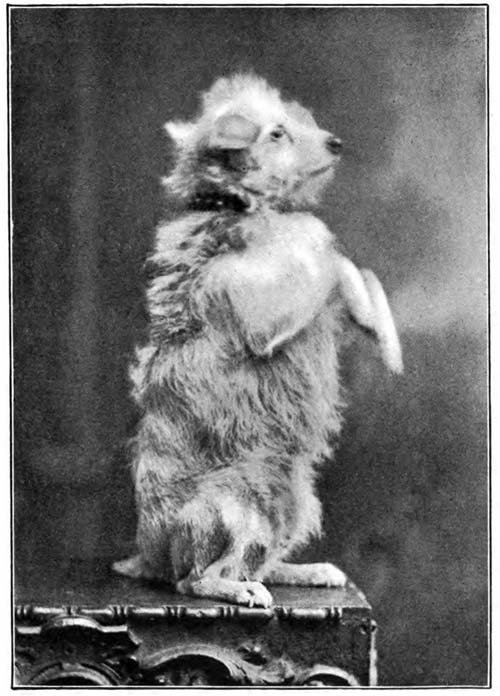
BILLY
In return for the love lavished on her, Billy is a most vigilant little guardian. In her basket she now spends the night in the kitchen. One Sunday evening on going in to take up her position for the night, Billy found a large kettle on the fire boiling over and sending a stream of water on to the floor. The maids being out, there was no one to appeal to in the kitchen regions, so Billy bustled off to the drawing room to her mistress, and by whining and catching hold of her dress and pulling at it she tried to show that all was not right. While her owner was wondering what she meant Billy grew more importunate. Seizing the lady’s skirt between her teeth she did her best to pull her mistress up; and then, rushing to the door, she paused and looked round to see if she were being followed. Then her mistress rose and went to see what was the matter. When she reached the kitchen the reason of Billy’s call was clear; and the dog, having done her duty, jumped into her basket and curled herself up for the night.
Another time Billy rushed into her mistress’s room with such signs of frantic eagerness to be followed that her appeal was responded to immediately. Leading the way into one of the rooms, Billy flew to the hearthrug, where a live coal had fallen from the fire. A large hole was already burnt in the rug, and the carpet was smouldering in most dangerous fashion. Without Billy’s summons the consequences must have been serious, for flames were on the point of breaking out.
Yet again Billy came to the rescue; and though on this occasion possible jealousy of the cat concerned in the story may have added to the zest with which she performed her duty, she nevertheless did the obvious and proper thing. Billy was settled for the night, but it was not long before she discovered that a cat had been shut into the larder by mistake, and was making the most of her unwonted opportunities. As usual, she rushed off to bring her mistress to the rescue. As Billy’s vigilance was now acknowledged and valued, she had little trouble in persuading her owner to come down. She led the way to the larder and calmly waited. The cat was discovered busy with a plump chicken; and who shall say what feeling of satisfaction came to Billy’s soul, while she watched the ignominious flight of the startled thief, to sweeten the sense of a duty successfully carried out?
Not many dogs, even of Billy’s unusual beauty, have had such striking testimony paid to their good looks. Billy was in the charge, for the time being, of her young mistress, when an American gentleman was so struck by the dog’s appearance that, with many apologies to her guardian for his intrusion, he ventured to ask if she could be persuaded to part with her pet. He would be delighted to give a cheque for £20 in exchange for the dog. The offer was politely refused, and the would-be purchaser then offered a blank cheque, to be filled in by the owner for any sum she pleased, if she would let him have Billy. Touched by the genuine admiration shown for the dog, it was then explained to the enthusiastic American that there were tender memories of a dead brother, to whom Billy had once belonged, that made it impossible to consider the noble offer made for the favourite’s transfer.
A very strong sense of duty was shown by Floss, the little terrier of eventful history, of whom I have spoken several times. She delighted in a day’s shooting, but looked upon it as her business to mount guard over anything in the shape of dead game. One day she was tested severely. A hare was killed early in the proceedings, and as the guns were going a long way to the next beat, the hare was hung on a tree and left. Not long after Floss was missed, and no one could remember where she had last been seen. Thinking, however, that she had probably run a rabbit to ground and would follow, the guns went on. At the end of the day a beater was told off to fetch the hare. When he reached the tree there was a little white form keeping guard over the trophy overhead. But Floss did not know the beater, and warned him sharply off her preserves. The man tried persuasion, caresses, and threats in turn, but to no avail. Floss was ready to use all her powers in the defence of her friends’ property, and the man went back to tell the tale of his failure. Then one of Floss’s friends went to find her and the missing hare. As soon as she saw him Floss ran to meet the new-comer with every mark of pleasure. She watched him take down the hare, and then trotted home contentedly by his side. Not even the sound of the firing that told her she was losing so much of the day’s fun had been able to tempt Floss from the path of duty.
A curious sense of the cares of guardianship Floss showed in regard to the many masks and brushes that adorn the walls of her mistress’s room. Every night before she curled herself up to sleep, she was observed to sit upright and look round the walls. If one of the usual trophies had been removed from its place, she would jump up and proceed on a tour of inspection through the house to find it. As soon as she discovered it, she barked again and again till some one arrived to see what was wanted. Then she waited till her treasure was restored to its usual place, and immediately this was done she settled herself down for the night. A visitor to the house, who was much struck with Floss’s careful guard, used to go into the room at night and pretend to touch some of the furry treasures on the walls. Floss would be up and on the alert in a moment. Flying at the rash intruder, she showed herself ready to defend her mistress’s property till the pretended examination came to an end.
The strongest personal note of another fox-terrier’s character was an indomitable will power. What he wanted he would have, if any efforts of his could secure it. A more independent, self-sufficing little person it would be hard to find. Even as a tiny puppy, before he had left his mother, he took the ordering of his young life in his own hands. His future mistress, accompanied by her brother, went to see the litter, of which Tyke was one, in order to choose a puppy for herself. When the strangers came up to the family group, the young things took no notice of them, with the exception of Tyke, who sat up and barked lustily. One of the visitors was so taken with the hostile demonstration of the tiny creature that he exclaimed to his sister, “That’s the little beggar for you.” To this the lady agreed, and in due time the terrier passed into her possession.
Now Tyke was not perfect from the point of view of beauty. He was spindly in form, and had a tail that curled in reprehensible fashion. Over one eye Tyke had a black patch that was the only touch of colour on his smooth white coat. He soon made his presence felt in his new home, and whenever he did not get what he wanted without delay, he would sit down and, putting his head in the air, give a succession of piercing howls. The noise he made was such that for the sake of peace some one was sure to hurry up to see what was wanted. Whether it was a door that needed to be opened, or whatever at the moment might disturb the comfort of the puppy, he thus took his own means of ensuring its removal.
From the first he was attached to his mistress, though he gave her brother an almost equal place in his affections. To go out for a day’s rabbit shooting with the latter was one of his greatest joys. While he was engaged in his favourite sport, Tyke got a nasty blow on one of his fore legs. He was so severely hurt and the wounded leg had swollen so much, that there was no thought of taking him for the next day’s shooting. Tyke, as an invalid, was being taken care of in his mistress’s room. But no sooner did he hear the usual preparations for a day among the rabbits being made, than he pushed open the door of the upstairs room, and tore down to the hall in impetuous fashion, as best he could on three legs. But Tyke’s enthusiasm cost him dear. As he turned a corner in the staircase in a headlong rush, he missed his footing and rolled down to the bottom of the last flight of steps. On the way he snapped the bone of the injured leg about halfway up.
Tyke’s mistress, who was in the hall at the moment, picked him up, and her brother, seeing what had happened, put down his gun and rushed out to the stables to get a horse put into the dog-cart, to carry Tyke off to have his leg set. In his mistress’s arms the dog was taken by his two friends to the family doctor, who lived about four miles off. They were sure that the latter would attend to their favourite for them. In this they were not mistaken. They fortunately found the Doctor at home, and enlisted his sympathy on behalf of the little sufferer. His mistress suggested that Tyke should have chloroform, so while the medical man busied himself in getting ready a bandage, he handed the chloroform and some cotton wool to his amateur assistants. But Tyke seemed insensible to the effects of the anæsthetic, and grew so excited over the attempts to make him take it that the idea was at last abandoned. Tyke’s self-control was equal to the demands made on it, and he remained perfectly quiet throughout the operation, gently licking his mistress’s hand, as a sign of comprehension and of gratitude for the efforts made in his behalf.
During the time that Tyke was an invalid, he came in for a carriage accident of a somewhat sensational kind. He was so unhappy at being left at home when his friends were out of the house that his mistress generally carried the little thing with her wherever she went, comfortably tucked under her arm. One morning, when a friend had to be driven to the station, the horse, whose business it was to do this work not being available, an old chestnut hunter named Bessie was pressed into the service. The wagonette was to be used and the man was to drive, so the two ladies and Tyke took their places in the back part. The mare did not take kindly to her new duties, but after a good deal of fidgeting about at the start, drew the party safely to the station.
On the return journey, Bessie was startled by a dealer’s cart that came rattling up behind her at a great pace. Laying back her ears she started off at a mad gallop, and the coachman, in his efforts to get a hold on her, pulled one rein harder than the other. Bessie’s head being thus turned towards a fence, she made straight for it. Being a capital jumper—as indeed her owner’s hunters were required to be—she landed well on the top of a broad bank. But here she was reminded of the unwonted encumbrance that hampered her movements. The two front wheels of the carriage she had carried on to the bank, but the rest of the conveyance remained hopelessly behind. After struggling vainly for a few seconds to keep her footing, Bessie rolled back into the ditch, where carriage, horse, and man were mixed up in hopeless confusion. Tyke and his mistress fortunately had made their escape, for the latter, with the dog in her arms, had, while the mare was striving to balance herself on the bank, taken a flying leap over the closed door into the road, where she landed happily on her feet. Looking round for assistance, she saw that the cart, that had been the cause of the mischief, had followed, and the driver was contemplating the scene of confusion in the ditch. Catching hold of his horse by the head, the lady told the man to go to the assistance of her coachman. At last, hatless, and with his coat nearly torn from his back, but, to his mistress’s great relief, without serious injuries, the coachman was extricated from the débris. Then more people arrived on the scene, and the poor mare was got up. She, too, had, in a marvellous way, escaped further injury than some cuts about the head, but the carriage looked like a huge spilt box of matches.
It was not long before the bone of Tyke’s leg joined, and when the last bandage was taken off it was seen that the injured leg was as straight as the other. His love for a day’s shooting was as keen as ever, and his attachment to his owner’s brother was so marked that the former was always afraid her dog would be carried off by him. When a visit of her brother’s was coming to an end, she determined, therefore, to leave Tyke at home when she drove down to the station on the morning of his departure. The dog was left shut into her bedroom, and the journey to the station passed without incident. But the dog-cart had only just turned homewards when Tyke’s mistress caught sight of a small creature tearing down the hill in front of her and clearly bound for the station. She knew it must be Tyke, so flinging the reins on the horse’s neck she jumped down just in time to catch the fugitive. He was promptly put into the dog-cart and driven home, and for once Tyke’s efforts to get his own way were defeated. A maid servant was, of course, responsible for his release. When she opened the door of the bedroom Tyke slipped past her, and, finding the front door open, he had made straight for the station, covering the three miles in less time than the horse had taken.
To one of the neighbouring country houses, situated some three miles off across the fields, Tyke was a constant visitor. He had often gone over there from his home for a day’s shooting, and this was a performance after Tyke’s own heart. It was not long before he took to making visits there on his own account, for he found the time dull at home on the days when his mistress was hunting. Tyke would consequently make his way over, and then sit down and howl at the front door until he was let in. The gentleman to whom he specially attached himself on his visits was in the habit of having a late breakfast before he started for a day’s shooting. Such an arrangement suited Tyke to perfection. He could see his mistress off on a hunting morning, and still be able to reach the house in time to share in the breakfast and start in good order for the day’s work. This over, Tyke would return home with his temporary companion, and there, curling himself up in front of the fire, he would rest peacefully for some hours till he had slept off his fatigue. As soon as he woke, he considered it time to return home, and announced his wishes in the usual manner. The prolonged and continuous howls that echoed over the house, if he found himself shut in, made his friends glad to clear the way for him. But all were fond of the strange little creature, and one very wet night they determined to keep him with them till the morning. Tyke seemed to acquiesce in the proposed arrangement, and the household retired to bed. But after a time Tyke came to other conclusions, and lifted up his voice in such piercing fashion that at last the butler came down and opened the front door for him. At four o’clock in the morning his mistress was roused from sleep by Tyke’s well-known calls under her window. In the quiet night air the shrill summons was enough to rouse the household, and she therefore got up obediently and let him in. Tyke must have taken an optimistic view of the general complaisance of humans, as he curled himself up in his accustomed place for the remaining hours of the night.
He combated successfully arrangements that were not to his mind when another day’s shooting was in question. His shooting friend was going with a party after pheasants, and Tyke, when he paid one of his usual morning visits, found that after breakfast he was no longer wanted. He was, indeed, handed over to the care of his friend the butler, who, fastening a lead of string to his collar, gave him into the charge of the local postman. The latter was going as far as the village, about a mile from Tyke’s home, and the butler—with memories of Tyke’s past exploits in his mind—declared that he was well able to find his way home from the village. The postman undertook the charge, and trudged off, holding the string carefully. The dog was no trouble to lead, and after a time his guardian paid no more attention to him. Great was his horror, therefore, on arriving at the village where the dog was to be set free, to find only a collar trailing on the ground behind him. Tyke as usual had taken his own means to carry out his wishes, and having adroitly popped his head out of his collar, he returned forthwith to the house from which he had been sent.
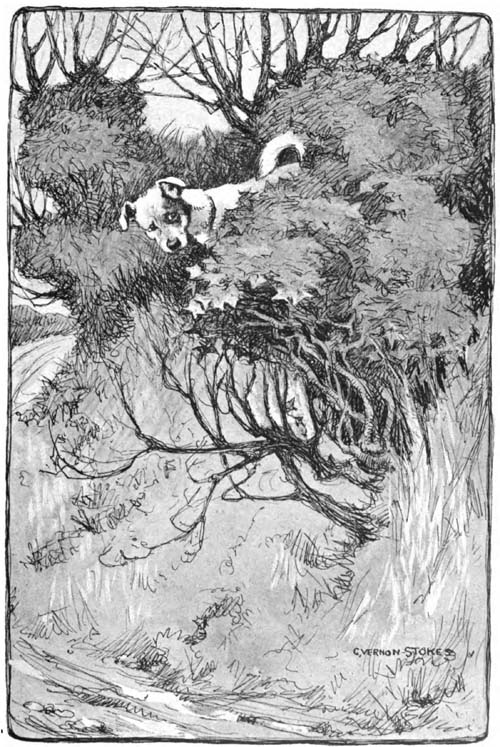
“Are they Coming?” TYKE
The troubles of the postman however did not end here. His was a slow working and a conscientious mind. He was in possession of a dog collar, on which was inscribed the name of the lost dog’s owner. This he understood was felony, and in much perturbation of mind he made his way to the house of one of the church-wardens and told his fears. He gave the collar into the custody of this respectable guardian, and begged him to assure Tyke’s mistress of his innocence in the matter.
It needed very little to make Tyke understand any proposed arrangements for the day, and to take his measures accordingly. At last his friends had to be very careful what they said before him. He was lying one morning asleep before the fire, in the room in which his mistress was sitting, when the latter’s brother came in with a letter in his hand. “I have been asked to shoot at S. to-day,” he observed to his sister. “Will you drive me over?” “Yes,” was the answer, “but Tyke must not go.”
Tyke, who had started up all attention when the visitor entered the room, slipped out instead of resuming his old place, as soon as he found what was going to happen. When the dog-cart came round and his two friends got in there was no sign of him. But when they reached the end of the long drive, across which a public road runs, they caught sight of Tyke’s head peeping out from the bushes on the top of the bank facing them. Directly he saw that he was noticed, and having satisfied himself that his friends were really coming, Tyke scampered off across the fields, paying no heed to the calls that followed him. When his mistress arrived at S., there was a sedate looking little dog sitting by the front door waiting for her.
Tyke’s life was a long and a merry one. It ended peacefully, for one morning it was a little lifeless form that his friends found lying in his basket.
IX
“There can be no question at all that the dog is capable of a kind of fidelity, which presents all the characteristics of loyal and passionate devotion. When that is the case ... there appear to be the germ of true moral and spiritual quality.”
IN the obedience that we claim and receive in such full measure from our dogs, an element of thoughtful discrimination is often shown in the response they give to our orders. Instead of following directions blindly they display a nice sense of the possibilities of the situation when all does not turn out as expected. In his behaviour a collie, who had been trained as a sheep dog, showed a power of reasoning that would have done credit to any human. The dog had gone to Scotland with his master, who was living at the time at Holyrood, where he filled the post of equerry to his relation, the High Commissioner of the day. On going into a large shop in one of the principal thoroughfares in Edinburgh, his owner told the collie to wait outside the shop door for him. The dog lay down obediently, and time passed without the reappearance of his master. The latter had indeed forgotten his dog, and had gone out by a door on the other side of the building. At length the collie, feeling that all was not right, got up and trotted back to his master’s rooms. Here he was seen by the valet, but he would not allow any one to touch him, and having satisfied himself that his master was not there, went back to his place in front of the shop door. Business detained his owner till the evening, and when at length he went home, he heard from his man of the dog’s visit, and remembered that the poor collie had been told to wait for him at the shop. Calling a cab, he drove off to the place where he had left him and found the dog obediently waiting for his return.
It is evident that when the dog realised that his master’s visit had been unduly prolonged, he thought that he might have been forgotten, and therefore took the obvious course of one possessed of reasoning power, of going to see if his owner had returned home. But he was mindful of his trust, and finding that his master had not gone back without him, he was satisfied that the order given him must be carried out to the letter. A more intelligent appreciation of the circumstances in which he was placed it would be hard to find.
Another and a wonderful instance of reasoning power in carrying out an order was shown by a collie, who was one of the performers in the sheep-dog trials held some years ago at the Alexandra Palace. A great crowd had gathered to watch the proceedings, and each dog had to single out three sheep from the flock, and drive them to a hillside about half a mile distant. On the hill was the pen into which he was to drive them. One fine collie had three wild and frightened sheep in charge, and for a long time he tried in vain to round them into the pen. They refused to face the opening, and again and again scattered in wild confusion whenever the collie tried to drive them in. The spectators watched his efforts with breathless interest. Suddenly the collie dropped as if exhausted, and lay with his back to the sheep, who were standing some little distance from the opening into the pen. He was panting with his exertions, and as he lay prone on the ground he seemed to have given up the game and to take no further interest in his charges. But the onlookers saw that every now and again he worked his body slowly backwards along the ground, the movement being so gentle that the sheep did not take alarm at it, though they moved gradually further away from him and consequently nearer to the pen. When the oft repeated manœuvre had brought them sufficiently near, the dog sprang to his feet and, twisting round with a shrill bark, drove the sheep with a sudden rush inside. A chorus of cheers showed the spectators’ appreciation of the clever way in which he had surmounted the difficulty. No man could have shown more patience in compassing the desired end, or have taken a more subtle method of overcoming opposition.
A clear evidence of reasoning power was the source of great delight to the many friends of a little dog called Nanky Poo. The name shows that the little favourite had foreign blood in her veins, and though Nanky Poo could not boast of pure descent, her mother was a Pekinese spaniel. The daughter was black, with white front and toes. She had a head that did credit to her mother’s side of the family, had a tail that curled over her back, and was too long in the leg in proportion to her size. But in spite of all blemishes in appearance, Nanky Poo was as fascinating a little specimen of her kind as any dog-lover need wish to know. In her country home, the spaniel used to have her basket in the front hall, which was used as a sitting room during the summer months. Here Nanky Poo was shut in, during her owner’s absence from the house. She was too small and too precious to be allowed to meet the possible dangers of woods and fields without a guardian at hand to protect her. But if she was left alone long, Nanky Poo found the time tedious, and whenever the front bell rang, and the man came to open it for the expected visitors, she would slip past him and make her escape. It sometimes happened that when the summons was answered no one was found waiting at the door, nor was any one to be seen in the drive. When it became of frequent occurrence for the man to be summoned on a fruitless errand, some of the household determined to solve the mystery, and, unknown to Nanky Poo, kept a watch upon her through the glass door. When the little thing got tired of solitude she was seen to get out of her basket and go to the wall on one side of the hall. Here a dainty paw was lifted to the bell wire that ran round the wall but a few inches from the ground. Nanky Poo pressed the wire down in business-like fashion, and when she was satisfied that she had brought about the desired result, she ran to the door that communicated with the house and took up her station in front of it. With her head on one side, she sat listening intently for the sound of approaching footsteps, and by the time the servant arrived she was ready to take advantage of her chance of liberty. Nanky Poo had a short but happy life, with a mistress who was devoted to her.
A high form of intellectual development must be allowed to those dogs who are always ready in an emergency to help themselves out of a difficulty, or in any other way to conform to the unexpected requirements of the moment. Such power has been shown by Bobbins, one of the old Scotch bobtail cattle dogs, throughout her life. Bobbins is a most fascinating dog, both in appearance and manner, and is of a gentle, loving nature to her friends. She is a blue grey with tan markings, and has a wonderful coat that resists the most inclement of weather. Though Bobbins came from her home in Lundy Island at an early age, and with her present owner has had none of the work in guarding sheep or cattle that is the ordinary portion of her kind, she still shows a keen appreciation of the duties to which she was bred.
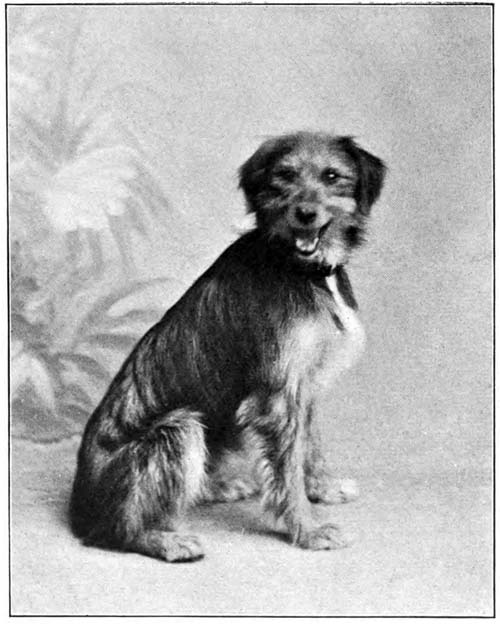
BOBBINS
Not long ago Bobbins was with her mistress in the fields when they came upon some men at work. One of the men was trying to prevent some heifers from forcing their way through a gate, that led into the field. Her mistress called to Bobbins to go to the man’s assistance. Just as the dog reached him the heifers charged through, and for a moment Bobbins’s mistress feared her dog would be killed in the mad rush of the young things. Bobbins was quick to see her danger, and threw herself flat on the ground. One of the heifers who was coming straight at her jumped over her prostrate form. No sooner had she passed than Bobbins was on her feet, and, heading the rushing heifers, turned them, and drove them safely through the gate.
Another story that shows Bobbins’s readiness to adapt her methods to the needs of the moment is told by Miss Serrell, and once again I will quote from her.[6] Bobbins was giving her assistance in the work of driving a refractory bull, which refused to answer to the dog’s repeated jumps at his head. Changing her tactics, Bobbins suddenly ran behind him, “seized him by the tail, and hung on so persistently that she was swung in the air, as the bull whirled round in his efforts to get at her. Failing to dislodge her, the animal at last took fright and beat a precipitate retreat.” The bull apparently nursed a sense of his wrongs, and one day charged Bobbins unexpectedly, and all but caught her. The dog only escaped “by turning head over heels and rolling cleverly to one side.” Then she proceeded to take her revenge for the unprovoked onslaught. Before the bull had time to turn, Bobbins was snapping at his heels, and perhaps fearing a second attack on his tail, the creature made off, and for the future he and Bobbins preserved an attitude of armed neutrality.
It is of Bobbins that the delicious story is told of a judge who, not being acquainted with the breed to which the dog belonged, put her down as “a bearded collie.” When his attention was drawn to the fact that the so-called collie had no tail, the worried judge made a reply that deserves to be immortal. “If she has not a tail, she ought to have one.” Needless to say that with such shortcomings Bobbins carried off no award of merit from the show.
Another member of the wonderful dog family that Bobbins’s mistress gathers round her is a pure white smooth fox-terrier named Roy. This dog is a son of Racer’s, who was a distinguished member of the sporting pack, whose exploits on land and water their owner has recounted. Roy has the sporting instincts that marked his sire, and nothing in the way of vermin comes amiss to him either above or under ground. But he recognises the limitations of what is lawful in the chase, and respects the inhabitants of the home poultry yard. Yet even they contribute to the pleasures of life for him. As soon as he is let out for his morning run, Roy dashes down the kennel steps and through the yard, scattering the game fowls in all directions as he makes for the gate leading into the fields. The more the birds fly and scream, the better pleased is he with this beginning of the morning’s joys, but he has too keen a sense of duty to offer to touch them.
In the summer months it is no unusual thing to see a number of ordinary barn-door fowls scattered among the home game-chicks. The former are bought by the owner of the place from the cottagers round, who are afraid to keep them for fear of their falling a prey to prowling foxes, and thus spoiling their season’s return. The first time Roy found such unaccustomed mongrels among the dark brown aristocrats of the yard, his duty appeared to him in a pleasanter light than usual. It was clear that such nondescript sort of animals could have no right there, and his mistress was apprised of something unusual going on by the sound of a great commotion in the yard. Hurrying from the kennels to see what was the matter, she met Roy with one of the strange birds in his mouth. She stooped to take it from him, and restrain him from further depredations. But Roy had no idea of wasting time in the delightful occupation that duty for once opened out to him. Dropping the chick, he scampered back before his mistress could secure him. Another trophy of the chase was brought and laid at her feet, and this time Roy was caught and a lead slipped on as the surest means of curbing his enthusiasm. Roy was now clearly puzzled. His mistress was angry, and told him sternly he was not to meddle with the new-comers. Yet, as he understood things, these were intruders, and had no more right to a place in the yard than from an æsthetic point of view they added to its appearance. He stood looking wistfully up into his mistress’s face, his stern carried low, but wagging it gently, as he always does when he is found fault with. Poor Roy, the aspect of the day had indeed changed, and the problem that confronted him was hard to solve. He had tried to do his duty in clearing his own ground of unauthorised trespassers, and he was being scolded for his pains. It was hard indeed that such an unwontedly delightful duty should not be appreciated by his usually discerning mistress. But though the reasons that dictated her conduct were beyond him, he understood the order given. For the future, the homely creatures must be allowed to join in the general rush that signalised his rapid passage across the yard, and he never again attempted to touch them. The carrying out of his personal responsibility in guarding his mistress’s property must have seemed beset with unknown dangers to him from that time.
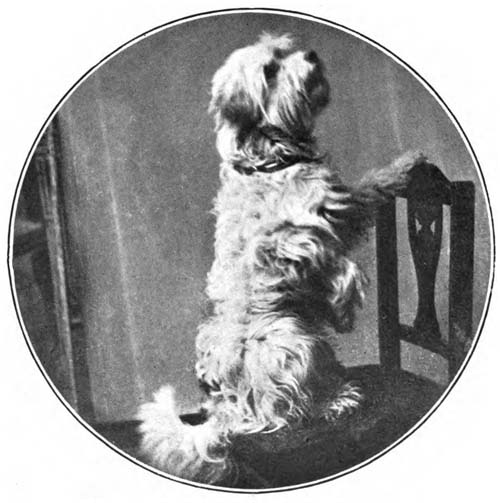
BOY
The duty attached to his position as guardian of his home also presents itself sometimes in attractive form to a thoroughbred mongrel named Boy. This dog is, in his home circle, said to be a Russian poodle. In colour he is white with black markings, and has a silky, curly coat and tail. He has a round head, in which there is plenty of room for brains, and a pair of very intelligent eyes. Belonging to his owners is an old and very fat Dalmatian who answers to the name of Tip. The latter is not allowed in the house, but is always finding means of ignoring the prohibition. Boy, whose own position is assured, feels called on to resent the intrusion. As soon as he catches sight of Tip on forbidden ground, he flies to tell his mistress what has happened. Then comes Boy’s full sense of virtue rewarded. While Tip is stealing away dejectedly from the coveted comforts of the house, Boy shows his delight in the situation by dancing about in glee, and letting off a series of joyous barks.
Boy is a great ratter, and with his first exploit in this line is connected an early foreshadowing of the serious views as to guardianship he now holds. In this case untold joys were found that proved too strong to be resisted. Boy was only a few months old when his mistress shut him up in a room into which a rat was known to find its way. In due course the rat appeared, and Boy, yielding to his hereditary instincts, fought and eventually killed it. But he knew nothing of the life history of the strange creature whose span of existence he had ended. Was it not a pet of the mistress whose belongings he was bound to guard? When his owner came in to see how things had fared, she was met by a shame-faced little creature, who crawled to her feet and begged forgiveness for the crime he believed he had committed. Since then Boy has learned much about rats in general, and suffers no qualms when he has laid low one of their mischievous tribe.
X
“To come to speech they have it questionless, Although we understand it not so well, They bark as good old Saxon as may be, And that in more variety than we.”
A NATURAL freak among dogs is Bettina Corona, of high sounding title. This small creature contains in her tiny form as many blemishes from a show point of view as any terrier—so called—that has ever lived. In weight she is only eight pounds, and in her photograph can be seen the bandy fore legs, the prick ears, the woolly curling coat, and altogether ridiculous tail that go to make up her physical attractions. But a lion’s heart is in that small body, and she is a sportswoman to the core, while a more fascinating little will-o’-the-wisp bundle of mercurial attractions it would be hard to find.
Bettina Corona was born in the Coronation year of King Edward VII, and her pedigree is of the longest. Her sire is one of the greatest champions of the kennel-world, and was sent to America at a very high price. But in compassion to her high relations, let us draw a veil over her family history, and concern ourselves only with her very interesting little person.
She is very compact and sturdily built, and has such a powerful jaw and rare set of teeth as to make her a very formidable creature to give offence to. Her curly coat is of quite extraordinary thickness, and resembles that of a sheep. So luxuriant is its growth that like a sheep she has to be shorn in the course of the summer, or Bettina with her active ways would be in danger of her life. Bettina’s time of beauty then is in the winter, when she is a mass of woolly curls from the tip of her aggressive little nose to the end of her gaily carried stern.
The amount of digging that Betty can get through is surprising, and in the orchard, where she spends a part of each day, she passes hours digging for field mice. Nothing indeed comes amiss to her in the way of game. She has followed a rabbit through all the turns and twists of a very large earth, and either killed or bolted it. Even cockchafers and stag beetles do not come amiss, for want of larger prey, and these she crunches up with a terrible finality. Her greatest enemies are, however, cats, and she will literally go through fire and water to reach them. Amongst her many feline foes is a fine long-haired tabby, half as big again as herself, who rejoices in the name of Jim. Now Jim is a great poacher, and one morning Betty lighted on him as he was returning from a midnight prowl. Jim was carrying a young rabbit, from which he evidently contemplated making his breakfast. But Betty had other views, and after a very noisy, skirmishing sort of fight, succeeded in getting possession of it. She then marched triumphantly into the house, carrying the prize, and making herself as big and fussy over it as she possibly could.
Another time she did not come off so well, as she rashly caught Jim by the tail as he was vanishing through the stable door. Swinging round on her, Jim fixed his claws on each side of her head, and seized one of her ears with his teeth. But Betty was game, and refused to release her hold. Fortunately the coachman was at hand to come to her aid, and with the stable broom tried to get in between them. The commotion soon drew her mistress to the spot, and she made frantic grabs at the struggling Betty. At length, Betty was seized by the neck and pulled off, and her mistress fled with her, while Betty fought and yelled to get back to the fray. Jim being now perfectly infuriated turned on the coachman, but the broom being well handled, he was finally swept out of the stable and the door closed. It was a very long time before the other combatant calmed down, and Betty spent the rest of the morning rushing about wildly and hunting for the enemy.
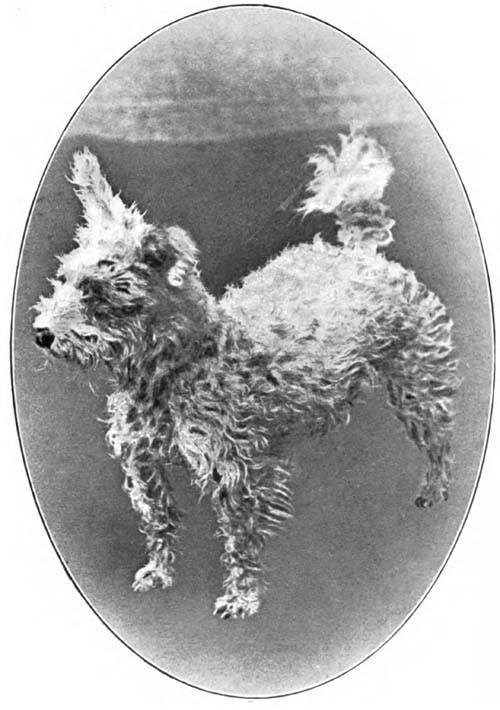
BETTINA CORONA
When Bettina emerges from the seclusion of the wired-in orchard, she has a long lead attached to her collar, as this is the only way of keeping her out of mischief. Her constant endeavour is to jerk the lead out of the hand of her captor, and one day, having escaped from her mistress’s vigilance by this means, she rushed headlong into a cottage. The scene that followed defies description. A black and white cat sat in peaceful enjoyment by the fire, and near by was an infant slumbering in its cradle. Betty flung herself with her usual impetuosity on the cat, and the terrified animal, in its efforts to escape, sprang into and out of the cradle as a first effort. Betty cleared the cradle in a flying leap, and, pinning the victim on the far side, a fierce fight began. The chairs and other articles of furniture were sent flying in all directions, as Betty’s lead wound itself round them in her mad struggles. The mistress of the house, brought hurriedly from her domestic duties, seized a chair as being the handiest weapon, and with it uplifted rushed on the fighters, while three terrified children clung screaming to her skirts. At this juncture, Betty’s owner appeared on the scene, and making a snatch at the uplifted chair with one hand, she succeeded in grasping Betty’s lead with the other, and swung the delinquent off her feet. Half choking, she was forced to release her hold of the cat, and poor puss straightway fled up the staircase into safety.
The startled woman received compensation for her fright and trouble, and, as Betty was borne off she turned her attention to the baby, who, disturbed from its sleep, had been doing its best to add to the general confusion.
Bettina’s great delight is to escape into the woods, where she will stay in a very ecstasy of hunting till she is captured and brought back. She and the two other house dogs, Bobbins a Scotch bobtail, and Bosky a beautiful wire-haired fox-terrier, all make a mad rush for the dining room as soon as the gong sounds for luncheon. Betty generally wins the race, but one day when she had been excited by the constant yapping of a dog in a distant covert, she turned at the foot of the stairs and, rushing through the open door that led to the kitchen regions, tore through the back premises and disappeared to freedom and hunting. The butler waiting by the dining-room door saw her turn, and knowing her proclivities and the care with which she was guarded, rushed after her. The cook, too, had seen her flight from the kitchen, and joined in the chase. But Betty was disappearing like a flash of greased lightning down the drive, and pursuit on foot was clearly useless. The man jumped on his bicycle, and pursued the fugitive alone.
At the end of the carriage drive, Betty, finding herself hard pressed, turned out of the road and scrambling through the hedge, made at top speed across the arable field that lay between her and the covert whither she was bound. The going was heavy, and the man soon found himself in difficulties as he sped on foot after her. Happily there was a plough at work in the field, squeaking loudly as is the way of Dorset ploughs—for what Dorset ploughman does not scorn to oil his shares? Bettina was immediately all attention, and hurrying up to see what strange animal was making the noise, the ploughman promptly put his foot on her lead, and stopping his horses waited for her panting pursuer to come up. A very snappish and disappointed little creature was then carried back to the house.
Yet Betty is very good-tempered with the dogs she knows, and romps and plays merrily with them. Her greatest favourite is Bobbins, and with her she has endless games. So strong is she that the tiny thing will jump up at her friend’s head, and dragging her over on her back will hold her down and pretend to worry her. She can lift the larger bobtail completely off the ground, and all her tricks the other takes in good part. They are often to be seen curled up together, with Betty’s head pillowed on her friend’s back.
An instance of good memory Bettina once showed in connection with a dog of my own. This dog had been on a visit with me to Betty’s home, and as the poor dog was ill at the time, the volatile Betty and her pressing attentions were too much for him. The two dogs had consequently been kept much apart, with the result that the aim and object of Betty’s existence was to get to him, and he roused her keenest interest. Some five months afterwards I was there again, but without my dog. When I came into the house I met Betty, and she rushed at me in her usual impetuous way. Scarcely staying, however, for my pat of greeting, she tore upstairs to the bedroom that I had occupied on my previous visit, and searched every corner of it to see if my dog was there. For several days she insisted on renewing her search from time to time, as she clearly thought the dog was being kept from her as he had been before. The instant linking in her little mind of the expected presence of the dog with my own appearance showed that Betty’s memory is enduring.
Another practical joke among dogs was one with whom a friend had a bowing acquaintance in a Midland town, where she was keeping house for a brother. This dog lived in a long street of suburban houses tenanted by workmen. He was a pretty little dog, with a fine silky coat and a sharp nose, a cross probably between a small spaniel and a black Pomeranian. He used to have great games with the children in the street where he lived, the favourite form of amusement being for the children to try and secure something—a stick or cap—that the dog held. The way the little thing’s eyes sparkled as he proved more than a match for many of his playmates, was as effective as any laugh. His popularity was evidently great, and my friend, who often passed by his house, never saw him anything but furry and jocose and on the best of terms with his surroundings. On one occasion, indeed, he was found doing a little bullying on his own account, though not without provocation. A child, whose face and appearance were far from prepossessing, always went down the street in terror of his life. A stone, thrown in wanton mischief at the dog, had roused the latter’s ire, and no sooner did the child appear in sight than a little black imp, barking wildly, would rush out and, circling madly round his enemy, disappear, only to pop out from some unexpected corner and renew the attack further on.
When the muzzling mania was abroad, the lady was anxious about the fate of her little friend. It was evident that his owner was away all day, and that the dog took his amusement at will from the doorstep. She was glad to see him as merry hearted as ever and not a little amused to find that the new regulations were so far understood by him that he preferred a policeman to any other playmate. He delighted in presenting his unmuzzled face, and being chased, and somehow, possibly because the policemen were not entirely untouched by the joke, he was a much hunted but never caught dog. But in time the imp himself needed more excitement, and then came discreet visits to the police station. It was summer, and the doors stood invitingly open, and it was no uncommon sight for a little black unmuzzled head to come peeping round the doorpost, and a shrill, impertinent bark to dare the inmates to the chase. As the police station was at some distance from the dog’s home, it seemed as if he was drawn there by the knowledge that a spice of real danger heightened the enjoyment of the game.
Not so irresponsible a member of the canine race, or one who did violence by her appearance to the feelings of well-bred relatives, was a beautiful fox-terrier named Venus. Yet more than once this terrier showed a strong and apparently unfounded dislike to strangers. Venus was a hound-marked dog, with tan head and black-marked body, and she was of a playful and confiding nature that endeared her to a large circle of friends. She always accepted any acquaintance of her mistress, and though in some cases she only showed the tolerance that the laws of hospitality and good manners demanded, to others she extended a warmer welcome. In all cases she seemed to make up her mind about a stranger at the first glance. One day a guest arrived to luncheon, and Venus was as usual curled up in a favourite position in the drawing room. The noise of the opening door roused her, and after a momentary look at the stranger, who was advancing to greet her hostess, Venus sprang to the ground and rushing to the visitor, jumped up and caught her firmly by the sleeve. Fortunately the little teeth only met in the sleeve itself, but the lady was terrified and shaking Venus off, she exclaimed that she hated dogs and they were never to be trusted. Venus’s mistress was utterly taken aback at the onslaught, for such a thing had never happened before. She captured the little criminal promptly and sent her off to be shut up until her visitor should have left the house. After many apologies calm was restored, and the party adjourned to the dining room.
But the maids of the household had not heard of Venus’s disgrace, and one of them going into the room where she was, set her at liberty. The tiny feet instantly pattered downstairs and made their way to the dining room. Through the open door the dog sped unnoticed by any of the party, and, singling out her former victim, made straight for her and again fastened on to her arm. The second offence was worse than the first, and the frightened visitor was only reassured when her hostess returned with the key of the door of the room into which she had locked the dog.
The strangest thing about the occurrence was that Venus had never seen the lady before, and the only explanation of her conduct seemed to be that a glance told her the stranger was to be regarded as an enemy, inasmuch as she had no love for dogs. It is certain that we poor humans would save ourselves much suffering and many painful disillusions if we had the same intuitive knowledge of those who, under the amenities of social usage, secretly regard us with disfavour.
The second time that Venus put her mistress to shame, she had more apparent ground for her action. In this case she was in a strange house, where she was visiting with her mistress. A lady entered the drawing room, who was perfectly unknown to the terrier, though she was on terms of intimacy with the members of the household. As soon as the usual greetings were over, the visitor turned her attention to the dog. Standing in front of the couch where Venus lay curled up, she exclaimed in a teasing voice, “Do you call that thing a terrier?” and laughed in a manner clearly insulting to a well-bred dog.
Venus lay quietly watching her, but her eyes glowed like two little balls of fire, and as the laugh ended she made one spring, and, fastening her teeth in the visitor’s dress, shook and worried it with every appearance of anger. The offender was borne off in disgrace and was shut up in her owner’s bedroom, there to reflect on her misdeeds. Some days later the same lady came to the house again, and no sooner was she inside the door than with a rush Venus was upon her, and worrying her dress in the way she had done before.
The gentle, amiable nature of the dog made these onslaughts all the more remarkable, for the delicate marks of her attention she bestowed on her friends were such as endeared her to them. To any one who was admitted to her favour—and to others she simply showed a well-bred indifference—she would carry a tiny stick, or failing that, or any small article she could find about the room, she would abstract a small piece of coal from the coal box, and going up to the selected person, would offer it, with every appearance of conferring a favour. Should any one, however, attempt to take the not always tempting morsel from her, she would refuse to part with it, and intimate that her playful condescension was not to be imposed on.
Venus had a way of extending the love she felt for her mistress to some of her belongings that occasionally led to embarrassment. Whenever the dog was left at home during her owner’s absence, she always searched for a pair of old slippers sacred to the use of the bedroom, and made use of one of them for a pillow. If she grew tired of staying in one room, Venus would carry her prize downstairs and, putting it down in front of the drawing room fire, curl up on it and await her mistress’s return. One day, when the latter came home late from hunting, she was told that some friends were awaiting her in the drawing room. On entering the room, she saw to her dismay a pair of dilapidated slippers occupying a prominent position in front of the fire, and Venus in high spirits doing the honours. As a mark of special favour she had offered one of the slippers to a lady who was a great friend of hers, and who was thoroughly enjoying the joke.
Her owner could not account for the anger she showed to the two strangers who received such startling marks of her disfavour. She must often have been in the society of other people who were not to be counted among dog-lovers, and she never, except in these two instances, swerved from the usual dignified indifference she extended to all who were not admitted to the circle of her friends.
XI
“To snarl, and bite, and play the dog.”
THESE words are typical of our master poet’s attitude towards the dog. Treachery, cunning, and quarrelsomeness are the traits he dwells on when he mentions dogs, and we search his plays in vain for any trace of his appreciation of the noble gifts and heroic virtues that bind the dog so closely to those who love him. At most we find such guarded praise as that given by Shallow in “The Merry Wives of Windsor,” where he says of Master Page’s greyhound, “Sir, he’s a good dog and a faire dog, can there be more said? He is good and faire.” Or again, when one of the sporting dogs, who always receive the kindliest treatment at his hands, is made the means of a sarcastic thrust of comparison with one of a higher species. This occurs in the “Two Gentlemen of Verona,” when Launce declares in praise of his mistress, “She hath more qualities than a water-spaniel, which is much in a bare Christian.”