Front matter (continued 4)
Reading edition
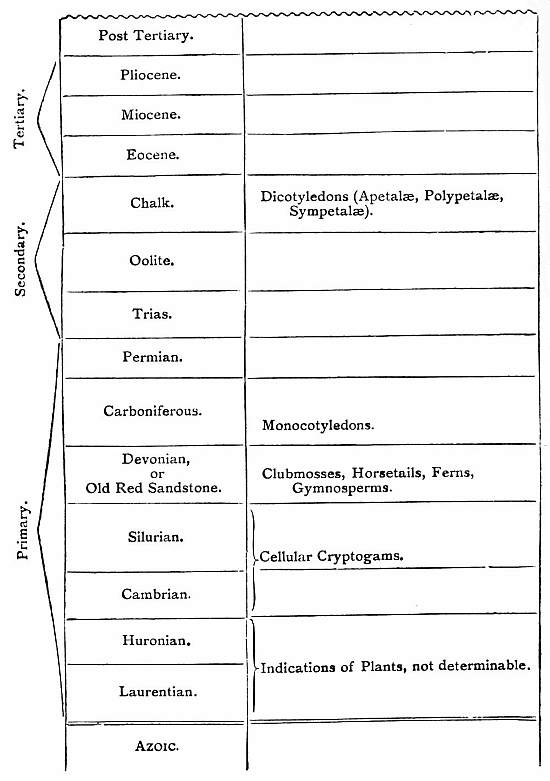
How these various classes of plants appear actually to have come upon the scene, Mr. Carruthers relates both in the paper from which we have just quoted, and at greater length in the address which he delivered as President of the Geologists' Association,[251] to the following effect.
In the first place, he declares that although the geological record, at least as known to us, is very imperfect, and represents only an insignificant fragment of plant-history,
There is a large series of plant-remains completely and accurately known which supply a fair representation of the great events of plant-life that have taken place on the earth since Palæozoic times. And these are more than sufficient to establish or destroy this hypothesis [of genetic evolution] by their testimony.
There is—he goes on to say—indirect evidence of the existence of vegetable life, long before we find any actual remains. Such indirect evidence is afforded in the first place by the abundance during this period of animal life, needing plants for its sustenance, and secondly by the enormous quantity of carbon in the rocks, which must have been secreted from the atmosphere by vegetable tissues. There are also certain surface marks or impressions occasionally to be found, which are probably due to plants of a soft and perishable character like the cellular cryptogams, and which although extremely vague and undefined, at least do not contradict the evolutionist, who regards them as evidence that the Algæ were, as according to him they ought to have been, the primeval plants. Mr. Carruthers adds a caution however, which can find its application in other instances as well:
While making this admission in relation to the vegetation of these older rocks, I must protest against the practice of completing the record of life forms, by filling in particular groups without any authority except the writer's impression of an adopted hypothesis, and then basing arguments on these assumptions in support of the hypothesis which created them. So completely has
phylogenetic [or racial] evolution become the creed of some leading naturalists that they unwittingly proceed in this manifestly unphilosophical method. But it is a first axiom, though one often forgotten, in this as in every scientific enquiry, that no step can be made in advance which is not based on fact.
After this initial stage, the story becomes much clearer, and at the same time less easy to reconcile with evolutionary requirements.
Instead of making their appearance singly and successively, and passing imperceptibly one into another, all three groups of Vascular Cryptogams, and the Gymnosperms into the bargain, come on the stage together, in the Devonian strata; and Monocotyledons in the lower Carboniferous immediately following. There is no trace whatever of the development of any of these forms from the earlier cellular cryptogams:
But [says Mr. Carruthers] the evolution of the Vascular Cryptogams, and the Phanerogams, from the green seaweeds, through the liverworts and mosses, if it took place, must have been carried on through a long succession of ages, and by an innumerable series of advancing steps; and yet we find not a single trace either of the early water forms or of the later and still more numerous dry-land forms. The conditions that permitted the preservation of the fucoids in the Llandovery rocks at Malvern, and of similar cellular organisms elsewhere, were, at least, fitted to preserve some record of the necessarily rich floras, if they existed, which through immense ages, led by minute steps to the Conifer [Gymnosperm] and Monocotyledon of these Palæozoic Rocks.
Further, these earliest plants are not generalized forms of the various tribes to which they belong, but they are as highly specialized as any subsequent representatives of the particular group to which they belong, and wherever they differ from later plants, it is in the possession of a more perfect organization.
From all which facts Mr. Carruthers thus argues:
The complete absence of intermediate forms, and the sudden and contemporaneous appearance of highly organized and widely separated groups, deprive the hypothesis of genetic evolution of any countenance from the plant-record of these ancient rocks. The whole evidence is against evolution, and there is none for it.[252]
Dicotyledons furnish evidence of especial value. On account of their higher organization, they are easily distinguished from both Monocotyledons and Gymnosperms; and they present features which clearly differentiate them amongst themselves. They did not make their entry till after a long interval—and their remains are therefore to be found in strata comparatively recent and better known to us than those of the older rocks. It is in the Chalk, the newest of the Secondary or Mesozoic formations, that they first exhibit themselves, and they do it in the same fashion as their predecessors.
When the Dicotyledons appear in the upper cretaceous beds, representatives of the three great groups [Apetalæ, Monopetalæ, Polypetalæ] appear together in the same deposit. Moreover, these divisions are represented, not by generalized types, but by differentiated forms, which, during the intervening epochs, have not developed even into higher generic groups.
And, here again, there is no vestige of intermediate species, linking dicotyledonous plants with other types.
No trace of a plant belonging to this great division has yet been detected in any earlier stratum [than the upper chalk]. There is no evidence whatever for Haeckel's statement that the Apetalæ probably existed in the Triassic and Jurassic periods.... It cannot be doubted that the conditions favourable to the preservation of Monocotyledons and Equisetums would have secured the preservation of some of the Apetalæ, had they existed. This absence can be accounted for only on the supposition that they formed no part of the then existing vegetation. And in the deposits older than the Trias, or in any subsequent deposits, no intermediate form has been detected,—no Gymnosperm or Monocotyledon which exhibits in any point of its structure a modification towards the more highly organized Dicotyledon.
Nor, on the same authority, is this all.
It is equally important in its bearing on the hypothesis of genetic evolution that the generic groups above named have persisted from the first known appearance of Dicotyledons, throughout the whole of the intervening ages, and still hold their places unchanged among the existing forms of vegetation. The persistence of generic and specific types, and the certain knowledge we possess of the life of many existing species of Phanerogams and Cryptogams which have come down through the Glacial Epoch, have not been sufficiently considered in their bearing on the hypothesis.
We have already seen something of an example which illustrates this point in a remarkable manner,—that of Salix polaris, the willow which has so obstinately preserved its specific identity amid great stress of circumstances. It belongs to a very variable genus—one in which if anywhere evidence of genetic development might be looked for. Yet it is found that since a period prior to the great Ice Age, or Glacial epoch, it has remained absolutely unchanged. At such a rate, we cannot but ask, how long would Evolution take to get back to the generalized type-form, or common ancestor, of the genus Salix, and then to that of the Order Salicineae, which includes poplars as well as willows. "The Ordinal form, if it ever existed, must necessarily be much older than the period of the upper Cretaceous rocks, that is than the period to which the earliest known Dicotyledons belong."
And it is obvious that when we had got back to the parental stock of the willow tribe, we should still, as evolutionists, be separated by a gulf still vastly greater from the common ancestor of all Dicotyledons, of oaks, apple-trees, primroses, and daisies no less than of willows and poplars.
The significance of all these various facts is thus summed up:
The whole evidence supplied by fossil plants is, then, opposed to the hypothesis of genetic evolution, and especially the sudden and simultaneous appearance of the most highly organized plants at particular stages in the past history of the globe, and the entire absence amongst fossil plants of any forms intermediate between existing classes or families. The facts of palæontological botany are opposed to Evolution, but they testify to Development, to progression from lower to higher types. The cellular Algæ preceded the Vascular Cryptogams and the Gymnosperms of the Newer Palæozoic rocks, and these were speedily followed by Monocotyledons, and, at a much later period, by Dicotyledons. But the earliest representatives of these various sections of the vegetable kingdom were not generalized forms, but as highly organized as recent forms, and in many cases more highly organized: and the divisions were as clearly bounded in their essential characters, and as decidedly separated from each other as they are at the present day.
So much for the vegetable world. As for the animal, although the number and complexity of its divisions makes it less easy to present so complete a sketch in these moderate limits, the features of its history are very similar. As Sir J. W. Dawson recounts it:[253]
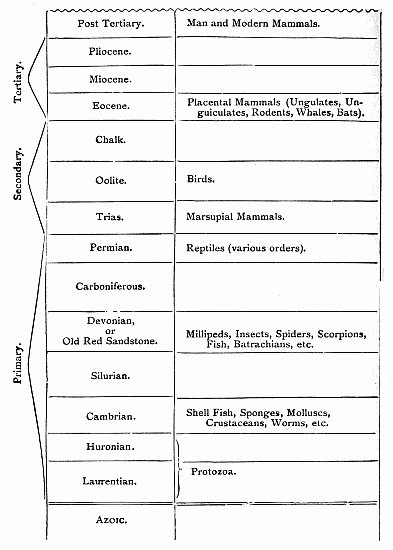
In the Cambrian age, we obtain a vast and varied accession of living things, which appear at once, as if by a sudden and simultaneous production of many kinds of animals. Here we find evidence that the sea swarmed with creatures near akin to those which still inhabit it, and nearly as varied.... Had we been able to drop our dredge into the Cambrian or Silurian ocean, we should have brought up representatives of all the leading types of invertebrate life that exist in the modern seas—different, it is true, in details of structure from those now existing, but constructed on the same principles, and filling the same places in nature.
In the latter half of the Palæozoic we find a number of higher forms breaking upon us with the same apparent suddenness as in the case of the early Cambrian animals. Fishes appear, and soon abound in a great variety of species, representing types of no mean rank, but, singularly enough, belonging in many cases to groups now very rare; while the commoner tribes of modern fish do not appear. On the land, Batrachian Reptiles now abound, some of them very high in the sub-class to which they belong. Scorpions, spiders, insects, and millipedes appear as well as land-snails: and this not in one locality only, but over the whole northern hemisphere.... Nor do they show any signs of an unformed or imperfect state.... The compound eyes and filmy wings of insects, the teeth, bones, and scales of batrachians and fishes; all are as perfectly finished, and many quite as complex and elegant, as the animals of the present day.
This wonderful Palæozoic age was, however, but a temporary state of the earth. It passed away, and was replaced by the Mesozoic, emphatically the age of Reptiles, when animals of that type attained to colossal magnitude, to variety of function and structure, to diversity of habitat in sea and on land, altogether unexampled in their degraded descendants of modern times.... Strangely enough, with these reptilian lords appeared a few small and lowly mammals, forerunners of the coming age.[254] Birds also made their appearance.
The Kainozoic, or Tertiary, is the age of Mammals and of Man. In it the great reptilian tyrants of the Mesozoic disappear, and are replaced on land and sea by mammals or beasts of the same orders with those now living, though differing as to genera and species. So greatly indeed did mammalian life abound in this period that in the middle part of the Tertiary most of the leading groups were represented by more numerous species than at present, while many types then existing
have now no representatives. At the close of this great and wonderful procession of living beings comes Man himself—the last and crowning triumph of creation the head, thus far, of life on the earth.
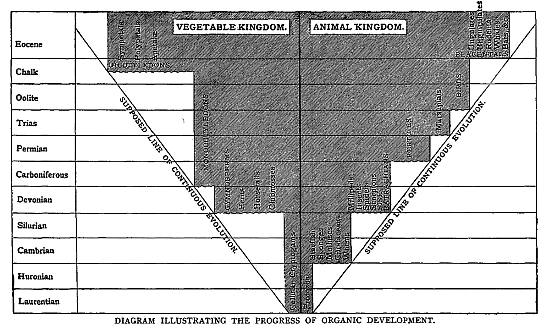
DIAGRAM ILLUSTRATING THE PROGRESS OF ORGANIC DEVELOPMENT. In the above Diagram the progress of Organic Development, as manifested in higher and higher types, is indicated by the increasing divergence of new forms from primitive simplicity of structure, represented by the medium line separating the vegetable and animal kingdoms. The Supposed line of continuous Evolution, indicates the gradual course which should be taken by Development, on Darwinian or Spencerian principles, by accumulation of minute differences in successive generations, as contrasted with the abrupt and simultaneous appearance of highly differentiated types, as spoken of by palæontologists. [To face page 227.]
It must be sufficient to quote one other remark:[255]
There is no direct evidence that in the course of geological time one species has been gradually or suddenly changed into another.... On the other hand, we constantly find species replaced by others entirely new, and this without any transition. The two classes of facts are essentially different, though often confounded by evolutionists; and though it is possible to point out in the newer geological formations some genera and species allied to others which have preceded them, and to suppose that the later forms proceeded from the earlier, still, as the connecting links cannot be found, this is mere supposition, not scientific certainty. Further, it proceeds on the principle of arbitrary choice of certain forms out of many, without any evidence of genetic connexion.
Having given a tabular view of Geological periods and Life-epochs, similar to those presented above, our author remarks:[256]
If in the table above we were to represent diagrammatically the development of animals and plants, this would appear not as a smooth and continuous stream, but as a series of great waves, each rising abruptly, and then descending and flowing on at a lower level along with the remains of those preceding it.
And here may be noticed an observation made amongst others by the Comte de Saporta[257] on the remarkable parallelism of Animal and Vegetable development. After a period in which these kingdoms were respectively represented by aquatic Algæ and Protozoa, land animals and land plants appear to have come in much at the same epoch; and afterwards dicotyledonous plants immediately preceded the advent of mammals.
Mr. Mivart is of like mind with the others we have heard. "The mass of palæontological evidence," he writes,[258] "is indeed overwhelmingly against minute and gradual modification." He points out, with the North British Reviewer so frequently quoted, that had the later forms of life descended from the earlier, through such a series of imperceptible gradations as is imagined, the probability would be that no two fossil specimens would be exactly alike, whereas in fact numbers are found of certain particular patterns, and none whatever between them, fossil animals and plants falling naturally into species, genera, families, and other categories just like those of the present day.
It is this total absence of graduated series, linking different forms together, that is the great and fundamental difficulty in the way of genetic evolution. Yet this seems very seldom to be realized, and it seems constantly to be assumed that in order to establish the genetic continuity of two creatures no more is required than to discover another standing more or less between them. Thus in the most famous of all instances, how often do we hear of "the missing link" between man and ape,—as though should a generalized form be disclosed, which might be considered a common ancestor, the question of man's simian origin would be finally settled. In the same way, as we have seen, the existence of birds with reptilian features, is taken by some as conclusive proof that birds and reptiles have descended from one stock. But what is most imperatively wanted, is persistently wanting,—namely some evidence of a series in which one form passes to another, as in a dissolving view. And yet, genetic evolutionists must suppose such series to have been the universal rule throughout the whole course of life on earth.
Assuredly [writes M. de Quatrefages][259] is it not singularly unfortunate for the evolutionary theory that so many facts which tell against it should have been preserved in the scraps of Nature's great book which remain to us, and that invariably those which would have told in its favour were recorded in lost volumes and missing leaves?
In some particular instances the absence of any trace of intermediate forms is especially significant. The tribe of Bats, for instance, is a very singular one. The wings, in which form the fore-limbs are specialized, represent the same elements as our own hands; and other modifications of the same members have produced the paws of cats and dogs, the hoofs of horses and cattle, and the flippers of whales and porpoises,—to mention no others. What countless hosts of the Bat's ancestors must have lived and died while by accumulation of minute differences the primitive generalized limb whence all these diverse forms originated, was being turned into a wing capable of flight. Yet of all these no vestige is to be discovered. "Whenever the remains of bats have been found," says Mr. Mivart,[260] "they have presented the exact type of existing forms." The same, he tells us, holds good of other flying creatures—birds and pterodactyles—(or flying lizards—now wholly extinct). No trace of any of these is forthcoming while their wings were in the making. "Yet had such a slow mode of origin as Darwinians [and genetic evolutionists generally] contend for, operated exclusively in all cases, it is absolutely incredible that bats, birds, and pterodactyles should have left the remains they have, and yet not a single relic be preserved in any one instance of any of these different forms of wing in their incipient and relatively imperfect functional condition!"
There are other creatures which stand in solitary isolation, with no fragments of a bridge to connect them with the general body. Such is the rattlesnake's family, whose pedigree, Mr. Mivart declares,[261] we cannot even imagine—"The ancestors of the rattlesnake are beyond our mental vision."
But the number of forms [says the same author][262] represented by many individuals, yet by no transitional ones, is so great that only two or three can be selected as examples. Thus those remarkable fossil reptiles, the Icthyosauria and Plesiosauria, extended, through the secondary period, probably over the greater part of the globe. Yet no single transitional form has yet been met with in spite of the multitudinous individuals preserved. Again, with their modern representatives the Cetacea, one or two aberrant forms alone have been found, but no series of transitional ones indicating minutely the line of descent. This group, the whales, is a very marked one, and it is curious, on Darwinian principles, that so few instances tending to indicate its mode of origin should have presented themselves. Here, as in the bats, we might surely expect that some relics of unquestionably incipient stages of its development would have been left.
Professor W. C. Williamson likewise remarks[263] on these lacunæ which persistently occur at crucial points:
If [he writes] these generic types [of plants] first came before us in such clearly defined forms, when and where did the transitional states make their appearance? The extreme evolutionists constantly affirm of those who believe in special creation that they "habitually suppose the origination to occur in some region remote from human observation," and that "the conception survives only in connexion with imagined places where the order of organic phenomena is unknown." It is legitimate to retort upon them that they as habitually resort to "strata now covered by the sea"—to rocks "from which all traces of such fossils as they probably included have been obliterated by igneous action," and to mysterious "migrations from pre-existing continents to continents that were step by step emerging from the ocean." Unfortunately, so far as the vegetable kingdom is concerned, we have as yet failed to discover any traces of these mysterious strata or hypothetical continents in which the transitions from one plant-type to another were being brought about. The believers in special creations are not the only reasoners who have made free use of hypothetical possibilities.
He presently adds:
We have no evidence that unaided Nature has produced a single new type during the historic period. We can only conclude that the wonderful outburst of genetic activity which characterized the Tertiary age was due to some unknown factor, which then operated with an energy to which the earth was a stranger, both previously and subsequently. The knowledge of this factor is what we need in order to perfect our philosophy; and until we obtain that knowledge, many things must remain unaccounted for, so far as primeval vegetation is concerned.
And elsewhere Professor Williamson reiterates the same idea:[264]
I contend stoutly [he says] that, however numerous may be the facts that sustain the doctrine of evolution (and I am prepared to admit that there are many that do so in a remarkable manner), this unexplained outburst of new life demands the recognition of some factor not hitherto admitted into the calculations of the evolutionist school.
In the record of fossil fishes he finds some features which are particularly hard to harmonize with any theory of genetic evolution.[265] Amongst the very earliest representatives of this class, even in the upper Silurian, are found remains of sharks, in his opinion the highest order of fish, and in the Devonian and Carboniferous above, of Ganoids armour clad, like the sturgeon. But nowhere below the Chalk do we find a single scale of Cycloids or Ctenoids, which in regard alike of the scales themselves, of the nervous system and of the reproductive organs, are much below the sharks, and not above the Ganoids. To complicate matters still more, however, the skeleton of Cycloids and Ctenoids is more highly organized than that of the others, and it is thus equally impossible to describe them as progressive or as retrogressive types.[266]
Over and above this absence of intermediate or link forms, the witnesses who have been cited insist on the fact that those earliest found are not simple or generalized representatives of their respective types, as the theory of genetic evolution requires them to be, but are as perfectly finished and specialized as those appearing in later ages. To their testimony on this point may be added that of Professor Huxley, who while frankly confessing that he would be glad enough to find evidence in favour of such progressive modification, was constrained by his love of scientific truth to bear witness as follows:[267]
The only safe and unquestionable testimony we can procure—positive evidence—fails to demonstrate any sort of progressive modification towards a less embryonic, or less generalized type, in a great many groups of animals of long-continued geological existence. In these groups there is abundant evidence of variation—none of what is generally understood as progression; and if the known geological record is to be regarded as even any considerable fragment of the whole, it is inconceivable that any theory of a necessarily progressive development can stand, for the numerous orders and families cited afford no trace of such a process.
So again he declared at a later period[268] summarizing what he had said previously:
In answer to the question, What does an impartial survey of the positively ascertained truths of palæontology testify in relation to the common doctrines of progressive modification?... I reply: It negatives these doctrines; for it either shows us no evidence of such modification, or demonstrates such modification as has occurred to have been very slight; and as to the nature of that modification, it yields no evidence whatsoever that the earliest members of a long-existing group were more generalized in structure than the later ones.
He went on, however, to say, on this latter occasion, that discoveries made in the interval afforded much ground for softening "the Brutus-like severity" which eight years before he had exhibited in this regard, by disclosing such evidence as he had declared to be lacking. From the samples, however, which he produced, it does not appear that this fresh testimony comes to very much; and in view of the observations with which he accompanied the exposition, it would seem that in only one instance did it appear to himself thoroughly satisfactory.
Every fossil [he said][269] which takes an intermediate place between forms of life already known, may be said, so far as it is intermediate, to be evidence in favour of Evolution, inasmuch as it shows a possible road by which Evolution may have taken place. But the mere discovery of such a form does not, in itself, prove that Evolution took place by and through it, nor does it constitute more than presumptive evidence in favour of Evolution in general.
It is easy[270] to accumulate probabilities—hard to make out some particular case in such a way that it will stand rigorous criticism. After much search, however, I think that such a case is to be made out in favour of the pedigree of the Horse.
Of this famous instance we have already heard, and since it will be examined at length in the following chapter, we will not dwell further upon it here.
So obvious indeed is this deficiency for evolutionary requirements of the Geological record, that Professor Haeckel attempts to supply the want by boldly interpolating a number of periods during which the metamorphoses occurred, but of which no record was left. He assumes that between the epochs of depression, when fossils were deposited beneath the water, there were other epochs of elevation when the land was dry and no deposits could occur, and he supposes that the abrupt changes of flora and fauna exhibited by successive formations, are due to the lapse of time of which we have no organic record in what he styles these "Ante-periods."
As to this summary mode of loosing the Gordian knot, it will be sufficient to quote Professor Huxley's verdict: "I confess this is wholly incredible to me."[271] And although in his favourable review of Haeckel's book[272] he showed himself far more tolerant of gratuitous speculations, than his utterances on other occasions might have led us to expect, upon this point he declared: "I fundamentally and entirely disagree with Professor Haeckel."
We may sum up the testimonies of which the above are representative in the words of two authorities by no means hostile to Evolution. M. Edmond Perrier,[273] having shewn how this theory is suggested by the successive developments of type, and how the phenomena of organic life seem to harmonize with it, thus continues:
Unfortunately, when we descend to details, such palæontological gaps present themselves that every sort of objection is possible. The chain which morphology has allowed us to piece together is continually snapped when we essay to travel back into the past.... The art of distinguishing realities from phantoms of the imagination is what has made modern science so great and so mighty. She is strong enough to win honour by avowing ignorance, and because men see her always determined to speak the truth, they gradually realize that she is not dangerous.
And in his Presidential address to the Linnean Society, May 24, 1902, Professor S. H. Vines thus expressed himself as to the genealogical table of organic life, which ever since the doctrine of Evolution was accepted, it has been sought to construct:
Though here and there fragments of the mosaic seem to have been successfully pieced together, the main outlines, even, of the great picture are as yet but dimly discernible.
The fact that organic Evolution should have proceeded so far as it has within such limits of time as may reasonably be allowed, admits, to my mind, of no other interpretation than that variation is not indeterminate, but, as Lamarck and Nägeli have urged, there must exist in living matter a certain inherent tendency or bias in favour of variation in the higher direction. It is this tendency or bias that I venture to regard as the primordial factor.
But it is precisely such an inherent tendency of organic life to develop on predetermined lines, which Darwinians and other advocates of Evolution by the agency of physical forces alone, vehemently repudiate as fatal to their whole system.
[Since Professor Williamson wrote, the opinion has been adopted that for the very reason which induced him to place the Sharks above the Cycloids and Ctenoids, their relative positions should be reversed. The Sharks being a more "generalized" type, with features more akin to those of land-dwelling reptiles, and the others more "specialized" for purely aquatic conditions, the latter, it is argued, are a higher evolutionary product. As a necessary corollary it is assumed that vertebrate life originated, not, as had been supposed, in the sea, but in swamps or lagoons on the shore-line. It must, however, remain a question how far the facility with which theories can thus be modified according to requirements, is calculated to inspire confidence in them.]
XVII
"AUDI ALTERAM PARTEM"
WE have heard Mr. Carruthers' declaration, based upon his survey of palæontological botany, "The whole evidence is against Evolution, and there is none in favour of it."
Remarkably enough, at almost the same period[274] Professor Huxley concluded a discussion of palæontological evidence with a precisely contrary pronouncement—"The whole evidence is in favour of Evolution, and there is none against it." On other occasions, also, he distinctly maintained that it is just this line of enquiry which conclusively establishes Evolution as no longer a theory, but an historical fact. To such a conclusion, he tells us,[275] "an acute and critical-minded investigator is led by the facts of palæontology;"—and, again, "If the doctrine of Evolution had not existed, palæontologists must have invented it, so irresistibly is it forced upon the mind by the study of the remains of the Tertiary mammalia."
Such declarations clearly challenge consideration, especially when it is remembered how strict were the views which Professor Huxley professed as to the necessity of proofs for our beliefs,—"that it is wrong for a man to say he is certain of the objective truth of any proposition unless he can produce evidence which logically justifies that certainty."[276]
We therefore turn naturally to his lectures on Evolution, wherein he treats the palæontological argument ex professo, and we find that his verdict is based upon a few selected instances, such as that of the reptilian birds already mentioned, which he considers favourable to Evolution, and one which he terms demonstrative,—namely that of the Horse. This he treats in some detail; in regard of it he delivers the positive judgment which we have just heard, and it therefore in a special manner demands our attention.
As furnishing evidence for the history of the horse, two features are of special importance, his limbs, and his teeth. Of these we may confine our attention to the former, as being, at once, sufficient for our purpose, and within the scope of ordinary observation.
The horse family, or Equidae, belong to the tribe of Ungulates, or hoofed animals, some points of whose anatomy require to be considered in relation to our own.
Taking first the fore-limbs. What we call the "knee" of a horse is in reality the wrist,—the true knee, or rather elbow, being what we call the "shoulder." Below the knee comes the "cannon bone," corresponding to the middle bone of the hand, and below it the "pastern," "coronary," and "coffin" bones, representing the joints of the solitary middle-finger, while the hoof is its greatly enlarged and thickened nail. Similarly, in the hind-limbs; the "hock" is veritably the ankle, and again the lateral digits are suppressed, the middle toe alone remaining.
It thus appears that an Ungulate such as the horse, is an extreme modification of the general Mammalian plan, his members being highly specialized for a certain kind of work. His leg and hoof, as the theory of genetic Evolution declares, have been gradually fashioned to their present shape from an original limb in the common Mammalian ancestor, which by other modifications has equally produced the totally different members possessed by other mammals.
That the horse is descended from a race bearing more than one digit on each extremity, seems to be indicated by the splint-bones which are found on the cannon-bone of both fore and hind legs, and which represent the second and fourth finger and toe, and also by recorded occurrences of polydactyle horses, one of which has a distinguished place in history as Julius Cæsar's charger.[277]
That the animal as we now know him is the lineal descendant of various other ungulates, in whom the digits were gradually reduced from the normal number of five, to their present solitary representative, Professor Huxley and other Evolutionists hold to be demonstrated by the discovery in due succession of various equine specimens, in which this diminution is gradually exhibited.
The remains of these animals are all found in Tertiary strata, of which, it will be remembered, there are three great divisions, the Eocene, Miocene, and Pliocene, the first named being the most ancient, and the last the most recent.
The genus Equus, or at least our modern horse, Equus caballus, can be traced no further back than the Post-tertiary period. The succession of forms leading up thither commences at the bottom of the Eocene, and extends to the upper Pliocene.
Following Professor Huxley's guidance, we trace the pedigree downwards, thus:
Firstly, there is the true horse. Next we have the American Pliocene form, Pliohippus. In the conformation of its limbs it presents some very slight deviations from the ordinary horse. Then comes Protohippus, which represents the European Hipparion, having one large digit and two small ones on each foot.... But it is more valuable than Hipparion, for certain peculiarities tend to show that the latter is rather a member of a collateral branch, than a form in the direct line of succession. Next, in the backward order in time, is the Miohippus, [Miocene], which corresponds pretty nearly with the Anchitherium of Europe. It presents three complete toes—one large median and two smaller lateral ones; and there is a rudiment of that digit which answers to the little finger of the human hand. The European record stops here: in the American Tertiaries, the series of ancestral equine forms is continued into the Eocene. An older Miocene form, Mesohippus, has three toes in front, with a large splint-like rudiment representing the little finger, and three toes behind. The radius and ulna, tibia and fibula,[278] are distinct. Most important of all is the Orohippus, from the Eocene. Here we find four complete toes on the front limb, three toes on the hind-limb, a well developed ulna, a well developed fibula.
Here, when the lecture which we are considering was delivered, the series terminated:—and upon the facts as above given Professor Huxley thus commented:
Thus, it has become evident that, so far as our present knowledge extends, the history of the horse-type is exactly and precisely that which could have been predicted from a knowledge of the principles of Evolution. And the knowledge we now possess justifies us completely in the anticipation, that when the still lower Eocene deposits, and those which belong to the Cretaceous Epoch have yielded up their remains, we shall find, first, a form with four complete toes and a rudiment of the innermost or first digit in front, with probably a rudiment of the fifth digit in the hind foot; while, in still older forms, the series of the digits will be more and more complete, until we come to the five-toed animals, in which, if the doctrine of Evolution is well founded, the whole series must have taken its origin.
Finally he was able to add in a note that since the delivery of the lecture, Professor Marsh had discovered a new genus of Equine Mammals, Eohippus, corresponding very nearly to his description of what might first be looked for. "This," adds Professor Huxley, "is what I mean by demonstrative evidence of Evolution.... In fact, the whole evidence is in favour of Evolution, and there is none against it."
That these facts are indeed most remarkable and deserving of all attention, cannot be questioned. But before we can agree that they are conclusive and demonstrative in Professor Huxley's sense a good many considerations require to be carefully weighed.
(i.) It is obvious, in the first place, that here as in all other instances which we have seen, the one thing is lacking which is really wanted in order to prove Evolution, namely evidence of one species gradually shading off into another. The creatures of which we have heard, are each isolated from the rest, and indeed very much isolated, for each belongs to a different genus,[279] which shows that the differences between them are substantial. They are, in fact, farther apart from one another, than the zebra or the donkey from the horse, for both of these are classed in the genus equus,—or than the Bengal tiger is from the domestic pussy-cat, both belonging to the genus felis.
These various ungulate forms thus stand a long way from one another, and if they were once connected together by a bridge, or rather a causeway, we ought certainly to find some traces of it, and not always of those particular types which require to be united. If we suppose the very distinct species actually known to have been the piers of such a bridge, yet what has become of the arches? Till some vestiges of these be found, or, at least, some positive evidence that arches there actually were, can it be said that the story of the fossil equidae furnishes convincing testimony on behalf of the supposed evolution? Affinities these various forms undoubtedly exhibit: it has yet to be shown that affinities necessarily imply descent.
There is, however, something even more remarkable. We have seen that Professor Huxley prognosticated beforehand the discovery of Eohippus, and specified pretty nearly the features it would be found to present. In the same way, Professor Marsh[280] anticipates and describes a still more remote ancestral form, for which, though it has not yet been found, he has provided an appellation, Hippops. But if either Professor really believes in Evolution, why does he take for granted that we shall chance upon one particular form, standing like a solitary outpost by itself, and not upon any other trace of the stream of life whereof it was but one transient phase? Such predictions may be evidence that the occurrence of these progressive forms is regulated by something analogous to Bode's Law of interplanetary distances, and that their discovery may be looked for at certain intervals. But the very fact that their actual position can be so accurately specified serves to show that it is very definitely fixed.
(ii.) Moreover, a very grave difficulty at once suggests itself, of which Professor Huxley makes no mention. The horse as we now have him, Equus caballus, is a native of the Old World, and has been introduced to America only since the time of Columbus. There had, it is true, been horses in America previously,—belonging to the genus Equus, perhaps even to the species caballus,—they had, however, been long extinct, and no memory of them remained. But, as will be noticed, the pedigree given by Professor Huxley consists almost entirely of American animals, to which category belong all whose names terminate in -hippus, and these cannot with any reason be assigned as progenitors to the European horse. As Sir J. W. Dawson observes:[281]
In America a series of horse-like animals has been selected, beginning with the Eohippus of the Eocene—an animal the size of a fox, and with four toes in front and three behind—and these have been marshalled as the ancestors of the fossil horses of America.... Yet all this is purely arbitrary, and dependent merely on a succession of genera more and more closely resembling the modern horse being procurable from successive Tertiary deposits often widely separated in time and place. In Europe, on the other hand, the ancestry of the horse has been traced back to Palæotherium—an entirely different form—by just as likely indications, the truth being that as the group to which the horse belongs culminated in the early Tertiary times, the animal has too many imaginary ancestors. Both genealogies can scarcely be true, and there is no actual proof of either. The existing American horses, which are of European origin, are, according to the theory, descendants of Palæotherium, not of Eohippus; but if we had not known this on historical evidence, there would have been nothing to prevent us from tracing them to the latter animal. This simple consideration alone is sufficient to show that such genealogies are not of the nature of scientific evidence.
(iii.) Even apart from this fundamental difficulty, there is much diversity as to the precise genealogy. We may compare together the lines of ancestry favoured—(1) by Professor Huxley, (2) In a case exhibited in our Museum of Natural History to illustrate the subject, (3) By Mr. Mivart,[282] (4) By Mr. Lydekker,[283] (5) In The Evolution of the Horse, a pamphlet issued, January, 1903, by the American Museum. This last gives the very latest version of the pedigree, but, naturally, of the American Horse alone.
Huxley. British Museum Case. Mivart. Lydekker. American Museum.
Equus Equus Equus Equus Equus
Pliohippus
Protohippus Hipparion Hipparion Protohippus Hipparion Protohippus Hipparion Hypohippus
{Miohippus Anchitherium Anchitherium Merychippus
Anchitherium Anchitherium Pachynolophus Anchilophus (form allied to) Mesohippus (2 species)
Mesohippus Protohippus Epihippus
Orohippus {Mesohippus (2 species) Protorohippus
Eohippus Hyracotherium Phenacodus Hyracotherium Systemodon Eohippus An undiscovered ancestor (Hippops)
It will be observed, that whereas Hipparion is disallowed by Professor Huxley as not being in the direct line of descent, in all the other genealogies he appears as the immediate ancestor of Equus. Also that in all these tables, Old World and New World forms are used indifferently to supply progenitors for the same successor. Also that there is no agreement at all as to the earlier ancestry. It would likewise appear that even the existence of Eohippus himself is not beyond question, for in our Museum galleries and guide-book his name always has a note of interrogation appended. The American authorities give an anticipatory sketch of the limbs of the ancestor which still remains to be discovered.
There is something even more remarkable.
DEVELOPMENT OF EQUIDÆ.
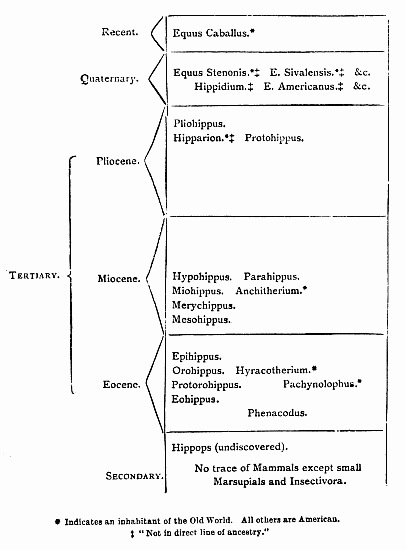
Huxley's lecture exhibiting the pedigree we have been considering was delivered in 1876. We have already seen that six years earlier he had declared himself satisfied, after much search, that though other genealogies might be doubtful, we had in the case of the Horse something really satisfactory. But the pedigree of 1870—which he thus indicated as scientifically established—was totally different from that of 1876, and was acknowledged as erroneous by the very acceptance of the latter. In 1870 the ancestry presented for Equus consisted of Hipparion, Anchitherium, and Plagiolophus. Of these, Hipparion was in 1876 specifically disallowed as a direct ancestor: Anchitherium was displaced by Miohippus, and although we are told that these creatures "correspond pretty nearly," the Horse cannot be descended from both, especially as they dwelt in different hemispheres. Finally Plagiolophus disappears from the amended pedigree altogether. Nothing could more vividly illustrate the danger of such speculations than that an authority so clear-headed and conscientious as Professor Huxley should thus proclaim his acceptance of a genealogy which he had on after information to renounce. Nor to him alone have such misadventures happened. Mr. Darwin too thought the claim of Hipparion to ancestral equine rank to be beyond dispute. "No one will deny," he wrote,[284] "that the Hipparion is intermediate between the existing horse and certain older ungulate forms." Yet, as we see, this has been denied by his champion Huxley himself.
(iv.) The materials available for the reconstruction of these various equine forms, are far less satisfactory than might easily be supposed. As a rule, each is known to us only by small fragments of its skeleton, so that we can have no assurance as to what the whole animal was really like, or even that all parts assigned to one creature really belonged to him. We can accordingly feel no certainty that if we could see any of these as a whole we should find it possible to suppose that the horse descended from it. Thus in Hippidium, an American genus closely allied to Equus, it is at least doubtful whether the digits did not terminate in claws.[285] One species of Hippidium is known only by a solitary tooth. Of Hyracotherium only the skull has been found: of Orohippus only parts of jaws and teeth and a forefoot: of Epihippus, "only incomplete specimens."[286] Accordingly, Professor Williamson, speaking of the discoveries of Professor Marsh and others, thus expresses himself:[287]
Beyond all question, some of the gaps that have hitherto separated the three animals [Anchitherium, Hipparion, and Equus] are filled up by these discoveries; but I want yet more evidence before I can arrive at the conclusion that the doctrine of Evolution is proved by these facts beyond the possibility of question. It appears to me that before I can unhesitatingly give to the testimony of these fossil horses the full value I am asked to do, I must know more about them than is at present possible. It will not be enough that the limbs and teeth of these creatures indicate transmutation, but such transmutation must be evidenced by every part of the animal. This demand is especially applicable to the stages which intervene between the Hipparion and the horse.... Myriads of individuals must have existed to effect the gradual shading of the one into the other in every part of its body.
(v.) It should likewise be remarked that in one not unimportant particular, the plates so commonly given to illustrate the horse's ancestry do not fairly represent the facts. It would appear from them that all the animals were much of a size, which doubtless greatly assists the imagination in picturing them as all in one line of descent. But as a matter of fact they differed in stature extremely, and the remoter supposed progenitors were comparative pigmies. Hyracotherium, for instance, was "about the size of a hare,"[288] and according to Professor Cope, Orohippus was the exact counterpart of this diminutive steed. The hypothetical Hippops, which Professor Marsh locates in the lower Tertiary or upper Secondary rocks, can, he thinks,[289] now "be predicated with certainty;" and amongst other things it "probably was not larger than a rabbit, perhaps much smaller." Sometimes, so far as evidence goes, it even seems that in respect of size there was deterioration instead of advance as the lineage progressed. Thus Epihippus, found in the Upper Eocene, is considerably smaller than Protorohippus, found in the Middle Eocene; "but," says the American pamphlet,[290] "no doubt there were others of larger size living at the same time," which will scarcely be called convincing.
"THE PEDIGREE OF THE HORSE," FROM THE AMERICAN MUSEUM. "THE PEDIGREE OF THE HORSE," FROM HUXLEY'S LECTURES ON EVOLUTION.
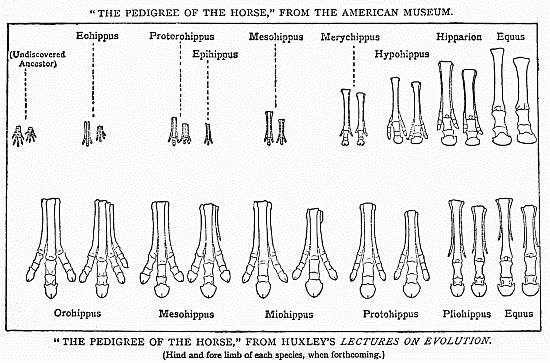
(vi.) Worthy of notice also is "the remarkable circumstance that in the line of evolution culminating in the modern Horse, a parallel series of generically identical or closely allied forms occurs in the Tertiaries of both Europe and North America, from which it has been suggested that on both continents a parallel development of the same genera has simultaneously taken place."[291] And, as we have seen, while the American pedigree must have been entirely different from the European, it terminates equally in both continents with the genus Equus, if not actually with Equus caballus.[292] But, on any mechanical system of evolution, it is impossible to suppose that developments conducted along separate roads could thus be brought to meet in one terminus.[293] Mr. Darwin did not conceive it possible that the same species should be produced twice over, "if even the very same conditions of life, organic and inorganic should recur,"[294] and the production of genuine horses, not only in widely diverse circumstances, but through totally different ancestors, must appear still less conceivable. Consequently, says Mr. Mivart,[295] "it follows from this generic identity, that classification will be no longer Darwinian, but one more Aristotelian, and will regard, not the origin but the outcome of development, whether of the individual or the species."
(vii.) There is, however, another consideration more serious than any of the above. In order to set the theory of genetic Evolution upon a sound and substantial basis, it is not sufficient to show that the last ungulate is lineally descended from the first,—Equus from Eohippus, Hyracotherium, Phenacodus, or Hippops,—but that this first ungulate himself—whichever it was—has been, or at least may have been, similarly developed from a non-ungulate Mammalian ancestor, the common parent of all the protean forms assumed by his progeny. To develop all these from one original, through a graduated series in each case, by the infinitesimal process of descent with modification, would require a period of time inconceivably long—immensely longer than that required to change one ungulate into another. Ungulates, as has been said, are a highly specialized type of Mammals, and although they walked on the nails of five digits instead of only one, a vast amount of Evolution would be required to bring them even to this point, from that whence all Mammals are said to have started. There must also have existed, while this development was in progress, a teeming and multitudinous mammalian life, as raw material for its operations—and of this at least some trace should remain.
But, so far as we know, the first Ungulates made their appearance upon earth quite as soon as did any other mammals from which they could possibly have sprung. Phenacodus, is in fact described as,[296] "The most primitive Eocene mammal yet discovered." He appears in the Lower Tertiary; while the Secondary and Mesozoic rocks beneath,—the whole period covered by which would be none too long for the evolution of Tertiary mammals generally,—are practically devoid of mammalian remains altogether, exhibiting only a few small marsupials, from which we can no more suppose Phenacodus and the huge and various beasts who were his Eocene contemporaries to have developed, than from opossums the size of shrew-mice.
It also complicates matters not a little to find that when placental mammals first show themselves all over the world at the beginning of the Eocene,—while this highly specialized order of the Ungulates seems to have been much the most numerous, it had a host of contemporaries, of extreme diversities of structure:—as for instance Unguiculates (or clawed animals) allied to the Hyena and the Fox, Rodents (gnawing animals) akin to the Squirrel, as well as Whales and Bats. Of the Cetaceans, Sir J. W. Dawson tells us:[297]
The oldest of the whales are in their dentition more perfect than any of their successors, since their teeth are each implanted by two roots, and have serrated crowns, like those of the seals. The great Eocene whales of the South Atlantic (Zeuglodon) which have these characters, attained the length of seventy feet, and are undoubtedly the first of the whales in rank as well as in time. This is perhaps one of the most difficult facts to explain on the theory of Evolution.... "We may question," says Gaudry,[298] "these strange and gigantic sovereigns of the Tertiary oceans as to their progenitors—they leave us without reply." ... Their silence is the more significant as one can scarcely suppose these animals to have been nurtured in any limited or secluded space in the early stages of their development.
The Bats, as is obvious, would require quite as much transformation from the generalized mammalian type as the Whales themselves, though in quite another direction. But they appear with their wings fully developed, in the Eocene, in both Hemispheres.
Gaudry thinks [writes Sir J. W. Dawson][299] that it is "natural to suppose" that there must have been species existing previously with shorter fingers[300] and rudimentary wings; but there are no facts to support this supposition, which is the more questionable since the supposed rudimentary wings would be useless, and perhaps harmful to their possessors. Besides, if from the Eocene to the present, the Bats have remained the same, how long would it take to develop an animal with ordinary feet, like those of a shrew, into a bat?
Such instances are by no means singular, nor are like difficulties confined to the Eocene. In the Miocene above, about the time when Anchitherium flourished, there appeared a family with whom he might claim relationship, for they were not only akin to the Ungulates but Perissodactyles, or "odd-toed," like himself. These were the "Proboscideae"—"the beasts that bear between their eyes a serpent for a hand," in other words the Elephants and their allies. These, like other families, amongst their earliest representatives included the giants of their race, for some of their Miocene specimens[301] are about half as large again as the largest of our modern elephants. Professor Ray Lankester has recently declared[302] that we now understand the genetic affinities of these creatures, whose faces have been pulled out into trunks with the nose at the extremity, and in support of his statement he adduces the features of the cranium as exhibited in certain recently-discovered specimens. But how far can conclusions be called final which are based upon such partial evidence?[303] As M. Gaudry, convinced Evolutionist as he is, acknowledges, in regard of this very matter:[304]
Like the Mastodons, the Dinotheria appeared suddenly. Whence did they come? from what quadrupeds did they spring? At present we do not know.... The points of difference [from other mammals] taken as a whole, and compared with the points of resemblance, are too great to enable us to point to any relationship between the Proboscideans and animals of other orders as yet known to us.
Such then are some of the still unanswered questions connected with the genesis of the Horse, "the most famous instance of geological evidence"[305] which Professor Huxley selects as proving Evolution to demonstration. It is by no means easy to understand how it could ever be supposed to merit any such description. In view of the various difficulties recited above it can hardly be thought that there is satisfactory evidence even of the modicum of Evolution for which alone are such arguments brought, namely within the limits of the Equidæ. Even were the reality of this established to the full, how would such evidence compare with that we have heard, drawn not from one corner of Organic Nature, but from a review of the great lines of its history?[306]
We find indeed that while Professor Huxley declares palæontology to be the main support of Evolution, other authorities tell us the exact contrary.
The doctrine of organic evolution [says Sir J. W. Dawson][307] is essentially biological rather than geological, and has been much more favoured by biologists than by those whose studies lead them more specially to consider the succession of animals and plants revealed by the rocks of the earth.
Similarly Professor Williamson,[308] speaking of the efforts made to obtain evidence on behalf of Evolution, says: "Not only living, but extinct animals have been appealed to; Professor Huxley especially has, with his wonted skilfulness, made use of the latter to buttress the geological side of the structure, which is confessedly its weakest one."
More important than all,—Mr. Darwin himself fully acknowledged that the palæontological evidence is far short of what it should be:—and attempted to meet the difficulty by pleading the imperfection of the geological record:—a plea to be more fully considered presently.
We must not leave unnoticed the method of dealing with the geological record adopted by Professor Haeckel. Of this we have already seen a slight specimen,—- in the gratuitous and baseless assertion that the apetalous Dicotyledons date as far back as the Trias, at the very bottom of the Secondary period, by which, were it a fact, a serious Evolutionary void would be filled. In the same manner he draws a perfectly imaginary picture of the submarine forests of primeval days, in which "we may suppose" all the forms of after vegetation to have begun their career as seaweeds.[309]
But in regard of his favourite doctrine of the bestial origin of man, he goes much further, and prints[310] an elaborate genealogy upon which Professor Huxley in reviewing him makes no adverse remark. In this he exhibits, as a simple matter of scientific fact, an "Ancestral Series of the human pedigree," which ninety-nine per cent, of his readers will naturally suppose to be based upon palæontological evidence. This wonderful genealogy stands thus:
1. Monera. 2. Single-celled Primeval animals. 3. Many-celled Primeval animals. 4. Ciliated planulæ (Planæada). 5. Primeval Intestinal animals (Gastræada). 6. Gliding Worms (Turbellaria). 7. Soft-worms (Scolecida). 8. Sack worms (Himatega). 9. Acrania. 10. Monorrhina. 11. Primeval fish (Selachii). 12. Salamander fish (Dipneusta). 13. Gilled Amphibia (Sozobranchia). 14. Tailed Amphibia (Sozura). 15. Primeval Amniota (Protamnia). 16. Primary Mammals (Promammalia). 17. Marsupialia. 18. Semi-apes (Prosimiæ). 19. Tailed narrow-nosed Apes. 20. Tail-less narrow-nosed Apes (Men-like Apes). 21. Pithecanthropus (Speechless or Ape-like Man). 22. Talking Man.
The first thing to remark [says M. de Quatrefages][311] is that not one of the creatures exhibited in this pedigree has ever been seen, either living or fossil. Their existence is based entirely upon theory.[312] All species, existing or extinct, are said to have been preceded by ancestral forms, which have disappeared leaving no vestige behind.... All the ancestral groups more or less ill represented in the actual organic world, do not suffice to fill up the gaps in his pedigree; from one stage to another there is sometimes too broad a gulf. Then Haeckel invents the types themselves, as well as the line of descent to which he assigns them [for example No. 7, The Scolecida, and No. 21, Pithecanthropus].
This kind of "Science" does not deserve to be treated seriously. It will be sufficient to cite another observation of M. de Quatrefages:[313]
If Darwin erred in regarding our very ignorance as to some degree telling in favour of his notions, he never tried to re-write the missing volumes of the earth's history, to restore the chapters which have been torn out, or to fill the blanks upon pages that have come down to us. But this is just what Haeckel does continually. Whenever a branch or a twig is lacking on his genealogical trees, whenever the transit from one type to another would appear too abrupt, were we to restrict ourselves to creatures actually known, he invents species and groups bodily, to which he unhesitatingly assigns a place in phylogeny, often a part in phylogenesis. Sometimes he calls in ontogeny to countenance the discovery of supposed ancestors: but frequently he does no more than affirm their existence. He thus creates a fauna, entirely hypothetical, of which Vogt rightly said that no man ever saw a trace of it, or ever will.
It is in this fashion that Professor Haeckel habitually solves the Riddles of the Universe.
As Vogt himself wrote,[314] "We shall be compelled to patch and alter these genealogical trees of species, which up to this time have been set forth as the last word of Science, and especially of Darwinism."
And Du Bois-Reymond,[315] "Man's pedigree, as drawn up by Haeckel, is worth about as much as is that of Homer's heroes for critical historians."
There remains to be considered Darwin's own explanation of the admitted deficiency of palæontological evidence.
The main cause [he writes][316] of innumerable intermediate links [between different forms] not now occurring everywhere throughout nature, depends on the very process of natural selection, through which new varieties continually take the places of and supplant their parent-forms. But just in proportion as this process of extermination has acted on an enormous scale, so must the number of intermediate varieties, which have formerly existed, be truly enormous. Why then is not every geological formation and every stratum full of such intermediate links? Geology assuredly does not reveal any such finely-graduated organic chain; and this, perhaps, is the most obvious and serious objection which can be urged against the theory. The explanation lies, as I believe, in the extreme imperfection of the geological record.
How imperfect this record is he proceeds to argue at length, and he has no difficulty in showing how much of it has at one time or other been defaced by natural causes, and how small a portion has been laid open to our inspection. But although his demonstration on this point is continually quoted, as though it solved the difficulty, it does not appear that it need detain us long.
It is, in the first place, obvious that the absence of evidence cannot prove the truth of the theory of Evolution or any other, and it is proof of that theory which is required. Apart from palæontological facts, as Professor Huxley has told us, there can be no conclusive evidence one way or the other; and if the geological record be not sufficiently complete to supply such evidence, the theory cannot possibly claim to be scientifically established.
Is it not also, as M. de Quatrefages has remarked, very singular that precisely that evidence must be supposed always to have perished which the Evolution theory imperatively requires, while so much remains which appears to contradict it?
But, moreover, as Mr. Carruthers says, incomplete though the record undoubtedly is, and limited as is our knowledge even of what exists,—there still remains a vast mass of information which it has actually supplied, and there seems to be no reason for denying that, as to the particular point under consideration, its testimony is ample. If, as on the principles of genetic Evolution must be the case, there were in each line of descent no successive species or genera, made up of forms clustered round one point in the course of development more than another, how comes it that we find always and everywhere just such isolated clusters, naturally forming genera and species; and that in no single instance do we find any trace of the graduated series linking them together? Is it not quite impossible to suppose, that at all points in Nature we stumble upon exactly those instances which disguise, and apparently contradict, the method upon which she invariably works?
It is likewise obvious that the practice of Evolutionists is quite inconsistent with their own plea, for their arguments are constantly unmeaning except on the assumption that the geological record is sufficiently complete for practical purposes. In the example of the Horse, for instance, which we have been considering, the whole case for his Evolution is based upon the supposition that the completed Equus did not exist during the earlier periods when Eohippus, Anchitherium, Hipparion and the rest of them were preparing the way for his appearance, and that none of these lived simultaneously with others more ancient still which are set down as their ancestors. But on what does such a supposition rest? Simply on the absence of remains of the more developed, in the strata containing those of the less developed. If such a reason be sufficient—which we will not question—it is likewise sufficient to establish the non-existence of intermediate forms to bridge the wide breaches in the supposed pedigree, and we must accordingly conclude that such intermediate forms there never were.
It is no less evident that whatever further evidence is found, may tell the wrong way, from the evolutionary point of view, no less than the right one; either by discrediting supposed link-forms, or by introducing us to new and strange types which increase our difficulties by requiring lines of communication to be established with them. Thus, as Mr. Mivart tells us,[317] "It is undeniable that there are instances which appeared at first to indicate a gradual transition, which instances have been shown by further investigation and discovery not to indicate truly anything of the kind." Another example of the same sort is furnished by the recent discovery of Arsinoetherium, a genus of very large and heavy hoofed beasts, the relics of which have been recently discovered in the upper Eocene of Egypt. This creature was something like a large rhinoceros, but had no connexion whatever with that family. In fact, we are told, its horns, of which it has four, two on top of its head, and two smaller above the eyes, and also its teeth, make it stand quite apart from all other mammals.
It thus appears that when the theory of genetic Evolution comes to the bar of Palæontology, the most favourable verdict to which it can pretend is, Not proven.
One thing is certain. All the evidence we possess in regard of Organic Evolution, leaves the question of the origin, the propagation, and the development of life exactly where it has always been. No force has been found by Science to which we may ascribe the origin of the world we know.
As the Count de Saporta writes:[318]
Although the problem of "creation,"—formerly thought so simple, and dated almost within human ken and the period of human history—has now been relegated to a period too distant to be imagined, it would be childish to say that on that account the problem has ceased to exist. Its limits have, it is true, been shifted; but we are bound to acknowledge that they have nowise been altered. The horizon may have broadened and receded before us more and more, but the relative position of the objects we have to investigate remains precisely the same.
So too M. Blanchard:[319]
There has never been witnessed, and it is impossible to imagine the apparition of a creature not derived from another creature: it would therefore be folly to pretend to an explanation of creation. If, as the advocates of transformism suppose, all species sprang from some primitive types, or even from a single primordial cell, the appearance, whether of those types or of that parent cell of the living world, would be neither more explicable nor less marvellous than the appearance of a host of creatures.
And, in like manner, Darwin's great ally and admirer, Sir Charles Lyell, when he had time to realize all the bearings of his friend's theory, wrote to him,[320]—"I think the old 'creation' is almost as much required as ever."
XVIII
TO SUM UP
IT is time to return to the point from which we started our whole enquiry, and to ask what has been gathered in the course of it towards a solution of the question with which we began. That the Cosmos in which we dwell, the world of law, order, and life, has not existed for ever, we saw to be a truth enforced by the researches of physical Science, no less than by the clear teaching of reason. It certainly had a beginning, and there must be a cause to which that beginning was due,—a cause capable of producing all which we find to have been actually produced. The material Universe and the mechanism of the heavens,—organic life with all its infinite marvels and varieties—animal sensation—human intelligence—canons of beauty, the law of good and evil—all these must have existed potentially in the First Cause, as in the Source whence alone they could be derived.
The Nature of this Cause was the object of our quest. In particular we set ourselves to examine the assertion now so loudly made that Science has found a full explanation in the forces of the Universe itself as they come within her cognizance, that is to say, the material forces which she can directly observe, and upon which she can experiment. In particular we have studied the Law of Evolution, in its various significations, and other laws subsidiary to it, in order to determine, from the point of view of reason and Science alone, whether it can be said that the prime factor of which we are in search is thus supplied.
The result has been to make it evident that while modern discovery has immensely multiplied and magnified the marvels which have to be accounted for, it has disclosed nothing which can be supposed to account for them in a manner to satisfy our reason. So far as the forces of Nature are concerned, the mysteries that lie beyond are even darker than they were. The origin and nature of matter and force, the source of motion, of life, of sensation and consciousness, of rational intelligence and language, of Free-will, of the reign of law and order to which all Nature testifies,—all these are for Science utterly unsolved problems, which, as some amongst her teachers tell us, must remain for ever insoluble. Even less prospect, if possible, can there be that any mechanical forces will ever account for perception of the sublime and beautiful,—and above all—of the distinction between right and wrong.
Here, then, Science stops,—confessing that she can be our guide no farther, and lending no colour whatever to the unscientific pretensions which are so noisily advanced by some persons in her name. Her domain is the world of sense, and it is evident that nothing existing within that realm can possibly furnish an explanation which will satisfy our intellectual need for causality.
Are we therefore to say that we can know nothing concerning the First Cause to which the phenomena of the Universe are due? Such is the Agnostic's position. What we have no means of knowing, he says, we must not pretend to know. It were irrational and dishonest to do so. When Science fails us, the true wisdom is to profess ignorance,—thus only can our position still be scientific.
But is such a principle itself scientific? Is it not a gratuitous and monstrous assumption that we can know nothing but that of which our senses directly tell us? That the Universe has a cause is no less certain than that the Universe exists, for of that cause it is the monument. And, as of the whole, so of every part or element which it contains, it is absolutely certain that there must be a cause, and one adequate to the production of what has actually been produced; for as the proverb says, "Nothing is to be got out of a sack but what is in it." From such conclusions there is no escape;—and since it is impossible to find the cause required within the world of material forces and sensible phenomena, it becomes no less obvious that it must lie beyond, across the frontier which nothing material can pass.
Therefore, also, we know something concerning that Cause,—very little, perhaps, in comparison with what we cannot know,—but still something very substantial. We know that such a Cause exists. We know that it must possess every excellence which we discover in Nature,—all that she has, and more; since what she derives from it, the Cause of Nature has of itself. In it must be all power, for except as flowing from it there is no power possible. Finally, as a capable Cause of law and order in Nature, and of Intellect and Will in man, the First Cause must be supereminently endowed with Understanding, and Freedom in the exercise of its might,—or it would be inferior to its own works.
Since there must have been something from eternity, [says Bolingbroke][321] because there is something now, the eternal Being must be an intelligent Being, because there is intelligence now; for no man will venture to assert that non-entity can produce entity, or non-intelligence, intelligence. And such a Being must exist necessarily, whether things have been always as they are, or whether they have been made in time: because it is no more easy to conceive an infinite than a finite progression of effects without a cause.
It is therefore not easy to understand how we can avoid the conclusion of the distinguished men of Science whom we have heard declare that they assume "as absolutely self-evident" the existence of a Deity who is the Creator and Upholder of all things.
It will probably be answered that this is mere Anthropomorphism; which formidable term appears by many to be considered sufficient to close the whole question, and to rule the idea of a personal God out of court. Did not Voltaire remark that if in the beginning God made man to His own image and likeness, man has well repaid Him ever since? And what can be more conclusive than that?
But what—after all—does "Anthropomorphism" mean in this connexion? Simply, that being men we have to speak in human terms, even of what is superhuman. By no possibility can we do anything else. Limited as we are by the conditions of our nature, we can find no mode of expression except such as is based upon sensible experience; and although we can convince ourselves by rational inference of the existence, and to some extent of the character, of what is beyond sense, we can frame no description of it, nor even a phantasm or image by means of imagination, except so far as we are able to draw upon the phenomena of the external world. Thus it is that artists who endeavour to represent an immaterial being, as an angel, a djinn or a sprite, though the essence of the object they would depict is that it has no body, have perforce to give it one, though they make it as little gross as possible, for otherwise they could not portray it at all. But however such images may be refined and etherealized they are intended to be understood only as conventional figures to suggest to the mind its own concept, which is as different from them as the notes produced by a singer are from those on the score from which he sings. No one imagines that the genius of Music is a young woman holding a shell to her ear, or that the Cherubim are heads and wings and nothing more. So it is with statements of the Theistic belief concerning the First Cause, or God. To put this into words we are compelled to use the only materials within our reach, and to borrow our phraseology from that which, within our experience is the highest and noblest element found in the Universe,—namely our own intelligence and will. These beyond question must be transcendentally possessed by the Cause on which they depend. So far Anthropomorphism is sound sense; that is to say, so long as it attributes all possible excellence to the source of all. It is foolish and unscientific only when it attributes to the Absolute and Unconditioned the limitations of an inferior order of being. We may truly say that a penny is contained in a pound,—but it does not follow that a sovereign must be of copper. According to the scientific doctrine that all our familiar forms of energy are ultimately derived from the Sun, it might well be argued from observation of a farthing rushlight that Solar Energy includes heat and light; but not that it is fed on tallow. This appears to be plain and obvious enough, often as it is forgotten or ignored. As Sir Oliver Lodge has lately put the matter:[322]
Shall we possess these things and God not possess them? Let no worthy human attribute be denied to the Deity. There are many errors, but there is one truth in Anthropomorphism. Whatever worthy attribute belongs to man, be it personality or any other, its existence in the universe is thereby admitted; we can deny it no more.
Or as Professor Baden Powell expresses the same argument:[323]
That which requires thought and reason to understand must be itself thought and reason. That which mind alone can investigate or express must be itself mind. And if the highest conception attained be but partial, then the mind and reason studied is greater than the mind and reason of the student. If the more it be studied the more vast and complex is the necessary connexion in reason disclosed, then the more evident is the vast extent and compass of the intelligence thus partially manifested, and its reality, as existing in the immutably connected order of objects examined, independently of the mind of the investigator.
The reluctance frequently manifested by scientific men to admit the force of so plain an argument, appears to be generally due to a fundamental misconception. It is constantly assumed that to introduce the element of purpose in Nature is to deny the continuity of Natural law, and that to speak of design in regard of a process or a structure, is equivalent to saying that a non-natural agent intervenes at that particular point and takes the work out of Nature's hands. This, it may be supposed, was Professor Huxley's idea when he spoke of "the commoner and coarser forms of teleology," giving as an instance the supposition that eyes were constructed for the purpose of enabling their possessors to see. It might indeed be replied that, at any rate, it is less difficult to suppose this, than that eyes were constructed without any purpose of seeing, or knowledge of the laws of optics;—but evidently it is taken for granted that Theists imagine every purposive item in nature to be violently introduced from without, like the forms of lions or peacocks into which topiarian gardeners clip their shrubs. But, as has been said, the laws of Nature are the expression of the mind of God: it is through them that He accomplishes His design. As Professor Romanes came to see at the close of his life, it is strange what jealousy there is of admitting the Creator into Creation. "It is still assumed on both sides," he wrote,[324] "that there must be something inexplicable or miraculous about a phenomenon in order to its being divine,"—and although we must utterly demur to such a description of the position of Theists, it undoubtedly is true of their adversaries. Their objections on this head can only signify that it is with the laws of Nature as with a railway locomotive from which the driver, having got up steam and set it going, jumps off, leaving it entirely to its own devices. But, as a legislator, if rightly interpreted, speaks by the mouth of every judge who administers the law in practice, and applies it to concrete cases,—so the Author of Nature, whose laws cannot be perverted, provides through them for all that is to be operated by the forces He has instituted.
So it is that, as Professors Stewart and Tait have told us, we must conceive of Him as not the Creator only, but likewise the Upholder of all things, while Lord Kelvin declares[325] we are unmistakably shown through Nature that she depends upon one "ever-acting Creator and Ruler." It is in this omnipresence of Divine influence that Monism finds the modicum of plausibility which serves it for a foundation. It runs, indeed, into the absurdity of endeavouring to explain such Omnipresence by identifying the finite with the Infinite, and attributing to matter qualities which all experience, and very specially all scientific experience, contradicts; but, for all that, it scores a distinct point as against mere materialism, which Comte declares to be "the most illogical form of metaphysics," and the late Sir Leslie Stephen, "not so much error as sheer nonsense." Theism avoids the error of either extreme. While it teaches the essential and fundamental distinction between the Absolute and the contingent, between the Creator and His creatures, it teaches likewise that He is ever present in His works, and that in their every operation He is manifested.
And so, in the words of Rivarol, God is the explanation of the world, and the world is the demonstration of God. The acceptance of a Self-existent, All-powerful, and intelligent Being can alone serve as a basis for any system of Cosmogony which satisfies our intellectual need of causation; while, on the other hand, the nature of this Being, as necessarily beyond the scope of our senses, can be known to us only indirectly through the effects of which He is the cause.
By no one has this conclusion been more clearly stated than by Lamarck, the real father of Organic Evolutionism, whom many would therefore represent as an atheist. His words are so much to the point that with them we may conclude.[326]
Of the Supreme Being, in a word of God, to whom all infinitude is seen to belong, man has thus conceived an idea, which, though indirect, is sound, and which necessarily follows from what he observes. In the same manner, he has formed another idea, equally solid, namely of the boundless power of this Being, suggested by the consideration of His works....
Nature not being intelligent, nor even a being, but an order of things constituting a power subject to law, cannot therefore be God. She is the wondrous product of His Almighty will: and for us, of all created things she is the grandest and most admirable. Thus the will of God is everywhere expressed by the laws of Nature, since these laws originate from Him.
APPENDIX
A. Evolution and the lower forms of life (p. 165).
A SINGULARLY instructive field for the study of the mutability or stability of species should be afforded by the lower forms of life, in which organization is reduced to a minimum, they being mere masses of protoplasm without even a containing envelope, while their nourishment is of the simplest. It would therefore appear that environment should be all-potent to modify them and produce specific modifications, while the extreme rapidity with which they propagate their kind, and that unisexually, ought to require no vast extent of time to make such transmutations apparent.
It is found, however, on the contrary, that nowhere in organic nature does the type remain more rigidly persistent. Professor Macbride, for example, tells us,[327]
"The Myxomycetæ may be regarded as the organic group in which the forces of heredity,—whatever these forces may be—are at their maximum: they have responded as little as possible to the influence of their environment."
To the same effect speaks Professor Paulesco of Bucharest, of other elementary organisms.[328]
What is still more remarkable, these same organisms are extremely sensitive to altered conditions of environment, which have a direct and immediate influence, gravely modifying their morphological and physiological characters, changes in respect of light, minute alterations of temperature, or the introduction of a new chemical substance, even in infinitesimal quantity, frequently causing them to assume forms very different from the specific type, and profoundly modifying their nutritive processes.
Here, it was at first thought, when Pasteur revealed their history, is clear evidence of specific transformation. But he presently convinced himself and others that it is not so, for although liable to assume such polymorphic forms according to the conditions in which they find themselves, there is no alteration of specific nature, and if the original circumstances be restored, the original forms reappear—"une élasticité functionelle de la cellule lui permettant de se plier à des conditions variées d'existence sans changer d'être." (Pasteur.)
As M. Duclaux adds:[329]
"La notion d'espèce ne disparait pas pour cela. La variabilité est un caractère comme un autre, bien que plus difficile à inscrire dans la classification, et une espèce est aussi bien définie par les sensibilités diverses qu'elle manifeste que par la petite liste des mots et de propriétés dans laquelle on croyait pouvoir autrefois enfermer toute son histoire.... La lien de l'espèce c'est la loi qui préside à ces changements, et la variété des formes et des fonctions n'est pas du tout en contradiction avec l'unité de l'espèce."
B. Note on Chap. XV. p. 203.
Since the foregoing pages have been in type there has come to hand the New York Literary Digest of January 23, 1904, containing the following article (p. 119).
"Are the Days of Darwinism Numbered?"
The recent death of Herbert Spencer lends special timeliness to the above topic, which is being actively debated just now in German theological circles. The immediate cause of the revival of interest in the present status of the Darwinian theory is found in a lengthy article by the veteran philosopher, Edward von Hartmann, which appears in Oswald's Annalen der Naturphilosophie (vol. ii. 1903), under the title 'Der Niedergang der Darwinismus' ('The Passing of Darwinism'). That the famous 'philosopher of the unconscious' is not prejudiced in favour of biblical views has been more than clear since the publication of his Selbstzersetzung der Christentums ('Disintegration of Christianity') in 1874. Hartmann in his new article has this to say—
'In the sixties of the past century the opposition of the older group of savants to the Darwinian hypothesis was still supreme. In the seventies, the new idea began to gain ground rapidly in all cultured countries. In the eighties, Darwin's influence was at its height, and exercised an almost absolute control over technical research. In the nineties, for the first time, a few timid expressions of doubt and opposition were heard, and these gradually swelled into a great chorus of voices, aiming at the overthrow of the Darwinian theory. In the first decade of the twentieth century it has become apparent that the days of Darwinism are numbered. Among its latest opponents are such savants as Eimer, Gustav Wolf, De Vries, Hoocke, von Wellstein, Fleischmann, Reinke, and many others.'
These facts, according to Hartmann's view, while they do not indicate that the Darwinian theory is doomed, undermine its most radical features:
'The theory of descent is safe, but Darwinism has been weighed and found wanting. Selection can in general not achieve any positive results, but only negative effects; the origin of species by minimal changes is possible, but has not been demonstrated. The pretensions of Darwinism as a pure mechanical explanation of results that show purpose are totally groundless.'
Other scholars think that Hartmann does not do full justice to the reaction that has set in, particularly in Germany, against Darwinism. This sentiment is voiced by Professor Zoeckler, of the University of Greifswald, in the Beweis des Glaubens (No. xi.), a journal which recently published a collection of anti-Darwinian views from German naturalists. He calls the article of Hartmann 'the tombstone-inscription [Grabschrift] for Darwinism,' and goes on to say:
'The claim that the hypothesis of descent is secured scientifically must most decidedly be denied. Neither Hartmann's exposition nor the authorities he cites have the force of moral conviction for the claim for purely mechanical descent. The descent of organisms is not a scientifically demonstrated proposition, although descent in an ideal sense can be made to harmonize with the biblical account of creation.'
Views of a similar kind are voiced in many quarters. The Hamburg savant, Edward Hoppe, has written a brochure, Ist mit der Descendenz-Theorie eine religiöse Vorstellung vereinbar? [Is the Theory of Evolution reconcilable with the Religious Idea?] in which he takes issue, in the name of religion, with the purely naturalistic type of Darwinian thought. The most pronounced convert to anti-Darwinian views is Professor Fleischmann, of Erlangen, who has not only discarded the mechanical conception of the origin of being, but the whole Darwinian theory. He recently delivered a course of lectures, entitled 'Die Darwin'sche Theorie,' which have appeared in book form in Leipsic. He comes to this conclusion: 'The Darwinian theory of descent has not a single fact to confirm it in the realm of nature. It is not the result of scientific research, but purely the product of the imagination.'
From another article in the same journal (p. 116), entitled 'A Study of Creation,' the following paragraphs may be cited:
"The French have never been enthusiastic Darwinians. It is, perhaps, not surprising, therefore, to find a French geologist, M. Stanislas Meunier, arguing in the Revue Scientifique (December 19) against all schools of transformism and stoutly maintaining what is practically a doctrine of special creation. He admits that living beings form a connected series; but the connexion, he believes, is not one of physical descent, but inheres in something outside of and pre-existent to the earth. He does not name it, but he would probably not object to the inference that it is the mind of a creator.
"M. Meunier gives at some length his reasons for rejecting Darwin's, Lamarck's, and all other theories of transformism. All we can be sure of, he thinks, is that, as in the case of the various kinds of pottery, we have to do with an orderly development, although he thinks it is not a development by descent. He closes, thus:
"'Doubtless we cannot usefully risk any hypothesis on the mechanism of the production of living things; but it is, perhaps, a step in advance only to come to the conclusion that the cause of life and its manifestations on the earth is exterior to the earth; that it is anterior to our world, just as are doubtless the laws of physics and chemistry, which govern the relations of matter and force throughout space.
"'The philosophy of science can lose nothing by the admission of points of view that, far from narrowing our subjects of study, enlarge them beyond all limits; and this is, perhaps, the occasion to show once more to persons who are turning toward metaphysics in their thirst for mystery, that they will find in pure science that wherewith they may satisfy their legitimate aspirations.'"
C. Succession of Plant forms p. 220.
Recent investigations have led to the remarkable discovery that many fern-like plants of the Carboniferous rocks, hitherto classed as Cryptogams, were in reality seed-bearers, and thus intermediate between Cryptogams and Cycads, the most primitive of existing seed-plants. They have accordingly been placed in a special group "Cycadofilices," or "Fern-Cycads," and regarded as transitional types, the view that they are the remains of a natural bridge connecting the Ferns with the Gymnosperms having received wide support,[330] and at first sight this conclusion would appear natural and obvious. But here, as in other cases, the difficulty is that the seeds which have been found are all fully developed; there are none in the intermediate stages between true spores and true seeds; we have the finished article, but no trace of seeds in the making; which upon any theory of evolution must have been exceedingly numerous. Hence Dr. Scott tells us:[331]
"The important discoveries of the seeds of the Pteridosperms scarcely touch the question of descent, for these organs are of too advanced a type to throw light on the probable derivation of the group."
In this instance, therefore, as in others, it remains true that in no case is any trace found of rudimentary character in the earliest fossil specimens of any class.
It is undoubtedly a further puzzle that some of the Carboniferous cryptogams which did not bear real seeds, yet simulated them, a habit not easily explained on evolutionary principles.
D. The Course of Evolution.
The evidence of Professor Vines quoted in the text (pp. 202, 237) receives a remarkable confirmation from that of Dr. Smith Woodward, Keeper of Geology in the National Museum of Natural History. Speaking before the International Congress of Arts and Science, St. Louis, U.S.A., September 22nd, 1904, he thus touched upon the same question, which he illustrated especially from the history of fossil fishes, which he has made his special study.[332]
"It must be confessed that repeated discoveries have now left faint hope that exact and gradual links will ever be forthcoming between most of the families and genera. The 'imperfection of the record,' of course, may still render some of the negative evidence untrustworthy; but even approximate links would be much commoner in collections than they actually are if the doctrine of gradual evolution were correct. Palæontology, indeed, is clearly in favour of the theory of discontinuous mutation, or advance by sudden changes, which has lately received so much support from the botanical experiments of H. de Vries.
"Further results obtained from the study of fossils have a bearing even on the deepest problems of Biology, namely, those connected with the nature of life itself. For instance, it is allowable to infer, from the statements already made, that the main factor in the evolution of organisms is some inherent impulse—the 'bathmic force' of Cope—which acts with unerring certainty whatever be the conditions of the moment."
E. Pedigree of the Horse.
Some recent evidence on this subject certainly does not clear away the difficulties set forth in the text.
From Nature, Sept. 8, 1904, p. 474.
"Professor Osborn (in a lecture before the British Association) mentioned that more than a hundred more or less complete skeletons of horses and horse-like animals had been found in North America. He thought he had established the fact that horses were polyphyletic, there being four or five contemporary series in the Miocene, but that the direct origin of the genus Equus in North America was not established with certainty."
Professor Sedgwick, Student's Text Book of Zoology, p. 599.
"Much has been written on the ancestry of the horse. It has been maintained by many authors that a continuous series of forms connecting it with the four-toed, brachyodont Hyracothoridæ of the Eocene has been discovered, and that here if anywhere a demonstrative historical proof has been obtained of the doctrine of organic evolution. Without desiring in the smallest degree to impugn that doctrine, it may be permitted us here to examine rather closely the view that the series of forms which recent palæontological research has undoubtedly brought to light constitute that historical proof which has been claimed for them."
[After an examination of the structural characters of these intermediate forms, viz., Pliohippus, Protohippus, Desmathippus, Miohippus, Mesohippus, Orohippus, and Hyracotherium, the author proceeds]:
"So far as the characters mentioned are concerned, we have here a very remarkable series of forms which at first sight seem to constitute a linear series with no cross-connections. Whether, however, they really do this is a difficult point to decide. There are flaws in the chain of evidence, which require careful and detailed consideration. For instance, the genus Equus appears in the Upper Siwalik beds, which have been ascribed to the Miocene age. It has, however, been maintained that these beds are in reality Lower Pliocene, or even Upper Pliocene. It is clear that the decision of this question is of the utmost importance. If Equus really existed in the Upper Miocene, it was antecedent to some of its supposed ancestors. Again in the series of equine forms, Mesohippus, Miohippus, Desmathippus, Protohippus, which are generally regarded as coming into the direct line of equine descent, Scott[333] points out that each genus is, in some respect or other, less modified than its predecessor. In other words, it would appear that in this succession of North American forms the earlier genera show, in some points, closer resemblance to the modern Equus than to their immediate successors. It is possible that these difficulties and others of the same kind will be overcome with the growth of knowledge, but it is necessary to take note of them, for in the search after truth nothing is gained by ignoring such apparent discrepancies between theory and fact."
Besides the structure of limbs and teeth, another argument for the descent of the horse has been drawn from certain phenomena of colouration. Stripings are found not unfrequently to occur in the legs and withers, which Darwin took for a reversion to the character of a very remote ancestor, the common parent, in fact, of horses and asses, which he supposed to have been striped all over like a zebra. Like other such common ancestors, this hypothetical animal had never been seen, but was thought to be most nearly represented by the Kathiwar horse, with stripes on a dun ground, a specimen of which is exhibited as illustrating the hypothesis in the National Museum of Zoology.