Front matter (continued 3)
Reading edition
That men of Science generally thus agree, cannot be questioned, and although this agreement is by no means so universal as is popularly supposed, there is no doubt that were the question to be settled by enumeration of the authorities on either side, Transformism would win easily. It may also be freely acknowledged, that Transformism in general and Darwinism in particular are theories to which on à priori grounds no exception need be taken, and that, so far at least as concerns their general scope, apart from the origin of Man, no one can reasonably start with a prepossession against them. Nay, we will go farther, and say that to our way of thinking it appears immensely more probable, that things should always have gone on as they go on now, by the operation of the same natural laws, and that specific forms should have been naturally produced, as individuals of a species are produced now, by generation,—rather than that not only repeated acts of specific creation, but any operations totally different from those we witness, should have occurred to interrupt, and as we should judge, to mar, the Law of Continuity.
All this is true. But we are engaged on a scientific enquiry,—and if there be one principle more than another upon which Science insists, it is that we should prove all things, not by authority, but by evidence,—and that we should seek evidence, not in pre-conceived ideas as to what should be, but in observation of what is. Accordingly, while we are most ready to accept Transformism or Darwinism should we find solid reasons for doing so, we are bound, for the sake of Science, to demand unimpeachable proofs before subscribing to doctrines which are made responsible for so much.
Before proceeding farther it will be necessary to exhibit more in detail the exact character of the question we have to discuss.
According to the celebrated "Formula" of Mr. Herbert Spencer—"Evolution is an integration of matter and concomitant dissipation of motion; during which the matter passes from a relatively indefinite, incoherent homogeneity, to a relatively definite, coherent heterogeneity; and during which the contained motion undergoes a parallel transformation." It would be interesting to know what idea this definition conveys to many of those who are in the habit of quoting it, but, so far as organic Evolution is concerned, it must mean that whereas in the earlier and lower forms of life one organ performed many different functions in an imperfect manner, evolutionary development has gradually produced higher forms, in which each function has its special organ, by which it is more perfectly discharged. As an extreme instance of the former condition, the Hydra has but two organs, an outside which respires, and an inside which digests. If it be turned inside out these functions are reversed; the skin becoming the stomach, and the stomach the skin. Thus Evolution has been an ascending process from the lower to the higher, from the less to the more organized.
Such, it must be added, has undoubtedly been the course of life. Amongst plants and animals alike, it began with lower and simpler forms, after which succeeded in due order others more developed and elaborately organized, the order in which they came upon the scene being much the same as that in which we should naturally arrange their specimens in a museum. Thus in the vegetable kingdom, first came such growths as sea-weeds and fungi, followed by ferns and club-mosses,—yews and pines,—and so through grasses, canes, and palms, to the highest group in which are included our forest trees and the bulk of our garden flowers. In like manner, the animal series,—to mention only leading groups of which evidence is found,—starting with almost structureless Protozoa, followed by such forms as starfish and sponges, worms, molluscs and crustaceans, has advanced to vertebrate creatures—fishes, amphibians, reptiles, birds, mammals,—and finally to man.
Thus, in a quite intelligible sense, there has certainly been Evolution, or development,—that is to say, an orderly progression from lower types to higher, throughout the history of life on earth, from its commencement to the present time. But, this is not the point. Was such Evolution or development genetic? Was it wrought by descent with modification of form from form? That is what we have to enquire. If this has not been so, there has been no Evolution in the sense intended by Evolutionists.
According to their highest authority, Mr. Herbert Spencer, Evolution means "the production of all organic forms by the accumulation of modifications and of divergences by the addition of differences to differences."
Beyond all question [he adds] unlikenesses of structure gradually arise among the members of successive generations. We find that there is going on a modifying process of the kind alleged as the source of specific differences, a process which, though slow, does, in time, produce changes—a process which to all appearance would produce in millions of years any amount of changes.[176]
The Transformist doctrine is, therefore, that one species of plants or animals, has in natural course grown out of another, through the aggregation of changes each exceedingly minute. Darwinism adds that the ruling principle of this process is Natural Selection. These are the points on which our enquiry turns, and we may conveniently commence with the second.
XV
DARWINISM
IT must first be observed that special consideration of Mr. Darwin's theory is rendered necessary even more imperatively on account of the claims advanced on his behalf by others, than of those to which he himself made any pretence. Without question the idea prevails almost universally, that he has furnished a scientific explanation of all organic phenomena through the operation of purely natural laws, and has thus rendered obsolete the idea that any power beyond Nature is required in order to account for the totality of things, or that there are any features of the world which indicate the operation of intelligent purpose.
That such ideas should be widely prevalent amongst those who, having no special acquaintance with the subject, must depend for their knowledge on the popularizers of Science, is scarcely wonderful, for such teachers, with scarcely an exception, so declare, and occasionally real men of Science lend the weight of their authority to similar statements.
It will be sufficient to cite Professor Haeckel, who writes thus:[177]
It seemed to Kant so impossible to explain the orderly processes in the living organism without postulating super-natural final causes (that is, a purposive creative force) that he said, "It is quite certain that we cannot even satisfactorily understand, much less elucidate, the nature of an organism and its internal faculty on purely mechanical natural principles—it is so certain, indeed, that we may confidently say: It is absurd for a man even to conceive the idea that some day a Newton will arise who can explain the origin of a single blade of grass by natural laws uncontrolled by design. Such a hope is entirely forbidden us." Seventy years afterwards this impossible Newton of the organic world appeared in the person of Charles Darwin, and achieved the great task that Kant had deemed impracticable.
It is quite impossible to understand how such an assertion can be made by any one who knows the facts. Not only did Mr. Darwin never profess to have achieved any thing of the kind,—he repeatedly and distinctly disclaimed and repudiated any such supposition. Thus at the very end of his life (August 28, 1881) he wrote concerning one who had spoken of him like Professor Haeckel:
He implies that my views explain the universe; but it is a most monstrous exaggeration. The more one thinks, the more one feels the hopeless immensity of man's ignorance. If we consider the whole universe, the mind refuses to look at it as the outcome of chance.[178] The whole question seems to me insoluble.
But it should not be necessary to appeal to such disclaimers in order to show how absolutely unwarrantable are the pretensions made on Mr. Darwin's behalf to have solved, or to have attempted to solve, the fundamental problems which scientific research unceasingly suggests but has never been able to elucidate. It should be quite sufficient to examine his theory as it actually is, and although its scope is immensely less ambitious than has been represented, it still occupies, even in its genuine form, a position of sufficient importance to challenge investigation.
Mr. Darwin's famous and epoch-making book, published in November, 1859, was entitled On the Origin of Species by means of Natural Selection, or the Preservation of Favoured Races in the Struggle for Life. In it he undertook to show how from one species[179] of animals or plants, another, quite distinct from it, may be derived by means of processes which go on in Nature every day, through the accumulation of minute differences occurring in successive generations, and guided to their collective result by the force of "Natural Selection." As man, he argues, has by means of selection been able to produce in a brief space such astonishing varieties among his domestic animals and plants—as dogs, pigeons, roses or apples,—Nature, with the practically unlimited ages of geological time at her disposal, must be able to produce far greater and more enduring transformations, through the accumulation of minute differences, such as those upon which man has worked,—if only a factor can be found which amid the infinity of diverse and discordant variations spontaneously occurring, could, like the breeder or the gardener, pick out those leading to one particular result, and thus secure its accomplishment. Such a force Mr. Darwin conceives is found in "Natural Selection," which he thus explains.
The tendency of organic life, whether vegetable or animal, being to propagate itself enormously,—and the life-sustaining capacity of the earth being limited,—it necessarily follows that only a fraction of the creatures which are born can survive to maturity, and that while those best fitted to live will live, those less well fitted will die. Thus, there is set up a constant struggle for existence, in which every advantage, however slight, must tell, so that those possessing such advantages in one generation will be the parents of the next. But in the course of propagation, the offspring never exactly reproduce the parent form, from which they vary, some in one way some in another, and as some of these variations cannot help being advantageous to their possessors in the struggle, we have here the required factor for the production of new forms. Any thus beneficially equipped, (although the variation, and consequently the advantage, must in each instance be exceedingly slight,) will have the chances on their side against their less favoured fellows, whom in the long run they will supplant. And as their offspring, or some of them, will carry the profitable variation somewhat further, the stream of life will thus be set in such a direction as will ultimately bring about what might at first appear impossible metamorphoses.
Thus, to take a simple and favourite illustration,[180] winged insects inhabiting an island far from other land, are liable to be blown out to sea and drowned. It is in consequence, an advantage to them to have their power of flight curtailed, or taken away, and consequently in such situations their wings are generally found to be so reduced as to permit little or even nothing in the way of flying. Or to take an example of another kind,[181] the extraordinary length of neck which characterizes the giraffe enables it to browse on the higher branches of trees inaccessible to other vegetable feeders, and thus gives it an advantage over them in times of drought and scarcity of fodder. It can accordingly be easily understood, how its present structure has resulted from gradual elongations of the neck, each conferring on its possessor a slight advantage.
The work attributed to Natural Selection in such instances, though no doubt highly important, is comparatively facile, and it would be difficult to say that it could not be accomplished. But Mr. Darwin ascribes to the same factor, not merely such modification of existing structures, but the creation of entirely new mechanisms for specific purposes. We have, for instance, heard his description of the eye and its manifold "inimitable contrivances:" yet all these, he persuaded himself, might be thus accounted for. The idea, he confessed,[182] seems at first sight preposterous; yet, though not without much difficulty,[183] he succeeded in convincing himself, that given the rudest and most rudimentary form of eye to start with—no more than a nerve sensitive to light but incapable of forming an image—Natural Selection might develop therefrom, through an infinite series of gradations the inconceivably complex machine that is now found in the higher vertebrates,[184] and the totally different but equally marvellous organs of sight possessed by insects, crustaceans, and other creatures.
In like manner, Mr. Darwin contended, might the most complex and wonderful instincts be generated. As an example may be cited that by which the hive-bee constructs its combs—of which he thus speaks:[185]
He must be a dull man who can examine the exquisite structure of a comb, so beautifully adapted to its end, without enthusiastic admiration. We hear from mathematicians that bees have practically solved a recondite problem, and have made their cells of the proper shape to hold the greatest possible amount of honey, with the least possible consumption of precious wax in their construction. It has been remarked that a skilful workman with fitting tools and measures, would find it very difficult to make cells of wax of the true form, though this is perfectly effected by a crowd of bees working in a dark hive.[186] Granting whatever instincts you please, it seems at first sight quite inconceivable how they can make all the necessary angles and planes, or even perceive when they are correctly made. But the difficulty is not nearly so great as it at first appears: all this beautiful work can be shown, I think, to follow from a few simple instincts.
He accordingly proceeds to argue, that beginning with circular cells, like those of Humble Bees, and progressing through an intermediate form, circular where free, but with flat partition walls where two or more cells touch one another, it is quite possible to suppose that Natural Selection has effected the whole improvement, those insects which accomplished any advance towards more scientific workmanship, and thus made materials go further, having been able to secure a livelihood better than their competitors.
Such in brief outline is the Darwinian system, which undertakes to account for all the alleged facts of Organic Evolution by means of the above factor, variously described as "Natural Selection," or the "Survival of the fittest in the Struggle for Existence." It should be remembered, though it is constantly forgotten, that it is this particular theory as to the working-cause of evolutionary transformations which is the essence of Darwinism. Mr. Darwin did not originate the idea of genetic transformism, which is almost necessarily suggested by the systematic development of life-forms to which Geology bears witness. Consequently, long before he came on the scene, the doctrine of transformation had been propounded, especially by Lamarck, and if it had met with no general acceptance, this was chiefly because no force was indicated which seemed to offer a satisfactory account of the mode in which the required changes could have been wrought. Such a force Mr. Darwin's "Natural Selection" was widely taken to furnish, and his theory was eagerly welcomed and adopted by those who only required such a basis on which to ground beliefs to which they were already predisposed, and Darwinism thus obtained that pre-eminent position which it still retains, at least in popular estimation.
Two special arguments may here be mentioned, which, although they really apply to all systems of Organic Evolution, have obtained a prescriptive right to be quoted particularly in favour of Darwinism, their bearing on which is easily seen.
The first is based on the frequent occurrence of "rudimentary," "fragmentary," or "vestigial" structures in animals and plants, which, although now seemingly useless, or even harmful, to their possessors, may be assumed to have been of service to their ancestors, but under changed conditions to have been thrown out of work by Natural Selection, and atrophied by disuse. Such are—the splint-bones of the horse, representing lost digits,—the rudimentary legs of some whales and serpents,—the mammae and mammary glands of male mammals; and in the vegetable kingdom,—the aborted pistil in male florets of some compositae,—the useless corolla of certain wind-fertilized flowers, as plantago, and indeed the whole floral apparatus of plants which, like Wordsworth's pet the Lesser Celandine,[187] seldom ripen their seeds, but depend on other methods of propagation. The other fact cited on behalf of Darwinism is unquestionably very striking. In the course of their embryonic development, and even in the initial stages of their life after birth, higher animals pass through various phases in which they exhibit the characteristics of lower forms. Thus all life starts from a cell, in which there is nothing to shew whether it is ever to be anything more than a cell, or is to evolve a plant or animal,—nor, in this latter case, what sort of animal it is to be—a mollusc, for instance, a frog, or a mammal. At a later stage[188] it is impossible to distinguish the embryos of lizards, birds, and mammals except by size. Even the human fetus at an early period bears vestiges of gill-clefts or arches, pointing to an aquatic existence. When the extremities come to be developed,[189] "The feet of lizards and mammals, the wings and feet of birds, no less than the hands and feet of man, all arise from the same fundamental form." The young of flat-fish such as soles and turbots, when they leave the egg are not flat, but shaped like ordinary fish, and they wear their eyes in the normal fashion, one on each side of their head, not both on the same side like their parents—whose form however they presently by degrees assume. Young lions and black birds are spotted, showing their affinity respectively to panthers and thrushes—and so on in numberless instances. All such features, it is assumed, indicate the phylogeny of each animal, or the history of the race to which it belongs. As Professor Milnes Marshall succinctly put the matter:[190]
The phases through which an animal passes in its progress from the egg to the adult are no accidental freaks, no mere matters of developmental convenience, but represent more or less closely ... the successive ancestral stages through which the present condition has been acquired. Evolution tells us that each animal has had a pedigree in the past. Embryology reveals to us this ancestry, because every animal in its own development repeats this history, climbs up its own genealogical tree.
Such are not by any means the only instances in which the Darwinist can appeal to Nature for facts with which his theory well agrees, and which therefore so far furnish a persuasive argument in its favour; but these are perhaps the chief ones, and the best known, and may serve as representative of their class which it is impossible for us to examine in detail.
It now remains to enquire how far, from the point of view of Science, with which alone we are concerned, the Darwinian hypothesis can make good its claim to our acceptance. When we proceed accordingly to examine the grounds upon which it rests, it must be confessed that as we do so it becomes increasingly difficult to understand how such a theory has been able to obtain such wide acceptance, especially on the ground that scientific evidence is in its favour.
On the very threshold of any such enquiry lies a difficulty the gravity of which seems to be strangely overlooked. Darwinism by its own confession knows nothing of Origins, not even of the Origin of Species itself. There must be life already existing before Natural Selection has anything to select; there must be eyes and honey-cells of some kind, before they can be improved; there must be Species, before one can be transformed into another. Is it not evident, however, that the cause—of whatever kind it may be—which brought any of these into being, must have something,—not to say everything,—to do with the capacities and potentialities by which its future history is conditioned? But this supreme and vital factor Mr. Darwin entirely eliminates from his calculation. In his system, the initiating force has no more to do with the subsequent career of its productions, than has the gas which lifts a balloon with the direction in which it travels. It is not, on his theory, as the impulse which, besides raising from earth an arrow or rifle bullet, directs it to a goal, but, on the contrary, an organism once launched on its course is left to be driven hither and thither and twisted into this form and that, as clouds are by the wind. For the variations through which transformations are wrought, Darwin could find no better epithet than "fortuitous," and it is laid down by his staunchest disciples that if such variations be predetermined towards certain results, there is an end of Darwinism.
It is not easy to understand how any theory can be deemed satisfactory which thus ignores the initial force, of whose existence and potency we have far clearer evidence than of any other.
When we turn from its omissions to study Darwinism as it is, obviously, in the first place, still, more than forty years since it was given to the world, it remains only an hypothesis, based not upon observation or experiment but speculation. In no single instance, past or contemporary, is one species known to have originated from another. The fact upon which Mr. Darwin primarily relies is that of variation. Undoubtedly amongst both plants and animals the offspring are not mere slavish reproductions of their parents, as if cast in the same mould, but exhibit individual differences, working upon which in domesticated instances, man can by selection produce wonderful varieties, as has already been admitted. But, as M. de Quatrefages says,[191] this tells us no more than that species admit of variation; it does not prove that they are capable of transformation, which is the whole point. Certainly, such transformation has never within our knowledge been effected. No breeder or fancier has succeeded, or can hope to succeed, in producing a new species. Moreover, as was pointed out by a critic whose ability Mr. Darwin himself candidly acknowledged,[192] the range of variability as we find it in any species is strictly limited, and although at first it is easy,—in the case of some few animals or plants,—to make great changes in particular directions, by selective breeding, it becomes more and more difficult as we proceed to continue in the same line. If, for instance, in the case of pigeons, a bird can be produced in six years with head and beak only one-half the size of those whence the process started, are we to say that in twelve years their bulk will be reduced to a quarter, and in twenty-four to an eighth? No one could suppose anything so absurd. Mr. Darwin would answer, that he relies upon the vast periods of geologic time to produce alterations such as we cannot possibly attempt within the few years at our disposal. But, it is replied, no length of time will avail anything for such a purpose, unless there be some force to produce variations in the required direction, to the required extent. Such a force is not proved to exist—all the evidence is against it. Where art is most practised in improvement of breeds, or the obtaining of any peculiarities—as with the speed of racehorses, the size of toy-terriers, or the "points" of prize cattle, it becomes most strikingly apparent that we have reached a limit beyond which species will not vary. And until such a cause as we require is fully proved to exist, its supposed effects cannot be made the basis of scientific argument.
A given animal or plant, [says the Reviewer] appears to be contained, as it were, within a sphere of variation; one individual lies near one portion of the surface, another individual near another part of the surface; the average animal at the centre. Any individual may produce descendants varying in any direction, but is more likely to produce descendants varying towards the centre of the sphere, and the variations in that direction will be greater in amount than the variations towards the surface. Thus a set of racers of equal merit indiscriminately breeding will produce more colts and foals of inferior than of superior breed, and the falling off of the degenerate will be greater than the improvement of the select (p. 282).
Similarly M. Blanchard declares:[193]
All investigation and observation make it clear that, while the variability of creatures in a state of nature displays itself in very different degrees, yet in its most astonishing manifestations it remains confined within a circle beyond which it cannot pass.
And the facts of nature, as we know them, far from favouring the instability of species, exhibit a tenacity of form compelling us to treat them as practically immutable. Thus, as Mr. Carruthers points out,[194] in the notoriously variable genus Salix, or willow-tribe, which seems to be actively advancing towards a multiplication of its subdivisions, sub-genera, species, varieties, and hybrid forms,—one species is found, S. polaris, dating from before the Glacial Epoch, which has been driven from England and other lands, by climatic changes, to within the Arctic circle of both Hemispheres,—yet amid this stress of circumstances has preserved its specific identity, down even to the casual variations, which might be supposed to furnish the starting-points for new developments. Yet in this tribe, if anywhere, evidence of specific evolution might be looked for.[195]
Other instances seem to show that even under new and trying conditions those creatures survive best which keep closest to the central family type, not those which diverge in any direction. Thus, of European sparrows introduced in America, Mr. Bumpus writes:[196]
Natural Selection is most destructive of those birds which have departed most from the ideal type, and its activity raises the general standard by favouring those birds which approach the structural ideal.
Variation supplies the raw material upon which Natural Selection is supposed to work. When we turn to examine the process by which its results should be produced, we find, quite apart from the above difficulties, a crop of others still more formidable.
It must be remembered, that the variations on which Natural Selection must work are in each instance extremely minute, well-nigh infinitesimal. Mr. Darwin was as strongly opposed to the idea of Nature making sudden bounds, as to that of a predetermined course of development. But, he argued, an extra chance of living, however slight, must necessarily tell in the long run, the theory of probabilities giving results as certain as any others in mathematics, and, according to these, we may confidently say that, given sufficient time, the favoured individuals would infallibly distance their competitors.
The impressiveness of such an argument depends upon its seemingly mathematical character, which is however wholly fallacious, for the probabilities are all the other way. It is perfectly true that a beneficial variation however slight will confer on its happy possessor a corresponding advantage in the struggle for life, as compared with each individual of the non-favoured herd, but, as to that herd collectively, the chances would, on the contrary, ensure that some of its members should outlive the favoured one. Let us even imagine the advantage of the latter to be very great, great enough to double his chances, so that the odds on his surviving each of his fellows will be two to one. Yet if there be a dozen of them to contend with, the odds will be six to one against his surviving the lot. And what of the actual case of minutest benefits conferred by variation? In order to give them even an equal chance of survival, the numbers of those possessing such advantages must be large in proportion as the advantages themselves are small. Thus, if a variation increases the chance of life by one-thousandth part, so that the odds on its possessor are 1001, against 1000 on each non-possessor, yet unless the number of possessors be to that of non-possessors as 1,000 to 1,001, their collective chances will not even be equal. As it is quite absurd to suppose that casual variations could ever occur in such wholesale fashion, how can it be supposed that, were Natural Selection the only factor operating, minute advantages could be accumulated by variation even in the simplest cases?
But it is also hard to suppose that in any actual case is the matter so simple as it appears to our limited comprehension. To take for instance the above example of the giraffe. It is very well to have a neck that will reach high-branches of a tree,—but this is not everything. For the mere prolongation of life, much else is required, fleet limbs to distance lions, and keen senses, sight, hearing, and smell, to give warning of the approach of human or other hunters, to say nothing of the extra strengthening of muscles and bones which increased size and weight demands. Unless, however, improvements in all these respects happened casually to concur in the same individual, which could scarcely happen, it is clear that each would militate against the others, for the survival of an individual beneficially developed in one respect, would tend to the extinction of other beneficial developments, possessed by individuals whom he overcame in the struggle for life.
Even the case of the insular insects is by no means so plain as might at first sight appear. There can be no doubt that wings are of some advantage, or on no system could they be supposed to exist. Nor do their advantages cease because disadvantages outweigh them. If some insects are blown out to sea when flying, others will doubtless perish in one way or another because they cannot fly. It may even be that those which can fly best will survive, as being able to make head against a breeze which overpowers others. Natural Selection will thus have many arrows in its quiver, some of which must reach the wrong objects.
Still more clearly does this appear in the case of complex structures in which, if they were produced as Mr. Darwin supposes, variation must have hit simultaneously upon independent contrivances, without each of which all the others would be useless and confer no benefit at all. In the eye, for example, to mention but one or two of innumerable similar points, it would be of no avail to have a retina, even such as has been described, without a lens to throw an image upon it, set just at the proper distance, and provided with muscles to alter its shape according to the distance of the object. How can Natural Selection be even conceived to have set to work on such a task as this?
It is still more fundamental to observe that, according to Mr. Darwin's own showing, Natural Selection is purely negative in its action. "If it does select, it selects for death and not for life."[197] It can originate nothing, but only destroy. All that it does for favoured races is to spare them while it sweeps away others, and the sole benefit they derive from it is to have more ample resources upon which to draw. But as for anything they possess in the way of structure or character, they must derive it entirely from themselves—Natural Selection can no more confer it, than the labourer who weeds a garden bed makes the flowers that grow there. Let it be imagined that the first human beings on earth, any number of thousand years ago, planted a garden, and determined to produce a rose, by eliminating every plant that did not show some promise of progress rose-wards. Let the gardeners have been endowed with acumen sufficient to detect every symptom of such a tendency, and let their operations have been carried on without interruption to this day,—it is obvious that if roses had resulted, it could only be because among the plants they allowed to remain there existed a rose-making quality of some kind, to which, and not to anything done by human art or skill, the result was due. It would likewise have to be supposed that there were infinite other potentialities latent in the original plants, as of evolving thistles, shamrocks, or leeks—all equally awaiting their opportunity. Selective action could effectually put such competitors out of the way; but in the way of developing a race it could but leave it entirely to itself. Precisely similar is the part played by Natural Selection, except that it must needs play it immensely more slowly,—and if no one can fancy that human agency could by any possibility grow roses unless from some stock predetermined to grow into a rose and nothing else, what grounds have we that can be called scientific for attributing to a blind struggle for life an incomparably greater potency? Nor does it avail to quote the immense extent of time which may be supposed to have been available. No more than Natural Selection has time by itself any creative power. We know on the contrary by experience, that when things are not controlled by some principle of order, the lapse of time serves only to make confusion worse confounded.
Another consideration of prime importance is too frequently ignored. On Darwinian principles, each step in any development can be made, not because it leads to an advantageous result in the future, but only because it is itself advantageous. At each stage favoured individuals survive others because they are favoured here and now, not because, when the development they promote shall be completed, their remote descendants will be favoured. Hence it must, for instance, be possible to suppose, that all the intermediate forms between two extremes, whereof one is supposed to have originated the other, were, each in its day, so beneficial as to preserve their possessors at the expense of non-possessors. But can this possibly be even imagined?
To take one example. We have heard, speaking of embryology, that the feet of lizards and the wings and feet of birds arise from the same fundamental form of limb, whence it is argued that birds and lizards are alike descended from a common sauroid, or lizard-like, ancestor, whose limbs in the case of the former class have developed into wings and into feet of a totally new type,—while scales were developing into feathers, and innumerable alterations of internal structure were simultaneously in progress. But if so, to confine our attention to one particular, it must be true that each of the innumerable minute gradations between the fore-limb of a lizard and the wing of a bird, was in its turn the best kind of member for a creature to possess, giving him a distinct advantage in the struggle for existence. Nothing, however, appears plainer than that this could not possibly have been the case. The limb shaping towards a wing would be a very clumsy and inefficient leg long before it got to the point at which it became of the slightest use for purposes of flight, that is to say before its alteration was accompanied by any utility whatever. We can neither imagine that creatures furnished with limbs of such intermediate forms could have been otherwise than hopelessly handicapped by them, nor do we find anywhere in the rocks any trace whatever of the innumerable series of modifications which would be needed to link by imperceptible gradations legs and wings together.
It only serves to make the matter less intelligible, that there are found in Secondary strata some few relics of birds with decidedly saurian characteristics,[198] as the Hesperornis and Ichthyornis in the Chalk, and the Archæopteryx, most ancient of fowls, lower still, in the Oolite. All these creatures have lizard-like heads and teeth; the Archæopteryx in addition has decidedly reptilian characters connected with its wings and tail. But none of them throw the slightest light upon the point we are now considering. In the case of all, the problem of flight has been completely solved. Their wings are no rudimentary structures half way between legs and wings, but as finished productions as those of to-day. As Professor Huxley acknowledges, if the skeletons of Hesperornis and Icthyornis had been found without their skulls, they would probably have been classed without more ado amongst existing birds. The latter "has, [he tells us,] strong wings, and no doubt possessed corresponding powers of flight." The wings of Hesperornis, he says, resemble those of our divers and grebes, and were probably used, like theirs, chiefly for swimming.[199] As for the Archæopteryx, its reptilian features notwithstanding, it is a perfectly-appointed bird. As Sir Richard Owen testifies,[200] its wing, despite the peculiarities mentioned, is completely developed as to all essentials. Nor does even this member furnish the creature with its most bird-like characteristics,—but the keeled breast-bone, so intimately connected with the requirements of flight,—and, still more markedly, the feet. Professor Huxley writes: "The feet are not only altogether bird-like, but have the special character of the feet of perching birds; while the body had a clothing of true feathers."
Thus, to whatever these Saurian birds may testify,—and the extreme importance of their evidence none will question—they no more serve to bridge the gulf between reptiles and birds, than a group of volcanic islets like the Azores bridges the Atlantic, for they supply no vestige of a continuous way from one term to the other. Rather, they do but enhance the mystery of the transformation, to the manner of which, despite their composite features, they furnish no clue.
All such difficulties are enormously aggravated by a consideration which, obvious as it is, seems seldom to be considered. The arguments we commonly hear appear to imply that one parent is sufficient to secure the transmission of a beneficial variation to the next generation. But, of course, the parent requires a mate, and unless this mate has chanced to hit on the same line of variation, it cannot be supposed that it will be transmitted. Seeing, however, the exceeding minuteness of these variations in each instance, they can avail nothing to bring together the right mates to perpetuate them. Two reptiles, for instance, are not the more likely to pair because their fore limbs have taken the first faint and distant step towards becoming wings, while in the vegetable kingdom, notwithstanding Erasmus Darwin's Loves of the Plants, the idea of any choice of partners is still more grotesque. The allotment of mates must therefore be left to Chance; and the results will follow the ordinary laws of probability. Accordingly, if we suppose so large a proportion as five per cent., or one in twenty, of any species to possess an advantageous variation,—only one in twenty of the individuals thus favoured will secure a similarly favoured mate,—for each will have nineteen wrong selections offered to him or her, for one right one. Only one pair in four hundred will therefore transmit the variation to five per cent. of their offspring, or one in eight thousand of the species, and of these only one pair in a-hundred-and-sixty-thousand will make an advantageous match. Such is the inevitable consequence of leaving any definite result to Chance: and here it is that Natural Selection is found to betray the most fatal of all its deficiencies; for, whatever its advocates may say, it is Chance and Chance alone upon which it relies. Just because man can and does select the proper mates, is he able to produce by breeding the results to which Mr. Darwin appeals as evidence, that Nature having no such power of selection, must be able to produce results of which man cannot even dream.[201]
Natural Selection is in truth no selection at all, that is just its weak point, which the title conferred upon it serves to hide. What are called its products owe no more to it than Wellington owed his generalship to the bullets which did not hit him at Seringapatam. If they are not determined to a particular development they can attain it only by Chance.
Of Chance, enough has already been said. It is, however, worth our while to observe how constantly to the last Mr. Darwin was haunted by the consciousness that this was in reality the factor upon which his system must depend, and that it could not possibly account for much that he came across in nature. If, as he confessed, the sight of a peacock's tail-feather made him sick, it was just because its elaborate beauty, to which no commensurate advantage can be supposed to attach, forbade the notion that his theory could account for it. So, of another still more marvellous instance in which Nature exhibits artistic power, namely the ball-and-socket ornament on the wings of the Argus pheasant, he writes:[202]
No one, I presume, will attribute this shading, which has excited the admiration of many experienced artists, to chance—to the fortuitous concourse of atoms of colouring matter. That these ornaments should have been formed through the selection of many successive variations, not one of which was originally intended to produce the ball-and-socket effect, seems as incredible as that one of Raphael's Madonnas should have been formed by the selection of chance daubs of paints made by a long succession of young artists, not one of whom intended at first to draw the human figure.
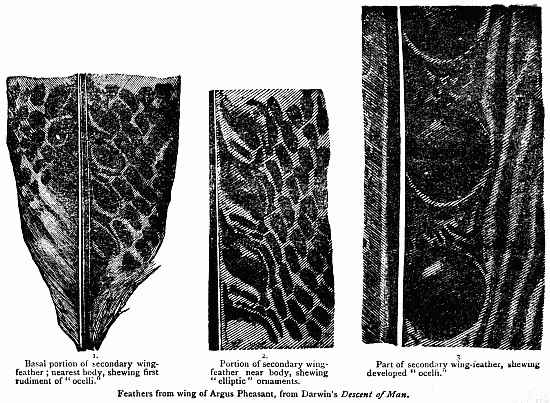
Nevertheless, Mr. Darwin proceeds to argue at considerable length that an explanation consistent with his theory is favoured by the occurrence on the same wings of designs exhibiting every stage of gradation from a mere spot to the finished ball-and-socket ocellus; in the same way as the tail feathers of a peacock advance from a mere sketch to the completed design. It is not easy, however, to understand in what way this is supposed to solve the difficulty and not vastly to increase it. That a finished artistic effect should be fortuitously produced at all would be incredible enough. That it should be worked up by Chance through a series of processes, each doing something towards its completion, is surely not less, but far more inconceivable.
In such a mode of explanation, however, is exemplified a feature which must not be forgotten in discussing Darwinism,—namely the fatal facility with which seeming arguments can be procured on its behalf. As Mr. Mivart well remarks:[203] "The Darwinian theory has the great advantage of only needing for its support the suggestion of some possible utility, actual or ancestral, in each case—no difficult task for an ingenious, patient, and accomplished thinker." And our North British Reviewer makes a similar comment: "The believer who is at liberty to invent any imaginary circumstances, will very generally be able to conceive some series of transmutations answering his wants."
Or if, as in the above instance of the Argus' eyes, a series is actually found, it is even less difficult to take for granted that it can have but one significance; while such assumptions are too frequently accepted without hesitation or demur, although it would be no easy task to show that they rest upon any solid grounds. When, in addition, either Mr. Darwin himself or some of his leading partisans has declared that some unverified process has undoubtedly occurred, or that they see no reason to doubt its occurrence, or that nothing which we know precludes its possibility,—it appears to be widely supposed that something substantial is thereby added to the scientific evidence, and that the suppositions thus sanctioned may even rank as facts. But however such a method may avail to secure acceptance for a doctrine, it does nothing for its scientific value. Such a style, as Mr. Mivart says,[204] is calculated to impress only minds too easily dominated, and not prepared by special studies accurately to weigh the evidence put before them.
Illustrations of this strange method of procedure are furnished in connexion with various points already mentioned. Thus, as we have seen, Mr. Darwin attempts to explain the origin of rational speech, by the conscious utterance of a significant sound by an unusually wise ape-like creature. In favour of this very large suggestion, Mr. Darwin has nothing more substantial to say[205] than that "it does not appear altogether incredible," which does not appear to take us very far.[206] Yet I have seen this described as an "idyllic scene" shedding an entirely new light on the subject. So again in regard of the evolution of the eye.[207] Having summarily enumerated the various stages of development exhibited by this organ as actually existing in various animals, Mr. Darwin goes on to say that when we remember how small the number of living forms must be in comparison with extinct, and the other gradations that may consequently have existed, "the difficulty ceases to be very great" in believing that Natural Selection has connected the most rudimentary with the perfect structure. Similarly, as to the cell-making instinct of the bee,[208] having postulated four several suppositions for which evidence is not forthcoming, he concludes: "By such modification of instincts ... I believe that the hive bee has acquired, through natural selection, her inimitable architectural powers."[209] Similar examples might be multiplied indefinitely.
Not unfrequently the tone of such utterances is more imperious. Thus, of the descent of Man from some animal ancestor Mr. Darwin pronounces[210] "The grounds upon which this conclusion rests will never be shaken," and again[211] "the possession of exalted mental powers is no insuperable objection to this conclusion" ... "It is only [p. 32] our natural prejudice which leads us to demur to this conclusion." He even goes so far as to declare that his view is forced upon every man who is not content to assume the mental attitude of a savage.[212]
Argumentation of this character, which he finds common with Darwin to other Evolutionists, is judged by de Quatrefages to be one of the weakest and most misleading features of their systems.
Personal conviction [he writes],[213] mere possibility, are offered as proofs, or at least as arguments in favour of the theory. Can we admit their validity? Obviously not. The human mind can conceive many things: is that a reason for accepting them all?... Obviously more serious proofs are needed. After all, save where a contradiction is involved, everything is possible.... If adopting, under the shadow of Oken's great name, his principle of the repetition of phenomena, a naturalist should maintain that each of the planets has its own Europe, its England, and its Darwin expounding to the Jovians and Saturnians the origin of species, I do not quite see how one would set about showing him that he was wrong. Unquestionably the thing is possible. Are we to draw the conclusion that it is a fact?
Again,[214] the same distinguished naturalist, having quoted Darwin's very elaborate explanation of a difficulty, remarks:
We see how with Darwin, as with his precursors, one hypothesis necessitates another. But can he, at least, by means of these subsidiary theories, these comparisons, these metaphors, account for all the facts? No, he himself honestly confesses more than once that he cannot. It is true that he adds "I am convinced that the objections have little weight, and the difficulties are not insoluble." But is this conviction of his a proof, or even an argument?
M. Blanchard likewise comments vigorously on this mode of argumentation. Speaking of the Mole and Darwin's explanation of its blindness, namely that having taken to living under-ground it lost its eyes through disuse—which he considers a most preposterous supposition,—M Blanchard continues:[215]
The realms of fancy are boundless; but the observer who is concerned with realities can only have recourse to the facts of science. Fossil remains discovered in very ancient strata show that the underground animal of present times does not differ from his geological counterpart. The Mole belongs to a very peculiar type, and has no nearer European relatives than the Hedgehog and the Shrew. Can we imagine a common ancestor of Shrews, Hedgehogs, and Moles? On this point Mr. Darwin expresses no opinion,—which should not be, for when confronted by forms clearly differentiated, he is wont to extricate himself from difficulties with matchless facility. The intermediate links, he will say, were doubtless less fitted to live than were the others, and so have disappeared. After that the Evolutionists consider any one quite out of date who does not consider himself entirely satisfied with so felicitous an explanation.
M. de Quatrefages denounces another fatal defect often observable in the method of proof.
Mr. Darwin frequently complains that our actual knowledge is incomplete. But instead of discovering in our lack of precise and extensive information a motive for caution, he appears to derive from it only greater daring. Doctrines based on the instability of species have often been combated by geologists and palæontologists. In reply to their objections Darwin devotes a whole chapter to shewing the imperfection of the geological record. "For my part," he concludes, "I look at the geological record as a history of the world imperfectly kept and written in a changing dialect; of this history we possess the last volume alone, relating only to two or three countries. Of this volume, only here and there a short chapter has been preserved; and of each page, only here and there a few lines. Each word of the slowly-changing language, more or less different in the successive chapters, may represent the forms of life, which are entombed in our consecutive formations, and which falsely appear to have been abruptly introduced. On this view, the difficulties above discussed are greatly diminished, or even disappear."
On my part [continues M. de Quatrefages] I will ask whether such a conclusion is the correct one. No doubt, Darwin is right in refusing to certain naturalists the right to dogmatize on the strength of uncompleted studies, or scanty and isolated observations. Is he therefore entitled to allege as proofs on his own behalf the very gaps of science, appealing to the lost volumes and leaves of Nature's chronicle? Clearly not. But the slightest reflection suffices to recognize that this appeal to the unknown, so frankly evidenced in the above passage, lies at the root of all argumentation analogous to that which I have tried to describe—that of Maillet, Lamarck, and Geoffroy,[216] as well as Darwin. Only the unknown, in sooth, can open the boundless region of speculation, where the possible replaces the actual, and where, despite the widest knowledge and the soundest intelligence, one comes as by a fatality to find a conclusive proof on one's own side, precisely in that of which we profess to know nothing.
So again, speaking of a certain conclusion of Professor Haeckel's concerning the embryology of lemurs, which MM. Grandidier and Alphonse Edwards afterwards proved experimentally to be altogether erroneous, de Quatrefages writes:[217]
Haeckel will perhaps answer that the publication of his book preceded the observation of the French savants. But such a plea itself discloses a method of procedure which is common to the majority of evolutionists, and of which, it must be added, Darwin set the example. When confronted by a question about which nobody knows anything, they appeal precisely to this want of knowledge, and draw arguments from their very ignorance.
In like manner speaks the Reviewer already cited more than once. Thus:[218]
The peculiarities of geographical distribution seem very difficult of explanation on any theory. Darwin calls in alternately winds, tides, birds, beasts, all animated nature, as the diffusers of species, and then a good many of the same agencies as impenetrable barriers.... With these facilities of hypothesis there seems to be no particular reason why many theories should not be true. However an animal may have been produced, it must have been produced somewhere, and it must either have spread very widely or not have spread, and Darwin can give good reasons for both results.
And again:[219]
We are asked to believe all these maybes happening on an enormous scale, in order that we may believe the final Darwinian "maybe" as to the origin of species. The general form of his argument is as follows:—"All these things may have been, therefore my theory is possible, and since my theory is a possible one, all those hypotheses which it requires are rendered probable." There is little direct evidence that any of these maybes actually have been.
In no respect, moreover, have Darwin's followers more closely imitated their master than in the construction of such hypotheses, which would appear to constitute in the eyes of many the most important work of Science. Attention has very largely been diverted from Nature as actually existing, which seems to be studied more for the light it can be supposed to throw upon evolutionary history, than simply for itself, and it seems to be thought that to imagine the mode of an evolutionary process is equivalent to establishing the facts which that process supposes. By this method lengthy and learned papers are written concerning the transformation of one species into another, which in reality do no more than describe in minute detail all the changes which must have taken place, if the said transformation really occurred. That Science is thus benefited, is not the opinion of some at least who are well entitled to speak on her behalf, for as the President of the Linnean Society recently observed,[220] as one grows older, it becomes more and more apparent that facts alone are of any serious interest, and that speculations however ingenious and attractive are best left to the constructive and destructive energies of the young. So too, a few years ago, the President of the Microscopical Society complained that interest in living creatures is largely supplanted by dead ones.[221]
We read much [he said] of the animal's organs: we see plates showing that its bristles have been counted, and its muscular fibres traced to the last thread; we have the structure of its tissues analyzed to their very elements; we have long discussions on its title to rank with this group or that; and sometimes even disquisitions on the probable form and habits of some extremely remote, but quite hypothetical, ancestor, who is made to degrade in this way, or to advance in that, or who is credited with one organ or deprived of another, just as the ever-varying necessities of a desperate hypothesis require....
There is another aspect of the question which must by no means be overlooked. It has to be assumed that Natural Selection, or the survival of the fittest in the struggle for existence, necessarily tends to the benefit of the race and moreover to its farther development on the upward grade, towards a more perfect and more specialized organization;—in Mr. Herbert Spencer's words, to progression from a relatively indefinite incoherent homogeneity, to a relatively definite, coherent heterogeneity. But here many questions occur.
In the first place, a consideration presents itself, which appears to furnish the most formidable of all difficulties in the way of Mr. Darwin's hypothesis. How can this struggle for existence be supposed to have any tendency to promote organic development to ever higher and more perfect types, in the orderly sequence which has in fact occurred? The "Survival of the fittest" means only the survival of the fittest to survive,—of such as can find means of living where others cannot. Unless it can be shown that increased complexity of organization necessarily brings with it such increased vitality, Natural Selection can do nothing for organic development. If the mere power of living be the only factor in the process, as on Mr. Darwin's showing it is, a man is only a more complicated and delicate machine for securing the same object which can equally well, or better, be attained by a mole, a cockroach, or a microbe. And who will say that, so far as this particular end is concerned, he is better equipped than creatures which all the resources of civilization are powerless to exterminate?
That practical advantage in the struggle for existence must necessarily accompany increased specialization of organs, and thus produce a "higher" organization, was a prime point of Mr. Darwin's argument, though at the same time he found himself compelled to encumber it with qualifications which go very far to neutralize its force; for he had to explain the obvious fact that so many creatures which represent the lowest and least specialized forms of life, have survived down to our own time. Thus he writes:[222]
The degree of differentiation and specialization of the parts in organic beings, when arrived at maturity, is the best standard, as yet suggested, of their degree of perfection or highness. As the specialization of parts is an advantage to each being, so natural selection will tend to render the organization of each being more specialized and perfect, and in this sense higher; not but that it may leave many creatures with simple and unimproved structures fitted for simple conditions of life, and in some cases will even degrade or simplify the organization, yet leaving such degraded beings better fitted for their new walks of life.
By this fundamental test of victory in the battle of life, as well as by the standard of the specialization of organs, modern forms ought, on the theory of Natural Selection, to stand higher than ancient forms. Is this the case? A large number of palæontologists would answer in the affirmative; and it seems that this answer must be admitted as true, though difficult of proof.
That is to say, Natural Selection is just as ready to degrade as to elevate a creature, according to the actual requirements of the circumstances in which it is placed, and how far progress has been the rule, rather than stability or retrogression, is a question for geological history to determine. This we shall have to consider in our next chapter.
It is likewise obvious that so far as the mere struggle for existence is concerned, a species each of whose individual members is but poorly furnished, may nevertheless flourish unimpaired on the mere strength of its fecundity. It is thus, says M. Blanchard,[223] that the lower forms of life continue to hold their own despite the enormous ravages to which they are subject. The herring, for example, affords food to all the fowls of the air and fish of the sea, over and above the myriads annually requisitioned by man. Yet its hosts show no sign of being exterminated or even reduced. Much the same is the case of the cod; but a tribe one individual of which has been known to produce nine million eggs does not require much in the way of coherent heterogeneity to ensure its survival.
Thus it appears that of itself Darwinism affords no explanation whatever of the regular progression of life forms from lower to higher, to which the records of Nature bear witness, and which is the one solid fact suggesting the idea of Evolution.
Such are some of the reasons which, on purely rational grounds, appear amply to justify those who decline to pledge their faith to Darwinism, in spite of the popularity it enjoys. But what is to be said of the phenomena cited as furnishing positive and unimpeachable evidence in its favour, which were mentioned above in our sketch of its main features?
First as to the rudimentary, fragmentary, or vestigial organs so common in Nature. These, it is said, being of no possible advantage to their possessors, and often a serious disadvantage, can be explained only by supposing that they were serviceable in the past to the ancestral race whence these possessors are derived, and have since been superseded by other modifications of structure, so as to dwindle away by disuse. This, no doubt, seems a very plausible explanation, but it does not follow that we ought immediately to adopt it as a certainty, instead of setting ourselves to examine how it accords with all the facts. Nothing is more dangerous and less scientific than to be in a hurry to conclude that everything is certain which seems to ourselves probable, especially if it suits a theory of our own. Unfortunately, this law is too frequently more honoured in the breach than the observance. In the present instance, Professor Haeckel himself furnishes an example. He is quite sure that the rudimentary structures can have but one significance, and that they are fatal to the idea of purpose in Nature, the object of his special aversion, and so he has proposed a new term, "Dysteleology," to embody this idea, of which he says,[224]
Dysteleology, or the theory of purposelessness [is] the name I have given to the science of rudimentary organs, of suppressed and degenerated, aimless and inactive, parts of the body; one of the most important and most interesting branches of comparative anatomy, which, when rightly estimated, is alone sufficient to refute the fundamental error of the teleological and dualistic conception of Nature, and to serve as the foundation of the mechanical and monistic conception of the universe.
It will be sufficient to quote Professor Huxley's remarks upon this passage, taken from the very laudatory review he wrote of the work in which it occurs.[225]
Professor Haeckel has invented a new and convenient name, "Dysteleology," for the study of the "purposelessnesses" which are observable in living organisms—such as the multitudinous cases of rudimentary and apparently useless structures. I confess, however, that it has often appeared to me that the facts of Dysteleology cut two ways. If we are to assume, as evolutionists in general do, that useless organs atrophy, such cases as the existence of lateral rudiments of toes in the foot of a horse place us in a dilemma. For, either these rudiments are of no use to the animal, in which case, considering that the horse has existed in its present form since the Pliocene epoch, they surely ought to have disappeared; or they are of some use to the animal, in which case they are of no use as arguments against Teleology. A similar, but stronger argument may be based upon the existence of teats, and even functional mammary glands in male mammals.... There can be little doubt that the mammary gland was as apparently useless in the remotest male mammalian ancestor of man as in living men, and yet it has not disappeared. Is it then still profitable to the male organism to retain it? Possibly; but in that case its dysteleological value is gone.
In later editions Professor Huxley further observed: "The recent discovery of the important part played by the Thyroid gland should be a warning to all speculators about useless organs."[226]
It seems, therefore, the wiser part to refrain from basing any vital conclusions upon these organs until we can assure ourselves that our knowledge warrants our so doing. As the same Professor Huxley intimated, it might be well for palæontologists, and doubtless for biologists likewise,[227] "To learn a little more carefully that scientific 'ars artium,' the art of saying 'I don't know.'"
So again as to the phenomena of embryology. No doubt they are very striking and impressive. That the most highly developed creatures, and man himself, should in the first stages of existence exhibit the characteristics of lower forms, is an exemplification of development no less signal than the succession of ascending types witnessed to by the rocks. It is not easy to see, however, why it should be taken for granted that this can only signify genetic descent from all such forms, and that these embryo animals are engaged in climbing up their genealogical trees. Yet this is usually assumed as a matter of course, and any one who ventures to question the validity of such an inference, must be prepared to find himself accused of dogmatizing.
And yet, after all, upon what grounds does the assumption rest? That such a recapitulation of racial experiences forms no essential feature of Evolution is sufficiently evident from the case of the vegetable world,—for plants do not climb their genealogical trees, or pass in the seed through a series of botanical phases. And as to animals, since through all varieties of form, each always arrives at the required term, it is obvious that, apart from any archaic associations, and on Darwinian principles themselves, these forms must be the best for the purpose at each respective stage,—perhaps the only ones by which the term could be reached. It is therefore, to say the least, quite conceivable, that we have here the whole explanation and need go no further.
In certain instances this obvious consideration is strikingly illustrated. Thus the salamander, an Amphibian of the newt family, brings forth its young in adult condition without gills.[228] But previously to birth they have gills relatively large. The experiment having been tried of bringing some of them forth by artificial means before their time, and placing them in water, the first thing they did was to cast off these big gills, which were speedily replaced by new ones of much smaller size, and evidently better suited for the work required, as they lasted as long as a fortnight.
Here, in the first place, it is quite impossible to suppose that the large gills would continue to appear unless they were of advantage during the period of gestation. It is equally evident that it is not from a previous aquatic condition that they are inherited, for in such a condition they are useless. Finally, as Mr. Mivart observes, the new gills, suitable for unwonted conditions, were developed "not in a struggle for existence against rivals, but directly and spontaneously from the innate nature of the animal."
This view of the matter commended itself on mature consideration to so ardent an evolutionist as Carl Vogt, with whom we may couple M. de Quatrefages, who cites his words with approval as follows:[229]
It has been laid down as a fundamental law of biogenesis that ontogeny (the development of the individual) and phylogeny (that of the race) must exactly correspond.... This law which I long held as well founded is absolutely and radically false. Attentive study of embryology shows us, in fact, that embryos have their own conditions suitable to themselves, very different from those of adults.
"In a word," M. de Quatrefages continues, "the learned Genevan professor rightly considers that, 'The ontogenesis of all organic beings without exception, is the normal result of all the various influences which operate upon such beings.'"
But it must, moreover, be noted that the story which embryology can be made to tell is by no means so plain as we might easily be led to suppose.
Thus, although snakes are held to be descended from lizards, and some of them have rudimentary legs even in the adult stage, others have no trace of limbs even in the egg, while they have vestiges of gills, and thus would seem to be visibly linked to ancient water-dwelling ancestors, and not to far more recent land-dwellers. Again;[230] Amphibians (frogs, newts and the like) agree in some respects, as to the development of the germ, with mammals, differing in the same respects from reptiles and birds. But reptiles and birds are supposed to be a more recent development than Amphibia, and therefore should intervene between them and mammals on the genealogical tree. Moreover the eggs of one group of Amphibians are found to exhibit some remarkable resemblances to those of reptiles and birds, from which it would thus appear to have derived them, although on other grounds it is declared to be of an older stock than theirs. Most frogs, toads, and newts come out of the egg as tadpoles, furnished with gills and so breathing in water. This should signify that these creatures are descended from fish or fishlike ancestors. But one frog (Rana opisthodon) is never a tadpole even in the egg, from which he gets out by means of a special opener on his snout which he has somehow acquired. On the other hand certain newts[231] breed as tadpoles instead of in their mature form, which looks like an attempt to climb down the tree instead of up.
It will be remembered that the latter phrase was that used by Professor Milnes Marshall. Yet even he expressed himself strongly concerning the exaggerations of Professor Haeckel on this subject. In his review of Haeckel's Anthropogenie,[232] after observing that many descriptions of human embryology have been based on observations of dogs, pigs, rabbits, or even chickens and dogfish, he thus continued regarding the book before him:
A student who relied on Professor Haeckel's description, would obtain an entirely erroneous idea of the development of the human embryo.... It is a matter for great regret that a book of 900 pages, bearing such a title, should be allowed to appear, in which the account of the actual development of the human embryo is so inadequate or even erroneous.
Far more fundamental, however, is a remark of Mr. Mivart's, that if, as Darwinians say, the development of the individual is an epitome of that of the species, the latter must like the former be due to the action of definite innate laws unconsciously carrying out definite preordained ends and purposes. For although cells or embryos may be indistinguishable from one another, and may appear to us identical in constitution, their differences are absolute. Each is determined to be one sort of animal and no other, and can live at all only on condition of developing towards the prescribed form.—Therefore, whatever evidence the embryonic forms may be supposed to afford in support of Evolution, they have nothing in common with the haphazard process of Natural Selection.
And here again Professor Huxley found himself obliged to enter his caveat, and to intimate his opinion that some of his friends were inclined to build too confidently upon this foundation. As his biographer Professor Weldon writes in the Dictionary of National Biography:
Darwin had suggested an interpretation of the facts of embryology which led to the hope that a fuller knowledge of development might reveal the history of all the great groups of animals at least in its main outlines. This hope was of service as a stimulus to research, but the attempt to interpret the phenomena observed led to speculations which were often fanciful and always incapable of verification. Huxley was keenly sensible of the danger attending the use of a hypothetical explanation, leading to conclusions which cannot be experimentally tested, and he carefully avoided it.... In the preface to the Manual of the Comparative Anatomy of Invertebrated Animals, he says: "I have abstained from discussing questions of ætiology,[233] not because I underestimate their importance, or am insensible to the interest of the great problem of Evolution, but because, to my mind, the growing tendency to mix up ætiological speculations with morphological generalizations will, if unchecked, throw Biology into confusion."
Accordingly, Huxley himself based his faith in Evolution on palæontological evidence, and attempted to decide the precise course it had followed only "in the few cases where the evidence seemed to him sufficiently complete." This line of enquiry we have still to pursue, but meanwhile, it is evident that the phenomena we have been considering, failing to meet the approval of so thorough-going an Evolutionist as he undoubtedly was, cannot be said to furnish convincing scientific evidence in favour of Darwinism.
It will be asked how it comes to pass, if the Darwinian system really lies open to so many objections, that it occupies so large a place in scientific estimation. To this we must reply that, in spite of its great name, its success has throughout been popular rather than truly scientific, and that as time went on it has lost ground among the class of men best qualified to judge. Evolutionists there are in plenty,—but very few genuine Darwinists, and amongst these can by no means be reckoned all who adopt the title, for not a few of them—as Romanes and Weismann—profess doctrines which cannot be reconciled with those of Darwin himself. Meanwhile, an increasing volume of scientific opinion sets definitely against Darwinism as an adequate explanation of the philosophy of life, and falls into the view expressed long ago by Charles Robin[234] who, as a freethinker, had no antecedent objections against it, "Darwinism is a fiction, a poetical accumulation of probabilities without proof, and of attractive explanations without demonstration."
It would be tedious to cite testimonies at length, but, in addition to M. de Quatrefages who has made a full and careful study of the whole question, [Charles Darwin et ses précurseurs Français, and Les Emules de Darwin] may be mentioned such continental scholars as Blanchard [La vie des êtres animés], Wigand [Der Darwinismus und die Naturforschung, etc.], Wolff [Beiträge zur Kritik der darwinschen Lehre], Hamann [Entwicklungslehre und Darwinismus], Pauly [Wahres und Falsches an Darwins Lehre], Driesch [Biologisches Zentralblatt, 1896 and 1902], Plate [Bedeutung und Tragweite des Darwinschen Selektionsprincip], Hertwig [Address to Naturalist Congress, Aachen, 1900], Heer [Urwelt der Schweiz], Kölliker [Ueber die darwin'sche Schöpfungstheorie], Eimer [Entstehung der Arten], Von Hartmann [Wahrheit und Irrthum im Darwinismus], Schilde [Antidarwinistisches im Ausland], Du Bois-Reymond [Conference, August 2, 1881, etc.], Virchow [Freiheit der Wissenschaft, etc.], Nägeli [Mechanisch-physiologische Theorie der Abstammungslehre], Schaafhausen [Ueber die anthropologischen Fragen], Fechner [Ideen zur Schöpfungs-und Entwicklungsgeschichte der Organismen], Jakob [Der Mensch, etc.], Diebolder [Darwins Grundprinzip, etc.], Huber [Die Lehre Darwins kritisch betrachtet], Joseph Ranke, and Von Bauer,—all of whom either reject Darwinism altogether, or admit it only with fatal reservations.
Special weight must attach to the adverse verdict of M. Fabre, styled by Darwin himself "that inimitable observer," who declares that he cannot reconcile the theory with the facts he encounters.[235]
It must be sufficient to quote one or two of our own countrymen, whose utterances will enable us to form an opinion as to the true scientific status of the doctrine.
We may begin with Huxley, the great popular champion of Darwinism, who did more than any other man to spread the new doctrine. Yet, strange to say, he seems never to have really accepted its fundamental tenet himself, always appearing very shy of Natural Selection, and carefully abstaining from committing himself to any responsibility for it. Thus in his treatise on Man's Place in Nature, he thus explains his position in its regard:
Mr. Darwin's hypothesis is not, so far as I am aware, inconsistent with any biological fact; on the contrary, if admitted, the facts of Development, of Comparative Anatomy, of Geographical Distribution, and of Palæontology, become connected together, and exhibit a meaning such as they never possessed before; and I, for one, am firmly convinced, that if not precisely true, that hypothesis is as near an approximation to the truth as, for example, the Copernican hypothesis was to the true theory of the planetary motions. But for all this, our acceptance of the Darwinian hypothesis must be provisional so long as one link in the chain of evidence is wanting; and so long as all the animals and plants certainly produced by selective breeding from a common stock are fertile with one another, the link will be wanting. For, so long, selective breeding will not be proved to be competent to do all that is required of it to produce natural species.
This missing link, like various others, has never been supplied, and in consequence Professor Huxley never abandoned his attitude of reserve. On the contrary, when, in 1880, he delivered an address to celebrate "the Coming of Age of the Origin of Species" he discharged the task without once mentioning Natural Selection, which is to that work as the Prince of Denmark is to Hamlet.
But there is one passage in the said address, which deserves to be specially remembered:
History warns us that it is the customary fate of new truths to begin as heresies and to end as superstitions; and, as matters now stand, it is hardly rash to anticipate that, in another twenty years, the new generation, educated under the influences of the present day, will be in danger of accepting the main doctrines of the Origin of Species, with as little reflection, and it may be with as little justification, as so many of our contemporaries, twenty years ago, rejected them.
In 1886, Professor Romanes pronounced as follows:[236]
"At present it would be impossible to find any working naturalist who supposes that survival of the fittest is competent to explain all the phenomena of species-formation."
As to the actual position now occupied in Scientific opinion by Mr. Darwin's hypotheses, we may content ourselves with the declaration of Professor S. H. Vines in his Presidential address to the Linnean Society, May 24, 1902.
1. It is established that Natural Selection, though it may have perpetuated species, cannot have originated any.
2. It is still a mystery why Evolution should tend from the lower to the higher, from simple to complex organisms.
3. The facts seem to admit of no other interpretation than that variation is not [as Darwin supposed] indeterminate, but that there is in living matter an inherent determination in favour of variation in the higher direction.
That is to say, Darwin's Origin of Species does not explain the Origin of Species; and as to the laws which govern Evolution we can be sure only that they are not those which he assigned.
In like manner, Sir Oliver Lodge pronounces:[237]
Take the origin of species by the persistence of favourable variations; how is the appearance of these same favourable variations accounted for? Except by artificial selection not at all. Given their appearance, their development by struggle and inheritance and survival can be explained; but that they arose spontaneously, by random changes without purpose, is an assertion which cannot be made.
We are thus in a position to form our own judgment as to the claim made on behalf of Mr. Darwin, with which we started this chapter—namely, that he has eliminated all mystery from the organic world by the discovery of natural mechanical laws by which all its operations are governed. It is, indeed, difficult to understand how Darwinists themselves can suppose their system to make any such claim, for, as M. Paul Vignon truly observes,[238] "La science darwinnienne s'imaginait avoir triomphé du Sphinx, alors qu'elle avait simplement décomposé le problème dans une monnaie d'énigmes moins rébarbatives en apparence." As has been said, it is far more on account of the vast consequences professedly based upon it, as a sure foundation stone, than for its own sake, that it has seemed advisable to devote so much attention to the study of Darwinism, quite apart from which the whole question of organic Evolution still demands consideration.
It seems far more just to conclude with M. Fabre:[239]
Let us acknowledge that in truth we know nothing about anything, so far as ultimate truths are concerned. Scientifically considered nature is a riddle to which human curiosity can find no answer. Hypothesis follows hypothesis, the ruins of theories are piled one on another, but truth ever escapes us. To learn how to remain in ignorance may well be the final lesson of wisdom.[240]
XVI
THE FACTS OF EVOLUTION
LEAVING the field of speculation and "ætiology," we have now to enquire, not to what causes organic Evolution may be attributable, but how far it can be shewn to have actually occurred. This can be learnt only from the history of life upon earth as disclosed by the evidence of palæontology, or the geological record, and we are thus brought to the investigation of that evidence, by which alone, as Professor Huxley agrees, can the truth about Evolution be scientifically or satisfactorily established. In his address recently mentioned on occasion of the twenty-first birthday of the Origin of Species, having spoken of various advances of our knowledge, as in comparative anatomy and embryology, which had helped to win acceptance for transformist doctrines, he thus continued:
But all this remains mere secondary evidence. It may remove dissent, but it does not compel assent. Primary and direct evidence in favour of evolution can be furnished only by palæontology. The geological record, so soon as it approaches completeness, must, when properly questioned, yield either an affirmative or a negative answer; if evolution has taken place, there will its mark be left; if it has not taken place, there will be its refutation.
This is common sense. Evolution can claim to be a scientific truth, only so far as clear evidence is forthcoming that Evolution there has been. If the geological record be sufficiently complete to prove or disprove its claims, the question is settled for ever. If, on the other hand, the record be not complete enough for a conclusive verdict, it is, at least, hard to understand the grounds of such a statement as that the doctrine of Evolution has long since passed beyond the stage of discussion among scientific thinkers;[241] or that of Professor Marsh, that to doubt Evolution is to doubt Science; or of Professor Huxley himself[242]—"So far as the animal world is concerned, Evolution is no longer a speculation, but a matter of historical fact."
This historical enquiry is accordingly all-important, and it is one which should be easy to undertake without any prepossessions, for it is hard to see upon what à priori grounds these could rest. That there has been Evolution in one sense of the term is obvious,—that is to say, development of organic types from lower to higher forms, from the sea-weed or fungus to the oak or the rose, from the star-fish or the coral-insect, to the eagle or to man. The question is, not whether there has been such a progressive succession of forms, but whether one form has proceeded from another genetically, being produced in the same manner as individuals of a species now are. That this has been the case, as Professor Huxley tells us in the same address, is the cornerstone of evolutionary teaching. He appears indeed to restrict Evolution within the limits of classes and groups, but such restriction is so contrary to all his principles that the words which seem to imply it can scarcely be taken as having any definite significance. Should the appearance of different classes and groups require to be severally accounted for, we should be landed back in the system of separate creations against which he is never tired of inveighing.
The fundamental doctrine of all forms of the theory of evolution applied to biology [he says] is that the innumerable species, genera, and families of organic beings with which the world is peopled have all descended, each within its own class or group, from common parents, and have all been modified in the course of descent.
And, holding as he does that palæontology furnishes the necessary evidence, he thus continues:
And, in the view of the facts of geology, it follows that all living animals and plants are the lineal descendants of those which lived long before the Silurian epoch.
Here is a plain issue, and one, as has been said, to be discussed without prejudice. That the innumerable forms of organic life should thus have been genetically derived one from another, is no more difficult to conceive than that they should have come into existence at all. Moreover, it appears to our minds almost a first principle that natural law must suffice to account for the phenomena of nature from beginning to end, and that any system is self-condemned which finds anywhere in these phenomena evidence of a non-natural, or supernatural, interposition. Has not such a theologian as Suarez, following St. Augustine, laid it down as an axiom[243] that God does not directly interfere with the operations of Nature, when He can effect His purposes through natural causes? Undoubtedly, too, it is difficult for our minds to imagine in what way, except through genetic evolution, the successive production of more and more developed types could be effected.
But, as has before been observed, what seems to us probable is not therefore proved to be true. What we want are facts, and by facts we must be ready to abide. At the same time, it is not very easy to understand the supreme importance which evolutionists generally appear to attach to the descent of all living creatures from some one original, and their abhorrence of the idea that the power, whatever it was, which first produced life, may have operated repeatedly, at different epochs, to repeat the production. It seems to be assumed that this must imply "miracle" and interruption of the continuity of Nature, to admit which is irrational and unscientific. But since life did unquestionably once originate somehow, which Science makes no attempt to deny, why should it be so improper to suppose that it originated more than once, at various times and in various forms, and that, consequently, genetic descent with modification, or "Evolution," is not the explanation of typic development? As Sir J. W. Dawson writes[244] concerning the oyster tribe, whereof two species are found in the Coal Measures (one European and the other American), and a continuous succession of species ever since:
All these species may have proceeded from one origin, by descent with modification, or, on the other hand, the same causes which led to their origination in the Carboniferous may have operated again and again.
It must, however, be remembered that, if the theory of genetic descent with accumulation of minute modifications be the true explanation of the production of new forms, it necessarily follows, that could a complete record be forthcoming of the ancestry of any actual species, there would be found in that pedigree no distinction of species or genera, for no sharply marked lines of limitation would be discoverable. It would be like the case of a man who had been photographed every hour of his life from birth to old age;—immense though the difference might be between the two extremes, the gradations of change would at all points pass as imperceptibly into one another as do the phases of the moon. This consideration is both fundamental and obvious, yet it would seem to be almost universally ignored. It appears to be thought that, in order to demonstrate the fact of evolution, all that is needed is to find a form here and there, in some sense intermediate between others,—like the reptilian birds already mentioned. This would imply that the course of Evolution must be like that of an army, making long marches from point to point, and traceable only by the remains of its camp-fires: whereas it should be as that of a glacier continuously creeping on, and leaving its tracks at one point as much as another. What are wanted, therefore, as evidence for Evolution, are not isolated specific forms uniting some characteristics of those which they are supposed to connect,—as Nelson's men-of-war form a stepping-stone between the vessels of the Norsemen and the ironclads of the present day,—but a series sufficient to show, or at least to indicate, that all changes have been gradual and insensible, without the introduction at any point of a new element. To pursue the illustration, such a new element would be gunpowder or steam in the evolution of the battle-ship, for by no mere development could bows or javelins produce a cannon, or sailing ships a steamboat.
Therefore, in proportion as the geological record approaches completeness, its testimony,—if it is to be in favour of Evolution—must tend more and more in this direction, and unless, in some instance at least, clear evidence be discoverable of the melting of one form into another, it cannot possibly be said that we have sufficient proof that such a process ever occurred. Mere graduated resemblance of isolated forms does not necessarily imply such transmutation, as we see for example in the methodical progression of shape, exhibited by various crystals, and even more remarkably in the affinities which we can recognize among what we know as elementary substances.
There is another important point to be borne in mind. According to the teaching of Evolutionists such as Darwin or Haeckel,[245] every Species has originated from a single ancestor,—or, as they should rather say, from a single pair.
If this were so, it would necessarily follow that every new form, originating in some particular spot of earth, would very gradually spread thence to other regions, fighting its way along. As Mr. Darwin acknowledges,[246] "The development by this means (i.e. Natural Selection) of a group of forms, all of which are descended from some one progenitor, must have been an extremely slow process; and the progenitors must have lived long before their modified descendants."
Of this gradual spread of new types there should, at least in some cases, be some palæontological evidence.
It is likewise by no means easy to understand how species thus generated could stand solitary and isolated from kindred forms in the records of the earth. The pair of individuals which started a new persistent group,—its members all stamped with the same specific characters, while all around were in a state of flux and divergence,—differed from their immediate ancestors, as we have seen, only infinitesimally. They can have differed no more from many of their contemporaries, for all the lines of descent must ramify afresh in each generation, and so form a web rather than anything like a line. It is not very easy to understand how a pair here and there struck root and founded a species, while the thousands which jostled them round about failed to do so, for the others which survived longest must be supposed to have resembled them most nearly, and therefore to have participated in their advantages. At least, we should expect to find around them the débris of the multitude they vanquished in the struggle for existence.
We are told, moreover, that, with hardly an exception, the organic forms found in a fossil state must be supposed to be the last of their special line of development, which terminated in them; so that neither can they be claimed as the direct ancestors of any other forms, fossil or living, nor can any others which are actually known be claimed as their progenitors. The genealogies supplied for almost all known species, extinct or existing, are admittedly conjectural, and as in the most famous instance of all, namely the supposed common ancestor of simians and men, the links are persistently "missing." Thus M. de Quatrefages, speaking of the human pedigree as set forth by Professor Haeckel, writes thus:[247]
All species, existing or extinct, are said to have been preceded by ancestral forms which have disappeared without leaving the slightest vestige behind them. The amphioxus itself, which more than any other realizes the type of the group it represents, was preceded, according to Haeckel, by the provertebrate, which no man has ever seen, but of which, nevertheless, the Jena professor gives us a figure, and describes the anatomy.
Thus the number of forms postulated by the theory of genetic Evolution, must have been enormous beyond conception, in comparison with those belonging to the numerically insignificant groups which formed the mere extremities of branches on the genealogical tree.
This being premised, we must ask what Geology has to tell us on the subject, and it will be well to begin by briefly recalling the main features of the geological record.
The stratified rocks comprising the crust of the earth, in which fossil plants and animals are found embedded, have evidently been formed at successive periods, chiefly by the agency of water, each formation having begun as a sediment like the mud or ooze at the bottom of our oceans and seas. Geological investigation has proved that the chronological order of the strata thus deposited can be satisfactorily determined, and they are found to divide themselves, in respect of the organisms they contain, into three great series, lying above the Azoic (or lifeless) rocks, older than them all.
These series, beginning from the bottom, in which order we shall have to trace their history, are most conveniently named Primary, Secondary, and Tertiary, otherwise termed respectively, Palœozoic ("ancient life"), Mesozoic ("middle life"), and Kainozoic ("recent life"). Each of these again, contains various formations, or as we may call them volumes of its chronicle, each of which has its fixed place in order of sequence.
Thus, always proceeding from below upwards, in the Primary series, commencing with the Laurentian, we find successively the Huronian, Cambrian, Silurian, Devonian or Old Red Sandstone, Carboniferous, and Permian.
In the Secondary, the lowest formation is the Triassic or New Red Sandstone, followed by the Jurassic or Oolite, and the Cretaceous or Chalk.
Finally the Tertiary has three main divisions; the Eocene, or "dawn of the recent," Miocene, or "less recent," and Pliocene, or "more recent."
Above these comes the series now in progress, variously called, Quaternary, Post-Tertiary, and Pleistocene, or "most recent."
It seems advisable to begin our investigation with the vegetable kingdom, as its classification being comparatively simple, the essential points of its development are easily followed. We cannot do better than start with the summary of its main divisions furnished by Mr. Carruthers.[248]
The vegetable kingdom is divided into sections, according to the simplicity or complexity of structure. Associated with plants of simple structure we find, as a rule, more elementary organs of reproduction. Linnaeus made two great divisions, of flowering (Phanerogams) and flowerless plants (Cryptogams).... The higher group have flowers, with their stamens and pistils, which produce seeds, while the lower group are without flowers and bear spores, which are much simpler bodies than seeds. There are seven main groups of spore-bearers—the algæ or water-weeds; the fungi or mushroom family; the lichens, which cover old walls and rocks with patches of coloured vegetation; the mosses with their green leaves and urn-shaped fruit; the ferns with their large and usually much-divided leaves, on the back or edges of which the spores are borne; the horsetails, found in wet places, having jointed hollow stems and spores produced in little cones; and the club-mosses, upright or creeping leafy plants found on our mountains. These seven groups may be arranged in two divisions, according to the tissues of which they are formed. In the first four the whole plant is composed of cells, while in the last three a firm vascular skeleton is present. These characters are of great importance to the student of fossil plants.... The flowering plants are more complex in their structure, and in their organs of reproduction. The lowest group of these plants is the Gymnosperms, or naked-seeded plants, like our yews and pines. The other flowering plants (Angiosperms) have their seeds in a closed fruit. These are divided into two sections from characters derived from the embryo plant in the seed, depending on whether this minute plant has one seed-leaf (cotyledon) or two, and so we have Monocotyledons and Dicotyledons. The higher group, or dicotyledons, have been arranged into three divisions, according to the complexity of the flower. In one large group (Apetalae) the pistil and stamens are not surrounded by petals, e.g. in the oak and the stinging nettle: superior to them are the plants (Monopetalae) in which the petals form a cup, as the blue-bell[249] and the gentian, while the highest group (Polypetalae) have all the petals separate, as the buttercups and roses.[250]
It is most important to recollect that on evolutionary principles the first representatives of any such classes—and the same holds of animals as well—must have been generalized forms, representing the type in the rough, or, in Mr. Herbert Spencer's phrase, exhibiting by comparison with their successors indefinite incoherent homogeneity, as contrasted with definite coherent heterogeneity. They should bear the same sort of relation to the finished articles worked up by Evolution as did the first bone-shaker bicycle to our latest patterns, or the news-sheets of Cromwell's time to the Times or Graphic of to-day. On this, as we saw in the last chapter, Mr. Darwin strongly insists, confessing at the same time that the Geological record alone can establish such progress as a fact.