AN OHIO STATION FOR AMPELOPSIS CORDATA. W. A. Kellerman. (Plate 1.)
Reading edition
AN OHIO STATION FOR AMPELOPSIS CORDATA. W. A. Kellerman. (Plate 1.)
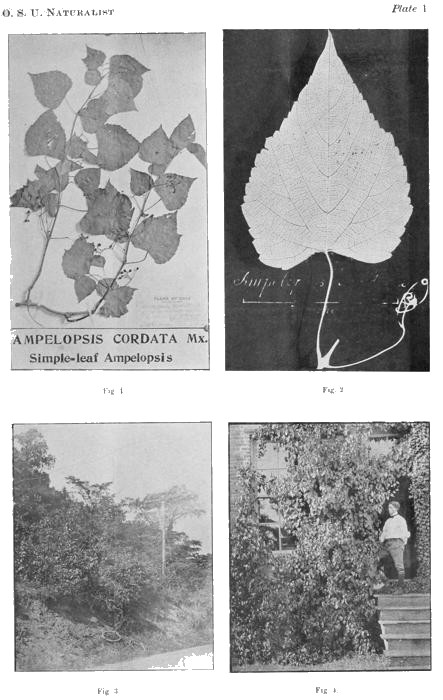
While collecting in Scioto County on the 8th of July, 1900, I was fortunate enough to come across an indigenous specimen of Ampelopsis cordata. [1]The station for the plant is on a hillside one mile east of Portsmouth, Ohio. The character of the environment is indicated in figure 3, Plate 1; the plant in question growing on the bank by the roadside at a point immediately above the bicycle in the central part of the picture. The photograph from which the half tone was made shows only a portion of the high hills that border the Ohio river. The soil is clay and not regarded as very fertile. It is generally the case perhaps that this species grows in “swamps and along river banks,” as stated in the manuals, but the ground here is high and dry.
The published statements as to the distribution of Ampelopsis cordata are not uniform. Riddell, in his synopsis of the Western Flora, says it occurs in the Alleghany Mountains west to Arkansas. Torrey and Gray, in the Flora of North America, Vol. 1, under the name of Vitis indivisa, give its distribution as Southern States west to Louisiana and Arkansas. Wood using the same name in his class-book, says Southern States to St. Louis. In Gray’s Manual, last edition, the plant is given under the name of Cissus ampelopsis with the statement that it occurs in Virginia to Illinois and Southward. The occurrence as noted by Britton and Brown in the Illustrated Flora, makes the species still more decidedly southern, namely, southern Virginia to Florida, west to Illinois, Kansas and Texas. Prof. Stanley Coulter, in a Catalogue of the Flowering Plants and Ferns indigenous to Indiana, published in 1899 in the 24th Annual Report of the Department of Geology and Natural Resources of Indiana, says this species occurs “in the central and southern counties of Indiana in swamps and moist woods.”
In the fifth edition of Gray’s Manual the range of this Ampelopsis (under the name of Vitis indivisa) was given as “West Virginia, Ohio and southward.” In answer to an inquiry as to what in the Gray Herbarium was perhaps the basis for the reference to the Ohio distribution, Mr. Merritt L. Fernald kindly wrote me as follows:—“I find in the herbarium a specimen of Cissus ampelopsis marked ‘Ohio’. It is one of the old Torrey and Gray specimens and no further data are given.”
Dr. Millspaugh lists this species as Cissus ampelopsis in the Flora of West Virginia and adds on the authority of Mertz and Guttenberg that it also occurs in Ohio, near Wheeling. Upon inquiry of Supt. Mertz, I learn that his notes of work upwards of twenty years ago contain no mention of this species at Wheeling, West Virginia, or at Bellaire, Ohio. He further informs me that what was taken for this Ampelopsis at Bellaire was probably Vitis cordifolia, three forms of which were found growing on the islands of the Ohio River near Wheeling. Of these he adds in a letter to the writer, “I think we probably decided that one was V. indivisa; but I feel sure that it was not and you are probably the first to find it in Ohio.”
It will be observed that the distribution as noted by Professor Stanley Coulter extends its range still further northward than my Ohio station. It is likely that its occurrence still further northward in Ohio may be detected by assiduous collectors.
I wish to say a word concerning the ornamental character of this native vine. The foliage is bright green and very handsome. A figure of a single leaf is shown in Plate 1, figure 2. This is reduced from a photograph taken with the leaf itself used as a negative. I have never detected a fungous attack or insect depredation on the leaves. The small dull-colored bluish fruits in loose panicles when abundant are somewhat ornamental. The vine is a vigorous grower and clings firmly to supports. Figure 4 shows a plant used for ornamental purposes growing on the south side of the Botanical Building at the Ohio State University. A figure from a still more vigorous specimen was shown by Mrs. Kellerman in Vick’s Magazine, January, 1900. This was made from a photograph of a specimen growing at the north porch of a residence in Columbus, Ohio. The same has been reproduced by Dr. Halsted in Bulletin No. 144 of the New Jersey Experiment Station. The species can be transplanted readily. One of the plants just referred to was dug up in June in Linn County, Kansas, and easily survived its rough treatment. Roots were taken from the Portsmouth plant in July this year and they are now growing and producing stems. We have repeatedly transplanted specimens that were grown from roots and from cuttings in the green house and always with success.
A word as to the synonymy should perhaps be given. The species was described by Michaux in 1803 under the name of Ampelopsis cordata. Persoon in 1805 proposed the name Cissus ampelopsis for the species. It was unfortunate that he did not retain the specific name, cordata; for there seems to have been no need of discarding that part of its name even if the genus had been originally misapprehended. Had he followed the most commendable usage of the modern systematists, he would have published the name in this form: Cissus cordata (Mx.) Pers. In 1811 Wildenow published the name as Vitis indivisa and here as before unnecessarily a new specific name was given. Many authors have regarded the plant as a Vitis rather than an Ampelopsis or a Cissus. We rely, however, on Dr. Britton’s authority and use the name Ampelopsis cordata, relegating the other names to synonymy.
KELLERMAN ON AMPELOPSIS CORDATA
Explanation of Plate 1.—Ampelopsis cordata. Figure 1: A herbarium specimen of twigs in fruit, from a photograph. Figure 2: A single leaf and tendril after a photograph direct from the same, reduced by the engraver. Figure 3: View of the station for the indigenous specimen at Portsmouth, Ohio; the Ampelopsis is in the center of the picture immediately above the bicycle. Figure 4: View of a plant growing on the south wall of the Botanical Building, Ohio State University; to the right of the door a portion of a Japan Ivy is seen.