A FOLIICOLOUS FORM OF SORGHUM SMUT AND NOTES ON INFECTION EXPERIMENTS. W. A. Kellerman. (Plate 2.)
Reading edition
A FOLIICOLOUS FORM OF SORGHUM SMUT AND NOTES ON INFECTION EXPERIMENTS. W. A. Kellerman. (Plate 2.)
On January 1st, 1900, several pots in the Botanical greenhouse of the Ohio State University were planted to sorghum, Kaffir corn, maize, sweet-corn and pop-corn. The seeds were previously moistened and mixed with a large quantity of head-smut of sorghum taken from smutted sorghum plants also from maize infected with the same fungus. This species was named Ustilago reiliana by Kühn in 1868 from specimens collected in Egypt.
The plants developed rapidly and normally, though the stems were slender and did not reach the normal height. The panicles appeared early and only in a comparatively few cases showed infection.
In one case an anomalous specimen appeared, namely, a sweet corn plant with the upper leaves as well as the panicle infected. This form therefore differs from the type in being in part foliicolous and may be designated as Ustilago (Cintractia[2]) reiliana forma foliicola nov. for. Figures 1 and 2, Plate 2, show the appearance of the infected plant, the one representing an earlier and the other a later stage of the emergence of the smut mass.
It may be remarked further that I have repeatedly tried seed inoculation experiments, mostly in the greenhouse but also occasionally in the field.
In the latter case in the summer of 1900, I obtained from a plot of many hundred stalks including field-corn, sweet-corn, pop-corn, sorghum, Kaffir corn and broom corn only three cases of smutted plants. These were of sweet-corn, both the tassel and ear being affected. The previous year about the same per cent. of successful inoculations were obtained. But in the greenhouse the experiments have uniformly resulted in the production of a considerable number of smutted stalks of sorghum and occasionally an infected plant of maize. These have for the most part been reported in print, the first account appearing in Bulletin No. 23, Kansas Experiment Station, in the year 1891.
I have now growing in the botanical greenhouse three sets of sorghum plants raised from seeds planted January 1, 1898, January 1, 1899, and January 1, 1900. Only the plants have been retained which showed successful inoculation experiments. They have been shifted to larger pots from time to time, but the plants make only a stunted growth. The new stalks that appear now and then are invariably affected, though sometimes one of the panicles, either the one terminating the main stem or one of the side branches may be free from visible smut. It is thus evident that this species of smut is perennial where its host lives from year to year. Figure 3 shows a photograph of one of the plants started in the greenhouse in 1899, its first stem producing an infected panicle. Figure 4 shows a plant grown in 1900, the first or central panicle not exhibiting the smut, but later when panicles from the side branches appeared, they were seen to be smutted.
It seems that another experimenter, whom I will quote, has succeeded scarcely as well. Mr. G. P. Clinton, the assistant Botanist of the Illinois Experiment Station, Urbana, Illinois, in Bulletin No. 57 (March, 1900) reports as follows: “Apparently from the experiments of Kellerman, infection takes place through the germinating seed, though the per cent. of infection he produced was rather small. In ’98 field experiments were conducted here with a view of infecting the Orange variety of sorghum with this smut. In one case the seed was mixed with an abundance of spores and in others these spores were sprayed in water or manure water on the young parts of the plants when about six inches high. In none of the several hundred plants that matured was any sign of the smut found. It is very likely that the variety used may have had something to do with the negative results, as it was not the same from which the smut was taken.”
The head-smut of sorghum is not to be confused with another species that occurs on the same host. The one now referred to is a grain-smut, that is, the panicle as a whole is not included, but the individual grains become smutted. This species has been called Ustilago sorghi, but Mr. Clinton regards it as a Cintractia, namely, Cintractia sorghi-vulgaris (Tul.) Clint. It is more common than the former, occurring often on sorghum and broom corn.
The head-smut of sorghum, Ustilago or Cintractia reiliana, was first found in this country by Prof. J. T. Willard at Manhattan, Kansas, in 1890, in a plot grown for purposes of chemical investigation. The same year it was detected by Dr. Halsted in New Jersey. I found it in Ohio in 1897 and it is now reported for Illinois by Mr. Clinton. In all these cases it occurred only on sorghum, but Prof. Hitchcock has reported it as not uncommon on maize in fields about Manhattan, Kansas.
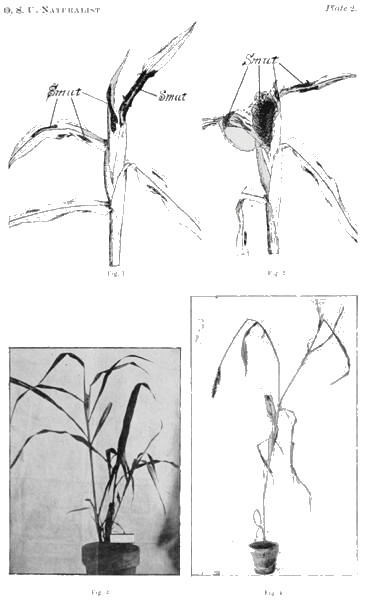
Plate 2: KELLERMAN ON SORGHUM SMUT.
Explanation of Plate 2.—Ustilago or Cintractia reiliana. Figure 1: The foliicolous form occurring on sweet-corn, the panicle not yet emerged, but the smut on upper leaves in sight. Figure 2: Same as in Figure 1, showing a later stage of maturity. Figure 3: An infected sorghum plant in the greenhouse, photographed in 1899, the panicle smutted. Figure 4: An infected sorghum plant, grown in the greenhouse in 1900, the central panicle sound, the later (side) panicles smutted.