PART III.
Reading edition
One day when the ship was at anchor in one of the ports on the western coast of South America, a number of sheep were brought on board. Whether Dennis regarded them as intruders, or not, I cannot say; but his treatment of them was anything but kind.
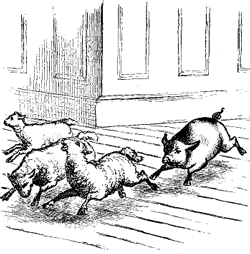
The poor sheep stood in great fear of him, and fled in alarm whenever he made a charge at them. One by one they began to disappear; and, at last, only one—a little fellow whom the sailors afterward named Billy—was left.
He was greatly distressed when the last of his companions was taken away, and ran bleating about the deck in search of him. To add to his troubles, that dreadful bully Dennis, who had been watching him for some time, was now coming towards him. He was frightened nearly to death.
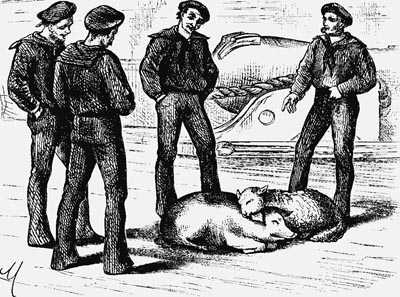
What must have been his delight when he saw in Dennis's eyes a look of pity, and heard his friendly grunt! I don't know what Dennis said; but I do know, that, half an hour afterwards, Billy had forgotten all about his troubles, and was lying down with his head resting in Dennis's fat neck.
Even the rough sailors were pleased; and as they looked at Dennis, who was fast asleep, they said, "Now that was a fine thing, and Dennis was the pig to do it. He was willing to fight with a flock of sheep; but, when it came to quarrelling with one little fellow, he was too noble for that."
Thenceforth Dennis and Billy were inseparable, and no pair ever agreed better. There were times, however, when Dennis seemed a little vexed with Billy, though he was always as kind as possible. I will tell you of an instance.
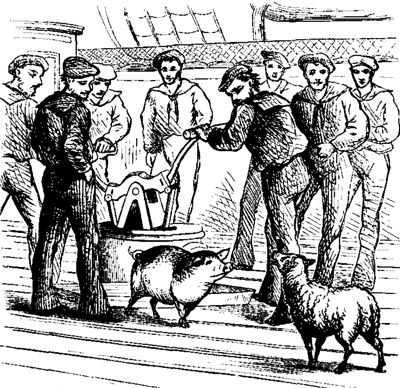
Billy would always watch the crowd about Dennis, when the latter was taking his bath, with a great deal of anxiety; and, if Dennis did not appear very shortly, he would begin bleating loudly.
This would disgust Dennis immensely; but he couldn't bear to think that Billy's feelings were hurt: so he would leave his nice bath, and push his way through the men, until Billy could see him. Then he would return to the pump, grunting in a manner that plainly showed his feelings.
He was certainly saying, "I do wish that sheep had a little more of the pig about him. If I am out of his sight for a moment, he begins to cry, and take on in such a manner, that I must show myself to him; and then I have all the trouble of making the sailors pump again."
But the sailors only waited to make Dennis beg a little. They had no idea of not pumping again. They were always pleased when he showed so much good feeling for Billy; and generally he got a larger allowance of water to pay for it.
I believe that Dennis was not living when the ship reached California. That ever he became food for his sailor friends no one can imagine. Therefore his fate must remain a mystery, unless some of my readers happen to know one of the crew of "The Vanderbilt," and can learn from him something on the subject.
If they can, there are many, no doubt, who would be glad to hear from them in the pages of "The Nursery." My little girls would, at least. But, probably, Dennis has more of a place in their thoughts than he can have in those of others.
C.E.C.
THE UNMOTHERLY HEN.
Now, my dear children, if you will be very quiet, I will tell you a true story, which I sometimes tell my little daughter Fanny and her cousin Grace, when they climb up on my knees just before going to bed.
On a farm near Fishkill, where Fanny's Aunt Jane lives, they raise a great many chickens, turkeys, ducks, and geese. When I was a boy, ever so many years ago, I used to have great fun hunting for eggs through the hay and straw in the barns.
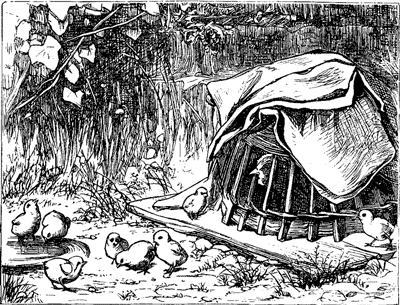
Well, last year one of the hens, instead of laying her eggs in the hen-house or barn, like a well-mannered hen, stole off under a wood-pile, and was not seen for three weeks, when she made her appearance with a fine brood of chickens. To keep her from straying away again, she was put into a coop. For several days, she was a good mother to her children; but, after a week or so, she began to act very strangely, and, when her children came near her, she would peck and abuse them.
Would you believe it, children? in one day, this unmotherly hen had pecked all but one of her chickens to death; and, when Aunt Jane found this poor chap, he had but one eye, and all the toes were gone from one foot; so that he had to stand on the other. At first, Aunt Jane thought it would be a mercy to kill the little fellow, and put him out of pain; but she finally determined that she would try to cure him.
So she took him into the kitchen, and made him quite comfortable in a box half filled with cotton-batting, and placed near the stove. She gave him cracked-corn to eat, and plenty of water to drink, and, after a while, he got so strong, that he hopped out of the box, and was just as jolly a chicken as he could be, with only one eye to see with, and only one foot and the stump of another to walk on.
Still he would not go out and play with other chickens of his age, but persisted in hanging around the kitchen. One morning, when Aunt Jane went into the breakfast-room, she found him on the table, helping himself from a dish of stewed potatoes. Such impudence could no longer be tolerated: so the saucy little cripple was banished to the barnyard to learn manners.
And what do you think became of the unmotherly hen? She lost all her friends. She was despised and hated by everybody on the farm. She was pointed at as "that cruel, speckled hen," until life became a burden to her. She was not permitted to have any more chickens. When the cold weather came, she was sent to a poor woman for a thanksgiving dinner; and it is to be hoped that all the hens in the barnyard took warning from her fate.
C.R.W. Lansingburgh. N.Y.
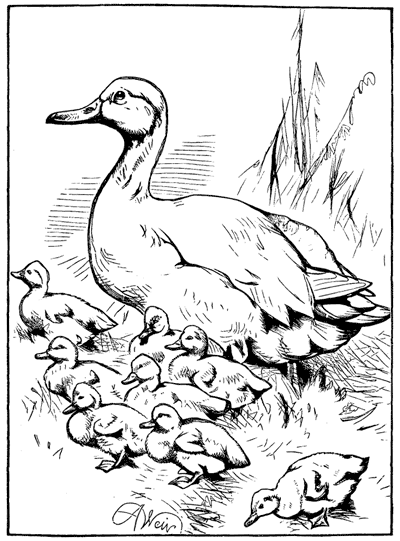
Outline Drawing by Mr. Harrison Weir, as a drawing lesson.
THE CHILDREN'S VISIT TO THE LIGHTHOUSE.
Charlie and Georgie were staying at Appledore, one of the Isles of Shoals, and, with two other little children, had many nice times fishing and sailing.
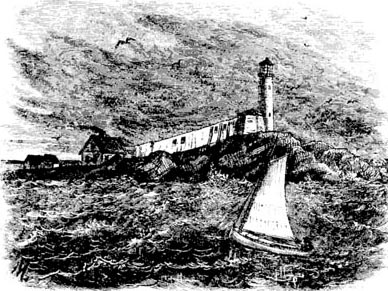
The lighthouse is on White Island, which, as you see in the picture, is a lonely and rocky place. It would be very dangerous for any ship to come in from sea on that part of the coast, if it were not for the friendly warning of the brilliant light.
One warm, sunny morning, Charlie and Georgie, with their papa and mamma, and their two little friends, rowed across from Appledore, and landed on the pebbly beach of White Island. Here the children ran about, and picked up stones until they were tired; and then the whole party seated themselves on some shaded rocks, and ate their lunch of crackers and bananas.
While they were eating, an old white dog, belonging to the lighthouse keeper, came up and made their acquaintance. Georgie shared his cake with him; and it was amusing to see the old dog watching with eager eyes every piece that went into any mouth but his own.
When lunch was over, the two older children, Charlie and Anna, led the way; and all were soon climbing the winding stairs in the lighthouse tower. When they reached the top, they found themselves in a small room with windows on every side, and the great lamp in the centre. The lantern is made of red-and-white glass, and turns around, so that first a red, and then a white, light may be seen far out at sea.
The keeper explained how, after lighting the lamp, he wound up the machinery which caused the lamp to revolve; and told them of the lonely hours he had spent in the little room below the lamp, while the waves dashed, and the storm beat outside.
For many weeks in the winter he lives there all by himself, and sees no one; but, in the summer time, there is hardly a day when he does not have a boat full of visitors. He always gives them a hearty welcome, and makes himself very agreeable. I suppose he feels as though he must make the most of society while he can get it.
The children listened to his talk with great interest. With many thanks for his kind attentions, they bade him "Good-by," and, intent on collecting shells on another island near, stepped into their boat, and were rowed away, leaving the man and his friendly dog to enjoy each other's company.
Charlie's Mamma.