Part 3 — GOING AFTER COWS.
Reading edition
When Edward was eight years old, his mother told him he might go with John, the hired man, to drive the cows from the pasture. How happy the little boy was!
Every day he would be ready as soon as John gave the word; and off they would go, through the woods, over hills and rocks, and gurgling brooks, wherever the ding-dong of the distant cow-bells pointed the way.
Sometimes they had a long search before they could find all the cows; for the pasture was very large, and the cows would wander about in every part of it, to find the best feeding-places.
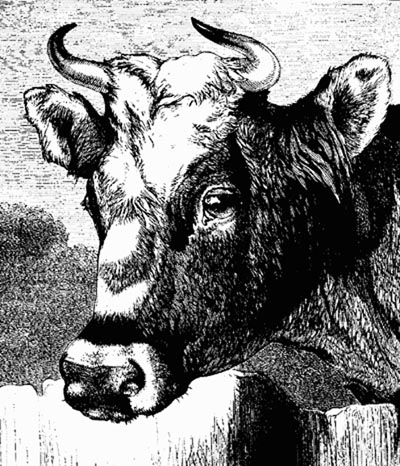
On the way home, Edward would run ahead of the cows, and open the bars; and sometimes he would sit on the wall, and pat each cow as she came through.
When the cows reached the barnyard, Edward would help milk. There was one old cow which he called his own, and which he named Carrie. She always stood very still while being milked, and that was one reason why he liked her better than any of the rest.
After milking, he helped John to carry in the milk, and his mother often gave him a mug full. Oh, how nice it was!
W.T.O.
ROLY-POLY.
Roly-Poly is three years old, Three years old, and a trifle over: Roly-Poly is round as a ball, Jolly as larks, and sweet as clover. Roly-Poly has stars for eyes, A heavenly chin with a dimple in it, Peaches for cheeks, the bud of a nose, And a tongue that is never still a minute. Roly-Poly gets up in the morning,— Morning, quoth I? it's the crack of the dawn!— Dresses himself in a boot and a stocking, Flies to his sister as swift as a fawn. Pulls at her eyes with his fat little fingers,— Crazy for stories, that's all the matter!— "Oh! I am sleepy and cross," she cries; "You, Roly-Poly, disperse and scatter!" But Roly-Poly's a resolute tyrant; Father and mother are captives wholly: So what can a poor big sister do But yield to a king like Roly-Poly.
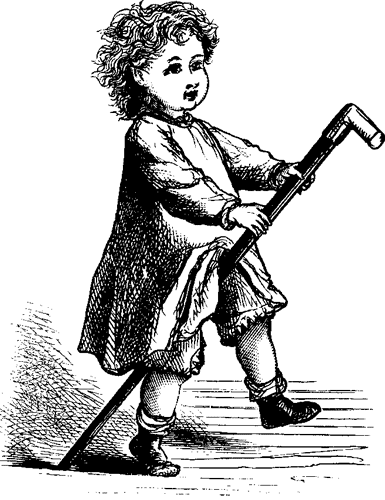
Roly-Poly's a man of business: He canters to market on grandpa's cane, Orders a breakfast of peppermint-candy, And gallops his pony home again. Roly-Poly's a man of pleasure: Sorrow and care are for grown-up stupids: Pictures and kisses, toys and caresses, Fondling and fun, for dimpled Cupids. After the sun has gone out of the south, The night comes down on his eyelids slowly; He topples asleep with his thumb in his mouth,— What an iniquity, Roly-Poly!
OLIVE A. WADSWORTH.

ELSIE'S DUCKS.
Elsie was the daughter of poor parents, who lived on the borders of a lake. Once, when she was very ill with a fever, a good neighbor made her a present of three young ducks. Elsie was much pleased, and she soon began to get well.
Her mother would bring a large tub of water into the room where the little invalid lay; and the three ducks would swim about, and swallow the crumbs which Elsie threw to them.
As soon as she got well, she would drive the ducks down to the lake, and let them swim. They were so tame, that they would come out of the water at her call.
Sometimes her father and the rest of the family would get into a boat, and he would row across the lake to the opposite side, where some families lived who employed Elsie's mother to wash clothes for them.
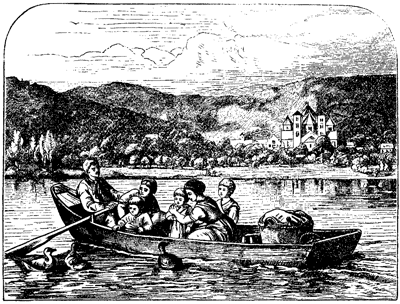
At these times, the three ducks would follow the boat. Perhaps they did not like to trust their dear Elsie on the water, unless they were by to help her in case of need.
Sometimes old and young would join in a song; and then far over the lake would be heard the words:
"Come to the sunset tree, the day is past and gone, The woodman's axe lies free, and the reaper's task is done."
It was a very pretty sight, on a summer evening, when the bright clouds over the setting sun threw their tints on the water, to see the ducks swimming by the side of the little boat which contained Elsie and the rest of the family. It was so pretty a sight, that a good artist made a picture of the scene. We give you a copy of it here.
Ida Fay.
FISHING FOR TROUT.
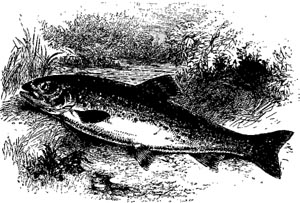
The trout belongs to the salmon family. Its flesh is generally of a pale pink or yellow color. It is one of the handsomest fish to be found in our waters. The variations of its tints are very beautiful; and the red spots on its skin distinguish it from common fish.
I never had much luck in catching trout. One summer I went from the city to try the trout-streams in Northern New York. I had a handsome rod, and a line nicely baited with an artificial fly; but, though I was very persevering, my success was small.
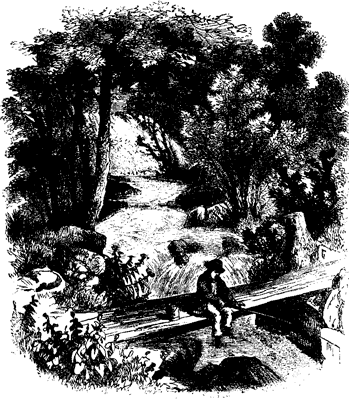
I remember sitting for hours on the slender bridge just below the Upper Cascades of Buttermilk Fall, represented in the picture; but my patience was not rewarded by the capture of a single trout. I was sorry for this; for I had depended on getting one for my dinner.
As I was about retiring, a little barefoot fellow, about twelve years old, came along with a common fishing-pole, and hook baited with a worm, and said, "Mister, I'll catch a trout for you."—"Do it, then," said I.
He threw his line over a smooth spot in the pool below; and, before he had been at it five minutes, he pulled up a noble trout, large enough for a good dinner. Another and another were pulled up in quick succession. I did not know what to make of it; for I thought I had fished in a very scientific way.
"Teach me the knack," said I. "Oh, it can't be taught," replied the boy. "Well, here is a dime for your trouble," said I, putting the fish into my pail. "Do you suppose I take pay for what I do for sport, mister?" said little barefoot, waving back my hand with the air of a prince.
After that we became good friends, and met often at the bridge; but I never could learn his knack of catching trout.
Alfred Selwyn.
WE THREE.
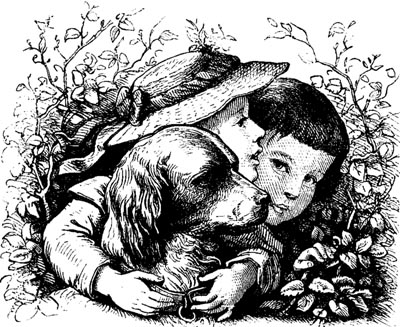
What fine times we have together!—Carlo, John, and Bella; by which last I mean myself. Carlo has the advantage of the other two of us sometimes; for he has four legs, and can run faster than either John or I. But then we can do a great many things that Carlo cannot do.
For example, John and I sometimes take our books, and sit down on the rocks in the wood, under the thick trees, and read stories. And then Carlo will lie down at our feet, and go to sleep; for he cannot understand the nice stories which the other two friends enjoy so much.
But wait till we go into the swamps after berries, or into the wood-borders after hazel-nuts. Then Carlo is wide awake, you may be sure. If he sees a snake, what a noise he makes! We can always tell by the tone of his bark when he has found a snake.
And, when John climbs a tree after nuts, how anxiously Carlo will stand underneath and watch him, so afraid is he that the little boy will get a fall! And how the good dog will jump and show his pleasure when he sees John once more safe on the firm ground!
Oh! we have fine times together, we three, both in summer and winter; for Carlo likes to see us skate on ice, and is fond of a snowballing frolic. In all our sleigh-rides he goes with us, and takes great care of us. We are dear friends, we three, and I should no more think of striking Carlo than of striking John.
Bella.
PET, THE CANARY.
A little girl by the name of Agnes, who lives in Maine, and who much enjoys "The Nursery," has a beautiful, bright canary, which her papa brought her one day in a paper-box. Agnes named him Pet.
The little fellow has become so tame, that he is allowed to stay out of his cage as long as he wishes, always going to it of his own accord when bedtime comes. One day I found no pins on my pin-cushion; and, seeing them scattered around on the bureau, I wondered who could have done the mischief. I soon found, by watching, that it was Pet's work.
Every day he took his stand on the pin-cushion, in front of the glass, to pull out all the pins. I saw him once work a long time trying to stick one back by tipping his head, first one side and then the other, holding the pin tightly in his bill; but he soon gave it up.
Little Fannie, Agnes's two-year-old sister, often shares her lunch with him; he sitting on the edge of the saucer, and helping himself while she is eating. As I write, he is sitting on the tassel of the shade, looking out of the window. Some day I'll tell you more of Pet's pranks.
Mamma.
THE CAT SHOW.
It was at the Crystal Palace, in Sydenham, England. I wish all the readers of "The Nursery" could have seen it.
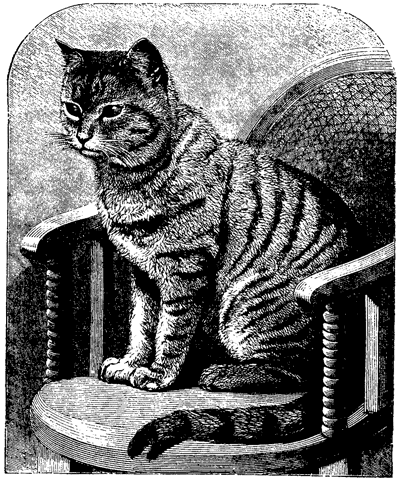
There were over three hundred cats in cages. Each one had a nice red cushion in the front-part of the cage, and in the back part a dish of water or milk. Each one had a ribbon around the neck, to which was attached a medal with the number of the cage. The ribbons were of all colors.
The cats that had taken the first prize were known by a little blue flag suspended over the front of the cage, and were the largest cats. Very many of them were lazily sleeping on their cushions, as happy as if they were in their own homes. They took little notice of the people who were looking at them; and, as a placard on each cage ordered spectators to "move on," no one could spend much time in trying to attract their attention.
I can hardly tell you about all the cats, there were so many,—some all white, some all black, and some all yellow; black-and-yellow, black-and-white, black-and-gray, gray-and-white, black-and-yellow-and-white; cats with long hair, and cats with short; cats with tails, and cats without. One large Russian cat, called the "Czar," was brown, with smooth, short, shining fur, which looked like seal-skin.
Then there were kittens of all sizes and colors. In one cage was a black mother-puss, with four perfectly white kittens, their eyes not yet open. Another black mother had two kittens,—one black, and one gray. A black-and-yellow puss had one black, and one yellow kitten.
In some of the cages were two or three large kittens having a good time together. Some of them had balls to play with; some were climbing on the sides of the cage or frolicking with one another; and others were running around after their tails, in real kitten fashion.
Just before five o'clock, the baskets in which the cats were brought were placed on the tops of the cages. Some of the cats reached up and tried to get hold of them. They all seemed to know that the show was over, and that they would soon be able to run and jump about, with plenty of air and space.
I must not forget to tell you how quiet all these cats were. Not one "Me-ow" was to be heard. When, out of sight of the cages, one would never have known there was a cat in the building.
Sallie's Mamma.
Moderato. mf.
Music by T. Crampton.
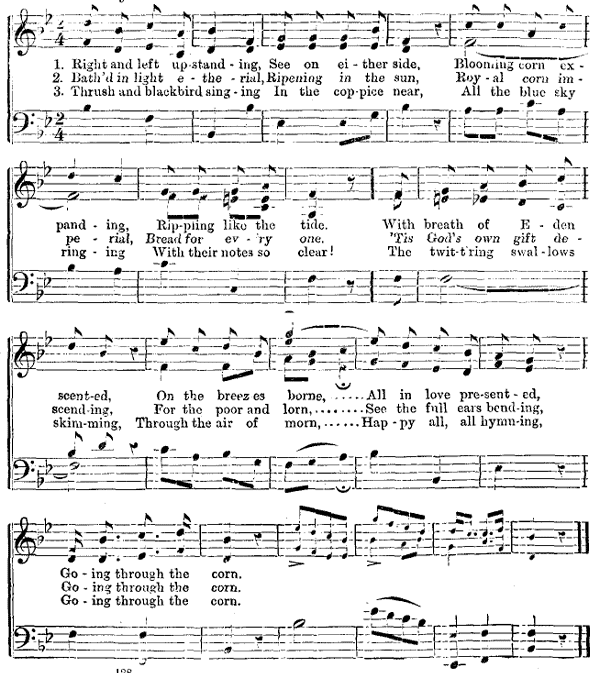
1. Right and left upstanding, See on either side, Blooming corn expanding, Rippling like the tide. With breath of Eden scented, On the breezes borne,... All in love presented, Going through the corn. 2. Bath'd in light etherial, Ripening in the sun, Royal corn imperial, Bread for every one. 'Tis God's own gift descending, For the poor and lorn,... See the full ears bending, Going through the corn. 3. Thrush and blackbird singing In the coppice near, All the blue sky ringing With their notes so clear! The twitt'ring swallows skimming, Through the air of morn,... Happy all, all hymning, Going through the corn.
VIOLET TOILET WATER. CASHMERE BOUQUET EXTRACT. CASHMERE BOUQUET Toilet Soap.

Price, Twenty-Five Cents. NEWSPAPER ADVERTISING NINETY-EIGHTH EDITION. Containing a complete list of all the towns in the United States, the Territories, and the Dominion of Canada, having a population greater than 5,000 according to the last census, together with the names of the newspapers having the largest local circulation in each of the places named. Also, a catalogue of newspapers which are recommended to advertisers as giving greatest value in proportion to prices charged. Also, all newspapers in the United States and Canada printing over 5,000 copies each issue. Also, all the Religious, Agricultural Scientific and Mechanical, Medical, Masonic, Juvenile, Educational, Commercial, Insurance, Real Estate, Law, Sporting, Musical, Fashion, and other special class journals; very complete lists. Together with a complete list of over 300 German papers printed in the United States. Also, an essay upon advertising; many tables of rates, showing the cost of advertising in various newspapers, and everything which a beginner in advertising would like to know. Address GEO. P. ROWELL & CO., 41 Park Row, New York.
IN PRESS. The Nursery Primer By which children can teach themselves to read, with but little help from parent or teacher. SUPERBLY AND APTLY ILLUSTRATED. The must beautiful Primer in the market. Containing upwards of a hundred fine pictures. 96 Pages of the size of The Nursery. The word-system of teaching explained and applied. JOHN L. SHOREY, 36 Bromfield Street, Boston. AGENTS WANTED. Men or women. $34 a week. Proof furnished. Business pleasant and honorable with no risks. A 16 page circular and Valuable Samples free. A postal-card on which to send your address costs but one cent Write at once to F.M. REED, 8TH ST., NEW YORK