CHARLES FELIX
Reading edition
The Novel as it appeared in the magazine "Once A Week"
(November 1862 - January 1863)
CONTENTS SECTION I. THE CASE. SECTION II. SECTION III. SECTION IV. SECTION V. SECTION VI. SECTION VII. SECTION VIII. CONCLUSION.
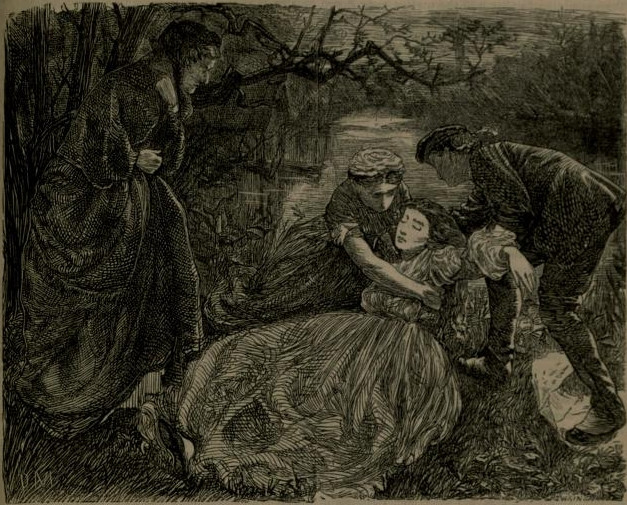
[It is unnecessary for us to state by what means the following papers came into our hands, and it would be no compliment to the penetration of our readers if we indicated beforehand the nature of the mystery they are supposed to unravel. It will, however, require a very close attention to names and dates to comprehend the view of the compiler, as to the case he is investigating; and, so far, it is requisite to rely on the reader's patience and discernment. The whole particulars of the case will extend to some seven or eight numbers of "Once a Week" and some things which are dark at first will appear clearer in the sequel. If the compiler has really discovered a new species or description of crime, it is natural that the evidence of it, which is circumstantial, should be somewhat difficult of acceptance. The illustrations are simply added to make the reader's task more agreeable, but, of course, it is not pretended that they were made simultaneously with the events they represent.]
Mr. R. Henderson to the Secretary of the —— Life Assurance Association.
"Private Enquiry Office, Clement's Inn,
"GENTLEMEN, "17th Jan, 1858.
"In laying before you the extraordinary revelations arising from my examination into the case of the late Madame R**, I have to apologise for the delay in carrying out your instructions of November last. It has been occasioned, not by any neglect on my part, but by the unexpected extent and intricacy of the enquiry into which I have been led. I confess that after this minute and laborious investigation I could still have wished a more satisfactory result, but a perusal of the accompanying documents, on the accuracy and completeness of which you may fully rely, will I doubt not satisfy you of the unusual difficulty of the case.
"My enquiries have had reference to a policy of assurance for 5000l., the maximum amount permitted by your rules, on the life of the late Madame R**, effected in your office by her husband, the Baron R**, and bearing date 1st November, 1855. Similar policies were held in the —— of Manchester, the —— of Liverpool, the —— of Edinburgh, and the —— of Dublin, the whole amounting to 25,000l.; the dates, 23rd December, 1855, 10th January, 25th January, and 15th February, 1856, respectively, being in effect almost identical. These companies joined in the instructions under which I have been acting; and, from the voluminous nature of this letter and its enclosures, I shall be obliged by your considering my present reply as addressed to them conjointly with yourselves.
"Before entering upon the subject of my investigations, it may be as well to recapitulate the circumstances under which they were originated. Of these the first was the coincidence of dates, above noticed; and an apparent desire on the part of the assurer to conceal from each of the various offices the fact of similar policies having been elsewhere simultaneously effected. On examining further into the matter your Board was also struck with the peculiar conditions under which the marriage appeared to have taken place, and the relation in which Madame R** had formerly stood to the Baron. To these points, therefore, my attention was especially directed, and the facts thus elicited form a very important link in the singular chain of evidence I have been enabled to put together.
"The chief element of suspicion, however, was to be found in the very unusual circumstances attendant on the death of Madame R**, especially following so speedily as it did on the assurance for so large an aggregate amount. This lady died suddenly on the 15th March, 1857, from the effects of a powerful acid taken, it is supposed, in her sleep, from her husband's laboratory. In the Baron's answers to the usual preliminary enquiries, forwarded for my assistance, and herewith returned, there is no admission of any propensity to somnambulism. Shortly, however, after the occurrence had been noticed in the public prints, a letter to the Secretary of the Association from a gentleman recently lodging in the same house with Baron R**, gave reason to suspect that in this respect, at least, some concealment had been practised, and the matter was then placed in my hands.
"On receipt of your instructions, I at once put myself in communication with Mr. Aldridge, the writer of the letter in question. That gentleman's evidence certainly goes to show that, within at least a very few months after the date of the latest policy, Baron R** was not only himself aware of such a propensity in his wife, but desirous of concealing it from others. Mr. Aldridge's statements are also to a certain extent supported by those of two other witnesses; but, unfortunately, there are, as will be seen, circumstances calculated to throw considerable doubt upon the whole of this evidence, and especially on that of Mr. Aldridge, from which alone the more important part of the inference is drawn. The same must, unfortunately, be said with regard to some other parts of the evidence, as will be more clearly seen when the case itself is before you.
"From his statement, however, in conjunction with other circumstances, I learned enough to induce me to extend my researches to another very singular case, which not long since had given rise to considerable comment.
"You will, no doubt, remember that in the autumn of 1856 a gentleman of the name of Anderton was arrested on suspicion of having poisoned his wife, and that he committed suicide whilst awaiting the issue of a chemical enquiry into the cause of her death. This enquiry resulted in an acquittal, no traces of the suspected poison being found; and the affair was hushed up as speedily as possible, many of Mr. Anderton's connections being of high standing in society, and naturally anxious for the honour of the family. I must, however, acknowledge the readiness with which, in the interest of justice, I have been furnished by them with every facility for pushing my enquiries, the results of which are now before you.
"In reviewing the whole facts, and more especially the series of remarkable coincidences of dates, &c., to which I beg to direct your most particular attention, two alternatives present themselves. In the first we must altogether ignore a chain of circumstantial evidence so complete and close-fitting in every respect, as it seems almost impossible to disregard; in the second, we are inevitably led to a conclusion so at variance with all the most firmly established laws of nature, as it seems almost equally impossible to accept. The one leaves us precisely at the point from which we started; the other involves the imputation of a series of most horrible and complicated crimes.
"Between these alternatives I am constrained to confess my own inability, after long and careful study, to decide. I have determined, therefore, simply to submit for your consideration the facts of the case as they appear in the depositions of the several parties from whom my information has been obtained. These I have arranged, as far as possible, in the form in which they would be laid before counsel, should it ultimately be deemed advisable to bring the affair into Court. In view, however, of the extreme length of the case, I have given, in a condensed form, the substance of such of the depositions as did not seem likely to suffer from such treatment. The more important I have left to tell their own tale, and, in any case, my abstract may be at once checked by the originals, all of which are enclosed.
"Should your conclusions be such as have been forced upon myself, further deliberation will yet be required with reference to the course to be pursued; a point on which, in such case, I confess myself almost equally unable to advise. Whether in a matter so surrounded with suspicion, it might not be well, in any event, to resist the claim, is certainly a question to be considered. On the other hand, even assuming the fullest proof of the terrible crimes involved, it is a matter calling for no less careful consideration, whether they would be found of a nature to bring the criminal within reach of the law. For the present, however, our concern is with the facts of the case, and ulterior questions had better be left on one side until that issue is decided, when, I conclude, I shall hear further from you on the subject.
"In conclusion, I must trouble you with a few words on a point which seems to require explanation. I allude to the apparent prominence I have been compelled to afford to the workings of what is called 'Mesmeric Agency.' Those, indeed, who are so unfortunate as to be the victims of this delusion, would doubtless find in it a simple, though terrible solution of the mystery we are endeavouring to solve. But while frankly admitting that it was the passage from the 'Zoist Magazine,' quoted in the course of the evidence, which first suggested to my mind the only conclusion I have as yet been able to imagine, I beg at the outset most distinctly to state, that I would rather admit my own researches to have been baffled by an illusory coincidence, than lay myself open to the imputation of giving the slightest credit to that impudent imposture. We must not, however, forget that those whose lives have been passed in the deception of others, not unfrequently end by deceiving themselves. There is, therefore, nothing incredible in the idea that the Baron R** may have given sufficient credence to the statement of the 'Zoist,' above-mentioned, for the suggestion to his own mind of a design, which by the working of a true, though most mysterious, law of Nature, may really have been carried out. Such, at least, is the only theory by which I can attempt, in any way, to elucidate this otherwise unfathomable mystery.
"Awaiting the honour of your further commands,
"I am, Gentlemen, very faithfully yours, "RALPH HENDERSON."
SECTION I. THE CASE.
Extracts from Correspondence of the Honourable Catherine B**.[1]
1. From Lady Boleton to Honourable C. B** (undated), about October or November of 1832.
"Oh, auntie, auntie, what shall I do? For three nights I have not closed my eyes, and I would not write even to you, auntie dear, because I kept hoping that, after all, things might come right, and he would come back again. Oh, how I have listened to every sound, and watched the road till my poor eyes ache! And now this is the fourth day since he went away, and, oh, auntie, I am so frightened, for I am sure he is gone after that dreadful man, and, oh, if he should meet him, I know something terrible will happen, for you can't tell how he looked, poor Edward, I mean, when he went away. But, indeed, auntie, you must not be angry with him, for I know it was all my own fault, for I ought to have told him everything long ago, though indeed, indeed, I never cared for him, and I do love dear Edward so dearly. I was afraid....
[Here the MS. becomes in places very blotted and illegible.]
... and I thought it was all at an end, and then ... and only a fortnight ago we were so happy ... married hardly seven months and ... but you must not think I am complaining of him, dear auntie, for you don't know how.... Only if you can, come to me, for I feel getting so ill, and you know it is only God bless you, auntie; oh, do come to me if you can. "GERTRUDE BOLETON."
2. Extract of letter from the Same to the Same, written about four days later.
* * * * *
"I am so sorry to hear you are so ill; don't try to come, darling auntie; I shall do somehow, and if not, anything is better than this horrible suspense.... No tidings yet, but I cannot write more, for I can hardly see to guide the pen, and my poor head seems to open and shut. God bless you, auntie. "G."
"I open my letter to thank you so much for sending dear kind Mrs. Ward; she came in so unexpectedly (in a blue [2]) just as if she had come from heaven. I wonder if she has seen Ed....?
[Here the MS. ends suddenly.]
3. From Mrs. Ward to Honourable C. B**, enclosing the above.
"Beechwood,[3] Tuesday night.
"MY DEAR CATHERINE,
"I fear I have but a poor account to give you of our dear Gertrude. Poor child! when I came into the room, and saw her looking so pale and wan, and with great black circles round her eyes, I could scarcely keep in my own tears. She gave a little cry of joy when she saw me, and threw herself upon my neck; but a moment after, turned to the writing table and tore open the letter I send you with this, and which was lying ready for the post. The long-continued strain seems to have been too much for her, and she had hardly written a line when her head began to wander, as you will see from the conclusion of her postscript, and in trying to write her husband's name she broke down altogether, and went off into a fit of hysterics which lasted for several hours. She is now, I am thankful to say, comparatively calm again, though at times her head still wanders, and she seems quite unable to close her eyes, but lies in her bed looking straight before her, and occasionally talking to herself in a low voice, but without seeming to notice anything. I have endeavoured, as far as I dared, to draw from her the history of this sad affair, but can get nothing, poor child, but eager assurances that it was 'all her fault,' and that 'indeed, indeed, he was not to blame.' It seems as though my coming—though certainly a great relief to her—had had the effect of putting her on her guard lest anything should escape her unfavourable to her husband, and her whole faculties seem to be concentrated in the endeavour to shield him from reproach. I fear, however, there can be no doubt that he has been very seriously to blame; indeed, from all I can gather, the fault seems to have been entirely on his side. What is the precise history of this unhappy business I have not been able to learn; but it seems that Sir Edward, who is certainly a most violent young man, and I fear also of a most jealous temperament, contracted some suspicion with regard to that Mr. Hawker who so perseveringly persecuted poor Gertrude the winter before last, and to have left Beechwood, after a very distressing scene, in pursuit of him. Mr. Hawker is supposed to be on the Continent, and it is known that Sir Edward took the Dover Road, which, as you know, passes close by this place. This is all I can at present learn with any certainty, though I hear but too much from the servants, who are all in such a state of indignation at Sir Edward's treatment of their mistress, that I have the utmost difficulty in restraining it from finding some open vent. Should I hear more, I will of course let you know at once; but meanwhile I cannot conceal from you my deep anxiety for our dear Gertrude, whose poor little heart seems quite broken, and for whom I am in hourly dread of the effect but too likely to be produced, in her present delicate state, by the anxiety and terror from which she is suffering.... You know how much I always disliked the match, and I feel more than ever the impropriety of consigning so young and sensitive a girl to the care of a man of such notoriously uncontrollable temper. Poor thing! this is evidently not the first time she has suffered from it, and even should she herself escape without permanent injury to her constitution, I dread the effect upon the child.... And now I must close this long and sad letter, but will write again should anything fresh occur; meantime, I cannot be longer away just now from Gertrude's side. I hope your own health is improving. My love to little Henry, and tell him to be very good while I am away. "Your affectionate "HELEN WARD."
4. The Same to the Same.
"Beechwood, Monday morning.
"MY DEAR CATHERINE,
"I am sorry to say I can still send you no better account of poor Gertrude. Since I last wrote by Saturday evening's post[4] very little change has taken place, though she is certainly more restless, poor child, and I fear also, if anything, weaker. She now constantly asks for letters, and seems impressed with the idea that we are keeping them from her, as indeed, in her present state, I should, I think, take the responsibility of doing, if any arrived. The newspaper I have always kept from her until it has first been carefully examined. I am dreading fever, though by the doctor's advice I have not attempted to dissuade her from getting up. The exertion, however, is almost more than she can bear, and I am looking anxiously for his next visit. She lies all day on the sofa, looking out of the window, which commands a view of the Dover Road. This morning she seems growing more and more restless, and I am waiting with inexpressible anxiety for Dr. Travers.
"Eleven o'clock. "The doctor has been, and confirms my fear of approaching fever, which, however, he says may possibly pass off. He has ordered me to lie down at once for some hours, as I have hardly been in bed since I arrived, and he says if fever should come on I shall want all the strength I can get. I shall keep this letter open, to send you by the evening's post the latest account.
"Wednesday. "All is over. I can hardly command myself sufficiently to write, and yet I must tell you what has happened. Oh, my dear Catherine, how shall I ever forgive myself for leaving poor dear Gertrude; and yet I know that this is foolish, for I was ordered to do so for her sake. But I must come at once to the sad news I have to tell. I left poor Gertrude in the charge of her maid, with strict injunctions to call me if there should be any change; but the poor child seems suddenly to have grown quieter, and at length to have fallen asleep. The maid watched her until just four o'clock, when, overcome with weariness, she herself dropped off into a doze, and on waking at a little before five, was horrified to find herself alone. She flew at once to me, but I had hardly got to the top of the stairs when some one came running up to say that the postman was below, and had just met with poor Gertrude, who had been watching for him at the gate. She enquired eagerly after letters, and on being told there were none, asked for the newspaper, which she at once hurried away with into a part of the grounds called the Wilderness, while the postman, fearing from her manner that something was amiss, came on to the house to tell what had occurred. I need not tell you with what anxiety I hastened to the Wilderness, and there, poor girl, we found her, stretched upon the turf close by the edge of the lake, with the fatal newspaper in her hand. I had her taken carefully to the house, and a man despatched on horseback for the doctor; but before he arrived she had recovered consciousness, only, poor child, to be at once seized with the signs of her approaching trouble. From that moment until she breathed her last—an hour ago —I have never left her side. After nearly thirty hours of the most terrible suffering I have ever witnessed, she at length gave birth to two poor little girls, both so small and weak-looking that it is quite piteous to see them. The elder in especial, which was born about an hour before the second, is so weak and sickly, that the doctor says it is scarcely possible it can live, and, indeed, one can hardly hope that it may. The second seems stronger, but both are very small and weakly even considering their premature birth.
"Poor Gertrude now sank rapidly, and though every means was tried, and she still lingered on for three or four hours, she at last sank altogether, passing away at the last so quietly that we hardly knew that she was gone. Poor darling, I always loved her as being such a favourite with you all.... One word before I close as to the paper which was the unhappy cause of this terrible blow. It contained, as I had feared, the long-dreaded intelligence of Sir Edward's fatal quarrel with Mr. H.; and I send it off by the same post, as you will wish to know the sad particulars. I cannot write more now, for I am fairly worn out, and must take some rest. You know how deeply I sympathise with you.... "Most affectionately yours, "HELEN WARD."
5. Extract from the "Morning Herald," of the 12th of November, 1832.
"Fatal Duel at Dieppe.—We learn from the Paris papers, that an extraordinary and fatal duel took place some days since in the neighbourhood of Dieppe, between two Englishmen, neither of whom have as yet been identified. It appears that the parties encountered each other in the court-yard of the Hotel de l'Europe, where one of them, whose linen bears the mark of C. G. H., had been staying for some days. The new comer at once assailed the other evidently with the most opprobrious language, to which Mr. H. replied with equal warmth, but the conversation being carried on in English, was unfortunately not understood by any one present. The altercation at length grew so warm that the landlord was compelled to interfere, and the parties then left the hotel together. A few hours afterwards Mr. H. returned, and calling for his bill, hastily packed his portmanteau, and departed. He has since been traced to Paris, where he was lost sight of altogether. Early the next morning a rumour spread that the body of an Englishman had been found in a vineyard, about a mile distant from the town, and on enquiry it proved that the victim was no other than the gentleman with whom the dispute had occurred on the previous night. It was evident on examination that the unfortunate man must have fallen in fair fight, though no seconds appear to have been present during the encounter. A pistol, recently discharged, was firmly grasped in the hand of the dead man; and at a dozen paces distant lay its fellow, evidently the weapon with which he had been killed. The fatal wound, too, was exactly in that portion of the chest which would be exposed to an adversary's fire, and had evidently pierced the heart, so that death must have been instantaneous. The weapons, too, with which the fatal duel was fought appear to have been the property of the deceased. They were a very handsome pair of duelling pistols, hair triggers, and evidently of English make. On the butt of each was a small silver shield, bearing the initials "E. B.," and an armed hand grasping a crossbow. The initials of the unfortunate gentleman's opponent were, as we have said, C. G. H.; and we have reason to fear that the victim was a young baronet, of considerable landed property, with whose sudden departure for the Continent rumour has for some time been busy.
"Since our first edition went to press, we have received further particulars, which leave no room for doubt that the victim of the above fatal occurrence was, as we feared, Sir Edward Boleton, Bart., of Beechwood, Kent; but the cause of the duel, and the name of his opponent, still remain a mystery. The unfortunate gentleman leaves behind him a young wife, to whom he was united but a few months since. Failing a male heir, the baronetcy will now, we understand, become extinct, while the bulk of the estates will pass to a distant connection. The widow, however, is, we believe, in possession of a considerable independent property."
6. Mrs. Ward to Honourable C. B**.
"July, 1836.
"MY DEAR CATHERINE,
* * * * *
"You ask me whether I am satisfied with what I saw the other day of poor Gertrude Boleton's little ones. To say that I am satisfied with their appearance would, poor little things, be hardly true, for they are still anything but healthy—poor Gertie especially looking like a faded lily. The younger, however, is certainly improved, and will, I hope, do well, and I quite think that they both are better where they are than they could possibly be elsewhere. It is indeed sad, poor things, that they should have no near relation with whom they could live, but I quite agree with you that, in your state of health, it would not only be too great an undertaking for yourself, but would be by no means beneficial to them. Indeed I am convinced that on every account they are best where they are. The air of Hastings seems to suit them, and in the higher part of the town where Mrs. Taylor lives is bracing without being too cold. Mrs. Taylor herself is a most excellent person, and extremely fond of them. She seems especially interested in poor Gertie, and never wearies of relating instances of the wonderful sympathy between the twins. This sympathy seems even more physical than mental. According to Mrs. Taylor, every little ailment that affects the one is immediately felt also by the other, though with this difference, that your namesake, Katie, is but very slightly affected by Gertie's troubles, while she, poor child, I suppose from the greater delicacy of her constitution, is rendered seriously ill by every little indisposition of her sister. I have often heard of the strong physical sympathies between twins, but never met myself with so marked an instance. Both, unfortunately are sadly nervous, though here, too, the elder is the greatest sufferer, while in the younger it seems to take the form of extreme quickness of perception....
Of course, as they grow up, they should be placed with some one in our own rank of life, but for the present I think poor Mrs. Taylor will do very well.... I shall be at Hastings again next month, and will write when I have seen them.... "Affectionately yours, "HELEN WARD."
7. From Mrs. Taylor to Honourable C. B**.
About January, 1837.
"HONNERED MISS,
"with My Humbel duty to Your ladyshipp and i am trewly sory to sai as mis Gerterud hav took a terrabel bad cold wich i Was afeard as she wud do has Miss kattarren av Likeways Had wun for 2 dais past wich i Am sory to sai as mis gerterud is wuss than mis Kattaren but Hoping she wil be Well agen Sone wich has I hev told your Honnered Ladyshipp they as allers the same trubbels ony pore mis gerterud allers hav them Wust. Honnered Miss the docter hay ben her wich he sais has mis Kattaren his quite wel agen he sais Honnered mis he hops mis gerterud will sone be wel 2. honuered Mis yore Humbel servt. to comand "SARAH TAYLER."
8. From the Same to the Same.
About June, 1837.
"HONNERED MIS
"with My humbel Duty to Yore ladyshipp hand i am trewly thenkfull to sai the dere childern are both quit wel wich miss Kattaren made erself Hill on teusday and pore miss gerterud were verry bad in connsekens for 3 dais but his now quit wel agen. honnered mis yore Ladyshipps humbel sert. to comand "SARAH TAYLER."
9. From Same to Same.
"July, 1837.
"HONNERED MIS
"with my humbel duty to Yore ladyshipp hand wud you plese Cum Direcly wich sumthink Dredfull hav apenned to pore mis Kattaren honnered mis Yore Ladyshipps humbel sert to comand "SARAH TAYLER."
10. Mr. Ward to Honourable C. B.**
"Marine Hotel, Hastings, "12th July, 1837.
"DEAR MISS B**,
"Helen was unfortunately prevented from leaving home at the time your letter arrived, so, as the matter seemed urgent, I thought it best to come myself. I am sorry to have to send you such very unsatisfactory intelligence. Poor little Catherine has been lost—stolen, I am afraid, by gipsies—and I have hitherto been quite unable to find any clue to their whereabouts. It appears that Mrs. Taylor took them for a trip with some friends of hers to Fairlie Down, where they fell in with a gang of gipsies, of whom, however, they did not take any particular notice. They had taken their dinner with them, and after finishing it sat talking for some time, when suddenly the child was missed; and, though they hunted in every direction for several hours, no trace of her could be found. On returning to the place where the gipsies had been seen, the camp was found broken up, and the track, after passing near where they had been sitting, was lost on the hard road. Unfortunately, poor Mrs. Taylor—who seems quite distracted by what has happened—could think of nothing at first but writing to you, and it was only by the gossip of her friends, who live at some distance from the town, that the intelligence at length reached the police. Enquiries were being set on foot when I arrived last night, but I fear that, from the time that has been lost, there is now but little chance of recovering the poor child. I have advertised in all directions, and offered a large reward, but I have little hope of the result, nor are the police more sanguine than myself. Unfortunately poor Catherine's dark, gipsy-like complexion, and black eyes and hair, will render it easy to disguise her features, while her quick intelligence and lithe, active figure, will make her only too valuable an acquisition to the band. I need not tell you how grieved I am at this fresh trouble to these poor children, and I fear Gertrude will suffer severely from the loss of her sister, with whom she has, as you know, so extraordinary a bond of sympathy. I am going now to the police station to consult on further measures, and will write to you again by to-morrow morning's post. "Ever, dear Miss B**, Very truly yours, "HENRY WARD."
11. Mrs. Vansittart to the Honourable C. B**.
"Grove Hill House Academy, Hampstead Heath, "Wednesday, May 1st, 1842.
"MADAM,
"I have much pleasure in complying with your request for a monthly report of the health and progress of my very interesting young friend and pupil, Miss Boleton. In a moral and educational point of view nothing could possibly be more satisfactory.... Of my dear young friend's health I am compelled, however, to lament my inability to address you in the same congratulatory terms which in all other matters I am happily so well authorised to employ. Notwithstanding the extreme salubrity of the atmosphere by which in this justly celebrated locality she is surrounded, and I trust I may venture to add the unremitting attention she has experienced both at my own hands and those of my medical and educational assistants, her general health is still, I regret to say, very far from having attained to that condition of entire convalescence at which I trust she may yet, with the advantage of a prolonged residence upon the Heath, before very long arrive. My medical adviser, Dr. Winstanley,—a physician of European reputation, and one in whom I can repose the most entire confidence,—informs me that Miss Boleton is suffering from no especial ailment, though subject from time to time to fits of illness to which it is often difficult to assign any sufficient cause, and which after a while disappear as strangely as they arose. He trusts with me that the pure air of the Heath, which so far as we can venture to believe has already been beneficial to his interesting patient, will in course of time effect a radical cure. The loss of her young sister, of which you informed me on her first joining our little society, inflicted, beyond doubt, a very serious blow upon her naturally feeble constitution; but I trust that its effects are already passing away. I shall, of course, adhere strictly to your instructions never in any way to allude to the sad occurrence in conversation with Miss Boleton, and have thought it advisable not to acquaint her companions with the fact. On the 1st of next month I shall again do myself the honour of acquainting you with the progress made by my interesting young friend, and have little doubt of being at that time able to furnish you with a satisfactory account of her physical no less than of her moral and intellectual advancement. For the present, dear madam, permit me to subscribe myself, "Your very faithful "And obliged servant, "AMELIA DOROTHEA VANSITTART." "To the Honourable Catherine B**."
12. Mrs. Ward to the Honourable C. B**.
"14 June, 1851. "MY DEAR CATHERINE,
"Very many thanks for your early intelligence of dear Gertrude's engagement. I, congratulate you most heartily, though as you have yourself alluded to it, I cannot deny that I should have been better pleased had Mr. Anderton, in addition to all his other good qualities, possessed that of a somewhat less nervous and excitable temperament. I have always liked him much; but with poor Gertrude's own delicate constitution I cannot but fear the results of such an union upon both. However, it is impossible to have everything, and in all other respects he seems more than unexceptionable, so once more I congratulate you heartily. Are you really thinking of coming up to the Exhibition?.... Give my best love to dear Gertrude, and say all that is kind and proper for us to her fiancée. Ever, dear Catherine,
"Affectionately yours, "HELEN WARD."
SECTION II.
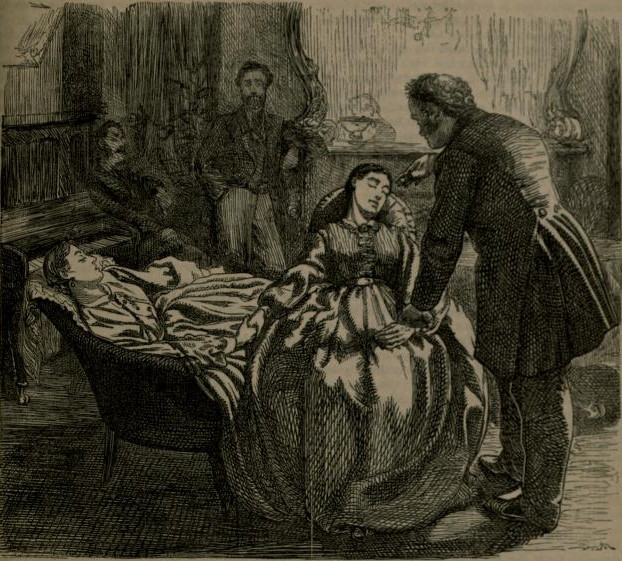
1. Memorandum by Mr. Henderson.
We now come to that portion of Mrs. Anderton's[1] history which embraces the period between her marriage and the commencement of her last illness. For this I have been compelled to have recourse to various quarters. The information thus afforded is very complete, and taken in conjunction with what we have already seen in Miss B——'s correspondence of the previous life of this unfortunate lady, throws considerable light upon two important points to be hereafter noticed. The depositions, however, unavoidably run to a greater length than at this stage of the proceedings, their bearing on the main points of the case would render necessary, and I have therefore condensed them for your use in the following memorandum. Any portion, not sufficiently clear, may be elucidated by a reference to the originals enclosed.
Mr. Anderton was a gentleman of good origin, closely connected with some of the first families in Yorkshire, where he had formed the acquaintance of Miss Boleton, while staying at the house of her great aunt, Miss B——. He appears to have been of a most gentle and amiable disposition, though unfortunately so shy and retiring as to have formed comparatively very few intimacies. All, however, who could be numbered among his acquaintance seem to have been equally astonished at the charge brought against him on the death of his wife, with whom he was always supposed, though from his retired habits little was positively known, to have lived upon terms of the most perfect felicity. As the event proved, the case would in effect never have come on for trial; but, had it done so, the defence would have brought forward overwhelming evidence of the incredibility of such a crime on the part of one of so gentle and affectionate a disposition.
During the four years and a-half of their married life there does not appear to have been a cloud upon their happiness. Mrs. Anderton's letters to her great aunt, Miss B—— (to whom I am indebted for almost the whole of the important information I have been able to collect respecting the family) are full of expressions of attachment to her husband and instances of his devotion to her. Copies of several of these letters are enclosed, and from these it will be seen how unvarying was their attachment to each other. Throughout the entire series, extending over the whole period of her married life, there is not a single expression which could lead to any other conclusion.
It is, however, evident that the delicate health with which Mrs. Anderton had been afflicted from her birth, still continued, and in two instances we have indications of the same mysterious attacks noticed in the letter of Mrs. Vansittart, before quoted. These, however, appear to have been but very slight. They had for some years been of more and more rare occurrence, and from this date, (October, 1852), we have no further record of anything of the kind. Still Mrs. Anderton's general health continued very unsatisfactory, and almost everything seems to have been tried by her for its improvement. Among the enclosed correspondence are letters dated from Baden, Ems, Lucca, Cairo, and other places to which the Andertons had, at different times, gone for the health of one or other, Mr. Anderton being also, as stated in Mrs. Ward's letter of the 14th June, 1851,[2] extremely delicate.
Of this gentleman all accounts agree in stating that the chief ailment was a constitutional nervousness, mental as well as physical. The latter showed itself in the facility with which, though by no means deficient in courage, he could be startled by any sudden occurrence however simple; the former, in his extreme sensitiveness to the opinions of those about him, and his dread of the slightest shadow of reproach on the name of which he was so justly proud. In the accompanying documents you will find instances of both these idiosyncrasies.
In the summer of 1854 Mr. Anderton's attention seems to have been drawn to the subject of Mesmerism. They had been spending some weeks at Malvern, where this science seems particularly in vogue, and had there made acquaintance with several of the patients at the different water-cure establishments, by some of whom Mr. Anderton was strongly urged to have recourse to mesmeric treatment both for Mrs. Anderton and himself.
The constant solicitations of these enthusiastic friends seem at length to have produced their effect, and the favourite operator of the neighbourhood was requested to try his skill on these new patients. On Mr. Anderton the only result seems to have been the inducing of such a state of irritation as might not unreasonably have been expected from so nervously excitable a temperament, in presence of the "manipulations" to which the votaries of mesmerism are subjected. In the case of Mrs. Anderton, however, the result was, or was supposed to be, different. Whether from some natural cause that, at the time, escaped attention, or whether solely from that force of imagination from which such surprising results are often found to arise, I cannot of course say; but it is certain that some short time after the mesmeric "séances" had commenced, a decided though slight improvement was perceptible. This continued until the departure of the operator for Germany, which country he had only recently left on a short visit to England.
Notwithstanding the worse than failure in his own case, the certainly curious coincidence of his wife's recovery seems to have entirely imposed on Mr. Anderton, whose susceptibility of disposition appears indeed to have laid him especially open to the practices of quacks of every kind. So great was now his faith in this new remedy that he actually proposed to accompany the Professor to Germany rather than that his wife should lose the benefit of the accustomed "manipulations." He had proceeded to London, for the purpose of making the necessary preparations, when he was induced to pause by the remonstrances of several of his friends, who represented to him that a winter in the severe climate of Dresden—the place to which the Professor was bound—would probably be fatal to one of Mrs. Anderton's delicate constitution.
His medical adviser also, though himself professing belief in mesmerism, gave a similar opinion, while at the same time he obviated the difficulty respecting the mesmeric treatment of Mrs. Anderton, by offering an introduction to "one of the most powerful mesmerists in Europe," who had recently arrived in London, and who eventually proved to be the so-styled Baron R**.
This introduction appears to have finally decided Mr. Anderton against the Dresden expedition; and, after a brief experience of his manipulations, Mrs. Anderton herself seems to have derived, in imagination at least, more benefit from them than even from those of her late attendant. So thoroughly were they both impressed with the beneficial results of the Baron's "passes," &c., that Mr. Anderton, who had now resolved to settle in London for the autumn and winter, went so far as to take a ready-furnished house at Notting Hill, for the express purpose of having his new professor in his immediate neighbourhood. Here the séances were continued often twice or three times a day, and though, of course, no one in his senses could really attribute such a result to the exercises of the Baron, it is certain that, from some cause or other, the health of Mrs. Anderton continued steadily to improve.
Matters had continued in this position for some weeks, when objections were raised by some of Mr. Anderton's relations to what they not unnaturally considered the very questionable propriety of the proceeding. There seems to have been a good deal of discussion on this point in which, however, Mr. Anderton's constitutional susceptibility finally carried the day against his newly conceived predilections with respect to, a practice so obviously calculated to expose him to unpleasant comment. The Baron, however, was not disposed so easily to relinquish a patient from whom he derived such large and regular profits. On being made acquainted with the decision respecting the cessation of his visits, he at once declared that his own direct manipulations were unnecessary, and that, if considered improper for one of the opposite sex, they could easily be made available at second-hand.
Having once swallowed the original imposition, any additional absurdity was of course easily disposed of, and it was now determined to avoid all occasion for offence; Mrs. Anderton should henceforth be operated upon through the medium of a certain Mademoiselle Rosalie, a clairvoyante in the employment of the Baron, who, after being placed "en rapport" with the patient, was to convey to her the benefit of the manipulations to which she was herself subjected by the operator.
Into the precise modus operandi I need not now enter, but will only remark upon the fresh instance of the extraordinary powers of imagination displayed in the still more rapid improvement of Mrs. Anderton under this new form of treatment, and the marvellous "sympathy" so rapidly induced between her and the Baron's "medium."
Mademoiselle Rosalie was a brunette rather below the medium height, with a slight but beautifully proportioned and active figure, sallow complexion, and dark hair and eyes. The only fault a connoisseur would probably find with her person would be the extreme breadth of her feet, though this might perhaps be accounted for by her former occupation, to be noticed later on. It is necessary for our purpose that this peculiarity should be kept in mind. In appearance she was at that time about thirty years old, but might very possibly have been younger, as the nature of her profession would probably entail a premature appearance of age. Altogether she formed a remarkable contrast to Mrs. Anderton, who was slight but tall, and very fair, with remarkably small feet, and notwithstanding her ill-health, still looking a year or two less than her age. Between these very different persons, however, if we are to credit the enclosed letters, such a "sympathy" sprang up as would, on all ordinary hypotheses, be perfectly unaccountable. Mrs. Anderton could feel—or imagined that she felt—the approach of Mademoiselle Rosalie even before she entered the room; the mere touch of her hand seemed to afford immediate benefit, and within a very few weeks she became perfectly convalescent, and stronger than she had ever been before.
At this point I must again refer you to the depositions themselves, that of Mr. Morton, which here follows, being of too much importance to admit of condensation.
2. Statement of Frederick Morton, Esq., late Lieutenant, R.A.
My name is Frederick George Morton. In 1854, I was a lieutenant in the Royal Artillery, and was slightly wounded at the battle of Inkermann, on the 5th of November of that year, the day after my arrival in the Crimea. It was before joining the battery to which I was appointed. I have since quitted the service, on the death of my father, and am now residing with my mother at Leeds. I was an old school friend of the late Mr. William Anderton, and knew him intimately for nearly fifteen years. I was present at his marriage with Miss Boleton, in August, 1851, and have since frequently visited at their house. During the time I was at Woolwich Academy, I spent every leave-out day with them, and frequently a good portion of the vacations. My father encouraged the intimacy, and I was as much at home in their house as in our own. My father was junior partner of one of the large manufacturing firms in Leeds. The Andertons generally lived in London, when they were not abroad; and on one occasion I went with them to Wiesbaden. I saw very little of them in 1854, as they were away the earlier part of the year, first at Ilfracombe, and then at Malvern, but I spent the 13th of October with them. I particularly remember the date, as I was on my way to the Crimea, where I was afterwards wounded, and the order had come very suddenly. When it came I had just gone to a friend's house for some pheasant-shooting, and I remember I was obliged to leave the second morning, and I spent the night at Anderton's, and embarked the next morning. I was to have gone for the first, but could not get away, and I lost the shooting altogether. It was on a Saturday that I embarked, because I remember we had church parade next day. That was the last time I saw Anderton. I was in Italy all that winter with my wound and rheumatic fever; and in the summer of 1855 I was sent for to my father, who was ill for several months before he died, and after that I could not leave my mother. We only took in a weekly paper, and I did not hear of his having been taken up till three or four days after. I started to see him immediately, but was too late. It was not on account of any quarrel that we had not met. Quite the reverse. We were as good friends as ever to the last, and I would have given my life to serve him. I was on the most friendly terms with Mrs. Anderton. He was dotingly fond of her. I used to laugh, and say I was jealous of her, and they used to laugh too. I never saw two people so fond of one another. He was the best and kindest-hearted fellow I over knew, only awfully nervous, and very sensitive about his family and his name. The only time we ever quarrelled was once at school, when I tried to chaff him by pretending to doubt something he had said: it made him quite ill. He often said he would rather die than have any stain upon his name, which he was very proud of. On the day I speak of—13th October, 1854—I telegraphed to them at Notting Hill that I would dine and sleep there on my way out. I found Mrs. Anderton better than I had ever seen her before. She said it was all Baron R**'s doing, and that since Rosalie came she had got well faster than ever. She wanted to put off the Baron for that night, that we might have a quiet talk, but I would not let her; and, besides, I wanted to see him and Rosalie. They came at about nine o'clock, and Mrs. Anderton lay on the sofa, and Rosalie sat on a chair by her side, and held her hand while the Baron sent her to sleep. It was Rosalie he put to sleep, not Mrs. Anderton. The latter did not go to sleep, but lay quite still on the sofa, while Anderton and I sat together at the farther end of the room, because he said we might "cross the mesmeric fluid." I don't know what he meant. Of course I know that it was all nonsense; but I don't think Rosalie was shamming. I should go to sleep myself, if a man went on that way. When it was over, Mrs. Anderton said she felt much better, and I couldn't help laughing; then Anderton sent her up to bed, and he and I and the Baron sat talking for an hour and more. I never saw Mrs. Anderton again, for I went away before she was up, but I used to hear of her from Anderton. What we talked of after she was gone was mesmerism. Of course I did not believe in it, and I said so; and Anderton and the Baron tried to persuade me it was true. We were smoking, but Rosalie was there, and said she did not mind it. She always seemed to say whatever the Baron wanted, but I don't think she liked him. She did not join in the conversation. She said—or at least the Baron said—she could not speak English, but I am quite sure she must have understood it, or at all events a good deal. I have learned German, and sometimes I said something to her, and she answered; and once I saw her look up so quickly when Anderton said something about "Julie," and the Baron said directly, in German, "not your Julie, child." I asked her, as she was going away, who Julie was, and she had just told me that she was her great friend, and a dancing girl, when the Baron gave her a look, and she stopped. That was as they were leaving. Before that, Rosalie was doing crochet, and we three were talking about mesmerism. They tried to make me believe it, and the Baron was telling all sorts of stories about a wonderful clairvoyante. That was his Julie, not Rosalie's. Of course I laughed at it all, and then they got talking about sympathies, and what a wonderful sympathy there was between twins, and the Baron told some more extraordinary stories. And when I wouldn't believe it, Anderton got quite vexed, and reminded me about the twin sister his wife had had, and who had been stolen by gipsies. And then the Baron asked him about it, and he told him the whole story, only making him promise not to tell it again, because they were afraid of her being reminded of it, and that was why it was never spoken of. The Baron seemed quite interested, and drew his chair close in between us. We were speaking low, that Rosalie might not hear. I remember the Baron said it was so curious he must take a note of it, and he wrote it all down in his pocket-book. He took down the dates, and all about it. He was very particular about the dates. I am sure Rosalie could have heard nothing of all this; not even if she had understood English. We had gone to the window, and were too far off. Besides, we spoke low. Afterwards the Baron seemed thoughtful, and did not speak for some time. Anderton and I got to mesmerism again, and he got a number of some magazine—the "Zoist," or something of that sort—to prove to me something. He read me some wonderful story about eating by deputy, and when I would not believe it, he called the Baron and asked if it was not true, and he said perfectly, he had known it himself. He started when Anderton spoke to him, as if he had been thinking of something else, and he had to repeat it again. I know it was something about eating by deputy, because afterwards, when I was wounded and had the fever, I used to think of it and wish I could take physic that way. You will find it in the "Zoist" for that month—October, 1854.[3] I remember saying at the time, that it was lucky for the young woman that the fellow didn't eat anything unwholesome, and Anderton laughed at it. The Baron did not laugh. He stood for ever so long without saying a word, and looking quite odd. I thought that I had offended him by laughing. Anderton spoke to him, and he jumped again, and I saw this time he had let his cigar out. I remember that, because he tried to light it again by mine, and his hand shook so he put mine out instead. He said he was cold, and shut the window. He would not have another cigar, but said he must go away, for it was late. Anderton and I sat smoking for some time. I tried to persuade him to give up mesmerism, and he said Mrs. Anderton was so well now, he thought she could do without it, and that she would give it up in a few weeks. I heard from him afterwards, in November, that the Baron had left town for some weeks. When I was ill at Scutari, after my wound, I wrote to ask him to meet me at Naples, and he started with Mrs. Anderton in December, but was stopped at Dover by Mrs. Anderton's illness. I have had several letters from him since, and am quite ready to give copies of them; all but the bits that are private. I have read over this statement, and it is all quite true. I am quite ready to swear to it in a court of justice, if required. I wish to add, that I am quite certain poor Anderton had nothing to do with his poor wife's death. I will swear to that.
3. Statement of Julie.[4]
"Manchester, 3 Aug., 1857. "DEAR SIR,
"In compliance with your instructions of the 11th ult., I forward deposition of Julia Clark, alias Julie, alias Miss Montgomery, &c., at present of the Theatre Royal, duly attested. "Dear Sir, "Yours faithfully, "WILLIAM SMITH."
"I am a dancer, and my name is Julia Clark: I have performed under the name of Julie, and other names. I am at present called Miss Montgomery. I knew the girl called Rosalie. She was my particular friend. We were for several years together in Signor Leopoldo's company. I forget how many. She did the tight-rope business, and had ten shillings a week and her keep. In our company she was called the 'Little Wonder.' Her real name was Charlotte Brown. She was about ten years old when I joined the company. I do not know her history. She did not know it herself. She often told me so. She would have told me if she did. She passed as the niece of old Mrs. Brown. Mrs. Brown was the money-taker. She took Lotty's money and found her in clothes. Lotty is Rosalie. Some of our ladies said she had been bought from a tramp. Of course I did not believe it. They said it out of spite. Lotty did the tight-rope business for about five years after I knew her. She was a beautiful figure, only her feet were very broad.[5] All tight-rope dancers are. The rope spreads them. Otherwise her figure was perfect. She was nervous. Not very, but rather. She used to tremble before she went on. It was not from fear. She was ill sometimes. Not often. Sometimes she caught cold from sitting on the damp ground to undress when she was hot with dancing. She got stronger as she grew up. Sometimes she felt ill, and did not know why. She had bad headaches. When she was in that way physic was no good, only brandy. Brandy took away the headaches. She used to drink brandy sometimes, but not like some of our ladies. I never saw her the worse for liquor. Her headaches were not from drinking. Certainly not. They came and went away again. Brandy took them away. I only know of once that she has been ill since she left the company. She wrote and told me of it. I have the letter still. It is not dated, but there was an extract from a newspaper in it about her which is dated some time in October, 1852.[6] The day of the month is cut off. She gave up the tight-rope business because of a fall. That was from being nervous. She was not drunk. She had not been drinking. She was nervous. A glass drop fell from the chandelier and frightened her. That was all. She was very much hurt. One foot was sprained, and the doctors at the hospital said she must never go on the wire again. She was two months there. When she came out the circus was shut up. The company was all dispersed except her and me and Mr. Rogers, and the gentleman who did the comic business. Mr. Rogers was Signor Leopoldo. He took a music-hall. I think it was in Liverpool. He got another singing lady and gentleman, and we gave entertainments. Every evening Mr. Rogers gave a short lecture on mesmerism, and Lotty was his subject. She was very clever at that. Of course she was not really asleep. One night she stopped in the middle. The manager was very angry. She tried to go on, but she fainted, and had to be carried off. She said some gentleman in the stalls had done it. Next morning the gentleman called and took her away. He gave the Signor 50l. He was the Baron R**. I knew it from Lotty. She has written to me several times. These are her letters. They are rubbed at the edges. It is from keeping them in my pocket. I do not think she ever left the Baron, but I do not know. The last letter I ever had from her was from his house. It was in the first week of November, 1854. I got it in Plymouth. It was the only week I was there before I went to Dublin for the pantomime. She said she was going to be married, but must not tell me who to just yet. I never heard from her since. I have written several times, but my letters have been returned. I have no idea who she married. It could not have been the Baron. She disliked him too much. She stayed with him because he paid her well. Partly that, and partly because she said she couldn't help doing what he told her. She said he really did mesmerise her, and that she could see in her sleep. She did not live with the Baron as his wife. Only as his medium. If she had she would have told me. I am quite sure she would. I am quite certain there was never any connection between her and the Baron except what I have said. Of course I cannot swear she did not marry him, but I should think it very unlikely. Why should she when she disliked him so much? All this is true. I believe Signor Leopoldo is now somewhere abroad. (Signed) "JULIA CLARK, alias JULIE."
Read over to the deponent, and signed by her in the presence of William Burton, J. P.
2nd August, 1857.
4. Statement of Leopoldo.
N.B.—This statement was obtained with some difficulty, and only on an express promise of immunity from any legal proceeding, in respect of the deponent's relations with the girl Rosalie, alias Angelina Fitz Eustace, alias the "Little Wonder," alias Charlotte Brown. The statement was enclosed in the following note:
"Signor Leopoldo, tragedian, &c., &c., &c., presents his compliments to R. Henderson, Esq., and in consideration of the assurance that 'what is done cannot be now amended,' I have the honour to forward the required information, in confidence that you will not keep the word of promise to the ear and break it to the hope, and thus 'my simple truth shall be abused.' "Sir, your most humble servant, (Signed) "THOMAS ROGERS."
Deposition of Signor Leopoldo, Tragedian; Professor of Fencing and Elocution; Equestrian, Gymnastic, and Funambulistic Artiste; Sole Proprietor and Manager of the Great Olympian Circus, &c., &c., &c.
"I, Signor Leopoldo, Tragedian, &c., &c., &c., do hereby depose and declare that the girl, Charlotte Brown, commonly known as the celebrated 'Little Wonder,' was transferred by me to my celebrated Olympian Company in the month of July, 1837, at Lewes, in the county of Sussex, where the celebrated Olympian Circus was at that time performing with great success and crowded houses. And this deponent further maketh oath and saith that I, the said Signor Leopoldo, tragedian, &c., &c., &c., did in consideration of the services of the said Charlotte Brown, commonly known as the celebrated Little Wonder, pay to a certain person or persons claiming to be the parent or parents of the said Charlotte Brown, commonly known as the celebrated Little Wonder, the sum of five pounds (5l.), which person or persons were of the tribe or tribes commonly known as gipsies or Egyptians. And this deponent furthermore maketh oath and saith that I, Signor Leopoldo, tragedian, &c., &c., &c., cannot tell whether the said Charlotte Brown, commonly known as the Little Wonder was really the child of the person or persons, gipsy or gipsies aforesaid, or that her name was Charlotte Brown, or any other of the particulars hereinbefore stated and deposed, but only that her linen was marked C. B., which initials do set forth and represent the name of Charlotte Brown.
"Witness our hand and seal this 4th day of January, in the year of grace, one thousand eight hundred and fifty-eight. (Signed) "THOMAS ROGERS."
5. Statement of Edward Morris, Cleric in the Will Office, Doctors' Commons.
"My name is Edward Morris. I am a clerk in the Will Office at Doctors' Commons, and my duty is to assist those who wish to search wills deposited in our office. On the 14th October, 1854, Baron R** came to the office and searched in several wills. One was the will of a Mr. Wilson, copy of which is herewith enclosed. I remember this will particularly, because I had an altercation with the Baron respecting his wish to copy parts of it. He wished to make extracts, and I told him it was not allowed; only the date and the names of the executors. He persisted, and I said I must report it. He then laughed and said it did not matter, and he tapped his forehead and said he could make a note of it there. He read parts of the will over two or three times and gave it back to me. He then said, 'You shall see, my friend,' and laughed again, and he made me follow him while he repeated several pages of the will by rote. He laughed again when he had done, and asked if he might copy it now. I said no; and he laughed again, and wrote for some time in his note-book, looking up at me every now and then and laughing. I was angry, partly because he laughed, and partly because he kept me there when I wanted to get away. I had leave for a week to go to the Isle of Wight and see my aunt. I wanted to get there that night because the next day was my birthday. He made me miss the train, and as the next day was Sunday, I did not get there till late. That is how I remember the date. I am sure of the year because my aunt only went to the Isle of Wight the November previously, and died in the spring of 1855. I am quite sure it was the Baron. I should recognise him anywhere. He is a short, stout man, with a rather florid complexion and reddish hair, rather light. He has large fat hands, white and well kept, and an immense head. He dresses all in black, and wears large spectacles of light blue. I don't think it is because his eyes are weak. I am sure it is not; for when he takes off his spectacles I never saw such extraordinary eyes. I can't describe them, only that they are very large and bright. I never could look at them long enough to make out the colour, but they are very dark, I think black, and they put one out to look at them, otherwise there is nothing very remarkable about him. I recognised him that day from having seen him before at a mesmeric lecture, when I asked his name."
6. Memorandum by Mr. Henderson.
I enclose the will of which the following is an abstract:
"Mr. Wilson, of the firm of Price & Wilson, Calcutta, who died in 1825, leaves the sum of 25,375l. three per cent. consols, to his niece, Gertrude Wilson (afterwards Lady Boleton), and to her children, if any, or their heirs in regular succession, whether male or female. In default of any such heirs, the money to be made over to trustees selected by the Governor General of India for the time being, from among the leading merchants of Calcutta, for the purpose of founding, under certain restrictions, an institution among the hills for the children of those who could not afford to send them home to England."
The will also provides that should any female taking under it die during her coverture, the husband shall retain a life interest in the property.
SECTION III.
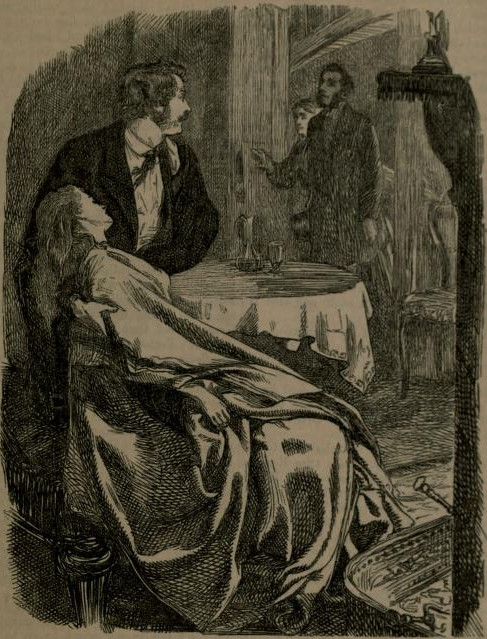
1.—Extracts from Mrs. Anderton's Journal.
Aug. 13, 1854.—Here we are, then, finally established at Notting Hill. Jane laughs at us for coming to town just as every one else is leaving it; but in my eyes, and I am sure in dear William's too, that is the pleasantest time for us. Poor Willie, he grows more and more sensitive to blame from any one, and has been sadly worried by this discussion about our Dresden trip. The new professor to-morrow. I wonder what he will be like.
Aug. 14.—And so that is the new professor! I do not think I was ever so astonished in my life. That little stout squab man, the most powerful mesmerist in Europe! And yet he certainly is powerful, for he had scarcely made a pass over me before I felt a glow through my whole frame. There is something about him, too, when one comes to look at him more closely, which puzzles me very much. He certainly is not the common-place man he appears, though it would be difficult just now to say what makes me so sure of it.
Aug. 25.—Quite satisfied now. How could I have ever thought the Baron common-place! And yet, at first sight, his appearance is certainly against him. He is not a man with whom I should like to quarrel. I don't think he would have much compunction in killing any one who offended him, or who stood in his way. How quietly he talks of those horrid experiments in the medical schools, and the tortures they inflict on the poor hospital patients. Willie says it is all nonsense, and says all doctors talk so; but I can't help feeling that there is something different about him. And yet he is certainly doing me good.
Sept. 1.—Better and better, and yet I cannot conquer the strange feeling which is growing upon me about the Baron. He is certainly an extraordinary man. What a grasp he takes of anything on which he rests his hand even for a moment; and how perfectly he seems to disregard anything that stands in his way. This morning I was at the window when he came, and I was quite frightened when I saw him, as I thought, so nearly run over. But I might have spared my anxiety, for my gentleman just walked quietly on, while the poor horse started almost across the road. Had it caught sight of those wonderful green eyes of his, that it seemed so frightened? What eyes they are! You can hardly ever see them; but when you do!—And yet the man is certainly doing me good.
Sept. 11.—So it is settled that the Baron is not to mesmerise me himself any more. Am I sorry or glad? At all events, I hope they will not now worry poor William....
Sept. 13.—First day of Mademoiselle Rosalie. Seems a nice person enough; but it feels very odd to lie there on the sofa while some one else is being mesmerised for one.
Sept. 15.—This new plan is beginning to answer. I think I feel the mesmerism even more than when I was mesmerised myself, and this way one gets all the pleasures and none of the disagreeables. It is so delicious. Looked back to-day at my Malvern journals. So odd to see how I disliked the idea at first, and now I could hardly live without it.
Sept. 29.—I think we shall soon be able to do without the Baron altogether. I am sure Rosalie and I could manage very well by ourselves. What a wonderful thing this mesmerism is! To think that the mere touch of another person's hand should soothe away pain, and fill one with health and strength. Really, if I had not always kept a journal, I should feel bound to keep one now, as a record of the wonderful effects of this extraordinary cure. Got up this morning with a nasty headache. No appetite for breakfast. Eyes heavy, and pulse low. Poor William in terrible tribulation, when lo! in comes little Mademoiselle Rosalie and the Baron. The gentleman makes a pass or two—the lady pops her little, dry, monkey-looking paw upon my forehead, and, presto! the headache has vanished, and I'm calling for chocolate and toast!
Sept. 30.—A blank day. Headache again this morning, and looking out anxiously for my little brown "good angel," when in comes the Baron, with the news that she cannot come. Up all night with a dying lady, and so fagged this morning that he is afraid she would do me more harm than good. I am sure she cannot feel more fagged than I do, poor girl. But, after all, in spite of the delight of doing so much good, what a life it must be!
Oct. 1.—Rosalie here again. Headache vanished. Everything bright as the October sun outside. I am getting quite fond of that girl. How I wish she could speak something besides German....
Oct. 4.—It is quite extraordinary what a hold that poor girl, Rosalie, is taking upon me. I am even beginning to dream of her at night....
Oct. 6.—Headache again this morning, and a message that Rosalie cannot come. How provoking that it is on the same day....
Oct. 12.—I think I shall really soon begin to know when poor Rosalie has been over-worked. Headache again to-day, and I had a presentiment that she would not be able to come....
Oct. 20.[1]—So now the Baron is going to leave us. Well, I am indeed thankful that he can now so well be spared. Jane Morgan here to-day, and of course laughing at the idea of mesmerism doing any good. She could not deny, though, how wonderfully better I am, and indeed, but for those tiresome headaches, which always seem to come just when poor Rosalie is too tired to take them away, I am really quite well and strong.
Oct. 31.—Something evidently wrong between poor Rosalie and the Baron. She has evidently been crying, and I suppose it must be from sympathy, but I feel exactly as if I had been crying too. Very little satisfaction from the mesmerism to-day. It seems rather as if it had given me some of poor Rosalie's depression. How I wish she could speak English, or that I could speak German, and then I would find out what is the matter. Perhaps she is to lose her work when the Baron goes. Mem.: To ask him to-morrow.
Nov. 1.—No. He says he shall certainly take her with him to Germany, and "he hopes that may have a beneficial effect." What can he mean? He says she is quite well, but throws out mysterious insinuations as to something being wrong with her. How I do wish I could speak German.
Nov. 3.—Still that uncomfortableness between the Baron and Rosalie. I am sure there is something wrong, and that she wants to speak to me about it, but is afraid of him. It certainly is strange that he should never leave us alone. Mem.: To ask William to get him out of the way for a little while to-morrow, though what good that will be when she and I cannot understand each other, I hardly know after all....
Nov. 4.—What a day this has been! I feel quite tired out with the excitement, and yet I cannot make up my mind to go to bed until I have written it all down. In the first place, this is to be my last visit from Rosalie, at all events till they come back from the continent. I cannot help perceiving that William is not altogether sorry that she is going. Dear fellow! I do really believe that he is more than half jealous of my extraordinary feeling for her. And certainly it is extraordinary that a woman quite in another class of life, of whom one knows nothing, should have taken such a hold upon one. I suppose it must be the mesmerism, which certainly is a very mysterious thing. If it is so, it is at all events very fortunate it did not take that turn with the Baron himself. Ugh! I can really begin to understand now all the objections I thought so foolish and so tiresome three or four months ago, before Rosalie first came. And yet, after all, I don't think—in spite of mesmerism or anything else—one need ever have been afraid of liking the Baron too much. I could quite understand being afraid of him. Rosalie evidently is, and to own the truth so am I a little, or I should not have been beaten in that way to-day. To-day was my last séance with Rosalie, and I had made up my mind to get the Baron out of the way, and try and get something out of Rosalie. They came at two o'clock as usual, and as I thought I would not lose a chance, I had got dear William to lie in wait in his study, and call to the Baron as he passed, in hopes that Rosalie would come up alone. That was no use, however, for the Baron kept his stout little self perseveringly between her and the staircase, and when I went—thinking to be very clever—to the top of the staircase and called to her to come up, it only gave him an excuse for breaking away from poor William altogether, and coming straight up to me before her. I was so provoked, I could hardly be civil. Well, of course the Baron was in a great hurry, and we went to work at once with the mesmerising. When that was done, we both tried to keep them talking, and I made signs to William to get the Baron out of the way. I was really beginning to get quite anxious about it, and kept on repeating over and over to myself the two German words I had learned on purpose from Jane Morgan this morning. It was no use, however, and I began to grow quite nervous; and I am quite sure Rosalie saw what I was wanting, for she seemed to get fidgety too, and then that made me more nervous still. At last the Baron declared he must go, and they both got up to leave. William would have given it up, but he says I looked so imploringly at him he could not resist, so made one more effort by asking the Baron to come into his study for a short private consultation. This he refused, saying he had not time, but could say anything needful where we were. Then William told me to take Rosalie into the next room, but the Baron would not have that either, though he laughed when he said he could not trust to a lady's punctuality in this case, but if I would leave Rosalie she would not understand anything that was said. Of course this would not do, and at last William, with more presence of mind and determination than I should have thought him capable of, took him by the buttonhole and fairly drew him away into the further window, where he began whispering eagerly to him to draw off his attention. I suppose it was the consciousness of a sort of stratagem, but my heart beat quite fast as I brought out my two words, "Gibst' was?" and I could see that hers was so too. She seemed surprised at my speaking to her in German, and certainly I was no less so to hear her answer in English, with a slight accent certainly, but still in quite plain English—"Don't seem to listen. I am ..." and then she stopped suddenly and turned quite pale, and I could feel all my own blood rush back to my heart with such a throb! I looked up, and there were the Baron's eyes fixed upon us. Poor Rosalie seemed quite frightened, and I declare I felt so too. At all events, we neither of us ventured on another word, and the next minute the Baron succeeded in fairly shaking off poor William and taking his leave. So there is an end of my little romance about Rosalie. I am sure there was something in it. Why, if she had nothing particular to say, should she have taken the trouble of learning that little bit of English? and why—but I must not sit here all night speculating about this, which after all is, I daresay, nothing at all. It is positively just twelve o'clock.
Nov. 6.—How strange! There is certainly some mystery about Rosalie and the Baron. I am quite certain I saw them in a cab together this morning, and yet they were to cross on Saturday night and be in Paris yesterday. I wonder whether they were late after all, and yet an hour and a-half is surely time enough to London Bridge, and if he had missed the train I should think he would have come to us yesterday. At all events he might have gone early this morning. It is very odd....
Nov. 7.—I wonder whether any one ever had such a husband as I have got. Yesterday he must needs worry himself with the idea that I am fretting about the loss of my mesmerism,—as if I could possibly think a moment about the loss of anything when I had got him with me. So nothing would satisfy him but that we must go to the Haymarket to see "Paul Pry" and the Spanish Dancers. I have not laughed so much for many a long day. I don't like all that violent dancing, so we came away directly after the absurd little farce—"How to Pay the Rent." How we did laugh at it to be sure, and the absurdities of that little monkey, Clark. Wright, too, in "Paul Pry," is quite inimitable. Dear William, how good it was of him!....
Dec. 5.—Just going to the theatre again when news came of poor Harry Morton's illness. My own dear William, how good he is to every one. And so prompt, too. Touch his heart or his honour, and the Duke himself could not be more quick and decided. The news only came as we were dressing, and to-morrow we are off to Naples to meet poor Mr. Morton, and nurse him.
Dec. 6.—There is no one like Willie. After all the scramble we have had to get ready, he would not take me across when it was so rough. So we have taken two dear little rooms, from day to day, because Willie cannot bear the publicity of an hotel, and I am sure I hate it too, and we are to wait till it is fine enough to cross.
Dec. 9.—Still here; but the wind has gone down almost suddenly within the last three hours, and to-morrow morning I hope we really shall cross. Dear William getting quite worried; I persuaded him to take me to a lecture that was going on, and while we were there the wind went down, and we have been packing up ever since. Twelve o'clock! and William calling to me. I must just put down about Mr.... Good Heaven! What is the matter? I feel so ill—quite—
2.—Statement of Dr. Watson.
My name is James Watson, and I am a physician of about thirty years' standing. In 1854, I was practising at Dover. On the night of the 9th of December in that year, I was sent for hurriedly to see a lady, of the name of Anderton, who had been taken suddenly ill immediately after her return from a lecture at the Town-hall, which she had attended with her husband. The message was brought by the servant from the lodgings where they were living. On our way to the house she told me that "the lady was dying, and the poor gentleman quite distracted." On arriving at the house I found Mr. Anderton supporting his wife in his arms. He seemed greatly agitated, and cried, "For God's sake be quick—I think she has got the cholera!" Mrs. Anderton was on the couch in her dressing-room, partially undressed, but with two or three blankets thrown over her, as she seemed shivering with the cold. There was a good fire in the room, but notwithstanding this and the blankets, her hands and feet were both quite chilly.[2] I asked Mr. Anderton why she had not been got to bed, to which he replied, that she had been vomiting, until within a very few moments, so violently, that they had been unable to move her. Almost immediately on my arrival the vomiting re-commenced, though there appeared to be now hardly anything left in the stomach to come away. The retching continued with unabated violence for more than an hour after the stomach had been evidently completely emptied, and was accompanied with great purging and severe cramps both in the stomach and the extremities. I at once sent to my house for a portable bath I happened to have hired for my own wife's use, and, on its arrival, placed Mrs. Anderton in it at a temperature of 98°, having previously added 3/4lb. of mustard. While waiting for the bath, I administered thirty drops of laudanum in a wine-glassful of hot brandy-and-water, but without, in any degree, checking the purging, which continued almost incessantly, and was of a most watery character. It was accompanied also by violent pains and great swelling of the epigastrium. A fresh dose of opium was equally unsuccessful, nor was any amelioration of symptoms produced by the exhibition of prussic acid and creosote. On removing the patient from the warm bath, I had her carefully placed in bed, shortly after which she began to perspire profusely, but without any relief to the other symptoms.... I now began to fear that some deleterious substance had been unconsciously swallowed, the more especially as the patient had, up to the very moment of her seizure, been in unusually good health. I therefore made careful examinations with the view to detecting the presence of arsenic; and instituted, by the aid of Mr. Anderton, the strictest inquiries as to whether there was in the house any preparation containing this or any other irritant poison. Nothing of the kind could, however, be found, nor were such tests, as I was at the time in a position to apply, able to detect anything of the kind to which my suspicions were directed. Deliberate poisoning proved, moreover, on consideration, entirely out of the question, as there could be no doubt of Mr. Anderton's devoted attachment to his wife, and the people of the house were entire strangers to her. Moreover, the length of time since any food had been taken was almost conclusive against such a supposition. Mrs. Anderton had dined at six o'clock, and between that hour and midnight, when the attack came on, had eaten nothing but a biscuit and part of a glass of sherry-and-water, the remainder of which was in the glass upon the dressing-room table when I arrived. Since then I have removed portions of all the matters tested, as well as the remaining wine-and-water, and have had them thoroughly examined by a scientific chemist, but equally without result. I am compelled, therefore, to believe that the symptoms arose from some natural though undiscovered cause. Possibly from a sudden chill in coming from the heated rooms into the night air, though this seems hardly compatible with the fact that she never complained of cold during the long drive home, and that she was seated comfortably in her dressing-room, making her customary entries in her journal, when the attack came on. Another very suspicious circumstance was that, afterwards mentioned by her, of a strong metallic taste in the mouth, a symptom sometimes occasioned, and in conjunction likewise with the others noticed in her case, by the exhibition of excessive doses of antimony in the form of emetic tartar. This medicine, however, had never been prescribed for her, nor was there any possibility of her having had access to any in mistake. At Mr. Anderton's request, however, I exhibited the remedies used in such a case, as port wine, infusion of oak-bark, &c., but with as little effect as the other medicines. Indeed, the remedies of whatever kind were precluded from exercising their full action by the extreme irritability of the stomach, by which they were ejected almost as soon as swallowed. This being the case, I abandoned any further attempt at the exhibition of the heavy doses I had hitherto employed, or indeed of drugs of any kind, and confined myself, until the irritation of the epigastrium should have been in some measure allayed, to a treatment I have occasionally found successful in somewhat similar cases; the administration, that is to say, of simple soda-water in repeated doses of a teaspoonful at a time. I have often found this to remain with good effect upon the stomach when everything else was at once rejected, nor was I disappointed in the present case. About an hour after commencing this treatment, the first violence of the symptoms began to subside, and by the next afternoon the case had resolved itself into an ordinary one of severe gastroenteritis which I then proceeded to treat in the regular manner. After quite as short a period as I could possibly have expected, this also was subdued, leaving the patient, however, in a state of great prostration, and subject to night-perspirations of a most lowering character. I now began to throw in tonics, and to resort, though very cautiously, to more invigorating diet. Under this treatment she continued steadily to improve, though the perspirations still continued, and her constitution cannot be said to have at all recovered the severe shock it had sustained by the month of April, 1855, when they left Dover, by my recommendation, for change of air. Since that time I have not seen her. I am quite unable to account for the seizure from any cause but that of a chill; an hypothesis which, I must admit, rests its authority almost solely on the fact that no other can be found.
3.—Extracts from Mrs. Anderton's Journal— Continued.
Jan. 20, 1855.—At last I get back once more to my old brown friend.[3] Dear old thing, how pleasant its old face seems! Very little to-day though; only a word or two, just to say it is done. Oh, how it tries one!
Jan. 25.—My own dear husband's birthday; and, thank Heaven! I am once more able to sit with him. Oh! how kind he has been through all these weary weeks, when I have been so fretful and impatient. Why should suffering make one cross? God knows, I have suffered. I never thought to live through that terrible night. It makes me shudder to think of it. And, then, that horrid, deathlike, leaden taste—that was worst of all. Well, thank God! I am better now, but so weak. I am quite tired with writing even these few lines....
Feb. 12.—How weak I still am! Walked out to-day with dear William for the first time upon the pier, but had scarcely got to the end of it, when I felt so tired I was obliged to sit down while poor William went to fetch a chair to take me home.
Feb. 13. I have been quite startled to-day. I was talking to Dr. Watson about my being so tired yesterday, and about how very weak I still was, and how ill I had been—and, at last, he let slip that, at the time, he thought I had been poisoned. It gave me quite a turn, and then he tried to make us talk of something else, but I could not get it out of my head, and kept coming back and back to it, and wondering who could have had any possible interest in poisoning poor me. And so we went on talking; and, at last, Dr. Watson said something which let out that at first he had suspected—William! my own William! my precious, precious husband! Oh! I thought I should have choked on the spot. I don't know what I said, but I do know I could not have said too much, and poor William tried to laugh it off, and said: "Who else would have gained anything by it? Would he not have had that miserable 25,000l.? and besides him, there was no one but the Charities in India, and they could not have done it, because they would not exist till we were gone;" but I could see how he winced at the idea, and I felt as though my blood were really boiling in my veins. And then that man—oh! how thankful I shall be when we can get away from him—tried to persuade me that he had not really thought it. I should think not, indeed! and that he soon saw it was impossible, and all that; and at last, I fairly burst out crying with passion, and ran out of the room. And—and—I could cry now to think of my poor dear Willie being—and I shall, too, if I go on thinking about it any longer, so I will write no more to-night.
Feb. 15.—No journal yesterday, I really could not trust myself to write. And poor Willie, though he tried to laugh at it, I could see how bitterly he felt the imputation. Good Heaven! think if that wretched man had really charged him with it. It would have killed him. I know it would, and he would rather have died a thousand times. Well, I must not think of it any more. Only, once more, thank Heaven! we shall soon be going away.
April 7.—Back once more at home, thank Heaven! But how slow, how very slow this convalescence, as they call it, is. Oh! shall I ever be well again, as I was last year before that horrid day at Dover!
May 3.—So we are to leave England for a time, and try the German baths. I am almost thankful for it. I have grown very fond, too, of this dear little luxurious house, though I could hardly say why. It is like my wonderful fancy for Rosalie. Ah, poor Rosalie! I wonder where she is now, and when they will return. I cannot help thinking she might do me some good. But, as I was saying; fond as I am of this dear little house, I shall be really glad to leave it for a time, and see what change of air will do for me. If I could only get rid of those terrible night perspirations. It is they that pull me down so, and make me so weak and miserable. Oh! what would I not give to be well once more, if it were only to get rid of the memory of that time.
July 7.—Safe at Baden Baden; and too early as yet for the majority of the English pleasure-seekers. What a delicious place it is; I declare I quite feel myself better already....
Sept. 11.—Really almost well again. Quite a comfortable talk to-day with dear Willie about that foolish Dr. Watson; the first time the subject has been mentioned between us, since that day when I got into such a passion about it. Poor man, he was hardly worth going into a rage about. We heard to-day of his having made some terrible blunder in the new place he has gone to, and lost all his practice by killing some poor old woman through it. It was this made us talk of his poisoning notion, and oh! how glad I was to see that dear Willie had quite got over his nervousness about it. We had quite a long talk; and, at last, he promised me faithfully never to say a word more about it to any one.
Oct. 10.—Home again at last, and in our own dear little house. And really I feel once more as well and strong as this time last year. Dear William, too, how happy he is; the shadow seems quite to have passed away. God grant it may not return.
Oct. 30.—An eventful day. All the morning at the Crystal Palace, and just as we returned who should walk in but the Baron R**! It was just a year since he left us, but he had not altered in the very least. I do not think that short, square figure, with the impenetrable rosy face, and the large white hands, and those wonderful great green eyes that you can so rarely catch, and when you have caught, so invariably wish you had let alone, can ever change. I am afraid I was not very cordial to him. I ought to be, for he has done great things for me; and yet somehow when I saw him, I felt quite a cold shudder run all through me. Dear William saw it, and asked if I was ill, and when I laughed and said, "No, it was only some one walking over my grave," I could not help fancying that for a moment the Baron's lips seemed to turn quite white, and I just caught one glance from those awful eyes that seemed as if it would read me through and through. And yet after all it may have been only fancy, for the next moment he was talking in his rich, quiet voice as though nothing could ever disturb him. So Rosalie is gone. That is clear at all events, though what has exactly become of her I cannot quite so well understand. From all I can make out, she seems, poor girl, to have married very foolishly, and it was that that was the matter between them when they went away last year. The Baron seemed indeed to hint at something even worse, but he would not speak out plainly, and I would defy any one to make that man say one word more than he may choose. Poor Rosalie, I hope she has not come to any harm.