CHARLES FELIX (continued 2)
Reading edition
Nov. 1.—Another visit from the Baron, to say good-bye before his return to—his wife! How strange that we should never have heard of her before, and even now I cannot make out whether he has married since he left us or whether he was always so. Certainly that man is a mystery, and just now it pleases him to talk especially in enigmas. He does not seem disposed, however, to put up with vague information on our part. I thought he would never have done questioning poor William and me about my illness, and at last he drew it out of me—not out of William, dear fellow—what that foolish Dr. Watson had said. After all I am not sorry I told him, for it was quite a relief to hear him speak so strongly of the absurdity of such an idea, and I am sure it was a comfort to poor William. He—the Baron—spoke very strongly too about the danger of setting such ideas about, and particularly cautioned dear Willie not to mention it to any one. I knew he would not have done so any way, but this will make him more comfortable.
April 3.—Such a delightful day and so tired. I never saw Richmond look so lovely, and how dear Willie and I did enjoy ourselves in that lovely park. But oh! I am so sleepy. Not a word more.
April 5.—Another lovely day—strolling about Lord Holland's Park all the morning, and this evening some music in our own dear little drawing-room. How happy—how very happy—good Heaven, what is this? That old horrible leaden taste: and oh, so deadly sick....
April 6.—Thank Heaven the attack seems to have passed away. Oh, how it frightened me. Thank Heaven, too, I was able to keep the worst from dear William, and he did not know how like it was to that other dreadful time.
April 20.—Again that horrible sickness, and worse—oh, far worse—still, that awful deadly leaden taste. Worse this time, too, than the last. In bed all day yesterday. Poor Willie terribly anxious. Pray Heaven it may not come again.
May 6.—Another attack. God help me! if this should go on, I do not know what will become of me. Already I am beginning to feel weaker and weaker. Poor Willie!—these last three days have been terrible ones for him. However, the doctor says it will all pass off. Pray Heaven it may!
May 25.—More sickness, more derangement, more of that horrible leaden taste. The doctor himself is beginning to look uncomfortable, and I can see that poor Willie's mind is reverting to that terrible suggestion a year ago. Thank Heaven I have as yet managed to conceal from him and from Dr. Dodsworth that horrid deadly taste which made such an impression on Dr. Watson. Oh, when will this end!
June 10.—A horrible suspicion is taking possession of me. What can this mean? I look back through my journal, and it is every fortnight that this fearful attack returns. The 5th and 18th of April—3rd and 21st of May—and now again the 7th of this month. And that terrible leaden taste which is now almost constantly in my mouth; and with every attack my strength failing—failing— O God, what can it be?
June 26.—Another fortnight—another attack. There must be foul play somewhere. And yet who could—who would do such a thing? Thank Heaven I have still concealed from my poor William that worst symptom of all, the horrible leaden taste which is now never out of my mouth. My precious Willie, how kind, how good he is to me....
July 12.—I cannot hold out much longer now. Each time the attack returns I lose something of the little, the very little strength that is left. God help me, I feel now that I must go.... The Baron came to-day, and for a moment my poor boy's face lighted up with hope again. They had a long discussion before the doctor would consent to consult with him, but after that, they seemed to change the medicines. But something must have gone wrong, for I have never seen Dr. Dodsworth look so grave.
Aug. 1.—I think the end is drawing very near now. This last attack has weakened me more than ever, and I write this in my bed. I shall never rise from it again. My poor, poor Willie.... Three days I have been in bed now, but I have taken nothing from any hand but his.
Aug. 17.—This is, I think, almost the last entry I shall make. Another fortnight and I shall be too weak to hold the pen—if, indeed, I am still here.
Sept. 5.—Another attack. Strange how this weary body bears up against all this pain. Would that it were over; and yet my poor, poor boy.... He too, is almost worn out; night and day he never leaves me... I take the things from his hand, but I cannot taste them now—nothing but lead....
Sept. 27.[3]—Farewell my husband—my darling— my own precious Willie. Think of me—come soon to me. God bless you—God comfort you—my darling—my own.
In the hand of Mr. Anderton.
This day my darling died. Oct. 12th, 1856. W. A.
SECTION IV.
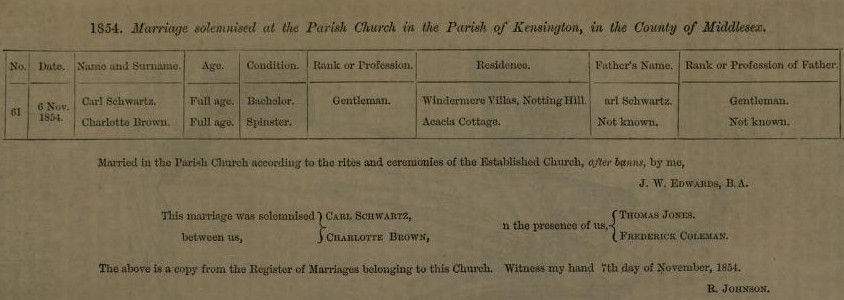
1.—Memorandum by Mr. Henderson.
In the following certificate[1] you will perceive that the lady is described as of "Acacia Cottage, Kensington." The identity of the name with that given by both Julie and Leopoldo, as the proper designation of the Baron's "medium," confirmed my suspicion that it was in fact to the girl Rosalie that the Baron was married under that name, notwithstanding the strong opinion of Julie as to the impossibility of such being the case. Still, however, it was possible that this might, after all, be a mere coincidence; and I therefore proceeded to make such inquiries as seemed most likely to elucidate the point. I had considerable difficulty in finding the house, which two or three years back was included in the regular numbering of the row of similar tenements in which it stands; but I at last succeeded in identifying it. I found the landlady a very deaf old person, whose memory was evidently failing, and was at first unable to extract from her any kind of information on the subject, except that "she had had a great many lodgers, and couldn't be expected to know all about all of them." In the course of a second visit, however, I succeeded in persuading her to favour me with a sight of her books, and looking back to October and November, 1854, I found the sum of 2l. 5s., entered as payment from Miss C. Brown of three weeks' rent, from the 18th October to the 8th November.[2] On further examining the books, I found that at this time, while the other lodger was charged sundry sums for fire, Miss Brown, though occupying the principal sitting-room, had no fire at all during the whole time of her tenancy, though the commencement of November in that year was unusually cold. There were also sundry other little charges invariable in the other cases, but omitted in the case of Miss Brown; and at length, on these things being pointed out to her, the old lady managed to remember that the rooms had been taken by a gentleman for a lady who was to give lessons in drawing. The gentleman had paid the three weeks' rent in advance, and had specially requested that they might be kept vacant for her, as the time of her arrival was uncertain. He had also begged that any letters or messages received for her should be sent to a certain address immediately. After a great deal of searching, this address was at length found, and proved to be the square glazed card which I enclose.
2. Letters or messages for Miss Brown to be forwarded immediately to care of
Baron R**, Post Office, Notting Hill.
The old lady further stated that she never saw the gentleman again, and that she had never seen the lady at all. In fact, after payment of the money, nothing further had been heard of either of the parties concerned; and as no inquiries had been made for Miss Brown, the subject had altogether passed from her mind.
Being thus pretty well satisfied of the identity of Madame R**, my next care was to trace the proceedings of the Baron between the time of his marriage and the death of his wife, which took place, as you are aware, in London, about two years and a half subsequently; the insurances having, as you well know, been effected at about the middle of this period. The information afforded me by Dr. Jones, the medical man who signed the certificate to your office in connection with the policy on the life of Madame R**, first gave me the required clue, and you will, I think, find in the depositions immediately following, sufficient, at all events, to justify, if not entirely to corroborate, the suspicions which first gave rise to my inquiries. It is certainly unfortunate that here, too—as in the case of Mr. Aldridge, whose letter first aroused these suspicions—the witness on whose evidence the principal stress must be laid, is not one whose testimony would probably carry much weight with a jury. Such, however, as it is, I have felt it my duty to lay it before you; and I will now leave it, with such other as I have been able to collect, to tell its own tale.
3.—Statement of Mrs. Whitworth.
My name is Jane Whitworth. I am a widow, and gain my living by letting furnished apartments at Bognor, Sussex. The principal season at Bognor is during the Goodwood races, and there are very few visitors there in the autumn and winter. On the 6th October, 1854, I let the whole upper part of my house to a lady and gentleman, who arrived there late that evening. They gave some foreign name; I forget what. It was some long German name. They did not give the name at first. Not till I asked for it. I don't know that the gentleman was particularly unwilling. I said I wanted it for my bill; and he laughed, and said it did not matter,—anything would do. Then I said, if letters came, and he said:—"Oh! there won't be any letters," and went on reading the paper. I went down stairs, and as I was going down he rang, and I went back, and he told me of his own accord. That was at the end of the first week when I was making out my bill. They said they intended remaining for some weeks. It was the gentleman who said this. The lady took no part in the business, and seemed out of spirits, and very much afraid of her husband. He settled with me to take the apartments at thirty shillings a week. He was to remain as long as he liked. Not beyond the next race week, of course. We never let over the race week. He also made an agreement with me about board. I was to find for him and the lady, and the servant, for 2l. 15s. a week. That was without wine, beer, or spirits. It is not a usual arrangement. We do it sometimes—not often. The gentleman said it was because his wife was not well, and could not be troubled. The servant was his. It was a maid. She did not come with them. The gentleman hired her at Brighton. That is not a usual arrangement. Certainly not. I never made such a one before, and I told him so. He said it was because he was so particular about his servants. He said he never would live where the servants were not under his own hand—where he could not turn them away. I said I did not like it, it was not the custom. He said he was sorry, but he could not take the apartments without it, and then I gave way. Afterwards he followed me down stairs, and gave me to understand it was something about his wife. At first, I thought she was not quite right in her head. That was from what he told me. I said I should be afraid to have her in the house, but he laughed, and said it was not that. I then supposed it must be temper. He was very pleasant about it. He was always very pleasant to me. I don't know what he may have been to other people. I always had my money to the day, and he was always pleasant. I can't say better than that. He got a servant a few days after they came. I did not turn away my own. I had none at the time. The season being over, it was a great chance whether I let again, and I sent my servant away, and did for myself. A charwoman did for the gentleman till he got a servant. He got one from Brighton. I recommended two or three in Bognor, but they did not suit. The one he got was a girl about twenty. Her name was Sarah Something. I did not think much of her. I used sometimes to think my tea and sugar went very fast. I never caught her taking anything. She was very quiet and civil-spoken. She stayed with the gentleman about a month; not quite. She was sent away for giving the lady a dose of physic in her arrow-root to make her sick. The lady was very bad indeed. We thought she would have died. She was dreadfully sick, and had the cholera awfully bad. This was the 9th of December.[3] I know it from my books. The gentleman sent out for brandy and several things, and they are down in my book. On the following morning he sent for some stuff from the chemist.[4] Before that he had given her some medicine himself. I don't know what it was. He had a lot of chemicals and things. He kept them in a back room. The lady had a doctor. Not at first. Not till the Monday after she was ill. I asked him to send for one, but he said he was a doctor himself. She continued very ill, and on the Sunday night I asked him again. He said if she was not better next morning, he would. I wanted him to send for Dr. Pesketh or Dr. Thompson, but he would not. He said they were no good. I have always heard them very highly spoken of. Dr. Pesketh I have always heard of as a first-rate doctor. He is since dead. Dr. Thompson is a very good doctor, too; but Dr. Pesketh, perhaps, had most practice. I don't think the gentleman knew anything about either of them. He sent for a Doctor Jones, who was in lodgings in the Steyne. I believe he lived in London. He prescribed for the lady while he stayed in Bognor. He went away the week after. He was only there a fortnight. The gentleman heard of him through a friend of mine in the Steyne. He asked me to find out whether there was no London doctor in the place. He would not have any one who belonged to the place. He said country doctors were no good. The lady got better, but very slowly. She was ill several weeks. When she was strong enough they went away. He was very attentive to her. Never left her alone for a minute hardly. She did not seem very fond of him. I think she was afraid of him, but I don't know why. He was very kind to her, and always particularly civil. Sometimes she seemed quite put out like by his civility. I thought sometimes she would have flown out at him. She never did fly out. He always seemed able to stop her. I don't know how he did it. He never said anything; only looked at her; but it was quite enough. I thought she must have been doing something wrong, and he had brought her to Bognor to be out of the way. I do not know exactly what made me think so. It was the way they went on, and what he said to me. He never told me so. It was from things he said. I did not talk much to the lady. I thought her very ungrateful when he was so kind. Then she was hardly ever alone. Only once when the gentleman went out for something. Then she was left about an hour. She was writing part of the time. She borrowed writing materials of me. There were none in the sitting-room. There usually were, but the gentleman had sent the inkstand downstairs. He said it was sure to be upset. I lent the lady the things, and she gave me two letters for the post. She did not say anything to me; only asked me to post them immediately. One was addressed to Notting Hill. I noticed that because I have a sister living there; the other was to some theatre. I forget where. It struck me, because I thought it odd that a lady should write to a theatre. I didn't think it was right. I would rather not say what I thought. Well, it was that she was connected with some one there. Improperly, of course. The letter was not addressed to a man. It was "Miss Somebody," but that might be a blind. I thought this might account for her behaviour to her husband. I was very angry. A woman has no business to go on so. It is particularly bad when she has such a good husband. I did not say this to her. I did not notice the address till I got down-stairs. I kept the letters, and told the gentleman when he came in. He seemed very much vexed. He took the letters, and was very much obliged to me. He put the letter to the theatre into the fire without opening it. The other he said he would post himself. I don't know whether he did post it, or not. I suppose so, of course. I think he spoke to the lady about it. I am sure he did, for that night when I went up, I could see she had been crying, and she would never speak to me again. She spoke English quite well. The letters were addressed in English. When she spoke to the gentleman it was generally in some foreign language, but she could speak English perfectly. I do not know what became of the girl, Sarah. I think she went into service again at Brighton. I know the gentleman gave her a character. He was very kind to her. He was always very kind. He was the pleasantest and most civil-spoken gentleman I ever met, and I think his wife behaved very bad to him.
4. Statement of Dr. Jones, of Gower Street, Bedford Square.[5]
I am a physician, residing in Gower Street, Bedford Square. In the beginning of December, 1854, I was suffering from a severe cold, and being unable to shake it off, went for a fortnight to the sea for change of air. I selected Bognor, because I had been in the habit of spending my holidays there for two or three years. I was lodging in the Steyne. Some few days after my arrival, I received a message requesting me to call and see a lady who was dangerously ill at a lodging in another part of the town. At first I declined to go, not wishing to interfere with the established practitioners of the place. A gentleman then called upon me, who gave the name of the Baron R**. He informed me that the lady in question was his wife, and that she was dangerously ill from the effects of a considerable quantity of emetic tartar, administered to her by the maid. He was very urgent with me to attend, saying that he was in the greatest anxiety about his wife, and that he could not in such a case sufficiently rely upon the skill of any country doctor. He pressed me so strongly, that I at length consented to accompany him to his lodgings. I found the patient in a very exhausted condition, and evidently suffering from the effects of some irritant poison. From what the Baron told me, the symptoms were much abated, but the purging still continued, accompanied with severe griping pains and profuse perspirations. I learned from the Baron that, being himself a good amateur chemist, and having accidentally discovered at the outset the origin of his wife's illness, he had so far treated her himself, rather than trust to the chance of a country physician. He described his treatment, which appeared to me perfectly correct. On becoming satisfied of the cause of the disturbance, he first promoted vomiting as much as possible by the exhibition of tepid water, and afterwards of warm water, with a small quantity of mustard. When no more food appeared to be left in the stomach, he then administered large quantities of a saturated infusion of green tea, of which he had a few pounds at hand for his own drinking, and, finally, at the time of my arrival was exhibiting considerable doses of decoction of Peruvian bark: both which remedies are recommended by Professor Taylor in cases of antimonial poisoning. Their action left no doubt on my mind as to the origin of the symptoms; but by desire of the Baron I proceeded to analyse with him portions of the vomited and excreted matter, as also a portion of the arrow-root in which the tartarised antimony was supposed to have been administered. To all of these we together applied the usual tests,—viz., nitric acid, ferrocyanide of potassium, and hydrosulphuret of ammonia,—and succeeded in ascertaining beyond doubt the presence of antimony in all three. The quantity, however, appears to have been small. So far as we could ascertain, there could not have been more than one, or at the most two grains of tartarised antimony in the arrow-root, of which not much more than three parts was eaten. I cannot account for the violent action of so small a quantity. I have frequently administered much larger doses in cases of inflammation of the lungs without ill effect. Two grains is by no means an unusual dose when intended to act as an emetic; but the action of antimony varies greatly with different constitutions. Having certified ourselves of the presence of the suspected poison, the question was, as to the person by whom it had been administered. The Baron said he had no doubt that it was a trick on the part of the servant maid, between whom and her mistress there had been some dispute a few days since. We therefore determined on taxing her with it; but before doing so, proceeded to examine a bottle of prepared tartar emetic, which, as the Baron informed me, he kept for his own use, being subject to digestive derangement. He was, I believe, addicted to the pleasures of the table, and was in the habit of taking an occasional emetic. The bottle was not in its usual place, but was standing on the table at the side of the dressing-case in which it was usually kept. It was labelled, "The emetic. One tea-spoonful to be taken as directed." I remarked that it should be labelled "poison," and the Baron quite agreed with me, and immediately wrote the word in large characters on a piece of paper and gummed it round the bottle. We then weighed the contents of the bottle, from which three doses only had been taken by the Baron, and, on comparing the results, we found that a quantity equivalent to about one grain and a-half of the tartarised antimony had been abstracted in excess of this amount. The servant maid was the only person besides the Baron who usually had access to the apartment; and we at once sent for her and taxed her with having administered it to Madame R** in the arrow-root before mentioned. My own counsel was to give her immediately in charge, but the Baron pointed out, very justly, that there was nothing to show the girl that she was doing anything that could possibly affect life; and that, in the absence of any motive for such a crime, it was only fair to conclude that nothing was intended beyond a foolish practical joke. He said the same to the girl, and spoke to her very kindly indeed. At first she altogether denied it, and pretended to be quite astonished at such an imputation. The Baron, however, looked steadily at her and said, "Take care, Sarah! Remember what I said to you only three days ago." She did not attempt then to deny it any longer, but said she was very sorry, but she hoped the Baron would forgive her. The Baron said he could not possibly retain her in his service, and she then begged of him not to send her away without a character. At this time I interfered, and said he would be very wrong to send her into any other family after playing such a trick. She again protested she had meant no harm, and the subject then dropped, the Baron saying he would take time to consider of it. From that time I attended Madame R** until my return to London, when she was clearly recovering. I did not enter into any conversation with her, as she seemed very reserved and of an unsociable disposition. The Baron seemed an unusually attentive husband. Talking over the subject of the seizure a day or two afterwards, he informed me that the death of his wife would also have been a severe loss in a pecuniary point of view, as if she lived she would inherit a considerable fortune. I asked him why he did not insure her life, and he said he should now certainly do so, but had not before thought of it. He called upon me about two months later, in passing through town, and informed me that he intended to travel abroad for some months. I recommended the German baths, and on his objecting to the crowds of English there, suggested Griesbach or Rippoldsau, in the Black Forest, where Englishmen are rarely to be encountered. It was too early for either place at that time, and I recommended the south of France until the season was sufficiently advanced. I did not see him again till October, 1855, when he again called upon me with Madame R**, who seemed perfectly restored, and of whom I had no difficulty in reporting most favourably to the —— Life Assurance Association, as also some weeks later to the —— Life Office of Dublin, when applied to for my professional opinion. I think Madame R**'s was an excellent life, and there could be no better proof of it than her entire recovery in the course of a very few months, or indeed weeks, from so severe an illness. The sensitiveness to antimony would not affect this opinion. Indeed Professor Taylor, in his work on poisons, points out distinctly the "idiosyncratic" action of antimony and other medicinals on certain constitutions, as "conferring on an ordinary medicinal dose a poisonous instead of a curative action." I have a copy of his work now before me, in which he says that "daily experience teaches us that some persons are more powerfully affected than others by an ordinary dose of opium, arsenic, antimony, and other substances;" and again, in considering the probable amount of the "fatal dose," he speaks of "that ever-varying condition of idiosyncracy, in which, as it is well known, there is a state of constitution more liable to be affected by antimonial compounds than other individuals apparently in the same conditions as to health, age," &c. I did not, therefore, nor do I now, consider the sensitiveness of Madame R**'s constitution to that medicine any objection to her life, especially in view of the immense vitality shown by her recovery. With regard to the sleep-walking, I have had no hint from the Baron of such a propensity on the part of Madame R**. Certainly it was never suggested that she could have poisoned herself in that way. Indeed the servant girl admitted the act. The mode of Madame R**'s death does not in any degree shake my confidence in my former opinion, as such an occurrence might have happened, though by no means likely to do so, to any one in the habit of walking in their sleep, a propensity which in Madame R**'s case I had no means of ascertaining. I have been enabled to be thus precise in my statement, from the fact that the interesting nature of the case led me to make a special memorandum of it in my diary, from which the above is taken. I shall therefore have no difficulty in confirming any portion of it upon oath.
5. Statement of Mrs. Throgmorton.
Mrs. Throgmorton presents her compliments to Mr. R. Henderson, and begs to inform him that the girl Sarah Newman, who is still in her service, and continues to give entire satisfaction in every way, came to her about Christmas, 1854, with a written character from the Baron R**, then residing at Bognor, and with whom she had been as housemaid and parlourmaid for some weeks. The character given by the Baron was a most satisfactory one, but on Mrs. Throgmorton's desiring to know the reason of Sarah Newman's leaving the situation, she was informed by the Baron that it was on account of her having played a foolish trick upon her late mistress by administering an emetic to her without authority, a highly reprehensible proceeding, which rendered Mrs. Throgmorton very much indisposed to receive her into her family. On further correspondence with Sarah Newman's late master, however, Mrs. Throgmorton received the impression that the fault had, in point of fact, been chiefly on the side of Madame R**, though, of course, as a gentleman, impossible to say so directly with respect to his own wife, and Mrs. Throgmorton therefore agreed to take Sarah Newman on trial, as she appeared truly penitent for her most reprehensible conduct, and has since proved a very valuable servant in every respect. Mrs. Throgmorton trusts that this information will be satisfactory to Mr. Henderson, as he appears interested in Sarah Newman's welfare, in whom Mrs. Throgmorton herself takes great interest.
Cliftonville.
6. Statement of Mr. Andrews.
"SIR,
"In reply to your letter of the 25th ultimo, I beg to inform you that the girl, Sarah Newman, certainly was in my service at Brighton for a month or two in the summer of 1854, but was discharged, I think, in September of that year, for various petty thefts. She was a very interesting girl, and took us in completely, but was accidentally discovered by one of our children, and after full proof of her delinquencies, turned away without a character. My own wish was to prosecute her, which indeed I considered almost a duty to others by whom she might hereafter be plundered, but I was persuaded to relinquish my intention by my wife, who had taken a great fancy to her. About two months after her dismissal, a gentleman, who gave some German name—I cannot now remember it—called to inquire our reasons for discharging her, and I then informed him of the whole case. He questioned me pretty closely as to my real opinion of the girl, stating that he was philanthropically disposed, and would give her a chance for reform, if there was any likelihood of her availing herself of it. I told him frankly my own opinion, viz., that the girl was a hardened offender; but my wife was very eager that she should have another chance, and I have very little doubt the German gentleman took her. He was, so far as I remember, a stout good-natured looking man, and he had with him a young lady whom he left in the carriage, and who was, he said, his wife. I think the name you mention—Baron R**, is the same name as that given—or at least something like it—but cannot be quite sure. I am, "Dear sir, "Faithfully yours, "CHARLES ANDREWS.
"P.S.—My wife begs me to ask that should you know anything of the after-career of her protégée you will kindly communicate it to us.
"R. Henderson, Esq., &c. &c. &c., "Clement's Inn, W.C."
7. Statement of Sarah Newman.
N.B. This statement was not obtained without considerable difficulty, and must be taken for whatever it may be worth. The girl was naturally anxious to be secured against the possible consequences of her own admissions, and I only at last succeeded in inducing her to speak out by means both of a promise on the part of Mrs. Throgmorton not to discharge her, and a threat of police interference, if she did not confess the whole truth. I have, myself, no doubt whatever of the correctness of her statement as it now stands, and it is, as you will see, corroborated in several very important particulars, but whether it could be produced before a jury, or, if it were so, what effect it would have upon their minds, are both very doubtful questions. R. H.
My name is Sarah Newman. I was in the service of Mr. Andrews at Brighton for three months. I was discharged by him for stealing tea and sugar. Mr. Andrews wanted to take the law of me, but my mistress would not let him. My mistress would have kept me on, but master said, No. She was always very kind to me, and it was very ungrateful of me to rob her. I would never do so again. My present mistress is very kind to me, too. I have never robbed her of a pin. I declare to goodness I have not, nor I never will steal from anybody again. I have often wanted to tell Mrs. Andrews so since, but did not know where she was. I did not say it to her when I left. I felt quite hard like, because of master. I was out of place two months after that. No one would take me without a character. At last a friend at Bognor told me of a gentleman, and I got her to speak to him. It was the Baron. He came to see me one day when he was at Brighton. He insisted on knowing all about me—where I had been and why I had left Mr. Andrews. He was very kind, and said it was hard a poor girl should be ruined for one false step. He said if I would promise never to steal again he would give me a trial. I promised him faithfully, and he at last took me down to Bognor with him. I do not know whether he made any inquiries about me. I think not. He did not tell me he had. I meant to keep my promise. Indeed I did, and I did keep it, almost. I mean I only took one little thing, and I really did not think that was stealing. Nothing was ever locked up. The Baron always insisted on having the tea-chest and other things left open in case he wanted some. I never took any. I might have taken a great deal, but I did not. I used to think sometimes things were left on purpose to tempt me, but of course that was fancy. Often there were coppers left about, but I never touched them. I did take one thing at last. I did not think it was stealing. It was only some orange-marmalade. I am very fond of sweet things. One day there was a pot of orange-marmalade. It was left on the table. It was after they had gone away from breakfast. I couldn't help it. It looked so nice. I just put in my finger. That was all. I declare to goodness that was all. I did not even taste it. The Baron came back and caught me. He did not say anything. He just shut the door close and walked straight up to me. I was so frightened I could not move. He took hold of my wrist and held up my hand. I burst out crying. He said it was no use crying; I had deceived him, and must go. He said if he did his duty he ought to give me up to the police. I said indeed I had taken nothing, but only that little taste of sweets. He said who would believe me with my character? He spoke very kind but very stern, and I was dreadfully frightened. I begged of him not to give me up, and he said he would give me one chance more; but I must go away. I said if he turned me out without a character I might as well drown myself at once. I begged him to let me stay; but he said that was impossible. Then I begged him not to say why I was sent away. He said, what else could he say? I begged him again very hard. At last he said he would think over it. He said he would try and make some other excuse for my going, but I must go next day, positive. He told me if he did make an excuse for me to be very careful not to contradict him. I was very grateful to him. He is a kind good gentleman, and I shall always bless him for it. I did not go next day. I was kept by my mistress's illness. She was very bad indeed. I did all I could for her. I hoped the Baron had forgotten and would let me stay. He sent for me two or three days afterwards. There was another gentleman with him. It was the doctor. He charged me with having given some stuff to my mistress to make her sick. Of course I denied it. I never gave her anything, I never had any quarrel with her at all. She was always very good-natured to me, but I did not like her much. I don't know why. I think it was because she did not like master. I said I had given her nothing. No more I had. I never saw the bottle, and don't know what it was. I cannot read at all. I saw master look at me, and he said something about two or three days ago. I knew then that he was making an excuse to send me away. He made signs at me to abide by what he said, and I did abide by it. The other gentleman was very hard, but of course he did not know. What the Baron said was given as a reason for my going away. That was all. The real reason was my taking the marmalade. If you ask the Baron he will tell you so. I hope you will tell him how grateful I am for his kindness to me.
SECTION V.
1.—Memorandum by Mr. Henderson.
We have now reached a point in this mysterious story at which I must again direct your attention most particularly to the coincidences of dates, &c., on which, indeed, depends entirely, as I have before said, the only solution at which I have found it possible to arrive.
The length to which these depositions have run has obliged me to divide them into distinct sections, each of which should bear more directly upon some particular phase of the case. For this purpose I have taken, as you will have perceived, first the early history of Mrs. Anderton, and as we may, I think, fairly assume, of Madame R** also, thus establishing, at the outset, the initiatory link of that chain of connection between these two extraordinary cases, which, inexplicable as either is in itself, will nevertheless, I cannot but imagine, each help to elucidate the other. The second division placed us in possession of the histories both of Mrs. Anderton and Madame R**, up to the point at which the thread of their singular destinies crossed; showing, also, how the Baron became aware of his wife's probable relationship to Mrs. Anderton, and of the benefit thereby accruing to her upon the death, without issue, of her sister and Mr. Anderton. The third section deals with the first illness of Madame R**, to the date and circumstances of which I felt it right to direct your most particular attention.
In the fourth division of the evidence we then reviewed the circumstances attending the fatal illness of Mrs. Anderton, which led to her husband's arrest on suspicion of murder, and finally to his suicide, while awaiting investigation. A considerable portion of the evidence connected with this phase of the subject I have thought it best to keep back for insertion in that division of the case which bears more particularly upon the conduct and death of Mr. Anderton, and which will follow that on which we are now about to enter. The narrative, therefore, of Mrs. Anderton's last illness has been thus far confined to the mention of it in the unfortunate lady's own diary, with the note at its termination, in which her husband records the fact of her decease. With this, however, I have coupled an account, drawn partly from an earlier portion of the same diary, and partly from the statement of the medical man by whom she was at the time attended, of a previous illness very similar in general character to that by which she was finally carried off, and apparently of an equally unaccountable description. The object with which I have thus placed in juxtaposition the first attacks respectively of Madame R** and Mrs. Anderton will probably be sufficiently apparent. I have now to direct your attention to a second illness of Madame R**, occurring, under what I cannot but feel to be most suspicious circumstances, but a very few months before her demise.
In proceeding with this portion of the case, the extreme importance attaching to a thorough and correct appreciation of the dates of the various occurrences will become more obvious at every step, and to them I must again request your utmost attention. I had at first proposed to submit to you in a tabular form the singular coincidences to which I allude, but on reflection, such a course appeared objectionable, as tending to place too strongly before you a view of the subject with which I must confess myself thoroughly dissatisfied. I have, therefore, preferred leaving entirely to yourselves the comparison of the various dates, &c., limiting myself strictly to a verification of their accuracy. In many instances this has been no easy task, and more particularly in establishing satisfactorily the exact date (5th April, 1856), at which the symptoms of Madame R**'s second illness first appeared, wherein I have experienced a difficulty only compensated by the importance of the result.
I have, therefore, to request that the depositions here following may be carefully compared with the concluding portion of Mrs. Anderton's diary, and also with the statement of Dr. Dodsworth. In making this comparison you will notice, besides the points I have already referred to respecting dates, various discrepancies between facts as actually occurring and as represented to Mr. and Mrs. Anderton by the Baron. These I need not here particularise, as they will be sufficiently obvious on a perusal of the depositions themselves, but it is as well to draw your attention generally to them, as they seem to have a significant bearing upon other parts of the case.
I must request you also to bear in mind the relation in which the Baron and his wife were supposed to stand towards each other previously to their marriage, and will now proceed to lay before you the depositions relating, as I have said, to the second illness of the latter.
2.—Statement of Mrs. Brown.
My name is Jane Brown. I am a widow, and my poor dear husband was a clerk in the city. I don't know in whose house. I did know but I forget. My memory is very bad. I live in Russell Place. The house is my own, not hired. My poor dear husband left it to me in his will. I sometimes let it off in lodgings. Not always. Only when I can get quiet lodgers. Last year[1] I let the first and second floors to Baron R**. The ground floor was let to Dr. Marsden. He has had it several years. He does not live there. He has a practice near London. He comes to Russell Place every Monday and Friday to see his patients. He used to live with us. That was in my poor dear husband's lifetime. Baron R** took the rest of the house except the attics. I lived there myself. I cannot remember when the Baron came. It was some time in February or March. I am sure I cannot remember. I have no means of ascertaining. I don't keep any accounts. My poor dear husband always kept the accounts. I have kept none since he died. I dare say I lose money by it, but I can't help it. I have no head for it. I am pretty sure it was in February or March. I think about the beginning of March.[2] There was no other lodger then. Not till my son went away from home again. He was away from home then. He came home some time in March or April. I suppose it was in March. He came from Melbourne to Liverpool. He was at home for some weeks. I can't tell how many. He went away again in April, or it might have been May. I am almost sure it was not later than May. Not so late I think. Mrs. Troubridge could tell you. Richard married her daughter. Richard is my son. He married Ellen Troubridge. That was while he was at home last year. They had been engaged ever so long. He came home on purpose to marry her. He had got a promise of something at Melbourne, and was obliged to go back directly. He worked his passage home from Melbourne. I do not know what ship he came in. I don't think he shipped in his own name. I forget why it was. Something about not liking to have it known. I don't know why not. I don't know at all what name he took. I cannot remember when he came home or when he went. I do not know when he left Melbourne. He brought home one paper. There is only a small piece of it left. He was with me all the time he was at home except Saturdays and Sundays. He used to go down to Brighton then to see Ellen. She was in a shop there. He used to go by the excursion train and stay with her mother from Saturday to Monday. All the rest of the time he was with me. That is all I can tell you about him. The other lodger was a friend of his. He had known him in Australia. He asked him to his wedding. That was at our house. It was on a Monday, and he came the Saturday before. They all came up together from Brighton. The Baron let us use his rooms. He went away somewhere to give his lady change of air. I think it was because she had been ill. I cannot be sure. She was ill several times at my house. She died there. I forget when was the first time she was ill there. It was while my son was in England. I remember talking to him about it. He was away from home at the time. There was no one in the house but myself. I remember it because I was so frightened. There was nobody at all. Not even a servant. I generally have a servant. I was without one then for two or three months. I got a charwoman to come in the day. The reason was my servant got tipsy. She had to be taken away by the police and I was afraid for a long while to get another. I can't at all remember when that was. I think it must have been before the Baron came. I can't be sure. I am quite sure it was before Madame R** was taken ill. I am sure of that because I remember so well how frightened I was. I think Dr. Marsden attended Madame R**. He used to be very friendly with the Baron. Everybody liked him. He was so good-natured and so very kind to his wife. We did not think so much of her. She was very quiet, but she did not seem to care about him. She seemed frightened like. I sometimes thought she was not quite right in her head. The Baron was always kind to her. He was good-natured with everybody. I never heard him say a hard word of any one but once. That was of young Aldridge. He was Richard's friend who lodged with us.[3] He made a noise and disturbed Madame R**. He came home one night quite intoxicated, and the Baron asked me to give him notice. He said if Mr. Aldridge did not go he must. Of course I gave him notice directly. He said it was all spite. Of course I knew that was not true. He said he was not drunk, but the policeman found him lying on the doorstep. I forget what he said. It was some foolish story about the Baron. I do not know of any reason why they should have quarrelled. I remember he said something once about Madame R** walking in her sleep. I don't know what it was. I don't think that could have had anything to do with it. Of course it could not. The Baron complained of being disturbed. That was all. I do not remember that I was ever disturbed myself. His room was next to mine. I might have been disturbed without remembering it. I certainly was that night he came home intoxicated. He might have disturbed Madame R** and I slept through it. I sleep heavy sometimes. I forget when this was and when he left the house. I cannot remember the exact dates of anything. My poor dear husband always did everything of that sort for me. He was a very exact man. I have no sort of books or papers of any kind to which I could refer. This is all I can tell you about it.
3.—Statement of Mrs. Troubridge.
My name is Ellen Troubridge. My husband is a seafaring man. He is captain of a small collier. We live at Shoreham, near Brighton. I have one daughter, whose name is Ellen. She is married to a man of the name of Richard Brown. He is in Australia. He went out to Australia in 1856. I forget the exact date. It was some time in April or May. The ship's name was the Maria Somes. She sailed from Gravesend. My daughter was married on the 14th of April. That was not very long before they sailed. She had been engaged to young Brown for three or four years. He came home on purpose to marry her. I don't remember exactly when he came home. It must have been about a month before. Something of that kind. He was in a great hurry to get out again. He wanted to marry by license, so as to be quicker, but I told him it was a foolish expense. He had the banns put up the first Sunday he was at home. I think it was the first, but cannot be quite sure. My daughter was then in service. She was at a shop in Brighton. During the week she used to sleep at a friend's house, and on Saturdays she used to come home to us for Sundays. Brown used always to come down on Saturdays. He used to come by the cheap excursion train. He used to go to Brighton and call for Nelly, and walk with her to Shoreham. He used to walk back with her early Monday morning, and go on to town. He never came at other times. It was no good. Nelly was only at home Sundays. He wanted her to leave and go to his mother's. She would not leave the shop till her time was out. I would not let him be at Brighton. I was afraid people might talk. So far as I know, he was at home all the rest of the time. The marriage took place from Mrs. Brown's house. She had a lodger then—a foreigner, I think. He went out of town for two or three days, and lent her his rooms. After the wedding young Brown and my daughter went to Southend for a few days. I cannot say exactly how long. About a week or a fortnight. On the Saturday before they sailed we all went down to Gravesend to meet them and see them off. The ship was to have sailed on the Sunday. We all went to Rosherville, and slept at Gravesend that night. I had some friends there who gave us beds. Mrs. Brown went back on Sunday, but I stayed. A young man by the name of Aldridge was with us. He was a friend of Brown's. I did not much like him. He went back with Mrs. Brown. I think he took lodgings in her house. I cannot call to mind the exact day young Brown came home. I think it must have been some time in March.
4.—Statement of Dr. Marsden
My name is Anthony Marsden. I am a physician, and formerly resided at Mrs. Brown's house, in Russell Place. Some three or four years ago I found the atmosphere of London beginning to tell upon my health, and determined to remove into the suburbs. I bought a small practice in the neighbourhood of St. John's Wood, and gave up the greater portion of my London patients. I was, however, desirous of not altogether relinquishing that connection, and with this object rented two rooms at Mrs. Brown's, where I might be consulted by such patients as I still retained in that neighbourhood. I used to drive up for this purpose every Monday and Thursday morning. I had been doing this for some time, when the first and second floor apartments were taken by the Baron R**. I did not at first much like him. I thought him an impostor. He seemed, however, to wish to make my acquaintance, and I found that he was, at all events, a very highly informed man on all matters of science. We had frequent conversations respecting mesmerism. He certainly seemed to be himself a believer in it. Were I not myself thoroughly satisfied of its impossibility, I am not at all sure but that he might have convinced me on the subject. I am quite unable to account for many of the phenomena exhibited. They were, however, of course, to be accounted for in some way. He seemed a very excellent chemist, and we used at times to pursue our investigations together. There was a small room at the back of the house, on the basement floor, which he used as a laboratory. He invited me to make use of it, and I was frequently there. He was always engaged in experiments of one kind or another, and had various ingenious projects in hand. In the laboratory was a large assortment of chemicals and medicines of various kinds. In the case of poor patients, I have sometimes asked him to make up a prescription, and he has done so. At the time at which I knew him, he was engaged in a series of experiments on the metals, and more especially on mercury, antimony, lead, and zinc. I think he must have had almost every preparation of these that is made. I believe that his researches were for the purpose of finding a specific against the disease so prevalent among painters, which is known by the name of "lead colic." The laboratory was at the back of the house, and quite detached from all the other rooms. There was an open space between it and the rest of the house, with only a passage communicating with the offices. This passage was shut off by a glass door, and there was a wooden door at the end into the laboratory. Both these doors were always kept closed. They were not usually locked. I told the Baron I thought they should be, but he said no one would go there. He had a weight put on to the laboratory door to close it. The glass door had a spring already. I frequently made use of his laboratory: sometimes when he was absent. I might go there with or without him, whenever I pleased. There was no attempt at concealing from me anything whatever that was done there. It was all quite open. I attended Madame R** through greater part of her illness. It was a very long affair, and of a very singular character. I cannot be at all certain as to the date at which it commenced. I was not regularly called in at the time, and did not notice it in my book. The Baron only consulted me in a friendly way about it, two or three days afterwards. It was certainly as much as that. I think it was the third day. I cannot be sure of that, but I am quite sure it was at least the second. By being the second day, I mean that at least one clear day had intervened between the night on which she was ill and the day on which I was consulted by the Baron. I cannot swear to more than one, but I think it must have been. From what the Baron told me of the symptoms, I remember concluding it to be a case of English cholera, but she was almost recovered at the time I first heard of it, and I did not prescribe for her. About a fortnight or three weeks after this she had another slight attack, for which the Baron himself also prescribed. He acquainted me on my visit to town with the course he had pursued, and I entirely concurred in his treatment of the case. The attack, however, returned, I think more than once, and he then asked me to see and prescribe for her. I first saw her professionally on the 23rd of May, 1856.[4] This was two days after the third or fourth attack, which occurred on the night of the 21st of May. As soon as I regularly took up her case, I made notes of it in my diary. Extracts from this are inclosed (vide 5 herewith), showing the progress of the case from time to time. I attended her throughout her illness. The attacks occurred, as will be seen from my diary, about every fortnight. They increased in intensity up to the 10th of October, 1856. At this time she was apparently, for three or four days, almost in articulo mortis, and I was unable to hold out any hope of her recovery. Another attack would certainly have been fatal. Happily the disease appeared to have spent itself, and at the expiration of the fortnight no renewal of the more acute symptoms was experienced. From this date Madame R** progressed steadily but slowly to convalescence, and would no doubt have ultimately entirely recovered, but for the unfortunate accident which put an end to her life. Madame R**'s case was one of great difficulty. It was apparently one of chronic gastritis; but its recurrence in an acute form at stated intervals was a very abnormal incident. The case presented, in fact, all the more prominent features of that of chronic antimonial poisoning recorded by Dr. Mayerhofer in Heller's Archiv., 1846, and alluded to by Professor Taylor in his work on Poisons, p. 539. There were also strong points of general resemblance to the other cases of McMullen and Hardman, quoted by Professor Taylor at the same page, and recorded in Guy's Hospital Reports for October, 1857. As matters progressed, I took the opportunity of pointing this out as delicately as I could to the Baron, and asked if he had any suspicions of foul play. He seemed at first almost amused by the suggestion; but upon further consultation was inclined to take a graver view of the matter. We went carefully through the cases in question, the Baron translating that of Dr. Mayerhofer for my benefit, as I was not a German scholar. At his suggestion, we determined to analyse the various excretions, &c., and an examination was accordingly instituted in the Baron's laboratory. He was always very particular in keeping up the supply of medicine, and would never allow the bottles, &c., to be thrown away. There was therefore some remnant of every medicine that had been made up for her. These we tested carefully, as well as the excreta, &c., both for arsenic and for antimony, but without finding the slightest trace of either. The analysis was conducted by the Baron, who took the greatest interest in it. I could not, perhaps, have done it myself. Such matters have not come within my line of practice. In such a case I should certainly not trust to my own manipulations. I trusted to those of the Baron, because I knew him to be an expert practical chemist, and in the daily habit of such operations. My own share in them was limited to the observation of results, and their comparison with those pointed out by Professor Taylor. I did not take any special pains to ascertain the purity of the chemical tests employed or of their being in fact what they were assumed to be. That is to say, when a colourless liquid with all the apparent characteristics of nitric acid was taken from a bottle labelled "Nit. Ac." I took for granted that nitric acid was being employed. Similarly, of course, with the other chemical agents. It never occurred to me to do otherwise. Nor did I take any especial precautions to identify the matters examined. Others might certainly have been substituted; but if so, it must have been done by the Baron himself. It was, perhaps, possible that he might have conducted his investigations, under such supervision as I then exercised, with fictitious tests, and it was quite so to substitute other matters and mislead me by subjecting them to a real analysis. That is to say, this would have been possible to be done by the Baron. No one else could, under the circumstances, have done it, or at least without his direct connivance. I had no ground for any suspicion of the kind, nor do I see any now. I think it most unwarrantable. Every circumstance that came under my notice goes equally to contravene such a supposition. The Baron was devotedly attached to his wife: he supplied her liberally with professional advice, as also with nurses, medicine, and every necessary; his care for her led him to precautions which, in their incidental results, must have inevitably exposed any attempt at the administration of poison. During the severer period of the disorder, he had no opportunity of attempting such a crime, as he universally insisted on both food and medicine being both prepared and administered by the nurses; he himself rendered every assistance in the endeavour to detect any such attempt when its possibility had been suggested by myself; and lastly, Madame R** did not die, although the investigation had already removed all suspicion. I think such an imputation wholly unwarranted and unwarrantable from any one circumstance of the case.
5.—Extracts from Dr. Marsden's Diary[5]
MAY 23rd.—Madame R**, nausea, vomiting, tendency to diarrhoea, profuse perspiration, and general debility. Pulse low, 100. Spirits depressed. Burning pain in stomach—abdomen tender on pressure. Tongue discoloured.
26th.—Madame R** slightly better—less nausea and pain.
30th.—Madame R**. Improvement continues.
JUNE 2nd.—Madame R** improving.
6th.—Ditto.
9th.—Recurrence of symptoms on Saturday evening.[6] Increased nausea, vomited matter yellow with bile. Pulse low, 105. Throat sore, and slight constriction. Tongue foul.
13th.—Symptoms slightly ameliorated. Treatment continued.
16th.—Ditto. Tongue slightly clearer. Pulse 100.
20th.—Improvement continued. Pulse slightly firmer.
23rd.—Ditto.
24th.—Special visit. Return of symptoms last night. Great increase of nausea and vomiting—very yellow with bile. Throat sore and tongue foul. Abdomen very tender on pressure. Slight diarrhoea. Tingling sensation in limbs.
27th.—Slight improvement.
30th.—Continued, but slight. Pulse firmer.
JULY 3rd.—Improvement continued, especially in throat. Perspiration still distressing. Less tingling in limbs.
6th.—Improvement continued. Pulse somewhat firmer, 110.
(10th to 20th.—Absent in Gloucestershire.)
20th.—A slight rally. Baron says attack shortly after last visit, but recovery for time more rapid.
24th.—Improvement continues, but less rapid. Pulse 110.
27th.—Recurrence yesterday. Vomiting, purging amounting to diarrhoea. Soreness and aphthous state of mouth and throat. Perspiration. Pain in abdomen. Complains of taste in mouth like lead. Pulse low, 115. Qy. antimony? Speak, Baron.
31st.—Analysis—satisfactory. Symptoms slightly abated.
AUGUST 3rd.—Improvement continued. Pulse 112, firmer.
7th.—Same.
10th.—Return of vomiting and purging. General aggravation of symptoms. Much prostrated.
24th, 28th, 31st.—Slight improvement.
SEPTEMBER 4th.—Improvement continued, but slight.
7th.—Return of severe symptoms. Vomiting, extremely yellow, much bile. Diarrhoea. Pulse low and fluttering, 120. Violent perspiration. Slight wandering. Extreme soreness and constriction of throat. Slight convulsive twitchings in limbs. Great exhaustion and prostration.
10th, 14th, 18th.—Very slight abatement of symptoms.
21st.—Violence of symptoms increased. Pulse 125. Great prostration.
25th, 28th.—Very slight amelioration. Pulse 125. Wandering.
OCTOBER 1st, 4th, 8th.—Symptoms slightly less severe.
11th.—Aggravation of all symptoms. Pulse 132, low and fluttering. Face flushed and pale. Much convulsive twitching in limbs. Power of speech quite gone. Entire prostration. Can hardly live through night.
12th, 13th, 14th.—Special visits. No perceptible change.
15th.—Pulse a shade firmer, 136.
N.B.—From this date recovery slow but steady.
6.—Memorandum by Mr. Henderson.
From the very vague nature of the foregoing evidence, so far as dates are concerned, it was, as you will at once perceive, no very easy task to determine the precise day of Madame R**'s first attack. To the view of the case, however, which I was even then inclined to adopt this was a matter of the last importance, and I determined to spare no effort to elucidate it if possible from the very loose data furnished by the depositions. In this I have, I think, been successful; but, as the process has been somewhat complicated, I must ask you to follow me through it step by step.
The difficulty of tracing the truth seemed at first sight not a little augmented by the fact that no one had been in the house but Mrs. Brown herself, whose memory, even had it afforded any clue, could not have been relied on. On further consideration, however, I began to fancy myself mistaken in this respect, and finally conceived a hope that this very fact might, if properly handled, prove an assistance instead of an obstacle to my investigation. The following was the course of reasoning I pursued.
There are only two points on which Mrs. Brown appears to be certain; her son's presence in England, and her being herself alone in the house on the actual day in question. The only chances of success therefore seemed to be:—First, in ascertaining precisely the limit of time within which such a combination was possible; and, second, in determining by a process of elimination the actual day or days on which such a combination could fall.
The result has been far more complete than at the outset of the investigation I could venture to hope.
1st. For the period of time to which our researches should be directed.
This was obviously limited by the residence of Richard Brown in England, and my first efforts were therefore directed towards determining the exact dates of his arrival and departure.
1. On inquiry at Liverpool, I found that the only vessels which had arrived from Melbourne during the month of March, 1856, were as follows:
Ship.Captain.Owners.Arrived.
James BainesMcDonaldJas. Baines & Co4th March
LightningEnright"24th "
EmmaUnderwoodPilkington Bros27th "
Of these the James Baines left Melbourne on the 28th November, and the Lightning on the 28th December. The exact date of sailing of the Emma I have not been able to ascertain, but it is immaterial to the case.
The fragment of newspaper preserved by Mrs. Brown has no date, nor could I at first find any clue by which it might be determined. The last paragraph, however, commences as follows:
SEASONABLE WEATHER!—The thermometer has, for the last four days, never been lower than eighty degrees in the shade. We wonder what our friends in England would say to singing their Ch... rols in such a....
The remainder is torn off, but the missing syllables are clearly Christmas Carols, and this shows clearly that the paper must have been published after the departure of the James Baines on the 28th November. Richard Brown must therefore have come home either in the Lightning or the Emma, the earliest of which reached Liverpool on the evening of the 24th March. The 25th of March therefore is the earliest date from which our examination need commence.
2. From Mrs. Troubridge, mother of the young woman to whom Richard Brown was married during his stay in England, I learned that the young couple sailed for Sydney in the Maria Somes. Mrs. Brown was unable to give me the date of this vessel's departure, but a search through the file of the Times for April, 1856, shows that she left Gravesend on the 23rd of that month. The period to be analysed is therefore confined to the interval between the 25th March and the 25th April, 1856.
3. During this period, as we learn from Mrs. Brown's statement, Richard Brown was at home every day except Saturdays and Sundays. These were respectively, 29th and 30th of March, and 5th, 6th, 12th, 13th, 19th, and 20th of April.
4. Dr. Marsden, in his evidence, states most distinctly that he did not see Madame R** until at least "one clear day" had elapsed after her attack. Dr. Marsden's visits take place on the Monday and Friday of each week. Madame R**'s seizure therefore did not occur on a Sunday. This reduces the days on which it may have happened to the 29th March and 5th, 12th, and 19th April.
5. From Mrs. Troubridge's evidence we learn that Mrs. Brown and the whole party slept at Gravesend on the Saturday night previous to the sailing of the Maria Somes. Mrs. Brown was therefore absent from town on the 19th April. The issue is thus narrowed to the 29th March and the 5th and 12th April.
6. From Mrs. Brown's statement we learn that on the Saturday and Sunday preceding the wedding her son's friend Aldridge slept at the house. The wedding took place on the 14th April. On the 12th April, therefore, Mrs. Brown was not alone. The only days, therefore, on which the occurrence, as described, could have taken place are the 29th March and 5th April.
At this point I feared for some time that my clue was at an end. This would, however, have been most unsatisfactory, as the possible error of a week in point of date would have seriously detracted from the trustworthiness of the entire case. The only possible chance of determining the point seemed to lie in ascertaining the precise date of the servant's dismissal, and it at length occurred to me that this might be accomplished by means of the police records of the court before which she was carried. From them I found—
7. That the offence for which she was discharged was committed on Sunday, the 30th of April. On the 29th, therefore, she was still in Mrs. Brown's house. The only day, therefore, on which Madame R**'s first seizure could have taken place as stated during Richard Brown's stay in England, and on a night when Mrs. Brown was alone in the house, was the 5th of April.
The importance of this date, thus fixed, you will, I think, at once perceive.
SECTION VI.
1.—Memorandum by Mr. Henderson.
We have now arrived at a point in this extraordinary case at which I must again direct your attention to the will of the late Mr. Boleton. By this will 25,000l. was, as we have seen, bequeathed to Miss Boleton (afterwards Mrs. Anderton), with a life interest, after her death, to her husband. At his decease, and failing children by his marriage with Miss Boleton, the money passed to the second sister, whom, as I have before said, we may, I think, be justified in identifying with the late Madame R**. It seems, at all events, clear, both from the circumstances attending the marriage of the Baron, and from the observation made by him at Bognor to Dr. Marsden relative to the pecuniary loss he would have sustained by the death of his wife, that the Baron himself believed and was prepared to maintain this relationship, and that the various policies of assurance effected on the life of Madame R**—to the gross amount of 25,000l., the exact sum in question,—were intended to cover any risk of her death before that of her sister. This is all that we need at present require. What import should be attached to the degree of mystery with which the whole affair both of the marriage and of the assurance seems to have been so carefully surrounded will, of course, be matter for consideration when reviewing the whole circumstances of the case. It is enough for our present purpose that the Baron clearly looked upon his wife as the sister of Mrs. Anderton, and calculated upon participation, through her, in the legacy of Mr. Boleton. The lives of Mr. and Mrs. Anderton thus alone intervened between this legacy and the Baron's family, and we have thus established, on his part, a direct interest in their decease.
On the death of Mrs. Anderton, under the circumstances detailed in an earlier portion of the case, the life of her husband only now stood in the way of Baron R**'s succession, and it is important to bear this in mind in considering, as we are now about to do, the various circumstances attendant on the death of that gentleman.
The chain of evidence on which hangs, as I have so often said, the sole hypothesis by which I can account for the mysterious occurrences that form the subject of our inquiry, is not only of a purely circumstantial character, but also of a nature at once so delicate and so complicated that the failure of a single link would render the remainder altogether worthless. Unless the case can be made to stand out clearly, step by step, in all its details, from the commencement to the end, its isolated portions become at once a mere chaos of coincidences, singular indeed in many respects, but not necessarily involving any considerable element of suspicion. It is for this reason that I have, as before stated, endeavoured to lay before you in a distinct and separate form each particular portion of the subject. Hitherto our attention has been entirely occupied with the death of Mrs. Anderton, and with various attendant circumstances, the bearing of which upon that occurrence will be more clearly shown hereafter. We have now to consider the very singular circumstances attending the lapse of the second life—that of Mr. Anderton—intervening, as we have seen, between Mr. Boleton's legacy and Madame R**.
For the purpose of this inquiry, I propose adducing pretty much the same evidence as that given at the inquests held on the bodies of Mrs. and Mr. Anderton. The final result of the former of these inquests was, as you are aware, a verdict of "Died from natural causes," though the case was at first adjourned for a fortnight in order to admit of a more searching examination of the body, during which time Mr. Anderton remained in custody in his own house. In the latter case the jury, after some hesitation, returned a verdict of "Temporary insanity, brought on by extreme distress of mind at the death of his wife, and suspicions respecting it which subsequently proved to have been unfounded." Our present concern, however, being with the conduct of the Baron rather than with that of Mr. Anderton, I have omitted portions not directly bearing upon this part in the matter, and have endeavoured to procure such additions to the evidence of Doctor Dodsworth and others as might serve to further elucidate the subject of our inquiry.
I now therefore lay before you this portion of the case with especial reference to its bearing upon the proceedings of Baron R**.
2.—Doctor Dodsworth's Statement.
I was in attendance on the late Mrs. Anderton during the illness which terminated fatally on the 12th October, 1856. I was first sent for by Mr. Anderton, on the night of the 5th of April[1] in that year. I found her suffering apparently from a slight attack of English cholera, but was unable to ascertain any cause to which it might be attributed. There was nothing to lead to any suspicion of poisoning, indeed this seemed to be rendered almost impossible by the length of time that had elapsed since the last time of taking food and that at which the attack commenced. This was at least three or four hours; whereas, had the symptoms arisen from the action of any poisonous substance, they would have shown themselves much earlier. This is only my impression from after consideration. No idea of poison occurred to me at the time, nor should I now entertain any were I called in to a similar case. I prescribed the usual remedies for the complaint under which I supposed Mrs. Anderton to be suffering. They appeared to have their effect, though not so rapidly as I should have expected. The symptoms appeared rather to wear themselves out. I visited her several times, as the debility which ensued seemed greater than, under ordinary circumstances, should have followed on such an attack. About a fortnight later she had a fresh seizure, of a very similar kind. This time, however, the symptoms were aggravated, and accompanied by others of a more alarming character. Of these the most conspicuous were nausea, vomiting, violent perspiration, and increasing tendency to diarrhoea. The patient also complained of great sinking of the heart, and of a terrible lowness of spirits, almost amounting to a conviction that death was at hand. In the course of another fortnight or three weeks there was a fresh recurrence of the symptoms. The tongue, which in the former attacks had been clammy and dry, was now covered thickly with dirty mucus, and there was a greatly increased flow of saliva. The condition of the tongue became greatly aggravated as the disease progressed, the mouth and throat becoming ultimately very sore, with great constriction of the latter. The abdomen was distended, and very tender to the touch, the liver also being very full and tender. Pulse low and rapid, decreasing in fulness as the disease progressed, and reaching finally to 130 or 140; and the depression of spirits and sinking at the heart considerably increased. The patient appeared to be daily losing strength, and at each attack, which seemed to return periodically at intervals of about a fortnight, the same symptoms appeared more severely than before. Mr. Anderton seemed to be in the deepest distress. From the time when the symptoms first became serious, he hardly ever left her side, administering both food and medicine with his own hand. So far as I am aware, Mrs. Anderton took nothing of any kind from any other person throughout the greater portion of her illness. I have heard her say this herself, in his presence, shortly before her death. For the last few weeks she took scarcely any nourishment, and could with difficulty swallow her medicine. The principal cause of this difficulty lay in the extreme nausea which followed any attempt to swallow, but it was greatly increased by the painful and constricted state of the throat, which was extremely rough and raw, and rendered swallowing very painful. As the disease progressed the vomited matter became strongly coloured with bile, and was of a strong yellow colour. The opression on the heart also increased, until at length respiration was almost impeded. The heart and pulses also gradually lost power, and latterly the lower portion of the body was almost paralysed, the limbs being stiff, and the whole frame, from the waist downward, very heavy and cold. The patient also suffered from severe cold perspirations, as well as from heat and irritation of the upper portion of the body, and from entire inability to sleep. A very remarkable feature in the case was, that notwithstanding this general sleeplessness, each fresh attack of the malady was preceded by a sound slumber of some hours duration, from which she appeared to be aroused by the return of the more active symptoms of the disorder. I tried all the usual remedies indicated by such symptoms, but without any permanent effect, and I was a good deal perplexed by the anomalous appearance of the case, and especially by its intermittent character, the symptoms recurring, as I have said, with increased severity, at regular intervals of about a fortnight. I mentioned my difficulty to Mr. Anderton, and asked if he would wish further advice. At his urgent request I consented, though with some hesitation, to meet Baron R**, who holds, as I was given to understand, a regular diploma from several of the foreign Universities, but whose practice has been of a somewhat irregular character. I first consulted with him on the 12th July.[2]
[Dr. Dodsworth here details at some length how he became convinced of the Baron's great skill and knowledge of chemistry, and was finally persuaded to meet him in consultation.]
After examination of the patient, however, and some conversation as to the nature of the symptoms and of the remedies employed, I had some difficulty in drawing from him (the Baron) any expression of opinion. He appeared, however, to agree entirely in the course hitherto pursued, and after some further conversation we separated. The consultation took place in Mrs. Anderton's dressing-room, and in passing by the wash-hand stand on his way out, the Baron suddenly took up a small bottle which was standing there, and turning sharply upon me, asked "if I had tried that?" On taking it from his hand, I found that it contained tincture of tannin, a preparation much used for the teeth. I was somewhat startled by the suddenness of the question, and replied in the negative, on which the subject dropped. On my way home, however, I was again struck by the peculiarity of the Baron's manner in putting the question; and on thinking the matter over, the idea suddenly flashed across me that tannic acid was the antidote to antimony, and that the symptoms of poisoning by tartarised antimony, to which attention had just been drawn by Professor Taylor, in the case of the Rugely murder, closely resembled in many respects those under which Mrs. Anderton was then suffering. At the first moment this supposition seemed to account for all the mysterious part of the case; but on reflection the difficulty returned, for it seemed impossible that the poison could have been administered by any one but Mr. Anderton himself, and I felt it still more impossible to suspect him of such an act, in face of the evident and extreme affection existing between them. On mature reflection, however, I determined on trying, at all events for a time, the course suggested by the Baron, and accordingly exhibited large doses of Peruvian bark, together with other medicines of the same kind. My suspicions were at first increased by the improvement apparently effected by these remedies, and I took occasion to ask Mr. Anderton, in a casual way, in presence of the nurse and one of the servants, whether he had any emetic tartar or antimonial wine in the house. The manner of his reply entirely removed from my mind any idea that either of those present at least had any knowledge of such an attempt as seemed implied by the Baron, and on seeing that gentleman a day or two after, I questioned him as to the true bearing of his suggestion. He disclaimed, however, any such meaning as I had been disposed to attribute to his words, stating, in a general way, that he had before known great benefit to accrue from the exhibition of such medicines in similar cases, and expressing a hope that they might be successful in the present instance. Something, however, in his manner, and especially the great stress laid upon careful watching of the patient's diet while under this course of treatment, led me still to fancy that he was not so entirely without doubt as he wished me to believe; but that, on the contrary, his suspicions pointed towards Mr. Anderton, his friendship for whom made him desirous of concealing them. This opinion was confirmed by the recollection of another apparent instance of suspicion on the part of the Baron, to which, a few days previously, however, I had not at the time attached any importance. I accordingly continued the bark treatment, determining, should any fresh attack occur, to take measures for investigating the matter; for which purpose I gave private orders to the nurse, on whom I knew that I could thoroughly depend, to allow nothing to be removed from the room until I had myself seen the patient. The beneficial effects of the bark continued for about ten or twelve days, at the end of which period I was sent for hurriedly in the middle of the night, the disease having returned with greater violence than at any previous attack. Having done what was in my power to alleviate the immediate pressure of the symptoms, I took an opportunity of privately securing portions of the vomited and other matters, which I immediately had submitted to a searching chemical analysis. No trace, however, of antimony, arsenic, or any similar poison, could be detected, and as the tannic acid appeared now to have lost its remedial power, I came finally to the conclusion that its apparent efficacy had been due to some other unknown cause, and that the suspicions of the Baron were altogether without foundation. I continued the former treatment, varied from time to time as experience suggested, but without being able to arrest the progress of the disease, which I am inclined to think must have been constitutional in its character, and probably hereditary, as I learned from Mr. Anderton that the patient's mother had also died of some internal disease, the exact symptoms of which, however, he was unable to call to mind. Towards the close of the case the patient was almost constantly delirious from debility, and the immediate cause of death was entire prostration and exhaustion of the system. I wished Mr. Anderton to allow a post mortem examination, with a view to discovering the true nature of the disorder, but he seemed so extremely sensitive on the subject, and was in such a state of nervous depression, that I forbore to press the point. The Baron also seemed to discourage him from such an idea. Subsequently an order came for an inquest, and I then assisted at the analysis which followed, and which was performed by Mr. Prendergast. We found no traces of antimony in any part of the body or its contents. The report of Mr. Prendergast, in which I fully concurred, will show the result of the analysis. Looking at that, and at all the circumstances of the case, I was, and still am, convinced that Mr. Anderton was perfectly innocent of the crime imputed.
In answer to the queries forwarded at various times by Mr. Henderson, Dr. Dodsworth gives the following replies:
1. In questioning the Baron as to his suggestion respecting the tincture of tannin, I put it plainly to him whether he had been led to make it by any suspicion of poison. This he disclaimed with equal directness, but with such hesitation as convinced me that the suspicion was really in his mind.
2. I told the Baron that I had exhibited bark and other similar remedies, and with what success. He smiled, and turned the conversation.
3. The Baron was not present at the post mortem examination. He wished very much to be so, but Mr. Prendergast objected so strongly that I was obliged to refuse him. I promised, however, to let him know by telegraph the result of the examination, which took place at Birmingham, where Mr. Prendergast was living at the time. I enclose a copy of the message sent. He offered to assist in removing the intestines, &c., from the body, but this I also declined, as Mr. Prendergast had particularly requested me to allow no one to come near the body after it was opened but myself and some student or surgeon from one of the great hospitals, to render such assistance as might be necessary. The caution was, I think, a very reasonable one, and I followed it out strictly.
4. The Baron certainly seemed at first, as I thought, annoyed at being excluded, but I attributed this to his interest in the case. He did not make the request as to telegraphing at the time, but wrote to me afterwards on the subject.
5. The object of Mr. Prendergast's precaution was, of course, to prevent the body from being tampered with.
6. By tampered with I mean in such manner as to destroy the traces of the poison.
7. It would, of course, be possible to manufacture traces of poison where none had previously existed, but this could only be done with the view of fastening on an innocent person the guilt of a murder which had never been committed, and was by no means what we intended to guard against in the exclusion of his friends.
8. Certainly had such a thing been successfully attempted in this instance, it would have rendered the case conclusive against Mr. Anderton.
9. The other incident to which I have alluded as evincing suspicion on the part of the Baron, was as follows. We were one morning in consultation in Mr. Anderton's room. I wished to seal a letter. The Baron lighted a taper for me with a piece of paper which he took from the waste basket. As he did so, he appeared struck with something on the paper, and untwisted it and showed it to me. There were only a few letters on it, part having been torn off and part burned. The letters were ... RTAR EME ... and part of what was evidently a T. Beneath was the upper portion of a capital P in writing. I did not, however, take much notice of it, and the thing passed from my mind.
10. I have no doubt myself that the paper came from the waste basket. The Baron said so. I did not actually see him take it out, but I saw him stoop to do so. There was nothing physically impossible in his having taken the paper from his own pocket, but I cannot see the slightest reason for such a supposition. The only object he could possibly have had in such an act would have been that of throwing suspicion on Mr. Anderton, and his whole desire evidently was to conceal the suspicions in his own mind as far as possible.
11. The Baron gave me no other grounds for supposing that he suspected anything. On the contrary, he was continually pointing out to me the affection of Mr. Anderton for his wife, and especially the assiduity of his attendance in permitting no one else to administer either food or medicine.
12. The practical effect of all this was certainly, I admit, to impress upon my own mind the suspicious circumstances of the case more strongly perhaps than if they had been pointed out in a directly hostile manner. It is impossible, however, that the Baron could have reckoned upon this, and I feel bound to add that it seems to me exceeding the limits of legitimate inquiry to suggest anything of the kind.
3.—Statement of Mrs Edwards.
I am a sick nurse. I was in attendance on poor Mrs. Anderton all through her sickness. The poor lady was greatly cast down. She was expecting her death for weeks before it came. She seemed to think there was a doom on her. I do not think she had any suspicion that she was being poisoned. I am sure poor dear lady, no one would ever think of poisoning her, everybody loved her too much. Mr. Anderton was dotingly fond of her. I never saw so good a husband in my life. I could have done anything for him, he was so good to his poor wife. I don't think he hardly ever left her. I used to be vexed sometimes because I said he would not let me do anything for her. I mean he would not let me give her her slops or her physic. She took nothing but slops the best part of the time. She couldn't feel to relish anything at all, and meat made her vomit. For the last two months or better I don't think she took anything from anybody, excepting it was from Mr. Anderton himself. He used to bring her her physic as regular as the clock struck, and everything from the kitchen was took first into his room if he wasn't with the mistress, and he would carry it to her himself. He used to have rare work sometimes to get her to take anything. I am sure she wouldn't have done it poor lady for any one but him. Not the last few weeks. She was so very sick and ill, and everything seemed to turn upon her stomach. Mr. Anderton always slept on a mattress in the mistress's room so as to be within call. The mattress was put on the floor by the side of the bed, and nobody could have got to the bed without waking him. He was a very light sleeper. The least little sound used to wake him, and I often told him he was going the way to kill himself, and then what would our poor lady do. Once or twice I persuaded him to go out for a bit, and then he always insisted on my not leaving the room while he was away. Even when he was in his study he always made me stay with the lady, and if I wanted to go out for anything, I was to ring for him. Mrs. Anderton was never left without one or other of us for an hour until the last six weeks, when she grew so bad, another nurse had to be got. Then we three did the same way between us. We were obliged to take her because I was getting quite knocked tip. How ever Mr. Anderton kept up the way he did, I cannot think or say, but he broke down altogether when the mistress died. I don't think after that the poor gentleman was ever quite right in his head. I remember the doctor asking him one day whether he had any tartar emetic in the house. He said no, but he would get some if it was wanted. Nothing more passed at the time, so far as I know. It was brought to my mind again by something which happened after the poor lady's death. It was nothing very particular, only I found in her room a piece of paper with "Tartar Emetic" printed on it. That was all that was printed, but the word "Poison" was written under it. I kept the paper and showed it to the Baron. I don't know why I did so; I suppose because he was in the house at the time. Afterwards I showed it to the lawyer, and he took charge of it. I had no particular suspicion, none at all. I can't tell why I took it up. I did it without thinking, quite promiscuous like. I didn't show it to master because he was too ill to be worried. That was the only reason.