Front matter (continued 4)
Reading edition
But a mawther may be of any age. A baby girl is a mawther, and so is a grandame. It is a curiosity of speech which is apt to startle the stranger who first hears it applied to a girl who has hardly yet learned to toddle, in the maternal threat, to be heard any day in any Suffolk village, "Yow come 'ere, mawther, this instant moment, or I'll spank yow, so I 'ool." "Yow," of course, is the Essex, Suffolk and Norfolk shibboleth for "you," by which a native of these parts may be immediately distinguished anywhere.
When the labourers have trudged over to their "shants o' gatter," or quarts and pots of beer—the "bellywengins," or belly vengeance, aforesaid; when the children have been put to bed, and the mawthers and the hudderens have gone nannicking off together in the gathering dusk, then is the gossiping time, both of the housewives and of the labourers. The women talk at the doors of the "housen": the men mostly in the village inns. Hear, passing stranger, what the mawthers are saying:—
"Good daa to 'ee, Mrs Potter, how are ye a-gettin' arn?"
"I'm a-doin' good-tidily, thank'ee, better'n tew or tree weeks sin'. The doctor say I fare to be on the mend; but it hev bin a bad time wi' me sure."
"Ay; owd bones 'on't be young agen, I'm thinkin'; but there, 'taint so much yer aige, 'tis yer sperrut what keep ye up or let ye down."
"Ay, that be trew," says one of the group, "what be life wi'out sperrut? Nothin', in a manner o' speakin'."
"Yar father, Mrs Cobbold, he had it, and he lived to be ninety."
"What a man that wor! I mind him when he come to mine arter he'd walked from Ipswich, an' that's a good ten mile. He come to paiy a shullun he ew my ole man, and, barrin' a bit tirsty, he were as spry as a mavish and fresher'n a paigle."
A mile distant, to the right hand, lies East Bergholt, Constable's birthplace, and between it and the road still stretch in summer those golden cornfields he loved so well. "The Cornfield," that crowning achievement of English landscape, how exquisite a thing it is, radiant in colour on the walls of the National Gallery, and how ineffectually the inadequate medium of black and white attempts to translate it.
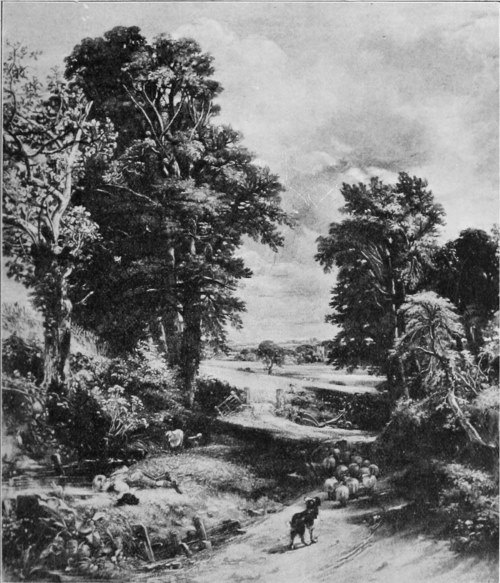
THE CORNFIELD. After Constable.
The grumbling farmer, who has good cause for his growls, poor fellow, is careful to explain his cornfields away. When asked why, if it does not pay to grow wheat, he still continues to do so, he says he grows it for the straw. At any rate, times are changed from those when agricultural England was merry with high prices; those picturesque days when the Ipswich and Norwich coaches were hailed, as every traveller was hailed, at harvest-time by the reapers' cry of "Halloo, halloo, largesse," the largesse going at harvest-home in a saturnalia at the village inn. "Largesse" has gone with the going of the reaping-hook, and with it and many other things has gone the Lord of the Harvest, elected from among his fellow-reapers to preside over their labours and their harvest-supper in the great fragrant barn or in the farm kitchen. The line of red-cheeked peasants, working from early morning with their sickles in the fierce sun upon the diminishing fields of standing wheat, with halts for levenses and bever, and so home by the light of the harvest moon, is no more to be seen: reaping-machines do the work instead. It was astonishing, and, in the haymaking fields, still is, what long and continual draughts of beer can be disposed of in the intervals of such labour. Levenses, that is to say the eleven o'clock forenoon meal, and bever, the four o'clock in the afternoon halt, whose name came through the Norman-French "bevre" from the Latin "bibere," to drink, reduced the contents of the barrels placed in the shady hedgerows, but quarts imbibed under such conditions were harmless. Almost solitary survivals of the old peasant life, the names of "bever" and "levenses" remain yet in the common speech of Norfolk and Suffolk as those of the hedgeside meals of ploughman and carter.
Old country folk still talk, in their reminiscent moments, of coaching and posting days here, when, near the tiny hamlet known as Cross Green, and in a deep dip of the high road, where a byway goes, leading from Manningtree to Hadleigh and beyond, "Laddenford Stables" stood at the cross roads that went then by the name of the "Four Sisters." Four sisters, if one likes to accept the rustic belief, agreed to part here and went their several ways, but how they fared, or what was their social status, the story does not tell.
Passing Capel St Mary and the level-crossing by Capel station, and so by Copdock, whose church tower has an odd weather-vane in the shape of King David playing his harp, Washbrook is reached at the foot of its steep hill. Copdock on the hill and Washbrook in the hollow, together with the broad and still marshy valley of the little Wash Brook, tell how that rivulet was once, in the far-off days when Saxons and Danes contended on this coast, a navigable creek, an arm of the Orwell. The road, in its sharp descent into and rise out of the valley, together with its acute bend, is also eloquent of bygone geographical conditions, leading as it does down to the place where a bridge now spans the stream on the spot where the creek was, in days of old, first fordable. Having thus crossed, the road went, and still goes, in a right-angle turn uphill, towards Ipswich.
It was by no means necessary for travellers journeying between London and Norwich to touch Ipswich. The coaches did, for obvious commercial reasons, but the "chariots" and the post-chaises commonly went from Washbrook, through Sproughton and Bramford, and joined the coach route again at Claydon, thus taking the base of a triangle, instead of its two sides. There are those at Washbrook who can still tell of the coaches that halted at "Copdock White Elm"; of the time when a toll-gate (the house still existing) stretched across the way at the foot of the hill, and of the "aristocracks" who posted the long stage between "Stonham Pie" and "Washbrook Swan." They can point out the "Swan," facing up the road and looking squarely up at the hill-top, but now a private residence with its stables chiefly put to alien uses; and can show the places, in what are now meadows, where many houses and cottages stood in those wayfaring days, when the high-lying road to Ipswich, across the uplands between the valleys of the Stour and the Orwell, was not so unfrequented as now.
XXXI
There can be no doubt of Ipswich and its surroundings having thoroughly captured the heart of grumbling old Cobbett.
"From the town itself," he says, "you can see nothing; but you can, in no direction, go from it a quarter of a mile without finding views that a painter might crave." This is not a little remarkable, for we do not generally attribute an artistic perception of scenic beauties to this practical farmer. Yet he was of one mind with Constable, of whom and his pictures he probably had never heard, although Constable had already for years been painting these very scenes.
The practical farming mind appears in Cobbett's next remarks: "And then, the country round about is so well cultivated; the land in such a beautiful state, the farmhouses all white and all so much alike; the barns and everything about the homesteads so snug; the stock of turnips so abundant everywhere; the sheep and cattle in such fine order; the wheat all drilled; the ploughman so expert; the furrows, if a quarter of a mile long, as straight as a line, and laid as truly as if with a level; in short, here is everything to delight the eye and to make the people proud of their country; and this is the case throughout the whole of this county. I have always found Suffolk farmers great boasters of their superiority over others, and I must say that it is not without reason."
Cobbett found the windmills on the hills round Ipswich so numerous that, while standing in one place, he counted no fewer than seventeen, all painted or washed white, with black sails. They are fewer to-day, and could Gainsborough, old Crome and Constable revisit the scenes of their artistic inspiration, they would sadly miss the picturesqueness they gave these woody scenes and fertile hills and vales. It is from the crest of one of these hills that Ipswich is first glimpsed. There it sprawls, prosperous, beside the broad Orwell; "doubtlesse one of the sweetest, most pleasant, well-built townes in England," as John Evelyn thought in 1656; but then swarming with "a new phanatic sect of dangerous principles." The reader will scarce guess aright who these fanatics were. They were neither sun-worshippers nor Mahometans, but merely Quakers.
One obtains no glimpse of the broad estuary of the Orwell when descending into the town by the London road, and the crowded mass of the place rises confusedly up before the traveller as he steeply descends, and forms no picture. You must take Ipswich in detail to admire it, and the actual crossing of the river at the foot of the hill where the town begins is at a narrow canalised stretch before it widens out into the noble harbour that makes the fortune of the port. A sign of that accomplished fortune is the unlovely sight of the great railway sidings and goods yards spread out before the stranger's eye as he comes downhill. One may say that the town begins at the door of the "Ipswich Arms" inn, uninteresting in itself, but displaying the fine "old coat" of this famous seaport; a shield with a rampant golden lion on a red field on the sinister, and three golden demi-boats on blue on the dexter side.
"A fine, populous, and beautiful place," says Cobbett, still harping on an unwonted string of praise. "The town is substantially built, well paved, everything good and solid, and no wretched dwellings to be seen on its outskirts." He knew no town to be compared with it, except it were Nottingham, which, after all, is not properly comparable, Nottingham standing high, while Ipswich is in a vale, and moreover, is situated on an arm of the sea. It is amusing to read Cobbett's remarks on the population of Ipswich, which stood in his time at twelve thousand. "Do you not," he asks, "think Ipswich was far larger and far more populous seven hundred years ago than it is at this hour?"—that hour being some time in March 1830. He remarked upon "the twelve large, lofty and magnificent churches," each of them seven hundred years old, one capable of holding from four to seven thousand persons, and came to the conclusion that, in fact, although he found Ipswich populous, it must, even thus, have been a mere ghost of its former self. That shrewd observer was right. Ipswich had grievously decayed even in Charles the Second's reign, when the Duke of Buckingham described it as "a town without inhabitants, a river without water, streets without names, and where the asses wore boots." The Duke, in speaking of "a river without water," was probably referring to the estuary of the Orwell at low tide, when mud-banks stretch vast, and the stream runs by comparison feeble and thread-like through them. In its then nameless streets, Ipswich was not singular, for many small provincial towns were in like case. The asses that wore boots were those employed in rolling the lawn of a neighbouring park, the object probably being to prevent their hoofs injuring the surface.
"Yepysweche," as Margaret Paston, writing to her husband over four hundred years ago, spells the name, derives its title from the aboriginal Gippings, a tribe or clan who squatted down beside the Orwell, and not only established their primitive village of Gippingswick here, but contrived to foist their tribal name upon the non-tidal part of the river above the town, which therefore still generally bears this alias. The town probably saw its greatest prosperity in the time of Cardinal Wolsey, a native, and, according to legend, son of a butcher. This "butcher's dogge," as the envious nicknamed the great Cardinal, determined that his birthplace should be great in learning as well as in commerce, and to that end founded a College which he intended to be in some sort preparatory for his greater college of Christ Church at Oxford. That his foundation was reared on the spoliation of a religious house and its revenues, procured by him for the purpose, seemed but an ill omen for its prosperity to those who saw his buildings rising to completion, and the omen was speedily fulfilled, for the new-made abode of learning never sent forth a scholar, but was suppressed by Henry the Eighth almost before the mortar of its brick walls was dry; the buildings themselves torn down and the endowments confiscated. All that remains of Wolsey's College is one noble red-brick gateway in College Street.
Daniel Defoe was a native of Ipswich and a curious contrast with Wolsey, his brother townsman of two hundred years before. In his day the old prosperity of the place had vanished, in the stress of Dutch competition and the virulence of the plague; but modern times have made amends for that temporary decay, and the town is now nearly four times larger than when, shortly after the first quarter of the nineteenth century had gone, Cobbett noted its many and empty churches and its scanty population. It numbers now over 58,000 souls, and its trades are numerous and prosperous. Whether it be in the making of agricultural and milling machinery, its corn markets, artificial manure making, or the manufacture of corsets, Ipswich is fortunate, with the good fortune of those who give heed to the ancient proverb and do not put all their eggs in one basket.
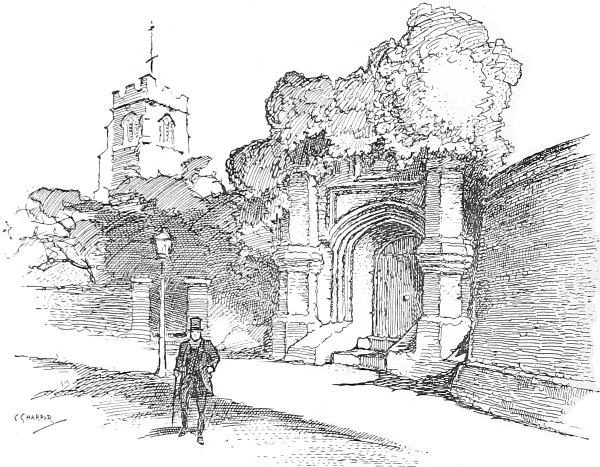
WOLSEY'S GATEWAY.
Picturesqueness coyly hides itself from the traveller who merely passes through the chief streets. Not in the open square of Cornhill, where the cabs and flys stand on the site of the old Market Cross and the trams fly to and fro, and where the Post-office and the Town Hall rise, side by side, does it appear, nor in the long street beyond; but rather in the Butter Market and the lanes that conduct to the waterside. There be streets in that quarter with odd names, among them Silent Street; and almshouses, and churches, and the queerest inns. Among the almshouses are Smart's, on whose walls, unhappily rebuilt in modern times, the charitable Smart and his no less charitable coadjutor, Tooley, are commemorated:—
"Let gentle Smart sleep on in pious trust, Behold his charity. Respect his dust." "In peaceful silence lett great Toolie rest, Whose charitable deeds bespeak him blest."
It is to be feared that these eulogies raise a smile at the expense of great Tooley and gentle Smart.
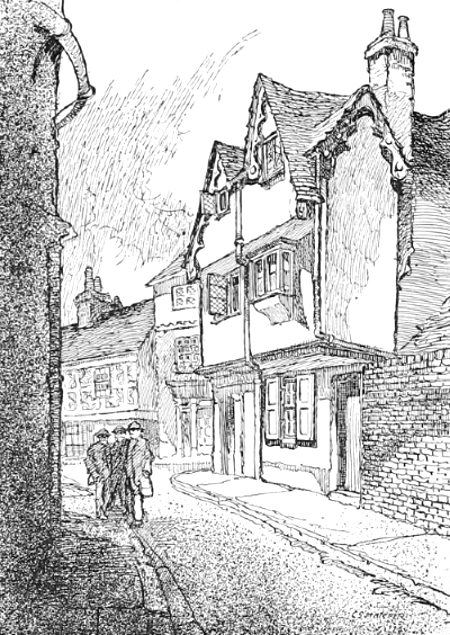
THE "LION AND LAMB," ANGEL LANE.
As to the inns, they include the odd conjunction of the "Lion and Lamb," pictured here, and the "Neptune" and the "Sea Horse," with a fine sound of the sea in their names. Some of these old hostelries yet retain their corner-posts: for example, that of the "Half Moon" in Foundation Street, where the post still keeps its mediæval carving of a fox, with uplifted sanctimonious eyes, preaching to three geese and a griffin; a satirical effort no doubt looked sourly upon by the clergy of St Mary Key Church, opposite, in days of old. A great gilt key serves as vane to that church and perpetuates the error in the name, which was originally, and rightly, St Mary-at-Quay: the custom-house quay and the harbour being close by, as the sight of certain corn-elevators, the rattling of chains and windlasses, and the sounds of throaty steam-sirens sufficiently proclaim. The custom-house stands in midst of coal-grit, laden steam vessels lying alongside the quay wall, bellowing steamily to be discharged, and railway-sidings, along whose maze of points and turn-tables fussy little locomotive engines, dragging jerky trucks, run, screaming intermittently, as though saying to the bellowing steam-vessels, "You just wait; can't you see I'm coming as quick as I can?" It is a dignified custom-house, and seems, surrounded with dutiable goods, to be aristocratically sneering at the trade in whose midst it is necessarily placed, and with as great a consciousness of its Ionic peristyle as any high-born beauty of her Greek nose.
Many of the old wool-staplers', clothiers' and merchants' fine mansions stood by the quay and in the by-lanes. They are mostly gone now, but traces of old doorways and stray fragments of stone and wood carvings remain, and here and there a courtyard, or a house that sheltered family circles in the amphibious half-mercantile, half-agricultural Ipswich of the sixteenth century.
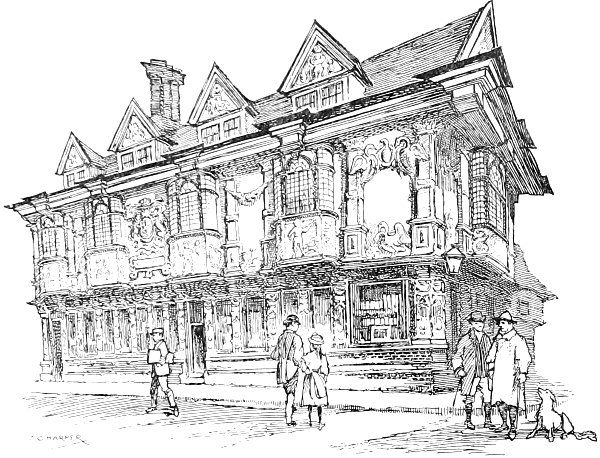
SPARROWE'S HOUSE.
Certainly one of the finest things Ipswich has to show is the wonderful old place in the old Butter Market, known still as "Sparrowe's House," although the last of the Sparrowes who inhabited here has long since gone to his home in the family vault within the Church of St Lawrence, where, over their tomb-house, may yet be read the punning motto, Nidus Passerum, "a nest of sparrows." These Sparrowes seem to have been endowed with some of the attributes of the cuckoo, for they did not build the house that bears their name. It owes its origin to a certain George Copping, who built it in 1567, but alterations and additions made in the Jacobean period give its architectural history a span of over a century. The woodwork of the bay windows and the grandly-projecting eaves, together with that of the shop premises, was added at the time. But the great glory of "Sparrowe's House" is its decorative plaster-work in high relief, which profusely covers the exterior with garlands of flowers and fruits and with quaint devices emblematic of the four quarters of the globe. Here Europa, cornucopia in one hand, book and sceptre in the other, sits with her bull, who might be taken for an elephant with half his trunk shorn off; here, on another bay, a podgy plaster relief typifies Asia, with palm-tree and a building of Oriental character in the background; followed by Africa, a nude nigger holding an umbrella over his head and sitting on a shark, at which four tiny figures at a respectful distance express astonishment, while nearer at hand a wicked-looking bird of quite uncertain family roosts on a something that greatly resembles a battered meat tin. America is typified by an Indian in a feather head-dress which represents his entire wardrobe. He stands with bow and arrows, attended by a dog with a damaged smile. A very beautiful representation of the Royal Arms occupies one of the spaces between the windows, and other devices show the pelican in her piety; Atlas supporting the world; a classical scene in which a shepherd bows as gracefully as the artist in plaster could make him to a rural nymph; St George and the Dragon, and several smaller subjects.
XXXII
The most famous thing in Ipswich is a thing neither ancient nor beautiful, yet it is an object to which most visitors to the town turn their first attention: it is the "Great White Horse." The "Great White Horse" is an hotel, of a size, in the merry days of the road, justly thought enormous. It has been left for the present age to build many hotels in town and country capable of containing half-a-dozen or more hostelries of the size of the "Great White Horse," but in its own especial era that house fully justified the adjective in its sign. Especially did its bulk strike the imagination of the reporter of the London Morning Chronicle who was dispatched to Ipswich in 1830 for the purpose of reporting a Parliamentary election in the town. He was a very young, a very impressionable and a very bright reporter, and although we may be quite sure that the business on which he was come to Ipswich was an arduous piece of work, calculated to fully occupy his time and thoughts, he carried away with him so accurate an impression of the big inn where he stayed, that when, some time afterwards, he wrote about it the description was as exact as though it had been penned within sight of the house. That reporter was Charles Dickens, and it is his description in the Pickwick Papers which has made the place famous.
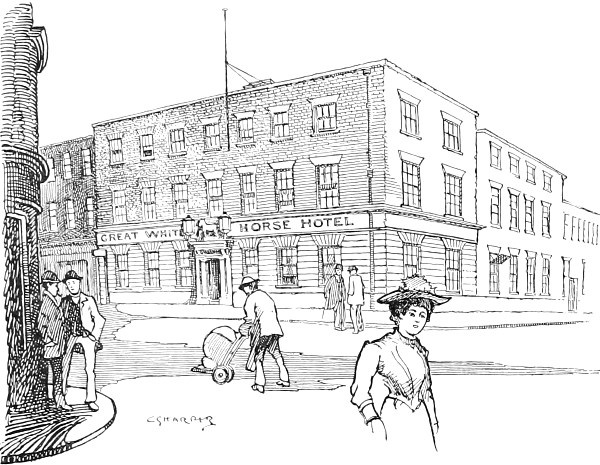
THE "GREAT WHITE HORSE."
It was not a flattering description. Few more severe things have ever been said of inns than those Dickens wrote of the "Great White Horse." Indeed, if such things were nowadays printed of any inn or hotel, the writer might confidently expect to be made the defendant in an action for libel. Yet (such is the irony of time and circumstances) the house that Dickens so roundly abused is now eager in all its advertisements to quote the association; and the adventures of Mr Pickwick in the double-bedded room with the elderly lady in yellow curl-papers have brought many more visitors than the unfavourable notice of the "uncarpeted passages" and the "mouldy, ill-lighted rooms" has turned away. If, as has been thought, Dickens thus wrote of the house in order to be revenged for some slights and discomforts he may have experienced here, certainly fortune has played the cynic in converting his remarks into the best of all imaginable recommendations.
The exterior of the house is much the same as it was when Dickens first saw it, "in the main street of Ipswich, on the left-hand side of the way, a short distance after you have passed through the open space fronting the Town Hall."
It is the same plain, square building, constructed of a pallid kind of brick suggesting underdone pastry, and is still, although the coaches have disappeared and railways have supplanted them, "known far and wide by the appellation of the 'Great White Horse.'" Still, over the pillared entrance trots the effigy of the Great White Horse himself, perhaps the aboriginal ancestor of that famous breed of equines, the "Suffolk Punches," a very muscular race, more famous for their bulk and strength than for elegance, like those sturdy Flanders mares to which Henry the Eighth inelegantly likened his bride, Anne of Cleves.
Dickens, using the usual licence of the novelist, describes this effigy as "a stone statue of some rampacious animal, with flowing mane and tail, distantly resembling an insane cart-horse, elevated above the principal door." Quite apart from the fact that the word "rampacious" is unknown to the English language, and is probably meant for "rampageous," the horse is really represented in the act of beginning a gentle trot, and looks as mild as the mildest milk that ever dewed the whiskers of a new-born kitten. His off fore-leg, broken at some period, has been restored of a size that does not match with the other three. Never, in the whole of his existence, has the Great White Horse gone on the rampage, and, like all the truly great, his manners have always been distinguished by their unobtrusiveness.
"The 'Great White Horse,'" writes Dickens, "is famous in the neighbourhood, in the same degree as a prize ox, or county paper-chronicled turnip, or unwieldy pig—for its enormous size. Never were such labyrinths of uncarpeted passages, such clusters of mouldy, ill-lighted rooms, such huge numbers of small dens for eating or sleeping in, beneath any one roof, as are collected together between the four walls of the 'Great White Horse' at Ipswich." Further, he describes it as "an overgrown tavern," at whose door, when Mr Pickwick descended from the coach, stood a waiter whose description quite takes one's desire for dinner away. He was "a corpulent man with a fortnight's napkin under his arm and coeval stockings on his legs."
Although that must have been in the best and most prosperous days of the highway, this waiter does not appear to have had anything more pressing to do than "staring down the road," while the account of the internal arrangements of the house does not indicate flourishing business. The private room into which the guests were shown was a "large, badly-furnished apartment, with a dirty grate, in which a small fire was making a wretched attempt to be cheerful, but was fast sinking under the dispiriting influence of the place." After this we are not surprised to read that it was only "after the lapse of an hour" that "a bit of fish and a steak," representing a dinner, appeared. When this was disposed of, Mr Pickwick and Mr Peter Magnus huddled up to the fire, and, "having ordered a bottle of the worst possible port wine, at the highest possible price, for the good of the house, drank brandy-and-water for their own."
Certainly Dickens must have had some very bitter grudge against the "Great White Horse."
Then come allusions to "tortuous passages," and the difficulty of a stranger's finding his way about the interminable corridors, or distinguishing between one "mouldy room" and another; difficulties which led to Mr Pickwick's comical predicament in the middle of the night. The rooms, not so mouldy now, and the passages, just as perplexing, remain, structurally unaltered to this day; but certain alterations have been made downstairs in the courtyard, now roofed in with glass and made very attractive, without spoiling the old-style character of the house. If you be a literary pilgrim, or an American, they will show you Mr Pickwick's bedroom; and can meet any of Dickens's criticisms by telling how Nelson stayed here with—ahem!—Lady Hamilton, and how Admiral Hyde-Parker and others of world-wide fame have occupied the "mouldy rooms."
XXXIII
Leaving Ipswich and passing through the dusty roadside fringe of Whitton village, known as Whitton Street, Claydon, nondescript, and neither very beautiful nor quite commonplace, is reached in two and a half miles. Just before entering the village, an old mansion is glimpsed from the road, embowered in trees, a mansion which, on inquiry, the ingenuous youth of Claydon declare to be "Mockbeggar Hall." Claydon Hall is its true title; but the popular name has been handed down since many, many years ago, when the old house (not old then) long remained tenantless. Like the many other places named "Mockbeggar," it stands well within view of passing travellers, and must have induced many a sturdy rogue and vagabond to trudge wearily up the long approach in search of alms, only to find the windows dark, the chimneys innocent of smoke, the place, in fact, deserted of all but fluttering bats and screeching owls, whose shrill notes must have sounded like jeers to the disappointed vagrants. Inhabited now, Claydon Hall is a handsome old house bearing the date 1635 on its Dutch-like gables. It will probably never lose its popular name. Behind the old Hall winds the willow-fringed Orwell, coyly approaching within view of the road, and then, as it were, timorously retreating again; its brimming stream, although seen only in such fleeting glimpses, potent in its effect upon at least three miles' length of the road, from Claydon to Creeting All Saints, in the loveliest stretch of woodland, where the fierce mid-day sun is baffled by over-arching foliage, and twilight comes early in the afternoon through the dense masses of leaves. These are the woodlands of Shrubland Park. The Hall lies secluded to the right hand, somewhere away beyond the rather terrible lodges that confront the traveller, who wonders where he has seen their like before; until, like a flash, the memory of certain great London cemeteries and their mortuary chapels comes upon him in desolating fashion and blights the cheerful rustic surroundings of forest trees and the scurryings of white-tailed rabbits and gorgeous blue and brown pheasants that inhabit this domain of Lord de Saumarez. The lodges, built like the Hall, from designs by Sir Charles Barry, are of white brick and stone, in the Italian Renaissance style.
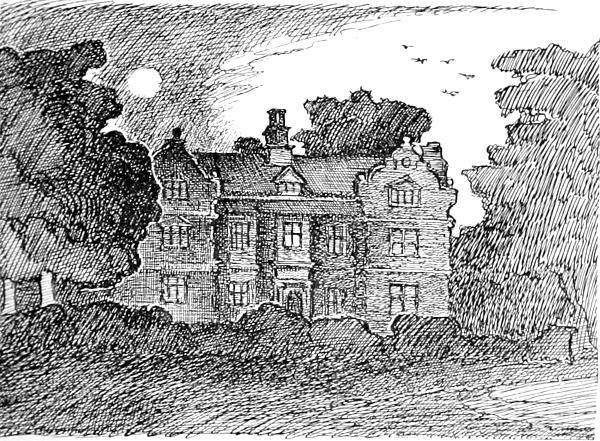
MOCKBEGGAR HALL.
At no great distance from the entrance to this lordly domain, and noticeable from the road, in an exquisitely damp situation by the river, eminently calculated to foster rheumatism in old bones, is the Barham Union-house—the "Work'us" of peasant speech. It is quite an old-world building, and one of the earliest built under the new Poor Law Act of the early nineteenth century, when outdoor relief gave place to retirement within these prison-like buildings. Hodge well named them "Bastilles." They say who should know of what they speak, that life in Barham Union is nowadays quite desirable, but the design of the building, a quadrangular structure enclosing a courtyard, with outer walls blank or only provided with windows at a height from the ground, closely follows the prison, or restraining, idea.
The little roadside sign of the "Sorrel Horse," standing in midst of these leafy bowers, is in pleasing contrast with the Campo Santo pretentiousness of Shrubland lodges or the prison-like style of the Union, now left behind on a rising road, where the scarped side of the highway reveals a momentary change from the prevailing claylands to chalk; a change so sudden and so strictly confined to this hillside that it at once attracts the attention of even the least geologically-inclined. Here the campions bloom that love the chalk and refuse to grow on clay. Below this hilltop, in the deep hollow scoured out ages ago, when the now insignificant stream that crosses the road was a considerable force, is Creeting Bottom, and Creetings of several sorts are set about the countryside, all hiding from the road that goes now up hill and down dale with as lonely an air as though the little town of Needham Market and the larger town of Stowmarket were not almost within sight, over the shoulders of the hills, on the highway parallel with this, that runs to Bury St Edmunds. To be on "on the road to Needham" is an obvious Suffolk saying, applied to those who are badly off for worldly gear, and it is a little curious that Needham itself was for many years, and until quite recently, a place of fallen fortunes, lamenting the decay of its textile trades in empty houses and an "irreducible minimum" of rent for those that were so fortunate as to find occupants at all. The name of "Hungry-gut Hall" that still clings to a farmhouse marks that depressed period to all time; but in the spicy odours of the tanneries and the chemical manure stores and other thriving industries and businesses that cluster round the railway station, the explorer finds evidences enough that Needham is reviving.
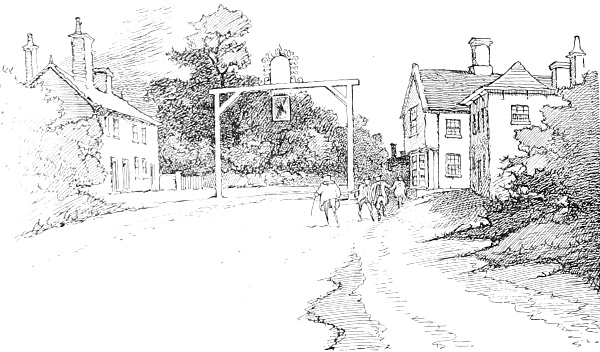
"STONHAM PIE."
Not a sign of those towns or of the railway is seen on the road to Norwich, where the cottage outposts of Stonham Earls and Stonham Aspall alone tell of the villages in the hinterland. In their gardens, spread on bushes or waving in the summer breeze, intimate articles of underclothing are prominently displayed, in the society of old hats and coats, not so much for the exhibition of the family wardrobe as in desperate attempts—bringing up all the reserves—at scaring away the hungry birds from currants, cherries and gooseberries. These contests, the only warring incidents on the way, in which the birds are generally the victors, bring one to a level road where Little Stonham stands, its chief feature the "Magpie" Inn. "Stonham Pie" owns one of those old gallows signs, stretching across the road, that were at one time a common feature. The picture-sign, with a painting of that saucy bird, has been hung below the cross-beam instead of in its old ironwork frame above, now that the piled-up coaches that once passed beneath are gone. Shortly before their going, and while turnpikes and tolls appeared likely to last for ever, the toll-gate that stood at the succeeding village of Brockford was removed two miles onward, to Stoke Ash, where, at the beginning of the pretty avenue at Stoke Chapel, the later toll-house remains, just as does the earlier one at Brockford. Brockford, the "badger's ford" of a tiny affluent of the Waveney, is preceded by Brockford Green, where the quiet road is made narrow by its sides being encroached upon by grass. It is here that the accompanying sketch of tall poplars and bushy willows was taken.
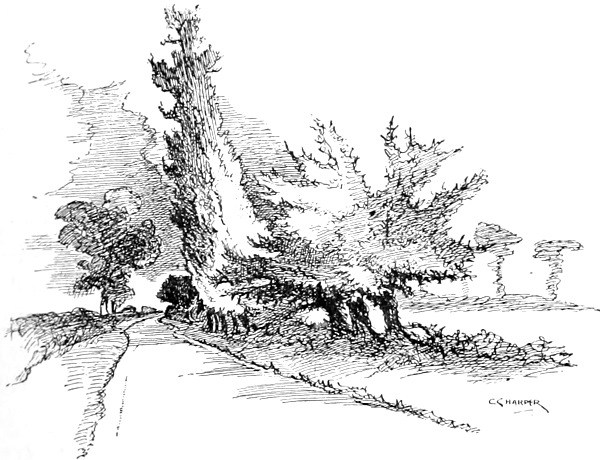
NEAR BROCKFORD.
Off to the left hand, in strong contrast with this level stretch of road, the country is tumbled into combes and rounded hills, where the River Gipping takes its rise in the village of that name, springing from the hill where the church tower stands solemn and grim, as though it held inviolate the story of the place, away from those days when the Gippings first settled here and gave it a title.
But let not the hurried seek Gipping, along the winding by-roads. The way, if not far, is not easy, and passengers are few. Scattered and infrequent farmhouses there be, at whose back doors to inquire the way, but rustic directions are apt to mislead. In any case, it is little use approaching the front door of a farmhouse. No one will hear you knocking, unless indeed it be a watchful and savage dog, trained to be on the alert for tramps; and you are like to hear him snuffling and gasping on the other side in a ferociously suggestive manner which will render you thankful that the door is closed and bolted. And not only bolted on this occasion, but always. The steps, and the space between the door and the threshold, where stray straws and wind-blown rubbish have collected, are evidence of the fact that the farmer and his family do not use the front door, but make their exits and entrances by way of the kitchen. It is an old East Anglian custom, and although many of the farmers nowadays pretend to culture and set up to be as up-to-date as the retired tradesfolk and small squires they are neighbourly with, many others would no more think of using the principal entrance to their homes than they would make use of the "parlour," where massive and sombre furniture, covered with antimacassars, is disposed with geometric accuracy around the room, in company with the family Bible and the prizes taken at school by the farmer's children; the stale and stuffy atmosphere proclaiming that this state apartment is only used on rare and solemn occasions. In fact, the "best room" and the front door only came into use in the old days on the occasion of a funeral. Perhaps it is a custom originating in a laudable idea of paying the greatest possible respect to the dead, but it is one which certainly gives a gruesome mortuary significance to both the entrance and the room.
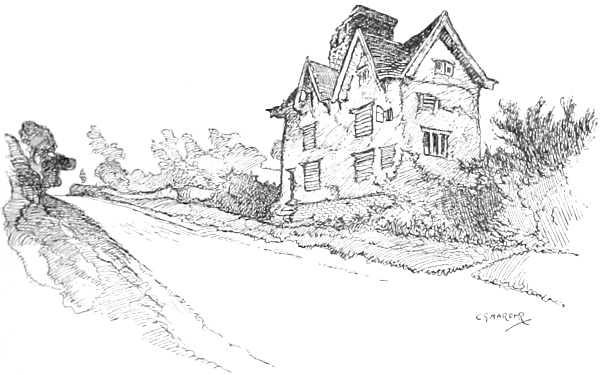
"THWAITE LOW HOUSE."
Thwaite or "Twaite," as East Anglians, incapable of pronouncing "th," call it, less than a mile beyond Brockford, numbers few cottages. Beyond it, where the hitherto flat road makes a descent, is in local parlance, "Thwaite Low House," not so called on account of any disreputable character it may once have earned, but from its situation. The name obviously entails the existence of a "High House," which was, like the other, a coaching and posting inn. The last named, now a farmstead, was in those days the "Cock," the other the "Queen's Head." While the "Low House" has fallen upon times so irredeemably evil that it has been long untenanted and is now a veritable scarecrow of a house, with gaping holes in its walls and windows battened up, the "Cock," save that its sign is gone, still remains much as it was, to show a later generation what manner of place the roadside inn was in days of yore.
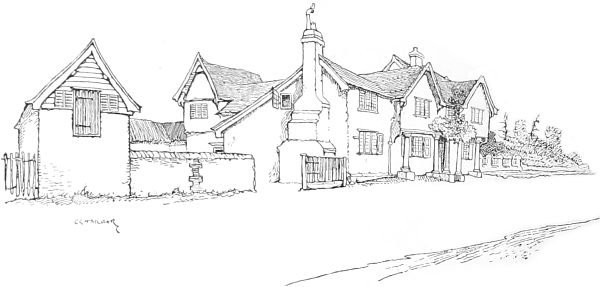
THE "COCK," THWAITE.
Stoke Ash, or "Aish," as Suffolkers pronounce it, like many another village, makes no sign from the road. Its church tower seen to the right, dimly, amid a hilltop screen of trees, a square, box-like red-brick chapel by the way, and that pretty inn, "Stoke White Horse," are the only other evidences of its being. The remaining six miles to the Norfolk border lead through Yaxley and Brome: Yaxley, where a branch railway runs under the road, on its way to Eye, and narrowly misses the old church: Brome, where the "Swan" stands for all the village to those who look to neither side of the road; church and houses skulking down a by-road on the way to Hoxne. There, down that pretty road, where the thatched cottages nestle under tall trees and the blue wood-smoke from rustic hearths curls upwards into the boughs and makes the sparrows cough and sneeze—there is the Rectory, approached in lordly fashion past a fine brick entrance and exquisite avenue, and, at a little greater distance the old black flint, round-towered church, restored and titivated out of all antiquity of tone: the stone sand-papered, and the flints polished with a handkerchief. The only thing missing—and, under the circumstances, it is missed—is a glass case, so that no damp, nor lichen, nor any effects of weather may come to spoil the housewifely neatness.
It was along this road to Hoxne that those who sought the revered head of St Edmund, King and Martyr, in the miraculous legend, were led to it by the voice calling, "Here, here, here;" at length finding the sainted relic in charge of a wolf, who allowed it to be taken from between his paws. But the voice thus calling was probably a much less supernatural manifestation, and was doubtless the hooting of owls in the woods. They still mock the belated traveller, only, to ears untuned to the miraculous, they simply seem to ask, "Who, who, who?" Ingenuity, however, vainly seeks the basis in nature of the wolf incident.
XXXIV
Now, crossing the River Waveney, winding with tree-fringed banks through a flat country, the road enters Norfolk at Scole. Coming over the little bridge, the village is seen huddled together on either side of a narrow rising road; village and church alike wholly dominated by a great building of mellow red brick whose panelled chimney-stacks and long row of beautiful gables give the impression of an historic mansion having by some strange chance been taken from its park and set down beside the highway. This, however, was at no time a private residence, but was built as an inn; and an inn it remains, after the passing of nearly two centuries and a half. Scole, or "Schoale," as the name was often spelled in old times (when, indeed, the village was not called by its alias of Osmundeston), was by reason of this inn quite a celebrated place in the days of long ago. Every traveller in Eastern England had then either seen or heard of "Scole White Hart" and its famous sign that stretched completely across the road, and as a great many coaches halted here for changing teams, passengers had plenty of time for examining what Sir Thomas Browne thought to be "the noblest sighne-post in England." Both house and sign were built in 1655, for James Peck, described as a "Norwich merchant," whose initials, together with the date, are yet to be seen on the centre gable. The elaborate sign alone cost £1057. It was of gigantic size and loaded with twenty-five carved figures of classic deities and others. Chaste Diana, with bow and arrow and two hounds, had a place on the cross-beam, in company with Time in the act of devouring an infant, Actæon and his dogs, a huntsman, and a White Hart couchant. On a pediment above the White Hart, supported by Justice and Temperance, was the effigy of an astronomer "seated on a Circumferenter," who by "some Chymical Preparation is so Affected that in fine Weather He faces the North and against bad Weather He faces that Quarter from whence it is about to come." On either side of the dizzy height occupied by the astronomer were figures of Fortitude and Prudence, a position suitable enough for the first-named of those two virtues, but certainly too perilous for the last.
Further suggestions of Olympus, with references to Hades and Biblical history, adorned the other portions of this extraordinary work. Cerberus clawed one side of the supporting post, while Charon dragged a witch to Hell on the other; and Neptune bestriding a dolphin, and Bacchic figures seated across casks alternated with the arms of twelve East Anglian noble and landed families. Two angels supported respectively the arms of Mr Peck and his lady and two lions those of Norwich and Yarmouth. On the side nearest the inn appeared a huge carving of Jonah coming out of the whale's mouth, while, suspended in mid-air, and surrounded by a wreath, was another White Hart.
Although, as we have seen, Sir Thomas Browne was impressed with this work, an early nineteenth-century tourist (so early indeed as 1801) curtly dismisses it as "a pompous sign, with ridiculous ornaments," and shortly after that it seems to have been taken down, for the reason that it cost the landlord more to keep it in repair than the trade of the house permitted. Together with this, the once celebrated Great Bed of the White Hart has also disappeared. It was a round bed capable of holding twenty couples, and was therefore a good deal larger than the famous Great Bed of Ware. Perhaps it was because guests did not relish this co-operative method of seeking repose, or maybe because sheets, blankets and coverlets of sufficient size were unobtainable, that the Scole Great Bed was chopped up for firewood; but did anyone ever suppose beds of this wholesale capacity would be desirable?
The accompanying old view of the gigantic sign shows one of the peculiar basket coaches of the second half of the eighteenth century, on its way to London.
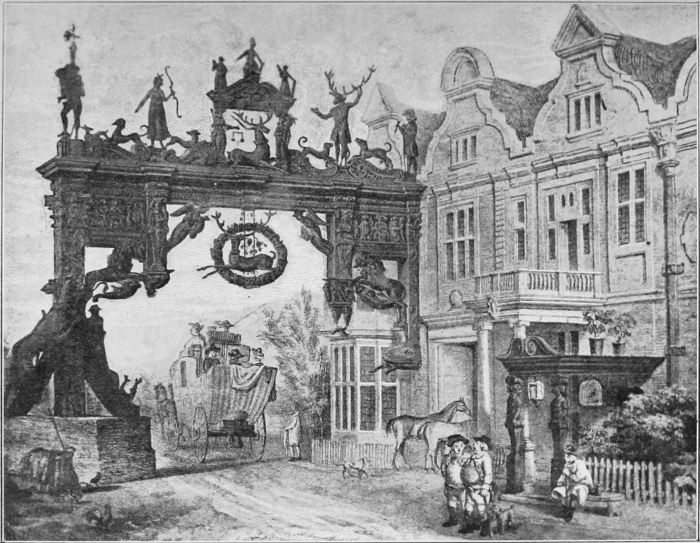
THE OLD SIGN OF SCOLE WHITE HART.
"Scole White Hart" must have been among the very finest of inns and posting-houses. Its wide staircases, of a width sufficient for the proverbial coach-and-four to drive up them, its large rooms and fine panelled doors, its great stone-flagged kitchen, all proclaim how great must have been its old prosperity; while the wide-spreading yard in the rear of the house, together with the outbuildings, gives some hint of how heavy the traffic was at this junction of the Lowestoft, Bungay, Diss and Thetford road with that from London to Norwich. Shrunken trade has caused portions of the inn to be let off; the stone and wooden porches seen in the old print have disappeared; the coach entrance has long since been blocked up and has become the bar-parlour, and the mullions of the windows have given place to sashes; but the building still retains a noble architectural character, and is perhaps more interesting in these latter days, now that its story is told, than ever it was when that story was in the making. Little or nothing is found in contemporary records of "Scole White Hart"; only one vivid flash in its later years, when indignant would-be coach passengers stood at the door on a day in October 1822 and saw the drivers of the "Norwich Times" and "Gurney's Original Day Coach," fired by rivalry, and reckless in their long race from Whitechapel, come pounding furiously down the road and over the bridge, pass the inn without stopping, and disappear in clouds of dust in the direction of Norwich. Do you know what it is to lose a train and to wait an hour for the next? You do? Then it will not be difficult to form some idea of the blind, stuttering fury that possessed those who had booked seats at Scole and saw the coaches dash away, to leave them with half a day's wait.
Thorogood was driving the "Times." Both started from London at 5.30 a.m. The "Day" coach reached Norwich at 5.20 p.m., and the "Times" ten minutes later, neither having stopped for changing horses during the last twenty-five miles. This was a "record" for that period, the usual time being fourteen hours.
Probably the would-be passengers had to remain the night; a fate which no one who has done the like of late would be apt to complain of. The guest at the "White Hart," seated in solitary state in the lofty sitting-room, lit dimly by candles in antique plated candlesticks, and with two ox-eyed seventeenth-century beauties of the Lely type gazing down upon him from their sombre frames, presently feels oddly as though he were living in another era; a feeling that grows as he wanders upstairs to bed, almost losing himself in the roomy corridors. When he has closed the nail-studded bedroom door with a reverberant clang, and, creeping into the generous embraces of a damask-hung four-poster that may have been new a century and a half ago, gazes reflectively about the panelled room and on the curiously coffered ceiling, he drops off to sleep straightway into the times when the inn was new-built and dreams of how the news of the Restoration may have come to Scole in 1661. Old times live again, faded flowers bloom once more, forgotten footsteps echo along the passages, and lo, the Has Been is enacted again, with all the convincing air of such visions. Post-chaises and chariots clatter up to the door and their noise wakens the sleeper to the consciousness that the sound is but that of a jolting rustic tumbril going down the road in the early morning; that this is the twentieth century, and the "White Hart" but a survival in a back eddy of life.
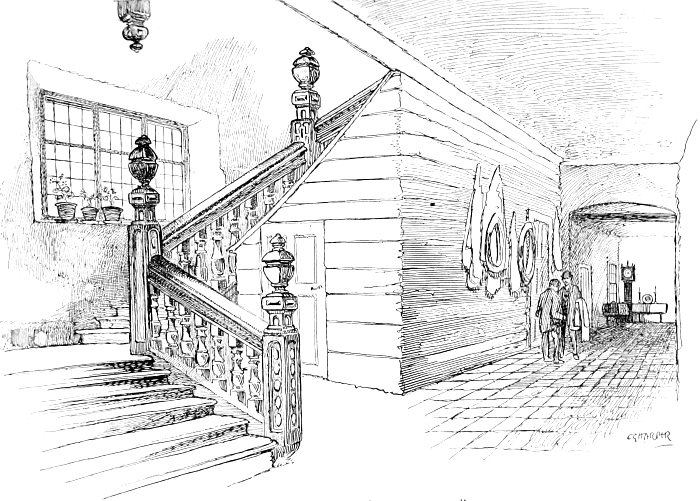
STAIRCASE IN THE "WHITE HART."
Besides the "White Hart," there is little else at Scole. The plain flint tower of the church stands by the roadside, on the ascent that leads from the village; and other two or three inns, a few rustic shops and cottages, and a private residence or so make up the tale. Scole, in fact, has not grown greatly since when it was a Roman station, and when the Roman soldiers whose remains have been found near the river occupied the military post on the long road to Venta Icenorum.
The legionaries first stationed in these East Anglian wastes must often have longed for their native Italy. When the sky sank almost to the level of the land in the long winter's rains and fogs, and the biting winds blew out of the east across the sandy scrub; when agues or the lurking enemy accounted for many of their comrades, and when some favoured few were recalled to the capital, they must have thought wistfully of a more congenial clime than this, situated on the edge of the Unknown. Rome, either as Empire or Republic, was a hard taskmaster, and when no fighting was in prospect employed the troops ingloriously as road-makers. The advanced garrisons in the wilderness cleared the enemy out of the tangled brush and boggy marshes, and working parties built roads under the protection of guards, or improved the rude trackways they found already in existence. Some fell by the way, and their skeletons have been found in these latter days, the teeth still clenched on the obolus placed in the dead man's mouth to pay Charon for ferrying him across the cold and darkling Styx; or, where the coin has perished, still stained with the metal's long decay. They perished, those pioneers, to found a civilisation, just as countless thousands of our own blood have laid their bones on distant shores, under burning skies or in the Arctic night, to make England what she is. Respect their long sleep, antiquaries, nor, as you honour your own creeds, take from the dead men their passage-money across that mystic river.
XXXV
This, as Dr Jessop charmingly names Norfolk, is Arcady. The scene is pleasant, but the stage waits: where are the actors? Gone, where and for what reasons beyond the substitution of rail for road shall presently be considered. But if the merry days of old are done and population dwindled, at least in East Anglia, and especially in Norfolk, dialect flourishes among those who remain. The "Norfolk drant" or drawl, is still heard, just as the "Suffolk whine"—that rising inflection of the voice towards the end of sentences—is even yet a mark of the sister county. They are, indeed, said to have originated the Yankee combined drawl and twang, for Norfolk and Suffolk were largely represented among the Pilgrim Fathers, the first colonists of North America. With these survivals, some of the old rustic simplicity is still met with, although the extraordinary ignorance of sixty years ago has disappeared, and the Norfolk labourer no longer thinks it possible to emigrate to America by driving over in a farm cart. The story is an East Anglian classic, how a farm labourer "didn't fare rightly to knaw" by what route they were going to the United States, "but we'm gwine ter sleep t' Debenham the fust night, so's to kinder break t' jarney." When railways came, and access to London grew easy, these simplicities gradually faded away. The young men took to "gettin' up the road," as the saying ran—otherwise, going to London—to "better themselves," and old illusions were soon dispelled; but in Arcady the mavis may still be seen knapping a dodman; the children of the rustic hamlets may be observed by the passing stranger gleefully sporting at the old game of tittymatorterin; the cowslips that in springtime turn the meadows to living gold are yet "paigles"; a small field remains, as ever, a "pightle," and when a countryman throws anything into a ditch, he "hulls" (or hurls) "it in t' holl," just as his ancestors did hundreds of years ago. Let some of the archaic words just noted be explained before we proceed any further. "Mavis" is the idyllic name of the thrush, and the "dodman," which he may be observed "knapping," or breaking, is a snail; called in Essex, by the way, a "hodmadod." "Tittymatorterin" is just the simple game of "see-sawing." Besides these fleeting instances there are many other peculiarities. The Norfolk peasant will never pronounce the letter E if it be possible to avoid it. It becomes I in his mouth, and a head becomes a "hid," while hens are "hins." Throughout the whole of the eastern counties, too, the elision of the final in the present tense is a feature of rustic talk. Examples of this peculiarity are found not only in modern speech, but in old epitaphs and inscriptions, dating back some hundreds of years. Thus, a bridge across the River Wensum, at Norwich, bears the sculptured effigy of a dragon's head with the words, "When dragon drink, Heigham sink." The meaning is that when the river rises and touches, or "rise" and "touch," as a Norfolk man would say, the dragon's mouth, the neighbouring Heigham becomes flooded. An older example still is seen on an inscription at Kimberley, to John Jenkin, in the words:—
"Under this stone rare Jenkin lie,"
while a comparatively modern one may be found in Stratford St Mary church, in the concluding lines of an epitaph dated 1739:—
'The Night is gone, ye Stars Remain, So man that die shall Live again."
Dickens has caught the East Anglian dialect readily enough in David Copperfield, where he makes Mr Peggotty say, "Cheer up, old mawther" to Mrs Grummidge, and speak of "a couple of mavishes," while Ham talks to David as "Mas'r Davy, bor." The willing Barkis, too, who asks "do she now?" and speaks of the "stage-cutch," is a true product of the soil.
For the benefit of those not to the manner born, let it be repeated that a "mawther" is not necessarily a parent. It is the generic name for a female. A "mawther" may therefore be a girl infant or a grown woman. "Bor" is, of course, a corruption of "neighbour," but need not, in fact, specifically mean a neighbour, and is practically the masculine of "mawther," and applicable to any man; friend close at hand or stranger from distant parts.
The Norfolk dialect has attained the distinction of being made the subject of study, and glossaries and collections of local words have long been made by enthusiasts in these matters. Perhaps the most interesting and amusing of the examples of Norfolk talk is found in the East Anglian version of the Song of Solomon, published many years ago by Prince Louis Lucien Bonaparte. It was taken down from a reading by a Norfolk peasant. A few verses will be instructive:—
1. The song o' songs, as is Sorlomun's.
2. Lerr 'im kiss me wi' the kisses of his mouth; for yar love is better 'an wine.
3. Becaze o' the smell o' yar intements, yar name is as intements pored out, therefoor du the mawthers love yĕ.
4. Dror mĕ, we'll run arter yĕ: the king he ha' browt me into his charmbers; we'll be glad and reījce in yĕ; we'll remahmber yar love more 'an wine: the right-up love yĕ.
5. I em black, but tidy, O ye darters o' J'rusal'm, as the taents o' Kedar, as the cattins o' Sorlomun.
6. Don't sin starrin' at me, cos I em black, 'ecos the sun t'have barnt mĕ; my mother's children wor snāsty wi' me; they made me keeper o' the winyerds, but m'own winyerd I han't kept.
7. Tell onto me, yow hu my soul du love, where ye fade, where ye make yar flock to rest at nune: fur why shud I be as one tarn aside by yar cumrades' flock?
8. If so bein' as yĕ don't know, O yow bootifullest o' women, go yer ways furth by the futtin' o' the flock, and feed yer kids 'eside the shepherds' taents.
9. I ha' likened yow, O my love, to a taamer o' hosses in Pharer's charrits.
10. Yar cheeks are right fine wi' ringes of jewiltry, yer neck wi' chanes o' gold.
The full flavour of this vernacular is only to be obtained by reading the original verses side by side with the above.
Among the sports that obtained on the borders of Norfolk and Suffolk of old was "camping." "Camping" was an old East Anglian game that, could it be revived, would please the footballing maniacs of our own day. It was a wild kind of football, played on these commons, often with a hundred players aside, and we are told that the roughest kind of Rugby football was child's play compared with it. If stories of old camping contests be true, it might almost seem that in ascribing the thinly-populated condition of Norfolk and Suffolk to the long-standing effects of the Black Death, and to mediæval insurrections and their resulting butcheries, we do an injustice to pestilence and the sword, and fail to make count of the casualties received in play. As the wondering Frenchman said, in witnessing a camping-match, "If these savages be at play, what would they be in war?"
"These contests," says a Norfolk historian, "were not infrequently fatal to many of the combatants. I have heard old persons speak of a celebrated camping, Norfolk against Suffolk, on Diss Common, with three hundred on each side. Before the ball was thrown up, the Norfolk men inquired tauntingly of the Suffolk men if they had brought their coffins. The Suffolk men, after fourteen hours, were the victors. Nine deaths were the result of the conflict in a fortnight." Camping went out of favour about 1810, and the coroners had an easier time.
XXXVI
Dickleburgh, the next village after Scole, is in its way as imposing a place, only not an inn, but a church, is its chief feature. The great church of Dickleborough (as the name should be pronounced) charmingly screened from the street by a row of limes, but not so charmingly enclosed by a very long and very tall iron railing, stands end on to the road, its eastern wall looking down upon the pilgrims who once passed on their way to Our Lady of Walsingham; two tabernacles, one on either side of the east window, holding effigies of popular saints, and halting many a sinner for supplication. The saints are gone, torn down by Henry the Eighth's commissioners, or by the fanatical Dowsing. They lie, perhaps, in the mud of some horse-pond, or, broken up, serve the useful part of metalling the road. Adjoining the church stands the "King's Head," the sign perhaps rather a general idea of kings than intended as a portrait of any particular one. At any rate it resembles none of the long line of English sovereigns, nor even that one-time favourite, the King of Prussia, though old enough to have been painted in the hey-day of his popularity. Dickleburgh Church is absurdly large for the present size of the place and for the empty country side; but there is a reason for the solitudes, and there was one for these huge buildings, ten times too large for the present needs of the shrunken villages. Norfolk and Suffolk, once among the most thickly-peopled of English counties, were practically depopulated in 1348 by that dreadful scourge, the Black Death. One-third of the total population of England perished under that terrible plague. The working classes were the worst sufferers, and the agriculturists, the weavers and labourers died in such numbers that the crops rotted on the ground, industries decayed, and no man would work. When the pestilence was stayed, other parts of the country flourished in greater proportion, than this. Manufacturing industries arose elsewhere and attracted the large populations; while East Anglia, remaining consistently agricultural throughout the centuries, has never shared the increase; only the few and scattered towns showing industrial enterprise, in the form of weaving in mediæval and later times, and in the manufacture of agricultural machinery nowadays. In the last two decades, with the decay of agriculture and the rush of the peasantry to London and the great centres of population, the country, and the eastern counties in especial, has become almost deserted.
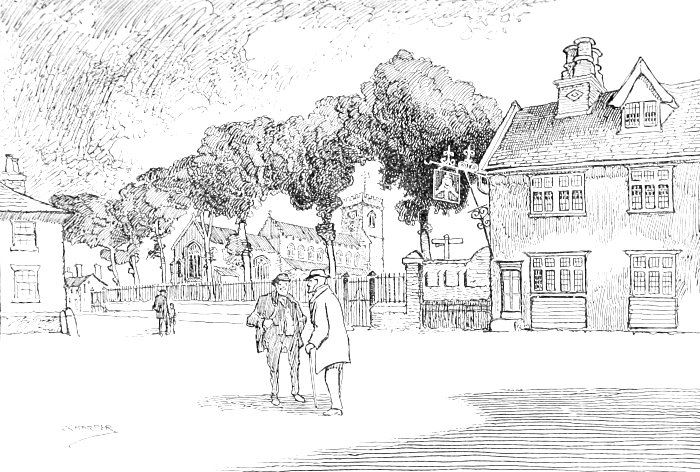
DICKLEBURGH.
The present state of agriculture in Eastern England is made manifest in deserted farms, in broken gates left hanging precariously on one hinge, in decaying barns and cart-sheds left to rot; rusted ploughs and decrepit waggons standing derelict in the once fertile fields, now overrun with foul weeds and rank with docks, charlock, and thistles; and farms, long advertised "to let," remaining and likely to remain tenantless. Not to everyone is it possible to grow seeds and flowers, and market-gardening is profitable only in the lands more immediately surrounding the great towns. With wheat at its present price of thirty shillings a quarter, it does not pay to grow corn for the market, and the land is going out of cultivation. Where the farmer still struggles on, he lays down most of his holding in grass for sheep and cattle, and grows, grudgingly, as little wheat as possible, for sake of the straw. Things are not quite so bad as in 1894, when wheat was down to twenty shillings a quarter, and farmers fed their pigs on the harvest which cost them three pounds more per acre to grow than it would have brought in the market; but at thirty shillings it yields no profit. Agricultural England is, in short, ruined, and there seems no present hope of things becoming better. While the boundless, bountiful harvests of Argentina, of Canada, the United States, Russia and other wheat-producing countries can be cultivated, reaped, and carried to these shores at the prices that now rule, and while the stock-breeders of those lands can raise sheep and cattle just as advantageously, the English farmer must needs go without a living wage. As matters stand at present, we import fully seventy-five per cent. of the wheat used in the country; the acreage under corn having gone down from 4,058,731 acres in 1852, to about half that at the present day. Meanwhile the population has increased by thirteen millions; so that, with many more mouths to fill, we grow only half the staple food these islands produced then. There are, of course, those who reap the advantage of cheap corn and cheap meat from over seas. The toiling millions of the towns and cities thrive on those benefits; but what if, through war, or from any other cause, those sea-borne supplies ceased? Of what avail would have been this generation of cheapness if at last the nation must starve? Extinguish agriculture and the farmer, and you cannot recall them at need, nor with magic wand bring back to cultivation a land which has long gone untilled.
But the farmer cannot alone be ruined, any more than the walls of a house can be demolished and the roof yet left standing. It was the farmer who in prosperous times supported the country gentleman in one direction, and the agricultural labourer in the other. With wheat, as it was a generation ago, at seventy shillings a quarter, and other products of the land proportionately profitable, the farmer could afford to pay both high rent and good wages. Farms in those days were difficult to obtain, and there was great competition among farmers for holdings. To-day, even at a quarter of those rents, tenants are difficult to obtain, and the income of the landed proprietors has dwindled away. The results are painfully evident here, in the old families reduced or beggared, and their seats either in the market or let to stock-jobbers and successful business men, while the old owners have disappeared or live humbly in small houses once occupied by the steward or bailiff of the estate.
While rents have thus, with the iron logic of circumstances, gone down to vanishing-point, and while farms have actually been offered rent free in order to prevent the disaster of the land being let go out of cultivation, the wages and the circumstances of the agricultural labourer have been, most illogically, improving. Instead of the miserable six to nine shillings a week he existed upon, at the beginning of the nineteenth century, he receives thirteen or fourteen shillings, lives in a decent cottage, instead of a wretched hovel, and finds the cost of food and clothing fifty per cent. cheaper than his grandfather ever knew it to be. Yet agricultural labourers are as difficult to get now as they were immediately after the Black Death had swept away three quarters of the working class, five hundred and fifty years ago. The crops went ungarnered then, as they have done of recent years in East Anglia—for lack of hands to gather them in. It was in 1899 that standing crops at Tivitshall St Margaret's and adjacent parishes were sold by auction for a farmer who could find no labourer willing to be hired.
What has been called the "rural exodus" is well named. London and the great towns have proved so attractive to the children of the middle-aged peasant that they despise the country. They can all read and write now, and at a pinch do simple sums in arithmetic; so off they go to the crowded streets. The ambitious aspire to a black coat and a stool in an office, and others become workmen of many kinds; but all are attracted by the higher wages to be earned in the towns, and by the excitement of living in the great centres of population, and only the aged and the aging will soon be left to till the fields.
Farmers entertain the supremest contempt for the agricultural labourer's attempts to better himself. To them they are almost impious; but the farmer is himself tarred with the same brush of culture. He is a vastly different fellow from his grandfather, who actually helped to till the soil among his own men; whose wife and daughters were noted hands at milking and buttermaking; who lived in the kitchen, among the hams and the domestic utensils, and was not above eating the same food as, and at the same table with, his ploughmen and carters. He has, in fact, and so also have the landed proprietor and the labourer, undergone a process of levelling up. It is a process which had started certainly by 1825, when Cobbett noticed it.
Hear him:—
"When the old farmhouses are down (and down they must come in time) what a miserable thing the country will be! Those that are now erected are mere painted shells, with a mistress within who is stuck up in a place she calls the parlour, with, if she have children, the 'young ladies and gentlemen' about her; some showy chairs and a sofa (a sofa by all means); half-a-dozen prints in gilt frames hanging up; some swinging book-shelves with novels and tracts upon them; a dinner brought in by a girl that is perhaps better 'educated' than she; two or three nick-nacks to eat, instead of a piece of bacon and a pudding; the house too neat for a dirty-shoed carter to be allowed to come into; and everything proclaiming to every sensible beholder that there is here a constant anxiety to make a show not warranted by the reality. The children (which is the worst part of it) are all too clever to work; they are all to be gentlefolks. Go to plough! Good God! What! 'young gentlemen' go to plough! They become clerks, or some skimming-dish thing or other. They flee from the dirty work as cunning horses do from the bridle. What misery is all this! What a mass of materials for proclaiming that general and dreadful convulsion that must, first or last, come and blow this funding and jobbing and enslaving and starving system to atoms."
The "convulsion" anticipated by Cobbett has not come about. This is not a country of earthquakes or of violent social upheavals. Free Trade has beggared the agricultural interests, but, on his way to the Bankruptcy Court, the farmer contrives to live in better style than possible three quarters of a century ago, while his pretensions to gentility certainly have not decreased. As for the "funding and jobbing," Cobbett could never, in his wildest dreams, have foreseen Limited Liability and the fungoid growth of Stock Exchange speculation, or the modern "enslaving and starving system" of the gigantic Trusts that, like vampires, feed on the blood of industry. We need look for no convulsions; not even, unhappily, for the hanging, or, at least, the taxing out of existence, of the millionaires. Our expectations of the future are quite different. The people will inhabit the towns, and the country will become a huge preserve of game for the sport of the millionaires aforesaid; a preserve broken here and there by the model farm or the training establishment of some colossus of wealth.
XXXVII
Beyond Dickleburgh, past the solitary "Ram" inn, a fine, dignified house still lamenting its decadence from a posting-inn to a beerhouse, Tivetshall level-crossing marks where the railway runs to Bungay and Lowestoft. Maps make Pulham St Mary the Virgin quite near, with Pulham St Mary Magdalene close by; Tivetshalls of different dedications, and other villages dotted about like plums in a Christmas pudding, but no sign of them is evident. Only windmills, whirling furiously on distant ridges, break the pastoral solitudes. In this conflict of charts, a carter jogging along the road with his team is evidently the authority to be consulted.
"Coom hather," says the carter to his sleek and intelligent horses; and they coom accordingly, with much jingling of harness, and stand in the shade of roadside trees while their lord takes his modest levenses and haffles and jaffles—gossips, that is to say—with the landlord of the "Ram."
"Tivetshall?" asks the carter, echoing a question; "niver heerd of un." Then a light breaks in upon him. "Oh, ay! Tishell we allus call 'em; Tishell St Marget an' Tishell St Merry," and with, a sweep of the arm comprising the whole western horizon, "Theiy'm ower theer."
"And Pulham St Mary the Virgin?"
"Pulham St Merry the Wirgin? oh, yis! Pulham Maaket, yar mean, bor. Et edd'n on'y a moile, ower theer"—a comprehensive wave to the eastwards.
And there, on a byroad, in an embrace of trees, it is found, a little forgotten town, the greater proportion of whose inhabitants appear to walk with two sticks. It is ranged round a green or market-place, with a great Perpendicular church, gorgeously frescoed within, and with a very good recent "Ascension" over the chancel arch, painted and stencilled timber roof, and elaborate stained-glass windows. The townlet and townsfolk sinking into decay, the church an object of such care and expense, afford a curious contrast.
An old toll-house and the prison-like buildings of Depwade Union conspire to make desolate the road onwards. He who presses, hot-foot, along it, turning neither to the right nor to the left, may readily be excused a legitimate wonder as to what has become of the great feature of East Anglia, its spreading commons; for, strange to say, despite the fame they have long since attained, no vestige of them is glimpsed from the road itself. One has usually to turn aside to some of the villages lying near, but wholly hidden from the highway, to find the yet unenclosed common lands, the pasturage of geese, ducks and turkeys; but a striking exception to this now general rule is the huge common of Wacton lying off to the left of the road at the hundredth mile from London, where a cottage and a wayside inn, the "Duke's Head," alone represent Wacton village, a mile distant. Wacton Common, reputed to be the highest point in Norfolk, although of no less extent than three hundred and fifty acres, might perhaps be passed without being seen, for the reason that, although still wild and unenclosed, it is screened from the high road by a hedge and entered through an ordinary field gate. The inn and the cottage, obviously built on land fraudulently taken from the common in the long ago, serve with their gardens to hide that glorious expanse of grass and heather. Here roam those chartered vagabonds, the plump geese, that pick up a living on the grassy commons and wander, like free-booting bands of feathered moss-troopers upon the heaths, closing their careers with royal feasting in the August and September stubble, and a Michaelmas martyrdom.
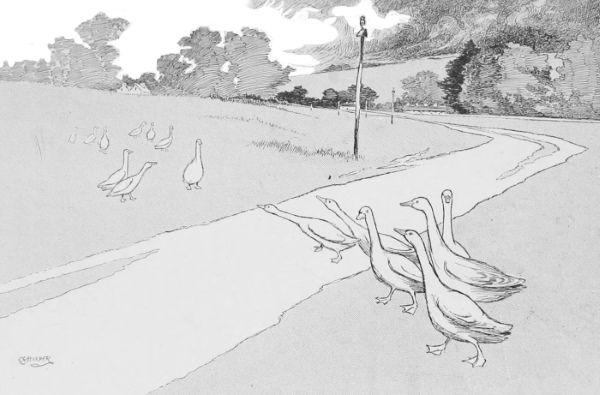
A DISPUTED PASTURAGE.
Norfolk and Suffolk are still famous for their geese, but those martyred fowls do not make their final journey to the London markets, between Michaelmas and Christmas, with the publicity they once attained. They go up to Leadenhall nowadays in the seclusion of railway vans. Seventy years ago they journeyed by coach, and in state, for the Norfolk coaches in Christmas week often carried nothing save geese and turkeys, beside the coachman and guard. Full inside and out with such a freight, the proprietors of fast coaches made a great deal more by carrying them than they would have taken by a load of passengers; so the fowls had the preference, while travellers had to take their chance of finding a seat in the slower conveyances. So long ago as 1793 the turkeys conveyed from Norwich to London between a Saturday morning and Sunday night in December numbered one thousand seven hundred, and weighed 9 tons, 2 cwt. 2 lbs. Their value was £680. They were followed on the two succeeding days by half as many more.
A Norfolk common without its screaming and hissing flocks of geese would seem strangely untenanted. They, the turkeys, the ducks, the donkeys ("dickies" they call them in Norfolk) and the vagrom fowls are among the only vestiges of the wild life that once made Norfolk famous to the naturalist and not a little eerie to the traveller of old, who, startled on the lonely way that stretched by heath and common and fen between the habitations of men, shrank appalled at the lumbering flight of the huge bustards, quivered with apprehension at the sudden hideous whirring of the night-jar as the day closed in, dismayed, heard the bittern booming among the reeds, or with misgivings of the supernatural saw the fantastical ruff stalking on long legs, with prodigious beak, red eyes and spreading circle of neck feathers, like the creation of some disordered imagination. Wild Norfolk, the home of these and of many another strange creature, is no more, and these species, now chiefly extinct, are to be seen only in museums of natural history.
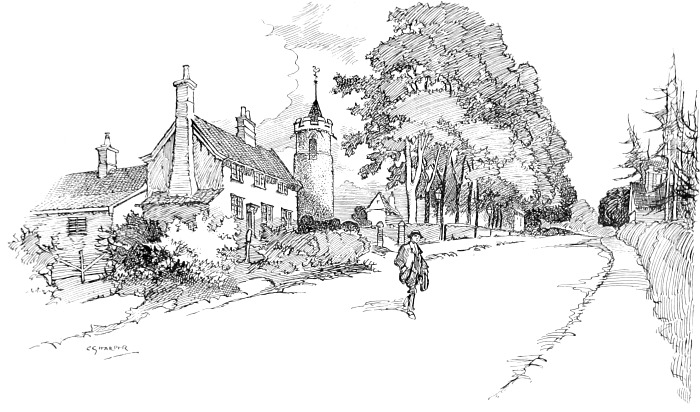
LONG STRATTON.
What Wacton lacks along the high road the village of Long Stratton has in superabundance. They named it well who affixed the adjective, for it measures a mile from end to end. Beginning with modern and (to speak kindly) uninteresting cottages, it ends in a broad street where almost every house is old and beautiful in lichened brick or soft-toned plaster. Midway of this lengthy thoroughfare stands the church, one of the Norfolk round-towered kind, in the usual black flint, and beyond it the Manor House, red brick, with Adam scrolls and neo-classical palm branches in plaster for trimmings, set back at some distance behind a very newty, froggy and tadpoley moat. Beyond this again, the village street broadens out. Looking back upon it, when one has finally climbed uphill on the way to Norwich, Long Stratton is a place entirely charming. Its name, of course, derives from its situation on the Roman Road, and Tasburgh, that now comes in sight, keeps yet its Roman camp strongly posted above the River Tase. Tasburgh—what little there is of a village—occupies an acclivity on the further side of that river, across whose wide and marshy valley the mists rise early, seeing the sun to bed dull and tarnished, and attending the rising of the moon with ghostly vapours. The old Roman camp is oddly and picturesquely occupied by the parish church, another round-towered example. Excepting it, the vicarage and the Dutch-like building of the "Bird in Hand" Inn, there is little else.
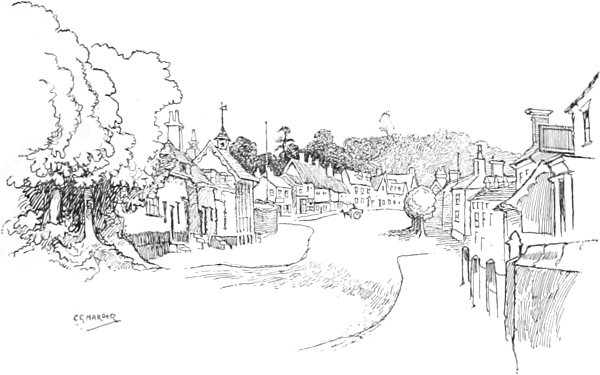
LONG STRATTON.
But what mean these sounds of anger and lamentation that drown the soothing, distant rattle of reaping machines on the hillside: a voice raised in reproach, and another—a treble one—in gusty shrieks of combined pain, fear and peevishness? Coming round a corner, the cause of the disturbance is revealed in a wet and muddy infant rubbing dirty knuckles into streaming eyes, and being violently reproached by an indignant woman.
"You're a pretty article, I must say; a fine spettacle. I'll give yow a good sowsin', my lord; coom arn;" and the malefactor is pulled suddenly inside the cottage, the door slammed, and muffled yells heard, alternating with thumps. The offender is receiving that sowsing, or being "yerked," "clipped over the ear-hole," getting a "siseraring," being "whanged" or "clouted," the striking Norfolk phrases for varieties of assault and battery.
XXXVIII
The Tase is met with again on surmounting the hilly road out of Tasburgh and coming down hill into Newton Flotman. Here it is broad enough to require a long and substantial bridge, grouping in unaccustomed rightness of composition with the mingled thatched, tiled and slated cottages and the church that stands on a commanding knoll in the background. When Newton was really new it would be impossible to say; perhaps its novelty may have been measured against the hoary antiquity of, say, Caistor yonder, down the valley. For what says the folk-rhyme:—
"Caistor was a city when Norwich was none, And Norwich was built of Caistor stone,"
and if Norwich partook of Caistor's building materials, why not, in degree, Newton Flotman? But a whisper. Caistor was never more than a camp, and not at any time a place of houses, much less of stone ones. Stone is not to be found in this neighbourhood, and flint only, of which Norwich is principally built, is available for building materials.
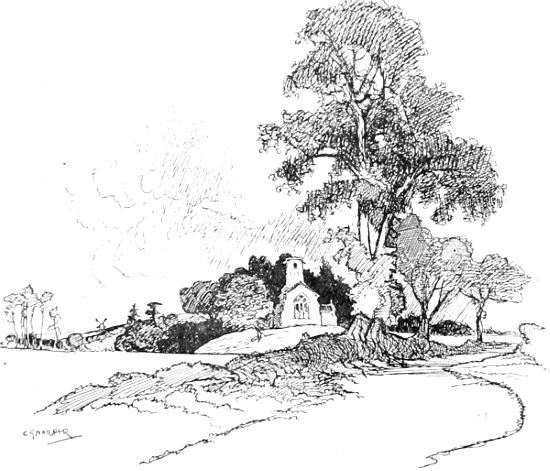
TASBURGH.
One object in Newton Flotman that puzzles the passing stranger is a little effigy of Bacchus fixed on the wall of the "Maid's Head" Inn, so thickly covered with successive coats of paint that it is difficult to give it a period. Remains of Roman antiquities are so many in this district that it is often mistaken for a work of that classic age, when it can really claim no higher antiquity than that of the late eighteenth century, a time when figures of the kind were a usual decoration of inn signs. Such an one still swings from the wrought-iron sign of the "Angel" at Woolhampton, on the Bath Road.
In the woody valley of the Tase beyond Newton Flotman lies Dunston, trees casting a protecting and secretive shade over it, and the "Dun Cow" Inn its only roadside representative. That inn and the circular brick pound for strayed sheep and cattle redeem the last few miles into Norwich from absolute emptiness. When the pound last was used who shall say? The tramps have played havoc with it, and its wooden gate has gone. The ancient office of pound-keeper is here evidently fallen into disuse.
Swainsthorpe's octagonal church tower is seen on the level to the left, but Caistor, in like manner with Dunston, is sunk deep in foliage, half a mile or more away in the valley, its church tower rising like a grey beacon from amid the trees, to tell the curious where its ancient camp may be found. Caistor St Edmunds, to give its full name, is the site of the great Roman camp established here to overawe the stronghold of the Iceni, four miles away on the banks of the Wensum, and now the site of Norwich.
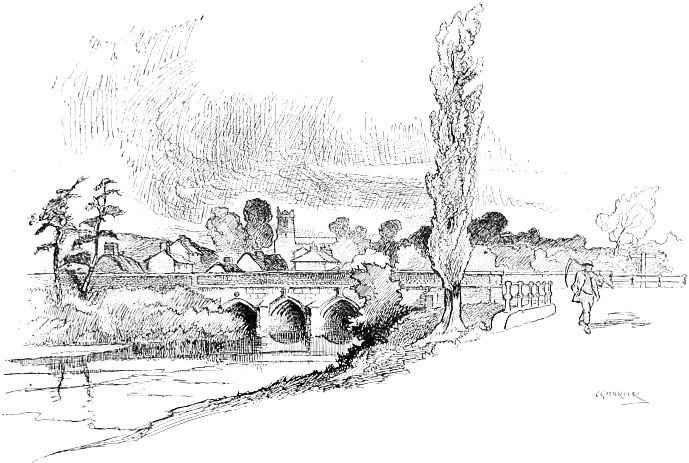
NEWTON FLOTMAN.
Caistor camp is a really satisfactory example of a Roman fortified castrum. For one thing, it has the largest area of any known relic of its kind in England, enclosing thirty-seven acres. If its fragments of flint walls have neither the thickness nor the height of those at Portus Rutupiæ, the old Roman port in Thanet, now known as Richborough, its deep ditch and massive embankment assist the laggard imagination of the layman in matters archæological, which refuses to be stirred before mere undulations in the sward. Here is a ditch that can be rolled into, an embankment that can be climbed and paced on three sides of the camp, if necessary, to put to physical test both height, depth and extent. The fourth side of this great enclosure, now a turnip-field, was bounded by the River Tase and was sufficiently defended by that stream, then a wide creek, so that no works are to be found there. How long it was before the Romans subdued the Iceni, whose great city is thought to have stood where Norwich does now, is not known. Nothing of that early time here, indeed, is known, and guesses are of the vaguest. Only it seems that the Roman advance into East Anglia, which had for its objective the principal stronghold of the tribes, here came to its military ending. To compare things so ancient and romantic with others modern and thought prosaic, the several Roman camps on the advance from London now to be sought at Uphall near Romford; Chipping Hill, near Witham, Lexden, and Tasburgh, are, with those that have disappeared, to be looked upon in the same light as the wayside stations on the railway to Norwich, a railway which originally came to a terminus at that city, and was only at a later date continued northward.
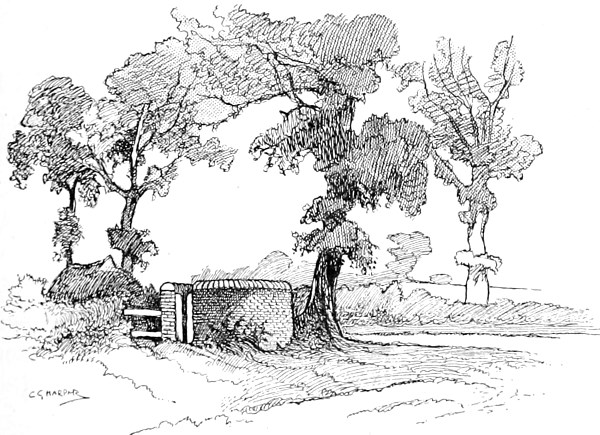
THE OLD BRICK POUND.
Where the Romans and the Romano-British citizens of Venta lived when the tribes were reduced—where the Venta Icenorum of Roman rule really was, in fact—is a mystery, for, unlike most of our great cities, Norwich has furnished no relics of that age; while, beyond coins and odds and ends, Caistor camp has produced nothing. No vestiges of streets or houses have been found, here or elsewhere, and Venta might, for all there is to show of it, have been a city of dreams. The fact that the original capital of the Iceni was re-settled by the Danes when they came in a conquering flood, seems to point to the site of it having long been deserted; and that they called it after the North "wic" or creek, presupposes a "South wic" somewhere else, near or far. The position of that south creek is fixed by the ancient geography of these last few miles. In those times the ground on which Yarmouth, at the mouth of the Yare estuary, is now built, was under the waves of the sea, which ran up in a long navigable creek—the "Gariensis" of the Romans and the "North Wic" of the Danes—from a Roman fortified port where Caistor-by-Yarmouth stands, to the site of Norwich, which indeed, centuries later, was still a port. Where the River Tase is now confluent with the Yare and the Wensum, there then branched out a shorter and perhaps shallower creek, running almost due south; the "South wic" of those northern pirates. At its head stood Caistor, where the navigation ceased.
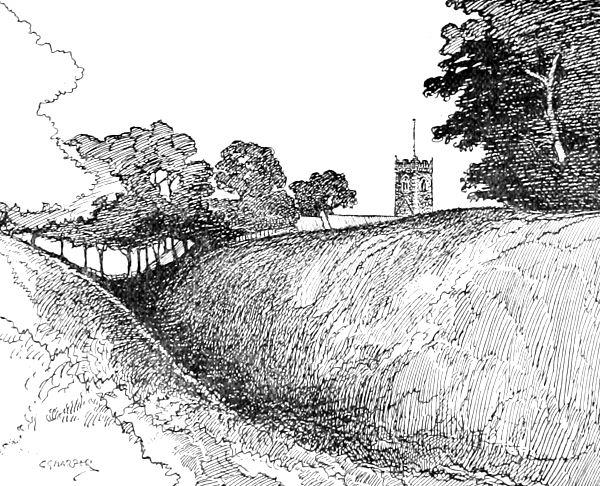
CAISTOR CAMP.
It is far inland now, but the marshy valley of the Tase still bears signs of those old conditions, and perhaps the villas of wealthy Roman citizens, together with other relics of the vanished city, still lie preserved deep down in the mud and silt that have filled up the old channel.
The lie of the land, in accord with these views, is plain to see when, returning to the high road, the journey to Norwich is continued to Hartford Bridge; bird's-eye views unfolding across the valley to the right. At Hartford Bridge, where there are several bridges, none of them sizeable, rivers, streams and runlets of sorts trickle, flow, and gurgle in their different ways through flat meadows, below the long rise where, two miles from Norwich, the road begins to grow suburban. It is on the summit that the Newmarket and Thetford route from London joins with this, and together they descend into the city.
XXXIX
This way came Queen Elizabeth into Norwich on her great "progress" of 1578, by St Stephen's Plain and through St Stephen's Gate. Gates and walls are gone that once kept out the turbulent, or even condemned the belated citizen to lodge the night without the precincts of the city, in suburbs not in those times to be reckoned safe.
Norwich long ago swept away her defences and modernised her outskirts, for this is no Sleepy Hollow, this cathedral city in the valley of the Wensum, but the capital of East Anglia, throbbing with industry and in every way in the forefront of modern life. To the entrance from London Norwich turns perhaps its most unattractive side. No general view of the city, lying in its hollow beside the winding Wensum, opens out, and the eye seeks the cathedral spire and finds it with some difficulty, modestly peering over tangled modern roof-tops. It is from quite the opposite direction, from the noble height of Mousehold Heath, that Norwich unfolds itself in a majestic picture of cathedral, churches and houses, with trees and gardens, such as no other city can show, displayed within its bounds. Norwich does not jump instantly to the antiquarian eye, and its electric tramways that are the first to greet the traveller who enters from the old coach road are not a little forbidding. The city grows gradually upon the stranger in all its wealth of beauty and interest, and becomes more and more lovable the better he becomes acquainted with it.
Until these railway times, in the old days of slow, difficult, dangerous and expensive travelling, the capital of East Anglia was in a very high degree a capital, and sufficient to itself. Its shipping trade and weaving industries, and the famous Norwich School of artists, brought this exclusive attitude down from mediæval times to modern; and Norfolk county families until the era of political reform had almost dawned, still had their "town houses" in Norwich, just as, in bygone centuries, that typical old family, the Pastons, owned their town houses in Hungate and in what is now called King Street, formerly Conisford Street.
The coaches coming to Norwich threaded the mazy streets to inns widely sundered. The original "Norwich Machine" of 1762 traversed the greater part of the city, to draw up at the "Maid's Head," in Tombland. On the other hand, the Mails, the "Telegraph" and the "Magnet," came to and started from the "Rampant Horse" in the street of the same name, standing not far from the beginnings of the city. The street is there still, but the oddly-named inn has given place to shops, and where the "Rampant Horse" ramped rampageously, in violent contrast with the mild-mannered "Great White Horse" of Ipswich, drapers' establishments now hold forth seductive announcements of "alarming sacrifices."
Among other coaches, "Gurney's Original Day Coach" and the "Phenomenon" favoured the "Angel," in the Market Place, while the "Times" house was the "Norfolk Hotel," in St Giles's, and that of the "Expedition" the "Swan" Inn. Other inns, many of them huddled together under the lee of the castle mound, were then to be found in the Market Place and the Haymarket and in the narrow alley in the rear that still goes by name of "Back of the Inns." Others yet, many of mediæval age, are to be sought in old nooks of the city. The Pilgrim's Hostel, now the Rosemary Tavern, like the "Old Barge," belongs to the fourteenth century, the last named still standing between King Street and the river, with a picturesque but battered entrance. The steep and winding lane of Elm Hill, where the slum population of Norwich stew and pig together down ancient courts and dirty alleys, has more inns, ramshackle but unrestored; and in the wide open space by the cathedral, dolefully called Tombland, although it has not, nor ever had, anything to do with tombs, is the "Maid's Head," the one establishment in Norwich that stands pre-eminently for old times and good cheer. It is an "hotel" now, and has the modern conveniences of sanitation and electric light; but its restoration, effected through the enthusiasm of a local antiquary, with both the opportunity of purchasing the property and the means of doing so, has been carried through with taste and discrimination. The "Maid's Head" can with certainty claim a history of six hundred years, and is thought to have been built upon the site of a former Bishop's Palace. Heavily-raftered ceilings and masonry of evident antiquity may take parts of the present house back so far, or even a greater length, but the especial pride of the "Maid's Head" is its beautiful Jacobean woodwork. The old sign of the house was the "Molde Fish," or "Murtel Fish," a name that antiquaries still boggle at. It was long a cherished legend that this strange and unlovely name was changed to the present sign in complimentary allusion to Queen Elizabeth when she first visited the city, but later researches have proved the change to have been made at least a century earlier, and so goes another belief!
The "Music House," facing the now disreputable King Street, has not for so very long been an inn. Its name tells of a time when it was the meeting-place of the "city music," old-time ancestors of modern town bands, but its story goes back to the Norman period, when the crypt that bears up the thirteenth-century building above was part of the home of Moyses, a Jew, and afterwards of Isaac, his nephew. "Isaac's Hall," as it was known, was seized by King John and given to one of his creatures; the unhappy Israelites doubtless, if they were allowed to live at all, finding cool quarters in the castle dungeons. A long succession of owners, including the Pastons, followed; last among them Coke, afterwards Lord Chief Justice, who resided here in 1633.
It has already been hinted that the streets of Norwich are mazy. They are indeed the most perplexing of any town in England. Many roads run into the city, and from every direction. Glancing at a plan of it, these roads resemble the main strands of a spider's web, and the streets the cross webs. In midst of this maze is the great castle, like the spider himself; that cruel keep in whose dungeons old wrong-doing, religious and private spite, have immured many a wretched captive, like that unfortunate unknown "Bartholomew," who has left his name scratched on the walls, and the statement that he was here confined "saunz resun," a reason of the best in those times. Did he ever see the light of day again? Or did some midnight assassin murder him as many another had been done to death?
"Blanchflower," that Bigod, Earl of Norwich who built the castle called his keep when it arose on its great mound, its stone new and white. He built upon the site of a castle thought to have been Saxon, and built so well that it became a fortress impregnable save to famine and treachery. It has, therefore, unlike weaker places that have been stormed again and again, little history, and even seven hundred years ago was little more than a prison. And a prison of sorts—for State captives first, and for common malefactors afterwards—it remained until so recently as 1883, when it was restored and then opened as the Museum and Art Gallery it now is.
This is no place to speak at length of the cathedral that withdraws itself with such ecclesiastical reserve from the busy quarters of the city, and is approached decorously through ancient gateways in the walls of its surrounding close; the Ethelbert Gate, with that other, the Erpingham Gate, built in Harry the Fifth's time by Sir Thomas Erpingham, whose little kneeling effigy yet remains in its niche in the gable over the archway, and whose motto—variously held to be "Yenk," or "Think,"—"Denk," or "Thank"—is repeated many times on the stone work. Norman monastic gloom still broods over the close, for the cathedral, save the Decorated cloisters and the light and graceful spire in the same style, is almost wholly of that period, and the grammar school that was once a mediæval mortuary chapel and has its playground in the crypt, keeps a gravity of demeanour that, considering its history, is eminently proper.
Through the Close lies the way to Bishop's Bridge and the steep road up to Mousehold Heath: the "Monk's Hold," or monastic property, of times gone by when it was common land of the manor belonging to the Benedictine priory.
XL
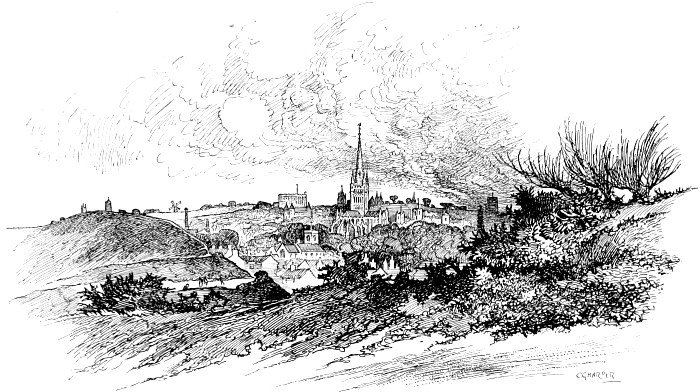
NORWICH, FROM MOUSEHOLD HEATH.
Here, on this famous Heath of Mousehold where the gorse and heather and the less common broom yet flourish, despite the electric tramways that bring up the crowds and the picnic parties, Nature, rugged and unconquerable, looks down upon the city, revealed as a whole. Even though the chimneys of great factories may intrude and smirch the sky when winds permit the smoke-wreaths to trail across the view, it is a view quite unspoilable. The cathedral, as is only proper, is the grand dominating feature, with its central tower and graceful crocketed spire rising to a height of 320 feet. Second to it, on its left hand, the huge bulk of the castle keep rears up; a time-ball on its battlements to give the time o' day to the busy citizens; those battlements where from a gibbet they hanged Robert Kett in 1549, when his rebellion was crushed and his army of 20,000 peasants who had encamped on Mousehold defeated. In similar fashion his brother William was hanged from Wymondham steeple. Between castle and cathedral the great tower of St Peter Mancroft looms up, and on the other side of the cathedral tower the twin spires of the Roman Catholic place of worship crown the sky-line. To the extreme right of the accompanying illustration is St Giles's, and on the extreme left, in company with the pinnacled tower of a modern church, the dark tower of St John-at-Sepulchre, Bracondale, which for shortness and simplicity the citizens call "Ber Street Church." For the rest, it is a mingling of town and country, of houses and gardens and churches in great number, that one sees down there; old Norwich, in short, exclusive of the modern suburbs that are flung everywhere around and cause the Norwich of to-day to outnumber the Norwich of coaching times by 80,000 inhabitants. It must be evident from those figures that the picturesque old Norwich numbering a population of only 30,000 has been in great degree improved away and borne under by that human deluge. It is delightful now, but what it was at the beginning of the nineteenth century, when Crome and De Wint and others sketched and painted its quaint bits, the picture-galleries of the Castle Museum can tell. Nay, even down to the mid-nineteenth century it was still very different, as a collection of early photographs in the castle proves. Then, before St Peter Mancroft was restored, before the old Fish Market was cleared away, Norwich had many more quaint nooks than now to show the stranger; even as, centuries before, it was yet more quaint and even more remarkable for its many churches than at the present time.
"The nearer the church the further from God," says the old saw. How irreligious then should Norwich be, that has even yet a cathedral and thirty-four ancient churches, and modern places of worship fully as numerous! Let the citizens, therefore, as old Fuller suggested, "make good use of their churches and cross that pestilent proverb." These churches bear a close resemblance to one another, having nearly all been rebuilt in the Perpendicular period, some five hundred years ago, and all built of the black flint that gives a character to East Anglian architecture quite distinct from that of other districts. The time when they were thus rebuilt was not only a great period of church-building throughout England, but a time of especial prosperity in mercantile and trading Norwich; a time when guilds grew powerful and merchants wealthy in the flourishing industry of cloth-weaving introduced some time earlier by Flamand and Hollander immigrants. English wool that before had gone across the narrow seas for manufacture into stuffs was now weaved in the land of its growth. "Many thousands," says Blomefield, "that before could not get their bread could now by this means live handsomely." In that age, to become rich and prosperous was to become also a founder and benefactor of churches; hence the great ecclesiastical buildings that, according to the picturesque metaphor of an old writer, writing when there were no fewer than sixty-one churches in the city, "surrounded the cathedral as the stars do the moon." The old citizens sleep in the parish churches for which they did so much; their monuments in brass or marble, stone or alabaster curiously wrought, often with their "merchant's marks"—the distinctive signs with which they labelled their wares—engraved on them in lieu of coats of arms. It is as though a modern trader were to have the registered trade-mark of his speciality engraved on his tombstone. A typical memorial of an old Norwich trader is that of Thomas Sotherton, in the church of St John Maddermarket. He—
"Under this cold marbell sleeps,"
and was no common fellow, mark you, but
"Of gentell blood, more worthy merrit, Whose brest enclosed an humble sperryt."