Front matter (continued 2)
Reading edition
There is nothing else to detain the explorer on his way into Essex. The People's Palace, it is true, is a remarkable place, the result of Sir Walter Besant's dream of a resort for those of the East who would get culture and find recreation, but it is a dream realised as an architectural nightmare, and is a very terrible example of what is done to this unhappy quarter in the names of Art and Philanthropy.
XIII
At last, by this broadest of broad roads, we come to Stratford-le-Bow and its parish church. In these hurried times, and for some centuries past, the old hyphenated place-name has been dropped, and as "Bow" alone it is familiar to all East-enders. The place is nowadays chiefly associated with Bryant & May and matches, but there yet remain many old Queen Anne, and even earlier, mansions by the roadside, telling of days long before "patent safeties" were thought of, and when flint and steel and timber were the sole means of obtaining a light.
"Bow," says the Ambulator of 1774, "is a village a little to the east of Mile End, inhabited by many whitsters and scarlet dyers. Here has been set up a large manufactory of porcelain, little inferior to that of Chelsea." That description is now somewhat out of date. The manufactory of porcelain has long disappeared and Bow china is scarce, and treasured accordingly. Whitsters—that is to say, bleachers of linen—and scarlet dyers, also, are to seek.
Bow Church confronts the eastward-bound traveller in bold and rugged fashion; its time-worn tower standing midway of the road and challenging, as it were, the crossing of the little River Lea, just beyond, to Stratford and into Essex. Church and churchyard split the road up into two channels and thus destroy its width, which it never afterwards regains until the suburbs are passed and the open country reached. A modern touch here is the bronze statue of Gladstone, in advance of the church, facing westwards in declamatory attitude from its granite pedestal, and erected in his lifetime; recalling the fervent hero-worshipping days of the "People's William." The outstretched hand is oddly crooked. Few be them that see statues raised to themselves, unless indeed they be made of finer clay than most mortals, kings and princes, and the like. Of recent years this bronze Gladstone has, in our vulgar way, been made to preside, as it were, over an underground public convenience, from whose too obtrusive midst he rises, absurdly eloquent.
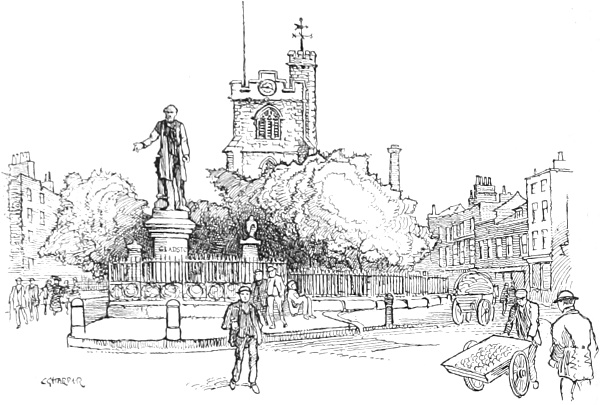
BOW.
Just how Stratford-le-Bow received its name is an interesting piece of history. Both here and at the neighbouring Old Ford the Lea was anciently crossed by a paved stone ford of Roman construction, continuing the highway into Essex; but when that river's many channels, swollen by winter's rains, rolled in freshets toward the Thames, the low-lying lands of what we now call Hackney and West Ham marshes were for long distances converted into a sluggish lake. For months together the approaches to the Lea were lost in floods, and the real channels of the river became so deep that those who valued their lives and goods dared not attempt the passage. To the aid of poor travellers thus waterlogged came the good and pious Queen Matilda, consort of Henry the First. "Having herself been well washed in the water," as old Leland says, she fully appreciated the necessity for bridges, and accordingly directed the raising of a causeway on either side of the Lea and the building of two stone structures, of which one was the original "Bow" Bridge; "a rare piece of work, for before that time the like had never been seen in England." It seems to have been the stone arch that gave its name of "Bow," and if an arched stone bridge was so remarkable in those times that it should thus derive a name for its semi-circular, or "bow" shape, it must have been either the first, or among the earliest, of stone bridges built, in times when others were constructed of timber.
The original name of the village that afterwards sprang up here, on the hither or Middlesex shore, was thus singularly contradictory; meaning "the street ford at the arched bridge." The Stratford on the Essex side was in those days known as Stratford Langthorne.
The good queen not only built the bridges and causeways, but endowed them with land and a water-mill, conveying those properties to the Abbess of Barking, burdened with a perpetual charge for the maintenance of the works. Having done all this, she died. Some years afterwards a Cistercian monastery was founded close by, where the Abbey Mills now stand, and the then Abbess of Barking, of opinion that the Abbot of that house, being near, would find it easier to look after the bridges than herself, reconveyed the property, together with its obligations, to him. The trust was kept for a time and then delegated to a certain Godfrey Pratt, who had a house built for him on the causeway and enjoyed an annual grant, in consideration of keeping the works in repair. Pratt did so well with his annual stipend and the alms given him by wayfarers that the Abbot at length discontinued the grant. Accordingly, the wily Pratt set up a quite unauthorised toll-bar and levied "pontage" on all except the rich, of whom he was afraid. This went on for many years, until the scandal grew too great, and, in consequence of an inquisition held, the Abbot dispossessed Godfrey Pratt of his toll-bar and resumed the control himself.
Meanwhile, no repairs had been effected, and the road had been so greatly worn down that the feet of travellers and those of the horses often went through the arches. Bow Bridge had, consequently, to undergo an extensive cobbling process; a treatment, by the way, continued through the centuries until 1835, when it was finally pulled down.
In its last state it was a nondescript patchwork of all ages. The property for its maintenance had, of course, been lost in the confiscation of monastic estates under Henry the Eighth, and its repair afterwards fell upon the local authorities, who always preferred to patch and tinker it so long as such a course was possible. On February 14, 1839, the existing bridge was opened, crossing the Lea in one seventy-foot span, in place of the old three arches.
XIV
"Farewell, Bowe, have over the bridge, where, I heard say, honest Conscience was once drowned."
Thus says Will Kemp, in his Nine Days' Wonder, the account of a dance he jigged from London to Norwich in so many days, in 1600. It is hopeless to recover the meaning hidden in that old joke about the drowning of conscience here, and so we will also without delay "have over" the modern bridge of Bow and into Essex, past dingy flour mills, and crossing another branch of the Lea by Channelsea Bridge, come to Stratford.
Here, then, begins the county of calves, according to the popular jest that to be a native of Essex is to be an "Essex Calf." It is not generally regarded as a complimentary title, for of all young animals the calf is probably the clumsiest and most awkward. To this day in rural England the contemptuous exclamation "you great calf!" is used of an awkward, overgrown boy tied to his mother's apron-strings. Yet, if we may believe a seventeenth-century writer on this subject, the nickname had a complimentary origin, "for," said he, "this county produceth calves of the fattest, fairest and finest flesh in England."
We have already seen that the French spoken at Stratford-le-Bow in Chaucer's time was a scoff and a derision. To-day, neither on the Middlesex nor the Essex shores of the Lea is the teaching of languages either a matter for praise or contempt. Mills of every kind, the making of matches that strike only on the box, the varied work of the Stratford and West Ham factories, fully occupy the vast populations close at hand; while the business of covering the potato-fields, the celery-beds and the grounds of the old suburban mansions with endless rows of suburban dwellings is engrossing attention down the road. Stratford and Maryland Point are now strictly urban, and Ilford far greater in these days than it ever was when its "great" prefix was never pretermitted. London, indeed, stretches far out along this road, and the country is reached only after many miles of that debatable land which belongs neither to country nor town. Heralds of the great metropolis appear to the London-bound traveller while he is yet far away, and even so far distant as Chelmsford "the dim presentiment of some vast capital," as De Quincey remarks, "reaches you obscurely like a misgiving."
Stratford has not improved since coaches left the road. It has grown greatly, and grown dirty, squalid and extremely trying to noses that have not been acclimatised to bone-boiling works, manure factories and other odoriferous industries. But it is a place of great enterprises and great and useful markets, and when its introductory mean streets are passed, the Broadway, where the Leytonstone Road branches off to the left, looks by contrast quite noble. This brings one to Upton Park, Forest Gate, Woodgrange and Manor Park in succession, past a building which, whether as an institution or an example of beautiful architecture, would well grace the West. The West Ham Public Library and Technical Institute is here referred to. "Irish Row," on the way, marked on old maps, is a reference to old wayside cottages inhabited until recent years by a turbulent colony of London-Irish market-gardening labourers, subsidised by Mrs Nelson in times of coaching competition to impede hated rivals as they came past the "Rising Sun" at what is now the suburb of Manor Park; a house which, like the "Coach and Horses" at Upton, has declined from a legitimate coaching trade to something more in the gin-palace sort. This is not to say that the staid and decorous Mrs Nelson entered into direct negotiations with the Mikes and Patseys of Irish Row, but when the rival Ipswich "Umpire" or the "New Colchester" coaches developed much sporting competition and their coachmen evinced a dogged determination to be first over Bow Bridge on the way up to London, and, by consequence, the first to arrive at their destination, why, an obscure hint or two on the part of one of her numerous staff, accompanied by the wherewithal for a drink, produced wonders in the way of highway obstruction. But such recollections are become unsubstantial as the fabric of which dreams are made, and fade before the apparitions of tramways and interminable rows of suburban shops that conduct to Ilford Bridge.
Great Ilford lies on the other side of the sullen Roding, that rolls a muddy tide in aimless loops to lazily join the Thames at Barking Reach. The townlet has from time immemorial been approached by a bridge replacing the "eald," or old, ford, whence its name derives and not from that crossing of the stream being an "ill" ford, as imaginative, but uninstructed, historians would have us believe; although the slimy black mud of the river-bed would nowadays make the exercise of fording an ill enough enterprise. Ilford is now in the throes of development and is fast losing all individuality and becoming a mere suburb. Let us leave it for places less sophisticated.
The morris-dancing Will Kemp of 1600, leaving Ilford by moonshine, set forward "dauncing within a quarter of a mile of Romford, where two strong Jades were beating and byting either of other." We take this to mean two women fighting on the road, until the context is reached, where he says that their hooves formed an arch over him and that he narrowly escaped being kicked on the head. It then becomes evident that he is talking of horses.
Leaving the centre of Great Ilford behind, and in more decorous fashion than that of Will Kemp, we come, past an inn oddly named the "Cauliflower"—probably as a subtle compliment to the abounding market-gardens of the neighbourhood—to the long, straight perspective of the road across Chadwell Heath. Unnumbered acres of new suburban "villa" streets now cover the waste on either side, so that the beginnings of the plain are not so much heath as modern suburb, created by the Great Eastern Railway's suburban stations and by the far-reaching enterprises of land corporations, which here carry on the usual speculations of the speculative builder on a gigantic scale. In acre upon acre of closely-packed streets, each one with a horrible similarity to its neighbour, thousands of the weekly wage-earning clerks, mechanics and artisans of mighty London live and lose their individuality, and pay rent to limited companies. Where the highwayman of a century ago waited impatiently behind the ragged thickets and storm-tossed thorn trees of Chadwell Heath for the traveller, there now rises the modern township of Seven Kings, and midway between Ilford station and that of Chadwell Heath, the recent enormous growth of population on this sometime waste has led to the erection of the new stations of "Seven Kings" and "Goodmayes," while widened lines have been provided for the increased train services. "Seven Kings" is a romantic name, but who those monarchs were, and what they were ever doing on the Heath, which of old was a place more remarkable for cracked skulls than for crowned heads, is impossible to say. Many wits have been at work on the problem, but have been baffled. The natural assumption is that at this spot, marked on old maps as "Seven Kings Watering," the seven monarchs of the Heptarchy met. History, unhappily records no such meeting, but there was no Court Circular in those times, and so many royal foregatherings must have gone unremarked, except locally and in some fashion similar to this. So let us assume the kings met here and watered their horses at the "watering," which was a place where a little stream crossed the road in a watersplash. The stream still crosses the highway, but civilisation has put it in a pipe and tucked it away underground.
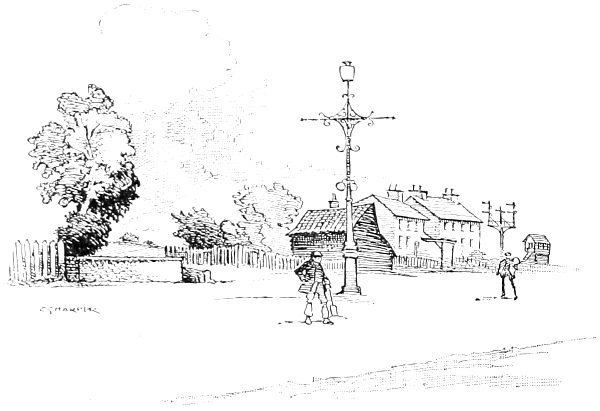
SEVEN KINGS.
A lane running across the Great Eastern Railway at this point, known as Stoup Lane ("stoup" meaning a boundary-post) marks the boundary of the Ilford and Chadwell wards of Barking parish. Here it was, in 1794, on a night of December, that a King's messenger, James Martin by name, was shot by five footpads. The register of St Edmund's, Romford, records the burial of this unfortunate man on the 14th of that month.
Let us not, however, in view of the more or less grisly dangers that still await belated wayfarers on this road, enlarge too greatly on the lawlessness of old times; for the homeward-bound resident making for his domestic hearth in these new-risen suburbs towards the stroke of ten o'clock is not infrequently startled by the sinister figure of a footpad springing from the ragged hedges of Chadwell Heath and demanding—not his money or his life, as in the old formula, but—a halfpenny! This invariable demand of the nocturnal Chadwell Heath footpads, which argues a pitiful lack of invention on their part, is for half the price of a drink.
"You haven't got a ha'p'ny about you, guv'nor?" asks the threatening tramp.
"No," says the peaceful citizen, anxiously scanning the long perspective of the road for the policeman who ought to be within sight—but is not; "w-what do you want a halfpenny for?"
"I've walked all the way from Romford and only got half the price of a glass o' beer," says the rascal.
The citizen is astonished and incredulous, and his astonishment gets the better of his fear. "Oh, come now," he rejoins, "no one walks three miles from Romford for a glass of beer; besides, all the houses here close at ten o'clock."
"Oh, they do, do they?" replies the tramp, offensively. "'Ere, my mate Bill'll talk to you," and, whistling, the ominous bulk of Bill emerges aggressively from the darkling hedge, and together they proceed to wipe the road with that respectable ratepayer, and, rifling his pockets, leave him, bruised and bleeding, to reflect on the blessings of civilisation and to be thankful that he was not born a hundred years ago, when he might have been shot dead instead of being felled to the ground by the half-brick in a handkerchief which he finds beside him and takes home as a trophy.
Chadwell Street, a wayside hamlet, conducts past Beacontree Heath, on the right, to an open country of disconsolate-looking contorted elms and battered windmills, telling even in the noontide heats and still airs of summer of the winter winds that race across the watery flats of Rippleside and Dagenham Marshes, out of the shivering east. Lonely, until quite recent times, stood "Whalebone House," beside the road, the two whalebones that even yet surmount its garden entrance the wonderment for more than two hundred years of chance travellers. Legends tell that they are relics of a whale stranded in the Thames in the year of Oliver Cromwell's death, and set up here in memory of him. However that may be, they certainly were here in 1698, when Ogilby's Britannia was published, for the house is marked on his map as "Ye Whalebone."
These "rude ribs," it may shrewdly be suspected, have little longer yet to remain, for though apparently proof against decay, the house and grounds are, like those of the surrounding properties, for sale to the builders.
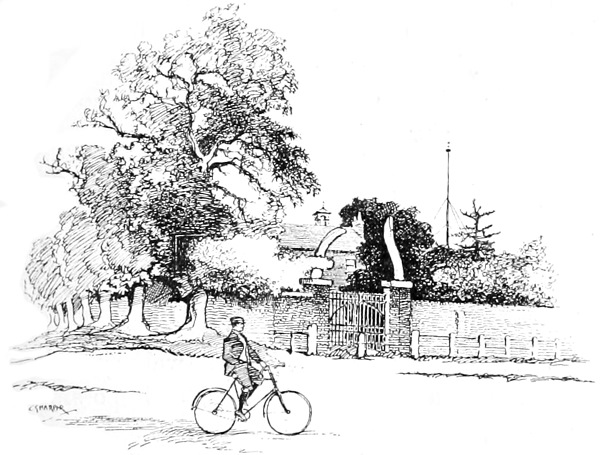
WHALEBONE HOUSE.
The sole historic or other vestige remaining of the "Whalebone" turnpike-gate, once standing here, is an account to be found in the newspapers of the time of an attack made upon George Smith, the toll-keeper, on a night in 1829. He was roused in the darkness by a voice calling "Gate!" and, going to open it, was instantly knocked down, in a manner somewhat similar to the treatment accorded the hero of that touching nursery rhyme, who tells how:—
"Last night and the night before, Three tom-cats came knocking at my door. I went down to let them in, And they knocked me down with a rolling-pin."
The two men who felled the unfortunate George Smith, alarmed by his cries of "Murder!" threatened to shoot him if he were not quiet, and, going over his pockets, were rewarded by a find of twenty-five shillings. While they were thus engaged in sorting him over, a third confederate, ransacking the house, discovered three pounds. With this booty and a parting kick, they left their victim, and disappeared as silently as they came.
XV
Romford, now approached, is but twelve miles from London, and has frankly given up the impossible and ceased all pretence of being provincial. At the same time, building-land having only just (in the speculator's phrase) become "ripe for development," the townlet has not yet lost all individuality in suburban extension.
The place, say some antiquaries, derives its name from the "Roman ford" on the Rom brook, but it is a great deal more likely that the origin is identical with that of the first syllable in the names of Ramsgate, Ramsey and Romney, and comes from the Anglo-Saxon "ruim" = a marsh. Time was when the town was celebrated for its manufacture of breeches; an industry which gave rise to a saying still current in the less polished nooks and corners of Essex—"Go to Romford and get your backsides new bottomed." Breeches have long ceased to be a noted product of the town, which for many years past has bulked large in the annals of Beer. Barricades, avenues, mountains and Alpine ranges of barrels, hogsheads, firkins and kilderkins of Romford ale and stout proclaim that the Englishman's preference for his "national drink" has not abated, and that
"Damn his eyes, whoever tries To rob a poor man of his beer"
is still a popular sentiment; as both the brewers of arsenical compounds and the more rabid among teetotallers are some day likely to discover.
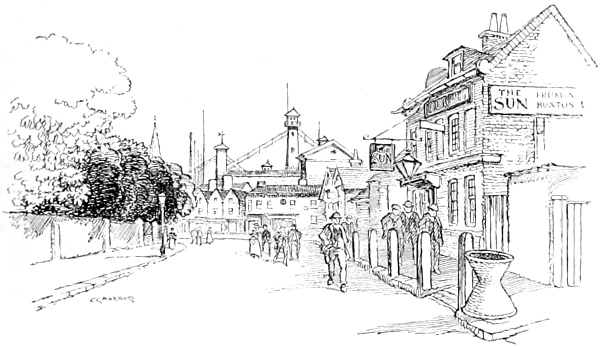
ENTRANCE TO ROMFORD.
A French traveller in England some two hundred years ago wrote that "there are a hundred sorts of Beer made in England, and some are not bad: Art has well supplied Nature in this particular. Be that as it will, beer is Art and wine is Nature; I am for Nature against the world." That old fellow did not know how artful beer could be, and if he could re-visit his native France might discover that even wine is no longer the simple child of nature it once was.
But although John Barleycorn is the tutelary deity of Romford, it is quite conceivable that the stranger bound for Norwich, and turning neither to right nor to left, might pass through the town without so much as a glimpse obtained of those Alpine ranges aforesaid. True, on entering Romford, he could scarce fail to observe certain weird structures ahead: odd towers like first cousins to lighthouses, springing into the sky line, with ranges of perpendicular pipes, like the disjointed fragments of some mammoth organ, beside them, the characteristic signs and portents of a great brewery; but the barrels are secluded, nor even are Romford's streets blocked, as might have been suspected, with brewers' drays. Romford, indeed, spells to the uninstructed stranger rather bullocks than beer; for the cattle-pens are the chief feature of its market-place, and sheep and hay and straw bulk more in the eye of the road-farer than the products of Ind, Coope & Co., which are to be seen in all their vastness beside the railway station and on the sidings constructed especially for the trade in ale and stout.
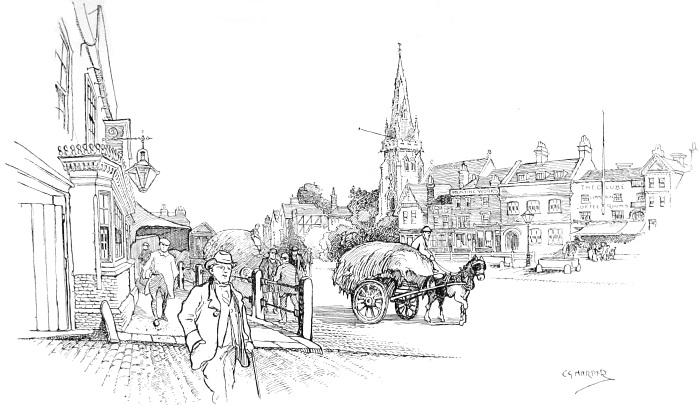
ROMFORD.
The town in its most characteristic aspect is seen in the accompanying illustration taken from the doorway of that old inn, the "Windmill and Bells," the broad road margined with granite setts and the pavements fenced with posts and rails; the re-built parish church prominent across the market-place.
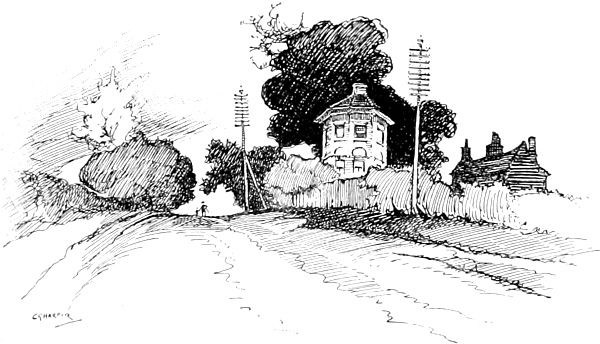
OLD TOLL-HOUSE, PUTTELS BRIDGE.
Beyond Romford the road grows rural, and, by the same token, hilly. This, gentle reader, let it not be forgotten, is Essex, and we all know with what persistence that county is spoken of, and written of, as flat. If you would know what flatness is, try the Great North Road and its long levels between Baldock, Biggleswade and Alconbury, or search Bedfordshire, Lincolnshire or Hunts. There is flatness, beside which that of Essex is the merest superstition, started probably by some tired traveller of inconstant purpose, who, essaying to explore the county, gave up the enterprise when he had reached Wanstead Flats. Surveying that not highly romantic expanse, he took it as an exemplar of the rest of the shire, and so returned home to start this immortal myth on its career. Certainly no cyclist who knows his Essex will subscribe to its flatness as an article of faith, and as such an one cycles from Romford, through the hamlet of Hare Street, over Puttels Bridge, where stands an old toll-house, to the other hamlet of Brook Street, the fact that he will actually have to walk his machine up the steep hill that conducts into the town of Brentwood will cause him to think hard things of myth-makers.
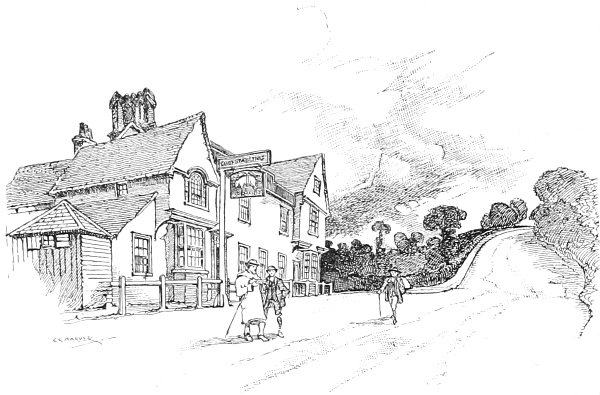
THE "FLEECE," BROOK STREET.
Brook Street Hill is the name of this eminence. Beside it stands a cemetery, convenient for brakeless cyclists who recklessly descend, and at its foot is a fine old inn, the "Fleece," a house of call for the fish-waggons that were once so great a feature of this road so far as Colchester and Harwich.
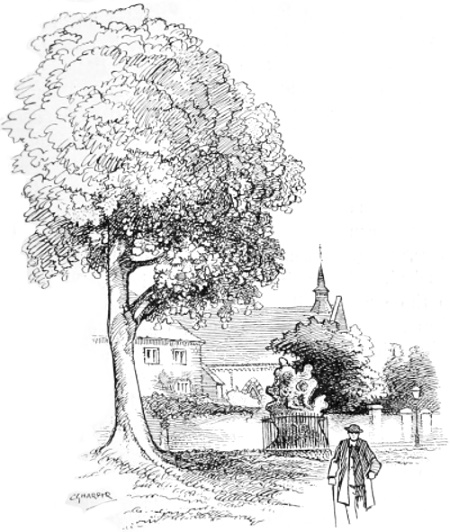
THE MARTYR'S TREE, BRENTWOOD.
Brentwood, on the crest of this hill, occupies an elevated table-land, with sharp descents from it on every side. The "burnt wood" town, destroyed in some forgotten conflagration, is now a long-streeted, old-fashioned place, apparently in no haste to bid good-bye to the past. It keeps the old Assize House of Queen Elizabeth's time in repair, and carefully sees to it that the Martyr's Tree, decayed though the old elm stump be and hollow, is saved from perishing altogether. It was in 1555 that William Hunter, in his twentieth year, suffered in this place for denying the doctrine of transubstantiation. That staunch upholder of the Protestant faith scarce needed the modern memorial, close by, while this shattered trunk remained, its gaping rents carefully bricked up by pious hands; but let the venerable relic be doubly safe-guarded in these times, when that candle lit by Latimer and Ridley, close upon three centuries and a half ago, burns dim, and lawless and forsworn clergy within the Church of England are working towards Rome and the return of the famous days of fire and stake; when the blood of the martyrs has ceased to inspire a generation which demands to be shown some tangible object before it can realise the significance of that sacrifice. Here, then, is something that can be seen and touched, to bring the least imaginative back in fancy to those terrible days, when brave hearts of every class gave up their lives in fire and smoke rather than abjure their faith. The Romanising clergy of to-day are made of coarser fabric than the martyrs. They are not actuated by honesty, but take oaths they have no intention of observing to a Church whose bread they eat and whose trust they betray.
Would you know something of that martyrdom at Brentwood? Then scan the inscription on the modern granite obelisk, and control, if you can, a righteous indignation when you perceive a modern Roman Catholic chapel standing, impudent in these days of an exaggerated tolerance, over against the Martyr's Tree itself, typifying the Scarlet Woman in midst of her blasphemies, exultant over the blood of the saints. "He being dead yet speaketh," quotes that inscription; but what avails it to speak in the ears of the deaf, or to talk of honour to the perjured? "Learn from his example," continue those momentous words, "to value the privilege of an open Bible, and be careful to maintain it"; but the world goes by unheeding, and only when the danger again becomes acute and liberty of conscience is passing away will indifference be conquered and the folly of it revealed.
XVI
Brentwood still keeps a notable relic of coaching days in the old "White Hart" Inn, a curious specimen of the timbered and galleried type of hostelry familiar to our great-grandfathers. It turns a long plastered front to the street, but the great carved and panelled doorway leading into the coach-yard confirms the proud legend, "Established 1480." Full forty coaches passed through Brentwood in every twenty-four hours at the close of the Coaching Age, but the earlier days of coaching brought the "White Hart" more custom than came to it at the close of that era, when, in consequence of the roads being improved, travelling was quicker, and places once halted at were left behind without stopping. Innkeepers were considerable losers by this constant acceleration of coaches, and saw the smart, long-distance stages go dashing by where, years before, the old slow coaches stayed the night, or, at the very least, halted for meals.
The "White Hart" remains typical of the earlier times, and still keeps the old-world comfort regretted in other places by De Quincey, who lived long enough to witness the beginnings of the great changes that have come over the hotels of town and country since coaches gave place to railways.
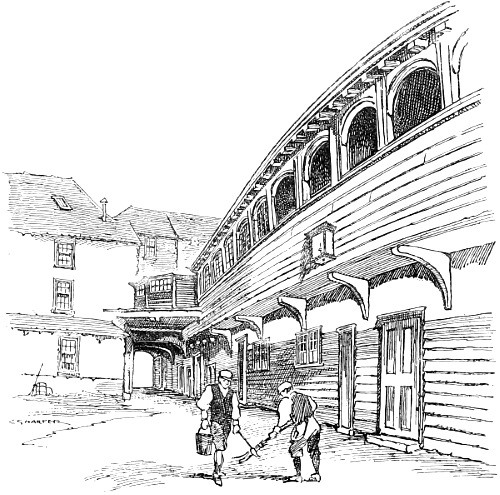
YARD OF THE "WHITE HART," BRENTWOOD.
XVII
Brentwood is no sooner left behind than the road descends steeply over what was once a part of Shenfield Common, an exceedingly wild and hillocky spot in days gone by, and probably the place where, in November 1692, those seven jovial Essex squires mentioned by Macaulay were themselves, while hunting the hare, chased and at last run down by nine hunters of a different sort, who turned their pockets out and then bade them good-day and be damned. The original chronicler of this significant incident, the diarist, Narcissus Luttrell, makes no especial feature of the event. He merely records it as having happened "near Ingerstone," and then proceeds to chronicle other happenings in the same sort along the several approaches to London. Little wonder, therefore, that Macaulay should have drawn the conclusion that at this time a journey of fifty miles through the wealthiest and most populous shires of England was as dangerous as a pilgrimage across the deserts of Arabia.
From the descending road or from Shenfield Church the country is seen spread out, map-like, below, over the valley of the Thames, to where the river empties itself into the broad estuary at the Nore. At least, there is the vale, and the map vouchsafes the information that the river flows thereby; but the compacted woodlands shut out the view of that imperial waterway. "I cannot see the Spanish fleet, because it's not in sight," says the disappointed searcher of the horizon in the poem, and it is precisely for the same reason that the Thames is not visible from Shenfield. But if one is denied a view of that imperial river, at least Shenfield Church itself and its churchyard, a prodigal riot of roses of every hue and habit, are worth seeing. The attenuated shingled spire, one of the characteristic features of Essex churches, beckons insistently from the road, and he who thereupon turns aside is well repaid, in a sight of the elaborately-carved timber columns of the interior, proving how in this county, where building stone is not found, thirteenth and fourteenth-century builders made excellent shift with heart of oak. This is, in fact, like so many other Essex churches, largely wooden, and its timber is as sound now as it was six or seven hundred years ago.
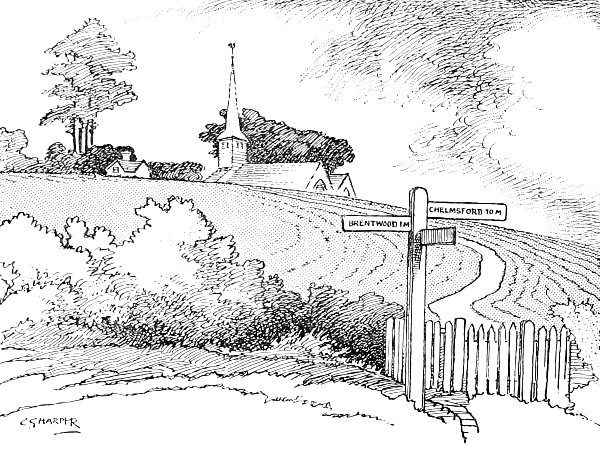
SHENFIELD.
Mountnessing, known locally as "Money's End" lies two miles distant from Shenfield. As in the case of so many other places near the great roads, a comparatively recent settlement bearing the name of the old village sprang up, to catch the custom of travellers; but an additionally curious fact is the utter extinction of the original village, which lay a mile distant from the highway, where the parish church now stands lonely, save for a neighbouring farmstead. Explorers in the countryside are often astonished at the great distances between villages and their parish churches, and seek in vain in their guide-books or in talk with the "oldest inhabitant" an explanation of so curious a thing. Here, as in many cases, the root of the mystery is found in the enclosure of the surrounding common lands. The enclosure of commons has never been possible without the passing of special Acts, which have divided what should have been the heritage of the people for all time between the lord of the manor and the villagers, in their proper proportions. Thus the lord of the manor and the tenants would each obtain their share of the plunder, in the form of freehold land, with the obvious result that the villagers, instead of paying rent for their cottages clustering round the church in the original village, built themselves new and rent-free cottages on their share of the spoil of the commons. The old cottages being pulled down, or allowed to decay, it was not long before the last trace of the original village disappeared.
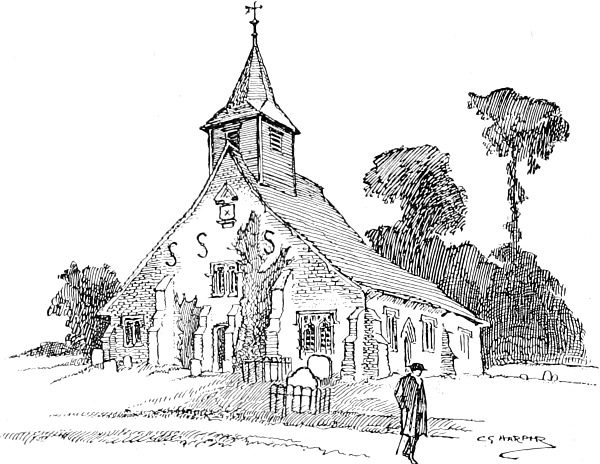
MOUNTNESSING CHURCH.
Mountnessing was once the seat of the Mounteneys, who have long since vanished from their old home. The old church, largely red brick without and timber within, still preserves the fossil rib-bone of an elephant, long regarded with reverence by the country folk as the rib of a giant, and has for an additional curiosity the carving of a head on one of the pillars, a head fitted, perhaps by way of warning to Early English parishioners of shrewish tendencies, with a brank, or "scold's bridle." The red-brick west front of the church, masking the wooden belfry-frame from the weather, still bears the date, 1653, carved in the brick, but such is the fresh appearance of the brickwork that without that evidence of age it would be difficult to credit it with so long an existence. The iron ties in the shape of the letter S give the view a singular appearance. An apologetic epitaph in verse, beginning, "Reader, excuse the underwritten," is a curiosity of Mountnessing churchyard.
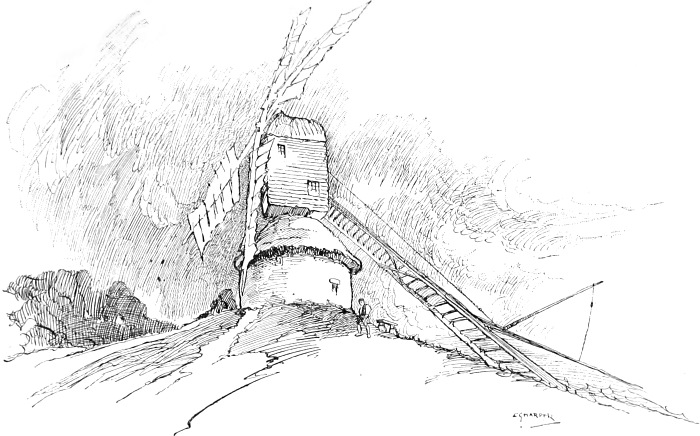
MOUNTNESSING WINDMILL.
Returning to the road, Mountnessing Street, as the modern settlement is named, is seen clustering on a hill-top, around four cross-roads and a wayside pond. The place may aptly be summarised as consisting of a dozen cottages, two public-houses, a general "stores" (our grandfathers would have been content with the less pretentious word "shop"), a tin tabernacle to serve those too infirm or too lazy to walk a mile to church; a sweep's shop, a tailor's, and a windmill situated on a knoll; a windmill that for picturesqueness might win the enthusiasm of a Crome or a Constable.
From this point it is, as a milestone proclaims, two miles to "Ingatstone," the "Ingatestone" of customary spelling. The milestones are undoubtedly strictly correct in their orthography, if erring on the pedantic side, for that village derives its name from a settlement of the Anglo-Saxons by the "ing" or meadow, at the Roman milestone they found here, but has long since disappeared. "Ing-atte-stone" they called their village, which lies in the little valley of the River Wid, or Ash, trickling (for it is a stream of the smallest) hither and thither to give a perennial verdure to the meads along its course. "Ing" is, by consequence, a marked feature of the place-names successively met with along the River Wid. Mounteney's Ing we have already seen, and Fryerning, or Friars' Meadow, is not far away; while Margaretting, the prettiest name of all, lies beyond Ingatestone.
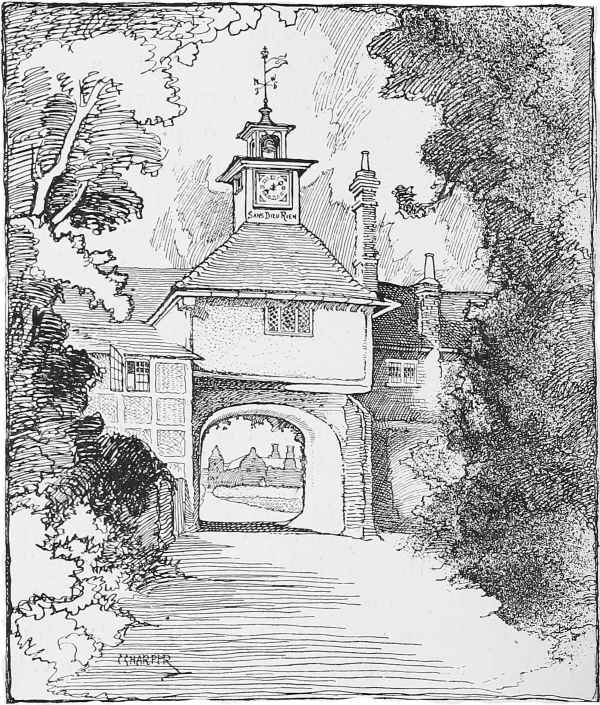
THE GATEHOUSE, INGATESTONE HALL.
Ingatestone's one street, fronting on to the highroad, is of the narrowest, and remains in almost every detail exactly as it is pictured in the old print reproduced here, with the red-brick tower of the church still rising behind. It is a tower which by no means looks its age of over four hundred years, so deceptive is the cheery ruddiness of the brick. Within, by the chancel, is the monument of that Sir William Petre who, emulating the accommodating qualities of the famous Vicar of Bray, bowed before the religious storms of the reigns of Henry the Eighth, Edward the Sixth, Mary and Elizabeth. "Made of the willow and not of the oak," those tempests not only left him unscathed, but brought him much plunder. Under Henry he was enriched with the manor of Ingatestone, plundered from the Abbey of Barking, together with much spoil elsewhere. How he managed to do it is a mystery, but during the reign of Mary this ardent Catholic (for such the Petres always have been) actually obtained a Papal Bull confirming him and his in these grants. One marvels, when gazing upon his high-nosed effigy, recumbent beside his wife, how one with that noble physiognomy could be so accomplished a time-server and truckler. His home, plundered from the nuns of Barking, and known for many years as Ingatestone Hall, is yet to be seen at a short distance from the road, down a beautifully-timbered country lane. The entrance is by a gatehouse with the motto, "Sans Dieu Rien," situated at the end of an avenue and framing in its archway a fine view of the romantic old red-brick turreted buildings of the fifteenth and sixteenth centuries. The Lord Petre of to-day does not reside here, but the place is still in the family, and the Roman Catholic chapel is even now in use. Miss Braddon is perhaps scarce to be numbered among those novelists whose literary landmarks are followed with interest, but it is claimed for Ingatestone Hall that it is the scene of her Lady Audley's Secret. The fish-ponds of old monastic times, the well in which Lady Audley thrust her husband, the lime-walk he haunted, together with such romantic accessories as terraced walks and a priest's hiding-hole, form items which would require the business enthusiasm of an eloquent auctioneer to fully enlarge upon. They do say—the "they" in question being the gossips of Ingatestone—that the guard and driver of the Parcel Mail, passing at 1·15 a.m. the head of the avenue leading from the high road, once saw "a something" in white mysteriously sauntering beneath the trees, but whether it was the shade of an Abbess of Barking or one of the sisters thus bewailing the fate of their old home, or merely a white cow, remains an unsolved mystery, the Postmaster-General's regulations and time-sheets not allowing for time spent in psychical research.
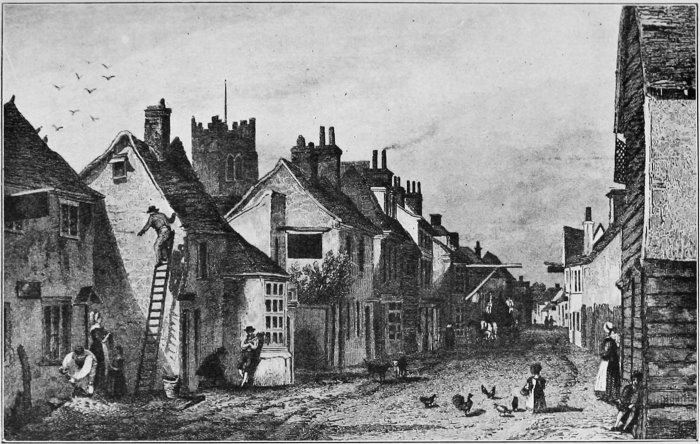
INGATESTONE IN COACHING DAYS. From an Old Print
The shingled spire of Margaretting Church is visible on the right, soon after leaving Ingatestone. Like the church of Mountnessing, it has its timbered belfry-framing, and like it again, is remote from the village, standing solitary, save for the vicarage and a farmhouse, beside a railway crossing—if, indeed, any building adjoining the main-line of a great railway may ever be called solitary. The Margaret thus honoured in the place-name is the Saint to whom the church is dedicated. Some traces of the "marguerite," or herbaceous daisy, painted on the old windows, in decorative allusion, remained until they were swept away for modern stained-glass in memory of a late vicar and his family; glass in which Saint Margaret has no place; so that, save for an inscription on one of the bells, she now remains unhonoured in her own church, deposed in favour of Isaiah and Jeremiah and subjects kept "in stock" by the modern ecclesiastical art furnisher. The only remaining ancient glass is that of the east window, a magnificent fifteenth-century "tree of Jesse."
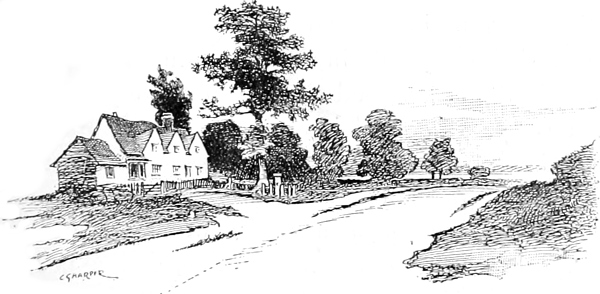
AT MARGARETTING.
Margaretting Street fringes the wayside at the twenty-fifth milestone, where a post-office and some few scattered cottages straggle picturesquely at the foot of an incline leading up to Widford. The odious wall of pallid brick that helps so materially to spoil some two miles of this road is the park wall of Hylands, a large estate purchased about 1847 by one John Attwood, a successful ironmaster, who stopped up roads, pulled down cottages, and raised this eyesore to enclose his new-made park. Almost as soon as the last brick was put in its place, the autocratic Attwood became utterly ruined by railway speculations, and his walled-in Eden was sold. Nature in the meanwhile has done her best, and a continuous fringe of trees now overhangs the ugly wall, while at a break in it, where the River Wid crosses beneath the road, water-lilies gem the stream and the wind sounds in the luxuriant Lombardy poplars with the sound of a waterfall.
If it were not for its church, which has been re-built and has a very fine and tall spire, one might easily pass Widford and not know it, for the very few houses do not suffice to make a village. Such as it is, it stands on the crest of something not quite so much as a hill and rather more than an incline, and beside its large church has an equally fine and large and brand-new inn, the "White Horse." Time was, and that until three years since, when Widford was celebrated for its one other inn, the "Good Woman," or, as it was sometimes styled, the "Silent Woman"; a bitter jest emphasised by the picture-sign of a headless woman, with the inscription, Fort Bone, on one side, and a portrait of Henry the Eighth on the other. "Fort Bone" was commonly Englished by slangy cyclists as "good business." The sign, of course, was a pictorial and satiric allusion to Anne Boleyn, but it remains an open question whether or not in their present form this and the several other "Quiet Woman" and "Good Woman" signs throughout the country are perversions of the original legend, "la bonne fame" displayed on old inns in the distant past; an inscription laudatory of the hostelry, and matching the self-recommendation of "la bonne rénommée," found in modern France, or the more familiar "noted house for—" and "good pull up" inscriptions on inns in modern England. Virgil's description of Fame, walking the earth, her head lost to sight in the clouds, may have originated the pictorial sign of the headless woman in days of ancient learning; and the classic allusion becoming lost and the supposedly incorrect spelling of "fame" being altered to "femme," we thus obtain a very reasonable derivation. We may take it that many shrew-bitten folks, innkeepers and customers alike, readily agreed to forget the original meaning in order to adopt one so exactly fitting their opinion that the only quiet or good women were headless ones.
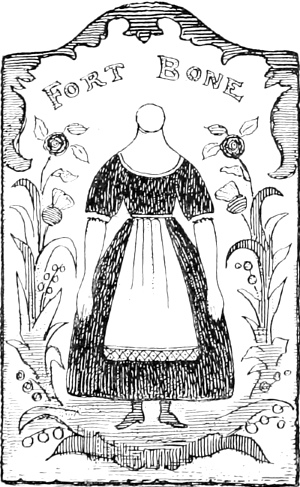
THE "GOOD WOMAN" SIGN.
Unhappily, in that senseless itch for change that is robbing places of all interest and distinction, the sign of the "Good Woman" no longer swings from its accustomed place, and the bay-windowed inn opposite the "White Horse" has retired into private life. The picture sign is now housed inside the "White Horse."
XVIII
Widford almost immediately introduces the explorer to Moulsham (originally the "mole's home"), itself own brother—but a very out-at-elbows brother—to Chelmsford. If we wished to put the wind between our gentility and the somewhat fusty purlieu of Moulsham, we should turn to the left at the fork of the roads, half a mile short of the town, and so, proceeding along the "new London road," come into Chelmsford, half way down the High Street. Being, however, intent rather upon old roads than new, we will e'en endure the half-mile length of shabby, untidy street, and thus come bumpily into Chelmsford, the county town of Essex, the Metropolitan City of Calves, over the hunchbacked and narrow stone bridge across the Chelmer, the successor, at an interval of seven hundred years or so, of the original bridge built by Maurice, Bishop of London. That is a huge slice of time, but it was too late, even in Norman days, for the town to change its name from Chelmersford to something more appropriate when the ford was thus superseded.
Straight ahead over this bridge goes the High Street of the town, the view closed by the Shire Hall and the church; the Norwich Road, however, turning abruptly to the right, by the Conduit, and refusing to make acquaintance with the town. It is the Conduit that is seen in this illustration of the High Street, its architecture scarce improved by the placing of an electric lamp, alleged to be ornamental, over its cupola.
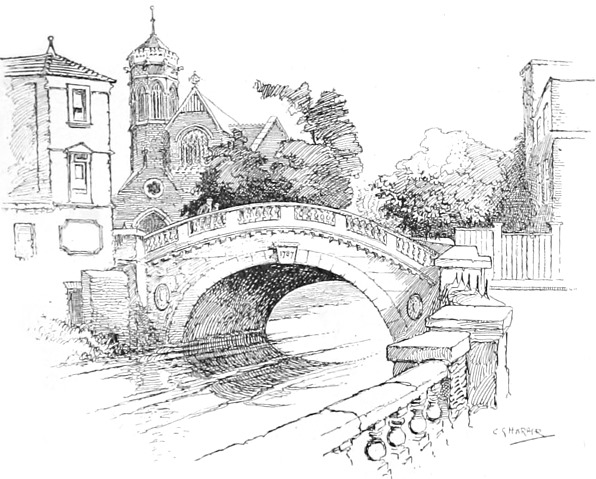
THE BRIDGE: ENTRANCE TO CHELMSFORD.
Chelmsford church and the Shire Hall, seen at the end of this view, spoil one another, the Hall almost entirely hiding the church when looking down the High Street, and the dignified Perpendicular exterior of the church putting the clumsy architecture of the Hall to shame, as a pagan upstart. The Shire Hall has its terrors for some, but its architecture, alleged to be classic, alone concerns the passing stranger, who feels so concerned by sight of it that he accordingly passes the quicker. A captured Russian gun and the seated bronze effigy of a native, a bygone Lord Chief Justice (who looks whimsically like an old apple-woman crouching over her basket, and drops green coppery stains over his nice stone pedestal) keep one another company in the open space fronting this building.
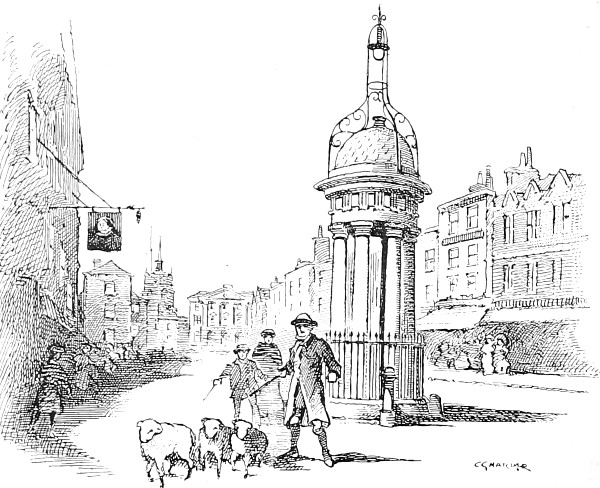
THE CONDUIT, CHELMSFORD.
The L.C.J. in question was Nicholas Tindal, whose career came to a close in 1806. The monument was erected in 1850, "to preserve for all time the image of a judge whose administration of English law, directed by serene wisdom, assisted by purest love of justice, endeared by unwearied kindness, and graced by the most lucid style, will be held by his country in undying remembrance." His birthplace could hardly have said more than that.
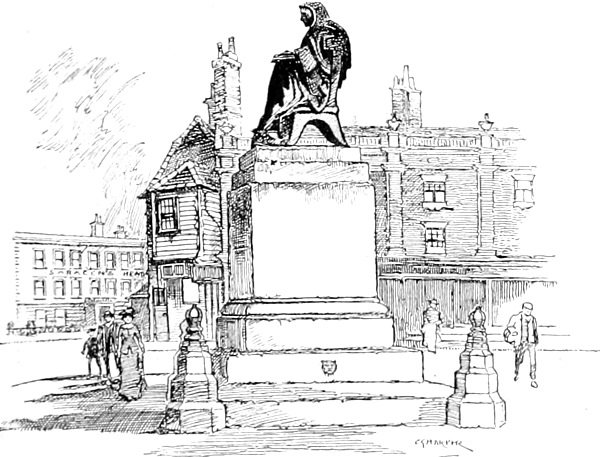
TINDAL'S STATUE.
Chelmsford stands not upon the ancient ways, being indeed very severely bitten with a taste for modernity. Is it not famous as the first town in the kingdom to adopt electric lighting, and have not its streets been resolutely swept clear of antiquity? The town, in short, is scarce picturesque. It is busy in the agricultural way on Fridays, but on other occasions every house provokes a yawn, with perhaps the exception of the "Saracen's Head," an inn that, despite its modernised and stuccoed frontage, keeps some memories of old times. There was a "Saracen's Head" here certainly as far back as the fifteenth century, and probably much earlier. Like all the signs of that name, it derived from Crusading times, when the knights and men-at-arms, returning from Palestine with wounds and spoils from the pagan; with monkeys, leprosy, tall stories, and other relics out of the Holy Land, found their fame come home before them, and the old inns they had known—the "Salutation," the "Peter's Finger," the "Catherine Wheel," and the like—often re-named in their honour. With little effort we can imagine the scenes at the "Saracen's Head" of that period, when exploits at Acre, Joppa and Jerusalem were told and re-told, and gained wonderfully in the repetition over sack and malvoysie. What bloody fellows they were, and with what zest they slew the Soldan's soldiers over and over again as they sat over their cups. It is, at the least of it, six hundred years ago, and the "Saracen's Head" has been rebuilt many times since then; but human nature remains the same though timber rot and brick perish, and again and again the same old talk has been heard in the bar-parlour of the inn. Those who fought at Agincourt and Creçy; men of a later age who warred under Marlborough at Blenheim, Ramillies or Malplaquet; the lads of the Peninsula and Waterloo; survivors from the horrors of the Crimean winter, and heroes from a hundred fights on the burning South African veldt—all have had their circle of greedy listeners here.
The "Saracen's Head" of to-day turns a sleek and stuccoed face to the street, and the house shows signs of extensive rebuilding and remodelling, undertaken in the full flush of the great days of coaching prosperity, when so many old inns were rebuilt, in the belief that coaching, and the road as an institution, would last for ever. Fond belief! Has anyone ever stopped to consider the fact that the great coaching era of the 'twenties and the 'thirties had a great deal more to do with the pulling down of the old-fashioned galleried and timbered inns of country towns than ever railways have had? The average small country town felt in fullest measure the great increase in business incidental to the last years of the coaching age, and every innkeeper hastened to rebuild his inn and to call it an "hotel." Those who had, from one cause and another, deferred rebuilding until the dawn of the Railway Age, on seeing that the road would decay and travellers be carried to their journeys' ends without halting for rest and refreshment, promptly gave up any such ideas and were thankful that they had not begun the work of reconstruction and enlargement. Those who had were ruined, and to this day the huge hotels they reared may yet be often met with, a world too large, in country towns where once the mails and the stage-coaches passed, like a procession, day by day. It is quite by a happy chance that an old galleried house like the "White Hart" at Brentwood remains, and it is not too much to say that, had the Coaching Age lasted another ten years, it also would have been rebuilt.
An amusing story, with Anthony Trollope for its central figure, belongs to the "Saracen's Head" at Chelmsford. For some years after he had won fame as a novelist he still retained his position in the General Post Office, of which he was a travelling inspector. On one of these official journeys he happened to be staying here, at the time when his Barchester Towers was being issued, after the then prevailing fashion, in parts. He was seated in the coffee-room when two clergymen entered, one of them with the newly-issued part of the story. The cleric, cutting the pages, was soon immersed in the trials of the Bishop and the domineering ways of Mrs Proudie, who was rather a trial to Trollope's readers, as well as to the Bishop. Suddenly the clergyman put the book down. "Confound that Mrs Proudie!" he exclaimed, "I wish she were dead!"
Trollope looked up. Introducing himself, he thanked the reader for thus accidentally telling him that the Bishop's wife had become wearisome, and undertook to have done with her. "Gentlemen," said he, "she shall die in the next number;" and die she accordingly did. But in defence of Trollope's truthful character-drawing, let it be said that, in the opinion of those likely to be best informed, Mrs Proudies may yet be found in a goodly proportion of the episcopal palaces of England.
XIX
Returning now to the Conduit, and making for the open road once more, Chelmsford is left by way of Springfield, past the successor of Chelmsford's finest old inn, the "Black Boy," demolished in 1857. The old inn of that name had stood on the spot for five centuries, and had been the halting-place of many famous travellers, among them a long line of Earls of Oxford, journeying between their castle at Hedingham and London; but none of these associations sufficed to save the house. Fragments of its carved beams are preserved in the local museum, but recall it as little as does the skeleton of the mastodon bring back in his majesty that denizen of the earth in the dim æons of the past. Chelmsford would dearly like many of its old buildings—wantonly demolished years ago—back again; but what is done cannot be undone, and there's an end on't. The "Cross Keys" remains, in a restored condition.
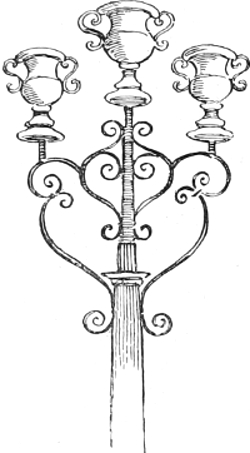
THE "THREE CUPS" SIGN
The name of Springfield, the eastern suburb of Chelmsford, carries varying significances. To the mere newcomer it sounds idyllic; to the American from the New England States it recalls the Pilgrim Fathers and their settlement of Springfield, Massachusetts; and to the gaol-bird it means a "stretch" of longer or shorter duration. At Springfield, in fact, is situated the County Gaol, a gloomy building enlarged in recent years for the accommodation of the guests consigned to it at Assize time from the Shire Hall down yonder in the High Street. But, once past this depressing place, Springfield is pleasing and cheerful. Its long miscellaneous street, where the quaint sign of the "Three Cups" stands out, gives place to suburban villas situated in attractive grounds and designed to sound the ultimate note of picturesqueness. That this has been the aim of their architects is abundantly manifest in examples where, under a single roof, one may experience the mingled romantic feelings of inhabiting an Edwardian castle, a Tudor manor-house, a Jacobean grange, and a "Queen Anne" mansion; all done in red brick, gabled here and battlemented there, and, moreover, fitted with electric light and hot and cold water supply. To this end has castellated and domestic architecture unwound its long story during some five hundred years. It will be seen thereby that William of Wykeham, John Thorpe, and many another old-time architect did not live in vain.
But if Springfield be modern as a suburb, it is ancient as a village. To see old Springfield, it is necessary to turn off the road to the left, and to journey a quarter of a mile, towards the old church, a noble building with mingled red brick and stone tower bearing the inscription, "Prayse God for al the good benefactors 1586." Oliver Goldsmith, it is quite erroneously said, took Springfield as the model for his Deserted Village. He certainly visited at an old cottage opposite the church, but the real Sweet Auburn is Lissoy, in Ireland.
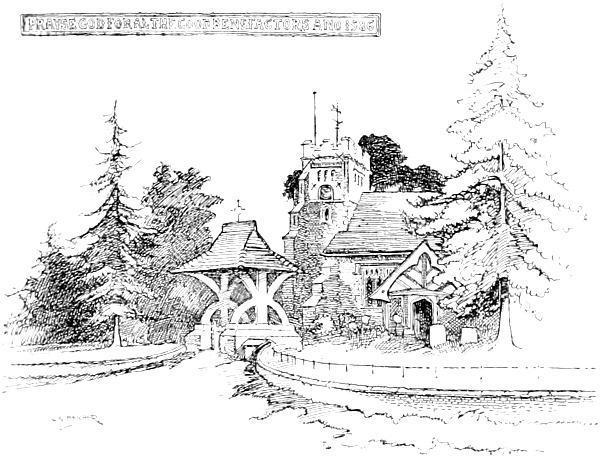
SPRINGFIELD CHURCH.
Beyond the village and facing the high road are the strangely impressive lodges of the historic estate of New Hall; new at the end of the fifteenth century, but declined into a respectable age by now and cobwebbed with much history and many legends. The place, now and for a considerable number of years past an alien convent, has been owned during a period of four hundred years by an astonishing number of historic personages, who have succeeded one another like flitting phantoms. Here the solemn reminder, "shadows we are," peeps out spectrally at every turn of Fate's wrist in the handling of the historic kaleidoscope. Built by Thomas Butler, Earl of Ormond, whose daughter and heiress became the wife of Sir Thomas Boleyn and mother of the unfortunate Anne, New Hall thus eventually came into possession of Henry the Eighth, who occasionally resided here and re-named it "Beaulieu." Elizabeth gave Beaulieu to Thomas Radcliffe, third Earl of Sussex. By this time it had resumed its name of New Hall. Later owners were George Villiers, the magnificent Duke of Buckingham, and Oliver Cromwell, who had it as a gift from Parliament and exchanged it so soon as he decently could for the more magnificent, convenient and king-like residence of Hampton Court Palace. To him succeeded another Duke of Buckingham, and to him that soldier and king-maker, the crafty Monk, Duke of Albemarle, who kept great state at the Hall and was visited here, when he was suffering from gout and dropsy, by that scribbling traveller, Cosmo, Grand Duke of Tuscany. With Monk the line of historic owners may be said to end, but constant change has ever been the lot of New Hall, and a succession of lesser lights followed him until the nuns set up their secluded life here and bade farewell to a vain world. That world passes by; the road on one side, the railway midway in the grounds, and if it gives them a thought at all, scorns them as morbid and idle malingerers from the work of the vineyard.
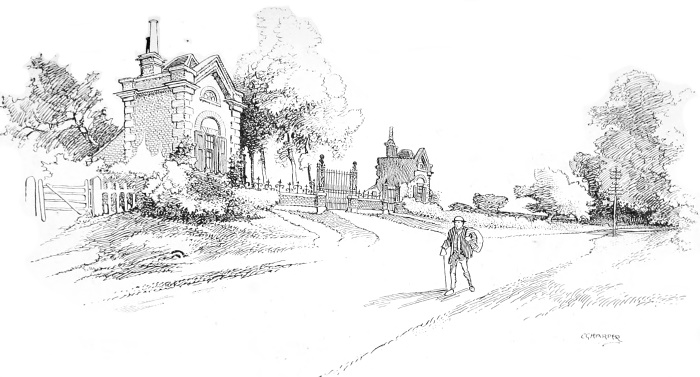
NEW HALL LODGES
No glimpse of the Hall is gained from the road. All is emptiness, and the lichened brick and the crumbling stone vases of neighbouring boundary walls add to the melancholy air of failure and unfulfilled aims characteristic of the place.
There is an air of romance about Boreham House, as seen from the tree-embowered road at a little distance from New Hall; an altogether deceptive air, let it be said, for the house is modern; a classic building of white brick. It is its situation at the head of a formal lake, fringed with stately elms, that confers the illusory distinction, but the explorer of old roads, who halts here and listens to the cawing rooks on the swaying tree-tops, or watches the water-fowl squattering on the lake, can weave his own romance to fit the scene. And if the house, though stately, be modern, yet it holds something of interest in the shape of the identical carriage used by the Duke of Wellington at the Battle of Waterloo. Greatly daring, they dragged it out in recent years to grace a Chelmsford holiday, when it was broken to pieces in an accident. Restored now to its original condition, it will need to be a great occasion indeed that brings it forth again.
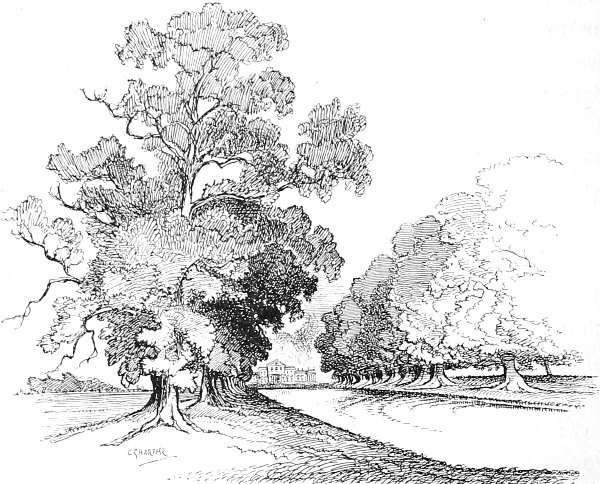
BOREHAM.
Boreham village lies hidden from the road, its old gabled cottages clustering round the still older church, itself embowered in lime trees whose delightful scent weights the July air with an Arcadian languor. The explorer who adventures into Boreham has every likelihood of having his nerves startled by the sudden glimpse at a bend of the road of a great mausoleum in the churchyard, with the door open, and, if it be midday, the sight, apparently, of one of the inmates of the silent tomb making a hearty lunch of bread-and-cheese. High noon being an hour when the supernatural is not so terrifying as to daunt investigation, it becomes evident on drawing nearer that the old tomb-house has been converted into a tool-house and general lumber-room, and that the figure seated within is the sexton enjoying his lunch, screened from the noonday heats. An inscription over the door of the ornate building—a copy of the Temple of the Winds at Athens—proclaims it the "Mausoleum Gentis Walthamianæ, Anno 1764"; but the Walthams have disappeared, both from their mausoleum and the district. The body of the last appears to have been arrested for debt when on the road hither from Chelmsford. The sexton explains that the parish took over the Walthams' last home in consideration of repairing the ruinated roof. "We ha'n't the conwenience hee-ar, years ago," says this typical Essex rustic, and goes on to tell how the oil and coals and candles for church use were formerly stored in the Radcliffe Chapel, where the Sunday School was also held. Three Radcliffes, Earls of Sussex, 1542-1583, grandfather, father, and son, lie in effigy side by side on an altar-tomb in that chapel, "as like as my fingers are to my fingers." "Old wawriors," the sexton calls them, and explains that their broken noses are due to the "ruff" having fallen in, years since.
Returning to what, in Essex parlance, is called the "mine" road, Hatfield Peverel is reached, past the great red-brick Georgian mansion of Crix, standing in its meadows where the little River Ter comes down from Terling, flows under the road, turns the wheels of Hatfield Mill, and then hurries off, as though belated, for a rendezvous with the Chelmer, two miles away. It is an old mill, fronting the road with whitewashed brick walls, a chimney bearing warranty of its age in the inscription, "A.A. 1715"; but if that evidence were lacking it could be found in the position of the mill-house doorway, sunk into an area with the raising of the road for the building of the bridge that long ago replaced the watersplash at this crossing of the stream.
Hatfield Peverel nowadays shows few signs of the heaths that once gave the place its original forename of "Heathfield," and the Peverels, identical with the Derbyshire Peverels of the Peak, are so utterly vanished that they have left not the slightest vestige of themselves in the church—that last resort of the antiquary in search of old manorial lords. It is true that on modern tablets built into the west front of the church the founding of a Benedictine Priory here in 1100 by Ingelrica, mother of William Peverel, is alluded to, together with the rather scandalous story of the Peverel origin, but these things are decently wrapped in the combined obscurity of Latin and lichen-stains, so that both their monastic beneficence and their maternal origin are only dimly to be scanned by the vulgar or the hurried.
It is the distance of half a mile from the high road to where Hatfield church lies secluded, adjoining the grounds of a mansion partly occupying the site of the Priory, and so named from that fact. It is here, if anywhere, that the "heaths" of Hatfield's original baptism must be sought, and accordingly some stretches of common-land may be discovered close by. But wayside Hatfield chiefly concerns us, though there be little enough to say of it, beyond the note that its closeness to the railway station has caused a certain growth and a certain amount of rebuilding, in alien and uncharacteristic style, of the old plaster cottages that were once the invariable feature of its street, and admirably figured forth the Essex manner of decoratively treating plaster-work. There remain here but two such cottages, bearing the date 1703, and the initials M.R., with fleur-de-lis.
XX
A road of almost unvarying flatness conducts in something under three miles to Witham, entered nowadays over an imposing bridge erected by the Essex County Council over a stream that luxuriates in no fewer than three separate and distinct names. As the River Witham, it confers a name upon the townlet; as the Brain, it performs the same sponsorial office for Braintree; but as the Podsbrook it is endowed with a title that smacks rather of the farcical sort. The traveller looking in summer-time over the railings of the bridge, down upon the mere thread of water oozing and stewing in the mud among the kitchen refuse of the neighbourhood, comes to the conclusion that it is not ill-named as the Podsbrook; but the Essex Council in bridging it so substantially think of it rather as the River Witham, which they have every right and cause to do, for the stream can avenge itself of those disfiguring potsherds and that contemptuous title in the most sardonic way when winter comes and the floods are out.
The long street of Witham is remarkable for the number of large and handsome mansions dating from the time of Queen Anne, through the period of the four Georges. The greater number of the professional men of Essex would, from the number of those houses, appear to have settled in the little town and to have medically attended it and legally represented it to such an effect that it is only now beginning to recover from them and from the coming of the railway, which dealt a death-blow to the thriving coaching interest of the early part of the nineteenth century.
For Witham was the half-way house, the dining-place of Mrs Nelson's famous "Ipswich Blues," the crack coaches on the seventy miles of road, which started at eight in the morning and by extraordinary exertions made Ipswich in something under six hours. Such remarkable performances as these were possible only by establishing six-mile stages in place of the average ten miles on other roads, and by placing leaders in readiness at the foot of hills like Brook Street Hill at Brentwood. The "Blue Posts" is gone, but the "White Hart," where some of the principal coaches drew up, is still in existence; its sign, a pierced effigy of that animal projecting from the front of the house and looming weirdly against the sky-line. There are many "White Harts" on the road to Norwich, the sign being just as peculiarly a favourite one here as that of the "Bay Horse" is on the Great North Road; but of all the many examples to be met along these hundred and twelve miles this is the one that is most quaintly out of proportion, with a head and neck less than half the size demanded by body and legs, and a golden collar and chain of prodigious strength. This heraldic device was the favourite badge of Richard the Second, whose connection with East Anglia was too slight for assuming this herd of White Harts to be especially allusive to him, or indeed more than a curious preference on the part of innkeepers along the Norwich Road.
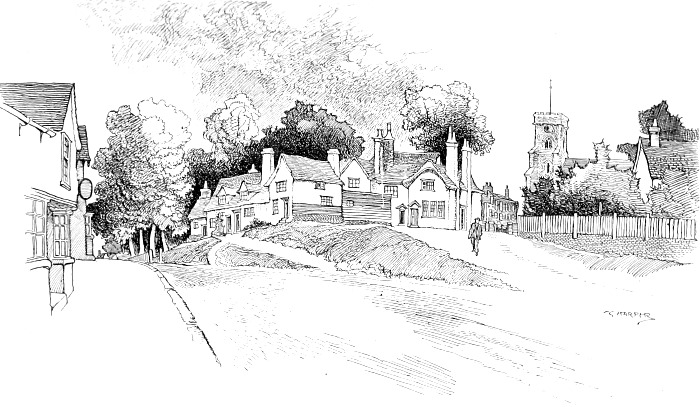
CHIPPING HILL.
Those who would seek the site of the original Witham must turn aside from the high road the matter of half a mile, past the railway station, to Chipping Hill, where, within the earthworks of a camp successively occupied and wrought upon by the Britons, the Romans and the Saxons, it will be found. Chipping Hill overlooks the pleasant valley of that triply-named river already mentioned, in 1749 described by Walpole as "the prettiest little winding stream you ever saw." The "sweet meadows falling down a hill" of which he speaks are there to this day, and as sweet, and the by-road that comes up from the gravelly hollow and cuts through the earthy circumvallation of the ancient stronghold climbs up romantically under the blossoming limes into as pretty a picture in the rural sort as you shall easily find. It is a little piece of Old England before railways came, or science and the ten thousand plagues of modern life, and the cheap builder of hideous new cottages were let loose upon the old order of things. Not a jarring note is in the picture of yellow-plastered and red-roofed old dwellings, flint-built church tower and red-brick rectory, set in, upon and around the swelling grassy banks where Romans kept guard and Saxons had both their fortress and their market, as evidenced by the still surviving name of Chipping, or Market Hill.
Old East Anglian cottages have their own special characteristics, arising from local conditions, but one feature they share in common with all old rustic dwellings; the great size and relative importance of their genial chimneys, suggesting warmth and the lavish laying on of logs. They tell the passer-by of old times when wood was the only fuel; when it was to be gathered for the mere labour of gathering, and plenty of it was piled upon the generous open hearth. Modern cottages, all over the kingdom, tell a different tale, in the look of their meagre chimney-pots—a tale of coal, dearly purchased, economised in tiny grates.
But the special features of East Anglian cottage architecture? They are here, in the highways and byways, for all to see who will. It is a land without stone, this East of England, where timber and flint and brick play important constructional parts in church and hall and manor-house, and where timber framing, lath and plaster, parge-work, and a few bricks for the chimney stacks, are combined to build up the cottages.
Out of their necessities our ancestors contrived dwellings that for durability, comfort and artistry put modern houses, whether halls or cottages, to shame. The stone cottages of Somersetshire, Rutland, Leicestershire; the cob and thatch of Devon, the granite of Cornwall; the timber and plaster, or timber and brick noggin of Cheshire and Herefordshire are all evidence to this day of how skilfully our forbears employed the materials to their hands; and here in Essex you shall find a something in the art of cottage building hardly to be discovered elsewhere. This is the frequent use of parge-work, or pargetting, as it is sometimes called, on old cottage exteriors. Parge-work is the ornamental filling or surfacing of walls with plaster. The term is just as often applied to the elaborately-moulded and panelled plaster ceilings of Elizabethan and Jacobean halls as to the exterior decoration that forms so remarkable and pleasing a feature of Essex rustic cottage architecture. Few Essex villages that can claim to preserve many relics of old times are without examples of this peculiarly local style; although, to be sure, an ignorant want of appreciation has been the cause of much destruction of late years. The commoner forms of this decoration are frequently seen, in the easily incised patterns that even the unskilful can make in the plaster while still wet, by the aid of anything from a trowel to the finger-tips; just as a cook ornaments the dough of her uncooked pies. Many of these patterns are traditional; as much a matter of tradition, for instance, as are the needlework patterns wrought on the breast of an old smock-frock. The commonest is one produced by a process of combing the plaster in repetitions of a device resembling an elongated figure 8 laid flat, or perhaps more narrowly resembling a hank of worsted. Other patterns, of whorls or concentric circles, stars, triangles and the like, are produced by wooden stamps. But the really beautiful examples are not the products of to-day. These belong to the seventeenth and eighteenth centuries, and are lavish in decoration of a Renaissance character moulded in high relief. Architects with sufficient culture and understanding to enable them to appreciate local style have, in recent years, reintroduced decoration of this character when building residences in the country, but many a humble cottager lives within walls that display a profusion of artistic devices unapproached by the houses of the wealthy.
Discoveries close by the church on Chipping Hill have led to the belief that the building stands on, or near, the site of a Temple of Diana, and certainly Roman bricks are still visible in great numbers in the walls of the tower. A memorial in the chancel to Sir Gilbert East, who died in 1828, reminds the historian of some strange survivals existing at that time. The Easts were owners of the tithes at Witham, and although they lived so far distant as Berkshire, always insisted on their right of being buried here. Sir Gilbert East's body was, by his express direction, buried beside his wife, with a band of brass encircling both, engraved with the words from the marriage service, "Whom God hath joined together let no man put asunder." His funeral was a three days' business, with knights bannerets accompanying, and much pomp and circumstance. In the family vault they laid him, wrapped in linen, returned to Berkshire for the reading of the will, when, to the dismay of the family, it was found that the knight had expressly wished to be buried in woollen. The family solicitor hurried back and, disinterring his defunct client, saw to it that he was comfortably tucked in as desired.
Between Witham and Kelvedon, where the road runs level, there is but one hamlet, an offshoot of Rivenhall known as Rivenhall End, where a cottage close by the "Fox" inn, once a toll-house, bears its former history, plain to read, in the evidence of its windows commanding either approach, up or down the road. A mile and a half beyond begins Kelvedon, set down in the flats beside the River Blackwater; "Kelvedon Easterford, vulgo Keldon," as Ogilby calls it; "consisting," he continues, "chiefly of inns"; a description which remains strikingly true to this day. This pronunciation, "Keldon," throws some light upon the following remarks of an old traveller who kept a diary of his wayfaring, and, writing in 1744, says, "From Colchester in an hour or two, I came to an old Village call'd Kildane, where they tell you the famous Massacre of the Danes began; but the true Name of the Town is Kelvedon."
How Kelvedon can ever have escaped being called "Long" Kelvedon is a mystery, for it straggles on and on and must be nearly a mile in length; a street of handsome old residences, of cottages and humble shops of all ages, and old broken-backed taverns where the Essex labourer gathers night by night and discusses the prospect of the carraway crop and the likelihood of the entire agricultural interest presently, going en masse to the "work'us." After which, with the courage of despair, and to drown his troubles, he will call for "another pot o' thrup'ny, missus," and, when closing time comes, slouch home through the mud and mist until the following evening, when the same programme is repeated. It is the agricultural labourer who supports the little wayside "publics" whose existence in such numbers puzzles the mid-day stranger, who, seeing them empty and apparently lifeless, wonders how they can possibly live. Business practically only begins when work in the fields is done, and the rent is not so high but that a few pots of beer a night represent a sufficient profit.
It must not be supposed that Kelvedon has not its exquisite architectural relics of a bygone time, or that its inns are all of the rural beer-house type. Not at all. Chief among the inns of Kelvedon is the "Angel," which indeed is a house not only of considerable size and outstanding character, but of historic interest, as having been the favourite resting-place of William the Third on his journeys along this road. Its projecting porch is the first thing the traveller sees on entering the town from the direction of London, where the road swerves violently to the left, and again as violently to the right, forming a very awkward corner. "Angel Corner," said Alexander, of the "Retaliator" coach, "is the very devil of a corner." This remark was drawn from him on the occasion of his nearly driving into the porch, when trying conclusions with a rival charioteer.
Almost opposite the still-existing "Angel" stood the equally extensive "Red Lion," long since retired from business and remodelled as a row of cottages. The histories of both houses, and of many another fine old inn, which might once have been written from the recollections of those who knew the old days of the road, are now in great part lost, and the world so much the poorer. Had scribblers then abounded, and the "personal" note of the modern journalist been sounded in those days, we should have known how King William came to and set out from his inn; how he looked, what he ate and drank, how many long clay pipes he smoked, and what comparisons he drew in conversation with Bentinck between the flat lands on the way from Kelvedon to Harwich and the still flatter lands of his native Holland. And besides such records of the great, we should then have been better furnished with the early history of coaching, which, if not indeed a sealed book, is at least a very short and fragmentary one.
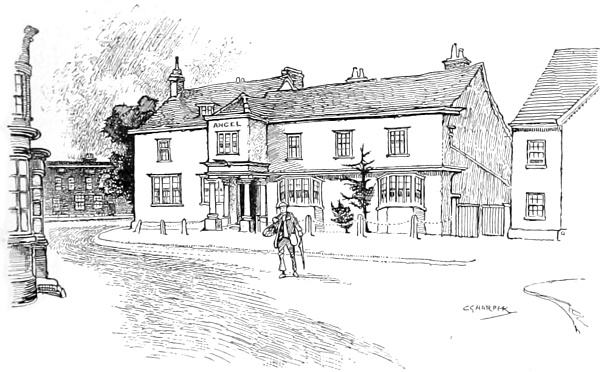
THE "ANGEL," KELVEDON.
XXI
Early coaching days are wrapped round with strange adventures and the oddest tales; some, doubtless, of the ben trovato, rather than the most truthful, nature. But those stories of coaching miseries and adventure that have been proved truthful are themselves so surprising and incredible to modern ears that even the most improbable of uncertified tales cannot be dismissed as mere romancing. The tale of the Sprightly Lady and the Anxious Gentleman should, for instance, surely be picturesquely written up some day and included in some English (and therefore strictly proper) kind of Thousand and One Nights' Entertainments.
The coach was nearing the outskirts of London. The rheumy air hung in dank and foggy vapours on the countryside and transformed innocent roadside trees and hedges into all sorts of menacing shapes. The guard let off his blunderbuss at a pollard willow that loomed suspiciously like a highwayman out of the reeking air, and the passengers all began to automatically turn their pockets out. It proved a false alarm, and purses and trinkets were returned. But the travellers were uneasy. One gentleman, in especial, feared for ten guineas he carried, whereupon a lady advised him to hide the money in his boot. He had hardly done this when a hoarse voice was heard commanding the coachman to stop. When the unhappy insides had picked themselves up from the straw at the bottom of the coach, into which they had unceremoniously been thrown by the driver's prompt obedience to that behest, they found themselves covered with a pistol projected through the door, and were invited to deliver up their money and jewellery. Those who had little gave it and were thankful it was no more. The lady protested that she had nothing; "but," said she, "if you look in this gentleman's boot you will find ten guineas." There was nothing for it but to take off that boot and hand over the coin; but when the highwayman had gone it was another matter, and the plundered traveller accused her, in no measured terms, of being the robber's accomplice. Bound to admit that appearances were against her, she (how like the Arabian Nights fashion!) invited the company to supper the following evening, when matters should be explained. They accepted, not, it is to be feared, very graciously. The time came, and, ushered into a splendidly-appointed room, with a supper laid, they were re-introduced to their acquaintance of the night before. When the repast was over she opened a pocket-book. "Here," she said, addressing the loser of the ten guineas, "in this book, which I had with me in the coach, are bank-notes to the amount of one thousand pounds. I judged it better for you to lose ten guineas than for me to be robbed of this valuable property. As you have been the means of my saving it, I entreat your acceptance of this bank bill of one hundred pounds."
Much of the humour that went to lighten old road travelling was of an evanescent kind, and has not survived, but a few examples, preserved in contemporary literature, keep their flavour. Among them is the narrative called "Three Blind 'Uns and a Bolter." "I recollect," said the Jehu who told the tale, "having a sanctified chap for a passenger, and nothing that was either said or done was at all to his mind. On that day I happened to have a very awkward team—three blind ones and a very shy off leader, and I confess that two or three times I lost my patience as well as temper. My near leader pulled to such a degree that I was obliged to get down and put up her bearing-rein up to the top of the bit, and curb her enough to break her jaw. After starting again, I could deal with her very well for about a mile, when her mouth got dead again, and I was wicked enough to let drive a few hearty damns at her, my pious companion all the while exhorting me to patience. 'Patience be damned,' at last said I, fairly sick of the two; upon which he bolted as if he had been galvanised.
"'Pray, sir,' said he, 'did you ever hear of Job?'
"'He can't keep out of the shop,' thought I, 'but I won't have it;' so I answered, 'What coach does he drive?'
"'Awful in the extreme,' said he, throwing up his hands, 'I fear you don't read your Bible; but I will tell you—he was the most patient man that ever existed.'
"'But, sir,' said I, 'did he ever drive three blind 'uns and a bolter?'
"'Certainly not,' replied he; 'he was not a coachman.'
"'Then it's accounted for,' said I, 'for if ever he had had four such horses to deal with as I have here, he would have had no more patience than myself.'"
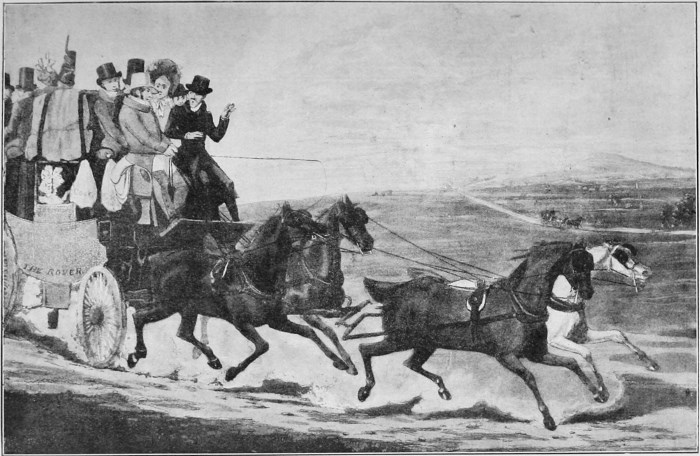
"THREE BLIND UNS AND A BOLTER." From a Print after H. Alken.
Here, at Kelvedon, one of the old-time coachmen played a drunken trick that would have been impossible in the last years of coaching, when discipline was strict and drivers less eccentric than they had been. He had just driven the London stage from Ipswich, and having more by good luck than careful driving brought his passengers safely to dinner at the "Angel," turned into the bar for a jorum of that favourite drink of coachmen—rum. Emerging, he perceived one of the Harwich to London fish-waggons, fully laden, standing at the door, and, mounting on to the driver's seat, unobserved, he wheeled the waggon round and dashed off at top speed on the way to Colchester, coming to grief at Lexden Hill, where the huge conveyance was upset and two tons weight of fish strewed the king's highway. The mad coachman survived to repent his escapade, but he went on one leg for the remainder of his life.
"Other times, other manners" is a saying that assumes an added force when contrasting the Coaching Age with the Age of Steam. Our fellow-travellers by railway, who glare at us, and we at them, like strange cats on a roof-top, have little idea of the chivalry that ruled on the road a hundred years ago. Glance, if you dare, at a lady who may be the only other occupant of a railway carriage with you, and she wonders whether she had not better call the guard; but it was, in the days of our great-grandfathers, almost the bounden duty of the gentlemen to see that the ladies in whose company the chances of the road might place them lacked nothing that courtesy could supply; whether it were merely the aid of an arm in walking up one of those hills the coaches could only climb unladen, or the more material attention involved in seeing that the dear creatures were duly supplied with refreshments. It was, for instance, long the chivalric custom of the gentlemen travelling by coach to pay for the breakfasts and dinners of the unprotected ladies who might be travelling by the same conveyance. "I vow," says one of these old travellers, "'tis a pleasure in a cavalier to do so; but, the Lord save us, what a prodigious appetite does not the swiftness of the travelling confer upon the fair, whose lassitude and vapours at other times render them incapable of more than drinking a dish of that noxious herb they call 'tay,' a thing which it is only fitting that the heathenish and phanatick peoples of the Indies should partake of. I protest that the ladies of the coach, when we alighted at the 'Angel' at Kelvedon, finding they could not be suited with tay, went to it with a right good will and left as good an account of the claret and the beef as if they had been going empty for a week. Spare me, I do beg, from your languishing creatures who would die of a surfeit of two biscuits at home, but compare with the most valiant of trenchermen abroad."
This protesting gentleman might, had he thought of it, have exclaimed with Othello on the pity "that we can call these delicate creatures ours and not their appetites."
He must have been particularly hard hit in the pocket by the robust appetites of his fellow-travellers, but did not, however, let his feelings appear, for he goes on to tell how he gave as a toast, "the ladies, bless them, whose bright eyes," etc., etc.—a toast we have many times heard of; and, indeed, rather flatters himself upon having "made an impression." He, in fact, seems to have been like Constable, in a way; for it was said of that painter that he was "a gentleman in a stage-coach; nay, more, a gentleman at a stage-coach dinner." "Then," said one, hearing that praise, "he must have been a gentleman indeed!"
That is very significant. It was, then, only your very paragon among gentlemen who could sustain the character at a stage-coach dinner. His manners might survive the strain of the journey itself, and even the sight and sound of lovely Phyllis, adorable when awake, snoring, unlovely to eye and ear, with open mouth and suffocating gurgles; but when after the tedious stage had been accomplished and the passengers had descended, irritable, hungry and thirsty, to a dinner scarce to be eaten, even at express speed, in the short time allowed, then, ay then, my friends, came the test! No man so insensible to politeness as a starving man, and few attentions were paid to the ladies by strangers whose sole chance of obtaining the dinner for which they had paid was the resolute determination to attend only to their own wants.
The discomforts of travelling by coach certainly outweighed the pleasures of that old-world method. A pleasant day and the open country made a seat on the outside of stage or mail an eminence not willingly to be exchanged for any other mode of conveyance then known; but, as little David Copperfield found on his first coach journey, night on a coach was an experience once gained not willingly repeated. Being put between two gentlemen, to prevent his falling off, David found himself nearly smothered by their falling asleep, so that he could not help crying out, "Oh! if you please!" which they didn't like at all, because it woke them. With the rising of the sun David found his fellow-passengers sleeping easier than they had done during the night, when terrific gasps and snorts disturbed their midnight slumbers. As the sun rose higher, so their sleep became lighter and they gradually awoke, one by one, each one indignant when charged with having slept. During the rest of his career, David invariably observed "that of all human weaknesses, the one to which our common nature is the least disposed to confess (I cannot imagine why) is the weakness of having gone to sleep in a coach."
XXII
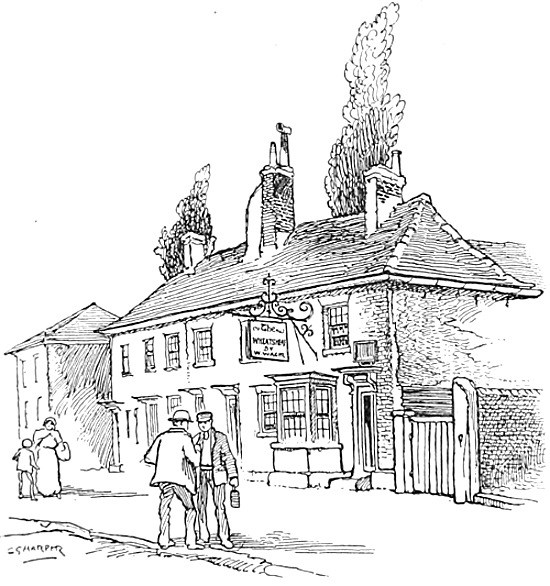
BIRTHPLACE OF SPURGEON.
Coaching times and coaching inns have long kept us at the very threshold of Kelvedon, which has a modern claim to notice of which it is not a little proud. Spurgeon was born here. Although the figure of that great wielder of homely and untutored pulpit oratory is but one among several preachers in the same family, there is only one possible Spurgeon when that name is mentioned. Charles Haddon Spurgeon was born in a house still pointed out, on June 19, 1834; the eldest son of the Rev. John Spurgeon. The old cottage is now the "Wheatsheaf" beer-house and has had a bay window and a brick frontage added since that time. Close by is a now highly respectable and not a little dignified private residence known still as the "Tommy shop," although almost seventy years have passed since it was used as a kind of restaurant and canteen for the navvies then working on the construction of the Great Eastern Railway, which runs at the rear.
The oldest house in Kelvedon is doubtless the "Sun," which dates from the middle of the fifteenth century and has within recent years had its carved woodwork, long covered with plaster, once more exposed to view. It stands, almost the last house in the town, by the bridge over the Blackwater, on the way to Gore Pit.
Gore Pit is generally said to be the site of a battle. What battle, however, historians do not and cannot specify; and indeed this name, bloody though it may sound to modern ears, has, despite the popular legend of the derivation of Kelvedon from "Kildane," perhaps no such sanguinary association, and is probably a contraction of the old word "coneygore," or rabbit warren.
It is, despite its name, a pretty and a peaceful hamlet, with a blacksmith's shop and a roadside horse-pond, and surrounded by the fruit-farms of a great jam-making company. The church of Feering can be seen across the flat fields, on the other side of the railway. Messing lies a mile away, in the other direction.
Let the idle wayfarer, curious as to the name of Gore Pit, speak to the blacksmith on the subject, and he will be told, with the seriousness of implicit belief, of the fighting of a great battle here, and that the blood ran down into "that there horse-pond." Moreover, that at Kelvedon—"Killdane they used to call it—they killed the Danes; at Feering they feared 'em, and at Messing they made a mess of it"; which seems to very correctly reflect the views of the neighbourhood on local history in ancient times, as reflected in place-names!
Rural Essex, in the aspect of its fields and meadows, is revealed along these miles in its most characteristic form. It is, in many respects, unlike other counties. In some ways the unhappy industry of farming has fared worse here than elsewhere, and many holdings have for years past gone uncultivated, and the dock, the thistle and other lusty weeds have resumed an evil possession of fields once kept clean and trim. But in the smaller operations of husbandry Essex has always been, and in some districts still is, remarkably successful; while, although the farmer protests that it does not pay to grow any kind of grain, the yellowing seas of autumnal cornfields are still a prominent feature of the landscapes of Essex and of its neighbouring Suffolk. Essex and Suffolk are old-world, far beyond the rest of England, and in growing wheat in these times, when a cornfield is a rare sight in other parts of the country and when "our daily bread" is chiefly compounded of grain grown in North America, Russia, or the Argentine, they maintain their singularity. It does the heart good to see the ripening wheatfields of East Anglia, to see the gathered stooks in the reaped perspectives, and to hear the hum of the threshing machine; for the sights and sound seem to carry us back to that England of a bygone age, when Constable painted such fields, and when they were numerous enough throughout the land to feed the population. Here and there one may still find fields of that famous grain, the "Essex Great Wheat," which grows at least two feet higher than the ordinary varieties, and is greatly prized for the length and stoutness of its straw; but it is a few miles to the north-eastward, in the light lands around Harwich, that the Great Wheat may be found. Seed and herb-growing are the most prominent industries between the Blackwater and the Colne, and the roadside fields are striped to wonderment in summer with the rainbow colours of the seedsman's trial-grounds. The heavy perfume of stocks and mignonette, the claret colour of that gorgeous flower, the "sops-in-wine," the gay and varied displays of asters, marguerites, marigolds and a hundred others make a midsummer fairyland of the levels that loom so drear and misty in the long months of winter. Nor is it only for the flower-garden that the Essex seedsman labours. With the sights and scents of the flaunting beauties of the garden are mingled the homelier ones of mint, grey-green sage and other dowdy kitchen herbs, together with the subtle beauty and piercing odour of wide-spreading, blue-grey lavender-fields. Even the unromantic mangold, running to seed in bush-like shape, sends forth a sweet and pleasing aroma, while the yellow mustard contributes its share.
The byways of farming are now, as we have already said, the most—some would say the only—profitable kind of husbandry in Essex. Some forms of cultivation have largely migrated to other counties, but others remain. The growing of the clothiers' teasel was discontinued with the decay of the Colchester and Norwich baize industry, and is now carried on in other parts of the country, close to districts where textile fabrics are still manufactured; but there was a time when, along this road between Chelmsford and Colchester, the fields of teasels were quite as much a feature as those of mustard are even yet. The clothiers' teasel, greatly prized in the East Anglian baize manufacture, was nothing but a weed, found useful and cultivated accordingly. An aristocratic relation of the less spiky burrs that have not been rescued from the hedges and ditches and are still allowed to grow wild, the clothiers' teasel was cultivated so far back as the reign of Richard the First, but the "common" burr will have to be contented with its lowly estate to the end of time, unless something unexpected happens.
To "stick like a burr" is proverbial, and the cultivated teasels have an even more pronounced clinging property. Furnished as they are with natural hooks, they were used in baize-making, and are still employed in the cloth trade for raising the nap of the material. The dried heads are fixed to cylinders, between which the fabric is passed, and their sharp spines, re-curved like so many minute fish-hooks, draw up the surface of the cloth. Thus the teasel was raised from its character of a worthless weed, and for many years Essex farmers devoted large portions of their holdings to its cultivation. It was hoed and kept clear of other vagrom weedlings; its heads were cut by hand and dried with every care, and eventually were eagerly competed for by manufacturers at £12 a load. When the old cloth manufacturers left East Anglia, a goodly portion of the Essex farmers' livelihood went with them.
Around Colchester, too, is cultivated that other weed, the colewort, for cole or rape-seed, which has the quadruple properties of feeding cage-birds, yielding rape-oil, making cake for cattle, and of manuring the fields. Coriander and carraway seeds, too, help to prop the husbandman's fortunes. Corianders and carraways are what "the faculty" knows as "carminatives," curative of flatulency; like the once popular "eringo root," a candied preparation of the root of the sea holly that grows by the estuaries of Essex rivers. Eringo root was once a favourite specific for lung troubles, but its popularity waned at last, and the preparation of it gradually died out and became extinct about 1865, when the only manufacturer was an elderly spinster who supplied a chemist in High Street, Colchester. Corianders are still used in the making of kümmel and other liqueurs, and carraway seeds, which look like commas, are those familiar denizens of "seed cake" that stick in the teeth and refuse to be dislodged, and are the central feature of "carraway comfits."
Farmers who do not occupy themselves with seed-growing have passed through evil times, but prosperity beams cheerfully from the seedsman's well-tilled land, and fruit-farming has come to render cultivation profitable. Still, to the shiftless farmer, who cannot adapt himself to new conditions, agricultural depression in Essex is a very real thing. Here, shambling along the road, comes such a one, a small cultivator, a son of the soil. He does not hurry. Who, indeed, would hurry in rural Essex, in these times, when the Bankruptcy Court and the Workhouse are said to close every vista? Besides, he has been hard at work in the fields, and much of that kind of labour takes all the lamb-like friskiness out of the limbs.
A conversation, leaning over a field-gate very badly in need of repair, elicits the fact that he has just come away, worsted, from another bout in the eternal conflict between Man and Nature. No conflict with wild beasts, but a struggle, really just as fierce, for life or a livelihood, with weeds—the sorry heritage of the present occupier from the slovenly or bankrupt farmer before him. A bookmaker, gazing upon the weedy scene, would back Nature pretty heavily against the cultivator.
"Farmin'?" says our rustic friend; "no great shakes, I tell 'ee. It don't pay to grow nawthen now, an' it gets wusser'n wusser. All the fields goin' under grass, for ship'n cattle. An' the land's fair pisoned with weeds. Yow see them 'ere beece, in that there close down along o' the chutch? There's a mort o' docks in that 'ere close. More docks'n grass, an' I thinks warsley o' the chanst of cattle gettin' a fair bite off'n it. Don't know what docks is? Wish I didden! I've bin a-pullin' of 'em till my back's pretty nigh broke, and I'm fair dunted with 'em. Last year there worn't ne'er a one: t'yen there's a mort on 'em. Where do they come from? God A'mighty knows. They don't want no cultivation, bless 'ee. There ain't no land so chice but what'll grow docks." Here he pulls out his "muckinger," that is to say, his handkerchief—the Essex dialect is not the most elegant form of speech—and, trumpeting on it like an elephant, with indignation, goes his way.
The "chutch" in question is that of Feering, on the other side of the Great Eastern Railway, along whose embankment go the frequent Prussian-blue-painted locomotives with long trains at their tail, past Mark's Tey Junction, whose forest of signal-masts is visible ahead, into Colchester. With the raising of that embankment went the life of this highway, only now experiencing a revival.
XXIII
The cyclists, the pedestrians, the motor-men, who adventure along the road rejoice at its smooth surface, and find little incident to mark their journey. A punctured tyre, a defective valve alone hinder those mechanical travellers; while the pedestrian finds a limit set to his progress only by his walking powers. Even so, he may obtain to Norwich long before the others, for the railway hugs the road closely for three parts of the distance, and stations are frequent.
In any case, the curtain has long since been rung down upon the Romance of the Road. If this were the place to do it, that romance might be recounted at great length; sometimes rising to tragical height, again sinking to comedy or farce. But we must take our romance as it comes, and, reading as we run, be content to act a vicarious part in the long story. And we may well be so content, for to have essayed the journey in days of old often meant a "speaking with strangers in the gates" that entailed fighting on unequal terms, with the possibility of a roadside grave and the tolerable certainty of being robbed of anything and everything worth the taking.