THE ELECTRIC CIRCUITS
Reading edition
OF THE PROPOSED NORTH ATLANTIC TELEGRAPH; BY COLONEL TAL. P. SHAFFNER, LL.D., F.R.G.S., OF THE UNITED STATES OF AMERICA.
The Lord Ashburton.—We have now come to the end of these papers which more particularly come within our province as geographers. There seems to me to be something wanting still. Physical geography is only interesting in so far as the results detailed are associated in some manner either with human feelings, human sympathies, or human interests. Now, the great purpose which has given attraction to the details which we have just listened to, is that of ascertaining whether the physical conditions of these northern regions are suited for the carrying out of the great enterprise which both Continents have at heart. Therefore, it seems to me you will hear with great interest how these details dovetail, as it were, into the necessities required by the establishment of the electric telegraph. The particular features of this scheme will be put before you by Colonel Shaffner, and I trust you will take the same interest in it that I am sure I myself shall.
Colonel Shaffner then read the following, viz.:—
As preliminary, I will briefly refer to the respective circuits proposed on the north-about route, as marked upon the large map before the Society.
LANDING PLACES AND LENGTHS OF CIRCUITS.
Scotland to Færöe Isles.—One end of the cable for this section will be landed in one of the many safe bays in north Scotland—the precise place has not been determined. The other end it is proposed to land in a beautiful bay near Thorshaven. This section will be some 225 miles, and the depth of the sea not exceeding 254 fathoms; bottom, mud and shells.
Færöes to Iceland.—One end of the cable will probably be landed at Haldervig, near the north of Stromöe Isle. Captain Young strongly recommends this bay, and that the other end be landed in Berufiord, Iceland, a very good place, with deep water and muddy bottom. The cable to this place will be about 240 miles. Depth of sea, maximum, 683 fathoms, bottom mud and shells. It may be found more advantageous, for reasons not necessary now to be discussed, to carry the cable more westward, to or near Portland, and to which place it can be laid on a muddy and sandy bottom, in water of good depth. Both of these places, namely, Berufiord and Portland, are free from any volcanic influences whatever, and ever have been, as far back as the discovery of that remarkable island in the year 863.
Iceland to Greenland.—This section will be the longest of the series, between 600 and 700 miles. Captain Young has reported in favour of Hvalfiord, a little north of Reikiavik, in the Faxe Bay, but in order to economise as to length of cable, it is quite probable that a more westerly place will be selected, on the south side of Faxe Bay. The other end of the cable he recommends be landed in Julianshaab fiord, on the south-west coast of Greenland. He examined that beautiful bay, and found it to contain deep water, with muddy bottom; and he states that it is his decided opinion that bergs cannot reach the cable when laid in it. The reports of others concur in this opinion. There are other fiords near Cape Farewell, equally favourable. Tessermiut and Illoa fiords are considered well suited for the cables.
Heretofore it was contemplated to land this section of the cable upon the east coast of Greenland, south of latitude 61° north, in or near Prince Christian’s sound, and then, either to carry the cable out at the other end of the sound, or to connect this section with the next by a cable around Cape Farewell; or, by a line across the land, avoiding the inland ice. For the present, the intention to land on the east coast has been abandoned, not because it has been found to be impracticable, but because it has not been proved to be practicable. It is now proposed to carry the cable from Iceland, around Cape Farewell, to one of the fiords on the west side, and from the same fiord run the cable to Labrador. Hereafter the Company may find it best to land on the east coast, and carry out the original intentions as above stated.
Greenland to Labrador.—The cable will start from Greenland, and land at or near Hamilton’s Inlet. The soundings taken by Sir Leopold M‘Clintock show 180 fathoms interior from the outer rocks on the coast, so that the cable can be laid into the inlet from the sea in water sufficiently deep to place the cable beyond the reach of icebergs. If, however, the depths be found more favourable from the sea into Byron’s Bay, near and south of Cape Harrison, that place will be equally satisfactory, all questions being considered; and from thence the cable can be carried into Hamilton’s Inlet, through one of the several channels connecting Byron’s Bay with the Inlet. Length of section about 510 miles.
Before the respective cables are laid, each of the places will be carefully sounded, and buoys will be placed indicating the deep trenches; and, besides, steam tenders will be in readiness to serve as pilots. Every precaution will be taken to obtain the most complete information, in regard to the depths of the bays and of the seas.
THE ELECTRIC CIRCUITS.
I will now explain to the Society the respective electric circuits, as practically applied to commercial telegraphy. I propose to illustrate the mode of manipulating one or more circuits singly and combined: when I say singly, I mean from one station to another, and the employment of one voltaic series: when I say combined, I mean the coupling together two or more circuits in succession, all of which are brought into action by the manipulation of any given one. The diagram, I. represents a voltaic current traversing a line on poles: M. is the magnet, B. the battery, and K. the key, or circuit closer at contact point C. of station A., A. the armature of the lever seen in the apparatus at station B. By this diagram it will be seen that the course of the electric current leaves the positive end of the battery B., and passes through the metallic key K. when brought into contact with the metallic point C., thence with the line wire to station B., and there through the respective instruments to the metallic plate P., thence through the earth E. E. to the metallic plate N., up with the wire to the magnet M., thence to the negative pole of the battery B., which completes the voltaic circuit. Before proceeding further, it is proper to say that the course of the current, when it takes the earth at station B., remains a mystery in physics, and I assume its return to the battery from whence it originated. By elevating key K. the circuit will be broken, and it is the opening and closing of the circuit, in time methodically arranged, that constitutes the alphabet for the transmission of intelligence.
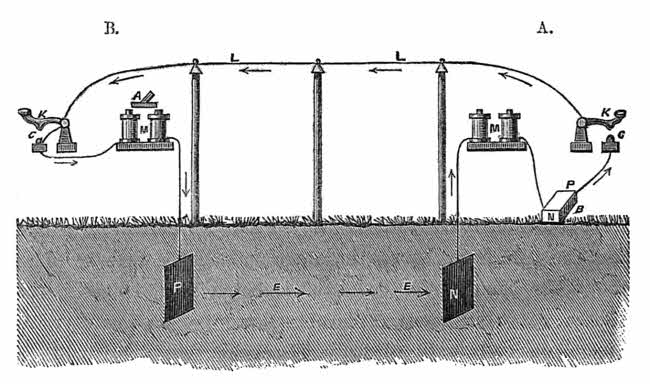
Diagram I.
I will next call the attention of the society to diagram II., which illustrates the respective circuits contemplated to be organised on the North Atlantic Telegraph. The first circuit connects Scotland with the Færöes by submarine cable of some 225 miles in length. The course of the voltaic current runs through the cable, starting from Scotland, passing through the apparatus at the Færöes, descending into the earth, and thence direct to the source of its origination in Scotland. The current of this circuit passes through the spools of wire at the Færöes constructed as the one which I hold in my hand, and when the wires are thus charged, the cores, or iron centres, become magnetised, and they attract down the armature, which causes the other end of the lever to form a metallic contact so as to close the succeeding circuit extending to Iceland. The course of the current on this second section extends from the Færöes to Iceland, thence through the apparatus, similar to that at the Færöes, and then returns to the battery, from whence it sprung. In like manner the circuit from Iceland to Greenland is opened and closed, and the same action takes place on the circuit from Greenland to America. It will be observed that these circuits are not of equal lengths, but the science of telegraphy has been so carefully studied by the practical manipulator, that the conductors can be adapted to the requirements of each circuit, if desired.
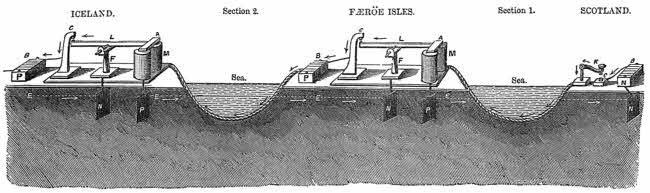
ELECTRIC CIRCUITS COMBINED. Diagram II.
Description of the Apparatuses.—At Scotland:—K is the key; c, point to close circuit; B, the battery connected with earth plate N from negative pole N. At Færöe Isles:—M is the magnet; A, the armature of the lever L; F, the fulcrum post; C, the contact post; B, the battery, with its positive pole P; N and P are earth plates. The black arrows indicate the course of the voltaic current through the cable; dotted line E the current returning to the earth plate N, and to the battery at N. At Iceland:—The apparatus is the same as that at the Færöe Isles.
Manipulation of the Apparatuses.—When the key K at Scotland is pressed to make a contact at c, battery B sends its electric current in the direction indicated by the arrows to C; through the key K, the submarine cable to the magnet M, through the coils of the magnet M to earth plate P, and thence to earth plate N, as indicated by the dotted line E. In this manner the circuit is completed. At the Færöe Isles, when the current traverses the magnet coils M, the armature A is attracted down, and the lever L makes a contact with C, which closes the next circuit. The current passes from battery B through the cable to the magnet M at Iceland; then to the earth plate P; then with the dotted line EE, to plate N; then up to the fulcrum post F, through the metallic lever L, and the contact post C to the battery B. When the current traverses the coils of magnet M at Iceland, the armature of lever L is attracted down, and a connection is made at C, which closes the next circuit to Greenland. At Greenland there will be a like apparatus, which will close the circuit to Labrador; and at Labrador will be another apparatus which will close another circuit to Quebec. At each place there can be a recording instrument, and dispatches can be received simultaneously at the Færöe Isles, Iceland, Greenland, Labrador, and Quebec.
The limited time allowed at this meeting of the Society prevents me from going further into detail in explanation of the sciences and the arts pertaining to the subject under consideration. But in order that the Society may more clearly understand that which I have already said, I have arranged the models of apparatuses placed in different parts of this room. Before me is an apparatus supposed to be at North Scotland, that on my right the Færöes station. I will now call the Færöe station by the opening and the closing of the circuit as shown in diagram II., section 1, and it will be seen that the bell at Færöes is made to ring by the instrument at Scotland. I will next call Iceland, which is the station immediately beyond the Færöes, as seen in diagram II. When I call Iceland, the Færöe station connects or couples on the circuit to Iceland; when Iceland hears the call by the ringing of his bell, he immediately responds. The next station desired is Greenland, and when that station is called, Iceland couples on the circuit to Greenland, and in like manner Greenland couples on the circuit to America, and now I communicate by the combination of the respective circuits from Scotland to America by the simple motion of my finger.
I have reduced this illustration to the most simple form, so as to bring it within the comprehension of the most uninitiated. It has not been done for the expert telegrapher. The apparatuses required at the respective stations to effect the working in the manner described, will be more complicated, and a description of them would occupy more time than is allotted to me on the present occasion. I have upon the table one of the instruments used on the continental lines for the uniting of two or more circuits, by which the end heretofore described is effected.
The respective circuits of the North Atlantic Telegraph will be within the bounds of known practicabilities, and we have no reason to expect other than the fullest success and the attainment of a calculated celerity. There are no air lines or lines constructed on poles that work in circuits more than perhaps 500 miles. There is no retardation on such lines. The telegraph from London to St. Petersburg is about 1900 miles, and upon that range there are eight relay stations. From London to Odessa the telegraph is about 3500 miles, and there are about fourteen relay stations. From London to Constantinople it is about 3200 miles, and there are about twelve relay stations. It is a common occurrence to work to the stations mentioned through the aid of mechanical contrivances. It is in this manner that telegraphic manipulation overcomes long distances, and although the original electric spark will not “leap with one bound” from continent to continent by the North Atlantic Telegraph, the intelligence will pass between the hemispheres with a celerity commensurate with the grandeur of the enterprise and the wants of the age.
The Lord Ashburton: The Society has heard, I have no doubt with much pleasure, the very interesting papers that have been read this evening, and to afford an opportunity for a discussion upon them, their consideration will be continued at the next meeting.
The Society then adjourned.