THE ROYAL GEOGRAPHICAL SOCIETY.
Reading edition
MEETING, FEBRUARY 11th, 1861. THE LORD ASHBURTON IN THE CHAIR.
A crowded Meeting of the Members and their Friends was held at Burlington House, on Monday Evening, February 11th, 1861, when the Adjourned Discussion took place.
The President: I need not read over to you again the names of the very interesting papers that were submitted to you on the last occasion of our meeting. We have now amongst us travellers who have gained experience in every quarter of the globe;—many learned geographers, who have been themselves present in those portions of the earth which have been alluded to in these papers: and I trust that we may have their assistance in correcting what they may see to be wrong; in amplifying and illustrating what we have heard. The subjects which come before us, within our province, are the geographical features; we are not engineers, nor electricians, to judge of the power of electric currents to pass from this or that part of the earth; we are not members of Parliament, who are to determine what aid, what facilities by law are to be afforded to men who have devoted themselves to this great enterprise; nor are we capable of judging of the respective merits of the many plans which have been put forward before the public. All that we can judge of are the geographical facts which have been laid before us, and of those facts there cannot be better judges than the assembly that I see before me. (Applause.) It is, therefore, with hopes of receiving instruction and much knowledge, that I call upon those gentlemen, more particularly, who have been in these scenes, to give us the advantage of their experience, in either amplifying, correcting, or illustrating, the several facts which have been brought before us. (Applause.)
Sir Edward Belcher, R.N.: I took a very deep interest in the deputation to Lord Palmerston to get the expedition sent out for this northern telegraph; and I am very happy indeed to find that nearly all the arguments that were then used have been so thoroughly realised. I thought, in the first instance, as has been proved, that we should find a great connecting bank between Scotland and the Færöes, and between Iceland and Greenland. As to the difficulties which were raised with reference to the Labrador shore, I am very glad to find that the reefs, which it was said would entirely prevent any cable being laid across there, have vanished with the ice; they have gone southerly somewhere or other, and have not yet been found; at least those reefs that are there are rather helps than otherwise by preventing the ice coming down upon the entrance. I should like very much to have been present at the last meeting to have understood the nature of the soundings;—and while I am speaking of the soundings, I am sorry to say that before another institution—the Civil Engineers—it has been assumed that we surveyors know nothing at all about soundings—that we do not know our business, and that really some civilians will have to teach us our work. Now, as far as I am myself concerned, during the whole of my servitude I adopted a particular means for getting up the bottom in large quantities, and in such large quantities that I thought nothing of bringing up a hatful at a time. I have six cases of microscopic shells, a very handsome collection, all of which I have got up by that means. The very simple mode that I adopted to sink my lead and to get up the soundings from the bottom was this. The sounding lead was encased by a cylinder, and the lead being conical, the cylinder on striking the ground flew up, and the lower part of the lead stuck to the bottom, picked up its quantity of soundings, and as the lead was withdrawn this cylinder (pointing) slipped down and completely protected whatever adhered to the lead from being washed away. The other one which I used for obtaining shells was a small dredge attached to the lead, and as the lead struck the bottom, the flanges scraped up a quantity of earth.
The Labrador coast takes its name “Labrador” from people having found there golden pyrites, as they termed them in those days, when they thought that they had made a discovery of a golden coast. It is a golden coast, inasmuch as the copper contains a great quantity of gold. In approaching that coast, I think that it would have been as well if the “Bulldog” had been furnished with a fine wire chain, such as our jack chains, as used in sweeping up anchors, and had it connected with an electrical machine. As she ran over the ground she might easily have detected at the instant whether there was any copper there. And as to any chance of the cable being corroded or cut, on approaching the shores of Labrador, or any of the places, I think that if application be made to the civil engineers, there are men of talent who would inform them instantly how they were to obviate it.
And if the cable is to be properly laid down, the ground must be properly examined; for it is quite absurd to attempt to lay cables in the teeth of nature. If that cable is to be connected with the Labrador coast, and that coast runs off in ridges under water, as is very natural, a further survey must be made to find where the hollows run. A correct and a very accurate survey should be made, so that the cable may be laid in the hollows.
I am very happy indeed that the experiment has been made, and that the officers have been so successful in planning the ground; and that we have a chance of connecting our coasts with those of our cousins across the Atlantic. (Cheers.)
Mr. Pliny Miles.—I do not know, My Lord, that I can throw any particular light on the subject of the explorations in Iceland and Greenland. I can, however, mention one or two facts that I noticed while travelling in Iceland a few years since. One great consideration of course will be that of climate; we can ascertain from certain circumstances that that country is not so cold as we should imagine it to be from its name and locality. The small hardy race of horses there subsist entirely out of doors in the winter, without any kind of food being given them in the shape of hay, excepting only those horses which they use for domestic purposes, during those months. The rest are without any kind of food, except what they gather from the open country. I saw in one case a mahogany tree on the south coast, not far from Portland, that had unquestionably floated with the gulf stream from the Gulf of Mexico itself. I was told also by Professor Johnson, that it was not unfrequently the case that spruce or other logs from Norway were found driven on to the northern coast, at the same time that logs of wood floated from the southern portion of the North American continent. They are there found together, the one current having come from Spitzbergen, and the other from the gulf stream. Standing on any mountain or height in Iceland, you will see a green and beautiful landscape; in fact, the natives say, “Iceland is the finest country the sun shines upon,” though at some seasons of the year they have very little of the sun to shine. I am satisfied of the feasibility of running the wires from this country to the Færöes and Iceland.
With regard to the absence or presence of trees in Iceland, that has nothing to do with the coldness or the severity of the climate. It is well known that there are trees of large size on the coast of Norway, where the climate is far colder than in any, the most severe seasons that have ever been known in Iceland, or in regions still farther north. It is a fact, that on some portions of the coast of Scotland, and in all parts of the Orkney and Shetland and Færöe Islands, you will not find a single tree six feet high, while they are found in Iceland 18 feet high. I will not attempt to explain, or to give a reason why, we find trees growing in one very severe climate, and not in others, but it is undoubtedly owing, to a certain extent, to the direction of the wind, and to some particular effect of the sea air. At any rate we find no trees whatever on some of our more southern coasts, while, farther north—on the Labrador coast, there are large trees, spruce, pine, larch, and others. So that the fact that there are no trees in Iceland, must not lead persons to suppose that the cold is necessarily extremely severe.
I would just refer to a statement made by a gentleman who read a paper here two weeks ago, with regard to the thickness of ice at Reikiavik. I have a distinct recollection that the lake seldom freezes to the depth of 18 inches. I have been told that sometimes it is not frozen more than two inches during the whole course of the winter, showing most conclusively the mildness of the climate. These circumstances will throw considerable light on the peculiarities of that climate; and prove that it is far more genial than you would naturally suppose from its name and locality. (Applause.)
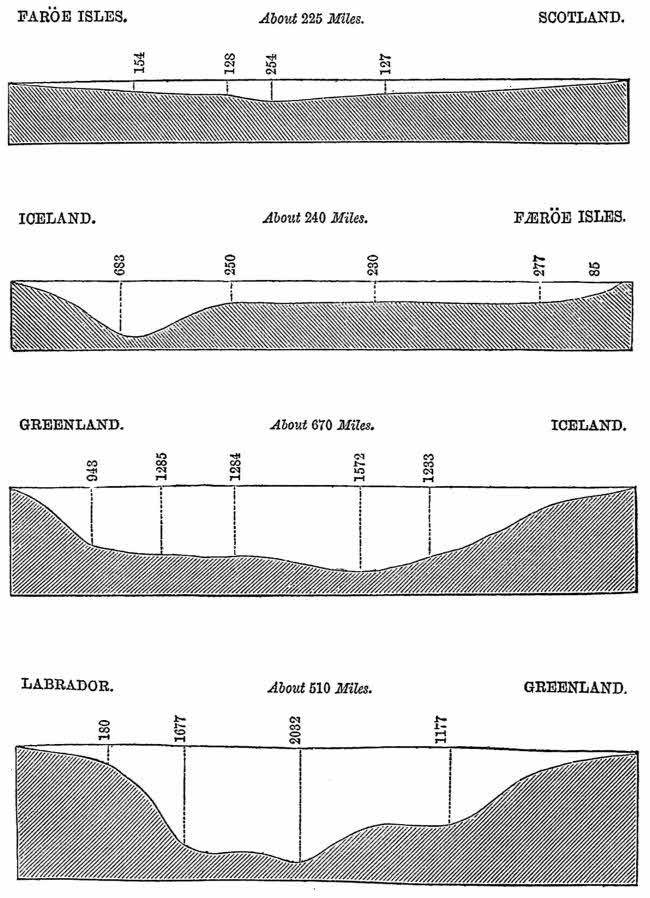
PROFILES OF THE DEEP SEAS ON THE NORTH ATLANTIC TELEGRAPH ROUTE.
[Referred to in the Remarks of Captain Osborn.]
FÆRÖE ISLES. About 225 Miles. SCOTLAND.
ICELAND. About 240 Miles. FÆRÖE ISLES.
GREENLAND. About 670 Miles. ICELAND.
LABRADOR. About 510 Miles. GREENLAND.
Captain Sherard Osborn, R.N.: I will not attempt to say anything as to the practicability of the route, inasmuch as the distinguished travellers and navigators, who read their papers at the last meeting, have given us sufficient authority to say that there were obstacles on the route undoubtedly, but that all those obstacles are surmountable. Touching the soundings, I would call your attention to the agreeable fact that the entire line of soundings show that there is no depth greater than 1000 fathoms between Scotland and longitude 30 west on the proposed route, or exactly halfway across the Atlantic Ocean. There are then two valleys of deep water, of small width, on either side of Greenland. The soundings diminished, as you see, very abruptly as Greenland is approached, and shallow water will be found probably round Cape Farewell. With regard to the Labrador coast, the principal difficulty was in carrying the cable within the 150 fathoms of water, so that it might not be exposed to the action of the icebergs. I am sure that Arctic men all agree that 150 fathoms would be about the maximum draught of any iceberg, so that the chief object to be secured in placing the cable is to push the 150 fathom mark as near into the coast as possible. They would remember that Sir Leopold M‘Clintock had said that he would like to have a more accurate survey of the Labrador coast, so as to carry the deep water a little closer. If they looked at the map they would see 1190 fathoms carried just to the north of Hamilton Inlet, and there was every reason to believe that the bank of Newfoundland—they might call it so, although it extended a long way up the Labrador coast—deepened suddenly there. As far as one might speculate upon the question, I have no doubt that a more accurate survey would lead to the obtaining of such information as would give us a channel leading close into the Labrador shore, near Cape Harrison. I would propose, that the cable there should open out and form, say, half-a-dozen strands running into the shore at certain distances from each other, so that if a berg drifted down and happened to pick up one, it would not pick up all the rest, and by that means the cable in the deep water would be at all times safe and recoverable by following out those strands. There was one feature that struck me particularly, and on which I wrote to Captain M‘Clintock. No man would dispute that bergs of ice sounding the bottom would rip it up, just as a plough would a ploughed field; and that if that bank was thus ripped up by the floes of ice, there would be hardly any animal or vegetable life upon it; it would be a kind of subterranean desert. Sir Leopold M‘Clintock was continually dredging there, and in a note just received, that distinguished navigator said, “The bank of Hamilton Inlet has from 100 to 200 fathoms upon it. I am of opinion that icebergs which ever drift down there cannot possibly reach the bottom. They ground near the islands at the entrance and are not bergs of the largest size. Shells and other small things were brought up by the sounding machines in 40 or 50 fathoms, as in other parts of the sea where icebergs cannot possibly interfere with them.” Near Frederickshaab Captain Sir L. M‘Clintock says they dredged up in 26 fathoms delicate corals and creatures which could not live at the bottom of the sea if much disturbed by icebergs,—and adds “so much for the destructive propensities of icebergs.” How all this came about was a question I do not pretend to solve, but the fact was very curious, as showing that bergs could touch the bottom without sweeping everything before them. I am sure that every geographer will be interested in the following fact, for it related to the late Sir John Ross, who stated that in his voyage in 1818 he brought up mud from 1050 fathoms, the deepest soundings ever obtained at that time; and in the mud were shells and fish. So to that old navigator they first owed that the fact of animal life in great depths had been discovered. We were talking the other day about the difficulties with regard to the intense cold and the aurora borealis affecting the telegraph. It might be interesting for the Society to know that a few seasons ago, Captain Kellett and Captain M‘Clintock were beset in the ice in 74 1/2° north, and they communicated with each other by telegraph from ship to ship. Now 74 1/2° north latitude was a long way in the Arctic zone, and the cable, the practicability of which they were at present discussing, would lie a long way without it. That telegraph was at work throughout the whole winter, and was not in any way affected by that terrible bug-bear the aurora borealis, nor by the intense cold experienced so far north. (Applause.)
Mr. John Ball: It is impossible to over-rate the importance of the subject brought to the attention of the Society by the gentlemen who read their papers. It is very desirable that we should not under-rate the difficulties which still remain, and which I think have not all of them been sufficiently brought forward, and it is by pointing out the difficulties at this early stage that we shall soonest arrive at the solution of those difficulties and the great end which I trust we shall live to see accomplished. I have long felt that this northern route was the right one; but I am not blind to the many difficulties which still remain in our way. With reference to the precise points which come particularly under the attention of this Society, and were brought clearly before us at the last meeting, there are two or three on which I wish to make a few observations. As to the Færöes, I apprehend there is no great difficulty. As to Iceland, it is proposed to land the cable at the south-east side of the island, to carry it across the island, and start again from Reikiavik in order to communicate from thence to Greenland. Now there, are we not unnecessarily encountering very serious difficulties and incurring a great increase of expenditure? It is true that it is possible to cross Iceland—perfectly possible—but so experienced a traveller as Dr. Rae found that it was not practicable without very great sacrifice of time, and encountering great difficulties, to take that direct route pretty nearly from east to west; but has he at all considered what the difficulties and cost of laying down a telegraphic wire are? I think he has mentioned—every traveller in Iceland has mentioned—that large district in the interior of the island over which you must hurry as fast as your horses can carry you, for the simple reason that there is nothing upon which to live; and if you are to lay down a telegraph across that interior desert of Iceland, you must be prepared for a vast number of difficulties and an enormous amount of money, and time, and labour, while they are doing it, and to accomplish it within a reasonable time. But, furthermore, how is it to be done? If you require piles, you must carry every pile into the island, across the island by horses, and supposing you could hire every one of the horses, there are not enough to enable you, in one or two seasons, to accomplish the work. And then, again, I have not alluded to the difficulty which every voyager will have encountered with respect to the breakers. Would it not be better to confine the difficulties to one point alone,—the entrance into the Faxe Fiord? I don’t know whether it is proposed to land it at that point or not, but let the difficulties be confined to one point instead of two. With reference to Labrador, even though it be true that we can carry the 150 fathoms depth near to the coast, still that, my lord, may be as formidable as ten, or twenty, or fifty miles in another place. If it be a part of the coast on which there are icebergs, it is necessary, it appears to me, not only to carry your 150 fathoms of water close in shore, but you must get it safe behind some headland which will throw aside the icebergs. May it not be possible that by making the line a little longer, and running it into the strait of Belle Isle, the true solution will be found?
Sir Roderick Murchison:—If any Arctic geographer or voyager had been prepared to rise, I would not have occupied the time of the Society for one moment, upon a subject on which I know little. I will only say I am one of the very many well-wishers to every expedition of this sort which the Royal Geographical Society holds within its number. My lord, we are not here, as you have very properly said, to discuss the engineering merits of the project, nor are we really capable of estimating the difficulties that have been apprehended by my friend Mr. Ball; but we are capable of estimating, in a very decisive manner, the facts that Sir Leopold M‘Clintock and Captain Sherard Osborn, who are men of great experience as Arctic voyagers, have pronounced in favour of this scheme.
I make no observations upon the scheme, except to say that had I risen at our last meeting, when your lordship adjourned the discussion to this evening, I should have felt it necessary to say that we owe a deep debt of obligation to those five gentlemen, who brought before us on that occasion their well elaborated and well received papers. They brought before us a mass of geographical knowledge which we never could have possessed, had not this expedition been matured—I say it to his honour—through the patronage of Lord Palmerston, and carried out through the active enterprise of the gentlemen who undertook this service.
Being in favour of all such expeditions, the moment my distinguished friend Captain Allen Young offered to go out in command of the little “Fox,” in which you know I took a deep interest, I went down to Southampton, to attend a great meeting assembled by the Mayor in honour of this expedition. There Colonel Shaffner and Mr. Croskey, and the other gentlemen associated with them, and the Danish officers and others present received from us as Englishmen every encouragement we could offer to promote this enterprise.
My lord, the details of the two expeditions have been so admirably laid before you that I, for one, should have been contented with the results, if I were in any way embarked as a speculator in the success of the undertaking. But not having any pecuniary interest in it, or in any rival speculation, I may say to the gentlemen of the North Atlantic Company, you have put your case so well before the public, that no gentleman associated with other lines can say that it is possible to have treated the subject in a more ingenuous and fair manner. (Hear, hear, and applause.)
And now, my lord, I cannot sit down without saying, it gave me very great satisfaction to hear Dr. Rae expatiate, as he did, upon the warm and hearty reception that he received from all the inhabitants of the Danish settlement of the Færöe Islands and of Iceland. I say this in the presence of the Danish minister; and I am sure Dr. Rae was justified when he spoke in the name of Englishmen, of our gratitude to the King of Denmark, and to the government of that country, for having so warmly assisted us in one of those great enterprises, which may lead us to connect America with our own country. (Applause.)
Dr. Rae: My Lord,—The time allowed me at the last meeting of this Society was necessarily so short, that I left unmentioned some important points connected with my journey over Iceland; so I now beg to say a few words in reply to the observations of Mr. Ball.
The interior of Iceland over which we travelled is not devoid of grass, there being sufficient for our horses throughout the whole route, which offered comparatively few difficulties. Although two of the party were heavy men, we crossed the island in thirteen or fourteen days, riding the same horses at the rate of more than thirty miles per day. These ponies can carry a load of 200 lbs. or upwards, and pieces of wood ten or fifteen feet long can be carried by them over the highest and steepest ground on the route. The best line for the telegraph lies to the south of that we travelled over, and is marked on the chart by a dotted line. Along this route there is abundance of water, and grass also, except at one station, to supply which a depôt of hay could be made. This portion of the way (about the centre of Iceland), called the Sprengisandr road, is almost a flat table land. Again, some of the larger rivers that flow northward appear to be navigable for boats similar to those used in Hudson’s Bay, which carry from three to four tons weight. By this means materials could be deposited at several stations near to the proposed line. I do not profess to be a surveyor, but having travelled a good deal both in the United States and Canada, I have seen telegraphs carried over more difficult and rougher country than we encountered in crossing Iceland. But should objections be offered to carrying the telegraph completely across the island, I am of opinion, from information obtained, that Portland, in the south of Iceland, although no safe harbour for ships, would form a good landing place for a cable. From Portland to Reikiavik the distance is not over ninety miles, and the road offers no obstacles. The object of our journey was not to make a minute or detailed survey, but to determine if it were practicable to carry a telegraph over the island. (Applause.)