VOLUME II. (continued 4)
Reading edition
For the New-York Weekly Magazine.
ANECDOTE.
A gentleman having put out a candle by accident one night, ordered his waiting man (who was a simple being,) to light it again in the kitchen; “but take care, James,” added he, “that you do not hit yourself against any thing in the dark.”—Mindful of the caution, James stretched out both arms at full length before him, but unluckily, a door that stood half open, passed between his hands and struck him a woeful blow upon the nose; “Dickens!” muttered he, when he recovered his senses a little, “I always heard that I had a plaguy long nose, but I vow I never have thought that it was longer than my arm.”
CURIOUS LAW ANECDOTE.
The following curious anecdote is told, in the Negoristan, of a famous lawyer of Baghdad, called Abu Joseph. It marks several peculiarities in the Mohammedan law, and displays some casuistical ingenuity adapting them to the views of his clients. The Khalif Haran Alrashid had taken a fancy for a female slave belonging to his brother Ibrahim. He offered to purchase her; but Ibrahim, though willing to oblige his sovereign, had sworn, that he would neither sell nor give her away. As all parties wished to remove this difficulty, Abu Joseph was consulted; who advised Ibrahim to give his brother one half of the slave, and to sell him the other. Happy to be relieved from this embarrassment the Khalif ordered 300,000 dinars for the moiety of the slave; which Ibrahim, as a mark of his acknowledgment, immediately presented so the lawyer. But a second difficulty now arose. The Moslem law prohibits all commerce between a man and the wife or concubine of his brother, till she has been remarried and divorced by a third person. Abu Joseph advised the Khalif to marry her to one of his slaves; who, for a proper consideration, would be easily induced to repudiate her on the spot. The ceremony was instantly performed: but the slave, falling in love with his handsome spouse, could not be prevailed upon to consent to a separation.
Here was a strange and unexpected dilemma; for, all despotic as the Khalif was, he durst not compel him. But Abu Joseph soon discovered an expedient. He desired the Khalif to make a present to the lady of her new husband, which virtually desolved the marriage; as no woman, by the Mohammedan law, can be the wife of her own slave.
Overjoyed that the Gordian knot was thus so ingeniously unloosed, the Khalif gave him 10,000 dinars; and the fair slave receiving a considerable present from her royal lover, presented him with 10,000 more; so that Abu Joseph, in a few hours, found his fees amount to 50,000 dinars, or nearly 15000l.
NEW-YORK.
MARRIED,
On Sunday evening last, by the Rev. Dr. Foster, Mr. Joseph Hannah, of this city, to Miss Polly Gray, of Brooklyn (L.I.)
Let fortune on this blithesome pair, With cloudless aspect smile; Nor trouble e’er or anxious care, Their peaceful life beguile.
On Monday se’nnight, by the Rev. Dr. More, B. Penrose, Esq. of Philadelphia, to Miss H. Bingham, of this city.
Last Sunday se’nnight, in the Methodist New Meeting, by the Rev. Ezekiel Cooper, minister of the Methodist Episcopal Church, Mr. John Wilson, to Mrs. Hester Bleecker, widow of the late Mr. John Bleecker, all of this city.
On Thursday evening last, by the Rev. Dr. M‘Knight, Mr. Enoch Ely, merchant, to Mrs. Kezia Camp, both of Catskill.
On Thursday evening last, by the Rev. Mr. Dow, Mr. Cornelius Day, to Miss Ann Hamilton, lately from Trinadad.
On Thursday evening Lft by the Rev. Dr. Kuntzie, Mr. John Aim, to Miss Peggy Moore.
Same evening, by the Rev. Dr. Beach. Mr. William Woods, to Miss Jemima Simmons, both of this city.
METEOROLOGICAL OBSERVATIONS.
Days of the Month. Thermometer observed at 8, A.M. 1, P.M. 6, P.M. Prevailing winds. OBSERVATIONS on the WEATHER.
deg.100 deg.100 deg.100 8.1.6. 8. 1. 6.
Aug. 1 7625 8675 7375 SW.do.W. Clear,rain,thun lt.
2 76 82 8350 NW.Wdo. clear,do.do. lt. wind.
3 70 7575 7575 NWdo. clear,do.do.
4 66 7275 71 N.nwdo. clear,do.do.
5 71 76 73 SEW.SW. clear,do.do.
6 69 72 67 SE.do.E. cloudy,rain,cloudy

ON READING SOME ELEGIES.
Hither your wreaths, ye drooping muses bring,
The short-liv’d rose, that blooms but to decay;
Love’s fragrant myrtles, that in paphos spring,
And deathless poetry’s immortal bay.
And oh! thou gentlest shade, accept the verse,
Mean though it be, and artlessly sincere,
That pensive thus attends thy silent hearse,
And steals, in secret shades, the pious tear.
What heart by heav’n with gen’rous softness blest,
But in thy lines its native language reads?
Where hapless love, in tender, plainness drest,
Gracefully mourns and elegantly bleeds.
In vain, alas, thy fancy fondly gay
Trac’d the fair scenes of dear domestic life;
The sportive loves forsook their wanton play,
To paint for thee the mistress, friend and wife.
Oh luckless lover! form’d for better days,
For golden years, and ages long ago:
For thee Persephone* impatient stays,
For thee the willow and the cypress grow.
For the New-York Weekly Magazine.
ELEGY ON AN UNFORTUNATE VETERAN.
The loud inclement storm now rages high, Then why, my friend, imprudent dost thou roam? Go seek some hospitable shelter nigh, Or haste and warm thee at thy social home. Nor longer thy half-cover’d limbs expose, To the assaults of th’ unpitying air; Thy fragile body sure demands repose, For numerous years have silver’d o’er thy hair. “No home I have!” the hapless wanderer cries; Say, was thy youth to vicious courses given; That thus thy age must brave inclement skies, To fate the vengeance of offended heaven? No guilty passion warm’d my youthful breast, Nor foul injustice stain’d my spotless name; But once in brighter, happier prospects blest, I sacrific’d those golden views to fame. Ardent to check Iberia’s tyrant pow’r, Thro’ unpropitious seas I took my way, And gain’d her coast, but, ah, unhappy hour! How many gallant soldiers fell that day! After long toils, and various hardships borne, Our gen’rous blood the vanquish’d foe repays; But now I droop in poverty forlorn, And mourn the triumphs of my youthful days. Frowning the soldier told his piteous tale, Ah! what to him the humbled pride of Spain? He help’d to conquer, what does it avail? He now is left to poverty and pain. Forever blessed be the bounteous heart, That may the suppliant child of woe receive, The blessings favouring fortune gave impart, To me that fortune gives but to relieve. MATILDA. New-York, 1775.


For the New-York Weekly Magazine.
TWILIGHT.
A SONNET.
“The West yet glimm’ring with some streaks of day “Now spurs the lated traveller apace “To gain the timely inn.” Shakespeare. Bright Sol retiring o’er the western hills, With parting radiance gilds the village spire: In other realms his healing office fills, To other climes emits beatific fire. The dusky shades of twilight now preside, And wrap the Hamlet in a solemn gloom; The labours of the industrious hind subside, The weary shepherd seeks his peaceful home. At this lone hour, in contemplative mood, Near some remote and solitary wood, To calm his grief the mourning lover strays: The nightingale in sympathetic strain, Warbling its plaintive notes, relieves his pain, While gentle zephyr ev’ry sigh conveys. ALEXIS. New-York, July 27, 1796.
For the New-York Weekly Magazine.
Lines sent to a Young Lady with an Æolian Harp.
Ye zephyrs who delighted stray O’er every grace which Flora wears, Hither direct your airy way, For worthier scenes demand your cares. Within these strings, in soft suspense, The latest powers of music rest; Oh, draw their tendered accent hence To soothe and charm my Sally’s breast. Should sorrow ever enter there, (For merit is no shield from woe) Disperse the Demons of despair, And teach the softening tear to flow. And e’en when rapture’s maniac train, Shall wildly seize the impassion’d soul, O, let some sweetly-plaintive strain, The blissful agony control. The feeling bosom illy bears The dire extremes of grief and joy, For anguish every sense impairs, And cruel “transports oft destroy.” And still each pensive hour to cheer, Let friendship raise her gentle voice; And when she seeks a friend sincere, Direct to me the envied choice. MONIMIA. New-York, May, 1796.
For the New-York Weekly Magazine.
CUPID STUNG.
Cupid wanton rogue they say, Inclin’d to rob a hive one day; Thrust his hand into the swarm, Thoughtless little thief of harm; When vext to be insulted so, A bee sprung out upon her foe; Around his fist a thousand clung, And faith the wag was soundly stung. He shook his hand, he leap’d, he cried, And all in tears to Venus hied; Ask’d how a bee, so small a thing! Could lodge to terrible a sting? Venus replied, “How like my child, Are these fell bees to you?” and smil’d; “Tho’ small your size, sharp is your dart, And keenly does it wound the heart.” OLIVERIUS. New-York, August 5th, 1736.
EPIGRAM.
Cries logical Bob to Ned, if you dare, A Bet, which has most legs, a mare or no mare, A mare to be sure, replies Ned with a grin; And fifty I’ll lay, for I’m certain to win; Quoth Bob, you have lost, sure as you are alive, A mare has but four legs, and no mare has five.
The printer’s notice is missing from this Number.
UTILE DULCI.
The New-York Weekly Magazine; OR, MISCELLANEOUS REPOSITORY.
Vol. II.] WEDNESDAY, August 17, 1796. [No. 59.
For the New-York Weekly Magazine.
REASON.
Q. Cannot we, by the light of Reason, discover enough of futurity and the attributes of God, to secure our peace of mind here, and our happiness hereafter, without the aid of a revelation?
A. As well might you ask, cannot a merchant freight his vessel for a voyage to a country of which he is entirely ignorant, and the description of which he refuses to examine and believe;---who puts to sea without his charts because they may be false, and would rather trust to his uninformed mind for a safe conduct through shoals and breakers to the desired port.
What is reason, or the exercise of the reasoning faculty, but the comparison of ideas and the exercise of the judgment thereon? And from whence can we acquire ideas, where can we acquire information relating to a subject so important as our future existence? The works of nature are open to our view;---these indeed are a copious source, but their insufficiency for promoting the love of God and of our fellow-creature, is obvious to any one who will observe man in a state of nature.---If, then, a fund of information is delivered to us, which carries with it all the evidence of a divine revelation, which explains and assists the language of nature, what should deter us from seizing with avidity the precious deposit, and accumulating facts on which we may employ our reasoning faculty to our eternal benefit.
ON LANDSCAPE PAINTING.
The poets, of all ages and all languages, have dwelt with particular delight upon the morning scenery, and the epithets of the dappled, the rosy fingered, the saffron, and the blushing morn, have been not less often quoted, than they have been imitated and read; and to these verbal descriptions have followed those of the pencil; and in these graphic truths no man has succeeded in any degree of comparison with Claude Lorraine. The reason appears to be pretty obvious; he studied nature with so much enthusiasm and perseverance, that he may be almost said to have exhausted her varieties; and we hardly behold a composition from his hand in which the rising or the setting sun does not irradiate or warm his scenes; but the sober impressions of the dawn, those chaste and reserved tints that particularly express the break of day, just awakening from repose; when the curtain of the night seems to be insensibly withdrawn, and the landscape appears to open by degrees, when the colours of the sky are yet doubtful, and the landscape imperfect to the view; in short, when darkness is not entirely fled, nor light distinctly seen; this period of the day I do not recollect to have seen expressed by the fidelity of his magical pencil.
When coolness sits upon the mountains, and freshness delights the plains, when the dews hang trembling upon every leaf, and the insects flutter on every thorn; when the groves begin to resound with the murmurs of the dove, and the vallies to echo with the twitterings from the spray; how delightful is it to see Arachne weave her web upon every bush and the gossamer uplifted by the breeze! how extatic is the twilight hour, which, for a time, hangs balanced between the dispersion of darkness, and the dapplings of the east; and which gives a solemn pleasure to every thing around! When these images of nature arrest our sight, and their charms find a passage to the heart, how pleasing at such a time are the feelings of anticipation to those who adore in his works, the wonders of the Creator!
Of that period, when the sun begins to diffuse his early rays, to tip the mountains with light, and to project the shadows of the hills, I do not recollect to have seen more than one attempt of imitation; and this effect I think is produced in the landscape of the celebrated picture of Aurora, by the hand of Guido, in the Rospiliosi palace at Rome. The distant sea would be undistinguished, or would rather partake of what Milton calls “the darkness visible,” did it not almost seem to be imperceptibly illuminated by the foam of the waves that wash, with breaking murmurs, the silver sands, and pour their drowsy hoarseness on the shore. As the eye wanders over this inimitable performance, the chilness of the dawn appears to brood over the scene below; but, as the imagination ascends, it fancies that it meets those breezes in the air that mildly prognosticate, the blushes of the morning; whose curtains the rosy fingered hours have drawn aside, and between which the infant day begins to peep.
INTERESTING HISTORY OF THE PRINCESS DE PONTHIEU.
Translated from the French.
(Continued from page 43.)
During their journey, and on their arrival, Thibault omitted no act of tenderness, to convince the Princess she was still as dear to him as ever; but finding all his protestations in vain, and that she concealed a dagger in the bed one night with an intent to assassinate him, he took a separate apartment, still endeavouring by his behaviour to her, to prevent the public from finding out the cause of their disagreement; and he was the more to be pitied, because he could not help loving her still with the same ardency as ever. In the mean time, the Count de Ponthieu perceived there was something more than ordinary between them, they could not hide it from his penetration; Thibault was overwhelmed with a secret melancholy—the Princess would be seen but rarely; her silence, and when she was obliged to speak, the incoherency of her words, in fine, all her actions implied a strange alteration, and made him resolve to oblige Thibault to a discovery of the cause.---He defended himself a long time, but being too closely pressed by a prince, to whom he owed every thing, he at last revealed all the particulars of his misfortune to him, and painted his love, and the unjust fury of the Princess, in such moving colours, that the Count was so thoroughly affected, that he could scarce contain his anger against her. He pitied Thibault, comforted him, and promised him to speak to the Princess in a manner, which should oblige her to change her conduct. “Yours,” said he, “is so prudent and so tender, that I cannot sufficiently admire it; and I hope my daughter will not always be insensible of it, but return to her duty.”
He left him, and passed to the Princess’s apartment, whom he found sitting in an elbow-chair; her head reclined, and in the posture of one buried in thought, her women round her in a profound silence. The Count making a sign for them to withdraw; “What, daughter,” said he, “will you never lay aside this gloomy melancholy which so much troubles me, and astonishes my whole court.---I know your misfortune, your generous husband has just discovered it to me---I am very sensible of it, but much more so of his proceeding; who, notwithstanding your blind rage, has preserved so great a regard for you, as never to complain.”
At these words, the Princess fixing her eyes full of fury on the face of her father, “How!” cried she, “has Thibault dared to reveal that secret to you?” “Ah Princess,” interrupted the Count, “speak with more moderation of a man who adores you——think a moment, remember you have loved this husband——that I did not force you to accept of him, that your misfortune, dreadful as it is, has not impaired his esteem; you, in return, owe him the same affection and confidence; I desire it of you as a friend, and demand it of you as a parent and a sovereign. Make good use of the pity that pleads in my breast in your behalf---and dread irritating me, lest I throw aside the father, and act wholly as a prince.” This discourse, so far from softening the Princess, redoubled her distraction, and she discovered so much rage of temper to the Count, that he deferred, till a more favourable opportunity, the reclaiming her. He went out, ordering her to be strictly guarded in her apartment, and that she should not be suffered to have communication with any one but her women; and so returning to Thibault, informed him of the ill success he had met with. Yet he did not despair, but every day for a whole month made fresh attempts on her disordered mind; but every thing proving in vain, and her fury rather increasing than diminishing, he resolved to free his family of a woman whom he looked on as a monster.---With this intent, on pretence of taking the air, he carried her with him in a shallop, and having got a considerable distance from shore, he ordered her to be seized by some sailors, and put into a tun prepared for that purpose, and closing it up again, thrown into the sea. After this cruel expedition he landed; but alas! what became of Thibault, when the other, still transported with rage, told him what he had done! how great was his affliction! and what reproaches did he not vent against so barbarous a father! He ran to the fatal place which he heard had been the grave of his unhappy Princess; but finding nothing that could flatter him with any hope of there being a possibility to save her, he returned to court in a condition truly pitiable;---the many charms of his lost Princess dwelt for ever on his mind, and he thought himself the most miserable creature living, because he had it not in his power to revenge her. It was not long before the Count himself repented of the action, and his remorse became so great, that even the miserable Thibault endeavoured to mitigate it. At last it wore off, and he began to think a second marriage, and the hope of an heir, would dissipate his afflictions; and well knowing that his son-in-law would never engage himself again, he married, and was happy enough at the expiration of a year to have a son: yet his grief was not wholly vanished, his daughter came ever fresh into his memory, and the light of Thibault, who continued overwhelmed with the deepest melancholy, added to his despair.
In this manner they passed almost nine years, when the Count becoming once more a widower, resolved, together with Thibault, and his little son, to travel to the Holy Land, hoping by devotion to expiate his crime. Thibault, who now thought he had an opportunity of dying gloriously in fighting for the faith, readily embraced the proposal. Every thing was soon ready for the voyage, and the Count de Ponthieu having entrusted the government of his dominions to persons of confidence, they set out, and arrived safely at Jerusalem. The Count and Thibault engaged themselves for the space of a year in serving the temple, in which they had frequent opportunities of testifying their zeal and courage. The year finished, and their vows accomplished, they embarked in order to return. The winds were for some days favourable, but a most violent tempest succeeding the calm, they were so shook by the fury of it, that they expected nothing but death; when on a sudden, a contrary gust arising, drove them on the coast of Almeria, a land belonging to the infidels; they were soon surrounded by the barks and brigantines of the Saracens, and as the ship was incapable of putting to sea again, they were much less so in a condition of defence.
The Count de Ponthieu, the young Prince his son, and Thibault, were made prisoners, and thrown into dungeons; all the christians in the ship were served in the same manner, and so loaded with irons, that they immediately found they had been preserved from the rage of the sea, only to perish in a more cruel manner on land. Those heroes prepared themselves for death with a resolution worthy of their courage; but the infidels believing them a noble sacrifice, permitted them to live till the day on which they celebrated the birth of the Sultan, it being the custom of that country, to offer to their gods on that day a certain number of criminals, or christians.
(To be continued.)
ACCOUNT OF THE LAST MOMENTS OF THE CELEBRATED DR. JOHNSON.
(Concluded from page 43.)
Mr. Windham having placed a pillow conveniently to support him, he thanked him for his kindness, and said, “That will do—all that a pillow can do.”
As he opened a note which his servant brought him, he said, “An odd thought strikes me---We shall receive no letters in the grave.”
He requested three things of Sir Joshua Reynolds:---To forgive him thirty pounds which he had borrowed of him---to read the Bible---and never to use his pencil on a Sunday. Sir Joshua readily acquiesced.
Johnson, with that native fortitude which, amidst all his bodily distress and mental sufferings, never forsook him, asked Dr. Brocklesby, as a man in whom he had confidence, to tell him plainly whether he could recover. “Give me,” said he, “a direct answer.” The doctor having first asked him if he could bear the truth, which way soever it might lead, and being answered that he could, declared that in his opinion he could not recover without a miracle. “Then,” said Johnson, “I will take no more physic not even my opiates, for I have prayed that I may render up my soul to God unclouded.” In this resolution he persevered, and at the same time used only the weakest kind of sustenance.
After being in much agitation, Johnson became quite composed, and continued so till his death.
Dr. Brocklesby, who will not be suspected of fanaticism, obliged Mr. B. with the following accounts:
“For some time before his death all his fears were calmed and absorbed by the prevalence of his faith, and his trust in the merits and propitiation of Jesus Christ.
“He talked often to me about the necessity of faith in the sacrifice of Jesus, as necessary beyond all good works whatever for the salvation of mankind.
“He pressed me to study Dr. Clarke, and to read his sermons. I asked him why he pressed Dr. Clarke, an Arian. ‘Because,’ said he, ‘he is fullest on the propitiatory sacrifice.’
“Johnson having thus in his mind the true Christian scheme at once rational and consolatory, uniting justice and mercy in the Divinity, with the improvement of human nature, while the Holy Sacrament was celebrating in his apartment, fervently uttered this prayer:
“Almighty and most merciful father, I am now, as to human eyes it seems, about to commemorate, for the last time, the death of thy Son Jesus Christ, our Saviour and Redeemer. Grant, O Lord, that my whole hope and confidence may be in his merits, and thy mercy; enforce and accept my imperfect repentance; make this commemoration available to the confirmation of my faith, the establishment of my hope, and the enlargement of my charity; and make the death of thy Son Jesus Christ effectual to my redemption. Have mercy upon me, and pardon the multitude of my offences. Bless my friends, have mercy upon all men. Support me, by the Holy Spirit, in the days of weakness, and at the hour of death; and receive me, at my death, to everlasting happiness, for the sake of Jesus Christ. Amen.”
“The doctor, from the time that he was certain his death was near, appeared to be perfectly resigned, was seldom or never fretful or out of temper, and often said to his faithful servant, ‘Attend, Francis, to the salvation of your soul, which is the object of the greatest importance:’ he also explained to him passages in the scripture, and seemed to have pleasure in talking upon religious subjects.
“On Monday the 13th of December, the day on which he died, a Miss Morris, daughter to a particular friend of his, called, and said to Francis, that she begged to be permitted to see the doctor, that she might earnestly request of him to give her his blessing. Francis went into the room followed by the young lady, and delivered the message. The doctor turned himself in the bed, and said, ‘God bless you, my dear!’ These were the last words he spoke.---His difficulty of breathing increased, ’till about seven o’clock in the evening, when Mr. Barber, and Mr. Desmoulins, who were sitting in the room, observing that the noise he made in breathing had ceased, went to the bed, and found he was dead.
“A few days before this awful event, he had asked Sir John Hawkins, as one of his executors, where he should be buried; and on being answered, ‘Doubtless in Westminster Abbey,’ seemed to feel a satisfaction very natural to a poet, and indeed very natural to every man of any imagination, who has no family sepulchre in which he can be laid with his fathers. Accordingly, upon Monday, December 20, his remains were deposited in that noble and renowned edifice; and over his grave was placed a large blue flag stone, with this inscription:
SAMUEL JOHNSON, LL. D. Obiit xiii die Decembris, Anno Domini M. DCC. LXXXIV. Ætatis suæ LXXV.
“His funeral was attended by a respectable number of his friends, particularly by many of the members of the Literary Club, who were then in town; and was also honoured by the presence of several of the reverend chapter of Westminster. His school-fellow, Dr. Taylor, performed the mournful office of reading the service.”
For sources, see the end of the final segment (page 76).
A STRIKING SPECIMEN OF INDIAN ELOQUENCE,
In a Speech of the Chief of the Mickmakis or Maricheets Savages, dependent on the government of Cape Breton.
When all the peltry of the beasts killed in the enemy’s country, (with whom they are about to declare war) is piled in a heap, the oldest samago, or chieftain of the assembly, gets up and asks what weather it is? is the sky clear? does the sun shine? On being answered in the affirmative, he orders the young men to carry the pile of peltry to a rising ground or eminence, at some little distance from the field or place of assembly. As this is instantly done, he follows them, and as he walks along, begins and continues his address to the sun in the following terms:
“Be witness, thou great and beautiful luminary, of what we are this day going to do in the face of thy orb! If thou didst disapprove us, thou wouldst, this moment hide thyself, to avoid affording the light of thy rays to all the actions of this assembly. Thou didst exist of old, and dost still exist. Thou dost remain for ever as beautiful, as radiant, as beneficent, as when our first forefathers beheld thee. Thou wilt always be the same. The father of the day can never fail us; he who makes every thing vegetate, and without whom cold, darkness, and horror, would every where prevail. Thou knowest all the iniquitous proceedings of our enemies against us. What perfidy have they not used? what deceit have they not employed, whilst we had no room to distrust them? There are now more than five, six, seven, or eight moons revolved since we left the principal among our daughters with them, in order thereby to form the most durable alliance with them, (for, in short, we and they are always the same thing as to our being, constitution, and blood) and yet we have seen them look on these girls of the most distinguished rank, as mere play-things for them; an amusement, a pastime, put by us into their hands, to afford them a quick and easy consolation for the fatal blows we had given them in the preceding war. Yet we had made them sensible, that this supply of our principal maidens was, in order that they should repeople their country more honourably, and to put them under a necessity of conviction, that we were now become sincerely their friends, by delivering them so sacred a pledge of amity as our principal blood. Can we then, unmoved, behold them so basely abusing that through confidence of ours? Beautiful, all-seeing, all-penetrating luminary! without whose influence the mind of man has neither efficacy nor vigour, thou hast seen to what a pitch that nation (who are, however, our brothers) has carried its insolence towards our principal maidens. Our resentment would not have been so extreme with respect to girls of more common birth, the rank of whose fathers had not a right to make such an impression on us: but here we are wounded in a point there is no passing over in silence or unrevenged.—Beautiful luminary! who art thyself so regular in thy course, and in the wise distribution thou makest of thy light from morning to evening, wouldst thou have us not imitate thee? and whom can we better imitate? The earth stands in need of thy governing thyself, as thou dost towards it. There are certain places where thy influence does not suffer itself to be felt, because thou dost not judge them worthy of it. But as for us, it is plain that we are thy children; for we can know no origin but that which thy rays have given us, when first marrying efficaciously with the earth we inhabit, they impregnated its womb, and caused us to grow out of it like herbs of the field, and trees of the forests, of which thou art the common father. To imitate thee, then, we cannot do better than no longer so countenance or cherish those who have proved themselves so unworthy thereof. They are no longer, as to us, under a favourable aspect. They shall dearly pay for the wrong they have done us. They have not, it is true, deprived us of the means of hunting for our maintenance and cloathing; they have not cut off the free pillage of our canoes, on the lakes and rivers in this country; but they have done worse, they have supposed in us a tameness of sentiment which does not, cannot exist in us. They have deflowered our principal maidens in wantonness, and lightly sent them back to us. This is the just motive which cries out for vengeance. Sun! be thou favourable to us in this point, as thou art in point of hunting, when we beseech thee to guide us in quest of our daily support. Be propitious to us, that we may not fail of discovering the ambushes that may be laid for us; that we may not be surprised unawares in our cabins or elsewhere; and finally, that we may not fall into the hands of our enemies. Grant them no chance with us, for they deserve none. Behold the skins of their beasts now a burnt-offering to thee! accept it, as if the firebrand I hold in my hands, and now set to the pile, was lighted immediately by thy rays instead of our domestic fire.”
Source: “An account of the customs and manners of the Micmakis and Maricheets Savage Nations, Now Dependent on the Government of Cape-Breton”, Antoine Simon Maillard, English trans. 1758
THE WONDERFUL QUALITIES OF HOPE.
A Rhodian, taking too much freedom in reprehending the vices of a tyrant, he was shut up in a cage, his hands were cut off, his nostrils slit, and his face disfigured with many rude gashes cut in it; whereupon a friend advised him to put an end to his miseries, by famishing himself to death; but he with great indignation rejected the proposal, saying, while a man has breath all things are to be hoped for, and he would not lose the pleasure of hoping, to rid himself of his present affliction.
C. Marius, though of obscure parentage, was very ambitious, and had deserved well of the public in several military expeditions, which gave him hopes of advancing his fortune in civil affairs. First he sought to be made an ædile of the superior class, afterwards solicited for a minor ædileship, and though he miscarried in both, yet still his hopes buoyed him up, in expectation of being one day the chief of that famous city, in which he luckily succeeded: and when Sylla proscribed him, and set his head at a price, and being now in his sixth consulship, compelled to wander in strange countries, in hourly peril of his life, yet he still supported himself by a prediction, that told him he should be consul of Rome a seventh time; nor was he deceived in his expectation; for by a strange revolution in public affairs, he was recalled to Rome, and elected consul the seventh time.
THE VICTIM OF MAGICAL DELUSION. OR, INTERESTING MEMOIRS OF MIGUEL, DUKE DE CA*I*A.
UNFOLDING MANY CURIOUS UNKNOWN HISTORICAL FACTS.
Translated from the German of Tschink.
(Continued from page 46.)
“I must not omit mentioning (en passant) a comical adventure which happened to me in the course of these three days. Taking a walk through the suburbs, I chanced to meet two vagabonds who pretended to be necromancers. I suffered myself to be persuaded to follow them to their garret, where they performed a conjuration amid the most antic grimaces and ceremonies. I beheld their comedy with an affectation of great seriousness; but when the ghost appeared, I could not dissemble any longer, and broke out in a loud laughter. This unexpected manifestation of merriment, at a time when they expected me to be seized with fear and trembling, convinced the necromancers that I was not so easily to be imposed upon, and apprehending to be sent to the house of correction or to the pillory, they begged me with anxious submission not to deprive them of their honour, and the only means left them to get a sufficient livelihood. Assuring them that I not only would bury in silence the whole imposture, but also might want their assistance occasionally, they parted with me in high spirits.—
“The three days were elapsed, the appointed hour arrived, and with it Miguel and his tutor. I was waiting at the skirts of the forest and made a signal to them to approach, retiring deeper into the forest, as they came nearer, and continued to beckon silently to them to follow me. Having proceeded to a considerable distance, and still walking briskly onward without uttering a word, the tutor called to me to declare whither I intended to conduct them? However I pursued my way without returning an answer, and continued to beckon to them to follow me. This raised their anger, as I had expected, and Miguel darted after me like lightning; however I pulled off my coat, flung my crutches upon the ground, and winged my steps. Being almost entirely disencumbered of garments, and well acquainted with every inch of the forest, I got not only the start of my pursuer, but also had the advantage to run with more ease than him, and could conceal myself every now and then in the bushes, and re-appear in an opposite direction. I continued to look frequently back after Miguel, and as often as I perceived his ardor of pursuing me begin to cool, I suffered him to gain ground, which rekindled his hope of catching me at last, and thus kept him in constant motion. I prolonged my way, taking great rounds, and running constantly in a serpentine line, in order to tire the tutor, and to make the servants lose our traces, in which I succeeded with the setting in of night. However, Miguel seemed now seriously inclined to return. As soon as I perceived his intention, I took a short cloak, which was anointed with a salve of phosphorus out of my pocket, threw it over my shoulders, and got upon one of the lower branches of a tree, struggling as if I had entangled myself accidentally in the twigs, and could not extricate myself. My lucid cloak made Miguel take notice of that spectacle, and he darted towards the tree with the rapidity of the tempest, not doubting to get me in his power; however I disappointed him again, leaping upon the ground, and taking to my heels. Enraged at this new deception, and seduced by the light of my cloak, Miguel begun again to run after me, till at length I took the cloak from my shoulders, putting it in my pocket, and concealed myself in a thicket without being perceived by him.
“Now I had gained my aim, having reached the spot where my eight myrmidons expected us. They surrounded him entirely, leaving only the front open. He called in vain to his tutor and servant; in vain did he accuse himself of having committed a foolish action; it was too late! he flung himself upon the ground in a kind of despair. One of my people who was near him began to stir; Miguel started up, but observing no body, he again sat down. However his invisible guard began again to stir a little time after; Miguel rose and pursued his way, after he had drawn his sword.
“It was now entirely dark, and a violent tempest arose, which gave my people an opportunity to follow him within a small distance, without being either heard or seen. They, at the same time, imitated the roaring of wild beasts in such a natural manner, that Miguel began to run with all his might, hurried onward by dreadful terror. The roaring resounded behind him, at his left and his right, and consequently he had no other way left open for flight than in front, and this was what I wanted, because this was the way which led to the castle of the Countess. As soon as he came in the open field and saw the castle, which was illuminated from that side, he fled towards it, in order to get out of the reach of the wild beasts, which, as he imagined, were in pursuit of him. His ringing the bell repeatedly, and his loud exclamations, bespoke plainly the greatness of his anxiety. The porter, who was previously informed of his arrival, opened the gate and admitted him. As soon as Miguel had reached the castle, I ordered my people to go in search of his tutor, but not to awaken him if they should find him asleep, and to give me notice of it. I intended to terrify, and to make him respect my power, for I could not forget that he had slighted my caution with regard to the inn. Manuel discovered him first, and informed me of it. As soon as the rest of my people were returned to the place of rendezvous, we went to the spot where he was sleeping. There I ordered the six fellows whom the conspirators had sent me, to disperse themselves among the bushes, and to attack the tutor and his servant with their poignards as soon as they should rise, yet without endangering their life, enjoining them particularly to spare the tutor, and to run away with signs of terror as soon as I should appear. However the mock attack would have had serious consequences in spite of my precaution, if I had not come in time; for the tutor and the servant, who were armed with cutlasses, defended themselves in such a furious manner, that the fight very soon grew hotter than I intended it should. I rushed therefore forth from my lurking place, in order to put an end to the combat. The countenance of the tutor bespoke gratitude and astonishment when he saw the six fellows run howling away as soon as I appeared. “Return to town, (said I) for now you are safe!” Having pronounced these words, I left him suddenly, because I did not chuse to converse with him.
“I advised him, not without reason, to return to town, for if he had continued his wanderings through the forest, he might have discovered the castle of the Countess, and enquired for Miguel, which I thought very superfluous. Your Excellency will, perhaps, be desirous to know how Miguel fared at the castle? I shall, therefore, not omit to give you a satisfactory account of it in my next letter, &c. &c. &c.”
In the following sheets I found a circumstantial description of all the tricks of which Paleski already had informed me. In order to avoid needless repetitions, I shall therefore transcribe only those passages which throw a light upon things of which Paleski had told me nothing, probably because he was not privy to them.
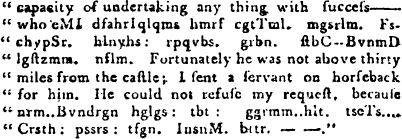
“——If I am not mistaken in Miguel’s character, he will be present at the apparition which I have promised to the Countess. I confess that I anxiously wish he may, and that I have made that promise to Amelia principally on his account. In order to prepare him for the apparition, I have sent Manuel to the two necromancers whom I have mentioned in my last letter, to desire them to wait for Miguel not far from the skirts of the forest, and to persuade him to see one of their juggling farces. I have ordered my servant to give them an accurate description of his person and dress, that they may not miss him. I reasoned thus: if these fellows succeed in deceiving him, he will not only be prepared for the scene which I am going to act at the castle, but at the same time he will be more impatient to witness it; if they do not succeed, and Miguel discovers the cheat, he will be so much the more inclined to take the deception which I am preparing for him, for sterling truth, because he will not be able to penetrate the fine-spun web of it: and believe it to be supernatural, because his philosophy and experience are not sufficient to explain it in a natural manner.——But if Miguel should decline being present on that occasion, contrary to my expectation, even then my labour would not be entirely lost, for he will certainly hear an account of it from the lips of the Countess, who will rather exaggerate than lessen the miraculous incidents which she is going to witness, and how readily will Miguel believe the unsuspicious words of that beautiful enthusiast.————Triumph! Miguel and his tutor have witnessed the apparition seen at the castle. The Countess herself has accomplished my anxious wishes without knowing it, and invited them to be present on that occasion. It is a remarkable instance of the contradictions of the female heart, that the very lady who was so desirous to see her deceased husband, was seized with such an horror at it on the day when her anxious desire was to be satisfied, that, without paying the least regard to female delicacy, she wrote a letter of invitation to Miguel. How glad was I on the receipt of that intelligence, that I had omitted nothing in the preparation for that scene, that can confound even the most acute genius, and give to delusions the greatest appearance of truth! Count Clairval acted the part of his deceased brother.—Your Excellency knows that fine acute genius, who by the intricate incidents of his life, and a long series of experience of all kinds, and his own reflections, has acquired the capacity of undertaking any thing, with success—— who’eMI dfahrIqlqms hmrf cgtTml. mgsrlm. FschypSr. hlnyhs: rpqvbs. grbn. ftbC—BvnmD lgstzmm. nflm. Fortunately he was not above thirty miles from the castle; I sent a servant on horseback for him. He could not refuse my request, because nrm..Bvndrgn hglgs: tbt: ggrmm..hlt. tseTs.... Crsth: pssrs: tfgn. InsnM. bttr. — —.”
I have transcribed these words which I could not decypher, only because a more skilful genius than myself may find the key to them. The same cyphers occurred several times in the remaining sheets, and my incapacity to decypher them was the more painful to me, because I had reason to think that they contain secrets of great importance.
(To be continued.)
The “cypher” is transcribed as printed. Unlike the rest of the text, it uses round “s” throughout.
EXTRAORDINARY EFFECTS OF SUDDEN JOY.
Arthur Plantagenet, viscount Lisle, natural son to King Edward IV. was imprisoned in the thirty-third year of Henry VIII. upon suspicion, that he designed to betray Calais to the French, when he was governor of that important garrison; but the accusation proving false, and the king willing to repair the dishonour he had sustained, sent him a diamond ring, and a kind message by his secretary of state Sir Thomas Wriothesly; at which the viscount was so over-joyed and transported to excess of satisfaction, that the night following, of that very joy he died.
Cinan Cuffutus Judæus being at Arsinoe, a port upon the Red Sea, making war upon the Portuguese, by commission from the grand signior Solyman, he there received the news, that his son Selechus was made a slave at the taking of Tunis, but being soon after informed that he was redeemed by Haradienus, made admiral of seven ships of war, and with them was at anchor before Alexandria, and from thence resolved to join him very suddenly. This notice of his son’s unexpected freedom, and his being preferred to such a post of honour, so surprized and overwhelmed the old man with excess of joy; that he swooned at the hearing of it, and at the arrival of his son he died in his arms.
Original: The wonders of the little world; or, A general history of man, displaying the various faculties, capacities, powers and defects of the human body and mind, Volume 2. Nathanial Wanley, 1678.
Original title of essay: Of Extraordinary Joy, and the Effects It Has Produced
Abridged edition: The history of man: displaying the various powers, faculties, capacities ... 1746 Vol. II
Also: 1806 William Johnston new edn. has “Sinan Ceffutus Judæus”, “Haradienus Barbarossa” and more details
Link: http://books.google.com/books?id=V0oBAAAAQAAJ
Notes: In the original, the Arthur Plantagenet segment is missing the words “over-joyed and”; the name is spelled “Cinan Ceffutus Judæus”.
For the New-York Weekly Magazine.
DEATH.
“————’Tis thy delight to make us sad; To blast our joys, and mock our every hope; To wretched man new miseries to add, And sling fresh gall into life’s bitter cup.” W. Townsend.
None are exempt from thy stroke, O thou lawless power! thou stretchest out thine hand and levellest alike, the rich, the poor, the brave, and the base. When thou givest the sign they are forced to obey—to prepare for the awful moment. Some thou layest on a languishing bed of sickness; and again some, who are, to all appearance, in the full enjoyment of health, thou called hence in a moment unexpected, when they, perhaps, are planning a way for future life. In an instant all that in imagination they have been erecting is brought to nought; and, for the first time, they behold themselves creatures of a moment.
The gentle, the amiable, the accomplished Elmira was forced to obey thy stern mandate while yet in the bloom of youth. Methought thou didst a little relent of thy savage cruelty, when thou sawest the victim thou hadst sought out for the purpose of wreaking thy fury on. The thought was illusive, although for a few minutes after thou hadst first aimed the dart, the finishing of thy work seemed suspended---yet it proved too sure.
In idea I have figured out thy portrait. Thou art of a pale visage, thine eyes dry, and the balls glaring like fire; they never dropped one pitying tear, and are therefore strangers to moisture. Thy cheeks are dry and hard; and thy teeth grinning a ghastly smile, as if pleased that the life of man is in thy power. In thy hand is grasped a barbed weapon, which thou aimest at the heart, and playest at thy will, and which none can withstand.——I must stop; for what I have pourtrayed fills me with horror.
L. B.
New-York, Aug. 13th, 1796.
EXTRAORDINARY BEHAVIOUR OF TWO COMMANDERS, IN A SEA FIGHT BETWEEN THE FLEETS OF CÆSAR AND POMPEY, OFF CUBA.
In the height of the action the two rivals, now grown enemies, Menas and Menacrates, happened to descry one another at the same instant. Immediately they left every other pursuit, and with all their art, and strength of oars, threatening and shouting, rushed upon one another. The shock was terrible: Menas’s ship had her brazen beak beat off with a part of her bow; and Menecrates’s galley had a tier of her oars stripped clear off, by the board. But when the grappling irons were thrown, and the ships made fast along side, there ensued the most desperate engagement that had ever been seen between two captains. It began with showers of darts, stones, arrows, spears. Then the bridges were thrown for boarding, where a cruel battle joined, foot to foot, and shield to shield: there was not a blow given in vain. They fought for some time, with equal fury and success, and the crews of both were generally either killed or wounded, when an accidental circumstance seemed to give Menas the advantage: his ship was higher than the enemy’s; his men fought as from a rising ground, and the blows and shot from above gave the superiority. Yet he was run through the arm with a dart, which was got out; but his adversary, Menecrates, was pierced through the thigh by a Spanish barbed javelin, which they durst not try to move. But, though disabled from fighting, he kept the deck, encouraging his men, till seeing them all cut down, and the enemy ready to clear the deck, he sprang overboard and perished in the sea.

NEW-YORK.
MARRIED,
On Thursday evening last, by the Rev. Dr. Foster, Mr. Eliphalet Barnum, to Miss Pœbe Cock, both of Oyster-Bay (L.I.)
The same evening, at Huntington (L.I.) by the Rev. Dr. Schench, Capt. Isaac Hand, of this city, to Miss Amy Weeks, of Oyster-Bay (L.I.)
On Monday se’nnight, by the Rev. Dr. M‘Knight, Mr. Patricius M‘Mannars, of this city, to Mrs. Seethe Arnold, formerly of Boston.
METEOROLOGICAL OBSERVATIONS.
From the 7th to the 13th inst.
Days of the Month. Thermometer observed at 8, A.M. 1, P.M. 6, P.M. Prevailing winds. OBSERVATIONS on the WEATHER.
deg.100 deg.100 deg.100 8.1.6. 8. 1. 6.
Aug. 7 6750 73 71 E.NE. do. cloudy,lt. wd.do.
8 70 7750 71 S.do.do. clear,lt. wd.calm.
9 71 7925 80 W.SW. do. clear,do.do.
10 73 84 77 N.S.do. clear,do.do.
11 74 82 76 SW.do.do. cloudy,do.do.
12 74 81 76 SW.do.do. cloudy,do.clear,
13 73 80 7650 SW.do.W. cloudy,do.do.
WHAT IS HAPPINESS?
’Tis an empty fleeting shade, By imagination made: ’Tis a bubble, straw, or worse; ’Tis a baby’s hobby-horse: ’Tis a little living, clear; ’Tis ten thousand pounds a-year: ’Tis a title, ’tis a name: ’Tis a puff of empty fame, Fickle as the breezes blow: ’Tis a lady’s YES or NO! And when the description’s crown’d ’Tis just no where to be found.
For the New-York Weekly Magazine.
TO AMYNTA.
Sad, O Amynta! through these shades I rove, And pensive hear the distant cannon roar; No charming warbler cheers the dreary grove, And peace, and glad content are now no more. ’Twas to these fields our dauntless fires of yore, With their bright goddess Liberty retir’d; They fix’d her standard on the desart shore, The barb’rous native at their feet expir’d. Her smiles illumin’d o’er the gloomy plains, And peace and glory were their valour’s meed: The virtuous ardour still informs our swains, And still they conquer, still they dare to bleed. Erewhile, all uninur’d to war’s alarms, And good and gentle was the generous swain; But now vindictive wrath his bosom warms, He grasps the steel, and treads the sanguine plain. The pensive Genius of our hapless land, Sits sadly weeping on a rock reclin’d: But, see Hope smiling hov’ring o’er him stand, And spread her gilded banners to the wind. MATILDA. Cedar Grove, 1777.
For the New-York Weekly Magazine.
THE CONFESSION.
Olivia, though Strephon I praise, His wit and good humour approve; Though the beauty, I own, of his lays, Yet still I may not be in love. His merit was always allow’d, By ev’ry gay nymph on the plain, And I sure must be stupid or proud, Not to join in the praise of the swain. But when each dear look I admire, When with raptures I list to his song, When my heart it beats time to his lyre, And the minutes without him seem long; Then I fear, that not friendship alone, My heart could so tenderly move; Yet, I’m still at a loss, I must own— For it cannot—it must not be love. To her friend thus the shepherdess said, Who suspected a little deceit, With smiles she reply’d to the maid, (Resolv’d to discover the cheat,) “Suppose he was equally charm’d, “Say, could you the shepherd approve?” The nymph of her caution disarm’d, With blushes confest—she could love. New-York, August 13, 1796.
AN ELEGY WRITTEN AT SEA.
Heaven gave the word, Delia! once more farewell, Ah me! how fleeting all our joys are found; The pangs I feel thy tender heart can tell, For pangs like mine thy tender heart must wound. Snatch’d from thy arms, to distant lands I roam, And face the horrors of the howling sea; Far from my long lov’d friends and native home, And far, my Delia! ah, too far from thee! No more thy pleasing converse cheers my soul, And smooths my passage through life’s rugged way; Thy smiles no more my wonted cares controul, And give new glories to the golden day. No more with thee I hail the approach of dawn, And hand in hand the varied landscape rove; Where fostering gales invest the dew-bright lawn, Unlock the garden’s sweets, and fan the grove. With notes accordant to thy skilful tongue, No more I seek my doric reed to tune; No more the tender melody prolong, And chide the envious hours that fleet too soon. When sinks in ocean’s bed the source of light, And darkness drear its raven pinions spread; Chearless and lone I pass the ling’ring night, With thoughts congenial to its deepest shade. Unless, perchance, my weary watchful eyes, Sleep’s balmy charms no longer can refuse; Then swift to thee my soul unfetter’d flies, And each past scene of tenderness renews. With all that winning grace I see thee move, That first endear’d thy tender heart to mine; When soften’d by thy grace of virtuous love, I led thee, blushing, to the hallow’d shrine. I see thee too, thou partner of my heart, With all a mother’s tender feelings blest; The frequent glance, the kiss, the tear impart, And press the smiling infant to thy breast. Eager I haste a parent’s joy to share, My bosom bounds with raptures felt before; But swift the soothing vision sinks in air, Winds howl around, and restless billows roar. Even now, whilst prompted by the pleasing past, In artless numbers flows this pensive lay; The tottering vessel quivers in the blast, And angry clouds obscure the cheerful day. Yet why repine, my anxious breast be still, No human bliss is free from foul alloy; But, what at present bears the face of ill, May end in smiling bliss and lasting joy. Soon may that Power supreme, whose dread command Can still the tumults of the raging main; Through paths of danger with unerring hand, Guide me to thee and happiness again. In Him, my Delia, then thy trust repose, ’Tis he alone the joyless bosom cheers; He soothes when absent all our heart-felt woes, At home our soft domestic scene endears.
NEW-YORK: Printed by JOHN BULL, No. 115, Cherry-Street, where every Kind of Printing work is executed with the utmost Accuracy and Dispatch.—Subscriptions for this Magazine (at 2s. per month) are taken in at the Printing-Office, and by E. MITCHELL, Bookseller, No. 9, Maiden-Lane.
UTILE DULCI.
The New-York Weekly Magazine; OR, MISCELLANEOUS REPOSITORY.
Vol. II.] WEDNESDAY, August 24, 1796. [No. 60.
REMARKS ON THE WONDERFUL CONSTRUCTION OF THE EAR.
The ear, it is true, in respect to beauty, must give place to the eye. However, it is perfectly well formed, and is no less a master-piece of the creative hand. In the first place, the position of the ear shews much wisdom. It is placed in the most convenient part of the body, near the brain, the common seat of all the senses. The outward form of the ear is worthy our admiration. It greatly resembles a muscle; but has neither the softness of mere flesh, nor the hardness of bone. If it was only flesh, it’s upper part would fall down over the orifice, and would prevent the communication of sounds. If, on the contrary, it had been composed of hard bones, it would be very painful and inconvenient to lie on either side. For this reason, the Creator formed the outward part of the ear of a gristly substance, which has the consistence, the polish, and the folds, most proper to reflect sounds; for the use of all the external parts is to collect and convey them to the bottom of the ear. The interior construction of this organ must still more excite our admiration. There is in the shell of the ear an opening, which they call the auditory pipe. The entrance of it is furnished with little hairs, which serve as a bar, to keep insects from penetrating into it; and it is for the same purpose that the ear is moistened with a substance that is conglutinous and bitter, which separates itself from the glands. The drum of the ear is placed obliquely in the auditory pipe. This part of the ear really resembles a drum; for, in the first place, there is in the cavity of the auditory pipe a bony ring, on which is stretched a round membrane, dry and thin: in the second place, there is, under that skin, a string stretched tight, which does here the same service as that of the drum, for it increases, by its vibrations, the vibration of the drum of the ear, and serves sometimes to extend, and sometimes to relax the membrane. In the hollow, under the skin of the drum, there are some very small bones, but very remarkable, called auditory bones, and distinguished by these names, the hammer, the anvil, the orbicular, and the stirrup. Their use is, to contribute to the vibration, and to the tension of the skin of the drum. Behind the cavity of the drum, another opening must be observed, which communicates with a pipe which leads to the palate, and which is equally necessary to produce the sensation of exterior sounds. Next comes the snail, which rises in a spiral line. Behind is the auditory pipe, which joins the brain.
Hearing is in itself a thing worthy of admiration. By a portion of air, extremely small, which we put in motion, without knowing how, we can in an instant make our thoughts known to one another, with all our conceptions and desires, and this in as perfect a manner, as if our souls could see into each other’s. But to comprehend the action of the air, in the propagation of sounds, more clearly, we must remember that the air is not a solid body, but a fluid. Throw a stone into a calm running water, there will result from it undulations, which will extend more or less, according to the degree of force with which the stone is thrown. Let us now suppose, that a word produces in the air the same effect as the stone produces in the water. While the person who speaks is uttering the word, he expels (with more or less force) the air out of his mouth; that air communicates to the outward air, which it meets with an undulating motion, and this agitated air comes and shakes the stretched membrane of the drum in the ear; this membrane, thus shaken, communicates vibrations to the air which resides in the cavity of the drum; and that strikes the hammer; the hammer, in it’s turn, strikes the other little bones; the stirrup transmits to the nerves, through the oval orifice, the motion it has received; and they then vibrate like the strings of a fiddle. This motion gains strength in the labyrinth, and reaches to what is properly called the auditory nerves. The soul then experiences a sensation proportionable to the force or weakness of the impression received, and, by virtue of a mysterious law of the Creator, it forms to itself representations of objects and of truths.
God, in order to make us more sensible of his general goodness towards mankind, permits now and then, that some should be born deaf. Must it not teach us to value highly the sense of which they are deprived? The best way to prove our gratitude for so great a blessing is to make a good use of it.
For sources, see the end of this file.
INTERESTING HISTORY OF THE PRINCESS DE PONTHIEU.
Translated from the French.
(Continued from page 50.)
The day being come, they were obliged to cast lots which of them should die first: the fatal chance fell on the Count de Ponthieu; his son and Thibault contended for the preference, but all they could obtain was, to wait on him to the place of execution. The whole court was assembled to see this spectacle—The Sultan was present himself, and his Sultaness, whose extraordinary beauty had attracted the eyes of all the Infidels, when they were drawn off by the arrival of the illustrious victims, that were going to be sacrificed to the honour of the day. But that Queen, whose soul was as perfect as her body, was surprized at the majestic air of the Count de Ponthieu, who was as yet at a great distance from her: his venerable age, and the contempt with which he seemed to look on his approaching fate, made her order him to be brought nearer to her; he being a stranger, she let down her veil, the women of that country never suffering themselves to be seen by any but Saracens.
As he approached, she found emotions which at that time she knew not had any other source than pity; but having attentively looked on his face, she soon discovered the true cause: but making use of her utmost efforts to prevent her disorder from being taken notice of, she asked him his name, of what country he was, and by what accident he had been taken. The softness of her voice, and the manner of her delivery, gave him a sensible alarm, though he knew not the meaning of it—He answered her without hesitation, that he was of France, and of the sovereignty of Ponthieu. “Are you here alone?” demanded the Queen. “I have two companions in my misfortunes,” replied he, “my son and my son-in-law.” The Queen ordered them immediately to be brought to her; and having heedfully observed them for some time, ordered the sacrifice to be suspended, and ran to the throne where the Sultan was sitting, and throwing herself at his feet “My lord,” said she “if ever I have been happy enough to please you, and may flatter myself with your affection, grant me the lives of these three slaves: they are of my country, and pity makes me interest myself for them, and I hope your clemency will be rewarded by the merit of those I am going to bind to your service.” The Sultan, who adored her, raised her tenderly; “You are mistress of my fate, madam,” replied he, “can I refuse you then the being so of that of those strangers? Dispose of them as you please, I give them entirely up to you, without reserving to myself any right over them.” She thanked him, in terms full of gratitude and respect, and returning to the noble captives, informed them of their pardon; and being secretly too much disordered to stay till the conclusion of the feast, she ordered them to follow her to her apartment; where seeing herself alone with them, she was obliged to renew her efforts, to conceal the confusion of her soul; and assuming an air of as much fierceness as she could, which was heightened by a natural majesty; “I have saved your lives,” said she, “and you may judge by such a proof of my power, that I have authority enough to put you again into the same danger; resolve therefore to satisfy my curiosity, in discovering without disguise all your adventures: I give you till to-morrow to prepare yourselves; I must know your names, qualities, and by what strange accident fate brought you into this country---if you are sincere you may expect every thing from my goodness.” Thibault who had not ventured to lift his eyes upon her while they were before the Sultan, now endeavoured to discover, with the nicest penetration, her beauties; which the thin gauze, of which her veil was made, did not altogether conceal. The dazzling lustre of her sparkling eyes, and the thousand charms which played about her lovely mouth, notwithstanding this impediment, were not wholly obscured from the view. The daring gazer found himself agitated with emotions, which had been unknown to him since the death of his unhappy wife. He felt a pleasure in contemplating this adorable queen, which nothing but itself could equal; and perceiving the Count was silent, perhaps kept so by sentiments which he knew not how to account for, he threw himself at her feet; “As for me, madam,” said he, “it will not be the fears of death that would prevail on me to relate the particulars of a life which has been full of such unheard-of woes, that what to others would be the greatest dread, to me would be a blessing---but there is something far more terrible than what you have named, the abusing a generosity such as yours, prevents me from concealing any part of what you command me to disclose---if therefore the recital of our misfortunes can testify our acknowledgments, depend on our sincerity.”
All the resolution which she had assumed for this rencounter, had like to have forsook her at so moving a discourse; but making a new effort, “Rise,” said she, “your destiny promises something very touching, I am concerned in it more than you can yet imagine. The Sultan will soon appear, therefore I would have you retire, you shall want for nothing this palace can afford, recover yourselves of your fears and fatigues, and to-morrow you shall receive my orders; and till then, I will defer the history I have engaged you to give me.” She then called a slave in whom she entirely confided; “Sayda,” said she to her, “conduct them as I have ordered;” and then making a sign to them to withdraw, they obeyed, and followed the slave. As they went out they heard the Queen sigh, and neither of them could forbear doing so too---Thibault, who quitted her with regret, returning to look on her once more, perceiving she put her handkerchief to her eyes to wipe away some tears, he could not restrain his own. Sayda led them to a little apartment behind the Queen’s, it consisted of three rooms, and at the end an arched gallery, where the fruit was kept that was every day served up to her table.---“This,” said Sayda, “is the only service the Sultaness expects from you; she could not have placed you so commodiously, without giving you some employment that required your attendance near her person, you must therefore take care of this fruit, put it in order in baskets provided for that use, and present it to her at her repasts---under this pretence you may possess these apartments, and be served by the slaves appointed for that purpose---you are to be subservient only to the Sultan and Sultaness.”
In speaking these words, she quitted them, leaving them in an inconceivable surprize at all they had seen. When they were by themselves, Thibault, who could no longer contain in his breast the different agitations which crouded one on another, and seemed to struggle for utterance, approached the Count, and tenderly embracing him; “What a woman is this Queen, my lord,” said he, “and by what miracle does she reign over these barbarians! what have we done to deserve her generous care of us! Ah! my lord, I find her companion dangerous---Alas! my dear Princess!” added he, “you alone were wont to raise these emotions in my soul!” “I don’t know,” replied the Count, “what will be our fate, or what are the designs of the Queen: her goodness does not affect me as it does you; you are young, and your heart still preserves a fund of passion, which may cause more violent perturbations in it than mine; yet I own, I have felt for her the tenderness of a father; and that when she spoke, my daughter came into my mind---But I am afraid, my dear Thibault, that you will doubly lose your liberty in this fatal place.” Thibault made no other answer than by sighs; and some refreshments being brought in, they were forced to drop a discourse, that did not admit of witnesses.
The Queen, in the mean time, was too much interested in the affairs of the day to be very easy, and was no sooner left alone with her dear Sayda, than giving a loose to the transports she had so long restrained, her beautiful face was bathed all over in tears. The faithful slave, astonished at her excess of grief, kneeled down at her feet, and taking one of her hands; “Alas! madam,” said she, “what is this sudden misfortune---are these strangers come to trouble the tranquility you were beginning to enjoy!---you have hitherto honoured me with your confidence---may I not now know what has occasioned this grief?” “Ah! dear Sayda,” replied her royal mistress, “let not appearances deceive you.—Love, joy, nature, and fear, makes me shed tears much more than any grief---that husband so dear to me, and of whom thou hast heard me speak so much, is one of the captives whose lives I have saved---the other is my father, and the young lad my brother. The horror of seeing my father die for the diversion of a people to whom I am Queen, has pierced me with so lively an affliction, that I wonder the apprehension of it did not a second time deprive me of my reason---my husband, partaker of the same fate, his melancholy, his resignation before me, his looks full of that love and tenderness which once made my happiness, has touched my soul in the most nice and delicate part: I dare not discover myself, before I know their sentiments; and the constraint I have put on myself, has been such, as nature scarce can bear---Preserve my secret, dear Sayda, and don’t expose me again to tremble for lives on which my own depends.” “Doubt not of my fidelity, madam,” answered the other, “’tis inviolable, my religion, your goodness which I have so often experienced, and the confidence with which you have honoured me, have attached me to your service till death.”
(To be continued.)
THE ROAD TO RUIN. A MEDITATION.
This road is easily found out, without a guide or a direction-post: it is a broad highway, in which the traveller may amuse himself with many pleasing prospects, without considering that he is exposed to many dangers. The Road to Ruin is so infested with robbers, that it is next to impossible to escape their depredations. In other avenues, the usual loss sustained is a purse of money; but in these paths, treasures inestimable are purloined from the unwary. The loss of cash may often be repaired, but what are we to do when our innocence, our health, our integrity, our honour, are basely pilfered from us? And such calamities will inevitably be our lot, if we continue long in the alluring road to Ruin.
But notwithstanding the certainty of destruction upon this road, it is the most frequented of any highway. Numbers of unthinking mortals are daily seen turning into it with impetuosity and glee, without considering the difficulty, and almost the impossibility of getting out of it.
When we see a man, possessed of a fortune of five hundred pounds a year, living at the rate of two thousand pounds a year, our veracity would not be called in question if we ventured to declare that he was on the Road to Ruin.
The spendthrift who frequently makes application to usurers, and purchases the use of money by extravagant douceurs, premiums, or discounts, may justly be said to be a traveller on the same high-way.
When any one becomes an abject slave to his bottle; we need not scruple to pronounce, that he is staggering into this much frequented road.
If a young girl, innocent in herself, should too credulously hearken to the enamoured tale of the deceiver, it is more than probable that she may be seen tripping upon this too general high-way.
When a lady has private recourse to ardent liquor, whether affliction or any other cause may have induced her to become acquainted with it, she seldom fails to be a passenger in this thronged avenue.
When a person, afflicted with disease, seeks relief in quackery, he may truly be said to be galloping upon this road.
It is seldom indeed that any advantages or emoluments are derived by travellers in the Road to Ruin. Holcroft and Harris, as toll-gatherers on that road, have doubtless been benefited by it.
For the New-York Weekly Magazine.
ON SEGAR SMOAKING.
There is nothing, perhaps, more pernicious, or more destructive to the health of man, than the present practice of segar smoaking. It is of all others the most disagreeable, as well as the most obnoxious thing in use. It may, no doubt, be thought by our bucks who are its votaries, a mark of gentility, or an accomplishment. Admitting then for a moment, the truth of this remark; yet which of these champions of folly will declare, when seriously reflecting, that he would rather sacrifice his health and happiness, than the gratification (if I may be permitted to use the expression) of drawing to such a filthy twist? There are none, however strenuous advocates they may appear for the fashions, still their own comfort will be consulted before that mad passion which will finally contaminate their blood beyond a purification. Let them further consider, that nothing, however fashionable, can receive the approbation of their companions, if offensive, and that segar smoaking, when practiced in company (as is often the case) is an unpardonable insult. The smell conveyed from one of those infected things, is sufficient very often to poison persons within the limits of a room.
It is somewhat astonishing to see so many who pretend to be men of sense, give their sanction to a thing that must finally terminate to their disadvantage; were they to consider the effects which flow from its indulgence, they would find it to be an irretrievable injury both to their persons and constitutions: and however sanctioned by custom is not the less detestable. Although slow in its operations, still it will prove to be a sure poison, such as will baffle medicine, and torture the skill of the most eminent physicians.
Such, O! ye votaries of segar smoaking, will be your reward, if you continue to follow this fashionable, though injurious custom.
TYRUNCULUS.
New-York, August 18, 1796.
PRECEPTS OF CHILO, THE GRECIAN PHILOSOPHER.
Three things are difficult; to keep a secret; to bear an injury patiently; and to spend leisure well. Visit your friend in misfortune, rather than in prosperity. Never ridicule the unfortunate. Think before you speak. Do not desire impossibilities. Gold is tried by the touchstone, and men are tried by gold. Honest loss is preferable to shameful gain; for, by the one, a man is a sufferer but once; by the other always. In conversation make use of no violent motion of the hands; in walking, do not appear to be always upon business of life and death; for rapid movements indicate a kind of phrenzy. If you are great, be condescending; for it is better to be loved than to be feared. Speak no evil of the dead. Reverence the aged. Know thyself.
For the New-York Weekly Magazine.
ON TEMPERANCE.
Temperance has those particular advantages above all other means of preserving health, that it is practicable to all ranks and conditions, in any season, or at any place; it is a kind of regimen which every man may put himself under, without interrupting his business, without any expence, or without loss of time. Every animal, except man, keeps to one dish; herbs serve for this species, fish for that, and flesh for a third. Man falls upon every thing that is found in his way; not the smallest fruit, or the least excrescence of the earth, scarce a berry or mushroom can escape him.
Though Socrates lived in Athens during a great plague, he never caught the least infection, which ancient authors unanimously ascribe to that uninterrupted temperance which he always observed.
ANECDOTES OF MEN OF EXTRAORDINARY STRENGTH.
George le Feur, a learned German author, tells us, that in the year 1529, there lived a man in Misnia in Thuringia, named Nicholas Klumber, an ecclesiastic and provost of the great church, that by main strength, and without the help of a pulley or other engine, took up a pipe of wine in a cellar, carried it into the street, and laid it upon a cart. The same author says, That there was a man at Mantua, named Rodomus, that could break a cable as thick as a man’s arm, with as much ease as a brown thread.
Mr. Richard Carew in his survey of Cornwall, tells us, that a tenant of his, named John Bray, carried about the length of a butt, at one time, six bushels of wheat meal, at the rate of fifteen gallons to the bushel, and a great lubberly miller twenty years of age hanging upon it. To which he adds, that John Roman of the same county, a short clownish grub, would carry the whole carcase of an ox upon his back, with as much ease as another of a greater stature could carry a lamb.
Caius Marius, who was originally a cutler, and in the time of Galienus elected emperor by the soldiers, was so strong a bodied man, that the veins of his hands appeared like sinews. He could stop a cart drawn with horses, and pull it backwards with his fourth finger: If he gave the strongest man a fillip, it was felt like a blow on the forehead with a hammer: With two fingers he could break many things twisted together.
The emperor Aurelian, as it is recorded in history by Flavius Vopiscus, was very tall of stature, and of such wonderful strength, that in a pitched battle against the Samaritans, he killed in one day with his own hands forty-eight of his enemies, and in some skirmishes afterward made them up nine hundred and fifty. When he was colonel of the sixth legion, he made such a slaughter among the Franci, that seven hundred of them perished by his own sword, and three hundred were sold that were taken prisoners by himself.
THE VICTIM OF MAGICAL DELUSION. OR, INTERESTING MEMOIRS OF MIGUEL, DUKE DE CA*I*A.
UNFOLDING MANY CURIOUS UNKNOWN HISTORICAL FACTS.
Translated from the German of Tschink.
(Continued from page 54.)
Of the following letter only the conclusion deserves to be transcribed.
“I am firmly convinced, that in Miguel’s and Amelia’s heart a passion has taken rise, which soon will burst out in blazing flames; the present which he has made her of a ring of great value, which she has accepted, his looks at table, Amelia’s extraordinary kindness for him, and his consternation on account of her illness, are incontestable proofs of the truth of this observation. How much soever this mutual passion coincides with my plan, because it furnishes me with infallible means to allure the inconstant, fickle Miguel, yet I must make haste to interrupt this growing passion because I am afraid he will be enslaved so much by that enchanting lady, that he will be rendered unfit for matters of greater importance.
“For that reason I have instructed the apparition to utter a few words, which I could foresee would cause a small breach between the two lovers. Your Excellency will recollect that the ghost accused Miguel’s father of being his murderer. By these means, I hope to put at least a temporary stop to Miguel’s and Amelia’s growing intimacy; for it cannot be expected that the son of the supposed murderer of the Count will dare to pay his addresses to his widow; and if he should, it is to be expected that she will decline admitting his visits, or at least treat him with coolness and reserve. However this misunderstanding would not be of long duration, for on close examination, both would find themselves deceived by the apparition, and their love would gain additional force. For that reason I have wrote a pressing letter to Miguel’s father, without subscribing my name, and advised him to order his son to continue his travels without delay, that he may be cured of a foolish passion which he had for the Countess of Barbis. I hope this letter will have the desired effect; and I will keep myself in readiness to follow Miguel every where with my myrmidons; for my plan requires that I never should lose sight of him.”
The following letter is so important that I must insert it at full length:
“My Lord,
“You have accused me in your letter from the twelfth of this month, of having acted equally dishonest and imprudent, by suffering the Count, when disguised as a spectre, to say an untruth, which injures the honour of an innocent man, and if ever discovered by his son or the Countess, will brand him and myself as impostors. I could have prevented these severe reproaches of your Excellency, if I had been at leisure to explain this matter at large in my last letter. First you will give me leave to observe, that the declaration of the ghost is no untruth, but only an oracle, the duplicity to which, beings of that kind are much addicted. Amelia’s husband has really been assassinated by order of the man whom Miguel calls father; however, that person is not his parent, but only the preserver of his life; in short, it is Vasconcello’s Secretary of State at L**b*n, who has saved Miguel’s life when a boy, and for that reason is called by him his second father. This man the ghost had in view, and of course has spoken the truth, but only has been misunderstood. This misunderstanding produced the accidental, and if your Excellency will give me leave to add——the salutary consequence of separating Miguel and the Countess. Fearing, however, the accusation of the ghost might produce fatal consequences for the Marquis of Villa R*al, and Amelia be tempted to revenge the death of her Lord, the ghost took the precaution to add, ‘be generous and forgive my murderer.’——The honour of the Marquis, which properly has received no injury from the declaration of the ghost, but only from the misunderstanding, shall, I vow solemnly, receive ample satisfaction. I have it myself too much at heart that the Countess and Miguel shall know the real murderer of Amelia’s husband, not to remove that error; being desirous to see the good understanding of the two lovers restored at some future period, and the assassin punished for his numberless crimes. You have signed the sentence which the rest of the conspirators have pronounced against this oppressor of the liberty of your country, with the full conviction of his deserving death; but would not Miguel look upon him rather as his benefactor and preserver of his life, than as an enemy to his native country, and prompted by gratitude and pity, endeavour to save his life? However, if he shall be informed that the preserver of his life, is not only the oppressor of his native country, but also the assassin of Amelia’s Lord, then his love for the Countess will give an additional energy to his patriotism, and silence his gratitude for Vas*****los; then the voice of his country and of the beloved of his heart, demanding revenge upon the villain, will silence the voice of his heart imploring his mercy; he will sacrifice the devoted victim to justice, at the expence of his sensibility, and consent to Vascon***los’s death. Not in vain did I introduce the apparition in such a rueful shape, not in vain instruct it to display the bleeding wounds, and to discover his horrid assassination! even the coolest observer would have been inflamed violently by that scene, and how vehemently must it have provoked the lover of the unfortunate lady to resentment against me murderer? Your Excellency will consequently easily conceive what my second secret aim was, which I designed to attain by the apparition, and at the same time, be convinced that I have exposed neither the ghost nor myself to the danger of being caught in a lie, although Amelia and Miguel should discover that the murderer was not the real father of the latter. However, this discovery could not take place, because Miguel has ceased visiting the Countess, and received orders from his father to leave, without delay, the castle and its environs. Amelia’s servants have drawn this grateful intelligence from his servant, and communicated it to me, upon which I put myself and my people in readiness to follow Miguel on the day of his departure, partly on horseback, and partly in coaches. To the valet of the Countess, who is entirely in my interest, I have given some important orders, which I intend to communicate at large in my next letter.”
I was already arrived at *ubia, and accommodated with a lodging at the inn which the Count had pointed out to me, when I finished the decyphering of this letter. Night had set in, and I was musing on the important visit which the Count had promised me, when I heard the rolling of a coach, which stopped under my window. A few moments after my servant came to inform me that an Irish captain, whose name was Dromley, wanted to speak to me. The word Irish chilled the very marrow of my bones—“Let him come in!” said I, turning my face from the servant, to conceal from him the emotions which must have been painted in every feature. I stepped to the window in order to recover myself a little; the door was flung open, and an officer in a blue uniform entered the room——I advanced two steps to meet him, and saw the Unknown standing before me. The sight of him made me speechless. “You will be surprised, my Lord! to see me here,” said he, “however the concerns of your heart are of so much importance to me, that nothing could deter me from paying you a visit.” Here he stopped. Not one syllable escaped my lips. He looked at me with seeming unconcern, advanced a step nearer, and resumed in a soft winning accent, “My Lord! you love the beautiful Countess Clairval! however, you would love her in vain, if my power had not removed every obstacle, and ensured you her reciprocal love.”
Now I had recovered the power of utterance. “Then you have informed her,” I exclaimed, “that her Lord has not been assassinated by my real father?”
The Irishman seemed to be struck with surprise, examining inquisitively my looks, and after a short pause, continued in a firmer accent: “It was my duty to make this discovery to Amelia; however, it would never have been sufficient to procure you her reciprocal love, if I had not done something which was not my duty.”
“What have you done? My notions of your actions have been confounded so much, that I cannot thank you beforehand.”
“Thank!” he replied haughtily, “as if I had ever done any thing for the sake of thanks! In order to save you that trouble, I will not tell you what I have done for you.”
The strain in which he spoke confounded me. I returned no answer.
“However, I must caution you,” he continued, “not to represent me to the Countess as an impostor, if you do not wish to destroy the effect of the service which I have done you. You will be convinced at some future period how necessary it is for your own happiness not to slight this advice.”
“If I am to enjoy the happiness you have prepared for me, I must first know the residence of Amelia.”
“Not before you have pledged your honour to follow my advice.”
“Should I suffer Amelia to be imposed upon like myself; I should owe her love to a delusion?”
“Who has told you that I have imposed upon the Countess? You do not know as yet what I have done; it would therefore be just not to condemn me before-hand, as you refuse to thank me before-hand for. what I have done!”
“I judge of an action of yours which I do not know, from your former actions, which I know very well, at present. Can you call this unjust?”
“This conclusion is at least premature. Every plan ought to be adapted to the existing circumstances, and every action fitted to the plan; therefore, as soon as the circumstances and the plan are changed, one ought not to judge of the present actions from the preceding ones.”
“I do not comprehend you completely.”
“You have been tried by delusions; however the time of probation is past; the delusions have made room for the dawn of truth, which is rising in your mind.”
(To be continued.)
For the New-York Weekly Magazine.
AN ACCOUNT OF A MELANCHOLY TRANSACTION, WHICH TOOK PLACE IN THIS CITY, MANY YEARS AGO.
It was in the commencement of autumn that Orlando, the only son of a respectable merchant of this place, prevailed upon the amiable Arria, to whom he had long been engaged, to fix upon a day for the celebration of their nuptials; and he had the happiness to see that morning ushered in with the warmest benedictions and wishes for his future felicity that pure friendship can bestow. Arria’s relations and his own, together with a numerous acquaintance, attended at the house of her parents, whose only child she was, and whose very existence seemed to hang upon hers.—Unaffected satisfaction presided in the assembly, light-hearted wit broke forth in a thousand brilliant sallies, while joy heightened the flush on the cheek of youth, and smoothed the furrows on the brow of age: nor did the sprightly fair one, who was just verging upon sixteen, fail to exert herself to enhance the hilarity of the company.—When a convenient time had elapsed, the priest arose in order to begin the ceremony, but, upon looking round, observed that the young lady was not present; one of the bride’s maids was therefore dispatched to inform her that the company were in waiting for her, but she returned with much disorder, and told them that Arria was not to be found:—her mother, offended at this seeming want of respect for their guests, went in quest of her herself, as did several of the family; but they all, after absenting themselves for a long time, returned with the surprising account that none knew where she was.—The alarmed assembly then separated to search for her, some supposing that a false delicacy might have prevailed upon her to conceal herself, and others were apprehensive that some fearful accident had befallen her; every apartment, therefore, of the house in which they were, and likewise the neighbours, together with the wells and cisterns were examined, but all to no purpose; for when night spread her shadows upon the earth, there still appeared no trace of her they sought.
For several succeeding days strict enquiries were made concerning her, but all proving fruitless, Orlando and her parents gave her up for lost, abandoning themselves to all the agonies of grief:---Sometimes, in frantic anguish, they would accuse her of being false to Orlando, and being with some more favoured lover; and again they would melt in the tenderness of affection and bewail the unknown chance which had wrested her from their bosoms; but suspence barbed the shafts of sorrow,—the susceptible heart of Orlando sunk beneath its weight, and before the next May opened upon the smiling year, he had sought
“The dreary regions of the dead, “Where all things are forgot.”
It was in that month that the mother of Arria, having occasion to put away some winter apparel, ascended to the garret, where in a remote corner was placed a large sea-chest with a spring-lock;---believing it to be empty, she attempted to open it, when finding that the spring had catched, she had recourse to the key which lay by it---it unlocked---and she partly raised the lid---but such a horrid smell of putridity burst through the aperture, that the lid fell from her hand!——a frightful idea flushed through her brain, and, uttering a death-like shriek, she fell upon the floor!---Some of the family who were in the apartment below, heard her and hasted to her assistance.---As soon as she was capable of motion, she raised her hand, and pointing to the chest, they instantly opened it, and beheld the ghastly skeleton of the once lovely Arria!!! who, it seems, in a fit of frolic had thrown herself therein, expecting every moment to be sought for! but, no doubt, she fainted as soon as she heard the lock shut, and as the chest was too close to admit any air, she must have suffocated before she had a full sense of her deplorable situation!