Front matter (continued 3)
Reading edition
After the whole of the 'combined water' has been driven off, if the temperature continues to rise, it is found that at a temperature of 900° C. an evolution of heat occurs. This exothermal point, together with the endothermal one occurring at the temperature at which the decomposition of the clay seems to be most rapid, has been found by Le Chatelier, confirmed by Mellor and Holdcroft, to be characteristic of clay substance derived from kaolin and china clay, and the two last-named investigators state that it serves as a means of distinguishing kaolinite or clayite from other alumino-silicates of similar composition. These thermal reactions have not, as yet, been fully studied in connection with plastic clays; with china clay, as already noted, they probably indicate a polymerization of the alumina set free by the decomposition of the clay substance, as pure alumina from a variety of sources has been found by Mellor and Holdcroft to behave similarly.
On still further raising the temperature of pure clay (pelinite or clayite) no further reactions of importance occur, the material being practically infusible. If, however, any silica, lime, magnesia, alkalies, iron oxide or other material capable of combining with the alumina and silica is present as impurities in the clay substance, combination begins at temperatures above 900° C. This causes a reduction of the heat-resisting power of the material; the silicates and alumino-silicates produced fuse and begin to react on the remaining silica and alumina, first forming an impermeable mass in place of the porous one produced with pure clay substance, and gradually, as the material loses its shape, producing a molten slag if the 'clay' is sufficiently impure. As ordinary clays are never quite free from metallic compounds other than alumina, this formation of a fused portion—technically known as vitrification (p. 37)—occurs at temperatures depending on the nature of the materials present, so that a wide range of products is obtained, the series commencing with the entirely unfused pure clay (china clay), passing through the slightly vitrified fireclays, the more completely vitrified ball clays to the vitrifiable stoneware clays and ending with materials so rich in easily fusible matter as scarcely to be worthy of the name of clays.
The constitution of the clay molecule is a subject which has attracted the attention of many investigators and is being closely studied at the present time. It is a subject of peculiar difficulty owing to the inertness of clay substance at all but high temperatures, and to the complexity of reactions which take place as soon as any reagent is brought into active connection with it.
Without entering into details regarding the various graphic formulae which have been suggested, it is sufficient to state that the one which is most probably correct, as far as present knowledge goes, is Mellor's and Holdcroft's re-arrangement of Groth's formula (30)
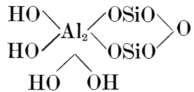
which on removal of the hydroxyl groups might be expected to give the anhydride
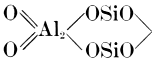
though in practice this substance—if formed at all—appears to be instantly split up into Al2O3 and SiO2.
By regarding the aluminium as a nucleus, as above, and some aluminium silicates as hypothetical alumino-silicic acids, as suggested by Ulffers, Scharizer, Morozewicz (29) and others, clay substance may be conveniently considered, along with analogous substances, as forming a special group quite distinct from the ordinary silicates. In this way Mellor and Holdcroft (29) consider that clay substance is not a hydrated aluminium silicate—as is usually stated in the text-books—but an alumino-silicic acid, the salts of which are the zeolites and related compounds. From this hypothesis it naturally follows that clay substance is analogous to colloidal silica which has been formed by the decomposition of a silicate by means of water and an acid.
If this view be correct, pure clay substance or true clay is a tetra-basic alumino-silicic acid H4Al2SiO9 or Al2Si2O5(0H4). That its acid properties are not readily recognizable at ordinary temperatures is due to its inertness; at higher temperatures its power of combination with lime, soda potash and other bases is well recognized, though the reactions which occur are often complicated by decompositions and molecular re-arrangements which occur in consequence of the elevated temperature.
There are a number of minerals which closely resemble clayite or pure clay substance in composition, the chief difference being in the proportion of water they evolve on being heated. Thus Rectorite H2Al2Si2O8, Kaolinite H4Al2Si2O9, Halloysite H6Al2Si2O10 and Newtonite H10Al2Si2O12. In the crystalline form these minerals may be distinguished from each other by means of the microscope, but as the chief materials of which clays are composed appears to be amorphous it is impossible to ascertain with certainty whether a given specimen of clay substance is composed of a mixture of these analogous minerals in an amorphous form or whether it consists entirely of clayite, i.e. the clay substance obtained from china clay. As already stated, the thermal reactions which occur on heating clayite appear to be characteristic of kaolinite whilst halloysite is completely decomposed at a temperature somewhat below 200° C.; but the not improbable presence of two or more of these alumino-silicic acids in clays of secondary or multary origin makes it almost impossible to determine whether clayite is an essential constituent of all clays or whether the purest clay substance (pelinite) obtained from some of the more plastic clays does not possess a different chemical composition as well as different physical properties.
The view that clays may be regarded as impure varieties of clayite is considered erroneous by several investigators for various reasons. For instance, felspar is rarely found in china clays, but is a common constituent of secondary (plastic) clays. J. M. van Bemmelen (26), who has found that the alumina-silica ratio of clays produced by weathering is always higher than that in clays of the china clay type produced by hypogenic action. In a number of clays examined he found that a portion was soluble in boiling hydrochloric acid whereas clayite is scarcely affected by this treatment. He also found a varying proportion of alumino-silicate insoluble in hydrochloric acid but dissolved on treatment with boiling sulphuric acid and subsequently with caustic soda solution; this latter he considers to be true clayite. Unfortunately, his results were obtained by treating the crude clay with acid, instead of first removing such non-plastic materials as can be separated by washing, so that all that they show is that some clays contain alumino-silicates of a nature distinct from clayite in addition to any clayite which may be found in them.
The fact that all clays when heated to 700 or 800° C. readily react with lime-water to form the same calcium silicates and aluminates indicates so close a resemblance between the clay substance obtainable from different sources as to constitute strong evidence of the identity of this substance with clayite or with materials so analogous to it as to be indistinguishable from it under present conditions.
In all probability, the plastic clays have been derived from a somewhat greater variety of minerals than the primary clays (p. 71) and under conditions of decomposition which differ in details, though broadly of the same nature as those producing china clays. The presence of colloidal matter suggests a more vigorous action—or even a precipitation from solution—instead of the slower reactions which result in the formation of the kaolinite crystals.
The much smaller particles present in plastic clays also indicate a more complete grinding during the transportation of the material or some form of precipitation. If, as Hickling suggests, all clays are direct products of the decomposition of mica, the fact that several varieties of mica are known and that the conditions under which these decompose must vary considerably, afford a good, if incomplete, explanation of some of the widely diverse characteristics observed in different clays.
Notwithstanding the great complexities of the whole subject and the apparently contradictory evidence concerning some clays, there is a wide-spread feeling that whatever may be the mineral from which a given clay has been derived, the true clay substance, which is its essential constituent, would (if it could be isolated in a pure state) prove to be of the same composition as kaolinite obtainable from china clay of exceptional purity. The purest clay substances (pelinite) yet obtained from some of the most plastic clays are, however, so impure as to make any detailed investigation of their composition by present methods abortive. The methods of synthesis which have proved so successful in organic chemistry have hitherto yielded few intelligible results with clays, on account of the complexity of the accessory reactions which occur.
The Difference between Pure Clay Substance and Ordinary Clays.
The properties and characteristics of true clay are very seriously modified by other materials which may be associated with it. This may be perceived by comparing the properties of clays mentioned in Chapter I with those of various forms of true clay just given. Moreover, as true clay never occurs in a perfectly pure state in nature, the properties of clays must be largely dependent on the accessory ingredients.
Silica, for example, when alone is a highly refractory material, but in the presence of true clay it reduces the refractoriness of the latter. Lime has a similar effect though its chemical action on the clay is entirely different. A very small proportion of some substances—notably the oxides of sodium and potassium—will greatly alter the behaviour of true clay when heated and will produce an impervious mass in place of a porous one.
For these reasons, it is necessary in studying clays to pay attention to both their physical and chemical properties and to separate the material into fractions so that each of these may be studied separately and their individual as well as their collective characteristics ascertained. Failure to do this has been the cause of much obscurity and confusion in investigations on certain clays composed of a considerable proportion of non-argillaceous material which ought to have been separated before any attempt was made to study the true clay present.
There is, therefore, a considerable difference between a natural clay and the pure clay substance theoretically obtainable from it; this difference being most marked in the case of low-grade brick clays of glacial origin, which may contain 50 per cent. or more of adventitious materials. If used in a natural state they would be found to be valueless on account of their impurities giving them characteristics of a highly undesirable character, whereas the true clay in them is found—in so far as it can be separated—to bear a close resemblance to that obtained from a high grade, plastic, pottery clay. Unfortunately, it is, at present, impossible to isolate this clay substance in anything approaching a pure form, and many clays are without commercial value because of comparatively small proportions of impurities which cannot be separated from the clay substance without destroying the latter.
Classification of Clays.
Owing to the widely differing substances from which clays can, apparently, be formed and the peculiar difficulties which are experienced in investigating the nature of clay substance from different sources, it is by no means easy to devise a scheme of classification of clays, though many of these have been attempted by different scientists.
The classification adopted by geologists is based on the fossil remains and on the stratigraphical position of clays relative to other rocks, as described in Chapter II. This is of great value for some purposes, but the composition of the substances termed 'clay' by geologists differs so greatly, even when only one formation is considered, as to make their classification of little or no use where the value or worthlessness of the material depends upon its composition. Thus the so-called Oxford clay ranges from a hard silicious shale to a comparatively pure clay; some portions of it are so contaminated with calcareous and ferruginous matter as to make the material quite useless for the potter or clayworker. A geological classification of clays is chiefly of value as indicating probable origins, impurities and certain physical properties; but the limits of composition and general characteristics are so wide as to make it of very limited usefulness.
The classification of clays on a basis of chemical composition is rendered of comparatively little value by the large number of clays which occupy ill-defined borders between the more clearly marked classes. Moreover, attempts to predict the value and uses of clays from their chemical composition are generally so misleading as to be worse than useless, unless a knowledge of some of the physical characters of the clays is available. It is, of course, possible to differentiate some clays from others by their composition, but not with sufficient accuracy to permit of definite and accurate classification.
A classification based exclusively on the composition of clays is equally unsatisfactory for other reasons, the chief of which is the placing together of clays of widely differing physical character, and the separation of clays capable of being used for a particular purpose. To some extent the latter objection may be disregarded, though it is of great importance in considering the commercial value of a clay.
Classification based on the uses of clays of different kinds has been suggested by several eminent ceramists, but is obviously unsatisfactory, particularly as it is by no means uncommon to use mixtures of clays and other minerals for some purposes. Thus stoneware clays must be vitrifiable under conditions which may be defined with sufficient accuracy, but many manufacturers of stoneware do not use clays which are naturally vitrifiable; they employ a mixture of refractory clay and other minerals to obtain the material they require.
A classification based on the origin of clays regarded from the petrological point of view offers some advantages, but is too cumbersome for ordinary purposes and suffers from the disadvantage that the origin of some important clays is by no means clearly known.
The author prefers a modification of Grimsley's and Grout's classification (31) as follows:
I. Primary clays.
(a) Clays produced by 'weathering' silicates—as some kaolins.
(b) Clays produced by lateritic action—very rich in alumina, some of which is apparently in a free state.
(c) Clays produced by telluric water containing active gases (hypogenically formed clays)—as Cornish china clay.
II. Secondary clays.
(d) Refractory[16] secondary clays—as fireclays and some pipe clays.
(e) Pale-burning non-refractory clays—as pottery clays, ball clays and some shales.
(f) Vitrifiable clays—as stoneware clays, paving brick clays.
(g) Red-burning and non-refractory clays—as brick and terra-cotta clays and shales.
(h) Calcareous clays or marls, including all clays containing more than 5 per cent. of calcium carbonate.
III. Residual clays.
(i) Clays which have been formed by one of the foregoing actions and have been deposited along with calcareous or other matter but, on the latter being removed by subsequent solution, the clay has remained behind—as the white clays of the Derbyshire hills.
Some further sub-division is necessary for special purposes, particularly in sections e, f and h, but to include further details would only obscure the general scheme. Some clays will, apparently, be capable of classification in more than one section, thus a vitrifiable clay may owe its characteristic to a high proportion of calcium carbonate and so be capable of inclusion as a calcareous clay. Broadly speaking, however, if the clay is tested as to its inclusion in each section of the scheme in turn it will be found that its highest value will be in the section which is nearest to the first in which the clay can legitimately be placed.
From a consideration of a classification such as the foregoing, together with a detailed study of the physical and chemical properties of the material as a whole, and also of the various portions into which it may be divided—particularly that which has been isolated by mechanical methods of purification and separation—it is not difficult to gain a fairly accurate idea of the nature of any clay. Although the present state of knowledge does not permit them to be classified with such detail as is the case with plants, animals, or simple chemical compounds, the study of clays and the allied materials has a fascination peculiarly its own, not the least interesting features of which are those properties of the clay after it has been made into articles of use or ornament. These are, however, beyond the scope of what is commonly understood by the term 'the natural history of clay.'
BIBLIOGRAPHY
A complete bibliography of clay would occupy several volumes. The following list only includes the more accessible of the works quoted in the text.
1. "Second Report of the Committee on Technical Investigation—Rôle of Iron in Burning Clays." Orton and Griffith. Indianapolis. 1905.
2. "British Clays, Shales and Sands." Alfred B. Searle. Charles Griffin and Co. Ltd. London. 1911.
3. "Transactions of the English Ceramic Society." v. p. 72. Hughes and Harber. Longton, Staffs. 1905.
4. "Royal Agricultural Society's Journal." XI.
5. "Die Tone." P. Rohland. Hartleben's Verlag. Vienna. 1909.
6. "Clays: their Occurrence, Properties and Uses." H. Ries. Chapman and Hall. London. 1908.
7. "Gesammelte Schriften." H. Seger. Tonindustrie Zeitung Verlag. Berlin. 1908.
8. "Tonindustrie Zeitung." 1902. p. 1064.
9. "Tonindustrie Zeitung." 1904. p. 773.
10. "Treatise on Ceramic Industries." E. Bourry (Revised translation by A. B. Searle). Scott, Greenwood and Son. London. 1911.
11. "The Colloid Matter of Clay." H. E. Ashley. U.S.A. Geological Survey Bulletin 388. Washington. 1909.
12. "Sprechsaal." 1905. p. 123.
13. "Action of Heat on Refractory Materials." J. W. Mellor and F. J. Austen. Trans. Eng. Cer. Soc. VI. Hughes and Harber. Longton, Staffs. 1906.
14. "Wiedermann's Annalen." VII. p. 337.
15. "Geological Contemporaneity." 1862.
16. "Geological Magazine." IV. pp. 241, 299.
17. "La Céramique industrielle." A. Granger. Gauthier Frères. Paris. 1905.
18. "American Journal of Science." 1871. p. 180.
19. "The Hensbarrow District." J. H. Collins. Geological Survey. 1878.
20. "Monographs of the U.S.A. Geological Survey." XXVIII. C. R. van Hise. 1897.
21. "On Kaolinite and Pholerite." American Journal of Science. XLIII. 1867.
22. "The Nomenclature of Clays." J. W. Mellor. Eng. Cer. Soc. VIII. Hughes and Harber. Longton, Staffs. 1908.
23. "On the present distribution of Coal Balls." M. C. Stopes and D. M. S. Watson. Phil. Trans. Royal Society. B. Vol. CC. 1908.
24. "Natural History of Coal." E. A. N. Arber. Cambridge University Press. 1911.
25. "Modern Brickmaking." A. B. Searle. Scott, Greenwood and Son. London. 1911.
26. "Die verschiedene Arten der Verwitterung." J. M. van Bemmelen. Zeits. angewandte Chemie. LXVI. Leopold Voss Verlag. Hamburg. 1910.
27. "Pyrometrische Beleuchtung." Carl Bischof. Tonindustrie Zeitung. 1877.
28. "Die feuerfeste Tone." Carl Bischof. Quandt and Haendler. Leipzig. 1904.
29. "The Chemical Constitution of the Kaolinite Molecule." Trans. Eng. Cer. Soc. X. Hughes and Harber. Longton, Staffs. 1911.
30. "Tabellarische Uebersicht der Mineralien." P. Groth. Brunswick. 1898.
31. "West Virginia Geological Survey." III. 1906.
32. "Memoirs of the Geological Survey." London.
33. "The Publications of Stanford's Geographical Institute." London.
34. "Handbuch der gesam. Tonwarenindustrie." B. Kerl. Verlag der Tonindustrie Zeitung. 1910.
35. "Causal Geology." E. H. L. Schwarz. Blackie and Sons, Ltd. 1910.
36. "China Clay: its nature and origin." G. Hickling. Trans. Inst. Mining Engineers. 1908.
INDEX
Jump to Start of Section [A] [B] [C] [D] [E] [F] [G] [H] [I] [J] [K] [L] [M] [N] [O] [P] [Q] [R] [S] [T] [U] [V] [W] [Z]
Absorption, 40, 151 Absorptive power of clays, 40 Accumulation of clays, 84 Acid-proof ware, 113 Acids, effect of, 106, 151, 152 Adsorption, 40, 150 Agriculture, clays in, 5, 56, 57, 59, 61, 62, 63, 67 Air, 43, 85 Alkalies in clay, 38, 115, 133, 142, 143, 155 Alluvial deposits, 68, 87, 112, 132 Alum clays and shales, 57, 123, 124 Alum manufacture, clays for, 124 Alumina, 6 Alumina, free, 80, 82, 154 Alumina-silica ratio, 133, 159 Alumino-silicic acid, 6, 76, 81, 118, 155, 157 Aluminous clays, 82, 117 'Amorphous' clay, 107, 146 Analyses of clays, 16, 141, 144 Anauxite, 134 Architectural ware, 129, 130 Argillaceous earths, 1 Argillaceous limestone, 88, 132 Associated rocks, 48 Bagshot clays and sands, 64, 125 Ball clays, 6, 19, 28, 62, 64, 82, 110, 115, 119, 125, 138, 141, 156, 166 Bending of clay, 33 Bibliography, 168 Binding power, 28, 151 Binds, 53 Bituminous shales, 57, 59 Black spots, 14, 128 Black ware, 113 Bleaching oil, 134 Blue bricks, 13, 56 Bone-ash, 110 Boulder clays, 3, 7, 10, 65, 101 Bovey Tracey clay, 62 Brick clays, earths and shales, 1, 2, 5, 10, 11, 12, 13, 31, 37, 40, 46, 56, 57, 59, 61, 63, 65, 67, 68, 91, 100, 101, 104, 112, 117, 123, 125, 129, 138, 162, 166 Brittleness, 46 Brown ware, 113 Buff bricks, 128 Burned clay, 28, 31, 41, 119, 121 Calcareous clays, 38, 61, 68, 88, 133, 139, 166 Calcareous sands, 88 Calcium, see Lime compounds Cambrian clays, 51 Carbon in clay, 15, 119, 144 Carbonates in clay, 10, 82 Carboniferous clays and shales, 52, 124 Carboniferous limestone, 52, 108 Carclazite, 78, 106 Cellulose in clays, 27 Cement clays, 57, 104, 131 Chalcopyrite, 14 Chalk, 10, 11, 61, 67, 68, 88, 116, 127, 128, 132, 134, 139 Chamotte, 121 Chemical properties of clay, 6 China clay rock, 78, 106, 116 China clays, 2, 5, 6, 7, 9, 22, 27, 40, 49, 64, 71, 75, 78, 82, 84, 104, 110, 116, 141, 146, 147, 148, 156, 165 China-ware, 109, 110 Chinese clay, 73 Classification of clays, 163 Clay molecule, 156 Clay-shales, 122 Clay substance, 135 et seq. Clay substance, defined, 150 Clayite, 83, 107, 147, 149 Clinker, 132 Clunches, 118 Coagulated clays, 97 Coagulation, 43, 152 Coal Measure clays and shales, 53, 96, 103, 117, 124, 130 Coarse pottery, 112 Cobalt, 110 Colloid theory, 97 Colloidal properties of clay, 25, 81, 82, 97, 106, 147, 150, 152 Colloidal silica, 81, 134, 157 Colloids, 24, 41, 43, 76, 160 Colluvial clays, 99 Colours of burned ware, 19, 123, 131 Colours of clays and shales, 19, 59, 115, 119, 124, 126 Combined water, 45, 154 Common clays, 3 Composition of clays, 4, 6, 16, 23, 35, 44, 107, 117, 118, 133, 134, 144, 156, 164 Composition of clays (burned)46 Cornish stone, 110, 116 Cracked ware, 46, 127, 130, 131 'Cream,' 39, 43, 152 Cretaceous clays, 61 'Crumb' of clay, 24 Crushing clay, 45 'Crystalline' clay, 107, 146, 148 Crystals in clay-ware, 46 Decantation, 139 Decomposition of clay, 154 Definitions of clay, 2-5, 120, 135, 149, 150 De-greasing wool, 134 Deposition of clays, 49, 51, 90, 99 Devonian clays, 51 Diluvial clays, 99 Dinas rock, 54 Disintegration, 102 Distribution of clays, 1 Drain-pipe clays, 112, 113 Drift, 65, 101 Drift clays, 101 Drying clays, 27, 127, 153 Durability, 131 Dyes, 41, 150 Earth movements, 85, 96 Earthenware, 37, 112 Earths for bricks, see Brick clays Electrolytes, 43 Elutriation, 8, 137, 140 Eocene clays, 63 Epigenic clays, 82 Erosion, 89, 99, 100 Estuarine clays, 90, 93, 118 Etruria marls, 55, 130 Expansion, 32 Exposure, 43 Faience, 129 Farewell Rock, 54 Fat clays, 29 Felspar, 7, 8, 41, 74, 104, 110, 116, 141, 144, 159 Ferric and Ferrous compounds, 12, 121, see Iron Fine clays, 112 Fineness, see Texture Firebricks, 14, 54, 61, 116 Fireclay, 33, 35, 52, 54, 82, 104, 108, 116, 123, 156, 166 Fissile clays, 117 Flint, 110, 116 Flint clays, 117 Floods, 85, 87, 99 Flower-pot clays, 57, 110 Fluoric vapours, 75, 77, 165 Fluviatile clays, 88, 92 Fluxes, 8, 11, 38, 39, 115, 116, 131 Food-clays, 1 Formation of clays, 48, 70 Formula of clay, 156 Free alumina, 80, 154 Free silica, 7, 80, 154, 161 Frost, 43, 86 Fuller's earth, 59, 133 Fulling cloth, 1, 133 Fusibility, 32, 58, 113, 116 Fusible clays, 116 Fusing point, 32 Fusion, 47, 113, 120, 132, 155 Ganister, 52, 54, 118 Gault, 61, 132 Geological classification, 163 Geological nature of clay, 4, 50 Glacial clays, 65, 100, 162 Glaciers, 85, 89, 100 Glass, 116 Glassy structure, 47 Glazed bricks, 119 Glazed pottery, 129 Glazed terra-cotta, 56, 129 Grades of fireclay, 120 Gravel, 7, 62, 65, 89, 100, 101, 102, 138, 144 Green colour, 14 Greensand, 133 Grinding, 80, 121 Grit, 112, see also Millstone Grit Grog, 28, 31, 41, 119, 121 Growan, 78 Gypsum, 10, 12, 62 Halloysite, 118, 158 Hardness, 45 Heat, effects of, 28, 37, 39, 45, 80, 122, 146, 153, 154, 158, 159 Hydrargillite, 80 Hydro-alumino-silicates, 6 Hydrocarbons in clay, 15 Hydrolysis, 78, 97 Hygroscopic clays, 153 Hypogenic clays, 165 Ice-action, 85, 100 Ideal clay, 146 Impermeability, 40, 113 Impervious articles, 113, 155 Impurities in clays, 7, 49, 82, 102, 104, 109, 121, 126, 142, 143, 155, 162, 163 Ions, 43 Indurated clays, 18 Infusibility, 106, 119, see Refractoriness Iron compounds, 7, 10, 12, 13, 20, 62, 112, 119, 121, 128, 133, 141, 145, 164 Ironstone, 62 Irregularity in shape, 131 Jurassic clays and shales, 57, 124 Kao-ling, 148 Kaolinite, 19, 80, 105, 107, 146, 149, 158 Kaolinization, 76, 77, 79 Kaolins, 9, 21, 49, 64, 71, 73, 76, 79, 82, 84, 104, 116, 141, 146, 147, 148, 165 Keele series, 55 Kellaways clay, 59, 61 Keuper marls, 57 Kiln shrinkage, 30 Kimeridge clays, 59 Knotts, 124 Lacustrine clays, 90, 91 Lake-deposited clays, 85, 88, 91 Lakes, 85, 88 Laminated clays, 53, 117, 122 Laterite, 80, 149 Lateritic action, 80, 165 Lateritic clays, 82 Lean clays, 29 Liassic clays and shales, 57, 125, 132 Lime, 7, 10, 102, 159 Lime compounds, 10, 11, 38, 41, 47, 113, 115, 116, 121, 127, 139, 142, 143, 145, 155, 157, 162, 164 Limestone, 10, 11, 52, 59, 61, 62, 88, 102, 117, 127, 132, 139 Lime troubles, 11 Loam, 57, 67, 88 London clay, 62, 63, 125 Ludwig's chart, 35 Magnesium compounds, 7, 10, 11, 41, 47, 113, 115, 116, 121, 133, 155 Malm-bricks, 11 Malms, 10, 68 Marcasite, 10, 13 Marine clays, 61, 93 Marls, 10, 51, 54, 55, 57, 67, 68, 88, 130, 132, 166 Mechanical analysis, 137 Medway mud, 132 Melting point, 31, 32 Mica, 7, 8, 76, 104, 105, 116, 140, 141, 144, 160 Microscopical examination, 18, 105, 143, 158 Millstone grit, 54, 55, 117 Mineral nature of clay, 3 Minerals resembling clay, 158 Mining ball clay, 111 Modelling clays, 130 Moisture, 15, 144 Molecular attraction, 22 Molecular constitution of clay, 21, 156 Montmorillonite, 134 Mundic, 13 Muscovite, 105 Newtonite, 158 Nodules, 121, 127 Non-plastic material, 43, 121, 151 Non-refractory clays, 166 Occurrence of clays, 48, 116 Ocean currents, action of, 89 Odour of clay, 19 Oil, bleaching, 134 Oil shales, 61, 122, 123 Oolite clays, 59, 134 Ooze, 95, 99 Organic matter, 19, 119 Origins of clays, 48, 71, 160, 165 Oxford clay, 59, 95, 164 Oxides in clay, 10, 82 Paint, clays for, 109 Paper, clays for, 109 Particles, nature of, 18, 31, 106, 107, 150 Paving brick clays, 166 Pelagic ooze, 95, 99 Pelinite, 83, 148, 149 Permian clays and shales, 57, 112, 124 Pholerite, 117 Physical characters of clays, 17 Picking clay, 121 Pipe clays, 64, 65, 82, 109, 166 Plant-extracts in clays, 26 Plastic clays, 2, 43, 65, 67, 82, 88, 102, 112, 123, 147, 148, 160 Plasticity, 20-27, 41, 46, 97, 98, 99, 108, 109, 112, 117, 123, 125, 127, 151, 160 Pleistocene clays, 67 Pockets, 65, 85, 101, 116, 166 Porcelain, 37, 46, 73, 109, 110, 125, 129 Pores in clay, 30, 114 Porosity, 30, 39, 121, 131, 155 Portland cement, 131 Potash compounds, 7, 10, 113, 115, 116, 121, 157, see Alkalies Pottery clays, 1, 5, 31, 46, 66, 100, 101, 104, 110, 112, 114, 125, 129, 162, 166 Precambrian clays, 51 Precipitated clays, 97, 152 Primary clays, 70, 71, 84, 165 Proximate analysis, 16, 144 Purbeck clays, 59 Pure clays, 5, 6, 7, 142, 155, 156 Purification of clay, 7, 66, 78, 104, 113, 128, 140 Pyrites, 10, 13, 44, 56, 57, 119, 124, 128 Quartz, 8, 104, 110, 118, 140, 141, 143 Rain, 44, 85, 86 Rational analysis, 141 Reading clays, 63 Recent clays, 67 Rectorite, 158 Re-deposited clays, 98 Red bricks, 12 Red burning clays, 141, 142, 166 Red iron oxide, 12 Red ware, 113 Reduction in volume, 30 Refractoriness, 34, 119, 120, 123, 155 Refractory articles, 5, 119 Refractory clays, 9, 32, 33, 35, 38, 52, 65, 82, 104, 116, 165, 166 Residual clays, 70, 84, 166 Resistance to abrasion, 119 Resistance to corrosion, 119 Resistance to crushing, 46 Resistance to cutting, 119 Resistance to temperature, see Refractoriness Resistance to weathering, 76 Ringing sound, 110 River-deposited clays, 88 Rivers, 85, 87 Rock binds, 53 Rockingham, 113 Rock-like clays, 2 Rocks associated with clay, 48 Roman cements, 133 Roofing tiles, 57, 63, 126, 128 Sagger marls, 54 Sand, 7, 31, 41, 62, 82, 89, 100, 101, 117, 133, 138, 144 Sandstones, 53 Sandy clays, 68 Sandy loams, 88 Sandy marls, 88 Sanitary articles, 5, 113 Sawdust, 40 Scum, 10 Sea, action of, 85, 89, 99 Sea-deposited clays, 93 Secondary clays, 70, 82, 83, 166 Sedimentary rocks, 48 Sedimentation of clay, 43, 88, 90, 104 Seger cones, 33, 34 Selection of clay, 122 Selenite, 10 Separation of clays, 90, 145 Settling, 43 Sewerage pipes, 113 Shale oil, 15, 61 Shale tar, 123 Shales, 2, 5, 51, 52, 53, 57, 61, 96, 104, 122, 130, 132, 138, 151, 162, 166 Shrinkage, 11, 29, 58, 68, 102, 110, 117, 119, 121, 127, 131, 153 Sifting, 7, 138 Silica, 6, 7, 80, 154, 155, 161 Silica rock, 118 Silicates, 8, 82 Siliceous clays, 117 Sillimanite, 46, 154 Silt, 90, 91, 99, 139, 144 Silurian clays and shales, 51, 124 Sintering, 38 Size of particles, 18, 21, 31, 106, 107, 150 'Skeleton,' 115 'Skin' on ware, 131 Slag in bricks, etc.11, 13, 119, 155 Slates, 51 Slurry, 39, 43, 152 Snow, 85 Soda compounds, 7, 10, 113, 115, 116, 121, 157, see Alkalies Softening point, 33 Soil, see Agriculture Solubility of clay, 151, 159 Soluble salts, 10 Sorting, 90 Sources of clays, 85 Specification of fire clays, 120 Specific gravity, 18, 106, 151 Staffordshire bricks, 13, 56 Standard clay, 4 Stone, Cornish, 110, 116 Stoneware clays, 104, 112, 113, 156, 165, 166 Stones, 7, 65, 100, 102, 128, 138, 144 Streams, 85, 86 Strength, 23, 45, 113 Sub-surface clays, 5 Sulphates in clay, 10, 12, 82 Sulphides in clay, 10, 82 Sulphuric acid, 124 Sunlight, 45 Surface clays, 2, 5, 52, 112 Suspension of clay, 43, 90, 140, 152 Swelling, 15, 102 Tannin in clay, 25, 26, 41 Telluric water, 165 Temperature, resistance to, 119, 120 Tensile strength, 23, 45 Terra-cotta clays and shales, 5, 10, 12, 31, 46, 56, 63, 91, 104, 123, 124, 129, 166 Tertiary clays, 62 Texture, 112, 130 Thermal reactions, 146, 154, 158 Tiles, 1, 5, 57, 91, 101, 129 Titanium compounds, 121 Tourmaline, 76, 104 Transportation of clays, 49, 86, 98, 99, 100 Transported clays, 70 Triassic clays, 57, 112, 130 True clay, 144, 146, 149, 150, 160 Twisted ware, 114, 129, 131 Types of clay, 82 Ultimate analysis, 16, 144 Ultra-marine, clays for, 109 Underclays, 53, 117, 118 Uses of clay, 1, 165 Valuation of clay, 103, 109, 123, 126, 162, 165 Vegetable matter, 15, 119 Veins, 85 Viscosity, 152 Verifiable clays, 113, 156, 166 Vitrification, 15, 20, 37, 112, 113, 114, 156 Vitrification range, 38, 114, 115, 116, 129 Volcanoes, 85 Warp, 99 Warped ware, 114, 129, 131 Washing, 7, 79 Water, effect of, 74, 76, 81, 85, 86, 151 Water in clays, 15, 17, 29, 39, 45, 154 Wealden clay, 62 Weathering, 44, 74, 76, 79, 80, 97, 107, 165 White bricks, 68, 128 White clays, 70, 166 Wind, 86 Zeolites, 157
CAMBRIDGE: PRINTED BY JOHN CLAY, M.A. AT THE UNIVERSITY PRESS
Transcriber's Note
Cover composed by transcriber and placed in Public Domain.