THE MYSTERYES OF NATVRE AND ART (continued 2)
Reading edition
How to make Crackers.
It is well known, that euery boy can make these, therefore I think it will be but labour lost, to bestow time to describe their making: only thus much, if you would make a Cracker to giue forty, fifty, a hundred, or two hundred blowes, one after another, then binde so many Crackers upon a stick, so that the end of the one may joyne to the mouth of the other.
How to make Trunkes.
These you may make of paste-board, paper, or wood, and of what bignesse and length you please, and ram them full of the composition of Rockets for the earth; if you would have them to change colour, then alter the composition that is, put in two or three spoonfulls of the composition of Rockets for the water, and ramme that in, then put in two or three spoonfulls of the composition of Rockets for the ayre, and ramme that in, then put in two or three spoonfulls of gunpowder dust, and ramme that in, doe so till you have quite filled it, then tie a bottome of leather upon it, and pierce it and prime it with stoupell; after the same manner may you make lanternes and lights.
How to make tumbling balls.
Make a ball of canvas, and fasten in it a double Rocket for the earth; you may stuffe the rest of the ball with a slow composition of two parts charcoale dust, and one part of gunpowder dust, mingled together, and put divers petrards amongst it.
How to make Saucissons.
Saucissons are of two sorts, eyther to be placed upon a frame, or such like, and so to bee discharged with a trayne of gunpowder, or else to bee discharged out of the morter-peece. The standing Saucisson is thus made; you must roll paper or canvas, nine or ten times upon a roller as A, B, and choake the one end of it: fill it then with whole gunpowder, and then choake the other end also, then cover all the Saucisson with cord, and glew it over; then pierce one end of it, and prime it with a quill filled with gunpowder dust; place it upon a forme having a hole for the quill to passe thorough; then fire it by a traine of gunpowder layd under the frame, it will give a report like a canon: marke the figure F F.
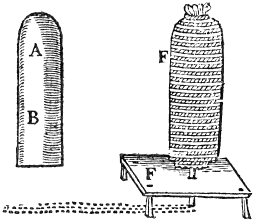
How to make the flying Saucisson to be delivered out of the morter peece.
Make a coffin for this, as you did for the former; first, fill it almost with whole gunpowder, then put upon that gunpowder dust, which you must ramme hard into the coffin, so that it may bee one finger thicke; then choake it close, and arme, and prime it as you did the former. It is represented by the figure, K M.
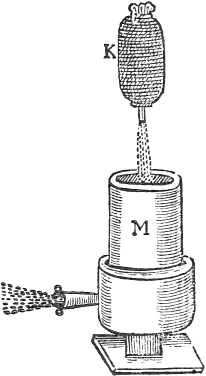
How to make a fire sword.
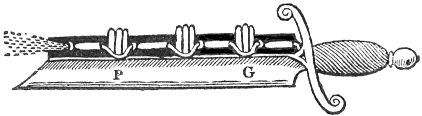
You must make a sword of woode, having a deepe channell in the backe of it, wherein place first a Rocket for the ground; then two or three serpents upright; (with their mouthes inward) let the stoupell that primeth the Rocket come under the mouth of the serpents, so that being kindled, it may set them on fire, and enter the breech of the next rocket, so fill the channell quite full with rockets and serpents, binde the rockets fast into the channell, but the serpents must be placed so, that being once fired, they may fly out of the channell, and it is made: mark the figure G, P.
The description and making of three sorts of Fire-lances.
To make the first Fire-lance, whose figure is noted A, you must make a hollow trunk of what length or bignesse you please, either of wood, paper, or pastbord rowled on a rowler, and armed with some cord and glew: first put into the bottom of whole gunpowder about one or two fingers thick; then ram upon it a pastebord peirced with a little hole in the middle, hauing a quill fastned in it, which quill must be filled with a slow composition, or else with gunpowder dust: this quill must stand up in the lance two or three inches; then fill the coffin up to the top of the said quill with starres, and strew among the starres some gunpowder dust, then put pastebord ouer them, having a hole for the quill fastned in the former bottom of pastebord to passe; then upon this pastebord ram gunpowder dust one or two fingers thick, then put a row of serpents in, and in the midst of the serpents put a cane open at both ends, and filled with gunpowder dust; this cane must be somewhat longer than the serpents, and it must passe through a pastebord, which must bee put ouer: then put some more gunpowder dust, and ram it in upon it, and upon that put another row of serpents, with a cane in the midst of them filled with a slow composition, and upon them put gunpowder dust, or else a slow composition, ramming it in till the lance bee full; then put a pastebord upon it, and in the midst of the pastebord put a little cane filled with a slow composition, then fasten it upon a staffe of what length you will, and it is made.
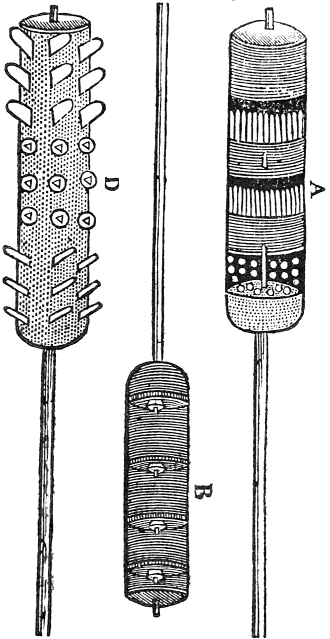
To make the second Fire-lance, you must prepare a trunk like unto the former, first ram in the bottom of it some of the composition of rockets for the earth about two fingers thick, then put a pastebord upon it, having a petard fastned in the middest; this pastebord must bee pierced in three or foure places, round about the petard, that thereby the powder that is rammed ouer the paste-bord may take fire: then ram in some more composition upon the petard, about two or three fingers thick, then another petard, then more composition, so doing untill you have filled the trunk: then fasten it upon a staffe, and prime it as you did the former, it is represented by the figure noted B.
To make the third Fire-lance you must haue a trunk also, which must bee rammed full of a slow composition, of two parts charcoale dust, and one part gunpowder dust well mixed, prime it as the former, then bore divers holes round about it, from the top to the bottom, into every of which holes glew a saucisson, or a serpent, or a little ball filled with gunpowder dust, and having a petard in the middle: either of these must bee well primed, and their primed ends must be towards the inside of the lance, so that as the lance burneth downward, it may orderly give fire unto the saucissons, bals, and serpents: the figure D representeth a lance having three rowes of serpents, three rowes of bals, and three rowes of saucissons, fastned round about it.
The description and making of two sorts of Fire-clubs.
To make the first you must make an ovall ball of paste-bord, canvasse, or parchment glewed together, which you must first fill with a slow composition, ram it in, and then bore divers holes round about it, and put therein serpents, fire bals, or what you will: fasten it upon a staffe, and prime it in the top with a cane filled with a slow composition: this is represented by the figure A, A.
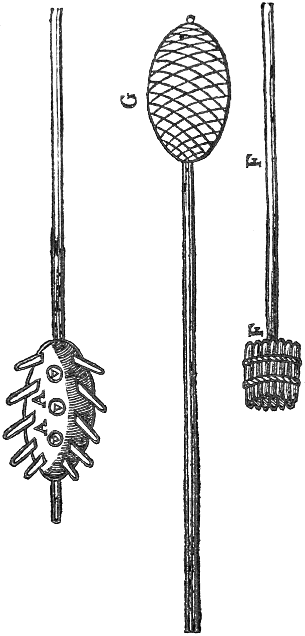
To make the second you must fill divers canes open at both ends (and of a foot long, or more, or lesse, as you think fit) with a slow composition, and binde them upon a staffe of foure or five foot long; prime them so that one being ended, another may begin: you may prime them with a stouple or match (prepared as before) make an osier basket about it with a hole in the very top to fire it by, and it is done.
The figure F, F, representeth the staffe, with the canes bound upon it. The figure marked G, representeth the staffe having a basket wrought over it.
How to make a Fire-target.
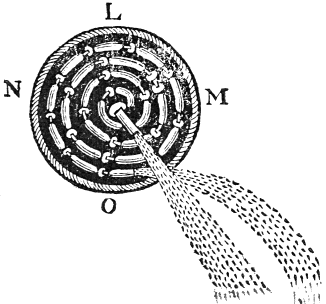
Make a Target of osier twigs, or else of light wood, & binde it upon it divers canes filled with a very slow composition: the canes must bee open at both ends, and primed with stouple, that one may give fire unto another: in the midst of all you may set up a large cane also, if you please, which you may fill with the same composition as you did the others. Mark the figure L, M, N, O.
Of Fire-works for the water.
How to make Rockets for the water.
The diameter of hollownesse of the mould for Rockets that swim on the water, must be one inch, and eight inches long: let the breech enter into the body of the Rocket one inch, and it must have no broach at all in it. Let the diameter of the thicknesse of the rowler bee three quarters of an inch, the rammer must be a thought lesser; then ram it full of the composition of Rockets for the water; joyne to the upper end of it a Saucisson: then couer it all over with melted pitch, rosin, wax, or tallow, to the end that the water may not spoyle the coffins; and to make it float along the water, binde a rod about two foot long, as you did unto the rockets for the ayre: now if you would have the rocket to change his actions, (that is, to swim one while above the water, and one while under the water) then put into it in the filling, one spoonfull of composition, and ram that in; then one spoonfull of whole powder, and ram that in; and then another of composition, and after that another of whole gunpowder, so do untill you have filled it quite. If you would have it change colour, then shift the composition divers times, (that is, put in one spoonfull of the composition of rockets for the water, then another spoonfull of the composition of rockets for the ayre, or rochpeter and gunpowder mixed) untill you have filled it.
How to make a Rocket that shall burne a good while in the water, and then mount up into the ayre.
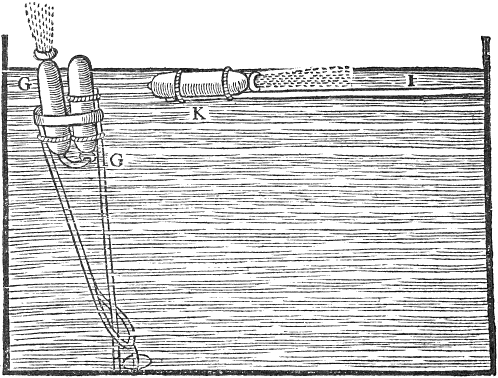
First you shall make a rocket for the water, and binde unto the lower end a stick about two foot and a halfe long, having a large hole in the end thereof: then tie unto it (but loosly, so that it may easily slip out) a rocket for the ayre, and let the stouple that primeth for the rocket for the ayre, enter into the breech of the water rocket, then let the end of the rod of the rocket for the ayre enter into the hole of the rod of the rocket for the water: besmeare then both the rockets with tallow, grease, or wax, or any oyle colour that the water may not spoyle the coffins of the rockets; then hang a stone at the bottom of the stick that hath the hole in it, to make it sink down into the water; then fire the water rocket, and cast them into the water; the fired rocket will burne in the water, and being consumed, will giue fire unto the other rocket, which being loosly tyed, will slip the bond, and mount up into the ayre. This is represented by the figure G, G. The floating rocket mentioned before, is expressed by the figure noted I, K.
The description and making of two sorts of fire bals for the water.
For to make the first, you must make a ball of Canvas, about the bignesse of a Foot-ball, or bigger if you please, and fasten in it a double Rocket for the water: if you will, also you may stuffe the rest of the ball with the composition that will burne under the water, and cut holes in the sides, and therein fasten other bals, and petrards in them: then cover the ball over with Tallow, Pitch, or painting, except the place where the Rocket is primed, and it is done. It is represented by the figure noted with A, and it will tumble up and downe in the water.
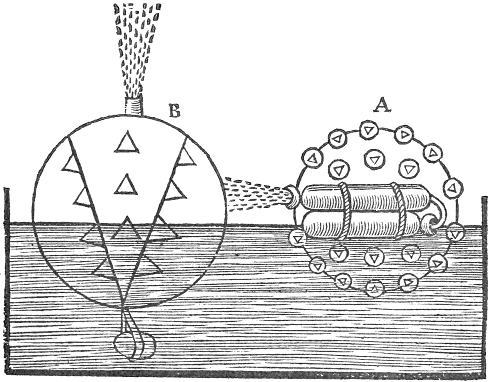
To make the second fire-ball, you must first make a ball of Canvas, Pasteboard, or such like, and cut a wide hole in the top of it, and place in it a channell of Tinne pierced in divers places: fill the channell with the compositions of Rockets for the water; against every hole therof, place a petrard: cover it with a cover, pitch it over, and prime it, then ballast it with leade, or a stone, that the vent may burne upwards, and it is done. It is represented by the figure B.
How to make a Dolphin.
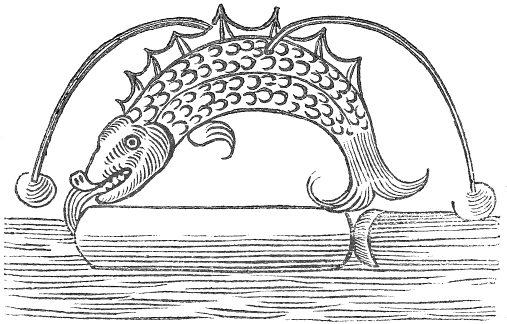
You must make the body of it of Pasteboard glued together, fill the body with the composition of Rockets for the water, pierce it in the back with divers little holes, wherein put Serpents, besmeare the body all ouer with the following pap: Take gunpowder dust, foure ounces, camphire, and sulphur, or brimstone in powder, of each one ounce, make them into a soft pap with oyle of tiles, then binde unto it a large Rocket for the water, which Rocket must be armed (as afore) that the water may not hurt it: then ballast it with a wyre, hauing at each end a piece of lead of weight sufficient, and it is done. Marke the figure.
I might haue beene infinite in the describing of such like with Ships, Towres, Castles, Piramides. But considering that it would but increase the price of the booke, and not better your understanding: since all consist of the former workes, which are so plainely described, as that the most ignorant may easily conceiue thereof, and (if any whit ingenious) thence contriue others, of what fashion they list.
FINIS.
THE
THIRD BOOKE
Of Drawing, Limming, Colouring,
Painting, and Graving.
By I. B.
LONDON.
Printed by Thomas Harper, for Ralph Mab,
1634.
THE THIRD BOOKE
of Drawing, Painting, Limming,
Graving.
The Art of Drawing is in it selfe most excellent, and most worthy commendations in whosoever it is; yea it is an Art so necessarie unto all ingenious Artists, as that in no wise they can be without it, and my selfe haue found it to bee true, that the sight of a good draught is more unto an ingenious person, then a whole Chaptor of Information; Wherefore I have, according unto my knowledge and practise therein, faithfully penned the same; for the use of all such as beare affection unto the Art, and are desirous to be instructed therein: And for that divers persons cannot attaine unto it, or perhaps are loath to bestow any time to practise it: whereby they might come to a requisite perfection: for such I have set downe certaine directions, and those so facile, and easie; that persons altogether unskilfull, may (having a patterne) worke very well; But before I begin, it behooveth that I prescribe what things are to be had in readinesse to worke withall: first therefore provide good smooth and cleare paper, divers plummets made of blacke leade, oker, or blacke chalke, or else Charcoals made of Ash, Sallow, or Beech, split in sunder, and pointed; also a wing: having provided these your implements, you shall thus begin to worke. First, let the thing, whose pourtrature you intend to take, stand before you, so that the light be not hindred from falling upon it, and with a pointed peece of charcoale draw it rustically; which when you have done, consider a while whether all the parts thereof are proportionable, and whether it carry the semblance of the thing that you drew it from, which if it do not, wipe it out with your wing, and begin anew: but if it be faulty in one part onely, wipe onely that part out, and draw it againe; whensoever it liketh you, or that you have so drawne it, that you can finde no great fault in it: wipe it over gently with your wing, so that you may perceive the former strokes: then with your blacke chalke, or blacke lead plummets; draw it as perfectly, and as curiously as you can, and shadow it according as the light falleth upon it; This way is workeman like, and the most difficult of all, yet by a little practice may easily be attained unto: so that the persons stand well affected unto the Art. Instead of white paper, you may take light coloured blew paper, and draw upon it with charcoale, and white chalke pointed, which will shew very wel: but note, that after you have made your draught, you must wet it in faire water, and let it dry of it selfe; this will make the drawing to hold fast on, which would otherwise easily be wiped off. This may serve for such as are contented to take some paines to attaine so noble a Science. But for others there are divers other helps, which follow in order.
How to take the perfect draught of any printed, or painted Picture.
Take a sheete of Venice (or in stead thereof) of the finest white paper that you can get: wet it all ouer with cleane sallet oyle: then wipe the oyle off from the paper, as cleane as you can, so that the paper may be dry, otherwise it will spoyle a printed picture by the soaking through of the oyle: hauing thus prepared your paper, lay it upon any painted or printed picture, and you shall see the picture through the same more perfectly appearing, then through glasse, and so with a blacke lead pen, you may draw it ouer with ease, and better first with a soft char-cole, and then with a pen. After that you haue thus drawne the picture upon the oyled paper, put it upon a sheete of cleane white paper, and with a little sticke pointed, or (which is better) with a feather taken out of a Swallowes wing: draw ouer the picture againe, and so you shall haue the same very prettily and neatly drawne upon the white paper, which you may set out with colours, as shall be taught hereafter.
Another way.
Having drawne the picture, first open the oyled paper, put it upon a sheete of cleane white paper, and pricke ouer the same drawing, with a good big pin, then from the cleane sheete, that is pricked, pounce it upon another: that is, take some small coale, powder it fine, and wrap it in a piece of Tiffanie or such like, and binde it up therein loosely, and clap it lightly ouer all the pricked lines by little and little, and afterwards draw it ouer again with a Pen or Pencill, or otherwise as you please.
Another way very pretty and easie to be performed.
Take some Lake, and grinde it fine, and temper it with Linseed oyle, and afterwards with a pen, draw with this mixture (in stead of Inke) all the out stroaks of any printed picture, also the muscles: then wet the contrary side of the picture, and presse it hard upon a sheete of cleane white paper, and it will leaue behinde it all the stroakes of the said picture that you draw ouer.
Another way much like the former.
Take Printers Blacking, grinde it fine, and temper it with faire water, and with a pen dipt therein, draw ouer the master stroakes and out lines of the muscles: wet then a faire paper with a spunge, and clap the picture upon it, pressing it very hard thereupon, and you shall finde the stroakes you drew, left upon the faire paper.
An easie way to lessen any picture: that is, to draw a picture from another, in a lesser compasse.
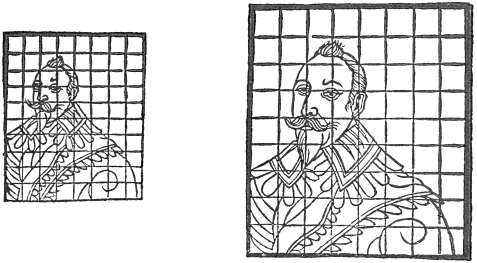
First, with a ruler, and a blacke lead plummet, draw a line at the very top: also another at the bottome paralell, or equally distant from the other: from the upper line, let fall two perpendicular or plum-lines euen unto the lowermost line, so those foure lines will make a square: now you must diuide this square into diuers equall parts, with a paire of compasses, and draw lines with a ruler and blacke lead plummet, quite over the picture: so the lesselines will divide the picture into equall parts or squares: then take a faire paper, and make as many squares upon it, as there is in the picture: you may make them as little as you will, but be sure that they are equall, and of just number with those in the picture. Having thus crossed your picture, and drawne over your faire paper into squares, take a blacke lead pen, and draw the picture by little and little, passing from square unto square, untill you have finished the whole: still observing the order of the squares as they stand in either: then draw it ouer with a pen, in which second drawing of it over, you may easily mend any fault: when it is dry, rub it over with the crum of white bread, and it will take off all the blacke lead strokes, and your draught onely will remaine faire upon the paper or parchment. Here I might have entred into discourse of drawing paralels, perpendiculars, making of squares, and such like: but to deal truely, I was as loth to trouble my selfe, as to wearie you: you shall neede onely to provide a ruler of thin brasse or copper, having a crosse thwart one end of it: the charge will not be much, nor the use tedious: the figure followeth, noted A, B.

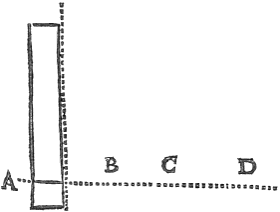
Let a, b, c, d, be a line given, whereon to erect a perpendicular or plumb line: lay the ruler so, that the crosse over the end of it, may lye full upon the Line, then draw a Line by the side of the rule, and it is done.
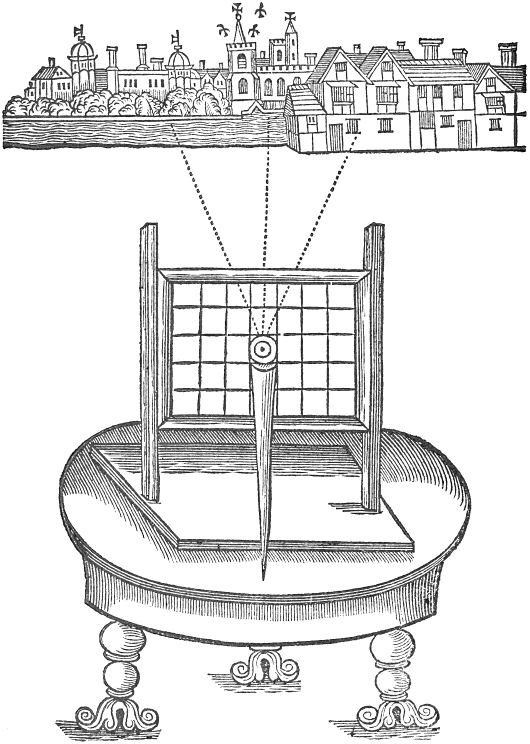
A verie easie way, to describe a Towne, or Castle: being within the full sight thereof.
For the effecting of this, you must have a frame made, and crossed into equall squares with Lute strings, and figured at the end of each string: this frame must have a foot, wherein it must be made to be lifted higher or lower as occasion serveth; also you must divide your paper that you are to draw upon into so many equal squares as your frame containeth: having the like figures at the ends of each line that there is on the frame; before this frame must be placed a style or bodkin having a little glasse on the top of it for to direct the sight. Note now that the nearer any thing commeth unto the Center, the lesser it appeareth: hence it is that a Towne of a mile, or more long, or a huge great Castle, at a distance may be comprehended, and that easily within the limits of so small a frame; By the stile direct your sight from one part to another, beginning at one square, and proceeding through the rest in order as they lie; Marke well the following figure.
How to make a Deske: by meanes whereof you may draw, and that most exactly with great facilitie any printed picture, or sollid Image.
First let there be a frame made, and with hinges let be joynted unto a board of equall breadth unto it: let this frame also have two stayes at the top, at each end one, by meanes whereof the deske may be raised higher, or lower, as need shall require; then fasten to the frame a peece of pure cleare glasse fitted thereunto, and it is finished. The figure followeth.
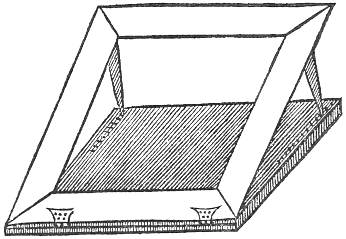
The Deske.
The manner of using this Deske is thus. If the picture that you intend to draw be a printed one, then first fasten it next unto the Deske with waxe, paste, or such like: upon it fasten a sheet of faire paper: If it be in the day-time place the backe of it towards the Sunne; if it be in the night that you worke, place a lampe behinde it, and so you shall see perfectly every (even the least) stroake of the picture, which with your penne you may draw as acurately as any Limmer whatsoever. If it be a solid peece, then place it behinde the Deske, betweene the light and the Deske: then fasten a sheet of cleane white paper upon the Deske; raise then the Deske higher, or lower untill you see the perfect shadow of the image through your Deske, and paper, and then draw the posture of the Image, and shadow it afterwards (without the Deske) as light falleth upon it.
An easie way to take the naturall, and lively shape of the leafe of any hearbe or tree, which thing passeth the Art of man to imitate with Pen or Pensill.
First take the leafe that you would have, and gently bruise the ribs and veines on the backe side of it, afterwards wet that side with Linseed-oyle, and then presse it hard upon a peece of cleane white paper, and so you shall have the perfect figure of the said leafe, with every veine thereof, so exactly exprest as being lively coloured, it would seeme to bee truly naturall, by this we learne, that Nature being but a little adjuvated or seconded with Art, can worke wonders.
Now for the farther information of such as are desirous of exemplarie instruction, I have set downe in order following the delineation of the proportion of such things as in my judgement seemed most necessarie for young beginners, and those in such easie demonstrations as for the most part they consist of equall squares, and require no more for their right understanding, then diligent observation, I might have filled a whole Booke of such like: but having considered that what I had done, was a sufficient ground for a farther procession, I thought fitting to leave each person to the exercise and practice of his best Invention.
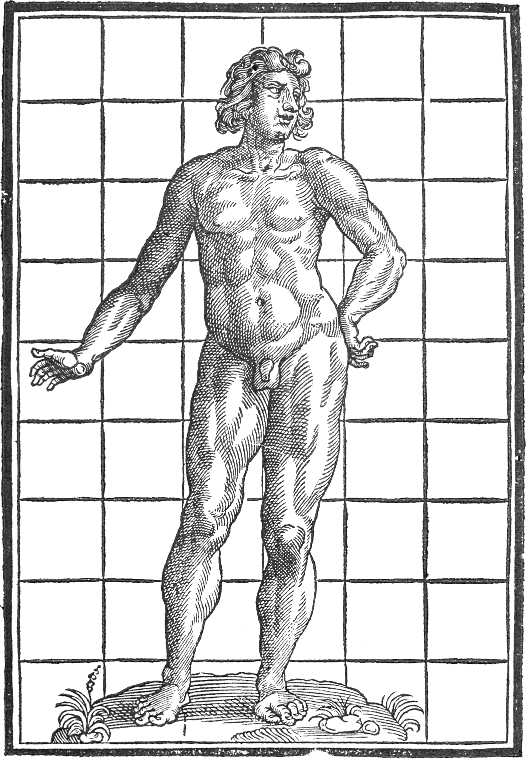
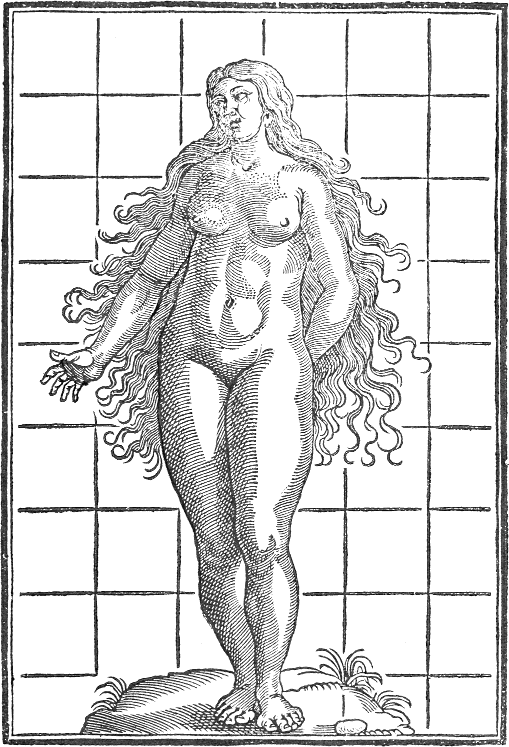
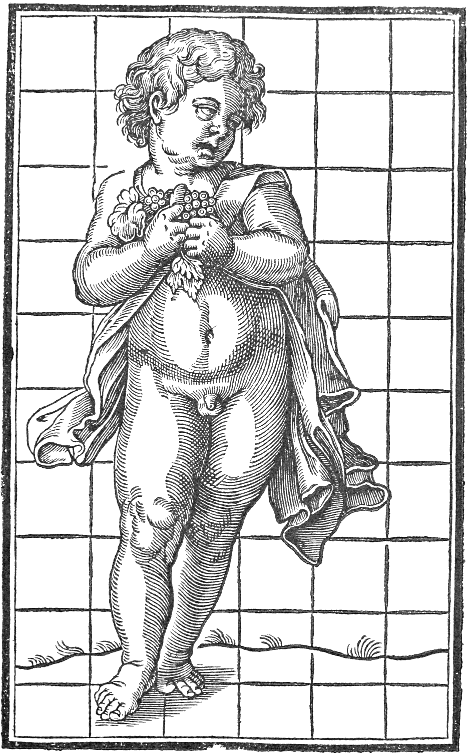
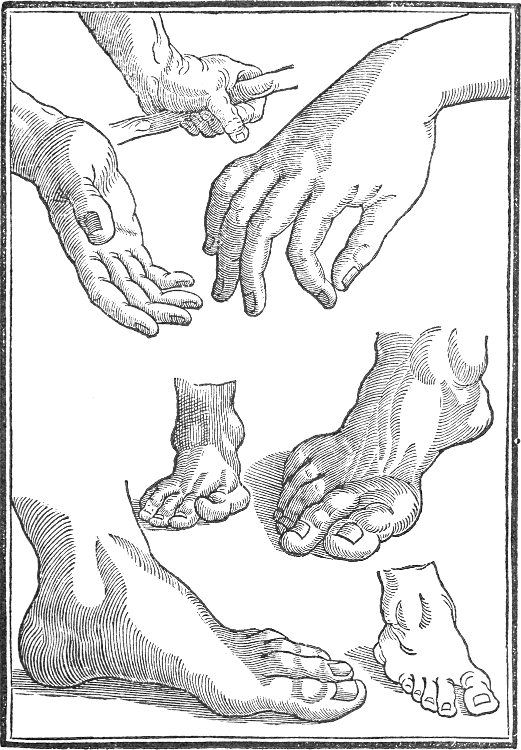
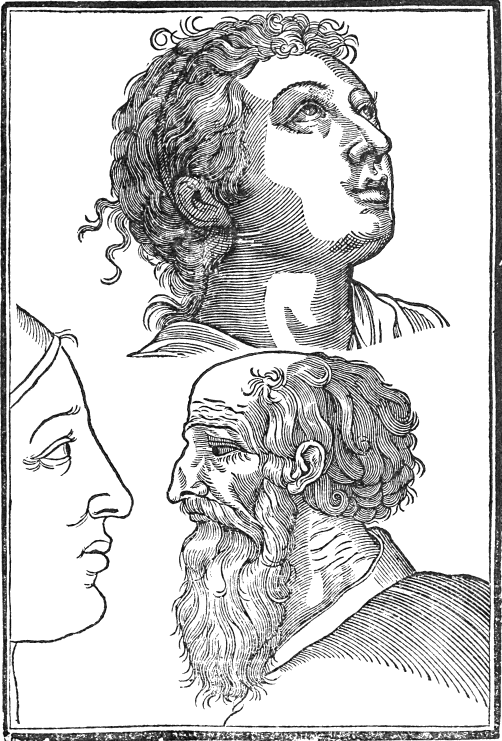
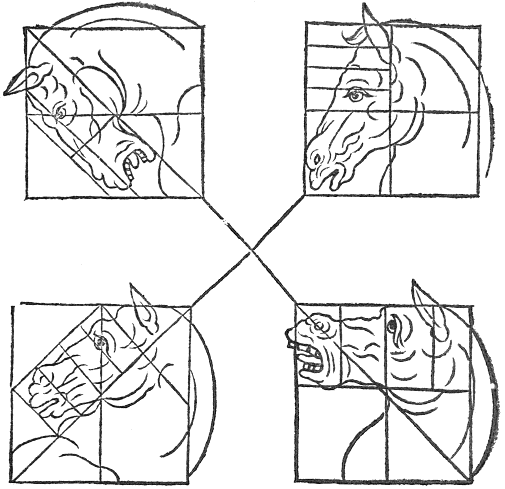
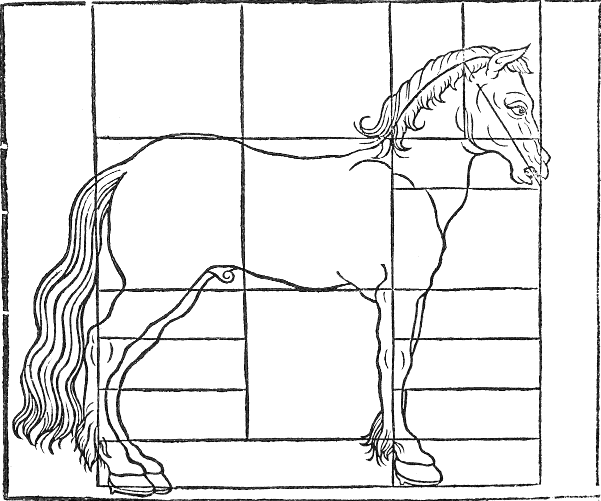
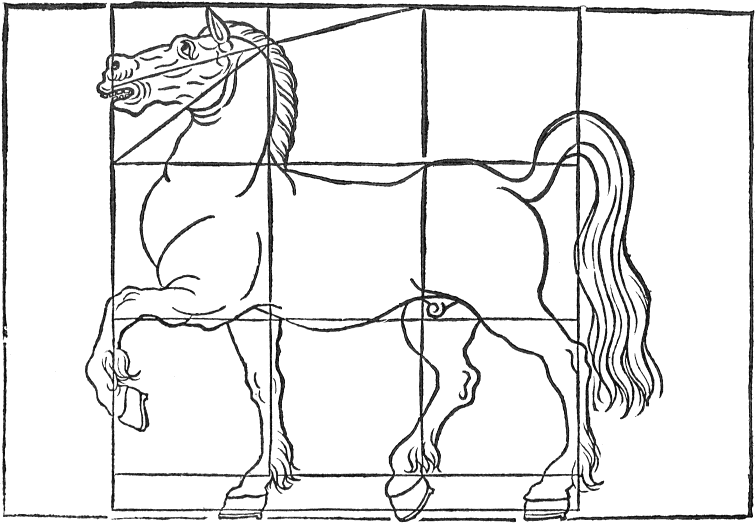
I thought fitting to give you a word or two, wherefore I have not made the crosse pricked lines to passe through the figures.
The reason is, 1 because the figure would have beene thereby somwhat defaced; 2 because some chuse rather to draw without such rules; 3 for others with a ruler and black lead plummet they may crosse the figures through, and with white bread crums take out the same againe at pleasure.
Of Painting.
The principall end and subject of this Art, is to set out things both in proportion of parts, and livelinesse of colour.
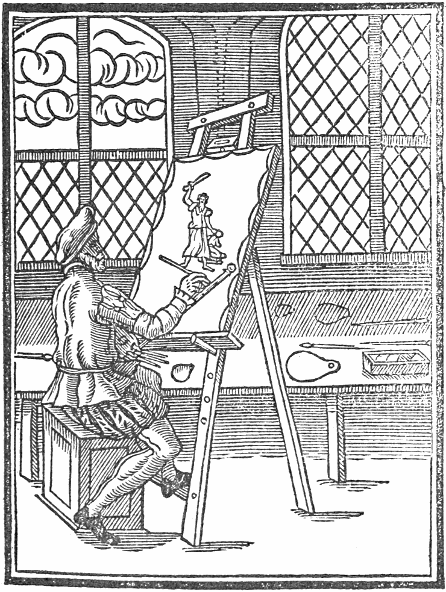
For the former, the proportion of parts, I have given sufficient information for the meanest capacitie in the precedent part of this tractat: now therefore I will speake of the other, the colouring or setting out in colours. But first provide a frame or Easel called by Artists, which is very necessary to worke upon, especially in greater pieces of worke: the forme whereof followeth.
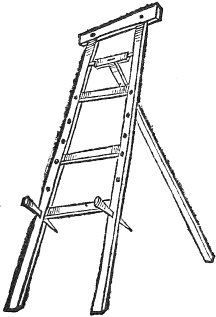
The Easel.
Also you must provide divers little shels to put your colours in, also pensils of all sorts, both for priming and other: a light ruler of one foot and a halfe, or two foot long: and colours of all sorts ground very fine upon a porphire or marble. Having provided these, you shall set to worke, observing the subsequent directions.
Painting may be performed either with water colours, or with oyle colours.
First I will speake of water colours, wherein I shall observe two things.
First, the diversitie of colours, and preparations. Secondly, their mixture, and manner of laying them on the ground.
First of the first, the diversitie of colours and their preparation.
Colours are either simple or compounded, meerely tinctures of vegetables, or substances of minerals, or both: the simple colours are such as of themselves, being tempered with the water or oyle, doe give a colour. The compounded are such, whose ingredients do exceed the number of one. Vegetables are rootes, juces, berries, and such like things as grow out of the earth. Minerals are such as are dig'd out of the earth, as earth, and stones, &c. All which follow in order, as well their preparations, as description. First note that every colour to be ground, ought first to be ground with the gall of a neat: then let them dry of themselves in a cold place, afterwards grinde them with gumme water for your use.
Now I am come to the second thing observable (to wit) the mixture and laying the colours on the grounds, which is thus: your colours prepared for use, ought to be tempered according unto direction, still observing a meane: and to that end, mixe them by little and little, till the colour please you; first you must lay on the ground colour, and let it dry throughly: then with a small pensill, pricke on the second colour, else it will be apt to run abroad, nor can you worke it so well, to make it seeme liuely, as you may by pricking it one, specially in small peeces.
If you are to paint ouer maps, or printed pictures that haue writing in them, they use to lay on the thinnest colours, and alwaies before you lay any colours upon paper, wet the backe side of it with faire water, wherein store of Allum hath been dissolued, and let it dry of it selfe: after wet it againe, and let it dry: doe it the third time, for this will strengthen the paper, that the colour shall not sinke through it, and moreouer it will make the colour shew the brighter, and last, the better.
To make Gum water to temper your Colours with.
Take cleane water, and put into it of gum Arabicke a little, and let it stand untill the gumme be dissolued. Now you must haue a care that it be neither too thicke, by reason of the Gumme, nor yet too thin: for with the one you cannot worke well, and the other will not binde the colour fast.
A Purple colour.
Take two pound of Heidleber, two ounces of Allum, halfe an ounce of ashes of Copper, halfe a pound of water; put them into a Skillet, and let them boyle till a third be consumed: when it is cold, straine it into a cleane vessell, and let it stand a while, then straine it into another, and then let it stand till it be thicke enough.
A Crane Colour.
You must onely grinde blacke Lead with Gum water.
Browne Colour.
Take good browne, and grinde it with Gumme water: his false colour is made with two parts browne, and a third part white lead, sad it with the same browne.
Hayre Colour.
Take Vmber or Spanish browne, grinde it, temper it with Gumme water.
A Blew.
Boyle Mulberries with Allum.
An Emerauld Colour.
Take Verdigreese, and grinde it first dry, and put unto it a little of the Gall of a neat: also of Saffron, and the juyce of Rew, of each a little: grinde them together, and put them into a shell, and let it dry there: when you would use it, grinde it againe with Vineger or Verjuce, and a little neats gall dissolved in either of them. His false colour is two parts greene, and a third ceruse: it must bee sadded with a good greene.
A Motlie greene.
This colour is compounded of red and greene.
A blacke Colour.
First you must lay on a light blacke, mingled with white lead, and afterwards when it is dry, sad it with good blacke; for sad blacke, mixe Indie Baudias with Gumme water.
A marble or ashe colour.
This is compounded of blacke and white.
A russet or sad Browne.
This colour is made by compounding a little white, with a good quantity of red.
A browne Blew.
Take two parts of Indie Baudias, and a third of ceruse and temper them with gumme water.
A Brasse Colour.
This is compounded of Masticot and Vmber.
A gold yellow for Armes.
Take Orpment, and Masticot, grinde each by themselves: but in grinding of the Masticot, adde a little Saffron, and worke with them. Note you may alay your Orpment with chalke, and sadde it with browne of Spain or Oker de Luke.
Azure.
Take of white lead foure ounces, of Indicum two ounces, put them into a leaden pot with vinegar: boyle them well, and that which swimmes on the top is the colour.
A purple or violet Colour.
This is a compounded colour, and it is made either by mixing a quantitie of Azure, and a portion of Turnsole: or else by mixing a quantitie of cusset, and a quantitie of Azure.
Sanguine or Blood-colour.
TThis is likewise a compounded colour, and it is made by mixing a good quantitie of Cinaper with a little blacke.
Orange-tawny.
This colour is compounded of a bright red, and a bright yellow.
A Lyon-tawny.
This colour is made by mixing red lead and Masticot together.
A Carnation, or Flesh-colour.
First you must lay on a white colour tempered with gumme-water, and when it is drie you must go it over againe with Vermillion or lake, or else you must temper ceruse and vermilleon together, and being dry, go over it againe with lake or vermillion.
A Peach Colour.
This is compounded of Ceruse and Vermillion.
A Skie Colour.
This colour is compounded of vermilleon and azure.
A Blood red.
This colour is made of Cinaper, and afterwards sadded with Vermilleon at the sides, or else with a browne colour. A bloudy colour, grinde Cinaper, Lake, and Cinaper tops, put them into good water, and if they be too light, put to them a little Turnsole.
A Lincoln-greene.
This colour is compounded of a good greene and Saffron.
A Poppin-jay greene.
This colour is compounded of azure, and masticot.
A good yellow.
Take Saffron, or Cambugium, and temper it with gum-water. Sad it with Vermilleon.
A sable or blacke.
Take a Torch, hold it under a lattyn Bason, temper that blacke with gumme-water.
A velvet-blacke.
Bvrne harts-horne on a Colliers hearth; then grinde it with the gaul of a neat, put it into a shell, and let it dry in the shade: when you would use it, grinde it againe with gumme-water.
To write gold with Pen or Pensil.
Take a shell of gold, and put a little gum-water unto it, and temper it together, and then you may write with it as with other colours.
To make Azure, or bise sadder.
Take blew Turnsole, wet it in gum-water, and then wring it out, and mixe it either with Bise, or else over-shadow the Bise with it.
Red Colour.
Take Vermillion, and temper it with gumme water: His false colour is two parts vermillion, and a third part ceruse.
Another Red.
Take russet, and temper it with gumme-water, clay it with ceruse, and sad it with it selfe.
Another Red.
Take Brassill in grosse powder, allum in powder: steep them in gum water a night and a day: then straine it, and keepe it for use.
A greene Colour.
Take Copper plates, put them in a copper pot, & put distilled vineger to them: set them in a warme place till the vinegar become blew, then put it out into another leaded pot, and poure more vinegar into it again; let it stand so till it become blew; this do so many times till you thinke you have enough: then let it stand till it be thicke.
To make good Inke.
Take two handfuls of gauls, cut each gaul into three or foure peeces, poure into them a pint of beere or wine, then let it stand eight houres; straine it from the gauls, and put vitreoll therein, and to the vitreoll a third part of gumme, set it on the fire to warme; but let it not seethe, and it will be good Inke, and of these gauls you may make Inke foure or five times more.
To seethe Brasill.
Take an ounce of Brasill, twelve ounces of beere, wine, or vinegar, put it in a new pot, let it stand a night; and in the morning set it on the fire, and let it seethe till halfe be consumed: then put into it two peny worth of allum beaten together, and as much beaten gum-Arabicke: stirre them well together, and let them seethe againe; if you desire to have it somewhat darke, then scrape a little chalke into it when it seetheth: let it not seethe over the pot: when it is cold straine it through a cloth, and put it into a glass well stopt.
Aurum Musicum.
Take one ounce of Salarmoniack, one ounce of quicksilver of counterfein, halfe an ounce of brimstone, bruise the brimstone, and set it on the fire, but let it not be over hot (lest it burne) then take the Salarmoniacke, and the quicksilver being in powder: mixe them well together, then mingle with them the brimstone: stirre them well, and quickly with a sticke till the brimstone become hard, then let it coole, grinde it on a stone, and put it in a glasse well stopt with waxe, and set it in a pan with ashes; make a fire under it, and let it stand halfe a day in that manner (but not over hot) till a yellow smoke riseth on it, and when the yellow smoke is gone it is prepared.
Argentum Musicum.
Take an ounce of Tynne, melt it, and put thereto one ounce of tartar, and one ounce of quicksilver, stirre them well till they be cold: then beat all in a morter, and grinde it on a stone; temper it with gumme-water, and write therewith, and afterward polish it.
To write a gold colour.
Take a new hennes egge, make a hole at one end, and let the substance out, then take the yolke without the white, and foure times as much in quantitie of quicksilver; grinde them well together, and put them into the shell; stop the hole thereof with chalke, and the white of an egge, then lay it under an henne that sitteth with sixe more, let her sit on it three weeks, then breake it up, and write with it.
To write with gold out of a Pensil.
Take honey, and salt a like quantitie, grinde them well, and put to them a leafe of gold, with a little white of an egge; put it into a mussell shell, and let it purifie; then temper it with gumme-water, and write with it, pollish it.
Or else grinde a leafe of silver, or gold, very small with gumme-water, and wash it in a mussell shell as aforesaid.
To temper Azure or Bise.
Take Azure or Bise, and grinde it on a stone with cleane water; then put it in a broad glasse, or shell, and when it hath stood a while all the dregs will sleet above, and the cleane colour will fall to the bottome; then poure out the water with the dregs, and poure the azure in cleane water againe; then stirre the colour and water together, and let it stand, and fine, and after that poure out the water, and dregs againe: do thus till it be well purged; then grinde it againe on a stone with gumme-water, and put it into a horne, or shell; when you paint or write, stirre it, and let the sticke drop into the pen, for it will sinke to the bottome as lead.
To temper Turnsole.
Take Turnsole, and wet it once or twice in cleare water, and let it lye till it be well steeped; then wring it into a dish till the colour be good, and sad; with this you may flourish red letters, or vestures, and this colour shall be darked, sadded, or renewed with blacke inke.
To make colouring, called Vernix: to varnish gold, silver, or any other colour on vellem, paper, timber, stone, &c.
Take Bengewine, and bray it well betwixt two papers, then put it into a viol, and poure on it Aqua vitæ, that it may stand aboue the bengewine three or foure fingers, and let it steepe so a day or two; then put to it for halfe a violl of Aqua vitæ fiue or sixe chieues of Saffron slenderly stamped; this done, straine it, and with a Pensil vernish therewith any thing gilded, which will become bright and shining, drying it selfe immediately, and will continue the brightnesse many yeares; But if you will varnish on siluer, then take the white that is found in Bengewine and dresse it with Aqua vitæ as afore, leauing out the Saffron, and the said vernish made with these onely is very good to varnish all things as well painted, as not painted: for it maketh Tables of Walnut tree and Hebene to glister if it bee laid on them; and all other things, as Iron, Copper, or Tin gilded, or not; it maketh bright, preserveth and aideth the colour, and dryeth incontinent without taking dust.
To make a double size to lay gold or silver on an embossed ground.
Take Venice Ceruse, white lead, plaister of an old Image, or chalke, any of these made in fine powder, and ground with the white of an egge, and a little water: this will make a good bottome to lay silver on. But when you use any of these to lay under gold, put to it a little Saffron, put not too much water; mingle it after discretion, and looke the size be thicke standing: put the size thus tempered, in a horne or shell in some Celler, or shadowed place, where it may stand moyst seven dayes, till it be perfect clammy and rotten, and once a day stirre it; the elder the size is, it is the better. If there stand any bubbles on the size, put in eare waxe, for that is a remedy thereto, and before you lay it on your worke, lay the size on a scrow, and dry it, and when it is dry, bend it, and if it bend and breake not, then it is perfect, and if it breake, put to it a little water to make it weaker, and proue if it cleaueth fast to the booke, if not, put glayr thereto, and make it more stedfast: the like size may you make of Gipsium, Bolearmoniacke, red or yellow Oker, Orpment or Masticot, with browne of Spaine, or red lead: if euery of them be ground seuerally, and tempered as afore.
Of painting in Oyle.
Here you must provide one thing more then you did before: that is, a Pallet (so called by Artists) whereupon you must put a small quantitie of euery such colour you are to use, the forme whereof followeth.
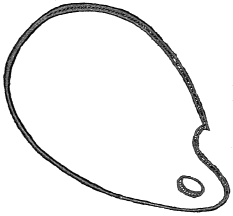
The Pallet.
The colours to be used, are altogether such dry substances as I mentioned formerly: as Oker, Vermilion red lead, Vmber, Spanish browne, Lam-blacke, Gambugice, Masticot, Orpment, Ceruse, or Spanish white, blew and greene Bise, Verdigrease, and a multitude of such like, which may be had at the Rose in Cornehill, London.
Your colours must be ground all very finely, and tempered with Linseed oyle; and to preserve them, put them in little earthen pans, and put water upon them, and cover them, that the dust come not at them: thus they may be kept a great while, and from thence you may take them as your use doth require.
There are divers colours which without the admixture of another colour, will not be dry a great while; as Lake, Verdigrease, Lam-blacke: with such you must temper a little Vmber or red lead.
Divers Painters there are, that having haste of worke, doe use to temper their colour with one part of fatte oyle, and two of common Linseed oyle, and by this meanes they make the colours dry the sooner: this fat oyle is onely Linseed oyle exposed to the weather, and so it becommeth thicker: yea sometimes you shall see it so thicke, that you may cut it almost like Butter: it may bee made likewise by boyling of it a little while, but the former is the best. As for the tempering of your colours, I can prescribe no surer way then experience with diligent observation.
Of Graving.
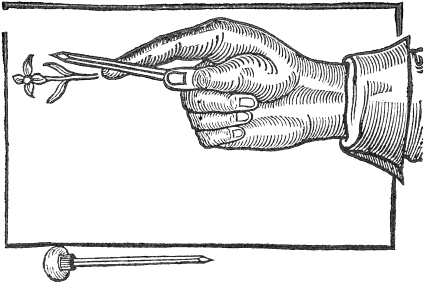
It is possible for one to be a good Painter, and yet not to be able to draw well with the pen, because there is not required in a Painter such a curious and exact carriage of the hand: but it is impossible for one ever to Grave or Etch well, except he can draw well with the pen. First therefore presupposing you can doe the first before you attempt the second, you must provide divers graving tooles, both long and short: some for hard worke, some for sweet worke, some for smaller worke, and some for greater: also a peece of a Beaver hat, and a good oyle stone, smoothed on one side, and free from pin holes, and plates of Copper or Brasse exactly polished.
Of Gravers.
There are two principall sorts of Gravers, the long and the short: the long are straight, and for to engrave Plates withall, especially the greater, and these are to be held as the figure following doth expresse: where you may note that the pummell of the Graver resteth against the ball of the thumb, and the point is guided with the forefinger. And there ought to bee a little bagge of sand under your Plate, to the end that you might turne your plate upon it as your worke doth require.
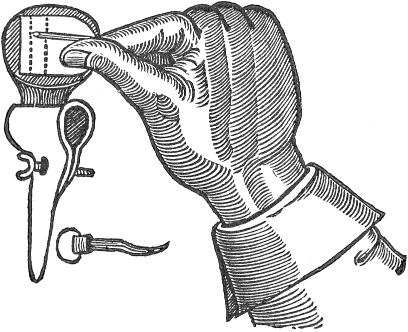
The second sort is a short Graver, and turneth up somewhat at the end, and that is to engrave Letters and Scutchions in plate seales, and smaller plates, being fastened in some convenient instrument: this must be held likewise according unto the expression of the figure following: where it is to be noted, that the pummell of the Graver is stayed against the further part of the hand, and is guided by the inward side of the thumbe. It were needfull that there were a piece of leather like a Taylors thimble, about the end of the thumbe, waxed or glued, whereby to guide the Graver more steadily, and stay it upon occasion.
How to make Gravers.
Provide some good crosse-bow steele, and cause it to be beaten out into small rods, and softned: then with a good file you may shape them at your pleasure: when you have done, heat them red hot, and dip them straight downe into sope, and by so doing, they will bee hard indeed. Note that if in the dipping of them into the sope, you turne your hand never so little awry, the Graver will be crooked. These Gravers made and hardened after this manner, doe farre exceed all the other Gravers.
If your gravers be too hard, heate them a little, and thrust them into tallow, and they will be tougher.
The oyle stone is to whet your gravers on; drop one or two drops of sallet oyle upon it, and whet your graver thereon, and it will have an edge presently.
How to smooth and pollish Copper Plates.
Because that in the printing with Copper Plates, the least scratch, though it be scarce visible, receiveth its impression, and so many times disgraceth the worke: I have set downe a way to smooth plates for impression.
First, take a piece of Brasse, or Copper, of what bignesse you intend, of an indifferent thicknesse, and see as neere as you can, that it bee free from fire flawes. First beat it as smooth as you can with a hammer, then rub it smooth with a pumice stone that is void of gravell, (least it race it, & so cause you as much more labour to get them out) burnish it after with a burnishing iron, having first dropped a drop or two of sallet oyle on it: then rub it over with a cole, prepared as is after taught, and lastly with a peece of beaver hat dipt in sallet oyle, rub it very well for an houre: thus you may polish it exactly.
How to prepare your Coales.
Take Beechen charcole, such as when they are broke, doe shine, such as are void of clifts, and such as breake off even: burne them againe, and as soone as they are all through on fire, quench them in chamber lye: after take them out, and put them in faire water, and reserue them for your use.
Having prepared all things in a readinesse, you must haue a draught of that you intend to cut or engrave.
Take the plate then, and waxe it lightly ouer, and then either pounce the picture upon it, or trace it, or by drawing ouer the lines of the picture with ungummed inke, reprint it upon the Plate: then worke upon it, obseruing the shadow, so that being printed, it may stand right, for it will be backward upon your plate: when you haue cut one stroke, drop a little sallet oyle upon your peece of Bever, and rub over the said stroke, for by this meanes you shall better see the stroke, and how to cut the next equall unto it, and so the rest proportionally distant one from another; but to worke by a Candle, you must place a glasse of faire water betweene the Candle, and a paper betweene that and the Plate, (which casteth a true light) or you will never be able to worke truely and aright.
Of Etching.
Etching is an imitation of engrauing, but more speedily performed. Things may be expressed to the life thereby, but not so sweetly as by the Graver. It is thus performed: the Plate you are to etch upon, must first exactly be pollished, afterwards ouerlaid but very lightly with a ground made for the purpose, (of which anon) and thereupon must be pounced, drawne, or traced, the thing that you are to etch: then the said ground is to be pierced with diuers stiles of seuerall bignesse according as the shadowes of the picture doe require: afterwards the edges of the Plate are to be raised with soft waxe and strong water, (for so they terme it:) (It is to be had at the signe of the Legge in Foster Lane a Distiller) is to be put upon it, which in those places were the strokes, are required to be lightly performed, is to be abated or alayed with faire water, which hauing dured a while upon the plate, will eate into it, as it were engraven, then put it into cold water, and wash it about, and it will leaue eating further, and then take off the ground and it is done.
A red ground for Etching.
Take red lead, grinde it very well, and temper it with varnish.
A white ground.
Take one ounce of Waxe, and two ounces of Rosin, melt them together, and adde thereto a quarter of an ounce of Venice Ceruse ground fine, lay it on while it is hot.
A blacke ground.
Take Asphaltum two parts, Bees waxe one part; melt them together, and being warme, lay it on very thinly with a fine lawne ragge. If it seeme somewhat red in any one part, hold it over the smoake of a Linke or waxe candle, and it will be amended. Note that it is a principall thing in this Art to lay the ground on aright.
Another way how to engrave with water.
Take Verdigrease, Mercury sublimated, vitreoll, and allum, a like quantity, beate all to powder, put them into a glasse, and let it stand so halfe a day, and stirre it often, then lay on the plate, waxe, mingled with Linseed oyle, or red lead with Linseed oyle, and write in it that you meane to grave, then put the water on it, and let it so remaine halfe a day, if you will have it very deepe, let it lye longer. If you will engrave Images, &c. lay the waxe on the Iron or Steele, thin, and draw what you will theron, that it may touch the mettall, then put the water into the strokes, and it will be engraven.
How to engrave on a flint stone.
Take a Flint, and write on it what you will, with the fat or tallow of an Oxe, afterward lay the flint in vineger, foure dayes.
FINIS.
Place this betweene folio 14. and 15.
THE BOOKE OF
EXTRAVAGANTS:
Wherein amongst others, is principally
contrived divers excellent and approved
Medicines for severall maladies.
By I. B.
LONDON.
Printed by Thomas Harper, for Ralph Mab. 1634.
To the Reader.
Courteous Reader, forasmuch as there were divers experiments that I could not conveniently, or rather my occasions would not permit me to dispose in such order as I would have done; I thought it would not bee amisse to call them by the names of Extravagants, and so to set them downe as I found them, eyther inserted amongst other my notes, as I put them in practise, or as they came into remembrance.
How to make a light burne under the water, being a very pretty conceypt to take fish.
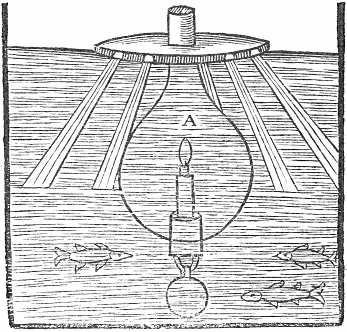
Let there be a glasse, as A, having a hole at the bottome, to put a candle in with a screwed socket. The socket must have a loope at the bottome, whereunto you must hang a weight of such heavinesse, that it may draw the body of the glasse under water. The necke of this glasse must bee open, and stand above the water; also about the necke must bee fastened a good broad peece of wood; round about which (but on that side of it that is next unto the water) must be placed divers peeces of looking glasses; so the light of the candle in the glasse body will bee multiplied according unto the number of them. All the fishes neere unto it will resort about it, as amazed at so glorious a sight, and so you may take them with a cast net or other.
How to make an image hang in the middle of a glasse.
Make the lower part of the image of hard wax, and the upper part of wood, and overlay it with oyle colours; then put it into a globe glasse filled with fayre water, and which way soever you turne the glasse, the image will still hang in the middle, and stand as it were upright; which, to my knowledge, hath been a thing causing no small admiration among divers that have not understood the cause of it.
How to make five or six dice of the ordinary bignesse of dice, such as you may game withall, and such as would be taken by their lookes to bee ordinary dice, and yet all of them to weigh not above one grain.
Take a peece of Elder, and pith it, lay the pith to dry, and then make thereof with a sharp knife five or six dice, and you shall finde it true that I haue sayd.
To lay gold on any thing.
Take red Lead ground first very fine, temper it with linseed oyle: write with it, and lay leafe gold on it, let it dry, and pollish it.
To lay gold on glasse.
Grinde Chalk, and red Lead, of each a like quantity, together, temper them with linseed oyle, lay it on; when it is almost dry, lay your leafe gold on it, when it is quite dry polish it.
To make yron as soft as lead.
Take black flints, powder them very finely; then put the powder in an iron pan, and make it red-hot, then cast it on a marble stone, till it be almost cold, then make it red-hot againe, and let it coole, and grinde it so long till it cleave to the stone, and grinde as it were clay; then put that in a glasse, and set it under the eaves of a house, where the Sunne commeth not nigh in the day, then the night after take out the water that you shall finde in the glasse above the powder, then take that powder and grinde it with the water, and put it in a stillatory, and let it still out the halfe; afterward poure the water againe on the sayd powder, and still it againe with a soft fire; then take and seethe that water till the halfe bee wasted, then take some iron blade that is new broke, and put it together, and hold it so a little while; then take of the water which was sod to the half, and with a feather lay it first to the one side of the blade, and when the water is cold, lay it on the other side, and it will soder fast with this water; and with this water you may make steele as soft as lead. It is likewise a soveralgne water to help the gout, being anoynted where the griefe is, for it giveth ease very speedily.
To colour tin, or copper, &c. of a golden colour.
Take linseed oyle, set it on the fire, scum it cleane, then put therein of amber, and aloe hepaticum, a like quantity, then beat and stir all well together with the oyle till it wax thick; then take it off, and cover it close, and set it in the earth three dayes: when you would use it, strike your metall all ouer therewith, and so let it dry, and it will be of a golden colour.
To gild iron with a water.
Take running water 3 pound, rochallum 3 pound, and Roman vitreoll one ounce, of vardigrease one penny waight, saltgem three ounces, orpment one ounce, boyle all these together, and when it begins to boyle, put in lees of tartar and bay salt, of each halfe an ounce; make it seethe, and being sod a pretty while, take it from the fire, and strike the iron over therewith, then let it dry against the fire, and then burnish it.
To soder on iron.
Set your joynt of iron as close as you can, then lay them so in a glowing fire; then take of Venice glasse in fine powder, and the iron being red-hot, cast the powder thereon, and it shall soder of it selfe. If you clap it in clay, it will be the surer way.
To gild on iron or steele.
Take one ounce of argall, three drammes of vermileon, and two drams of bol armeniack, with as much aqua vitæ, then work and grinde them all together on a stone, with linseed oyle; having so done, put thereto lapis calaminaris as big as a hazell nut, and grinde therewith in the end three or foure drops of varnish; take it off the stone, and strain it through a linnen cloth into a stone pot, (for it must bee as thick as hony) then strike over your iron therewith, and let it dry, and then lay your gold or silver on, as you would do upon the varnish.
A varnish like gold, for tin, silver, or copper.
Take small pots well leaded, then put therein six ounces of linseed oyle, one ounce of mastick, one ounce of aloes epaticum; make them altogether in fine powder, and then put it into your sayd pot, and cover it with such another; yet in the bottom of the uppermost pot make a small hole, wherein put a small stick with a broad end beneath to stir the other pot withall, and when the pots are set just together, close them all about with good clay, and couer them all over also, leaving the hole open above to stir the other pot with the stick; set it over the fire, and stir it as often as it seetheth, and when you will gild, pollish your metall over first, and then strike this over the metall, and let it dry in the Sunne.
To lay Gold on Iron, or other mettall.
Take liquid Varnish l.1. Turpentine, & oyle of Lynseed, of each an ounce: mixe them all together: with this ground you may gild on any mettall, first striking it upon the mettall, and afterward lay on the gold or silver. When it is dry, polish it.
To make Ice that will melt in fire, but not dissolve in Water.
Take strong water made with saltpeter, allum, and oyle of tartar, of each, one pound. Infuse them together, then put into them a little aqua ardens, and it will presently coagulate them, and turne them into ice.
A cement as hard as stone.
Take powder of Loadstone, and of flints, a like quantity of either, and with whites of egges, and gumme dragant, make paste, and in a few dayes it will grow as hard as a stone.
To make Paper waved like unto marble.
Take divers oyled colours, put them severally in drops upon water, and stirre the water lightly, and then wet the paper (being of some thicknesse) with it, and it will be waved like a marble: dry them in the Sun.
To make Copper or Brasse have the colour of silver.
Take Sal Armoniacke, allum, and salt, of each a like quantity, and with a little filings of silver, let all be mixt together, then put them into the fire, that they may be hot, and when they shall cease to smoke, then with the same powder moystned with spittle, rub your Copper or Brasse.
How to make glew to hold things together as fast as stone.
Take of the powder of tile sheard, two pound, unflakt lyme, foure pound, oyle of Lynseed, a sufficient quantity to temper the whole mixure; this is marvellous strong.
To make a thinne glew.
Take gluten piscis, beate the same strongly on an Anvill, till it be thin; after lay it to soke in water, untill it be come very soft and tender: then worke it like paste, to make small rowles thereof, which draw out very thinne, and when you will worke with it, put some of it into an earthen pot, with a little water, over the embers, and skim the same very cleane, and let it seeth a little while, then worke with the same: keeping it still over the fire. With this glew you may fasten peeces of glasse together.
To make Iron have the colour of Brasse.
First, polish it well, rub it after with aqua fortis, wherein the filings of brasse are dissolved: the like may bee done with Roman vitrioll dissolved in vineger and faire water, of each a like quantity.
To make wood or bone red for ever.
Take the powder of Brazill, mingle it well with milke, but so, that it be very red, and put therein, either wood or bone, letting it lye in eight dayes, and it will looke red for ever.
How with one Candle to make as great a light, as otherwise of two or three of the same bignesse.
Cause a round and double glasse to be made, of a large size, and in fashion like a globe, but with a great round hole in the top, and in the concave part of the uppermost glasse, place a candle in a loose socket, and at the same hole or pipe which must be made at the side thereof, fill the same with spirit of wine, or some other cleere distilled water that will not putrifie, and this one candle will give a great and wonderfull light, somewhat resembling the sunne beames.
A Cement for broken Glasses.
Beate the whitest Fish glew with a hammer, till it begin to waxe cleere, then cut the same into very small pieces, suffering the same to dissolve on a gentle fire, in a leaded pan, with a few drops of aqua vitæ, then let some other that standeth by, hold both the pieces that are to bee cemented, over a chafingdish of coles, till they be warme: and during their heat, lay on the dissolved glew with a fine pensill; then binde the glasse with wyre or threed, and let it rest till it be cold.
An admirable secret of representing the very forme of Plants, by their ashes, philosophically prepared, spoken of by Quertitanus and Angelus salæ.
Take saith hee, the salt both the fixed and the volatill also. Take the very spirit, and the phlegme of any herbs, but let them all be rightly prepared; dissolve them, and coagulate them, upon which if you put the water stilled from May dew, or else the proper water of the herbe you would have appear, close them all very well in a glasse for the purpose, and by the heat of embers, or the naturall heat of ones body, at the bottome of the glasse, the very forme and Idæa thereof will be represented: which will suddenly vanish away, the heat being withdrawne from the bottome of the glasse. As I will not argue the impossibility of this experiment, so I would be loth to employ mine endeavours, untill I were expert therein.
A device to bend glasse Canes, or make any small worke in Glasse.
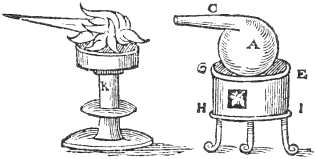
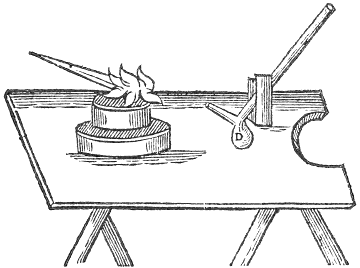
Let there be a vessell of Copper about the bignesse of a common Foot-ball, as, A, let it have a long Pipe at the top as G, which must be made so that you may upon occasion screw on lesser, or bigger vents made for the purpose. Fill this one third part with water, and set it over a fornace of coals, as E, G, H, I, and when the water beginneth to heat, there will come a strong breath out of the nose of the vessell, that will force the flame of a lampe placed at a convenient distance as K: if you hold your glasse in the extention of the flame it will melt suddenly; so you may worke what you will thereof. There are that instead of this globe make use of a Pipe, as A, fastned in a sticke as, F, of which I have made use, but hold it not so convenient for those that are not accustomed thereunto.
An excellent Water for any Morphue, or scurvinesse in the Face.
Take of quicke Sulphur 2. ounces, blacke Sope, the rankest and illest favoured that can bee got: binde them up in a cloth, and hang them in a pint of the strongest wine-vineger for the space of nine dayes; herewith wash the Morphue in the Face or elsewhere, and let it dry in of it selfe. This Water will for the present staine the face with a yelow collour, which will weare away in time.
How to soften Iron.
Take of Allum, sal Armoniacke, Tartar, a like quantitie of either, put them into good vineger, and set them on the fire: heat your Iron, and quench it therein.
A good Cement for broken glasses.
Take raw silke, and beat it with glasse, and mixe them together with the whites of Egges.
Another.
Take of calcined flints, quicke lyme, and common salt, of each a like quantity: mingle them all together with the whites of Egges; then take a linnen cloth and spread it over with this mixture, and put it upon the fracture, and let it dry; afterwards annoint it with Linseed oyle.
How to cause that the same quantitie both of powder and shot discharged out of the same peece shall carry closer, or more scattering.
Take the quantitie of a pease of Opium, and charge it amongst the shot; and this will make the shot to flie closer together then otherwise it would. This I had of a Sea-man, who had made triall hereof, as he said, and unto whom I sold some for the same purpose.
A Baite to catch Fish with.
Take Cocculus Indiæ ℥ ss, Henbane-seeds, and wheaten flower, of each a quarter of an ounce, hive honey as much as will make them into paste. Where you see most store of Fish in the River, cast of this paste into it in divers little bits about the bignesse of barley cornes, and anon you shall see the fish swimme on the top of the water, some reeling to and fro as drunken, others with their bellies upwards as if they were nigh dead; so that you may take them either with your hands, or a small net at the end of a sticke made for the same use. Note here, that if you put the Fish that you thus take, into a bucket of faire and fresh water, or if it raine after that you have cast this your bait into the water, they will revive and come to themselves to your admiration; and this was told me by a Gentleman of good credit, that hath often made use thereof.
I have heard that the stinking oyle drawne out of the roots of Polipody of the oake by a retort, mixed with Turpentine, and hive-honey, and being anointed upon the bait will draw the fish mightily thereto, and make them bite the faster: and I my selfe have seene fishes, as Roches, and taken in the dead time of Winter with an angle, bayted onely with paste made of Wheaten flowre, but it hath beene in the morning, and when the Sunne hath shined.
How to write without inke that it may not be seene, unlesse the paper be wet with water.
Take some Vitriol, and powder it finely, and temper it with faire water in any thing that is cleane, when it is dissolved, you may write whatsoever you will with it, and it cannot be read, except you draw it through water wherein some powder of galls hath beene infused, and so it will shew as blacke as if it had beene written with inke.
How to make white letters in a blacke Feild.
Take the yelke of a new layd egge, and grinde it upon a marble with faire water, so as you may write with it: having ground it on this wise, then with a penne dipt into it, draw what letters you will upon paper, or parchment, and when they are through drie, blacke all the paper over with inke; and when it is drie, you may with a knife scrape all the letters of that you wrote with the yelke of the egge, and they will shew faire and white.
How to sodder upon Silver, Brasse, or Iron.
There are two kindes of Sodder, to wit, hard Sodder, and soft Sodder. The soft Sodder runneth sooner then the hard: wherefore if a thing be to be sodered in two places, which cannot at one time well be performed, then the first must be sodered with hard soder, and the second with soft: for if the first be done with soft, it will unsoder againe before the other be sodered. Note, that if you would not have your soder to runne over any one part of the peece to be sodered, you must rub over that part with chalke that you would not have it runne upon.
Note likewise that your soder must be beaten thinne, and then laid over the place to be sodered, which must be first fitted together, and bound with wyer as occasion shall require. Then take Burras, powder it, and temper it with water like pap, and lay it upon the soder, and let it drie upon it by the fire: Afterwards cover it with quicke coals, and blow them up, and you shall see your soder run immediately: then presently take it out of the fire, and it is done.
Hard Soder is thus made.
Take a quarter of an ounce of silver, and a three penie weight of copper, melt them together, and it is done.
Soft Soder is thus made.
Take a quarter of an ounce of silver, and a three penie weight of brasse, melt them together, and it is done.
How to gild Silver, or Brasse, with water-gold.
First take about ℥. ii. of quicke silver, put it into a little melting pot, and set it over the fire, and when it beginneth to smoke, put into it an angel of fine gold: then take it off presently for the gold will presently be dissolved in the quicke silver, which if it be too thinne, you may through a peece of fustian straine a part of the quicke-silver from it. Note likewise that your silver, or brasse, before you go about to gild it, must be boyled in argol, and beare, or water, and afterwards scratcht with a wyer brush: then rub the gold, and quicke-silver upon it, and it will cleave unto it, then put your siluer or brasse upon quicke coales untill it begin to smoke: then take it from the fire, and scratch it with your wyer brush: Do this so often till you have rubd the quicke-silver as cleane off as you can, then shall you perceive the gold to appeare of a faint yellow colour, which you may make to shew faire with sal armoniacke, bole armoniacke, and vardigrece ground together, and tempered with water.
How to take smoake of Tobacco through a glasse of water.
First fill a pinte glasse with a wide mouth, almost full of faire water: fill also a pipe of Tobacco, and put the pipe upright into the glasse of water, so that the end of the pipe may almost touch the bottome of the glasse: then take another crooked pipe, and put it into the glasse, but let the end thereof not touch the water: waxe then the mouth of the glasse, that no ayre may come in nor out, but at the pipes: then put fire unto the Tobacco, and sucke with your mouth, at the end of the crooked pipe, and you shall see the smoake of the Tobacco penetrate the water, and breake out of a bubble, and so come into your mouth.
To colour Ivory or any other bones, of an excellent greene colour.
Take aqua fortis, wherein dissolue as much Copper, as the said water is able, then let the bones that you would have coloured, lye in the same all night, and they will be like a Smaragdin colour: Mizaldus.
How to make birds drunke, so that you may take them with your hands.
Take such meate as they loue, as Wheate, Barley, and lay the same to steepe in the lees of Wine, or else in the juyce of Hemlockes, and sprinckle the same in places where Birds use to haunt.
A way to catch Crowes.
Take the Liuer of a Beast, and cut it in diuers pieces, put then into each piece, some of the powder of nux vomica, and lay these pieces of Liuer in places where Crowes and Rauens haunt. Anon after they haue eaten them, you may take them with your hands, for they cannot flye away.
How to take Crowes or Pigeons.
Take white Pease, and steepe them eight or nine daies in the Gall of an Oxe: then cast the same where they use to haunt.
You may make Partridges, Duckes, and other birds drunke, so that you may take them with your hand: if you set blacke wine for them to drinke in those places whereunto they resort.
Another.
Take Tormentill, and boile it in good wine: put into it Barley or other graine: Sprinckle this in those places you haue appointed to take Birds in, and the Birds will eate the pieces amongst the graine, which will make them so drunke, that they cannot flye away. This should be done in the winter; and when it is a deepe snow.
Another way to take Birds.
Make a paste of barley meale, onion blades, and Henbane seeds; set the same upon seuerall little boards, or pieces of tiles, or such like, for the birds to eate of it.
How to make Brasse white for ever.
Take Egge shels, and burne them in a melting pot: then powder them, and temper them with the whites of Egges; let it stand so three weekes: heate your brasse red hot, and put this upon it.
How to make Marble.
Take ℥ vj. of quicke Lime, put it into a pot, and poure upon it, one pinte of good wine: let it stand fiue or sixe dayes, stirring it once or twice a day: then poure off the cleare, and therewith temper flint stones calcined, and made into fine powder, then colour it, and make of it what you please, and let them dry.
How to whiten copper.
Take a thin plate of copper, heat it red-hot divers times, and extinguish it in common oyl of tartar, and it will be white.
To make Saltpeter.
Take quick lyme, and poure warm water upon it, and let it stand six dayes, stirring it once or twice a day: take the cleare of this, and set it in the Sunne untill it bee wasted, and the Saltpeter will remaine in the bottom.
How to make Corall.
Take of red Lead ground, ℥. I. vermilion finely ground, ℥ ss. unquenched lyme, and powder of calcined flints, of each ℥ vj. these powders must bee tempered with a Lixivium that is made with quick lyme and wine: adde unto the whole a little salt; then make thereof what you list; then boyle them in linseed oyle.
How to make Pearles of Chalk.
Take some Chalk, and put it into the fire; there let it lie untill it break: temper it then with the whites of egs. Then make of it divers fashions of Pearles, both great and small: wet them being dried, and cover them with leafe gold, and they are done.
An approved and excellent plaster for ach in the raines of the back, or in any other part whatsoever.
Take one pound of black Sope, and foure ounces of frankincense, and a pinte of white wine vineger: boyle all together upon a gentle fire, untill it be thick; spread it then upon a lether, and apply it unto the grieved place. If the ach bee very great and fervent, then adde unto it a little aqua vitæ, and it will be much better.
An excellent oyntment for the Shingles, Morphew, Tetters, and Ringwormes.
Take a quarter of a pound of sope, and mingle with it two drams of the powder of black Ellebor, litharge of silver in fine powder, two ounces, vardigrease halfe an ounce, and a quarter of an ounce of glasse in powder, and as much quicksilver, make them all into an oyntment by stirring them well together; wherewith anoynt the grieved parts. This is approved and true.
An excellent Balme, or water for grievous sore eyes, which commeth either of outward accident, or of any inward cause.
Take two spoonfuls of the juyce of Fennell, and one spoonfull and a halfe of the juyce of Celandine, and twice as much hony as them both; then boyle them a little upon a chafingdish of coales, and scum away the dregs which will ascend, but first let it coole somwhat, and then let it run through a fayre cleane cloth: then put it into a violl of glasse, and stop it close. Put a little quantity of this into the eye. This medicine is approved, and more precious than gold.
A speedy way to asswage the paine of any scald, or burne, though never so great, and to take the fire out of it.
Take old lawn rags, dip them into Runnet, for want of it dip them into verges, and apply them cold upon the grieved place, shifting them for halfe an houre together, as oft as they dry: this I have known to give ease in an instant, and quickly to take out the fire.
An approved oyle for to heale any burne or scald.
Take of housleek one handfull, and of brooklime as much, boyle them in a quart of creame untill it turne unto an oyle; boyle it very gently: with this oyle a little warmed, anoint the grieved place twice a day, and it will soone make it well.
An oyntment, very excellent and often proued, for the same.
Take a good quantity of mosse scraped from off a stone wall, fry it in a fryingpan with a call of mutton suet a good while, then straine it, and it is done. Dresse the grieved part therewith once or twice a day, as you shall see fitting.
Another oyntment for a burne.
Take one part of sallet-oyle, and two parts of the whites of egs, beat them together exceeding well, untill they come to be a white oyntment, wherein dip the feather of a black hen, and anoynt the grieved place divers times every day, untill such time as the scales fall off, using in the meane while neither clothes nor any outward binding. This, sayth Minshet the authour, though it seeme to be a thing of no estimation, yet was there never found any more effectuall for a burn than it is.
An excellent oyntment for a green wound.
Take foure handfuls of Clownes, Allheale, bruse it, and put it into a pan, and put to it foure ounces of barrowes grease, sallet-oyle halfe a pound, Bees wax a quarter of a pound; boyle them all untill the iuyce be wasted; then straine it, and set it over the fire againe, and put unto it two ounces of Turpentine, then boyle it a little while more, and it is done. Put hereof a little in a saucer, and set it on the fire, dip a tent in it, and lay it on the wound, but first lay another plaister round about the wound, made of diapalma mollified a little with oyle of Roses. This cureth very speedily all greene wounds, as saith M. Gerard.
A Balsam of wonderfull efficacy.
Take Burgundie pitch, brimstone, and white frankincense, of each one ounce: make them into an oyntment with the whites of egges: first draw the lips of the wound, or cut, as close as you can, then lay on some of this spread upon a cloth, and swathe it ouer afterwards.
An excellent healing Water, which will drie up any old sore, or heale any greene wound.
Take a quarter of a pound of Bolearmoniacke, powder it by it selfe, then take an ounce of Camphire, powder it also by it selfe: also take foure ounces of white Coppras in powder: mixe the Coppras and Camphire together, and put them into a melting pot, and set them on the fire, untill they turne unto water: afterwards stirre it untill it come to be as hard as a stone: then powder it againe, and mixe it with the Bolearmoniacke: keepe this powder close in a bladder, when you would use it, take one pinte and a halfe of faire water, set it on the fire, and when it is even ready to boyle, put into it three spoonfuls of the powder; then take it off from the fire, and put it into a glasse, and let it stand untill it be cleare at the top, then take of the clearest, and wash the sore very warme therewith, and dip a cloth foure double in the same water, and binde it fast about the sore with a rowler, and keepe it warme: dresse it thus twice a day.
A Water for a Fistula.
Take one pint of white wine, 1 ounce of juyce of Sage, three penie weight of Borace in powder, Camphire in powder the weight of foure pence: boyle them all a prettie while on a gentle fire, and it is done: Wash the Fistula with this water, for it is certainly good, and approved to be true.
A Water for the Toothache.
Take ground ivie, salt, and spearemint, of each an handfull: beat them very well together, then boile them in a pint of vineger; straine it, and put a spoonfull of it into that side that aketh, and hold downe your cheeke.
Another Water approved for the same.
Take red rose leaves halfe a handfull, Pomegranate-flowers as many, two gaules sliced thinne: boyle them all in three quarters of a pint of red wine, and halfe a pint of faire water untill the third part be wasted: then straine it, and hold a little of it in your mouth a good while: then spit it out, and take more. Also if there be any swelling on your cheeke, apply the strainings betweene two clothes as hot as may be suffered. This I have knowne to do good unto divers in this Citie, when as they have beene extreamely pained.
To make a Water for the eyes.
Take Lapis Calaminaris, and burne it in the fire nine times, and quench it in white wine, and beat it into powder, and when you use it, put it into rose-water, and drop the water into the eye.
For Deafenesse.
Take a good quantitie of Camomill, and two handfuls of greene Wormewood, and seethe them in a pot of running water till they be very well sodden, and put a funnell over it, and let the steame go up into the eare, and then go to bed warme, and stop your eare with a little blacke wooll, and a grain of Civet: do this morning and evening, and with Gods assistance you shall finde ease.
An excellent Electuary for the Cough, Cold or against Flegme.
Take of Germander, Hissope, Horehound, white Maidenhaire, Agrimony, Bettony, Liverwort, Lungwort, and Harts-tongue, of each one handfull: put these to nine pints of water, and let them boyle to three pints; then let it coole and straine it. To this juyce put of clarified honey halfe a pound, fine powder of Liquorice fiue ounces, fine powder of Enulacampana root three ounces, boyle them to the thicknesse of an Electuary. Take of this at any time, but specially in the morning fasting, as also at night when you go to bed, or two houres after supper, the quantitie of a Wallnut or Nutmeg.
A very excellent salve to heale, well proved, for any old sore, or new wound.
Take of Waxe, Rosin, Sheeps suet, Turpentine, of each a like quantitie, Sallet oyle also as much: mixe them all together, and take the juyce of Smallach, of Planten, of Orpin, of Buglosse, of Comfery, of each a like quantitie: let them boyle untill the iuyce of the hearbes be consumed; and in the seething put a quantitie of Rose-water, and it will be a very good Salue.
A soveraigne Water to heale a greene wound: and to stanch bloud.
Take a pottle of running water, and put thereto foure ounces of Allum, and one ounce of Copras, and let them seethe to a quart, and then straine it, and keepe it in a glasse, and wash the wound, and wet a cloth, and lay to the fore, and with Gods helpe it will soone be healed.
For the Byting of a mad Dogge.
Take brine, and bathe the wound: then burne Claret wine, and put in a little Mithridate, and so let the patient drinke it; Then take two live pigeons, cut them through the middle, and lay them hot to his hand if he be bitten in the armes. If in his legges, to the sole of his feet.
An Oyle for any Ach.
Take a pound of unwashed butter, and a handfull of red mints, and a handfull of camomill, a handfull of rew, two ounces of oyle of Exeter: stamp the herbs to a juyce, and boyle them with the butter; straine them in a cloth, and rub them out very well: this so done, take the oyle of Exeter, and put to them, and stir them well together, and put them into a gally pot, and where the ach is anoint the place against the fire, and lay a browne paper on it, and wrap a cloth about the place, and keepe it warme: proved to be excellent.
To stanch the bleeding of a cut.
Take a peece of a felt hat, and burne it to a coale; beat it to powder, and put it in the cut, and it will stanch the bleeding presently. Or else apply linnen rags that in the spring of the yeere have beene often washed in the sperm of frogs, and afterward dried in the Sunne.
For an ague, to bee layd to the wrists.
Take a handfull of soot, a spoonfull of bay salt, halfe a spoonfull of pepper; bruse them together, and temper them with two yelks of egs; spread it on a cloth, and lay it to the wrists.
Almond milke for the cough of the lungs.
Take foure spoonfuls of French barly well washed, and boyle it in three wine pints of faire water, unto a pint and a halfe; then take it from the fire, and let it coole, and settle; then take the cleere liquor, and straine therewith a quarter of a pound of sweet almonds blanched, and beaten; then set it on the fire, and let it boyle a while till it begin to grow thick; then beat two yelks of egs, and put them to it; stirre them well together, and put to it as much fine suger as will sweeten it, and a spoonfull of damask rose water, and so let it boyle a while longer, till it be as thick as good creame; eat of it warm twice or thrice a day, but at breakfast especially.
For a scald head.
Take a pinte of running water, and as much Mercury as a good walnut, three or foure branches of Rosemary; boyle these all together till a third part be boyled away, or thereabout, and every morning and evening wash the infected place with some of this water cold, and a quarter of an houre after or lesse anoint the place with lamp oyle, and every morning after the first dressing try to pull up some of the hayre as easily as you can: have care where you set this water, for it is poyson. If you shave the head, and apply a plaster called Emplastrum Cephalicum cum Euphorbio, it is also excellent.
For to heale a red face that hath many pimples. Proved.
Take foure ounces of barrowes grease, and as much oyle of bayes, halfe an ounce of quicksilver killed with fasting spettle, then take two spoonfuls of wilde tansie water, or honisuckle water, and let all be ground in a morter three houres at the least, untill you see nothing of the quicksilver, and so keep it close in a glasse; the older, the better; and when you go to bed anoint the face, and look that you keep it from your eyes.
To wash the Face, if it be given to heat.
Take Snailes, beat them shels and bodies together: steep them a night in new milke: then still them with the flowers of white Lillies.
To make Vsquebach.
Take a gallon of the smallest Aqua vitæ you can make, put it into a close vessell of stone; put thereto a quart of Canary Sacke, two pounds of Raisons of the Sunne stoned, but not washed, two ounces of Dates stoned, and the white skinnes of them pulled out, two ounces of Cinamon grossely bruised, foure good Nutmegs bruised, foure good Liquorish sticks sliced, and bruised, tye up all your Spices in a fine linnen cloth, and put them into your Aqua vitæ, and tye up your pot very close, and let this infuse a weeke, stirring it three times a day, then let it runne through a jelly bagge close covered; keepe it in glasse bottles.
To make Almond Butter.
Take two pound of Almonds, and blanch them, and let them lye all night in cold water: then grinde them in a mortar very small, and put in a blade of Mace or two; then straine it through a strong cloth as neare as you can, that the milke be not too thin, and let it seethe a prettie while: then put in a little Rose-water, and a little salt when you take it off the fire, and stirre it still: then take a bigge cloth very cleane, and let two hold it; then you must take the milke and cast it round about the sides of the cloth that the whay may come from it; then with a saucer put it downe from the sides: then knit the cloth, and hang it up untill it have left dropping; then take it forth, and season it with fine Sugar and Rose-water.
To make Ielly for one that is in a Consumption, or troubled with a loosenesse.
Take the feet of a Calfe, and when the haire is cleane scalded off, slit them in the middle, and cut away all the blacke veines, and the fat, and wash them very cleane, and so put them in a bucket of faire water, and let them lye foure and twentie houres, and in that time the oftner you shift them in faire water it will be the better; then set them on the fire in two gallons of water, or somewhat lesse, and let them boyle very softly, continually taking off the scumme and fat which riseth; and when the liquour is more then halfe boyled away, put into it a pinte and a halfe of white wine, and as it boyleth there will come a foule scumme upon it, take it off still cleane, and when the Ielly is boyled enough, you may know, for your fingers will sticke to the spoone; then take it from the fire, and with a Cullender take out all the bones and flesh, and when the Ielly is almost cold, beat the whites of sixe Egges, and put into it, and set it on the fire againe, and so let it boyle till it be cleare: then straine it through a cleane cloth into a Bason, and so let it stand all night long; the next morning put it into a skellet, and put to it a pound of Sugar, halfe an ounce of Cinamon broken in peeces, one ounce of Nutmegs, an ounce of Ginger bruised, and a good quantitie of large Mace; boyle all these together till it taste of the Spices as much as you desire, and when it is almost cold, take the whites of six egs, and beat them, and put into it, and set it on the fire, and when it riseth wilde it in halfe a pint of white wine; then strain it through a jelly bag.
To stay the flux.
Take Date stones, and beat them to fine powder, and take the quantity of one of them, and drink it with posset drink, or beere; use these two or three mornings together, and after as often as you finde occasion; this is very good.
In the month of May gather of the reddest Oak leaves you can get, and still them, and when need requireth make pap thereof, mingled with milk or fine flower, suger, and Cinamon, as oft as your stomack serveth to eat it.