THE MOUNTAIN CHANT:
Reading edition
A NAVAJO CEREMONY.
BY
Dr. WASHINGTON MATTHEWS, U. S. A.
CONTENTS.
Page.
Introduction 385
Myth of the origin of dsilyídje qaçàl 387
Ceremonies of dsilyídje qaçàl 418
First four days 418
Fifth day 419
Sixth day 424
Seventh day 428
Eighth day 429
Ninth day (until sunset) 430
Last night 431
First dance (nahikàï) 432
Second dance (great plumed arrow) 433
Third dance 435
Fourth dance 436
Fifth dance (sun) 437
Sixth dance (standing arcs) 437
Seventh dance 438
Eighth dance (rising sun) 438
Ninth dance (Hoshkàwn, or Yucca) 439
Tenth dance (bear) 441
Eleventh dance (fire) 441
Other dances 443
The great pictures of dsilyídje qaçàl 444
First picture (home of the serpents) 446
Second picture (yays and cultivated plants) 447
Third picture (long bodies) 450
Fourth picture (great plumed arrows) 451
Sacrifices of dsilyídje qaçàl 451
Original texts and translations of songs, &c. 455
Songs of sequence 455
First Song of the First Dancers 456
First Song of the Mountain Sheep 457
Sixth Song of the Mountain Sheep 457
Twelfth Song of the Mountain Sheep 458
First Song of the Thunder 458
Twelfth Song of the Thunder 459
First Song of the Holy Young Men, or Young Men Gods 459
Sixth Song of the Holy Young Men 460
Twelfth Song of the Holy Young Men 460
Eighth Song of the Young Women who Become Bears 461
One of the Awl Songs 461
First Song of the Exploding Stick 462
Last Song of the Exploding Stick 462
First Daylight Song 463
Last Daylight Song 463
Other songs and extracts 464
Song of the Prophet to the San Juan River 464
Song of the Building of the Dark Circle 464
Prayer to Dsilyi‘ Neyáni 465
Song of the Rising Sun Dance 465
Instructions given to the akáninili 466
Prayer of the Prophet to his Mask 466
Last Words of the Prophet 467
Index
NOTE ON THE ORTHOGRAPHY OF NAVAJO WORDS.
The spelling of Navajo words in this paper is in accordance with the alphabet of the Bureau of Ethnology:
c = ch in chin; ¢ = th in this; ç = th in think; j = z in azure; q = German ch in machen; ‘ shows that a vowel is aspirated; the vowels have the continental sounds; ai is the only diphthong, and is like i in line; l is usually aspirated; the other letters have the ordinary English pronunciation.
See also Transcriber’s Supplement.
ILLUSTRATIONS
In the original text, full-page Plates were interleaved with the book pages. For this e-text, the Plates have been placed as close as practicable to their discussion in the text.
Page.
Plate X. Medicine lodge, viewed from the south 418
XI. Medicine lodge, viewed from the east 420
XII. Dance of nahikàï 432
XIII. Fire dance 442
XIV. The dark circle of branches at sunrise 444
XV. First dry painting 446
XVI. Second dry painting 448
XVII. Third dry painting 450
XVIII. Fourth dry painting 452
Figure 50. Qastcèëlçi, from a dry painting of the klèdji-qaçàl 397
51. The çobolçà, or plumed wands, as seen from the door of the medicine lodge 422
52. Akáninili ready for the journey 424
53. The great wood pile 429
54. Dancer holding up the great plumed arrow 434
55. Dancer “swallowing” the great plumed arrow 434
56. The whizzer, or groaning stick 436
57. Yucca baccata 440
58. Sacrificial sticks (keçàn) 452
59. The talking kethàwn (keçàn-yalçì‘) 452
THE MOUNTAIN CHANT: A NAVAJO CEREMONY.
By Dr. Washington Matthews, U. S. A.
INTRODUCTION.
1. The ceremony of dsilyídje qaçàl, or mountain chant—literally, chant towards (a place) within the mountains—is one of a large number practiced by the shamans, or medicine men, of the Navajo tribe. I have selected it as the first of those to be described, because I have witnessed it the most frequently, because it is the most interesting to the Caucasian spectator, and because it is the best known to the whites who visit and reside in and around the Navajo country. Its chief interest to the stranger lies in the various public performances of the last night. Like other great rites of the shamans, it has its secret ceremonies of many days’ duration in the medicine lodge; but, unlike the others, it ends with a varied show in the open air, which all are invited to witness. Another ceremony which I have attended, and which the whites usually call the “Yaỳbichy Dance” (Yèbitcai), has a final public exhibition which occupies the whole night, but it is unvaried. Few Europeans can be found who have remained awake later than midnight to watch it. Such is not the case with the rite now to be described. Here the white man is rarely the first to leave at dawn.
2. The appropriateness of the name dsilyídje or tsilgitce—towards (a place) within the mountains—will be better understood from the myth than from any brief description. “Dsilyi‘” may well allude to mountains in general or to the Carrizo Mountains in particular, to the place in the mountains (paragraphs 9 and 38) where the originator of these ceremonies (whom I often find it convenient to call “prophet”) dwelt, or to the name of the prophet (par. 41), or to all these combined. Qaçàl signifies a sacred song or a collection of sacred songs. From the many English synonyms for song I have selected the word chant to translate qaçàl. In its usual signification hymnody may be its more exact equivalent, but it is a less convenient term than chant. The shaman, or medicine man, who is master of ceremonies, is known as qaçàli or chanter—el cantador, the Mexicans call him. In order to keep in mind his relationship to similar functionaries in other tribes I shall, from time to time, allude to him as the priest, the shaman, or the medicine man, following
3. Sometimes the collective rites and amusements of the last night are spoken of as ilnasjíngo qaçàl, or chant in the dark circle of branches, from il, branches of a tree; nas, surrounding, encircling; jin, dark; and go, in. The name alludes to the great fence of piñon branches, erected after sunset on the last night, to receive the guests and performers. I shall often refer to this inclosure as the corral. Some white men call the rites I describe the “corral dance,” but more usually they call them the “hoshkàwn dance,” from one of the minor performances of the last night, the hackàn-inçá‘, or act of the Yucca baccata, a rite or drama which seems to particularly excite the Caucasian interest. To such minor acts the terms inçá‘ and alìli are applied; these may be translated dance, show, act, or exhibition.
4. The purposes of the ceremony are various. Its ostensible reason for existence is to cure disease; but it is made the occasion for invoking the unseen powers in behalf of the people at large for various purposes, particularly for good crops and abundant rains. It would appear that it is also designed to perpetuate their religious symbolism. Some of the shows of the last night are undoubtedly intended to be dramatic and entertaining as well as religious, while the merely social element of the whole affair is obvious. It is an occasion when the people gather to have a jolly time. The patient pays the expenses and, probably in addition to the favor and help of the gods and the praise of the priesthood, hopes to obtain social distinction for his liberality.
5. This, like other great rites of the Navajo, is of nine days’ duration. Some of these rites may take place in the summer; but the great majority of them, including this dsilyídje qaçàl, may be celebrated only in the winter, in the season when the thunder is silent and the rattlesnakes are hibernating. Were they to tell of their chief gods or relate their myths of the ancient days at any other time, death from lightning or snake-bite would, they believe, be their early fate.
6. While in New Mexico I sometimes employed a very liberal minded Navajo, named Juan, as a guide and informant. He had spent many years among Americans, Mormons, and Mexicans, and was, I imagined, almost perfectly emancipated from his “early bias.” He spoke both English and Spanish fairly. On one occasion, during the month of August, in the height of the rainy season, I had him in my study conversing with him. In an unguarded moment, on his part, I led him into a discussion about the gods of his people, and neither of us had noticed a heavy storm coming over the crest of the Zuñi Mountains, close by. We were just talking of Estsánatlehi, the goddess of the west, when
7. When the man (or the woman) who gives the entertainment concludes he is sick and that he can afford to call a shaman, it is not the latter who decides what particular rites are best suited to cure the malady. It is the patient and his friends who determine this. Then they send for a man who is known to be skilled in performing the desired rites, and it is his province merely to do the work required of him.
8. Before beginning to describe the ceremonies it will be well to relate the myth accounting for their origin.
MYTH OF THE ORIGIN OF DSILYÍDJE QAÇÀL.
9. Many years ago, in the neighborhood of Dsilyi‘-qojòni, in the Carrizo Mountains, dwelt a family of six: the father, the mother, two sons, and two daughters. They did not live all the time in one locality, but moved from place to place in the neighborhood. The young men hunted rabbits and wood rats, for it was on such small animals that they all subsisted. The girls spent their time gathering various wild edible seeds.
10. After a time they went to a place called Tse‘-biçàï (the Wings of the Rock or Winged Rock), which lies to the east of the Carrizo Mountains, on a plain. When they first encamped there was no water in the vicinity and the elder brother went out to see if he could find some. He observed from the camp a little sandy hillock, covered with some vegetation, and he determined to see what sort of plants grew there. Arrived there, he noticed a spot where the ground was moist. He got his digging stick and proceeded to make a hole in the ground. He had not dug long when the water suddenly burst forth in great abundance and soon filled the excavation he had made. He hastened back to the camp and announced his success. When they left the Carrizo Mountains it was their intention to go to ¢epéntsa, the La Plata Mountains, to hunt for food, and their halt at Tse‘-biçàï was designed to be temporary only; but, now that they had found abundance of water, the elder brother counseled them not to hasten on, but to remain where they were for a while. The spring he developed still exists and is known to the Navajo as Çobinàkis, or the One-Eyed Water.
11. The spring was some distance from the camp, and they had but one wicker water bottle; so the woman, to lighten her labor, proposed that they should move their goods to the vicinity of the spring, as it was her task to draw the water. But the old man counseled that they should remain where they were, as materials for building were close at hand and it was his duty to erect the hut. They argued long about it; but at length the woman prevailed, and they carried all their property
12. They had a stone ax-head, with a groove in it. Around this they bent a flexible twig of oak and tied it with the fibers of the yucca, and thus they made a handle. The first day after the spring was found the young men went out and chopped all day, and in the evening brought home four poles, and while they were gone the old man dug in the hillock. The next day the young men chopped all day, and at night returned with four more poles, while their father continued his digging. They worked thus for four days, and the lodge was finished. They made mats of hay to lie on and a mat of the same material to hang in the doorway. They made mats of fine cedar bark with which to cover themselves in bed, for in those days the Navajo did not weave blankets such as they make now. The soles of their moccasins were made of hay and the uppers of yucca fibers. The young men were obliged to go hunting every day; it was only with great labor they could keep the house supplied with meat; for, as has been said, they lived mostly on small animals, such as could be caught in fall traps. These traps they set at night near the burrows, and they slept close to the traps when the latter were set far from home. They hunted thus for four days after the house was finished, while their sisters scoured all the country round in search of seeds.
13. With all their work they found it hard to make a living in this place. The land was barren; even rats and prairie dogs were scarce, and the seed bearing plants were few. At the end of the fourth day they held a consultation, and the old man said they would do better to move on to the San Juan River, where food was more abundant, and they could trap and gather seeds as they traveled. They determined to leave, and next morning broke camp. They journeyed on till they reached the banks of the San Juan. Here they found abundance of tciltcin (fruit of Rhus aromatica) and of grass seeds, and they encamped beside the river at night.
14. Next day they traveled up the stream to a place called Tse‘çqàka, and here again they halted for the night. This place is noted for its deposits of native salt. The travelers cut some out from under a great rock and filled with it their bags, made out of the skins of the squirrels and other small animals which they had captured. Thence they followed up the river to Tse‘¢ezá‘ (Rock Sticking Up), and thence to Çisyà-qojòni (Beautiful Under the Cottonwoods), where they remained a day and killed two rabbits. These they skinned, disemboweled, crushed between two stones, bones and all, so that nothing might be lost, put them into an earthen pot to boil, and when they were sufficiently cooked they added some powdered seeds to make a thick soup; of all this they ¢epéntsa. Here they left the main river and followed the branch until night approached, when they made camp.
15. They moved on next day and came close to ¢epéntsa, to a soil covered with tracks of deer and of other great animals of the chase. Here they encamped, and on the following morning the young men set out by different ways in the direction of the mountain to hunt; but at night they returned empty handed. Thus they hunted four days unsuccessfully. Every day while his sons were gone the old man busied himself cutting down saplings with his stone ax and building a house, and the daughters gathered seeds, which constituted the only food of the family. As the saplings were abundant and close to the camp, the old man built his house fast, and had it finished at nightfall on the fourth day, when his sons returned from their fruitless labors. They entered the lodge and sat down. They were weary and hungry and their bodies were badly torn by the thorns and thick copse of the mountains. Their father spoke not a word to them as they entered; he did not even look at them; he seemed to be lost in deep contemplation; so the young men said nothing, and all were silent. At length the old man looked up and broke the silence, saying, “Aqalàni cactcini!” (Welcome, my children.) “Again you have returned to the lodge without food. What does it avail that you go out every day to hunt when you bring home nothing? You kill nothing because you know nothing. If you had knowledge you would be successful. I pity you.” The young men made no reply, but lay down and went to sleep.
16. At dawn the old man woke them and said: “Go out, my children, and build a sweat-house, and make a fire to heat stones for the bath, and build the sweat-house only as I will tell you. Make the frame of four different kinds of wood. Put kaç (juniper) in the east, tse‘isçázi (mountain mahogany) in the south, ¢estsìn (piñon) in the west, and awètsal (cliff rose) in the north; join them together at the top and cover them with any shrubs you choose. Get two small forked sticks, the length of the forearm, to pass the hot stones into the sweat-house, and one long stick to poke the stones out of the fire, and let all these sticks be such as have their bark abraded by the antlers of the deer. Take
17. The elder brother arose early, stirred the embers and made a fire, and soon the younger awoke. As they sat by the fire warming themselves, the elder one said: “Younger brother, I had a dream in the night; I dreamt I killed a buck deer.” And the younger replied: “Elder brother, I, too, had such a dream, but that which I killed was a doe.” The old man heard their words and rose, saying, “It is well, my children; go out and try again.” They went out to visit their traps. The first one they came to had fallen; they lifted the stone and found under it the body of a rat. So each one in turn, as they visited it was found to have fallen, killing in its fall some small animal; and they returned to the lodge with twelve little creatures for their food. Then the old man told them to take their bows and arrows and hunt for deer. “Hunt,” said he, “to the east, the west, and the north, if you will, but do not pass to the south of the lodge.” With these instructions they set out, each one in a different direction. The elder brother had not traveled far when he saw a herd of deer and shot one of the number. He skinned it, cut it up, took the backbone, hide, and tallow, and hung the rest in a tree. As he drew near the house, he saw his younger brother approaching from a different direction with the hide and meat of a doe. When they entered the hut, the old man asked which of the two deer was shot first. The elder brother answered: “I think mine was, for I killed it early this morning, soon after I left the house.”
18. On the following day they left the lodge together and did not take separate trails. Soon they killed a deer, and the younger brother said: “What shall we now do with it, since our father has told us not to skin it and not to cut it up?” The elder brother said: “I know not. Return to the lodge and ask our father what we must do.” Then the younger brother returned to his father and the latter instructed him thus: “Cut the skin around the neck; then carefully take the skin from the head, so as to remove the horns, ears, and all other parts, without tearing the skin anywhere. Leave such an amount of flesh with the nose and lips that they will not shrivel and lose their shape when they dry. Then take the skin from the body, which skin will again be mine. One of you must take out the pluck and carry that in the hide to me; the other will bring the skin of the head and the meat. Let him who bears the pluck come in advance, and stop not till he comes directly to me, and he must hand it to me and to no one else.” The younger brother went back and told all this to the elder. They dressed the deer as they were bidden; the younger put the pluck in the skin and went in advance, and the elder followed with the venison and the skin of the head. When they reached the hogán, the father said: “Where is the atcai?” (pluck) and the younger said: “It is in the skin.” “Take it out,” said the old man, “and hang it on yonder mountain mahogany.” The young man did as he was bidden. The father advanced with his bow and arrow and handed them to the elder brother, who placed the arrow on the string and held the bow. The old man put his hands on top of those of his son and together they drew the bow. The former took careful aim at the pluck and let the arrow fly. It struck the object and penetrated both heart and lungs so far that the point protruded on the opposite side. Then the old man told his son to seize the arrow by the point and draw it completely through, which was done. Next he made his son stand close to the pluck, looking towards it, and while his son was in this position he blew on him in the direction of the pluck. “Now,” said the father, “whenever you want to kill a buck, even if there is neither track nor sign of deer in sight, you have only to shoot into the tse‘isçázi (mountain mahogany, Cercocarpus parvifolius) and you will find a dead deer where your arrow strikes; while if you wish to kill a female deer you will shoot your arrow into the awètsal (cliff rose, Cowania mexicana) and you will find a doe there.” When all this was done they prepared the skin of the head, under the old man’s directions. To keep the skin of the neck open they put into it a wooden hoop.
19. From the camp where these things happened they moved to a place called Tse‘-lakàï-iá‘ (White Standing Rock). Before they went to hunt or gather seeds, the old man desired that they should all help to build the hogán (hut); so all went to work together, men and women, and the hogán was completed, inside and outside, in four days.
20. The morning following the completion of the hogán, the father sent the young men out again, directing them, as before, not to go to the south. They went off together, and soon espied a herd of deer. The elder brother put on the deer mask and began to imitate the motions of the animal, asking his younger brother what he thought of the mimicry. When the latter gave his approval, the elder brother said, “Steal round to the other side of the herd and when they see you they will come in my direction.” He waited, and when he saw that his brother had got to the other side of the herd, he selected a big fat buck as his special object, and began to move towards him, walking and pawing the ground like a deer, and rubbing his antlers against the trees. Soon the buck began to approach the hunter, but the latter kept his head constantly turned toward the deer the better to maintain his disguise. Presently the buck came quite close to the Indian, when the latter sped his arrow and brought the quarry down. They carried the meat home and the old man demanded that the meat and skin should all be his in payment for his advice. This was the third time he had advised them and the third time he had received a gift for his service. He directed that the meat should be cut into pieces and hung in the trees to dry, and that the skin should be stretched and dried for his bed.
21. Next day the elder brother desired the younger to stay at home, saying that he would like to hunt alone. As usual, the old man warned him against the south, and directed him to hunt in the country north of the hogán. He set out, accordingly, to the north; but he returned at night without any game. Again on the following morning he set out alone, and this time went to the west, as his father had directed. He hunted all day without success, until near sunset, when it was time for him to return. Then he remembered what his father had told him of the shrubs that would always have deer for his arrow. Looking around he saw a cliff rose, into which he shot his dart, and at the same instant
22. On the morrow, when he went forth on his hunt, his father gave him the usual injunctions, saying: “Hunt in any direction from the lodge that you will; but go not to the south.” He departed as if he were going to the east; but when he got out of sight from the hogán he turned round to the south and pursued his way in that direction. He went on until he came to the San Juan River, and he forded it at a place a little above Beautiful Under the Cottonwoods, where they had crossed it before. He went on to a place called Tyèl-saka¢ (Erect Cat-Tail Rushes) and thence to a place called Dsiskí¢ (Clay Hill). Here he laid his deer skin mask and his weapons on the ground and climbed the hill to observe the surrounding country for game. But instead of looking south in the direction in which he was going he looked to the north, the country in which dwelt his people. Before him were the beautiful peaks of ¢epéntsa, with their forested slopes. The clouds hung over the mountain, the showers of rain fell down its sides, and all the country looked beautiful. And he said to the land, “Aqalàni!” (greeting), and a feeling of loneliness and homesickness came over him, and he wept and sang this song:
That flowing water! That flowing water! My mind wanders across it. That broad water! That flowing water! My mind wanders across it. That old age water! That flowing water! My mind wanders across it.
23. The gods heard his song and they were about to gratify his wishes. He was destined to return to ¢epéntsa, but not in the manner he most desired. Had he gazed to the south when he ascended the hill, instead of to the north, it might have been otherwise.
24. He wiped away his tears and went down to the place where he had laid his mask and arms at the foot of the hill. He put on his buckskin coat and was just putting on his mask, but had not quite drawn it down over his head, when he heard a noise to the south and, looking ¢epéntsa, where they watched him closely all night and gave him nothing to eat. They bound his feet firmly together, tied his hands behind his back, and threw an untanned buckskin over him before they lay down to sleep.
25. They set out on their journey again early in the morning. At Çòinçeski‘ (Scattered Springs) they stopped for a little while to eat, but the only food they gave the Navajo was the full of his palm of service berries. When they arrived on the south side of Çòtsosi (Narrow Water) they halted for the night and a number went out to hunt. Among them they secured two deer, one large and one small; the feet of these they gave to their captive for his supper. Next morning they gave him a piece of liver, half of which he ate and the rest he kept. They moved on rapidly and rested for the night at Dsil nahoyàl, where there was a spring. They had given him nothing to eat all that day, and at night they gave him nothing; so it was well for him that he had secreted part of the liver. This he ate after dark. On the third morning he had to set out fasting and had to go on foot as usual. About noon, however, one of the Ute took pity on him and lent him a horse to ride, while the owner of the horse walked all the afternoon. That night they arrived at the bank of a large river, and here they gave him to understand, by signs, that this was the last river they would cross until they got home. Beyond the river there was nothing in sight but a great plain.
26. By the light of the morning, however, on the next day, he discerned some mountains showing their points faintly above the northern horizon. To these the Ute pointed and motioned to him to go ahead. They did not follow him immediately; but saddled up at their leisure while the Navajo went on. Though he was now for some time alone on the trail and out of sight of his captors, he knew that he could not escape; all around and before him was a desert plain where he could
27. At night they came to a plain situated between four mountains, one on the east, one on the south, one on the west, and one on the north, and here there was a great encampment of Ute, whose tents were scattered around in different places on the plain. There was one tent whose top was painted black and whose base was painted white and which had a forked pole set in the ground in front of it. To this his master, the old man who had saved his life and taken him by the arm on the occasion of his capture, led him, while the rest of the war party departed to their respective tents. The old man hung his own arms and accouterments on the pole, and the slave, following his example, hung his deer skin mask and robe on the forks and laid his crutches against the pole, and he prayed to the head of the deer, saying:
Whenever I have appealed to you, you have helped me, my pet. Once you were alive, my pet. Take care that I do not die, my pet. Watch over me.
When he had finished his prayer an old man came and danced around him, and when the latter had done an old woman approached with a whistle in her hand and she whistled all around him. This was for joy because they had captured one of an alien tribe. Then his master motioned to him to go into the tent. Here he was given a large bowl of berries of which he ate his fill, and he was allowed to lie down and sleep undisturbed until morning.
28. Next morning the Ute began to enter the tent. They came one by one and in small groups until after a while there was a considerable crowd present. Then they gave the Navajo to understand by signs that they wished to know for what purpose he wore the mask and the buckskin. He answered that he used them for no particular purpose, but only for a whim. They repeated the question three times very pointedly and searchingly, but he continued to make evasive replies. The fourth time they addressed him they charged him to tell the truth and speak quickly, reminding him that he was a prisoner whose life was in the hands of his captors and telling him that if he did not disclose the use of his mask and robe he would be killed before sunset, while if he revealed the secret his life would be spared. He pondered but a short time over their words and determined to tell them the truth. So he explained to them the use of the mask and the robe in deceiving the deer and told the wonderful power he had of getting game by shooting into certain bushes. At dark they sent in two young men to be initiated into his mysteries. He began by giving them a full account of all his father had done and all he had shown him; he then taught them how to build the sweat-house, how to make the mask, how to shoot the pluck, and how to walk like a deer, and he made them practice
29. On the twelfth day the Ute went out to hunt, leaving few men in camp. There was a small inclosure of brushwood close to the tent; in it were two high poles on which skins were dressed. His master left him, that day, two skins to prepare, and he set to work at them and labored hard scraping and rubbing them until about noon, when he felt hungry and went into the tent to see if he could find anything to eat. He opened a bag and found it to contain dried meat; he put some of this on the coals and sat down to wait till it was done. As he watched the meat cooking he heard a noise at the deer skin door of the tent and, looking up, he beheld an old woman crawling in on her hands and knees. She passed once around the fire and went out at the door again, but before she disappeared she turned her head and addressed him, saying: “My grandchild, do something for yourself.” He paused a moment in wonder at the strange vision he had seen and the strange words he had heard, and then he rushed out of the tent to follow his visitor and see who she might be. He went around the tent four times; he gazed in every direction; but no one was to be seen. During the rest of the day he worked but little. Occasionally he took up a stone and rubbed the hides; but most of the time he walked and loitered around, busy with his thoughts.
30. After sunrise the hunters returned with an abundance of meat. They came to the great lodge where the master of the Navajo dwelt; they extended its circumference by removing the pegs at the bottom; they stored the goods of the owner away at the outer edge, so as to leave a clear space in the center, and made everything ready for the reception of a large number of guests. After dark a great number gathered in the tent and the captive was ordered by his master to bring some water. He took two wicker bottles to a neighboring spring, filled them, and laid them on the ground beside the spring, while he went to gather some plants to stick into the mouths of the bottles as stopples. As he went he heard a voice saying “Hist!” and looking in the direction whence it came he saw a form sitting in the water; it wore a mask like the head of a great owl and it was smoking a pipe. When he turned towards it, it said, “You walk around like one without sense or knowledge. Why don’t you do something for yourself? When next you hear my voice it will be well for you if you walk towards it.”
31. The voice ceased and the form of the owl-man vanished. Then the Navajo put the stopples into the vessels and carried them back. When he returned he observed that two large dogs were tied to the door, one on each side, and that three doors had been added to the lodge during his absence, so that now there were four doors covering the doorway. When he entered he found the lodge filled with Ute and he saw four bags of tobacco and four pipes lying near the fire, one at each cardinal point of the compass. He observed a very old man and a very
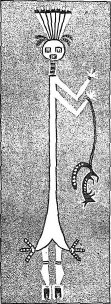
Fig. 50. Qastcèëlçi, from a dry painting of the klèdji-qaçàl.
32. Now he feared more than ever for his safety; he felt sure that his captors contemplated his death by torture. The pipes were lit and the council began. The talking in the strange tongue that he could not understand had lasted long into the night, when he fancied that he heard the voice of the Yèbitcai (Anglicized, Yày-bi-chy or Gay-bi chy) above the din of human voices, saying “hu‘hu‘hu‘hu” in the far distance. He strained his attention and listened well, and after a while he felt certain that he heard the voice again nearer and louder. It was not long until the cry was repeated for the third time, and soon after the captive heard it once more, loudly and distinctly, immediately to the west of the lodge. Then there was a sound as of footsteps at the door, and the white lightning entered through the smoke-hole and circled around the lodge, hanging over the heads of the council. But the Ute heard not the voice which the Navajo heard and saw not the vision he beheld. Soon the Yàybichy (Qastcèëlçi) entered the lodge and standing on the white lightning, said: “What is the matter with you, my grandchild? You take no thought about anything. Something you must do for yourself, or else, in the morning you will be whipped to death—that is what the council has decided. Pull out four pegs from the bottom of the tent, push it open there, and then you can shove things through.” The Navajo answered, “How shall I do it! See the way I am tied! I am poor! See how I am wound up!” But Qastcèëlçi again said: “When you leave, take with you those bags filled with embroideries and take with you tobacco from the pouches near the fire.” Scarcely had Qastcèëlçi disappeared when the Navajo heard a voice overhead, and a bird named qocçò¢i flew down through the smoke-hole, hovered four times around the lodge over the heads of the Ute, and departed by the way it had entered. In a moment after it had
33. At this moment he heard, at a little distance to the south of where he stood, the hoot of an owl. Instantly recollecting the words of the owl-like form which he had encountered at the spring at nightfall, he set off in the direction from which the call proceeded. He had not walked far until he came to a precipitous bluff formed by two branching cañons, and it seemed at first impossible for him to proceed farther. Soon, however, he noticed a tall spruce tree, which grew beside the precipice from the foot to the summit, for the day had now begun to dawn and he could see objects more clearly. At this juncture Qastcèëlçi again appeared to him and said: “How is it, my grandchild, that you are still here? Get on the top of that spruce tree and go down into the cañon on it.” The Navajo stretched out his hand to seize the top of the tree, but it swayed away from his grasp. “See, my grandfather,” he said to Qastcèëlçi, “it moves away from me; I cannot reach it.” Then Qastcèëlçi flung the white lightning around the top of the tree, as an Indian flings his lasso around the neck of a horse, and drew it in to the edge of the cliff. “Descend,” he commanded the Indian, “and when you reach the bottom take four sprays from the tree, each from a different part. You may need them in the future.” So the Navajo went down, took the four sprays as he was bidden and put them under his robe.
34. At the base of the bluff he again met Qastcèëlçi, and at this moment he heard a noise, as of a great and distant tumult, which seemed to come from above and from beyond the edge of the cliff whence they had descended. From moment to moment it grew louder and came nearer, and soon the sounds of angry voices could be distinguished. The Ute had discovered the flight of their captive and were in hot pursuit. “Your enemies are coming for you,” said the divine one; “but yonder small holes on the opposite side of the cañon are the doors of my dwelling, where you may hide. The bottom of the cañon is strewn
35. It was nightfall when he emerged. He turned his face in the direction of his home and walked rapidly all the night. As day dawned he began to feel hopeful; but, ere the sun rose, distant sounds, which grew louder and louder, reached his ear. He knew them to be the voices of his pursuers and again he became sorely afraid. He hurried on and came near the foot of a high isolated pinnacle of rock, whose top appeared to be inaccessible. Glancing to the summit, however, he beheld standing there a black mountain sheep. Thinking that this singular vision was sent to him as a sign from the yays (gods) and boded well for him, he came to the base of the rock, when the sheep addressed him, saying: “My grandson, come around to the other side of the rock and you will
36. He journeyed homeward all the night, and when daylight began to appear he found himself on the banks of the stream where the Ute slept the night before they reached their tents, when they bore him home a captive. Here again he heard in the distance the voices of his pursuers and he hastened his steps. Presently he met a little old man sitting on the ground and cleaning cactus fruit. The old man had a sharp nose, little bright eyes, and a small moustache growing on each side of his upper lip. At once the Navajo recognized him as the Bushrat (Neotoma mexicana). The latter asked the traveler where he came from. “Oh, I am just roaming around here,” was the answer. But the rat, not satisfied, repeated his question three times, in a manner which gave the Navajo to understand that his answer was not credited. So at last he answered truthfully that he was a Navajo who had been captured by the Ute, and that he was fleeing homeward from his captors, who were at that moment close behind him in pursuit. “It is well,” said the rat, “that you have told me this, for I think I can save you. On yonder hillside there is a flat rock, and round about it are piled many little sticks and stones. It is my home, and I will guide you thither.” He led the Indian to the rock and, showing him a small hole under it, bade him stoop low and place his head near the hole. As the Navajo obeyed the rat blew a strong breath on the hole, which at once opened wide enough to let the visitor in. The rat followed immediately behind him as he entered. Inside of the den there were an old woman, two young men, and two young women. These constituted the family of the Bush-rat, who left the den as soon as the stranger was safely housed. Soon the voices of the pursuing Ute were again heard around the rock and at the mouth of the den, and the Navajo sat a long time
37. He trudged wearily on all night, and at dawn he was beside the high volcanic rocks at Çòtsosi, another place where his captors had halted with him. There is one place where the rocky wall is quite smooth. As he was passing this place he heard a voice saying, “Sh!” He looked all around him, but saw nothing that could have made the sound. He was about to pass on when he again heard the voice, and,
38. He pursued his way in the direction indicated to him all night, and at break of day he found himself walking between a pair of low hills of clay which stood close together, and once more he heard behind him the voices of his enemies and the trampling of their horses. But now his good friend Qastcèëlçi appeared to him and said to him: “My grandchild, are you still here? Have you come only thus far?” “I am here,” cried the Navajo, “and oh, my grandfather, I could do no better. Look at my limbs! See how sore and swollen they are! I am exhausted and feel that I cannot flee much farther before my enemies.” “Go, then,” said Qastcèëlçi, “to that hill which is the farther from us and climb to the top of it; but, when you are taking the very last step which will place you on the summit, shut your eyes as you make that step.” The Navajo hastened to the hill, and, weary as he was, he soon ascended it. As he lifted his foot to take the last step he closed his eyes, as the yay had bidden him. When he felt his foot again on the earth he opened his eyes, and lo! instead of having a little hill under his feet, he stood on the summit of a great mountain peak, seamed with deep cañons, bordered with rugged rocks, and clothed with great forests of pine and spruce; while far away on the plain at the foot of the mountain—so far that he could scarcely discern them—were his baffled pursuers, and beside him stood Qastcèëlçi. The latter pointed out to him many familiar places in the distance—the valley of the San Juan, and Dsilyi‘-qojòni (Beautiful in the Mountains), where he and his people first lived. He rested securely on the mountain top all day.
39. At sunset he went on his way again. When daylight began to appear he crossed the San Juan. Soon after, while journeying on over an open plain, he once more heard the Ute on his trail. He now felt very sad and hopeless, for his limbs were so stiff and swollen that every motion gave him pain and he could hardly drag himself along. But at this moment he became conscious that he was not alone, and glancing to one side he saw Niltci, the wind god, walking with him. And Niltci brought a great dark whirlwind, which roared a moment beside them and then buried its point in the ground and dug a deep hole
40. It was about sunset when he reached the top of the mountain. The snow began to fall heavily and a strong wind began to blow. He walked on to the western brow of the mountain, where there was a great precipice. Here the storm blew with such violence that he could scarcely stand, and yet the precipice was so steep that he did not see how he could get down. But soon, as on a former occasion of this kind, he discovered a spruce tree which grew against the side of the precipice, and at the same time Qastcèëlçi appeared to him again and directed him to go down on the spruce tree. He did so, and when he reached the bottom he found the yay there awaiting him. He addressed Qastcèëlçi: “Oh, my grandfather, I am tired and sore and sleepy. I would like to lie down under this tree and sleep.” But the god answered, “Go, my grandchild, to yonder fire and rest,” and he pointed to a distant gleam on the side of a mountain which lay beyond a very deep valley. “No, my grandfather,” cried the Navajo, “I am weary and my limbs are sore and weak; I can not travel so far.” “I will help you,” said the yay, and as he spoke he spanned the valley with a flash of lightning, over which he led the man to the distant mountain. They reached it at a point close to the fire; but the moment they stood again on the firm earth Qastcèëlçi and the fire vanished. The man was bewildered and at a loss what to do. He walked around the mountain a short distance and then changed his mind and walked back to the place from which he started. Here he found Qastcèëlçi awaiting him. The yay spoke not a word, but pointed down into the valley and led the way thither. At the bottom of the valley they came to a great hole in the ground; the yay pointed in and again led the way. As they advanced into the cave the air grew warmer. In a little while they discovered a bright
41. As he passed down the valley he heard a loud rushing noise be hind him, and looking around he beheld a tornado. The air was filled with logs and uprooted trees, borne along by the great storm. It came nearer and seemed to be advancing to destroy him. He was terrified and cried out to the storm: “Ciyèïcçe, Dsilyi‘ Neyáni. Quaïláçi?” (“’Tis I, Reared Within the Mountains. Who art thou?”) The tempest recognized him and subsided, and in its place appeared four men in the shape of the glòï or weasel. The four weasel men showed him how to make the glòï-bikeçan, or sacrificial sticks of the glòï. What name the Navajo bore before this time the ancient tale does not tell us; but from the moment he said these words he was called among the gods Dsilyi‘ Neyáni, and was afterwards known by this name among his people.
42. After this adventure he continued on his way to Tsenástci. He had not journeyed far when he met the wind god, who said to him: “Those whom you will meet at Tsenástci are evil ones; therefore I will be with you and will walk before you.” When they came to Tsenástci they found a hole in the rocks guarded by two great rattlesnakes, one on each side, and covered by two piñon trees, for a door. When the travelers drew near, the serpents showed signs of great anger, and when the former approached the door the reptiles shook their rattles violently, thrust out their tongues, and struck at the intruders as though they would bite them; but they did not bite. Niltci thrust aside the piñon trees; he and his companions entered, and, when they had passed within, the piñon trees, moving of their own accord, closed the entrance behind them. Within they encountered a bald headed old man who had only a little tuft of hair over each ear. This was Klictsò, the Great Serpent. He asked Niltci who his human companion was, and the wind god answered that he was a Navajo who had been captured by the Ute, but had escaped from them and had suffered many hardships. On hearing this Klictsò showed the Indian how to make the kethàwns, now known to the Navajo shamans as klictsò-bikeçan, or sacrificial sticks of the Great Serpent, and he told him how to plant these sacrifices.
43. From the home of Klictsò they went to a place called Tse‘binàyol (Wind Circles Around a Rock). When they drew near the place they heard loud peals of thunder and the lightning struck close to them in four different places. They were now approaching the home of the lightning gods; this is why destruction by the thunderbolt seemed to threaten them. Then the Navajo spoke to the lightning, as he had formerly spoken to the whirlwind, saying, “’Tis I, Reared Within the Mountains. Who art thou?” whereat the thunder and the lightning ceased, and the travelers walked on until they entered a house of black clouds, inside of a mountain, which was the house of I‘¢nì‘, the Lightning. He was bald, like the Great Serpent, having only a little tuft of hair over each ear. At each of the four sides of the room where I‘¢nì‘ sat was a lightning bird; that in the east was black, that in the south was blue, that in the west, yellow, and that in the north, white. From time to time the birds flashed lightning from their claws to the center of the room where the god sat, and the lightning was of the same color as the bird that emitted it. When the travelers entered I‘¢nì‘ said to Niltci, “Who is this that you have brought with you?” The latter answered, “It is a Navajo who has been a captive with the Ute and has escaped. He has suffered much. See how his knees and ankles are swollen.” Then the Lightning showed him two kethàwns, such as the shamans now sacrifice under the name of I‘¢nì‘-bikeçan, or sacrificial sticks of the lightning, and, having instructed him how to make and to plant these, he bade his visitors depart.
44. The next place they reached on their journey was Sàï byitsòzi (Narrow Sand Hills). They entered the hill and came to the house of Ka¢lùgi, the Butterfly, a dwelling filled with butterflies and rainbows. They found Ka¢lùgi and his wife sitting there, and also Atsòs-bebagàni (House of Feathers), who wore black leggings. Here Niltci disappeared and the woman had to put her questions to the Navajo. She inquired, as the others had done, who he was, and he briefly told her his story. She arose, went out, and presently returned with a large basin made of a beautiful white shell; this was filled with water and soap root. She laid it before the Navajo, saying, “You are about to visit some fair and beautiful people, and it is proper that you should bathe your body and wash your hair well.” When he had finished his bath he of the house of feathers took fine corn meal and applied it to the feet, the knees, the abdomen, and the other parts of the body which are usually touched in healing ceremonies. Then, under the directions of Atsòs-bebagàni, the Navajo rubbed his whole body with meal to dry himself and painted his face white with glee (white earth}. House of Feathers next brought in small bundles of the following plants: tcil¢elgísi (Gutierrezia euthamiæ), çoikal (Artemesia trifida), tséji, and tlo‘nasçási (Bouteloua hirsuta), burned them to charcoal, and directed the Indian to blacken his legs and forearms with this substance. When this was done he put spots of white on the black, and, in short, painted him as the akáninili, or courier (Fig. 52) sent out to summon guests to the dance, is painted to this day in the ceremonies of the dsilyídje qaçàl. When the painting was done Ka¢lùgi Esçáya (Butterfly Woman) took hold of his hair and pulled it downward and stretched it until it grew in profusion down to his ankles. Then she pressed and worked his body and face all over until she molded him into a youth of the most beautiful form and feature. They gave him fine white moccasins and a collar of beaver skin with a whistle attached to it; they put the kàbasçan, or plumed sticks to represent wings, on his arms, and altogether dressed and adorned him as the akáninili is dressed and adorned. The woman gave him white corn meal mixed with water to eat, and he slept all night in the house of the butterflies. In the morning the woman (or goddess, as we might better call her) laid two streaks of white lightning on the ground and bade him stand on them with one foot on each streak. “Now,” she said, “the white lightning is yours; use it how and when you will.” Then she told him to go to the top of the hill in which their house lay. When he ascended he found another house on the top, and in it he again met Ka¢lùgi and his wife, who awaited him there. He observed a streak of white lightning that spanned a broad valley, stretching from the hill on which he stood to a distant wooded mountain. “There,” said Ka¢lùgi Esçáya, pointing to the lightning, “is the trail you must follow. It leads to yonder mountain, which is named Bistcàgi.”
45. He followed the lightning trail and soon arrived at the house of Estsàu-¢igìni (Holy Woman). The house was inside of a black mountain; but the lightning ended not until it went quite into the dwelling; so he had only to follow it to find his way in. The door was of trees. Within, on the east wall hung the sun and on the west wall hung the moon. Here he was shown the kethàwn which is called Estsàn-¢igìnibikeçàn, or the sacrificial stick of the holy woman, and was told how to make it and how to bury it. As he was about to depart from this place two of the wind gods and the butterfly god appeared to him, and the whole party of four set out for Tcùckai (Chusca Knoll of our geographers).
46. At this place they entered a house which was inside of the mountain. It was two stories high; it had four rooms on the first story and four on the second. It had four doorways, which were covered with trees for doors; in the east was a black spruce tree, in the south a blue spruce tree, in the west a yellow spruce tree, and in the north a white shining spruce tree. Here dwelt four of the Tcikè-cac-nátlehi (Maiden that Becomes a Bear). Their faces were white; their legs and forearms were covered with shaggy hair; their hands were like those of human beings; but their teeth were long and pointed. The first Tcikè-cac-nátlehi, it is said, had twelve brothers. She learned the art of converting herself into a bear from the coyote. She was a great warrior and invulnerable. When she went to war she took out and hid her vital organs, so that no one could kill her; when the battle was over she put them back in their places again. The maidens showed him how to make four kethàwns and told him how to bury them in order to properly sacrifice them.
47. From Tcùckai they went to Ninà-qo¢ezgòç (Valley Surrounded on All Sides by Hills), near ¢epéntsa, where they found the house of the Tsilkè-¢igìni (Holy Young Men), of whom there were four. There were, in the dwelling, four rooms, which had not smooth walls, but looked like rooms in a cavern; yet the house was made of water. A number of plumed arrows (kátso-yisçàn) were hanging on the walls, and each young man (standing one in the east, one in the south, one in the west, and one in the north) held such an arrow in his extended right hand. No kethàwn was given him; but he was bidden to observe well how the holy young warriors stood, that he might imitate them in the rites he should establish amongst men.
48. The next place they visited was Tse‘ça-iskági (Rock that Bends Back), where they entered a house, striped within horizontally of many colors, and found eight more of the Tsilkè-¢igìni (Holy Young Men). Two stood at each cardinal point and each one grasped a sapling which he held over his upturned mouth, as if about to swallow it. One of the young men addressed him, saying “Do thus. There are eight of us here; but when you do this in the dance that you will teach your people you need not have eight young men—six will be enough.”
49. From here they went to Tcétcel-hyitsò (Big Oaks), to visit the home of ¢igin-yosíni (yosíni is a species of squirrel). It was built of black water-slime (çraçlíç) and the door was of red sunbeams. On the east wall hung a big black log; on the south wall, a blue log; on the west wall, a yellow log; and on the north wall, a white log; in which logs the squirrels dwelt. Although they were squirrels, they were young men and young women, and looked very much like one another. All had red and black stripes on their backs. These taught him how to make and bury the kethàwns sacred to themselves.
50. Dsilninèla‘ (Last Mountain) is a conical, sharp pointed eminence, shaped like a Navajo hogan or lodge. It is black and has white streaks running down its sides. This was the next place they visited. Within the mountain was a house, whose door was of darkness and was guarded by Tcápani (the Bat) and an animal called Çantsò (of crepuscular or nocturnal habits). Here dwelt many young men and young women who were skunks (golíji), and they taught the Navajo wanderer how to make and how to bury the kethàwns which are sacred to the skunk.
51. The next place to which they went was Dsil-nikí¢i-àgi (Mountain Comes Down Steep), and here they found the place where Glo‘dsilkàï (Abert’s squirrel, Sciurus aberti) and Glo‘dsiljíni dwelt. When the four entered, the squirrels said to them: “What do you want here? You are always visiting where you are not welcome.” The gods replied: “Be not angry with us. This is a Navajo who was a captive among the Ute, but he has escaped and has suffered much. I‘¢nì‘ (the Lightning) has bidden us to take him to the homes of all the ¢igìni (holy ones, supernatural beings); therefore we have brought him here.” “It is well,” said the squirrels; “but he is hungry and must have some food.” They brought him piñon nuts, pine nuts, spruce nuts, and service berries; but the gods told him not to partake of the nuts or he would be changed into a squirrel, to eat only of the service berries. When he had finished his meal, the squirrels showed him how to make two kethàwns and how to bury them.
52. Now Niltci whispered: “Let us go to Dsilyà-içín” (Four Doorways Under a Mountain), where dwells ¢asàni (the Porcupine). His house was in a black mountain. At the eastern doorway there was a black spruce tree for a door. On the other sides there were no doors; the entrances were open. They found here four porcupine gods, two male and two female. They were colored according to the four cardinal hues. The black one stood in the east, the blue one in the south, the yellow one in the west, and the white one in the north. They instructed him concerning the kethàwns of the porcupines, and they offered him food, which consisted of the inner bark of different kinds of trees. But again, prompted by Niltci, he refused the food, saying that he was not able to eat food of that kind. “It is well,” said the porcupines, “and now you may leave us.”
53. “Off in this direction,” whispered Niltci, pointing to the northeast, “is a place called Qo¢estsò (Where Yellow Streak Runs Down). Let us go thither.” Here they entered a house of one room, made of black water. The door was of wind. It was the home of Tcal-ninéz (Long-Frog), of Çoklíc (Water Snake), of Klickà (Arrow Snake), and of other serpents and animals of the water. It was called Ahyèqo¢eçi‘ (They Came Together), because here the prophet of the dsilyídje qaçàl visited the home of the snakes and learned something of their mysteries. The ceremonies sacred to these animals belong to another dance, that of the qojòni-qaçàl (chant of terrestrial beauty); but in the mysteries learned in Ahyèqo¢eçi‘ the two ceremonies are one. Here he was instructed how to make and to sacrifice four kethàwns. To symbolize this visit of Dsilyi‘ Neyáni and this union of the two ceremonies, the first sand picture is made. (See Plate XV.)
54. The next place they visited was Açànkikè, where there was a house built of the white rock crystal, with a door made of all sorts of plants. It was called Tsegà¢iniçini-behogan (House of Rock Crystal) and was the home of Tcikè-¢igìni (Supernatural Young Woman, or Young Woman Goddess), who was the richest of all the ¢igìni. In the middle of the floor stood a large crystal in the shape of a kethàwn. Just as they were entering, Qastcèëlçi, who had disappeared from the Navajo’s sight at the house of the bears, here rejoined him, and the party now numbered five. The apartment, when they came into it, was very small, but Qastcèëlçi blew on the walls, which extended thereat until the room was one of great size. The goddess showed the Navajo how to make two kethàwns and directed him how to dispose of them.
55. Thence they journeyed to Tsitsè-intyèli (Broad Cherry Trees), where, in a house of cherries with a door of lightning, there lived four gods named Dsilyi‘ Neyáni (Reared Within the Mountains). The Navajo was surprised to find that not only had they the same name as he had, but that they looked just like him and had clothes exactly the same as his, His companions said to him: “These are the gods in whose beautiful form the Butterfly goddess has molded you. These are the gods whose name you bear.” The hosts bade their visitors be seated, and they ranged themselves around the fire, one at each of the cardinal points. Each held an arrow made of the cliff rose (Cowania mexicana) in his extended right hand. The head of the arrow was of stone, the fletching of eagle feathers, and the “breath feather” of the downy plume of the Tsenáhale (the Harpy of Navajo mythology). As they held the arrows they ejaculated, “ai‘, ai‘, ai‘, ai‘,” as they who dance the kátso-yisçàu do in the ceremonies to this day, and after the fourth ai‘ each one swallowed his arrow, head foremost, until the fletching touched his lips. Then he withdrew the arrow and they said: “Thus do we wish the Navajo to do in the dance which you will teach them; but they must take good care not to break off the arrowheads when they swallow and withdraw them.” Such is the origin of the dance of the kátso-yisçàn, or
56. From this place they journeyed on until they reached Açàdsil (Leaf Mountain), and found the house that was made of dew-drops (¢açò-behogan) and that had a door made of plants of many different kinds. This was the home of the Bitsès-ninéz (Long Bodies), who were goddesses. When they rose, as the strangers entered, the plumes on their heads seemed to touch the heavens, they were so very tall. The goddesses said to Dsilyi‘ Neyáni, “We give you no kethàwn, but look at us well and remember how we appear, for in your ceremonies you must draw our picture; yet draw us not, as we now stand, in the east, the south, the west, and the north; but draw us as if we all stood in the east.” This is the origin of the second picture that is painted on the sand. (Plate XVI.)
57. Leaving the House of Dew they proceeded to Çonakàï (White Water Running Across). This was a stream which ran down the side of a hill and had its source in a great spring. Immediately above this spring was the home of Qastcèëlçi. The latter, as they approached his home, stopped at the foot of the hill and four times ordered his companions to go in advance; but four times they refused. After the last refusal Qastcèëlçi clapped his hands, uttered his cry of “hu‘hu‘hu‘hu‘!” and led the way. The house was of corn pollen; the door was of daylight; the ceiling was supported by four white spruce trees; rainbows ran in every direction and made the house shine within with their bright and beautiful colors. Neither kethàwn nor ceremony was shown the Navajo here; but he was allowed to tarry four nights and was fed with an abundance of white corn meal and corn pollen.
58. Now Qastcèëlçi took him to a place called Lejpáhiço (Brown Earth Water) and led him to the top of a high hill, from which they could see in the far distance Gángiço, where the prophet’s family dwelt; for they had moved away from the valley in ¢epéntsa, where he left them. Then the yay showed him the shortest road to take and bade him return to his people.
59. When he got within sight of his house his people made him stop and told him not to approach nearer until they had summoned a Navajo shaman. When the latter, whose name was Red Queue, came, ceremonies were performed over the returned wanderer, and he was washed from head to foot and dried with corn meal; for thus do the Navajo treat all who return to their homes from captivity with another tribe, in order that all alien substances and influences may be removed from them. When he had been thus purified he entered the house and his people embraced him and wept over him. But to him the odors of the lodge were now intolerable and he soon left the house and sat outside. Seeing this, the shaman gave it as his opinion that the purification already
60. It was agreed that before the dance began Dsilyi‘ Neyáni should be allowed four days and four nights in which to tell his story and that the medicine man should send out a number of young men to collect the plants that were necessary for the coming ceremony. For four nights and for four days he was busy in relating his adventures and instructing his hearers in all the mysteries he had learned in the homes of the ¢igìni. Then they built the medicine lodge and got all things ready for the new rites and for the purification of the one who had returned. The shaman selected from among the plants brought him by the young men such as he thought would best cleanse his patient of all the strange food he had taken among the alien Indians and in the houses of the supernatural ones whom he had visited. On the first day he gave him pine and spruce; on the second day, big and little willows; on the third day, a plant called litci and the aromatic sumac; on the fourth day, cedar and piñon. Of these the prophet drank cold and hot infusions in the morning by the fire.
61. During these four days the ceremonies which Dsilyi‘ Neyáni had introduced were in progress. On the fifth day it was proposed they should send out the akáninili (meal sprinkler) or courier to invite their neighbors to the great dance. There were two couriers to be sent: one was to go to the north, to a place called Çògojilá‘ (Much Grease Wood), to invite some friendly bands of Ute, some distant bands of Navajo, and some Jicarilla who dwelt there; the other was to go to the south, to Tse‘lakàī-silà (Where Two White Rocks Lie), to ask the Southern Apache, the White Mountain Apache, the Cohonino, and a tribe called ¢ildjèhe, to attend. To the camp in the north it was a journey of two days and two nights, and it would take the fleetest runner the same time to return. To the home of their neighbors in the south it was as far. As these long journeys must be made on foot and running, they could not find a single young man in the camp who would volunteer for the task. The men counseled about the difficulty all day and tried much persuasion on the youths, but none were found willing to make either journey.
62. As night approached an old woman entered the medicine lodge and said: “I will send my grandson as an akáninili.” This old woman’s lodge was not far from where the medicine lodge was built and all present knew her grandson well. Whenever they visited her lodge he was always lying on the ground asleep; they never saw him go abroad to hunt, and they all supposed him to be lazy and worthless; so when she made her offer they only looked at one another and laughed. She waited awhile, and getting no response she again offered the services of her grandson, only to provoke again laughter and significant looks.
63. As soon as there was light enough in the morning to discern objects, a man who was looking out of the door of the medicine lodge cried out, “He comes,” and those inside laughed and waited. Presently Tlà¢esçìni (such was the name of the old woman’s grandson) entered and sat down near the fire. All looked at him in astonishment. When last they saw him his hair was short and matted, as if it had not been combed or washed for three years, and his form was lean and bent. Now he appeared with thick glossy locks that fell below his knee; his limbs were large and firm looking; he held his head erect and walked like a youth of courage; and many said to one another, “This cannot be the same man.” In a little while another young man named Indsiskàï (Radiating White Streaks), as fair and robust as the first, entered and sat down by the fire on the side opposite to where Tlà¢esçìni sat. The white earth and the charcoal for painting the akáninili were already prepared; so some of the young men in the lodge, when they beheld this pair of fine couriers, arose without a word of debate and began to paint the latter and to adorn their persons for the journey. When the toilet was done, the medicine man sent the couriers forth with many messages and injunctions and told them to blow on their whistles four times before they got out of hearing of the lodge. Tlà¢esçìni went to the north and Indsiskàï to the south, and they walked so slowly that all the spectators again laughed and made merry, and many said: “They will never reach the camps whither we have sent them.” They passed out of sight just before the sun rose. Those who remained in camp prepared to amuse themselves. They cleared the ground for the game of nánjoj, and brought out their sticks and hoops. Some said: “We will have plenty of time for play before the couriers return.” Others said: “At
64. About the middle of the afternoon, while they were playing their games, one looked to the north, and, at a distance, he saw one of the messengers approaching them, and he cried out, “Here comes Tlà¢esçìni; he has wakened from his sleep and is coming back for something to eat.” A moment later Indsiskàï was announced as approaching from the south. They both reached the door of the medicine lodge at the same time; but Tlà¢esçìni entered first, handed his bag to the medicine man, and sat down in the same place where he sat when he entered in the morning. Indsiskàï followed and, handing his bag to the shaman, sat down opposite his companion. Now, many who were without thronged into the lodge to enjoy the sport, and they laughed and whispered among themselves; but the couriers were grave and silent, and, while the medicine man opened the bags, they took off their ornaments and washed the paint from their bodies. In the bag of Tlà¢esçìni were found four ears of léjyipĕj (corn baked in the husk underground). They were still hot from the fire, and the shaman broke them into fragments and passed the pieces around. From the bag of Indsiskàï two pieces of noçá‘ (the hard sugar of the maguey), such as the Apache make, were taken. When the young men had finished cleaning themselves, they passed out in silence, without a glance for any one.
65. At nightfall they returned to the lodge, and entering, sat down in the west, one on each side of the medicine man, and Tlà¢esçìni addressed him, saying: “When we came to the lodge this afternoon, we did not give you an account of our journeys because the people who are with you are fools, who laughed when we came home from the long journey which they feared to undertake; but now we have come to tell you our adventures. I,” continued Tlà¢esçìni, “went to the north. On my way I met another messenger who was traveling from a distant camp to this one to call you all to a dance in a circle of branches of a different kind from ours. When he learned my errand he tried to prevail on me to return hither and put off our dance till another day, so that we might attend their ceremony and that they in turn might attend ours; but I refused, saying our people were in haste to complete their dance. Then we exchanged bows and quivers as a sign to our people that we had met and that what we would tell on our return was the truth. You observe that the bow and quiver I have now are not those with which I left this morning. We parted, and I kept on my way towards the north. It was yet early in the day when I reached Çògojilá‘, where the Jicarilla and friendly Ute were encamped. There I sprinkled meal on the medicine man and gave him my message. When I arrived they were just opening a pit in which they had roasted corn, and they gave me the ears which I have brought home. They promised to be here in our camp at the end of the third day, which will be the night of our dance.”
66. When Tlà¢esçìni had done speaking, Indsiskàï gave the following account of himself: “It was but a little while after sunrise when I reached Tse‘lakàï-silà and entered the camps of the four tribes. In one they were just taking some noçá‘ out of a pit, and they gave me those pieces which I brought home. I entered the lodge of a medicine man in each tribe, scattered on him the sacred meal, and announced to him when our dance would take place. They all promised to be here with their people on the end of the third day, which will be on the night we hold our ceremony.”
67. When the akáninilis came to tell their adventures to the medicine man, they were beautifully attired. They wore earrings and necklaces of turquoise, coral, and rare shells. They had on embroidered blankets of a kind we see no longer, but the gods wore them in the ancient days. They rustled like dry leaves. The blanket of one was black and that of the other was white. When they came out of the medicine lodge they went around among the huts and inclosures of those who were assembled, visiting the wives and the sweethearts of the silly men who had laughed at them in the morning; and everywhere the women smiled on the beautiful and well dressed youths. The next morning the men laughed and sneered at them no more, nor whispered in their presence, but glanced at them with sulky or shamefaced looks. During the day the akáninilis took part in the game of nánjoj with those who once jeered at them, and won many articles of great value.
68. On the afternoon of the third day following the one on which the akáninilis made their journeys, a great cloud of dust was observed on the northern horizon and a similar cloud was seen in the south. They grew greater and came nearer, and then the invited Indians began to arrive from both directions. They continued to come in groups until nightfall, when a great multitude had assembled to witness the dance. After the guests began to arrive the young men set to work to cut trees for the corral, and when the sun had set the building of the dark circle of branches began. While the young men were making the circle the old men were making speeches to the multitude, for the old men always love to talk when the young men are hard at work. It was the greatest corral that has ever been built in the Navajo country. It was as broad as from Cañon Bonito to “the Haystacks” (a distance of about six miles), yet the visiting tribes were so numerous that they filled the circle full. In the mean time the sounds of singing and of the drum were heard all around, for many different parties of dancers, who were to take part in the night’s entertainment, were rehearsing.
69. There was some delay after the inclosure was finished before the first dancers made their appearance. A man entered the corral and made a speech begging the atsáleï, or first dancers, to hasten, as there were so many parties from a distance who wished to perform during the night. Soon after he had spoken, the two atsáleï who led in the dance of the great plumed arrow entered, and after them came six more, and 131.) When this was concluded various groups from among the strangers entered, one after another, and conducted their different alìlis, or shows, which the Navajo then learned and have since practiced when they sing their songs in the dark circle of branches.
70. When the dance began in the evening there was one of the invited tribes which, it was noticed, had not arrived. This was the Beqai, or Jicarilla. The Navajo asked the Ute where the missing ones were, and the Ute answered that they had passed the Jicarilla on the way; that the latter were coming, but had stopped to play a game of roulette, or nánjoj, and were thus delayed. Shortly before dawn the Jicarilla came and entered the corral to exhibit their alìli or show. It was a dance of the nánjoj, for the wands and implements of the dance were the sticks and wheels used in playing that game.
71. During the night a chief of the Navajo, while walking through the crowd, observed the grandmother of Tlà¢esçìni sitting on the ground. He approached her and said: “Your grandson and his friend have done a great deed for us; they have made a long journey. Many doubted whether they had really made it until we saw the multitude gathering in our camp from the north and from the south in obedience to their summons. Now we know that they have spoken the truth. Tell me, I beg you, how they did this wonderful thing.” She answered: “They are ¢igini. My grandson for many years has risen early every morning and run all around Tsòtsil (Mount Taylor, or San Mateo) over and over again before sunrise. This is why the people have never seen him abroad during the day, but have seen him asleep in his hogán. Around the base of Tsòtsil are many tse‘ná‘djihi (heaps of sacrificial stones). These were all made by my grandson; he drops a stone on one of these piles every time he goes round the mountain.”
72. When day began to dawn there were yet several parties who came prepared to give exhibitions, but had not had a chance; still, at the approach of day the ceremonies had to cease. At this time, before the visitors began to leave the corral, the Navajo chief who had spoken with the grandmother arose and addressed the assembly. He told them all he knew about the swift couriers and all the grandmother had told him. He remarked that there were yet many who could not believe that the young men had made the journey; so, to satisfy all, he proposed that within twelve days they should have a race between the two fleet akáninili around the base of Tsòtsil, if all would agree to reassemble to witness it, and he begged them to invite their neighbors of the Pueblo and other tribes to come with them. Then other chiefs arose to speak. In the end the proposition of the Navajo chief was agreed to. All promised to return within eleven days and decided that the race should take place on the morning following. Then they dispersed to their homes.
73. On the afternoon of the eleventh day, when they had reassembled according to their promises, the Navajo chief arose and addressed them. He invited the chiefs of the other tribes to come forward and complete the arrangements for the race. So the headmen all came together at the place where the Navajo was speaking, and, after some consultation, they agreed that the race should be around the peak of Tsòtsil, but not around the entire range of mountains. The Navajo separated themselves into one party and the alien tribes into another, the two parties standing at a little distance from one another. The aliens were given the first choice, and they chose Indsiskàï; therefore Tlà¢esçìni fell to the Navajo. Then the betting began. The stakes consisted of strings of coral, turquoise, and shell beads, of vessels of shells as large as the earthen basins of the Zuñi, of beautifully tanned buckskins, of dresses embroidered with colored porcupine quills, and of suits of armor made of several layers of buckskin. The warriors in those days wore such armor, but they wear it no longer. The beads and shells were laid in one pile; the buckskins, the embroidered dresses, and the armor in another; and the piles were of vast size.
74. The homes of these young men were at Kaç-sakà¢tsé‘çqa (Lone Juniper Standing Between Cliffs), now Cobero Cañon. There is seen to day a rock shaped like a Navajo hogán. It stands near the wagon road and not far from the town of the Mexicans (Cobero). This rock was once the hut where Tlà¢esçìni dwelt. Not far from it is another rock of similar appearance, which once was the home of Indsiskàï. For this reason the runners were started at the Lone Juniper. They ran towards the west and five of the fleetest runners among the assembled Indians set out at the same time to see how long they could keep up with them. By the time these five men had reached the spur of the mountain opposite Çòsaço (Hot Spring, Ojo de los Gallinos, San Rafael), the two champions were out of sight. Then the five turned back; but before they could return to the Lone Juniper the runners had got in and the race was decided. Tlà¢esçìni had won by about twice the length of his own body, and all the wagered wealth of the other nations passed into the hands of the Navajo.
75. When all was done the strangers were dissatisfied; they mourned over their losses and talked about the whole affair among themselves for a long time. Finally they decided to give the Navajo another challenge if the latter would agree to a longer racecourse, which should include all the foothills of the San Mateo range. The Navajo accepted the challenge and agreed to have the race at the end of another twelve days. Early on the eleventh day the strangers began to assemble from all quarters; they continued to arrive all day, and when night fell they were all in. Then the headmen addressed them, explaining all the conditions of the challenge and describing carefully the racecourse decided on. The betting did not run as high this time as before.
76. Then the strangers were satisfied and said, “We will try no more. Many of our goods are still with the Navajo; but we have done well to rescue what we have.” One of the wise men among them said, “Yes, you have done well, for had you lost the second race you would have lost with it the rain and the sunshine and all that makes life glad.” It is because the Navajo won so much wealth on this occasion that they have been richer than the neighboring races ever since.
77. The ceremony cured Dsilyi‘ Neyáni of all his strange feelings and notions. The lodge of his people no longer smelled unpleasant to him. But often he would say, “I know I cannot be with you always, for the yays visit me nightly in my sleep. In my dreams I am once more among them, and they beg me to return to them.”
78. From Lejpáhi¢o the family moved to Dsildjoltcín¢i (Mountain of Hatred). Thence they went to Tsinbiláhi (Woods on One Side), and from there to Tse‘yuçáhia‘ (Standing Rock Above). In this place they encamped but one night, and next day they moved to ¢epè-aça¢ (Sheep Promontory), and went on to ¢epè-¢asi¢i (One Sheep Lying Down). Here again they camped for the night. Next day they traveled by Tse‘atcàlçali (Rock Cracked in Two) to Tcoyàjnaskíç (Hill Surrounded With Young Spruce Trees), to Nigàqokaï (White Ground), and to Tse‘yistci¢ (Dipping Rocks, i.e., dipping strata), where they stopped to rest for the night. On the following day they journeyed to Çosakázi (Cold Water), in which place they encamped again.
79. When the morning came, Dsilyi‘ Neyáni said to his younger brother, “Let us go out and try to shoot some deer, so that we may make beça‘ (deer masks), such as we wore in ¢epéntsa, where we killed so many deer.” The brothers departed on the hunt and came to a place called Dsil-líjin (Black Mountains), and they sat down on the side of the mountains looking towards Tsòtsil. As they sat there Dsilyi‘ Neyáni said, “Younger brother, behold the ¢igìni!” (holy ones); but the younger brother could see no one. Then he spoke again, “Farewell, younger brother! From the holy places the gods come for me. You will never see me again; but when the showers pass and the thunder peals, ‘There,’ you will say, ‘is the voice of my elder brother,’ and when the harvest comes, of the beautiful birds and grasshoppers you will say ‘There is the ordering of my elder brother.’”
80. As he said these words he vanished. The younger brother looked all around, and seeing no one he started for his home. When he returned to his people he told them of the departure of Dsilyi‘ Neyáni, and they mourned as for one dead.
THE CEREMONIES OF DSILYÍDJE QAÇÀL.
81. It has been my lot to see portions of these ceremonies at various times. The most complete view I had of them was during a visit made to a place called Niqotlizi (Hard Earth), some twenty miles northwest from Fort Wingate, New Mexico, and just within the southern boundary of the Navajo Reservation. This was the only occasion when I obtained full access to the medicine lodge on the later days of the ceremonies and had an opportunity of observing the wonderful pictures on sand which are illustrated in color in the accompanying plates.
82. On October 21, 1881, when I arrived at this place, the patient for whose benefit the rites were celebrated and a few of her immediate relations were the only people encamped here. They occupied a single temporary shelter of brushwood, within a few paces of which I had a rude shelter erected for my own accommodation. The patient was a middleaged woman, who apparently suffered from no ailment whatever; she was stout, ruddy, cheerful, and did her full share of the household work every day; yet she was about to give away for these ceremonies sheep, horses, and other goods to the value of perhaps two hundred dollars. No ceremonies whatever were in progress when I came. Everything, so the Indians said, was waiting for the qaçàli. (Paragraph 2.) Some men were engaged in building a corral for the sheep that were to be slaughtered for the guests, and some old women were grinding corn to feast the men who were to work in the medicine lodge, which had been completed six days before.
83. This lodge was a simple conical structure of large, partly hewed piñon logs, set on end and inclined at an angle of about forty-five degrees, so as to join one another on top, where they formed the apex of the lodge. The circle of logs was incomplete in the east, where the openings for the door and the smoke hole were. A passage, or entry, about five feet high and three feet wide, led from the body of the lodge to the outer doorway, where some blankets hung as portières. The frame of logs was covered with sods and loose earth to keep out wind and rain. Internally, the lodge was eight feet in height under the apex of the cone and on an average twenty-five feet in diameter at the base. The diameter was increased at the east (to allow for the entry) and at the north. The irregularity in the circumference in the north was at first conjectured to be a mere accident; but in the ceremonies of the first night its use became apparent as affording a hiding place for the man dressed in evergreens. (Paragraph 96.)
BUREAU OF ETHNOLOGY FIFTH ANNUAL REPORT PL. X
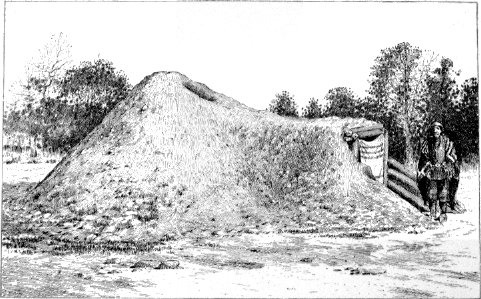
MEDICINE LODGE, VIEWED FROM THE SOUTH.
84. The first four days’ ceremonies in this case had been performed during the previous year. Such a division of the work is sometimes made, if more convenient for the patient and his friends, but usually all is done in nine consecutive days. These first days have less of interest than the others. Early each morning, before eating, all who desire, men and women, enter the medicine lodge, where, in a stifling
85. Fifth day. The chanter did not arrive until the afternoon of October 23. His ceremonies in the medicine lodge began on the morning of the 24th. The forenoon was devoted to the preparation and sacrifice of certain kethàwns (keçàn)—the sacrificial sticks, to the origin of which so much of the foregoing myth is devoted—and of sacrificial cigarettes. About eight o’clock the sick woman entered the medicine lodge, followed by the chanter. While she sat on the ground, with her limbs extended, he applied some powdered substance from his medicine bag to the soles of her feet, to her knees, breasts, shoulders, cheeks, and head, in the order named, and then threw some of it towards the heavens through the smoke hole. Before applying it to the head he placed some of it in her mouth to be swallowed. Then, kneeling on a sheep skin, with her face to the east, and holding the bag of medicine in her hand, she recited a prayer, bit by bit, after the chanter. The prayer being finished, she arose, put some of the medicine into her mouth, some on her head, and took her seat in the south, while the shaman went on with the preparation of the sacrifices.
86. An assistant daubed a nice straight branch of cherry with some moistened herbaceous powder, after which he divided the branch into four pieces with a flint knife. Two of the pieces were each about two inches long and two each about four inches long. In each of the shorter ones he made one slight gash and in each of the longer ones two gashes. The sticks were then painted, a shred of yucca leaf being used for the brush, with rings of black, red, and white, disposed in a different order on each stick. The two cigarettes were made by filling sections of some hollow stem with a mixture of some pulverized plants. Such cigarettes are intended, as the prayers indicate, to be smoked by the gods. (Paragraph 88.)
87. While the assistants were painting the sticks and making the cigarettes the old chanter placed on a sheep skin, spread on the floor woolly side down, other things pertaining to the sacrifice: five bundles of assorted feathers, five small pieces of cotton sheeting to wrap the sacrifices 85); two of the little sacrificial bundles were placed in her right hand, and while she held them she again repeated a prayer, following again phrase by phrase, or sentence by sentence, the words of the priest. The latter, when the prayer was ended, took the sacrifices from her hand and pressed them to different parts of her body in the order previously observed, beginning with the soles of the feet and going upwards to the head, but on this occasion touching also the back, and touching it last. Each time after pressing the sacrifices to her body he held them up to the smoke hole and blew on them in that direction a quick puff, as if blowing away some evil influence which the sacrifices were supposed to draw from her body. Then the three remaining bundles were put in her hands and the rites observed with the former bundles were repeated in every respect, including the prayer, which was followed by singing and rattling. When the song had ceased some of the assistants took the bundles of sacrifices out of the lodge, no doubt to bury them according to the method proper for those particular kethàwns. The round painted stones were also carried out.