THE MOUNTAIN CHANT: (continued 2)
Reading edition
88. The prayers which the woman repeated varied but little. They all sounded nearly alike. The night the shaman arrived he rehearsed some of these prayers with the woman, at her own hogán, to make her familiar with them before she repeated them, in the medicine lodge. The prayer addressed to Dsilyi‘ Neyáni, when she held in her hand the offering sacred to him, was as follows:
Reared Within the Mountains! Lord of the Mountains! Young Man! Chieftain! I have made your sacrifice. I have prepared a smoke for you. My feet restore thou for me. My legs restore thou for me. My body restore thou for me. My mind restore thou for me. My voice restore thou for me. Restore all for me in beauty. Make beautiful all that is before me. Make beautiful all that is behind me. Make beautiful my words. It is done in beauty. It is done in beauty. It is done in beauty. It is done in beauty. (Paragraphs 261-4.)
BUREAU OF ETHNOLOGY FIFTH ANNUAL REPORT PL. XI
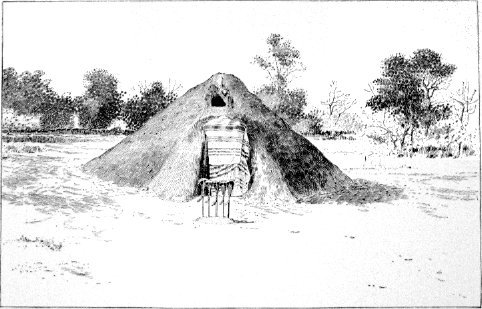
MEDICINE LODGE, VIEWED FROM THE EAST.
89. The next part of the ceremonies (or, shall I say, the treatment?) was a fumigation. The medicine man took from the fire a large glowing coal, placed it beside the woman, and scattered on it some powdered substance which instantly gave forth a dense smoke and a strong fragrance that filled the lodge. The woman held her face over the coal and inhaled the fumes with deep inspirations. When the smoke no longer rose the coal was quenched with water and carried out of the lodge by the chief, Manuelito, probably to be disposed of in some established manner. Then the woman left the lodge and singing and rattling were resumed.
90. While the rites just described were in progress some assistants were busy with other matters. One made, from the spotted skin of a fawn, two bags in which the akáninilis or couriers were to carry their meal on the morrow’s journey. Another brought in and hung over the doorway a bundle of dry, withered plants which he had just gathered. Glancing up at them I recognized the Gutierrezia and the Bouteloua. The bundle may have contained the other plants mentioned in the myth (paragraph 44). They were hung up there till the next day, to be then used in a manner which will be described (paragraph 101).
91. The sheepskin on which the sacrifices had been placed was taken away and a blanket was spread on the ground to receive some more sacred articles from the bag of the chanter. These were five long notched wands, some tail feathers of the wild turkey, some small downy feathers of the eagle, and some native mineral pigments—yellow ocher, a ferruginous black, and a native blue. With the pigments the assistants painted the notched wands; with the plumes the chanter trimmed them. (See Fig. 51 and Plate XI.) Then they were called çobolçà, a word of obscure etymology, or in¢ia‘, which signifies sticking up or standing erect. They are called in this paper “plumed wands.”
92. While some were making the çobolçà others busied themselves grinding, between stones, large quantities of pigments, coarser than those referred to above, to be used in making the sand pictures or dry paintings of the ceremony. They made five colors: black, of charcoal; white, of white sandstone; red, of red sandstone; yellow, of yellow sandstone; and “blue,” of the black and white, mixed in proper proportions; of course this was a gray, but it was their only cheap substitute for the cerulean tint, and, combined with the other colors on the sanded floor, in the dim light of the lodge, it could not easily be distinguished from a true blue. It may be remarked in passing that the Navajo apply to many things which are gray the term they use for blue (çolíj); thus the gray fox is called màï-çolíj (blue coyote) and a gray sheep is called a blue sheep. Yet that they make a distinction between these colors is, I think, fairly evident from the fact that in painting small articles, such as kethàwns and masks, they use the more costly articles of turquoise, malachite, and indigo. These coarse pigments for the dry paintings were put for convenience on curved pieces of piñon bark.
93. About noon they cleared off that portion of the floor of the lodge which lay west of the fire, and brought, in blankets, a quantity of dry sand, which they spread out over the cleared portion of the floor in a layer of the nearly constant depth of three inches. They smoothed the surface with the broad oaken battens used in weaving. Now for a time all operations were suspended in the lodge while the chanter went out to plant the çobolçà, or plumed wands, in front of the medicine lodge, and to lay beside them the collars of beaver skins and the symbols for wings which the couriers were to wear next day. (Fig. 51.) These articles, it was said, were placed outside as a sign to the gods that the holy pictures were being drawn; but it is not improbable that they were intended also as a sign to uninitiated mortals. However that may be, they were taken in as soon as the picture was finished. The great painting was begun about 1 o’clock p.m., was finished about 3, and was allowed to remain until the ceremonies at night were concluded. It will be described later. (Paragraphs 160 et seq.)
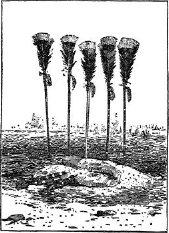
Fig. 51. The çobolçà, or plumed wands, as seen from the door of the medicine lodge.
94. When the picture was completed food was brought in, and there was a good deal of eating and sleeping and smoking done. Being informed that nothing more would be done until after nightfall, I went to my own shelter, to elaborate some of my more hasty sketches while matters were still fresh in my mind. At 7 o’clock a messenger came to tell me that ceremonies were about to be resumed. During my absence the principal character in the night’s performance—a man arrayed in evergreens—had been dressed.
95. I found, on returning to the lodge, a number of spectators seated around close to the edge of the apartment. The fire burned in the center. The sick woman, with some companions, sat in the south. The qaçàli, with a few assistants who joined him in singing and shaking rattles, was seated at the north, at the place where the circumference of the lodge was enlarged. (Paragraph 83.) There was a space about two feet wide and six feet long between them and the wall, or roof if you choose so to call it, of the lodge. I was assigned a place in the west. The sick woman was directed to move from the position she occupied Plate XV.)
96. When she was seated the qaçàli began a song, accompanied by the usual rattling and drumming. At a certain part of the song the chanter was seen to make a slight signal with his drumstick, a rapid stroke to the rear, when instantly a mass of animate evergreens—a moving tree, it seemed—sprang out from the space behind the singers and rushed towards the patient. A terrifying yell from the spectators greeted the apparition, when the man in green, acting as if frightened by the noise, retreated as quickly as he came, and in a moment nothing could be seen in the space behind the singers but the shifting shadows cast by the fire. He was so thoroughly covered with spruce twigs that nothing of his form save his toes could be distinguished when he rushed out in the full glare of the fire. This scene was repeated three times, at due intervals.
97. Some time after the third repetition, the chanter arose, without interrupting his song, and proceeded to erase the picture with his rattle. He began with the mountain in the west (paragraph 162), which he completely leveled; next in order he erased the track of the bear; next, the hole in the center; and then, one by one, the various other figures, ending with the serpents on the outside. In erasing the serpents, he began with the figures in the east and followed the apparent course of the sun, ending with the figures in the north. When the picture was completely obliterated, the sand on which it had been drawn was collected, put in a blanket, and carried out of doors, to be thrown away.
98. Then the sick woman was lifted by two other women and laid on her side where the picture had been, with her face to the east. While she lay there, the medicine man, amid much singing, walked around her, inscribed on the earth at her feet a straight line with his finger and erased it with his foot, inscribed at her head a cross and rubbed it out in the same manner, traced radiating lines in all directions from her body and obliterated them, gave her a light massage, whistled over her from head to foot and all around her, and whistled towards the smoke hole, as if whistling something away. These acts were performed in the order in which they are recorded. His last operation on her was a severe massage, in which he kneaded every part of her body forcibly and pulled her joints hard, whereat she groaned and made demonstrations of suffering. This concluded, she rose. A blanket was spread on the ground on the north of the fire, near where the man in evergreens was concealed. At the last appearance of the man in evergreens the woman fell back apparently paralyzed and suffering from difficulty of breathing, all of which was probably feigned, but was supposed to be a sign that the right remedy or ceremony for her ailment had been found and that none other need be tried. The medicine man now proceeded to restore her to consciousness by drawing zigzag lines from her body
99. There were no more ceremonies that night. I remained in the medicine lodge until it was quite late. The men occupied their time in singing, rattling, gambling, and smoking. After a while some grew weary and lay down to sleep. Being repeatedly assured that nothing more would happen until the whistle sounded in the morning, I left the lodge to roll myself in my blankets. Yet frequently during the night, fearing I might have been deceived, I stealthily arose and visited the medicine lodge, only to find all slumbering soundly.
100. Sixth day. At five in the morning (Saturday, October 25) the whistle sounded and I hastened to the medicine lodge. There was much to be done; the couriers were to be dressed and sent on their way, and a large picture was to be painted; so the work had to begin early.
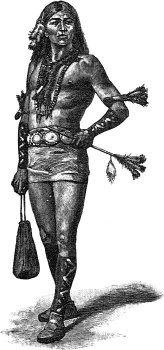
Fig. 52. Akáninili ready for the journey.
101. The first thing done was to burn to charcoal the bundle of plants which had been gathered on the previous morning and hung over the door of the lodge inside. (Paragraph 90.) The charcoal was used in painting the limbs of the akáninilis or couriers. A basin of water containing soap root or amolë (the root of Yucca baccata, and other species of yucca) was brought in, and after the medicine man had dabbed them with a little of the suds the akáninilis-elect washed themselves with it from head to foot, cleaning their hair well. When the bath was done, they were dabbed by the qaçàli with some other mixture contained in a waterproof wicker basin and were made to inhale the fragrant 44.) Their legs and forearms were painted black, to represent the storm cloud. The outer aspects of these members were decorated with white zigzag streaks, to indicate the white lightning. Their faces were painted partly white and small white spots were scattered over their bodies. Downy eagle feathers were fastened to their hair; necklaces of shell and coral were hung around their necks, and over these were laid collars of beaver skin, with whistles attached, which had lain in front of the lodge the day before, near the plumed wands. (Paragraph 93, Fig. 51.) Small objects to represent wings were tied to their arms. Each was given one of the fawn skin bags (paragraph 90) with corn meal in it. In the hand of the akáninili who was to go to the south was placed one of the çobolçà, or plumed wands, whose stem was painted black, the color of the north, as a sign to all he might meet that he was a duly authorized messenger from a medicine lodge in the north. In the hand of the other akáninili was placed a blue shafted wand, to show that he came from the south. Thus equipped they were all ready for the journey. (Fig. 52.)
102. The chanter gave them his messages, telling them where to go, what places they were to visit, what other chanters they were to see, what dancers they were to invite, and what gifts they were authorized to offer to the visiting performers for their trouble. Having given these special instructions, he closed with the general instructions, which are always given to the akáninili, as follows:
These [pointing to the eagle feathers on the head] will make for you a means of rising as you progress.
These [pointing to the wing symbols on the arm] will bear you onward.
This [pointing to the collar of beaver skin] will be a means of recognition for you. For this reason it hangs around your neck.
Sprinkle meal across a little valley, across a big arroyo.
Across the roots of a tree sprinkle meal and then you may step over.
Sprinkle meal across a flat rock.
Then the plumed wand. For this purpose you carry it, that they will recognize you as coming from a holy place.
103. The akáninili on his journey scatters meal before him as directed in these charges. He also scatters it on the medicine men whom he visits, and for this reason he is called akáninili, which signifies meal sprinkler.
104. When the last word of the instructions was uttered, the couriers departed, one to the north and one to the south. It was not later than 7 o’clock when they left. As soon as they were gone, the work of painting the picture appropriate to the day was begun. It was much more elaborate than the painting of the previous day. Although a dozen men worked on it, it was not finished until two o’clock. About the time
105. When the picture was finished, the shaman, having applied pollen in three places to each god, stuck around it in the ground, at regular intervals, the three plumed wands which had stood before the door of the lodge all day and the wand which the akáninili from the south had just brought back with him. This wand he placed at the south of the picture, and laid beside it the collar, wings, and plumes which the akáninili had worn. The fifth, or north, wand was still absent with the courier who went to the north.
106. All was ready now for the treatment of the sick woman. She was sent for, and a crier went to the door of the lodge to announce that song and ceremony were to begin. Accompanied by another woman, she entered, carrying a basket with corn meal in it. This she sprinkled lightly over the picture and then handed it to some of the assistants, who finished the work she had begun by strewing the meal plentifully on the figures. She sat on the form of the god in the east, facing the door, with her feet extended, and her companion sat on the figure of the cornstalk in the southeast. (Plate XVI.) In the mean time the medicine man had made a cold infusion in an earthen bowl and placed it on the hands of the rainbow figure (paragraph 169), laying over it a brush or sprinkler made of feathers, with a handle of colored yarn. When the women were seated, the chanter dipped his brush in the solution; sprinkled the picture plentifully; touched each divine figure with the moistened brush in three places-brow, mouth, and chest; administered the infusion to the women, in two alternate draughts to each; drained the bowl himself; and handed it to the bystanders, that they might finish the dregs and let none of the precious stuff go to waste. Next came the fumigation. The woman whom we have designated as the companion rose from her seat on the picture and sat on the ground beside the door. The principal patient retained her seat on the eastern god. Near each a live coal was laid on the ground. On the coal a strong scented but rather fragrant mixture was thrown, and as the fumes arose the women waved them towards their faces and breathed them in as before. The coal was extinguished and carefully removed, as on previous occasions. The application of the sacred dust to the body of the patient followed. The shaman moistened his hands with saliva and pressed them to the feet of all the gods. Some of the powder, of course, stuck to his palms. This he applied to the feet of the patient. Thus he took dust from the knees, abdomens, chests, shoulders, and heads of the figures and applied it to corresponding parts of the patient’s form, making a strong massage with each application.
107. When the patient had departed many of the spectators advanced to the picture and gathered the corn pollen (paragraphs 105 and 112), now
108. By the time they were all done the picture was badly marred; yet its general form and some of the details were quite distinguishable. Then it became the province of the chanter to completely obliterate it. He began with the white god in the east and took in turn the figures in the southeast (corn), south, southwest, west, center, northwest, north, and northeast. Next, the figure of the rainbow was erased from foot to head, and, on his way, the chanter knocked down, with rather vicious blows, the plumed wands which stood up around the picture. When he came to the round figure in the center he dug up a cup which had been buried there. He erased the picture with a long slender wand and sang in the meantime, to the accompaniment of the rattling of his assistants, a plaintive chant in a minor key, which was perhaps the most melodious Indian song I ever heard. All was over at half past 2 in the afternoon.
109. Later in the day it was announced that the other akáninili was approaching from the north. He could then be observed about a mile away in an open plain. As he advanced the sound of his whistle was heard. At exactly half past 4 he entered the medicine lodge, where the chanter motioned him to a seat in the south. Singing and rattling were at once begun and the akáninili was divested of his trappings in the following order: head plumes, beaver collar, necklace, right wing, left wing, belt, sash, moccasins. The white paint was removed and preserved as on the former occasion. He was led out of the lodge, where he was well washed from head to foot in a hot decoction of the detergent amolë and dried with corn meal. Two large blood blisters were to be seen on the inner aspects of his thighs, brought on by the friction of his breechcloth in running. He said that he had run constantly when not in sight from our camp, had traveled a long way since morning, and was very tired. It seems to be the custom with the akáninilis to walk slowly when near camp and to run when out of sight, probably to follow the mythic examples of Tlà¢esçìni and Indsiskàï. (Paragraph 63.)
110. With the toilet of the akáninili the ceremonies of the day ended. He returned to the lodge to relate his adventures and get some food. During the day visitors arrived occasionally from distant camps. In the afternoon there were several young men present, who busied themselves in grubbing and clearing the ground where the corral was to be built and the great dance of the last night was to be held. I remained in the lodge until it was quite late, and I frequently rose during the night to see if anything was going on; but the night passed without event, like the previous one.
111. Seventh day. The painting of the picture and the treatment of the sick woman were the only works performed on this day (Sunday, October 26). The whistle sounded from the lodge at 6 a.m., but already the plumed wands and the beaver collars had been placed before the door of the medicine lodge and the sand for the groundwork of the picture had been brought in. As the picture (Plate XVII) was to be larger than those which preceded it, the fire was moved quite near to the door; the heated earth which lay under the fire in its former position was dug up and replaced with cold earth, probably for the comfort of the artists.
112. The work of the painters was begun soon after 6 a.m. and was not completed until about 2 p.m. About a dozen men were engaged on it, and it occupied them, as we have seen, about eight hours. As usual, the qaçàli did very little of the manual labor; but he constantly watched the work and frequently criticised and corrected it. When the painting was done, it became his duty to apply the sacred corn pollen to the brow, mouth, and chest of each of the gods and to set up the bounding çobolçà or plumed wands. After this he placed a bowl of water on the left hand of the white god—the form second from the north—threw into it some powdered substance to make a cold decoction, and laid the sprinkler on top of it. (Paragraph 106.)
113. The whistle was blown. The herald announced that all was ready. The sick woman and her companion entered, and one after the other cast meal upon the floor. The former took off her moccasins and sat on the ground near the door while a song was sung. Then she sat on the form of the white god, her companion sat on the form of the blue god, and the singing and rattling were resumed. Without interrupting his song the chanter sprinkled the picture with the infusion, applied the moistened sprinkler to the breast, head, and brow of each of the gods in the following order: white, blue, yellow, black, and sat down to finish his chant. He administered the decoctions to his patient in two draughts, to her companion in two draughts, to himself (honest physician!) in the same manner, and gave as before (paragraph 106) the dregs to the bystanders. He applied the dust from different parts of the divine figures to the sick woman, in much the same manner as on the previous day, and while doing this he obliterated the pictures of the little animals over the head of the white god. The fumigation of both women was repeated with exactly the same rites as on the second day, and the fumes had precisely the same odor on this occasion as on that. When the coals were extinguished and taken out, the chanter said to the women, “kaç” (now), whereat they arose and left the lodge.
114. As soon as they were gone the work of obliteration began. The figures of the gods were rubbed out in the usual order (white, blue, yellow, black, rainbow), the erasure in each case proceeding from foot to head. The plumed wands fell as before, simultaneously with the destruction of the rainbow. The sand was carried out at half past 2 o’clock and no further rites were performed during the day.
115. Eighth day. The picture painted on Monday (October 27) was of a simple character, and hence did not occupy much time. The work was begun at 7 a.m. and was finished at 10 a.m. Of the four shorter or interior arrows (Plate XVIII), that which stands second from the north was regarded as the arrow of the east and was begun first. On this arrow the sick woman was placed, sitting with her face to the east, when she came to be treated and fumigated. The bowl of infusion was laid on the point of the arrow immediately to her left, regarded as the arrow of the north. The medicine man put the pollen on the base, on the red cross lines near the center, and on the white tips. All the ceremonies which took place between the completion and the obliteration of the picture (the planting of the five plumed wands, the sprinkling of the picture with meal, the sprinkling and administration of the infusion, the application of the colored dust to the person of the patient, the fumigation of the two women, the whistling, the singing, and rattling) were essentially the same as those observed on the previous day. In taking the dust from the picture, however, the shaman applied his hands only to the bases of the arrows. The ceremony of obliteration was also a repetition of the rites of the previous day.
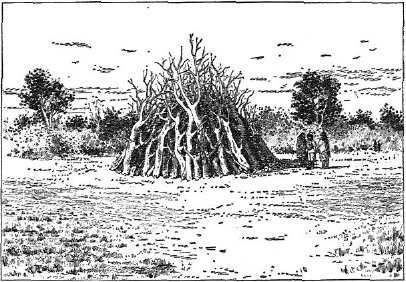
Fig. 53. The great wood pile.
116. The building of the great stack of wood (Fig. 53) which was to furnish the fire in the center of the corral on the last night went on simultaneously with the painting of the picture. Both tasks were begun and ended about the same time. The wood in the big pile was dead, long seasoned juniper and cedar, fuel of the most inflammable character. The pile was about twelve feet high and sixty paces in circumference.
117. In the afternoon there were no ceremonies in the medicine lodge. The qaçàli and his assistants took a half holiday, and not without deserving it, for they had wrought well for three days and they had a long day’s work and a long night’s work still before them. A large number of people had by this time assembled, and from time to time more arrived. Throughout the sparse grove which surrounded us, little temporary corrals and huts of boughs were going up in every direction. In more secret spots in the rugged walls of a cañon, about half a mile from the medicine lodge, other shelters were erected, where visiting performers were to prepare themselves on the last night. Many young men were busy in the afternoon cutting down the trees and lopping off the branches which were to form the great corral (the ilnásjin, the dark circle of branches) on the next day. Some of the visiting women were busy grinding meal and attending to different household duties; others played cards or engaged in the more aboriginal pastime of áz¢ilçil, a game played with three sticks and forty stones, the latter for counters.
118. The friends of the sick woman prepared the alkàn, a great corn cake baked in the earth, the manufacture of which gave evidence of the antiquity of the process. The batter was mixed in one large hole in the ground lined with fresh sheepskin. It was baked in another hole in which a fire had been burning for many hours, until the surrounding earth was well heated. The fire was removed; the hole lined with corn husks; the batter ladled in and covered with more cornhusks; hot earth and hot coals were spread overall. The cake was not dug up until the following day, and was designed chiefly for the special entertainment of those who were at work in the medicine lodge.
119. Ninth day (until sunset). On Tuesday (October 28) the work in the lodge consisted in preparing certain properties to be used in the ceremonies of the night. These were the wands to be used in the first dance, the kátso-yisçàn or great plumed arrows, and the trees which the dancers pretended to swallow.
120. The wand of the nahikàï was made by paring down a straight slender stick of aromatic sumac, about three feet long, to the general thickness of less than half an inch, but leaving a head or button at one end. A ring was fashioned from a transverse slice of some hollow or pithy plant, so that it would slide freely up and down the slender wand, but would nob pass over the head. Eagle down was secured to the wooden head and also to the ring. In the dance (paragraph 129) the eagle down on the stick is burned off in the fire while the ring is held in the palm of the hand. When the time comes for the wand to grow white again, as the name nahikàï expresses it, the ring is allowed to leave the palm and slide to the other end of the stick.
121. The great plumed arrows were deceptions somewhat similar in character to the wands. One-half of the arrow was made of a slender
122. The piñon saplings, which the dancers also pretended to swallow, had no deceptive arrangement. They were slender little trees trimmed at the butt into a broad, thin, wedge shaped point, which was carefully smoothed by rubbing it with sandstone, so that no offensive splinters should present themselves to the lips of the dancers. The smooth end was painted red, probably to make the spectators, at night, by the uncertain firelight, suppose that the dissemblers had torn their throats in their great efforts. Sometimes the saplings have all their branches removed, and are then trimmed with cross pieces and circles of evergreen sprays. In most cases, however, I have seen the sapling used in its natural condition.
123. As each set of implements was completed there was a ceremony with singing and rattling, the men who were to use them at night partook of powdered medicines on their extended tongues, from the hands of the chanter, and then practiced themselves in the use of the implements. Although they well knew the deceptive nature of these articles and fully understood the frauds they were preparing to perpetrate on the public, these young men seemed to view the whole work with high reverence and treat it with the greatest seriousness. For instance, when, in the secrecy of the lodge, they went through the motions of swallowing the trees they showed indubitable signs of fear: all looked anxious, some trembled quite perceptibly, and one looked as pale as a live Indian can look. They probably dreaded the displeasure of the gods if all were not done well.
124. Last night. Just after sunset the old chanter posted himself some paces to the east of the great woodpile, on the spot where the gate of the corral was to be, and began a song. Simultaneous with the beginning of the song was the commencement of the building of the dark circle. All the young and middleaged men in camp assisted. They dragged the branches from where they had been cut down in the neighboring woods and put them in position in the circle with great celerity. The work was all done in less than an hour, during which time the chanter ceased not for an instant his song and rattle. When the fence was finished to his satisfaction he stopped his song and the labors of the workmen ceased with the sound. When finished the corral averaged
125. The moment the dark circle of branches was finished it inclosed sacred ground. Any dog who dared to enter was chased out with shouts and missiles. The man or woman who came must, on the first occasion, pass around to the left, i.e., to the south of the great woodpile. No one was allowed to peep through the fence or look over the edge of if to witness the ceremonies. That part of the auditorium was reserved for the spirits of the bears and other ancestral animal gods. No horse might be led into the inclosure until after sunrise next morning, when the fence was razed and all became common soil once more.
126. When the night began to fall many of the visitors moved all their goods into the corral and lighted there a number of small fires close to the fence, temporarily abandoning their huts and shelters outside. Those who did not move in left watchers to protect their property; for there are thieves among the Navajo. The woods around the corral were lighted up in various directions by the fires of those who had not taken their property into the great inclosure and of parties who were practicing dances and shows of an exoteric character.
127. The nocturnal performances of this evening (Tuesday, October 28, 1884) were as meager as any I have seen within the dark circle of branches. The best show I ever witnessed in the circle was one which took place at Keam’s Cañon, Arizona, on the 5th of November, 1882. For this reason I will make the notes taken on the latter occasion the basis of my description of the “corral dance,” adding as I proceed such comments as may be justified by subsequent observation and information.
128. At 8 o’clock a band of musicians which I will call the orchestra entered, sat down beside one of the small fires in the west, and began to make various vocal and instrumental noises of a musical character, which continued with scarcely any interruption until the close of the dance in the morning. At the moment the music began the great central fire was lighted, and the conflagration spread so rapidly through the entire pile that in a few moments it was enveloped in great flames. A storm of sparks flew upward to the height of a hundred feet or more, and the descending ashes fell in the corral like a light shower of snow. The heat was soon so intense that in the remotest parts of the inclosure it was necessary for one to screen his face when he looked towards the fire. And now all was ready to test the endurance of the dancers who must expose, or seem to expose (paragraph 149), their naked breasts to the torrid glow.
BUREAU OF ETHNOLOGY FIFTH ANNUAL REPORT PL. XII
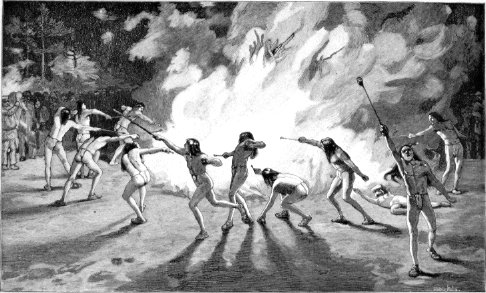
DANCE OF NAHIKÀÏ.
129. First dance (Plate XII). When the fire gave out its most intense heat, a warning whistle was heard in the outer darkness, and a dozen forms, lithe and lean, dressed only in the narrow white breechcloth and moccasins, and daubed with white earth until they seemed a group of living marbles, came bounding through the entrance, yelping 120), but the dancer feigned to produce the wonderful result by merely waving his wand up and down as he continued to run around the fire. When he succeeded he held his wand up in triumph, yelped, and rushed out of the corral. The last man pretended to have great difficulty in restoring the down. When at last he gave his triumphant yell and departed it was ten minutes to 9. The dance had lasted twenty minutes.
130. In other repetitions of this ceremony the writer has witnessed more of burlesque than on this occasion. Sometimes the performers have worn immense false mustaches, exaggerated imitations of spectacles and of other belongings of their white neighbors. Sometimes the dance has assumed a character which will not be described in this place (paragraph 146). It is called nahikàï-alil. The former word signifies “it becomes white again” and refers to the reappearance of the eagle down. The show is said to have been introduced among the Navajo at the great corral dance mentioned in the myth (paragraphs 69-72) by a tribe from the south named ¢ildjèhe. It is no essential part of the rites of the dark circle, yet I have never known it to be omitted, probably because it is a most suitable dance for the time when the fire is the hottest.
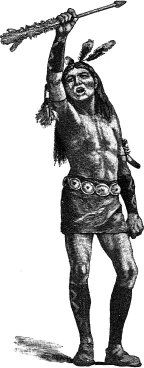
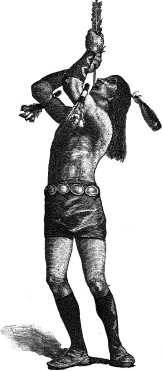
Fig. 54. Dancer holding up the great plumed arrow. Fig. 55. Dancer “swallowing” the great plumed arrow.
131. Second dance. After an interval of three-quarters of an hour, the dance of the kátso-yisçàn, the great plumed arrow, the potent healing ceremony of the night, began. There were but two performers. They were dressed and arrayed much like the akáninili, but they bore no meal bags, wore no beaver collars, and the parts of their bodies that Fig. 54), and then appeared to thrust the arrow, slowly and painfully, down his throat (Fig. 55) as far as indicated. While the arrows seemed still to be stuck in their throats, they danced a chassé, right and left, with short, shuffling
132. The plumed arrow is frequently referred to in the songs of this rite. It seems to be the most revered implement and the act in which it appears the most revered alili of the night. All the other shows may be omitted at will, but the dance of the kátso-yisçàn, it is said, must never be neglected. I have witnessed other performances where the arrow swallowers reappeared with their numbers increased to six or eight. The additional dancers all pretended to swallow arrows, but they did not apply them to the patient. The origin of this alili is well accounted for in the myth (paragraphs 47, 55, and 69), and the peculiar significance of the injunction not to break the arrow is easily understood when we know how the arrow is made.
133. Third dance. At 10 o’clock the sound of the whistle again called the spectators to attention and a line of twenty-three dancers came in sight. The one who led the procession bore in his hand a whizzer (Fig. 56) such as schoolboys use, a stick tied to the end of a string; this he constantly whirled, producing a sound like that of a rain storm. After him came one who represented a character, the Yébaka (anglicized, Yaybaka), from the great nine days’ ceremony of the klédji-qaçàl, or night chant, and lie wore a blue buckskin mask that belongs to the character referred to. From time to time he gave the peculiar hoot or call of the Yàybichy, “hu‘hu‘hu‘hu” (paragraph 32). After him followed eight wand bearers. They were dressed like the bearers of the great plumed arrows; but instead of an arrow each bore a wand made of grass, cactus, and eagle plumes. The rest of the band were choristers in ordinary dress. As they were all proceeding round the fire for the fourth time they halted in the west, the choristers safe and the standing wand bearers formed a double row of four. Then the Yaybaka began to hoot, the orchestra to play, the choristers to sing, the whizzer to make his mimic storm, and the wand bearers to dance. The latter, keeping perfect time with the orchestra, went through a series of figures not unlike those of a modern quadrille. In our terpsichorean nomenclature the “calls” might have thus been given: “Forward and back. Chassez twice. Face partners. Forward and back. Forward and bow. Forward and embrace. Forward and wave wands at partners,”
134. Three times more the same band returned. In the third and fourth acts the wands were exchanged for great piñon poles (eight to ten feet long), portions of which they pretended to swallow, as their predecessors had done with the arrows. (Paragraph 48.) That the simple and devoted Pueblo Indian does actually, in dances of this character, thrust a stick far down his gullet, to the great danger of health and even of life, there is little reason to doubt; but the wily Navajo attempts no such prodigies of deglutition. A careful observation of their movements on the first occasion convinced me that the stick never passed below the fauces, and subsequent experience in the medicine lodge only strengthened the conviction (paragraph 121).

Section.
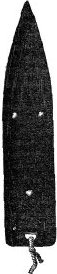
Fig. 56. The whizzer.
135. The instrument designated above as the whizzer is a thin, flat, pointed piece of wood, painted black and sparkling with the specular iron ore which is sprinkled on the surface; three small pieces of turquoise are inlaid in the wood to represent eyes and mouth. One whizzer which I examined was nine inches long, one and three-fourths inches broad, and about a quarter of an inch thick in the thickest part. (Fig. 56.) To it was attached a string about two feet long, by means of which the centrifugal motion was imparted to it. It is called by the Navajo tsín-¢e‘ní‘, or groaning stick. It is used among many tribes of the southwest in their ceremonies. The Navajo chanters say that the sacred groaning stick may only be made of the wood of a pine tree which has been struck by lightning.
136. In the Fourth dance there were about thirty choristers, in ordinary dress, bearing piñon wands; there was a man who shook a rattle, another who whirled the groaning stick, and there were three principal dancers, wearing fancy masks and representing characters from the rites of the klèdji qaçàl or dance of the “Yàybichy.” These three danced a lively and graceful jig, in perfect time to the music, with many bows, waving of wands, simultaneous evolutions, and other pretty motions which might have graced the spectacular drama of a metropolitan theater. Three times they left the corral for a moment, and returning varied the dance, and always varied to improve. The wands they bore were large light frames of reeds adorned with large eagle plumes.
137. After this there was an interval of nearly an hour, which passed slowly with those in the corral. Some smoked and gossiped; some listened to the never ceasing din of the orchestra or
138. Fifth dance. It was after midnight when the blowing of a hoarse buffalo horn announced the approach of those who were to perform the fifth dance, the tcòhanoai alili or sun show. There were twenty-four choristers and a rattler. There were two character dancers, who were arrayed, like so many others, in little clothing and much paint. Their heads and arms were adorned with plumes of the war eagle, their necks with rich necklaces of genuine coral, their waists with valuable silver studded belts, and their loins with bright sashes of crimson silk. One bore on his back a round disk, nine inches in diameter, decorated with radiating eagle plumes to represent the sun. The other carried a disk, six and a half inches in diameter, similarly ornamented, to symbolize the moon. Each bore a skeleton wand of reeds that reminded one of the frame of a great kite; it was ornamented with pendant eagle plumes that swayed with every motion of the dancer. While the whole party was passing round the fire in the usual manner wands were waved and heads bowed towards the flames. When it stopped in the west the choristers sat and sang and the rattler stood and rattled, while the bearers of the sun and the moon danced at a lively rate for just three minutes. Then the choristers rose and all sang and danced themselves out of sight. A second performance of this dance came between the first and second repetitions of the next show.
139. I have recorded one story (but have heard of another) accounting for the origin of this dance; it is as follows: When Dsilyi‘ Neyáni visited the mountain of Bistcàgi, the home of Estsàn ¢igìni, these divine beings had for ornaments on their walls the sun and the moon. When the great mythic dance was given they were among the guests. They brought their wall decorations, and when the time for their alili came, they wore the sun and the moon on their backs when they danced.
140. The Sixth dance, that of the standing arcs, was both picturesque and ingenious. The principal performers were eight in number, as usual with scanty clothing. Their hair fell loose and long over back and shoulders and each bore in front of him, held by both hands, a wooden arc, ornamented with eagle plumes. The ends of the arc (which was a full semicircle) showed tufts of piñon twigs, and they were evidently joined together by a slender string, which was invisible to the audience. Besides the eight principal actors, there was a rattler, a bearer of the groaning stick, and a chorus. While all were making the fourth circuit of the fire, frequent shouts of “Çòhe! Çòhe!” (Englished, Thòhay—“Stand! stand!” or “Stay! stay!”) were heard, the significance of which soon became apparent. When they stopped in the west, the eight character dancers first went through various quadrille-like figures, such as were witnessed in the third dance, and then knelt in two rows that faced one another. At a word from the rattler the man who was nearest to him
141. Seventh dance. The arc bearers had scarcely disappeared when another troupe entered the circle, the buffalo horn announcing their coming. A man with a whizzer led the procession. The choristers, in ordinary dress, were thirteen in number. The principal dancers were but two; they wore the usual sash and belt; the uncovered skin was painted white; they had on long blue woolen stockings of Navajo make and moccasins. Each bore a slender wand of two triangles of reeds adorned at the corners with pendant plumes. They saluted the fire as they danced around it. They halted in the west, where the choristers sat down, and the two wand bearers danced for three minutes in a lively and graceful manner, to the music of the whizzer, the rattle, the choristers, and the drum of the orchestra. These returned twice more, making some variation in their performance each time. In the second act the rattler brought in under his arm a basket containing yucca leaves, and a prayer was said to the sun. It is possible that this dance was but a preliminary part of the eighth dance, but it must be described as a separate alili.
142. Eighth dance. In this there were sixteen performers, in ordinary Navajo dress. One of these bore the whizzer and led the procession; another, who came in the center of the line, carried a hewn plank, or puncheon, about 12 feet long and 4 inches broad, painted with spots and decorated with tufts of piñon branchlets and with eagle plumes; immediately behind the bearer of the plank walked a man who had in a basket an effigy of the sun, formed of a small round mirror and a number of radiating scarlet plumes. Having walked around the fire as usual,
143. Ninth dance. It was after 1 o’clock in the morning when the dance of the hoshkàwn (Yucca baccata) began. (Fig. 57. See paragraph 3.) The ceremony was conducted in the first part by twenty-two persons in ordinary dress. One bore, exposed to view, a natural root of yucca, crowned with its cluster of root leaves, which remain green all winter. The rest bore in their hands wands of piñon. What other properties they may have had concealed under their blankets the reader will soon be able to conjecture. On their third journey around the fire they halted in the west and formed a close circle for the purpose of concealing their operations, such as was made in the eighth dance. After a minute spent in singing and many repetitions of “Thòhay,” the circle opened, disclosing to our view the yucca root planted in the sand. Again the circle closed; again the song, the rattle, and the chorus of “Thòhay” were heard, and when the circle was opened the second time an excellent counterfeit of the small budding flower stalk was seen amid the fascicle of leaves. A third time the dancers formed their ring of occultation; after the song and din had continued for a few seconds the circle parted for the third time, when, all out of season, the great panicle of creamy yucca flowers gleamed in the firelight. The previous transformations of the yucca had been greeted with approving shouts and laughter; the blossoms were hailed with storms of applause. For the fourth and last time the circle closed, and when again it opened the blossoms had disappeared and the great, dark green fruit hung in abundance from the pedicels. When the last transformation was completed the dancers
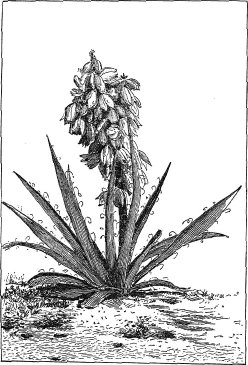
Fig. 57. Yucca baccata.
144. In a moment after they had disappeared the form of one personating an aged, stupid, short sighted, decrepit man was seen to emerge slowly from among the crowd of spectators in the east. He was dressed in an old and woefully ragged suit and wore a high, pointed hat. His face was whitened and he bore a short, crooked, wooden bow and a few crooked, ill made arrows. His mere appearance provoked the “stoic” audience to screams of laughter, and his subsequent “low comedy business,” which excelled much that I have seen on the civilized stage, failed not to meet with uproarious demonstrations of approval. Slowly advancing as he enacted his part, he in time reached the place
145. There were scenes in this drama which may not be told in this connection. It will suffice to say here that when the yucca fruit was picked and put in the basket the old man helped the “woman” to shoulder her load and the pair left the corral. The hackàn-inçá‘ does not invariably appear in the corral dance. I have attended one ceremony where it was omitted. I have heard two descriptions of the dance which differed very much from the one given above.
146. Many facts concerning not only the hackàn inçá‘, but other parts of the mountain chant, have not been allowed to appear in this essay. Recognized scientists may learn of them by addressing the author through the Director of the Bureau of Ethnology.
147. Tenth dance. At twenty minutes past three an uninteresting performance called the “bear dance” began. A man entered on all fours; his face was painted white; he wore around his loins and over his shoulders pieces of some dark pelt which may have been bear skin, but looked more like the skin of a black sheep. The fire had now burned low and the light was dim. He was accompanied by two attendants, one of whom carried a rattle. He went twice around the ring, imitating the lumbering gait of the bear. He occasionally made a clumsy lunge sidewise at some of the spectators, as though he would attack them; but on these occasions the man with the rattle headed him off and rattling in his face directed him back to the usual course around the fire. This show lasted five minutes.
BUREAU OF ETHNOLOGY FIFTH ANNUAL REPORT PL. XIII
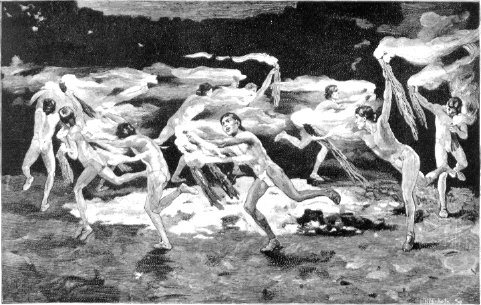
FIRE DANCE.
148. The Eleventh dance, was the fire dance, or fire play, which was the most picturesque and startling of all. Some time before the actors entered, we heard, mingled with the blowing of the buffalo horn, strange sounds, much like the call of the sand-hill crane; they will, for convenience, be called trumpeting. These sounds continued to grow louder and come nearer until they were heard at the opening in the east, and in a second after, ten men, having no more clothing on than the performers in the first dance, entered. Every man except the leader bore a long thick bundle of shredded cedar bark in each hand and one had
149. Did these dancers, next day, hide sore and blistered backs under their serapes? I think not, for I have seen and conversed with some of the performers immediately after the fire show, and they seemed happy and had nothing to complain of. Did the medicine they spat on one another save them? Certainly not, although the Indians claim it is a true prophylactic against burns and call it azè-sakázi or cold medicine. But it is probable that the cedar bark ignites at a low temperature, and more than probable that the coating of white earth with which their bodies were covered is an excellent non-conductor. However, the thought that their bodies might have been thus ingeniously protected lessened little, if any, the effect produced on the spectator.
150. The closing ceremonies I did not witness on this occasion, but I saw them at subsequent dances. Shortly before sunrise an assistant passed around the fire four times and sprinkled a little water on the mass of smoldering embers, while the medicine man chanted the appropriate song. Later, three gaps were torn in the circle of branches—one in the south, one in the west, and one in the north—making, with the original gate in the east, four entrances to the corral. (See Plate XIV.) Just after sunrise the entire circle of branches was razed, but the branches were not carried away. The traveler through the Navajo country often encounters withered remains of these circles. In the ceremony of October, 1884, the chanter, having another engagement which was pressing, packed up his sacred utensils and left soon after sunrise. The patient, it was said, was not permitted to sleep until after sunset.
BUREAU OF ETHNOLOGY FIFTH ANNUAL REPORT PL. XIV
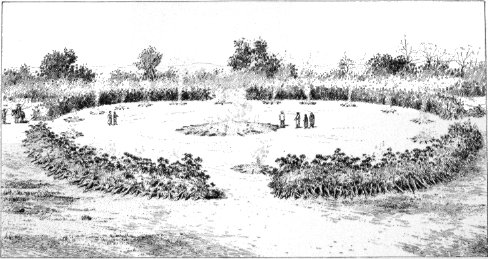
THE DARK CIRCLE OF BRANCHES AT SUNRISE.
151. Other dances. In subsequent dances I saw exhibitions which did not occur in the ceremony of November 5, 1882, just described, and I have learned of other shows produced on the last night, which I have never had an opportunity to witness. All the alilis may be modified. I have rarely seen two performances of the same dance which were just alike.
152. On two occasions I have witnessed a very pretty dance, in which an eagle plume was stuck upright in a basket and by means of some well hidden mechanism caused to dance in good time to the song, the beat of the drum, and the motions of the single Indian who danced at the same time; not only this, but the feather followed the motions of the Indian: if he danced toward the north, the feather leaned to the north while making its rhythmical motions; if he moved to the south, it bent its white head in the same direction, and so on. On one occasion it was a little boy, five years old, son of the chief Manuelito, who danced with the eagle plume. He was dressed and painted much like the akáninili, or the arrow swallowers (Figs. 54, 55), on a diminutive scale. The sash of scarlet velvet around his hips was beautifully trimmed with feathers. They said he had been several weeks in training for the dance, and he certainly went through his varied motions with great skill. I have rarely seen a terpsichorean spectacle that struck my fancy more than that of the little Indian child and his partner, the eagle plume.
153. It might be thought that the word “thòhay,” so often used to make inanimate objects pay attention, was one of very sacred import. So it is, no doubt; yet I have seen it broadly burlesqued. It was on the occasion of the last “chant” which I attended. A number of boys, from twelve to fifteen years of age they seemed, led by a pleasant looking old man
THE GREAT PICTURES OF DSILYÍDJE QAÇÀL.
154. A description of the four great pictures drawn in these ceremonies has been deferred until all might be described together. Their relations to one another rendered this the most desirable course to pursue. The preparation of the ground and of the colors, the application of the sacred pollen, and some other matters have been already considered.
155. The men who do the greater part of the actual work of painting, under the guidance of the chanter, have been initiated, but need not be skilled medicine men or even aspirants to the craft of the shaman. A certain ceremony of initiation has been performed on them four times, each time during the course of a different dance, before they are admitted into the lodge during the progress of the work or allowed to assist in it. The medicine man receives a good present in horses for his work; the assistants get nothing but their food. This, however, is abundant. Three times a day the person for whose benefit the dance is performed sends in enough mush, corn cake, soup, and roasted mutton to satisfy to the utmost the appetites of all in the lodge. There are some young men who live well all winter by going around the country from dance to dance and assisting in the work of the lodge.
156. The pictures are drawn according to an exact system. The shaman is frequently seen correcting the workmen and making them erase and revise their work. In certain well defined instances the artist is allowed to indulge his individual fancy. This is the case with the gaudy embroidered pouches which the gods carry at the waist. Within reasonable bounds the artist may give his god just as handsome a pouch Plate XVII), which are drawn 9 feet in length, the naked body is first made in its appropriate color—white for the east, blue for the south, yellow for the west, and black for the north—and then the four red shirts are painted on from thigh to axilla, as shown in the picture.
157. The drawings are, as a rule, begun as much towards the center as the nature of the figure will permit, due regard being paid to the order of precedence of the points of the compass, the figure in the east being begun first, that in the south next, that in the west third in order, and that in the north fourth. The periphery is finished last of all. The reason for thus working from within outwards is that the men employed on the picture disturb the smooth surface of the sand with their feet. If they proceed in the order described they can smooth the sand as they advance and need not cross the finished portions of the picture.
158. I have learned of seventeen great healing dances of the Navajo in which pictures of this character are drawn. There are said to be, with few exceptions—only one exception that I am positively aware of—four pictures appropriate to each dance. Some of the dances are practiced somewhat differently by different schools or orders among the medicine men, and in these divers forms the pictures, although agreeing in general design, vary somewhat in detail. Thus there are, on an average, probably more than four designs, belonging to each of the seventeen ceremonies, whose names I have obtained. If there were but four to each, this would give us sixty-eight such paintings known to the medicine men of the tribe, and thus we may form some conception of the great number of these sacred pictures which they possess. But I have reason to believe, from many things I have heard, that besides these seventeen great nine days’ ceremonies to which I refer, there are many minor ceremonies, with their appropriate pictures; so that the number is probably greater than that which I give.
159. These pictures, the medicine men aver, are transmitted from teacher to pupil in each order and for each ceremony unaltered from
BUREAU OF ETHNOLOGY FIFTH ANNUAL REPORT PL. XV
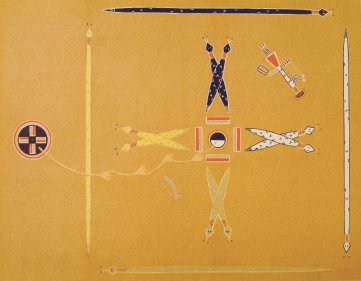
FIRST DRY-PAINTING larger view
160. First Picture. The picture of the first day (Plate XV) is said to represent the visit of Dsilyi‘ Neyáni to the home of the snakes at Qo¢estsò. (Paragraph 53.)
161. In the center of the picture was a circular concavity, about six inches in diameter, intended to represent water, presumably the house of water mentioned in the myth. In all the other pictures where water was represented a small bowl was actually sunk in the ground and filled with water, which water was afterwards sprinkled with powdered charcoal to give the impression of a flat, dry surface. Why the bowl of water was omitted in this picture I do not know, but a medicine man of a different fraternity from that of the one who drew the picture informed me that with men of his school the bowl filled with water was used in the snake picture as well as in the others. Closely surrounding this central depression are four parallelograms about four inches by ten inches in the original pictures. The half nearer the center is red; the outer half is blue; they are bordered with narrow lines of white. The same figures are repeated in other paintings. They appear in this drawing, and frequently in others, as something on which the gods seem to stand. They are the ca‘bitlòl, or rafts of sunbeam, the favorite vessels on which the divine ones navigate the upper deep. In the Navajo myths, when a god has a particularly long and speedy journey to make, he takes two sunbeams and, placing them side by side, is borne off in a twinkling whither he wills. Red is the color proper to sunlight in their symbolism, but the red and blue together represent sunbeams in the morning and evening skies when they show an alternation of blue and red. It will be seen later that the sunbeam shafts, the halo, and the rainbow are represented by the same colors. In form, however, the halo is circular, and the rainbow is distinguished by its curvature, and it is usually anthropomorphic, while the sunbeam and the halo are not. External to these sunbeam rafts, and represented as standing on them, are the figures of eight serpents, two white ones in X. In drawing these X’s the snake which appears to be beneath is made first complete in every respect, and then the other snake is drawn over it in conformity with their realistic laws of art before referred to. The neck, in all cases, is blue, crossed with four bands of red. The necks of the gods in all the pictures, it will be observed, are made thus, but the bars in the manlike figures run transversely, while those in the snake-like run diagonally. Three rows of V-shaped figures, four in each row, are seen on the backs of the snakes; these are simply to represent mottlings. Outside of these eight snakes are four more of much greater length; they form a frame or boundary to the picture, except in the west, where the mountain of Dsilyà-içín lies beyond them. There is a white snake in the east, lying from north to south and bounding the picture in the east; a blue snake, of similar size and shape, in the south; a yellow one in the west, and a black one in the north. They seem as if following one another around the picture in the direction of the sun’s apparent course, the head of the east snake approximating the tail of the south snake, and so on.
162. In the northeast is seen the yay, Niltci, who accompanied the Navajo prophet to the home of the snakes. In the extreme west is a black circular figure representing the mountain of Dsilyà-içín. In the original picture the mountain was in relief—which I have not attempted to represent—a little mound of about ten or twelve inches high. The description of the mountain given in the myth is duly symbolized in the picture, the halo added. The green spot in the center is designed to represent a twig of spruce which was stuck in the mound of sand to indicate the spruce tree door. From the summit of the mountain to the middle of the central waters is drawn a wide line in corn meal, with four footprints, depicted at intervals, in the same material. This represents the track of a bear. Immediately south of this track is the figure of an animal drawn in gray pigment. This is the grizzly himself, which here, I have reason to believe, is used as a symbol of the Navajo prophet. The bear, in the sacred language of the shamans, is appropriately called Dsilyi‘ Neyáni, since he is truly reared within the mountains. His track, being represented by a streak of meal, has reference to the same thing as the name akáninili and the practice of the couriers (paragraph 102), who are dressed to represent the prophet, throwing corn meal in front of them when they travel.
BUREAU OF ETHNOLOGY FIFTH ANNUAL REPORT PL. XVI
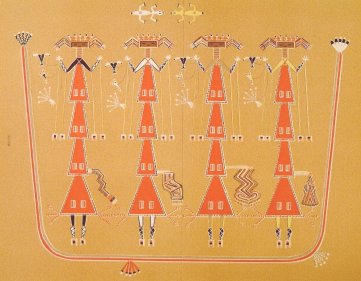
SECOND DRY PAINTING larger view
163. The Second Picture is said to be a representation of the painting, which the prophet saw in the home of the bears in the Carrizo Mountains (paragraph 40). In the center of this figure is the bowl of water covered with black powder, to which I referred before. The edge of the bowl is adorned with sunbeams, and external to it are the four ca‘bitlol, or sunbeam rafts, on which seem to stand four gods, or yays.
164. The divine forms are shaped alike but colored differently. They lie with heads extended outward, one to each of the four cardinal points of the compass, the faces looking forward, the arms half extended on either side, with the hands raised to a level with the shoulders. They wear around their loins skirts of red sunlight, adorned with sunbeams. They have ear pendants, bracelets, and armlets, blue and red (of turquoise and coral), the prehistoric and emblematic jewels of the Navajo. Their forearms and legs are black, showing in each a zigzag mark to represent lightning on the surface of the black rain clouds. In the north god these colors are, for artistic reasons, reversed. Each bears, attached to his right hand with a string, a rattle, a charm, and a basket. The rattle is of the shape of those used by the medicine men in this particular dance, made of raw hide and painted to symbolize the rain cloud and lightning. The left hand is empty; but beside each one is a highly conventionalized picture of a plant. The left hand remains empty, as it were, to grasp this plant, to indicate that the plant at the left hand belongs to the god whose corresponding hand is unoccupied and extended towards it. The proprietorship of each god in his own particular plant is further indicated by making the plant the same color as the god. The body of the eastern god is white; so is the stalk of corn at his left, in the southeast. The body of the southern god is blue; so is the beanstalk beside him, in the southwest. The body of the western god is yellow; so is his pumpkin vine, in the northwest. The body of the north god is black; so is the tobacco plant, which is under his special protection, in the northeast.
165. Each of the four sacred plants is represented as growing from five white roots in the central waters and spreading outwards to the periphery of the picture. The gods form one cross whose limbs are directed to the four cardinal points; the plants form another cross having a common center with the first named cross, but whose limbs extend to the intermediate points of the compass.
166. On the head of each yay is an eagle plume lying horizontally and pointing to the right. A similar arrangement of four plumes, all pointing in one direction (contrary to the sun’s apparent course), may be observed on the baskets carried by the gods.
167. The gods are represented with beautiful embroidered pouches, each of a different pattern. In old days the most beautiful things in art the Navajo knew of were the porcupine quill embroideries of the northern races. The art of garnishing with quills, and later with beads, seems never to have been practiced to any extent by the Navajo women. They obtained embroideries of the Ute and other northern tribes, and their ancient legends abound in allusions to the great esteem in which they held them. (See, for instance, paragraphs 32, 34.) Hence, to represent the grandeur and potency of their gods, they adorn them with these beautiful and much coveted articles.
168. Surrounding the picture on about three-fourths of its circumference is the anthropomorphic rainbow or rainbow deity. It consists of two long stripes, each about two inches wide in the original picture, one of blue, one of red, bordered and separated by narrow lines of white. At the southeastern end of the bow is a representation of the body below the waist, such as the other gods have, consisting of pouch, skirt, legs, and feet. At the northeastern end we have head, neck, and arms. The head of the rainbow is rectangular, while the heads of the other forms in this picture are round. In the pictures of the Yàybichy dance we frequently observe the same difference in the heads. Some are rectangular, some are round; the former are females, the latter males; and whenever any of these gods are represented, by characters, in a dance, those who enact the females wear square stiff masks, like our dominoes, while those who enact the males wear roundish, baglike masks, of soft skin, that completely envelop the head. The rainbow god in all these pictures wears the rectangular mask. Iris, therefore, is with the Navajo as well as with the Greeks a goddess.
169. All the other gods bear something in their hands, while the hands of the rainbow are empty. This is not without intention. When the person for whose benefit the rites are performed is brought in to be prayed and sung over, the sacred potion is brewed in a bowl, which is placed on the outstretched hands of the rainbow while the ceremony is in progress and only taken from these hands when the draught is to be administered. Therefore the hands are disengaged, that they may hold the gourd and its contents when the time comes (paragraph 106).
170. In the east, where the picture is not inclosed by the rainbow, we see the forms of two birds standing with wings outstretched, facing one another, their beaks close together. These represent certain birds of blue plumage called by the Navajo çòli (Sialia arctica). This bluebird is of the color of the south and of the upper regions. He is the herald of the morning. His call of “çòli çòli” is the first that is heard when the gray dawn approaches. Therefore is he sacred, and his feathers form a component part of nearly all the plume sticks used in the worship of this people. Two bluebirds, it is said, stand guard at the door of the house wherein these gods dwell; hence they are represented in the east of the picture.
171. Here is an appropriate occasion to speak of a part of Navajo symbolism in color to which reference has already several times been made. In the majority of cases the east is represented by white, the south by blue, the west by yellow, the north by black; the upper world by blue and the lower by a mixture of white and black in spots. The colors of the south and west seem to be permanent: the south is always blue and the west is always yellow, as far as I can learn; but the colors of the east and north are interchangeable. The cases are rare where white is assigned to the north and black to the east; but such cases
BUREAU OF ETHNOLOGY FIFTH ANNUAL REPORT PL. XVII
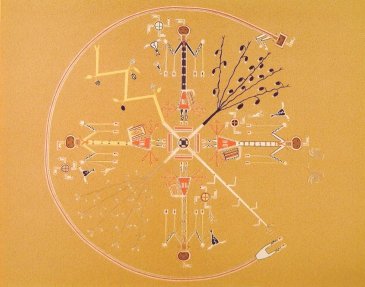
THIRD DRY-PAINTING larger view
172. The Third Picture commemorates the visit of Dsilyi‘ Neyáni to Çaçò‘-behogan, or “Lodge of Dew” (paragraph 56). To indicate the great height of the Bitsès-ninéz the figures are twice the length of any in the other pictures, except the rainbows, and each is clothed in four garments, one above the other, for no one garment, they say, can be made long enough to cover such giant forms. Their heads all point to the east, instead of pointing in different directions, as in the other pictures. The Navajo relate, as already told (paragraph 56), that this is in obedience to a divine mandate; but probably there is a more practical reason, which is this: if they had the cruciform arrangement there would not be room on, the floor of the lodge for the figures and at the same time for the shaman, assistants, and spectators. Economy of space is essential; but, although drawn nearly parallel to one another, the proper order of the cardinal points is not lost sight of. The form immediately north of the center of the picture is done first, in white, and represents the east. That immediately next to it on the south comes second in order, is painted in blue, and represents the south. The one next below that is in yellow, and depicts the goddess who stood in the west of the House of Dew-Drops. The figure in the extreme north is drawn last of all, in black, and belongs to the north. As I have stated before, these bodies are first made naked and afterwards clothed. The exposed chests, arms, and thighs display the colors of which the entire bodies were originally composed. The glòï (weasel, Putorius) is sacred to these goddesses. Two of these creatures are shown in the east, guarding the entrance to the lodge. The appendages at the sides of the heads of the goddesses represent the glòï-bitcà, or headdresses of glòï skins of different colors which these mythic personages are said to wear. Each one bears attached to her right hand a rattle and a charm, or plume stick, such as the gods in the second picture carry; but, instead of the basket shown before, we see a conventionalized representation of a branch of choke cherry in blossom; this consists of five diverging stems in blue, five roots, and five cruciform blossoms in white. The choke cherry is a sacred tree, a mountain plant; its wood is used in making certain sacrificial plume sticks and certain implements of the dance; it is often mentioned in the songs of this particular rite. Some other adjuncts of this picture—the red robes embroidered with sunbeams, the arms and legs clothed with clouds and lightning, the pendants from the arms, the blue and red armlets, bracelets, and garters—have already been described when speaking of the second picture. The object in the left hand is a wand of spruce.
173. The rainbow which incloses the picture on three sides is not the anthropomorphic rainbow. It has no head, neck, arms, or lower extremities. Five white eagle plumes adorn its southeastern extremity. Five tail plumes of some blue bird decorate the bend in the southwest. Colaptes auratus var. mexicanus) are near the bend in the northwest and the tail of the magpie terminates the northeastern extremity. Throughout the myth, it will be remembered, not only is the House of Dew-Drops spoken of as adorned with hangings and festoons of rainbows, but many of the holy dwellings are thus embellished.
BUREAU OF ETHNOLOGY FIFTH ANNUAL REPORT PL. XVIII
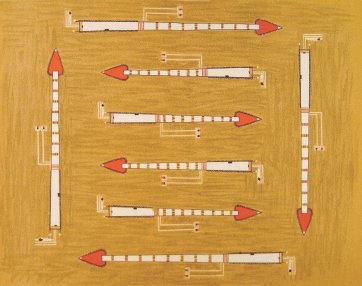
FOURTH DRY-PAINTING larger view
174. The Fourth Picture represents the kátso-yisçàn, or great plumed arrows. These arrows are the especial great mystery, the potent healing charm of this dance. The picture is supposed to be a fac simile of a representation of these weapons, shown to the prophet when he visited the abode of the Tsilkè-¢igini, or young men gods, where he first saw the arrows (paragraph 47). There are eight arrows. Four are in the center, lying parallel to one another—two pointing east and two others, alternate, pointing west. The picture is bordered by the other four, which have the same relative positions and directions as the bounding serpents in the first picture. The shafts are all of the same white tint, no attention being paid to the colors of the cardinal points; yet in drawing and erasing the picture the cardinal points are duly honored. Among the central arrows, the second from the top, or north margin of the design, is that of the east; it is drawn and erased first. The next below it is the arrow of the south; the third is that of the west. The one on top belongs to the north; it is drawn and erased last. The heads are painted red to represent the red stone points used; the fringed margins show the irregularities of their edges. The plumes at the butt are indicated, as are also the strings by which the plumes are tied on and the notches to receive the bowstring.
175. The ground of this picture is crossed with nebulous black streaks. These were originally present in all the pictures. I have omitted them in all but this, lest they might obscure the details of the reduced copies. It has been explained to me (although in the myth it is expressly stated only in one case, paragraph 40) that all these pictures were drawn by the gods upon the clouds and thus were shown to the Navajo prophet. Men cannot paint on the clouds, but according to the divine mandate they do the best they can on sand, and then sprinkle the sand with charcoal, in the manner indicated, to represent the cloudy scrolls whereon the primal designs of the celestial artists were painted.
SACRIFICES OF DSILYÍDJE QACÀL.
176. The sacrifices made to the gods during these ceremonies consist of nothing more than a few sticks and feathers, with the occasional addition of strings and beads—a form of sacrificial offering common among various tribes of the Southwest, including the sedentary Indians, of the pueblos. During the six days’ work in the medicine lodge and the corral, I saw but one lot of these sticks prepared (paragraphs 86, 87); but I think this lot represented two sets, i.e., sacrifices to two different
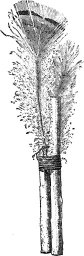
Fig. 58. Sacrificial sticks (keçàn).
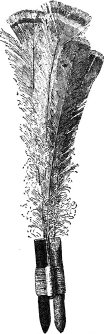
Fig. 59. The talking kethàwn (keçan-yalcì‘).
177. Fig. 58 represents a kethàwn belonging, not to the mountain chant, but to the klèdji-qaçàl, or chant of the night. It is sacred to the Youth and the Maiden of the Rock Crystal, divine beings who dwell in Tsisnàtcini, a great mountain north of the Pueblo of Jemez. The original is in the National Museum at Washington. It consists of two sticks coated with white earth and joined by a cotton string a yard long, which is tied to each stick by a clove hitch. A black bead is on the center of the string; a turkey feather and an eagle feather are secured with the clove hitch to one of the sticks.
178. Fig. 59 depicts a kethàwn pertaining also to the klèdji-qaçàl. It is called keçàn-yalçi‘, or talking kethàwn. The sticks are willow. The one to the left is painted black, to represent a male character (Qastcèbaka) in the myth and ceremony of klèdji-qaçàl. The other stick is painted blue, to denote a female character (Qastcèbaäd) in the same rites. The blue stick has a diagonal facet at the top to indicate the square topped female mask (paragraph 168). The naturally round end of the black stick sufficiently indicates the round male mask. The cord wrapped around the two sticks is similar to that described in the
179. In Schoolcraft’s Archives of Aboriginal Knowledge, Philadelphia, 1860, Vol. III, page 306, is a cut illustrating an article undoubtedly of a similar nature to that shown in Fig. 59. It is a sacrificial plume stick of the Moki. The Moki interpreter explained to Mr. Schoolcraft that it contained a message from the Indians to the President and the particulars of this message are fully set forth in his text. At first I doubted if the object could have any other purpose than a sacrificial one and was inclined to discredit the statement of the Moki interpreter. But on learning that the Navajo had a similar arrangement of sticks and feathers, which was called by the significant name of keçànyalçi‘, or talking kethàwn, I was more inclined to believe that some of these kethàwns may answer a double purpose and be used to convey messages, or at least serve as mnemonic aids to envoys.
180. The cac-bikeçàn (bear kethàwn) spoken of in the myth consisted of two sticks, each a span long, one painted black (male), the other painted blue (female). Each had red and blue bands at the ends and in the middle. There were no feathers or beads. (Paragraph 40.)
181. The glòï-bikeçàn, or sacrifices to the weasels, were four in number, two yellow and two white. In preparing the sticks one end was always to be held to the north, the other towards the south. At each end a narrow circle of red and a narrow circle of blue were painted; the red being to the north, i.e., outside of the blue at one end and inside of it at the other. The weasel men directed that the sticks should be buried in the ground in the same direction in which they were held when being made, lying from north to south with the outer red ring at the north. (Paragraph 41.)
182. Four sticks pertained to the klictsò-bikeçàn: one was black, with four white deer tracks painted on it; another was blue, with four yellow deer tracks; a third was white, with four black deer tracks; the fourth was yellow, with four blue deer tracks. The Great Serpent said to the Navajo prophet: “There are certain moles who, when they dig in the ground, scatter the earth in a long winding heap like the form of a crawling snake. In such a heap of earth will you bury these kethàwns.” (Paragraph 42.)
183. There are two sticks belonging to the kethàwn of the lightning god (i¢nì‘-bikeçàn). One is black, with a white zigzag stripe from end 43.)
184. The Estsàn-¢igìni, or Holy Women, showed the prophet but one kethàwn stick. It was painted white and decorated with three pairs of circular bands, red and blue, the blue in each case being next to the body of the painter while he holds the stick in decorating it. This kethàwn must be buried at the base of a young spruce tree, with the first blue circle next to the tree. (Paragraph 45.)
185. Pour sticks were shown by the Tcikè-cac-nátlehi. They were black, sprinkled with specular iron ore to make them shine; decorated with three pairs of bands, red and blue, applied as in the kethàwns of the Estsàn-¢igìni; and buried under a young piñon, with the first blue band or circle next to the tree. (Paragraph 46.)
186. The two kethàwns seen by Dsilyi‘ Neyáni at Big Oaks, the home of the ¢igin-yosíni, were both banded at the ends with blue and red and had marks to symbolize the givers. One was white, with two pairs of stripes, red and blue, running lengthwise. The other was yellow, with many stripes of black and yellow running lengthwise. (Paragraph 49.)
187. At Last Mountain, the home of the skunks, two kethàwns, evidently intended to symbolize these animals, were shown to the prophet and his divine companions. Both the sticks were black: one had three white longitudinal stripes on one side; the other had three longitudinal rows of white spots, three spots in each row, on one side. (Paragraph 50.)
188. The two sticks shown by the squirrels, Glo‘dsilkàï and Glo‘dsiljíni, were painted blue, sprinkled with specular iron ore, and surrounded at the ends with red and blue bands. One was to be planted at the base of a pine tree and one at the base of a spruce tree.
189. At Dsilyà-içín the porcupines exhibited two kethàwns. They were very short, being equal in length to the middle joint of the little finger. One was black and one was blue. Each had red and blue terminal bands and each had a number of white dots on one side to represent porcupine quills. “Bury them,” said ¢asàni, “under a piñon tree.” (Paragraph 52.)
190. At Qo¢estò four kethàwns, rather elaborately decorated, were shown. Two were half white and half black, the black part having white spots and the white part having black spots on it. The other two were half blue and half yellow, the yellow being spotted with blue and the blue with yellow. There were red and blue rings at the ends. (Paragraph 53.)
191. The Tçikè-¢igìni showed their visitors two kethàwns, one black and one blue. Each was a span long and was surrounded with three pairs of bands, blue and red, put on in the manner observed in making the kethàwns of the Estsàn-¢igìni. (Paragraph 184.) To the center of the black kethàwn five blue feathers were tied. To the center of the 54.)
ORIGINAL TEXTS AND TRANSLATIONS OF SONGS, &C.
192. The songs of the dsilyídje qaçàl are very numerous and their recitation is governed by many rules, a few of which only have been discovered by the writer.
193. A list has been recorded of thirteen sets of songs which may properly be sung at night in the medicine lodge, when the ceremonies of the day are done, and in the corral on the last night, when there is no special song in progress pertaining to a particular alili or dance. The list which follows exhibits the order in which these songs may be sung on any particular night. For example, if the singers begin with a song from set III, they cannot follow immediately with a song from sets I or II, but mast select from some of the following sets, as set IV or V. Again, in each set the songs have a certain order of sequence which must not be reversed. For convenience these will be called
SONGS OF SEQUENCE.
Order. Indian name of set. English name of set. Number in each set.
I. Atsátleï Bigin Songs of the First Dancers 16
II. Tsintsò Bigin Songs of the Great Stick, or Plumed Wand 12
III. ¢epè Bigin Songs of the Mountain Sheep 12
IV. I‘¢nì Bigin Songs of the Lightning 12
V. Tsilkè-¢igìni Bigin Songs of the Holy Young Men 12
VI. Tcikè-cac-nátlehi Bigin Songs of Young Women Who Become Bears 16
VII. Dsilyi‘ Neyáni Bigin Songs of Reared Within the Mountains 8
VIII. Tsáhagin Awl songs 8
IX. Nahikï-gin Whitening songs 8
X. ¢asàni Bigin Songs of the Porcupines 7
XI. Nanisè Bigin Songs of the Plants 8
XII. Tsin¢ilçòï Bigin Songs of the Exploding Stick 26
XIII. Yikàï-gin Daylight songs 16
Total 161
194. Besides those referred to in the above list, there are more which are appropriate to different acts in the ceremony, such as the songs sung at the obliteration of the pictures, at the building of the corral, at the departure of the akáninili, &c.
195. In some cases a number of songs in the same set are nearly alike; the addition or substitution of one verse, or even of one word, may be the only difference. Such songs usually follow one another in immediate succession; often, on the other hand, we find a great variety in subject and in style.
196. Some songs are self-explanatory or readily understood, but the greater number cannot be comprehended without a full knowledge of the mythology and of the symbolism to which they refer; they merely hint at mythic conceptions. Many contain archaic expressions, for which the shaman can assign a meaning, but whose etymology cannot now be learned; and some embody obsolete words whose meaning is lost even to the priesthood. There are many vocables known to be meaningless and recited merely to fill out the rhythm or to give a dignified length to the song. For the same reasons a meaningless syllable is often added or a significant syllable duplicated.
197. Other poetical licenses are taken, such as the omission of a syllable, the change of accent, the substitution of one vowel for another. The most familiar words are often distorted beyond recognition. For these various reasons the task of noting and translating these songs is one of considerable difficulty.
198. FIRST SONG OF THE FIRST DANCERS.
Same song, using alternative spelling.
Qaniè qaò yaè, qaniè qaò yaè Qaniè iè oayè oayè.
1. Qadjinäìa qaò yaè, 2. Kaç dsil ¢ilhyíli qaò yaè, 3. ‘Çaltsoï tsèë qaò yaè, 4. Cija cigèlgo qaò yaè. Náhi ìni èhi oayè, náhi ini èhi oöhè. 9. Qadjinäìa qaò yaè, 10. Kaç dsil litsòï qaò yaè, 11. Bitselitsòï qaò yaè, 12. Cija cigèlgo qaò yaè. Náhi ìni, etc.
5. Niqoyastcàdje qaò yaè, 6. Kaç dsil çolíji qaò yaè, 7. Kini bitsèë qaò yaè, 8. Cija cigèlgo qaò yaè. Náhi ìni, etc. 13. Niqoyastcàdje qaò yaè, 14. Kaç dsil lakàie qaò yaè, 15. A‘a‘i tsèe qaò yaè, 16. Cija cigèlgo qaò yaè. Náhi ìni, etc.
199. Translation.—1, 9. Qadjinàï, “Place-where-they-came-up,” a locality in the San Juan Mountains where, according to their mythology, the Navajo emerged from the lower world to this. 5, 13. Niqoyastcàdje, another name for Qadjinàï. 2, 6, 10, 14. Kaç, now; dsil, mountain; ¢ilhyíli, black; çolíji, blue; litsòï, yellow; lakàie, white. These verses refer to four mountains surrounding Qadjinàï, which are designated by colors only to indicate their topographical positions. 3, 7, 11, 15. ‘Çaltsoï = aça litsòï, “yellow wing,” a large bird of prey; kini, hen hawk; bitselitsòï, “yellow tail,” a bird of undetermined species; a‘a‘i, magpie; tse, a tail; bitse, its tail. 4, 8, 12, 16. Cija, my treasure; cigèl, my desideratum, my ultimatum, the only thing I
200. Free translation.
Place-whence-they-came-up looms up, Now the black mountain looms up, The tail of the “yellow wing” looms up, My treasure, my sacrifice, loom up. Land-where-they-moved-out looms up, Now the blue mountain looms up, The tail of the hen-hawk looms up, My treasure, my sacrifice, loom up.
Place-whence-they-came-up looms up, Now the yellow mountain looms up, The tail that is yellow looms up, My treasure, my sacrifice, loom up. Land-where-they-moved-out looms up, Now the white mountain looms up, The tail of the magpie looms up, My treasure, my sacrifice, loom up.
201. FIRST SONG OF THE MOUNTAIN SHEEP.
1. Yìki ¢asizìni, 2. Kaç Tsilkè-¢igìni, 3. Kaç kátso-yisçàni, 4. Tsí¢a baälìli, 5. Bíja-ye¢igíngo. 6. Kaç Tcikè ¢igìni, 7. Kátsoye yisçàni, 8. Yìki ¢asizìni, 9. Tsí¢a baälìli, 10. Bíja-ye¢igíngo.
202. Translation.—1, 8. Yìki, upon it; ¢asizin, he stands on high. 2, 6. Kaç, now; tsilkè, young man; tcikè, young woman; ¢igìni, holy. 3. Kátso-yisçàn, the great plumed arrow; kátsoye yisçàn, with the great plumed arrow. 4, 9. Tsí¢a, truly, verily; baälìli, an alili, a show, a rite, or implement used in a dance for him. 5, 10. Bíja, his treasure, his special property, his peculiar belonging; ye, with, a prefix forming nouns which denote the means; ¢igíngo, positively holy or supernatural. Bíja-ye¢igíngo might be translated “charm” or “talisman.”
203. Free translation.
He stands high upon it; Now the Holy Young Man [Young Woman, in second stanza], With the great plumed arrow, Verily his own sacred implement, His treasure, by virtue of which he is truly holy.
204. A reference to the myth, and the description of the ceremonies will probably be sufficient to give the reader an understanding of this song. This set of songs, it is said, was first sung by the black sheep which stood on the rock as a sign to the Navajo fugitive; hence the name. (See paragraphs 35, 47, 48, 54.)
205. SIXTH SONG OF THE MOUNTAIN SHEEP.
Binaçoöláe [four times] oäyèhe oöhè.
1. Kaç Tsilkè-¢igìni, 2. Ca‘bitlòli yèë, 3. Tsí¢a bialìli, 4. Bíja ye¢igíngo, 5. Binaçoöláe oäyèhe oöhè. 6. Kaç Tcikè-¢igìni, 7. Natsilíçi yèë, 8. Tsí¢a bialìli, 9. Bíja ye¢igíngo, 10. Binaçoöláe oäyèhe oöhè.
206. Translation.—1, 6. Kaç, now; tsilkè, young man; tcikè, young woman; ¢igìni holy one, god or goddess. 2. Ca‘bitlòl, sunbeam, sunbeams; ye, with. 3, 8. Tsi¢a, verily; bialìli (paragraph 3), his dance or sacred implement. 4, 9. Bíja, his special property, his treasure; ye¢igíngo, that by means of which he is ¢igín, i.e., holy or supernatural. 5, 10. Binaçòla, it is encircled. 7. Natsiliç, the rainbow.
207. Free translation.
Now the Holy Young Man, With the sunbeam, Verily his own sacred implement, His treasure which makes him holy, Is encircled. Now the Holy Young Woman, With the rainbow, Verily her own sacred implement, Her treasure which makes her holy, Is encircled.
208. Which is to say that the great plumed arrows which they bear are adorned with sunbeams and rainbows. They “shine in glory.” (See references in paragraph 204)
209. TWELFTH SONG OF THE MOUNTAIN SHEEP.
1. Nayunáni tcènia, 2. Kaç biçèïltsos tcènia, 3. Biqolçègo, tcènia. 4. Nayunáni tcènia, 5. Kaç biçènackòji tcènia, 6. Biqolçègo, tcènia.
210. Translation.—1, 4. Nayunáni, again on the other side, i.e., across two valleys. 2. Biçè, his horns; iltsos, slender; biçèïltsos, slender horns, i.e., the deer, by metonomy. 3, 6. Biqolçègo, it is becoming to him. 5. Biçè, his horns; nackòj, turgid, filled out, stuffed; biçènackòji, turgid horns—metonymically, the mountain sheep, Ovis montana. The refrain, tcènia, he appears, he comes in sight.
211. Free translation.
Far beyond he appears; Now “Slender Horn” appears. His antlers are becoming. He appears. Far beyond he appears; Now “Turgid Horn” appears. His horns are becoming. He appears.
212. This song, it is said, refers to the time when the prophet saw the vision of the black sheep on the rock. (Paragraph 35.) The reason for introducing the deer into the song is not obvious.
213. FIRST SONG OF THE THUNDER.
1. Çòna! Çòna! A‘āīyèhe oöhè [repeat], 2. Yùçakoö ani‘; 3. I‘¢ni‘djië ani‘; 4. Kos ¢ilhyíl biyì‘dje, 5. Nabizàç qolègo, 6. Çòna! Çòna! A‘āīyèhe oöhè 7. Çòna! Çòna! A‘āīyèhe oöhè [repeat], 8. Yùyakoö ani‘; 9. Anilçàni ani‘; 10. Nánise bicqàko, 11. Nabizaç qolègo, 12. Çòna! Çòna! A‘āīyèhe oöhè.
214. Translation.—1, 6, 7, 12. Çòna, an imitation of the thunder, not a word. 2, 8. Yùçako, above; yùyako, below; ani‘, any sound, the sound of the voice. 3. I‘¢ni‘dji pertaining to the thunder. 4. Kos, cloud; ¢ilhyíl, black, dark; biyì‘dje, within, or toward within it. 5, 11. Nabizaç qolègo, again and again sounds his moving voice. 9. Anilçàni, a general name for large meadow grasshoppers. 10. Nánise, plants in general; biçqàko, in among them.
215. Free translation.
Thonah! Thonah! There is a voice above, The voice of the thunder. Within the dark cloud, Again and again it sounds, Thonah! Thonah! Thonah! Thonah! There is a voice below, The voice of the grasshopper. Among the plants, Again and again it sounds, Thonah! Thonah!
216. TWELFTH SONG OF THE THUNDER.
Aïena. Beqojònigo ani‘i [four times] oöhè.
1. Yùçakoö ani‘i; 2. I‘¢ni‘djië ani‘i; 3. Kos ¢ilhyíl biyì‘dje, 4. Nàbizaç qolègo, 5. Beqojònigo ani‘i, oöhè. 6. Yùyakoö ani‘i; 7. Anilçàni ani‘i; 8. Nánise biçqàko, 9. Nàbizaç qolègo, 10. Beqojònigo ani‘i, oöhè.
217. Translation.—Aïena, a meaningless beginning to many songs, which may be omitted. 1. Yùçako, above. 2. I‘¢ni‘dji, pertaining to the thunder. 3. Kos, cloud; ¢ilhyíl, dark; biyì‘dje, within it. 4, 9. Nàbizaç, his voice again, his voice repeated; qolègo, sounds along, sounds moving. 5, 10. (Be, a prefix forming nouns of the cause or instrument; qojòni, local or terrestrial beauty; go, a suffix to qualifying words); beqojònigo, productive of terrestrial beauty; ani‘, a voice, a sound. 6. Yùyako, below. 7. Anilçani, grasshopper. 8. Nánise, plants; biçqàko, in among them.
218. Free translation.
The voice that beautifies the land! The voice above, The voice of the thunder Within the dark cloud Again and again it sounds, The voice that beautifies the land. The voice that beautifies the land! The voice below; The voice of the grasshopper Among the plants Again and again it sounds, The voice that beautifies the land.