Front matter (continued 7)
Reading edition
The caterpillar is of a faint bluish green, inclining to greenish white on the back; a row of black spots along the back, and a broken black narrow stripe along each side. It feeds on tree lichens (Usnea barbata), etc., from September to June or July. Three figures of this caterpillar are given on Plate 133, Fig. 3.
The moth is out in July and August, and may be found at rest on tree trunks now and then, but is more frequently obtained by jarring the lichen-clad branches of oak. Although it is known to occur very locally and somewhat rarely in the counties of Wilts., Dorset, and Devon, the New Forest in Hampshire is the English district where one is most likely to meet with this species. It has been recorded from Cornwall (Falmouth district, 1904), Hereford, Pembrokeshire, Carnarvonshire (Beddgelert), and Cumberland. Charlton Forest, Sussex, has also been mentioned. In Scotland, Renton states that it is generally common in Roxburghshire; it occurs in several of the woods in Clydesdale, and has been noted from Argyllshire.
The Engrailed (Tephrosia bistortata).
In the following brief remarks on T. bistortata, Goeze (= biundularia, Borkhausen), I have included reference to crepuscularia, Hübner (= biundularia, Esper). The former (which is also named abietaria, Haworth, and laricaria, Doubleday) appears on the wing in March and April, and there is a second flight in July and August. Moths of the second generation are few in number and small in size, and are referable to abs. consonaria and strigularia, Stephens. A third generation of still smaller moths has been reared. Crepuscularia is out in May and June, rarely in April; its caterpillar feeds in June and July or later; according to Barrett, a second generation of the moth has occurred in August. One or two moths have been captured in September or October, but whether these were referable to bistortata or crepuscularia is not quite clear.
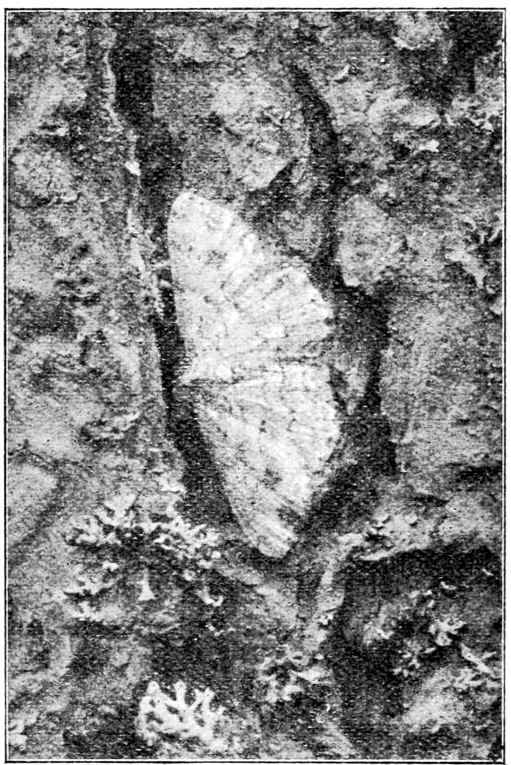
Fig. 19.
Small Engrailed, at rest.
(Photo by W. J. Lucas.)
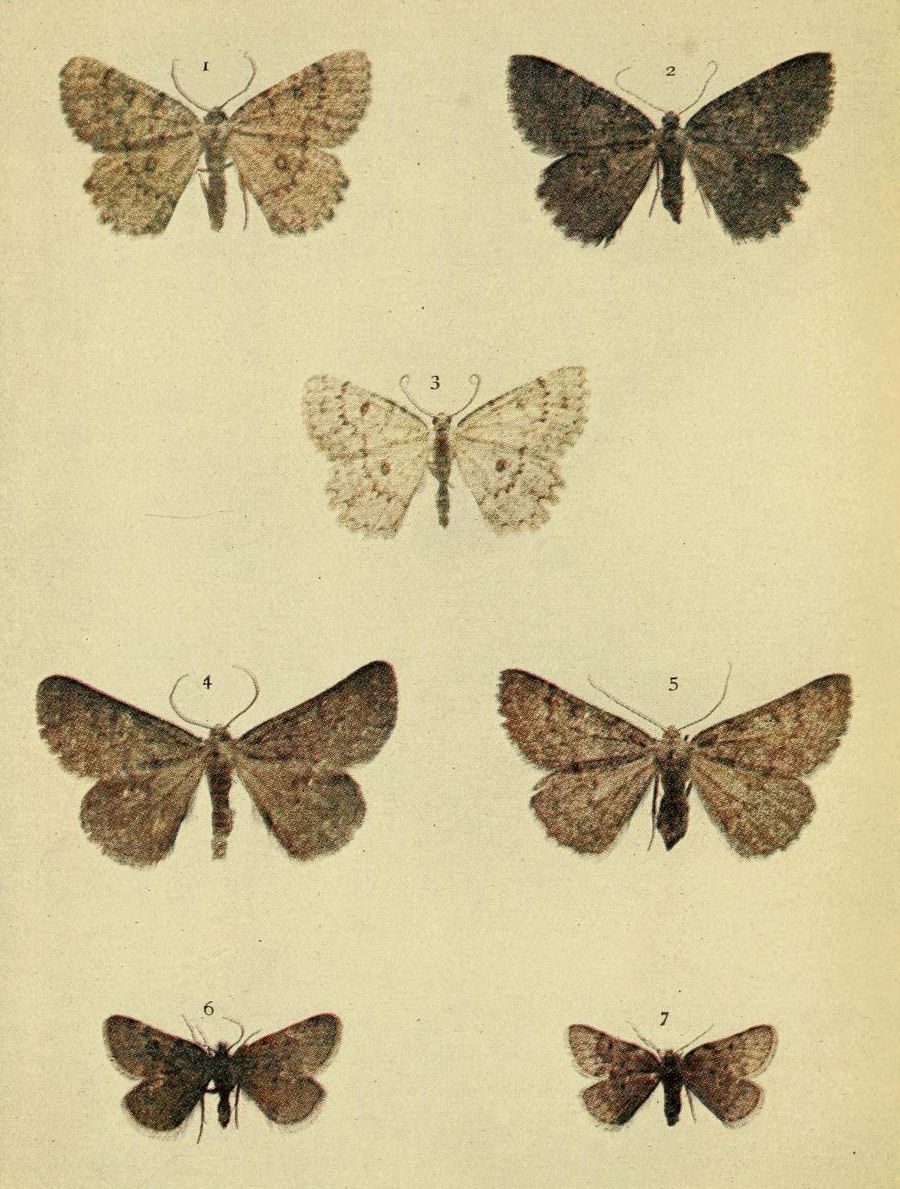
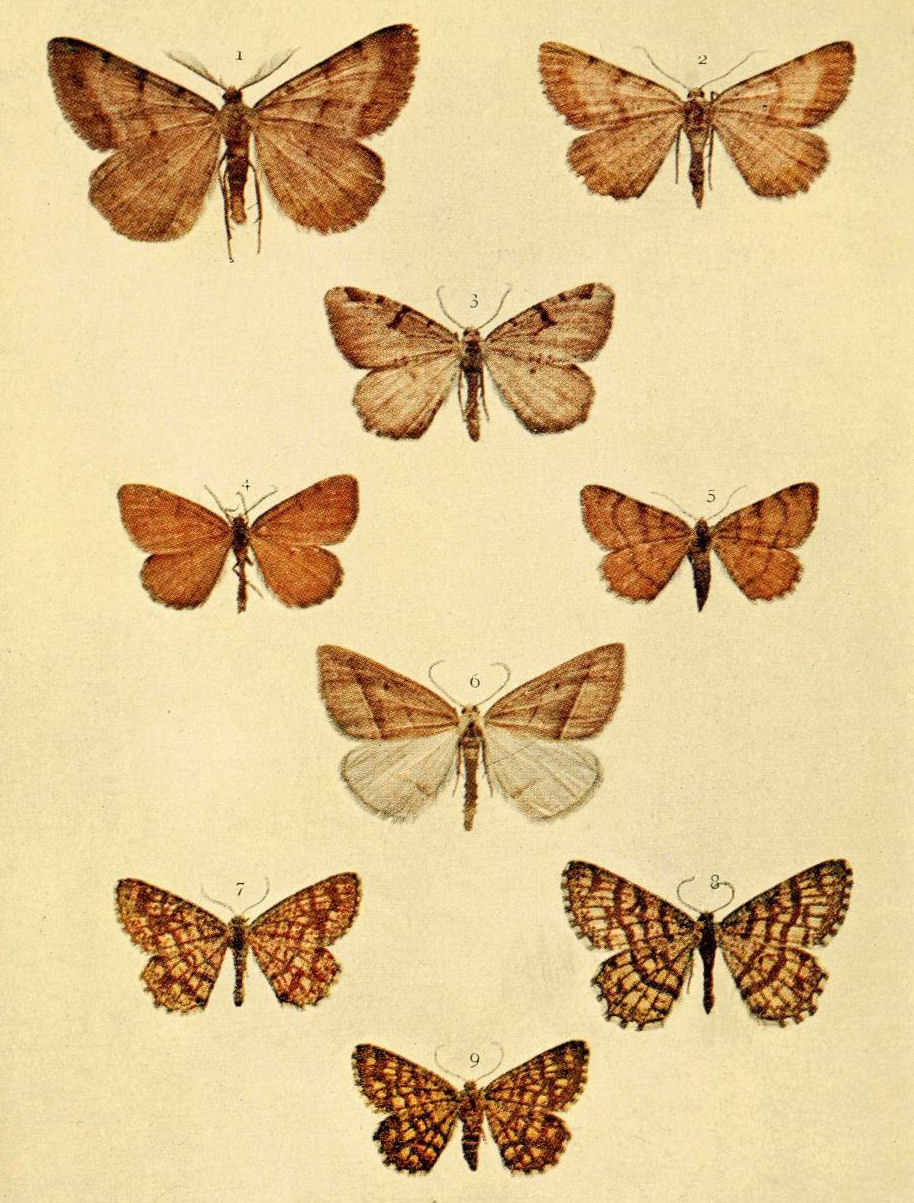
By some authorities the double-brooded bistortata is considered specifically distinct from the, normally, single-brooded crepuscularia; others hold the opposite view. The March and April moths are generally rather browner in colour than those appearing in May and June, but I have some specimens taken in Wiltshire at the end of March, which are quite as pale as any example in the May-June series. Probably, we should be right in regarding crepuscularia as the older stock from which the double-brooded race, bistortata, has sprung. The former has a more extensive range, as it inhabits Northern Europe (Sutherlandshire in British Isles), whilst bistortata seems to be confined to Central Europe. A Perthshire form of the May-June race is shown on Plate 136, Fig. 7; and an example of ab. delamerensis, White, from Delamere Forest, Cheshire, is represented by Fig. 8. Figs. 6 ♂, 7 ♀, represent examples of the March and April race. Black or blackish forms, with the sub-marginal line more or less distinctly white, occur in both races, chiefly in Glamorganshire, South Wales.
A photograph, by Mr. H. Main, of the caterpillar, is reproduced on Plate 138, Fig. 3. The general colour is grey, inclining to yellowish or brownish; sometimes it is reddish brown; two broken dark-grey lines on the back, and some pale blotches on the sides. The caterpillars of the first race (bistortata) feed in May and June, and again in August and September. Those of the second race in June and July, or later. They seem to eat the foliage of trees, including those in orchards.
Note.—Cross-pairings between bistortata ♂ and crepuscularia ♀ resulted in the ab. ridingi, Tutt, whilst the offspring of a crossing of crepuscularia ♂ and bistortata ♀ have been named bacoti, Tutt. Pairings of bistortata ♂ and delamerensis ♀ produce ab. ridingi-suffusa, Tutt; and those of delamerensis ♂ and bistortata ♀ = bacoti-suffusa, Tutt. Further, bacoti-suffusa will pair with ridingi-suffusa, or the last named with crepuscularia; the progeny being in the first case mixta, Tutt, and in the latter, reversa, Tutt.
Brindled White-spot (Tephrosia luridata).
Two examples of this species (also known as extersaria, Hübner) are depicted on Plate 137, Figs. 1 ♂, 2 ♀. There is variation in the amount of black speckling and in the strength of the cross lines.
The caterpillar is dull hazel or chocolate brown, often tinged with green; a row of whitish dots on each side of a series of pale spots along the middle of the back; rings 4 and 8 barred with black-brown or dusky rust colour. Sometimes the general colour is green. (Adapted from Fenn.) It feeds in July and August, or even later, on oak and birch, sometimes on alder and sallow. The moth is out in May and June, earlier or later in some seasons. In Britain apparently confined to England, where it occurs locally, in woods, from Worcestershire southwards to Kent and Cornwall, and eastward to Norfolk and Suffolk. In the New Forest, Hampshire, where it is often plentiful, it may be seen on the boles of trees, but is more easily obtained after dark when it comes to the sugar patch.
Square Spot (Tephrosia consonaria).
Two examples of this species will be found on Plate 137, Figs. 3 ♂, 4 ♀. There is variation in the greyish or brownish speckling of the wings, and this in some typical examples is so sparse that the wings appear to be almost white with brownish basal band and brownish markings on the outer area; the most conspicuous of the latter being the middle square spot between the second and submarginal lines, more or less distinct in all forms, to which the English name refers. In other specimens the wings are, especially the front pair, densely covered with the dark speckling. Some Surrey specimens, chiefly from the Leith Hill district, have an ochreous tinge; and quite recently a black form of the species has occurred in a wood near Maidstone, in West Kent. The last phase of aberration seems to be unknown in any other part of Britain, and also, I believe, elsewhere.
The egg (Plate 138, Fig. 2) is yellowish green when laid; later it becomes yellow, and orange red markings appear, chiefly at one end.
The somewhat wrinkled caterpillar is ochreous brown above, inclining to greyish between the rings; an ochreous line along the middle of the back is only clearly defined on the front rings; the under side is greenish ochreous, and sometimes this colour extends to the upper side also; the head, which is notched on the crown, is pale ochreous, more or less marked with brown. It feeds at night, in June and July, on birch, beech, oak, pine, etc.
The moth is out in May and June, earlier in some districts. In the daytime it may be seen on the trunks or boughs of trees, most frequently at too great a height to be easily secured; but still a few sit low enough for capture, especially on the trunks of fir trees. The species is a decidedly local one, and seems to be largely confined, in Britain, to the southern parts of England, Wales, and Ireland. It occurs in some of the woods of Kent, Surrey, Sussex, Hampshire, Dorsetshire, Devonshire, Cornwall, Gloucestershire, Oxfordshire, Buckinghamshire, Bedfordshire, Essex, and Suffolk. Edwards notes the species as rare at Malvern, Worcestershire. Forsythe, in "A List of the Macro-Lepidoptera of Lancaster and District" (Entom. 1905, p. 12), states that the moth may be found sitting on the fir-tree trunks at the end of May, at Witherslack and Quernmore; and a single specimen has been recorded from Upton, near Birkenhead, Cheshire. The occurrence of T. consonaria in the north of England seems open to question. The only county in Wales appears to be Glamorganshire, as mentioned by Barrett. Kane (Catalogue of the Lepidoptera of Ireland) noted the species from Derrycunihy, and Mucross, Killarney, where he has taken it in moderate abundance; he also gives Clonbullogue, in King's County.
The range abroad extends to Amurland and Japan.
Grey Birch (Tephrosia punctularia).
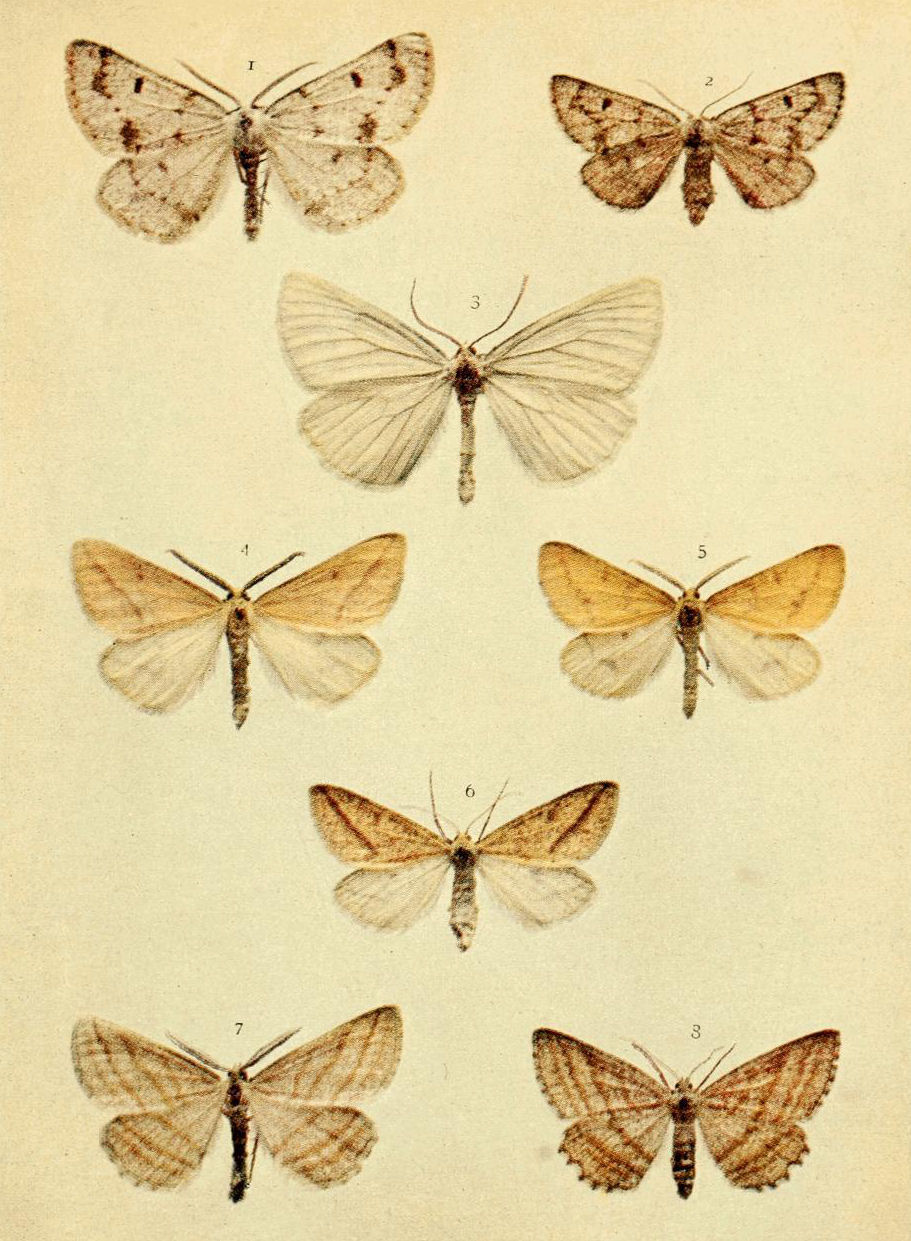
Three examples of this greyish species are shown on Plate 137. The wings are usually whitish grey in the ground colour, and sprinkled or dusted with darker grey; there are three blackish, or black dotted, cross lines on the fore wings, often indistinct, but rarely entirely absent, and even then represented by black marks on the front margin. Sometimes the first and third lines may be well in evidence and the central one absent; occasionally the second line is placed quite close to the first; the sub-marginal line is whitish, inwardly shaded with dark greyish, especially at the middle and towards the front margin. The hind wings have two cross lines corresponding with the first and third on the fore wings. There is a good deal of variation in the amount of dark speckling, and this is occasionally so heavy that the insect becomes dark grey in colour; I have taken such specimens at Oxshott in Surrey. Dark aberrations are perhaps more frequent in the north of England, but the species is more local and less plentiful in that part of the country.
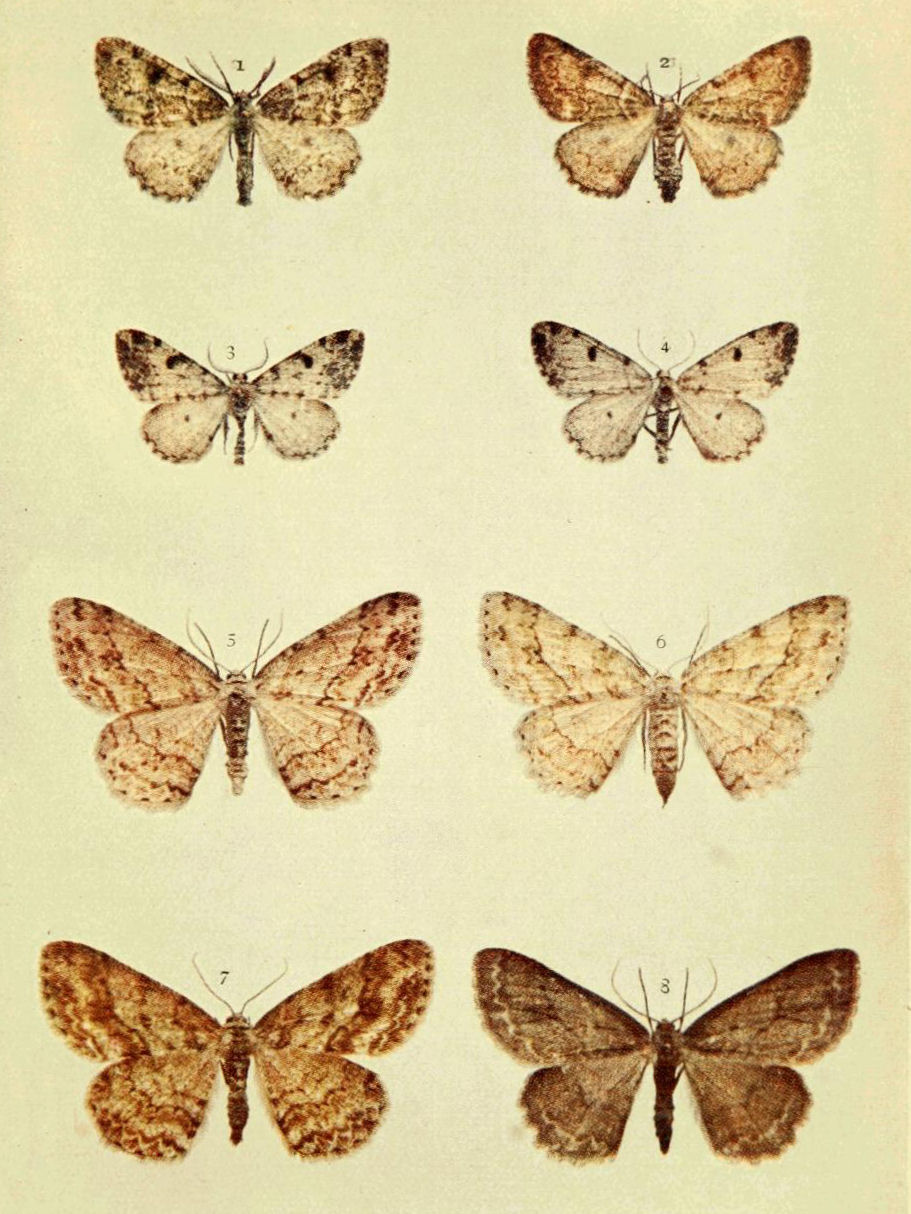
2 Pl. 136.
1, 2.Brussels Lace. 3, 4.Dotted Carpet. 5, 6.Small Engrailed.
7, 8.The Engrailed.
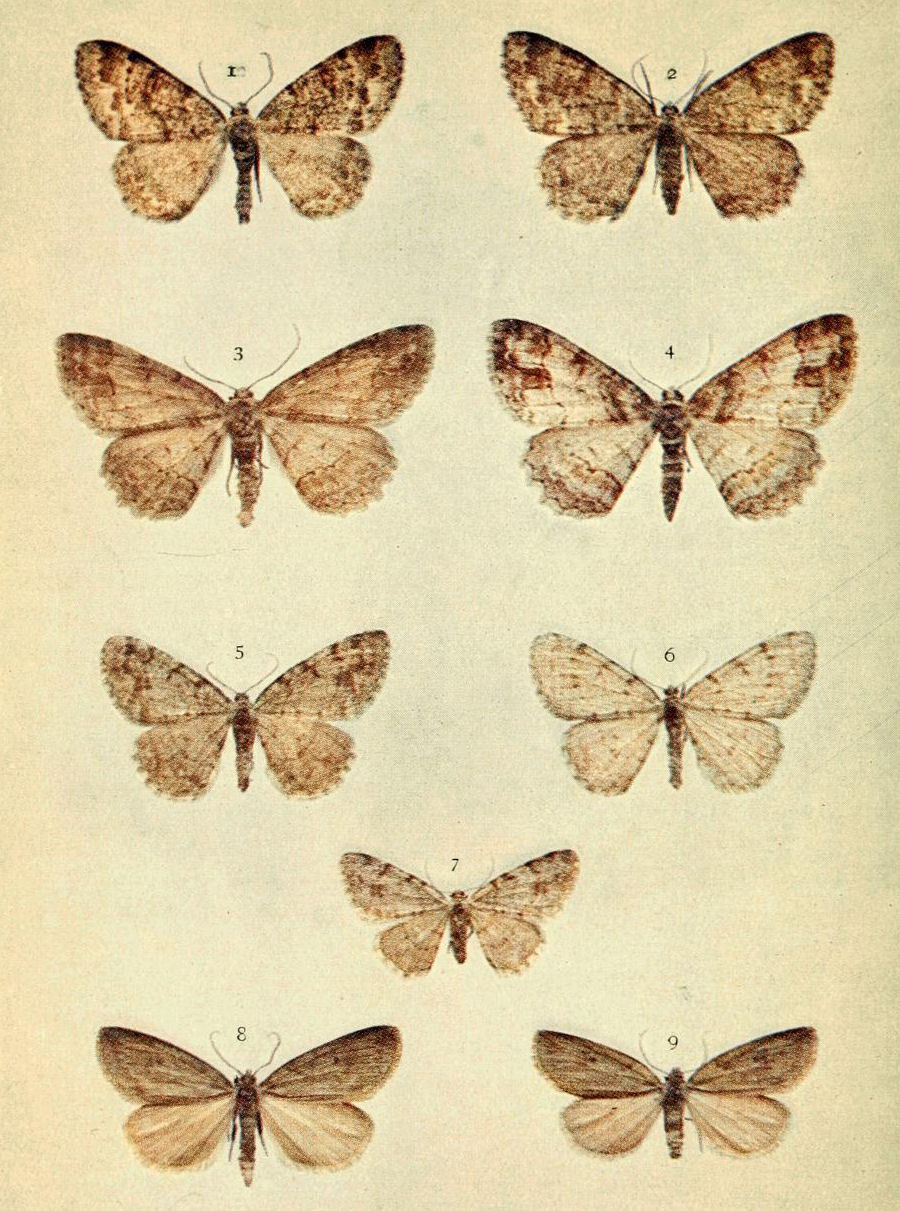
2 Pl. 137.
1, 2.Brindled White-spot. 3, 4.Square Spot.
5-7.Grey Birch. 8, 9.Horse Chestnut.
The caterpillar, which may be beaten from birch, and sometimes alder, in July, is bright apple green with yellowish lines on the sides and back; the ring divisions are yellow, and the head is tinged with that colour. (Adapted from Porritt.) Sometimes the caterpillars are brownish, or greenish grey in general colour. The moth, which is out in May and June, will be found in woods, or on heaths, where birches grow. It rests on the trunks of the trees and may be boxed, as a rule, with ease. On some occasions, however, it is very lively, and the net will have to be brought into action for its capture.
The distribution of this species extends through England, but it is far more plentiful in the south than in the north, although it has been recorded from several places in Yorkshire, and from Coal Law Wood in Northumberland. It is found also in Wales, and in Scotland up to Moray. In Ireland it is not frequent, but has been noted from Mucross, and the Upper Lake of Killarney, in Kerry, and from Tinahely in Wicklow; Kane also gives Clonbrock in Galway, and adds that "some specimens from this locality have the spots very large on a clear whitish ground, so that they have a superficial resemblance to Cleora glabraria."
The range abroad spreads to East Siberia, Amurland, and Japan.
Note.—Staudinger places the last four species in Boarmia, Treitschke; but Prout and others refer them to the genus Ectropis, Hübner. The latter will probably have to be adopted.
Horse Chestnut (Pachycnema hippocastanaria).
The rather long and somewhat oval fore wings of this species (Plate 137, Figs. 8, 9) are brownish grey, inclining to purplish grey; the two cross lines are blackish, edged with whitish, but generally indistinct; when the lines are well defined, the enclosed central area is sometimes darker than the other parts of the wings; there is a black central dot, and occasionally there is a well-marked dusky central shade. Hind wings, whitish, more or less tinged with smoky grey; frequently there is a dusky, curved line beyond the middle, and this is sometimes outwardly edged with whitish.
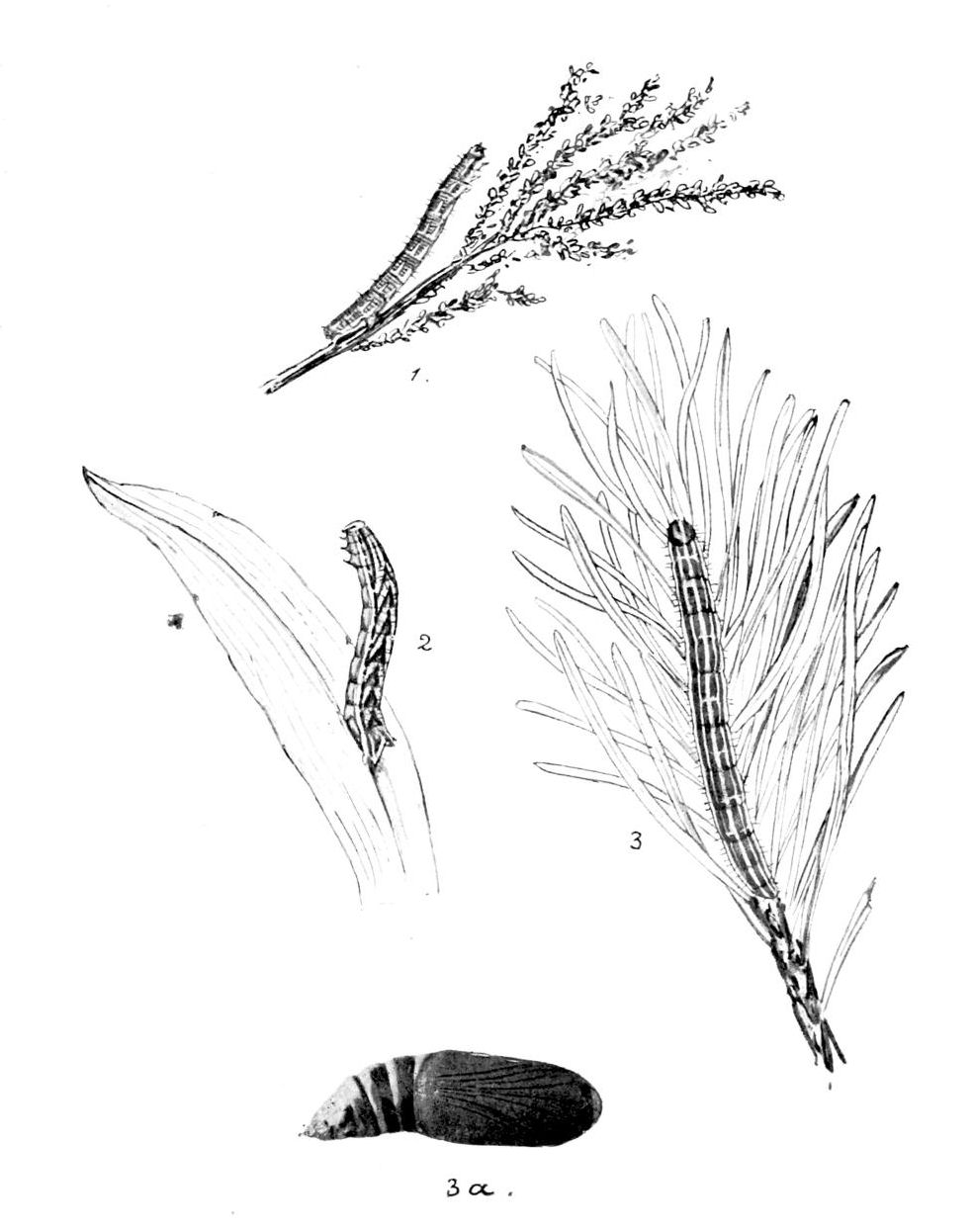
The caterpillar is greyish brown, dotted with black, and marked on the back and sides with reddish brown. When at rest on the twigs of its food plant, heather or ling (Calluna vulgaris), this caterpillar agrees so well with its surroundings that it is not at all easy to see; at least, we may see it, but fail to distinguish it from the twigs of the plant. It may be obtained in June and July, and again in the autumn. (Figured on Plate 140, after Hofmann.)
The first flight of the moth occurs in April and May; the second in August, but specimens of the later generation are usually small in size and in number, as compared with those of the early brood.
In Britain, this species has so far only been found on the heaths of Kent, Surrey, Sussex, Hampshire, Dorsetshire, Somersetshire, Berkshire, and Suffolk; in all these counties it is more or less local, but it abounds in some of its haunts. It has been recorded from Hereford, and Edwards states that it occurs rarely in the Malvern district of Worcestershire.
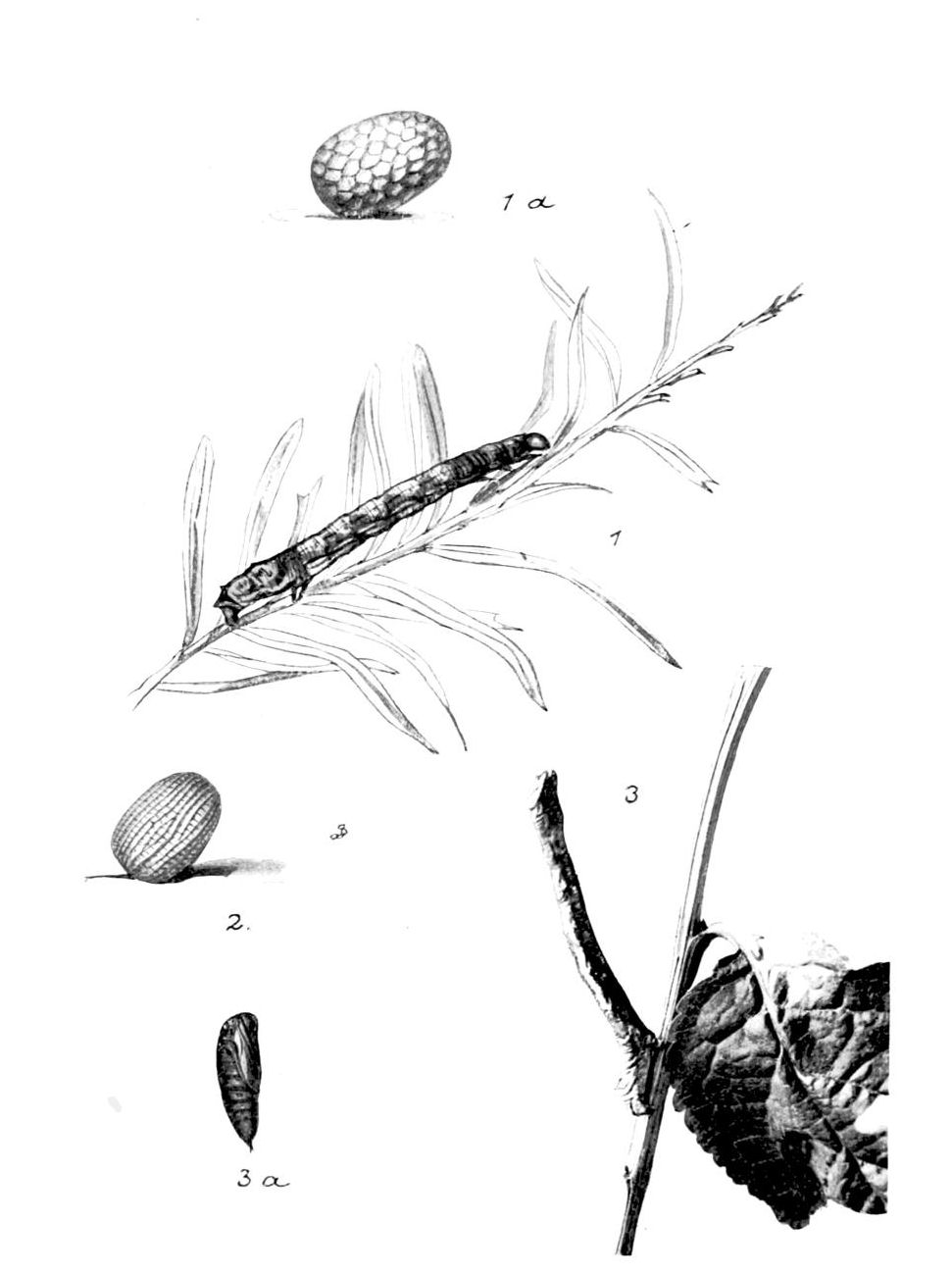
2 Pl. 138.
1.Satin Carpet: egg and caterpillar.
2.Square Spot: eggs.
3.The Engrailed: caterpillar and chrysalis.
2 Pl. 139.
1-3.Annulet. 4, 5.Scotch Annulet. 6, 7.Black Mountain Moth.
The Annulet (Gnophos (Sciadion) obscurata).
In a general way, all the grey specimens of this species are referable to the type form obscurata, Schiffermüller; the true type, however, appears to be rare in Britain, even if it occurs at all. It is, perhaps, best represented by well-marked dark specimens from limestone districts, or the lighter ones from peaty ground. At Folkestone and in other chalky localities on the Kentish coast, the bulk of the specimens are pale grey inclining to whitish, usually with the black cross lines showing more or less clearly. Sometimes the lines are obscured by heavy freckling (ab. woodiata, Prout); not infrequently, at Folkestone chiefly, the inner and outer areas are pale, more or less free of freckling, but the central area, defined by black lines, is densely freckled; this is the banded form (ab. fasciata, Prout). A form occurs on the chalk hills at Lewes in Sussex, in which the wings are almost white, without freckling, but with distinct black lines and rings (ab. calceata, Staudinger); a modification of this whitish form from Lewes has been described by Prout as ab. mundata, "Almost pure whitish, with virtually no markings, excepting the annulets." On heaths in Surrey and Hampshire, and on the mountains of Aberdeen and Perthshire, a blackish form occurs (ab. obscuriorata, Prout = obscuraria, Hübner, 146); and sometimes specimens are found in which the wings are of "an intense and almost uniform black" (ab. saturata, Prout). In Devonshire and Cornwall, the species is darkish grey inclining to brownish (ab. anthracinaria, Esper); whilst on the coasts of North Devon and Wales it is of a slaty grey, more or less tinged with brown, and almost without markings; the Welsh specimens are large, and the wings are rather shining (ab. uniformata, Prout). A form, which I have not seen, of "a sandy or reddish colour" is referred by Prout (Trans. City of Lond. Ent. Soc., 1903, p. 39) to ab. argillacearia, Staudinger; it occurs in sandstone localities. (Plate 84, Figs. 1, Folkestone; 2, New Forest; 3, Lewes.)
The rather rough and dumpy caterpillar is dark greyish brown above, inclining to purplish brown beneath; the raised dots are capped with white, and there is a pair of white-capped warts on the last ring (adapted from Barrett). It feeds on rock rose (Helianthemum), cinquefoil (Potentilla), salad burnet (Poterium), etc.; or the larvæ may be reared on groundsel, chickweed, and strawberry, both wild and cultivated: September to May. (Plate 140, Fig. 2.)
Mr. A. J. Scollick kindly gave me some eggs, laid by a female taken in Surrey; they were yellowish green at first, but changed to pale brownish. The caterpillars hatched and seemed to thrive on groundsel, but they died during the winter.
The moth is out in July and August, and is widely distributed in England, but except that it occurs in Surrey, Berkshire, Herefordshire, and Worcestershire, it seems to prefer the seaboard counties, and in them chiefly affects localities near the sea. It is found in Wales, and in Scotland up to Moray; but in both these countries and also in Ireland it is most frequent on the coast.
Scotch Annulet (Gnophos myrtillata).
This species (Plate 139, Figs. 4 ♂, 5 ♀) was introduced, as a species new to Britain, by Curtis, who described and figured it as Charissa operaria in 1826, from specimens captured in Scotland. Subsequently, it was found to be the obfuscaria, of Hübner, and also the obfuscata of the Vienna Catalogue (1776). The latter, however, being only a bare name without description, was not generally accepted, although, if valid, it would be prior to Hübner. Still later the species was ascertained to be the myrtillata of Thunberg (1792), and as this name is much earlier than obfuscaria it is here adopted. As a matter of fact, both names are in use, as that of Hübner applies to our ashy grey form of the species, whilst that given by Thunberg belongs to the typical fuscous grey form.
2 Pl. 140.
1.Horse Chestnut: caterpillar.
2.Annulet: caterpillar.
3.Bordered White: caterpillar, and chrysalis (enlarged).
2 Pl. 141.
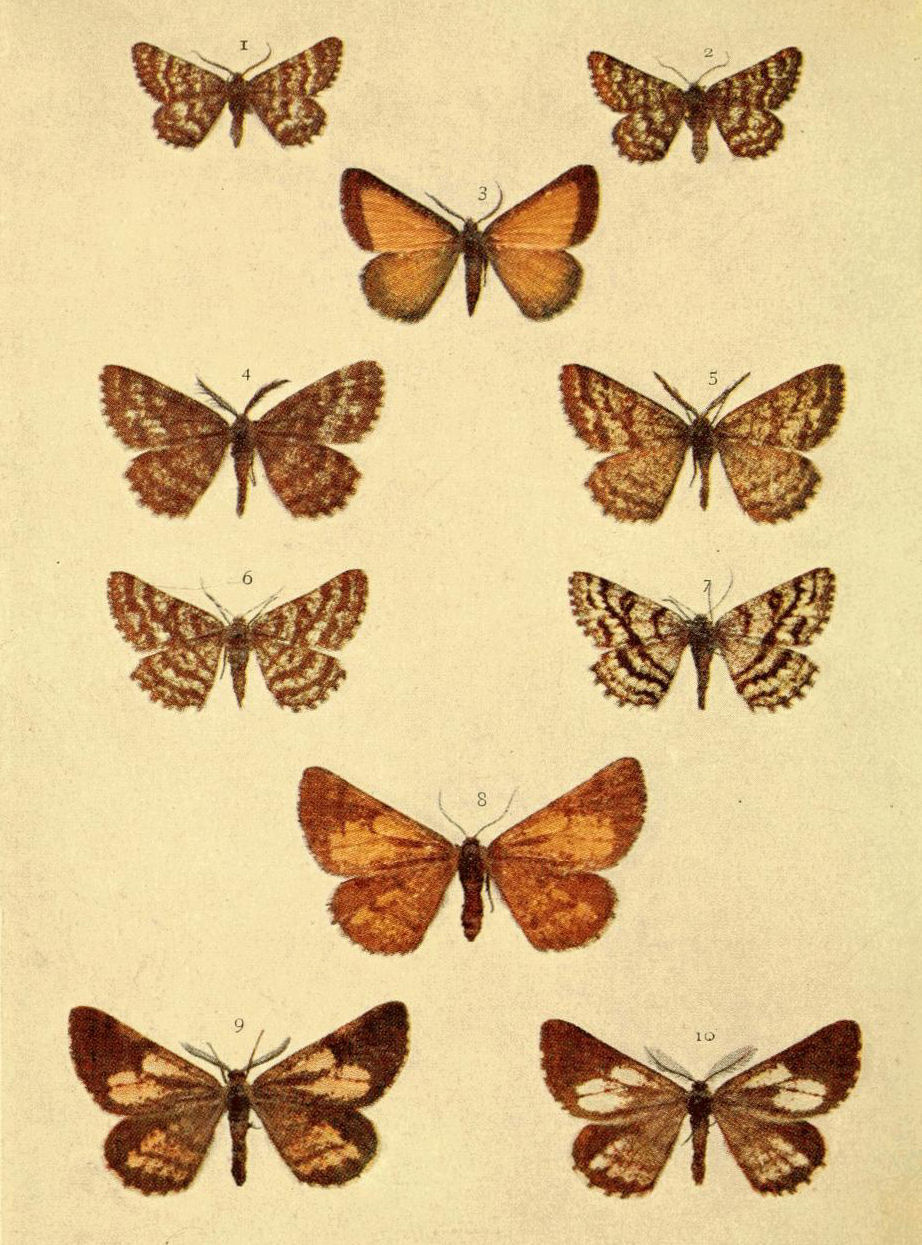
1, 2.Netted Mountain Moth. 3.Frosted Yellow.
4-7.Common Heath. 8-10.Bordered White.
The rather stout caterpillar is grey with darker lines and V-shaped marks along the middle of the back, and dark-edged pale lines on the sides; two erect whitish points on ring 12. It feeds on heather (Calluna), broom (Sarothamnus scoparius), and needle furze or petty-whin (Genista anglica), but it may be reared on knot grass. September to June, sometimes later.
The moth is out in July and August, and frequents heaths, moor, and mountain, in Scotland from Clydesdale (including Bute and Arran) to Aberdeen and Ross, and the Isle of Lewis. A male specimen has been recorded from Ireland (Dowros Head, co. Donegal, 1898). It may be found resting upon rocks, stone walls, etc.; where these have suitable holes, crannies, or projections they are selected as hiding places. Sometimes the moth has been noted on the wing during the day, but at night it flies freely, and will then visit light.
Black Mountain Moth (Psodos coracina).
The smoky-grey species represented on Plate 139, Figs. 6 ♂ 7 ♀, has two black lines on the fore wings; these are often edged with whitish, and the space between them blackish; the submarginal line is whitish, and the discal spot is black; the hind wings have a black central spot and two pale lines or bands. The female is rather smaller and much paler. In both sexes the central band of the fore wings is generally narrowed below the middle, and sometimes it is completely divided at this point.
As regards the British Isles, this species is known only to occur in the Highlands of Scotland. It is a day flyer, and very fond of sunshine, but its favourite haunts are situated at elevations of from 2000 to 4000 feet.
Note.—Newman (British Moths, p. 68) figures this species as The Dusky Carpet (Mniophila cineraria), and the insect, then known by the latter name, is figured as Psodos trepidaria, a synonym of the present species. In referring to this transposition of names, it may be well to add that M. cineraria, catalogued as British by Doubleday, and stated by Stainton (Manual ii., p. 31) to have once occurred at Tenby, South Wales, can only be regarded as an "accidental." The specimen, which is in the Natural History Museum, at South Kensington, appears to be Tephronia sepiaria, Hufnagel, which is the cineraria of Hübner.
A moth, supposed to be a specimen of Dasydia tenebraria, Esper = torvaria, Hübner, was reported as taken in Ireland "many years" before 1843, but at the present time that specimen, apparently, does not exist, and there is no exact description of it extant.
Netted Mountain Moth (Fidonia carbonaria).
The white wings of this species (Plate 141, Figs. 1 ♂, 2 ♀) are freckled with blackish and crossed by black stripes; sometimes the freckling is so heavy that the white ground colour is much obscured and only distinctly seen as edging to the cross stripes.
The caterpillar is dingy ochreous or whity brown marked with wavy darker stripes. It feeds at night on birch and sallow; Vaccinium, Erica, bearberry (Arctostaphylos uva-ursi) have also been mentioned as food plants.
In April and May, the moth, which is to be found locally, high up on the mountains of Scotland from Perthshire to Ross, is on the wing, and flies in the sunshine. Writing of this species at Rannoch in May (about 17th), 1905, Mr. E. A. Cockayne remarks that the moths began to fly about noon, when they appeared on all sides and were fairly active on the wing.
The distribution abroad is northern and Alpine, and the range extends to North-east Siberia.
Frosted Yellow (Fidonia limbaria).
This black-bordered orange-yellow species (Plate 141, Fig. 3) is not likely to be confused with any other occurring in Britain. The wings are more or less sprinkled with black, but this is usually most noticeable on the hind wings which are sometimes thickly sprinkled, or, more rarely, the yellow ground colour is entirely obscured. The form with a black discal spot on all the wings has been named ab. quadripunctaria, Fuchs. In ab. fumata, Mathew, the orange yellow is replaced by smoky umber brown, tinged with orange, and dusted with black atoms (bred July, 1899).
The caterpillar is greenish with grey-edged yellowish lines along the back, and a black-edged yellow one along the sides. The ground colour is sometimes purplish brown. It feeds on broom chiefly, but will eat other Genisteæ. There appears to be two broods, one in June, and the other in September, or earlier sometimes. The moth is out in May and early June, and again in July and August, but it has been known to remain in the chrysalis for four years. It flies in the sunshine, and when resting, it sits like a butterfly, with its wings brought together over its back.
Stephens (1831) states that the species was "not uncommon among high broom in the vicinity of Birch-wood in Kent." Later authors give Stowmarket (common), Needham, Barham, and Ipswich, in Suffolk. There are no recent records from the county of Kent; and not much has been heard of the species from Suffolk, although it may still exist, in greatly reduced numbers, in some of its old haunts therein.
Common Heath (Ematurga atomaria).
Four specimens of this variable species are shown on Plate 141 (Figs. 4, 5 ♂, 6, 7 ♀). The general colour of all the wings in the male is ochreous, inclining to whitish or to brownish. Usually the wings are speckled with brown, and the cross lines, or bands, are dark brown. Occasionally the cross markings are absent; but more frequently the three lines on the fore wings are much broadened and more or less united, sometimes forming a central band in which are a few ochreous scales towards the front margin: ab. obsoletaria, Zetterstedt. Dark brown or blackish specimens (ab. unicolorata, Staudinger) are captured now and then in the southern counties of England, but such uniform dark varieties are more frequent in the north (Staffordshire and Yorkshire). The female is white in colour, and usually only lightly speckled with blackish; the cross lines are more conspicuous, as a rule, than in the male, but they are subject to pretty much the same kind of aberration. Sometimes examples of this sex greatly resemble Fidonia carbonaria, and have been confused with that species by Haworth and other entomologists in the past. An abnormal specimen with six wings has been recorded, and Barrett mentions a gynandrous example—the right side like a small dark female, and the left an ordinary male; both antennæ shortly pectinated.
The caterpillar, according to Fenn, is variable in colour and markings, all shades of brown, greenish brown, ochreous, purple, and grey; in some examples there are pale diamonds, and in others whitish spots, along the back. It feeds on ling and heath, and will eat clover, trefoils, broom, etc.: July and August, and occasionally September. The moth is out in May and June, and sometimes there are specimens on the wing in August. Abundant on almost every heath throughout the British Isles, except in the Shetlands.
2 Pl. 142.
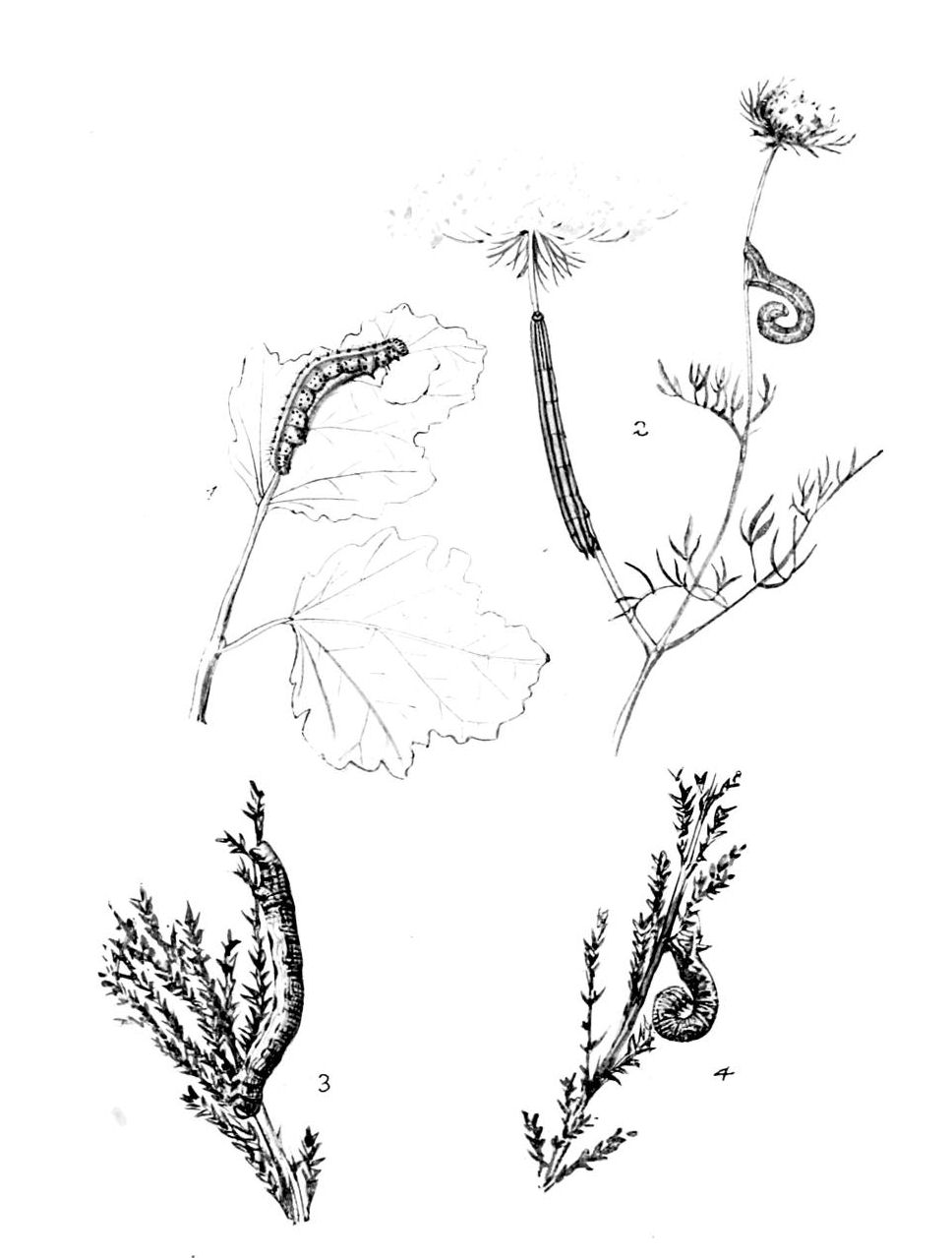
1.V-moth: caterpillar. 2.Yellow Belle: caterpillars.
3.Bordered Grey: caterpillar. 4.Grey Scalloped Bar: caterpillar.
2 Pl. 143.
1, 2.Bordered Grey. 3.V-moth. 4, 5.Rannoch Looper.
6.Brown Silver-line. 7-9.Latticed Heath.
Bordered White (Bupalus piniaria).
Two forms of the male of this species are represented on Plate 141. Fig. 9 shows the yellow English form (ab. flavescens, White), and Fig. 10 the white North English and Scotch forms. In southern localities, however, specimens occur which are almost as white as the northern or even Scotch examples; I have two such specimens from Surrey. There is considerable variation in the size of area occupied by the pale colour, both in white and yellow forms. In one of the former, from Forres, in Scotland, the white is represented by a small oval spot and dappled streak on the fore wings; an entirely black specimen (ab. nigricarius, Backhaus) has been noted from Berkshire. In other specimens there is an unusually large proportion of pale colour. The females are usually orange, or orange yellow, in the south (Fig. 8); and yellowish brown, or dingy orange brown, in the north. The brownish-coloured females occasionally occur in the south, and the brighter form of this sex is sometimes taken in the Midlands, where the two forms of the species seem to overlap.
The long, greenish caterpillar is marked with whitish or yellow lines; those along the back are edged with black, and along the sides with dark green. It feeds from August to October on the needles of the pine, and also on other firs. (Plate 140, Fig. 3; Fig. 3a shows a photo of the chrysalis, twice natural size, by Mr. H. Main.) The moth is out in May and June, later in the north; it is generally common in pine woods throughout England, Wales, and Scotland.
Bordered Grey (Selidosema ericetaria).
Portraits of the male and female of this species (known also as plumaria) will be found on Plate 143, Figs. 1 ♂, 2 ♀. The cross markings are more distinct in some specimens than in others, and the central one of the fore wings varies in width.
The caterpillar (Plate 142, Fig. 3, from a photograph by Mr. H. Main) is grey, with a dark-brown or blackish irregular double line along the back, and pale lines along the sides, the lower one edged above with reddish brown; spiracles, black, as also are the dots on the back; the last ring ends in a point. (Adapted from Porritt.) It feeds on ling (Calluna), from September well on into the following spring.
The moth occurs on heaths and mosses in July and August, but it is local. On warm days the males are very active, but about dusk they are not difficult to capture. In southern England, the New Forest, Hants, appears to be its special home, but it is also found in other parts of that county, including the Isle of Wight, in Dorsetshire, and in Surrey; also noted from Berkshire. It is scarce in Cheshire, fairly common on the Witherslack mosses in North Lancashire, and at Ullswater in Cumberland. Except that it has been recorded from the Isle of Arran (1882), it does not seem to have been noted in Scotland. In Ireland it is widely distributed, and is abundant at Kinsale, co. Cork.
The V-moth (Thamnonoma (Itame) wauari).
The popular name of this species (Plate 143, Fig. 3) refers to the black discal mark on the more or less violet-tinged pale, greyish fore wings; but there is a good deal of variation in this character. Occasionally the wings are suffused with smoky (ab. vau-nigraria, Hatchett), or more rarely with blackish brown (ab. fuscaria, Thunberg).
On Plate 142 is a figure of the caterpillar, from a coloured drawing by Mr. A. Sich. The general colour is greenish, or some shade of brown; the lines on the back are white, and that low down along the sides is broad, and yellow; the raised dots are black with short bristles. It feeds in April, May, and June on the foliage of gooseberry and currant, and is especially fond of the tender shoots.
The moth, which is out in July and August, is often common in gardens and orchards where bush fruit is grown, pretty well throughout the United Kingdom. It appears to occur only rarely in Ireland.
Abroad, the range extends to Amurland, and a form is found in Labrador.
Rannoch Looper (Thamnonoma brunneata).
All the wings are of a rusty ochreous colour, sometimes, chiefly in the male, inclining to a purplish tint on the fore wings; the brownish cross lines are usually most distinct in the female, which sex Hübner figured as pinetaria. (Plate 143, Figs. 4 ♂, 5 ♀.)
The caterpillar is reddish brown, with a black-edged dark-green irregular line along the middle of the back; a white line on each side of the central one, and following this are a dark-brown shade-like stripe and some brownish-green lines; the line along the spiracles is whitish, inclining to yellow. In general appearance it closely resembles a twig of bilberry (Vaccinium), upon the foliage of which plant the caterpillar feeds in the spring.
The moth is out in June and July, but in the British Isles it is only to be obtained in Perthshire and northwards in Scotland. Black-wood, Loch Rannoch, is the original, and a now well-known, locality for this species, which Curtis in 1828 figured as Speranza sylvaria.
The range abroad extends to Amurland and Japan, and to North America.
Brown Silver-line (Lozogramma (Phasiane) petraria).
The two cross lines on the pale-brown, sometimes pinkish, fore wings, are edged with whitish, but this is most distinct on the outer one. In some specimens there is a distinct submarginal line, but this character is only faintly in evidence as a rule, and occasionally it is entirely absent. (Plate 143, Fig. 6.)
The caterpillar feeds in June, sometimes earlier, on bracken or brake-fern (Pteris aquilina). It is olive green marked with reddish brown lines, and there is a whitish line under the black spiracles.
In most English and Welsh localities where bracken is plentiful, this moth should be found in May and June; also in the south of Scotland, but its occurrence in that country north of Clydesdale appears to be only casual. It is common in several parts of Ireland.
The distribution abroad includes Amurland and Japan.
Latticed Heath (Chiasmia (Strenia) clathrata).
In its ground colour this species (Plate 143, Figs. 7, 8 ♂, 9 ♀) varies from ochreous of some shade to white. The dark-brown or blackish cross lines and veins give a latticed appearance to the wings, hence both the Latin and popular names for this insect. There is much variation in the width of the cross markings; sometimes two or more unite and so form bands; more rarely, perhaps, the outer lines are absent, and the others broken up into dashes; or the blackish cross lines may be slender and the veins remain of the ochreous ground colour (ab. radiata, Haworth). A less frequent aberration has the wings dark brown or blackish all over, except a row of whitish or ochreous spots on the outer margins (ab. nocturnata, Fuchs = nigricans, Oberthür).
The caterpillar, which feeds on clovers and trefoils, is green, with white lines along the back and sides; the slightly notched head is rather glossy, and the mouth is brownish: June to September, in two broods.
The first generation of the moth is out in April and May, and the second in July and August. It may be found in clover fields and on chalk slopes, etc., where the food plants flourish; although it is an active day flyer, it is not difficult to capture with the net. It is most plentiful in southern and eastern England, but its range extends throughout the United Kingdom to Clydesdale, and the species is widely distributed in Ireland.
The distribution abroad extends to East Siberia, Amurland, and Japan.
Grey Scalloped Bar (Scodiona fagaria).
In its typical form this species (also known as belgiaria, Hübner) is grey, more or less tinged with ochreous, speckled with brownish grey, and crossed by black-marked brownish-grey lines. The bulk of British specimens, especially those from southern localities, are whitish grey, thinly sprinkled with darker grey scales in the male, and sometimes heavily powdered in the female; a pair are figured on Plate 144, 1 ♂, 2 ♀. The whiter form of the male, occurring in Britain chiefly in the New Forest, Hampshire, has been named albidaria, Staudinger.
The roughened caterpillar is figured on Plate 142 (photo by H. Main). In general colour it is dingy brown, with a whitish stripe along the back and some greyish marking on the sides. It feeds on ling and heath; growing slowly in the late summer, but more quickly in the spring, after hibernation, when it may be obtained at night from the tips of the heather twigs, either by searching or by means of the sweeping net. The moth is out in June and July in the south, and later in the north. It is found on moist heaths, moors, and mosses; when resting on the dark-coloured earth it so closely resembles a stone that it is probably frequently passed unnoticed.
The species is apparently more plentiful in the New Forest than in its other known southern localities (Kent, Surrey, Berkshire, Sussex, and Dorset). Its range northwards in England extends from Worcestershire (Malvern, rare) to Cumberland and Northumberland. It seems to be distributed over the greater part of Scotland, including the Hebrides and the Orkneys. In Wales it has been recorded from Flint, Denbigh, and Carnarvon; and it is widely spread over Ireland, occurring chiefly on the bogs.
Black-veined Moth (Scoria lineata).
This slightly ochreous tinged silky white moth has the veins of the wings blackish, and this is especially noticeable on the underside of the fore wings. A male specimen is shown on Plate 144, Fig. 3; the wings of the female are slightly smaller, and the body is stouter and shorter. This species is the dealbata of Linnæus, but lineata, Scopoli, is older by four years. The long caterpillar is greyish inclining to ochreous or brownish; several irregular darker lines on the back and sides. It feeds, in confinement, on knot-grass, dock, bird's-foot trefoil, etc., but in the open is said to eat wood grasses, such as Brachypodium, upon the blades of which the female moth has been seen to deposit eggs: July to May. The moth is out from late May through June; it flies in the sunshine, or rests among long grass, etc., from which it is readily disturbed. Its chief British haunts are in Kent (Higham, Wye, etc.); but it has been recorded from Sussex, Dorset, Somerset, Gloucester, and Herefordshire, chiefly in single specimens.
Abroad, the range extends to Amurland.
Straw Belle (Aspilates gilvaria).
This straw-coloured species (Plate 144, Fig. 4 ♂, 6 ♀) will be easily recognised by the brownish stripe on the fore wings, which extends from the front margin, near the tip, almost to the inner margin; this is sometimes faint, but rarely quite absent. The hind wings are paler and have a dusky central dot and incomplete band. The caterpillar, which in shape is somewhat similar to that of the next species, is ochreous grey inclining to pinkish on the sides; a dark almost blackish line along the middle of the back is edged on each side with pale ochreous, and there are other pale and dark lines along the sides. It feeds on thyme, cinquefoil, yarrow, and other low-growing plants; it may be reared on knot grass: September to June. The moth is out in July and August, and, although very local, is not uncommon on downs and hilly fields on the chalk in Kent and Surrey—Dover, Folkestone, and Rochester in the former county, and Leatherhead, Box Hill, and Reigate in the latter, are the best-known localities. It has also been reported from Sussex (Brighton, Horsham, near Polgate, Shoreham). In Devonshire it is said to occur at Braunton and Ilfracombe, but is scarce. In his catalogue of the Lepidoptera of Suffolk (1890) the Rev. E. N. Bloomfield notes the species as very plentiful in clover fields about Tuddenham. Also recorded from Somerset, Gloucestershire, Cheshire (West Kirby and Hale), and from near Harrow in Middlesex.
Very local and scarce in Ireland (Kane).
The range abroad extends to East Siberia and Amurland.
Yellow Belle (Aspilates ochrearia).
As will be seen from Fig. 5 ♀ on Plate 144, this species differs from the last in its yellower colour and rather smaller size; the fore wings have two cross bands, generally well defined, but in the male they are sometimes very faint and slender, and specimens have been recorded in which the bands were missing.
The roughened caterpillar, figured on Plate 142, from a coloured drawing by Mr. A. Sich, is pale ochreous brown, lined and striped with darker brown. It feeds on wild carrot, plantain, hawks'-beard, etc., and will thrive on knot-grass. There are two broods, one feeding in the spring, after hibernation; and the other in June and July, sometimes later. The first generation of moths flies in May and June, and the second in August and early September. The species occurs in all the southern seaboard counties of England from Kent to Cornwall, frequenting the downs and rough fields near the coast; also in the Sandbreck district of the eastern counties. It occurs in South Wales; and odd specimens have been reported from Cheshire (Delamere), and from Cumberland.
The range abroad extends to North-west Africa and Asia Minor.
Grass Wave (Perconia (Aspilates) strigillaria).
A male and a female of this species are depicted on Plate 144, Figs. 7 ♂ and 8 ♀. There is variation in the amount of dark speckling on the wings, and in the number and width of the cross markings; sometimes the first and second on the fore wings are united throughout their length, or towards the inner margin; coupled with this there is sometimes considerable increase in the width of the first cross marking of the hind wings. A rare variety in Britain is ab. grisearia, Staudinger, which is of an almost uniform greyish or greyish-brown colour, with the markings obscured.
The caterpillar is purplish grey, marked with paler and darker; two warts on the back of rings 7-10, the middle pair the largest and most prominent. It feeds on ling, heath, broom, and the flowers of gorse or furze, and is best obtained in the spring after hibernation.
2 Pl. 144.
1, 2.Grey Scalloped Bar. 3.Black-veined. 4, 5.Yellow Belle.
6.Straw Belle. 7, 8.Grass Wave.
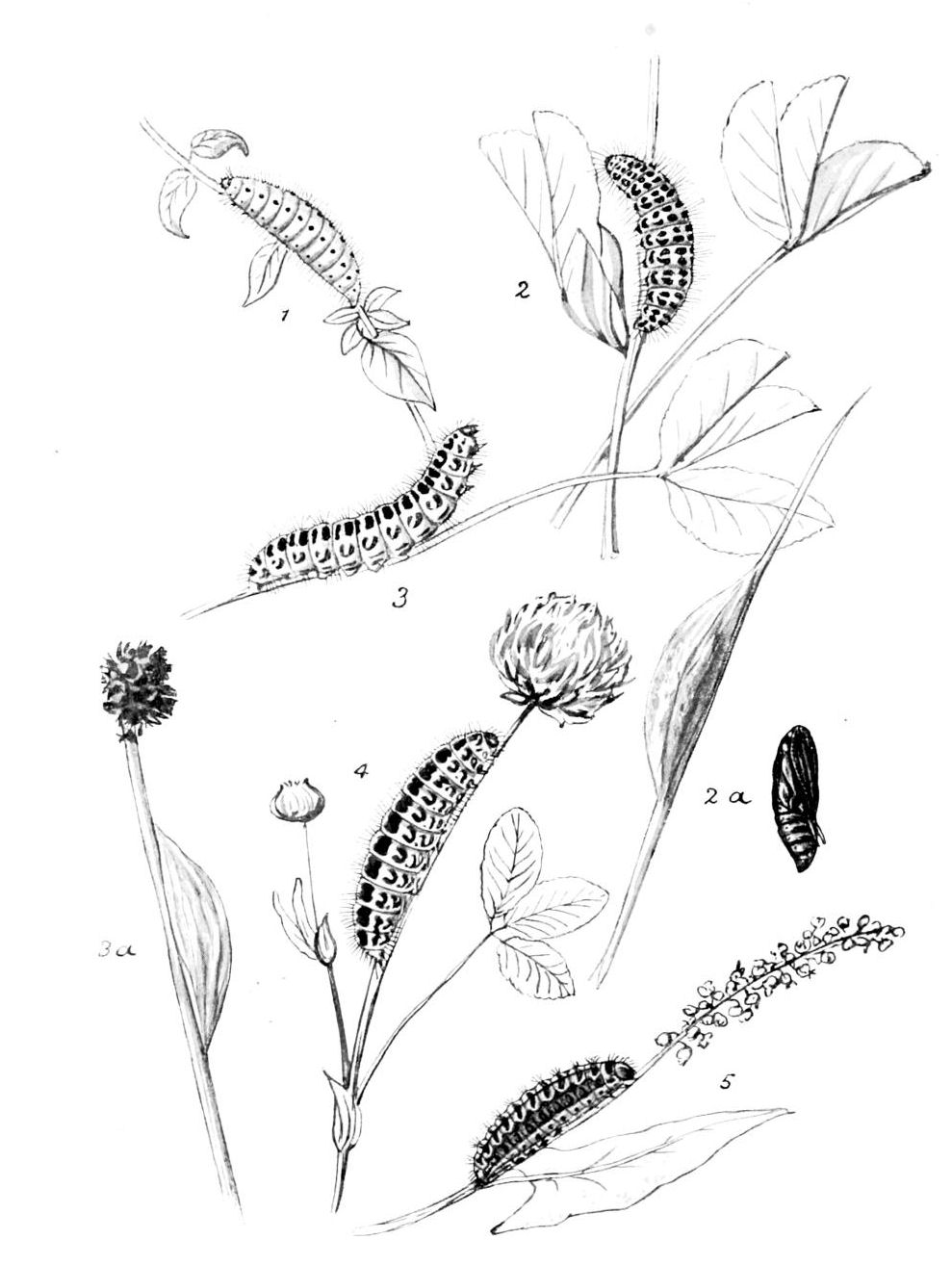
2 Pl. 145.
1.Transparent Burnet: caterpillar.
2, 2a.Narrow-bordered Five-spot Burnet: caterpillar, chrysalis and cocoon.
3, 3a.Five-spot Burnet: caterpillar and cocoon.
4.Six-spot Burnet: caterpillar. 5.Forester: caterpillar.
The moth, which is out in June and July, occurs on most of the heaths and moors throughout England; apparently commoner and more generally distributed in the south than in the north; but it seems to be rare on the eastern side of the country altogether. From Cheshire it spreads into Flint and Denbigh, North Wales. In Scotland, it is found in Roxburgh (Bellion Moor), Clydesdale (local, but common), and northwards to Ross. It is found on the boggy heaths of Ireland, and Kane states that it is abundant where it occurs.
The range abroad extends to Scandinavia and eastward to Asia Minor.
ZYGÆNIDÆ.
The moths belonging to this family are popularly known in Britain as Burnets and Foresters. Of the former seven kinds occur in the British Isles, and of the latter there are only three species.
All the species live in colonies, so that when a specimen is seen or captured others may be expected to occur on, or somewhere around, the same spot. The caterpillars bear a close resemblance to each other, and are not always easily distinguished.
Over thirty species of Zygæna are found in Europe, and about thirty-six more have been described from other parts of the Palæarctic Region. There are at least twenty-five Palæarctic species referred to the genus Ino, and about ten of these are European.
By most authors filipendulæ is regarded as the type of the genus Zygæna, Fabricius; but others refer this species, and its allies, to the genus Anthrocera, Scopoli, using the Fabrician genus for phegea, Linnæus. The latter species and its allies are perhaps more frequently referred to Syntomis, Ochsenheimer, the typical genus of the family Syntomidæ, the systematic position of which is near the Arctiidæ. It may be added that S. phegea, and also Naclia ancilla, have been reported as British. There does not seem, however, to be any reason to suppose that the occurrence of either species in Britain could be other than accidental.
The Transparent Burnet (Zygæna purpuralis).
Two Welsh specimens are depicted on Plate 146, Figs. 1 and 2; these are of the typical form. A rare aberration has the spots and the hind wings more or less suffused with blackish (ab. obscura, Tutt), but a still rarer variety has the crimson of spots and hind wings replaced by yellow (ab. lutescens, Tutt).
Newman in 1861 referred an Irish specimen to achilleæ, but a little later, after seeing other examples, in the same year he changed the name to nubiginea. Birchall (Ent. Mo. Mag., iii. pt. i.) figured four forms of the species from Ireland; his minos (Figs. 5a and 5b) seems to represent two modifications of ab. interrupta, Staudinger, in which form the red blotches are widely separated or interrupted by the ground colour; and his nubigena is made up of more or less typical purpuralis (Fig. 6a), and a variety (Fig. 6b), with red marks between the lower and central blotches.
The caterpillar (Plate 145, Fig. 1) is dark green inclining to olive above and paler below; the spots are black (outer row) and yellow (inner row); the line along the back is obscure whitish; hairs, whitish. It feeds on thyme and burnet saxifrage (Pimpinella). Trifolium and Lotus have also been given among other food plants. In late summer, and after hibernation, in the spring. The moth flies in June, and is locally common in Ireland (Clare and Galway), Wales (Abersoch), and Scotland (Oban, Loch Etive). It has been reported from Tintagel, Cornwall, and possibly, as suggested by Tutt, these Cornish specimens may turn out to be Z. achilleæ, the latest addition to our small band of Burnets. Perhaps the Scottish specimens recorded as purpuralis, or at least some of them, may prove to be achilleæ.
This species was figured by Brünnich, in 1763, as purpuralis, and authorities are now agreed that this name must be adopted in place of pilosellæ, Esper (1781), or minos, Fuessly (1782).
Scotch or Mountain Burnet (Zygæna exulans).
This semi-transparent and rather greyish moth has five reddish spots on the fore wings. (Plate 146, Fig. 3.) So far as concerns the British Isles it is only known to occur in Aberdeenshire, where it was discovered on the mountains at Braemar in July, 1871, and where it may be still found by those who are acquainted with the situation of its lofty haunts. The late Dr. Buchanan White named the Scottish form subochracea, but others consider that it is not readily separable from vanadis, Dalman, which in turn is said by Tutt to be pretty much the same form of the species as that described as the type exulans, Hochenwarth.
The caterpillar is dark green above, and paler below; two velvety black stripes on the back, each stripe interrupted by yellow spots; warts with black hairs; head, black. It feeds on Silene acaulis, cyphel (Arenaria cherleria = Cherleria sedoides), clover, trefoils, Azalea procumbens, etc.; has been known to eat dock and knot-grass: August to June. The cocoon has been found on a stem of crowberry (Empetrum), and on heath and grass stems. The moth is out in July, and, like the rest of its kindred, delights in the sunshine.
Zygæna achilleæ.
A specimen of this species, quite recently introduced as British, has been kindly lent by Mr. B. Adkin. It was taken, with others, in the vicinity of Oban, Argyllshire. Mr. Sheldon informs me that he believes that a worn Zygænid he captured in 1898, in the Glencoe district, was this species.
On Plate 1, with the Scottish example (Fig. 2) referred to, is also shown a specimen from the continent (Fig. 3), and it will be noted that the former is very like the latter. In some respects this species is not unlike some confluent-spot forms of filipendulæ, but it is a more slender-looking insect, and the body is more hairy. Further, the upper basal spot of the fore wings is lengthened almost to the upper spot of the middle pair, and the fifth and sixth spots together form an almost oval mark. Both specimens depicted seem to be referable to var. viciæ, Hübner. In the typical forms the spots are larger. A yellow form ab. flava, Oberthür, is known on the continent.
The caterpillar, after Hofmann, is figured on Plate 1, Fig. 5. It is said to feed on Astragalus and Coronilla.
New Forest Burnet (Zygæna meliloti).
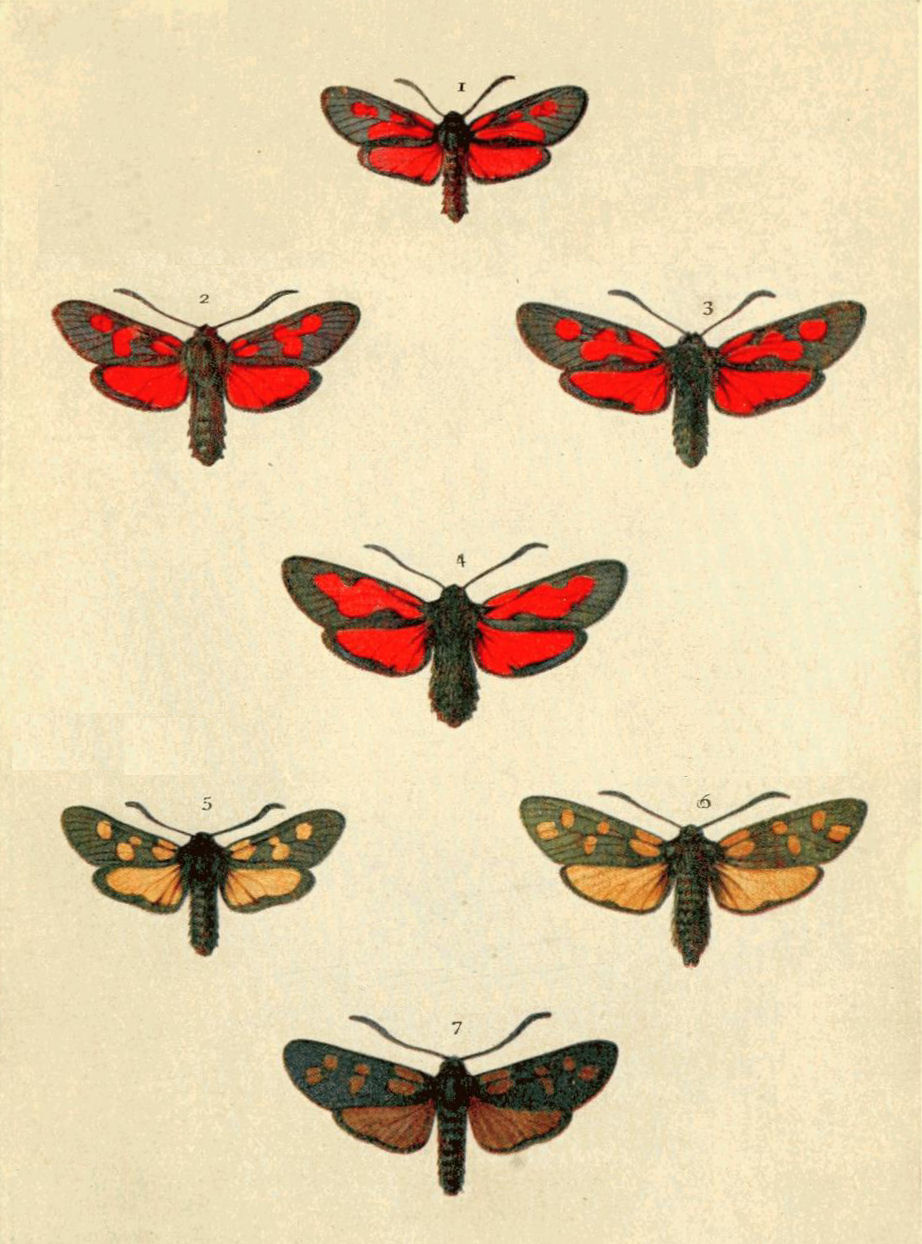
Two examples of this, normally, five-spotted little species are shown on Plate 146, Figs. 4 ♂, 5 ♀; a variety, referable to ab. confusa, Staudinger (spots run together forming streaks somewhat as in purpuralis), is depicted in Plate 148, Fig. 1. Occasionally a sixth spot is in evidence (ab. sexpunctata, Tutt). A form in which the body has a red belt is known abroad as ab. stentzii, Freyer, and examples having traces of this belt have been recorded from the New Forest, which, it may be added, is the only locality in Britain producing this species.
The caterpillar is of a dull pale greenish colour, with numerous black speckles; three whitish lines on the back, the central one greenish tinged and broader than the others, which are interrupted on each ring by a yellow spot; between the lines is a series of black dots, one on the outer edge of each ring; hairs, from greenish warts, white and short; head, black, dotted with white. It feeds on bird's-foot trefoil (Lotus corniculatus), and other trefoils and clovers: August to May. Sometimes the caterpillars do not complete growth until they have passed two winters in hibernation. The cocoon, which is yellow or yellowish white, has been found on a grass stem, but it is generally placed so low down among herbage that it seems to be rarely detected.
The moth is out in June and early July.
As previously stated the only part of Britain that the species inhabits is the New Forest, Hampshire. Here it was first met with in Stubby Copse, about 1869, but was apparently not distinguished from Z. trifolii until 1872. It is now less frequent in its old haunt than formerly, although it still occurs there; in other spots around, I believe, it is not uncommon in some years.
Some authorities refer this species to viciæ, Schranck.
Five-spot Burnet (Zygæna trifolii).
Four specimens of this species are portrayed on Plate 146. In the typical form (Figs. 7 ♂, 8 ♀) the central pair of crimson spots are united and often form a large blotch; ab. orobi, Hübner (Figs. 6 ♂, 9 ♀), has the spots placed well apart. Other more or less frequent aberrations are depicted by Mr. Horace Knight on Plate 148 where Fig. 2 represents ab. glycirrhizæ, Hübner (spots 3, 4, and 5 united); Fig. 3, ab. basalis, Selys (spots 3 and 4 united with the basal pair); and Fig. 4, ab. minoides, Selys (all the spots united, forming an irregular patch). An extreme development of the last-mentioned form has been named ab. extrema, Tutt (see Entom. xxix., p. 341, Fig. 2). Specimens with a sixth spot as in Z. filipendulæ have been occasionally recorded, and an example with the lower spot of the central pair absent has been taken in West Sussex by Mr. W. M. Christy, who has also obtained a number of specimens of a yellow form (ab. lutescens, Cockerell) in the same locality. The yellow form is shown on Plate 148, Fig. 5. Some of the yellow aberrations also exhibit variation in the spots pretty much as in the ordinary form. In some localities, especially marshy ones, the spots on the fore wings and the hind wings are occasionally dull orange; and I have noted specimens in the Weybridge district, Surrey, with the spots on the fore wings of a pinky ochreous colour, whilst the hind wings were of the usual crimson. Such "aberrations" as those last mentioned probably result from weather exposure. In 1899, Mr. G. B. Corbin recorded the capture, near Ringwood, Hants, of a specimen which had the spots on the fore wings and the red of the hind wings darkened over with dull smoky black, so that the insect when seen at a distance seemed to be wholly black. Dr. Hodgson has recently obtained several of these melanic specimens in Sussex. A form with the spots and hind wings suffused with brownish has been named ab. obscura, Oberthür.
With regard to six-spot examples referred to this species, I am inclined to suppose that they may be the offspring of a chance pairing of trifolii and filipendulæ. That such crossing does occur in nature I have evidence, as on one occasion I found four mixed pairs, the male being trifolii in each case, and the female typical filipendulæ. This was in the Weybridge district, where I had come across a colony of the latter species and was closely examining the specimens for aberrations.
The caterpillar (Plate 145, Fig. 3) is green inclining to yellowish and to bluish, with black marks on the back; a series of black streaks low down along the sides. It feeds on Lotus corniculatus, and on other trefoils and clover: July to May. Sometimes taking two years to complete its changes.
In damp meadows the moth is out in May and June, but in marshes it does not appear, as a rule, until July, and may be found in early August. The marsh specimens, which are sometimes rather large in size, have been referred to palustris, Oberthür, and are treated by Tutt (Nat. Hist. Brit. Lep., vol. i.) as a sub-species.
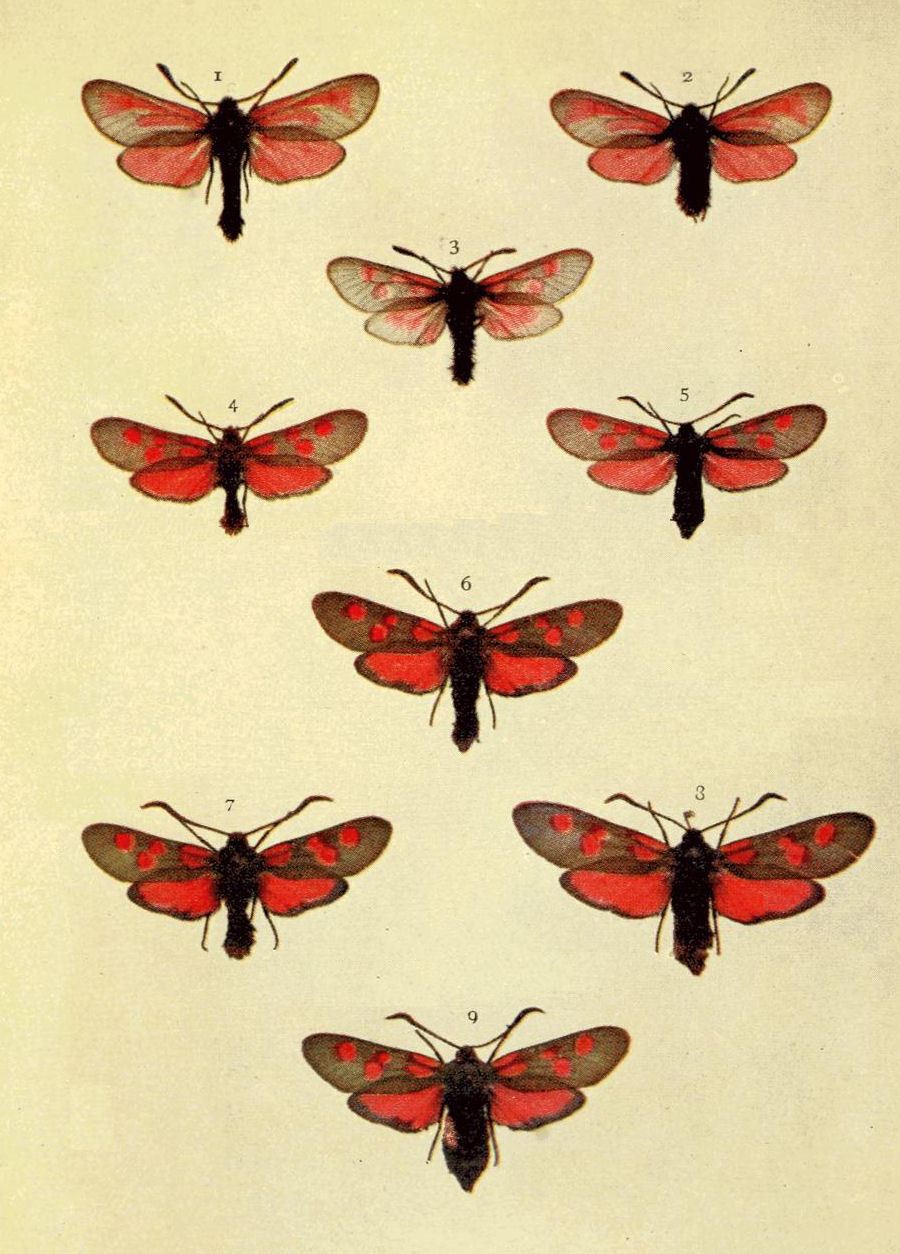
2 Pl. 146.
1, 2.Transparent Burnet. 3.Scotch Burnet.
4, 5.New Forest Burnet. 6-9.Five-spot Burnet.
2 Pl. 147.
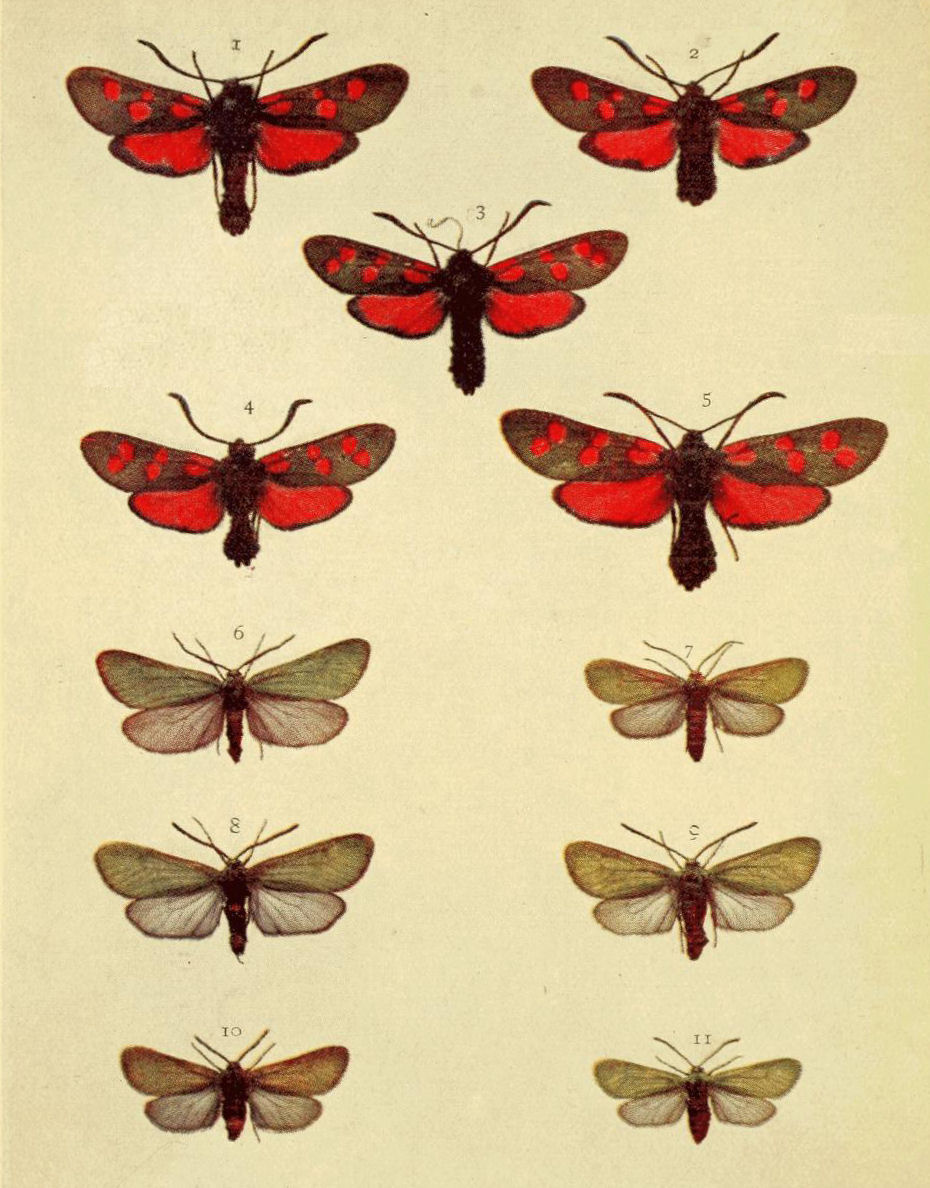
1, 2.Narrow-bordered Five-spot Burnet. 3-5.Six-spot Burnet.
6, 7.Scarce Forester. 8, 9.The Forester.
10, 11. Cistus Forester.
In the British Isles, the species is apparently confined to England and North Wales. In the former country it is locally common in most of the southern counties; still more local in the eastern counties, and northwards to Lancashire and Yorkshire. There are records from Armagh and Fermanagh, but Kane appears to doubt the occurrence of the species in Ireland. There is no doubt that the next species has frequently been mistaken for the present one, therefore the actual range of trifolii in the British Isles has probably not been fully ascertained.
Narrow-bordered Five-spot Burnet (Zygæna loniceræ).
As will be seen from the two specimens represented by Figs. 1 ♂ and 2 ♀ on Plate 147, this species bears considerable resemblance to ab. orobi of Z. trifolii. The chief differences are in the rather longer fore wings and the more pointed tips of the hind pair; the borders of the hind wings are often narrower. In a broad way, it may be stated that the general tone of colour in the male of loniceræ is bluer than that of trifolii. The union of any two or more spots is rarely seen in this species in Britain, but specimens with all the spots joined together have certainly been noted. A yellow form, ab. citrina, Speyer (= flava, Oberthür), is known on the continent, and Barrett states that it has occurred in England. In ab. lutescens, Hewett, the hind wings are orange. Ab. eboraceæ, Prest, is semi-transparent, steel blue; the spots and the hind wings are pink, the border of the hind wings brown, and the fringes of all the wings are whitish.
The caterpillar (Plate 145, Fig. 2) is very similar to that of the last species, but the black marks on the sides are heavier, and the hairs of the body are longer. It feeds on trefoils and clover, and sometimes passes two winters before becoming full grown. The cocoon, which is attached to stems of grass, etc., is generally placed well up above the ground, so that it is readily seen.
The moth, which is out in late June and in July, occurs in woods and plantations; also said to be found in meadows, and on rough waste ground, as well as in marshes and salterns. The distribution is much as in the last species, but it is plentiful in East Yorkshire, and the range extends to Cumberland and Northumberland.
Six-spot Burnet (Zygæna filipendulæ).
This species (Plate 147, Figs. 3-5) is the most generally common of our Burnets. Perhaps the most frequent form of variation in the spots of the fore wings is that in which the outer pair run together, and so form a blotch; but union of the middle pair is not an uncommon occurrence. In ab. cytisi, Hübner, the three pairs of spots are each united, so that the fore wings have three separate blotches, and when these are of a dull scarlet instead of the usual crimson, ab. ramburi, Lederer, is represented. Occasionally, all the spots are united, as in ab. cytisi, and the blotches thus formed are connected by reddish streaks in various modifications leading up to ab. conjuncta, Tutt, which has all the spots merged into a large blotch, extending over the disc of the fore wings. From the normal crimson, the spots and the hind wings vary now and then to orange (aurantia, Tutt), or to yellow (ab. flava, Robson = cerinus, Robson and Gardner); intermediate shades between these two extremes, and the typical coloration, are rather more frequent. I am indebted to Mr. R. Adkin for the loan of the example of the yellow form shown on Plate 148, Fig. 6. Pink, and orange, forms have been noted from various parts of England, but they seem to occur, or have been found, more especially in Cambridge and the north-east corner of Essex. Fig. 7, Plate 148, represents an example of ab. chrysanthemi, Hübner, and is copied from Oberthür's Etudes d'Entom., xx., Plate 8, Fig. 134. A few specimens referable to this form, probably not exceeding half a dozen altogether, have been recorded as taken in England. In typical filipendulæ the dark blue border of the hind wings is narrow, but in ab. hippocrepidis, Stephens (tutti, Rebel), the borders are rather broad. Another character of this form is that the nervule upon which the sixth spot is placed is here of the ground colour, and therefore divides the spot. (Plate 147, Fig. 3.) At Northwood, Middlesex, I have found this form in May and June, and also in the Weybridge district, Surrey, in late July; and, it may be added, there was a flourishing colony of Z. trifolii hard by in each locality. For this reason, plus the fact that trifolii ♂ is known to pair with filipendulæ ♀, I hold the opinion that hippocrepidis is a hybrid. It may be noted here that hybrids have been raised from the crossing of filipendulæ and loniceræ; the sexes of loniceræ and trifolii pair somewhat readily, and the hybrid offspring of such pairings are fertile.
2 Pl. 148.
1.New Forest Burnet, ab. confusa. 2, 3, 4, 5.Five-spot Burnet, vars.
6, 7. Six-spot Burnet, vars.
2 Pl. 149.
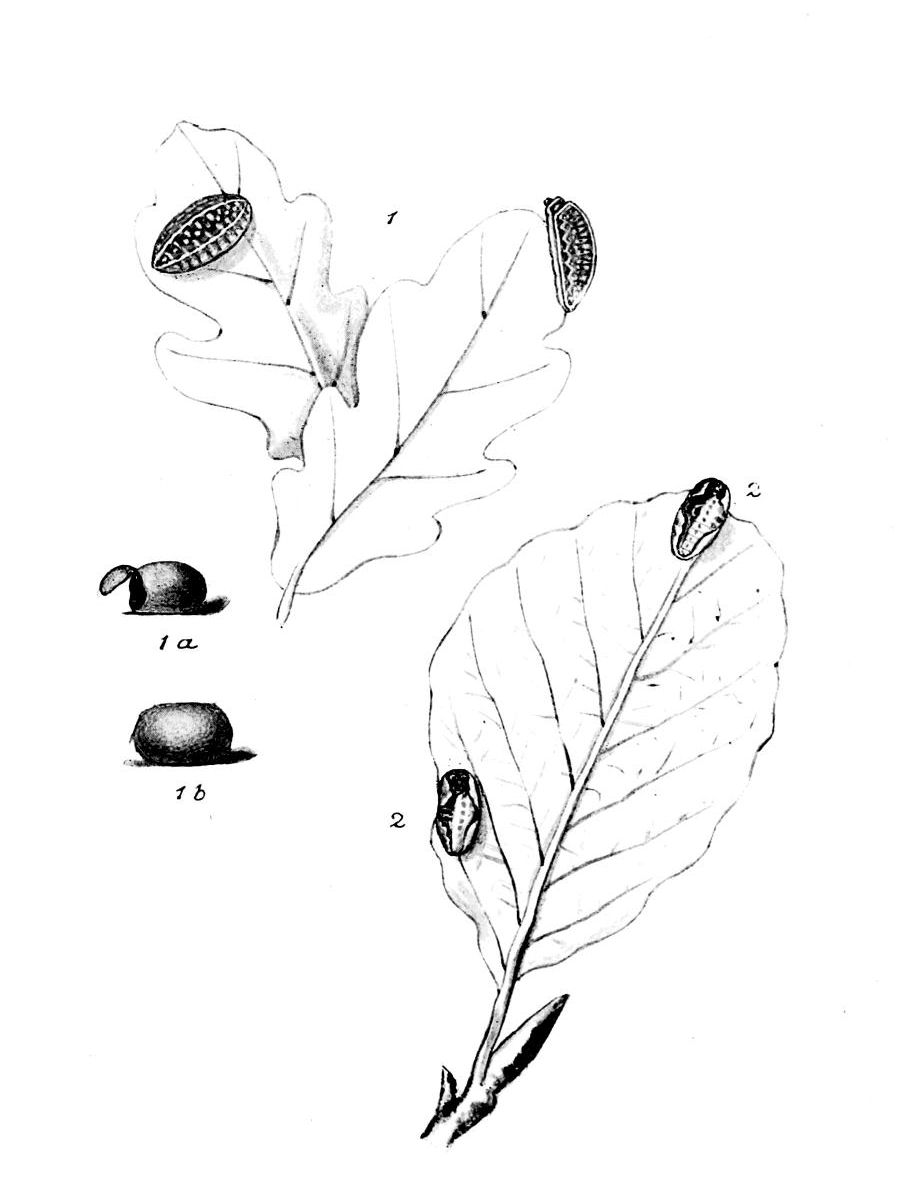
1.Festoon Moth: caterpillars and cocoons.
2.Triangle Moth: caterpillars.
It seems, then, that trifolii, loniceræ, and filipendulæ have not, so far, lost the power of fertile cross-pairing. Wherever colonies of two of the kind exist within visiting distance of each other, there, it appears, we may reasonably expect to find hybrids.
From a number of cocoons collected in a Yorkshire locality for loniceræ, I reared, in 1907, a good many examples of that species, and also about a dozen six-spot specimens, which agree in colour with filipendulæ, but they have the vein-interrupted sixth spot and broad border to hind wings, as in hippocrepidis.
The caterpillar (Plate 145, Fig. 4) is greenish, with black markings and some yellow spots, the latter chiefly on the hind edges of the rings. It feeds in the autumn and after hibernation, on trefoils, clover, bird's-foot (Ornithopus), and kidney-vetch (Anthyllis), completing growth in the spring.
The moth flies on sunny days in July and August, on chalk downs, etc., inland, and on cliffs and sand hills on the coast, also in marshes; but, as previously stated, it also occurs locally in meadows in May and June.
Scarce Forester (Ino (Rhagades) globulariæ).
Of the three species occurring in Britain this is slightly the larger, at least in the male. The fore wings are green, sometimes with a slightly golden sheen; fringes, greyish. The male is best distinguished from statices by its more slender body, and by the pectinated and rather pointed antennæ. The female is a good deal smaller than the male; the antennæ are simple, and somewhat thread-like, compared with those of the females of statices and geryon. (Plate 147, Figs. 6 ♂, 7 ♀.)
The caterpillar is green, with the raised spots inclining to bluish; two yellowish-white lines along the back, and a dark green stripe along the sides; head and plate on first ring of the body, black. It lives on knapweeds (Centaurea nigra and C. scabiosa), feeding on the leaves much in the same manner as the caterpillar of the next two species.
The moth is out in June and July; it is partial to blossoms of salad burnet (Poterium sanguisorba), and only flies in the sunshine. The late Mr. J. Jenner Weir, who found the species commonly on the downs near Lewes, Sussex, was the first entomologist to record it as British. The best known localities in Sussex are Hollingbury Vale and Cliffe Hill, but it also occurs at the Devil's Dyke near Brighton. In Kent it is found on the downs behind Folkestone and Shorncliffe Camp.
The Forester (Ino (Adscita) statices).
In its most frequent form in Britain, this species is bronzy green (ab. viridis, Tutt); the typical bluish green type is much less frequent. The female is smaller than the male, but the difference in size is hardly ever so marked as in the sexes of globulariæ. The antennæ of the male are pectinated, but the tips are thickened. (Plate 147, Figs. 8 ♂, 9 ♀.)
The caterpillar (Plate 145, Fig. 5) is whitish, inclining to green, yellow, or pinkish, on the back, and the sides are pinkish brown; the hairy warts are brown or pinkish brown, and the small head is glossy black. It feeds on sorrel (Rumex acetosa), and it attains full growth, after hibernation, about the end of April. On leaving the egg-shell in the summer, the young caterpillar bores into a leaf, and eats the tissue between the upper and lower skins; later on it attacks the foliage from the underside, but leaves the upper skin intact; or the process may be reversed, and the under skin left.
The moth is on the wing in June, sometimes late May. It occurs, locally, in meadows, frequently damp ones, where there is plenty of ragged-robin (Lychnis flos-cuculi), the blossoms of which plant it seems to prefer to all others.
Widely distributed over England, but in Wales only recorded from Capel Curig and Barmouth, in the north of that country (1900). In Scotland its range extends to Moray; and in Ireland it is found in counties Wicklow, Cork, Clare, Westmeath, Monaghan, Sligo, and Galway.
Cistus Forester (Ino (Adscita) geryon).
This species is much smaller than the last; the fore wings, the outer margins of which are somewhat rounded, are bronze green, but, in the male, rather dull in tint, sometimes tinged with golden towards the base. The antennae are more stumpy than those of statices, but in other respects they are similar in appearance. The female is not much smaller than the male. (Plate 147, Figs. 10 ♂, 11 ♀.)
The caterpillar is yellowish white, with bristle-bearing warts of pretty much the same colour; three lines on the back, the central one whitish, edged on each side with purplish, the others waved and of a claret colour; a reddish-brown stripe low down along the sides; head and plate on first ring of the body black, the latter edged in front with yellowish. It feeds on rock rose (Helianthemum chamæcistus). At first it attacks the leaf from the upper side, and partly burrows therein; when older it clears away patches from the under surface, leaving the upper skin of the leaf more or less transparent; as it approaches full growth it likes to take its meals in the sunshine, and then eats the top skin as well as other parts of the leaf, and also tender shoots: July to May. The moth is out in June and July, as a rule, but is sometimes observed in May. Its haunts are on warm slopes of chalk downs and limestone hills, where it flies in the sunshine.
This species was first noted as British in March, 1860, when specimens from Worcestershire were recorded as Procris tenuicornis. It seems, however, to have been considered doubtfully distinct from statices until 1863, when the caterpillar was found, and the occurrence of the species in several other English counties recorded. At the present time I. geryon is known to inhabit Sussex (Brighton and Lewes districts), Kent (Canterbury and Shorncliffe), Bucks (Aylesbury and Tring), Oxfordshire (Chinor), Gloucestershire (Cotswolds), Worcestershire (Malvern Hills), Derbyshire and North Staffordshire (Bakewell and Dovedale), Yorkshire (Richmond, Barnsley, Sheffield, etc.), and Durham (banks on the coast). In Wales, it is sometimes common on Great Orme's Head, Carnarvonshire.
COCHLIDIDÆ.
This family of moths mainly comprises tropical species, and is but poorly represented in the Palæarctic Region. Only two species are European, and both occur in Britain.
As Cochlidion, Hübner, supersedes Limacodes, Latrielle, the name of the family so long known as Limacodidæ, will have to be changed to that here adopted. Meyrick, who sinks Limacodes in favour of Apoda, Haworth, uses Heterogeneidæ as the family name.
The Festoon (Cochlidion (Heterogenea) limacodes).
The fore wings of the male are orange brown, more or less smudged or clouded with blackish; two oblique black lines, the first inclined inwards, and the second outwards and apparently terminating on the outer margin just above the inner angle, but there is a slender dusky curve from this point enclosing a clear, orange-brown spot. Hind wings blackish, except on the inner margin, which is broadly orange brown. Female, ochreous brown, with lines on the fore wings as in the male; hind wings suffused with dark grey or blackish, except on the inner area; generally rather larger than the male. (Plate 153, Figs. 1 ♂, 2 ♀.) Not infrequently, the fore wings of the male are so much clouded with blackish that the cross lines are obscured, and the spot on the inner margin alone remains clear.
The caterpillar (Plate 149, Fig. 1, from a coloured drawing by Mr. A. Sich) is green, with two reddish-edged yellow lines on the back; between these lines are yellowish spots; a yellow line along the sides extends along the front edge of the second ring, where it is marked with red. It feeds on oak, and may be beaten from the boughs in the autumn. The brownish cocoon is depicted on Plate 149; Fig. 1a shows the hinged lid which covered the opening through which the chrysalis protruded previous to the moth's escape; Fig. 1b represents one from which the moth has not emerged, and in nature this would be attached to a leaf and covered with a delicate film of silk. The moth is out in June and July, and both sexes may be beaten from the branches of trees, or seen flying around their tops in the sunshine.
This species, often referred to as Limacodes testudo, and said to be the avellana of Linnæus, is an inhabitant of oak woods, and occurs in Hampshire, Sussex, Kent, Essex, Suffolk, Oxfordshire, Bucks, Gloucestershire, and Worcestershire. A male and two females have been reported from Clonbrock, Co. Galway, Ireland.
The Triangle (Heterogena asella).
The fore wings of this little species (Plate 153, Figs. 4 ♂ and 5 ♀) are of triangular shape; in the male, which sex is smaller than the female, they are dark brown, sometimes almost blackish (ab. nigra, Tutt), and those of the female yellowish brown varying to ochreous yellow (ab. flavescens, Tutt). The hind wings of the male are blackish, and of the female clouded with blackish.
The curious woodlouse-shaped caterpillar is green, sometimes inclining to yellowish; the broad reddish band on the back broadens out before the middle, thus giving the idea of a rough cross, or, as sometimes described, a blunt spear head. It is found, by searching, in August and until October, on the foliage of beech and oak. Birch has also been mentioned as a food plant, and on the continent it is said to feed on poplar, lime, hazel, and hornbeam. Fig. 2 on Plate 149 is from a photo by Mr. H. Main.
Although the caterpillar constructs its gall-like cocoon on a leaf or in the fork of a twig in the autumn, it does not change to a chrysalis until late in spring, sometimes not until June. The moth is out in June and July and flies in the sunshine, chiefly in the afternoon, and might easily be confused with the Lechean Tortrix (Ptycholoma lecheana).
2 Pl. 150.
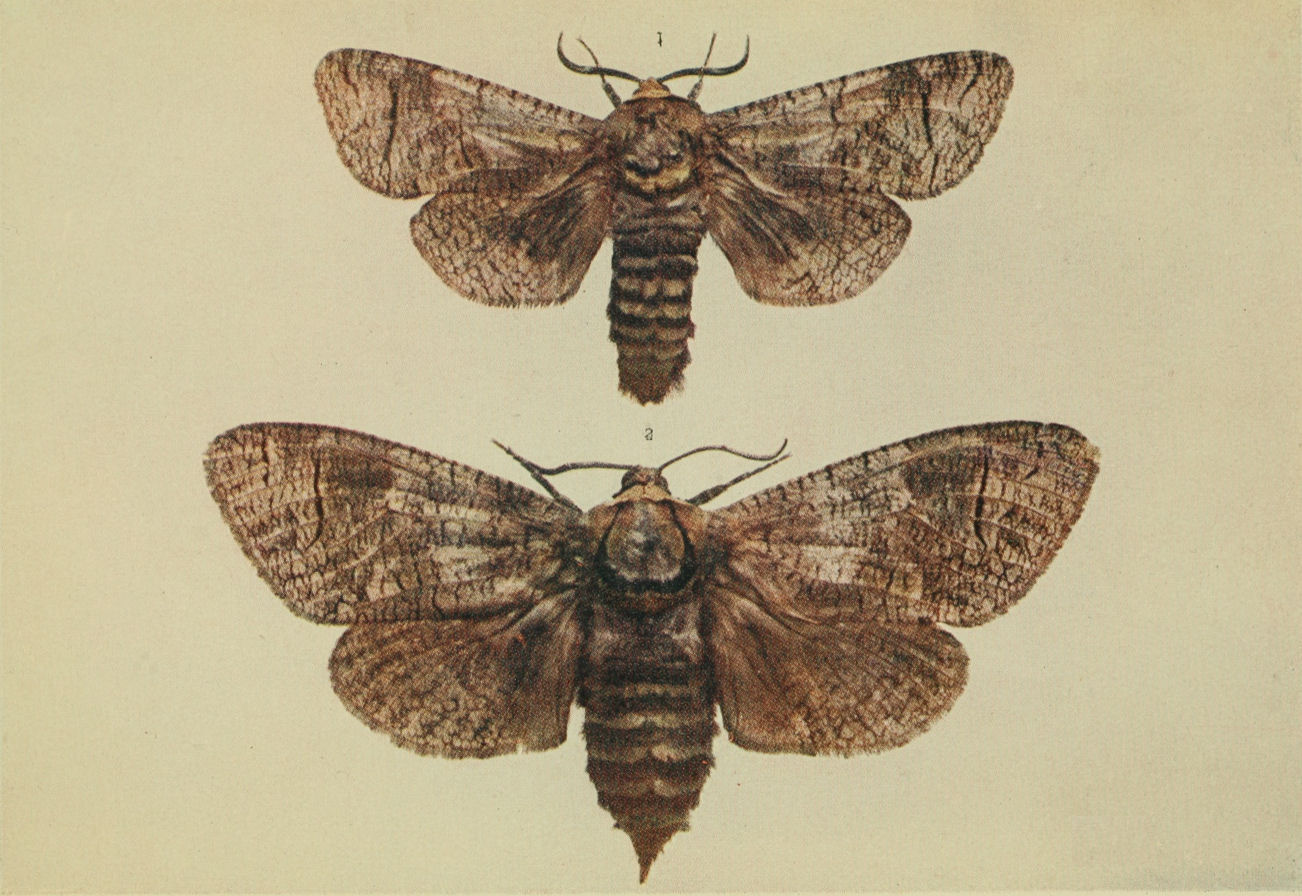
1, 2. Goat Moth.
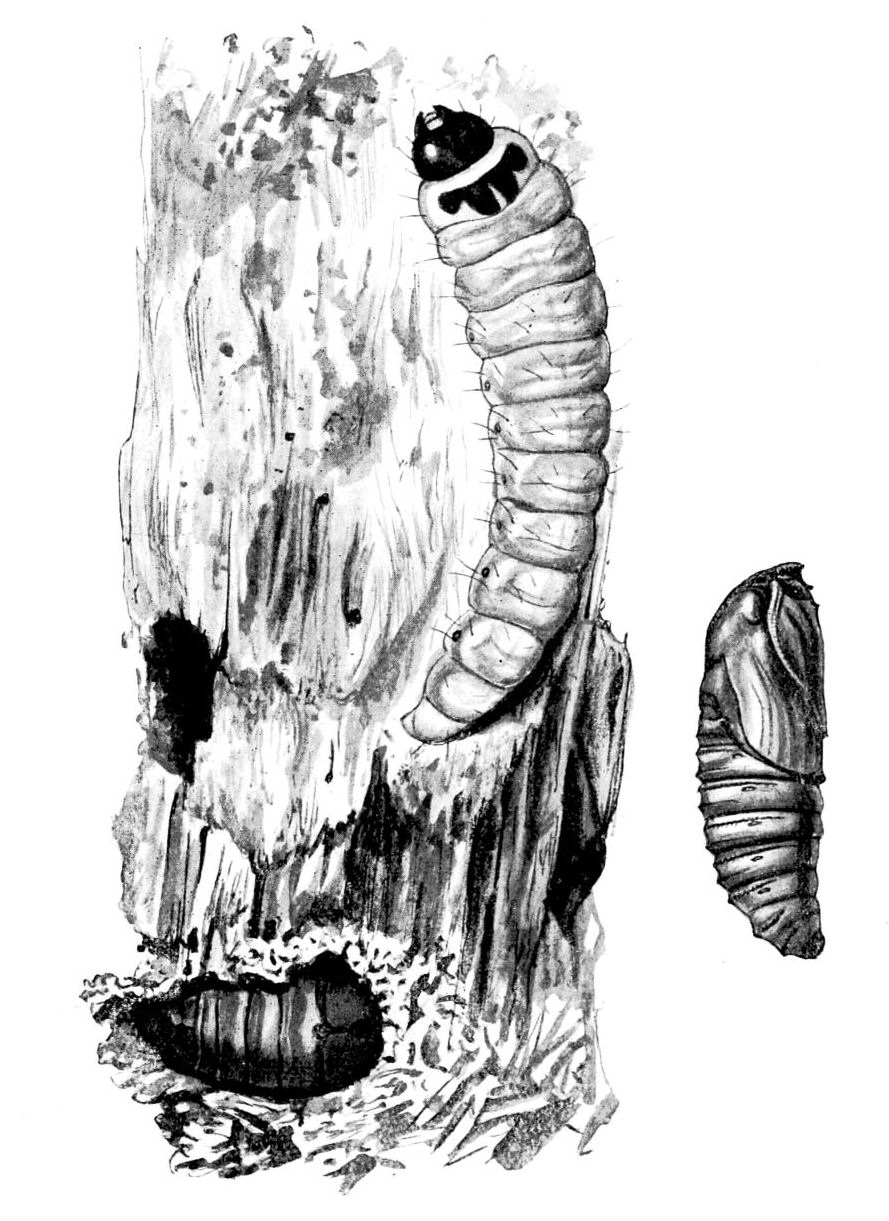
2 Pl. 151.
Goat Moth: caterpillar, chrysalis and cocoon.
The species appears to be very local in England and confined to the south. Its chief haunts seem to be in Bucks, where it is not uncommon in beech woods at Marlow, and in Hampshire, especially parts of the New Forest. It has been found in Epping Forest, Essex; rarely in Abbot's Wood and Rewell Wood, Sussex; also recorded from Bickleigh Vale and the Plym Valley, Devonshire.
The range abroad extends to Amurland.
COSSIDÆ.
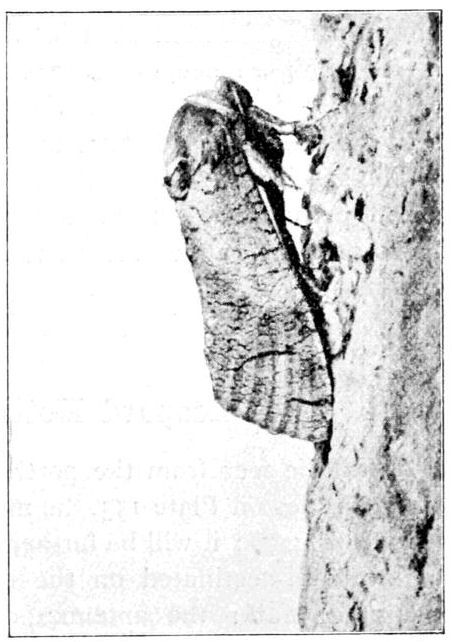
Fig. 20.
Goat Moth at rest.
(Photo by Hugh Main.)
Of the eighty-six Palæarctic species referred to this family, by far the larger number are eastern, only about eight appear to be found in Europe, and but three of these occur in Britain.
Meyrick separates Cossus cossus (ligniperda) from our other two species, adopts Trypanus, Rambur, as the generic name, and removes it to the Tortricina as a family of that group under the name Trypanidæ.
The Goat Moth (Cossus cossus (ligniperda)).
The English name of this species (Plate 150, Figs. 1 ♂, 2 ♀) applies more especially to the caterpillar, as this creature gives off an odour which has been compared to that of the he-goat. In general colour the caterpillar is pinkish ochreous, inclining to dark reddish on the back; the small head is black and glossy, and the mark on the first ring of the body is black. It feeds in the solid wood of various trees, especially elm, ash, and willow, but is three or four years in completing growth. When mature, it often leaves its burrow and wanders in search of a suitable place for pupation. When met with at such times it should be, if taken, placed in a roomy tin box with a good supply of sawdust or decayed wood, when it will make its cocoon, and appear as a moth in due course. The early stages are shown on Plate 151.
Caterpillars are more likely to come under the notice of the country rambler than are the moths; examples of the latter, however, may be seen occasionally, in June or July, resting on a tree-trunk, a fence, or a gate post; sometimes, although practically tongueless, the moth visits the sugar patch and either settles on the tree or flutters around.
The species seems to occur in all parts of the British Isles, except perhaps the extreme north of Scotland and the Hebrides.
Abroad, the range extends to Amurland and to North-west Africa.
The Leopard Moth (Zeuzera pyrina).
As will be seen from the portraits of this blue-black spotted white species on Plate 153, the male (Fig. 6) is smaller than the female (Fig. 7); it will be further noted that the antennæ of the male are bi-pectinated on the basal half, and thread-like on the outer half; the antennæ of the female are thread-like throughout.
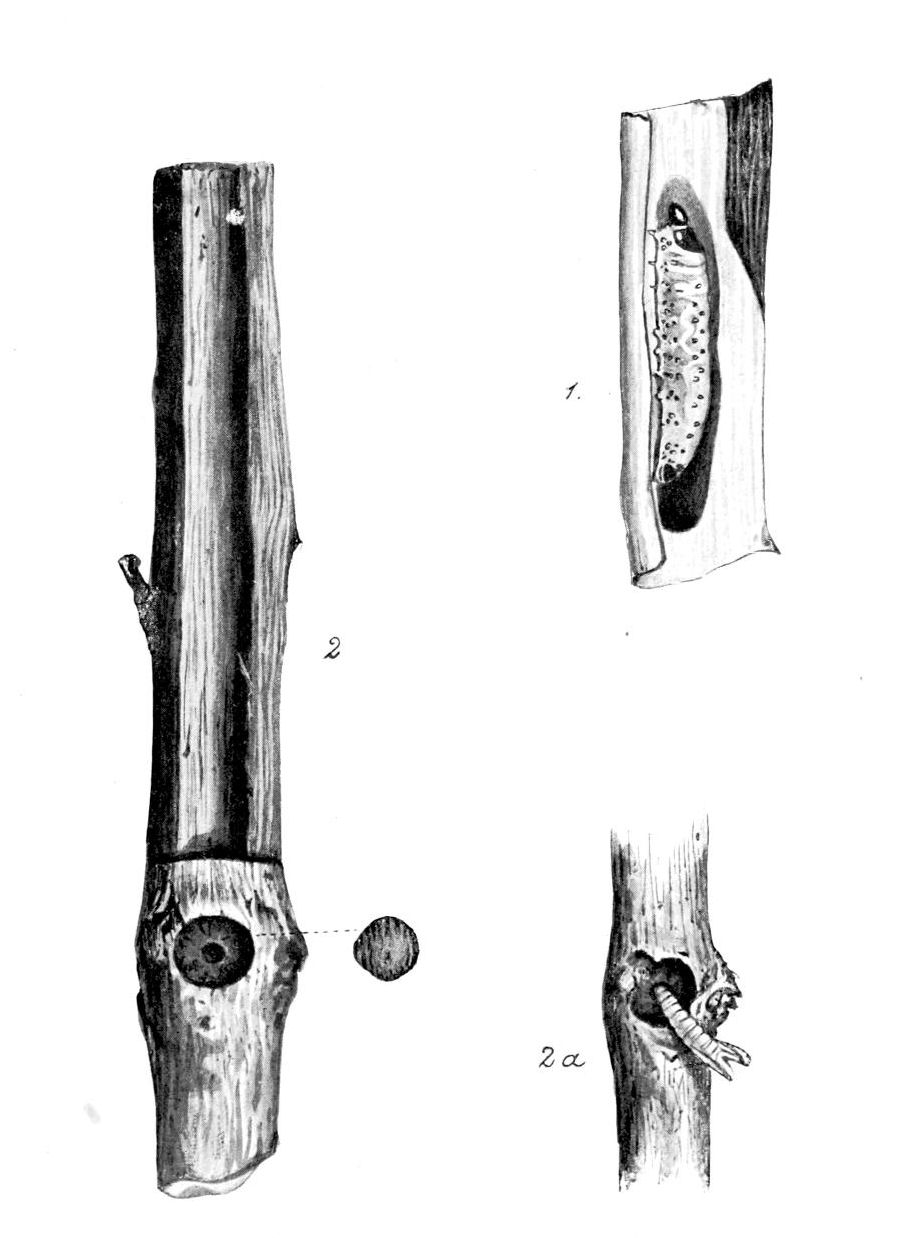
2 Pl. 152.
1.Leopard Moth: caterpillar.
2.Orange-tailed Clearwing: caterpillar's burrow and exit hole; chrysalis skin.
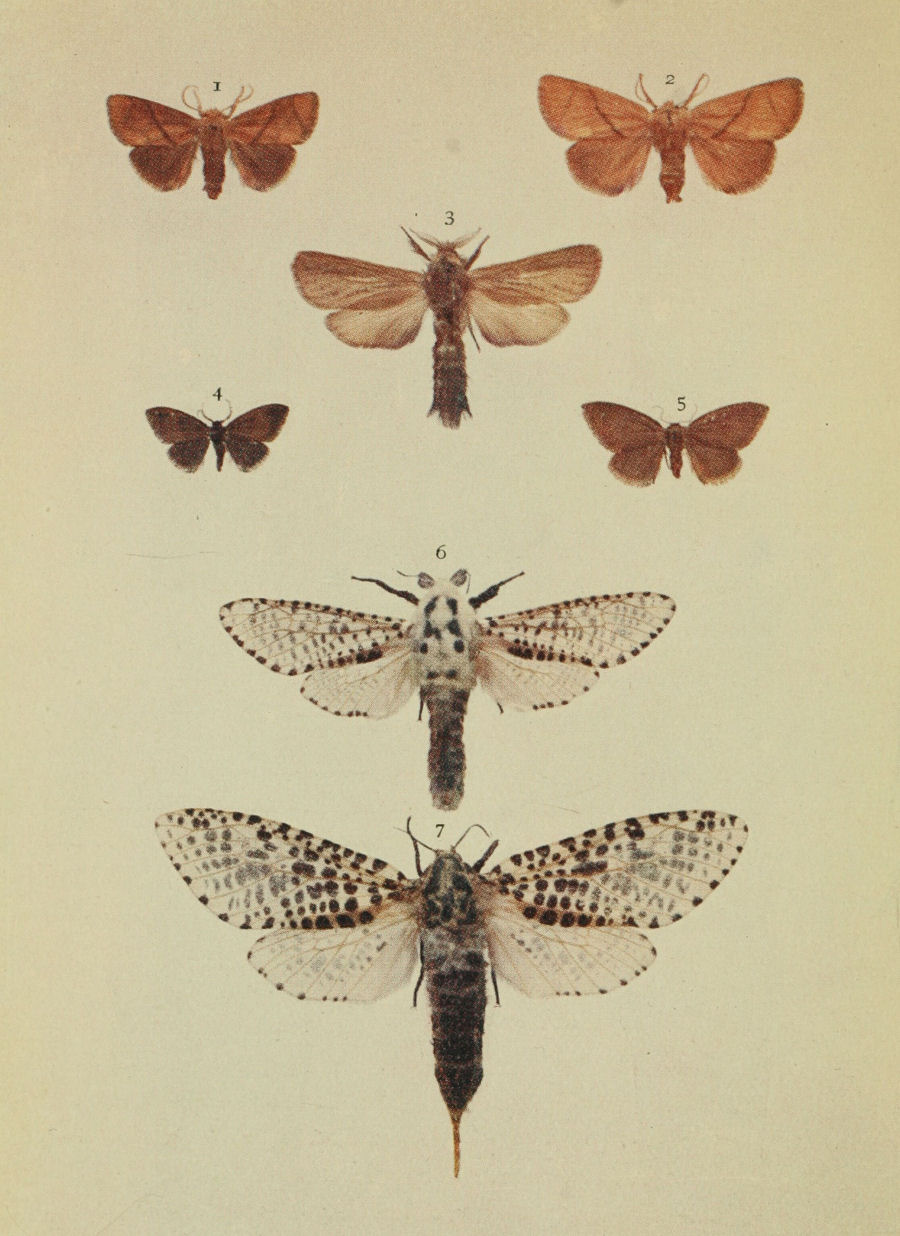
2 Pl. 153.
1, 2.Festoon. 3.Reed Leopard. 4, 5.Triangle. 6, 7.Leopard Moth.
The caterpillar (Plate 152, Fig. 1, from a coloured drawing by Mr. A. Sich) is dull whitish, more or less tinged with yellow; the spots are black, and the head and plates on the first and last rings of the body are blackish brown. It feeds in branches and stems of trees and shrubs. Hatching from the egg, say in the late summer of 1908, the caterpillar will not be full grown until May or June of 1910, or possibly 1911; forming a cocoon of silk and wood particles, it turns to a reddish brown chrysalis in the burrow, and near the bark of the stem or branch. The moth comes out in the summer, and is most often seen in the London district, where the female especially is not infrequently found on tree-trunks or on grass, etc., under trees. It visits light, and the electric arc lamps are very attractive to it.
The species occurs in the south and east of England, and through the north-west counties to Cheshire. It has been recorded from Cardiff, South Wales, and doubtfully from Ireland.
Abroad, the range extends to Corea and Japan. In America it seems to be established in parts of the State of New York.
The Reed Leopard (Phragmatæcia castaneæ).
A male of this species (Macrogaster arundinis of some authors) is shown on Plate 153, Fig. 3. The female is rather larger, with longer body, and the antennæ are without pectinations.
The wrinkled and rather shining caterpillar is ochreous white with reddish-brown stripes along the back. It feeds low down on the stems of reed (Phragmites communis) and is full grown in the spring of the second year following that in which it left the egg in late summer. Thus, a caterpillar hatching in August, 1908, would be mature about May, 1910, pupate in that month, or the next, and the perfect insect would appear in June or July.
The moth flies at night, and may be attracted by a brilliant light. The earliest known British locality for the species was Holme Fen in Huntingdonshire (1841-1848). In 1850 it was found abundantly at Whittlesea Mere. Its haunts in the present day are Wicken and Chippenham fens in Cambridgeshire, but specimens from these localities are somewhat smaller than the old Hunts examples. Barrett states that he put down some eggs of the species in Ranworth Fen, Norfolk, and that five years later two males were captured within a short distance of the spot where the eggs had been placed.
The range abroad extends to China and Japan.
SESIIDÆ.
This family—the Ægeriadæ of some authors—has over one hundred Palæarctic species assigned to it; these are distributed among five genera, two of which are not represented in Britain. Fourteen species are found in the British Isles, but to obtain fine specimens of most of them the mature caterpillars or the chrysalids will have to be collected and the moths reared. All species emerge from the chrysalis early in the forenoon, and then only under the influence of sunshine.
The caterpillars are somewhat maggot-like, and live in stems, branches, and roots of trees and shrubs; or in the crowns and roots of low-growing plants. The majority, possibly all, are nearly two years in arriving at full growth.
Hornet Moth (Trochilium apiformis).
As indicated by the English name this moth, and also that next to be mentioned, are very like the hornet (Vespa crabro). On turning to Plate 154, Fig. 1, it will be seen that this species has a yellow head and patches of yellow on the shoulders; these characters at once separate it from T. crabroniformis.
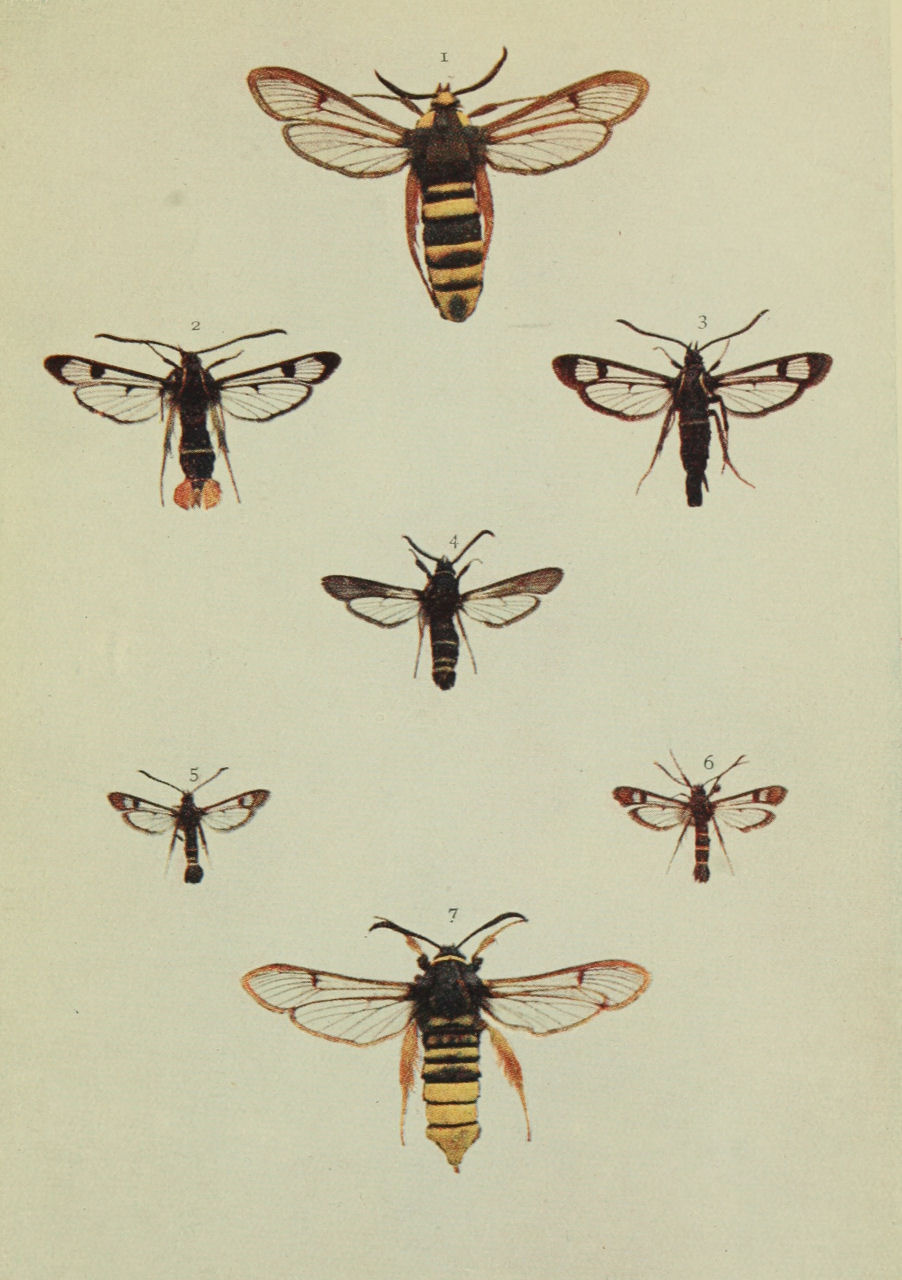
2 Pl. 154.
1.Hornet Moth. 2.Welsh Clearwing. 3.White-barred Clearwing.
4.Clear Underwing. 5, 6.Currant Clearwing. 7.Lunar Hornet Moth.
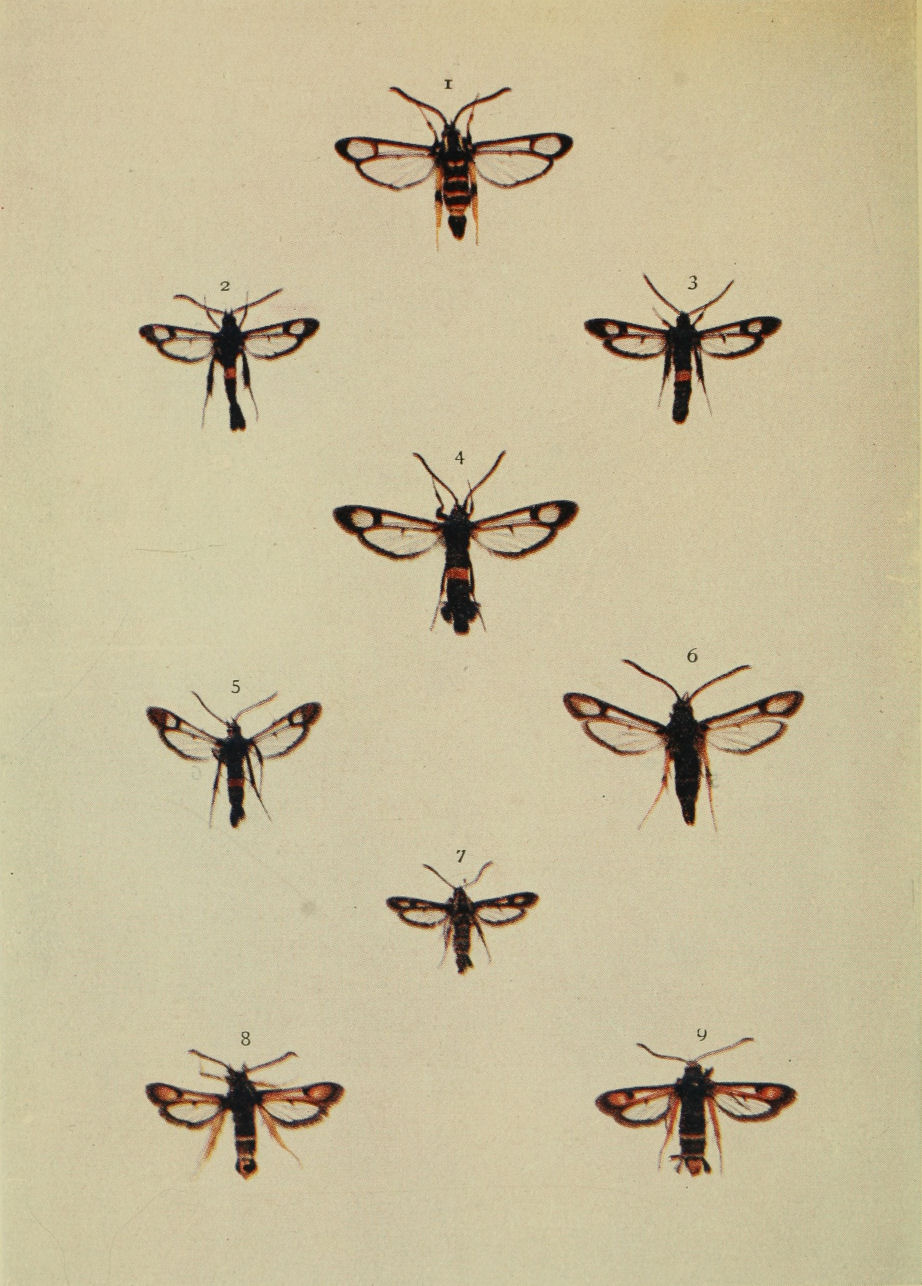
2 Pl. 155.
1.Yellow-legged Clearwing. 2, 3.Red-belted Clearwing.
4.Large Red-belted Clearwing. 5.Red-tipped Clearwing.
6.Six-belted Clearwing. 7.Thrift Clearwing.
8, 9. Fiery Clearwing.
The caterpillar is yellowish white, with a red brown head, and a yellow plate on the first ring of the body. It feeds on the roots and lower portion of the trunks of poplar. The brown shining chrysalis is enclosed in a cocoon of wood scrapings woven together with silk. The moth is out in May and June; and has been found, newly emerged, sitting on stems of poplar in the morning.
The eastern counties of England appear to be most favoured by this species, but it also occurs northwards to Yorkshire, southwards to Devonshire, and a specimen has been recorded from Rhyl, North Wales. In Scotland, it has been reported from some localities in the south; Kane states that he has reason to believe that the species occurs in the northern half of Ireland, and that he found caterpillars plentiful in young poplars growing in a marsh near the city of Waterford.
Lunar Hornet (Trochilium crabroniformis).
Another hornet-like moth, best distinguished from that just mentioned by the yellow collar behind the black head (Plate 154, Fig. 7 ♀). The male is rather smaller, but otherwise similar.
The caterpillar is yellowish white, with dark brownish head, and a blackish edged yellow plate on the first ring of the body. It feeds in stems of sallow, willow, and poplar. In late June and through July the moth is on the wing, and may occasionally be seen at rest on leaves or stems of sallow, etc.
The species, known also as bembeciformis, Hübner, is generally distributed throughout England, Wales, and Ireland; in Scotland its range extends into Perthshire.
Abroad it seems pretty much confined to Holland, Northern and Central Germany, Austria, and Bohemia.
Clear Underwing (Sciapteron tabaniformis).
This species is the Trochelium vespiforme of some British authors, and the Ægeria asiliformis of Stephens and others.
Another English name for it is the Dusky Clearwing, and this refers to the cloudy fore wings.
Stephens, writing of it in 1828, remarks: "Occasionally taken on poplars, near London, in June. I have obtained it from the neighbourhood of Bexley, and from Birchwood; but it is doubtless a rare species, and exists in few collections: of the male, I have hitherto seen but two specimens, one of which I possess." Both places mentioned by Stephens are in Kent, and one or two specimens of the species have since been reported from Ashford in the same county. The late Henry Doubleday took specimens at Epping, Essex. Colney Hatch Wood in Middlesex has also been given as a locality in the past; more recently two specimens have been noted from Chiswick. The example shown on Plate 154, Fig. 4, is of continental origin.
The caterpillar lives under the bark of poplar trunks, and the moth flies in June and July.
Welsh Clearwing (Sesia scoliæformis).
As a British species this insect was first noted from Llangollen, in North Wales, somewhere about fifty years ago. In 1867 it was found to inhabit birch woods in the Rannoch district of Scotland, and later on its presence was detected in Sutherlandshire. It has been recorded from Hereford; one example was reported from Wiltshire in 1857; and two from Delamere Forest, Cheshire (1901 and 1905). Kane (Catalogue of the Lepidoptera of Ireland) states that moths have been taken at Killarney, and caterpillars obtained in the same district, and also at Kenmare.
The caterpillar (Plate 156, Fig. 3; after Hofmann) feeds on the inner layer of bark of large birch trees, and is full grown about May. It turns to a dark brownish chrysalis, in a cocoon formed close up to the bark, which thinly covers the outer end of the burrow. The moth flies in June or sometimes July. It is of comparatively large size, and may be distinguished from the next species by the yellow belts on its body, and the chestnut coloured tuft at the tail. (Plate 154, Fig. 2.)
White-barred Clearwing (Sesia spheciformis).
Although generally smaller, some specimens run very close to the last species in size. It may be distinguished by the single belt on the body and the black tail (Plate 154, Fig. 3). One of the best known localities for the species in England is Tilgate Forest, in Sussex; but it also occurs in Hampshire (Basingstoke), Hereford (Tarrington), Worcestershire (Wyre Forest), Staffordshire (Burnt Wood), Cheshire (one, Delamere Forest, 1901), Denbighshire (Llangollen), Lancashire (Chat Moss), and Yorkshire (Bishop's Wood, 1894).
The caterpillar feeds in stems of alder, and is full grown in May of the third year after hatching from the egg. It is said that the chrysalis may sometimes be found by bending and twisting the stems of alder, so as to cause the thin skin of bark over the exit hole of the burrow to crack, and so disclose its whereabouts. The burrow is generally low down the stem. The moth is out in June and early July, and is sometimes to be seen on sunny mornings at rest on alder leaves, or flying over and around the bushes.
Orange-tailed Clearwing (Sesia andrenæformis).
Although known to be a British species since 1829, when a specimen was taken in a wood near Greenhithe, Kent, this insect continued to be very rare until quite recently. For a long time the caterpillar was supposed to feed in the stems of dogwood, but it is now known to live in the stems of the wayfaring tree (Viburnum lantana), and several specimens of the moth have been reared during the past year or two. Unfortunately the caterpillar is much infested by parasites, and comparatively few escape attack. Notes on the life history of this moth, by the Hon. N. Charles Rothschild, Mr. Eustace Bankes, and Dr. Chapman, are published in the Transactions of the Entomological Society of London for 1906 (Part IV., pp. 471-482).
Most of the known localities for the species are in Kent, but it has also been found in Surrey, Dorset, Gloucester, Hertfordshire (Tring district), and Northamptonshire (Oundle). Possibly it will be discovered in other parts of the country. I am indebted to Mr. L. W. Newman, of Bexley, for the specimen figured on Plate 1, Fig. 1. For the caterpillar mine in stem of Viburnum (Plate 156, Figs. 2, 2a) my thanks are due to Mr. Rayward, who kindly sent me a living pupa, from which the moth duly emerged, but, I regret to add, escaped from the box in which the stick containing the chrysalis was kept.
Newman, in 1833, described this species as Trochilium allantiformis, and in 1842 it was figured by Westwood and Humphreys as T. andreniforme. It is distinguished from Sesia tipuliformis by the two yellow belts of the body (the first sometimes indistinct) and the orange-yellow tuft in the blue-black tail; on the underside of the body there is a broad yellow band on the fourth ring, sometimes extending to the fifth and sixth.
Currant Clearwing (Sesia tipuliformis).
In this species the body is narrowly belted with yellow, usually four belts in the male and three in the female; the tail tuft is black in both sexes. The outer marginal border of the fore wings has a bronzy tinge, due to orange patches between the veins. (Plate 154, Figs. 5 ♂, 6 ♀.)
The caterpillar lives in the stems and shoots of black and red currant bushes; it feeds on the pith, and works its way downwards. When full grown, about May, it gnaws an outlet to the side of the stem, but does not penetrate the outer skin, although it reduces this to a very thin layer, through which the reddish brown chrysalis is able to force itself when the moth is ready to emerge. A figure of the caterpillar will be found on Plate 156, Fig. 1; the chrysalis protruding from currant stem (Fig. 1a) is from a photo by Mr. H. Main. In June or July, the moths are not infrequently seen on leaves of shrubs in gardens where there are currant bushes in or around such gardens, but the foliage of the food plant is a favourite resting place.
Generally distributed throughout England, the range extending into Wales, and South Scotland, but is apparently rare in these countries and also in some of the northern counties of England. Kane states that the species is common near Dublin, and is probably widely distributed in Ireland.
This species seems to have been introduced into North America, where its caterpillar is known as the "currant borer," and, as in England, is regarded with little favour by bush-fruit growers.
Yellow-legged Clearwing (Sesia vespiformis).
This species (Plate 155, Fig. 1), known also as asiliformis, Rottemburg (1775), and cynipiformis, Esper (1782), is now held to be correctly referred to vespiformis, Linnæus (1761). The crossbar of the fore wings is orange red in both sexes; the body of the male has two more or less united yellow spots at the junction with the thorax, four yellow belts, and the tail tuft is black above, mixed with yellow below; in the female the body belts are usually one less than in the male, the yellow spots at the junction are generally run together, and the tail tuft is almost wholly yellow. As indicated by the English name, the legs are largely yellow in both sexes.
The caterpillar feeds on the inner bark of oak trees, is full grown in May or June, and turns to a brownish chrysalis in a cell formed in the bark. A well-known locality for this moth, which is out in July and early August, is Hyde Park, London. It is also found in woods or oak-timbered parks in Kent (Tunbridge Wells), Surrey, Sussex (Abbot's Wood, Tilgate, etc.), Dorset (Glanvilles Wootton, etc.), Devon (Devonport, Plymouth, Topsham, etc.), Essex (Epping), Suffolk, Oxfordshire, Gloucestershire, Leicestershire, Staffordshire, and Yorkshire (Doncaster).
Red-belted Clearwing (Sesia myopæformis).
One example of each sex is shown on Plate 155, where Fig. 2 represents the male and Fig. 3 the female; both have a single belt on the body; as a rule, the belt is red, but occasionally it inclines to orange or yellow.
The caterpillar feeds on the inner bark of the trunks or boughs of apple, and sometimes pear, trees. It is nearly two years in maturing, but is full grown about June. The moth is out during the summer months, and is to be seen early on sunny mornings, newly emerged from the chrysalis on the trunks of the trees in which the caterpillar lives; the chrysalis skins will also be noted at the same time, sticking out from holes in the bark. Later in the day it sits on leaves, etc., after its flights, and I have even found it occasionally on a gravel path, and once on the pavement of a road in North-west London.
The species seems to be most frequent in gardens and orchards around London, but it has been recorded from as far north as Lancashire and Yorkshire; it is probably widely distributed over England. The Irish localities, mentioned by Kane, are Dublin, Cork, Killarney, and Clonbrock.
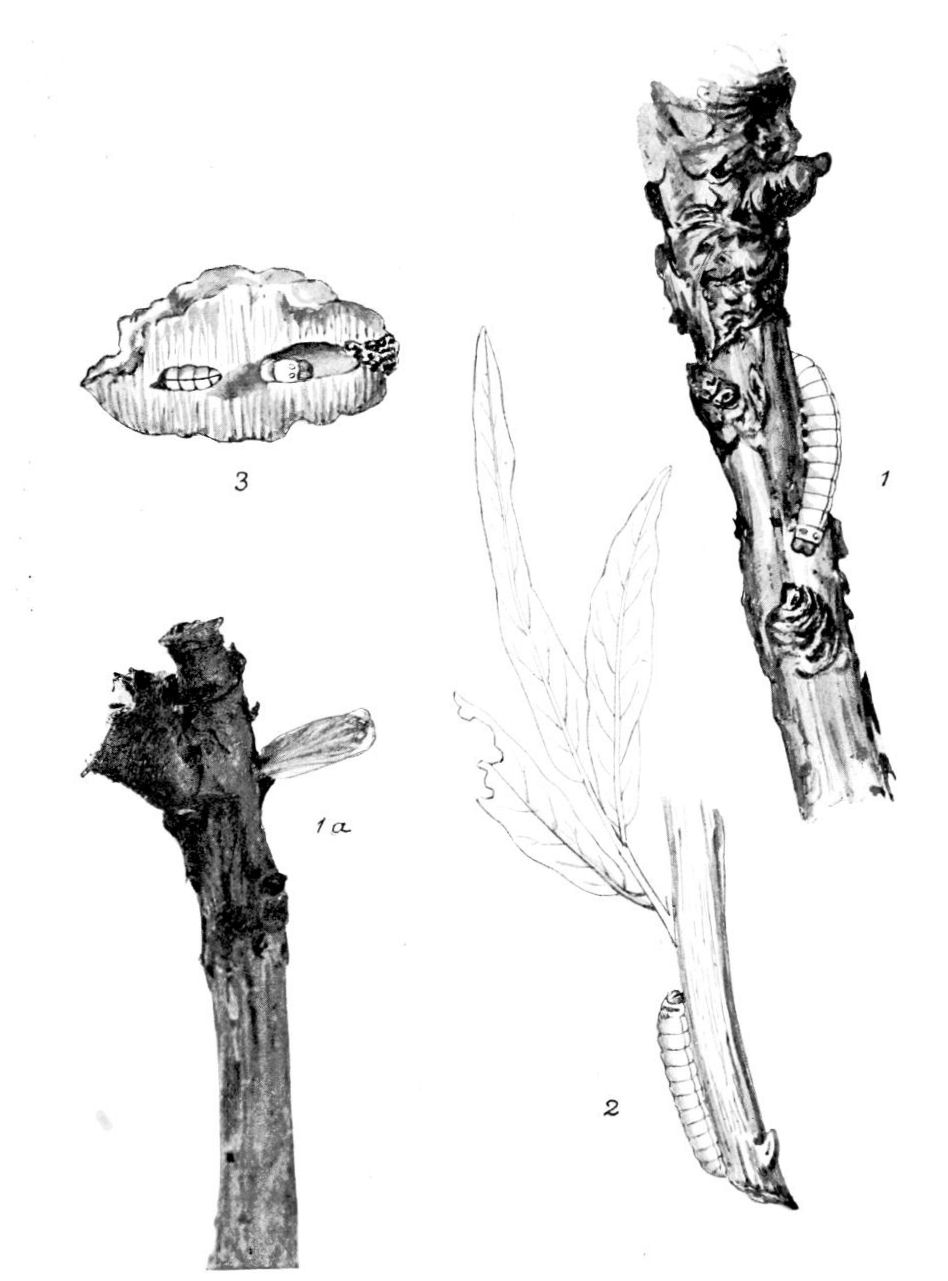
2 Pl. 156.
1.Currant Clearwing: caterpillar and chrysalis skin.
2.Red-tipped Clearwing: caterpillar.
3.Welsh Clearwing: caterpillar.
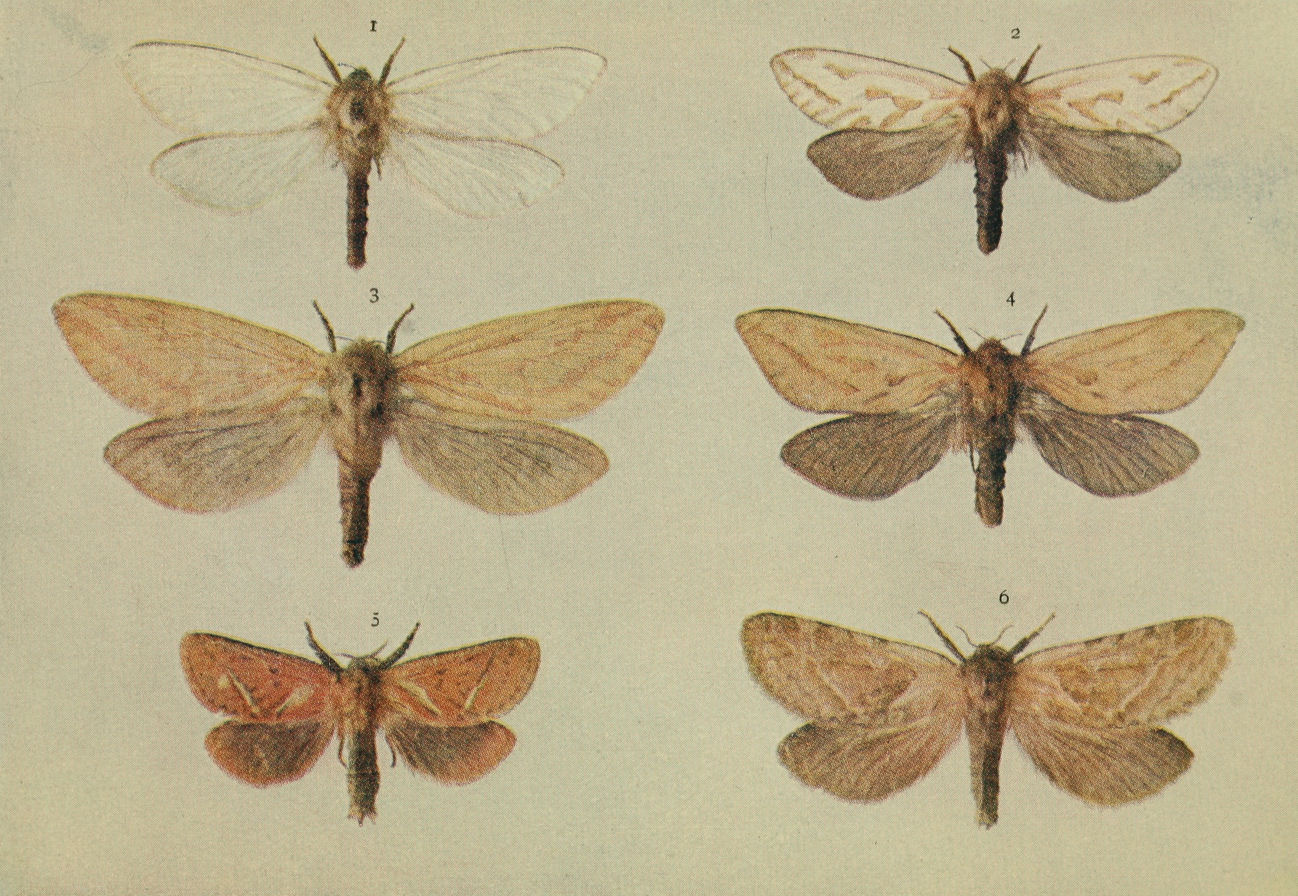
2 Pl. 157.
1, 3.Ghost Moth. 2, 4.Do., var. thulensis. 5, 6.Orange Swift.
Large Red-belted Clearwing (Sesia culiciformis).
This species (Plate 155, Fig. 4) is very similar to the last, but it is larger, and the fore wings are dusted with reddish scales towards the base, sometimes also along the inner margin. The belt on the body is generally red, not infrequently with an orange tinge, but it is sometimes yellow or far more rarely white.
The caterpillar, which is full grown in May, feeds on the inner bark of birch trees and bushes, apparently preferring the stumps left in the ground where stems have been cut down. It is not difficult to find, but as it is about two years in this stage it should not be taken until nearly or quite full grown, and it is safer to leave it until it has entered the chrysalis state. The moth is out in June, or sometimes at the end of May; it flies over birch and rests on leaves, and has been known to visit flowers of the wood spurge and the rhododendron.
Kent and Sussex appear to be the counties most favoured by this species, but it occurs in most of the other English counties in which there are birch woods, certainly up to Yorkshire, and probably further north, as it is found in Scotland (Clydesdale, Perthshire, and Aberdeen). The Irish localities are Killarney, Ballinasloe, and Derry.
Red-tipped Clearwing (Sesia formicæformis).
This is another red-belted species, but it differs from either of the two immediately preceding in having the fore wings tipped with red. (Plate 155, Fig. 5.)
The caterpillar feeds in the twigs and stumps of osier (Salix viminalis), sometimes called "withe"; it is full grown about June. (Plate 156, Fig. 2; after Hofmann.) The moth is out in July and August; it is partial to marshes and other wet spots, and is fond of a leaf as a resting place. Like the rest of its kind, it is very alert, and skips off quickly on one's approach. Probably the species is more widely distributed in England, but from the records, it only appears to have been noted from Kent, Hampshire, Somersetshire, Gloucestershire, Herefordshire, Derbyshire, Yorkshire, Norfolk, Suffolk, Cambridgeshire, and Essex.
Six-belted Clearwing (Sesia ichneumoniformis).
The inner and outer margins of the fore wings are tinged with orange, and there is an orange mark on the outer edge of the cross bar; the body of the male has seven yellow belts, and that of the female one less. (Plate 155, Fig. 6.)
The caterpillar feeds in the roots of bird's-foot trefoil (Lotus corniculatus), and kidney vetch (Anthyllis vulneraria); it is full grown about June. July and August are the months for the moth, and its haunts are on chalk downs, and on banks by the sea; it seems partial to the edges of chalk pits, sloping banks, and broken ground of undercliffs, etc. In such places it is to be seen on the wing in the early evening, and, I believe, in the early morning also. It has frequently been obtained by sweeping the net over herbage in the vicinity of the food plants.
Mr. W. H. Flint records (1902) the species from the Forest of Dean district, where, he states, he could easily have captured two dozen a day, as they flew over trefoils, etc.
The species occurs in most of the southern seaboard counties of England, from Kent to Cornwall and including the Isle of Wight; Surrey, Bucks., Essex, and other eastern counties, including Cambridge; and it has been recorded from Yorkshire. On the western side of the country it is found in Somerset, Gloucester, Hereford, Worcester, Staffordshire, and in South Wales.
Thrift Clearwing (Sesia muscæformis).
This is our smallest species of the genus, and it is further distinguished by narrow clear spaces on the blackish, or bronzy, fore wings, three whitish bands on the body, and traces of a whitish line along the middle of the back. (Plate 155, Fig. 7.)
The caterpillar feeds on the roots of thrift or sea-pink (Armeria vulgaris), and is full grown about June. The moth is out in June and July, and seems to have a liking for the flowers of thyme.
This species (also known as philanthiformis, Laspeyres) frequents rocky places on the coasts of Devon (Torquay, Lynmouth, etc.), Cornwall, Wales; Isle of Man; Scotland (Aberdeenshire); and Ireland (Saltee Islands, Wexford, and Seven Heads, Cork. Gregson recorded it from Howth).
Fiery Clearwing (Sesia chrysidiformis).
The orange red colour on the fore wings, and of the tail tuft, at once distinguish this species (Plate 155, Figs. 8 ♂, 9 ♀) from either of its British allies. The blackish body has two pale-yellow belts, but in the male the lower one is often double. As a rule, the body of the female is stouter than that of the male, but the bodies of some males appear quite as thick as those of the females, and the true sex is only disclosed by the ciliated antennæ, which is a character of the male alone.
The caterpillar feeds on the roots of dock and sorrel, and it is full grown about May. In June and July the moth is on the wing and flies in the sunshine, about noon, over the food plants.
The species occurs not uncommonly in the Warren at Folkestone, Kent. This locality, well known to entomologists, is a long stretch of rough broken ground lying between the railway and the sea; and is probably the only spot in the British Isles where the Fiery Clearwing is almost certain to be found, either in its early or its perfect stage, at the proper season. The moth has been recorded from Eastbourne, Sussex (1874), and from the Forest of Dean, Gloucestershire (1902).
HEPIALIDÆ.
Of the twenty-two Palæarctic species belonging to this family, nine appear to occur in Europe, and the range of five of these extends to the British Isles.
In some of the more recent systems of classification, this family is relegated to almost the bottom of the scheme, and therefore occupies a much lower place than do the bulk of the families comprised in the old style "Micro-Lepidoptera." As, however, these insects, commonly called "Swifts," have long received the attention of collectors, and in collections usually occupy a position among the so-called "Bombyces," they have been included in the present volume.
Ghost Moth (Hepialus humuli).
On Plate 157 are portraits of a male and a female of the typical form of this species (Figs. 1 ♂ and 3 ♀); and two male examples (Figs. 2 and 4) of the Shetland race var. thulensis, Newman, better known perhaps as hethlandica, Staudinger, but the former is the older name. It will be noted that in the ordinary form the male has white wings, and that the female has yellowish fore wings marked with orange, and smoky hind wings. The Shetland male, represented by Fig. 2, has the fore wings whitish buff in colour with brownish markings similar in pattern to those of an ordinary female; the hind wings are blackish. The second example of thulensis (Fig. 4) is somewhat similar in appearance to a typical female. In other male specimens of this insular race the wings are pretty much of the typical colour, but the markings on the front pair are reduced both in number and size. Mr. H. McArthur, who has collected a good deal in the Shetland Isles, states that in Unst, the most northern island of the group, more or less typical humuli were found on the cliffs facing south-east, whilst the majority of the specimens obtained in boggy meadows, etc., were of the thulensis form.
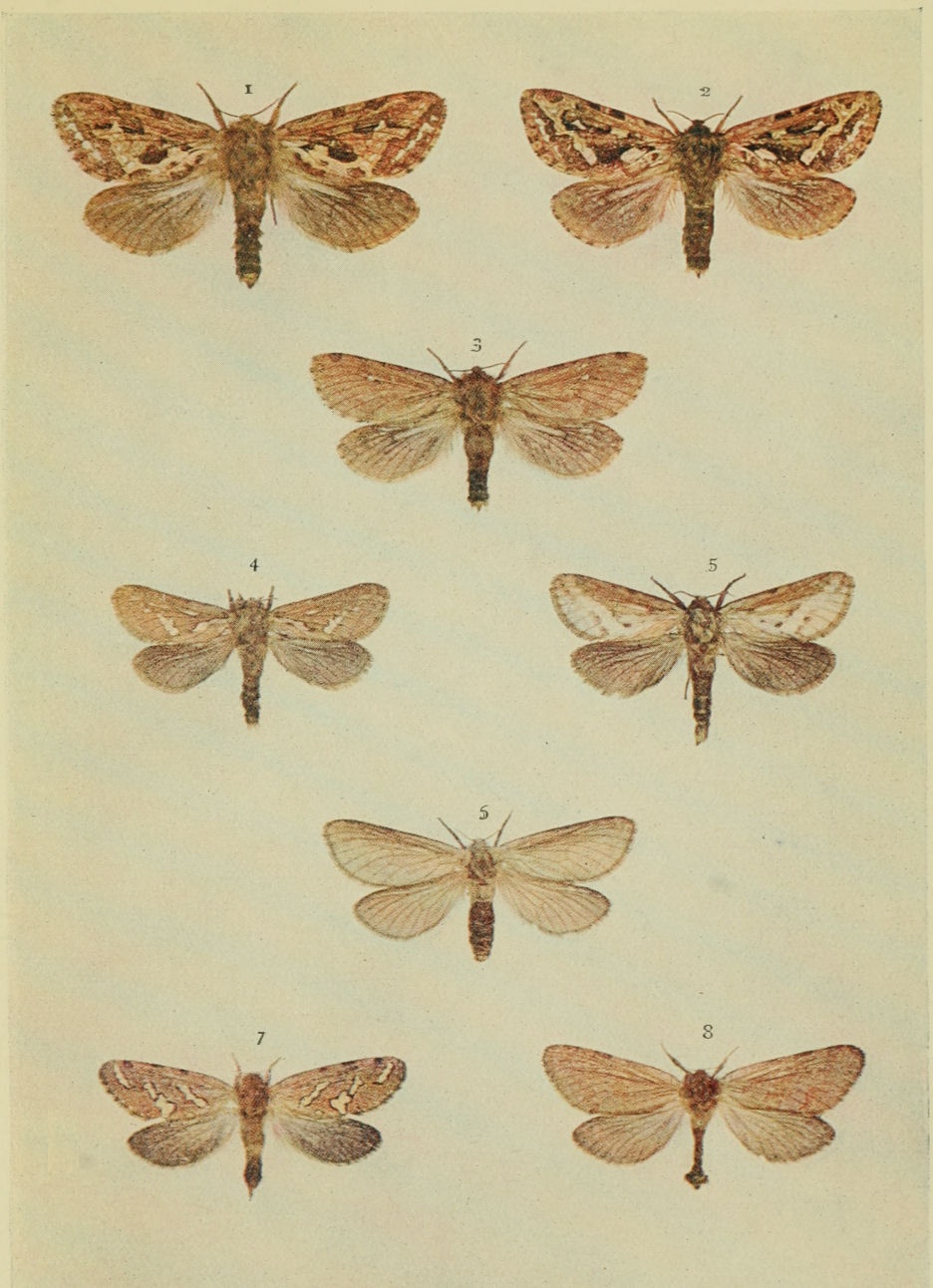
2 Pl. 158.
1-3.Map-winged Swift. 4-6.Common Swift. 7, 8.Gold Swift.
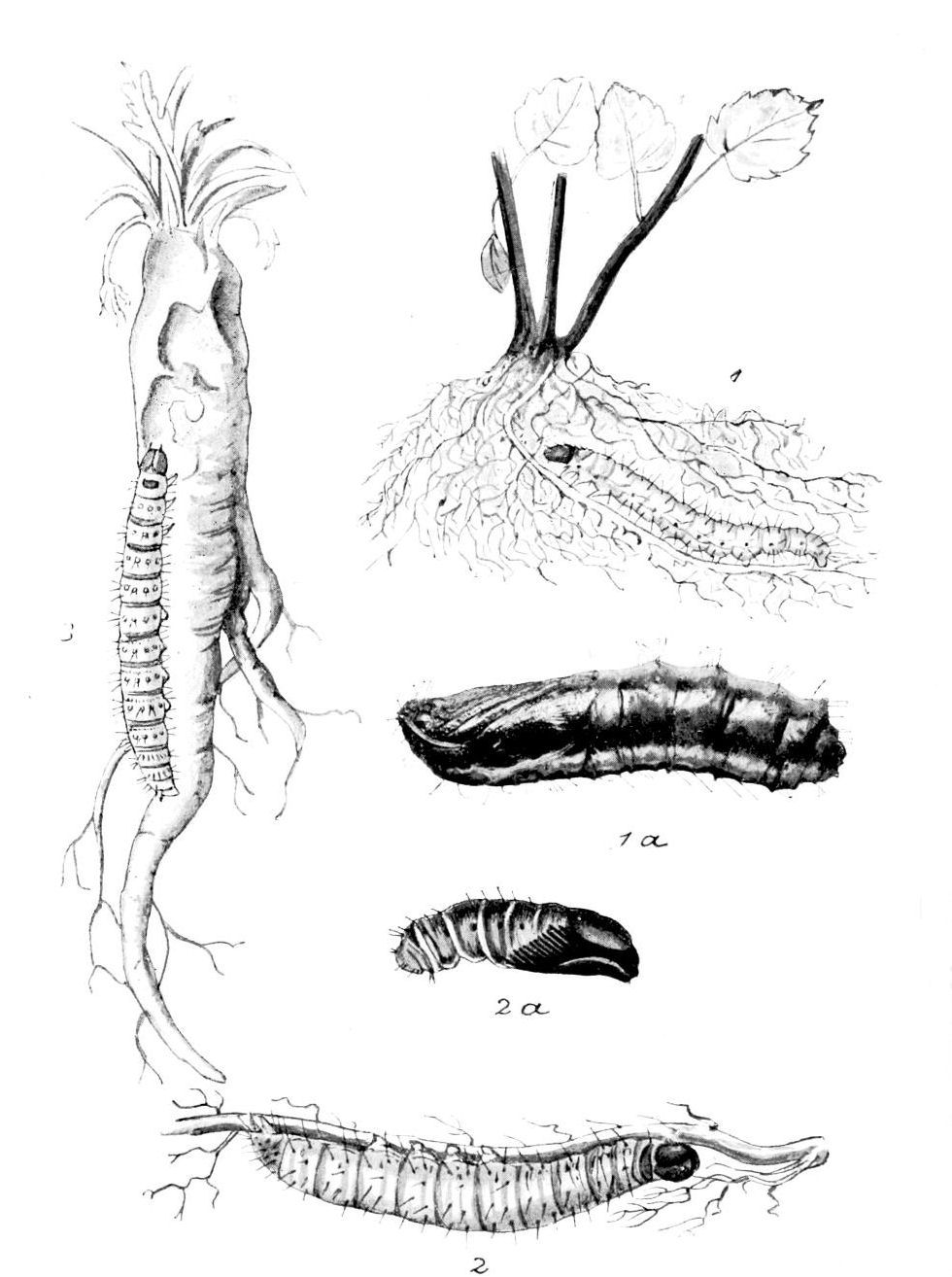
2 Pl. 159.
1, 1a.Common Swift: caterpillar and chrysalis.
2, 2a.Ghost Moth: caterpillar and chrysalis (enlarged).
3.Orange Swift: caterpillar.
The caterpillar feeds on the roots of plants, such as burdock, dandelion, dead-nettle, etc. It is full grown in May, and the moth is out in June and July. (Plate 159, Fig. 2; after Hofmann.) The males may be seen in the evening, sometimes in numbers in grassy places, swaying themselves to and fro without making progress, and appearing as though they dangled from the end of an invisible thread; the female flies straight, and, as a rule, in the direction of one or other of the pendulous males.
The species is generally distributed over the British Isles.
Orange Swift (Hepialus sylvina).
The male of this species (Plate 157, Figs. 5. ♂, 6 ♀) usually some shade of orange brown, with greyish-edged white markings on the fore wings. Sometimes the female is orange brown, but more often it is some shade of grey brown.
The caterpillar (Plate 159, Fig. 3; after Hofmann) feeds on the roots of dock, bracken, viper's bugloss, etc., and is full grown about July. In late July and in August the moth may be seen in the early evening flying among bracken, and not infrequently around trees fairly high up. Occasionally, specimens are seen in the daytime on tree-trunks, fences, etc. At one time this species was known in the vernacular as "The Tawny and Brown Swift"; it is also "The Orange or Evening Swift" of Harris (1778) and the "Wood Swift" of Newman. It is common in many southern and eastern parts, but widely distributed over England, Wales, and Scotland to Moray. Only doubtfully recorded from Ireland.
Map-winged Swift (Hepialus fusconebulosa).
At one time this species (the velleda of Hübner) was known as the "Northern Swift," but as it is plentiful in North Devonshire and Somersetshire, and occurs less commonly in other southern English counties, that name is hardly suitable. Haworth's English name for it—"The Beautiful Swift"—does not quite meet the case, because, although the insect is prettily marked, it is scarcely beautiful. We have then to fall back on Donovan's Map-winged Swift as a popular name, and this seems a fairly apt one, as the markings on the fore wings are somewhat map-like in pattern, especially in the more typical specimens.
There is much variation in colour and in marking; some examples, chiefly those from Shetland, are prettily variegated. A uniform reddish-brown variety, ab. gallicus, Lederer, is depicted on Plate 158, Fig. 3; and a more or less typical specimen of each sex is shown on the same plate (Figs. 1 ♂, 2 ♀).
The caterpillar is ochreous white, with orange-brown plates, and rather paler raised dots; head, reddish brown, and spiracles black. It feeds on the roots of the bracken, and is full grown about May. The moth is out in June and July, and flies, in the gloaming, on hill slopes, heaths, and the edges of mosses and woods; it seems to be more active than either of the other British "Swifts"; at all events, I have always found it less easy to capture with the net.
The species is pretty generally distributed throughout the British Isles.
Common Swift (Hepialus lupulina).
Three examples of this species are shown on Plate 158. Fig. 4 is a typical male, Fig. 5 a whitish suffused variety, and Fig. 6 is a female. The latter sex is generally devoid of marking, and in the male the stripes and dashes are far more conspicuous in some specimens than in others.
The glossy whitish caterpillar has a brown head; the plate on the first ring of the body is brownish, and the raised dots are pretty much of the same colour. It feeds on the roots of grass and other plants, and is full grown about April. A figure of the caterpillar, from a drawing in colour by Mr. A. Sich, and a photo of the pupa by Mr. H. Main, are shown on Plate 159, Figs. 1 and 1a; the latter is twice natural size.
The moth is out in June, or sometimes late May, and occasional specimens have been noted in September. It is more frequently seen at rest, on fences, etc., than either of the other species of the genus; but towards dusk it is on the wing, and may then be observed in large numbers careering over grass meadows or along stretches of green turf by the wayside.