Front matter (continued 4)
Reading edition
The boles of trees are favourite resting places, and upon them, and also upon gate-posts, etc., the moth is often met with in the daytime.
Abroad, the range extends to Eastern Siberia.
Yellow-barred Brindle (Lobophora (Trichopteryx) viretata).
The general colour of the fore wings is olive green, varying from pale to dark, the wavy cross lines are blackish, dotted with black, and sometimes there are whitish lines between them; those on the central area are often united by a blackish cloud, and so form a band, and not infrequently the basal area is also blackish marked. (Plate 58, Figs. 3 and 4.) The ground colour is very apt to fade if the insect is exposed to moisture of any kind, as, for instance, when pinned in a damp collecting box, but I have one bred specimen of a reddish ochreous colour, and I am assured that it was of this tint when it emerged from the chrysalis. An old English name was "The Brindle-barred Yellow."
The thick-set caterpillar is green, more or less tinged with pinkish; three interrupted pink lines on the back, the central one sometimes inclining to purple, and broken up into spots; the head is brown, sometimes marked with purplish, and there are two tiny points on the last ring of the body. It varies in the green tint and also in marking. It feeds on flowers and leaves of holly, ivy, dogwood, privet, etc., in June and July, and in some sheltered southern localities again in September and October.
The moth is out in May and early June, and where a second generation is developed, in August and early September. It sits in the daytime on tree-trunks, but more especially those with smooth bark; the stems of holly are a favourite resting place, but at Box Hill I have occasionally seen a specimen on the trunk of a beech tree. Barrett states that it also rests on the trunks of fir trees, and that it is then very easily seen. Night is its time of activity, and it is then attracted by light.
The species seems to be widely distributed, but locally and not generally common, throughout England, Wales, and Ireland; it has only been recorded from Rosemount, Ayr, and one or two other localities in the south of Scotland.
The range abroad extends to Western India, Amurland, and Japan.
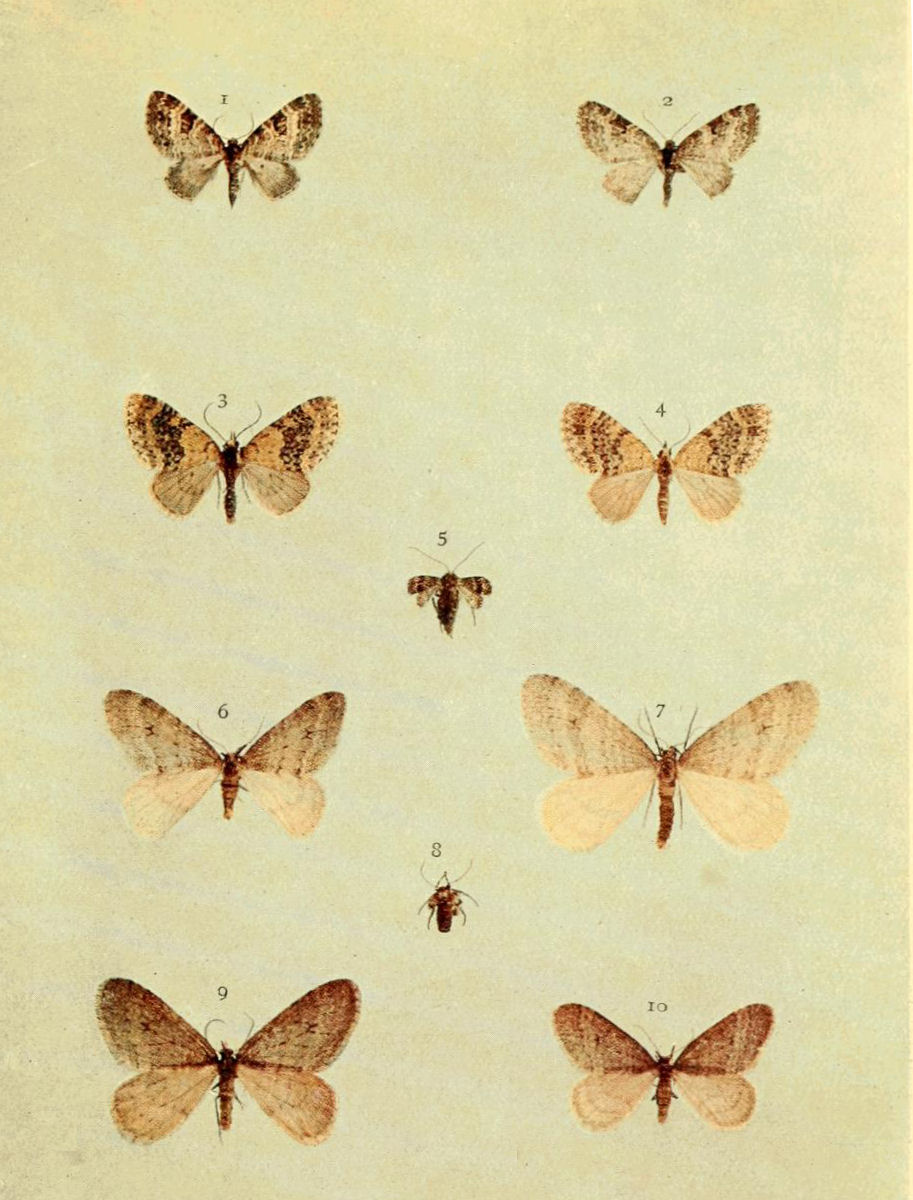
2 Pl. 58.
1, 2.Small Seraphim. 3, 4.Yellow-barred Brindle.
5-7.Northern Winter Moth. 8-10.The Winter Moth.
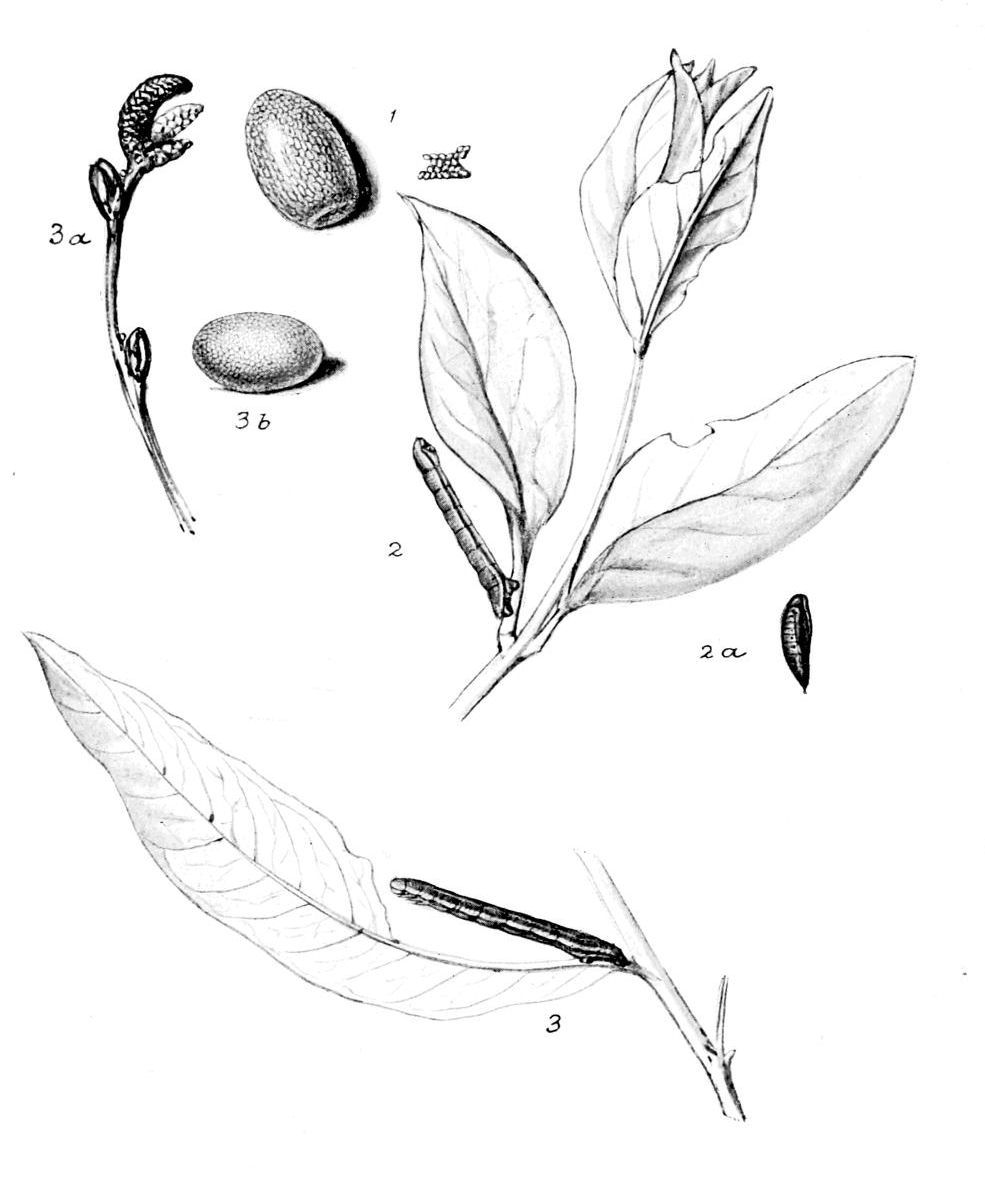
2 Pl. 59.
1.Northern Winter-moth: eggs.
2, 2a.Barred Tooth-Striped: caterpillar and chrysalis.
3, 3a, 3b.Early Tooth-Striped: eggs and caterpillar.
The Seraphim (Lobophora halterata).
Fore wings whitish, with two greyish bands on the basal area; first and second lines greyish, variable in width, and sometimes only represented by marks on the front or inner margins; there is a black central dot, and the outer area beyond the submarginal line is clouded with dark grey, especially on the upper half. Sometimes the wings are so thickly stippled with the darker colour that they appear to be greyish, with interrupted and indistinct whitish cross lines. A rather frequent form has the fore wings tinged with ochreous, and of this tint is ab. zonata, Thnbg., which has the basal bands and outer marginal border blackish, the central area being without cross lines. (Plate 57, Figs. 9 ♂ and 10 ♀.)
The caterpillar is green, darker below and between the rings; the most distinct markings are two yellow lines along the back; head, notched; body wrinkled, and with two points on the last ring. It feeds on aspen, and other kinds of poplar, in June and July.
The moth appears in May, and continues out well into June, especially in its northern localities. It rests on the trunks of poplar trees, or on the stems of bushes around, and is sometimes easily alarmed, and flies off on the collector's approach, whilst at other times it sits quietly, and may be easily boxed. At dusk it may be seen flying around the poplars.
Widely distributed in the southern half of England, and only found where poplars, chiefly aspens, are well established. From Worcester its range extends northwards to Staffordshire, Leicestershire, Derbyshire, and Cheshire; and it has been recorded from Yorkshire and Cumberland; also from Glamorganshire, South Wales. In Scotland it seems not to have been noted in the south, but is found more or less frequently from Perthshire to Sutherlandshire. Rare in Ireland.
Abroad, its range extends to Amurland and Japan.
The Small Seraphim (Lobophora (Mysticoptera) sexalisata).
This is a much smaller species than the last. The fore wings are whitish, with brownish-grey, or blackish-grey, cross lines and bands; the central most distinct towards the front margin, where it encloses a black dot; hind wings greyish, with black central dot. (Plate 58, Figs. 1 and 2.)
The green, much wrinkled caterpillar has three whitish lines or stripes along the back, and in some examples there is a white line low down along the sides; the head, which inclines to yellowish, is notched, and there are two pinkish points on the last ring of the body. It feeds on sallow in August and September.
The moth is to be found in May and June, and, in some years, again in July and August. It inhabits woods and hedgerows where sallow is plentiful, but, perhaps, is obtained more freely in fens. Occasionally it may be beaten from the hedges, but it is active on the wing just before the close of day, and then disports itself over and about the sallow bushes. It occurs in suitable localities in most of the eastern and southern counties of England, and has been reported from some of the northern ones, and from Glamorganshire, in South Wales. Kane states that it has been found in the north, south, east, and west of Ireland, but is always local and scarce.
Note.—Prout considers this species to be the sexalata of Retzius (1783).
Winter Moth (Cheimatobia brumata).
In orchards and gardens wherein are fruit trees one may have noticed that the trunks of the trees have broad bands around them. If these bands are examined, they will be seen to be covered with a sticky compound, which has been put there for the purpose of trapping the almost wingless females of the Winter Moth, as they crawl up the tree after emergence from the chrysalis. In spite of such devices, and other precautionary measures taken to safeguard the trees from attack, the foliage of apple, pear, etc., will not be quite free from the caterpillars of this species in their season.
The male has greyish brown fore wings, which are crossed by rather darker lines, and a dark, more or less distinct, central band (ab. hyemata, Huene). The ground colour is very much darker in some specimens than in others, and examples of a sooty brown colour are not infrequent; Barrett mentions an almost buff-coloured specimen. In the female, the tiny affairs representing wings are brownish, with indications of a darker band towards the outer margin of the front pair.
A small, purplish brown form, reared in January, 1882, from caterpillars found in Cumberland, feeding on sweet gale (Myrica gale), was described as a new species under the name myricaria, Cooke (Entom., xv. 57). This has been referred by Staudinger to C. boreata, as a form of that species, but it is probably an aberration of C. brumata.
The caterpillar is green, with a stripe of darker green along the back; on each side of this are two white lines, and along the black spiracles is a pale yellowish line; head, green, sometimes marked with blackish. It feeds on the foliage of trees and bushes, and sometimes abounds in April and May.
The moth appears during the winter months, and has been noted as early as October and as late as February. (Plate 58, Figs. 8-10.)
Generally distributed throughout the British Isles.
Northern Winter Moth (Cheimatobia boreata).
This species is generally larger than the last-mentioned. The fore wings are marked somewhat as in that species, but they are paler in colour and more glossy; hind wings whitish and glossy. In the female, the wings are useless for flying, but still they are larger than those of brumata. The front pair have a blackish band. (Plate 58, Figs. 6 and 7 ♂, 5 ♀; ova. Plate 59, Fig. 1.)
The caterpillar is greenish, with a greyish stripe along the back, another edged above with yellow along the black spiracles, and a greyish line between the stripes; the head is black. It feeds, in May and June, on birch, and the moth does not appear until October or November.
At one time considered to be a purely northern species: the earliest known British specimens, four in number, having been captured at Petty Pool, Delamere, Cheshire, on October 31, 1848. It is now known, however, to have a wide distribution in the south of England. Northwards, its range extends throughout England and Scotland up to Moray. It is found in South Wales; also in Galway, Monaghan, and Connemara, in Ireland.
The Tissue (Triphosa dubitata).
The fore wings of this glossy species (Plate 60, Figs. 1, 2) are pale brown, tinged more or less strongly with rosy or purplish; there are numerous darker and paler cross lines, the most distinct and constant being the blackish basal, and the two forming the edges of the central band; the latter are marked with black; the submarginal line is whitish, wavy, and sometimes broken up into dots. The species varies considerably in tint, some specimens inclining to pale greyish brown, others to smoky brown. Hind wings, whitish grey, with several darker grey cross lines; in dark specimens these wings are smoky grey. Ab. cinereata, Stephens, is a small pale greyish form, almost without rosy tinge and with fewer cross lines.
The caterpillar (Plate 62, Fig. 1) is yellowish green with darker green stripes and lines. In another form there are four pale yellowish lines along the back and a yellow stripe low down along the sides. It feeds on buckthorn (Rhamnus), the leaves of which it fastens together with silk, and so forms a retreat. It will also eat sloe and bird-cherry (Prunus padus).
The moth is out in August and through the autumn, when it sometimes visits the flowers of ivy, ragwort, etc.; after hibernation it is again seen, perhaps even more frequently, in April and May, and is then occasionally found at sallow catkins. The species seems to have been noted from nearly all the English counties, but becomes rare from Yorkshire northwards. In Wales, and in Ireland, it is apparently widely distributed, but in Scotland it seems confined to southern localities, and is only rarely met with.
Abroad, the distribution spreads to Amurland, China, and Japan.
The Scarce Tissue (Eucosmia (Calocalpe) certata).
This species is very similar to the last, but the wings are not glossy, only reddish on the outer margin, and the black marked lines edging the central band of the fore wings are less irregular, the inner ones usually being much straighter. On the under side of the hind wings of the male is a fold enclosing hairs; this is on the inner margin, just above the anal angle. (Plate 60, Fig. 3 ♀.)
The thickset caterpillar (Plate 62, Fig. 3, after Hofmann) is greyish inclining to greenish; four white lines along the back, the central pair enclosing a dark line, the others are bordered below with dark greyish; the black spiracles are set in yellowish blotches, and the plates on first and last rings are brown; head, reddish-brown, glossy (adapted from Fenn). It feeds on the barberry (Berberis vulgaris) and the holly-leaved barberry (B. aquifolium) grown in gardens, in June and July. The moth is out in May and June, but in favourable seasons has appeared in late April. When on the wing at night it is freely attracted by light, but otherwise not often noticed. The species has occurred in many of the English counties from Devon to Durham, but it seems to be only common in the eastern counties, and most frequent perhaps in Suffolk. It has been recorded from South Wales, but is seemingly absent from Ireland.
The range abroad extends to Amurland.
The Scallop Shell (Eucosmia undulata).
Wings pale greyish, sometimes ochreous tinted, and crossed by numerous dark-grey wavy lines inclining to blackish on the front margin of the fore wings; the waves of the central pair of lines on the fore wings often meet and so form a series of rings; sometimes the space between the eighth and twelfth lines is of a dusky hue, and occasionally it is distinctly darker and band-like; the outer margin of all the wings is brownish and traversed by a wavy white line. The male has tufts of blackish hair in a fold on the inner margin of the hind wing, this is noticeable on the upper side, but is best seen from the under side. (Plate 60, Figs. 4 ♂, 5 ♀.)
The somewhat dumpy caterpillar is reddish-brown with four yellowish lines along the back; a greyish stripe along the sides, and a creamy stripe along the black spiracles; head, pale brown and glossy. It feeds on sallow, aspen, and bilberry, and may be found from August throughout the autumn in spun-together leaves at the tips of the shoots. (Plate 62, Fig. 2.)
The moth is out in June and July, and occurs in woods where there is a good growth of bilberry, or in marshy spots where sallow bushes abound.
In England the species is widely distributed over the southern and eastern counties; its range extends through the Midlands to Cheshire, Lancs., and Westmorland, rarely in Lincoln and Yorks., and once recorded in Durham; it occurs in Wales and in Scotland, but only in the more southern part of each country. It is not plentiful in Ireland, but widely distributed. The range abroad includes Amurland.
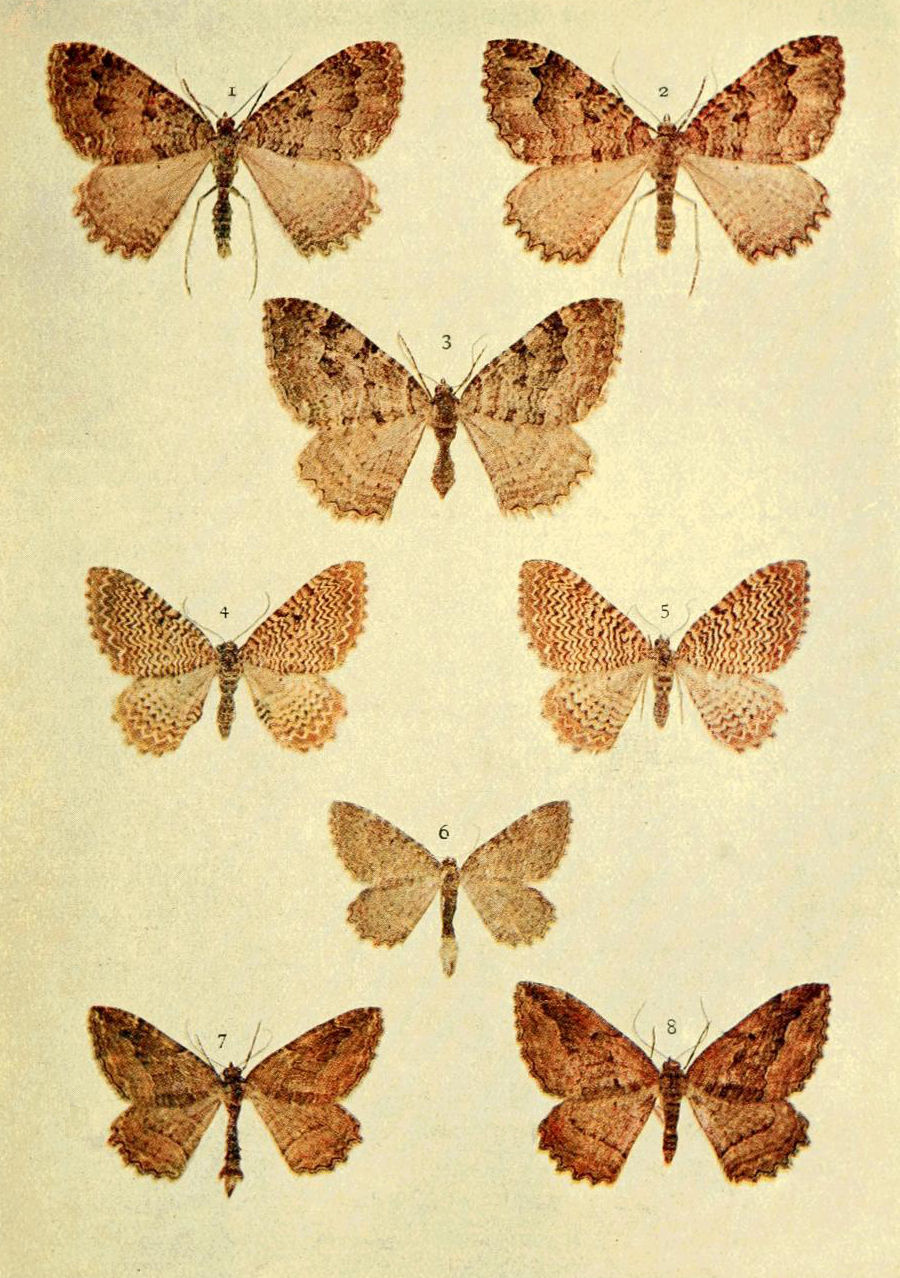
2 Pl. 60.
1, 2.The Tissue. 3.Scarce Tissue. 4, 5.The Scallop Shell.
6.The Brown Scallop. 7, 8.The Dark Umber.
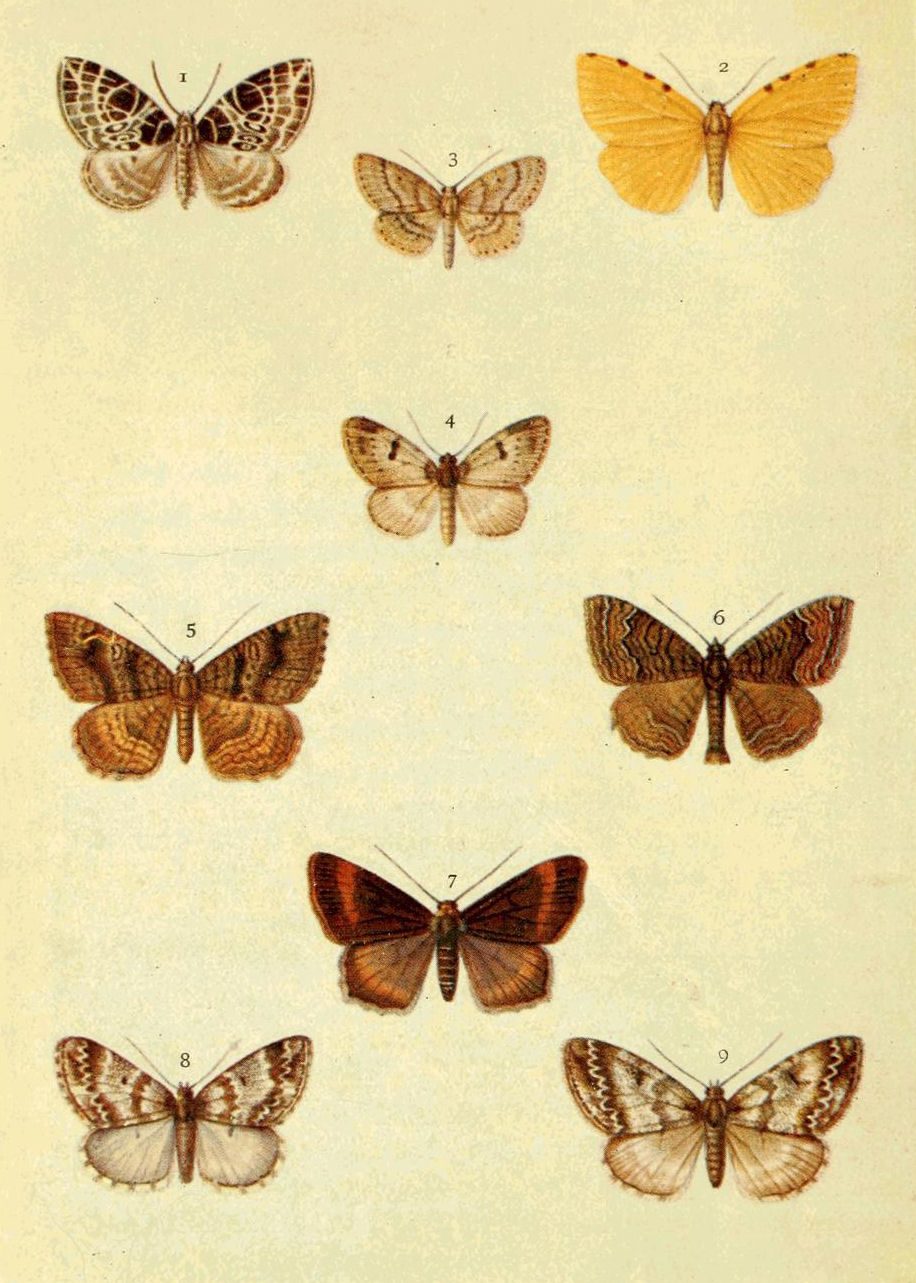
2 Pl. 61.
1.Netted Carpet. 2.Speckled Yellow, var.
3.Dotted Border Wave (ab. circellata). 4.Garden Carpet (ab. costovata).
5, 6.Yellow Shell, aberrant forms. 7.Tawny-barred Angle (ab. nigrofulvata).
8, 9. Broken-barred Carpet, Scottish form.
The Brown Scallop (Scotosia vetulata).
The male is always smaller than the female, and is noticeable for its long body with tuft of hairs at the extremity. The wings in both sexes are dingy brown, or greyish brown, and the usual lines on fore wings are blackish, the space between first and second often dusky. (Plate 60, Fig. 6.)
The caterpillar is short and stout, and in form very like that of the winter moth; the back and a central dorsal stripe are black, the latter bordered with white, the sides are yellow; the spiracular line is black, broken, and unconnected; the spiracles are black; the head is black, and the edge of the first ring of the body is yellow. (Crewe.) It feeds, in May and June, on purging buckthorn (Rhamnus catharticus), and is to be found between two or more leaves, which it spins together as a hiding place.
In June and July the moth may sometimes be obtained by beating bushes of buckthorn, or the herbage below and around; this plan works best when operated just before dusk. As a British insect it is only found in England, and is most frequent in the southern and eastern counties, but widely distributed in the west to Worcester, and has been found in Lancashire, Westmorland, and Yorks. In the last-named county, caterpillars were obtained freely at Askham Bogs in 1900.
When Stephens wrote of this insect in 1831 he noted its occurrence "in a lane near Fulham." Even so recently as 1906 I obtained specimens on the Putney side of Wimbledon Common.
The range abroad extends to Eastern Siberia.
The Dark Umber (Scotosia rhamnata).
The blackish oblique band on the fore wings of this ochreous brown species (Plate 60, Fig. 7 ♂, 8 ♀) is sometimes indicated only by the blackish lines, the space between them being hardly darker than the general colour. Sometimes all the wings are suffused with blackish brown, and in such specimens the only distinct marking is the whitish submarginal line.
The caterpillar is green, with three lines along the back, the central one dark green, and the others yellow; the hind wings are marked with purple, and a stripe of the same colour runs along under the spiracles. In another form the general colour is greyish with a reddish-brown stripe along the back, and series of spots of the same colour along the sides. It may be found in May and June, concealed between leaves that it has fastened together to form a retreat.
The moth flies in late June and in July, and may be disturbed in the daytime from buckthorn bushes. It is widely distributed, and often common in the South of England, but is rare in the north; and has also been recorded from South Wales.
Note.—This species has been referred to transversata, Hufnagel, and as this is an earlier name it may have to be adopted. According to Prout, both this and the preceding species should be placed in the genus Philereme, Hübner.
Small Phœnix (Eustroma silaceata).
In its typical form (Plate 63, Fig. 3) the blackish band of the fore wings is entire, but in ab. insulata, Haworth (Fig. 4), this band is interrupted by two whitish lines along the median veins, and so divided into three or four portions, the smaller section placed between the lines; occasionally, the dividing lines assume stripe-like proportions, and the main portions are consequently smaller in size and further from each other, but one "island" still remains. In another form, the lower outer corner is distinctly separate from the costal portion; thus the band is broken into four parts.
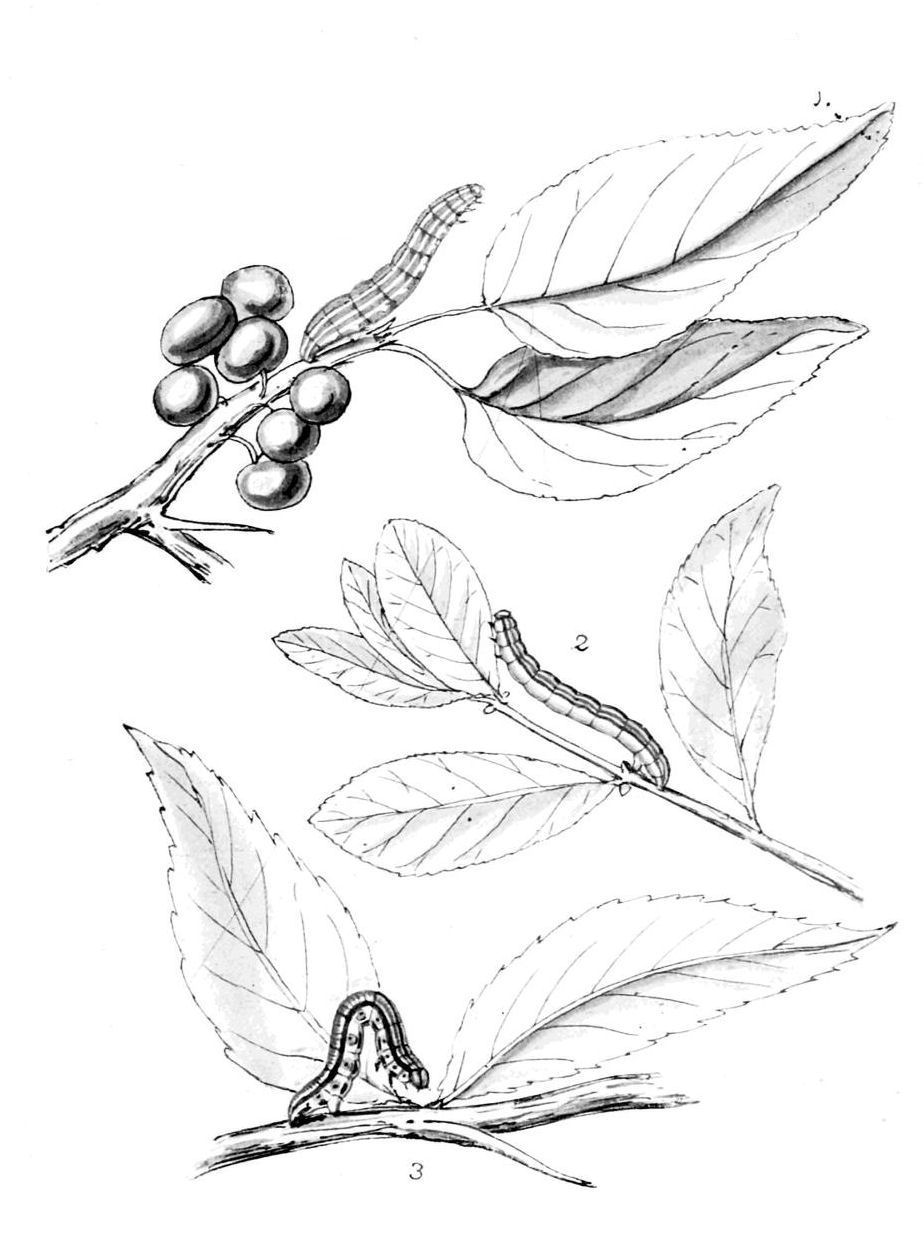
2 Pl. 62.
1.The Tissue: caterpillar.
2.Scallop Shell: caterpillar.
3.Scarce Tissue: caterpillar.
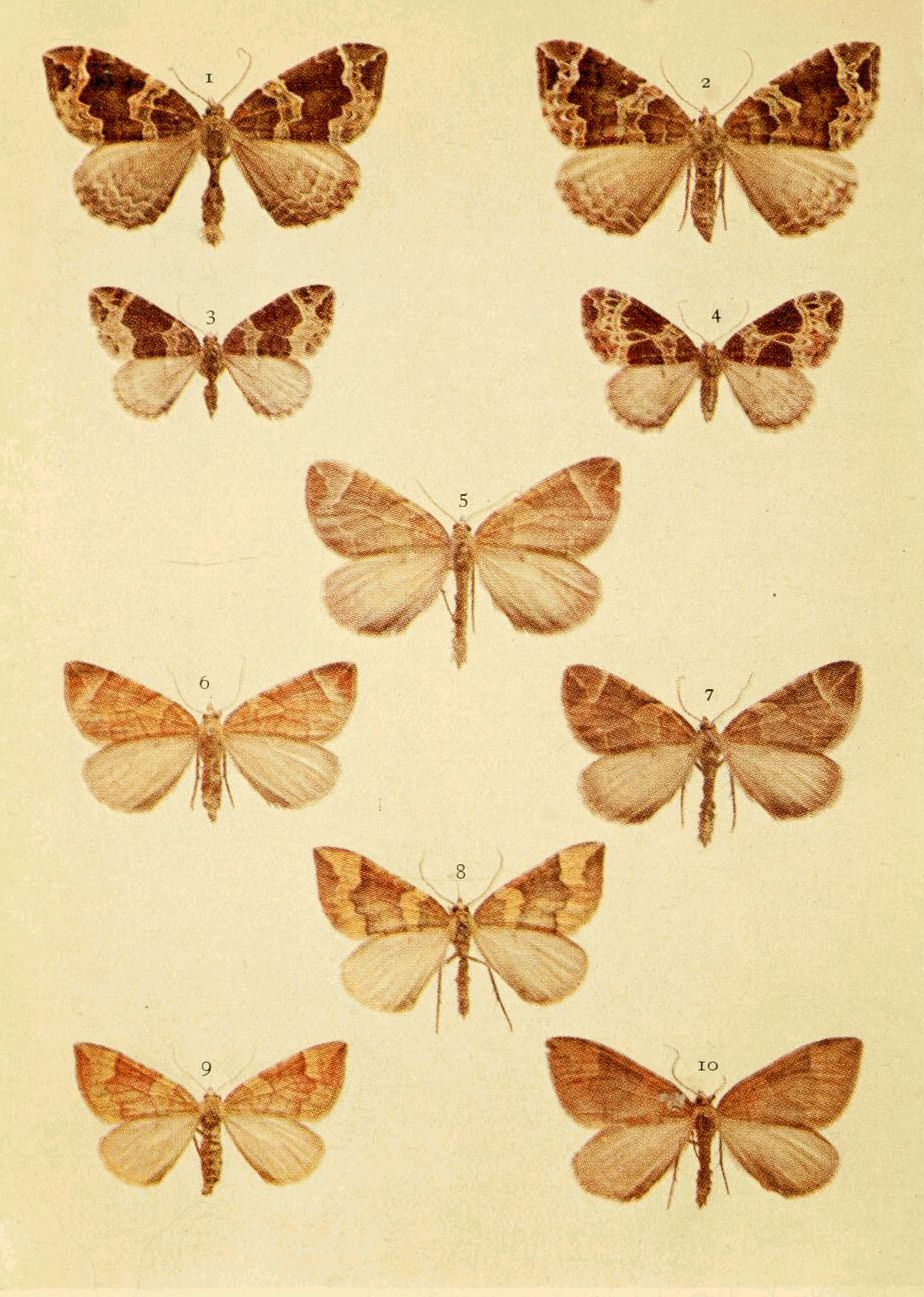
2 Pl. 63.
1, 2.The Phœnix. 3, 4.Small Phœnix. 5-7.The Chevron.
8-10.Northern Spinach.
The long caterpillar is green, with a reddish-brown stripe along the back; this is broken up into spots, except on the first three rings; there are some reddish-brown spots on the sides. It feeds on various kinds of willow herb (Epilobium), and enchanter's nightshade (Circæa lutetiana) in July, and sometimes in August and September.
The moth should be looked for in beech and other woods amongst the food plants, from which, and the surrounding herbage, it is readily evicted. It flies at twilight, and later on, when it has been known to visit the sugar patch; it is also attracted by light. It is out in May and June, and specimens of a second generation sometimes occur in the South. The species occurs locally throughout England, probably Wales, and in Scotland up to Ross. In Ireland, it is widely distributed and locally common in the North, but apparently not noted in the South.
Netted Carpet (Lygris reticulata).
The white veins and white lines passing through the blackish blotches at the base and on the front margin of the fore wings, give these wings a curious netted appearance; the hind wings are smoky grey, with two white lines which appear to be continuations of the white second line and sub-marginal of the fore wings. (Plate 61, Fig. 1.)
The caterpillar is green, inclining to yellowish, and more or less tinged with pinkish, especially on the sides; three lines on the back, the central one reddish, the others whitish; a central line along the pinkish spiracles. It feeds at night on yellow balsam (Impatiens noli-me-tangere), preferring the flowers, seeds, and young foliage, and rests by day on the undersides of the leaves: September and October. (Plate 64, Fig. 2, after Hofmann.)
The moth is out in July and August, and, of course, will only be found in localities where the balsam flourishes; these are very limited, and in Britain are confined to Westmorland and the northern border of Lancashire, and North Wales. The species was first introduced as British in 1861, when the late Henry Doubleday recorded the capture of three specimens in August, 1856, on the border of one of the lakes in Westmorland, by his friend the late Thomas H. Allis. It seems that other specimens had been taken at the same time, but these passed into collections as the "second brood of silacearia." The caterpillar is said to have been found in North Wales, but has been more frequently obtained in the English Lake District.
The range abroad extends to Eastern Siberia, Amurland, Corea, and Japan; but in the three last-named countries it is chiefly represented by var. ærosa, Butt., a large form.
The Phœnix (Lygris prunata).
The English name here retained was given to this species (Plate 63, Figs. 1 ♂, 2 ♀) by Harris, in 1775, but in 1782 he changed it to "Clouded Carpet."
In ground colour the fore wings are pale brown, more or less clouded with darker brown, or with reddish-brown; the basal patch, central band, and blotch on outer margin below the tip of the wing, are all chocolate brown clouded with blackish and edged with white. Hind wings, whitish, suffused with smoky grey, except on front area; three dusky whitish-edged wavy lines, inclining to blackish on the inner margin. The egg (Plate 67, Fig. 3) is yellowish when laid, and then changes to purplish with a whitish bloom.
The caterpillar is green, varying to brownish; along the middle of the back is a series of purplish-edged, brown-centred, whitish, triangular markings; the third ring is swollen, and has a black collar. It feeds at night on the foliage of red and black currant, also on gooseberry, and may be found in April and May, earlier or later according to season, sitting by day upon the bushes.
The moth flies in July and August, and occurs in gardens, but is said to be partial to sloe bushes and hedges. It is always more or less local, although it is distributed over the greater part of the British Isles.
This species occurs in the Northern United States of America.
The Chevron (Lygris testata).
The fore wings of this rather variable species (Plate 63, Figs. 5-7) are yellowish or reddish grey, with a darker basal patch and central band; a reddish blotch below the tip of the wing is edged with white, and the central band is also outwardly edged with white. Hind wings, whitish, with two lines, and dusky hind marginal border, the latter sometimes inclining to reddish. Occasionally, the fore wings are entirely pale ochreous, and the basal patch and the central band only very slightly darker, but the limiting lines are reddish, and the patch under the tip of the wing is bright orange red. Var. insulicola, Staud., from the isles of Scotland, has the fore wings rather narrower, and suffused with purplish brown or deep violet grey; the hind wings are smoky grey. The female is usually smaller than the male, and often more yellow in colour.
Eggs, whitish brown, mottled with darker. The early stages are shown on Plate 67, Figs. 2-2b.
The long caterpillar is pale yellowish brown, with three lines along the back, the central one dark brown, and most distinct at each end; the others are white, irregularly shaded above with reddish; another white line along the region of the spiracles. It feeds, in May or June (earlier or later in some seasons), on sallow and birch. The moth is out in July and August, and frequents heaths and bogs more especially, but is also found in or around woods, and I have captured male specimens as they flew along hedgerows bordering fields, at dusk, in Middlesex. The female is rarely seen on the wing.
The species, which ranges through Central and Northern Europe to the Ural and Altai, is generally distributed throughout the British Isles; it is found also in the Atlantic States of America.
Northern Spinach (Lygris populata).
The fore wings are yellow, with a reddish or purplish-brown basal patch, central band, and small patch on outer margin below tip of the wing, the central band more or less clouded or mottled with yellow. Hind wings, whitish, tinged with yellow. The female is usually smaller, the colour generally paler, and the markings frequently only represented by cross lines. Specimens from the Isle of Arran have the ground colour of fore wings more or less dappled with brown of the same tint as that of the central band and other markings; the hind wings are tinged with a smoky hue. In other parts of Scotland the brown colour becomes more and more general, until the fore wings are uniformly brown, and the hind wings dusky. On the mountains in the north nearly black specimens occur, and these seem to be referable to ab. musauaria, Freyer. (Plate 63, Figs. 8-10.)
The long caterpillar is variable in general colour, brown, mottled with greyish, pale grey, reddish brown, or yellowish green; all have darker or whitish lines along the back, and whitish or pinkish triangles or X-marks. It feeds, in May and June (earlier in some localities, and later in others), on bilberry, crowberry, and sallow; it may also be reared on willow.
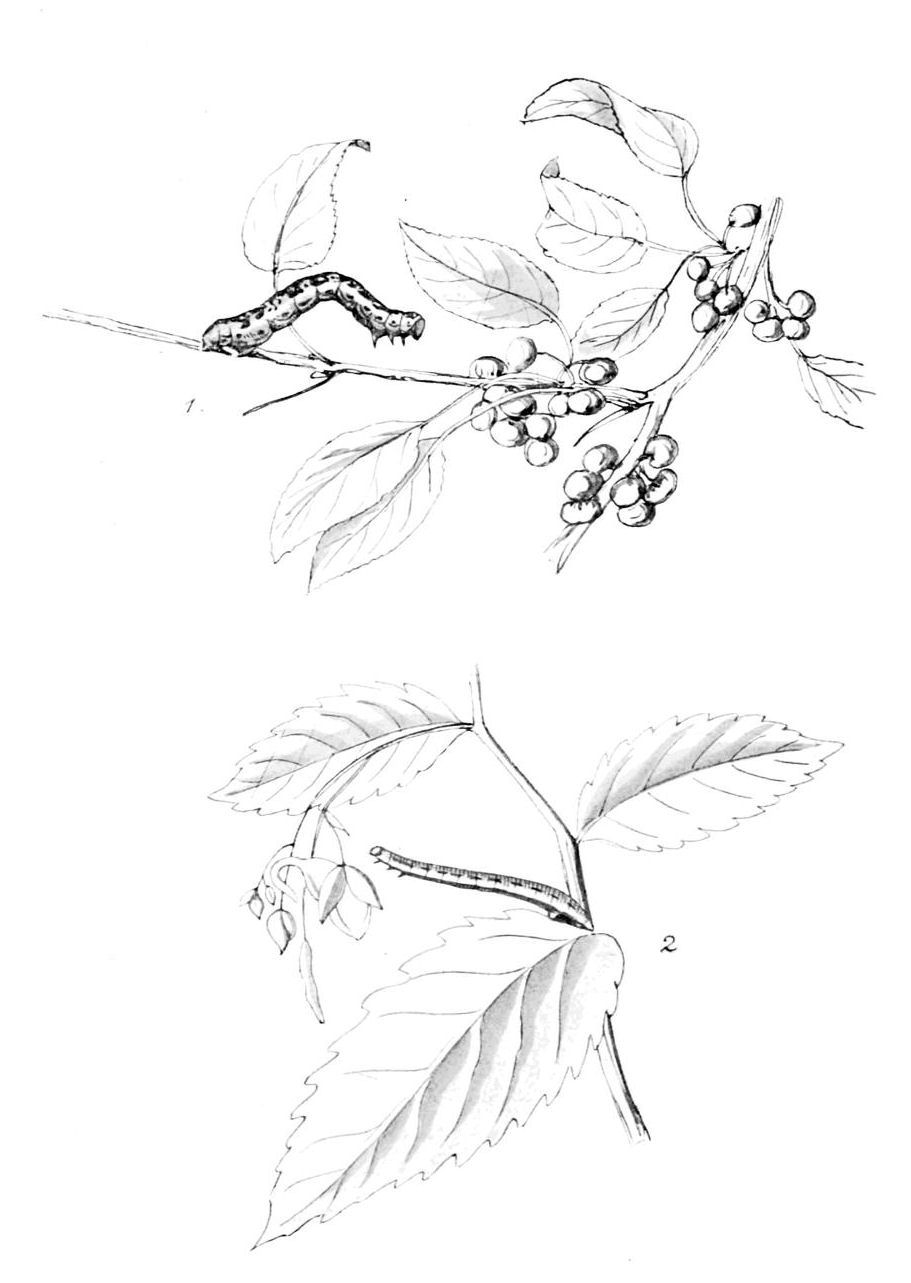
2 Pl. 64.
1.Dark Umber: caterpillar.
2.Netted Carpet: caterpillar.
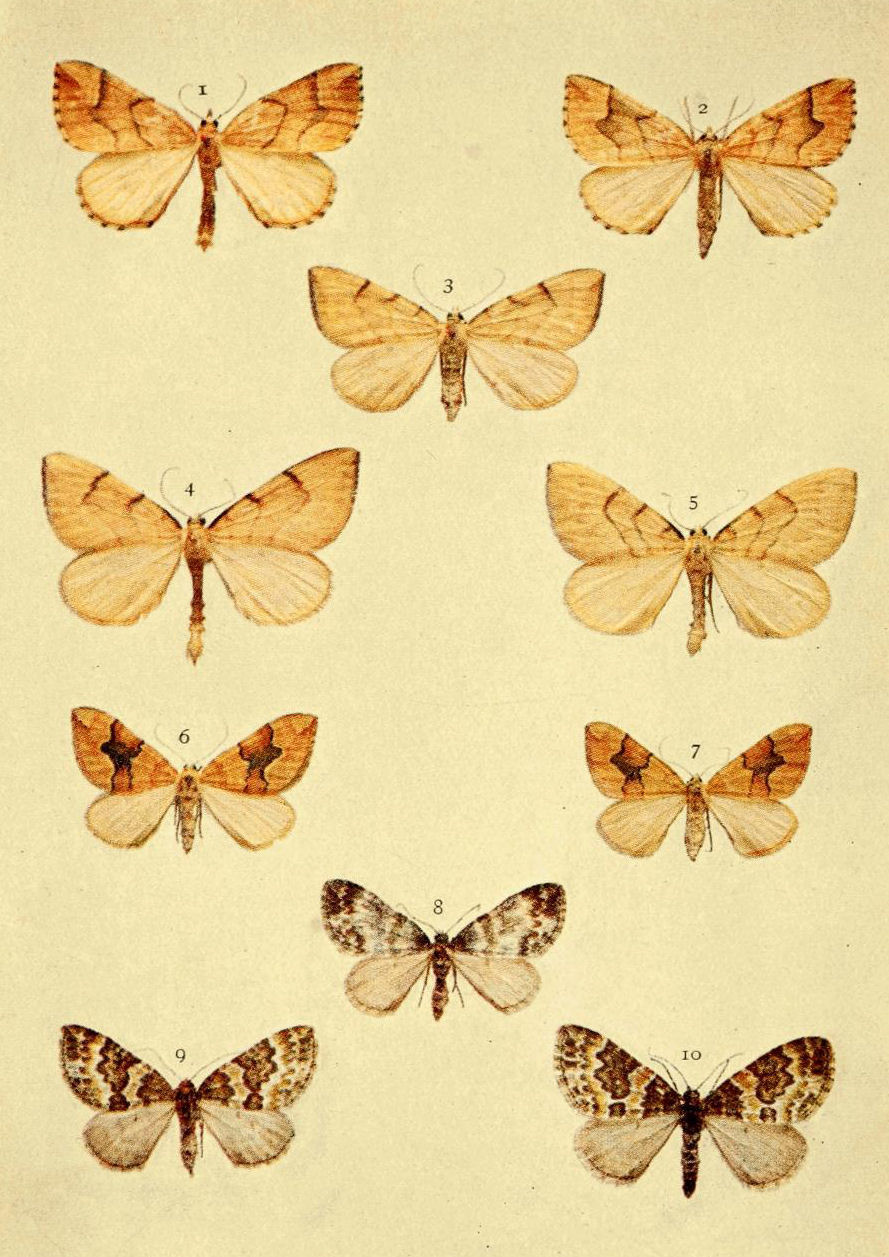
2 Pl. 65.
1, 2.The Spinach. 3-5.Barred Straw. 6, 7.Barred Yellow.
8-10.Broken-barred Carpet.
The moth is out in July and August, and may be found on the leaves and among the sprays of Vaccinium myrtillus growing in woodlands (especially the more ancient), bogs, and moorlands.
The species is widely spread, and generally abundant in suitable districts, over the greater part of the British Isles; but it seems to be more or less casual in England south of the Midlands, although its range runs through Gloucestershire and Somerset into Devon. In the last-named county it sometimes swarms at Martinhoe, on the edge of Exmoor.
The distribution abroad includes Eastern Siberia, Amurland, Labrador, and North America.
The Spinach (Lygris associata).
The fore wings are pale ochreous, more or less clouded with darker; three brownish cross lines. Hind wings, paler, with indication of cross lines on the inner margin. Fringes of all the wings chequered with brown, most distinct on the fore wings. (Plate 65, Figs. 1, 2.)
The long caterpillar is green, inclining to yellowish; three lines along the back, the central one dark green and the others whitish; there is also a whitish line low down along the sides. It feeds at night, in May and June, on currant (Ribes rubrum and R. nigrum), and may be found on the underside of a leaf in the daytime. (Figured on Plate 67, Fig. 1, from a coloured drawing by Mr. A. Sich.)
During July and August the moth flies in the evening, and after dark it often comes to any bright illumination. It is essentially a garden insect, and where currant bushes are there also spinach is often grown; hence it was probably connected with the vegetable rather than the fruit when Haworth named it spinachiata. The species seems to be found more or less frequently in suitable spots through England. In Wales it has been recorded from Glamorganshire, and from Rhyl, Flintshire; in Scotland, Renton states that it is common in Roxburgh gardens; and it is also noted from Paisley. It has been doubtfully recorded from Ireland.
The range abroad extends to Amurland.
Barred Straw (Cidaria pyraliata).
In certain respects this species (Plate 65, Figs. 3-5) is not unlike that last referred to. The fore wings are yellowish straw-colour, the cross lines are brownish, but the central two are closer together, especially on the inner margin, than they are in associata, and are straightly oblique from the angle, or elbow, below the front margin; there is often a line of brownish dots between the second line and the outer margin, and the fringes are brown, not chequered. Occasionally there are darker clouds on the second line, at the angle, and such clouds sometimes appear in the central space. Not infrequently the markings are very faint. Staudinger and others refer this species to dotata, L., but there seems to be some doubt in the matter.
The caterpillar feeds, in April and May, on the common cleavers or goose-grass (Galium aparine) of our hedgerows, etc., but it also eats G. mollugo and other kinds of bedstraw. It is to be found low down on the stems.
The moth may be disturbed from the herbage along hedges and ditches in lanes, and the borders of woods, but it seems most partial to the former.
The species is generally distributed, and often plentiful, in the southern half of England; but although widely spread in the northern half, it is only common locally. It occurs in Wales, both North and South; is common in Roxburghshire and Clydesdale, and is said to be found on the Aberdeenshire coast and in West Ross. In Ireland it is widely distributed, and sometimes abundant; but more frequent on the coast than inland.
The distribution abroad includes Eastern Siberia and Amurland.
Barred Yellow (Cidaria fulvata).
This very pretty, and most distinct, little species (Plate 65, Figs. 6, 7) does not vary very greatly; there is certainly some modification in the general colour, and in that of the markings, but in both it is only a matter of tint.
The caterpillar is somewhat wrinkled, and in colour is green, with three greyish lines along the back, the central one double; the ring divisions are yellow, and there is a yellow line low-down along the sides. It feeds at night, in May and June, on the leaves of wild rose, and does not object to the garden kinds. (Plate 69, Fig. 3, after Hofmann.)
The moth is out in June and July. It hides by day under leaves in hedges, and although not often induced to get on the wing at that time, the male commences its evening flight at an early hour. It is generally a common species in England and Wales; it occurs here and there through Scotland, up to the Orkneys; and although somewhat local, it is common enough, where found, in Ireland.
Broken-barred Carpet (Cidaria corylata).
The fore wings have an olive-brown basal patch and central band, both are edged with white, wavy lines, and the band is contracted below the middle. (Plate 65, Fig. 9), and often broken at this point (Fig. 10); the inner marginal portion sometimes very small; the space between the basal patch and central band is pale brown, and so also is the outer marginal area; but there are dark clouds and white marks beyond the white wavy submarginal line. Variable in tint and in marking, the variety generally known as albocrenata, Curtis (Plate 65, Fig. 8), is perhaps most frequent in Perthshire and Sutherland. Two other examples of the Scottish form, which Staudinger has named effusaria, are depicted on Plate 61, Figs. 8, 9.
The caterpillar is green, inclining to yellowish; three stripes on the back, the central one reddish brown and broad, but only distinct at each end, the other paler green; spiracles, white, placed in a reddish-brown stripe, which is sometimes broken up. It feeds on sloe, birch, oak, and the foliage of other trees, and may be found from July to September, and even later.
The moth is out in May and June, and is to be beaten from hedges, or may be found at rest on tree-trunks, palings, etc.
Generally distributed, but not extending to the Scottish Isles.
Abroad, the range spreads to Amurland and Japan.
Common Marbled Carpet (Cidaria truncata).
Six examples of this very variable species are shown on Plate 66, and these have been selected to illustrate the more important forms. There are a number of modifications of each of the forms, and several of these have been named. Fig. 1 of our plate represents the typical form, and this is Haworth's centumnotata (Common Marbled Carpet); Fig. 2 is ab. commanotata of Haworth (Yellow Marbled Carpet); Fig. 3 is ab. perfuscata, Haworth (The Brown Marbled Carpet), and Fig. 4 is a modification of the same form. A specimen from Arran is shown in Fig. 5; this example agrees fairly well with that figured in Wood's Index as concinnata from Arran. In his description of the form, Stephens does not mention fulvous bands in his type. Fig. 6 shows a specimen from Stornoway, Isle of Lewis, which appears to be a modification of the typical form of truncata, but it has some of the character of concinnata. The latter, it may be mentioned, is considered by Mr. L. B. Prout to be a distinct species, and as the genitalia have been found, on examination by Mr. Pierce, to differ from these organs in truncata and immanata, there seems to be reason to accept it as such.
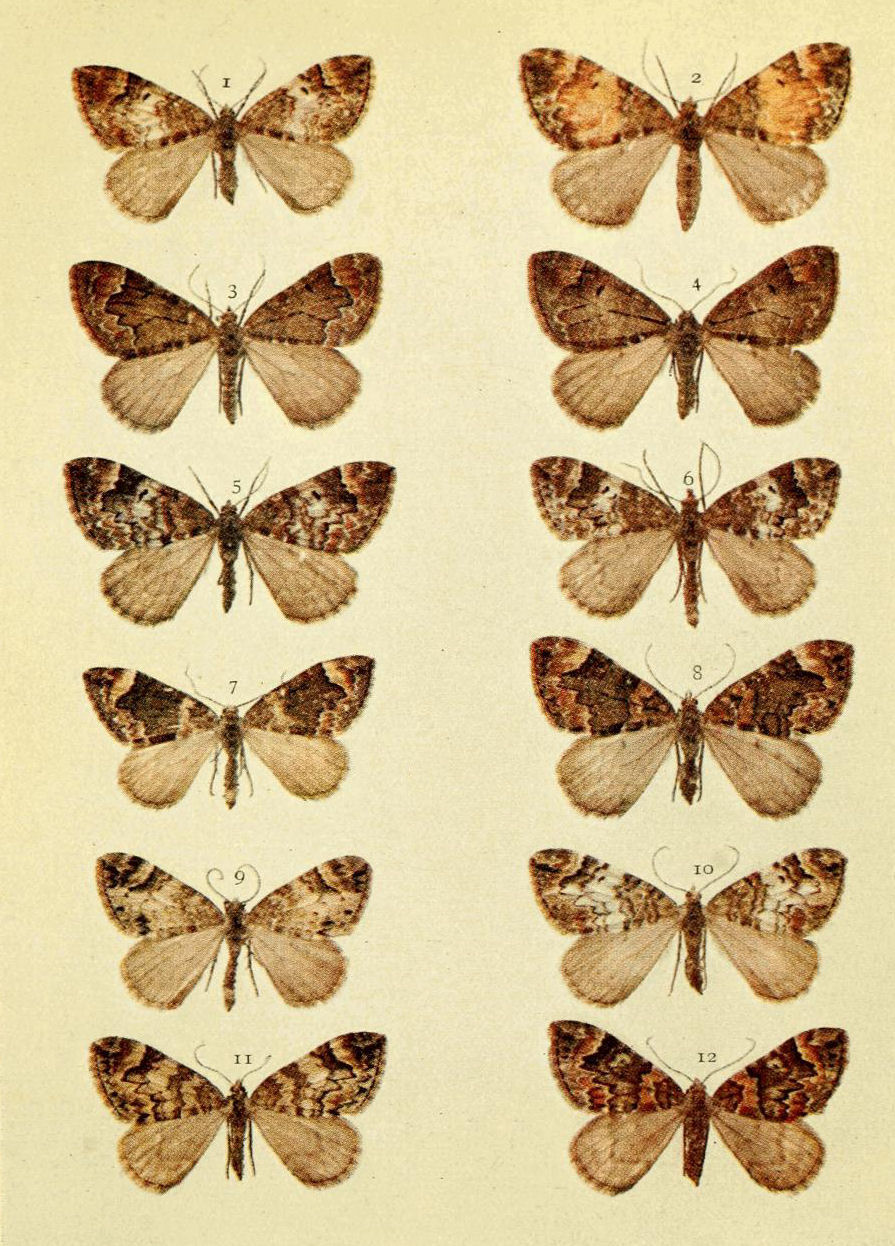
2 Pl. 66.
1-6.Common Marbled Carpet. 7-12.Dark Marbled Carpet.
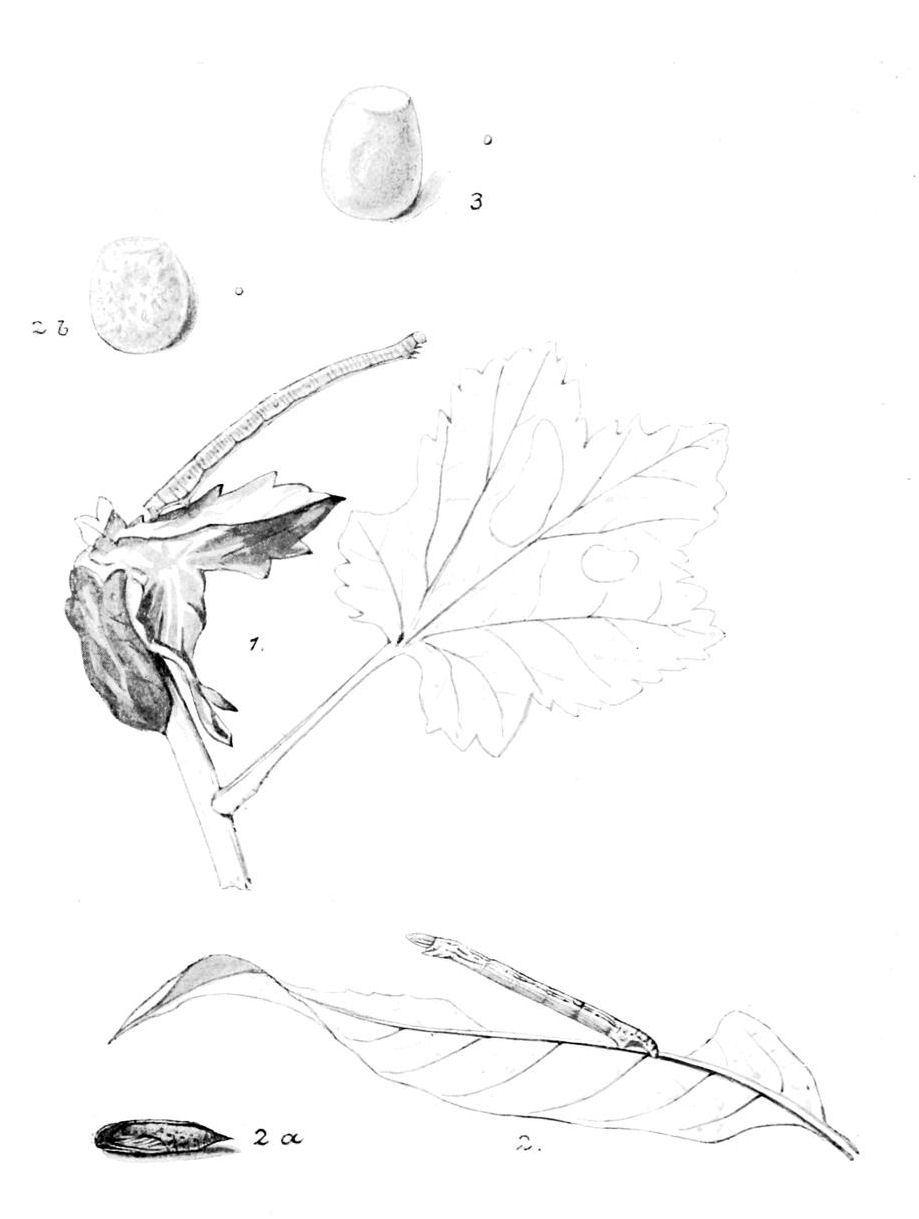
2 Pl. 67.
1.Spinach: caterpillar.
2, 2a, 2b.Chevron: eggs, caterpillar and chrysalis.
3.Phœnix: eggs.
The caterpillar is long, slender, and wrinkled, especially on the sides; the ground colour is green, inclining to yellowish; three lines along the back, the central one dark green, and the others yellowish; sometimes a rosy stripe, or a series of dashes along the sides; the points on the last ring are green, or rosy. It feeds, in the autumn and again in the spring after hibernation, on sallow, birch, hawthorn, bilberry, wild strawberry, etc. It will also eat rose, but as the specimens resulting from caterpillars reared on rose are frequently small, such food is probably unsuitable; garden strawberry, on the other hand, is an excellent pabulum. A photograph of the caterpillar by Mr. H. Main is shown on Plate 69, Fig. 1. There is a second brood in late June and in July. The first generation of the moth is out in May and June, and the second emerges in the autumn; specimens, possibly of a third generation, have been seen in December in favourable localities.
The species, which frequents woods and hedgerows, and is pretty generally common, is to be found almost everywhere throughout the British Isles. It has not, however, been noted from Shetland.
The distribution abroad extends to Amurland, China, and Japan.
Dark Marbled Carpet (Cidaria immanata).
This is another exceedingly variable species (Plate 66), and here again six examples have been chosen to illustrate something of the range of aberration. Figs. 7 and 8 are of the typical form, and Figs. 9 and 10 show the form marmorata, Haworth (Marbled Carpet); while Figs. 11 and 12 represent specimens from Shetland, and are referable to the island race known as pythonissata, Millière; neither of the specimens figured, however, quite agrees with the type of this form, but Fig. 12 does so fairly well. In some specimens the general colour of the fore wings is tawny or rust-colour, or they are strongly suffused with that tint (ab. ferruginea, Prout). I have such examples in my series of specimens from Lewes and the Shetlands. Ab. thingvallata, Staud., from Iceland, has the fore wings white, with black basal patch and central band, and I have seen at least one example from Yorkshire that closely approached this variety.
The caterpillar is not very unlike that of the last species, but it is rounder in appearance, the general green colour is paler, and the points on the last ring are blunt. It feeds from April to June on sallow, birch, bilberry, and wild strawberry. (Plate 69, Fig. 2, after Hofmann.) The moths are out in July and August, and may be found resting on tree-trunks, rocks, or stone walls; at night, when it is active on the wing, it is said to be often seen in numbers on the flowers of the rush, and this habit has been noted more particularly in Scotland.
The species affects woods and moors, and appears to be found more or less commonly throughout the British Isles.
Marsh Carpet (Cidaria sagittata).
The fore wings of this very distinct species are brown, with white-edged black bands at base and across the central area, the latter with a strong projection on its outer edge, almost reaching a white spot on the outer margin; sub-marginal line whitish, often only traceable on the front edge. The central band is always narrowed below the middle, sometimes divided, and occasionally this part of the band is finely cut off from both upper and lower portions. (Plate 68, Figs. 7, 8.)
The caterpillar is yellowish green, merging into pinkish on the sides; the pink is edged below with black, and this is followed by a dark olive stripe; rings 1-3 and 10-12 are wrinkled, whilst all the others are ridged across the back and along the sides. It feeds, in August and September, on the unripe seeds of meadow-rue (Thalictrum flavum), also on T. minus, and, according to Barrett, on old withered leaves of columbine.
The moth is out in July, occasionally at the end of June, and occurs locally in "Fenland."
Doubleday introduced it as British in the Zoologist for 1848. He there states, "A single example of this pretty species was obtained last season near Peterborough, but I believe it was not in very good condition. A splendid female was sent to me from the same neighbourhood this week (July 15, 1848)."
In 1853 and 1854 the species was discovered in the fens of Huntingdonshire and Cambridgeshire. Later it was found to inhabit the fens of Norfolk and Suffolk. It is still obtained in the Cambridge fens from Bottisham to Chatteris. Outside "Fenland" it has been recorded from Worcestershire (Bewdley Forest) and Warwickshire (Rugby).
The range abroad extends to Amurland.
Red-green Carpet (Cidaria siterata).
The general colour of the fore wings of this species (Plate 68, Figs. 1-4) is greyish green, with more or less of rosy suffusion; the basal patch and central band are darker green, and the latter is outwardly edged with whitish below the front margin, and towards the inner margin. The female has rather more ample wings, and is generally of a darker hue, but in both sexes the basal patch and central band are blackish; the hind wings are dark greyish brown, inclining to blackish in some females, and there is a blackish central dot and two or three curved lines.
The long caterpillar is yellowish green, with an interrupted red line along the middle of the back; two green points on last ring are usually pink-tipped. It feeds on oak, birch, ash, sloe, apple, etc., in July and August.
The moth occurs in woodlands, but is not easily disturbed in the daytime from its lurking-place in bush or tree. In the autumn it may be found at ivy-bloom, and in the spring, after hibernation, has been taken at sallow.
The species appears to be widely distributed over England and Wales, Scotland up to Moray, and Ireland.
Autumn Green Carpet (Cidaria miata).
Somewhat similar to the last, but the general colour of the fore wings is paler, inclining to whitish, and the basal patch and central band are pale green tinged with greyish; there is no rosy suffusion, but the wavy sub-marginal line is distinctly white. The hind wings are greyish white, with black discal dot, and dark-grey curved lines. (Plate 68, Figs. 5, 6.)
The caterpillar is pale green, inclining to yellowish, especially between the rings, and with a more or less distinct dark-green line along the middle of the back; the points on the last ring are pinkish brown, and there is a line of the same colour along the centre of the under surface of the body.
It feeds on alder, birch, oak, sallow, etc., and may be beaten out from June to August.
The moth is out in September and October, when it may be obtained at ivy-bloom, and in the following spring, after hibernation, it visits sallow catkins.
The range in the British Isles agrees pretty closely with that of the last species, but in Scotland it extends to the Hebrides and to the Orkneys.
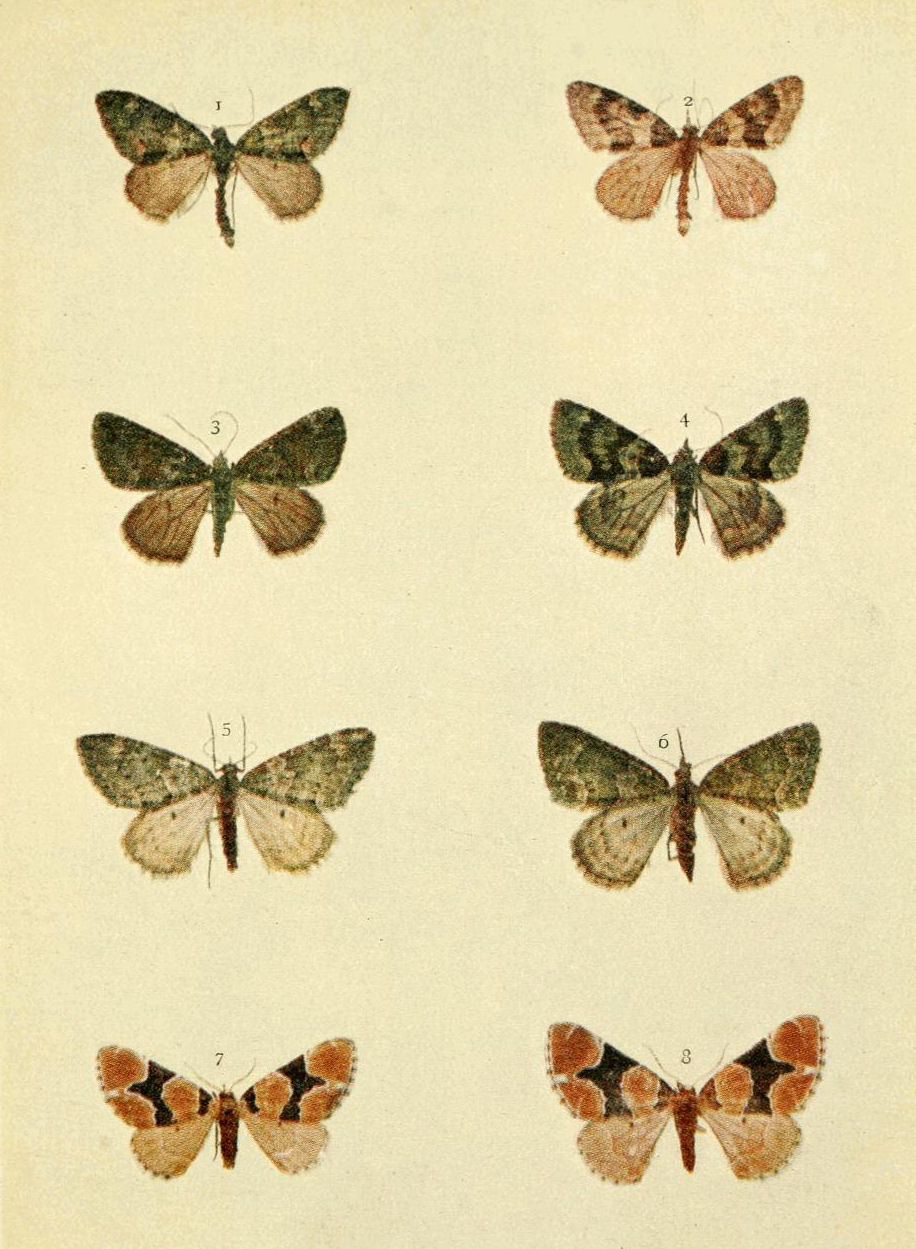
2 Pl. 68.
1-4.Red-green Carpet. 5, 6.Autumn Green Carpet. 7, 8.Marsh Carpet.
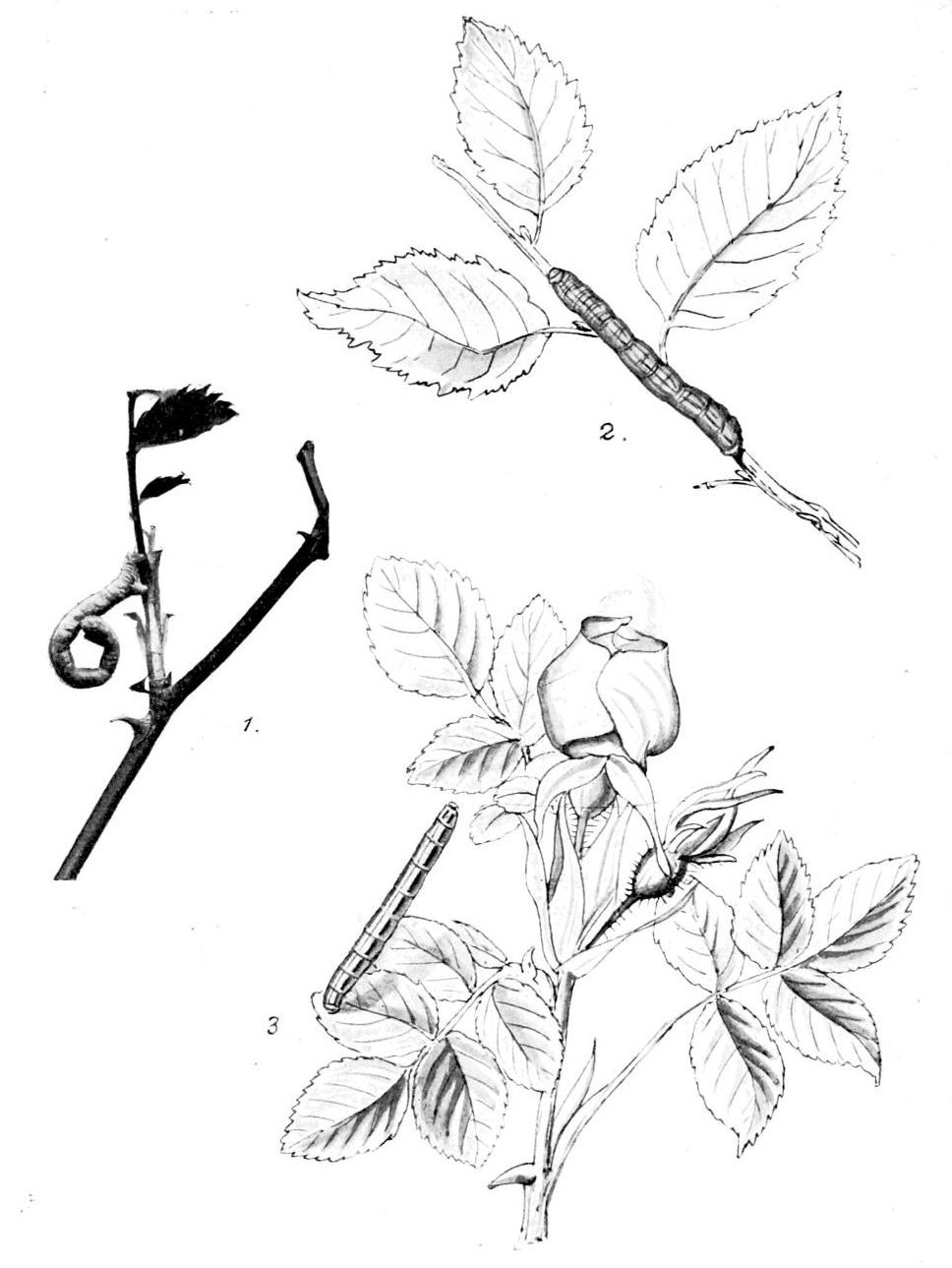
2 Pl. 69.
1.Common Marbled Carpet: caterpillar.
2.Dark Marbled Carpet: caterpillar.
3.Barred Yellow: caterpillar.
Note.—According to Prout, sagittata is not a Cidaria, as its larva is of a very different form; and siterata and miata are referred to Chloroclysta, Hübner.
Grey Pine Carpet (Thera variata).
In its typical form, the fore wings of this species are greyish, and from this the colour ranges through various tints of greyish brown to smoky brown or blackish; sometimes these wings are shades of ochreous brown. The usual markings are a basal patch, more or less clearly defined, and a central band, and these may be either brown or blackish; the band varies in width, is not infrequently narrowed or contracted below the middle, occasionally broken at this point, and more rarely only represented by a small angular spot near the front margin.
Four examples are shown on Plate 70, and of these 1 and 2 represent our ordinary form obeliscata, Hübner (Shaded Broad Bar, of Newman). Fig. 6 is a blackish banded specimen of the obeliscata form, and Fig. 3 is the almost entirely blackish form obliterata, White (scotica, Staud.), which is not uncommon in the Paisley district, and other parts of Scotland, and also occurs in a modified form in some pine-woods in the South of England.
The long caterpillar (Plate 71, Fig. 1), which feeds on the needles of Scots pine in April and May, also in July, and sometimes in September, is bright green, with three whitish lines along the back, the central one broad, and a yellowish line low down along the sides; the green roundish head is lined with white.
The moth is generally common in pine-woods throughout the greater part of the British Isles. The May-June flight is the most abundant, but there is occasionally a good sprinkling of moths in the autumn.
Abroad, the area of distribution includes Eastern Siberia, Corea, China, and Japan.
Chestnut-coloured Carpet (Thera cognata).
This is a generally smaller species than that last referred to, and it is more glossy in appearance. The fore wings are brown, sometimes grey-brown, more or less tinged with reddish, and the basal patch and central band are darker; these markings are usually white-edged, and there is a wavy whitish submarginal line. Hind wings whitish, tinged with smoky grey. Specimens from the Hebrides are strongly purplish; and Kane states that some he reared from Sligo caterpillars are more richly coloured than any that he has seen from Scotland. (Plate 70, Figs. 9 ♂ 12 ♀.)
The bright green caterpillar is stouter than that of the last species. It is of a bluish hue along the back, and marked with three lines, the central one greenish and the others whitish and broad; there are sometimes reddish markings low down on the sides, just edging the broad white spiracular line. It feeds in May and June, earlier or later in some seasons, on juniper; it turns to a dark-green chrysalis in a frail cocoon spun up among the litter under the juniper bushes.
The moth is to be found in July and August among juniper growing in the hilly and maritime haunts of the species in North England, Wales, Scotland, and Ireland.
This species, long known as simulata, Hübner, has been referred to cognata, Thunberg, and as this is an earlier name it will have to be used.
Pine Carpet (Thera firmata).
The pale reddish-grey fore wings have a rather darker central band and round-edged basal patch, but the latter is often indistinct, and the band, which is always deeply indented about the middle of its inner edge, is sometimes not well defined. The hind wings are whitish, tinged more or less with greyish or pale brownish, but always paler than in any form of T. variata, with which it is often confused. (Plate 70, Figs. 10, 11.)
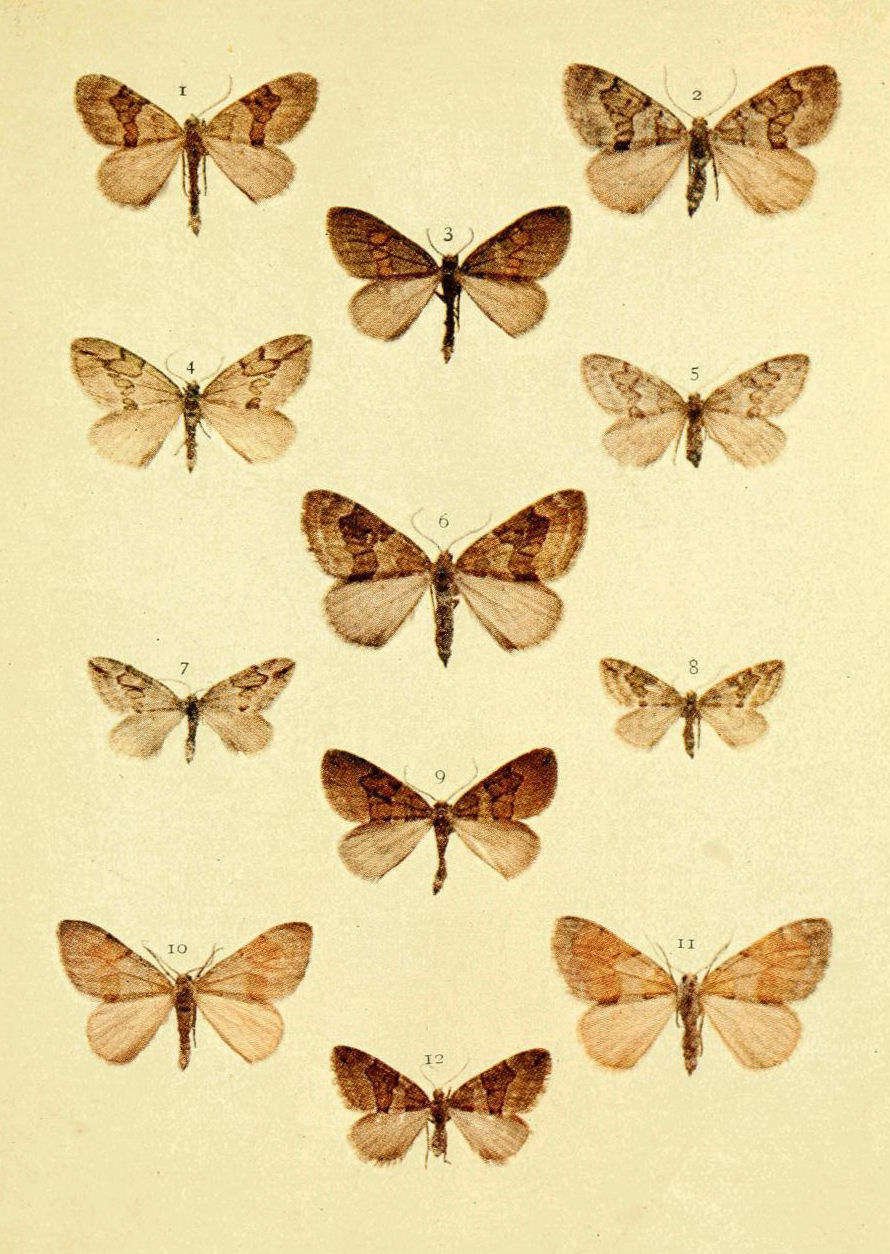
2 Pl. 70.
1, 2, 3, 6.Grey Pine Carpet. 4, 5, 7, 8.Juniper Carpet.
9, 12.Chestnut-coloured Carpet. 10, 11.Pine Carpet.
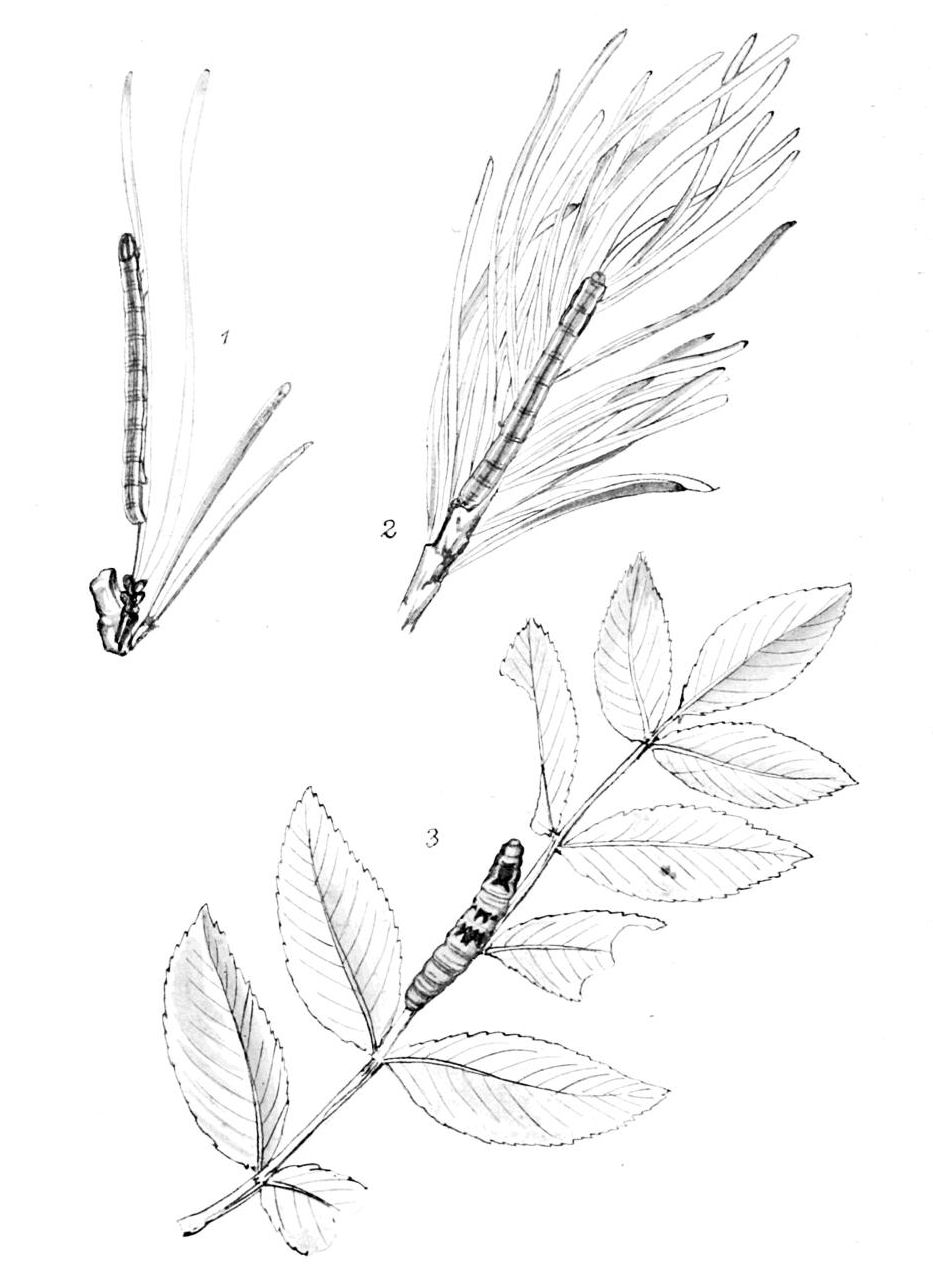
2 Pl. 71.
1.Grey Pine Carpet: caterpillar.
2.Pine Carpet: caterpillar.
3.Welch Wave: caterpillar.
The caterpillar is bluish-green above, and green beneath; three lines along the back, the central one a darker tone of the ground colour, the others whitish; head reddish, marked with brown on each cheek. It feeds in April and May (June in Scotland) on Scots pine; Barrett states that there is a second brood in August. (Plate 71, Fig. 2.)
The moth is out in September and October, and may be disturbed from the pine boughs, or occasionally seen resting on the trunks, but it is more frequently met with at night when it flies naturally, and has been known to visit the sugar patch. Barrett, who considered this species to be double brooded, gives June and July for the first flight of moths. Certain it is that moths have been reared even as late as October from Spring caterpillars. As adverted to, the pale reddish forms of T. variata are sometimes confused with T. firmata, but in addition to other differences indicated above, it may be noted that in the male of the latter the antennæ are bipectinated except towards the tips. Most of the pine woods throughout England seem to produce this delicate insect more or less frequently; the same remark applies to Wales. In Scotland it is found up to Aberdeen, and also in the Hebrides. The only localities mentioned by Kane for Ireland are in counties Westmeath, Dublin, and Fermanagh.
Juniper Carpet (Thera juniperata).
On Plate 70, Figs. 4 and 5 represent the sexes of the typical form of this species, the small and rather more strongly marked Scottish form is shown by Figs. 7 and 8. In these small forms a noticeable character is the brownish band on the fore wings, between the central band and the outer margin; this band is only indicated by a dusky greyish shade in the larger form. Most of the examples of the small form from the Isle of Hoy have also a dark central line on the hind wings. The central band of the fore wings is often broken below the middle, in both forms.
The caterpillar is yellowish green, inclining to a black tinge on the back, along which are three lines, the central one dark green, and the others yellow and rather broad; a whitish stripe low down along the sides is sometimes marked with yellow and red, and there is a red thread above it; head, pink tinged; two points on last ring of the body. It feeds in July and August, on juniper. The moth is out in October and November, and may be found plentifully flying at night about the juniper bushes.
Berkshire, Kent, Surrey, and Sussex appear to be the only English counties in which it is established, and it is probably most plentiful in the last named. It has, however, been recorded from Suffolk, Lancashire, York, and Durham; also from Carnarvonshire in North Wales. It is more widely spread throughout Scotland, including the Orkneys and Shetlands, where the moths fly in July. Only doubtfully reported from Ireland.
Water Carpet (Lampropteryx suffumata).
The fore wings are whitish, more or less clouded with brownish, with dark brown, inclining to blackish, basal patch and central band. The variation tends in two opposite directions; in the one the general colour is so clouded and suffused with blackish-brown, that the entire fore wings become almost entirely of that colour (ab. piceata, Stephens), N. England and Scotland; the other extreme is ab. porrittii, Robson, in which the central band and basal patch are black, and the white ground colour is almost free of brown clouding; the last named occurs at Dover in Kent, and Huddersfield, Yorks. On Plate 72, Fig. 1 shows the typical form, Fig. 3 ab. piceata, and 2 ab. porrittii. The caterpillar varies from greyish, with pinkish or greenish tinge, to ochreous brown; the upper surface is rather darker than the under, and there is a series of dark V-shaped marks and arrow-heads on the back of rings 4-8; there is a whitish central stripe on 1-3, and a dark one on 9-12; head, brownish, marked with black. It feeds on goose-grass (Galium aparine), and other kinds of bedstraw, in May and early June. It seems to thrive best, however, on the goose-grass. (Plate 74, Fig. 1, after Hofmann.)
The moth may be found in weedy lanes and along hedgerows, pretty well throughout England, Wales, Scotland to Moray, and Ireland. It cannot, however, be said to occur in all suitable places, as although it may be found in some plenty in one lane or hedgerow in a district, it may be quite absent in similar spots just around. Wherever it is noted one year it may be almost certainly obtained there in subsequent years. April and May are the months in which it is usually seen, but it has been taken in June in late seasons, and occasionally in July.
Large Twin-spot Carpet (Coremia (Ochyria) quadrifasciaria).
The ground colour of the fore wings of this species is most often of a pale reddish brown, but sometimes it inclines to grey brown; the outwardly angled central band is often black, but more frequently perhaps the middle area is pretty much of the ground colour or greyish, with a black dot in the upper portion, and limited by two black lines which approach, or join, in the lower half. A dusky basal blotch is not always present, but it is sometimes well in evidence, as also is a dusky shade before the whitish submarginal line; frequently there are two blackish or brownish dots on the upper part of this line, and a third dot above them, but nearer the outer margin. (Plate 72, Figs. 4, 5.)
The caterpillar is pale yellowish brown, finely freckled with grey, and with greyish V-shaped marks on the back; three greyish lines along the back, the central one broken, and the others most distinct at each end. It feeds on bedstraw (Galium) and other plants, such as primrose, groundsel, etc., from August to April. The moth is out in June and July, and should be looked for on tree-trunks growing around the borders of woods or in lanes near by. It may also be beaten out of hedgerows in the vicinity of woods.
A very local species and only found with us in the southern half of England. Its chief haunts appear to be in the counties of Kent, Surrey, Hants, Essex, Suffolk, Cambridge, and Norfolk (the Breck sand district); thence its range extends through Hertford, Buckingham, and Berkshire to Gloucester, where, however, it is scarce, as it is also in Lincoln. Abroad, the range extends to Eastern Siberia, Amurland, Corea and Japan.
Red Carpet (Coremia (Ochyria) munitata).
The typical form (Plate 72, Fig. 6) has pale greyish fore wings, and these are crossed by a black-edged purplish central band. In var. hethlandica, Prout (Fig. 7), the ground colour is ochreous and the band is reddish; this form is frequent in the Shetlands.
The caterpillar is yellowish green, with greyish clouds around white dots, tinged with pink between the rings; three lines along the back, the central one grey inclining to blackish, broken on three of the hinder rings, and edged with whitish; the others are double, wavy, brownish, a whitish stripe bordered above with grey along the area of the spiracles; head, ochreous, dotted with dark brown (adapted from Fenn). It feeds on lady's mantle (Alchemilla), chickweed, groundsel, etc., from September to May.
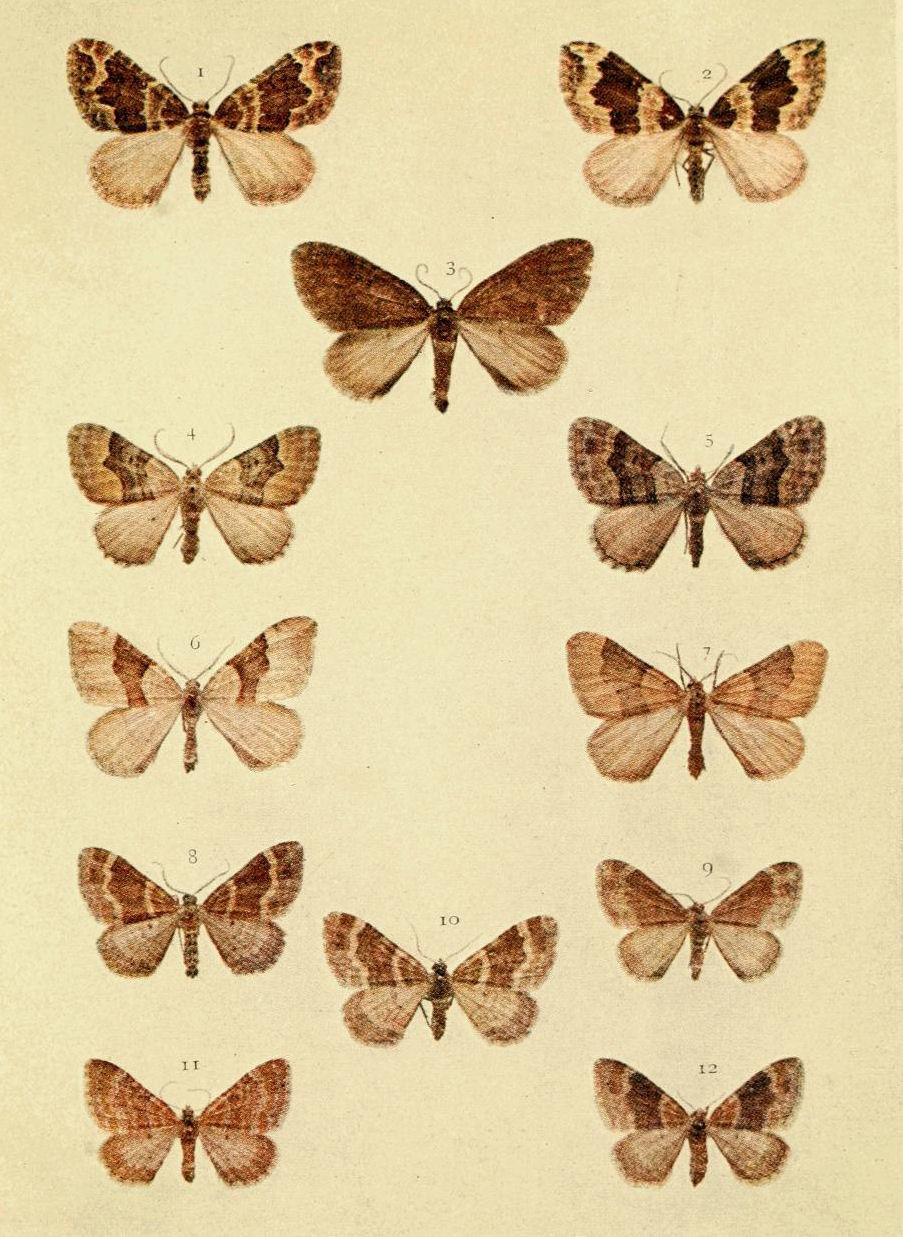
2 Pl. 72.
1-3.Water Carpet. 4, 5.Large Twin-spot Carpet. 6, 7.Red Carpet.
8-12.Red Twin-spot Carpet.
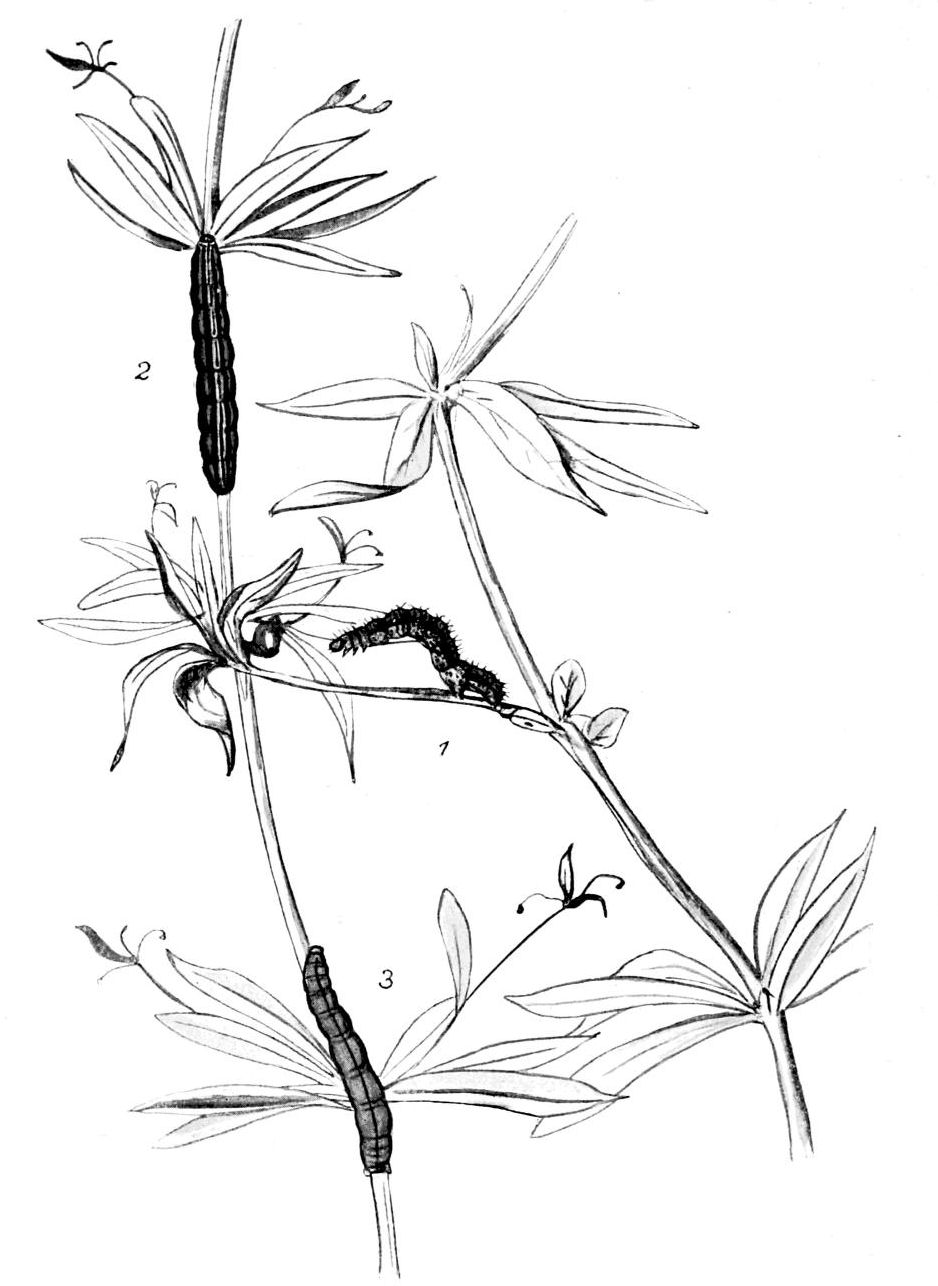
2 Pl. 73.
1.Beech-green Carpet: caterpillar.
2.Striped Twin-spot Carpet: caterpillar.
3.Mottled Grey: caterpillar.
The moth is out in July and August, and in England is only found in the mountain districts of Yorkshire and the more northern centres. It has been reported from the high-lying district on the border of Cheshire, between Macclesfield and Buxton (Day), and from Llantrissant, Glamorganshire, S. Wales (Evan John). Generally distributed through Scotland and the Isles. Widely spread, but local, and not always common, in Ireland.
Abroad, the range extends to Eastern Siberia, Amurland and North America.
Dark-barred Twin-spot Carpet (Coremia (Ochyria) unidentaria).
Portraits of three examples of this species will be found on Plate 75, Figs. 1-3. The ground colour of the fore wings is whitish tinged with pale ochreous or greyish; the central band is blackish with darker wavy lines running through it near the edges, and not infrequently the middle area is greyish, either on the upper half, or throughout from front to inner margins; a narrow patch at the base of the wings is of the same colour as the central band, and is followed by a reddish-brown streak; as a rule, there is an irregular reddish-brown line, commencing in a cloud on the front margin, and sometimes stripe-like, beyond the pale edging of the central band; in ab. coarctata, Prout, the central band is much narrowed; the two black dots on upper part of the outer margin, generally well in evidence, are occasionally united, but sometimes they are very tiny. The hind wings are whitish, more or less sprinkled with dusky scales, chiefly on the basal two thirds, and crossed by dark-grey wavy lines.
Sometimes the central band and the basal patch of the fore wings are dull reddish-brown, inclining to purplish. This form which has been referred to corculata, Hufnagel, is pretty generally distributed abroad, but is apparently only of local occurrence in the British Isles.
The caterpillar is very similar to that of the next species, it feeds on the same kinds of plants, and during the same months of the year. (Plate 74, Fig. 2.) The first generation of moths is on the wing in May and June, and the second in August.
The species is widely distributed in England and Wales, often plentiful in some districts in the southern half of the former country, scarce and more local northwards from Yorkshire. Widely spread in Roxburghshire and Clydesdale in Scotland, but less frequent than ferrugata; this also seems to be the case in Ireland. The range abroad extends to North America.
Note.—It is to be regretted that the names by which this and the following species have been known for many years may have to be changed. It has been claimed that the reddish-banded form of unidentaria, Haworth, is identical with ferrugata as figured by Clerck, Icones, Plate XI. Fig. 14, and is also referable to corculata, Hufnagel, both earlier names. If the red form referred to is adopted as the ferrugata of Clerck, then that name will supersede unidentaria, Haworth, and the species now known as ferrugata, Clerck, will become spadicearia. Authorities, however, are not agreed upon this point, so the question still remains open.
Red Twin-spot Carpet (Coremia (Ochyria) ferrugata).
Five examples of this variable species are shown on Plate 72, Figs. 8-12. The ground colour of the fore wings is usually greyish, more or less ochreous tinted, but sometimes inclining to whitish; the basal patch and the central band are reddish brown, the latter usually entire in southern specimens, but frequently broken up (ab. spadicearia, Borkhausen), especially in northern examples. A bright, ochreous form, with the central band much streaked, occurring in Scotland, has been referred to ab. salicaria, Haworth. Occasionally the central band is dark purplish. The hind wings are whitish, more or less suffused with smoky grey, and lined with the same; the outer margin is bordered with smoky grey.
The caterpillar is ochreous brown, mottled with greyish, and marked with pale diamonds and black spots on the back of the middle rings; there are wavy lines along the sides. It feeds in June and July, and also in September and October, on various low plants: knotgrass, dandelion, bedstraw, garden marigold, and ground ivy (Nepeta) being especially useful in captivity. The moth is usually double-brooded, at least in the southern half of England, the first flight occurring in May and June, and the second in July and August.
The species is generally distributed, and often common, over the greater part of England and Wales, but somewhat local north of the Midlands and through Scotland to Aberdeen; widely spread in Ireland.
Flame Carpet (Coremia (Ochyria) designata).
The ground colour of this rather common woodland species (Plate 75, Figs. 4-6) is pale grey, varying to whitish, or sometimes faintly brownish tinged. The purple band on the fore wings is always broadly edged in front with black, but the black outer edging is irregular, and sometimes only distinct towards the front margin of the wings; it varies in width, and in tint, being, in some specimens, faint purplish grey.
The caterpillar is ochreous, inclining to greyish on the back, which is marked with whitish lines on the front rings, and with ochreous diamonds and black dots on the other rings; there is also a row of black spots low down along the sides; head, brownish, freckled with black. It feeds, in June and July, probably, in a wild state, on some kind of "cress," growing in the moister parts of woods; in confinement, it will eat cabbage, horseradish, and wallflower, among other kinds of Cruciferæ. There is a second brood in August and September. (Plate 74, Fig. 3, after Hofmann.)
The moth is out in May and June, and again in August. It is fond of resting on tree-trunks in woods, especially where the ground is moist, but it may also be beaten out of hedges and bushes. It is most plentiful in the southern half of England, but is spread over the greater part of the British Isles, including the Orkneys.
Abroad, its range extends to Eastern Siberia, Amurland, Japan, and North America.
The Beech-Green Carpet (Amoebe olivata).
The species, depicted on Plate 75, Figs. 9, 10, when quite fresh has the fore wings greenish, and the central band more or less tinged with brown, in some specimens with blackish; the inner edge of the band is not so clearly defined as the outer, the latter being followed by a narrow whitish wavy band; a series of black dots edged with white represent the submarginal line. Hind wrings, smoky grey, with a pale band beyond the middle, and a pale line nearer the outer margin.
The roughened caterpillar (Plate 73, Fig. 1) is ochreous brown, mottled with darker brown, and lined with grey; the raised dots are black, each with a short bristle. It feeds at night on bedstraw (Galium), in the spring to May, after hibernation.
The moth is out, as a rule, in July and August, but sometimes much earlier. I reared specimens during the last week in May, 1907, from caterpillars sent from Torquay by Mr. Walker. It lurks among the vegetation growing on banks, and the hedgerows of lanes, etc.
In the south of England the species chiefly affects the coasts of Dorset, Devon, and Cornwall; but it occurs locally in and around beech woods of Kent, and is more frequent in those of Berks, Oxford, and Bucks. From Somerset it spreads through the western counties, including part of Wales, to Lancashire. It is, however, most common among the hills and rills from Yorkshire northwards. In Scotland it is local in Roxburgh, widely distributed, and sometimes abundant in Clydesdale and throughout the Highlands to Sutherland. It has also been noted from Arran. Local in Ireland, but apparently abundant in some parts.
Green Carpet (Amoebe viridaria).
This species (Plate 75, Figs. 7, 8), also, has green fore wings, with a rather deeper green central band and basal patch. The former is limited by white lines marked with black, conspicuously so on the front and inner margins; there are also black marks on the front edge of the basal patch, and at the tips of the wings. The green colour quickly fades to a yellowish or sandy tint.
The wrinkled caterpillar is olive brown, with bristle-bearing black dots; the back has a dark central line, and is adorned with reddish V-shaped marks except on the end rings. It feeds in the spring, after hibernation, on bedstraw (Galium), but it is said to eat sorrel, dead-nettle (Lamium), etc.
The moth is out in June, earlier in the south, and later in the north. It hides among herbage during the day, and may occasionally be seen resting on tree-trunks, etc., then feeding just before dark about hedges, and on commons and heaths. Specimens have been noted in some years in September.
Except that it has not been detected in the Shetlands, the species seems to be found in all parts of the British Isles.
Striped Twin-spot Carpet (Malenydris salicata).
Portraits of a male and a female of this species will be found on Plate 75, Figs. 11 ♂ and 12 ♀. The fore wings are greyish white, crossed by several darker grey wavy lines; the central band is rather darker, and in some specimens there is also a darker basal patch. In an almost unicolorous form the fore wings are wholly suffused with darker; Kane, who states that such specimens occur with the paler form in Ireland, refers the aberration to unicolorata, Gregson.
The caterpillar is brownish, with three whitish lines along the back, and a pinkish line low down along the sides. It feeds, at night, on bedstraw (Galium), in September and October, but may be found on the plants in the daytime. (Plate 73, Fig. 2, after Hofmann.)
The moth is out in May and June, and in some localities again in August and September. It is fond of sitting on rocks, and also on tree-trunks.
Except that it has been found, not infrequently, on Dartmoor and Exmoor, in Devon, and has also been once noted from Dorset, the species in England is chiefly an inhabitant of the northern counties. It occurs in Wales, but almost exclusively in the north. In Scotland it appears to be widely distributed throughout; and in Ireland it occurs locally in all four provinces.
Mottled Grey (Malenydris multistrigaria).
The fore wings in the typical form of this species are grey, with a slight brownish tinge; basal patch, central band, and shade before the whitish submarginal line, sometimes darker. (Plate 77, Figs. 1 ♂, 2 ♀.) In some specimens the central band is very much darker (ab. virgata, Tutt); and in some parts of south-west Yorkshire a blackish form (ab. nubilata, Tutt) is not uncommon. (Plate 77, Fig. 3.)
The caterpillar is ochreous grey, with three brownish lines along the back, and two other lines on each side, the upper one yellowish, wavy, and edged above with dusky. It feeds on bedstraw (Galium) in May and June. (Plate 73, Fig. 3.)
The moth is out in March and April, and keeps pretty much to the shelter afforded by its food plant or other herbage around in its favourite haunts, which are damp woodlands, heaths, and mosses. Occasionally, however, it may be seen on the lower parts of fences, tree-trunks, rocks, etc. About dusk it may be found sitting on grass and other vegetation, and at such times is not much disposed to fly away from the collector.
Pretty generally distributed throughout the British Isles, including the Orkneys.
Twin-spot Carpet (Malenydris didymata).
The fore wings in the male are pale greyish, more or less tinged with ochreous brown, and crossed by a dark grey, inclining to blackish, central band; the base of the wings is often banded with dark grey, as also is the outer marginal area; on the latter, above the middle, are twin black spots, and there is a black spot or streak above nearer the tip of the wing. The female is smaller, paler, often whitish, and sometimes pale ochreous; the latter form is prevalent in the Shetlands; the central band is the only distinct cross marking in this sex. On the moorlands in the north of England a blackish form of the male occurs (ab. nigra, Prout), and this is very similar to ab. nubilata of the previous species; ab. ochroleucata, Aurivillius, is uniformly greyish brown, with a white submarginal line, and I have a specimen near this from Durham.
The caterpillar is green, inclining to yellowish on the back, and to pinkish on the sides; three lines along the side, the central one dark green, and the others whitish. It feeds on primrose, red campion (Lychnis diurna), bilberry, etc., as well as on the flowers of coarse grasses; in North Devon I found it in profusion at night, on the blossoms of a wood-rush (Luzula), growing in a sheltered wood near the sea. April and May, later perhaps in the north. (Plate 77, Figs. 4-6 ♂, 7-9 ♀.)
The moth is out in July and August, and is common in almost every part of the British Isles.
November Moth (Oporabia (Epirrita) dilutata).
The more usual forms of this common autumnal species are those represented by Figs. 1 and 2, Plate 78. Fig. 3 is a small example of the pale form, ab. christyi, Prout, which, in many respects, is very similar to autumnata, Guenée, a form of the next species. Fig. 4 is a female approaching ab. obscurata, Staud., and Fig. 5 shows the uniformly blackish ab. melana, Prout. In some pale-coloured specimens the only conspicuous marking is a broad central band which is almost black in colour (ab. latifasciata, Prout).
The eggs (Plate 76, Fig. 1a) were yellowish when laid, but soon changed to crimson red.
The caterpillar is green, inclining to whitish below, often marked, more or less distinctly, with purplish red, as a central line, or series of spots, along the back, and sometimes as bands on the ring division. It feeds on the foliage of trees, such as elm, oak, birch, etc., also on fallow, hawthorn, sloe, apple, plum, and other fruit trees. April to June. (Plate 76, Fig. 1.)
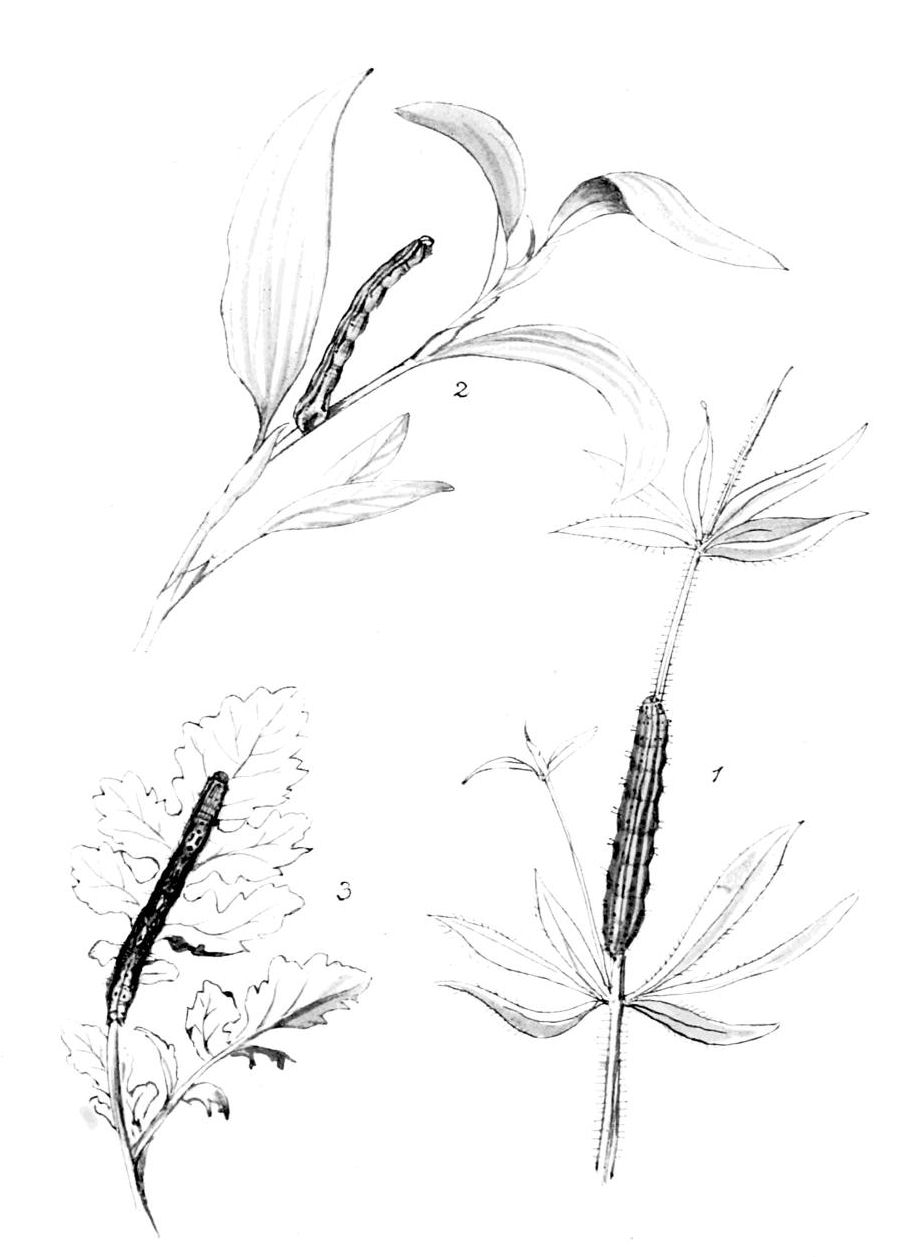
2 Pl. 74.
1.Water Carpet: caterpillar.
2.Dark-barred Twin-spot Carpet: caterpillar.
3.Flame Carpet: caterpillar.
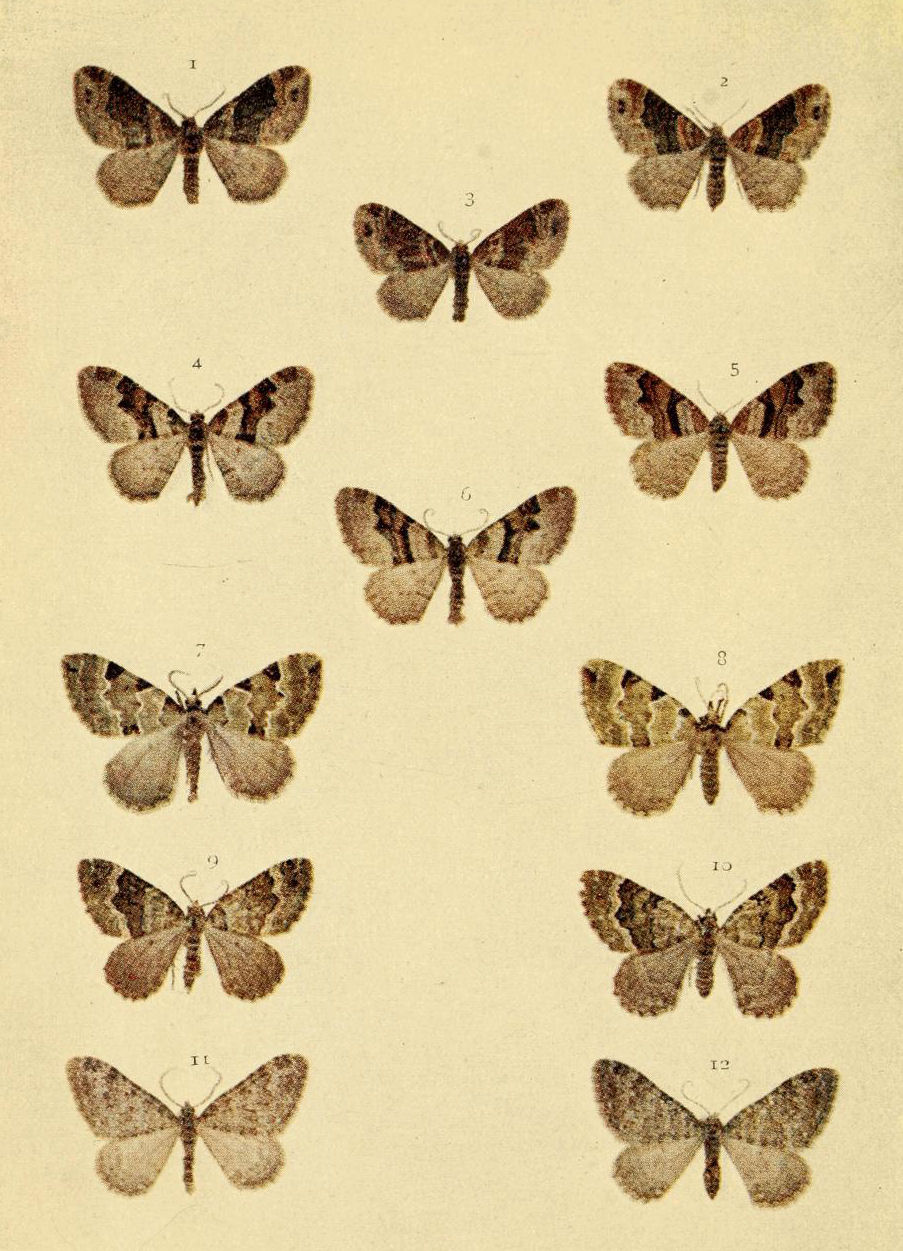
2 Pl. 75.
1-3.Dark-barred Twin-spot Carpet. 4-6.Flame Carpet. 7, 8.Green Carpet.
9, 10.Beech-green Carpet. 11, 12.Striped Twin-spot Carpet.
The moth is out in October and November in the South, but earlier in the North. It is an inhabitant of woodlands, and may be disturbed from bushes, trees, and sometimes may be seen on the trunks of the latter, and on fences. At night it flies lazily and will occasionally visit ivy then, and even sugar, but is more frequently attracted by light.
The species is pretty generally common throughout England and Wales, Scotland up to Moray, and Ireland.
The Autumnal Moth (Oporabia (Epirrita) autumnata).
Three examples of this species are shown on Plate 78. Figs. 6 ♂ and 7 ♀ represent the typical form except that the male should be rather more silvery white in the ground colour of the fore wings, and the cross bands more distinctly separated. Fig. 8, also a female, is very close to ab. sandbergi, Lampa, in the character of the central cross bands of the fore wings. Ab. gueneata, Prout (autumnata, Guenée, not Borkhausen), is a form with the typical coloration, but with fainter cross bands.
The caterpillar is somewhat similar to that of the last species, but there is a yellowish tint in the general green coloration, and it is rarely marked with reddish. It is found chiefly on birch, alder, fir, and larch, but will eat hawthorn, and probably the foliage of other shrubs and trees. May and June.
The moth is out in September and October, sometimes later. It may be dislodged from trees in the daytime, but it seems to be rarely noticed at rest on the trunks.
The species is so often confused with that previously mentioned that its distribution in our islands has not, so far, been clearly ascertained. However, it certainly occurs in the following northern counties of England—Lancashire (Liverpool district); Cheshire (Delamere Forest); Yorkshire (Cleveland district); North Durham (Birch woods); Cumberland (Carlisle). In Scotland it is found in Clydesdale, Perthshire, where it was first noted by Weaver in 1851, Kincardineshire, Aberdeen, and probably further north; in Ireland at Belfast and Enniskillen. Prout notes that he has seen a specimen from Swansea in South Wales.
Small Autumnal Carpet (Oporabia (Epirrita) filigrammaria).
This is most probably a small moorland form of O. autumnata, but it rarely assumes the silvery white typical coloration of that species. A male specimen and two examples of the female are depicted on Plate 77, Figs. 10 ♂, 11, and 12 ♀.
The caterpillar, which feeds in the spring on bilberry and heather, is green, with yellow lines, a line of darker green between the two central yellow lines along the back; head, green, inclining to brown above.
The moth appears in August and early September, and may be found on the moors, resting on rocks, stones, and even on the ground, as well as on the stems of its food plants.
As a British species it was first recorded by Weaver, who obtained it in the Isle of Arran in 1841; but Edleston, writing in 1842, states that he had taken specimens off stone walls near Staley Bridge, in the Manchester district, "every year for the last three years." It appears to be peculiar to the British Isles and is found in suitable localities from North Staffs., through Cheshire, Lancs., Yorks., and northwards over England and Scotland to the Hebrides and the Orkneys. In Ireland it is known to occur in Antrim, Derry, Mayo, Galway, and Limerick.
The Welsh Wave (Venusia cambrica).
This moth, of which two portraits are given on Plate 78, Figs. 9 ♂, 10 ♀, is known also by the English name of "Cambric Wave." It was not ascertained to be an inhabitant of Britain until 1839, when it was figured and described by Curtis from specimens obtained in Cardiganshire in Wales.
In its typical form the fore wings are white, inclining to greyish, with a number of brownish or dark-grey cross lines; two pairs on the central area are marked with black. Sometimes the wings are greatly suffused with smoky grey, and this tint in examples from the Sheffield and Rotherham districts of Yorkshire assumes a much darker hue, so that all the markings are obscured, but the veins are blacker.
The caterpillar is green, marked with some irregular reddish blotches; a yellowish line along the back. It feeds in August, earlier or later in some seasons, on mountain ash (Pyrus aucuparia), and the moth, which rests by day on tree-trunks, is out in July and early August. The haunts of the species are chiefly in hilly localities of the northern counties of England, but it has also been reported from Gloucestershire (Cotswolds), Somersetshire (Weston-super-Mare), and Devon (Dulverton). In Wales it occurs in Merionethshire, as well as in Cardiganshire; and in Scotland it spreads from Roxburghshire, where it is locally common among mountain ash, through Clydesdale to Inverness. It is widely distributed in Ireland. The range abroad extends to Japan and North America.
Grey Mountain Carpet (Entephria cæsiata)
The typical greyish form, with blackish wavy cross lines and dark central band, is shown on Plate 80, Fig. 1 ♂ and 2 ♀. Figure 3 represents a specimen from Shetland in which the band is sooty black (ab. annosata, Zetterstedt = nigristriaria, Gregson). The interesting blackish suffused form from the Isle of Arran (Fig. 4) leads up to a still blacker variety, occurring in the same isle, and also in the Shetlands, in which the whole of the fore wings is nearly as dark as the central band of Fig. 3, and the hind wings are also much darkened; such specimens are referable to ab. glaciata, Germar. Ab. prospicuata, Prout = gelata, Staud., is a form with the fore wings whitish, and the base and the central band thereof blackish; some Shetland specimens closely approach this pretty variety.
The caterpillar is green, with a brownish line along the middle of the back, and a series of pinkish or purplish-red oblique streaks which nearly meet at the central line and so form V-shaped marks; a whitish or yellowish stripe low down along the sides, sometimes edged above with reddish. In some examples the general colour is reddish brown. It feeds in April and May, after hibernation, on bilberry, ling, and heath in a wild state, but may be reared on knot-grass or sallow.
The moth is out from June until early August, and may be found resting, often in numbers, on rocks and stone walls in mountain and moorland districts, from Herefordshire, northwards through England, North Wales, and over the whole of Scotland, including the isles, and Ireland. Kane states that in the latter country melanic forms, such as those from Yorks, etc., are nowhere met with.
Yellow-ringed Carpet (Entephria flavicinctata).
The general colour of the fore wings of British specimens of this species (var. obscurata, Staud.) is slaty grey; the basal, central, and outer marginal cross bands are thickly sprinkled with yellowish-brown, and it is this feature that at once separates this species (Plate 80, Figs. 5, 6) from that last referred to.
The bristly caterpillar is green, chocolate, or red brown, but always of a dull shade; on the back is a series of black V-shaped marks, and a central dark, slender line; the front part of each V-mark filled up with pink or lilac, forming a triangle, the apex of which is yellow; a yellowish stripe low down along the side (adapted from Fenn). It feeds in the spring till April, after hibernation, on saxifrage (Saxifraga aizoides, S. hypnoides, etc), and also on stonecrop (Sedum), and is most partial to the flowers of these plants.
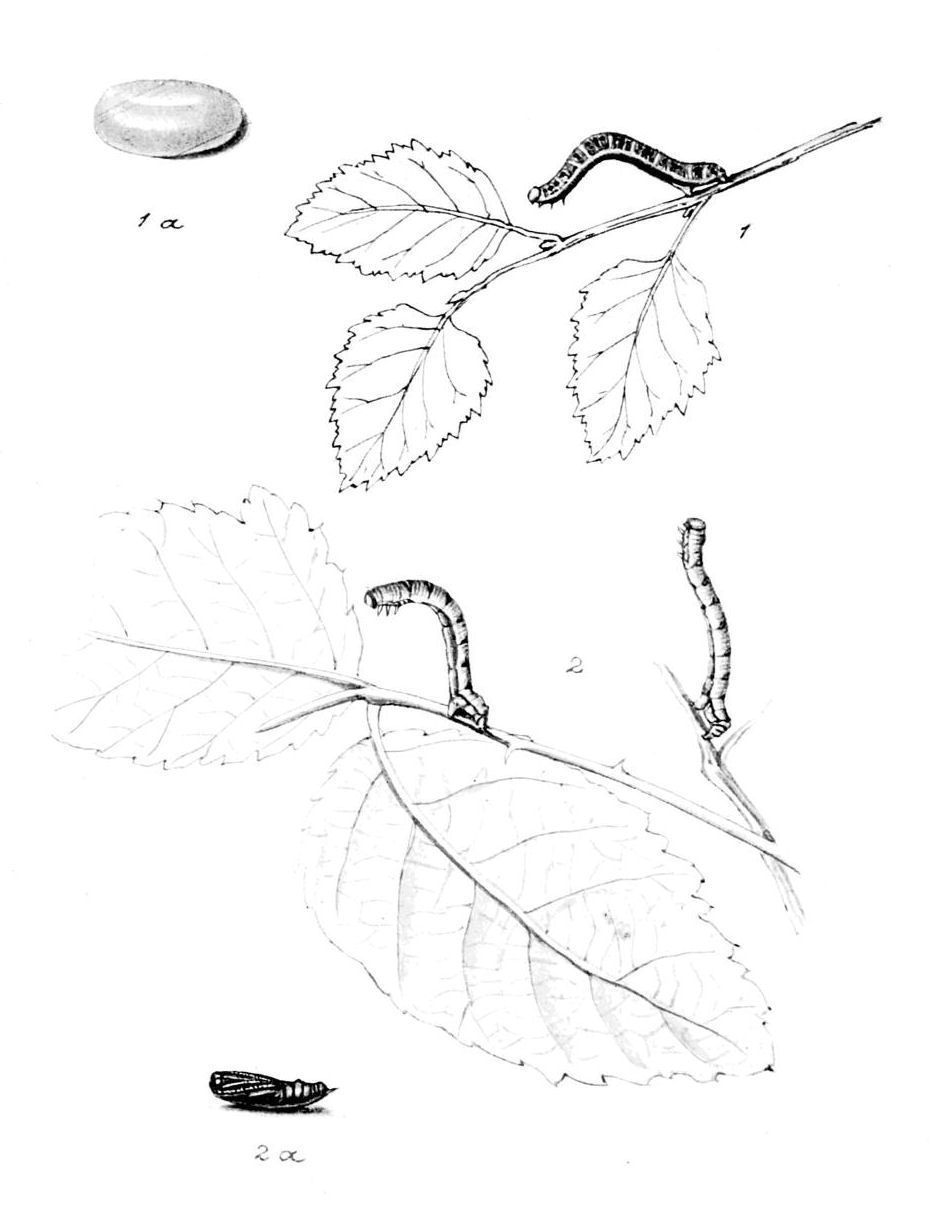
2 Pl. 76.
1, 1a.November Moth: eggs and caterpillar.
2, 2a.Beautiful Carpet: caterpillars and chrysalis.
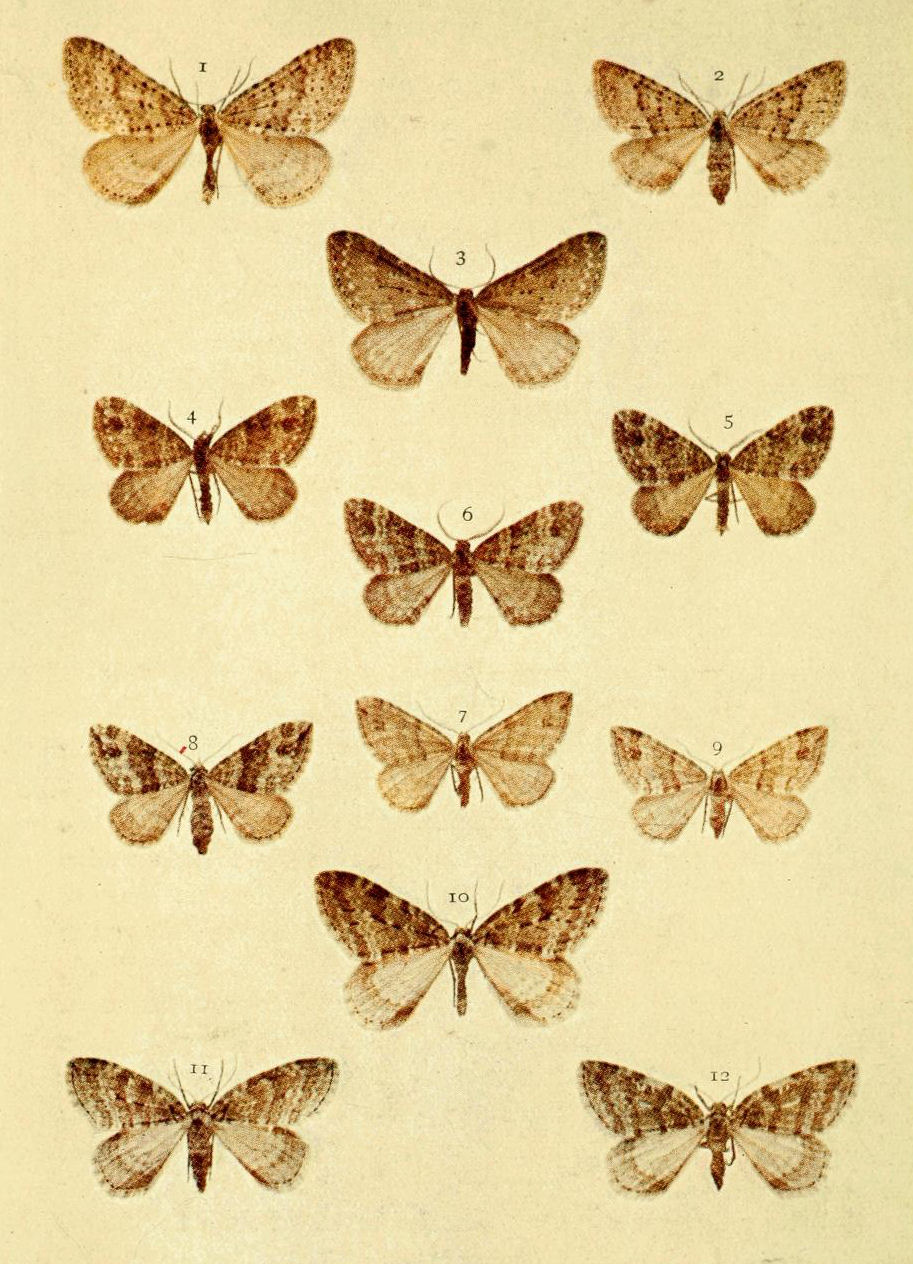
2 Pl. 77.
1-4.Mottled Grey. 5-8.Twin-spot Carpet. 9-12.Small Autumnal Carpet.
The moth flies throughout the summer, possibly in two generations, as, when reared in confinement, moths appear in May, and from eggs obtained from these, caterpillars feed in June and July, and attain the perfect state in August. Like the last species, its chief resting-places are the rocks, in its favourite haunts, in gorges among the hills and moorlands. It has been recorded from few parts of northern England, but one specimen is said to have been taken in Dovedale, Derbyshire. In Lancashire it has been noted as scarce about Clougha; and in Yorkshire one example was taken on Malham Moor in August, 1876, and one at Hutton Buscel Moor, near Scarborough, July 16, 1891. It is more plentiful in Scotland; in Clydesdale it is local, but not uncommon, the localities mentioned being Lochgoilhead, and watercourses above Ardentinny; more frequent in Perthshire, thence to Sutherland, and it occurs also in the Hebrides and the Orkneys. In Ireland, it is found in Co. Antrim; and Mr. Thomas Greer informs me that it is common at Murlough Bay, Fair Head.
Silver-ground Carpet (Xanthorhoë montanata).
Figs. 7 and 8 on Plate 80 represent the most usual form of this species, which is variable in the amount of clouding on the fore wings and in the intensity of the cross marking. In some specimens, chiefly from southern localities, the fore wings are almost clear white, and the central band is broadly blackish (Fig. 9). Shetland specimens, on the other hand, are much clouded or suffused with ochreous brown, and the central band is greyish brown (ab. shetlandica, Weir (Fig. 10)). Then there is variation in the central band, which is often entire, but more frequently broken up by bandlets; or it may be considerably narrowed, especially from the middle to the inner margin, and not altogether rarely it is completely severed below the middle, and the lower part almost or quite absent. A specimen with all the wings smoky leaden-grey, and the central bar of the fore wings pale grey-brown, was taken near Longfleet in Wiltshire, in the summer of 1881.
The caterpillar is wrinkled, with a ridge along the sides; in colour it is pale brown, inclining to purplish with blackish dots; three lines along the back, the central one dark greyish, the others paler and broader; below the latter the sides are greyish tinted with a lower edging of pale yellowish brown. It feeds at night on bedstraw, and various low-growing herbage, including grass. August to April.
The moth is out in June and July, sometimes earlier in the south. It is generally distributed, and, as a rule, common, in woodlands, lanes, etc., throughout the British Isles.
Garden Carpet (Xanthorhoë fluctuata).
Of this common frequenter of our gardens four examples are depicted on Plate 80. Figs. 11 and 13 are the more frequent forms, but specimens with the central band complete, as in Fig. 12, are not uncommon. Chiefly, but by no means exclusively, in Southern localities, some examples have the ground colour almost pure white; often the wings are more or less suffused with dark grey (ab. neapolisata, Millière), and this is especially the case in Scotland, where, in Aberdeenshire and in Shetland, a blackish form, ab. thules, Prout, occurs. Fig. 14 represents a specimen of this form from Aberdeen. Somewhat rarely, the central band is only indicated by a small spot on the front area of the wing (ab. costovata, Haworth), and more often the band is much narrowed or otherwise modified in the direction of that aberration. Fig. 4, Plate 61, shows an extreme example of this form. Specimens vary in size from rather under one inch to one inch and a half in expanse.
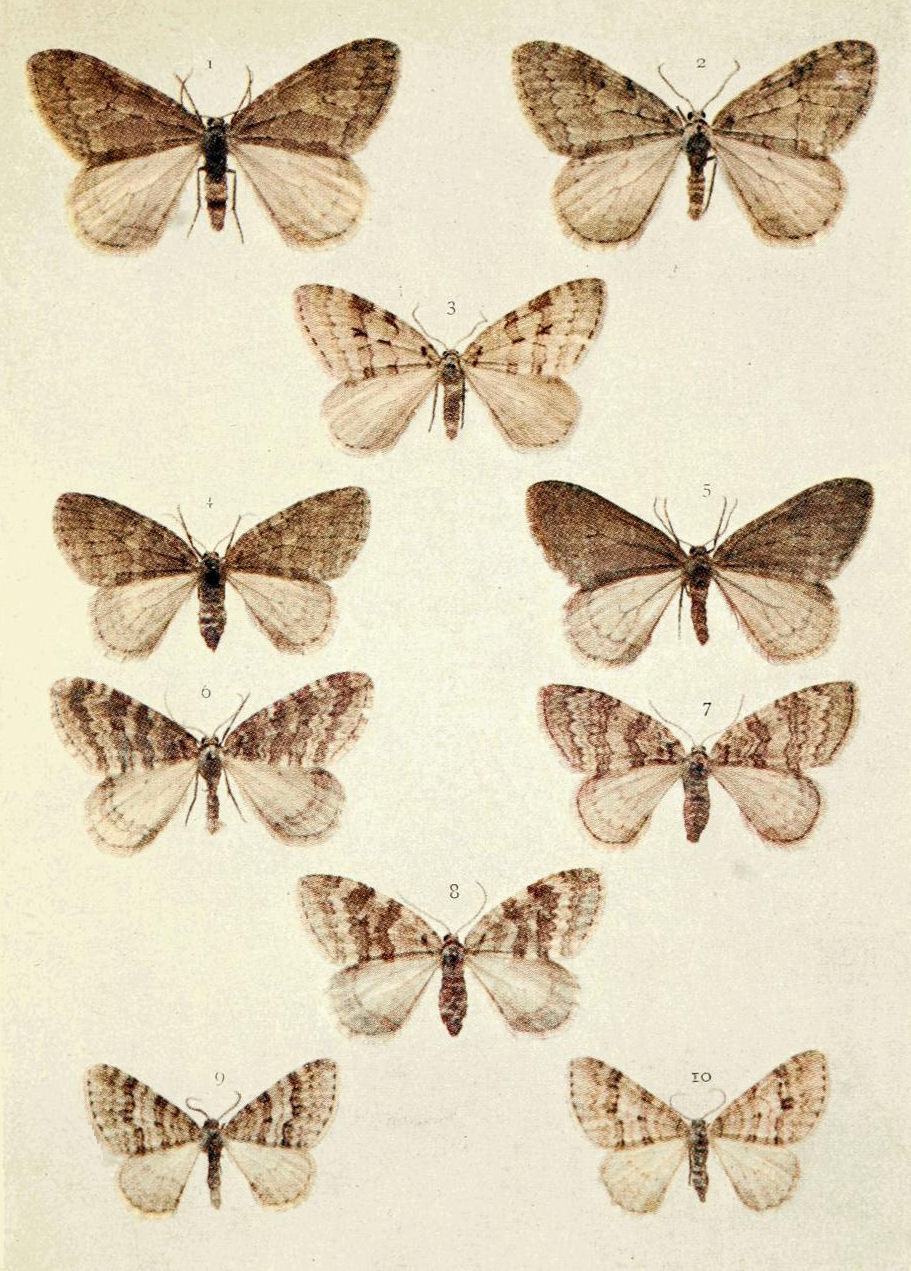
2 Pl. 78.
1-5.November Moth. 6-8.Autumnal Moth. 9, 10.Welsh Wave.
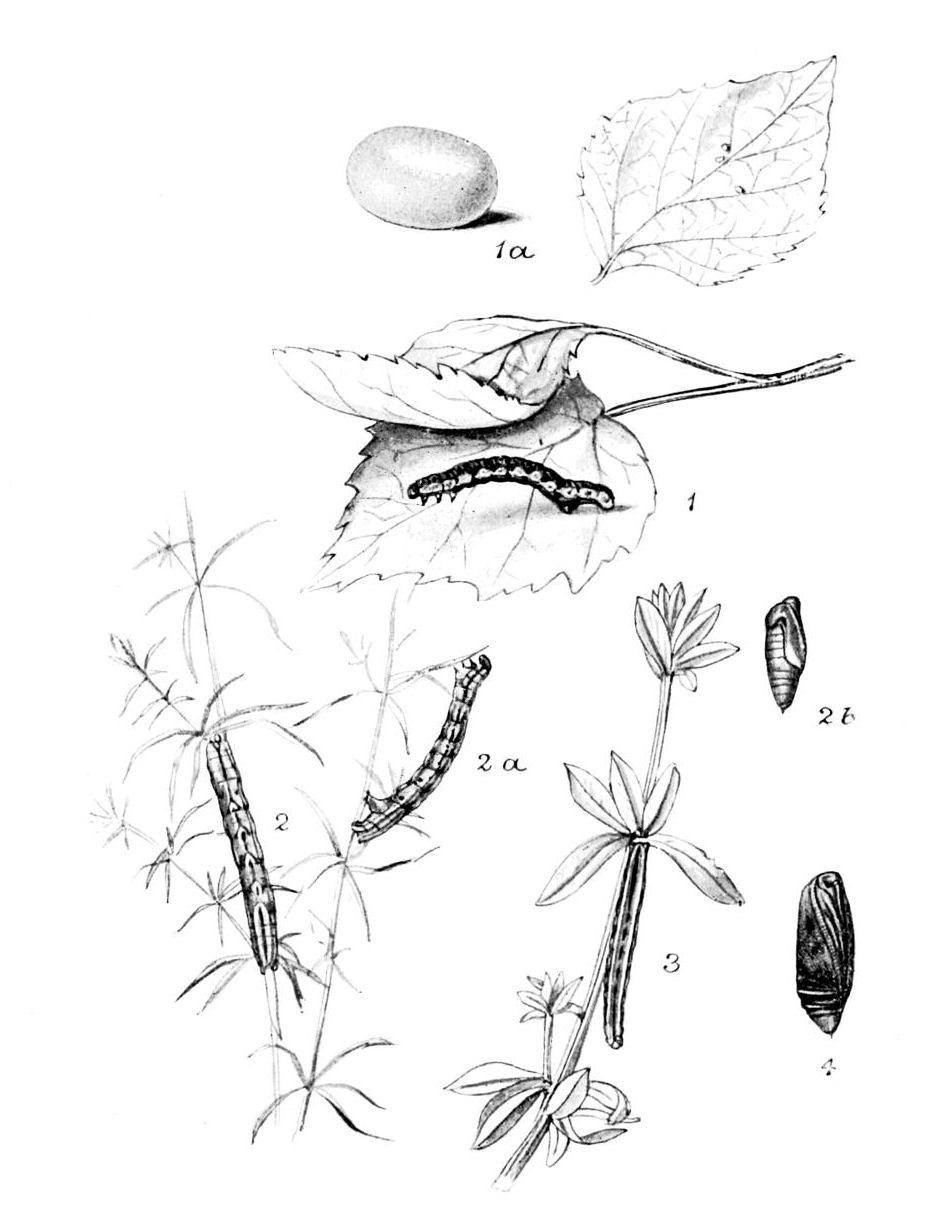
2 Pl. 79.
1, 1a.Argent and Sable: eggs, natural size and enlarged, and caterpillar.
2, 2a, 2b.Wood Carpet: caterpillar and chrysalis.
3.Galium Carpet: caterpillar.
4.Common Carpet: chrysalis.
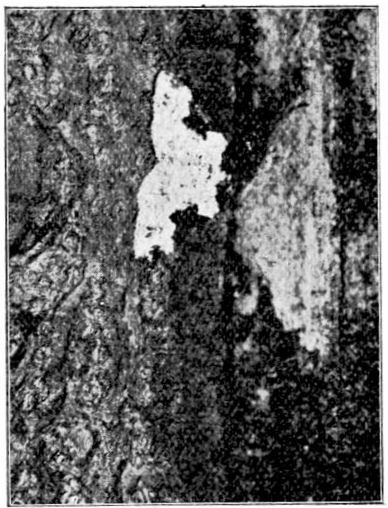
Fig. 4.
Garden Carpet at rest.
(Photo by H. Main.)
The caterpillar varies in colour from dark grey through yellowish green to obscure green, but the underside is always paler; on the back there is a series of pale blotches, and some black spots on the middle rings; the head is rather paler than the general colour, and marked with black. It feeds, at night, on cabbage, horseradish, wallflower, white arabis, and many other kinds of Cruciferæ; and it is said to eat the foliage of gooseberry and currant. June—October.
There are certainly two broods, and possibly more, as the moths occur in greater or lesser numbers throughout the year, from late April to October, but it seems to be most plentiful in May and June, and in August and September.
Generally distributed over the British Isles. It is also an inhabitant of North America.
The Galium Carpet (Xanthorhoë galiata).
The more usual forms of this species are represented on Plate 81, Figs. 1, 2. Fig. 3 is the portrait of a form occurring in Yorkshire, Sussex, and probably elsewhere, in which the central band is blackish and solid-looking; this seems to be referable to unilobata, Haworth. Besides varying in tint of ground colour, and in the amount of freckling or mottling, there is modification in the width of the central band.
The caterpillar is brown, dotted with black, and striped with blackish brown on the back, and with pale brown on the sides; the head is light brown, sprinkled with black, and marked with a dark V. It feeds on bedstraw in late June and July, and there is a second brood in August and September. The figure of the caterpillar on Plate 79, Fig. 3, is from a coloured drawing by Mr. A. Sich.
The moth is out in June, sometimes later in the north and earlier in the south, where it occurs as a second generation in August. It is chiefly found in chalk and limestone districts, and may be easily put up from the herbage among which it secretes itself during the day. In the seaboard counties of England, from Kent to Cornwall, it is especially common on the coast, but is also to be met with in suitable inland localities in these counties, and also in Surrey, Middlesex, Herts, Bucks., and Oxford. It is always rare on the eastern side, but on the west, including Wales, it is more or less frequent from Somerset and Wilts. to Westmorland. Not uncommon in Yorkshire, principally in the West Riding, and an odd specimen has been recorded from Durham. Somewhat rare in Scotland, but it has been noted in Berwick, Wigtown, Arran, Clydesdale, and Perthshire. In Ireland it is local, although often plentiful on the coast.
Abroad, the range extends to Eastern Siberia.
Wood Carpet (Xanthorhoë (Epirrhoë) rivata).
The broad, clear white borders of both edges of the dark central band of the fore wings, coupled with the clearer white of the hind wings, and the generally larger size of the moth, should distinguish this species from its very close ally, X. sociata; but it must be added that some forms of the latter species approach the present one exceedingly close. (Plate 81, Figs. 4, 5.)
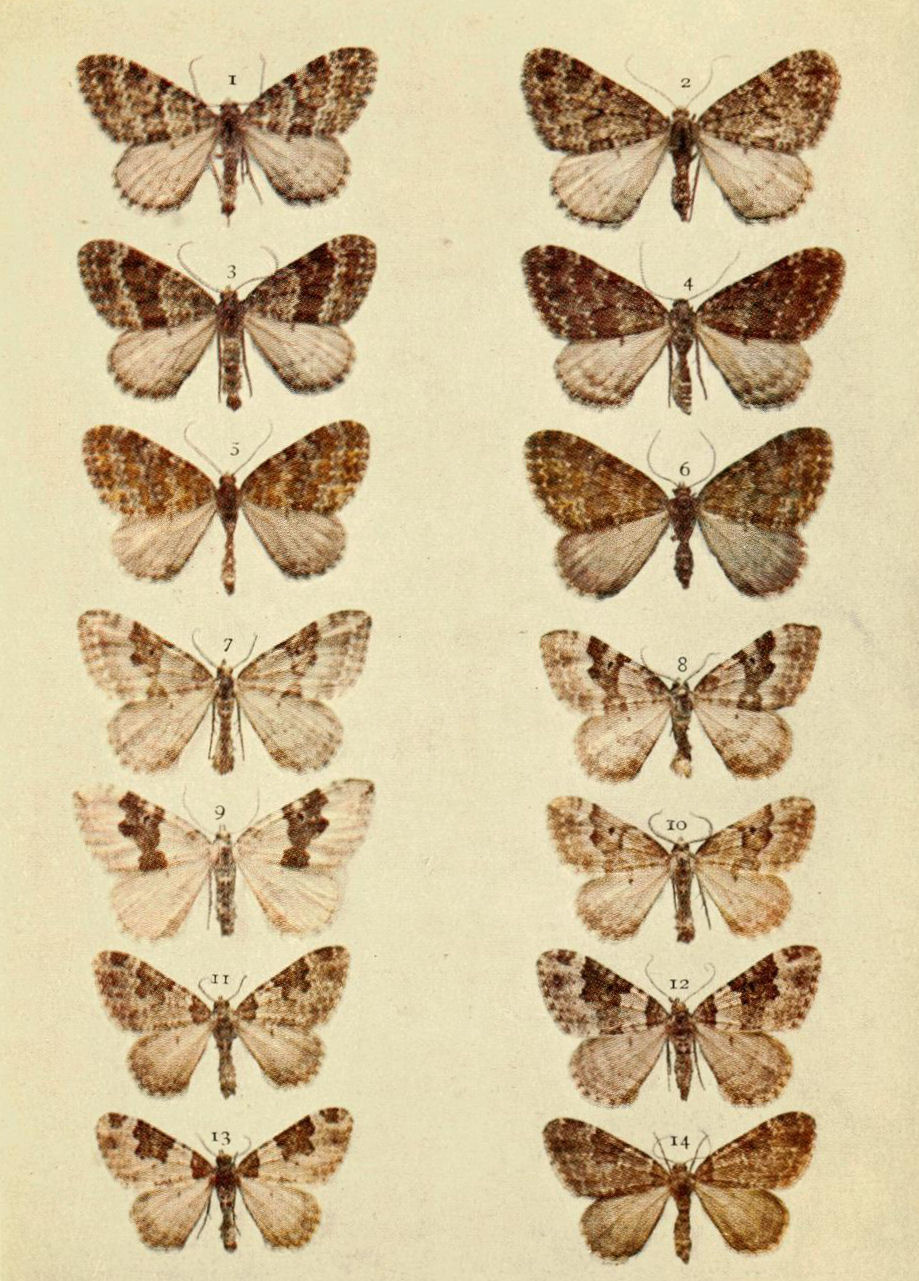
2 Pl. 80.
1-4.Grey Mountain Carpet. 5, 6.Yellow-ringed Carpet.
7-10.Silver-ground Carpet. 11-14.Garden Carpet.
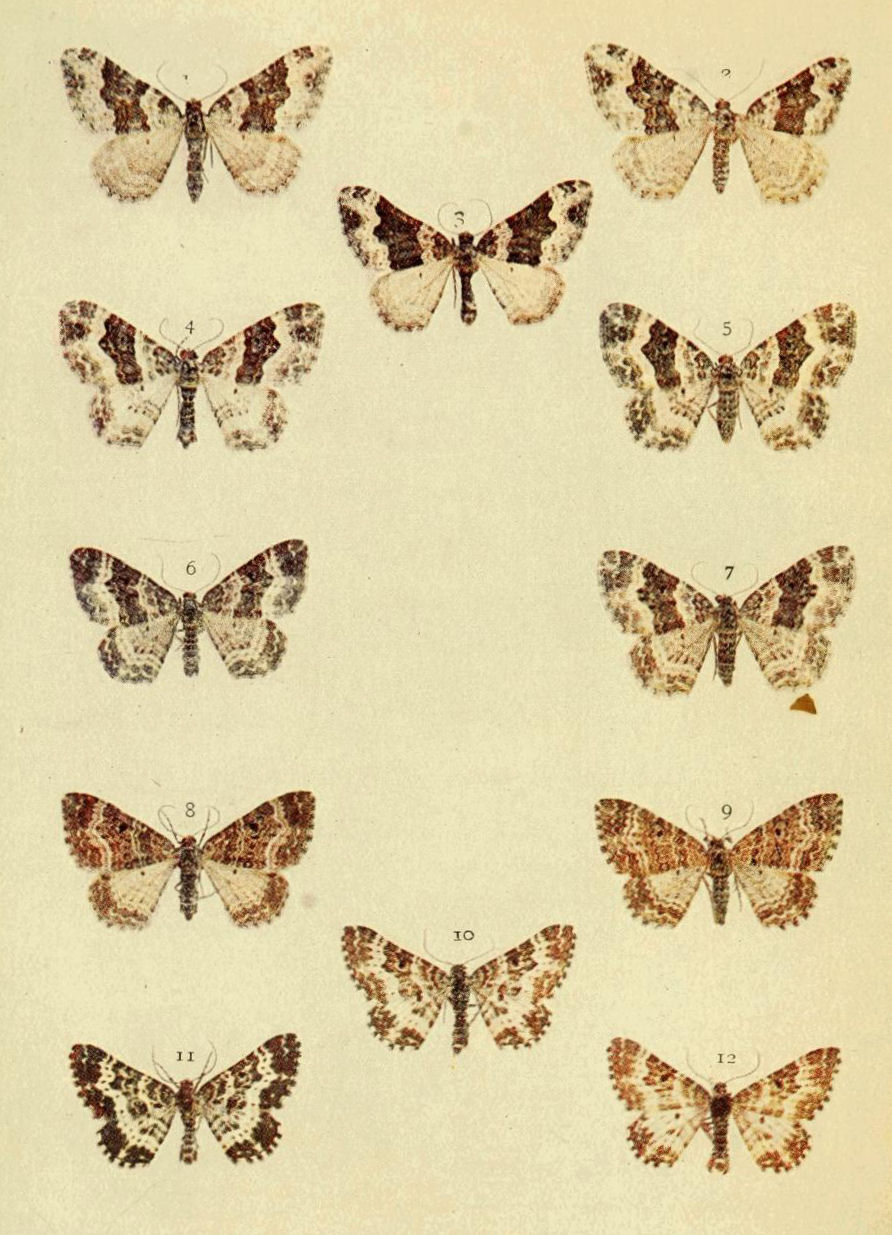
2 Pl. 81.
1-3.Galium Carpet. 4, 5.Wood Carpet.
6-9.Common Carpet. 10-12.Small Argent and Sable.
The caterpillar is brown or olive-brown, dotted and freckled with white; three lines on the back, the central one black, the others whitish, not seen on rings 5-8, which have dark V-shaped marks enclosing white ones; sometimes there is a V-mark instead of lines on ring 4; head, large, pale brown sprinkled with blackish, and marked with a blackish V, the apex of which appears to meet the central line of the body. It feeds, at night, in July and August, on bedstraw (Galium mollugo, and G. verum), but will thrive very well on cleavers or goose-grass (G. aparine). The chrysalis, which is enclosed in a cocoon of silk coated with earth, is reddish brown, thorax and wing-cases paler, shining. A coloured drawing of the caterpillar, kindly lent, with others, for this volume, by Mr. A. Sich, has been used for the figures on Plate 79, Figs. 2, 2a; but the description of the caterpillar, and also of the chrysalis (Fig. 2b), are from material that Mr. Pope, of Exeter, was good enough to furnish. In captivity a second brood may be reared in August.
The moth is out in July and early August, and although local, is not uncommon in bushy places on downs, etc., also in lanes, in chalk districts, in most of the southern and eastern counties. In the north of England it is far more local and uncommon, but is known to occur in Cheshire, Yorkshire, and Cumberland, and has been recorded from Durham. It is found in Wales, and in Scotland has been noted as very local in Roxburghshire and rare in Clydesdale and Arran. Kane states that in Ireland it is "very rare and local."
Common Carpet (Xanthorhoë (Epirrhoë) sociata).
The white ground colour of this species is nearly always obscured, to a greater or lesser extent, by greyish markings and suffusions on the basal area; the outer margin is broadly bordered with dark grey, and the white band between this and the dark-grey central band is intersected throughout its length by a grey line. As shown on Plate 81, Figs. 6, 7, the central band varies in width; it is often contracted below the middle, sometimes completely severed at this point, and in ab. degenerata, Haworth, both portions are much reduced in width. Figs. 8 and 9 represent two specimens from the Isle of Lewis; these brownish-grey examples are var. obscurata, South. There are intermediate modifications leading up to a form in which the whole of the central third of the fore wings is whitish, with the usual cross lines dingy grey, and some tiny clouds of the same colour around the black discal spot.
The caterpillar is very like that of the last species referred to, but it is rather smaller in size and rougher in appearance. There is variation in the general colour, from pale fawn through greenish-brown, to dull or bright green, and sometimes the markings are tinged with reddish (Hellins).
It feeds on bedstraw, in June and July, and a second brood occurs in September. The figure of the brownish, inclining to reddish, chrysalis (Plate 79, Fig. 4), is from a photo by Mr. H. Main, and is twice the natural size.
The moth is out in May and June, and, in the South especially, again in August and September. It is generally distributed over the British Islands, but so far has not been noted from the Shetlands.
The range abroad extends to Eastern Siberia and Amurland.
According to Prout, the earliest name for this species is alternata (Müller).
Small Argent and Sable (Xanthorhoë (Epirrhoë) tristata).
On Plate 81 are shown three examples of this variable species. Fig. 10 represents the typical form from N. Devon. Fig. 11 is a black-marked specimen from Yorkshire, and Fig. 12 depicts a smoky-brown marked specimen from Clydesdale, in which the ground colour has a brownish tinge. All these have the central band more or less entire, but this character may be broader or narrower, and is sometimes divided into two parts, and these reduced to very small proportions; the white projections into the outer marginal border of all the wings is not infrequently enlarged, in some cases so much so that the borders are separated into two parts, and also reduced in width.
The caterpillar is grey brown, ochreous brown between the rings and on the underside; a dark line along the back, and a dark-edged, pale line on each side; a black dot on each ring at the junction of the dark upper and pale lower areas; head, grey-brown, with blackish freckles. It feeds, in July and August, on bedstraw, preferring the heath kind (Galium saxatile), but will eat the large hedge kind (G. mollugo).
The moth is out in June, or from late May, and in some parts specimens are seen in August. Its haunts are moors and upland heaths, and its British distribution extends from Dartmoor and Exmoor, in Devon, through Western England and Wales to Westmorland. It appears to be very local in Somerset, Gloucester, Hereford, Shropshire, and Cheshire; from Staffordshire and Derbyshire northwards, and through Scotland, it becomes more plentiful; and has been recorded from the Shetlands. In Ireland it is local, but common where it occurs.
Sharp-angled Carpet (Xanthorhoë (Euphyia) unangulata).
This species (Plate 82, Figs. 1, 2) may be recognized by the distinctly angled outer edge of the blackish central band, which is thrown into strong relief by the usually broad white stripe following it. Wilkes, who figured the moth in 1742, called it the "White Stripe." By some authors the species is referred to amniculata, Hübner.
The caterpillar is pale whity brown, with a slightly darker but indistinct line along the centre of the back, and a black spot on the middle rings; a pale line on the sides is edged with dark grey; head, brown, marked with black. It feeds, in July and early August, on chickweed (Stellaria media).
The moth, which is partial to hedges and easily disturbed therefrom, is out in June and July, and even later in some seasons. The earliest hatched caterpillars reared in confinement sometimes attain the moth state in August of the same year. Although certainly local, the species has a wide distribution in the southern half of England, and is not uncommon in some localities. Its range extends into Wales, and also northwards to Cumberland and Westmorland, but it is generally very much scarcer in the north than in the south. In Ireland it is known to occur locally in counties Antrim, Tyrone, Fermanagh, Waterford, Kerry, and Galway, but, as a rule, only sparingly.
Abroad, the distribution includes North Amurland and North America.
Cloaked Carpet (Euphyia picata).
An older English name for this species (Plate 82, Figs. 4, 5) is "The Short Cloak Carpet," Harris (1782), but that given to it by Haworth is here adopted. It is also the biangulata of Haworth, Stephens, and others.
As will be observed on referring to the figures, the outer edge of the blackish central band of the fore wings is twice angled just above the middle; the basal area and the outer marginal border are dark greyish brown, more or less tinged with olive; the whitish ground colour only shows distinctly as a strip immediately beyond the central band, and from this an irregular streak runs to the tips of the wings; some white wavy cross-lines through the outer border are often obscure.
The stoutish caterpillar is yellowish brown, or sometimes reddish brown; there is a series of blackish or dark-brown spots along the back, and a stripe of dusky freckles along each side; lower down are two slender wavy lines enclosing a dusky stripe; head, yellowish-brown mottled with darker brown. It feeds, at night, on chickweed and other kinds of Stellaria, in August and September. One of the mouse-ear chickweeds (Cerastium glomeratum) has also been mentioned as a food plant, and for rearing the caterpillars this would perhaps be useful, as common chickweed, unless in a growing state, is difficult to keep in a suitable condition for larval requirements.
The moth, which is partial to a hedgerow as a hiding-place, is out in June and July, and may be sometimes reared as a second generation in September.
The species is somewhat local, but it is not scarce in many parts of England; its range does not appear to extend northwards beyond Worcestershire on the western side, although it has been recorded from North Wales; on the eastern side it is found up to Norfolk.
The Argent and Sable (Eulype hastata).
About one hundred and sixty years ago Wilkes figured this species as "The Mottled Beauty," but Harris in 1778 gave it its present English name. On Plate 82 are shown two examples of the typical form (Figs. 7, 8), also two specimens of the small form (Figs. 10, 11), var. subhastata, Nolcken (= hastulata, Hübner); the latter form in Britain occurs chiefly in Sutherlandshire and the Isle of Lewis. As regards variation there is, in the small form, a tendency to an increase of black; whilst in the typical form there is a considerable reduction of the black marking—so much so occasionally that of the central black band only a few dots remain around the discal spot, and perhaps a speck or two below it, and a dot or two on the inner margin (ab. demolita, Prout).
The rather stumpy caterpillar is dark olive-green, inclining to blackish, and somewhat shiny; the skin along the sides puckered and marked with ochreous; a black line along the middle of the back; head, black and glossy. It feeds, in July and August, later in the north, on birch, Vaccinium, chiefly uliginosum, and sweet gale (Myrica). It spins together the leaves at the tips of the twigs, and so forms a cocoon-like habitation. The moth is out in May and June, and even July in the north. It flies in the afternoon sunshine around and over birch trees, and occasionally alights on the leaves. It has been taken in Kent, and more frequently in Essex and Suffolk, but it is more plentiful in Oxfordshire and Berkshire, and from Surrey to Dorsetshire and Wiltshire; also in Herefordshire and Worcestershire, and on high ground in North Wales, Staffordshire, and Derbyshire; its range extending through Cheshire and Lancashire to Cumberland and Northumberland, but only odd specimens have been reported from the last-named county and from Durham. The egg and the caterpillar are shown on Plate 79, Figs. 1 and 1a.
It is widely distributed, and often common in places, throughout Scotland. In Ireland it is local, but has occurred plentifully in some of its haunts in that country; Kane states that var. subhastata has not been noted.
The range abroad spreads to Amurland, China, Iceland, Labrador, and North America.
Beautiful Carpet (Mesoleuca albicillata).
The English name of this species (Plate 82, Fig. 13) is exceedingly appropriate; few of our native moths exhibit such a pleasing combination of colour and marking. It varies but very little in a general way, but a specimen taken in York some years ago has the fore wings dark leaden grey instead of creamy white (ab. suffusa, Carrington), and very rarely the ground colour inclines to yellow.
The stoutish caterpillar (Plate 76, Fig. 2) is green with reddish marks along the back; a white line low down along the sides is edged below with purplish red on the first three rings; the last ring, and the claspers, tinged with purplish red. It feeds at night on bramble and raspberry, in August and September, occasionally earlier or later. In the daytime it rests on the underside of a leaf. When full grown it forms a cocoon just under the surface of the soil, or among rubbish (in the cage), and therein changes to a dark reddish-brown chrysalis (Plate 76, Fig. 2a).
The moth is out in June, sometimes in late May, and occasionally there seems to be a few individuals about in August. The species is a denizen of the woodlands, and is generally to be found in the more open parts of woods where its food plants are well established. It is widely distributed over England and Wales, but most frequent in the south of the former country. In Scotland, it is local in Roxburghshire and Wigtownshire; and it occurs in many parts of Ireland. The range abroad extends to Amurland and Japan.
The Purple Bar (Mesoleuca ocellata).
The whitish fore wings of this species (Plate 82, Fig. 12) are often tinged with pale ochreous brown on the lower two-thirds of the outer marginal area, and this tint sometimes invades the central portion of the bluish-black central band. Rarely the ground colour is almost entirely white, and the central band is very slender (ab. coarctata, Prout), and perhaps rather more frequently the band is completely severed below the middle.
The caterpillar, which feeds at night on bedstraw (Galium mollugo and G. verum), is pale ochreous brown, or pale pinkish brown, netted with darker brown; on the back are a reddish ochreous central line, and some reddish edged pale V-marks: June and July, and sometimes again in the autumn.
The moth is out in June and early July, occasionally in late May in some southern localities. Individuals of a second emergence sometimes appear in August and September. It rests by day on tree-trunks or in hedges, and flies at night. Widely distributed over the British Isles, but, except perhaps in the highlands of Scotland, not very common.
Blue-bordered Carpet (Mesoleuca bicolorata).
The more usual form of this pretty little species is shown on Plate 82, Figs. 3 and 6. In the type the central band is only represented by a spot on the front margin of the fore wings; in ab.parvula, Retz = rubiginata, Hübner, there is also a portion of the band showing on the inner margin. Ab. plumbata, Curtis, from Scotland has the central band entire and the ground colour inclining to creamy white. In ab. fumosa, Prout, the usual white parts of the wing are smoky or dark lead colour (Fig. 9). Barrett mentions a form with all the wings smoothly smoky black; markings of the fore wings olive brown, margined with slender stripes of smoky white.
The long, thin, caterpillar is green, with a darker stripe along the back, and a yellowish green stripe on each side; two points on the last ring. It feeds on alder, birch, sloe, and crab; also in orchards and gardens on plum and apple: April to June.
The moth is out in July and August. It appears to occur most freely in districts where alder is plentiful, but it is not uncommon in country lanes, especially where these are rather moist. It is one of the earliest Geometrid moths to get on the wing, as it is generally active well before dark. Decidedly more common in some districts than in others, but it may be said to be generally distributed.