Front matter (continued 6)
Reading edition
The Gem (Percnoptilota fluviata).
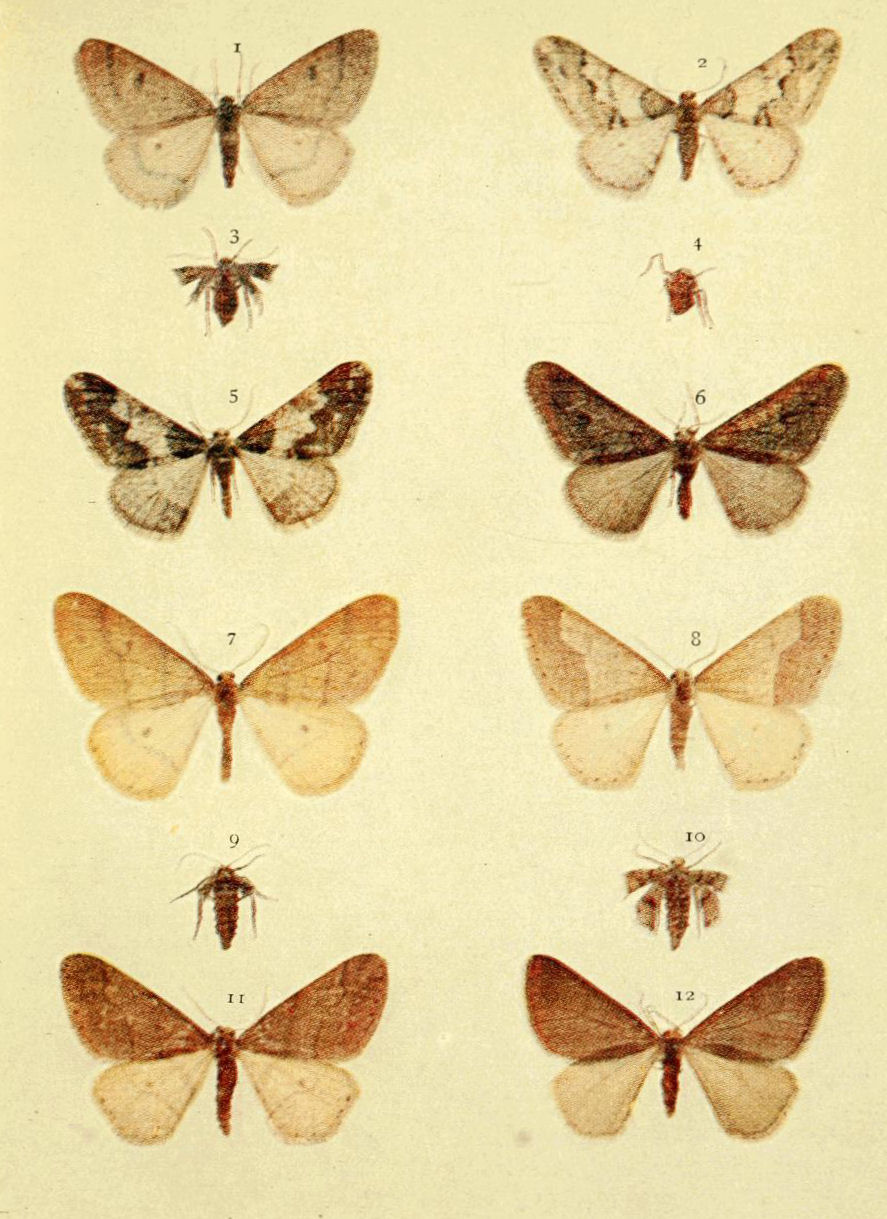
Also known in the vulgar tongue as "The Narrow-barred Carpet." As will be seen on reference to Plate 102, the male (Fig. 12) is pale brown with a dark central band; and the female (Fig. 11) is purplish brown, the central band rather blackish, and on it is the discal mark, a black centred white spot. The specimens figured are rather small.
The following aberrations have been named—ab. marginata, Mathew, with the fringes of all the wings conspicuously pinky-grey; ab. olivacea, Mathew, a form of the female with olive brown fore wings; ab. obsoleta, Mathew, a form of the male with the dark central band nearly or quite absent.
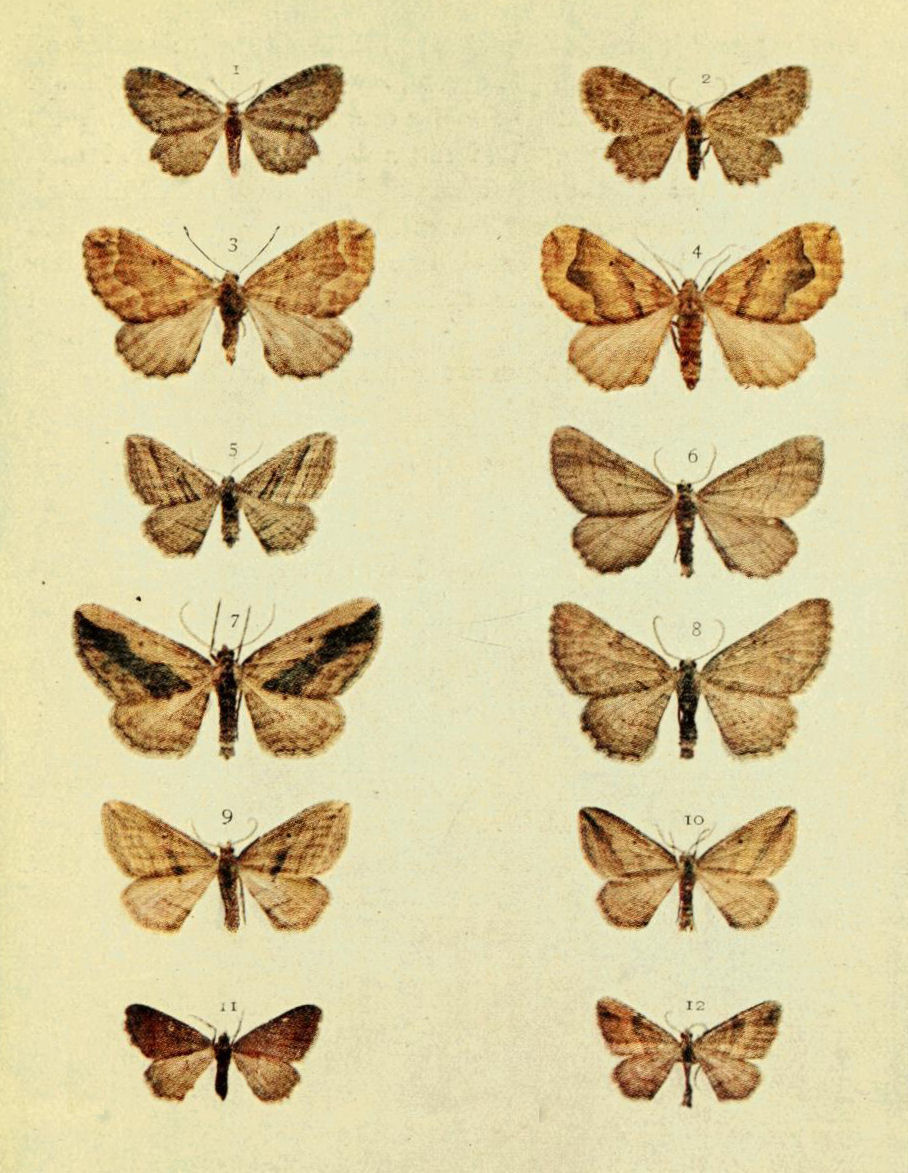
2 Pl. 102.
1, 2.Dentated Pug. 3, 4.Dark Spinach. 5.Many-lined.
6.Slender-striped Rufous. 7.Small Waved Umber. 8.The Fern.
9, 10.Oblique Carpet. 11, 12.The Gem.
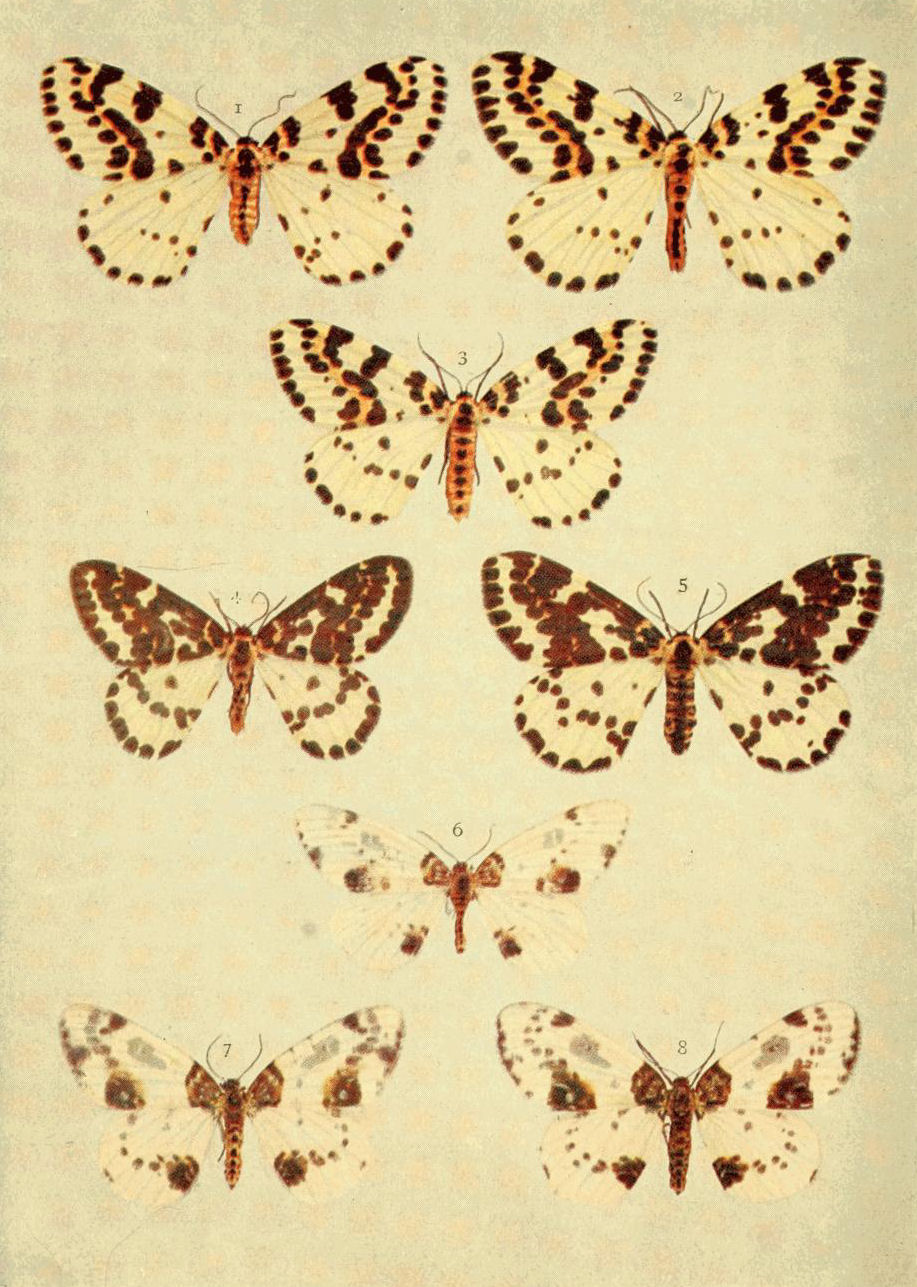
2 Pl. 103.
1-5.Magpie Moth. 6-8.Clouded Magpie.
The caterpillar is greyish, sometimes tinged with pink, and sometimes with green; three dusky lines on the head and first three rings of the body, a series of blackish outlined, whitish marks on the middle rings, and blackish marks on the other rings, which are pale in colour; a blackish line above the black-edged spiracles is broken up into dashes on the middle rings. Several other forms of the caterpillar, which is a variable one, have been described by Hellins. The food comprises groundsel, knotgrass, chrysanthemum, and various other plants. There are several generations during the year, and in hot weather the caterpillars feed up rapidly, so quickly indeed that in about a month the whole round of changes from egg to moth is effected. The species is migratory in habit, and there is little doubt that the specimens taken in this country in late spring or early summer are immigrants; those examples obtained later in the year are probably the descendants of such aliens. It is more frequently noted from southern England, chiefly from the seaboard counties, but it has been recorded from Lancashire and Yorkshire; also from Wales, and from several parts of Ireland: April to November.
BOARMIINÆ.
Clouded Magpie (Abraxas sylvata).
A more or less typical example of each sex of this variable species will be found on Plate 103. Fig. 7 represents a male, and Fig. 8 a female; the slightly marked specimen (Fig. 6) somewhat approaches the continental species A. pantaria, L., in appearance, and it is probable that such individuals have done duty for the species just named in some of the older collections of British lepidoptera. On Plate 104 are shown the leaden tinted form (Fig. 6), sometimes not infrequent in certain Yorkshire localities; a specimen with smoky fore wings (Fig. 7), taken with a few other examples of the same form in a wood in Buckinghamshire, in 1907, when also the strongly banded form (Fig. 8) was secured by Mr. A. J. Scollick. Between these extremes and the more typical forms all kinds of intergrades occur, but it is not possible here to discuss these in detail.
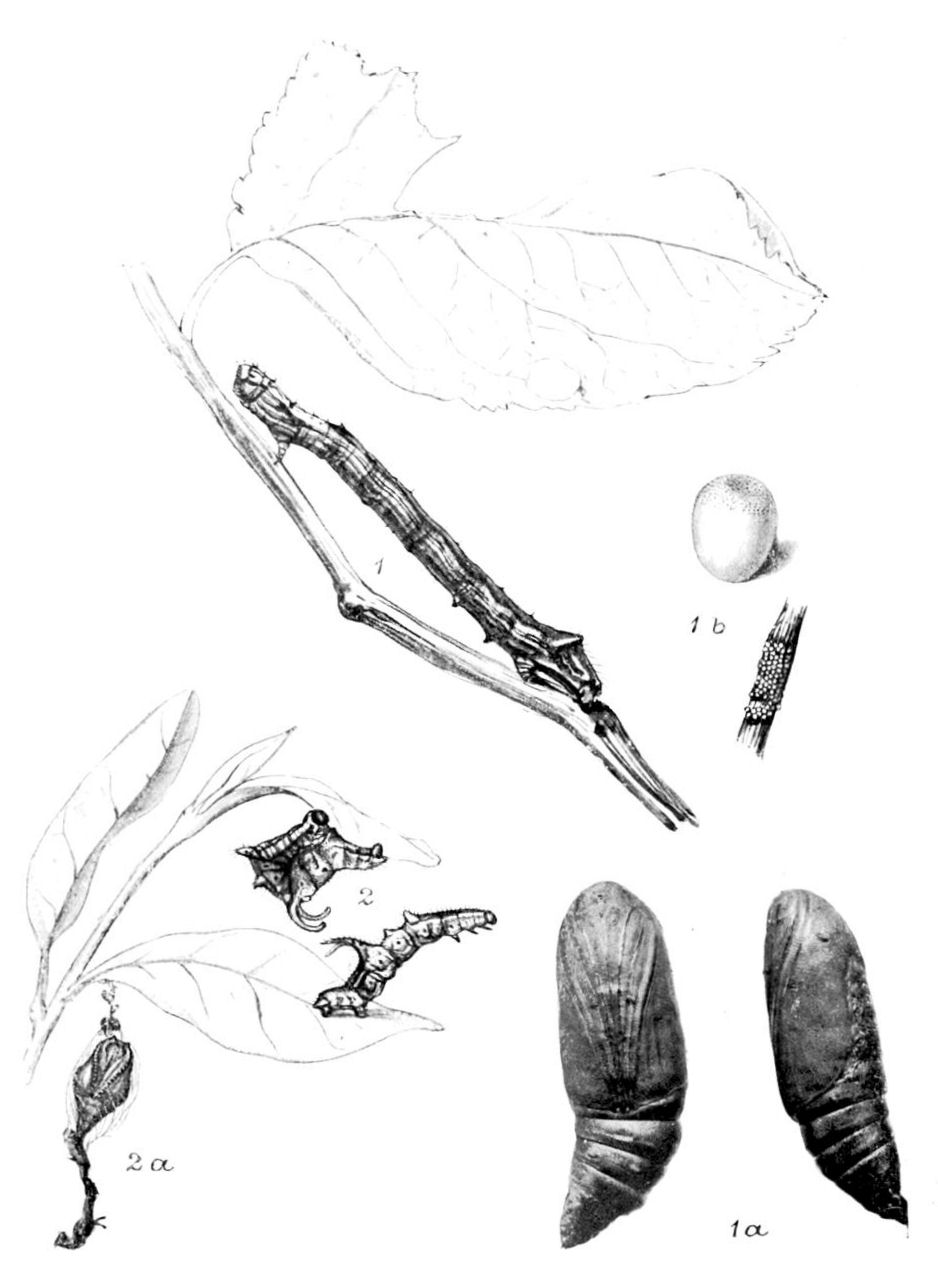
The pale greenish yellow eggs and two caterpillars are figured on Plate 101, Figs. 2, 2a. The latter are whitish, inclining to yellowish on the back, and lined with black; stripe below the black spiracles, yellow; head, black and glossy. The food is wych-elm (Ulmus montana), but beech and hazel are said to be eaten at times: August to October. The moth is found in May and June, sitting about on the leaves of dog's mercury, and other vegetation in its woodland haunts. Although it sometimes occurs sparingly in the southern seaboard counties, it is far more frequent in the west, ranging from North Devon to Cumberland, and including Wales. It is common in Bucks., and northwards to Northumberland, and extends into South Scotland. In Ireland, not uncommon at Killarney, and reported from a few other localities.
The Magpie (Abraxas grossulariata).
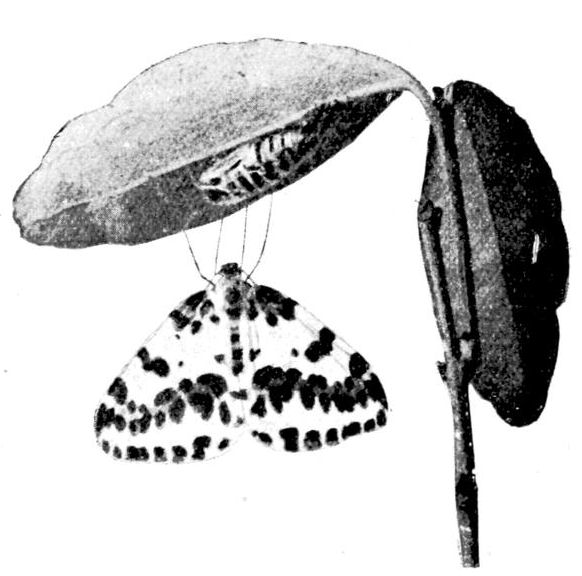
Fig. 6.
Magpie Moth, drying wings.
(Photo by H. Main.)
Except that the specimen represented by Fig. 2 has traces of a yellow band on the hind wings, Figs. 1-3 on Plate 103 show this highly variable species in its typical and most frequent form. Figs. 4 and 5 depict examples of the ordinary darker forms leading up to ab. hazeleighensis, Raynor, in which the whole of the fore wing area between the orange bands is blackish, except two tiny white specks near the front margin. Not infrequently the black spots on the outer margin of the fore wings exhibit a tendency to spread inwards, as in Figs. 2 and 5, and very occasionally they unite with the series of spots outside the orange band, as in Plate 104, Fig. 1, which represents a specimen (kindly lent by Mr. R. Adkin) with blackish tinged hind wings. Sometimes the ground colour of all the wings is yellowish (ab. lutea, Cockerell), but the markings are of the usual pattern. The example of this form (Plate 104, Fig. 3) was reared from a large number of caterpillars I collected at Purley, in Surrey, a year or two ago, and was the only example among the moths resulting therefrom that was worth retaining. The very fine variety shown on Plate 104, Fig. 5, is ab. varleyata, Porritt, which occurs in Yorkshire, but is mostly reared in captivity from eggs obtained from a wild female in the first place, and subsequent pairings; the specimen figured is an especially fine example of the female sex, raised among others of the same form by Mr. G. T. Porritt of Huddersfield, who has been good enough to lend it for the purpose. Several other varieties of this species have been named and described by the Rev. Gilbert H. Raynor, but reference can only be made here to two of these; one is ab. melanozona, a Scottish form, in which there is a black blotch with traces of yellow in it at the base of the fore wings; a large black discal spot in the white central area; a black band, widening towards the front margin, before the faint yellow band, the latter followed by four black spots; hind wings with central black spot, and two series of black spots beyond, seven in each series, separated by a well-defined white area. Fig. 2 on Plate 104 represents a specimen that approaches this variety. The handsome cream-coloured specimen (Plate 104, Fig. 4) is ab. lacticolor, Raynor, and I am obliged to Mr. Adkin for the loan of these insects also.
The caterpillar and chrysalis are figured on Plate 101, Figs. 1, 1b; the former is creamy white, marked on the back with black blotches and dots, and lines of black dots on the sides; between the lower two rows is a broad reddish line; head, black; sometimes the whole body is black. It occurs in gardens, and sometimes is a serious pest where currants and gooseberries are cultivated; it frequently abounds on Euonymus japonicus. In the open country it feeds on sloe and hawthorn; sometimes it is found on elm (low growth in hedges), apple, navelwort (Cotyledon umbilicus), orpine (Sedum telephium), and in the Hebrides, on ling (Calluna). August to May, or early June, are the months in which it is found as a rule; occasionally it does not hibernate, but feeds up and attains the moth state in the autumn of the year that it hatches from the egg. The moth is out, normally, in July and August, and is generally distributed over the greater part of the British Isles.
The range abroad extends to East Siberia, China, and Japan.
Clouded Border (Lomaspilis marginata).
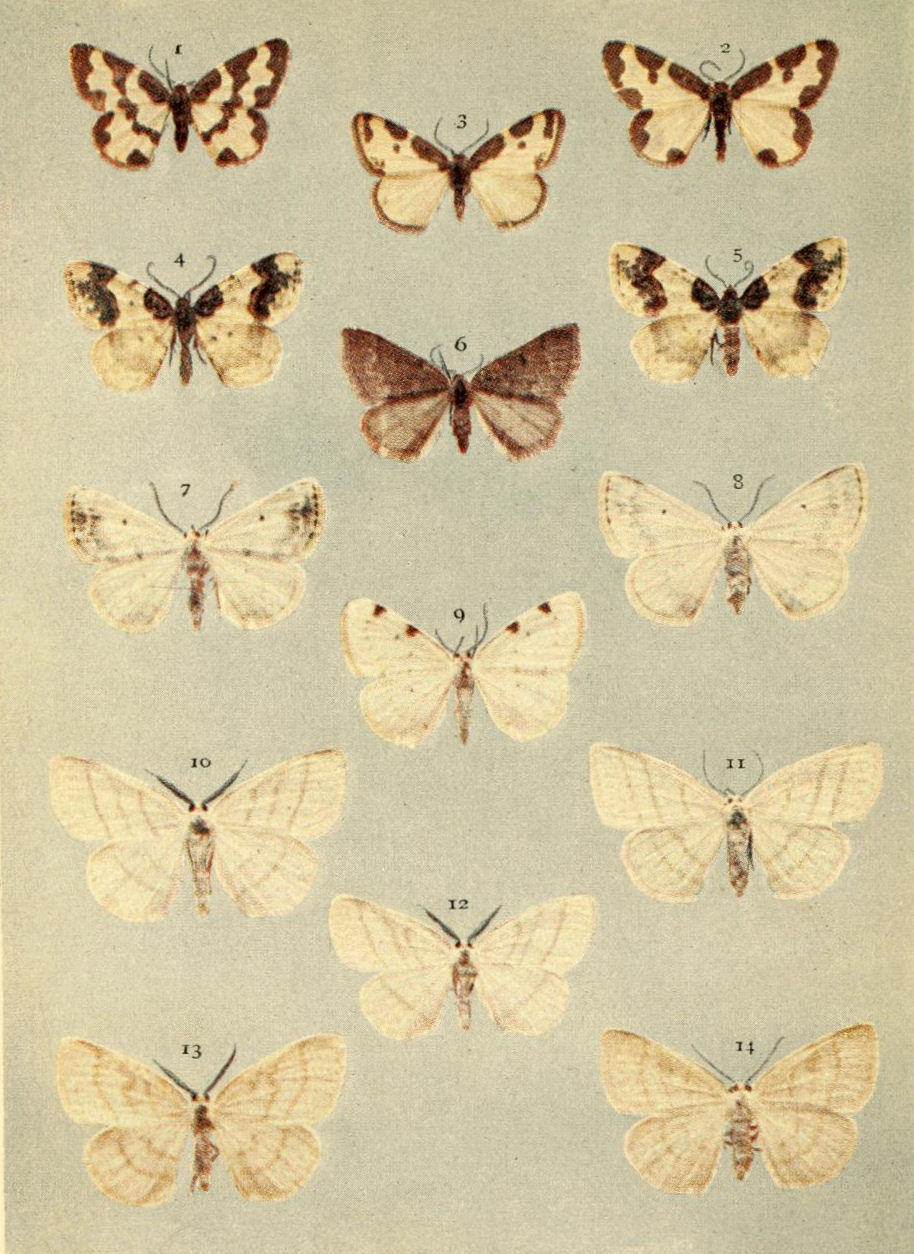
Figs. 1 and 2 on Plate 107 represent the more usual forms, in both sexes, of this rather common, but pretty, little moth. Occasionally, specimens are obtained in which, with the exception of a dark patch or two on the front margin, the wings are entirely white or slightly tinged with pale yellowish (ab. pollutaria, Hübner); a modification of this form is shown in Fig. 3.
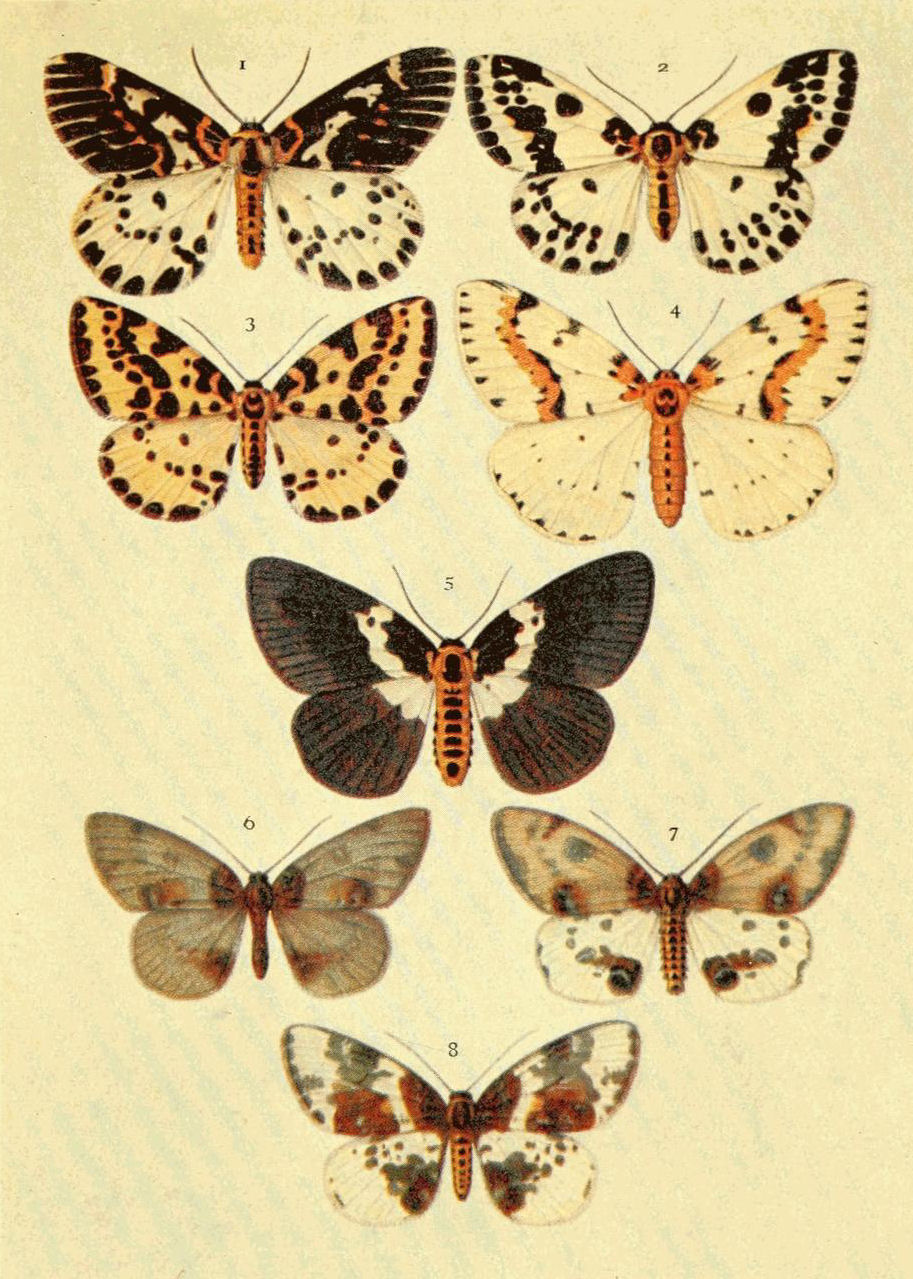
2 Pl. 104.
1-5.Magpie Moth varieties. 6-8.Clouded Magpie varieties.
2 Pl. 105.
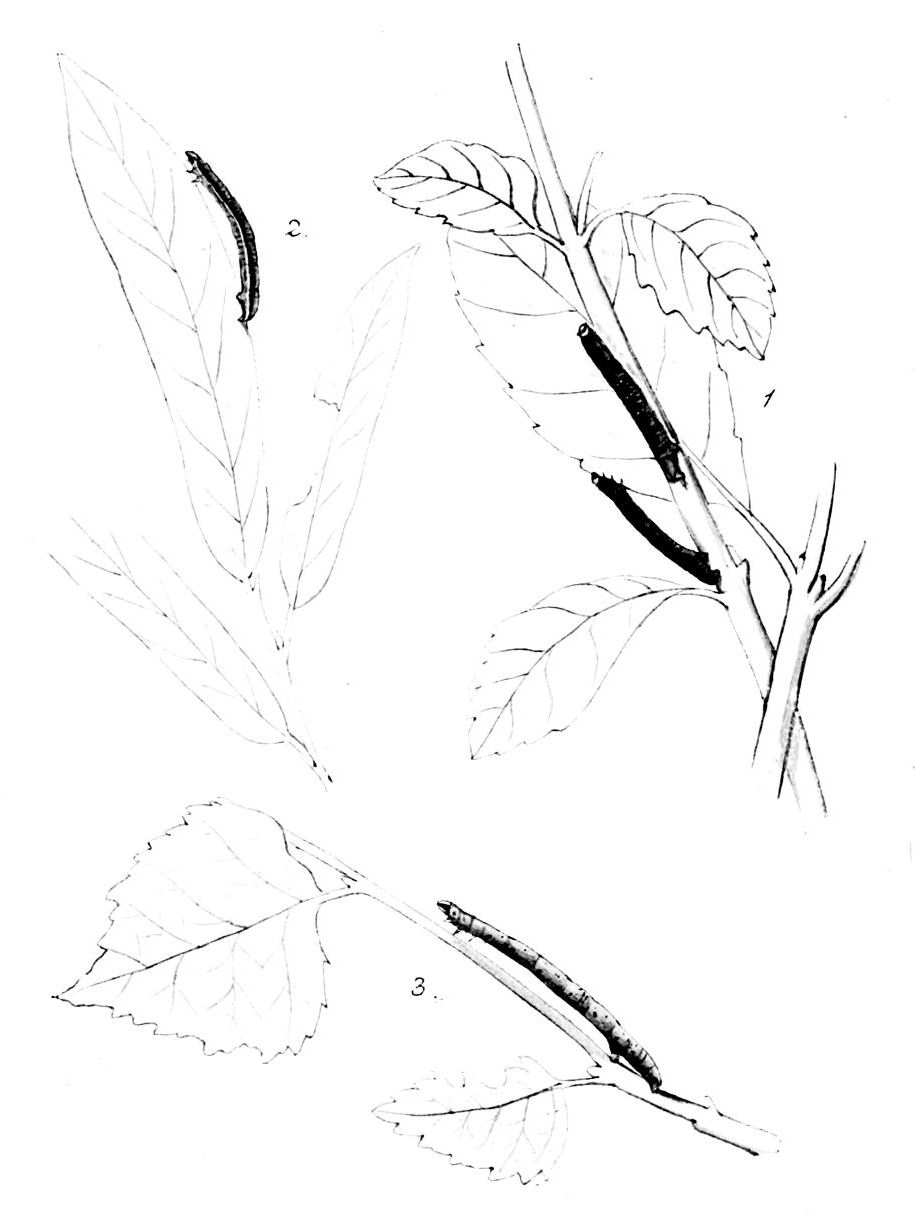
1.Scorched Carpet: caterpillar.
2.Clouded Border: caterpillar.
3.Common White Wave: caterpillar.
Ab. nigrofasciaria, Schöyen, has a rather broad blackish band across the central area of each wing, and indications of such bands, in the shape of spots or dots, are seen in many examples of the species; occasionally, the irregular dark border of the outer margin of the wings is traversed by an interrupted whitish line.
The caterpillar is yellowish-green, with three dark-green double lines on the back, the central one blotched with purplish brown on the last ring; head, green, marked with purplish brown. The figure (Plate 105, Fig. 2) is from a drawing in colour by Mr. Sich. It feeds on sallow, willow, and aspen, and may be found almost throughout the summer from June. The moth is also met with during the summer months, but seems to be most frequent in May and June. The species prefers moist localities where sallows abound, and in such places seems to occur pretty generally over the British Isles. In Scotland, however, it has not, apparently, been noted north of Moray.
The range abroad extends to Amurland and Japan.
The Scorched Carpet (Ligdia adustata).
The bluish-grey band on the outer third of the fore wings varies in width, and the velvety black marking thereon varies in amount; this area of the wings is also more or less clouded with reddish brown, and the underside of all the wings is much suffused with reddish brown, which gives the insect the burnt or scorched appearance to which both Latin and English names refer. (Plate 107, Figs. 4 ♂ and 5 ♀.) In June and early July, and again in late August and September, the red-spotted, bright-green caterpillar may be beaten from the spindle bushes (Euonymus europæus) in hedgerows. (Fig. 1, Plate 105, is from a coloured drawing by Mr. Sich.)
The moth is out in late April sometimes, but it is more frequent in May and June, and as a second generation in August, earlier or later in some seasons. It may be knocked out of hedges in which spindle is growing. The species is not uncommon in most of the southern English counties, but in the northern ones its occurrence is more casual. It has been recorded from North Wales; in Ireland it is fairly common in some western and southern counties, and rare in the east and north; in Scotland, only noted from the south-east, Arran, and the Hebrides.
Abroad, its range extends to Japan, where it is represented by var. japoniata, Staudinger.
The Sloe Carpet (Aleucis (Bapta) pictaria).
This blackish-grey species (Plate 107, Fig. 6) has been confused in the past with pictaria, Thunberg, which is referable to Cleora lichenaria, and it was then known by the popular name of "The Grey Carpet." As the caterpillar feeds on the foliage of the sloe, and the moth is fond of resting on the stems and twigs, and appears at the time the bushes are wreathed in their snowy blossoms, the sloe carpet seems to be rather more suitable than are most of the names by which our moths are popularly known.
The caterpillar is dusky brown, with blackish V-shaped marks upon the back, white marks on rings 7 and 8, and a black line on the last ring. It feeds at night, in June and early July, and as it remains on the bushes during the day, it may be obtained by beating. At night the moths fly about the bushes for a short time, and then sit on the twigs, when they may be secured. Of course, a lantern will be a necessity.
Barrett states that stunted bushes on open heaths and hillsides are preferred to hedgerows.
The species is very local, but generally not uncommon where it occurs, as, for example, in the New Forest, Hampshire; the Loughton and Colchester districts, Essex; and in some parts of Kent. It has been noted from Tilgate Forest, and other localities in Sussex; and also from Surrey, Berkshire, and Suffolk.
White-pinion Spotted (Bapta bimaculata).
The two cross lines on the fore wings of this silky white species (Plate 107, Fig. 9) commence in blackish spots on the front margin; often they are only indicated by series of dots, and are rarely really distinct. Occasionally, a greyish submarginal line or band is present.
The darkish green caterpillar has a series of purplish marks on the back; head, inclining to yellowish, and powdered with purplish. It feeds, in June and July, on the leaves of wild cherry and plum, and will eat hawthorn; it may be beaten from its food plant in the daytime. The moth is out in May and June, and shelters in bushes, etc., in woods and hedgerows. During the day it is frequently put up from its hiding-places, but its usual time of flight is the evening, when it is readily seen and not difficult to capture. It is local, and perhaps most frequently met with in those parts of South England where the wild cherry flourishes. Occurs more or less commonly in most of the southern counties, but north of Gloucester, Oxford, and Norfolk it has only been noted from North Lancashire, Westmoreland, and Cumberland. In Wales the late Mr. C. G. Barrett found the moth rare in Pembrokeshire, and there is also a record from Anglesey.
The range abroad extends to China, Corea, and Japan.
Clouded Silver (Bapta temerata).
In its silky, white wings this species (Plate 107, Figs. 7 ♂, 8 ♀) is similar to the last mentioned. It is, however, rather larger, and there are greyish clouds on each side of the outer cross line, but there are no blackish spots on the front edge of the fore wings. The clouding referred to is heavier and darker in some specimens than in others, but occasionally, chiefly in the female, is almost absent.
The green caterpillar, when full grown, is ornamented with brown-bordered reddish spots on the back, but these markings are absent in its earlier stages. The head is paler than the body, and has a reddish spot on each side. It feeds, in July and August, on sloe, plum, and bird cherry in this country, but the continental authors give birch, willow, rose, etc. The moth is out in May and June, and occurs throughout England and Wales, to Cumberland; but it is far more frequent in the south than in the north. Barrett mentions a single specimen from Wigtownshire in Scotland. In Ireland, Kane states that it is abundant at Clonbrock, Merlin Park, and in several other localities in Galway; it is not uncommon at Killarney, Kerry; and a few specimens have been taken at Powerscourt, Wicklow, and Sligo.
The range abroad extends to Amurland and Japan.
Common White Wave (Cabera pusaria).
In its typical form (Plate 107, Figs. 10, 11) this white species has three dark-grey almost parallel cross lines on the fore wings and two on the hind wings. The first or the second of these lines on the fore wings may be absent, occasionally both may be missing and the third very faint. Not infrequently in undersized bred specimens the first line approaches the second line either throughout its length or near the inner margin, and more rarely the two are united; in most of such aberrations the tips of the fore wings are rather more rounded than in typical specimens, and these are referable to ab. rotundaria, Haworth (Round-winged Wave). I have over a dozen examples of this form, all of which were reared from caterpillars which had been kept on short rations when nearly mature; in some, the outer margin of the fore wings is distinctly rounded, but in others it is much the same as in the larger typical form, and one of these is shown on Plate 107, Fig. 12. The ground colour occasionally assumes a greyish tint, and sometimes this is tinged with pink; more rarely the general colour is leaden grey.
2 Pl. 106.
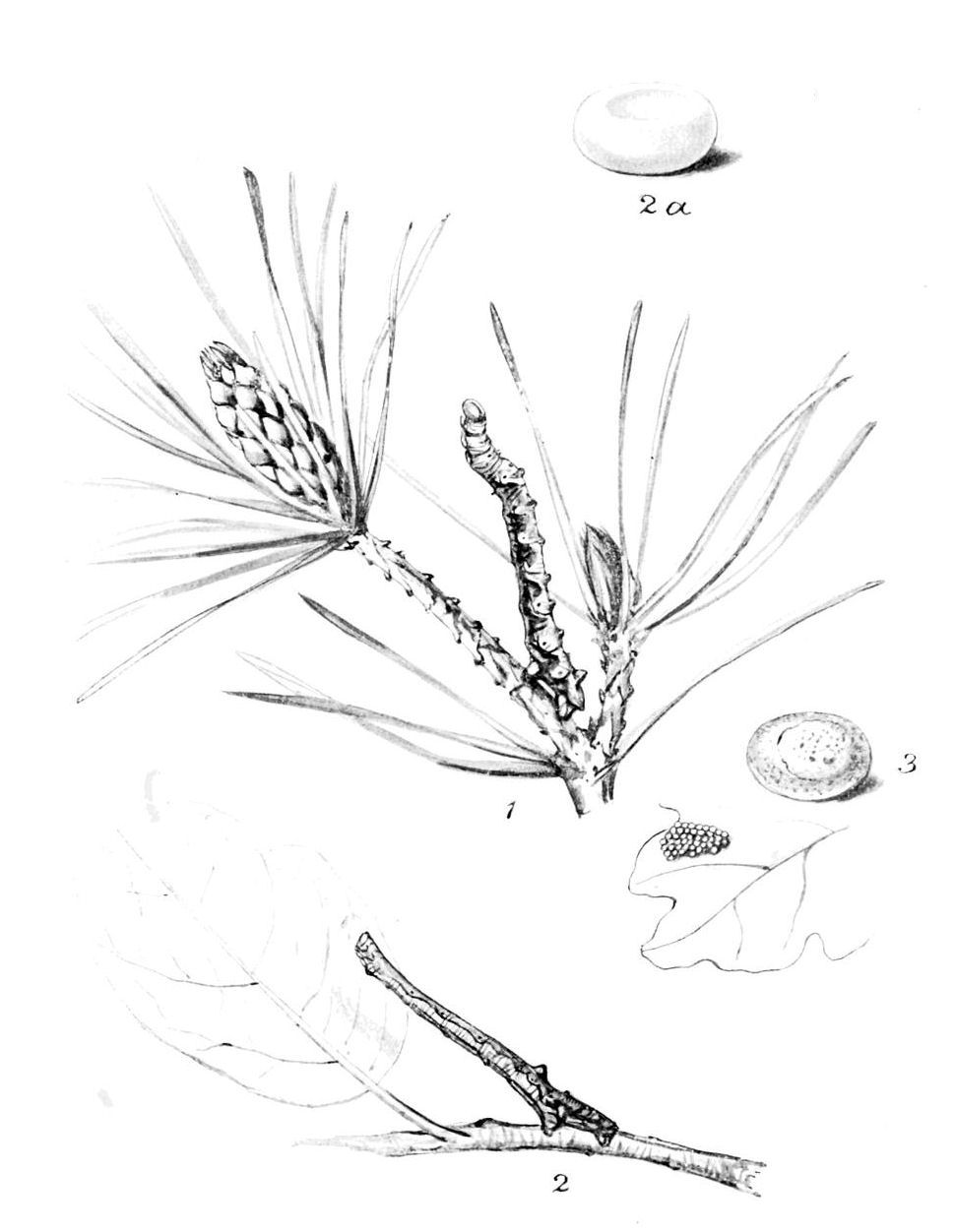
1.Barred Red: caterpillar.
2, 2a.Barred Umber: egg, natural size and enlarged, and caterpillar.
3.Light Emerald: eggs, natural size and enlarged.
2 Pl. 107.
1-3.Clouded Border. 4, 5.Scorched Carpet. 6.Sloe Carpet.
7, 8.Clouded Silver. 9.White-pinion Spotted.
10-12.Common White Wave. 13, 14.Common Wave.
The caterpillar, of which there are two broods, one in July and another in September, feeds on birch, alder, sallow, etc. It is purplish brown, spotted with white above, and greenish below on the first three rings. There is also a green form with purplish brown marks on the back. (Plate 105, Fig. 3, from a coloured drawing by Mr. A. Sich.) The moth is out in May, June, and August, and is generally common throughout the greater part of the British Isles.
Abroad, the range extends to East Siberia and Amurland.
Common Wave (Cabera exanthemata).
Somewhat similar to the last species, but sprinkled with ochreous grey; the fore wings have three greyish cross lines, the first two less regular than those of pusaria, and the outer one distinctly curved; variation in the lines is pretty much the same as in pusaria and its small form ab. rotundaria. Of the form showing the first and second lines more or less confluent, I have seven examples reared from collected caterpillars; six are undersized, but the other is of quite ordinary size (ab. approximata, Haworth); another specimen, also bred, is thinly powdered with ochreous grey, and the lines are very indistinct. The more usual forms are shown on Plate 107, Figs. 13, 14.
The caterpillar is green, inclining to yellowish or to brownish; some purplish-red marks and white-edged black spots on the back; the ring divisions are yellow, and there are reddish-brown or purplish-red marks on the sides; the markings vary. It feeds on birch, alder, and sallow, and may be beaten out at any time from July to September. The moth is out through the summer from May; its range in the British Isles is very similar to that of the last species, but it seems to have a preference for moist places.
The distribution abroad extends eastward to Amurland, and a form known as ab. schæfferi, Bremer, occurs in the last-named country, and also in Corea and Japan.
Barred Umber (Numeria pulveraria).
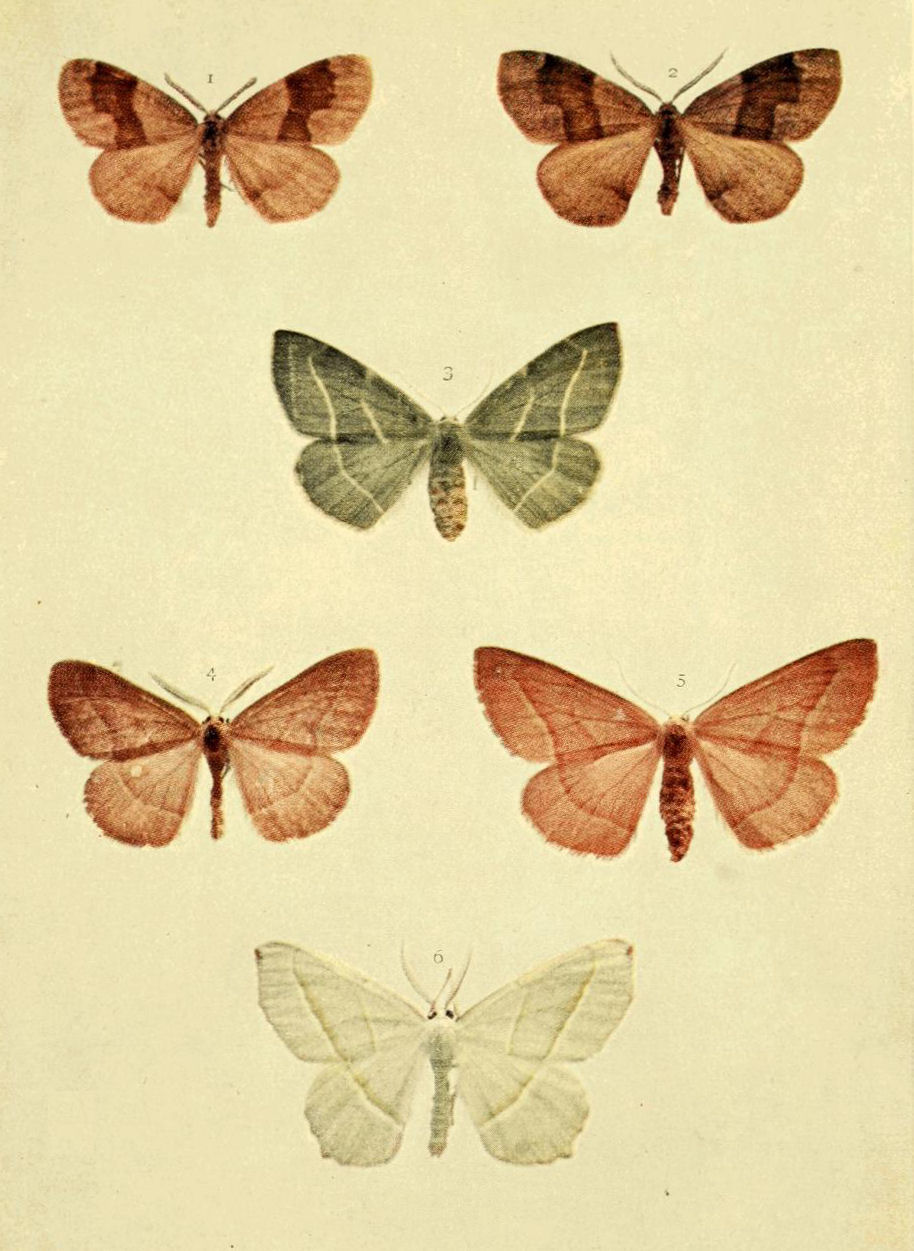
Pale ochreous or reddish brown freckled with darker; the central dark reddish brown band is sometimes much narrowed below the middle; sometimes only the edges of the band are dark, the enclosed space being but little darker than the ground colour, or occasionally tinged with greenish; one example of the latter and two of the former were reared this year (1908) from larvæ received in July, 1907, from Mr. F. Pope of Exeter; a male specimen bred from the same batch of larvæ, but which emerged in August of the year last mentioned, is distinctly tinged with rosy over all the wings; the narrow band on the hind wings, not usually extended to the front edge, is in this specimen entire, whilst the greenish-banded specimen referred to above is without trace of a band on the hind wings. Two examples which are without locality, but which, I believe, came from the New Forest, have pale greyish-brown fore wings banded with brown in which there is a tinge of olive. Two examples of the male are figured on Plate 108. The eggs (Plate 106, Fig. 2a) were pale greenish yellow when laid, May 17 to 20; the larvæ hatched out from May 31 to June 2.
The caterpillar, which is also depicted on the plate, is reddish brown, mottled with yellowish brown. It feeds on birch, sallow, ash, etc., from June to August.
The moth, as a rule, does not emerge until the following spring, but sometimes specimens will come out the same year.
Although widely distributed over nearly the whole of the British Isles, the species seems to be rarely met with in large numbers. The range abroad extends to Amurland, Corea, and Japan.
Barred Red (Ellopia (Hylaea) prosapiaria).
The typical form of this species is depicted on Plate 108, Figs. 4 ♂, 5 ♀, and Fig. 3 on the same plate represents ab. prasinaria, Hübner, a form not uncommon in Germany (whence came the example figured), Switzerland, and other parts of the continent, but which is very rare in Britain, and has been recorded from Kent and Suffolk. Sometimes, but chiefly in Scotland, the colour varies to a greyish or even yellowish tint; the cross lines are often parallel or nearly so, and frequently approach each other about the middle; the usual white edging to the cross lines is occasionally absent, and the enclosed space in such specimens is hardly darker than the general colour.
On Plate 106, Fig. 1, will be found a figure of the caterpillar, which is tawny brown with white-edged, connected reddish marks along the back. It feeds, from September to May, on Scots pine (Pinus sylvestris), and occasionally on larch. The moth is out in June and July, and sometimes in September. It may be jarred from the pine boughs, and is not infrequently seen resting on foliage of the undergrowth. Generally distributed in fir-woods throughout Great Britain, and widely spread in Ireland.
The range abroad extends to East Siberia.
The Light Emerald (Metrocampa (Eudalimia) margaritaria).
When quite fresh, this species (Plate 108, Fig. 6) is of a delicate whitish-green colour, but the green tint is apt to fade or to change colour, so that the wings are almost ochreous white sometimes.
The eggs shown on Plate 106, Fig. 3, were kindly supplied by Mr. Norman Riley.
The caterpillar ranges in colour from greenish brown to purplish brown, and is frequently freckled with a darker shade of the general colour; there is sometimes a pale patch on rings 6 and 7, and the sides are fringed with fine bristles along the spiracle area. It feeds, from September to May, on the leaves of oak, birch, beech, elm, etc., and during the winter will nibble the bark of the younger twigs, and also eat the buds.
The moth, which is partial to the woodlands, is out in June and July, and is pretty generally distributed over the British Isles, except the Hebrides, Orkneys, and Shetlands.
Large Thorn (Ennomos autumnaria).
This fine species was first definitely ascertained to occur in Britain in 1855, but it had been reported as British at a much earlier date, and was figured by Wood in 1839. Up to 1859 it had only been recorded from the North Foreland and Margate in Kent, and from Brighton, Sussex. In 1862, a specimen was taken at Brighton and one at Deal, the latter a female. Two examples were secured at Gosport, Hampshire, in 1865, and one at Deal in 1867. Then, after an interval of ten years, three were captured in Hants (Alverstoke), and two years later a round dozen were obtained at Gosport. During the last thirty years specimens have been recorded from Margate, Deal, Dover, Folkestone, Hythe, and Ashford (1907), in Kent, from Chichester, Sussex, and from Shoeburyness, Essex (1898). It has been reared on several occasions from eggs obtained from captured females, and is still more frequently bred from eggs deposited by the descendants of wild parents.
2 Pl. 108.
1, 2.Barred Umber. 3.Barred Red (green var.).
4, 5.Barred Red. 6.Light Emerald.
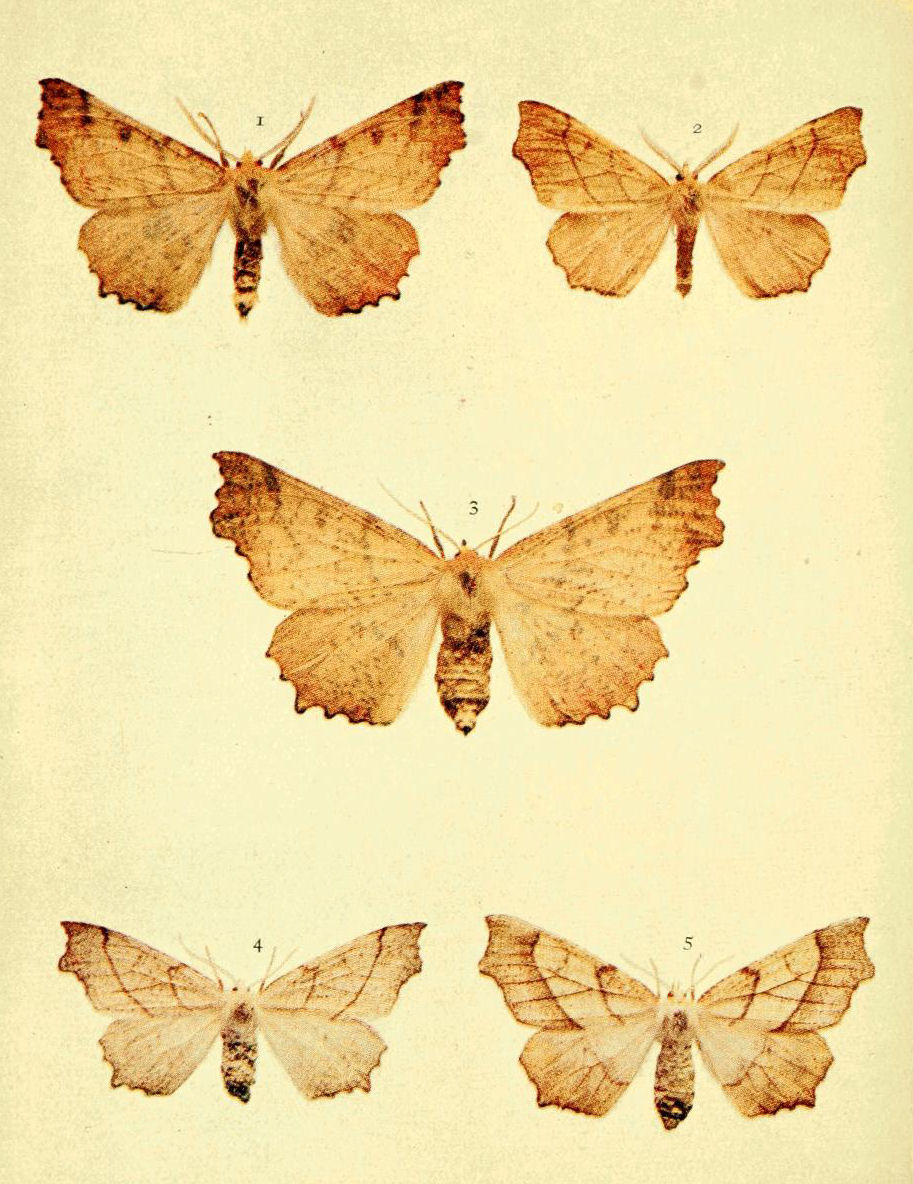
2 Pl. 109.
1, 3.Large Thorn. 2, 4, 5.August Thorn.
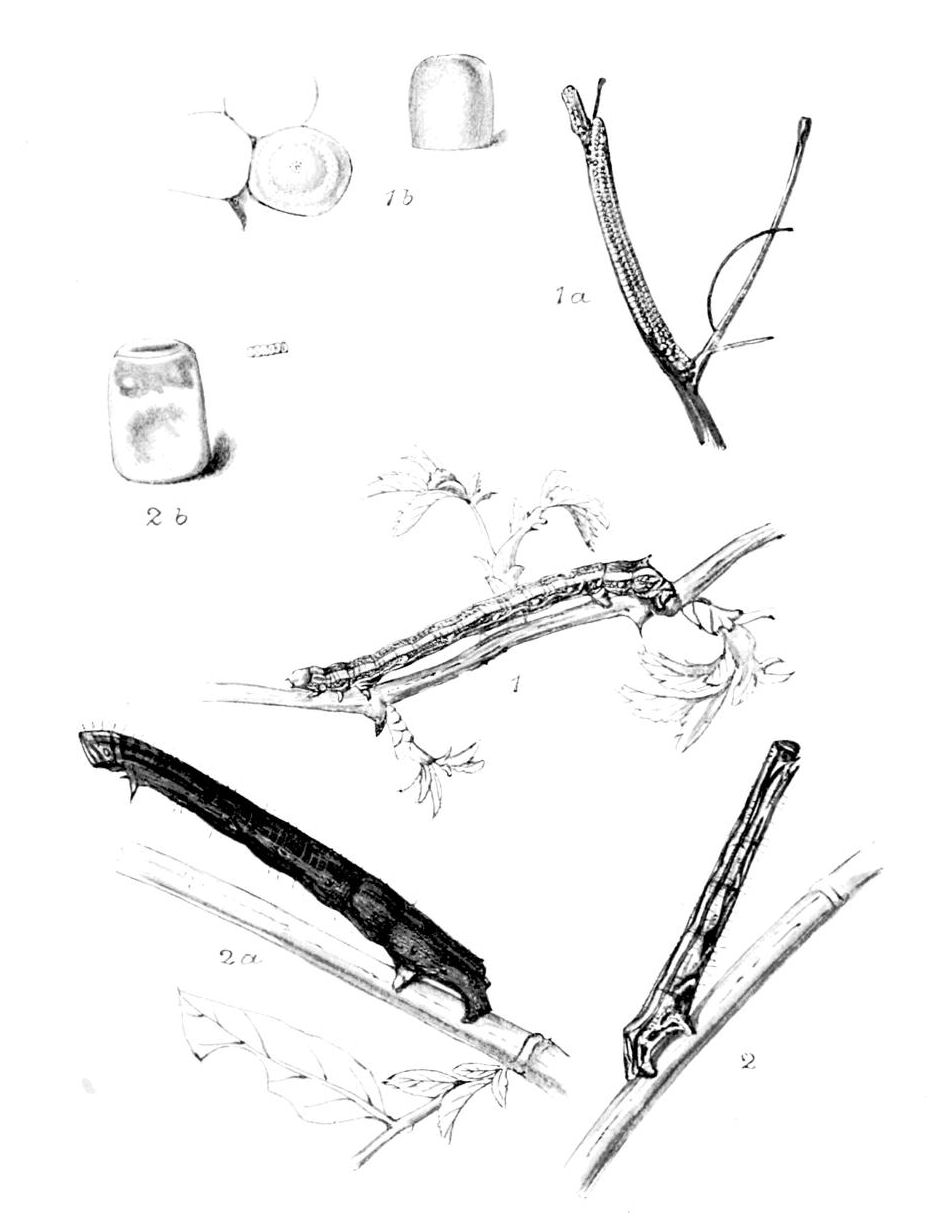
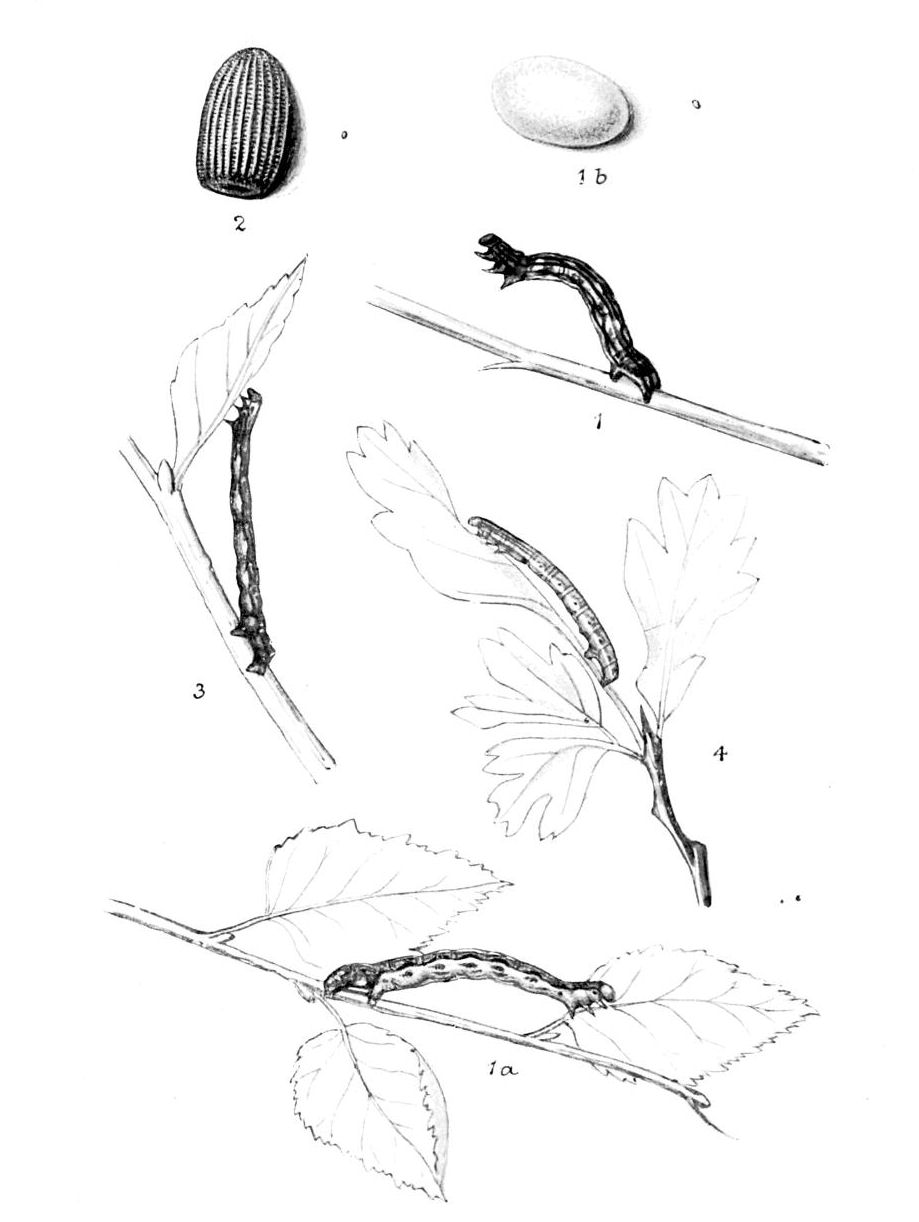
The eggs are deep olive, with a white ring at one end; and the caterpillar is brownish in colour, rather shining, and very twig-like. It feeds on birch, alder, hawthorn, sloe, plum, etc., and has been found on sycamore and cherry; May to August. The early stages are figured on Plate 106, Figs. 1, 1a. The moth (Plate 109, Figs. 1 ♂, 3 ♀), which varies in colour from pale to deep ochreous yellow, and also in the amount of purplish brown freckling, usually has the upper part of the outer marginal area some shade of tawny brown. Specimens of a greyish chocolate tint have recently been reared by Mr. Newman, of Bexley (Plate 134, Fig. 9). Most of the specimens captured in England have been obtained at light in the autumn. The range abroad extends to Amurland, Japan, and North America.
August Thorn (Ennomos quercinaria).
The male (Plate 109, Fig. 2) is generally yellower than the female (Fig. 4), and it is in the former sex that brownish or red-brown clouding on the outer area beyond the second cross line appears most frequently, but it occurs also in the female (Plate 109, Fig. 5). Sometimes the wings are partly or entirely dull reddish brown. Two other examples of the type form showing modification of the cross lines will be found on Plate 111, Figs. 5 ♂, 6 ♀. In ab. carpinaria, Hübner, the wings are of a reddish ochreous colour. A hybrid resulting from a crossing of E. alniaria ♂ and E. quercinaria ♀ has been named dartfordi, Tutt.
The caterpillar (Plate 113, Fig. 3) is generally grey brown, mottled with reddish or olive; but, according to Fenn, it is sometimes greenish, without humps or projections. It feeds, in the summer, on lime, birch, oak, hawthorn, etc. A chrysalis which I took out of its puparium (two leaves spun together with silk) on July 9, 1907, was green, with the upper surface tinged with yellowish; a dark-green central line, and a series of dark-green irregular marks on each side; the tail pointed and furnished with reddish hooks.
The moth is out in August and September, and may often be seen sitting on the boles of trees, generally low down. The species is widely distributed over England, but is much more frequent in the south than in the north. It has been recorded from Swansea in Wales; from Dumfries, Dunoon, and Monteith, in Scotland; and from near Derry, Hazlewood (Sligo), Mote Park (Roscommon), and Clonbrock (Galway), in Ireland.
Canary-shouldered Thorn (Ennomos alniaria).
This species (Plate 111, Figs. 1, 2) is generally easily recognised by the canary yellow coloured hairs of the thorax. The fore wings are yellowish, sprinkled with purplish grey, and crossed by two curved greyish-brown lines, which not infrequently fall close together on the inner margin. In some female specimens that I reared from eggs, received from York, the wings are more or less tinged with dull tawny brown, especially on the outer area, and in two of them the thorax is also brownish tinged.
The at first green, and afterwards blackish slate-coloured, egg, with whitish ring, and the caterpillar are shown on Plate 110, Fig. 2, 2a. The latter is brownish, mottled with purplish above, and inclining to greenish below; head, rather paler brown. It feeds, from May to July, on birch, alder, etc. The moth is out in the autumn, and occurs in suitable woodland and marshy places over England, Wales, and Scotland to Moray. It has been found in many parts of Ireland.
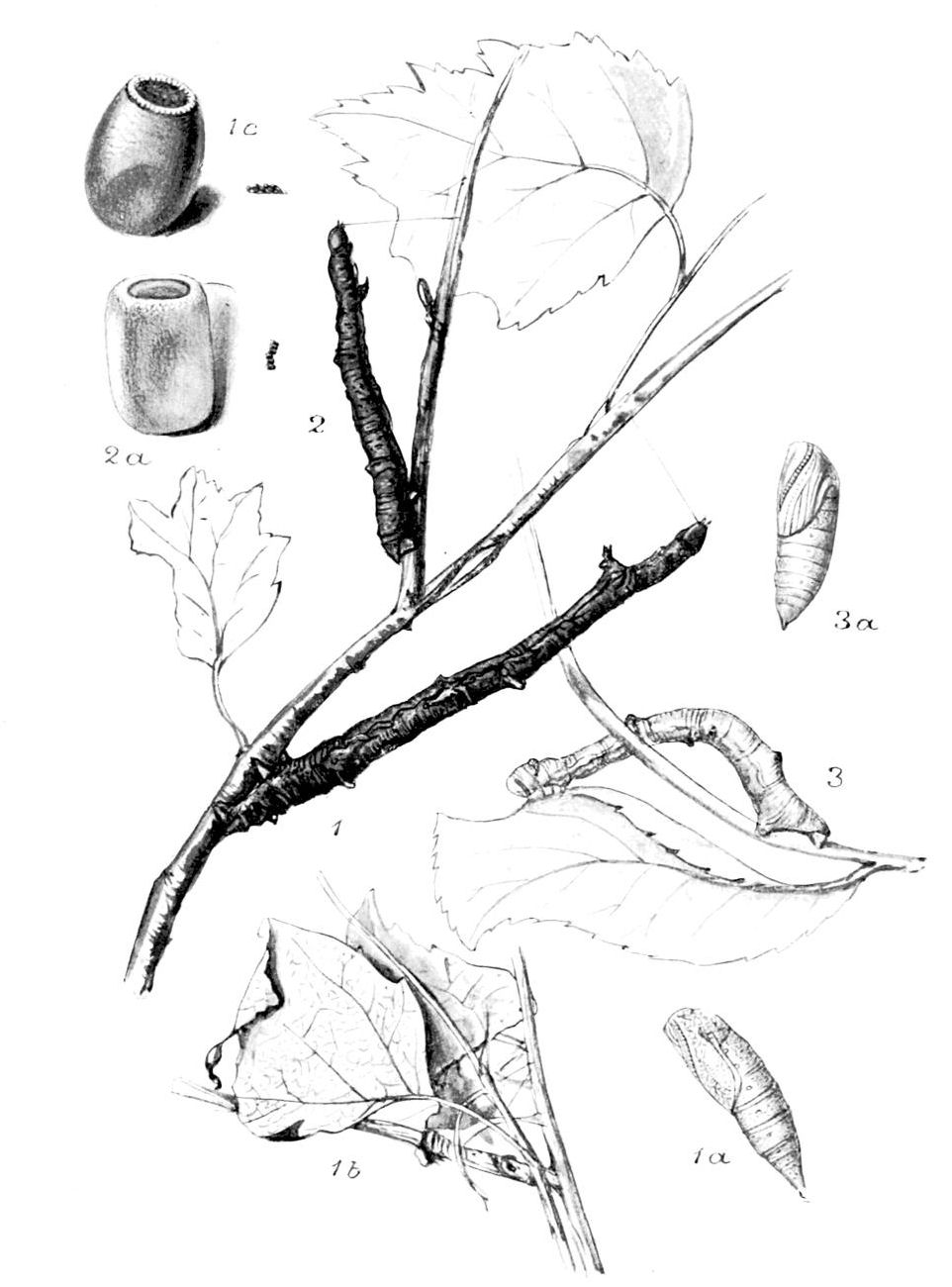
2 Pl. 110.
1, 1a, 1b, 1c.Large Thorn: eggs, natural size and enlarged; caterpillar, chrysalis and puparium.
2, 2a.Canary-shouldered Thorn: eggs, natural size and enlarged, and caterpillar.
3, 3a.Dusky Thorn: caterpillar and chrysalis.
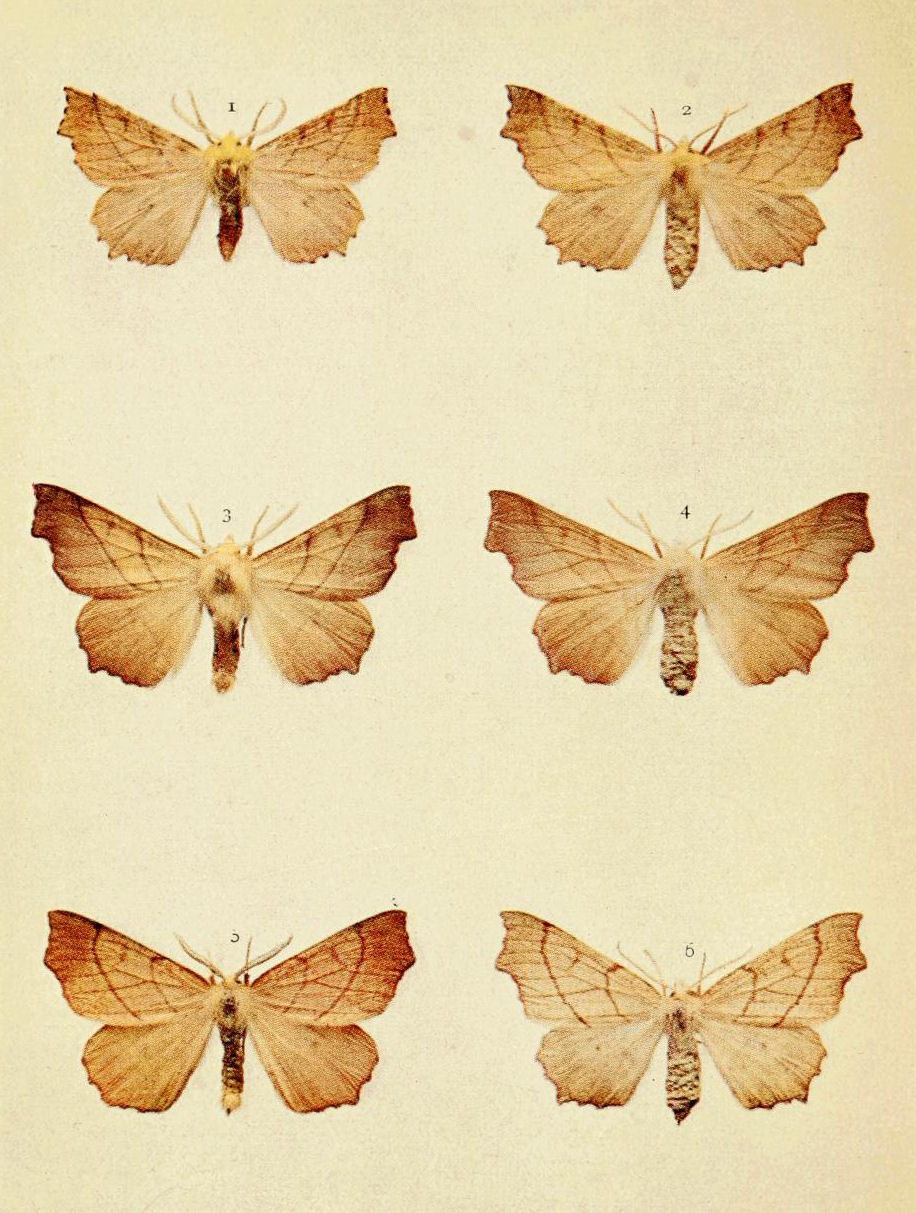
2 Pl. 111.
1, 2.Canary-shouldered Thorn. 3, 4.Dusky Thorn. 5, 6.August Thorn.
Dusky Thorn (Ennomos fuscantaria).
Figs. 3 ♂, 4 ♀, Plate 111, represent the usual form of this species; in some specimens the outer marginal pale purplish-brown shading spreads inwards over the fore wings to the base; in other examples it is only seen on the upper part of the outer area.
The caterpillar (Plate 110, Fig. 3) is green, pretty much of the same tint as the underside of the ash leaf upon which, and the stalks, it rests by day. In some examples the general colour inclines to pale brown, or reddish brown. It may be found during the summer, and where the leaves are seen to have neat round holes in them, these should be examined, when this caterpillar will probably be found somewhere adjacent. Ash (Fraxinus excelsior) is the usual food, but possibly privet might answer as a substitute. The moth is out in August and September, and occurs in most parts of Southern England where the ash flourishes; its range extends into South Wales, and northwards to Durham and Northumberland. Only doubtfully recorded from Ireland, and apparently unknown in Scotland.
September Thorn (Ennomos erosaria).
This species, shown on Plate 134, Fig. 6, varies in ground colour from pale ochreous to pale fulvous; the cross lines approach towards the inner margin, and sometimes the second line is bent inwards below the middle. The central spot is generally absent, and when present is exceedingly faint. The twig-like caterpillar is brownish, with a greenish or purplish tinge. In its infancy it is a smooth-looking creature, but as it advances in growth knobs and humps appear, the most prominent of which are on rings 2, 5, 8, and 11; on the last ring there are two points. It feeds on oak chiefly, but will eat birch, lime, etc.: May to July. The moth is out in August and September, and occurs more or less frequently in most of the southern counties of England, but is rather scarce in the Midlands and northwards. It occurs in South Wales, and has been recorded from the south of Scotland. Very rare in Ireland.
Note.—The species of Ennomos are fond of light, and in suitable spots, gas and electric lamps, in the streets, or even in the house when windows are open, will attract these moths. Most of the specimens of autumnaria that have been captured in Britain have occurred at light. Quercinaria is, perhaps, less often noted at light than its allies; but, curiously, this species is more frequently seen at rest on tree trunks, etc., than are either of the other kinds. Female moths taken at light may not always be in first-rate condition, but they will probably lay eggs, and should be kept for that purpose in a chip box. The caterpillars do not hatch out until the following spring. Put the eggs in a cool place.
Early Thorn (Selenia bilunaria).
The sexes of the spring or typical form are depicted on Plate 112, Figs. 1 ♂, 2 ♀, and the paler summer form var. juliaria (July Thorn), Haworth, is represented by Fig. 3. The underside is shown in Mr. H. Main's photo of the moth in its natural resting attitude.
The caterpillar is orange or reddish brown, sometimes inclining to purplish; there are pairs of reddish raised points on the back of rings 7 and 8; as will be seen from the accompanying illustration, which is from a photograph by Mr. Main, the creature, when resting, is very like a twig. It feeds on birch, alder, sallow, hawthorn, sloe, etc., in May and June, and again in August and September. The moth is out in April and early May. In 1905, a male occurred at Carnforth, Lancs., on June 8; the second generation appears in July and August. A third has been obtained in captivity, and the moths of this brood are similar to those of the second. It has happened that the emergence of some moths of the second, or summer, form has been delayed until the following February, but these remained true to their race and did not assume the spring form.
Fig. 7. Early Thorn at rest. Fig. 8. Caterpillar of Early Thorn.
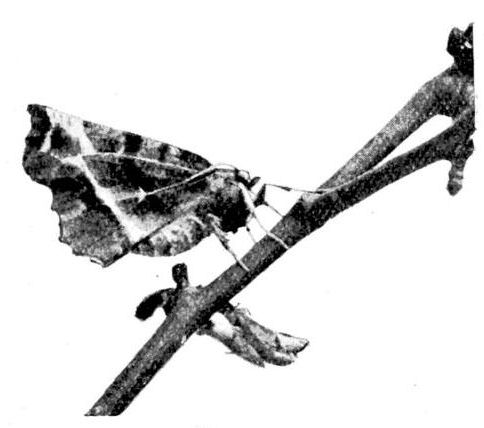
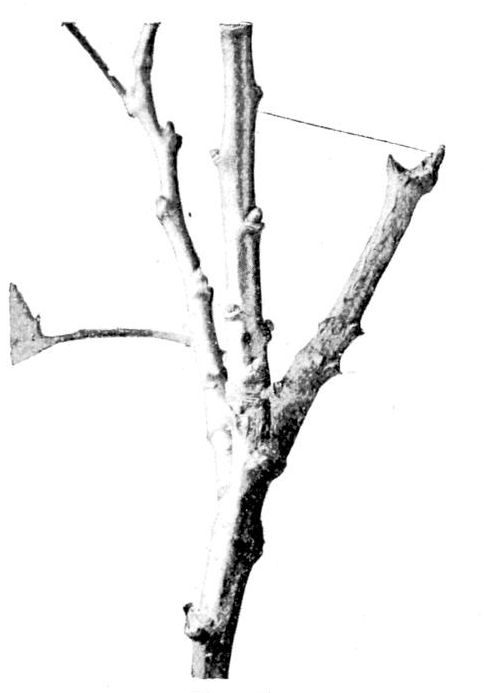
(Photos by H. Main.)
Generally distributed throughout England and Wales, and often abundant, especially in the south. In Scotland, Renton states that it is common in Roxburghshire, but there is only one brood; the range extends to Sutherlandshire. Widely spread in Ireland and plentiful in some parts.
Lunar Thorn (Selenia lunaria).
A female of this species is shown on Plate 112, Fig. 4; the male is usually more clouded with reddish. A second generation is sometimes raised in captivity, and the males of this brood (var. delunaria, Hübner) are somewhat paler, whilst the females incline to a yellowish tint. In Scotch specimens, the reddish markings are tinged with purple; and ab. sublunaria, Stephens, from Derbyshire, has the coloration very similar to that of the spring form of S. tetralunaria.
The caterpillar is figured on Plate 113, Fig. 2. The ground colour is usually some shade of brown, ranging from greyish or greenish to reddish, variegated with darker or paler clouds, and with traces of pale lines on the back. It occurs in the open from July to September, but may be reared both earlier and later in confinement. It feeds on sloe, plum, oak, birch, etc. The moth, in May and June, is sometimes seen on hedges or on the plants growing below; or it may be jarred from the branches of trees, when it is more apt to fall to the ground than to fly. Like others of this group it is fond of light, and is frequently attracted thereto at night. The species is rarely plentiful, and always more or less local, but it is widely distributed over the British Isles to the Orkneys.
Purple Thorn (Selenia tetralunaria).
On Plate 112, Fig. 5 represents a specimen of the spring brood, and Fig. 6 one of the summer brood (var. æstiva, Staudinger). The ground colour of the typical form is whitish, sometimes tinged with grey, and sometimes with pinkish; the patch at the tip, and the basal two-thirds of the fore wings, also the basal half of the hind wings, are purplish brown, varying almost to blackish; or they may be rich red brown. Var. æstiva is rarely whitish in ground colour, but this is frequently of a pinkish tinge, and the darker portions of the wings are brownish, inclining to olive; sometimes the general colour is ochreous brown with dark brown cross lines, and a rust-coloured lunule at the tips of the fore wings. The hybrid resulting from a female of this species that had paired with a male bilunaria has been named parvilunaria, Bastel. At the time it is laid, the egg is pale olive green, but it changes to shining reddish, and just before hatching to purplish black. (Plate 113, Fig. 1a.)
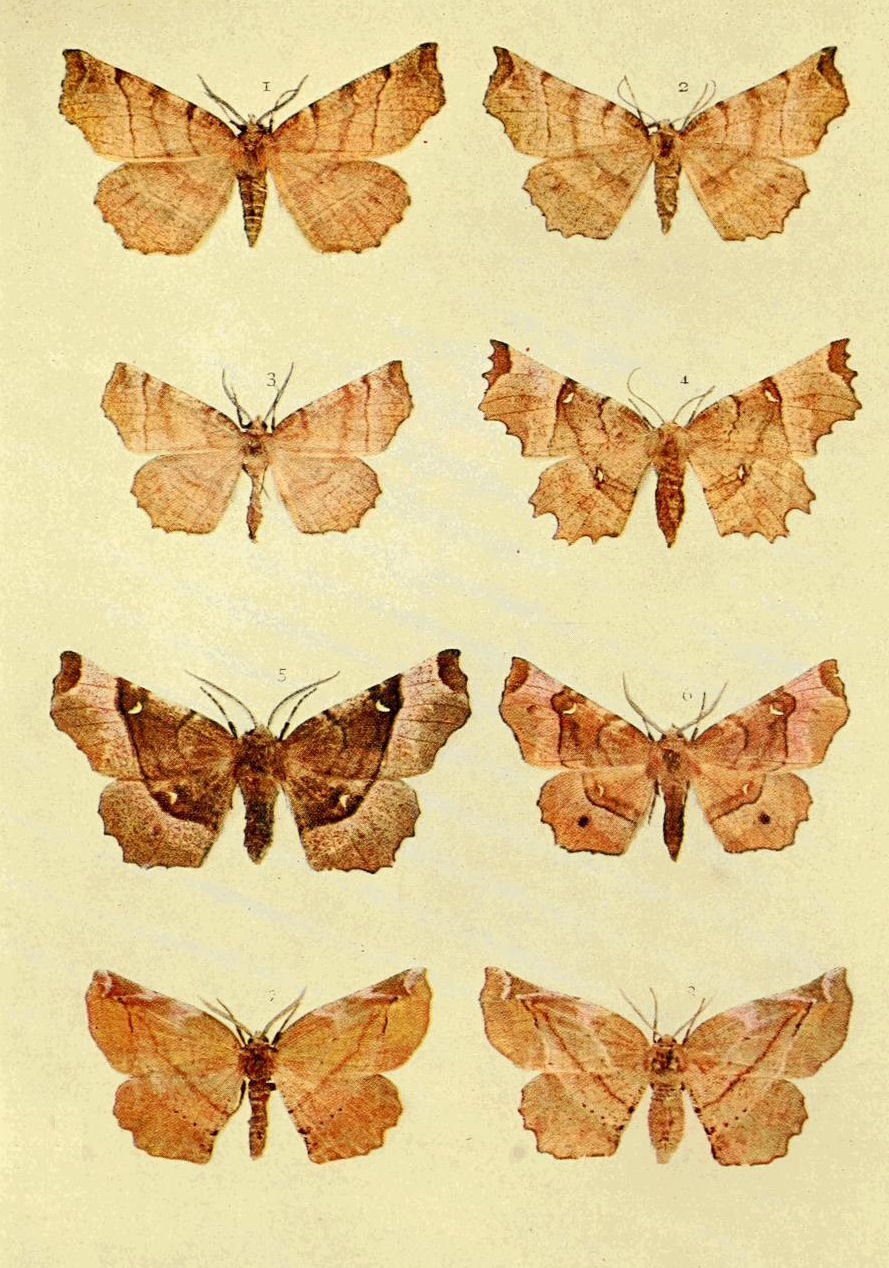
2 Pl. 112.
1-3.Early Thorn. 4.Lunar Thorn.
5, 6.Purple Thorn. 7, 8.Lilac Beauty.
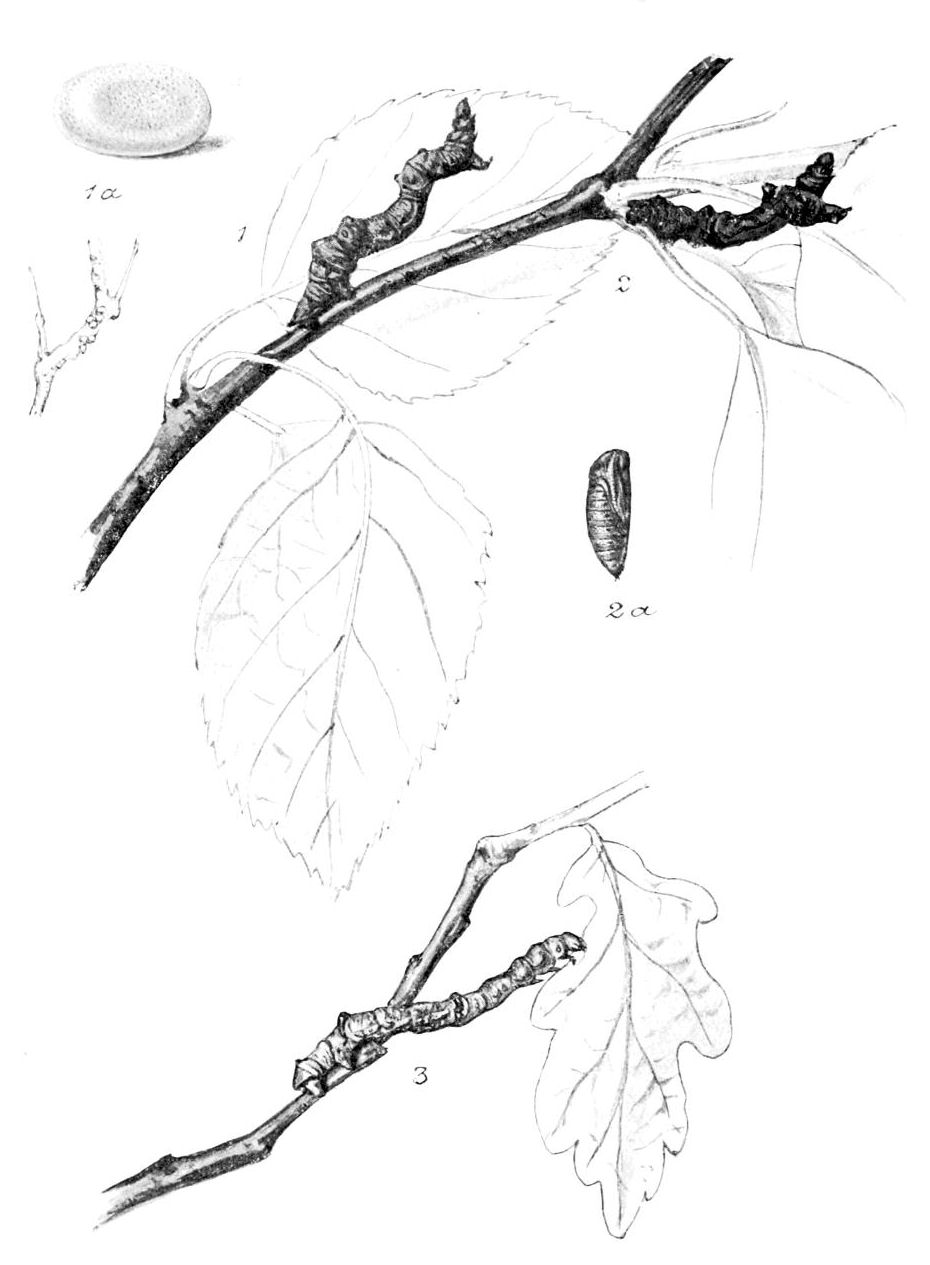
2 Pl. 113.
1, 1a.Purple Thorn: eggs and caterpillar.
2, 2a.Lunar Thorn: caterpillar and chrysalis.
3.August Thorn: caterpillar.
The caterpillar is reddish brown, mottled with darker brown, and with pale greyish. It feeds on birch, alder, oak, sallow, cherry, etc.: June and July, and again in the autumn. (Plate 113, Fig. 1.)
The moth is out in April and May, and the second generation emerges in July and August. A few specimens of a third generation have been reared in October, but this is unusual.
The species is more or less local, and rarely common, at least in the moth state; it occurs in all the southern counties of England, and a few specimens have been recorded from some of the midland and northern counties, and from South Wales. In Scotland, only noted from Rannoch, Perthshire, and a specimen was reared on April 25, 1901, from a caterpillar found at Dunkeld, in the same county, the previous autumn.
Abroad, the range extends to Amurland and Japan.
Lilac Beauty (Hygrochroa (Pericallia) syringaria).
The sexes of this species are shown on Plate 112, and it will be noted that the male (Fig. 7) is rather smaller and decidedly more brightly coloured than the female (Fig. 8). An older English name is "Richmond Beauty," Wilkes. Figures of the curiously shaped caterpillar and chrysalis will be found on Plate 115, Figs. 2, 2a. The former is yellowish brown, variegated with reddish and violet; it feeds on honeysuckle, lilac, and privet, and may be beaten or searched for in May and early June, after hibernation. I have found it commonly on privet hedges in the Mill Hill district, Middlesex, but in woods, and especially in the New Forest, it is obtained from honeysuckle. In my experience, the privet-feeding caterpillars always produce larger moths than those reared from caterpillars fed on honeysuckle. The moth emerges in June and July, the former month chiefly in confinement, and from such early moths a second generation may be obtained in the autumn.
Although most frequent in the southern half of England and Wales, the range of the species extends to the northern counties; and single specimens have been recorded from Durham and Northumberland, but the species has not been noted in Scotland.
The distribution abroad extends to Amurland and Japan.
Scalloped Hazel (Gonodontis bidentata).
This species varies in ground colour, from pale whity brown through shades of grey brown, olive brown, ochreous, and dark brown to black; the blackish cross lines of the fore wings are generally edged with white, but the edging is sometimes absent, and occasionally it alone remains distinct; the central space enclosed by the cross lines is often darker than the general colour, and not infrequently it is faintly reddish. Figs. 1 and 2, Plate 114, represent two of the more usual forms of the species. Fig. 3 is the black ab. nigra, Prout, which occurs on the mosses of Lancashire, and in Yorkshire.
The yellowish and brown mottled, purplish caterpillar is figured on Plate 115, where also are shown the eggs (turquoise blue, changing to reddish brown), and the reddish brown chrysalis. The latter, which is twice the natural size, is from a photograph by Mr. H. Main. The caterpillar feeds on the foliage of oak, birch, sallow, hawthorn, sloe, plum, larch, etc.; it grows very slowly, and may be beaten out in most of the months from July to October. The moth is out in May and June, and sometimes earlier. Pretty generally distributed over the British Isles, but not noted in the Orkneys or Shetlands. The range abroad extends to Amurland and Japan.
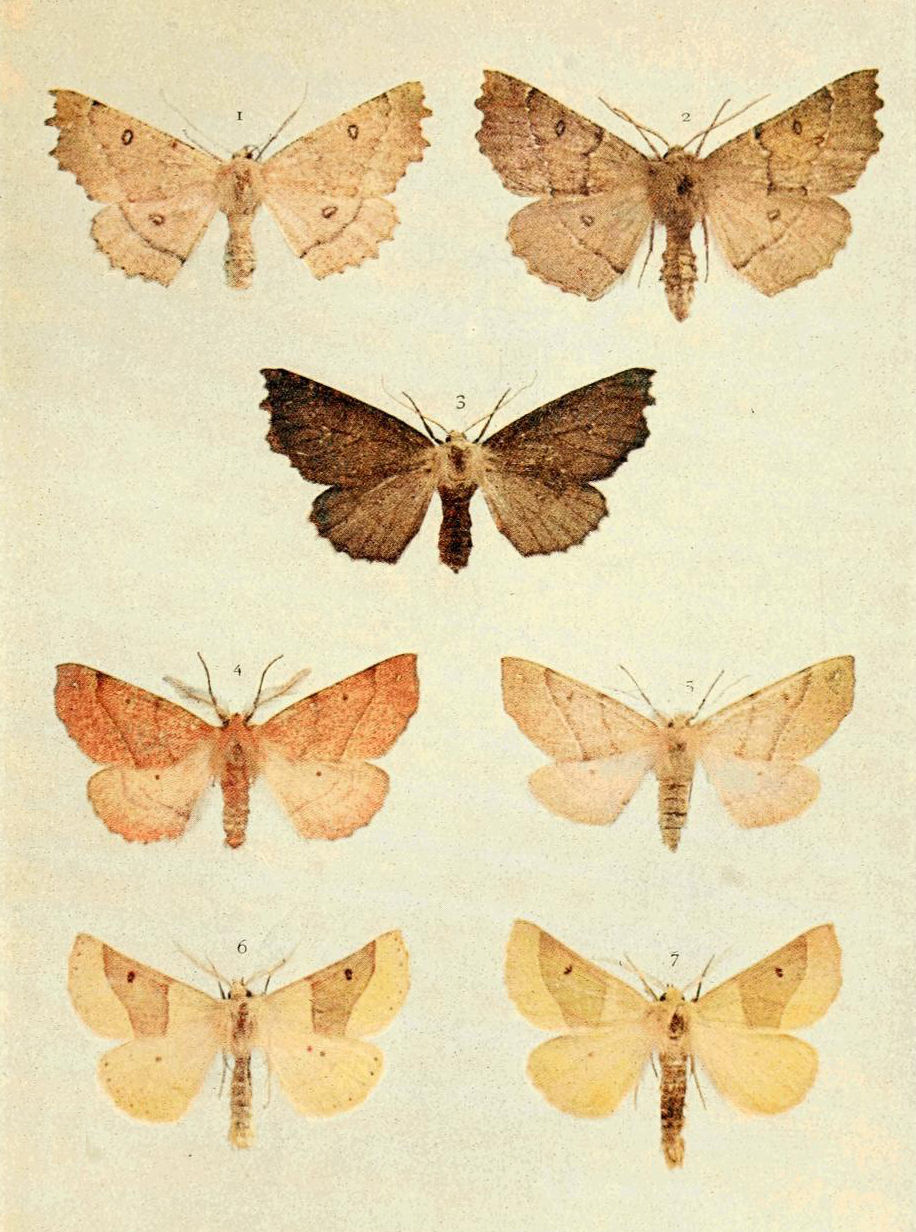
2 Pl. 114.
1-3.Scalloped Hazel. 4, 5.Feathered Thorn. 6, 7.Scalloped Oak.
2 Pl. 115.
1, 1a, 1b.Scalloped Hazel: eggs, caterpillar and chrysalis.
2, 2a.Lilac Beauty: caterpillar and chrysalis.
Feathered Thorn (Himera (Colotois) pennaria).
A more or less typical but rather small male specimen is shown on Plate 114, Fig. 4, but the ground colour is frequently more tawny in tint, and sometimes it is much paler inclining to yellowish; the cross lines may be either wider apart, or closer together, and the inner one is often clouded with blackish; sometimes both lines become almost bandlike; the submarginal, usually interrupted, line is occasionally well defined. The female, often browner than the specimen depicted (Fig. 5) is frequently tinged with purple, and occasionally with pink.
The batch of eggs, as deposited, was photographed by Mr. Main. The egg is olive green with a ring of pale specks around the micropylar end. The caterpillar is slaty grey inclining to purplish, with a series of not clearly defined ochreous diamonds on the back and a row of ochreous dots on each side; the raised points on the last ring are tipped with reddish (Plate 116). It feeds on oak, birch, poplar, sallow, apple, hawthorn, sloe, etc. April to June. The moth is out in October and November, but is seldom noticed in the daytime; at night, the males are frequently seen at gas and electric light. The species is generally common in woodlands, especially as caterpillars, over the southern half of England and Wales, and occurs more or less frequently over the rest of the country, also in Scotland to Moray, and in Ireland.
Scalloped Oak (Crocallis elinguaria).
Fig. 6 on Plate 114 shows the usual form of this species, in which there are blackish dots on the outer margins of all the wings. Fig. 7 depicts a form with the ground colour paler, and the outer marginal dots absent (ab. trapezaria, Boisduval). The ground colour varies to almost whitish on the one hand and to reddish buff on the other; the cross lines on the fore wings are distinct as a rule, but may be faint, and occasionally are entirely missing; the central space between the lines is most often brownish, sometimes tawny, but not infrequently this area is but little darker than the general colour. The blackish discal spot on the hind wings varies in size and somewhat in shape, but this and also the line beyond, are sometimes absent. Porritt (List of Yorkshire Lepidoptera) mentions two gynandrous specimens. Eggs, pale grey, with darkish grey marking (Plate 116, Fig. 2b). The caterpillar, of which two figures from coloured drawings by Mr. A. Sich are given on Plate 116, Figs. 2, 2a, varies from ochreous grey to dark grey tinged with purple; the front rings are often paler above, and the back has diamond-shaped marks upon it; the elevation on the last ring is edged with black. It feeds on the leaves of most trees and bushes during the spring. The moth is out in July and August, sometimes earlier. A pretty generally distributed species throughout the British Isles, but so far it has not been noted from the Hebrides, Orkneys, or Shetland.
Abroad, the range extends to East Siberia.
Orange Moth (Angerona prunaria).
Typical males of this species are orange and the females pale ochreous, all the wings sprinkled or freckled with purplish grey. (Plate 117, Figs. 1 ♂, 7 ♀.) Ab. corylaria, Thunberg (Figs. 2 ♂, 8 ♀), is brownish on the basal and outer marginal areas of the fore wings, and nearly the whole of the hind wings. The typical ground colour appears on the fore wings as a central band, but as a rule this does not quite reach the inner margin. Ab. pickettaria, Prout, is a modification of the corylaria form, in which the typical ground appears on the front margin above the brownish basal patch, and also along the outer margin, thus narrowing the brownish border on that area; in one male specimen the right pair of wings were corylaria and the left pair pickettaria. Another modification has the basal and outer marginal areas "a nondescript grey shade in the male and a golden brown in the female" (ab. pallidaria, Prout). Ab. spangbergi, Lampa, is of the typical form, but is without the dark freckles. Other aberrations have been named, and at least one gynandrous specimen is known. The eggs, which are laid in June, hatch in about twelve days. The caterpillars feed slowly until September or October, and then hibernate; but it has been noted that when reared in confinement, and supplied with privet, they nibble the stems during the winter. Occasionally, a caterpillar will feed up and assume the moth state in the autumn, but the usual habit is to complete growth in the spring, enter the chrysalis state in May, and appear as moths about the end of that month, if in captivity, or in June and July in the open. Various food plants have been given, among which are hawthorn, sloe, plum, birch, lilac, privet, and honeysuckle. The caterpillar is figured on Plate 118, Fig. 2.
The male flies in the early evening, but the female not until later. The species frequents woods, and may be disturbed by day from among the bracken and other undergrowth. It is more or less common in many woods throughout the southern half of England, and its range extends northwards to Yorkshire. In Ireland, it has occurred locally in counties Waterford, Cork, Kerry, Limerick, Clare, and Galway. It has been recorded from the Isle of Arran, but not from the mainland of Scotland.
Abroad, the distribution spreads to Amurland, Corea, and Japan.
Swallow-tailed Moth (Ourapteryx sambucaria).
This conspicuous-looking insect (Plate 117, Fig. 6) is frequently seen in gardens, lanes, and the outskirts of woods, pretty well all over England, Wales, and Ireland. In Scotland, it seems to be rare and confined to the south, but has been noted up to Glasgow. Very rarely the cross lines of the fore wings are placed close together, but, except in the matter of size, there is, as a rule, little variation.
The caterpillar, of which a figure, from a coloured drawing by Mr. A. Sich, is given on Plate 118, Fig. 1, is brownish, variegated with reddish or purplish. It feeds, from August to June, on the foliage of hawthorn, sloe, elder, etc., but is especially partial to ivy.
The moth is out in July, and sometimes an odd specimen or two will appear in the autumn; one was captured at Gravesend on October 22, 1904.
The species is represented in Amurland and Japan by the smaller and whiter var. persica, Ménetries.
Scorched Wing (Eurymene dolabraria).
The crumpled or shrivelled appearance of the wings, coupled with the brown coloration of the streaks and other markings on the wings, no doubt suggested the English name of this species (Plate 117, Fig. 3).
The twig-like caterpillar is brownish, tinged with greenish or reddish, and variegated with darker, especially along the back of the first three rings, the hump on ring 8, and a cross stripe on the last ring. It feeds on oak, birch, and sallow, from July to September.
2 Pl. 116.
1, 1a, 1b.Feathered Thorn: eggs, natural size and enlarged, and caterpillar.
2, 2a, 2b.Scalloped Oak: eggs, natural size and enlarged, and caterpillar.
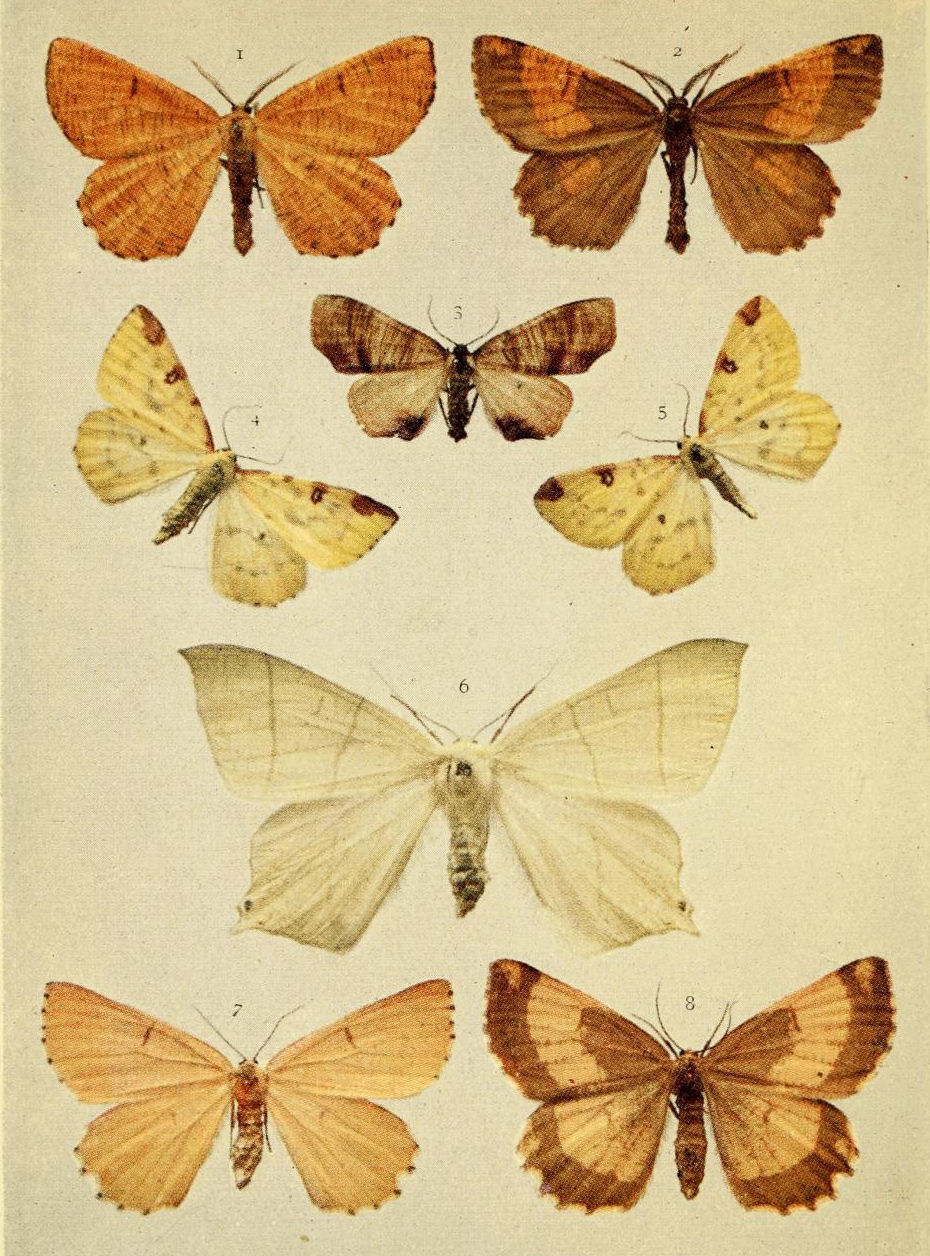
2 Pl. 117.
1, 2, 7, 8.Orange Moth. 3.Scorched Wing.
4, 5.Brimstone. 6.Swallow-tailed.
The moth, which inhabits woods, and is out in late May and in June, is sometimes attracted to sugar, but rather more frequently to light. It is, however, far more rarely seen than the caterpillar, which has been obtained in almost every English county up to Yorkshire. A specimen of the moth has been recorded from Darlington, Durham, and one at Meldon Park, Northumberland. It occurs in Wales and Ireland, but is hardly known to be found in Scotland.
The range abroad extends to Amurland and Japan.
The Brimstone (Opisthograptis luteolata).
This generally distributed and often common yellow species (Plate 117, Figs. 4 and 5) has the front margin of the fore wings marked with reddish, and occasionally a stripe of this colour extends along the front margin from the base to the tip; the discal mark is whitish outlined in reddish brown; the wavy cross lines are often faint, and not infrequently quite absent. White specimens, ab. lacticolor, Harrison, have been recorded from Cheshire and Durham, and probably have occurred elsewhere, since I have a specimen said to have been taken in Staffordshire; an orange-yellow form has occurred in the last-named county. (Also known as Rumia cratægata.)
The twig-like caterpillar is brownish tinged with greenish or purplish; there is a double-pointed hump on the back of ring 6 and smaller projections on 8. It feeds on hawthorn chiefly, but sometimes on sloe, plum, etc. It may be found after hibernation in the spring, and a second generation occurs in the summer.
The moth seems to have been noted in each month from April to August, but it is most frequent in May and June.
Bordered Beauty (Epione apiciaria).
The orange-yellow moth whose portrait is shown on Plate 119 (Fig. 1) has the outer margins, beyond the second blackish line, more or less shaded with purplish grey, inclining to purple near the line; on the fore wings, the first cross line is angled at the middle, and the second line runs to the tips of the wings. Gynandrous specimens of this and also the following species have been noted.
The early stages are figured on Plate 121, Figs. 2, 2a. The eggs, which are laid in July and August on the food plant, are pale yellow at first, then reddish, with white dots and patches. The caterpillars generally emerge in the following spring, but sometimes, at least in captivity, they hatch in about a fortnight, feed up quickly, and attain the moth state in September or October.
Caterpillar, brown, with a greenish or ochreous tinge; along the back of rings 3 to 6 is an ochreous patch, and within this a black mark, and on the rings following 6 there are more or less distinct ochreous diamonds; a dull yellowish line low down along the sides; head, dull reddish brown. It feeds, in May and June, on willow, sallow, alder, etc. The moth is out in July and August, and is not uncommon in many parts of Southern and Eastern England. Its range extends through England, Wales, and Scotland to Sutherland. In Ireland, it is widely distributed, and not at all scarce in some northern localities.
Dark Bordered Beauty (Epione parallelaria).
As will be seen on referring to Plate 119 the sexes of this species are strikingly different. The male (Fig. 2) is very similar to the last species, except that the first cross line is curved and reddish brown in colour; the second line runs to the front margin before the tip, and the outer margin beyond is almost entirely purple. The female (Fig. 3) has the ground colour pale yellowish, and the outer borders narrowed, especially on the fore wings. Very occasionally, the ground colour in the male approaches that of the female. The eggs (Plate 121, Fig. 1) are pale yellow when deposited, but afterwards become honey yellow, freckled with reddish, and later they are red all over. The caterpillar is dingy brown, inclining to greyish on the back of the first four rings, a dark mark about the middle of the back, and on each side of this two slender whitish lines are fairly distinct; underside, whitish tinged with pale violet. It feeds, in May and June, sometimes later, on dwarf sallow and willow, birch, aspen, etc.
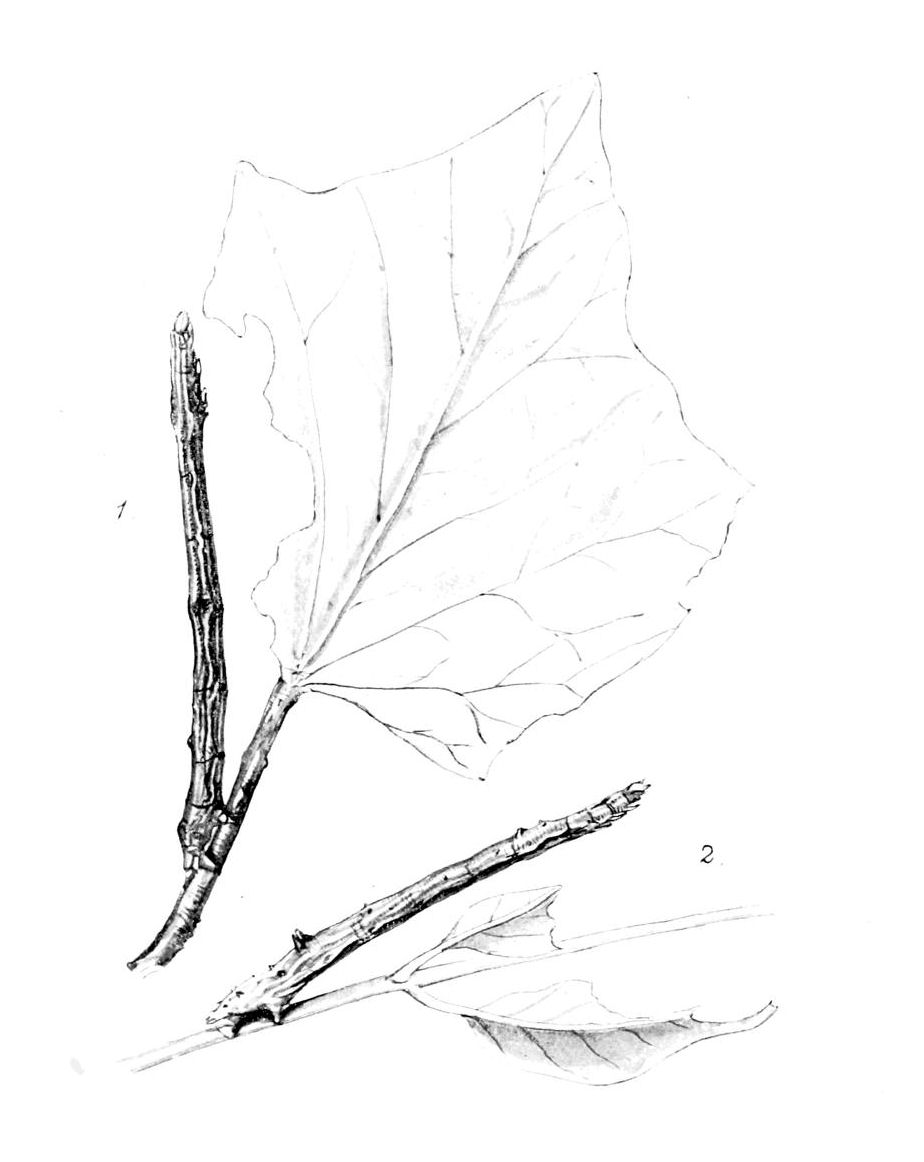
2 Pl. 118.
1.Swallow-tailed: caterpillar.
2.Orange Moth: caterpillar.
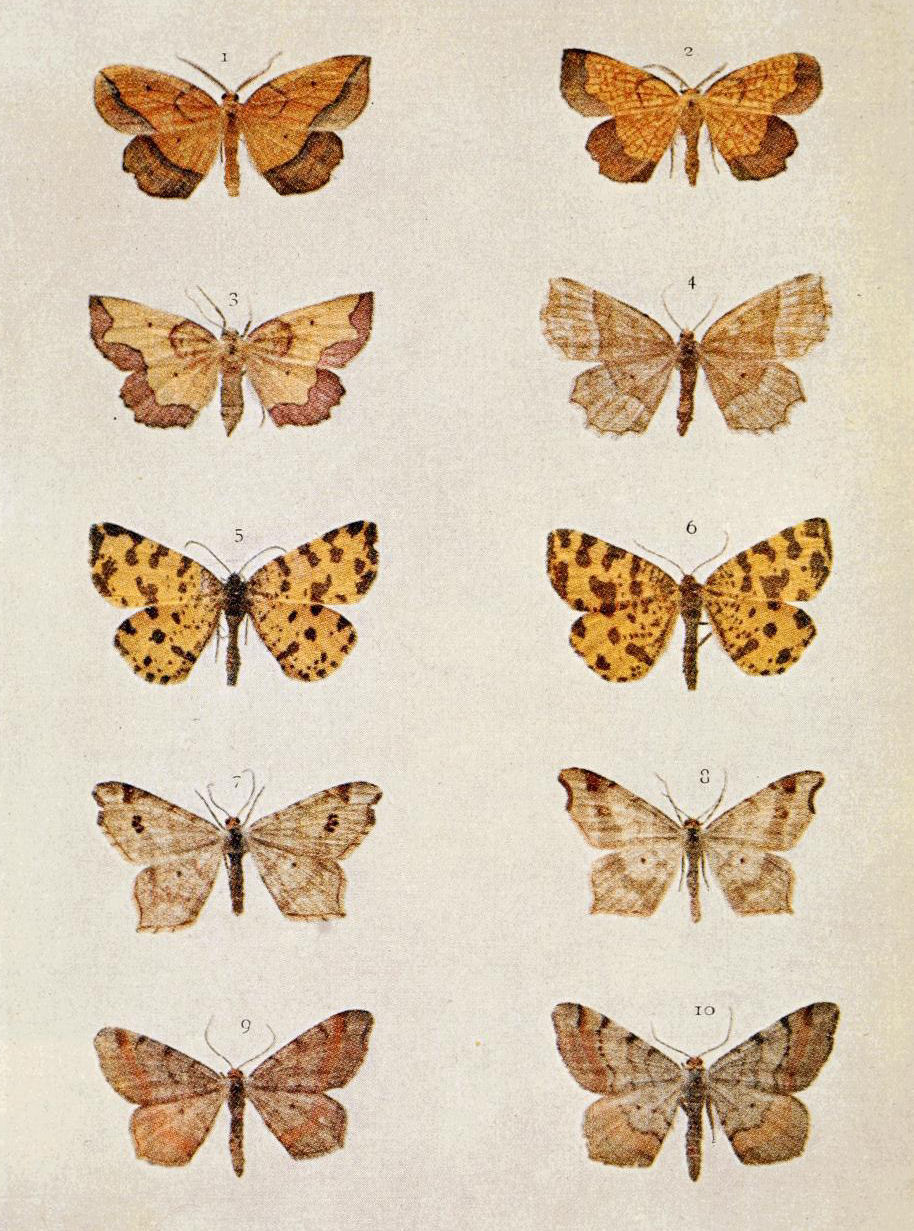
2 Pl. 119.
1.Bordered Beauty. 2, 3.Dark Bordered Beauty.
4.Little Thorn. 5, 6.Speckled Yellow.
7.Peacock. 8.Sharp-angled Peacock.
9, 10. Tawny-barred Angle.
The moth is out in July and August, sometimes later. Although odd specimens have been recorded from Norfolk, St. Ives (Hunts), Newbury (Berks), and Arundel (Sussex), the species is a northern one, occurring chiefly near York (Sanburn Moss).
In 1863, two specimens were secured at Learmouth Bog, near Cornhill-on-Tweed, and in 1890, Bolam found it at Newham Bog, on the Northumberland border. Renton states that it is fairly common in good seasons at Adderstone-lea Moss, Roxburghshire; and Salvage found it widely distributed in Sutherlandshire.
Little Thorn (Epione advenaria).
This species (Plate 119, Fig. 4) is usually whitish, freckled and clouded with grey brown; cross lines rather darker. The markings may be tinged with ochreous, or with red (Sheffield).
A uniform brown-coloured specimen with white fringes has been bred (Surrey).
The caterpillar is greyish brown, minutely freckled with blackish; two white spots on front of ring 5, and two smaller ones on 11; the rings between 5 and 11 with pale diamonds on the back, and whitish marks on the sides; head, black, white dotted. It feeds, in July and August, or even later, on dogwood, bilberry, sallow, etc. Mr. A. J. Scollick, who kindly provided the caterpillar figured on Plate 121, Fig. 3, informs me that in rearing larvæ from the egg he finds that they prefer dogwood as a pabulum, and that in the locality where he takes the moth in June there is no bilberry, but plenty of Cornus sanguinea. This local species, which is out from late May well into June, is generally associated with bilberry, but by no means confined to localities where this plant flourishes. In some of its haunts it affects bramble, and in others rose. It occurs, in woodlands, in Essex, Kent, Surrey (Leith Hill, Horsley, Chilworth, etc.), Berkshire, and Oxfordshire (near Watlington), Sussex (Abbots Wood, St. Leonards Forest, etc.), Hampshire (New Forest), Devonshire (Haldon), in the West to Shropshire, and South Wales; Derbyshire and South Yorks.
The range abroad extends to Amurland, Corea, and Japan; thus it has a more eastern distribution than either of our other species of Epione, which only reach Amurland.
Speckled Yellow (Venilia maculata).
This pretty blackish-spotted yellow species (Plate 119, Figs. 5 and 6) varies somewhat in the tint of ground colour, but more so in the number and size of the markings; occasionally some of these are united, forming bands or blotches; or they may be reduced in number and size, leading up to ab. quadrimaculata, Hatchett (Pinion-spotted Yellow), a form that used to occur rarely in the Dartford district, Kent, and of which an example is depicted on Plate 61, Fig. 2.
The caterpillar is green, with white lines and stripes; head, shining green. It feeds, in July and August, on wood sage (Teucrium), woundwort (Stachys), and dead nettle (Lamium).
The moth is a lover of the woodlands, and as it flies in the daytime, especially when sunny, will be almost certainly noted on the wing by any one rambling through the woods in June, or even late May. It is generally plentiful in the south and west of England, but although its range extends through the northern parts of the country, and widely over Scotland to Sutherland, it is more or less local and often rare in the northern area indicated. In North Wales and South-west Ireland, it is local, but not uncommon.
The Peacock Moth (Semiothisa (Macaria) notata).
Whitish, with an ochreous tinge, and clouded with ochreous grey; three indistinct cross lines on the fore wings, commencing as brownish spots on the front margin; a larger brownish spot, inclining to reddish, on the front margin beyond the angle of outer line, and a large blackish or brownish divided spot below it; a shallow notch under the tips of the wings, edged with dark brown, and fringed with smoky brown. (Plate 119, Fig. 7.)
The caterpillar is green, with brown markings on the sides, or brownish with green markings; head, black as a rule, but occasionally green. It feeds, in late June and in July, on birch and sallow; there is a second brood in August and September. The moth may be beaten out from birch bushes in May and June, and again in July and August. Woods are its favourite haunts, especially those where heather and small birch abound, but it is very local in the south of England, although it occurs in most of the counties from Kent to Cornwall. Barrett states that it is rather common in heathy woods in Staffordshire and Cheshire, and Forsythe gives it as local and uncommon in the Lancaster district; also recorded from Cambridgeshire, Suffolk, Herts (Bentley Wood, 1901), and Gloucestershire; Glamorganshire, South Wales; Inverness and Ross, in Scotland.
Sharp-angled Peacock (Semiothisa alternata).
Whitish clouded and suffused with greyish; fore wings crossed by three dark lines, commencing in blackish spots on the front margin; a greyish band follows the outer line, a reddish brown spot at the costal end, and a blackish spot about the middle, the spot broken up by the veins, which are here ochreous; a rather deep notch below the tip is edged with black and fringed with blackish. Hind wings with a black central dot, and a greyish band beyond. (Plate 119, Fig. 8.)
Mr. A. J. Scollick has recorded that some caterpillars, presumably about a week old on June 24, 1905, went into chrysalis July 7 to 12. One moth emerged July 18, but no other appeared until December 20. A third came up on January 5, 1906, and a fourth on February 5.
The caterpillar is pale green, with reddish brown blotches on the sides, and sometimes the back is also reddish brown. It feeds on alder, sallow, and sloe, in June, and as a second generation in the autumn. (Eggs and a caterpillar, the latter after Hofmann, are figured on Plate 123.) The moth flies in May and early June, and occasionally in July or August.
This species, which is always local, is perhaps most frequently met with in the New Forest, Hants, but it is not uncommon in some parts of the Isle of Wight, Dorset, Devon, and Kent. Also noted from a few other southern counties, and from Suffolk, Norfolk, and Westmoreland. In Wales, it has occurred at Neath, Glamorganshire.
The range of this species abroad, and also that of the last, extends to Amurland.
Tawny-barred Angle (Semiothisa liturata).
The more frequent forms of this species are shown on Plate 119, Figs. 9, 10. In some examples the cross lines are almost absent, but in others they are very distinct and blackish in colour; the orange yellow band in the outer marginal area varies in width and in strength, but it is usually present, even in the sooty brown form ab. nigrofulvata, Collins (Plate 61, Fig. 7), described from Delamere, Cheshire, also found in Shropshire, and recorded from "Oakley Wood."
2 Pl. 120.
1, 3.Early Moth. 2, 4, 5, 6.Spring Usher.
7, 9.Scarce Umber. 8, 10, 11, 12.Dotted Border.
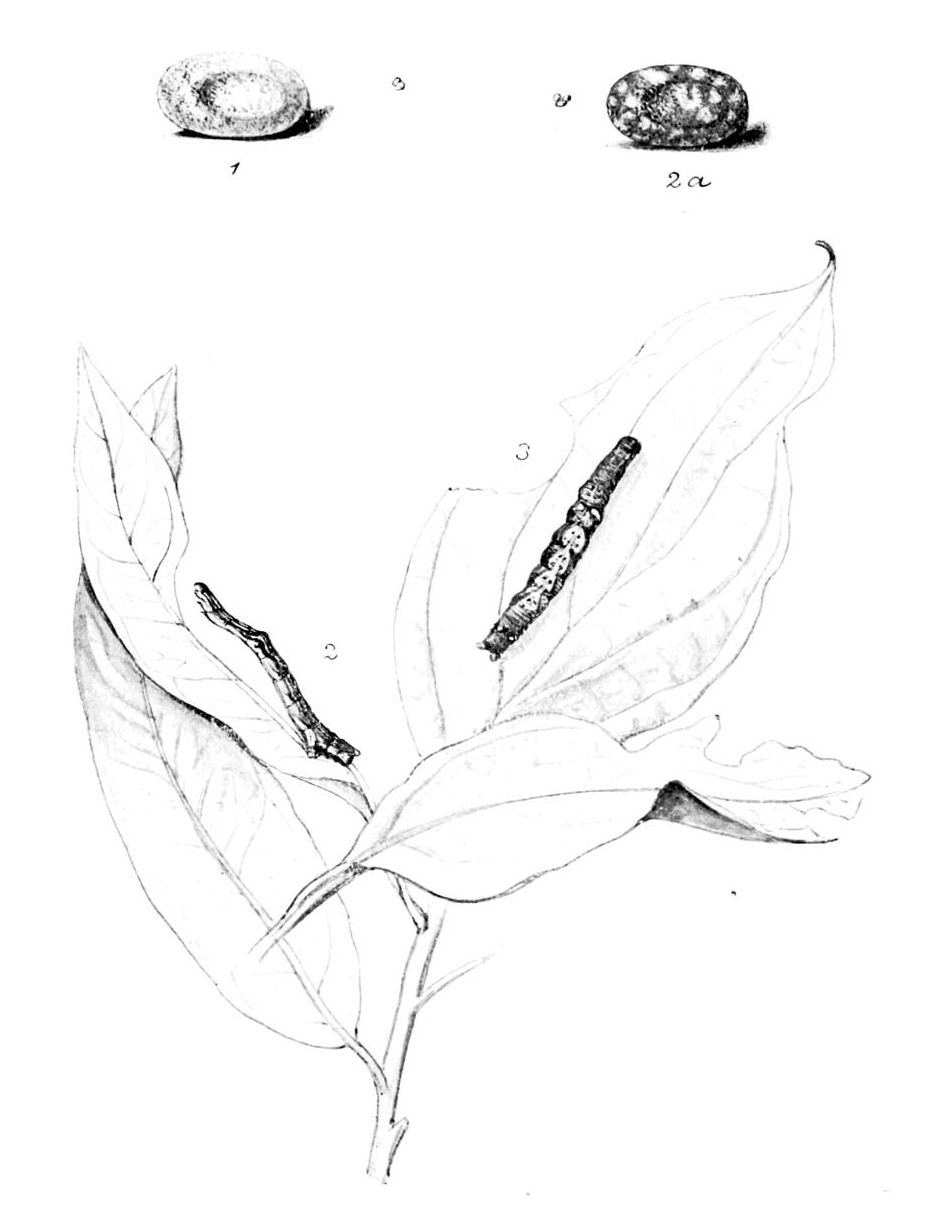
2 Pl. 121.
1.Dark-bordered Beauty: eggs.
2, 2a.Bordered Beauty: eggs and caterpillar.
3.Little Thorn: caterpillar.
The caterpillar (Plate 123, Fig. 2) is green, with white or creamy transverse lines and stripes; head, reddish. Another form is pale ochreous grey or brownish, with pale grey lines and stripes; head, almost black, with purple tinge. It feeds on the needles of Scots pine (Pinus sylvestris), in July and August, and occasionally in September and October. A photograph of the chrysalis by Mr. H. Main, enlarged to twice natural size, is shown on Plate 123.
The moth is to be found in fir woods, where it lurks among the branches or sits on the trunks, or on the fallen needles on the ground. The moths of the first generation appear in June and July and, where it occurs, the second flies in August and September. Widely distributed over the British Isles, but not noted north of Moray, in Scotland.
Early Moth (Hybernia rupicapraria).
Although generally common, and often abundant, over England, Wales, the south of Scotland, and Ireland, this species (Plate 120, Figs. 1 ♂, 3 ♀) hardly ever comes under notice unless hedgerows and hawthorn bushes are examined in January and February, by the aid of a lantern, after darkness has set in. Then the males, and almost wingless females, will be found in numbers, sitting at the ends of the twigs.
The caterpillar is whitish green, clouded with darker green, striped with white along the back, and marked with white on the sides. The general colour is sometimes very dark green, approaching black, and in this form the white markings are more striking. It feeds, in April and May, on hawthorn, sloe, plum, and bilberry.
Spring Usher (Hybernia leucophæaria).
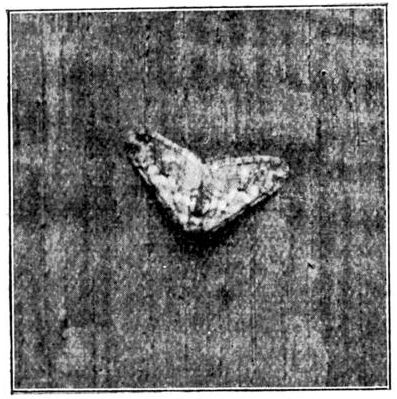
Fig. 9.
Spring Usher at rest.
(Photo by W. J. Lucas.)
On Plate 120 are shown the typical and more usual forms of this variable species. Fig. 2 represents the male, and Fig. 4 the female. The form with blackish base and outer margin is ab. marmorinaria, Esper (Plate 120, Fig. 5). Ab. merularia, Weymer, is entirely black, and a modification of this form is shown in Fig. 6. Between each of these extremes and the type there are various gradations.
The caterpillar is usually some shade of green, with yellowish lines on the back, and some have brownish marks on the sides; in others there are dark brown marks on the back of each ring. It feeds on the leaves of oak, in April and May.
The moth rests on tree-trunks, fences, etc., and the males may be thus found during the day in February, earlier or later in some seasons; the female is less often obtained on trees and fences, but may be beaten, together with the male, from the dead leaves which remain upon oak and other bushes.
The species appears to occur, more or less locally, in most of the English counties; it has also been recorded from Pembrokeshire and Flintshire, in Wales. In Scotland, it is obtained in the south, and northwards to Aberdeenshire. There are but two records from Ireland, and these are doubtful.
Abroad, the range extends to Amurland and Japan.
Scarce Umber (Hybernia aurantiaria).
One specimen of each sex of this orange yellow species will be found on Plate 120, where Fig. 7 represents the male, and Fig. 9 the female; the cross lines, in the male, are usually distinct on all the wings, but those on the hind pair are sometimes very faint, and occasionally absent. The ground colour is paler in some specimens than in others, and there is variation in the amount of purplish speckling, in the purplish clouding following the second line, and in the submarginal series of purplish marks of the fore wings. The marginal dots are sometimes absent from the hind wings, most frequently in specimens with faint cross lines on these wings.
The eggs (Plate 125, Fig. 2), when I received them in February, were purplish, or violet brown.
The caterpillar is yellowish, inclining to ochreous, lined with brown on the back, and striped with purplish on the sides; underside, dark purplish brown, inclining to blackish, and striped with yellowish. It feeds in the spring, sometimes to June, on oak, birch, blackthorn, etc., and may be found on the leaves during the day. The moth is out in the latter part of the year, from October, and is best obtained at night, when sitting on the twigs of trees and bushes, but a specimen or two may be found on tree-trunks, palings, etc., in the daytime.
The species is widely distributed over England, and in some parts it is common in woods; also occurs in Wales. In Scotland it is very rare and local in Roxburghshire; local and uncommon in the Clyde area, and has been recorded from other parts of the country up to Aberdeen. Rare in Ireland, but noted from Tyrone (local among birches at Cookstown), Monaghan, Fermanagh (Enniskillen), and Galway.
Dotted Border (Hybernia marginaria).
On Plate 120 four specimens of this rather variable species are depicted. Figs. 8 ♂ and 10 ♀ show the more usual form; Fig. 12 represents the northern English, blackish var. fuscata, Harrison, and Fig. 11 an intermediate form resulting from a cross-pairing of fuscata ♀ with a southern ♂. Somewhat similar forms to the last have been captured in Wear Dale, Durham.
Fig. 10. Dotted Border, male. Fig. 11. Dotted Border, female.
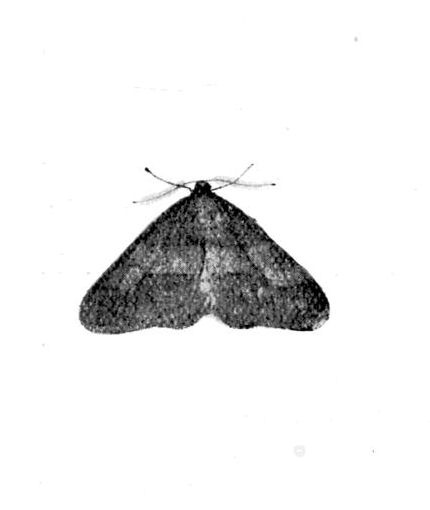
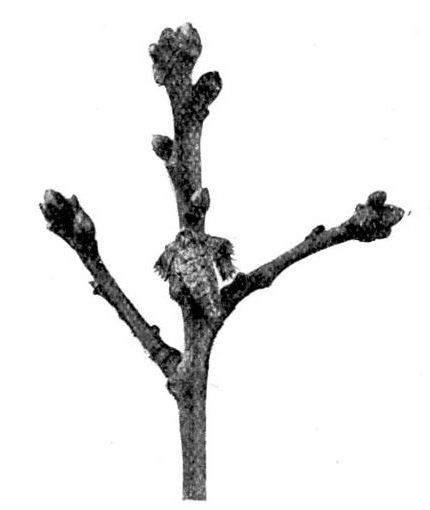
(Photos by H. Main.)
The caterpillar is figured on Plate 125, from a coloured drawing by Mr. A. Sich. It is described by Fenn as dull yellow, olive green, or greenish brown; a series of dark grey X-like marks on the back, most distinct on rings 5-11; the spiracles are white, each placed in a black cloud, and the spaces between them paler, sometimes yellowish; the last ring is often brown without marking, and the front rings have a purplish stripe above; under surface, paler throughout. It feeds, in April and May, as a rule, but has been found later, on hawthorn, sloe, oak, birch, alder, sallow, etc., and may be obtained in the daytime.
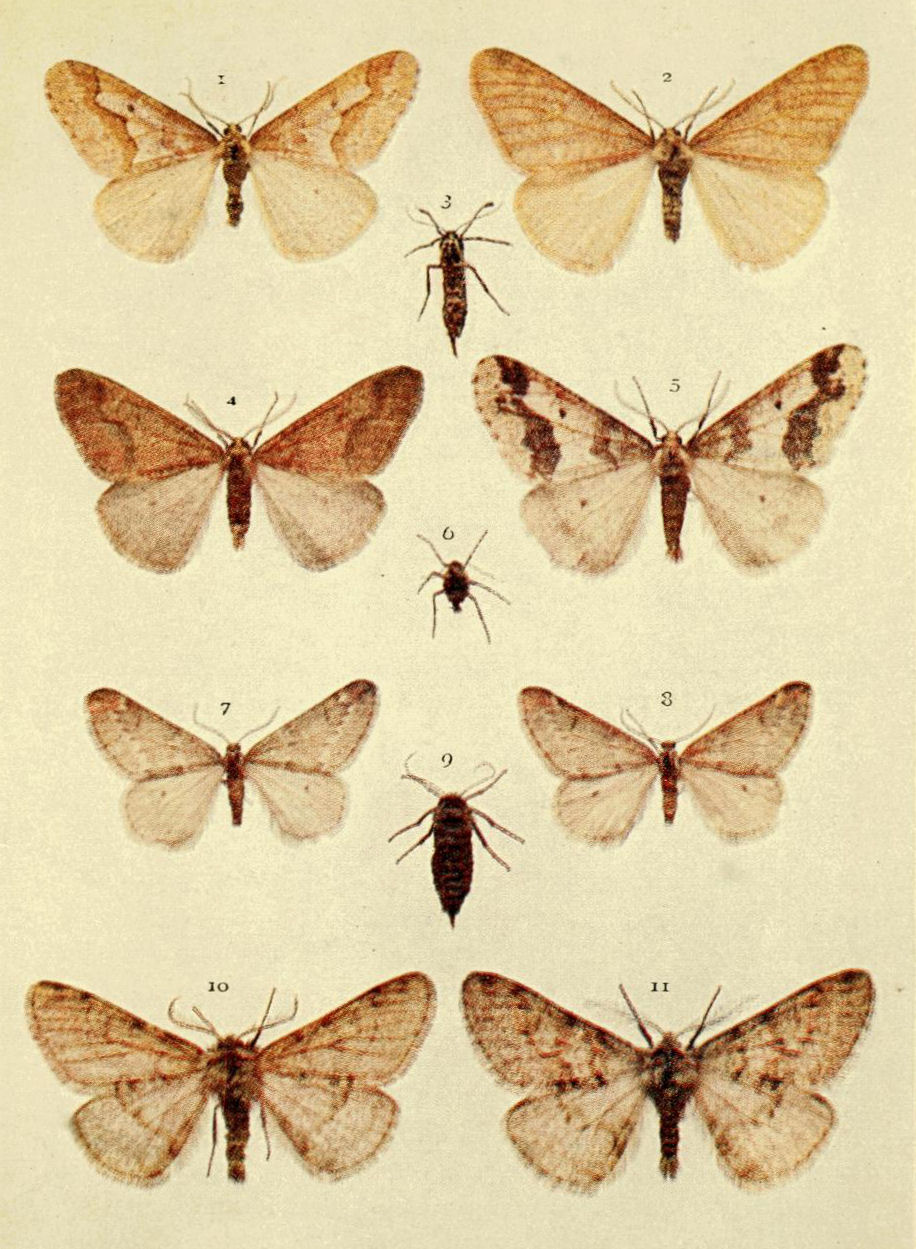
2 Pl. 122.
1-5.Mottled Umber. 6-8.March Moth. 9-11.Pale Brindled Beauty.
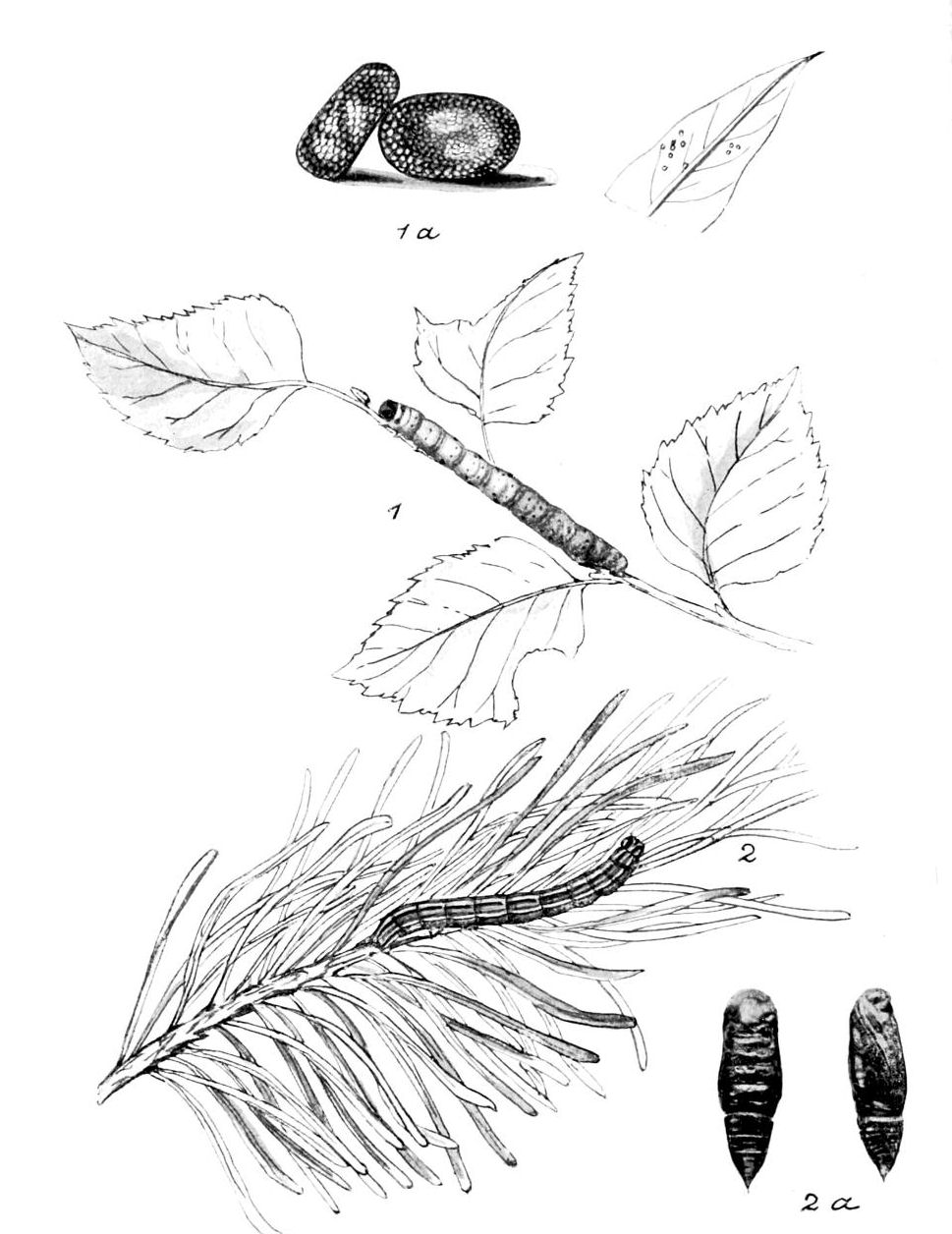
2 Pl. 123.
1.Sharp-angled Peacock: eggs and caterpillar.
2.Tawny-barred Angle: caterpillar and chrysalids.
The moth is out in March and April; and after their short evening flight the males may be seen in numbers on hedgerows and the twigs of trees. It is not infrequent at sallow catkins, and sometimes is not scarce on palings and tree-trunks. The female may occasionally be detected in the crevices of bark on tree-trunks, but is more easily obtained on the twigs at night.
The species is common over the whole of England and Wales, also in Ireland. As regards Scotland, it is abundant in the south, but its range does not seem to extend beyond Aberdeen; the var. fuscata occurs in Renfrewshire.
Mottled Umber (Hybernia defoliaria).
A female (Fig. 3) and four examples of the male of this variable species are shown on Plate 122. The ground colour of the fore wings in the male varies from whitish, through ochreous brown to dull russet brown; the cross bands (when present) range in colour from reddish brown to dark purplish, almost blackish, brown; in all the paler specimens the ground colour is more or less sprinkled or suffused with brownish; the darker specimens are sprinkled with dark purplish or blackish. Ab. obscurata, Staud., is almost uniformly dull brownish, and an example approaching this form is represented by Fig. 4.
When deposited the eggs (Plate 125, Fig. 1b) were deep straw yellow.
The caterpillar (figured on Plate 125, Fig. 1, from a coloured drawing by Mr. A. Sich) has various shades of reddish brown on the back, and yellowish on the sides and beneath; the line above the red-marked white spiracles is black, and this has an interrupted edging of white. Fig. 1a shows a pale form. It feeds on the foliage of birch, oak, and other forest trees, also on fruit trees, rose, honeysuckle, etc. It often occurs in great abundance, and is largely responsible for the leafless condition of the trees, sometimes noticed in May.
The moth appears from October to December, and occasionally in January, February, or March.
Generally abundant throughout England and Wales; widely distributed, and often common in Ireland; not uncommon in the south of Scotland, but becoming less frequent northwards to Perthshire and Aberdeen.
March Moth (Anisopteryx æscularia).
Fig. 12. March Moth, male. Fig. 14. March Moth, female x2. Fig. 13. March Moth, female.
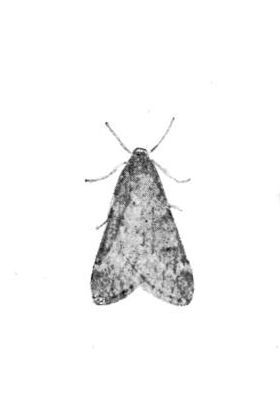
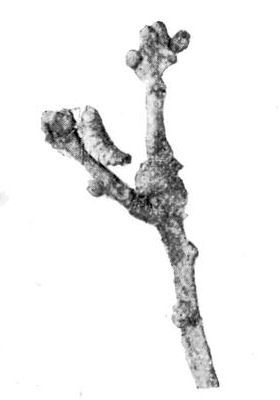
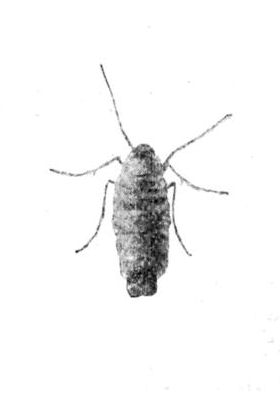
(Photos by H. Main.)
Examples of each sex are shown on Plate 122, Figs. 7 and 8 ♂, 6 ♀. The male varies in the general colour from pale to dark grey; the central area being sometimes smoky tinged. In the north of England, chiefly in Yorkshire, blackish specimens occur in which the markings are more or less obscured.
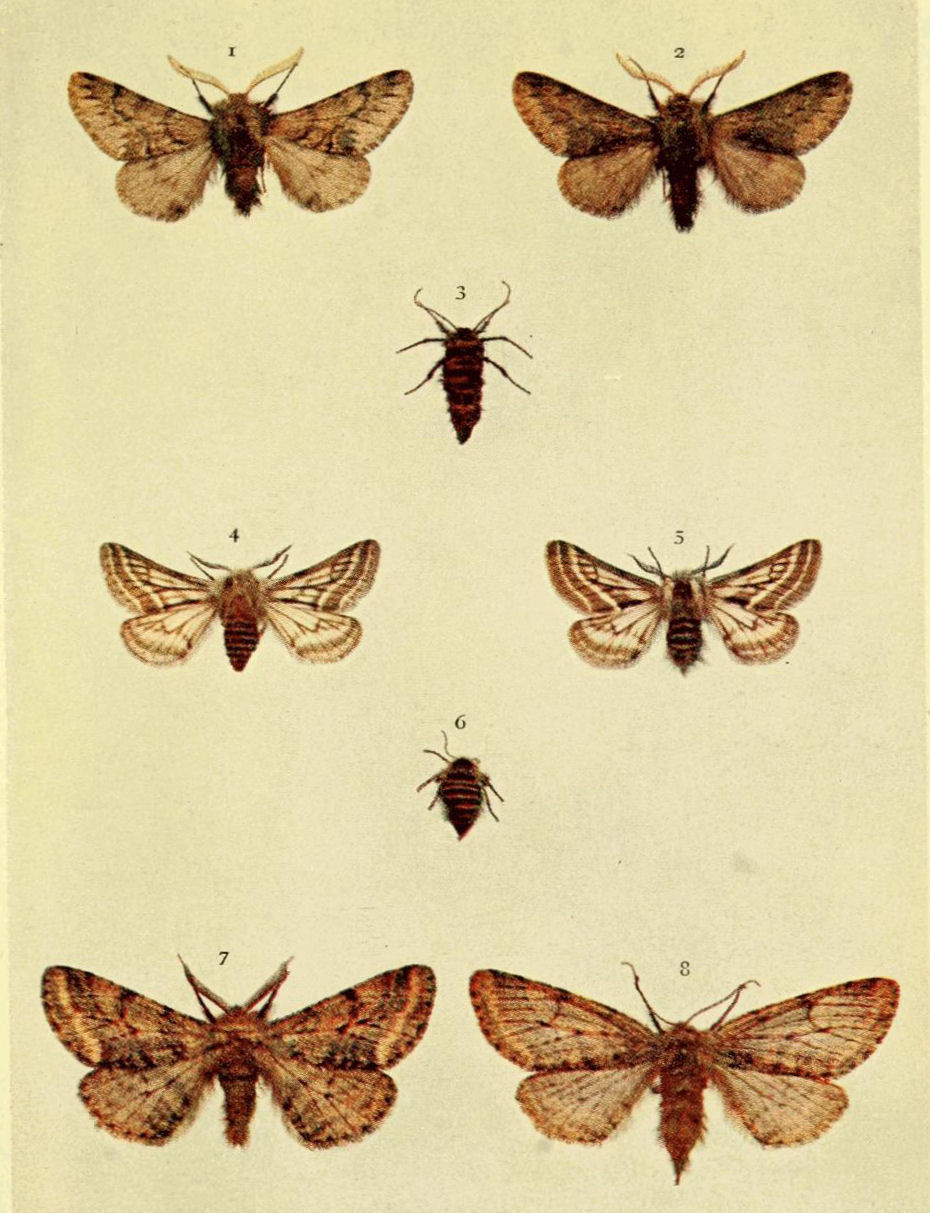
2 Pl. 124.
1-3.Small Brindled Beauty. 4-6.Belted Beauty. 7, 8.Brindled Beauty.
2 Pl. 125.
1.Mottled Umber: egg, natural size and enlarged, and caterpillars.
2.Scarce Umber: egg, natural size and enlarged.
3.Dotted Border: caterpillar.
4.March Moth: caterpillar.
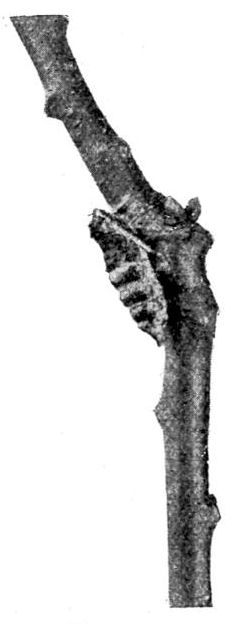
Fig. 15.
Pale Brindled Beauty.
(Photo by H. Main.)
The caterpillar is pale green with a rather darker line along the back, and yellowish lines along the sides. It feeds on hawthorn, sloe, privet, lilac, currant, plum, cherry, rose, etc., also on oak, hornbeam, and some other trees: April to June. The figure of the caterpillar on Plate 125, Fig. 4, is from a coloured drawing by Mr. A. Sich.
The moth is out in the spring, and may be found on palings, tree-trunks, etc., in the daytime, and more freely flying about, or sitting on hedges, at night, when the spider-like wingless female is more frequently obtained. The male is attracted by light, and sometimes is not uncommon on gas lamps.
Except that it seems not to have been noted north of Perthshire in Scotland, the species is generally distributed over the British Isles.
Pale Brindled Beauty (Phigalia pedaria).
The fore wings of this species (Plate 122, Figs. 9 ♀, 10, 11 ♂) are greyish, tinged with greenish or brown, and sprinkled with darker grey or brownish; the irregular cross lines are blackish. Occasional specimens in the north of England are more or less sprinkled with yellow buff or orange buff, and in these the cross-markings may be present or absent. A more frequent form of aberration in the north is a general darkening of the colour in the direction of ab. monacharia, Staud., which is smoky black with the veins black, and occurs chiefly in South Yorkshire.
The caterpillar, figured on Plate 126, Fig. 1, from a coloured drawing by Mr. A. Sich, is dull reddish brown, relieved with rust red mottling; the notched head is greyish brown. It feeds, in the spring, on birch, oak, elm, lime, poplar, sallow, hawthorn, sloe, plum and other fruit trees, rose, etc.
The moth is out as a rule during the first two or three months of the year, but it has been noted in November and December, and also in mid-June. It may be seen in the daytime on tree-trunks, palings, etc., but the female secretes herself in any convenient cranny, and is not easily detected. The male flies at night, and comes freely to light.
The species is pretty generally distributed throughout England and Wales, and Scotland up to Aberdeen. In Ireland, it has a wide distribution, but Kane states that, except in the Belfast district, it is decidedly scarce in the country.
Small Brindled Beauty (Apocheima hispidaria).
In the male (Plate 124, Figs. 1 and 2) the fore wings are ochreous grey inclining to brownish, usually much paler on the outer margin; cross lines black. Hind wings, greyish white, with a blackish central band. Fringes of all the wings chequered with blackish. Often the central area of the fore wings, between the first and second lines, is more or less blackish; less frequently the whole of these wings, up to or just beyond the submarginal line, is blackish; and sometimes the pale outer marginal area is broken up by the blackish nervules. Very rarely, the ground colour is almost white, and the cross-markings on the fore wings dusky grey. The female (Plate 124, Fig. 3) varies from brown to blackish.
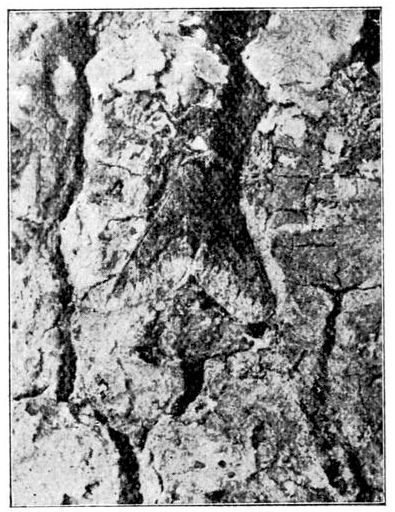
Fig. 16.
Small Brindled Beauty at rest.
(Photo by H. Main.)
The caterpillar is brown, inclining to blackish or purplish, the raised spots are black, and occasionally the sides are freckled with orange (Plate 126, Fig. 2, from a coloured drawing by Mr. A. Sich). It feeds in May and early June on oak, and will also eat hawthorn, birch, and elm.
The moth, which is out in February and March, appears to be local, but has a wide distribution through England from Durham to Hampshire, and even Devonshire. It has also been recorded from Denbighshire, North Wales. A well-known locality is Richmond Park, in Surrey, and here it is found resting on oak trunks or on the grass stems, etc., under or around the trees. The male is attracted by light.
Rannoch Brindled Beauty (Nyssia lapponaria).
The sexes of this species are shown on Plate 134, where Fig. 3 represents the male, and Fig. 5 the female. It was not known to occur in the British Isles until 1871, when a male specimen was captured in Perthshire, on April 20 of that year. Mr. William M. Christy, in 1895, bred some moths from larvæ obtained in the Highlands of Scotland, and he sent eggs to Mr. F. W. Frohawk, who worked out the life history, and described and figured all the stages from egg to perfect insect (Entom. xxviii. 237). In July, 1900 and 1901, Mr. E. A. Cockayne found caterpillars, in Perthshire (Rannoch district), on ling, heath, and bog-myrtle; and in June, 1904, he published (Entom. xxxvii. 149) some interesting observations on the habits of the species in its native haunts. The greenish yellow eggs are laid in batches of 10 to 150 in the dry corollas of the cross-leaved heath, and less frequently between the stem and sheath of reeds, or in cracks in dead bracken stems, etc. The caterpillar (Plate 126, Fig. 3) is pale drab, inclining to a yellowish tint; irregular yellow stripes along the back and sides, and lines of blackish streaks between the stripes. It will eat birch, sallow, and hawthorn, in captivity; but in the open it feeds on heather and bog-myrtle: May-July. The chrysalis is reddish brown, rather paler on the wing covers (figured on Plate 126 from a photo, twice natural size, by Mr. H. Main). The moth is out in April and May, and sits on the twigs of heather and the stems of bog-myrtle. It has only been recorded from Perthshire, and is there very local, frequenting damp places near streams.
Mr. A. W. Mera has obtained hybrids from a crossing of this species with N. zonaria.
Belted Beauty (Nyssia zonaria).
Two males and a female of this species are depicted on Plate 124 (Figs. 4, 5 ♂, 6 ♀). There is variation in the ground colour of the male, from white to greyish, and the markings are sometimes greyish brown and sometimes blackish. Kane states that, in Ireland, a large number of Connemara specimens have the fore wings entirely white, broken by dark veins, front margin, and three streaks parallel to the outer margin. The caterpillar is greenish, with dusky grey lines and freckles on the back, and a yellow stripe low down along the sides; the latter is edged below with blackish; the underside is black and striped with grey; head, greyish, freckled with darker. It feeds on sallow, dandelion, dock, plantain, clover, yarrow, grass, etc.: May to August. (Plate 126, Fig. 4; chrysalis, Fig. 4a; eggs, Plate 133, Fig. 4.) The moth is out in March and April, and rests by day on or among herbage. The male has been known to fly in the sunshine, but its more usual time of flight is the early evening.
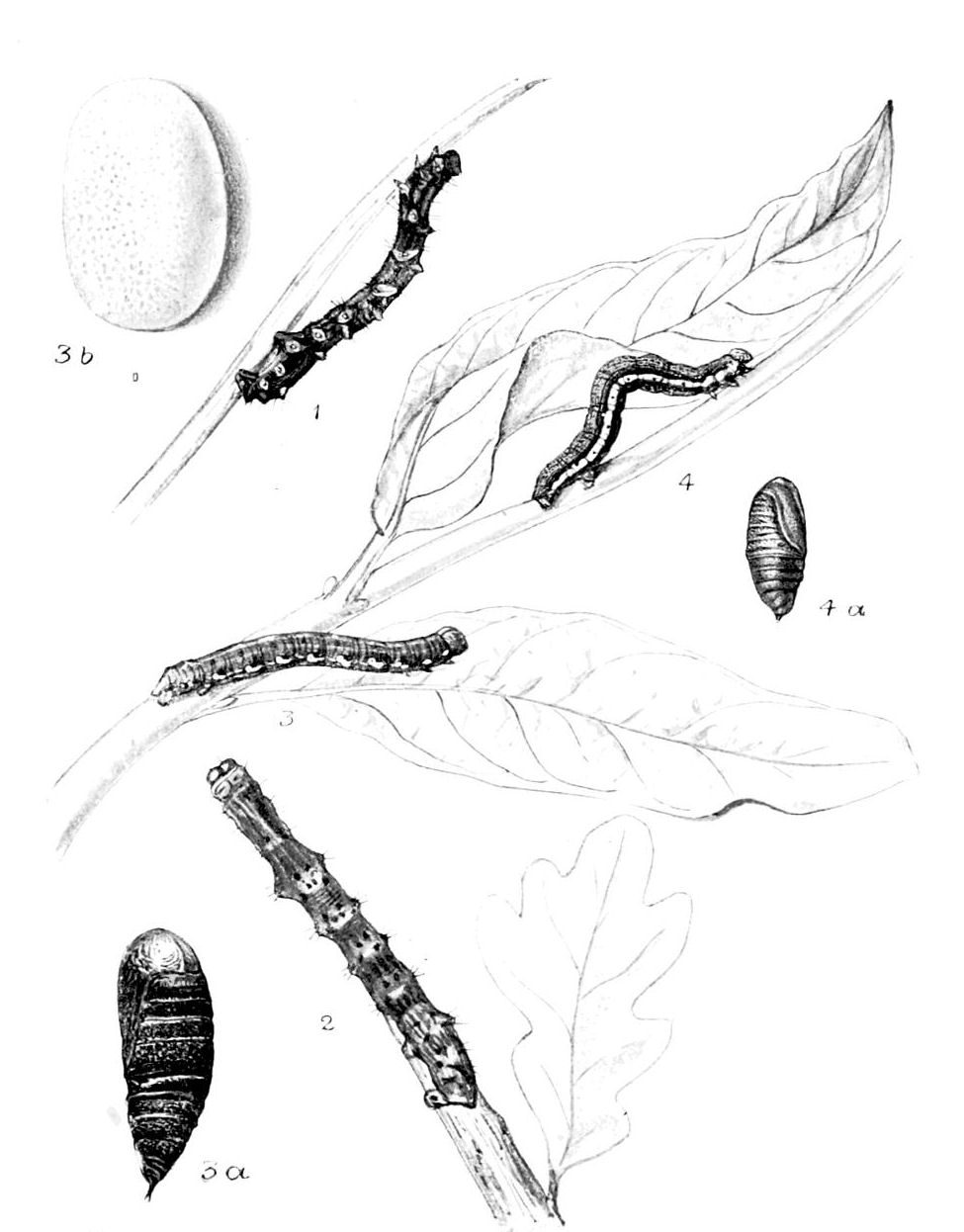
2 Pl. 126.
1.Pale Brindled Beauty: caterpillar.
2.Small Brindled Beauty: caterpillar.
3, 3a, 3b.Rannoch Brindled Beauty: egg, natural size enlarged. caterpillar and chrysalis.
4, 4a.Belted Beauty: caterpillar and chrysalis.
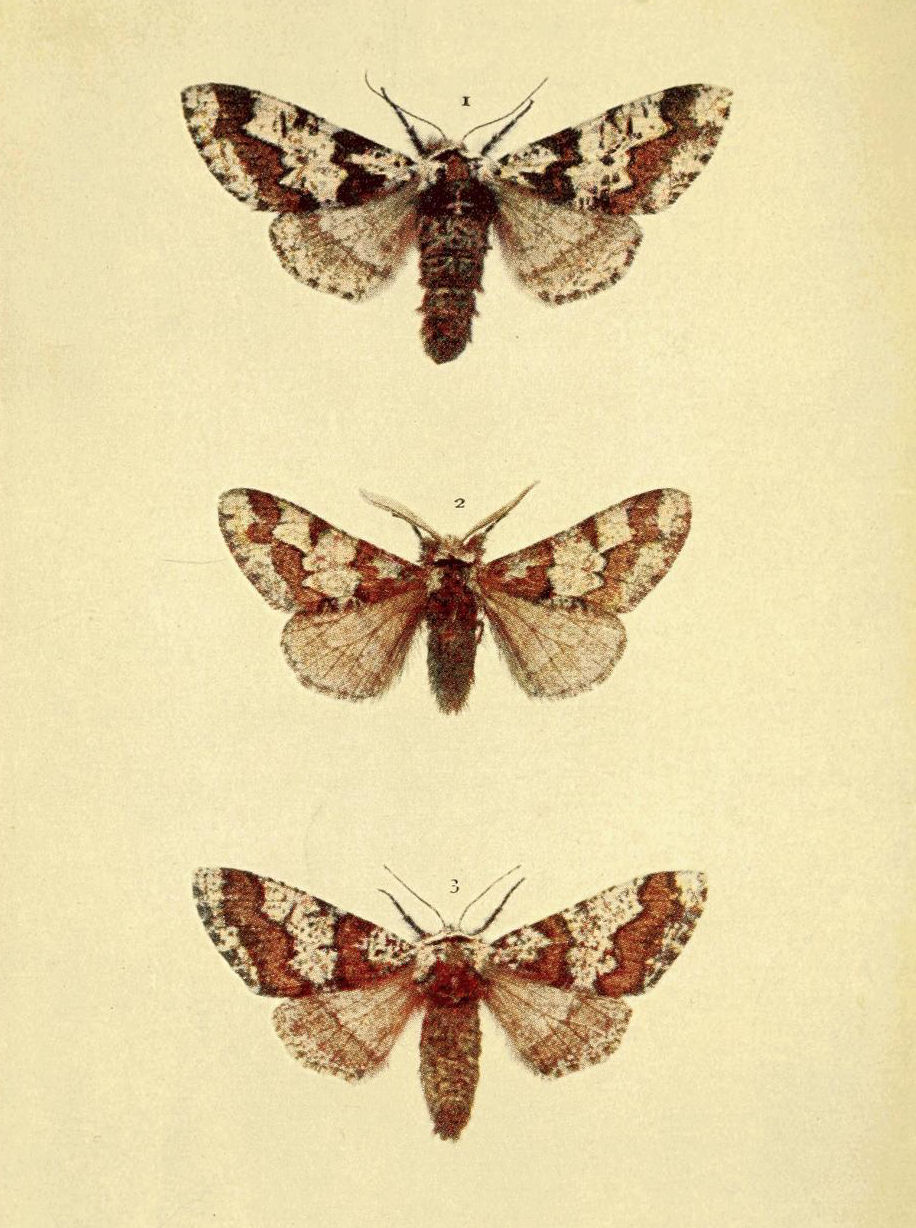
2 Pl. 127.
1-3. Oak Beauty.
The species is locally common on sand hills, on the coast of Cheshire, Flintshire, and Carnarvon; Wallasey is a noted locality, and the earliest British specimens were taken in that district about 1832; it also occurs on the Lancashire coast, in the Liverpool and Blackpool districts. In Ireland, it was first noted in Co. Antrim, where caterpillars were found at Ballycastle, and about twenty-two years ago moths were captured at the same place. Other Irish localities are Achill Island, off the coast of Mayo; Slyne Head and Roundstone, Connemara coast. There are records of its occurrence in the Isles of Skye and Tiree.
Brindled Beauty (Lycia hirtaria).
A male and a female are shown on Plate 124 (Figs. 7 ♂, 8 ♀), and these represent the more usual form of the sexes in the London district. Some specimens are paler, others are darker; and not infrequently the wings are sprinkled with yellowish.
On Plate 1 (Figs. 4, 6, 8) will be found figures of a female and two male examples of a large race taken by Mr. H. McArthur this season (1908) at Aviemore, in Scotland. One of these males is of a remarkable ochreous coloration, whilst in the other the contrast of grey ground and black marking is equally striking. The female is blackish sprinkled with ochreous.
The caterpillar is purplish grey or reddish brown clouded and freckled with darker, and spotted with yellow on rings 5-8; the first ring is also marked with yellow in front, the head is freckled with black, and about the jaws with yellow. It feeds on lime, elm, willow, and fruit trees, especially plum and pear, in May, June, and July. For the example figured on Plate 128, Fig. 1, I am indebted to Mr. Norman Riley; an Aviemore example is shown in colour on Plate 1, Fig. 7. The chrysalis (Plate 128, Fig. 1a) is dark reddish brown inclining to blackish. The moth comes out in March and April and is often a common object on tree-trunks, etc., in the London parks, squares, and gardens. Its range extends over the south of England, and northwards to Yorkshire and Cumberland, but it is nowhere so plentiful in England as throughout the Metropolitan area. It occurs in Wales, in Ireland, and in Scotland up to Inverness.
Oak Beauty (Pachys (Amphidasys) strataria).
The fore wings of this species (Plate 127, Figs. 1-3) are white, sprinkled and cross lined with black; the first line is bordered inwardly, and the second line outwardly with brownish; frequently these two lines fall closely together on the inner margin, and sometimes they are united by a blackish blotch at this point; the brownish borders of the lines vary in width, and in some specimens the outer area beyond the second black line is almost entirely brownish; in other specimens the central and outer areas are almost free of black speckling, and in such examples the brownish borders of the lines stand out conspicuously. The caterpillar (Plate 128, Fig. 2) is usually some shade of brown—greyish, violet, or purplish—mottled and freckled with a darker hue. It feeds on oak, birch, and elm, will also eat sloe, plum, rose, etc., and is found from May to July. In confinement, larvæ hatched in early May have gone down to pupate during the second week in June.
The moth is out in March and April as a rule, but has been noted in late February, and also in early May. It may be seen resting during the day on trunks of trees, palings, etc., generally near the ground; when on the wing at night the male will come to light. Although not generally common it is widely distributed over England and Wales. In Ireland it has occurred in Wicklow, Westmeath, and Cork, and has been reared from pupæ obtained at Glenmalure in the former county.
Hybrids resulting from a cross between strataria ♂ and betularia ♀ have been named herefordi, Tutt.
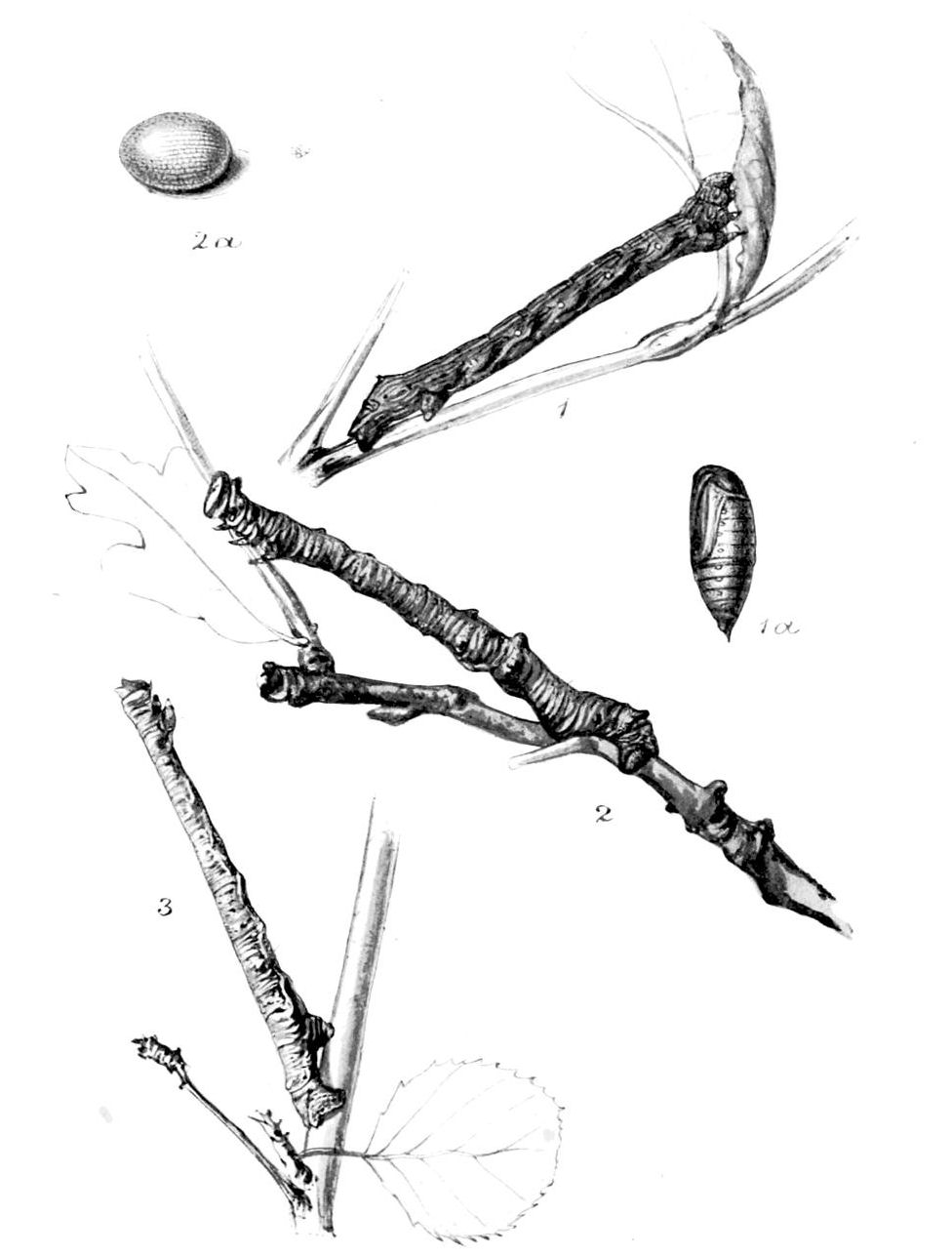
2 Pl. 128.
1.Brindled Beauty: caterpillar and chrysalis.
2.Oak Beauty: eggs, natural size and enlarged, and caterpillar.
3.Peppered Moth: caterpillar.
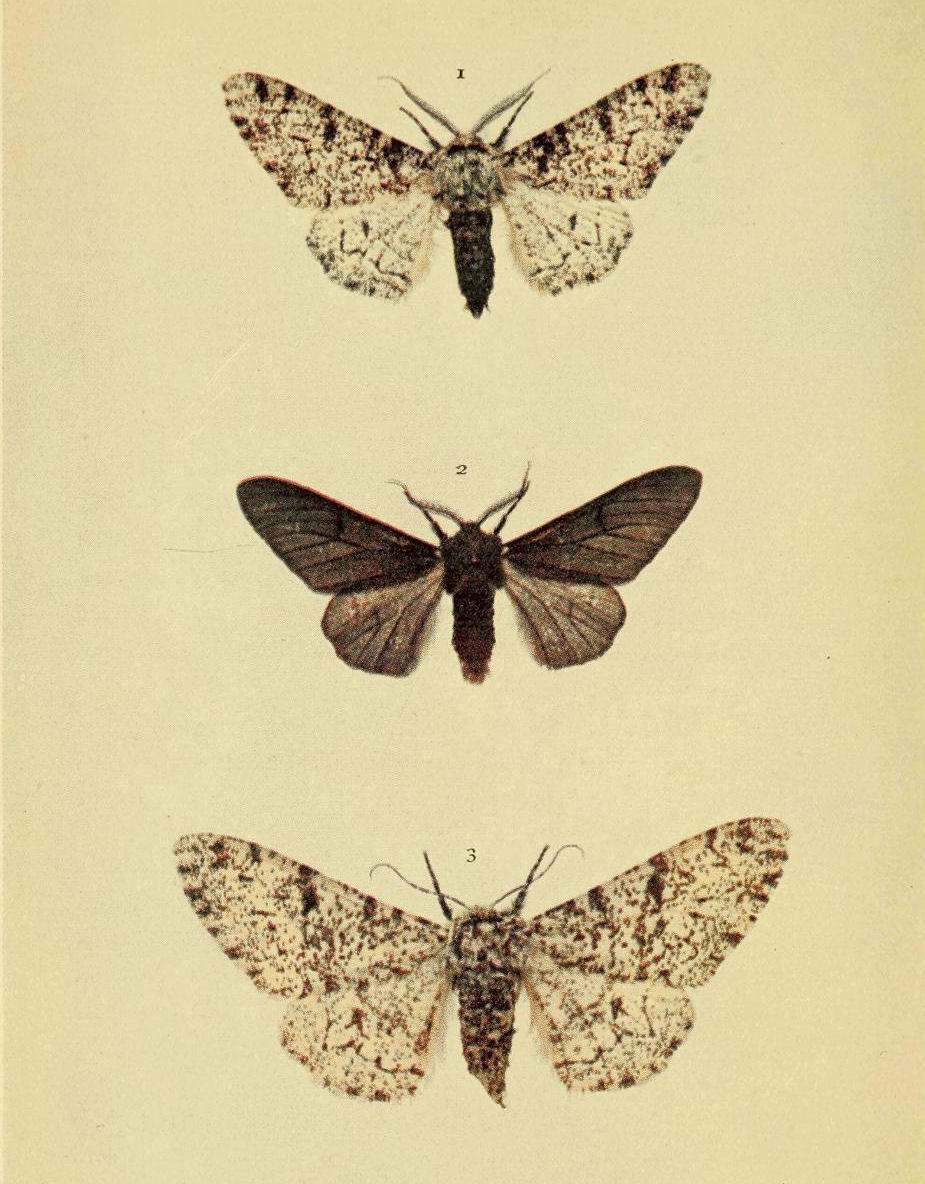
2 Pl. 129.
1-3. Peppered Moth.
Peppered Moth (Pachys betularia).
Typically (Plate 129, Figs. 1 ♂, 3 ♀) the wings are white, "peppered" with black, and with more or less distinct cross lines, also black. The black speckling varies in amount, in some examples it is almost absent, whilst in others it is so dense that the wings appear to be black sprinkled with white. Specimens of the last form are intermediate between the type and the melanic ab. doubledayaria, Millière (Fig. 2). This black form, which seems to have been unknown about sixty years ago, is now much commoner than the type in the South-west Riding of Yorkshire, and has spread into Lancashire, Cheshire, and southwards to Lincolnshire. On the wolds of the latter county, and on Cannock Chase, Staffordshire, it is said to be the dominant form of the species. The aberration also occurs in the eastern and the southern counties of England to Hampshire. Northwards, the form has extended to Clydesdale in Scotland, where one was reared from a caterpillar obtained near Paisley. In Wales doubledayaria is in the ascendant at Newport, Monmouth, and in Ireland one example of this variety together with some intermediate and typical specimens were reared from caterpillars collected at Castle Bellingham, Co. Louth. Possibly the liberal distribution of the eggs of doubledayaria may have had something to do with the comparatively rapid extension of this form, at least to districts far away from its original locality.
What is known as the buff var. of this species dates back to the year 1874, when a buff female, paired with a black male, was captured at Heaton Park. From the eggs she deposited caterpillars hatched, and in due course pupated, but the moths reared from them were all either typical, or black. Some of the female moths were, however, given to other collectors to pair with black males with the result that buff specimens appeared among the moths reared by seven collectors. Subsequently, by breeding only from buff males and females 80 per cent. of this form were said to be obtained. By the year 1880, however, the race was extinct. In all the examples of the buff var. that I have seen, including a pair in my own collection, the ground colour is normal, but the usual black markings of the wings are brownish buff; I understand, however, that there are specimens in which the ground colour is ochreous. The vapour of chlorine will change an ordinary specimen to a buff var.; and it is said that caterpillars reared in an apartment where this vapour is present will produce these buff varieties. Mr. Mansbridge has recently described ab. ochrearia, and in this form the typical black markings are present on an ochreous ground. The specimen, a female, was captured at St. Annes, Lancashire, June, 1891.
Gynandrous examples have been obtained, and seven of these abnormal forms occurred in a single brood reared from eggs by Mr. A. Harrison.
The caterpillar (Plate 128, Fig. 3, from a photo by Mr. H. Main) is green, brownish green, or purplish brown; in the green form, which is minutely dotted with white, there is generally a faint purplish line along the back, two purplish knobs on ring 8, and a purplish patch enclosing two ochreous spots on ring 11; the deeply notched head is ochreous, shaded with purplish; the last ring of the body is tinged with purplish, as also are the two small points thereon. It feeds, from July to September, on oak, birch, elm, beech, sallow, plum and other fruit trees; also on rose, bramble, etc. The moth is out in May and June, sometimes in July. The species is generally distributed, and sometimes common in the caterpillar state, but seems to be absent from the Scottish Isles.
Waved Umber (Hemerophila (Synopsia) abruptaria).
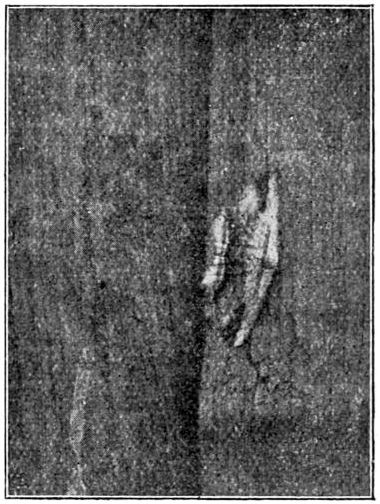
Fig. 17.
Waved Umber at rest.
(Photo by W. J. Lucas.)
A male and a female specimen are figured on Plate 130. The males are usually darker than the females, but they vary in the amount of darker clouding and suffusion. Three forms of the species have been named as follows—ab. brunneata, Tutt, a modification of the female rather more strongly coloured than the darkest typical male. Ab. fuscata, Tutt, sooty brown, tending to blackish; both sexes somewhat paler in central area of fore wings. Ab. unicolor, Tutt, similar to ab. fuscata, but without pale marking; the thorax is also darker. (Plate 134, Fig. 7, ab. fuscata.) The eggs, furnished by Mr. Norman Riley, were verdigris green when laid, but on the third day changed to greyish.
In general colour the caterpillar is greyish brown sometimes tinged with green; pinkish brown blotches along the back, often united on the front and hind rings. In some cases the caterpillar is almost black, with a lighter mark on front of the first ring. It feeds on privet and lilac, and is said to eat currant, broom, and jasmine: May to August. (Plate 133, Fig. 3.)
The moth is out in April and May, and is fond of resting on palings, trees, and even walls. It appears to be most plentiful in the London district, in the north and east of which the dark forms occur; but it is found more or less frequently over the greater part of England, and in South Wales; single specimens were taken at Hartlepool, Durham, in 1874 and 1875. One example has been recorded from Kincardineshire, Scotland; and one from Enniskillen, Ireland.
Ringed Carpet (Boarmia cinctaria).
Two specimens are shown on Plate 130. Fig. 3 represents the more or less typical form, and Fig. 4 depicts an example in which the central area is almost free of dark speckling, so that the whitish ground colour comes out distinctly. There is a good range of variation in the direction of both darker and paler forms than those figured. In some specimens with a clear white central area, the basal and outer marginal areas of the fore wings, and the outer area of the hind wings, are black or blackish; similar aberration is sometimes found in the more speckled specimens also. Occasionally, there is a projection from below the middle of the second black line to the basal band.
The caterpillar is green, with darker green and whitish lines along the back and sides. It feeds on birch, sallow, and heath (Erica cinerea), and may be reared on knot-grass. The moth is out in May, sometimes late April or early June. The New Forest in Hampshire is the district par excellence for this species, the most favoured locality being the heathy tract near Lyndhurst, where the moths are very common, in some years, on tree-trunks, especially birch, and on heather. Other localities in England are Poole Heath, Parley Heath, and Bloxworth in Dorset; Tilgate Forest, etc., in Sussex; Reading district in Berks, first noted in 1891. In Ireland, it is widely distributed, and is abundant at Killarney and some other parts of Kerry.
The range abroad extends to Amurland and Japan.
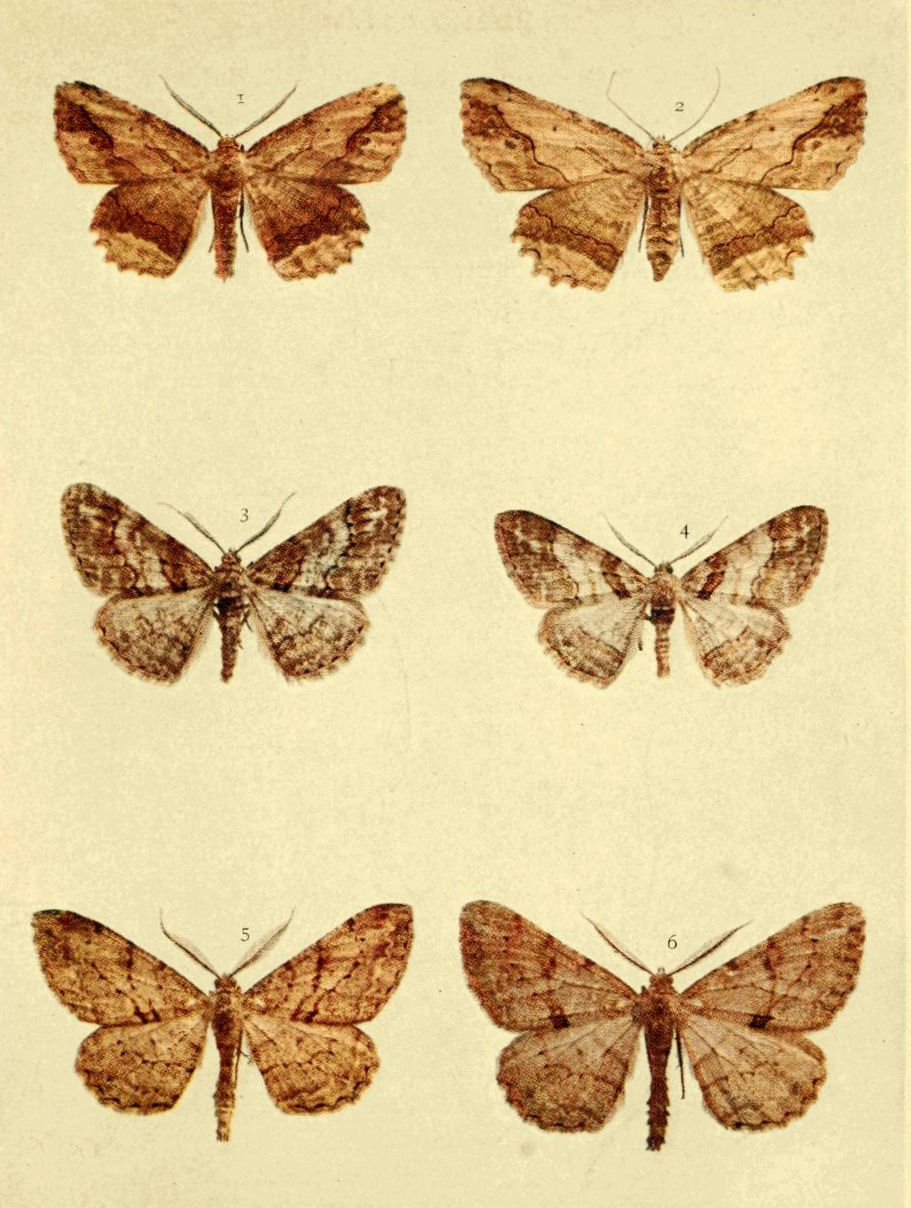
2 Pl. 130.
1, 2.Waved Umber. 3, 4.Ringed Carpet. 5, 6.Willow Beauty.
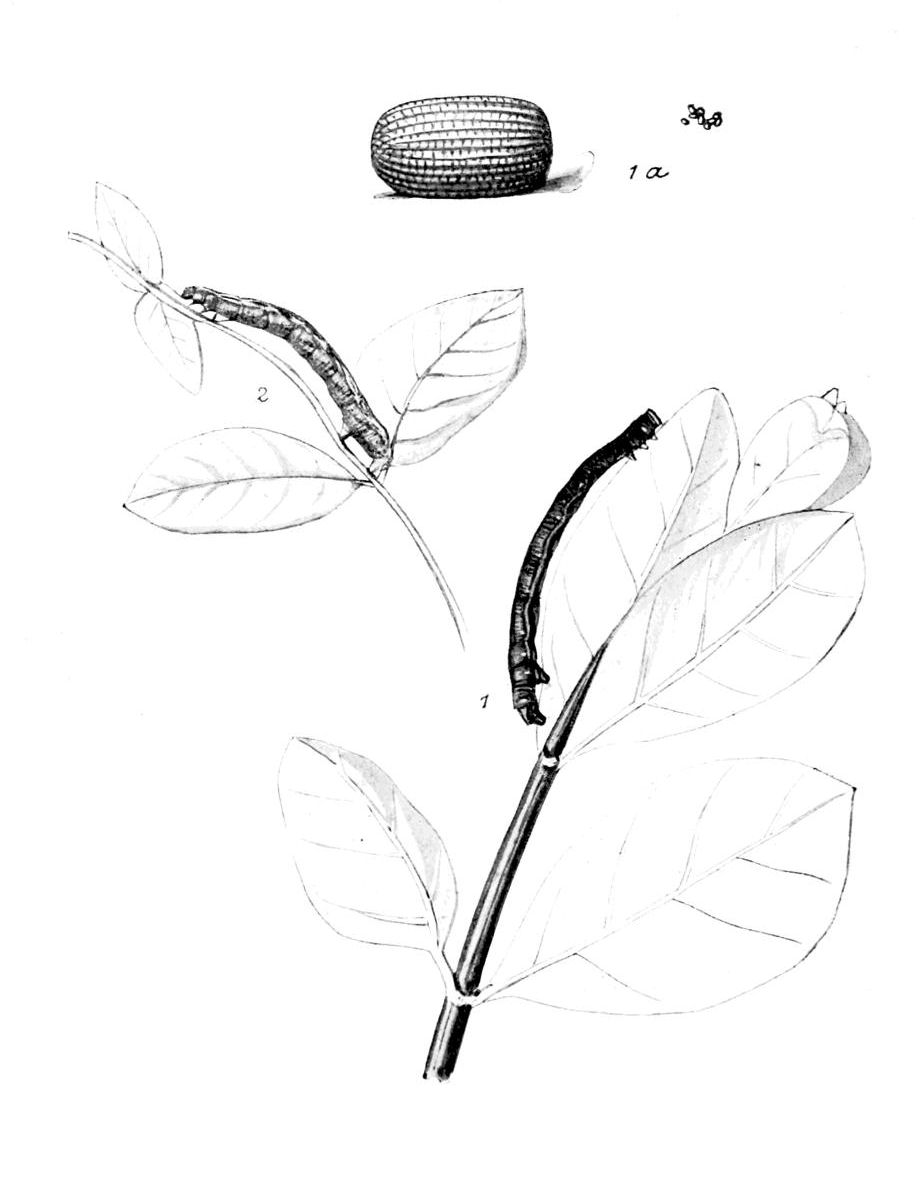
2 Pl. 131.
1.Willow Beauty: eggs and caterpillar.
2.Mottled Beauty: caterpillar.
Willow Beauty (Boarmia gemmaria).
The two portraits on Plate 130 represent the best known forms of this species. Stephens in 1831 referred the smoky or dark slaty grey form (Fig. 6), which is the ordinary one in the London district, now as then, to rhomboidaria. Newman subsequently named this form perfumaria, and he, and other entomologists of the time, considered it as a species distinct from gemmaria = rhomboidaria. We now know that the smoky grey specimens are not peculiar to the metropolitan area, but occur in other parts of England (Warwickshire, Yorkshire, Lancashire, etc.), and are found, with the type, at Howth and other localities in Ireland. The more general forms throughout England, Wales, Ireland, and Scotland up to Perthshire, are pale brown, or greyish brown (typical), sometimes ochreous tinged (Fig. 5); the latter is referable to ab. consobrinaria, Haworth. Black forms have been recorded from Norwich in Norfolk, and blackish specimens have been noted from Ashdown Forest, Sussex; from Cannock Chase, Staffordshire; and from the south of Scotland.
The eggs (Plate 131, Fig. 1a) are green at first, changing to pink mottled with green, and finally to dark grey; the latter change indicates early hatching of the caterpillar, which usually occurs about a fortnight after the eggs are deposited.
The caterpillar (Plate 131, Fig. 1, after a coloured drawing by Mr. A. Sich) is dull reddish brown, mottled more or less with ochreous; traces of diamond-shaped marks on the back, the latter sometimes well defined. It feeds on ivy (in London gardens especially), hawthorn, birch, privet, lilac, rose, clematis, broom, and many other shrubs, and also on yew and fir, in August, and after hibernation in the spring. The moth is out in July and August; sometimes a second brood occurs in September.
This species is the gemmaria of Brahm (1791), but rhomboidaria, Schiffermüller (1776), although only a catalogue name until figured by Hübner, about 1797, is adopted by some authors.
Satin Carpet (Boarmia abietaria).
As an inhabitant of Britain this species was first noted from Hampshire, and in 1825 was figured and described by Curtis as Alcis sericearia. Two specimens of this form, from the New Forest, are depicted on Plate 132, Figs. 1, 2; but paler, and also darker, examples are found in this locality, and, occasionally, melanic specimens occur as well. The latter form, some examples of which might be described as sooty black with black veins, is more prevalent among the yews and firs of Surrey.
The caterpillar, for the example of which (and also the egg), figured on Plate 138, Figs. 1, 1a, I am obliged to Mr. Arthur J. Scollick, is, in one form, ochreous brown with paler cream-coloured patches on the back; and in another dark grey-brown with paler patches, sometimes of a light cinnamon brown; a pale, thin line along the middle of the back runs through a series of brownish diamonds; there are other pale lines on the back and sides, and these are edged with brownish, and partly with blackish; spiracles outlined in black. (Adapted from Buckler.) It feeds on spruce, pine, yew, oak, birch, sallow, etc., from August to June. A larva has been found on bilberry in Devon.
The moth is out from late June to early August, but captured specimens are not often suitable for the cabinet, they are generally more or less frayed or scarred.
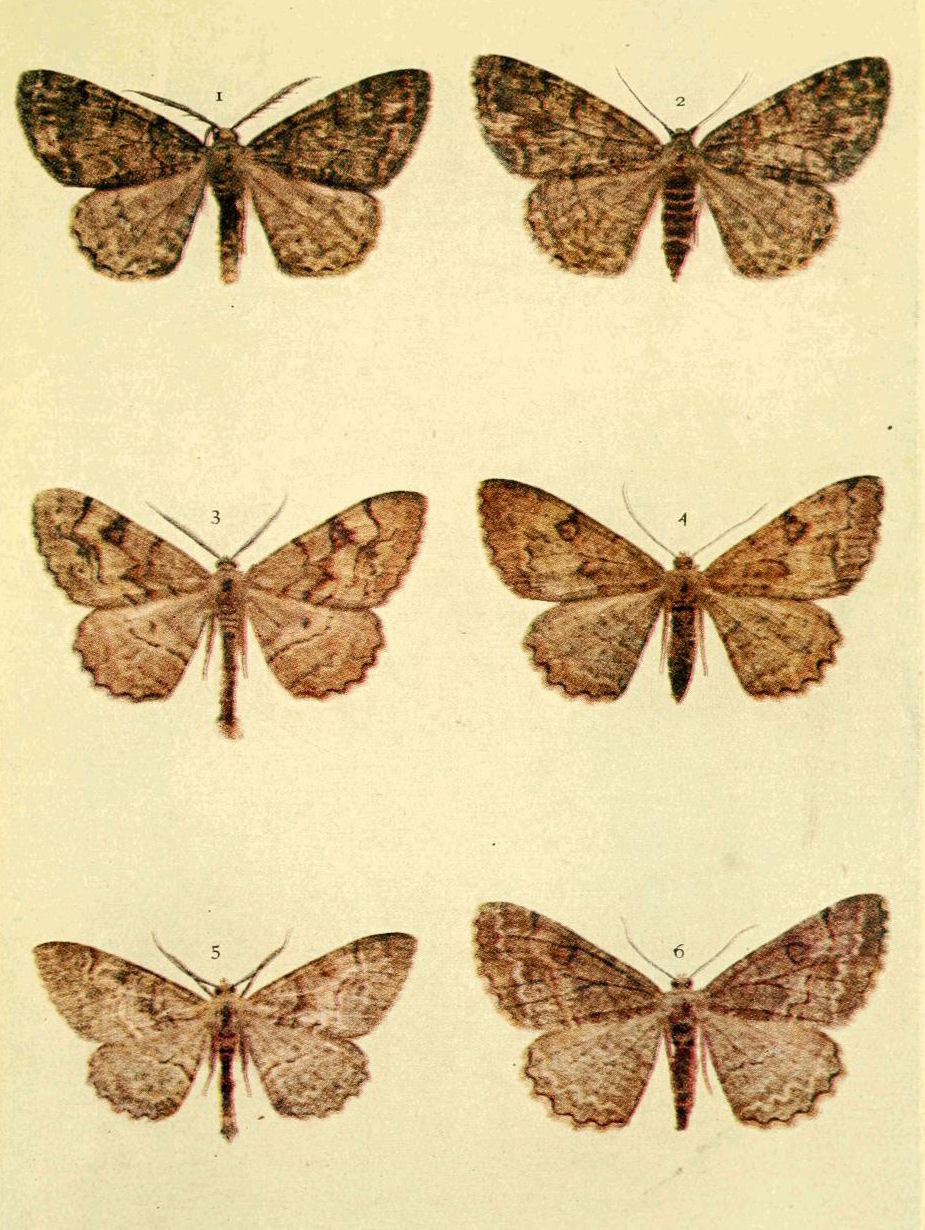
2 Pl. 132.
1, 2.Satin Carpet. 3-6.Mottled Beauty.
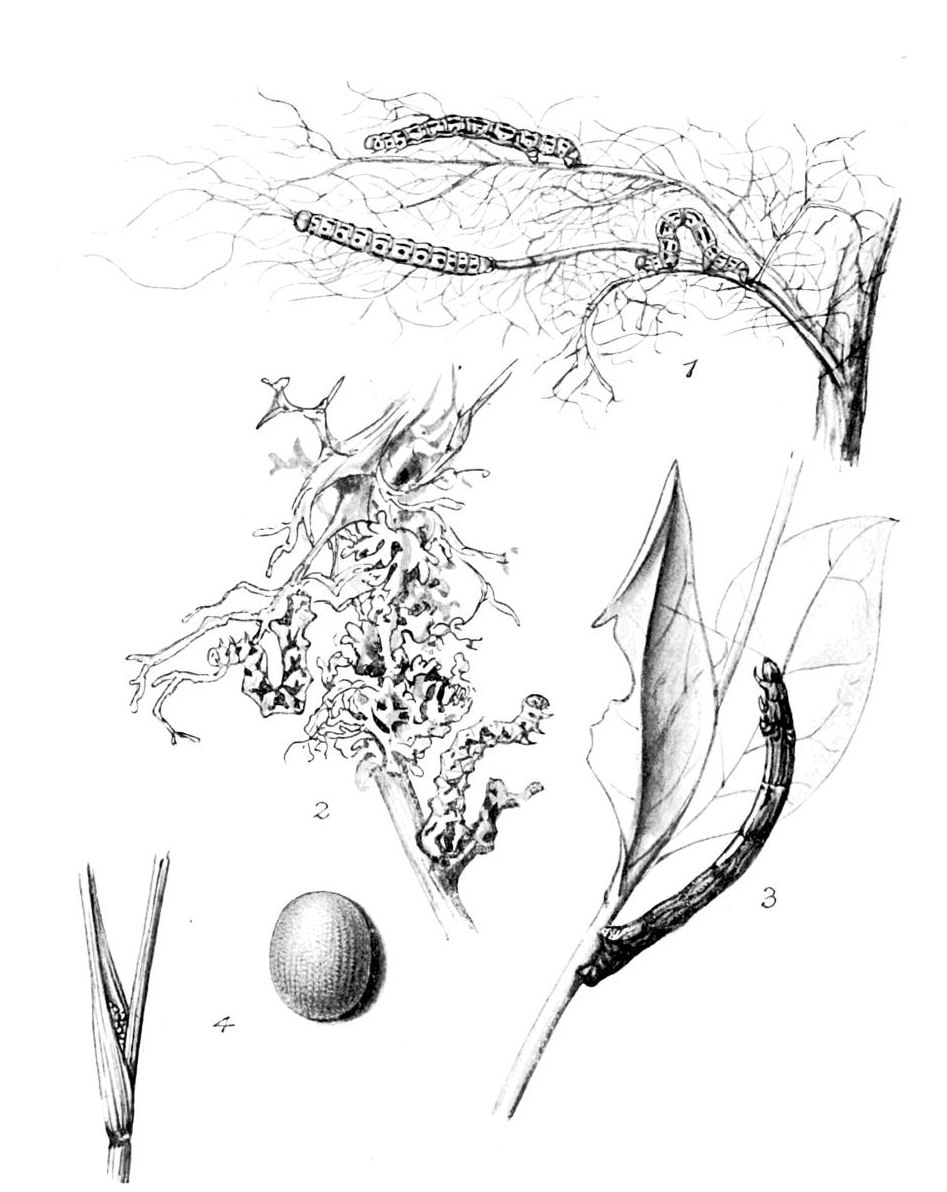
2 Pl. 133.
1.Dotted Carpet: caterpillars.
2.Brussels Lace: caterpillars.
3.Waved Umber: caterpillar.
4.Belted Beauty: eggs.
Beside Surrey and Hants, previously mentioned, the species occurs in Sussex (Tilgate Forest), Buckinghamshire (Halton), and has been recorded from Berkshire; Egg Buckland, Oxton, Bickleigh Vale, and other Devonshire localities; also from Cornwall, Somersetshire, Gloucestershire (the Cotswolds), and Monmouthshire.
Staudinger and other recent authors have adopted ribeata, Clerck, for this species.
Mottled Beauty (Boarmia repandata).
Two examples of the more ordinary mottled form of this species are shown on Plate 132, Figs. 3 ♂, and 4 ♀. Fig. 6 represents ab. destrigaria, Haworth (muraria, Curtis); and Fig. 5 depicts a specimen near var. sodorensium, Weir, from the Isle of Lewis. Dark-brown forms, inclining to blackish, are not uncommon in the London district, but in South Yorkshire coal-black specimens with whitish submarginal lines occur; a sooty black example from the Sheffield district is figured on Plate 134, Fig. 4, and, it may be added, these melanic forms are referable to ab. nigricata, Fuchs.
Two forms of ab. conversaria, Hübner, will be found on Plate 134, where Fig. 1 depicts a specimen from the New Forest, and Fig. 8 represents an extreme example from North Devon. The conversaria form occurs chiefly in the south and west of England, and is perhaps most plentiful along the North Devon coast; also in South Wales; Durham (rarely, on the coast). Broad dark banded specimens are recorded from Arran and Argyll.
The caterpillar (figured on Plate 131, Fig. 2, after Sich) is brownish inclining to ochreous; a dark brownish line along the middle of the back, and a series of brownish diamond-shaped marks most distinct on the back of the middle rings; a line of blackish marks along the sides shows up in the paler examples. Sometimes the general colour is dark reddish brown, freckled with dark brown; but in all cases the underside is paler than the upper, and is striped and lined with dark and pale brown. It feeds on hawthorn, birch, elm, hazel, bilberry, heather, etc., from July to May.
The moth is out in June and July, and specimens of a second generation have been reared in September. Generally common throughout the British Isles.
Great Oak Beauty (Boarmia roboraria).
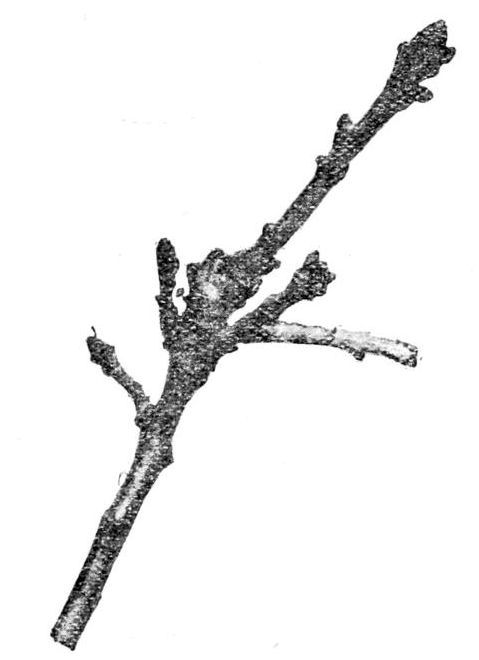
Fig. 18.
Caterpillar of Great Oak Beauty.
(Photo by "A. Forester".)
The fine Boarmid moth shown on Plate 135, Fig. 2, has all the typical markings well defined. Occasionally the black cross lines are more distinct, but sometimes they are more or less absent, or obscured. An almost black specimen is mentioned by Barrett as taken in the Reading district, Berkshire; and the same author states that a black example was captured in the Midlands about the year 1887, but no other specimen was observed until 1893, when a female was obtained, and from eggs deposited smoky black moths were reared.
The caterpillar is very like an oak twig in shape, especially when in repose. (See Fig. 18.) In colour it is reddish brown, inclining to ochreous brown; brownish grey on the humps on rings 5 and 11, and on the skin folds. It feeds on oak during the autumn, and, after hibernation, in the spring. The moth is out in June and July, and may be found on oak trees rather high up the trunks. When on the wing at night it will visit the sugar patch.
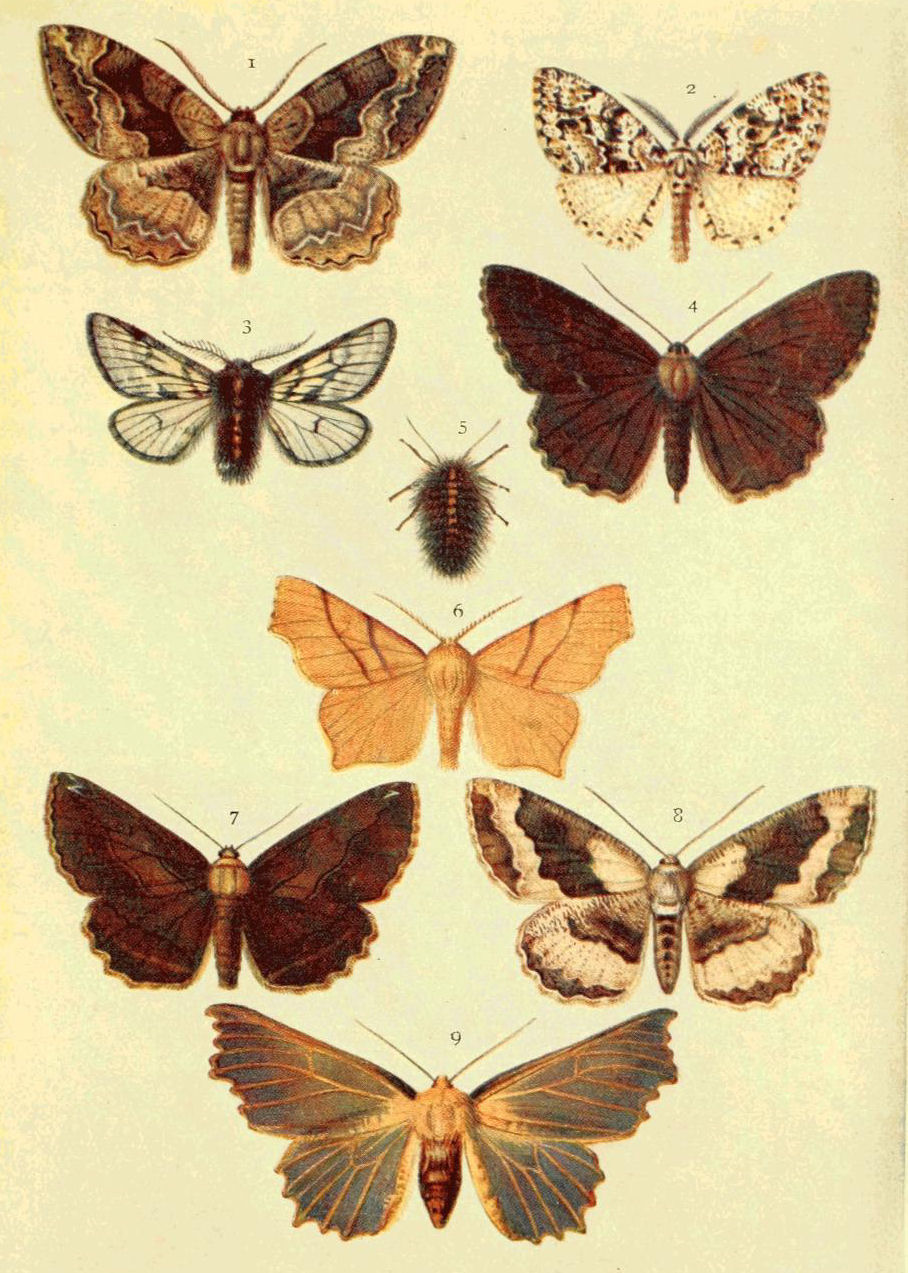
2 Pl. 134.
1, 4, 7, 8.Mottled Beauty, vars. 2.Speckled Beauty.
3, 5.Rannoch Brindled Beauty. 6.September Thorn.
9. Large Thorn, var.
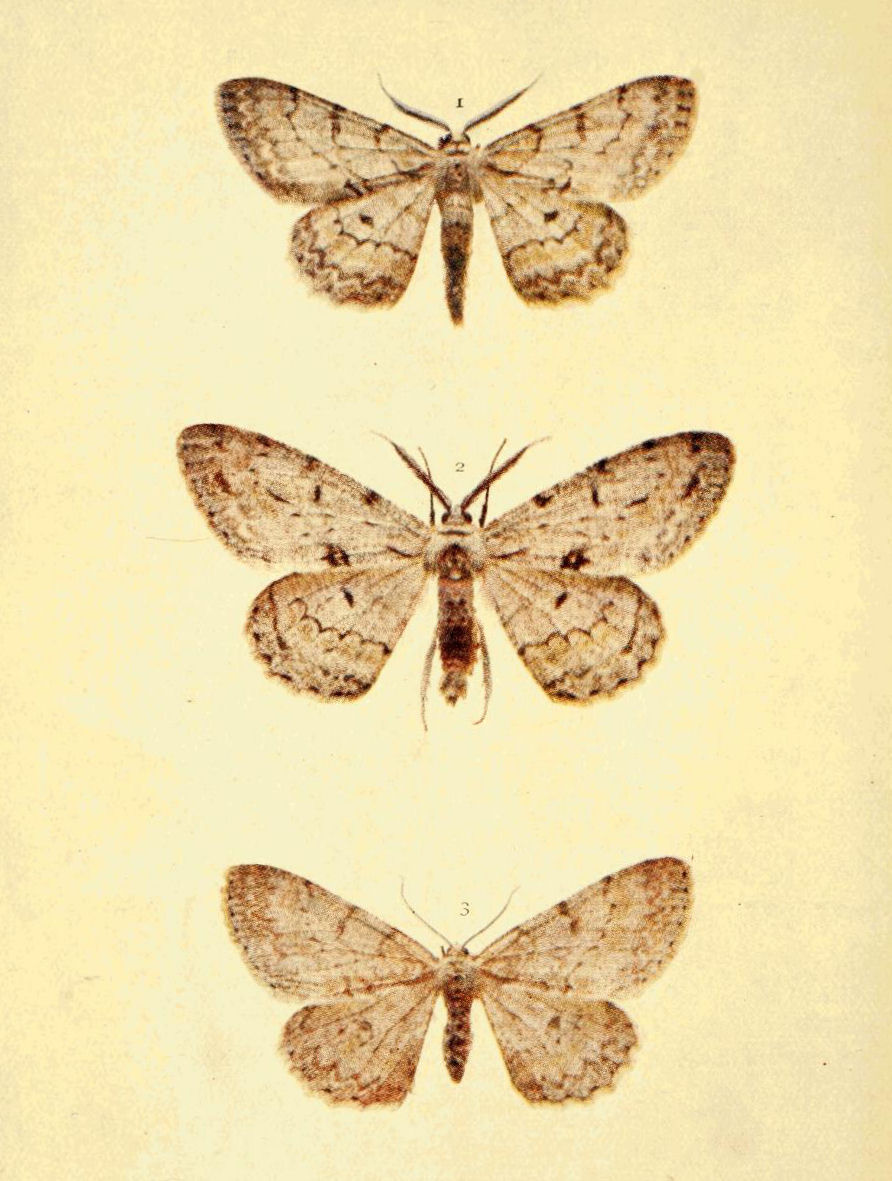
2 Pl. 135.
2.Great Oak Beauty. 1, 3.Pale Oak Beauty.
The species occurs most frequently in the New Forest, Hampshire, where, in some years, it is very common. Other English counties in which it has been found, or still exists, are—Devon (Cann Woods), Dorset (Cranborne and Bloxworth), Wilts. (Savernake Forest), Sussex (Abbots Wood, Charlton Forest, Holme Bank, etc.), Surrey (Addington, June, 1902), Kent, Essex (Epping Forest), Berks., Bucks., Warwick (Princethorpe Wood), Worcester (Wyre Forest), Stafford (Cannock Chase), Cheshire (Dunham Park), York (wood near Selby), Lancashire (Corporation and Quernmore Woods).
Pale Oak Beauty (Boarmia consortaria).
Some specimens are rather greyer, and the cross markings are occasionally less distinct than in Figs. 1 ♂, and 3 ♀ on Plate 135, which represent the typical forms of this species in England. Examples of a blackish form have been noted from a wood in West Kent, and these are apparently referable to the melanic ab. humperti, Humpert, but the Kentish specimens I have seen had the second line of fore wings edged with white, and a white submarginal line.
The caterpillar, which in shape is somewhat like that of the last species, varies in colour. One form is greenish grey, with three lines, the central one darker than those on each side. In another the colour is pale brown mottled with reddish and a darker brown. It feeds on oak, birch, and sometimes sallow, in July and August.
The moth is out in June and July, and specimens have been recorded as captured in September. It may be found on the trunks of oak and fir trees, and will come to sugar and light at night. Although local it is not uncommon in the New Forest and other woods in Hampshire; also in Sussex, Surrey, Kent. and Berkshire. It has been recorded from Buckinghamshire, Wiltshire, and Dorsetshire; and as local and scarce in the Lancaster district.
The range abroad extends to Amurland and Japan, and in both countries it is represented by var. conferenda, Butler.
Speckled Beauty (Cleora angularia).
Stephens, who in 1831 figured this insect as Cleora viduaria, Wien. Verz., remarks, "All the examples I have seen of this beautiful species were captured in the New Forest: the first about June, 1822, the remainder in 1825 and 1826: I believe in the vicinity of Lyndhurst." Barrett states that the late Mr. Samuel Stevens obtained a number of specimens "by sweeping the upper branches of oak trees in the New Forest with a long pole." This was in 1849; and between that year and 1872, about which time it seems to have disappeared, the moth was found, by those who knew where to look for it, in the Forest between Brockenhurst and Lyndhurst. Specimens have also been taken, in the past, in Tilgate Forest, Sussex, by the late William Tester, and by Mr. Merrifield, at Holm Bank, near Henfield, in the same county. There have been recent rumours of its reappearance in the New Forest, but I have been unable to ascertain anything definite about this. The specimen depicted in Plate 134, Fig. 2, has been kindly lent by Mr. R. Adkin.
The caterpillar, stated by Hofmann to feed on lichen growing upon oak and birch, is brownish variegated with paler shades.
Brussels Lace (Cleora lichenaria).
The greenish grey species shown on Plate 136, Figs. 1 ♂, 2 ♀, varies in tint; the fore wings are often clouded with olive, and occasionally with blackish; there is frequently a tinge of ochreous between the black cross lines, but sometimes this area is flushed with orange.
Two figures of the caterpillar will be found on Plate 133, Fig. 2. In colour and marking it so closely resembles the greenish-grey lichen upon which it feeds, that its detection thereon is not always easy. May and June are the best months in which to collect the caterpillars (although they may be found during the autumn and early spring), and they may then be jarred from the lichen (Usnea barbata), etc., growing on branches of trees and bushes, or searched for among the lichen on the tree trunks, or on wooden pales and fences.
The species is widely spread over the southern half of England, but is more or less rare from the Midlands northwards. It has occurred in South Wales; and Kane states that it is widely distributed and locally common in Ireland. In some parts of South Scotland it is not uncommon, and its range extends to Aberdeen and Ross.
The Dotted Carpet (Cleora jubata).
This species (Plate 136, Figs. 3, 4) has long been known as glabraria, Hübner, but as authorities are agreed that jubata, Thunberg, is an earlier name, it must be adopted. The general colour is whitish, powdered with dark grey and black; there are four black spots on the front margin and from these blackish markings cross the wings, but only the first line is generally distinct, although a second line, beyond the large black discal spot, is sometimes clearly defined and entire; occasionally a central shade and a submarginal line are both in evidence. The hind wings have a black central spot and a blackish line beyond, but the latter is often absent. Exceptional aberration takes the form of leaden black blotches, clouds, and streaks on the fore wings, and dusky clouding on the hind wings, chiefly on the basal area.