Front matter (continued 5)
Reading edition
The range abroad extends to Eastern Siberia, Amurland, and Japan, but the ab.fumosa is only known from Britain.
Pretty Chalk Carpet (Melanthia procellata).
From almost any well-grown hedgerow, in which traveller's joy, or old-man's beard (Clematis vitalba) is plentiful, throughout the southern counties of England, this species (Plate 82, Fig. 14) may be disturbed by the beating stick. It is generally to be met with in July and early August, but may be obtained in forward seasons, or in sheltered localities, at the end of June.
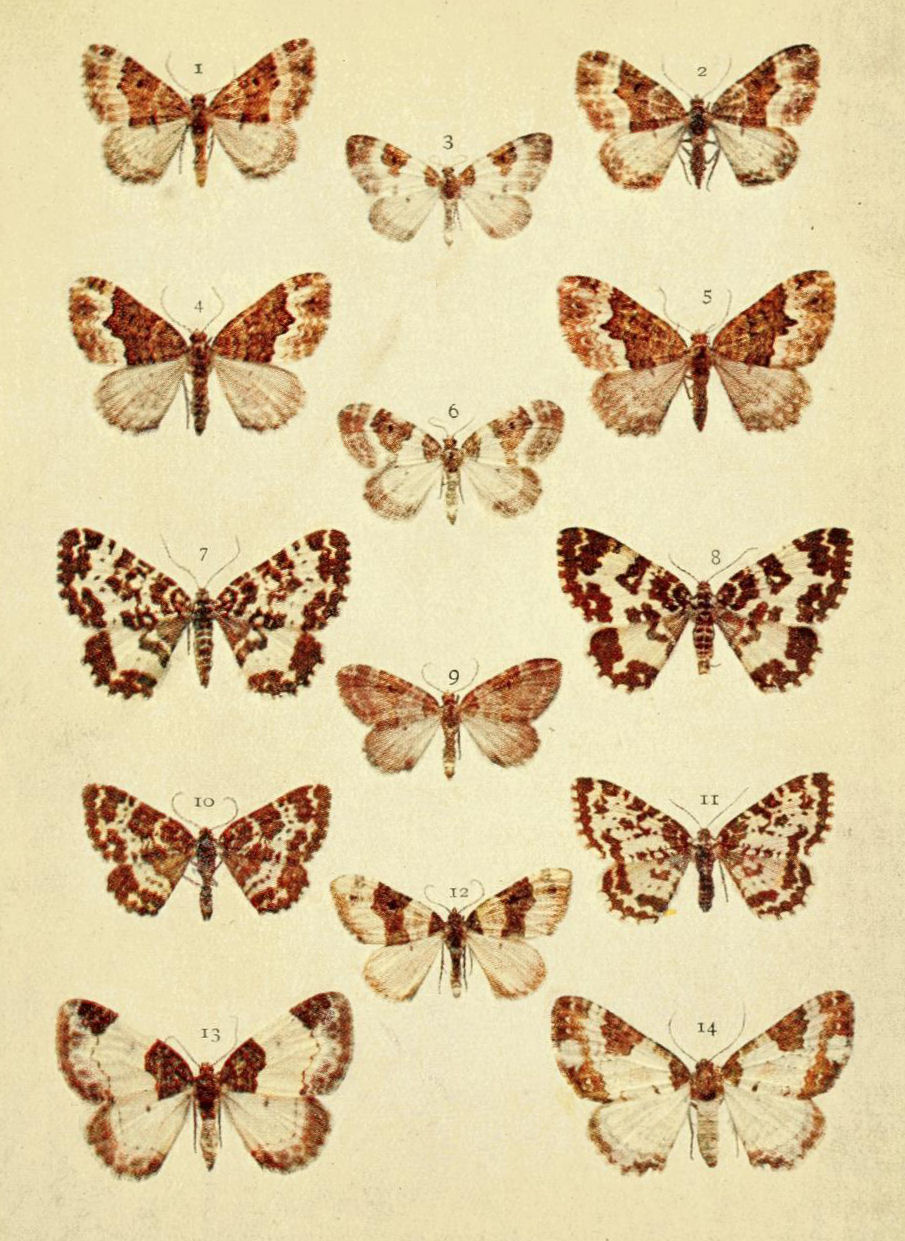
2 Pl. 82.
1, 2.Sharp-angled Carpet. 3, 6, 9.Blue-bordered Carpet.
4, 5.Cloaked Carpet. 7, 8, 10, 11.Argent and Sable.
12.Purple Bar. 13.Beautiful Carpet.
14. Pretty Chalk Carpet.
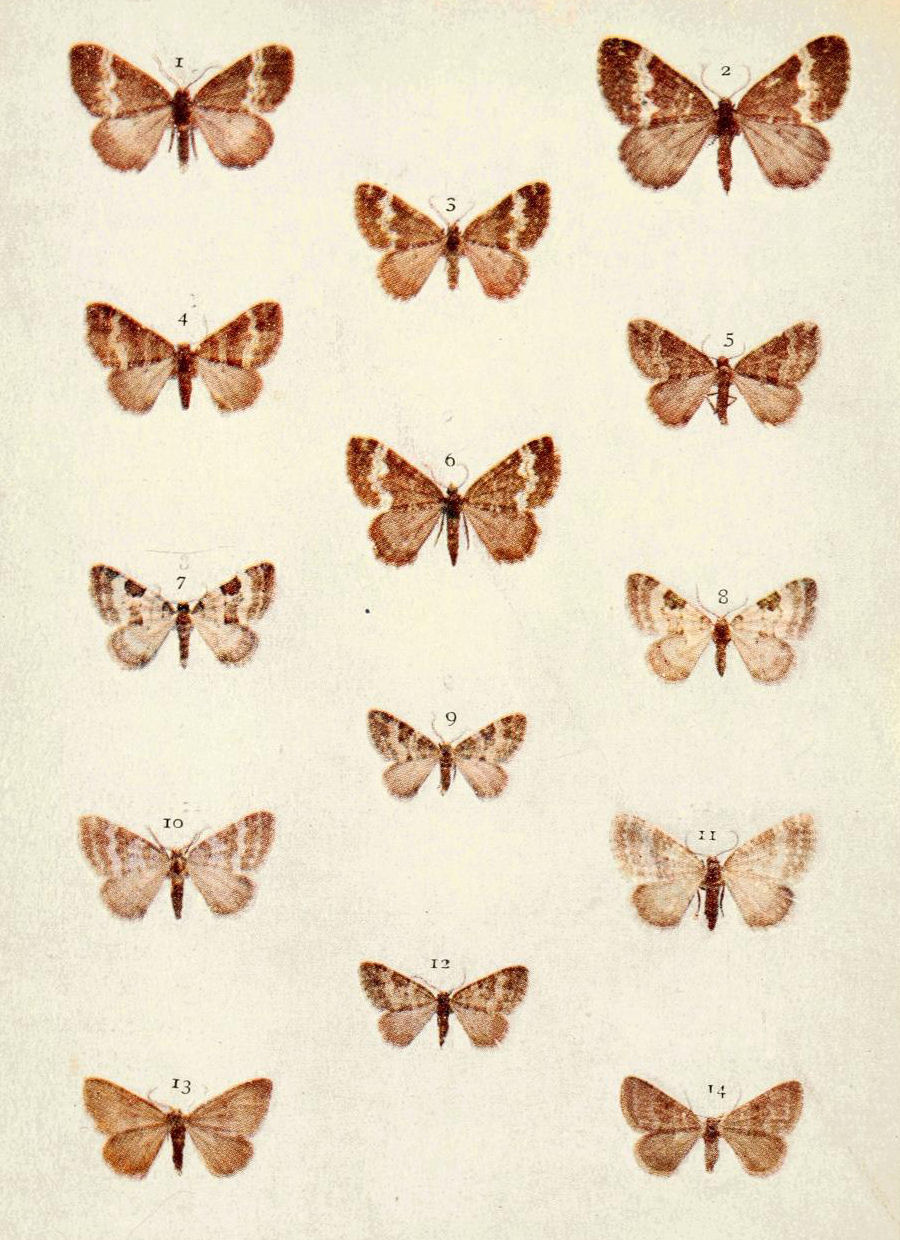
2 Pl. 83.
1, 2.Rivulet. 3, 6.Small Rivulet. 4, 5.Barred Rivulet.
9, 12.Heath Rivulet. 10, 11, 13, 14.Grass Rivulet. 7, 8.Pretty Pinion.
On the fore wings the dark, slender and wavy cross lines are more distinct in some specimens than in others, and occasionally the blackish blotch on the front margin is traversed by a white line, sometimes by two lines.
The caterpillar is pale ochreous brown, with three darker brown lines along the back, the central one slender, spotted with black on the middle rings; usual dots, black, encircled with white; head, marked with a reddish brown triangle. It feeds on Clematis in August and September.
Distribution of the species abroad extends to Amurland, and in Japan, Corea, and China it is represented by the darker inquinata, Butler.
The Rivulet (Perizoma affinitata).
The whitish band crossing the brownish fore wings is generally fairly wide, sometimes broad, but occasionally it is very narrow; the reduction in width is mainly the result of brownish suffusion of the outer half of the band, leaving the inner half white. Kane mentions a smoky form from Co. Derry, in which the band is absent, and refers this to ab. unicolorata, Gregson. In a specimen from Sligo in my series, the band is tinged with brownish throughout. The hind wings are usually smoky brown, with a paler central band, but in some specimens, referable to ab. turbaria, Stephens, the basal two-thirds are whitish. The moths also vary in size (Plate 83, Figs. 1 and 2).
The caterpillar is pinkish-ochreous inclining to brown; three pinkish lines along the back, and a similar line along the blackish spiracles; a dark plate on the first and last rings. It feeds in the capsules, on the seeds, of red campion (Lychnis dioica), and will eat those of the white L. vespertina: July to September. When eggs can be obtained early, it is possible to rear moths from them in August of the same year.
The moth is out in June and July, in some southern districts in late May.
As it conceals itself during the day among its food plant, or other vegetation around, it may be put up therefrom by gently stirring the herbage; but it flies freely about sundown, and is then easily netted.
The species is widely distributed over England, Wales, and Scotland, up to Moray. In Ireland it is local and not plentiful, and the same is the case in the North of England.
Small Rivulet (Perizoma alchemillata).
This species (Plate 83, Figs. 3 and 6) is exceedingly close to the last mentioned, but in a general way it is to be distinguished by its greyish-brown coloration. A stippled whitish stripe before the central band, usually only faintly indicated in affinitata, is fairly distinct as a rule. Although the outer edge of the central band is rather more irregular, the middle tooth is not so prominent as in affinitata.
The rather plump caterpillar is purplish above and yellowish green below; three yellow lines on the back, the central one broad; the spiracles are black, and a little above them is another yellow line; head, black and glossy, and there are black shining plates on the first and last rings of the body, that on the first ring divided by the yellow central line (adapted from Porritt). It feeds, in August and September, in the seed capsules of hemp nettle (Galeopsis tetrahit), sometimes on the rarer G. ladanum, and is said to eat woundwort (Stachys) occasionally.
The moth is out in June and July, and, as in the case of the last species, may be stirred up from among its food plant or the surrounding vegetation, in lanes, and around wood borders. The species is widely distributed over the British Isles, except that it seems not to have been noticed in Scotland, north of Moray, although it occurs in the Hebrides.
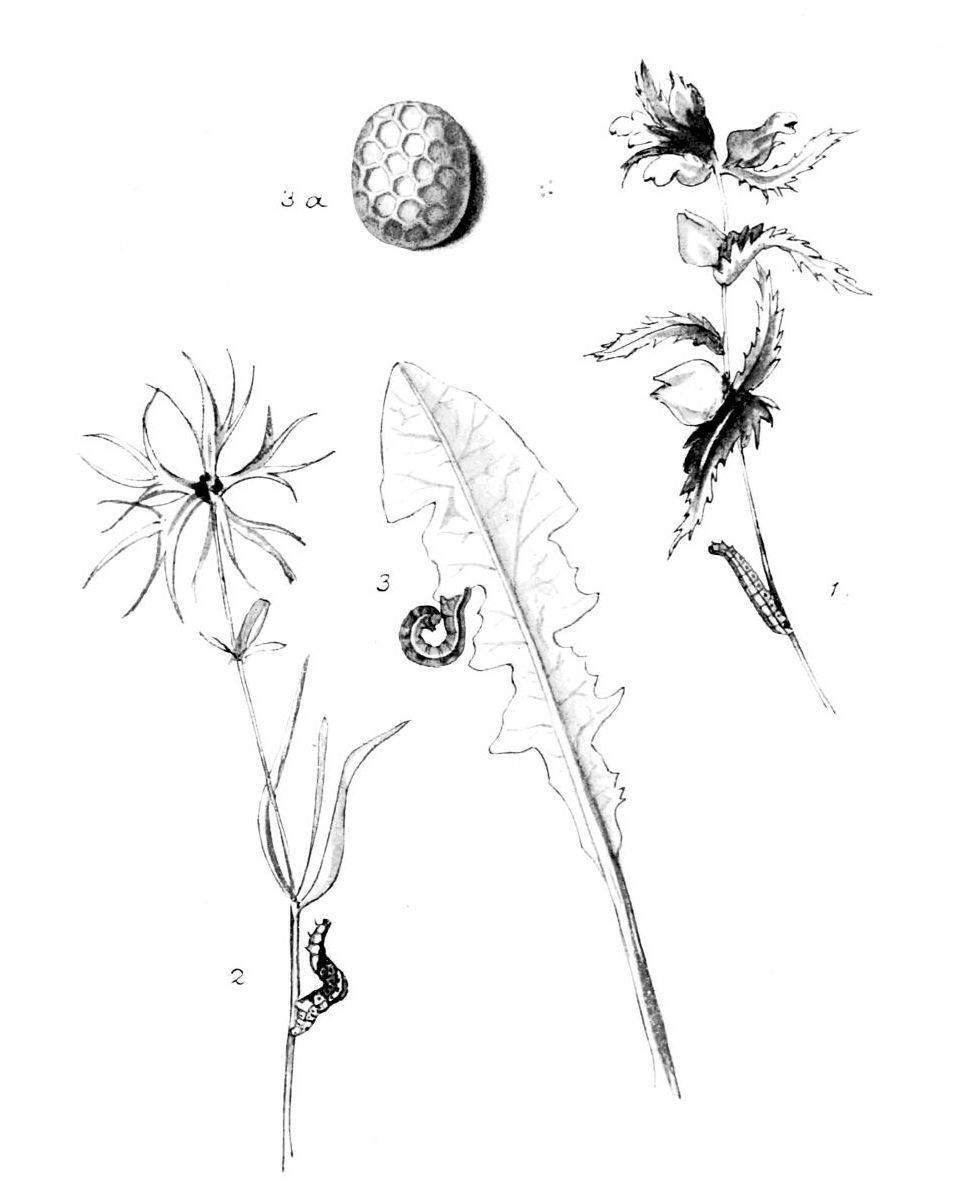
2 Pl. 84.
1.Grass Rivulet: caterpillar.
2.Waved Carpet: caterpillar.
3, 3a.Yellow Shell: eggs and caterpillar.
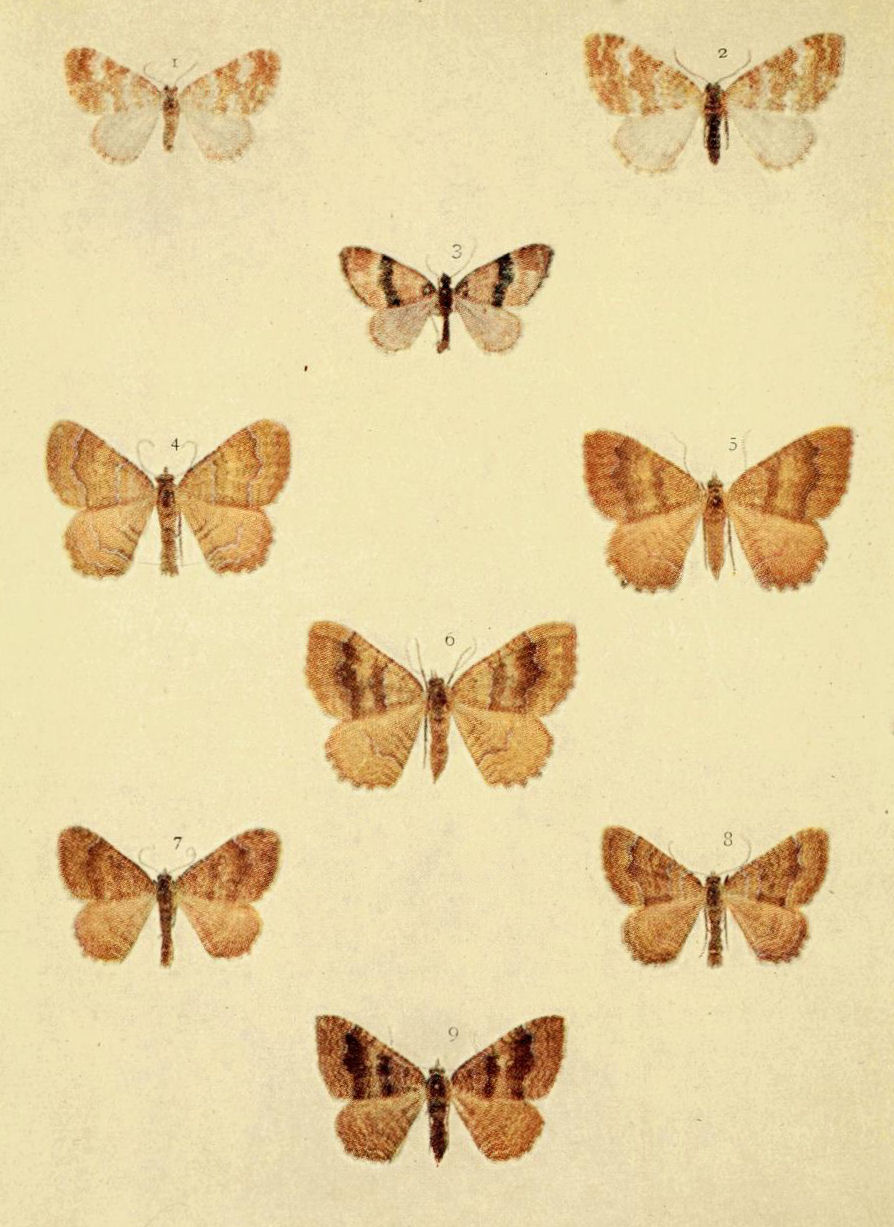
2 Pl. 85.
1, 2.Sandy Carpet. 3.Barred Carpet. 4-9.Yellow Shell.
Sandy Carpet (Perizoma flavofasciata).
The pale ochreous-brown, or sandy, markings on the white fore wings of this species readily distinguish it from either of its allies. Variable in size, and also in the brownish tint of the markings; the central band is usually contracted below the middle, and not infrequently it is completely severed at this point. It is the decolorata of Hübner, and although more generally known by that name, the earlier flavofasciata, Thunberg, will have to be adopted for this species. (Plate 85, Figs. 1 ♂, 2 ♀.)
The stoutish caterpillar is pale reddish ochreous with browner lines; head, brown and shining, plate on first and last rings of the body brown. It feeds on the flower buds, and on the immature seeds, of the red campion (Lychnis dioica), and the white campion (L. vespertina), but is more partial to the first named; in Ireland it is said to feed on bladder campion (Silene inflata).
In July and August, or even later, the moth may be beaten out of hedgerows, sandy banks, and borders of woods, and sometimes disturbed from patches of the campion growing in thickets; in such places it is on the wing about sundown.
Although local to some extent, it appears to be common enough in most of the counties of England and Wales. In Scotland, it is more or less generally common in Roxburghshire and Clydesdale, and is said to have been an inhabitant of Perthshire (Moncrieffe Hill). It appears to be very local in Ireland, but is recorded from Antrim, Derry, and Kerry, and noted as common at Larne in the first-named county.
Grass Rivulet (Perizoma albulata).
Although some English specimens approach the larger and whiter typical form, the species as it occurs in the British Isles is generally greyer, var. griseata, Staudinger; two examples of this form are shown on Plate 83, Figs. 10 and 11. In the Shetland Isles, the species assumes a darker coloration, and is either well marked on the fore wings, as in Fig. 14, or almost plain, as in Fig. 13 (ab. thules, Weir), which is an extreme aberration of the form subfasciaria, Boheman. In other examples of a deep leaden grey, or brown tint, the central area is no darker than the rest of the wing. In the Isle of Lewis a white form with faint markings is prevalent, and this leads up to a clear white aberration devoid of markings, ab. niveata, Stephens, = hebudium, Weir.
The wrinkled caterpillar, which feeds, in July and August, on the seeds of the yellow rattle (Rhinanthus crista-galli), and lives in the capsule, is whitish, inclining to greenish, dotted with black, and striped with dark green on the back and sides; head, black and glossy; plates and first and last rings of the body dusky. (Plate 84, Fig. 1.)
The moth is out in May and June, sometimes later. It occurs chiefly in dry meadows where the yellow rattle flourishes, and is to be seen on the wing, often in large numbers, in the late afternoon about sundown. Generally abundant in suitable places, throughout the British Isles.
The Barred Rivulet (Perizoma bifasciata).
Haworth described two forms of this species, and a specimen of each is shown on our Plate 83. Fig. 4 represents bifasciata (bifaciata, the Double-barred Rivulet), and Fig. 5 depicts unifasciata (the Single-barred Rivulet). The chief difference appears to be that in the type (bifasciata) the "rivulets" are white and distinct, thus bringing out a dark band between the central one and the base of the wing.
The stoutish caterpillar is pale brown, inclining to ochreous on the back, along which are three lines, the central one greyish, and the others whitish shaded with greyish; a whitish stripe low down along the sides; the usual dots are black, and the spiracles are black, margined with ochreous (adapted from Fenn). In September and October it feeds in the seed capsules of Bartsia odontites, and is often plentiful; Mr. G. F. Mathew records obtaining nearly five hundred from three small bundles of the food plant gathered in the Harwich district.
The moth is out in July and August, but is not often seen in the daytime, and is not taken very frequently, even when flying at night, but it comes to light, and visits flowers.
From chrysalids obtained from caterpillars reared in 1900, Mr. Robert Adkin bred ten moths in 1901, eleven in 1902, two in 1903, five in 1904, and two in 1905.
The species is widely distributed over England, Wales, and the south of Scotland, but it is most frequent in the south of England. Not much is known of it in Ireland, but it has been noted from counties Dublin, Louth, and Derry.
Heath Rivulet (Perizoma minorata).
The British form of this species (Plate 83, Figs. 9, 12) is rather smaller and darker than typical minorata, Treitschke, and as Stephens has figured and described it as ericetata, this name should be adopted for our native race.
The white fore wings have a greyish basal patch and three bands of the same colour; the outer one is traversed by a more or less distinct wavy whitish line; the band nearest the basal patch is sometimes very faint; more rarely the markings are absent from the central area of the wings (ab. monticola, Staud.), and a specimen approaching this form has been taken in Perthshire.
The caterpillar is pale green with a dark-green edged ochreous brown stripe along the middle of the back, and green stripes on each side; the usual dots are black, and the plates on first and last rings are brown, as also is the head. It feeds, in September, on the seeds of eyebright (Euphrasia officinalis).
The moth is out in July and August, and is found very locally, flying in the late afternoon among its food plant, on the moorlands and pasture-grounds of Northumberland, Cumberland, Durham, and Westmorland; and has been reported from Hawkshead, in Lancashire. In Scotland, it is common in suitable parts of Roxburghshire and several localities in Clydesdale; thence widely spread to the Orkneys. Only noted from the Mourne Mountains in the north-east of Ireland, but probably to be found in other parts of that country.
Pretty Pinion (Perizoma blandiata).
This species (Plate 83, Figs. 7, 8) is also known as adæquata, Borkhausen, the name under which it is catalogued by Staudinger. As a rule the central band on the whitish fore wings is only represented by a round, or sometimes triangular, blackish spot on the front margin, a smaller blackish mark on the inner margin, and some dusky clouding between these two portions. In specimens from the Hebrides the band is more or less complete, and in some of them it is very much narrowed, especially towards the inner margin (ab. coarctata, Prout).
The caterpillar is green, with three crimson lines, the outer ones bent inwards to the central one on the middle of each ring; two lines above and one below the yellowish spiracular line are pink; head green, tinged and freckled with pink. It feeds in September on the flowers and seeds of the eyebright (Euphrasia officinalis).
The moth is out from late May to July, and its habits are similar to those of the last species. In Scotland it appears to be commoner than in other parts of the British Isles, its range extending from Clydesdale to the Hebrides, Orkneys, and Shetland; but it has been recorded from Cumberland, and once from Durham. In Wales it has been taken at Dolgelly, in Merionethshire. Prout states that in 1902 he secured two specimens near Cwm Bychan, and that the species has since been captured regularly in the locality. It is widely distributed throughout Kerry and Galway, and also recorded from Cork and Derry, in Ireland.
The Barred Carpet (Perizoma tæniata).
This species is shown on Plate 85, Fig. 3. There are two forms of the central band of the fore wings, which in the type as figured by Stephens is broad, but is narrow in ab. arctaria, Herrich-Schaeffer = angustifasciata, Staud. The colour of the bands may be greyer or browner than in the specimen figured, and the ochreous general colour of the fore wings is more tinged with brown in some specimens than in others.
The rather bristly caterpillar is light brown with a pinkish tinge; the back is marked with browner diamonds and some black dots, and there is a yellow stripe along the sides. It feeds on moss (Hodgkinson, Entom. xxviii. 241) growing in damp places, hibernates when quite small, and reappears about April, when it seems to prefer the fruit of the moss, but will also thrive on chickweed. The moths appear from the end of June, and may be found, but in wasted condition, up to early September.
The species is extremely local, and in its secluded haunts may be found on the trunks of holly and yew trees, or it may be disturbed from the branches of such trees, or from hedgerows, etc.
In Britain the species seems to have been first noted in Castle Eden Dene, Durham (1825), and subsequently in Cumberland (Flimby, near Maryport), Westmorland, Lancashire (Arnside and Silverdale), Yorkshire (Scarborough), Derbyshire (Dovedale), Arthog in North Wales, and Tintern in Monmouthshire. The only English locality for it south of Monmouth is Watersmeet, near Lynton, in North Devon. In Scotland, it has been noted from Rannoch and Pitlochrie, in Perthshire, and from Dalmallin, in Argyllshire. It has a wide distribution in Ireland, and is common in some parts of that country, as at Killarney, Co. Kerry, and Rockwood, in Sligo.
Abroad, the range extends to Amurland; it is represented in Japan by fulvida, Butler, and in North America by basaliata, Walker.
Yellow Shell (Camptogramma bilineata).
This very common and generally distributed species is subject to a good deal of variation in the tint of ground colour, and also in the greater or lesser amount of black marking. On Plate 85 six specimens are shown; Figs. 4, 5 represent the more frequent form in most localities, but in many districts ab. infuscata, Gumppenberg (Fig. 6), is hardly less common; in some specimens the central band is entirely blackish, and occasionally the middle area of the band is partly or wholly whitish. Sometimes the wings are uniformly yellow without markings, but such aberrations are scarce, or have not been noted often. A small form occurring in the Hebrides and the Shetlands, var. atlantica, Staud., has the wings generally darkened; Figs. 7-9 depict three specimens from the Isle of Lewis. Portraits of two very local Irish forms will be found on Plate 61; one is ab. hibernica, Prout (Fig. 5), and the other approaches the dark ab. isolata, Kane (Fig. 6).
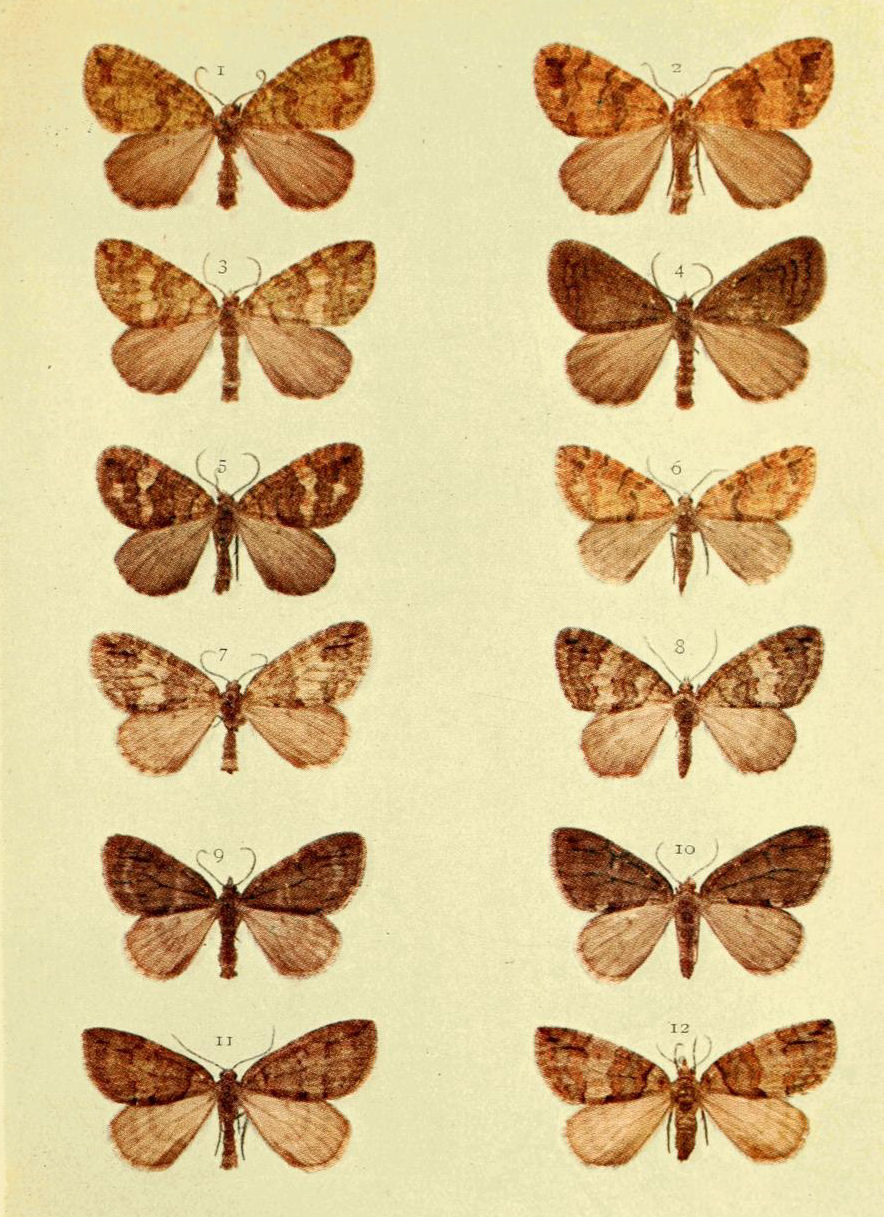
2 Pl. 86.
1-6.July Highflyer. 7-10.May Highflyer. 11, 12.Ruddy Highflyer.
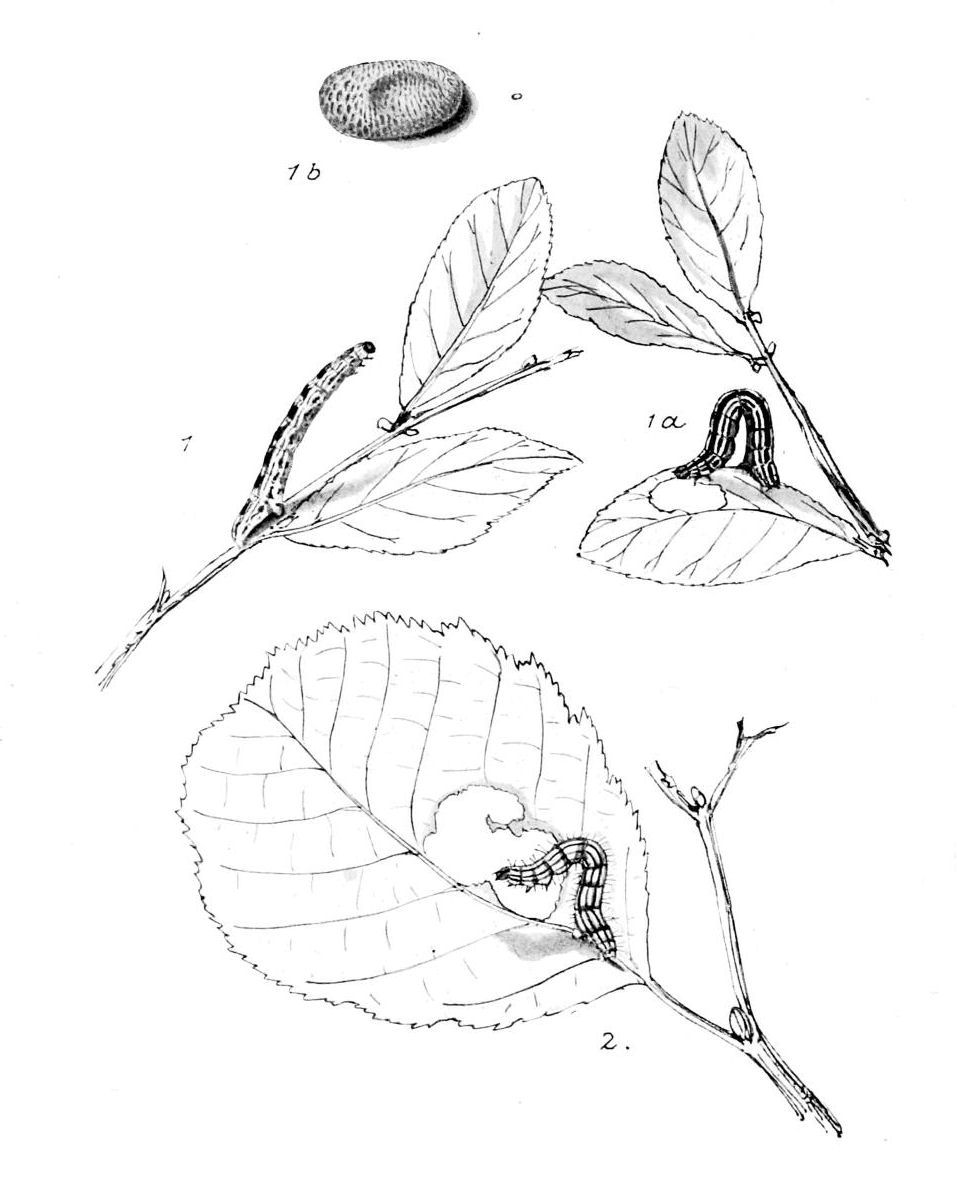
2 Pl. 87.
1.July Highflyer: eggs and caterpillars.
2.May Highflyer: caterpillar.
The eggs, which are laid loosely, are yellowish or pale straw colour (Plate 84, Fig. 3a). Caterpillar, stoutish, green inclining to yellowish; three lines on the back, the central one dark green, and the others yellowish, as also are the ring divisions; a pale wavy line low down along the sides. In some examples the general colour is pale greyish-brown, inclining to reddish brown. It feeds on grass, dock, chickweed, and various low-growing plants, from August to May, and is often abundant in hay meadows (Fig. 3, Plate 84, is from a coloured drawing by Mr. A. Sich). The moth occurs throughout the summer, and is very plentiful (often a pest) in almost every hedgerow and most bushy places.
July Highflyer (Hydriomena furcata).
Some idea of the variable character of this species (sordidata, Fab., and elutata, Hübner) may be formed from the selection of half a dozen examples shown on Plate 86. The typical form has the fore wings greyish, with dark bands as in Fig. 1, and a modification without the dark bands seems to be ab. cinereata, Prout. In the form sordidata, Fabricius, the general colour of the fore wings is greenish, and the bands are dark; ab. obliterata, Prout, is of the same colour, but the bands are absent. Ab. fusco-undata, Donovan, has the general colour reddish, with dark bands; without dark bands it becomes testaceata, Prout. Blackish or sooty forms are referable to infuscata, Staud. (Fig. 4). Frequently in the green forms, and less often in the reddish, there is a broad whitish central stripe, and a narrow one on the basal area; in the green form again the basal and central areas are occasionally crossed by red bands, and this is one of the prettiest forms of the species and, so far as I know, occurs only in the large sallow-feeding race; it possibly represents ab. fusco-undata, which is most frequent in the smaller moorland race.
The egg (Plate 87, Fig. 1b) when figured, February 8, 1908, was whitish as regards the shell, but the interior was dark greenish. In April the caterpillar appeared to be formed, but it did not leave the shell until early in May.
The full-grown caterpillar (Plate 87, Figs. 1, 1a) is brownish, inclining to blackish; whitish between the rings, white lines along the back and sides, and tinged with red along the spiracular region. It feeds, in May and June, on sallow, willow, poplar, hazel, bilberry, and heather. The moth is out in July and August, but I have seen the small bilberry-feeding form (Plate 86, Figs. 5, 6) on a corner of Exmoor, North Devon, in great profusion in late June, whilst in the same district the sallow-feeding, larger form appeared about a fortnight later, at which time specimens among bilberry were not numerous, and rather shabby in appearance.
Except perhaps in the Shetlands, this species is to be found in all parts of the British Isles. It is very common in hedgerows, and around the margins of woods; the smaller race frequents woods where bilberry is established, and also occurs on mountains and moors.
Abroad, the range extends to Amurland, China, Japan, and also to North America.
May Highflyer (Hydriomena impluviata).
The typical and commoner form of this species is shown on Plate 86, Figs. 7 and 8. The ground colour, usually pale green, is sometimes almost white, but more frequently it is tinged with greyish brown, thus leading up to the blackish ab. infuscata, Prout (Figs. 9, 10).
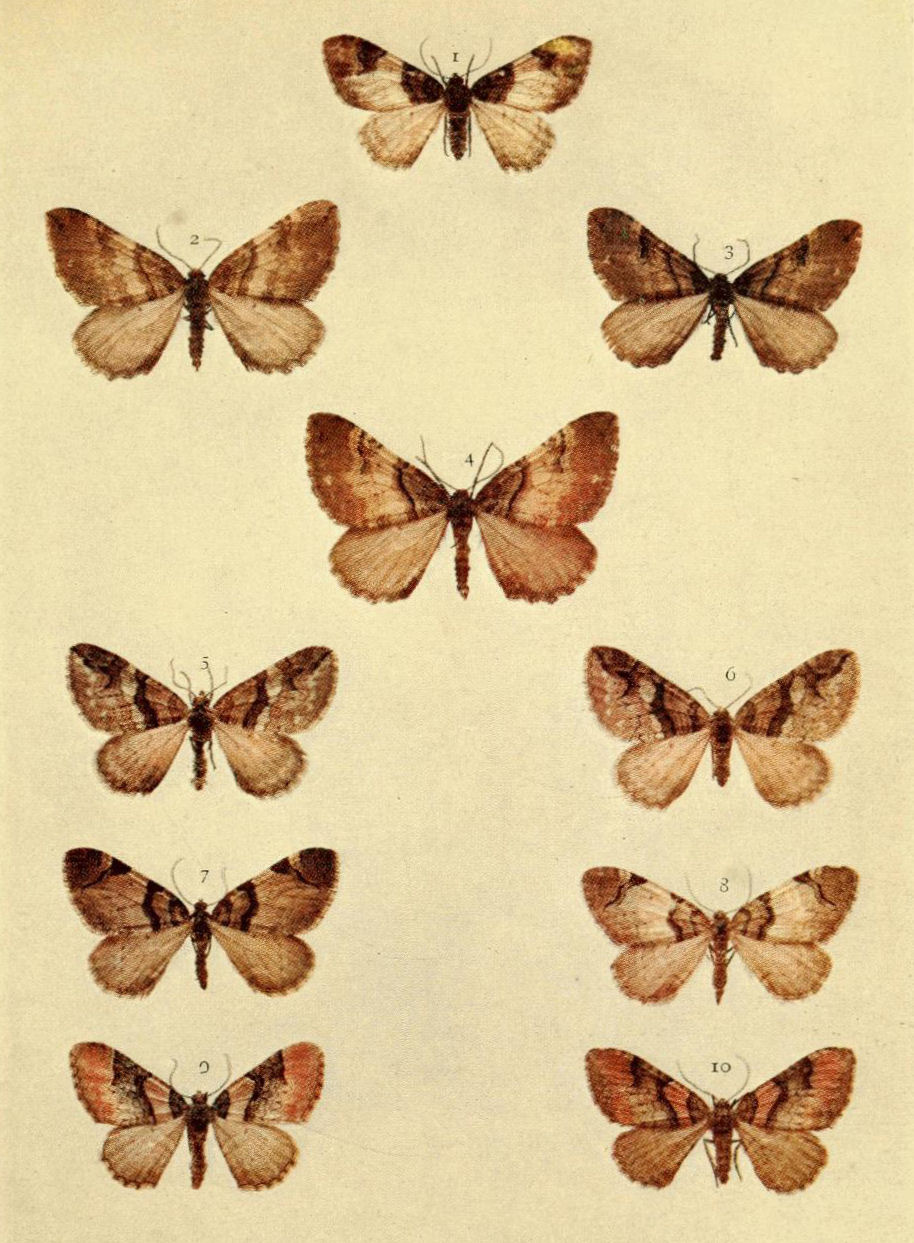
2 Pl. 88.
1.Royal Mantle. 2-4.Shoulder-stripe. 5, 6.Barberry Carpet.
7, 8.The Streamer. 9, 10.The Flame.
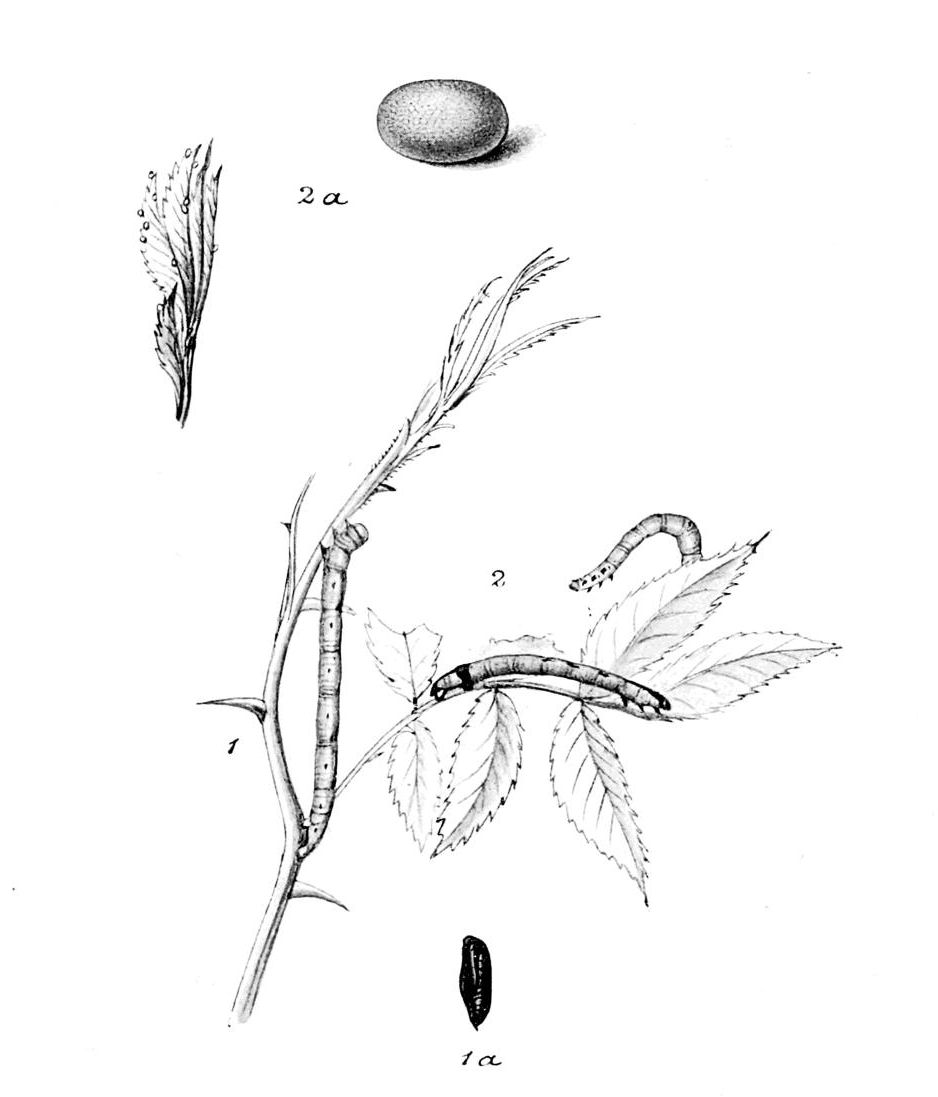
2 Pl. 89.
1, 1a.Shoulder-stripe: caterpillar and chrysalis.
2, 2a.Streamer: eggs and caterpillars.
The caterpillar is brownish grey, or purplish grey, dotted with black and dappled with dark brown; of the three lines along the back, the central one is black and swells out on the middle of each ring, the others are pale; a clear stripe of the ground colour below the black spiracles, and a slender line above them. The general colour is sometimes pale pinky brown or ochreous. It feeds on alder throughout the summer and autumn, and may be found in its domicile of spun-together dry leaves even in November, and sometimes later. Occasionally, a few caterpillars will feed up quickly, and attain the moth state in July or August, but the bulk do not become chrysalids until later in the year, and the moths emerge therefrom in May and early June. (Plate 87, Fig. 2.)
The species seems to occur, more or less freely, wherever there are alders throughout the greater part of the British Isles.
Abroad, the range extends to Eastern Siberia and Amurland.
Ruddy Highflyer (Hydriomena ruberata).
This species is most readily distinguished from the last by the short oblique black streak on the tips of the rather narrower fore wings; there are also black streaks between the veins and below the tips of the wings, as in the last species, but they are generally shorter and often hardly traceable.
The ground colour ranges from pale grey (sometimes with a green tinge), through brownish grey to reddish brown; usually central and outer marginal bands of a darker shade are present, but these characters may be very indistinct or entirely lost in the general coloration. (Plate 86, Figs. 11 and 12.)
The caterpillar is pale brown, dappled with grey; three dark greyish lines along the back; spiracles and the usual dots black, the latter with fine hairs; head, reddish brown, plates on first and last rings of the body light brown. It feeds, at night, during the summer and autumn, on sallow and willow, spinning together the leaves at the top of a twig to form a retreat during the day.
The moth is found in hedges, woods, and on heaths, in May and June; it may be occasionally beaten out of sallow bushes, but flies in the early evening, and is then more readily obtained. The species is widely distributed, but not generally common, in England and Wales, and in Scotland to Perthshire and probably further north, as it is found in Orkney, where specimens are numerous but rather small in size, and the caterpillars, according to McArthur, feed on heather as well as on sallow. Decidedly uncommon in Ireland, but it has been met with, in most instances singly, in Armagh, Tyrone, Westmeath, Kerry, Galway, and Sligo.
Royal Mantle (Anticlea cucullata).
This species (Plate 88, Fig. 1) is also known as sinuata, Hübner. The white fore wings have a blackish patch at the base and a blackish mark on the front margins beyond the middle; the former is separated into two parts by a pale reddish-brown band, and there is a reddish band, most distinct on the front area, beyond the black mark; in some specimens these bands are greyish.
The caterpillar is green, sometimes inclining to yellowish, with two black or purplish stripes, enclosing a broader pale yellow one, along the back; head, green, freckled with black. It feeds on the flowers of bedstraw (Galium mollugo, and G. verum), in July and August, or later in some seasons.
The moth is out in late June and in July, and occasionally may be disturbed from its food plant or the surrounding herbage. About dusk it is on the wing, and later is attracted by light. It seems to occur in most of the English counties from Kent to Cornwall; also in Berks., Oxon., Herts, and the eastern counties. Always local, and except in the east, where it is found in the Breck-sand area, most frequent in chalky localities. Barrett notes a specimen from Knowle, Warwickshire, and there are at least two records from Scotland (Perthshire). In Ireland, Mr. W. F. de V. Kane took one example from a wall in co. Clare, and another has been recorded from Galway.
The range of the species abroad extends to Siberia and Amurland; and it is represented in Corea and Japan by A. yokohamæ, Butler.
The Shoulder Stripe (Anticlea badiata).
The ground colour of the fore wings is pale ochreous brown, inclining to whitish; there are three dark-edged black cross-lines, the first of them sharply bent below the front margin, the second is rather oblique, and the third is wavy and often not clearly defined towards the inner margin; the outer marginal area is broadly bordered with pale reddish brown or dark purplish brown, there is a black streak from the more or less indistinct, whitish submarginal line to the tips of the wings, and a white mark about the middle of the line; the ground colour is most in evidence on the central area of the wings, but even here it is frequently reduced to a slender band, or occasionally only a patch near the front margin of the wing. (Plate 88, Figs. 2-4.)
The caterpillar (Plate 89, Fig. 1) is green, inclining to yellow between the rings; the spiracles are black, and there is sometimes a pinkish brown or purplish stripe along their area. Varies in general colour, and also in marking. It feeds, at night, on wild rose, and may be beaten from the bushes from May to July. When full grown it forms an oval cocoon in the earth, and therein changes to a chrysalis (Plate 89, Fig. 1a), which is dark reddish brown, inclining to blackish on the thorax, wing-cases, and the front edges of the body rings.
The moth appears in March and April, and may be obtained from almost any hedgerow, where wild rose is plentiful, throughout the British Isles, except that it seems not to extend north of Moray in Scotland.
Barberry Carpet (Anticlea berberata).
The fore wings are greyish or whitish, tinged with grey; there are two dark-edged black lines on the basal half, and a black line beyond the middle of the wings; the latter has a conspicuous tooth in its upper half, but the lower wavy half is indistinct; there is a black streak in the tip of the wing. (Plate 88, Figs. 5, 6.)
The stout and roughened caterpillar is brown, with indistinct darker stripes along the back; the head is brown, checkered with darker brown. It feeds, in June and July, on barberry (Berberis vulgaris); there is a second brood in late August and September.
The moth is out in May and early June, and again in August. Although it certainly has been noted from other parts of England, the species seems at present to be confined to the eastern counties. Barrett gives Somerset also.
The Flame (Anticlea rubidata).
The markings on the reddish fore wings of this species (Plate 88, Figs. 9 and 10) are somewhat similar to those of the last mentioned, but there is no black streak in the tips of the wings, and the upper part of the outer black line is not toothed. The lower central area is often greyish, and the reddish ground colour is sometimes obscured.
The caterpillar is pale brown, sometimes greyish or greenish tinged, with obscure darker diamond-shaped marks on the back; a black central line, indistinct on the middle rings; under side striped and lined with pale and dark brown; head, with a black V-shaped mark. It feeds, in July and early August, on bedstraw (Galium mollugo and G. verum), and will eat cleavers or goosegrass (G. aparine) in confinement.
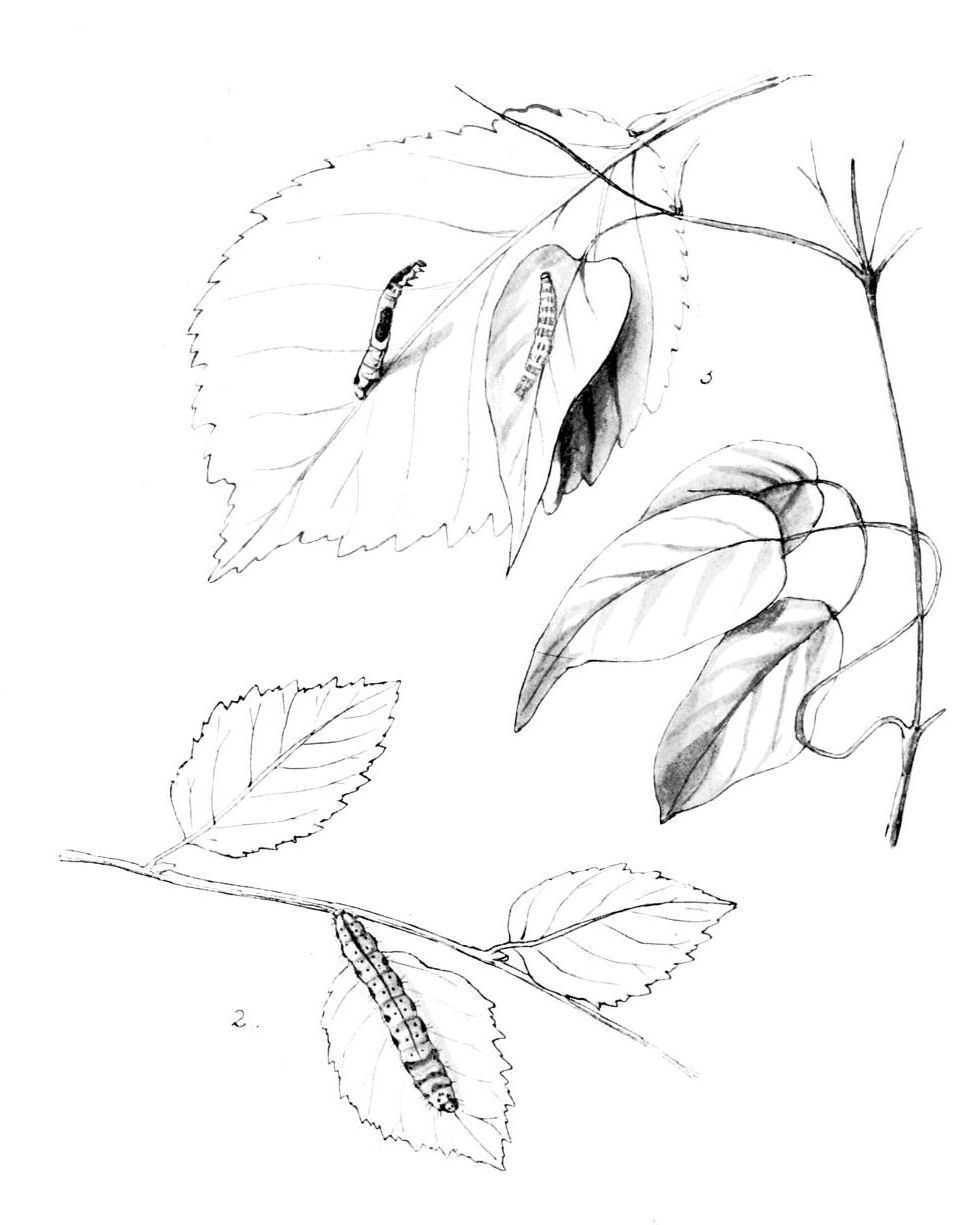
2 Pl. 90.
1.Blomer's Rivulet: caterpillar.
2.Small White Wave: caterpillar.
3.Haworth's Pug: caterpillar.
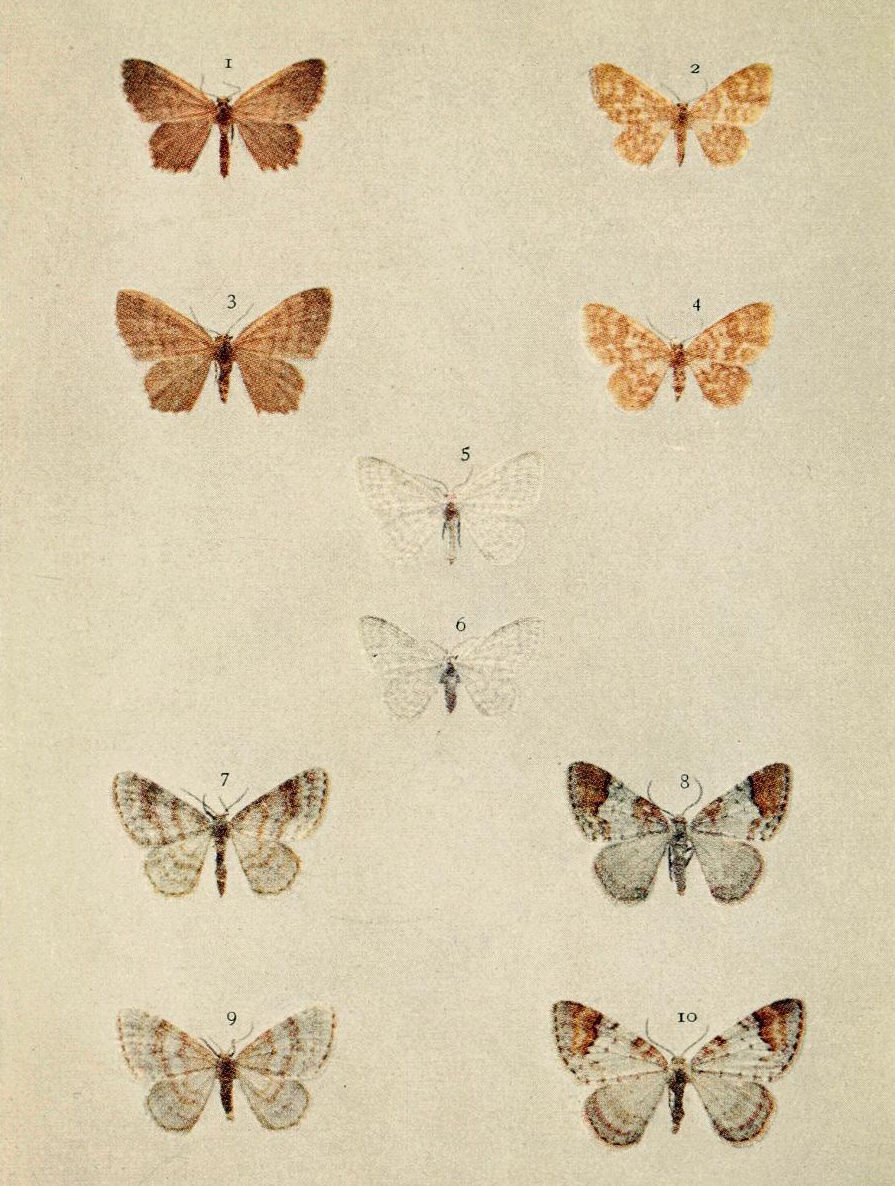
2 Pl. 91.
1, 3.Dingy Shell. 2, 4.Small Yellow Wave. 5, 6.Small White Wave.
7, 9.Waved Carpet. 8, 10.Blomer's Rivulet.
The moth flies in June and July, and in the daytime may be readily disturbed from hedges in localities on the chalk in the southern half of England and Wales, especially in the seaboard counties from Kent to Cornwall. It has been recorded from Derbyshire and Yorkshire, and once from the Isle of Arran (Entom. xv. 250).
The Streamer (Anticlea nigrofasciaria).
The two examples of this species depicted on Plate 88 show the ordinary form with the central area of the fore wings greyish brown (Fig. 7, Essex), and a New Forest specimen in which the central area is whitish (Fig. 8).
The long caterpillar is green, inclining to yellowish between the rings; a purplish, or reddish-brown, stripe along the back is broken up into spots on the middle rings. It feeds on the flowers and leaves of wild rose, and can be found or beaten out in May and June. (Plate 89, Figs. 2, larva, 2a, ova.)
The moth is out in April and early May, and is often seen at rest on palings, etc., but it occurs chiefly in hedgerows, along which it flies at dusk.
This species (also known as derivata, Borkhausen) is pretty well distributed over England, Wales, and Scotland up to Sutherlandshire. In Ireland it seems to be local.
Dingy Shell (Euchœca obliterata).
This pale ochreous brown species (Plate 91) is in the male (Fig. 1) more or less sprinkled and shaded with darker brown, and the three brown cross lines are consequently often obscure, and rarely as distinct as in the female (Fig. 3).
The green caterpillar has a yellow line running down the middle of a black stripe along the back, and this stripe is bordered on each side with yellow, and broken up by the yellow ring divisions; head, with a black spot on each side. It feeds, in July and August, on alder.
The moth is out in June and early July, and will be found in almost every locality in England where the alder flourishes, most plentifully, perhaps, on the eastern and western sides. It has been recorded from North and South Wales, but it does not seem to have been noted from Ireland or Scotland.
The range abroad extends to Amurland and Japan.
Small White Wave (Asthena candidata).
The delicately lined white moth shown on Plate 91, Figs. 5 ♂ and 6 ♀, is chiefly a woodland species. It is generally common in the south of England, occurs more or less frequently throughout the northern half, and is widely distributed in Wales. In Scotland, it is said to be locally common in Clydesdale, and to be found in Arran and in Perthshire. It is plentiful at Dromoland, co. Clare, Ireland, not uncommon in parts of Galway, and once recorded from Wicklow.
The caterpillar is found, in July and August, on birch, hazel, and wild rose. In general colour it is green, inclining to bluish at each end, and tinged with yellowish along the ridge on the sides; the back is marked with crimson. (Plate 90, Fig. 2, after Hofmann.)
The moth is out in May and June, and sometimes July, and individuals of a second generation occasionally appear in August or September.
Small Yellow Wave (Asthena luteata).
This pretty little species (Plate 91, Figs. 2 and 4) has the pale yellowish wings marked with ochreous brown lines, which vary in thickness, and a dash of the same colour on the fore wings, from the central pair of lines to the middle of the outer margin.
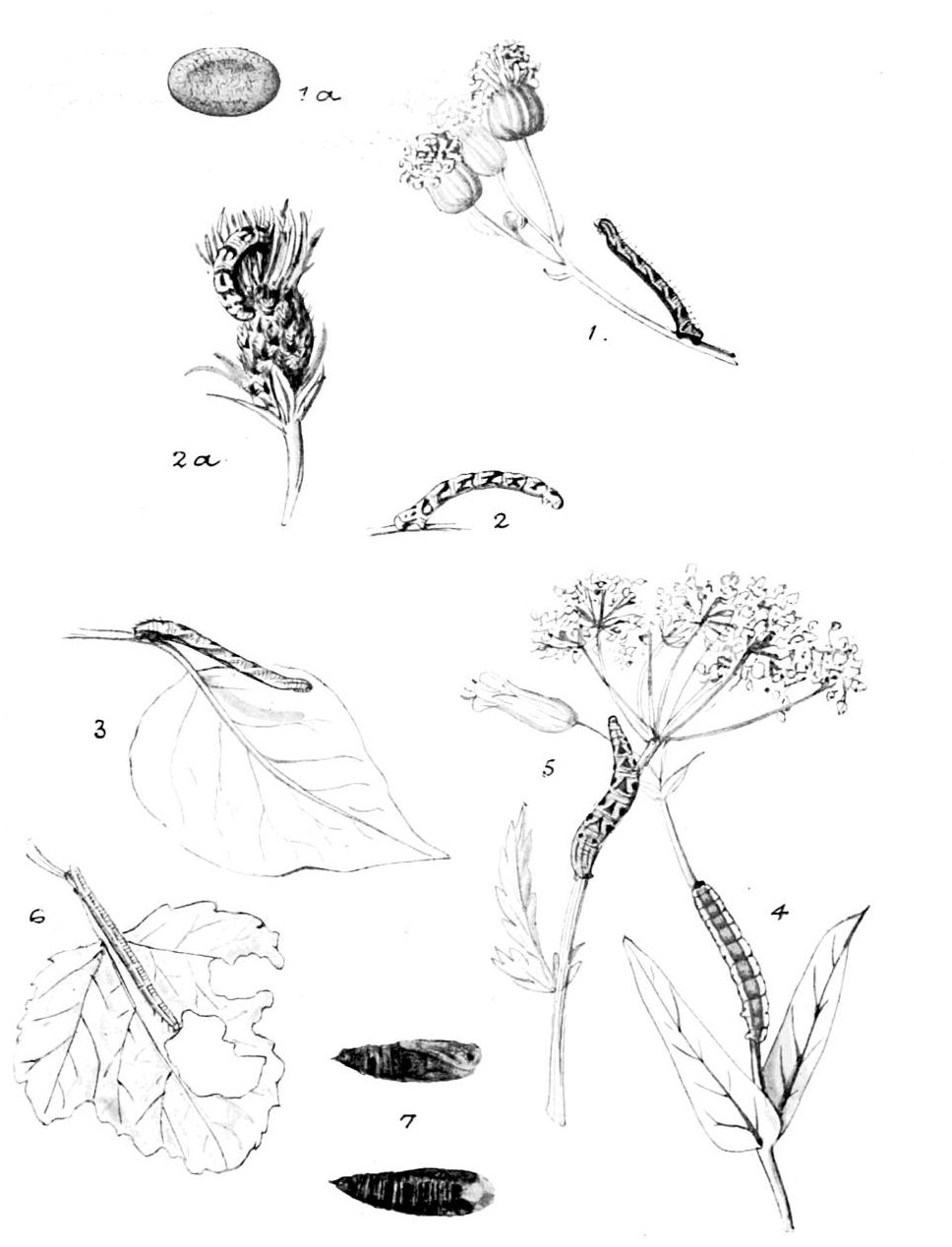
2 Pl. 92.
1.Grey Pug: egg and caterpillar. 2.Lime Speck Pug: caterpillars.
3.Common Pug: caterpillar. 4.Netted Pug: caterpillar.
5.White-spotted Pug: caterpillar. 6.Currant Pug: caterpillar.
7. Bordered Pug: chrysalids.
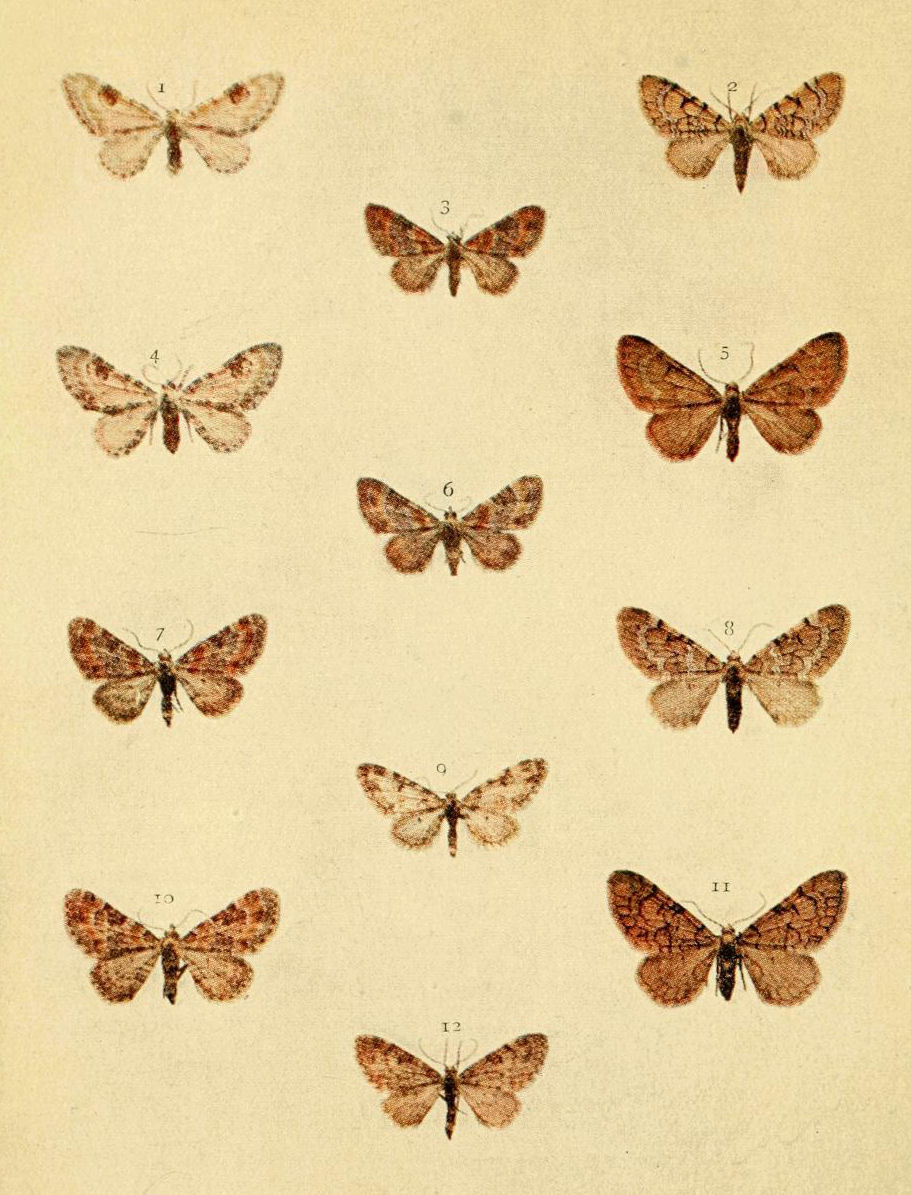
2 Pl. 93.
1, 4.Lime Speck Pug. 2, 5, 8, 11.Netted Pug. 7, 10.Foxglove Pug.
3, 6.Toadflax Pug. 9.Marbled Pug. 12.Dwarf Pug.
The caterpillar, which feeds in August and September, on maple, and in the northern counties on alder, is green, inclining to whitish between the rings.
The moth is out in June and early July, sometimes from mid May in warm localities. It is widely distributed over England and Wales, and in the southern counties of England it occurs in hedges wherever the maple grows, but in the midlands and northwards it is chiefly found among alder. In Scotland it is local and rare in Clydesdale, and is known to occur in Perthshire.
Abroad, the range extends to Amurland and Japan.
Waved Carpet (Asthena testaceata).
The typical, greyish-dusted, white form is depicted on Plate 91, Figs. 7 ♂ and 9 ♀. Mr. E. R. Bankes states (Entom., xl. 33) that in one restricted area in mid-Kent this species varies in the direction of melanism, and he describes two forms as under: ab. intermedia has the usual coloration, but the wings are thickly dusted with dusky brown, chiefly along the front edge of the fore wings, and the cross lines are more distinct than in the type. In ab. goodwini all the wings have the whitish ground colour largely obscured by dusky brown powdering.
The rather spindle-shaped caterpillar is purplish brown, inclining to greenish on the sides and below at each end; on the back of the middle rings are whitish V-marks, and the last three rings incline to purplish red above (adapted from Fenn). It feeds on the young leaves of alder, birch, and sallow, in July and August. The moth is out in June, and hides by day among the bushes, but may be seen occasionally on tree-trunks. Its haunts are in damp woods and plantations, and it occurs in most of the English and Welsh counties, although it is rarely common, except in the south of England. In Ireland it has been noted as scarce in counties Wicklow, Kerry, Galway, and Sligo.
The range abroad extends to Amurland and Japan.
Blomer's Rivulet (Asthena blomeri).
The earliest British specimens of this species (Plate 91, Figs. 8 ♂ and 10 ♀) were taken in Castle Eden Dean, Durham, and among the first to detect these was Captain Blomer, after whom Curtis named the species in 1832. It is still found in that locality, but is also known to occur in Cumberland, Lancs., Yorks., Derby, Staffs., Merionethshire, Worcester, Hereford, Glamorgan, Gloucester, Somerset, Devon, Wilts., Oxford, and Bucks.
The slender caterpillar is yellowish green, generally marked with pinkish-brown on the back, but most or all such markings may be absent. It feeds, on wych elm (Ulmus montana) (Plate 90, Fig. 1), in August and September. The moth is out in June and July, earlier or later in some seasons. As a rule, it sits on the trunks of beech trees, but I have seen it on the stems of cherry and fir, though hardly ever on wych-elm. Occasionally, newly emerged specimens have been noted on the leaves of dog's mercury (Mercurialis perennis).
The range abroad extends to Amurland and Japan.
Lime-speck Pug (Eupithecia oblongata).
The characteristic features of this white, or greyish white, species (Plate 93, Figs. 1 and 4) is the bluish grey blotch on the front margin, in the lower end of which is the black discal spot. Occasionally, the blotch is much reduced in size, but it is usually large, and sometimes there are indications of a dusky stripe from it to the inner margin.
When freshly laid, the egg is whitish, but changes to pale orange. The caterpillar (Plate 92, Figs. 2, 2a) is greenish, with more or less connected reddish marks on the back, or green inclining to yellowish, or bluish, without markings. It feeds through the summer on flowers of ragwort, knapweed, scabious, yarrow, golden rod, etc.
The moth, which is often common in gardens, is out from May to August, and specimens of a second brood occur in September and October.
It is widely distributed over the British Islands, but in Scotland it does not, apparently, extend north of Perthshire.
Foxglove Pug (Eupithecia pulchellata).
The fore wings are pale ochreous brown with a dusky basal patch limited by a black line; a greyish central band inclining to blackish near the costa, and clouded with ochreous below the middle; the black-and-white edges are wavy; a reddish stripe across the wing before the central band, and a similar, but more irregular, one beyond the band. The hind wings are whitish grey, with several dark-grey bands (Plate 93, Figs. 7 ♂, 10 ♀).
In var. hebudium, Sheldon, from the Hebrides, the usual reddish stripes are replaced by narrower dark-brown ones; the space left by the reduction in width is white, giving the insect a decidedly grey appearance.
The caterpillar lives in the flowers of the foxglove (Digitalis purpurea) and feeds therein upon the stamens and the immature seeds. It enters by boring through the side walls, and then secures the longer lobe of the blossom to the shorter upper one with a few silken threads. Tenanted flowers have a rather faded look and are easily detected. July is the best month, but the caterpillar may be found earlier as well as later.
The moth is out in May and June, and is found in almost every part of the British Isles where the foxglove is common.
Toadflax Pug (Eupithecia linariata).
Very similar to the last species, but generally smaller, neater and more glossy looking. The central band of the fore wing is blacker, without ochreous clouding below the middle, and the edges are not wavy. The hind wings are darker, and the only distinct band is a whitish one beyond the middle (Plate 93, Figs. 3, 6).
The caterpillar is yellowish green, with a series of dull olive or rust coloured spots or bars along the back, bordered on each side by a dusky olive line; in some examples the markings are absent (Crewe). It feeds in the flowers of yellow toadflax (Linaria vulgaris), and may be reared on flowers of the snapdragon (Antirrhinum). It is hardly necessary to examine each blossom separately to find the caterpillar, except, perhaps, to make sure when doubtful about the quarry being there. Probably, a handful of the flower sprays gathered in August or September in any locality in the southern half of England where the food plant abounds would furnish moths in the following May or June. The Linaria should be secured on a dry day for choice, but when brought home it need not be put in water; just throw it into an airy breeding cage, and hopefully await emergence of the perfect insects in due course. Sometimes caterpillars attain the moth state the same year.
The range of the species in England extends to Durham, but it seems to be rather uncommon from the Midlands northwards. It is found in Wales, and has been recorded once from Scotland (Inverurie), and once from Ireland (Dublin).
Marbled Pug (Eupithecia irriguata).
The fore wings are whitish and rather shining, the discal spot is black and very distinct, but the dark grey-brown markings, which are only well defined on the front and outer marginal areas, vary in intensity (Plate 93, Fig. 9).
The long, slender and roughened caterpillar is dull yellowish green; three lines along the back, the central one reddish and expanded on the middle rings, the others yellowish; head, reddish. It feeds on oak, in late May and in June. The moth is out in April and May, and is sometimes found on fences or palings in the neighbourhood of oak woods, but may be jarred from the oak boughs, on the undersides of which it usually sits.
The New Forest in Hants is, perhaps, the best British locality for the species, but it has been found in Dorset (Glanville's Wootton), Devon (Exeter district, Tiverton, etc.), Sussex (Abbots Wood, St. Leonard's Forest, etc.), Wilts. (Savernake Forest); also oak woods in Surrey, Berks., Gloucester, Hereford and Glamorgan. On the eastern side it occurs in Suffolk (Bury and Needham), and Norfolk.
Dwarf Pug (Eupithecia pusillata).
The fore wings of this species (Plate 93, Fig. 12) are pale greyish white, discal spot black, cross lines irregular dark grey inclining to brownish, usually most distinct on the front margin.
The long, slender caterpillar is orange-red or dull ochreous green; three dusky olive lines along the back, the central one often only distinct on the front rings; a yellow line low down along the sides. It feeds, in June and early July, on spruce (Picea excelsa). The moth is out in May and June, and rests by day among the branches of the spruce.
The species is very local, but is found in Kent (West Wickham, etc.), Surrey (Mickleham district), Hants (New Forest), Devon (Exeter district, Plymouth), Wilts. (Watlington district), and Suffolk.
Ochreous Pug (Eupithecia indigata).
Captured specimens of this pale greyish-ochreous-brown species nearly always have a washed-out appearance, and even freshly emerged examples are unattractive. In some specimens, cross lines are more or less traceable on the fore wings; in others four or five tiny dusky dots will be noted on the front edge; as a rule, the only clearly defined character is the black discal spot (Plate 96, Fig. 1).
The long caterpillar is greenish-yellow or yellowish-red; three lines on the back, the central one brownish, but often only distinct on the front rings; the others, and also one low down along the sides, yellowish; head, reddish (adapted from Crewe). It feeds, in June and July, on pine and larch, or may be reared on juniper.
The moth is out in May and June, and sometimes there seems to be another emergence in the latter part of the summer. It frequents pine-woods, where it rests upon the trunks and branches of the trees.
Generally distributed over the whole of England; has been found in South Wales, and occurs in Perthshire, in Scotland. In Ireland, it has been noted from Tyrone, Derry, and Galway.
Pinion-Spotted Pug (Eupithecia insigniata).
The greyish white fore wings have a blackish basal line, and three slender double lines between this and the outer margin; three blotches on the front margin of the wings, the middle one blackish, the others brown with dashes of the same colour below; discal spot, black and streak-like (Plate 96, Fig. 2).
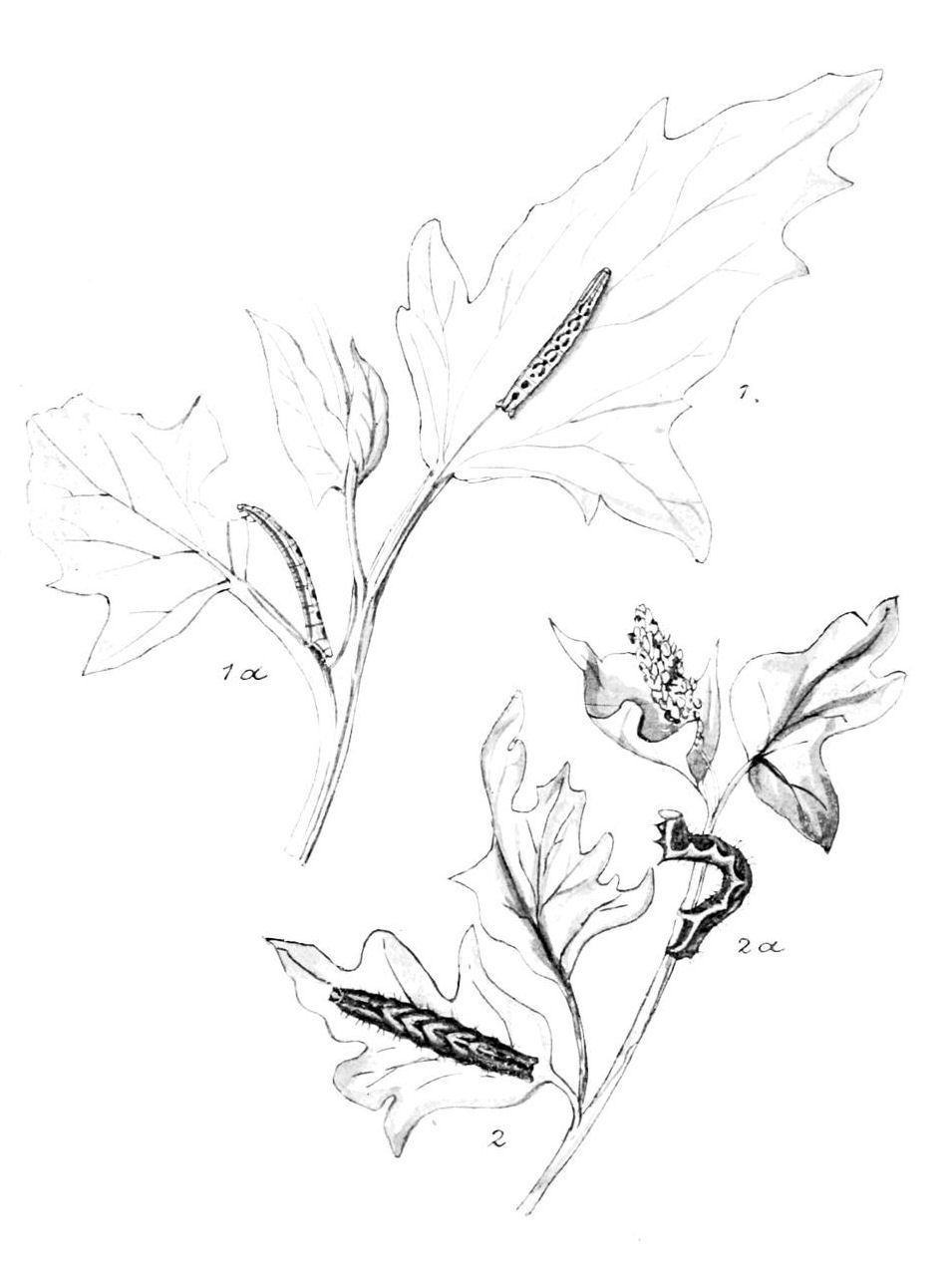
2 Pl. 94.
1.Plain Pug: caterpillars.
2.Dark Spinach: caterpillars.
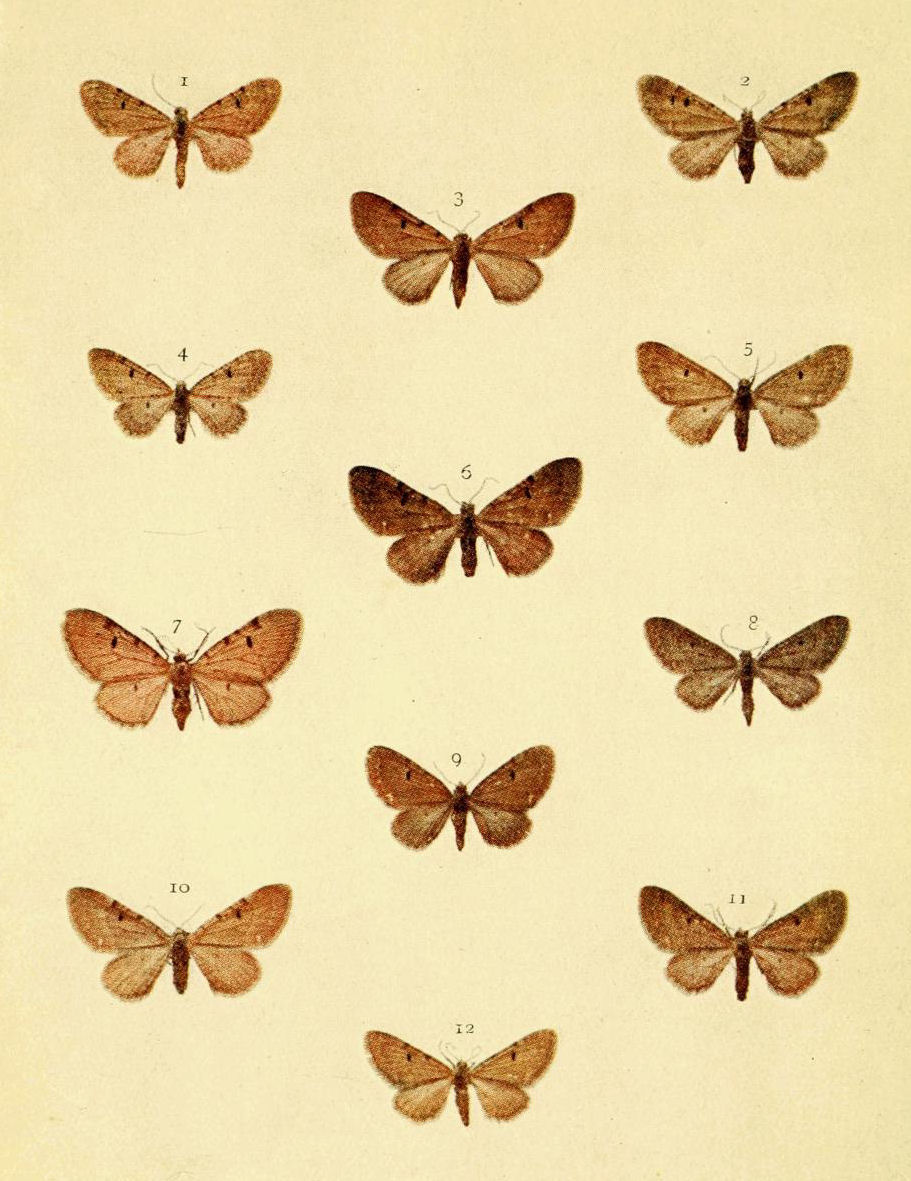
2 Pl. 95.
1.Pimpinel Pug. 4.Thyme Pug.
7.Bleached Pug. 3, 6, 10.Wormwood Pug.
9.Currant Pug. 2, 12.Ling Pug.
5.Campanula Pug. 8, 11.Jasione Pug.
The long, slightly roughened caterpillar is green, inclining to yellowish, especially between the rings; reddish marks on the back connected by a slender line of the same colour; head, green, flecked with reddish. It feeds, on apple, eating flowers and leaves, in May and June. Also said to eat hawthorn and sloe. The moth is out in April and May, but it is rarely met with in the open. If, however, one is lucky enough to capture a female, and fertile eggs are obtained, moths should hardly fail to result. From these the stock might go on increasing year by year for quite a long period. Ten specimens presented to the National Collection of British Lepidoptera in 1904, by the late Mrs. Hutchinson, were bred in April of the previous year, and were the direct descendants of a female captured in 1874, at Grantsfield, Herefordshire.
Other counties in England from which the species has been recorded are—Worcester (Birchwood), Gloucester, Somerset, Wilts., Hants (Hayling Island), Sussex, Surrey, Kent, Berks., Bucks., Huntingdon, Cambridge (once bred from mixed larvæ beaten from hawthorn on the "Gogs"), Suffolk (beaten from hawthorn at Brandon, Tuddenham, etc.), and Norfolk.
As insigniata, Hübner, is claimed to be at least two years older than consignata, Borkhausen, the former name will have to be adopted for this species.
Netted Pug (Eupithecia venosata).
This moth has also been named by the old authors "the Pretty Widow Moth." On Plate 93 are shown four examples; the typical form (Fig. 2), in which the fore wings are pale greyish, with black cross lines, two of which are edged with whitish; var. fumosæ, Gregson = nubilata, Bohatsch (Fig. 5)—the Shetland race—is brownish grey, with the markings obscure; Fig. 8 represents a variegated modification of the last form, for which the name bandanæ was proposed by Gregson; Fig. 11 depicts another specimen, which in its light-brown colour closely approaches the Orkney form var. ochracæ, Gregson = orcadensis, Prout.
Specimens from North Devon have a rather darker tone of the typical coloration, and those from North Wales and from Ireland incline to brownish.
The rather stumpy caterpillar is greyish brown above, and pale greenish or yellowish below; three darker brown lines along the back; head, blackish. It is found from late June to early August, in the seed capsules of catchfly (Silene inflate, S. maritima, etc.). Plate 92, Fig. 4, from a coloured drawing by Mr. A. Sich.
The moth is out in May and June, and is widely distributed over the British Isles.
Pimpinel Pug (Eupithecia pimpinellata).
A portrait of this species, which, as a British insect, was first noted in Suffolk nearly sixty years ago, will be found on Plate 95, Fig. 1. The fore wings are pale brownish, except on the front edge, which is greyish; the black discal spot is distinct and rather long; the median vein and its branches are dotted with black, and most of the cross lines are only distinct on the front margin, where they are blackish; the rather wavy whitish submarginal line is sometimes marked with blackish. In some specimens the costal half of the fore wings is greyish, and the other portion only tinged with pale brownish.
The long caterpillar is green, with three purplish lines along the back, the central one wider and more distinct than the others; the head is purple. Sometimes purple, with two lines of a deeper shade on each side of the back (Crewe). It feeds, in the autumn, on flowers of burnet-saxifrage (Pimpinella). The moth is out in June and July, and in the late afternoon is occasionally put up from among its food plant or the herbage around, but such specimens are rarely worth keeping, unless of the female sex, when eggs may be obtained.
The species has a wide distribution in England, especially in the southern half; it occurs in Wales, and also in Ireland, but not in Scotland.
Thyme Pug (Eupithecia distinctaria).
This delicately marked species, better known, perhaps, as constrictata, Guenée (Plate 95, Fig. 4), has the fore wings whitish grey, with three slender blackish curved cross lines, and some less distinct greyish ones; the outer margin is slightly darker, and traversed by a wavy whitish line; discal spot black and conspicuous.
I have not seen specimens from the Hebrides, but, according to Barrett, these have a more decided grey tint.
The rather long, wrinkled caterpillar is dark green, inclining to yellowish between the rings, with a broad purplish red line along the back. It feeds on the flowers of wild thyme (Thymus serpyllum), in August and September.
The moth is out in June and July, and inhabits dry places where there is an abundant growth of wild thyme. It is easily alarmed, and quickly rises on the wing from its hiding-place among the herbage.
The species is, or has been, found in most of the southern counties of England, from Sussex to Cornwall, on the western side from Somerset to Westmorland, including North Wales and the Isle of Man; also recorded from Buckinghamshire, Yorkshire (Richmond), and Northumberland. In Scotland it occurs chiefly on the west to Ross, and in the Hebrides; in Ireland it is widely spread, but most frequently met with on the coast.
Bleached Pug (Eupithecia expallidata).
The ample wings light brown in colour, with large black discal spot, and smaller black marks on the front edge of the fore wings, distinguish this species (Plate 95, Fig. 7) from its closest British allies.
The caterpillar feeds, in September and October, on flowers of golden rod (Solidago virgaurea), but it will thrive on those of michaelmas daisy, and probably the asters of the garden. It varies in ground colour, but this is usually some shade of green, and there are brownish spots and lines on the back.
The moth is out from late June until August, and may be put up from among golden rod during the day, or netted as it flies about the plant in the gloaming.
It is rather local, but occurs in most of the southern counties of England, from Kent to Devonshire, and westward from Somerset to Hereford and South Wales; also recorded from North Lancashire. Rare in Scotland, and only noted from Perthshire and Aberdeenshire. Reported from a few localities on the coast in Ireland.
Currant Pug (Eupithecia assimilata).
This species (Plate 95, Fig. 9) is similar in marking to that next mentioned, but the wings are shorter and rounder; the fore wings are a trifle redder in tint, and the white mark at the termination of the submarginal line is usually more conspicuous.
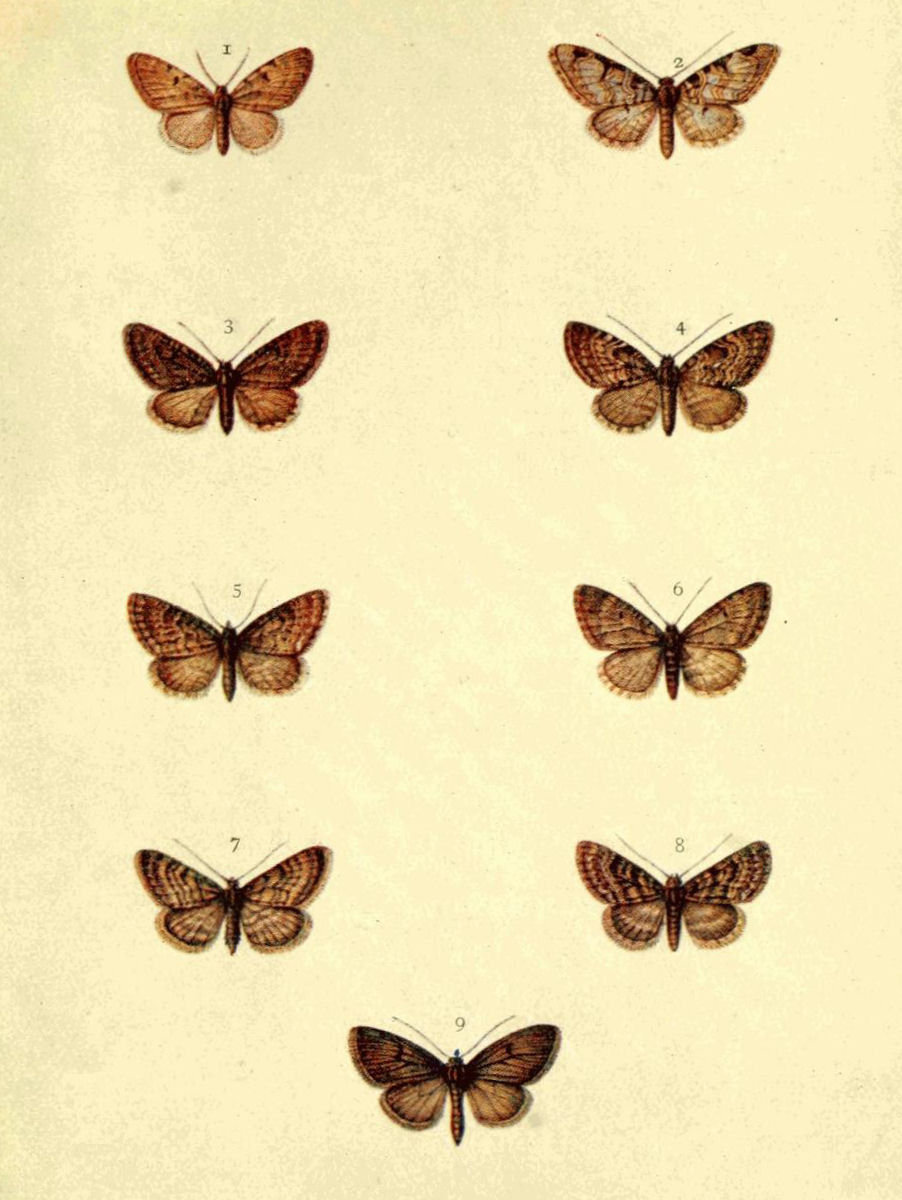
2 Pl. 96.
1.Ochreous Pug. 2.Pinion-spotted Pug. 3, 4.Edinburgh Pug.
5-8.Satyr Pug. 9.White-spotted Pug, var. angelicata.
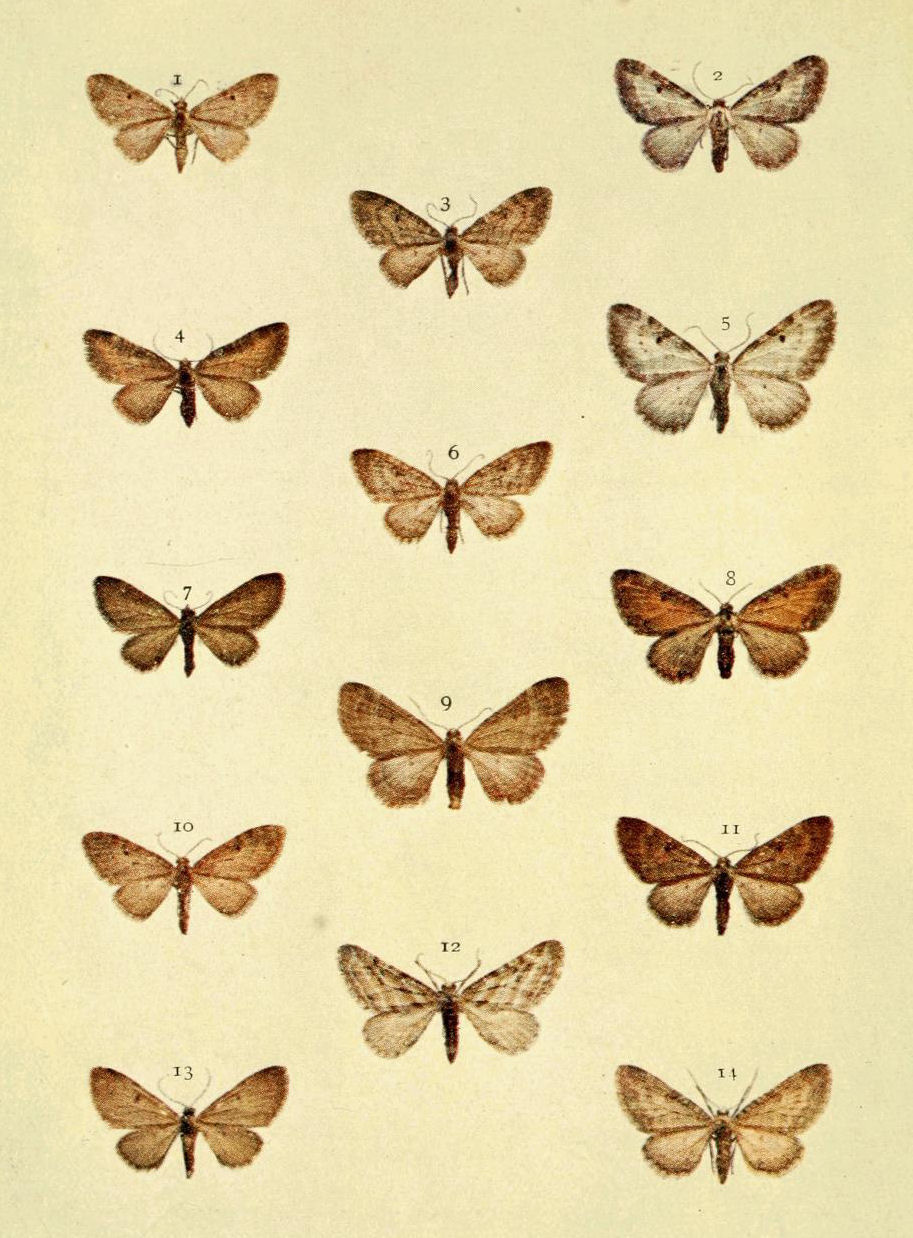
2 Pl. 97.
1.White-spotted Pug. 2, 5.Bordered Pug. 3.Larch Pug.
4, 7.Common Pug. 6.Grey Pug. 8, 11.Tawny Speckled Pug.
9.Plain Pug. 10.Golden-rod Pug. 12.Scarce Pug.
13.Triple-spotted Pug. 14.Shaded Pug.
The rather slender caterpillar, figured on Plate 92, Fig. 6, from a coloured drawing by Mr. A. Sich, is yellowish green, inclining to yellow between the rings; three darker green lines on the back, the central one most distinct, the others rather broad and not well defined; sometimes the central line is tinged with brown, as also is the front edge of each ring. It feeds on currant and hop, and is said to eat the leaves of gooseberry also. The first brood is in June and July, and the second in the autumn. The moth is out in May and June and in August. It frequents gardens, and hides among the foliage, or occasionally sits on walls or palings; from hedges where the wild hop grows freely it may be beaten out in the daytime, but it flies in the twilight, sometimes in numbers, around the hop bines.
Widely distributed over England, Wales, and Scotland up to Ross; in Ireland it has been noted from Tyrone, Dublin, Cork, Galway, and Sligo.
Wormwood Pug (Eupithecia absinthiata).
The fore wings are reddish or purplish brown; cross lines indistinct, but represented on the front edge by black marks; discal dot black, submarginal line whitish interrupted, often indistinct, except above the inner margin (Plate 95, Figs. 3, 6, 10). The short, stout, and roughened caterpillar varies in colour, and may be yellowish green, deep rose colour, or dirty reddish brown; a series of lozenge-shaped reddish spots on the back, faint towards each end (often absent in green forms); oblique yellow stripes on the sides form borders to the marks on the back (adapted from Crewe). It feeds, in the autumn, on the flowers of ragwort, golden rod, aster, yarrow, hemp agrimony, etc. The moth is out in June and July.
The species is generally common in the south of England, and is widely distributed over the rest of that country, Wales, and Ireland. In Scotland its range extends to Moray.
Abroad, the distribution spreads to Amurland.
Ling Pug (Eupithecia goossensiata).
The fore wings are rather narrower and more pointed at the tips than those of the last species; the ground colour of the fore wings is of a paler reddish brown, and frequently tinged with greyish; the hind wings are usually greyish-brown (Plate 95, Figs. 2, 12). The caterpillar, which feeds in August and September on the flowers of heath (Erica), and ling (Calluna), is pinkish with dusky marks on the back, most distinct on the middle rings; a yellowish line low down along the side has dusky marks upon it; head, dusky olive, marked with white (adapted from Crewe).
It may be mentioned here, that knautiata, Gregson, which was described as a distinct species, is by some authorities considered to be a form of this species, whilst others refer it to absinthiata. The caterpillar is stouter than that of goossensiata, varies in colour from whitish to green, and even purplish-brown, but not to pinkish; it feeds on the flowers and seeds of Knautia arvensis. The moth is out in June and July, and occurs on heaths and moors throughout England, Wales, and Ireland. In Scotland, it is obtained freely in some parts of the south, and its range extends to the Orkneys.
This species is the minutata of Guenée and other authors, but this name, being a synonym of absinthiata, will have to be discarded in favour of goossensiata, Mabille (1869).
Campanula Pug (Eupithecia denotata).
The faint reddish tinged pale-brown fore wings distinguish this species (Plate 95, Fig. 5). The blackish marks on the front edge are minute, the cross lines are usually indistinct and often absent; the discal spot, however, is black and conspicuous, and the whitish submarginal line is very wavy. In general colour, the caterpillar is pale brownish; lines and marks on the back, dark brown or blackish. It feeds on the seeds of the nettle-leaved bell-flower (Campanula trachelium), and may be reared on the flowers of the various kinds of Campanula grown in gardens: August and early September. The moth is out in July, but is rarely seen in a state of nature. Caterpillars, however, are not uncommon, where the food plant is plentiful, in several of the English counties from Worcestershire southwards to Kent and Cornwall; also in Norfolk.
This species is the campanulata of most British authors.
Jasione Pug (Eupithecia jasioneata).
Except that the ground colour inclines to dark greyish brown, and the cross markings are rather more in evidence, this species is somewhat similar to that last mentioned, pale specimens especially (Plate 95, Figs. 8, 11). The caterpillar feeds in the seed heads of sheep's bit (Jasione montana), is very like that of denotata (campanulata), and occurs in the same months. Possibly this insect, which is regarded as purely British, may eventually be reduced to varietal rank. As pointed out by Mr. Prout, it is in its paler form not easily separable from atraria, Herrich-Schaeffer, a mountain form of denotata, Hübner. Whether species or variety, it is equally interesting to the student of British Lepidoptera from the fact that, up to the year 1878, it seems to have been unknown to entomologists. From its close allies, it stands out more distinctly than do absinthiata and goossensiata from each other, and the latter can hardly escape a similar fate if jasioneata is degraded.
The moth is out in May and June, but it is very rarely seen at large, though caterpillars are found locally in Devon and Somerset, England; at Barmouth, in Merionethshire, North Wales; and in Cork and Kerry, Ireland. Possibly, it awaits discovery in several other parts of the British Isles, and almost certainly in the west of England. In ascertaining new localities for the species, the best method of investigation would be to search for the caterpillars.
White-spotted Pug (Eupithecia albipunctata).
This greyish brown species (Plate 97, Fig. 1) will be recognised by the white spot at the lower end of the whitish submarginal line on the fore wings; not infrequently there is a second white spot placed on the line about the middle, and sometimes a third near the front margin; the hind wings have a white dot at the anal angle, and, occasionally, a second is placed a little beyond. Ab. angelicata, Barrett, occurring with the type in the north of England, is blackish with the discal spot and the veins showing blacker, but without white spots. (Plate 96, Fig. 9.) The caterpillar is pale lemon yellow, or yellowish green; three brown lines along the back, the central one with brown marks upon it; some brownish marks on the sides. Variable in general colour, and the markings sometimes absent. It feeds on the flowers of angelica (Angelica sylvestris), hogweed (Heracleum sphondylium), and other Umbelliferæ. It has also been reared on a diet of elder leaves: August, September, or even later. Our figure (Plate 92, Fig. 5) is from a coloured drawing by Mr. A. Sich. The moth emerges in May and June, sometimes earlier in confinement, and then a second generation has resulted in July.
Widely distributed in England, in many localities the caterpillars are not uncommon, although the moth may never be seen at large. Also occurs in South Wales, in Scotland to Aberdeenshire; and in Ireland it has been found in Sligo and Cork.
Common Pug (Eupithecia vulgata).
This pug varies in colour from pale grey brown through reddish brown to blackish. In some of the lighter coloured specimens, the darker cross lines and the whitish submarginal lines are all well defined; more frequently, perhaps, most of the markings are indistinct or absent, but the small black discal dot and a white spot above the outer angle of the fore wing remain fairly clear. (Plate 97, Figs. 4, 7, ab. subfuscata, Haw.) The caterpillar (Plate 92, Fig. 3) is brownish, inclining to reddish, dotted with white; a series of dirty green marks along the back, and a pale yellow wavy line low down along the sides. It feeds on the leaves of sallow, hawthorn, bramble, bilberry, ragwort, golden-rod and various other plants. There are at least two broods in the year, one in June and July, and the other in the autumn. The moth flies in May and June, and again in August, and is often common, almost everywhere, over the greater part of the British Isles.
The range abroad extends to Eastern Siberia and Amurland.
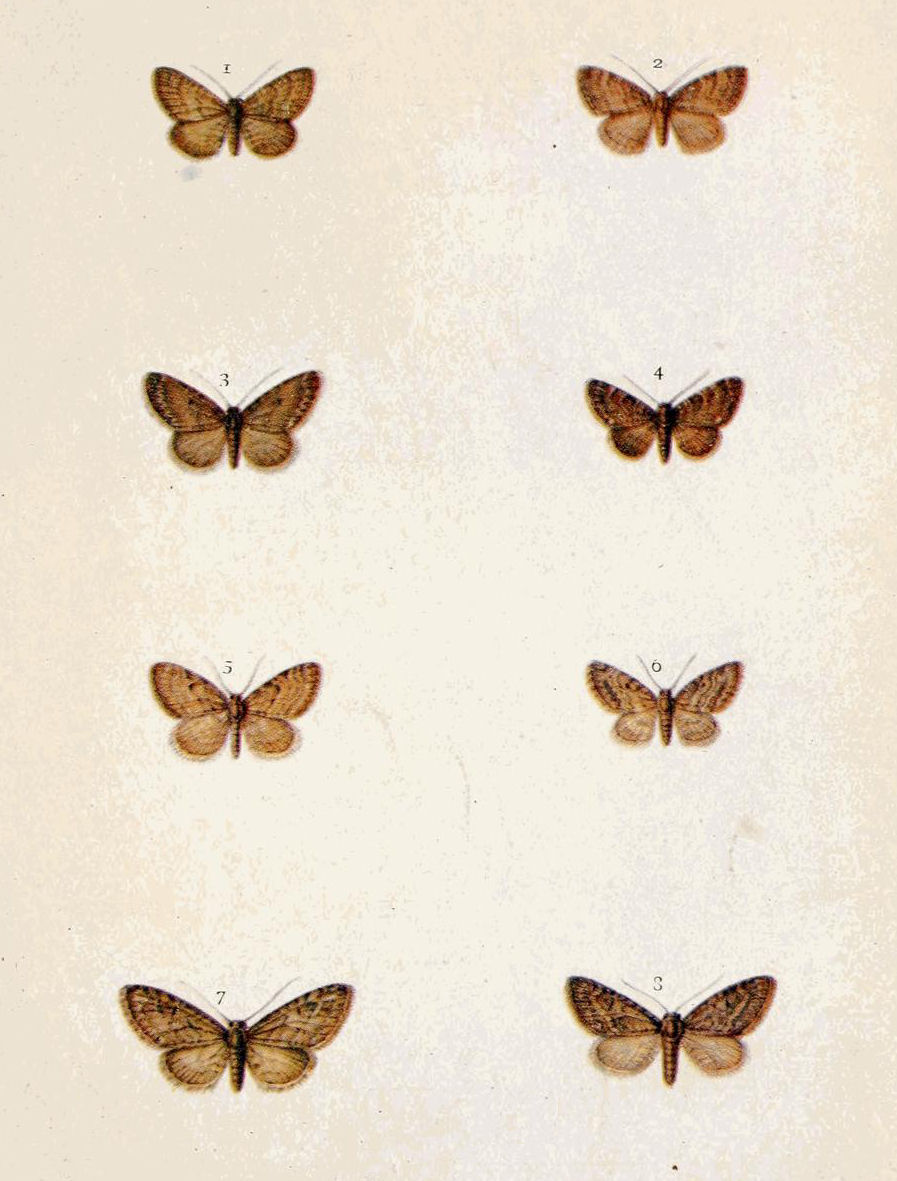
2 Pl. 98.
1.Lead-coloured Pug. 2.Haworth's Pug.
3.Valerian Pug. 4.Marsh Pug.
5.Slender Pug. 6.Maple Pug.
7.Angle-barred Pug. 8.Ash Pug.
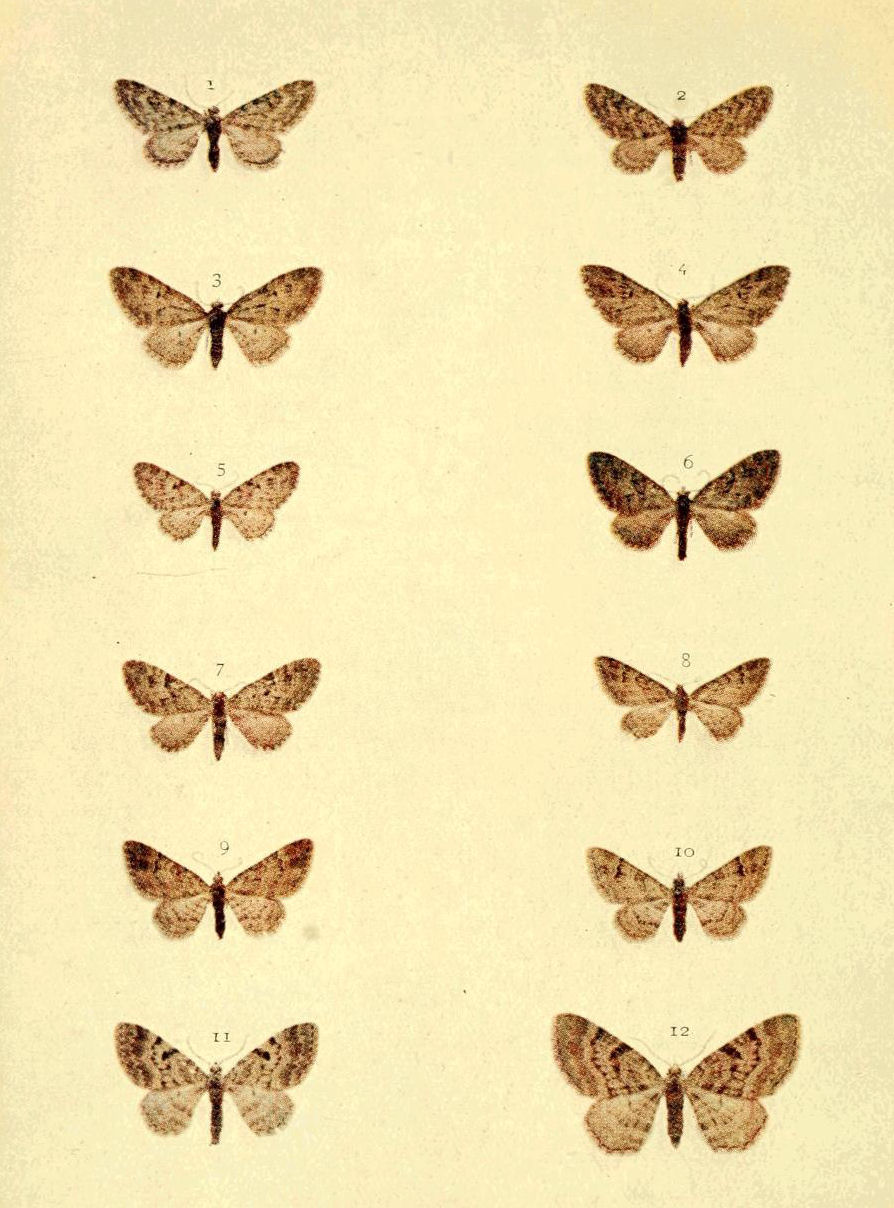
2 Pl. 99.
1, 2.Narrow-winged Pug. 3.Brindled Pug. 4.Mottled Pug.
5.Oak-tree Pug. 6, 7.Juniper Pug. 8-10.Double-striped Pug.
11, 12.Cloaked Pug.
Golden-rod Pug (Eupithecia virgaureata).
The fore wings of this obscurely marked species (Plate 97, Fig. 10) are pale greyish brown inclining to ochreous; the discal spot is black, the veins are marked with dark brown and white, and the whitish submarginal line terminates in a white spot above the inner angle.
The caterpillar varies in colour from grey brown or purplish grey to reddish brown; a series of blackish triangular spots on the back, and yellowish oblique stripes on the sides. It feeds on the flowers of the golden-rod (Solidago virgaurea), in the autumn; also on ragwort (Senecio). The moth is out in May and early June, but in captivity there is apparently a second emergence in July and early August. The caterpillars from which these smaller and rather darker specimens result, hatch from the egg in May and feed on the flowers of beaked parsley (Anthriscus sylvestris).
Widely distributed in England, Wales and Ireland.
The range abroad extends to north-east Siberia; and the species has been recorded from Japan.
Triple-spotted Pug (Eupithecia trisignaria).
The most noticeable markings on the rather shiny, pale-brown fore wings of this species (Plate 97, Fig. 13) are the black discal spot and two blackish clouds above it on the front margin.
The stoutish caterpillar is green, with three darker green lines along the back, and a wavy yellowish line low down along the sides; head, black. It feeds, in the autumn, on flowers and seeds of angelica and cow-parsnip, but the former is its chief food.
June and July are the months for the moth, but it is rarely met with in the open. The only English counties in which the species has been noted are Surrey, Sussex, Dorset and Devon in the south; from Herefordshire in the west its range extends through Worcester, Warwick, Leicester, and Derby to Lancashire and York. In Scotland, Renton records it as common at Hawick, in Roxburghshire; and it was recorded from Argyllshire in 1902. Hardly known in Ireland.
Larch Pug (Eupithecia lariciata).
This species (Plate 97, Fig. 3) is very like that next referred to, but the fore wings are rather longer, the ground colour is whiter, and the dark-grey or blackish cross lines are rather more angled and slanting; the hind wings are paler, and especially so on the front margins.
The long caterpillar is bright green, with a darker green line along the back, merging into reddish on the last ring; sometimes reddish ochreous with the line along the back brownish. It feeds, in June and July, on larch, and will also eat spruce.
The moth is out in May and early June, and may be jarred from larch trees, or sometimes be found at rest on their stems.
As a British species, it was first met with in Surrey, in 1862, then it was noted in Sussex, and shortly afterwards in Yorkshire. At the present time, it will probably be found in any locality where larch is plentiful.
Grey Pug (Eupithecia castigata).
Although, as the English name suggests, this insect is greyish, there is always a tinge of ochreous in the composition of its general colour (Plate 97, Fig. 6). Not infrequently the ground colour is decidedly brownish in tint. The markings vary in clearness, but are most distinct in the paler forms. A blackish form occurs in the north of England, and in the Clydesdale district of Scotland, and was formerly known as the "Paisley Pug."
The longish caterpillar (Plate 92, Fig. 1) is pale or dusky olive, varying to reddish brown, with a series of darker marks on the back. It feeds, from August to October, on the foliage of almost any plant.
The moth is out in May and June, and occasionally a few specimens emerge in the autumn. Generally distributed over the British Isles, but apparently not noted in the Orkneys and Shetlands.
Abroad, the range extends to Amurland.
Plain Pug (Eupithecia subnotata).
The fore wings of this species are pale ochreous brown, inclining to pale reddish on the outer marginal area; the most distinct markings are a pale cross band beyond the black discal dot, and a pale winding submarginal line. The hind wings are smoky grey, with whitish wavy cross lines, the most distinct being the outer (Plate 97, Fig. 9). The stoutish and somewhat stumpy caterpillar is green, or pale yellowish brown, with three darker lines and marks on the back; a yellowish line low down on the sides. It feeds on flowers and seeds of orache (Atriplex), and goosefoot (Chenopodium): August and September. Figured on Plate 94, Figs. 1, 1a, from coloured drawings by Mr. A. Sich. In July, the moth may be disturbed from its food plant or adjacent herbage, or it may be seen resting on palings or fences. It flies at night, and will come to light.
Not uncommon in many places in the southern half of England, and found in the rest of the country, chiefly on the coast, to Hartlepool in Durham, also in Wales. Once recorded from south Scotland, and only noted from the coast near Dublin, in Ireland.
Scarce Pug (Eupithecia extensaria).
The conspicuously marked insect represented on Plate 97, Fig. 12, is, so far, only known to occur, in Britain, on the coasts of Norfolk and Yorkshire. It was first discovered in the latter county more than thirty years ago; about twelve years later it was found on the Norfolk coast, and caterpillars were also obtained from the sea wormwood (Artemisia maritima) in the autumn.
The long caterpillar, which feeds on the flowers and foliage of its food plant, is green, with three lines along the back, the central one dusky and the others whitish; a white stripe low down along the sides is edged below with rosy brown. It will thrive on the cultivated southernwood or "lad's love" (Artemisia abrotanum).
The moth is out in June and July, and may be found in its haunts among the sea wormwood, not only on the coast of Norfolk, but quite possibly, here and there, in suitable places on the east coast from Essex to the Humber. Caterpillars may be obtained in August and September.
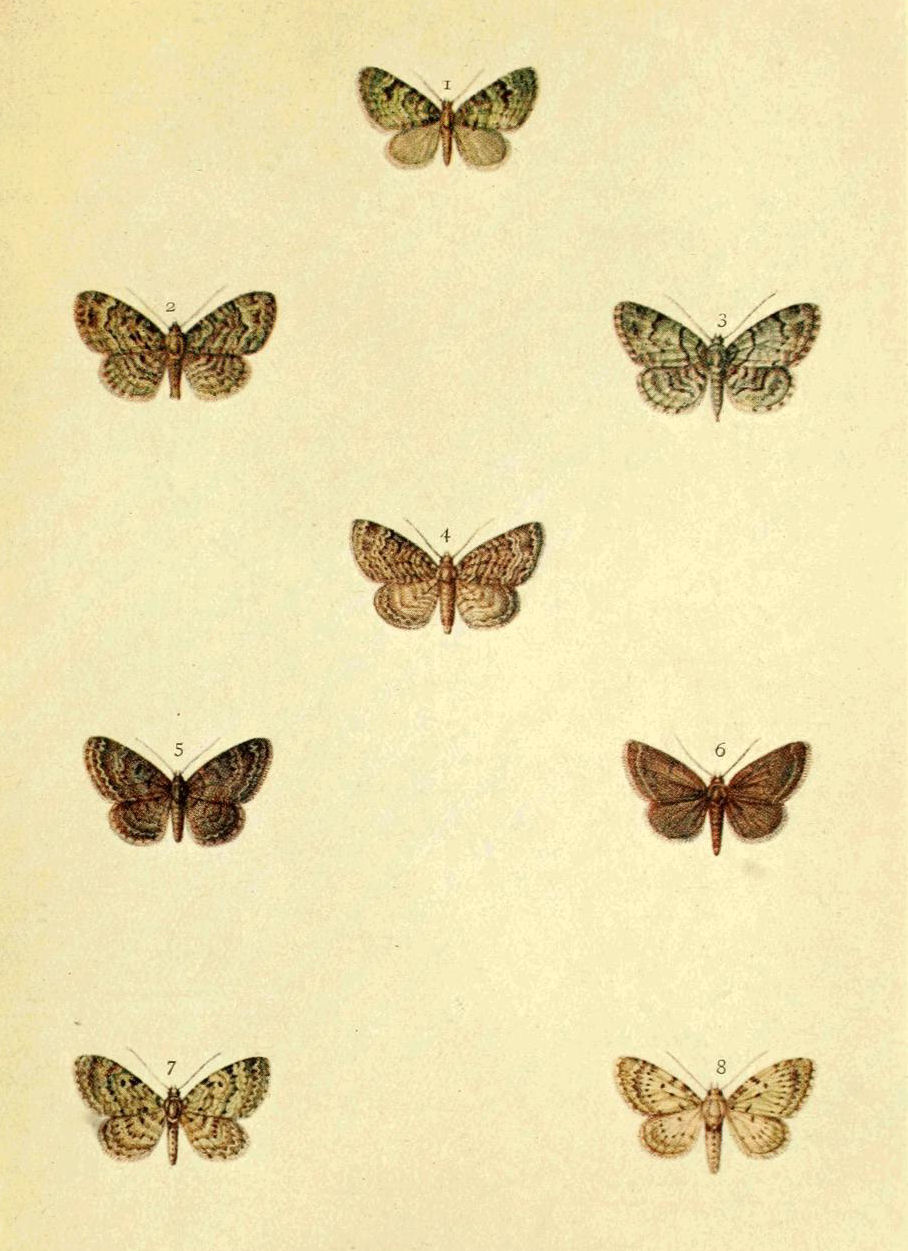
2 Pl. 100.
1.V. Pug. 2-6.Green Pug, and vars. 7, 8.Bilberry Pug.
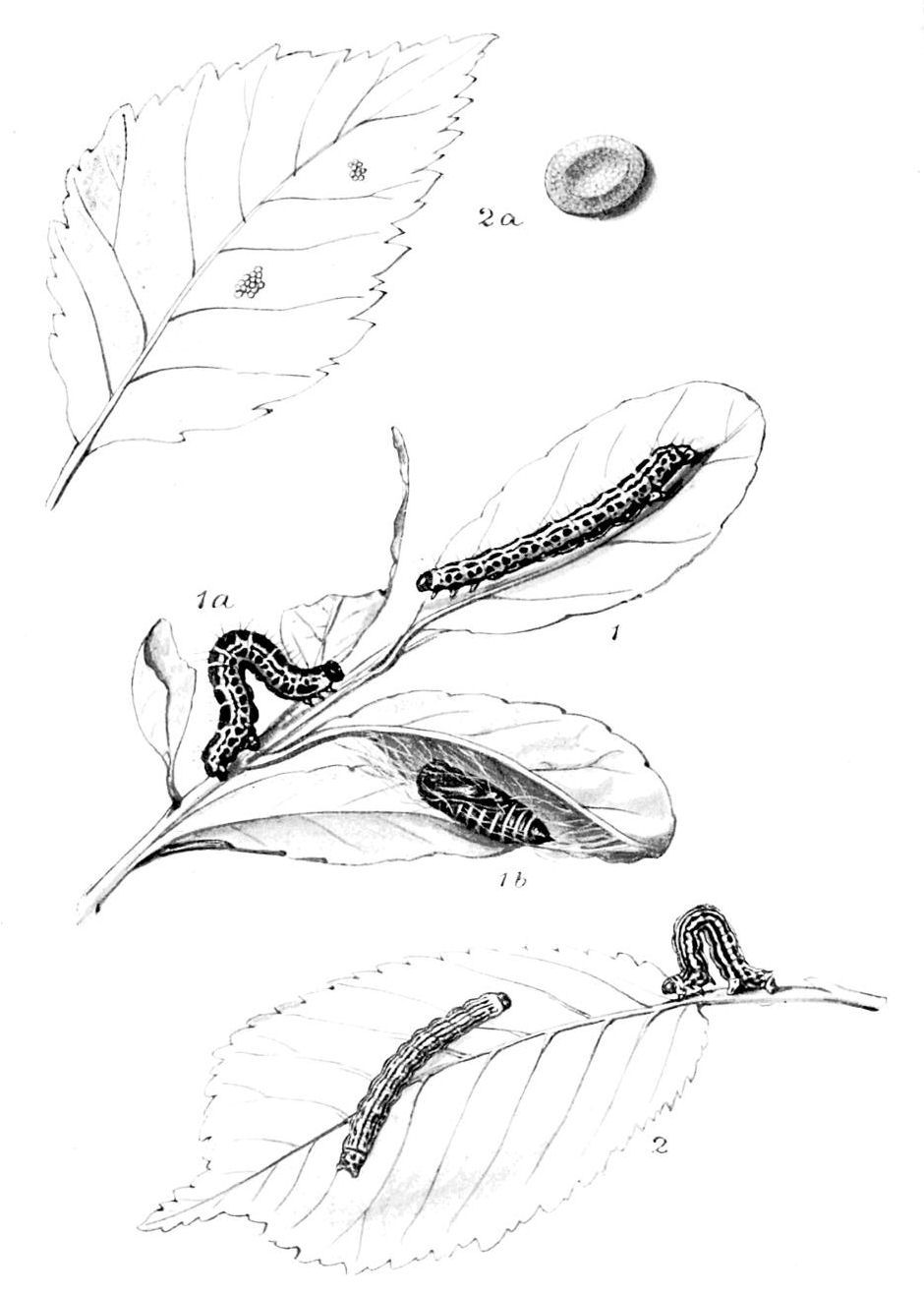
2 Pl. 101.
1.Magpie: caterpillars and chrysalis.
2.Clouded Magpie: eggs, natural size and enlarged, and caterpillars.
Edinburgh Pug (Eupithecia helveticaria).
The two examples of this species on Plate 96, Figs. 3, 4, are from the Pentland Hills, Scotland, and are referable to anglicata, Millière. In this form, which is smaller than the type, the fore wings are grey brown, more or less tinged with reddish, and sometimes inclining to purplish; the whitish edged dark cross lines, especially the basal first and second, are usually distinct, and the veins are often marked with black and white. Ab. arceuthata, Freyer, a paler grey form, occurs in Buckinghamshire, and has also been reported from Surrey. The specimens from the latter county, at least those from the Dorking district, were subsequently referred to E. satyrata.
The stoutish and rather rough caterpillar is green, with three lines along the back, the central one dark green, and the others white; a broad yellowish stripe low down along the sides. It feeds on juniper, in June and July, and sometimes again in September and October. The moth is out in April, May, and June, and a second brood may appear in August and September. The species seems to occur among juniper, in Scotland, from Roxburghshire to Sutherland. It is local in North Lancashire, has been reported from near Llandudno, North Wales, and, as adverted to above, occurs in Bucks.
Satyr Pug (Eupithecia satyrata).
Four specimens are depicted on Plate 96. Fig. 5 represents the typical pale brownish grey form, in which the cross lines are indistinct, and the veins are marked with white and dusky. Fig. 6 shows the rather browner, moorland ab. callunaria, Doubleday, and Figs. 7 and 8 depict two forms of the Shetland race, known as var. curzoni, Gregson. A much rarer form than any of the above is the pale brownish ab. pernotata, Guenée (cauchyata, Meyrick).
The caterpillar is greenish with a series of purplish-brown edged, dusky green, Y-shaped marks along the back; above the yellow spiracular line is a row of slanting purplish blotches; sometimes the general colour is paler, and the markings on the back and sides rosy; occasionally, the whole of the back is rosy (adapted from Crewe). It feeds on the flowers of knapweed (Centaurea nigra), scabious, hawkweed (Hieracium), heath, sallow, etc., etc.: August and September.
The moth is out in May and June, and is found in woodlands, and on heaths and moors. It is widely distributed over the British Isles.
Bordered Pug (Eupithecia succenturiata).
The fore wings are white, clouded and suffused with dark grey on all the margins. The greyish clouding sometimes covers the whole area of the wings, except a very limited space under the black discal spot (ab. disparata, Hübner). Plate 97, Figs. 2, a specimen from Lancs., 5, one from Surrey.
The caterpillar is reddish brown, paler in some specimens than in others; a series of blackish spear-head marks along the back, connected by a blackish line, and a dusky line on each side; a whitish line along the spiracles. It feeds, in September and October, on mugwort (Artemisia vulgaris), tansy (Tanacetum vulgare), and yarrow (Achillea). It may be reared on garden Chrysanthemum. Chrysalis, dark buff, inclining to brown; wing cases olive green; figure 7 on Plate 92 is from a photo by Mr. Main, and is enlarged to twice the natural size.
The moth is out in July and early August; it is not readily put up from its hiding-place among herbage, but at night, when on the wing, it will come to light.
The species is most frequent, perhaps, on the coast, but it is widely distributed over England and Wales. Rare in Ireland, and only noted from counties Armagh, Louth, and Dublin; Kane states that he met with it in some numbers on Lambay Island. Once reported from Ayrshire, Scotland.
The Surrey specimen (Fig. 5) appears to be referable to exalbidata, Staudinger, a form occurring chiefly in Asia, but occasionally found in Germany and elsewhere in Europe.
Tawny Speckled Pug (Eupithecia subfulvata).
Two forms of this species are shown on Plate 97. Fig. 8 represents the reddish typical form, and Fig. 11 (from Lancs. coast) the dark ab. oxydata, Treitschke. Between these two extremes, there are various intermediate forms, showing more or less distinct cross lines.
The caterpillar is reddish brown, with a chain of oval, olive-brown spots along the back; there are also two brownish interrupted lines; the spiracular line is white. Sometimes the general colour is ochreous brown, or grey brown. It feeds, in September and October, on yarrow, and will thrive on tansy, and the flowers of garden chrysanthemum.
The chrysalis of this species is said to differ from that of E. succenturiata in being of a rich red colour, inclining to buff on the wing cases.
In July and August, the moth may sometimes be seen resting on fences, but it is more frequently hidden away among herbage. At night it will visit flowers, especially those of the ragwort.
The species is widely distributed over England and Wales, and in Scotland up to Moray. In Ireland, it is found on the coast from Louth to Cork.
By some entomologists, subfulvata, Haworth, and its variety, oxydata, are set down as forms of the preceding species.
Shaded Pug (Eupithecia scabiosata).
The grey, or greyish-brown lined, whitish species shown on Plate 97, Fig. 14, has been known by three names in Britain. It was named and described by Stephens, in 1831, as piperata (The Speckled Pug), from a specimen, or specimens, taken at Riddlesdown, near Croydon, Surrey; later, it was supposed to be the subumbrata, of the Vienna Catalogue (1776), and certainly of Guenée. The name given to it by Borkhausen, in 1794, appears to be the correct one, and is here adopted.
Crewe describes the caterpillar as yellowish green, with three dark lines on the back, the outer one not clearly defined; a yellow line on each side of the head, and of the last ring of the body.
It feeds on flowers of one of the hawkbits (Leontodon hispidus), and hawk's-beard (Crepis taraxacifolia), etc., from July to September. In June and early July, the moth may be started up from the herbage, as the collector walks over rough ground inland, or more frequently on the coast. It also occurs in fens, marshy places in woods, etc.
The species occurs in Bucks., Berks., Surrey, and in the seaboard counties from Norfolk in the east to Gloucestershire in the west, also in South Wales; in the north it is found in Lancashire, Yorkshire, Durham, and Northumberland. It is not common in Scotland, but has been reported from various parts, extending from Wigtown to Argyll and Aberdeen. In Ireland it is also a coast insect, from Donegal to Cork.
Haworth's Pug (Eupithecia haworthiata).
The fore wings of this species (Plate 98. Fig. 2) are pale greyish, with dark cross lines, and still darker narrow bands; hind wings, similar, but markings less distinct. Resembles the last species in size, but the wings are somewhat rounder, darker, and not so silky in appearance; the body, near the thorax, is ochreous brown. Also known as isogrammaria, Herrich-Schaeffer, but haworthiata, Doubleday, is stated by Prout to be the older name.
In July and August the caterpillar (Plate 90, Fig. 3) may be found in the flower-buds of the traveller's joy or old man's beard (Clematis vitalba). It is green, with a bluish or pinkish tinge, and there are generally three darker stripes along the back, but these are sometimes absent; occasionally the ground colour is yellowish.
The moth is out in June and July, and may be seen flying about clematis in the sunshine, but such specimens are not often worth taking. It is easily reared from caterpillars, which will thrive on flowers of garden Clematis, and may be obtained by the score, either by beating, or by searching for discoloured or black-specked flower buds of the traveller's joy.
The species is most frequent in the south of England, but it occurs in all the eastern, some of the midland, and also in the northern counties to Lancashire and Yorkshire; in the last-named county, Porritt states that the caterpillars were found in profusion on Clematis near Wadworth, Doncaster, in 1901, It inhabits South Wales and Ireland.
Abroad, the species ranges to Amurland and China.
Valerian Pug (Eupithecia valerianata).
The fore wings of this species (Plate 98, Fig. 3) are brownish grey, with indistinct darker cross lines, and a wavy whitish submarginal line; the latter is sometimes not clear, except towards the inner angle.
Caterpillar, rather short, bright green, with three darker green lines along the back; a whitish line low down along the sides, and the ring-divisions are yellow. It feeds, in July and August, on flowers and seeds of all-heal, or cat's valerian (Valeriana officinalis).
The moth is out in May and June; its haunts are in fens, marshes, and damp spots affected by its food plant, but, as a rule, is only found in the caterpillar state. A local, but widely distributed species in England; occurs also in Wales and in Ireland.
Lead-coloured Pug (Eupithecia plumbeolata).
The small, obscurely marked species, represented on Plate 98, Fig. 1, has the fore wings whitish grey, sometimes assuming a yellowish tinge; a number of rather wavy, darker cross lines, and a more or less clearly defined pale band beyond the middle; discal spot always tiny and rarely distinct.
The stumpy caterpillar is yellowish green, with three purplish-red lines along the back, the central one swollen on each ring, and the others irregular; sometimes the back is suffused with purplish-red. It feeds on the flowers of cow-wheat (Melampyrum) in July and August.
The moth is out in May and June, and is readily induced to fly out from among cow-wheat, or the other herbage around. It may be found in most of the English counties, wherever its food plant abounds; in South Wales; in Scotland to Argyll and Aberdeen, and in Ireland from Cork to Donegal.
The range abroad extends to Amurland.
Marsh Pug (Eupithecia pygmæata).
This species (Plate 98, Fig. 4) may be distinguished from haworthiata, which it approaches in size and general appearance, by its more pointed fore wings and the white dot at the inner angle of these wings.
The long, thin caterpillar is yellowish green; a pale olive line along the middle of the back, connecting a series of urn-shaped blotches of the same colour; two pale olive, irregular lines on each side. It feeds, in June and July, on flowers of stitchwort (Stellaria holostea).
The moth is out in May and June, sometimes later; examples of a second brood have been obtained in August and September. It flies in the afternoon, but only when the sun shines, and where the food plant grows freely.
The species occurs in all the eastern counties of England, in Bucks., and in the northern counties to Cumberland and Northumberland. In Wales it has been recorded from Colwyn, Denbighshire; in Scotland it is widely spread to Perthshire; it is local and scarce in Ireland.
Slender Pug (Eupithecia tenuiata).
The fore wings are rather rounded; grey, more or less tinged with brownish, and with ochreous or reddish brown along the front edge; the latter with dusky clouds upon it; the cross lines are dark grey brown and fairly distinct, and the discal spot is black (Plate 98, Fig. 5). A large grey form from Moray, in Scotland, has been named cineræ, Gregson.
Caterpillar, rather stumpy, and dingy yellowish green in colour, the sides and middle of the back rosy; a series of dusky spots, edged by black lines or short streaks, along the back; and a row of pinkish oblique stripes on the sides. It feeds, in the spring, in sallow catkins, and the moths may often be bred in numbers, in June and July, from those catkins which fall most readily from the bushes when we go "a sallowing." Moths frequently rest on the stems, and where there is a clump of well-grown sallows, a good series may be obtained.
The species is partial to fens and marshy places, and is found in such situations over the greater part of the British Isles.
Maple Pug (Eupithecia inturbata).
The fore wings are greyish brown, with many darker cross lines; the outer margin is darker and traversed by a pale line; discal dot, dark grey and not very distinct (Plate 98, Fig. 6). This species was long known as subciliata, Guenée, but is now referred to inturbata, Hübner.
In May and June the caterpillars may be beaten from maple, which is apparently the only food plant, and of which they have a decided preference for the flowers. When full grown the larva is yellowish green with a purplish stripe along the back, and whitish lines along the sides.
The moth may be jarred from the branches of the maple in July and August; it is occasionally seen resting on fences, etc. It seems to be found in England and Wales, in most places where there is a mature growth of maple.
The Angle-barred Pug (Eupithecia innotata).
The greyish-brown fore wings of this species (Plate 98, Fig. 7) are crossed by darker oblique lines, which are angled on the front margin; the submarginal line is white and irregular, especially at each end.
Caterpillar, ochreous grey, inclining to pinkish, marked on the back with white-edged, purplish- or reddish-brown blotches, and on the sides with reddish or purple spots; a whitish line low down along the sides. It feeds on the flowers of wormwood and mugwort (Artemisia), from August to October.
The moth, which is uncommon and very local in England, is out in July. It occurs in Devonshire (Exeter district), Kent (Wye), Essex (Shoeburyness), Lincolnshire (Skegness, etc.), Worcestershire (Malvern), Lancashire and Cheshire (coast sand-hills, Macclesfield, etc.), and Durham (Hartlepool).
Ash Pug (Eupithecia fraxinata).
Very similar to the last mentioned, but smaller, and the markings are less distinct (Plate 98, Fig. 8).
The caterpillar is variable, but generally some shade of green, occasionally purplish red; lines on the sides yellowish, and sometimes there are dusky purplish marks on the back. It feeds, in August and September, on ash, and is said to eat Artemisia, Laurustinus, and the flowers of scabious. The moth is out in late June and July, and sometimes a second generation appears in the autumn.
This species, which by some entomologists is considered to be a form of E. innotata, is widely distributed over England, south Scotland, and Ireland. Tamarisciata, Freyer, is also considered by some authorities to be a form of E. innotata.
Some moths reared from larvæ obtained, in 1905, from Tamarisk, in Cornwall, have been referred to tamarisciata.
Narrow-winged Pug (Eupithecia nanata).
The rather variable species represented on Plate 99, Figs. 1 and 2, will easily be recognised by its long pointed fore wings, which in colour are whitish grey, darkened by brownish cross-stripes; a whitish spot before the small, black discal dot.
The long, thin, caterpillar, which feeds on ling or heather in the autumn, is whitish with a greenish tinge: the sides are marked with red, and there are some reddish spots on the back.
On almost all heather-clad ground throughout the British Isles, this pretty little moth will be found, more or less commonly, during the months of May and early June, and sometimes there is a second flight in July and August.
Brindled Pug (Eupithecia abbreviata).
The ochreous grey fore wings of this species (Plate 99, Fig. 3) are crossed by dark, bent lines, and marked with black on the veins; the central area is sometimes whitish, and generally paler than the ground colour.
Caterpillar, slender, ochreous brown in colour, with browner lines and redder V-shaped marks on the back. It feeds on oak, in June and July. The moth is not uncommon in oak woods, in April and May, and may be beaten from the boughs in the daytime, and not infrequently found resting on the trunks. Generally distributed, but in Scotland not noted north of Perthshire.
Oak-tree Pug (Eupithecia dodoneata).
This species (Plate 99, Fig. 5) differs from the last in being smaller, paler in colour, more distinctly marked, and with a rather larger and more conspicuous discal spot.
The caterpillar feeds, in June and July, on young leaves of oak, the flowers of the evergreen oak (Quercus ilex), and hawthorn. It is orange, or ochreous red, with blackish marks connected by a line of the same colour along the back, and yellowish stripes and lines on the sides.
The moth is out in May and early June, and occurs in some of the woods in most of the southern counties of England, and on the west to Worcestershire. It has been recorded from Yorks. and Cumberland; from Glamorganshire, South Wales; and from counties Armagh, Dublin, Wicklow, and Sligo, in Ireland.
Mottled Pug (Eupithecia exiguata).
In some respects this species (Plate 99, Fig. 4) is not unlike E. abbreviata, but the general colour of the fore wings is pale grey inclining to brownish; a good character is the blackish band before the submarginal line, which is interrupted by patches of the ground colour, one above, and the other below, the middle; the submarginal line is whitish towards the inner margin.
Caterpillar, long and thin; dark green; a series of yellow dotted reddish marks on the back, and a yellow-edged reddish line low down along the sides. It feeds, in the autumn, on hawthorn, sloe, currant, sallow, ash, etc.
The moth is out in May and June, and is sometimes seen at rest on the stems and branches of trees, fences, etc., and may be beaten out of hedgerows.
Widely distributed throughout England, Wales, Scotland to Perthshire, and Ireland.
Juniper Pug (Eupithecia sobrinata).
Two specimens are shown on Plate 99: Fig. 6 represents a more or less typical example from the Surrey downs, and Fig. 7 a pale form from Forres in Scotland. The species varies in tint of ground colour, and in the strength of marking, in all its localities; but in Scotland there is a greater tendency to pale forms than in England. Mr. H. McArthur, during the present year, obtained an extensive and most variable series from heather, at Aviemore, in Inverness. A pale-brownish tinged white pug found in Kent and the Isle of Wight, at one time referred to E. ultimaria, Boisduval, and afterwards known as stevensata, Webb, is really, according to Prout, anglicata, Herrich-Schaeffer. Whether this is a form of the present species or specifically distinct is still left in doubt, but personally I believe it to be a variety.
The dark-green, sometimes reddish marked, caterpillars may be beaten from juniper bushes, from April to early June. The moth is out from late July to early October, and may be found in nearly all parts of the British Isles where the food plant occurs, and occasionally in localities from which juniper appears to be absent.
Double-striped Pug (Gymnoscelis (Eupithecia) pumilata).
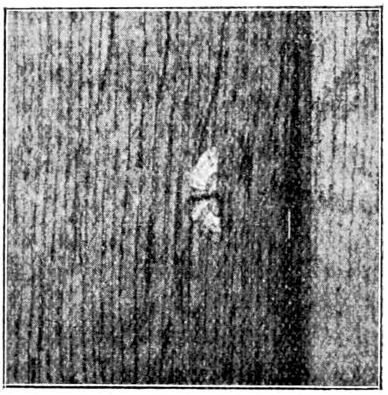
Fig. 5.
Double-striped Pug, at rest.
(Photo by W. J. Lucas.)
This species varies a good deal in the tint of the ground colour and the cross markings. Three forms are depicted on Plate 99: Fig. 8 is a typical male, and Fig. 9 shows a female with distinct red bands (ab. rufifasciata, Haworth); both specimens are from Surrey. The greyish example without red markings (Fig. 10) is from Ireland, and approaches ab. tempestivata, Zeller, in form.
The caterpillar ranges in colour from yellowish-green to reddish; on the back there is a dark-green or blackish line, and often a series of marks of the same colour; the lines on the sides are yellowish. It feeds chiefly in or on the flowers of furze, broom, holly, clematis, hawthorn, etc., from May to September. There are certainly two broods, possibly more. The specimens of the first, or spring, generation are usually larger in size and more strongly marked than those of the summer brood.
The moth is most frequent, perhaps, in April, May, July, and August, but it may be met with in either of the months from April to November. Pretty generally distributed over the British Isles, including the Hebrides and the Orkneys.
Cloaked Pug (Eucymatoge togata).
Over sixty years ago, this fine pug (Plate 99, Figs. 11 and 12) was detected in England. It was first noted in a plantation of spruce fir at Black Park, Buckinghamshire, in mid-June, 1845, and for many years this was the only known British locality. At the present time it is obtained more or less regularly in the New Forest, and has been recorded, chiefly in single specimens, from Wiltshire, Essex, Cambridgeshire, Suffolk, Yorkshire, and Durham. It is not uncommon in Scotland up to Inverness, but is most plentiful in Perthshire.
Kane (Catalogue of the Lepidoptera of Ireland) states that it is spreading over an extensive area in Ireland, as a result of the planting of spruce fir.
The caterpillar, which feeds in the spruce cones, and eats the immature seeds, is dingy white with a pinkish tinge, and suffused with blackish above; the lines along the back and sides, when present, are whitish but not distinct; head, and raised dots on the body, black; a brown plate on the first ring: July and August. Cones containing caterpillars may be secured by visiting a known locality for the species towards the end of August, especially immediately after a gale.
The moth may be dislodged from its resting place among the branches of the spruce in June, sometimes earlier or later.
V-Pug (Chloroclystis coronata).
This is "Phalæna" v-ata, Haworth, and also the V-Pug of that author. A later English name for the species is "The Coronet Pug," an Anglicism for the Latin specific name, and has reference to the black upper part of the outer cross line which is twice angled and bears a fanciful resemblance to a coronet; the lower angle is, however, most distinct, therefore Haworth's English name seems most suitable as it indicates the V-mark, which is a noticeable character of this delicate green species. (Plate 100, Fig. 1.)
The caterpillar is yellowish green, with three reddish lines along the back, the central one most distinct and sometimes forming triangular marks, or lozenges. The ground colour varies, and may be greener, yellower, or occasionally greyish; and the markings are not always present.
There are two generations, the first in June and July, and the second in the autumn, and in confinement a third brood is sometimes obtained. The blossoms of various plants are eaten, but those of hemp-agrimony (Eupatorium cannabinum), golden-rod (Solidago), clematis, and purple loosestrife (Lythrum salicaria), are perhaps favourites. Hawthorn and bramble have also been mentioned as food plants.
The moth is out in most of the months from May to August, but seems to be most frequent in the first named.
Generally distributed in the southern half of England, extending into South Wales, rare in Yorkshire and in Roxburghshire, Scotland. Widely distributed in Ireland. The range abroad extends to Japan.
Green Pug (Chloroclystis rectangulata).
Of this variable species five examples are shown on Plate 100. Figs. 2 and 3 represent the typical and more usual forms; 3 varies in the direction of ab. subaerata, Hübn., and Fig. 4 is the greyish ab. cydoniata, Bork. Ab. nigrosericeata, Haworth (Fig. 6), is blackish with white submarginal line; and an intermediate form (Fig. 5) may be referable to ab. sericeata, Haworth.
The stumpy caterpillar is of a pale yellow green colour, with a more or less distinct reddish or dark-green line along the back, and reddish ring-divisions. It feeds in flowers of the wild apple or crab, and of apples and pears grown in orchards and gardens. It is found in April and May, and the moth is out in June and July.
The species is common throughout the greater part of England and Wales, and its range extends to Ross in Scotland. It has a wide distribution in Ireland.
Bilberry Pug (Chloroclystis debiliata).
As a British insect, this species (Plate 100, Figs. 7 and 8) was first found in Devonshire, and was then known by the English name of "The Devon Pug." As the yellowish green caterpillar, marked with a darker line along the back and a yellowish one low down on the sides, feeds on bilberry, in April and May, and is by no means confined to Devonshire, the popular name here adopted is more suitable.
When quite fresh the moth, which is out in June and July, has a very delicate tinge of green, but this quickly fades out, leaving a pale greyish white insect. In the typical form (Fig. 7) the black central lines are fairly well defined, but in ab. nigropunctata, Chant (Fig. 8), the lines are represented by a series of dots.
The species is common in some of the sheltered hollows among the hills in Devon and Somerset, and I used to find it in abundance in the Martinhoe district, in the former county. The moths were rarely disturbed from the food plant during the day, but towards dusk they flew in numbers around small trees of mountain ash. Other counties in which it is known to occur are—England: Cornwall, Worcester, Staffordshire, Leicester, and Lancashire (formerly on Chat Moss). Wales: Glamorgan and Pembroke. Scotland: Aberdeen. Ireland: Wicklow, Waterford, Cork, Kerry, and Sligo.
Dentated Pug (Collix sparsata).
At one time this greyish brown species (Plate 102, Figs. 1, 2) was known by the English name of "Broom Scallop," but it is now usually referred to, in the vulgar tongue, as the Dentated Pug. The hind wings have their outer margins toothed rather than scalloped, and the insect has nothing to do with broom.
The rather long caterpillar is pale green, with four white lines along the back, and one on each side; a whitish stripe along the black spiracles. Head, pale brown, rather flat above. (Adapted from Porritt.) It feeds on the yellow loosestrife (Lysimachia vulgaris), in July and August, or even later. Fens and marshy woodlands are the haunts of the moth, which is out in June and early July. It hides among the coarser vegetation, and is not always easily disturbed therefrom; neither is it often noticed when on the wing at night, although it is sometimes found at the flowers of buckthorn.
Localities for the species are the fens of Cambridge and Norfolk, the boggy parts of the New Forest, Hants; Dorset (Bloxworth and Hyde, etc.); Cheshire (Delamere Forest); Yorkshire (bogs near York, and Thorne Waste).
The range abroad extends to Japan.
Dark Spinach (Pelurga comitata).
The darker banded, pale ochreous species shown on Plate 102, Figs. 3 ♂, 4 ♀, varies in the colour of the band to brownish; the central area of this band is almost always pale ochreous or whitish, to a greater or lesser extent.
Caterpillar, stout and roughened; ochreous inclining to reddish, and tinged above with greenish; a series of V-shaped marks along the back, yellow oblique darker on the sides, and a greyish edged pale wavy line low down along the sides. The figures 2, 2a, on Plate 94 are from coloured drawings by Mr. A. Sich.
It feeds in the autumn on the flowers and seeds of various kinds of goosefoot (Chenopodium), also on Orache (Atriplex). The moth is out in July and August, and may be found among its food plants and other low herbage growing in waste places, more particularly those on sandy coasts. Around the borders of market gardens, especially those in the south of London, and in Kent and Surrey, it is often very common. The species probably occurs more or less freely in suitable places almost throughout the British Isles.
Its range abroad extends to East Siberia.
Slender-striped Rufous (Phibalapteryx lapidata).
The rather pointed fore wings are pale brownish, and are crossed by several fine wavy and rather darker lines, and three more distinct, slightly curved lines, one of which is at the base and two are on the central area. The outer margin of the hind wings, which are pale brown, more or less shaded with dusky, is irregular. (Plate 102, Fig. 6.)
Caterpillar, whitish-yellow above, inclining to pale buff below; lines of grey freckles along the back and sides, the lower one broader and darker; head, grey, freckled with darker. According to Hellins, who reared it from the egg, it feeds in May and June, on traveller's joy (Clematis vitalba). The natural food is doubtful, but is said to be grass, whilst Kirby states that in the South of France the caterpillar eats evergreen oak.
The moth is out in September and early October, and is found in Scotland on the hills, in rough grassy and rush-covered spots, at elevations ranging from 300 to 800 feet. In Ireland, it is not uncommon in Antrim, Donegal, Sligo, Mayo, Galway, and Limerick. Barrett states that a specimen has been taken at Shap Fell in Westmorland.
Abroad, the range extends to East Siberia.
Many-lined Moth (Phibalapteryx polygrammata).
The female example of this species, represented on Plate 102, Fig. 5, is from Germany; the male is somewhat paler and the central markings less distinct. This form is var. conjunctaria, Lederer, and most of the specimens formerly obtained in the Cambridgeshire fens, chiefly Burwell and Wicken, were referable to it. The species has not been seen in its old fenland haunts for very many years, and it is probably now extinct in Britain. Specimens have been in the past (and still continue to be) recorded from other British localities, but these on investigation are found to be cases of mistaken identity. C. vittata = lignata bears a strong likeness to P. polygrammata, and is often confused with it, but in the latter the outer band does not run to the tips of the fore wings, as it does in the former species.
Small Waved Umber (Phibalapteryx (Coenocalpe) vitalbata).
At first sight this moth (Plate 102, Fig. 7) might be mistaken for a small specimen of the Waved Umber (Hemerophila abruptaria), but it will be noted that the dark stripe on the fore wings starts from the middle of the inner margin, and runs to just below the tips of the wings; the outer margin of the hind wings is not wavy, and the antennæ of the male are not pectinated.
The caterpillar, which feeds on traveller's joy (Clematis vitalba), in June-July, and in September-October, is greyish brown, with three blackish lines along the back, the central one broader than the other two, especially on the middle of each ring, where it swells out into a black spot.
In May and June, and again in August, the moth may be disturbed from the food plant growing in masses in hedgerows, etc. It occurs in most of the southern counties of England, westward to Herefordshire and South Wales, and eastward to Suffolk. Forsythe states that it is local in the Lancaster district.
The range abroad extends to Amurland and Japan.
The Fern (Phibalapteryx (Coenocalpe) tersata).
The general colour of this species (Plate 102, Fig. 8) is pale brown, with a tendency to reddish in some specimens, and to greyish in others.
Caterpillar, pale brownish inclining to ochreous; on each side of an irregular blackish line along the centre of the back is a pale yellowish line, and there are white spots on the back of the middle rings. It feeds on Clematis, in August and September. The moth is out in June and July, and will be found in similar localities to those mentioned for the previous species, and, except that it has not been recorded from Lancaster, its range in England is much about the same.
The distribution abroad extends to Japan.
Oblique Carpet (Coenocalpe vittata).
This species, also known as lignata, Hübner, is usually pale brown in ground colour, tinged with ochreous or pinkish; the darker oblique stripes vary in width and in intensity. (Plate 102, Figs. 9 ♂, gen. 1; 10 ♂, gen. 2.)
The caterpillar is of a yellow-green colour, inclining to ochreous brown on the upper portions of the middle rings; a darker irregular line along the back, and a whitish line on each side, the latter edged above and below with a fine black line; below the spiracles is a pale pinkish brown stripe. Varies in the tint of ground colour and in the markings. It feeds, after hibernation, on bedstraw (Galium palustre, G. saxatile, etc.), and caterpillars from eggs laid in June may be reared on clematis, wild or cultivated.
The moth is out in May and June, sometimes later, and a second generation appears in August and September; the individuals of the later brood are often smaller than those of the first brood. Its haunts are fens, marshes, and water-meads, but in Middlesex I have taken a specimen or two flying along a weedy ditch. Widely distributed throughout the British Isles, but not noted in Scotland north of Moray.