Front matter (continued 3)
Reading edition
When newly laid the eggs are whitish, but soon change to greenish yellow, and finally to pinkish.
The caterpillar hatches in late summer, and feeds on birch, hazel, and beech, until the leaves begin to fall in the autumn; it then constructs a carpet of silk on a twig, and near a bud, upon which it takes up its position for the winter. When thus seen, its reddish brown colour, variegated more or less with green, assimilates so closely with its surroundings that the creature is not easy to detect. In the spring, when it awakens, the green colour increases in extent as the buds open and the leaves unfold; when they are fully expanded, the caterpillar sits among the foliage towards the tip of a twig, and is then almost entirely green, the reddish brown only showing on the head, slightly on the warts, and more distinctly on the hinder parts which are in touch with the twig. The chrysalis, enclosed in a flimsy silken web among the dead leaves, usually on the ground, is of a delicate green colour, dotted with buff on the back, and shaded with buff on the wing cases. The early stages are figured on Plate 42.
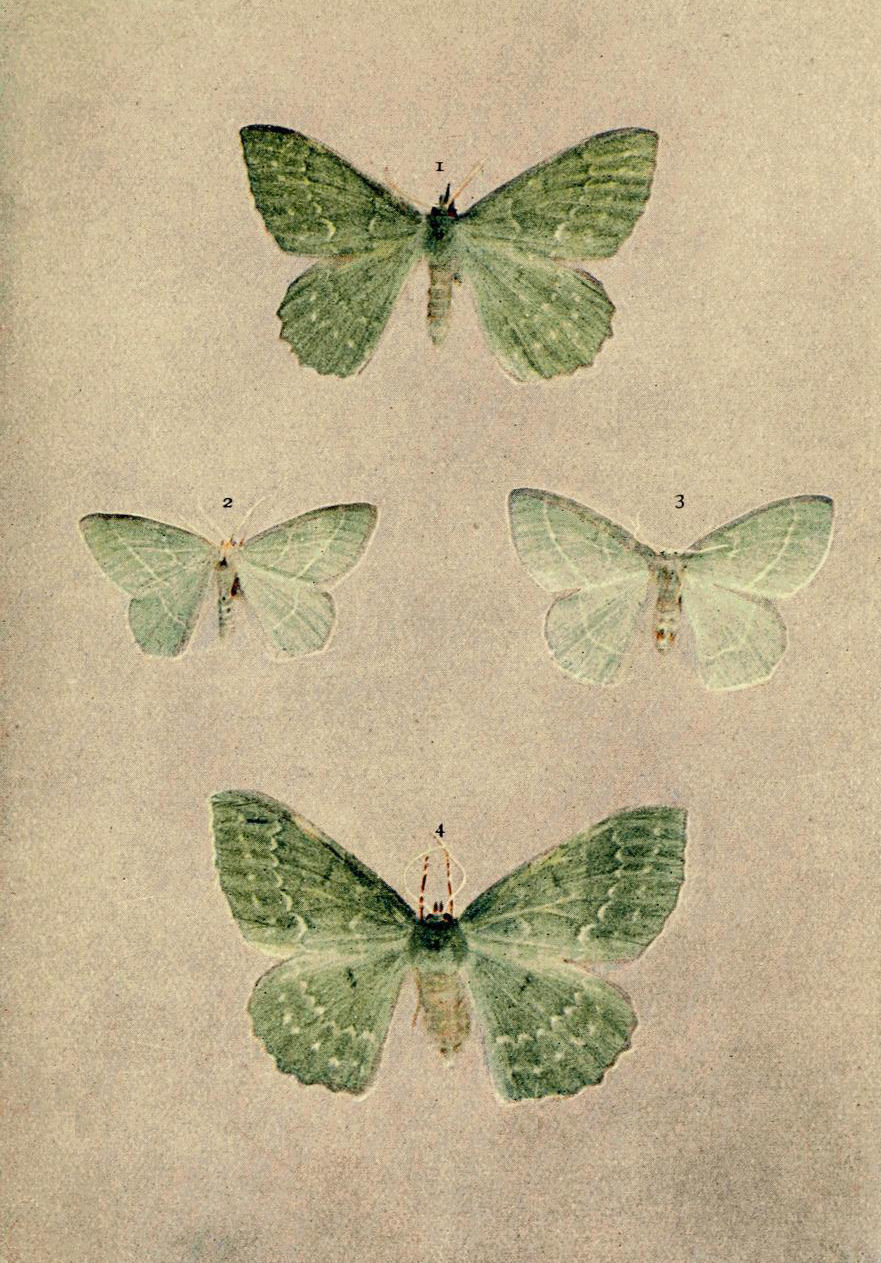
2 Pl. 40.
1, 4.Large Emerald. 2, 3.Small Emerald.
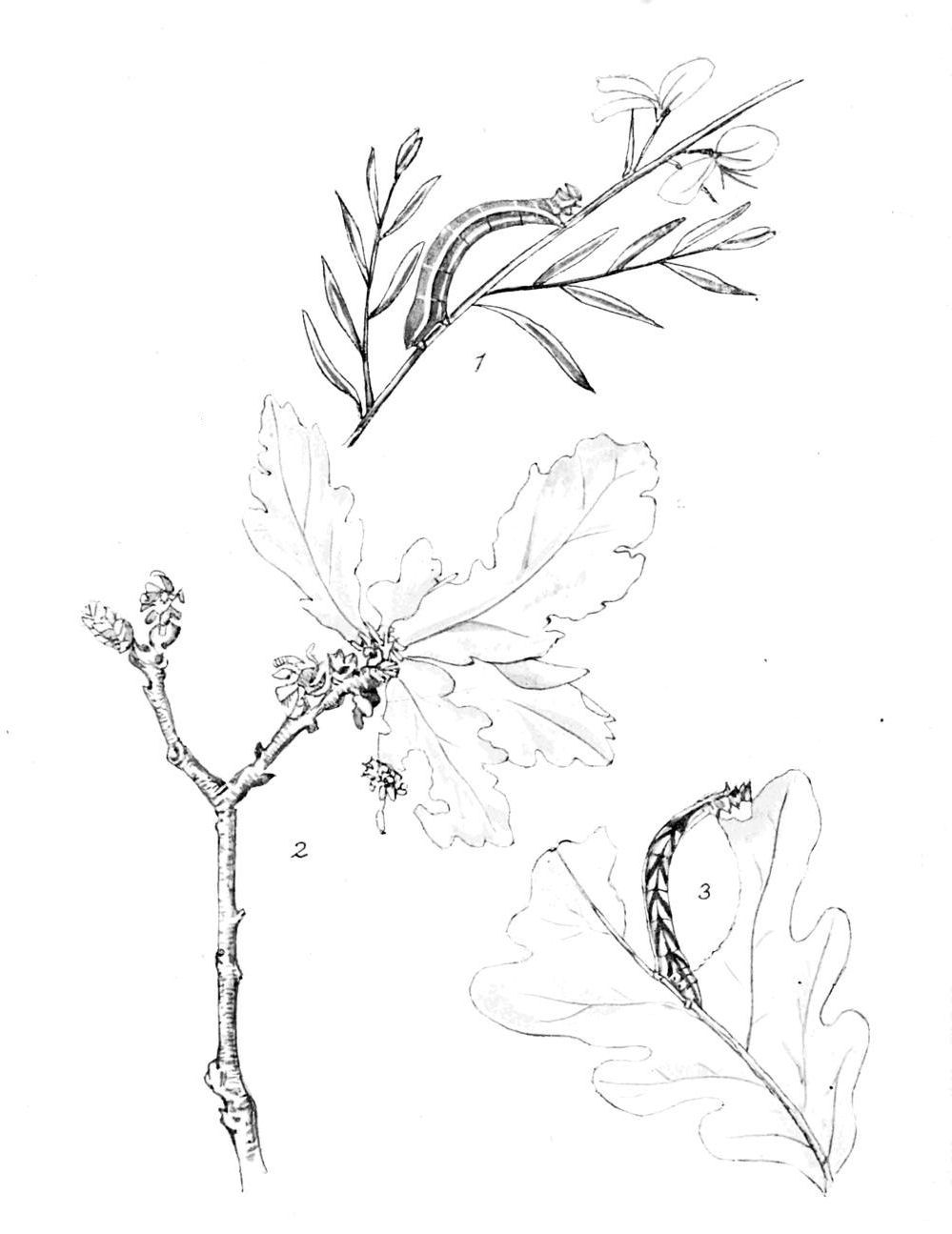
2 Pl. 41.
1.Grass Emerald: caterpillar.
2.Blotched Emerald: caterpillar.
3.Common Emerald: caterpillar.
The moth is out in June and July, and may occasionally be beaten out of a hedge or bush, but is most frequently obtained late at night, when it is active on the wing, and is attracted by a brilliant light.
The species occurs in woods, on heaths and moors, and in fens, throughout the British Isles, except the most northern parts of Scotland and the isles.
Abroad, the range extends to Amurland and Japan.
The Small Emerald (Geometra vernaria).
This species (Plate 40, Figs. 2 and 3) is smaller than the last mentioned, the green colour is of a softer tint, and the lines crossing the wings, two on the fore wings and one on the hind wings, are whitish, and not waved.
The caterpillar hatches from the egg in August, and after hibernation is to be found in May and June on Traveller's Joy or Old Man's Beard (Clematis vitalba). It is then green, with white dots arranged in lines along the back and sides; the head is deep reddish brown, and this, and also the first and last rings of the body, have raised points. Transformation to the greenish chrysalis is effected among the leaves, drawn together with silk. (Plate 44, Figs. 3 and 3a.)
The moth flies in the evening in July and August, and in the daytime may be disturbed, by the application of the beating stick, from its retreats in hedges, etc., where the food plant flourishes. Found in most of the southern and eastern counties of England, most frequently on the chalk; its range extends to Worcestershire. Except that it has been recorded as a doubtful inhabitant of Ireland, the species does not appear to occur elsewhere in the British Isles. The distribution abroad extends to Amurland.
The Blotched Emerald (Euchloris (Comibæna) pustulata).
When quite fresh, this moth (Plate 43, Fig. 1) is exceedingly pretty; the pale blotches vary a little in size, as also do the reddish marks upon them.
The caterpillar adorns itself with particles of its food as soon as it leaves the egg in July; after hibernation it uses the scales or husks of the oak buds for the same purpose. When stripped of its trappings it is found to be reddish brown in colour, with three slightly darker lines along the back; hooded bristles arising from raised brownish spots afford means for the attachment of the masquerading outfit, each moiety of which is covered with silk on one side before being placed in the required position. When beating oaks for larvæ in May and June, the contents of the umbrella or beating tray should not be too hastily thrown away, but allowed to remain therein for awhile, and closely watched for any movement among the litter. The spectacle of a cluster of oak bracts suddenly becoming active will certainly arouse curiosity, and on examination the cause of the commotion will frequently be found to be the caterpillar of this species. (Plate 41, Fig. 2; after Auld.)
The moth is out in June and July, and flies at dusk in and around oak woods. In the daytime it may be jarred from its perch in oak trees, and once I found a specimen on a fence in the Esher district. It has been known to visit light, and examples of a September emergence have been recorded.
As a British species it only inhabits England, and it has been noted from Staffordshire and Leicester, but seems to be rare in the midland counties generally. It is more frequently found in the southern and eastern counties.
Abroad, the range extends through Central Europe to Southern Sweden, S. Russia, N. Asia Minor, and Andalusia.
The Essex Emerald (Euchloris smaragdaria).
In some examples of this species (Plate 43, Figs. 2, 3) the green colour is brighter than in others, and very occasionally it is tinged with bluish; typically, there are white cross lines on the fore wings, but the inner one is not infrequently absent, and more rarely both are missing. The white central spot is very rarely absent, and the edges of the fore wings are yellowish.
The caterpillar feeds on the sea wormwood (Artemisia maritima), and adorns itself with fragments of its food plant in much the same manner as that of the species last referred to. Although obtained in the autumn in some numbers from its food plant, it seems to have been rarely met with in the spring after hibernation. It is, therefore, advisable to collect the caterpillars about September, and transfer them to plants of the garden Artemisia abrotanum, locally known as "Southernwood," "Old man," or "Lad's love," or, where available, wormwood (A. absinthium) will suit it admirably. Upon either of these plants the larvæ will hibernate, feed up in the spring, and become full grown about May. The early stages are figured on Plate 42, larva and pupa from photos by Mr. H. Main.
The moth is out in June and early July, but it is rarely seen in the open, although over sixty years ago a few specimens were put up from among grass and netted at St. Osyth; in later years an example or two have been taken at Sheerness in Kent. Possibly, others may also have been captured in one or other of the insect's haunts, but records are silent on the matter. Barrett mentions a specimen emerging in September, and the Rev. C. R. N. Burrows notes that part of a brood of caterpillars reared from eggs, and fed on A. absinthium, attained the moth state during the autumn. So far as concerns the British Isles it seems to be almost exclusively an inhabitant of the salterns, or sea marshes of Essex.
Abroad, the species occurs inland, and is not confined to the coast; its range extends eastwards to Siberia and Amurland.
The Small Grass Emerald (Nemoria viridata).
This species, represented on Plate 43, Figs. 5 and 6, is readily distinguished by its small size and the well-defined white cross line on each wing. In most examples there is a more or less distinct whitish inner line on the fore wings. Ab. mathewi, Bankes, has all the wings dusted with orange scales, more especially on the outer marginal areas. A few examples of this form were reared in 1905, with a number of normal specimens, from eggs laid by a female captured in South Devonshire.
The caterpillar (figured from a skin on Plate 44, Fig. 1) is green, roughened with whitish points; a dusky line along the middle of the back, marked on the front and end rings, also between the rings, with purplish red. Head, and first ring of the body, notched, the points reddish; last ring of the body pointed. When at rest on a twig it assumes a rigid posture, and the legs are tightly drawn together. It feeds on heather, sallow, and birch, but the general experience appears to be that in captivity it thrives best on a diet of hawthorn, and is especially partial to the young shoots. It may be obtained in July and August, and the moth comes out in the following May or June. In 1905, Mr. A. J. Scollick reared some caterpillars from eggs laid June 2nd, and hatched June 16th; all duly pupated, and a moth came up on December 20th of that year. Four others appeared in January and February, 1906.
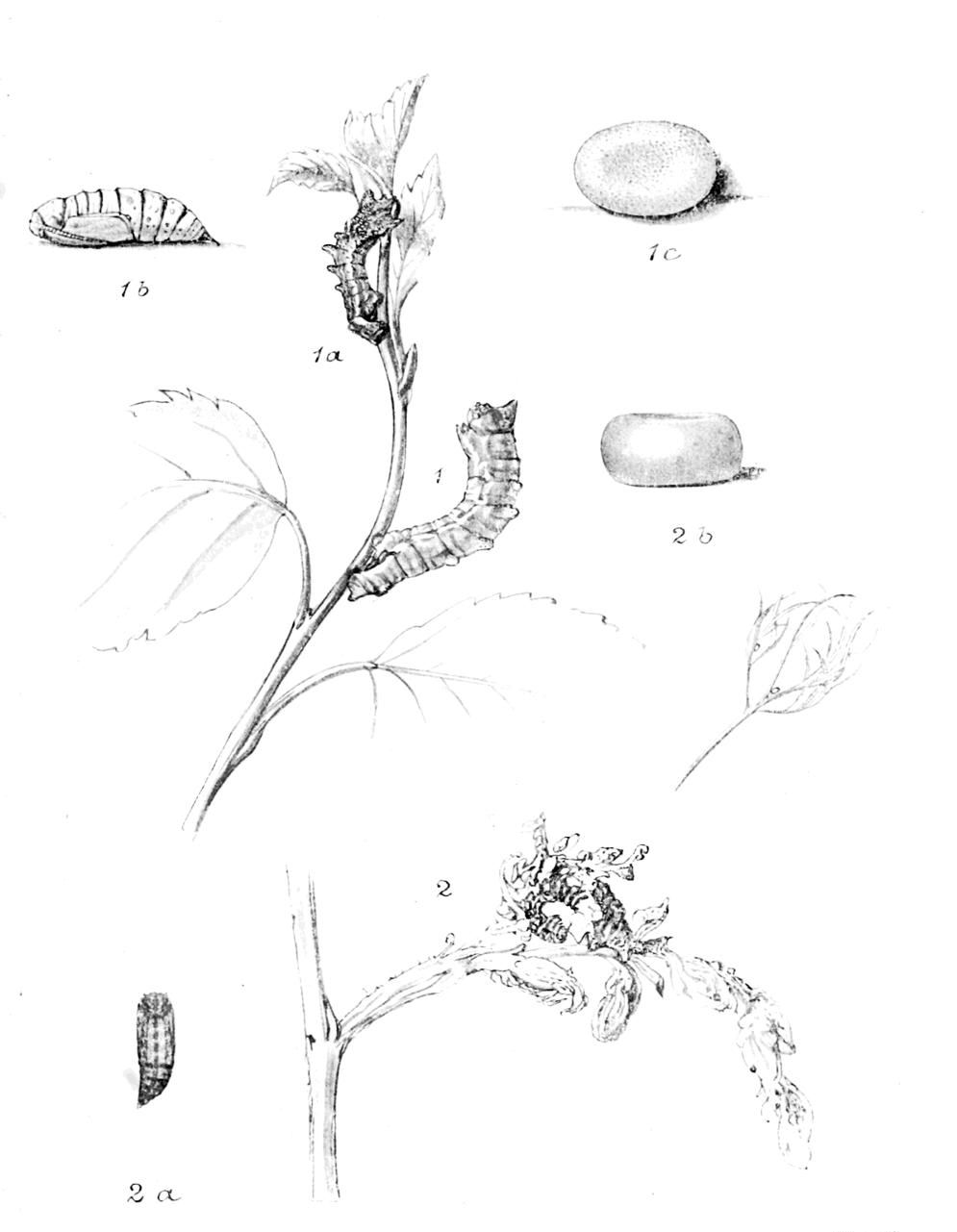
2 Pl. 42.
1, 1a, 1b, 1c.Large Emerald: egg, caterpillars and chrysalis.
2, 2a.Essex Emerald: eggs, caterpillar and chrysalis.
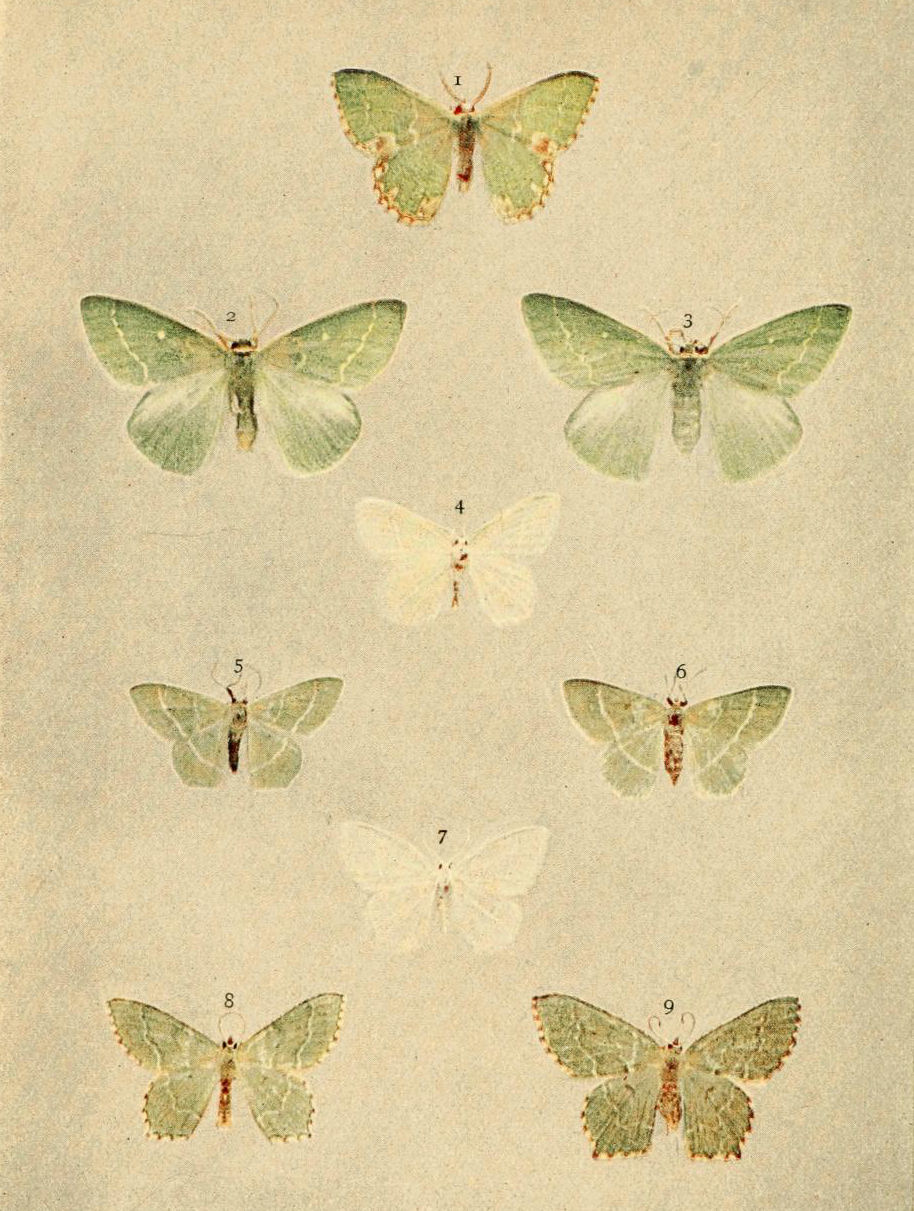
2 Pl. 43.
1.Blotched Emerald. 2, 3.Essex Emerald.
4, 7.Little Emerald. 5, 6.Small Grass Emerald.
8, 9. Common Emerald.
The Rev. F. E. Lowe states that in Guernsey the species occurs exclusively among furze on cliffs by the sea, and chiefly where the plant is cut down from time to time. In Britain it inhabits heaths and mosses, but is very local. It is found in the English counties of Hants (New Forest, etc.), Dorset (Poole Heath, etc.), Devon (Woodbury, Exeter district, etc.), Norfolk (Horning), Worcester (Malvern district, rare); also at Methop, Witherslack, and other localities in Westmoreland and Cumberland. Only doubtfully recorded from Scotland and Ireland.
Abroad, the range extends to Amurland, Corea, and China.
The Little Emerald (Iodis lactearia).
The green tint in this species (Plate 43, Figs. 4 and 7) is even more unstable than in others of the group. When quite fresh the wings can often only be described as whitish with a delicate green tinge, but even when the greatest care is taken to preserve it, the colour is apt to fade.
The caterpillar (Plate 44, Fig. 2, from a coloured drawing by Mr. A. Sich) is long and thin, with two points on the edge of the first ring, and one on the last ring, of a bright green colour, paler between the rings; the spots along the back are reddish, as also is the whitish-fronted deeply notched head. It feeds on the leaves of various trees and bushes, such as birch, oak, hawthorn, sallow, etc. It may be obtained by beating or searching from August to September.
The moth is out in May and June, in some seasons later, and may be beaten out of hedges, as well as from trees in woods. Generally distributed, and often common, throughout England, Wales, and Ireland. In Scotland it is locally common in Clydesdale, and occurs in other southern parts of that country.
Abroad, the range extends to Amurland, Corea, China, and Japan.
The Common Emerald (Hemithea strigata).
When freshly emerged from the chrysalis, this species (Plate 43, Figs. 8 and 9) is darkish green, but it soon fades to a greyish tint. Easily distinguished by its shape, and by the chequered fringes. It is the æstivaria of Hübner, and thymiaria of Guenée. The long, thin, green caterpillar is ornamented with reddish brown, the V-shaped marks on rings 5 to 8 are sometimes whitish; head, deeply notched, brown; the first ring of the body is also notched. It hatches from the egg in August, when it is said to feed on mugwort (Artemisia vulgaris), and other low plants; after hibernation it feeds on the foliage of oak, birch, hawthorn, rose, etc., and attains full growth in May or June. In late June and in July the moth may be put up from the undergrowth in woods, or from bushes in well-timbered hedgerows bordering lanes and fields. Specimens so obtained are poor in colour as a rule, and it is well, therefore, to rear the species from the caterpillar. (Plate 41, Fig. 3; after Hofmann.) This remark applies to all "Emeralds."
The species is often common in the south and east of England, and along the western side, including Wales, up to Cheshire and Lancashire, but it becomes local in Worcestershire and northwards. There are few records of it from Yorkshire, and its occurrence in Durham, Northumberland, and Scotland is doubtful. In Ireland it appears to be widely distributed, but scarce.
The range abroad extends to Amurland, Corea, and Japan.
[Thalera fimbrialis. A specimen of this Central European species (identified by the late Mr. C. G. Barrett) was taken on August 7, 1902, by Mr. C. Capper, from a blade of grass growing on a slope under Beachy Head, Sussex. The species is somewhat similar in appearance to H. strigata, but is larger; the hind wings are notched above the angle on the outer margin; the fringes of all the wings are chequered with red, and the antennæ of the male are bipectinated.]
ACIDALIINÆ.
Purple-bordered Gold (Hyria muricata).
Two forms of this pretty little species (known also as auroraria) are shown on Plate 45. Fig. 1 represents the more usual form, but between this and the almost entirely purple variety (Fig. 4), which occurs chiefly in the north, there are various modifications. Then again, especially in the south of England, there is a tendency to become entirely yellow, the purple, inclining to crimson in such specimens, being confined to the front margin and cross lines on the fore wings, and a narrow band on the outer margin of all the wings.
The caterpillar is pale brownish, inclining to ochreous at each end, marked with irregular blackish lines on the back, and dots and streaks on the sides. Its natural food plant seems to be unknown, but when reared from the egg the caterpillar will eat knotgrass, and sometimes a few will feed up and attain the moth state the same year. August to May.
The moth occurs in late June and in July, and frequents fens, boggy heaths, and mosses. Although odd specimens may, occasionally, be flushed during the day, the collector will need to be up early in the morning if he would see this species on the wing, as it seems to fly most freely about sunrise. The New Forest in Hampshire is a noted district for it, as also are Ranworth, Horning, etc., in Norfolk, and Witherslack in Westmoreland. In Ireland, it is found in counties Galway, Kerry, and Mayo.
Abroad, the range extends to Amurland, China, Corea, and Japan.
Weaver's Wave (Acidalia (Ptychopoda) contiguaria).
The earliest known British specimen of this species (Plate 45, Figs. 2 and 5) was taken in North Wales by Weaver, in 1855, and was figured and described in The Entomologist's Annual for 1856 as Dosithea eburnata, Wocke. About seven years later Greening captured a female specimen, and he subsequently reared the insect, when it became known as "Greening's Pug." Still later, about 1875, the English name was changed to "Capper's Acidalia."
Fortunately, the species seems not difficult to rear from the egg, otherwise specimens in collections would be not only very limited in number, but frequently very indifferent in condition.
In colour the moth is whity brown, more or less dusted or clouded with dark grey; except in the darker forms, three irregular black lines on the fore wings, and two on the hind wings, are clearly seen. It flies at dusk in June and July, and sits by day on lichen-covered rocks.
The caterpillar is pale ochreous brown, with irregular dark brown lines. It feeds on ling (Calluna) and crowberry (Empetrum) from September to May; but when eggs are obtained, the caterpillar hatching from them may be kept on chickweed, knotgrass, etc., and the moth be reared the same year.
Mr. R. Tait records the finding of ten caterpillars on navelwort (Cotyledon) growing among heather in a very sheltered corner among rocks in North Wales, at Easter, 1906. He also notes that moths reared in captivity pair readily.
The British localities, all in North Wales, are Aber, Bangor, Barmouth, Bettws-y-coed, Conway, Dolgelly, Lanfairfechan, and Penmaenmawr.
The Least Carpet (Acidalia (Ptychopoda) rusticata).
The whitish fore wings of this species (Plate 45, Figs. 3 and 6) are crossed by a blackish central band, and there is a blackish patch at the base of the wings, with an extension along the front margin, almost or quite to the central band; the hind wings have a central dot, and three or four dark grey wavy lines, the space between the first and second darkened, and appearing to be a continuation of the fore wing band. The thick set, pale ochreous-brown, or grey-brown, caterpillar (Plate 48, Fig. 1, drawn from a skin) has three more or less distinct pale lines along the back, and a series of darker diamonds along the central area; head, brown. In the open, its food probably consists of decaying or withered leaves, but when treated in captivity it will eat and thrive upon growing knotgrass, groundsel, dandelion, etc. August to May. Mr. Mera mentions that some caterpillars he reared on dandelion produced moths that were larger in size than most captured specimens.
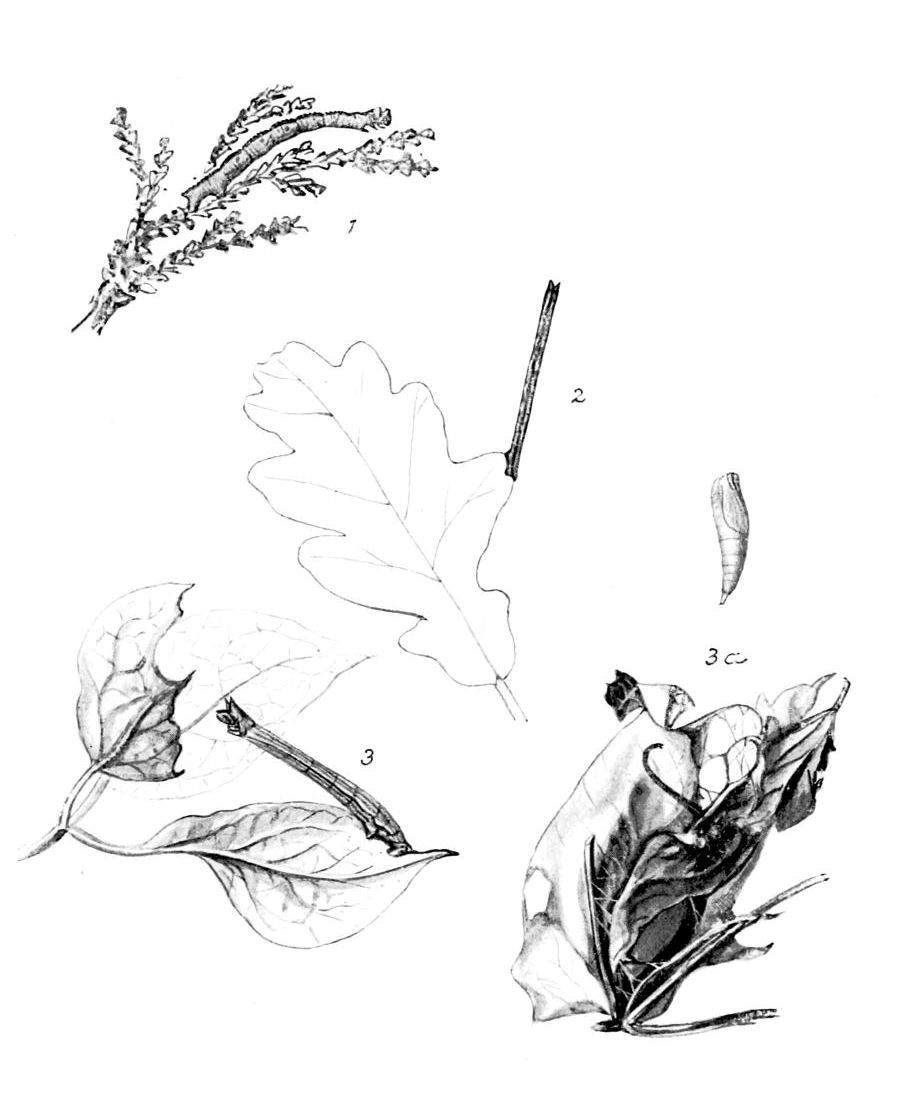
2 Pl. 44.
1.Small Grass Emerald: caterpillar.
2.Little Emerald: caterpillar.
3, 3a.Small Emerald: caterpillar, chrysalis and cocoon.
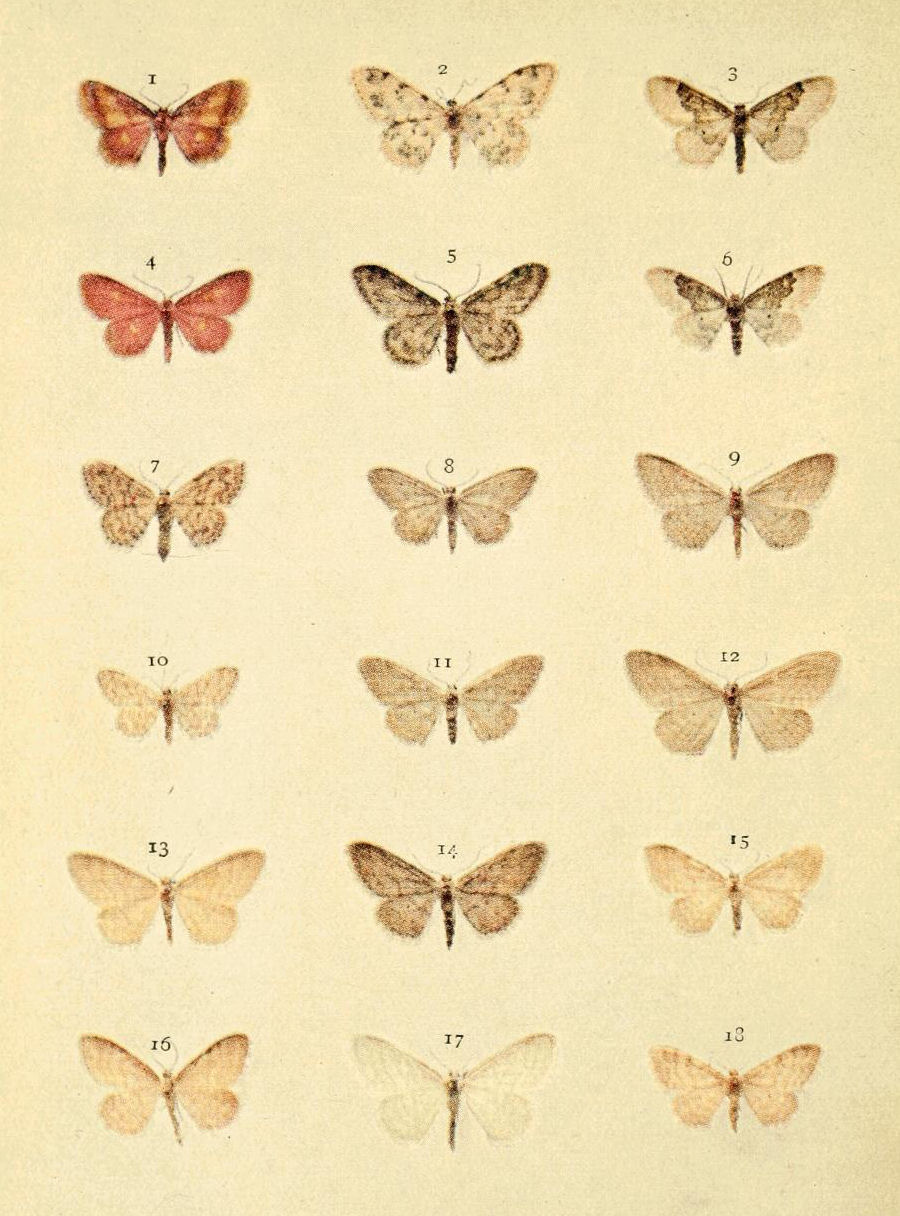
2 Pl. 45.
1, 4.Purple Bordered Gold. 2, 5.Weaver's Wave. 3, 6.Least Carpet.
7, 10.Rusty Wave. 8, 11, 14.Small Dusty Wave.
9, 12.Dotted Border Wave. 13.Silky Wave. 15, 18.Dwarf Cream Wave.
16.Isle of Wight Wave. 17.Satin Wave.
The moth is out in July, and specimens have been bred in September from eggs laid in July of the same year. To obtain this species, a journey will have to be made to one or other of its special haunts in Kent, lying between Greenhithe and Sheerness. Other localities from which it has been recorded are Kingsdown, Dover, Folkestone (Kent); Brighton, Lewes, West Horsham (Sussex); Isle of Portland (Dorset); Rame Head, Torquay (Devon); and single specimens have been reported from Stowmarket and Felixstowe (Suffolk).
The Rusty Wave (Acidalia (Ptychopoda) herbariata).
In The Entomologists Annual for 1856, two species of Acidalia were brought forward as new to the British list. One of these has been referred to under A. contiguaria, the other was the present species, which at the time was wrongly referred to circuitaria, Hübner. The specimens depicted on Plate 45, Figs. 7 and 10, are of continental origin.
Although other specimens were then known to exist in at least two British collections, the first recorded example was that mentioned above. This was captured in Bloomsbury Street, London. In June, 1868, three or four examples were found in a herbalist's shop in Holborn; one occurred on a shop window in Oxford Street in 1873; one example was taken from a door-post in Cannon Street, July 21, 1879; and two others have been noted from the same street, but dates were not given. The latest record, that of a specimen on July 21, 1898, in a shop in Southampton Row, Bloomsbury, closes the list; it then appears that all the British specimens known to us have been taken in London.
The eggs are laid on dry or withered plants, upon which the long brownish or greenish caterpillars feed throughout the autumn, winter, and following spring. They pupate towards mid-May, and the moths appear in June and July. According to Guenée, caterpillars seem to have been found only in herb or drug stores, and the moths occur in gardens and houses in July and August.
The Small Dusty Wave (Acidalia (Ptychopoda) virgularia).
In most parts of the southern half of England this species, of which three specimens are shown on Plate 45, Figs. 8, 11, 14, is more or less common, and is often to be seen on garden walls, pales, and other kinds of fences. Although apparently infrequent in the Midlands, it has been recorded as common at Rugely in Staffordshire; in several parts of Cheshire it is not uncommon, and its distribution is known to extend to Northumberland. Possibly the species is more widely spread over England than the records show it to be. In Wales, it has been found in the North; in Scotland, it occurs locally from Berwick to Aberdeen; and it is doubtfully recorded from Ireland. The long, thin caterpillar is ochreous-brown, with a pale stripe on each side. It feeds on the leaves of various low plants, and seems, at times, to like its food best when withered. Some that I reared from eggs deposited in September, 1904, fed for a time on fresh dandelion, but on the approach of winter they apparently ceased feeding, and were allowed to remain in the box with the food last supplied. In March it was found that they had been, and were then, eating the old provender. Some fresh dandelion was added, but this was not touched until all the old had been consumed. The same thing was repeated until the caterpillars were nearly full grown, when the fresh food was eaten as well as the stale. The moths resulting from them emerged during the last week in April, 1905, and were all well above the average size, and considerably larger than the female parent. One example is represented by Fig. 11 on the plate.
There are certainly two generations of the moth during the year; in some years possibly more.
Dotted Border Wave (Acidalia (Ptychopoda) straminata).
In its ordinary form this moth (Plate 45, Figs. 9, 12) is greyish white, sometimes with a tinge of brown, especially on the fore wings; the darker cross lines are slightly wavy; each wing has a central black dot, and there is a more or less distinct series of black dots on their outer margins. Ab. circellata, Guenée (Plate 61, Fig. 3), has the first and second lines of the fore wings strongly defined and deep brown, and the first is united with the central shade above the inner margin; the corresponding lines on the hind wings are also deep brown. This form, which occurs on the Lancashire and Cheshire mosses, and is known as the Obscure Wave, has been considered a distinct species, but it is connected with typical straminata by intermediate aberrations which occur together with circellata and the ordinary form on the same ground. Similar intergrades also occur in the New Forest, Hampshire, the Dover district of Kent, and probably elsewhere.
The rough-looking, long and slender caterpillar is pale greyish, with a black-edged pale line along the middle of the back, the black edging interrupted on rings 4-9; on each side of the central line, and lower down along the sides, are other black streaks; head, notched on the crown, and marked with brown.
Some eggs laid August 8th, hatched on September 1st; the infant caterpillars were long and thread-like, the colour was black, and there was a whitish stripe low down along the sides. They would not feed on knotgrass and other plants offered to them, and I failed to rear them. Moths have, however, been bred, as a second generation, in the autumn from caterpillars reared from the egg, on bramble and knotgrass.
The moth occurs in July and August on bush-sprinkled heaths, or heathy ground, where it may be disturbed from the herbage in the daytime, or netted as it flies in the evening. South of England from Kent to Dorset; also in Berkshire, Cheshire (one specimen, Whitegate Heath, 1901, one ab. circellata in Delamere Forest, July, 1903); Yorkshire (Thorne Moor, and rather plentiful on Skipton Common in 1900 and subsequent years; ab. circellata also occurred).
The Dwarf Cream Wave (Acidalia (Ptychopoda) interjectaria).
This moth (Plate 45, Figs. 15, 18) is said to be referable to fuscovenosa, Goeze, and as this is an earlier name than interjectaria, Guenée, it may have to be adopted. For many years it was known in England as osseata, and was described by Haworth, Stephens, and others, under this name. It is also the dilutaria of some authors, but not of Hübner. Hübner's dilutaria is considered by some writers to be the holosericata of Duponchel, and therefore an earlier name for the species generally known by the latter name.
The present species, to which Haworth gave the English name here used, is whitish straw-coloured, and silky in appearance; the wings have a central black dot and four or five dusky cross lines, some of which are more distinct than others; the front edge of the fore wings is tinged with reddish brown, in which is often a dark dot at the ends of the first and central lines; a series of linear blackish dots at the base of the fringes, most distinct on the fore wings.
The somewhat stumpy caterpillar is dull smoky brown, marbled and variegated with ochreous, the darker colour most in evidence in front, and the ochreous behind; an ochreous line along the middle of the back, and one along the region of the spiracles; white spots on rings 5-7. (Adapted from Porritt.) It feeds from August to April on dandelion and other low-growing plants, and especially on the withered leaves. The moth occurs among weeds growing on banks, and hedgerows, and the outskirts of woods, in greater or lesser plenty throughout the South of England; but it becomes local, and more or less rare in the north of the country. In Scotland it is said to be uncommon in Clydesdale, but has not been noted from Ireland, or from Wales.
Isle of Wight Wave (Acidalia (Ptychopoda) humiliata).
This species (Plate 45, Fig. 16) is the osseata of Fabricius, but not of Haworth and other British authors. It is very similar in general appearance to the species last considered, but the wings are somewhat less ample, and rather yellower in tint. It is most readily recognised, however, by the distinctly reddish stripe on the front edge of the fore wings. Previous to 1891, when specimens were obtained by Mr. A. J. Hodges in the Isle of Wight, the species was not certainly known to be an inhabitant of the British Isles, although it seems to have been represented in many collections. The insect is still found by those who know where to look for it on the sea cliffs of its island home, but so far as appears to be known at present, it does not occur in any other part of Britain. For this reason, it does not seem desirable to indicate the exact locality more definitely; but it may be added that the moth flies in July.
Silky Wave (Acidalia (Ptychopoda) holosericata).
Somewhat similar to A. interjectaria, but tinged with pale brown, and even more glossy; the front edge of the fore wings is of the general coloration, and the only markings on the wings are darker cross lines, the third on the fore wings, and the second on the hind wings, being the most distinct. (Plate 45, Fig. 13.)
The rough and rather stumpy caterpillar tapers towards the small notched head; general colour dusky reddish-brown, a pale line along the middle of the back, finely edged with black. It feeds from August to May on rock rose (Helianthemum), eating the withered and even mouldy leaves. Will eat knotgrass, and, no doubt, dandelion also.
Here, again, we have an ancient name brought forward to supplant that which the species has borne for years, and by which it is well known to entomologists. As I am not quite certain that Hübner's (Fig. 100) dilataria does represent this species, Duponchel's name is here retained.
As a British insect, it has only been known since 1851, when the capture of a specimen in the neighbourhood of Bristol was recorded in The Zoologist. Subsequently it transpired that the scene of capture was Durdham Down, Gloucestershire, and here it has been found annually, and in some plenty, among the bushes and low vegetation covering the ground in that rugged locality. Specimens have also been noted from Berkshire (Newbury), Bucks (Chalfont St. Peter), Dorset (Halstock), and Norfolk (Thetford). Possibly there are other localities in England, more especially in the west, where this species may be awaiting discovery.
The Satin Wave (Acidalia (Ptychopoda) subsericeata).
The wings of this species (Plate 45, Fig. 17) are glossy whitish, with a faint greyish, or sometimes yellow greyish, tinge; the cross lines are grey, oblique and straight on the fore wings, but the outer two on the hind wings are curved or bent.
Var. mancuniata, Knaggs, a local form found in Lancashire and Yorkshire, is rather more tinged with yellowish, the lines being distinct, and some more or less distinct dusky dots on the outer margin of the fore wings.
A blackish form, with white fringes, has been recorded from North Cornwall, where the species, in its usual form, has been noted as abundant.
The rough-looking caterpillar is pale greyish, inclining to reddish above; three black lines along the back, the central one slender, and the outer ones widening out towards each end. It feeds on knotgrass, dandelion, chickweed, and other kinds of weeds, and will eat plum. Hatching in August, it hibernates, as a rule, and attains full growth in the following spring; but sometimes caterpillars feed up quickly, and produce moths the same year.
The moth, which is out in June and July, is partial to heathy ground, but not confined to heaths, as it has been met with in lanes bordered by pasture fields. Widely distributed throughout England and Wales, rare in Scotland, where it has only been recorded from the Solway. In Ireland it has been found commonly at Howth, near Dublin; and in the counties Cork and Waterford.
Portland Ribbon Wave (Acidalia (Ptychopoda) degeneraria)
This reddish-banded species (Plate 46, Fig. 1) is, so far as we know, only found, in Britain, in the Isle of Portland, Dorset, where it was first noted on June 24th, 1831. It will be seen that apart from its different colour, the bands in this moth are placed nearer the base of the wings than in A. aversata; on the fore wings the band is limited by the first and central lines, but sometimes it encroaches on the basal area; on the hind wings, it occupies more or less of the basal area, from the first line inwards; the front edge of the fore wings is also reddish.
The caterpillar is ridged along the sides of the roughened body, and tapers towards the slightly notched, blackish marked head; the general colour is reddish-ochreous, darker on the back of the middle rings, along which are three interrupted pale greyish ochreous lines, and dark V-shaped marks. The natural food plant is not known, but it may be reared from the egg on bramble, traveller's joy (Clematis), and, of course, knotgrass and dandelion, both of these plants being generally acceptable to larvæ of the Acidaliinæ, as well as to those of many other species of Geometridæ.
The moth is out in June and July in the open, but has been bred as early as June 2. Some of the caterpillars from eggs laid in June will feed up quickly, and produce moths in September; from these, other eggs may be obtained, the caterpillars from which will feed for a time and then hibernate; as also do the slow-growing individuals of the earlier hatching.
Abroad, this seems to be a Mediterranean species, ranging eastward through Asia Minor to parts of Central Asia; and northwards to Austro-Hungary, Castile, France, and West Central Germany.
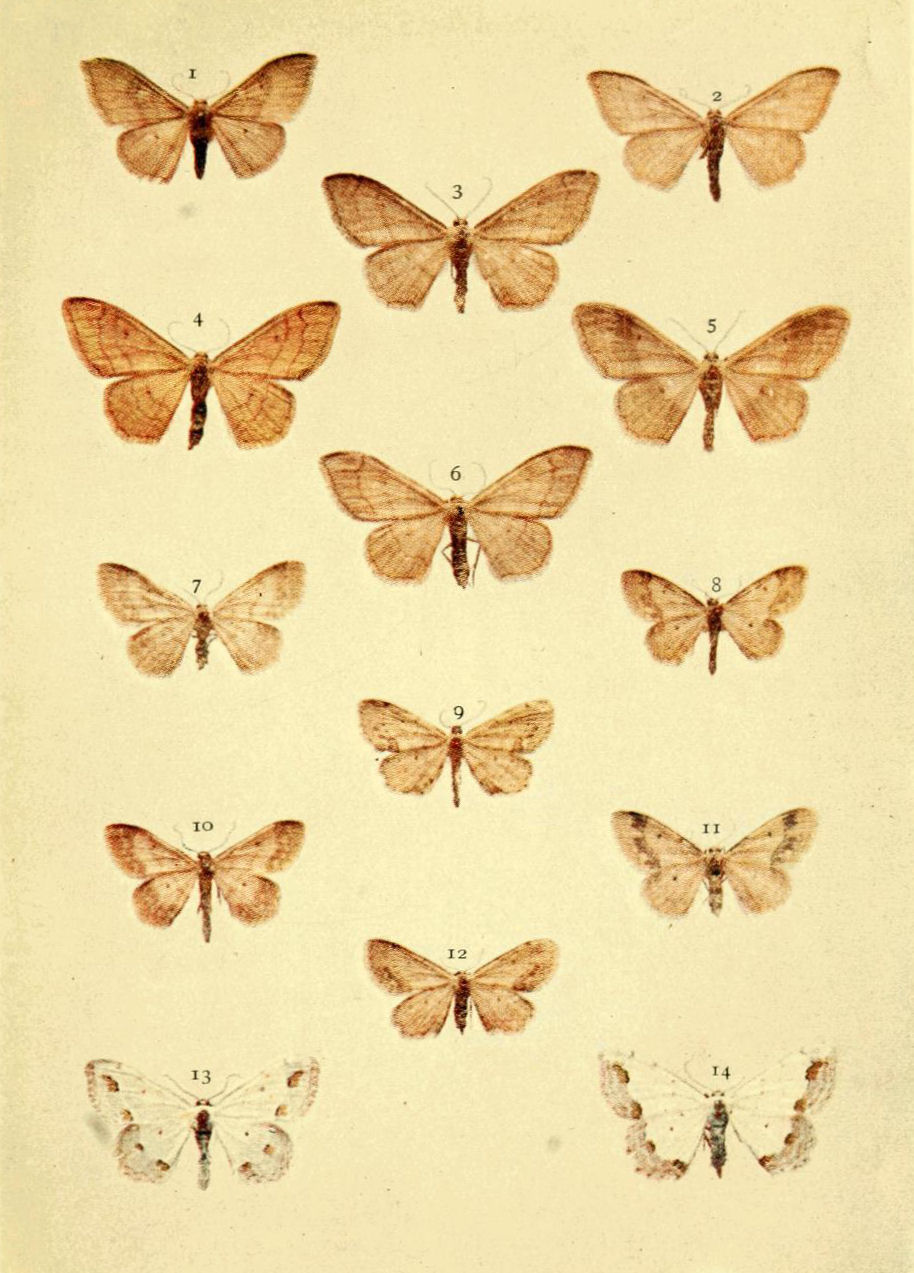
2 Pl. 46.
1.Portland Ribbon Wave. 2.Plain Wave. 3-6.Riband Wave.
7-10.Small Fan-footed Wave. 9, 12.Single-dotted Wave.
8, 11.Treble Brown-spot. 13, 14.Lace Border.
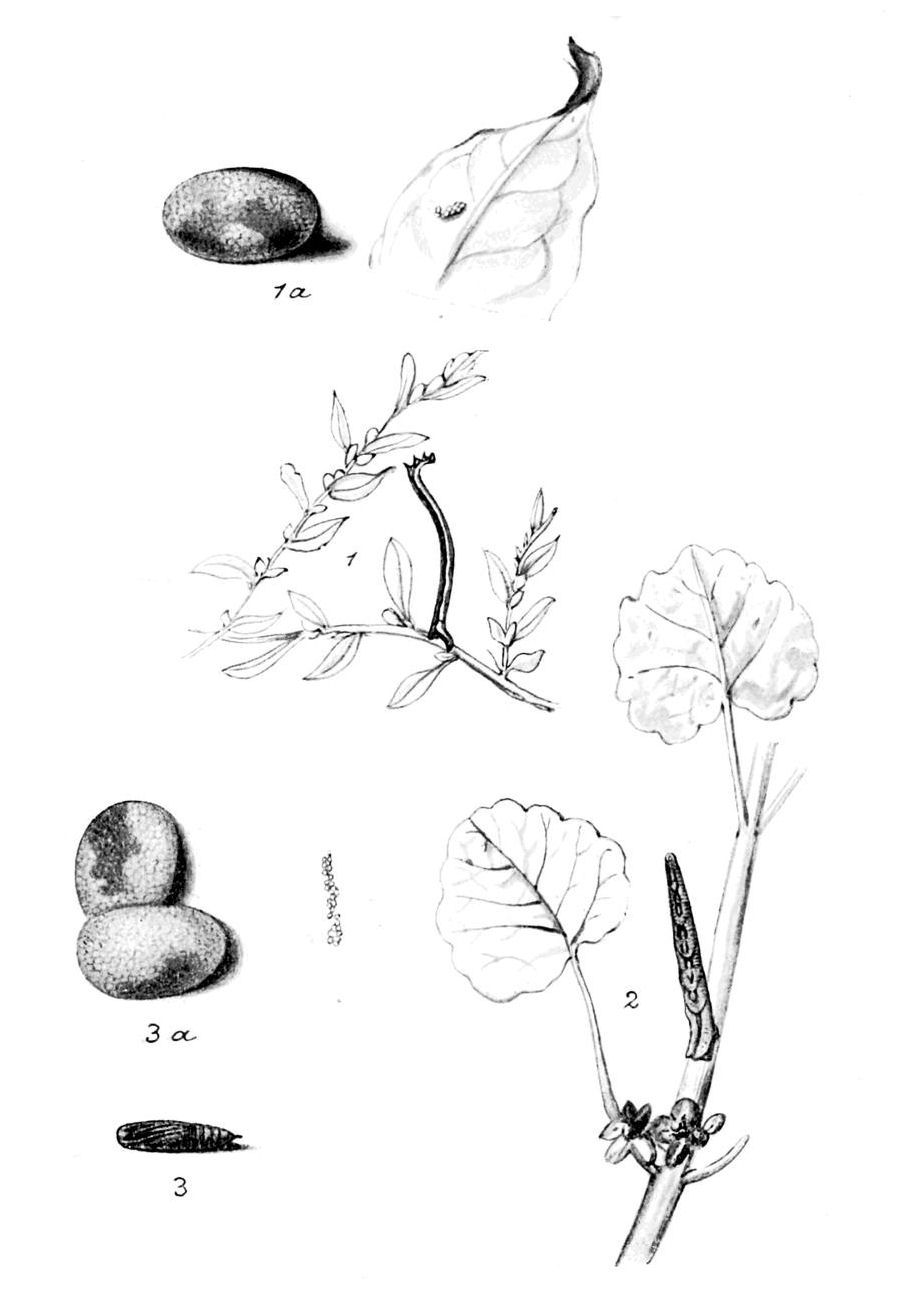
2 Pl. 47.
1, 1a.Single-dotted Wave: eggs and caterpillar.
2.Riband Wave: caterpillar.
3, 3a.Plain Wave: eggs, caterpillar and chrysalis.
The Plain Wave (Acidalia (Ptychopoda) inornata).
Somewhat similar to the last in appearance, but without reddish bands, and front edging to the fore wings; the second or outer line of the fore wings is generally distinct, but the others, especially the central, are often obscure. This species, one example of which is shown on Plate 46, Fig. 2, may be distinguished from the plain form of A. aversata by its generally smaller size and more silky appearance; the cross lines are less distinct, and the outer one of the fore wings is not indented below the front margin. The eggs (Plate 47, Fig. 3a) are laid in strings of from 6-20; at least this is so in captivity. Like the eggs of other species in this genus that I have seen, they are at first whitish bone colour, changing to reddish. They were laid in July, and most of the caterpillars that hatched from them attained the moth state in September; about one-third hibernated, but died off during the winter.
The much-wrinkled and rough-looking caterpillar is pale reddish brown, varying to greyish; the back with V-shaped marks, and a light coloured spot on rings 5 and 6. It feeds, from August to June, on dandelion, dock, and other weeds, also on sallow, bramble, heather, etc.
The moth is out in July, earlier or later in some seasons; it affects woods in which there is plenty of heather or bilberry, and may often be seen resting on tree trunks, especially those of the pine. It is on the wing in the evening, and is said to visit the sugar patch, as well as flowers growing in its haunts. Widely distributed over England and Scotland to Moray, but does not appear to have been noted in Wales. Reported from Kingstown, Killarney, and Londonderry in Ireland.
The Riband Wave (Acidalia (Ptychopoda) aversata).
There are two distinct colour forms, one is greyish white (ab. spoliata, Staudinger), and the other decidedly ochreous; the former is sometimes tinged with ochreous, and sometimes heavily sprinkled with dark grey. In the type form of aversata, the general colour is greyish white, and the space between the central and outer lines of the fore wings, and that enclosed by the first and central of the hind wings, is more or less entirely filled up with dark grey inclining to blackish; occasionally the dark colour spreads beyond the outer line, and covers a large portion of the outer area. These bands also occur in the ochreous and intermediate colour forms. A specimen, bred in June by Mr. W. G. Sheldon, from a caterpillar found on a fence at West Wickham in May, had the wings and abdomen black, but the head, thorax, anal tuft, and fringes of the wings were normal. (Plate 46, Figs. 3-6.)
The caterpillar (Plate 47, Fig. 2; from coloured drawing by Mr. Sich) is much wrinkled, rather thickened behind, and tapers gradually towards the small, black-flecked head; the general colour is brownish, merging into ochreous on the hinder rings; a darker brown shade along the back, interrupted on the middle rings by V-shaped marks, encloses a slender whitish line, and there is a whitish spot on ring eight; a wavy pale ochreous line low down along the sides. (Adapted from Fenn.) It feeds on dandelion, dock, primrose, bedstraw, knotgrass, and many other low-growing plants; after hibernation, from April to May, it will thrive on the young growth of sallow, birch, hawthorn, etc. It will sometimes feed up and reach the moth state in August or September.
The moth flies in June and July, and is generally distributed; but in Scotland does not seem to have been observed north of Moray.
Small Fan-footed Wave (Acidalia (Ptychopoda) bisetata).
One form (Plate 46, Fig. 10) has whitish wings, with a deep, dark-grey border on the outer area of all the wings; this border is traversed by a whitish, wavy line (ab. fimbriolata, Stephens). Another form (Plate 46, Fig. 7) is more or less typical, and in this it will be noted that the marginal borders are much paler, and are broken up into bandlets. Between these two forms there are modifications, and sometimes a greyish shade spreads over all the wings.
The caterpillar is long and slender, with a somewhat flattened appearance, and gradually tapered towards the notched head; the general colour of the roughened body is greyish brown, the middle ring divisions, and V-shaped marks on the back, are blackish or dark brown; there is also a double dark-brown line along the back, not always distinct. It feeds, from August to May, on a variety of low-growing plants, and is partial to withered leaves, especially those of bramble and dandelion. The moth is out in June and July, and is often common, and pretty generally distributed throughout our islands, except that it seems not to have been noted north of Moray, in Scotland.
Abroad, the range extends to East Siberia and Amurland.
The Single Dotted Wave (Acidalia (Ptychopoda) dimidiata).
The most noticeable feature in this whity brown moth (Plate 47, Figs. 9 and 12), sometimes known as scutulata, are the larger dots at the costal end of the dotted cross lines, and the blackish or dark-brown chain-like mark on the lower part of the outer marginal area of the fore wings; the latter is sometimes obscured in a cloud of its own colour.
Eggs (Plate 47, Fig. 1a), laid in a batch on a dried leaf of dandelion, were whitish at first, but turned reddish later.
The elongated and somewhat flattened caterpillar (figured on Plate 47, Fig. 1, from a coloured drawing by Mr. Sich) is ochreous, with brown lines on the back, the central one double, and interrupted on the middle rings, upon which are oblique pale-brown dashes. It feeds, from September to April, on beaked parsley (Anthriscus sylvestris), burnet saxifrage (Pimpinella), etc., and may be reared on withered leaves of dandelion and other weeds. The moth is out in June and July, and in northern localities in August. Generally distributed, and often common.
Treble Brown Spot (Acidalia (Ptychopoda) trigeminata).
This species (Plate 46, Figs. 8, 11) is similar to the last, but generally rather larger and somewhat paler; the front edge of the fore wings is marked with blackish or dark purplish grey, and there is a band of the same colour on the outer marginal area; the inner edge of this band is formed by the second line, and the outer edge is wavy, interrupted above the middle, and sometimes below also.
The rough and rather flattened caterpillar tapers towards the head; in colour it is dusky brown. The markings comprise interrupted black lines and V-shaped blackish marks on the back. Buckler states that this caterpillar may be distinguished from those of its nearest allies by having a rather long, dingy ochreous bristle from each of the raised dots; these bristles, which are of the same thickness throughout, curve forwards on all rings to the ninth, and on the other three backwards. It feeds, from September to April, on various low-growing plants, ivy, birch, etc. If kept warm, it is said that whole broods will attain the moth state in July or August; this may happen sometimes, but in my experience only a few individuals have obliged in this way. The moth is another inhabitant of the hedgerow and the bushy wood-border, where it may be disturbed in the daytime during late May and June. It flies in the evening, and will visit light, and occasionally the sugar patch. Always a local species, but not uncommon in its special haunts in Kent, Surrey, Wiltshire, Essex, and Suffolk; it is also found more or less frequently in Sussex, Hampshire, Dorsetshire, Gloucestershire, Herefordshire and Worcestershire. In Scotland, it is reported as scarce in Renfrew; and Kane notes that it does not occur in Ireland.
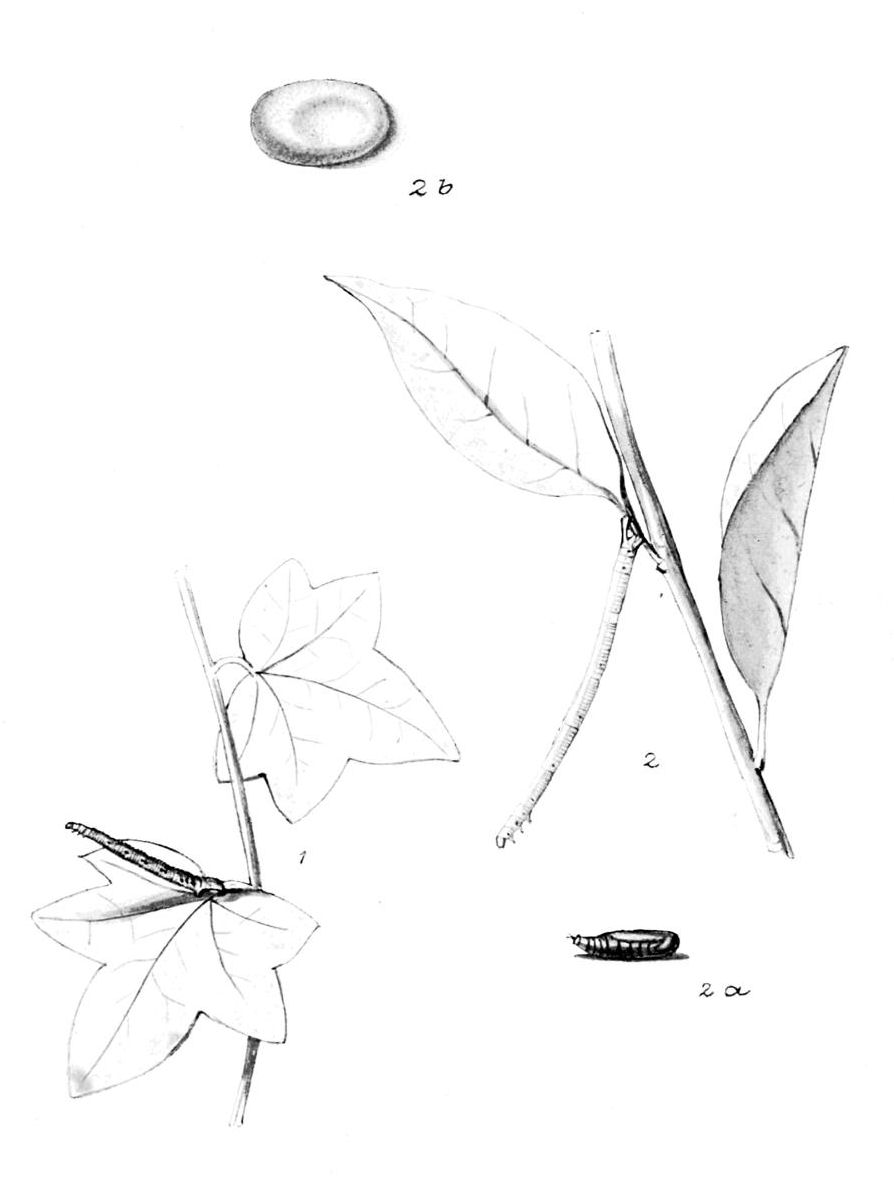
2 Pl. 48.
1.Least Carpet: caterpillar.
2, 2a, 2b.Small Blood-vein: egg enlarged, caterpillar and chrysalis.
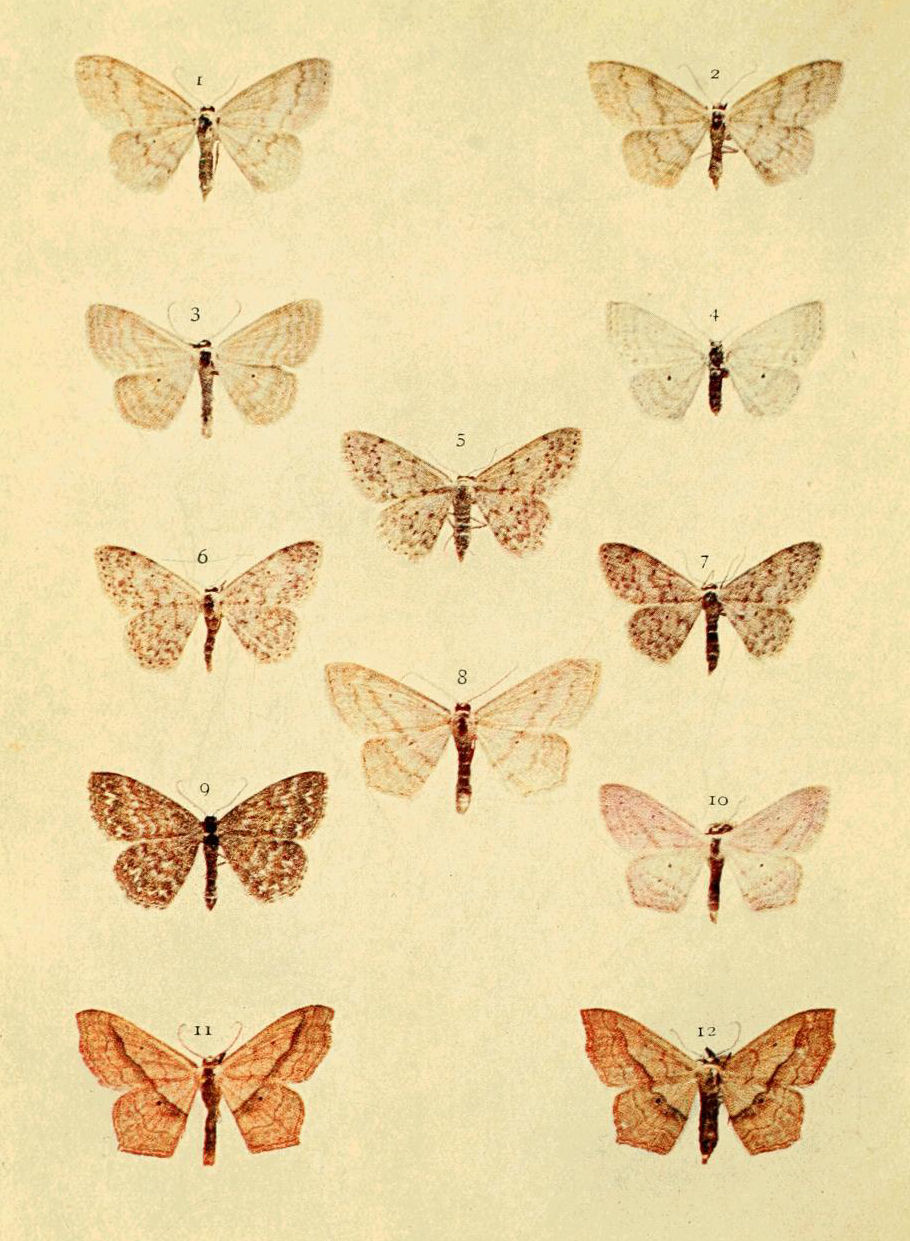
2 Pl. 49.
1, 2.Cream Wave. 3, 4.Lesser Cream Wave. 5-7.Mullein Wave.
9.Lewes Wave. 8.Sub-angled Wave. 10.Rosy Wave.
11, 12.Small Blood-vein.
The Lace Border (Acidalia (Craspedia) ornata).
The conspicuously marked white moth depicted on Plate 46, Figs. 13 and 14, is unlikely to escape the notice of the collector who visits rough fields and hillsides in some of the chalk districts of Southern England, especially in the counties of Kent, Surrey, and Sussex. Usually there are two generations of the moth during the year; one is on the wing in May and June, and the other flies in August and September.
The caterpillar is of long and slender build, the head is notched, and the skin of the body is roughened. In colour it is ochreous brown above and greyish beneath; there are three lines along the back, the central one pale, except towards the head, edged with dusky, the others dark brown. On each ring, from four to eight, are two dark V-shaped marks; low down along the sides there is a dusky edged and mottled, pale ochreous stripe. It feeds, from October to May, and in July and August, on thyme, marjoram, and may be reared on garden mint. Abroad, the species ranges over Central and Southern Europe, and through Asia to Amurland.
Note.—According to Prout (Entom. xxxix. 267), this species is the type of the genus Scopula, Schrank.
The Cream Wave (Acidalia (Leptomeris) remutaria).
This species (Plate 49, Figs. 1, 2) has the wings white or ochreous white, becoming rather smoky grey on the front edge of the fore wings, and sometimes this tinge spreads all over the wings. In well-marked specimens there are two dark, wavy, cross-lines, a dusky central shade, and a dusky shade-like stripe along the outer area beyond the second line; the first line of the fore wings is often placed close to the central shade, and sometimes it is merged in it. Not infrequently the lines are barely traceable, but almost as often the wings appear to have a pair of lines only, and these distinctly darker than usual.
The caterpillar is rough, long and slender; grey-brown with irregular darker marks, a pale line along the middle of the back, and a dark cross on the back of ring ten. The notched head is pale brown with a black V-mark. It feeds, from July to September, on bedstraw (Galium), woodruff (Asperula), dock, sallow, etc.
The moth is out in May and June, and often is plentiful in woods throughout the greater part of England and Wales; in Yorkshire and northwards through Scotland up to Moray it is rather local. In Ireland it has been found in Wicklow and Louth, but more commonly in the south and west.
The range abroad extends to Amurland and Japan.
The Lesser Cream Wave (Acidalia (Leptomeris) immutata).
White, more or less tinged with ochreous or ochreous grey in the male, is the general colour of this moth; the wings are crossed by several ochreous lines, the third line of the fore wings and the second line of the hind wings rather wavy. All the wings with central black dots, most distinct on the hind pair, occasionally absent from fore wings. (Plate 49, Figs. 3 ♂, 4 ♀.)
The long caterpillar is pale greyish-brown, with three dusky lines on the back; the black spiracles are set in a pale stripe, and below this is a dusky line; head small and round (Barrett). August to May. The natural food appears to be Valeriana officinalis, and Spiræa, but it has been reared from the egg on groundsel, knotgrass, etc., also hawthorn, and moths obtained the same year, about September.
In the open the moth is to be found in fens, bogs, and marshy places in fields and woods, during June and July. It is not uncommon, in suitable spots, in most of the southern and eastern counties of England. In the west, including Wales, and through the Midlands, it is local to Yorkshire, but is widely distributed in the south of the latter county; it occurs, rarely, in Durham. In Scotland it has only been definitely noted from Arran. Widely distributed, and common, in many parts of Ireland.
Abroad, the range extends to Amurland.
The Mullein Wave (Acidalia (Leptomeris) marginepunctata).
This species exhibits more variation than is usual in this group. Typically, the moth is greyish white, but in some specimens the grey is most in evidence, and in others the white. A practically black form, with white fringes, has been noted from North Cornwall, and at Eastbourne and Portland many of the specimens have a clear, bone-coloured ground, with fine but very distinct cross-markings; these seem to be referable to ab. pastoraria, Joannis. The cross lines in both dark and light forms are sometimes very indistinct, but occasionally the first and second of the fore wings are united, and so form an irregular dusky band; the greyish clouding on the outer marginal area is also variable. Three specimens are shown on Plate 49; two from Eastbourne, Figs. 5 ♀, 6 ♂, and one from Essex, Fig. 7 ♀.
The long caterpillar is very pale slaty-olive, with three paler lines along the back, the central one edged on each side with olive, darkest on the last three rings; spiracles black, and under surface of the body pale slate blue (adapted from Porritt). It feeds on various low-growing plants, among which, yarrow, mugwort, chickweed, cinquefoil, and knotgrass have been mentioned; also, it is said, on sallow. There are certainly two broods in the south, one feeding up in the summer, and the other hatching in September, and after hibernation attaining full growth in May or June. Moths of the first generation are on the wing in June and July, and of the second in August and September. Although sometimes found inland, the species is more especially attached to the coast, and is found in nearly all the seaboard counties of England, Wales, and Ireland. In Scotland, it occurs in Wigtownshire, and very dark specimens have been obtained on rocks in dry pastures at Ardrossan; June to end of July.
The Lewes Wave (Acidalia (Leptomeris) immorata).
Although the late Mr. S. Stevens exhibited a British specimen of this species, as a curious variety of Strenia clathrata, at a meeting of the Entomological Society of London in 1868, it was not until the year 1887, when Mr. C. H. Morris captured two specimens in Sussex, that the insect became recognized as a native. It is probable that the earlier example, taken some years before it was shown at the meeting referred to, may have come from the same locality in the Lewes district where the later specimens were captured. Anyway, the species has, so far, not been recorded from any other part of our islands, but it continues to be found in its original haunts, described as "some heathy ground," up to the present day. (Plate 49, Fig. 9.)
The long, slender, and roughened caterpillar is pale greyish brown; the central line along the back is greyish-white, each side edged on the hinder half with brown, having at the beginning of each ring after the third a black dot on either side; side stripes dark brown, inclining to black above; a slender brown line below the black spiracles. (Adapted from Barrett.) It feeds from August to May on ling (Calluna vulgaris), marjoram, thyme, knotgrass, etc.
From eggs laid on July 1 and 2 caterpillars hatched on July 17 and 18. These were placed on leaves of ribwort plantain (Plantago lanceolata), and as soon as large enough transferred to a potted plant, and kept out of doors. Two of the caterpillars grew up quickly, and on August 24 were taken indoors, where they spun up for pupation, one on August 28, and the other on September 1. A female moth emerged September 14 from the first chrysalis (F. C. Woodbridge, 1906).
The range abroad extends to East Siberia and Amurland.
The Sub-angled Wave (Acidalia (Leptomeris) strigilaria).
This species is greyish white, sometimes brownish-tinged; dusky cross markings, of which the oblique shade following the central black dot of the fore wings, and that before the central black dot of the hind wings, are usually most distinct, forming a narrow band across both pairs of wings; the outer margin of the hind wings is angled.
The long, slender caterpillar has a roughened appearance; the colour is greenish grey, and the markings comprise a dull green line along the middle of the back, spotted with black on each side; the grey head is variegated with very pale brown. (Adapted from Porritt.)
This species (Plate 49, Fig. 8) was known to Haworth, who gave it the English name which it bears to-day. Stephens, writing of it in 1831, states that it was very rare, and that specimens in his collection were from a lane near Darenth, in Kent. With one exception (Hastings, Sussex, 1876), the only present known locality in the British Isles for the species is the Warren, near Folkestone, Kent, where it was discovered in 1859. Here it occurred more or less freely for several years, then it became scarce, and finally, about 1890, seemed to be practically extinct. In 1906, however, Mr. G. H. Conquest netted a female specimen in the Warren on July 24, and as she laid a few eggs, it may be presumed that others had been deposited before capture. From the eggs obtained by Mr. Conquest, nine moths were reared in July, 1907. The caterpillars thrived on traveller's joy (Clematis vitalba), which is probably the natural food; but they will also eat dandelion, knotgrass, etc., and like the withered leaves. By keeping in a warm place, it is possible to get moths out the same year, but, as a rule, the caterpillars prefer to hibernate.
The range abroad extends to Amurland, China, Corea, and Japan.
The Rosy Wave (Acidalia (Leptomeris) emutaria).
Figure 10, Plate 49, shows an example of this species, which also has angled hind wings. In coloration it is whiter and more silky than the last, and when fresh is delicately tinged with pink; the first and second lines are dotted or represented by dots, and the greyish central shade is obliquely inclined in the direction of the tips of the wings. In the marshes on the Essex and Kentish coasts the species is generally rather more rosy (ab. subroseata, Haworth), but this form occurs occasionally in the New Forest also. The long, slender caterpillar is whitish ochreous, inclining to pinkish; on the back of each ring is a broad grey shade enclosing a white spot, and a faint grey line on each side. Spiracles, black, with black spots below them on rings four to eight; undersurface bluish-grey with a central white stripe. (Adapted from Fenn.) When reared from the egg, the caterpillar will feed on knotgrass, chickweed, birdsfoot trefoil, etc. The moths sometimes appear in August or September, but the more usual habit of the larva is to hibernate when small and complete growth in the following spring.
The moth, which is out in July and early August, conceals itself by day among the vegetation growing in its somewhat restricted haunts. These are chiefly the marshes on the east coast, and similar spots in Kent and Sussex; also the bogs of Hampshire and Dorset, but especially those between Lyndhurst and Brockenhurst in the former county. It is not readily put up during the day, but towards evening it becomes active on the wing, and after its flight may be found sitting about upon the herbage.
Abroad, it seems to be pretty much confined to Southern Europe and North-west Africa.
The Small Blood-vein (Acidalia (Leptomeris) imitaria).
All the wings of this pale reddish-brown species are angulated (Plate 49, Figs. 11 and 12). A conspicuous character is the reddish or purplish-red stripe crossing both the wings, and to which its English name no doubt refers. It varies somewhat in the amount of reddish in the general coloration, also in the tint and the width of the prominent oblique cross stripe.
The early stages are shown on Plate 48, Figs. 2-2b. The eggs, when laid on June 18 and 19, were whitish-green, but soon turned pinkish, inclining to coral red. The caterpillars hatched July 3 to 6, and were reared on a diet of privet leaves—a food that I have always found they preferred to any other that has been offered to them, and upon which I have found them in the open. They are exceedingly easy to rear, and if, as sometimes happens, they refuse to feed up and get through to the moth state in September of the same year, they do not die off during the winter or early spring, as do so many larvæ of other hibernating species. Enclosed in a suitable receptacle, such as a roomy glass cylinder, with some twigs of privet plugged in a bottle of water, the caterpillars may be left in any odd corner until spring, when fresh twigs should be introduced from time to time. Other food plants are dock, groundsel, dandelion, knotgrass, bedstraw, etc. In colour the caterpillar is pale ochreous brown, with three darker brown lines on the back, the central one broken on the front rings, and the others edged above with whitish; the spiracles are black, and the stripe along the side pale drab.
The moth affects hedgerows, banks, bushy places on rough sloping ground, and sandhills by the sea. It flies in the evening, and may be met with in July and August, sometimes in September, in most English and Welsh counties, and in the south of Ireland. It is local and somewhat rare in Northern England, and seems not to occur in Scotland.
Tawny Wave (Acidalia (Leptomeris) rubiginata).
This attractive little moth (Plate 50, Figs. 1, 2), known also as rubricata Fab., varies in colour from ochreous brown with a purplish or reddish tinge, to purplish brown or crimson; the first line of the fore wings is curved, and the second is parallel with the central shade. Sometimes the space between the last two lines and between the first and second lines of the hind wings is paler than the general colour. A dusky brown form has been recorded from boggy heaths in Norfolk.
The roughish caterpillar, which gradually tapers to the notched head, is greyish inclining to yellowish or greenish; three blackish lines on the back, the central one widened on the middle rings, and the others only distinct on the front rings; a black-edged pale line above the black spiracles, and a dusky stripe below them (Barrett). It feeds from August to May on clover, trefoil, knotgrass, etc. Sometimes as a second generation in June and July.
According to Stephens, who figured this species in 1831, a specimen was taken, near Dover, somewhere about 1825; he also refers to Yorkshire specimens, one of which he had in his collection. Since that time the species has been obtained in Lancashire (Ashton-on-Mersey), and it was noted, not uncommon from the first to third week in July, 1875, on low heathery ground at Winch Bridge, Upper Teesdale, Durham. Casual specimens have also been recorded from Folkestone, Kent; Hastings, Sussex, and South Devon. The last concerns a specimen taken in the Newton Abbot district in 1902. What may be termed the British home of the species is, however, the Breck sand district in the eastern counties, where, since 1860, it has been found in greater or lesser plenty, in June, each year up to the present time. The best known localities are Tuddenham, Brandon, Thetford, and Bury St. Edmunds. It sits among the vegetation in fields or the borders thereof, and also on heaths. Occasionally, it indulges in flight in the afternoon, but it is more often put up as the collector approaches its place of retreat. At night it is usually active, and light has a strong attraction for it.
Abroad, its range extends to Amurland and Corea.
The Smoky Wave (Acidalia (Pylarge) fumata).
The sexes of this greyish-white moth are figured on Plate 50, Figs. 4 ♂, 5 ♀. It will be seen that the female is smaller than the male. The caterpillar is very slender, and finely wrinkled; pale ochreous brown, with three pale lines along the back, each of which is shaded on both sides with brown. Beneath the ridge, low down along the sides, is a dark stripe, and the under surface is pale. It feeds on bilberry, sallow and heather, and will eat knotgrass, chickweed, and dandelion. Hatching in August, it hibernates when nearly mature, but it resumes feeding in the spring. The moth is out in June and July, and frequents moors and mosses. Plentiful in Scotland and in the north of England, its range extends through Wales and the west of England to Devonshire, where it occurs on Exmoor and is common in some parts of that extensive area. In Ireland, recorded by Birchall as widely distributed; Kane notes it from counties Kerry, Waterford, and Galway.
The range abroad extends to Amurland and Japan.
Bright Wave (Acidalia (Sterrha) ochrata).
At one time this ochreous brown species (Plate 50, Fig. 3) was an inhabitant of the Essex coast, and was found commonly at Southend among other places. Deal and other parts of the Kentish coast are more frequently mentioned in connection with later records of the species. In the present day it is far less plentiful at Deal than formerly, but it is still to be found there. Specimens have been taken in the Isle of Wight, and one has been noted from Suffolk (Aldeburgh).
The pale ochreous brown or greyish ochreous caterpillar has three broken greyish lines on the back; it tapers towards the small head, and the skin of the body is closely wrinkled. It feeds from August to May, or a little later, on the flowers of hawk's-beard (Crepis), dandelion, coltsfoot, golden rod, etc., and in confinement it seems to accept most kinds of flowers that are offered, even when widely different. Thus, Mr. Conquest, in 1907, had some caterpillars which hatched during the first week in August from eggs laid on July 25; these were at first supplied with flowering sprays of yellow bedstraw (Galium verum), and later on with the flowers of golden rod (Solidago). Instead of hibernating, which is no doubt the normal habit in the species, some larvæ reared from the egg in confinement and subjected to fostering warmth will grow very quickly and produce moths the same year.
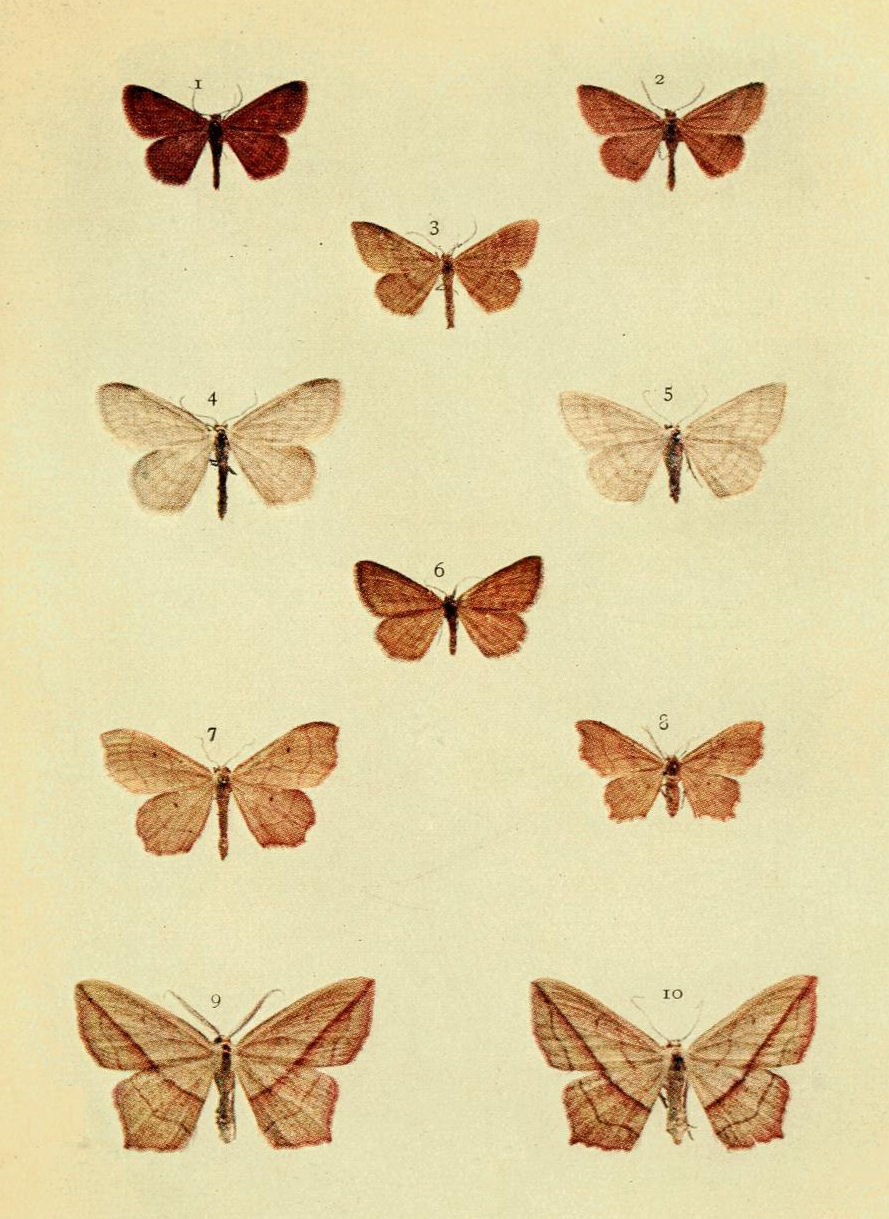
2 Pl. 50.
1, 2.Tawny Wave. 3.Bright Wave. 4, 5.Smoky Wave.
6.Acidalia perochraria. 7, 8.Small Scallop. 9, 10.Blood-vein.
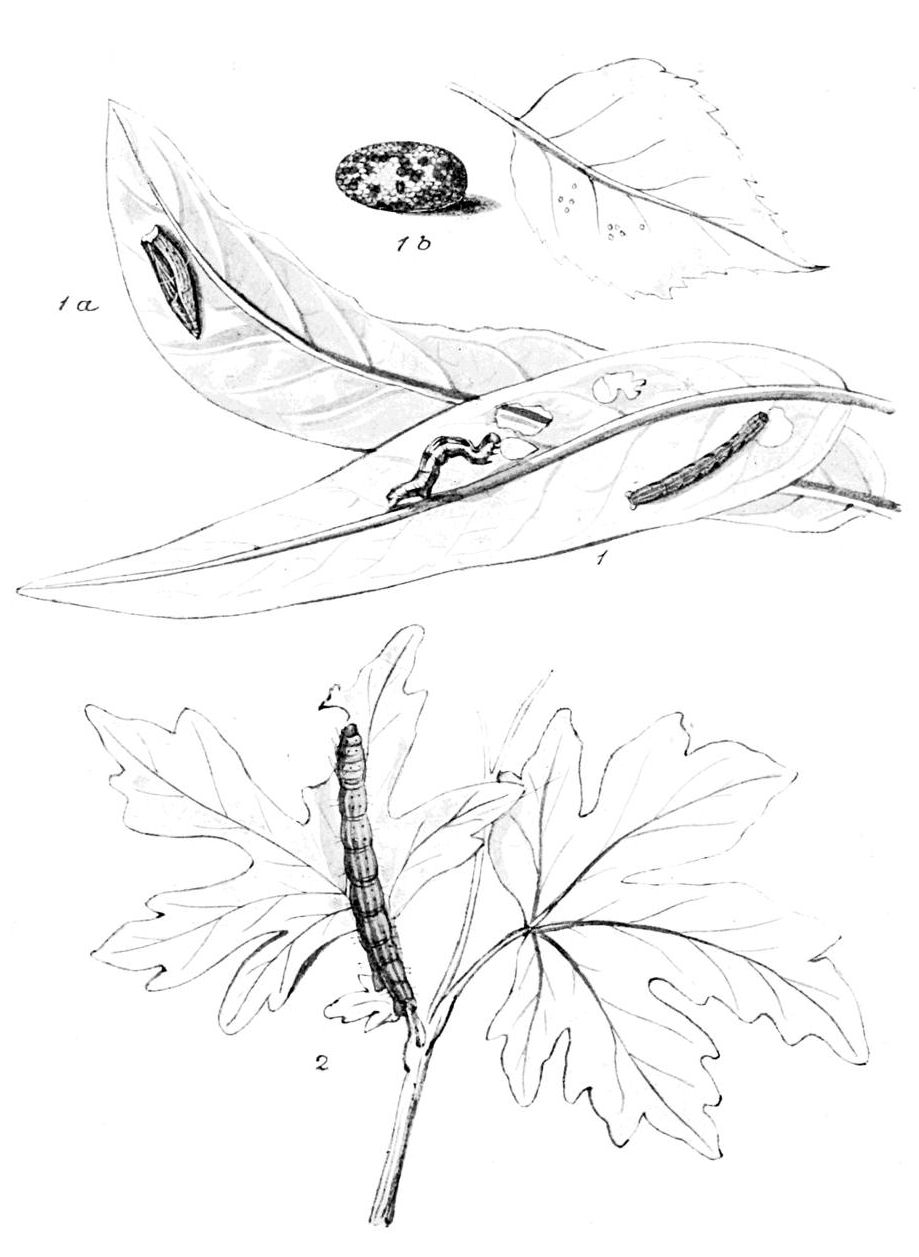
2 Pl. 51.
1, 1a, 1b.Dingy Mocha: eggs, caterpillars and chrysalis.
2.Mocha: caterpillar.
This species has been referred to the genus Sterrha, Hübner, but authorities are not agreed as to the validity of this.
Acidalia perochraria.
The species last referred to as A. ochrata was formerly known in Britain as pallidaria, and was figured by Curtis in 1831 under that name. Afterwards the name was changed to perochraria, and later still the correct name was found for it.
How far there may have been confusion of the two species in the records of the present one, I have no means of ascertaining, but probably all but two should properly refer to ochrata. The only two known British specimens of perochraria therefore appear to have been captured in the Redhill district of Surrey, one in 1865 and one in 1869. As will be seen on reference to Plate 50, where a portrait of a Continental specimen will be found (Fig. 6), the general colour is much brighter than that of ochrata. It will be noted, also, that there are four darker cross lines on the fore wings, and three on the hind wings. The antennæ, too, of the male are toothed, and therefore differ from these organs in ochrata.
The Small Scallop (Ania emarginata).
As will be noted on turning to Plate 50, Figs. 7, 8, the male of this pale ochreous brown species is generally rather larger than the female, and the more ample wings are less acutely angled in outline; the latter sex is also more clouded with reddish brown.
The caterpillar is variable in colour; one form is of a dusky ochreous colour with a pale line along the middle of the back, edged on each side with a darker tint, and most conspicuously so on the hinder rings; the back is also dotted with black, and has some dark V- or X-shaped marks upon it; the body tapers to the notched dark-brown head. It feeds on bedstraw (Galium), convolvulus, etc., and, like others of its tribe, has a taste for withered leaves. August to May or June, according to the season. In confinement it has been induced by warmth to feed up quickly, and appear as a moth the same year. Only a short time is passed in the chrysalis stage. July is perhaps the best month for the moth, but it may be seen at any time from late June to early August. Its haunts are fens, marshes, and moist woodlands, etc., and although it is more frequent in the south, it is widely spread throughout England, but in the north it is rare, and its occurrence more or less casual.
In Wales it has been recorded from Glamorganshire and Flintshire; but it is apparently unknown in Scotland and Ireland.
The Blood-vein (Timandra amata).
The stripe across the wings of this pretty species (Plate 50, Figs. 9 and 10), extending from the apex of the fore wings to near the middle of the inner margin of the hind wings, is normally pinkish red, but it may be of a more crimson or purplish hue; it also varies in width. The fringes are usually pinkish red, and occasionally the margins of the wings are tinged with the same colour. The whitish-ochreous ground colour is normally finely powdered with grey, but sometimes so thickly that a greyish tinge is imparted to the wings. Barrett mentions a specimen with pale smoky brown wings, and, excepting that the tips of the fringes are tinged with pink, the usual markings are absent. In another example, "the space between the central and second lines is filled up with purple brown."
The caterpillar is brownish grey, with three whitish lines on the back, the central one intersecting a series of four dark lozenges. It feeds on various low-growing plants, such as persicaria, orach, sorrel, etc., but dock seems to be the most frequently selected pabulum. July to May, sometimes feeding up and appearing as a second generation of the moth in August.
Weedy ditches, hedge banks, or moist waste places, are the favourite resorts of the moth; and when one example is flushed from its lurking place, others are almost certain to be hiding in the immediate vicinity.
Widely distributed throughout England, but most common in the south; found also in North and South Wales; and sparingly in Scotland to Aberdeenshire, also recorded from Arran. Apparently rare in Ireland, as it is only noted from Kerry and Galway.
False Mocha (Ephyra porata).
The wings are pale ochreous brown, finely flecked with purplish grey, and more or less tinged with reddish; the cross lines are indicated by blackish dots, the central shade is greyish inclining to reddish, and the rings enclosing white dots are blackish or dark brown, but sometimes indistinct on the fore wings; occasionally there are some purplish grey clouds on the outer marginal area, and this is more frequent in examples of a second generation. Sometimes the wings are entirely suffused with dull reddish brown, and all the markings, except the white dot on the hind wings, are obscured. (Plate 53, Figs. 7 and 8.)
The caterpillar is pale pinkish ochreous, with inconspicuous wavy white lines, and brownish dots, on the back; dark oblique marks on the sides; the head is pencilled with darker brown. It feeds on oak and birch in June and July, and individuals of a second brood sometimes occur in September or October.
The moth is out in May and June, and rests in the daytime among the foliage of trees and bushes in or around woods. Like others of the genus, it is attracted by light, and is said to visit the sugar patch. Specimens of a second generation sometimes appear in August and September, but, I believe, more frequently in the breeding cage than in the open. Although it has been recorded from several of the northern counties from Staffordshire to Cumberland, this is more especially an inhabitant of the south and west of England, and of Wales. In Scotland, it is known to occur singly and rarely in Clydesdale and Arran, and has been found in Perthshire.
Note.—This species, and the other five here included in Ephyra, have been referred to Zonosoma, Lederer, and more recently to Cyclophora, Stephens.
Maiden's Blush (Ephyra punctaria).
In a general way, this moth (Plate 53, Figs. 10-12) is not unlike the last mentioned. Apart, however, from the absence of ringed dots on all the wings, the central line is more prominent. Certain vagaries occur in connection with this line, which is generally reddish, or purplish brown. Occasionally, it may be visible on the fore wings, but absent on the hind wings; or it may change its course about mid-way, and turn inwards to the base of the fore wing. I have a specimen from Surrey in which this line is double the normal width, and dark purplish in colour. Examples of the second generation have brownish clouds on the outer margin (Fig. 12).
The caterpillar is pale reddish-ochreous or bright green; a black line along the middle of the back, and a brownish one along the sides; a black horse-shoe mark, edged below with yellow, on the back of rings four to nine.
It feeds, in June and July, on oak, but may be reared on birch; also found in September as a second brood.
The moth is out in May and June, and specimens of a second generation are often not uncommon in August. It occurs in woodlands throughout England, but is most plentiful in the south. In Scotland, it appears to be local in Clydesdale, but is found thence up to Moray. In Ireland, only recorded from Galway (two specimens).
Clay Triple-Lines (Ephyra linearia).
This species (Plate 53, Fig. 13) varies in the general colour from yellowish to pale reddish ochreous; the cross lines are also variable, often the first is missing (Plate 53, Fig. 14), and not infrequently the dark central line is the only visible marking, but very exceptionally the central line is very little, if at all, more distinct than the normal first and second. The ringed white dots are rarely very conspicuous, and are often quite absent.
The caterpillar is pale brownish, with a brown-edged yellowish line along the middle of the back, and some yellow-edged dark-brown streaks on the sides. In another form, the head is brown and the body green.
It feeds in June, July, and again in September, on beech. The moth is out in May and June, and again in August and September. Beech woods are its favourite haunts, and it seldom strays far from them. It is generally common in the south, and its range apparently extends to Northumberland; but it is local and infrequent in the north. Three specimens have been recorded from Co. Galway, and one from Co. Cork, in Ireland.
Note.—Nearly fifty years ago, at Brighton, a single specimen was reared from one of eight larvæ that hatched from the same number of eggs deposited by a female E. linearia that had paired with a male E. orbicularia. This hybrid has been named brightoni, Tutt.
The Mocha (Ephyra annulata).
Normally, the wings of this species (Plate 53, Figs. 6, 9) are yellowish white, inclining to ochreous yellow with the blackish central shade near to and sometimes united with the blackish irregular and outwardly toothed second cross line on both fore and hind wings; the rings are deep brown or blackish. There is variation in the width and intensity of the central shade, and the rings sometimes are absent on the fore wings (ab. obsoleta, Riding), and occasionally all the wings are devoid of the annular mark (ab. biobsoleta, Riding). Examples of a second generation reared in captivity are rather deeper coloured, and have a sprinkling of black scales, chiefly on the fore wings.
The caterpillar (Plate 51, Fig. 2, after Hofmann) is dark green, yellow between the rings; there are three yellow lines along the back, the outer ones waved; head reddish brown, paler marked. (Adapted from Porritt.) There is also a pale ochreous brown form.
It feeds on maple in June, and as a second generation in August and September. It may be reared on sycamore. The moth frequents lanes, woods, and thickets, especially those in which maple is plentiful; it flies at dusk, and in the daytime may be beaten from hedgerows in which the food plant grows. It has also been found among hornbeam. The species is most frequent from Kent to Hampshire, but widely distributed over England up to Worcester and Herefordshire, and eastward to Norfolk, occurring also in Northampton and Yorkshire.
The colour and ornamentation of this charming little insect seem to have struck Haworth, who named the species in the vernacular, as bearing some resemblance to the Mocha stone from Arabia, a kind of transparent agate in which are seen brownish moss-like markings.
Dingy Mocha (Ephyra orbicularia).
The wings are greyish, thickly striped with darker grey; the markings similar to those of the next species, but the rings are nearly always reddish or purplish, and the central line is wavy. (Plate 53, Figs. 4 and 5.)
The egg (which, together with the caterpillar and chrysalis, is figured on Plate 51) is at first bone-coloured; later, pink dots and patches appear.
The caterpillar is bright green with three lines along the back, the central one edged on each side with dark green and the others wavy; the sides are blotched with pink or pale purple, or sometimes whitish and unmarked; head slightly notched on the crown, pale brown, marked with darker; fore legs tipped with pink. (Porritt, abridged.) In another form of the green coloration, the sides are pinkish with dark-brown oblique stripes; in a third the general colour is pale brown. The first brood of caterpillars feeds in June on sallow and alder, and a second in August and September.
The moth appears in May and June, and again in July and August; sometimes a third brood has been reared in captivity. It is less frequently met with than the other species of Ephyra, even in its most favourite haunts, such as the New Forest, in Hampshire. Other localities for it are Abbots Wood, St. Leonards and Tilgate Forests, and elsewhere in Sussex; Redstone, Haslemere, and the Croydon districts, in Surrey; and in some Kentish woods. It has also been taken rarely in Dorset, Devon (Tiverton), S. Wales, and Suffolk (Lowestoft).
Birch Mocha (Ephyra pendularia).
The general colour of this species (Plate 53, Figs. 1, 2) is whitish, more or less powdered or suffused with grey; all the wings have two blackish dotted cross lines and a greyish, sometimes reddish, central shade; not infrequently there is an interrupted grey or dark greyish band on the outer marginal area, and this margin itself is always dotted with black; the rings enclosing white dots on all the wings are usually black, but sometimes reddish. In some specimens having a reddish central shade, the general colour, especially of the fore wings, is delicately tinged with reddish. Var. subroseata, Woodforde (Fig. 3), a form of this species occurring in N. Staffs. is slaty grey, with the space between the inner and outer cross lines of fore wings rosy pink or reddish.
The caterpillar is of a green colour with slender yellowish lines along the back and sides; between the rings the colour inclines to yellowish, and the head, legs, and prolegs are reddish brown. In another form the general colour is greyish, inclining to reddish, and the lines paler grey. It feeds on birch in June and July, and again in August and September. It is said to eat alder and oak. The chrysalis, which is similar in shape to that of the last species (Plate 51), is pale greyish-ochreous marked with dark brown.
The moth, which appears in May and June, and in some seasons in August, frequents woodlands and heaths where birch flourishes. Although fairly plentiful in most of the southern English counties, it appears to be rare in Dorset and Devon, and more or less so in the eastern counties. It is very local in Nottinghamshire and Yorkshire, but not uncommon at Strensall in the latter county; and although it has been recorded from Cumberland, it seems to be absent from Lancashire and Cheshire. Doubtfully reported from North Northumberland, but found in Wells Wood, Roxburghshire, and appears to be widely distributed in Scotland, although generally scarce in that country. In Ireland it is local, but not uncommon sometimes.
The range abroad extends to Eastern Siberia.
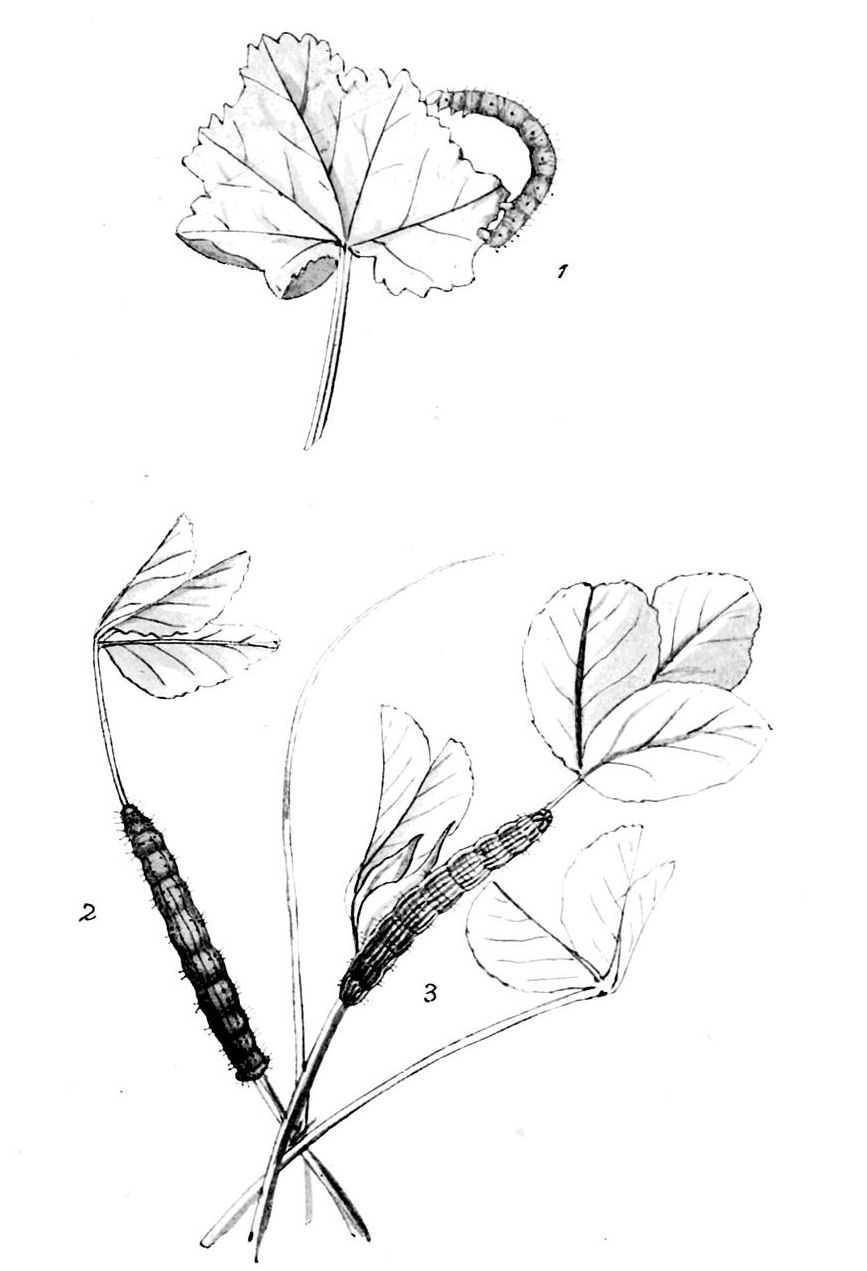
2 Pl. 52.
1.Mallow: caterpillar.
2.Shaded Broad-bar: caterpillar.
3.Chalk Carpet: caterpillar.
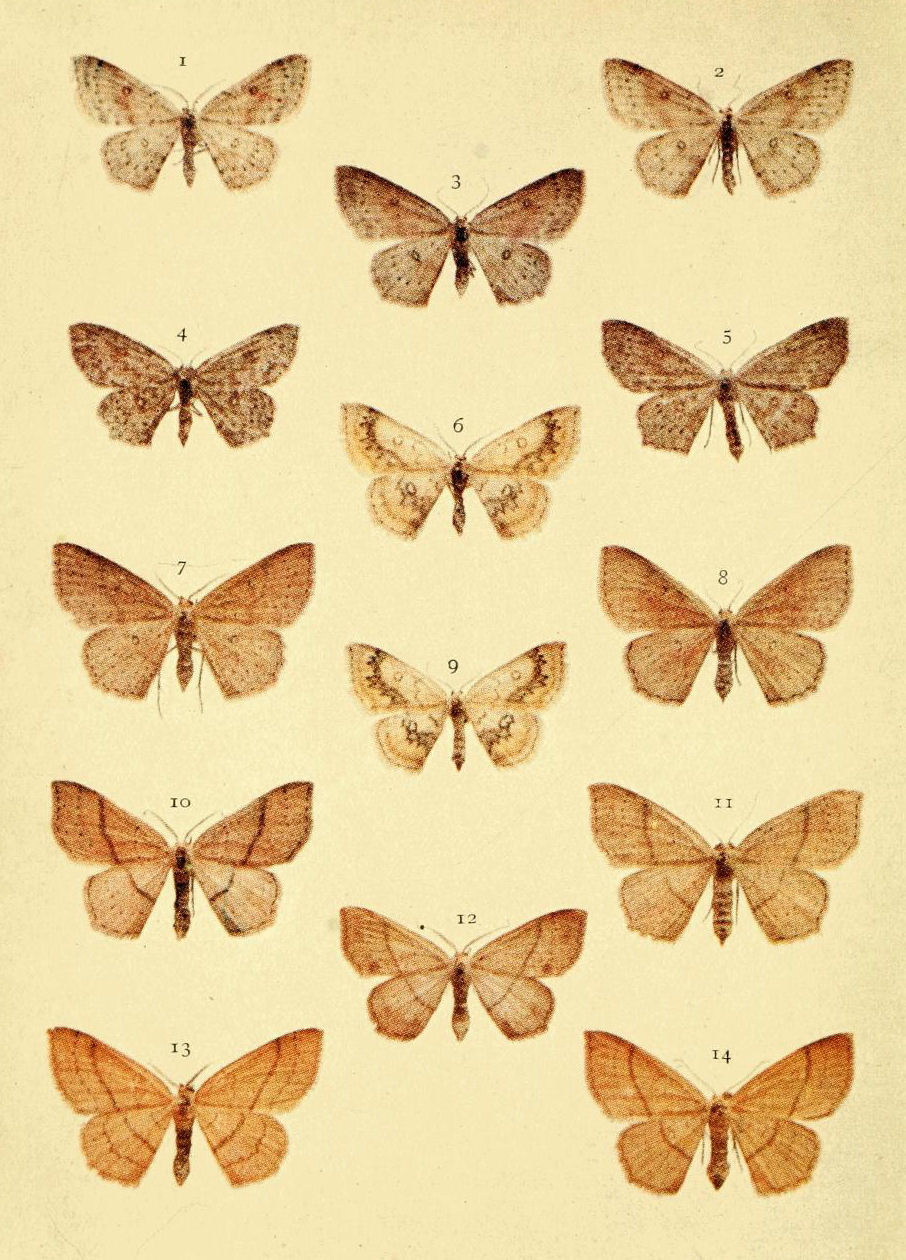
2 Pl. 53.
1, 2, 3.Birch Mocha. 4, 5.Dingy Mocha. 6, 9.The Mocha.
7, 8.False Mocha. 10-12.Maiden's Blush. 13, 14.Clay Triple-lines.
HYDRIOMENINÆ.
The Vestal (Sterrha sacraria).
The fore wings are pale yellow inclining to ochreous, and the front edge is more or less tinged with the same colour as that of the oblique stripe from the tips of the wings to the middle of the inner margin. In the type, this stripe is purplish-brown, but in ab. labda, Cramer, it is crimson, and in ab. atrifasciaria, Stefan, it is blackish. In ab. sanguinaria, Esper, the ground colour is pinkish. The hind wings are always white. (Plate 54, Figs. 1 and 2.)
From 1857, in which year the first specimen recorded as British was captured in September at Plymouth, to 1874, one or more examples of this interesting migrant seem to have occurred during the autumns of most years, in some part of the British Isles, but chiefly in the South of England. The years in which it was apparently unrecorded were 1860, 1861, 1870, 1872, and 1873. Since 1874 there have been very few records. In 1879 a male specimen was taken at Chingford, Essex, August 17th, and a female (ova obtained) on September 1st; a specimen occurred at Christchurch, Hants, October, 1893; a male was obtained in the Isle of Purbeck, Dorset, September, 1895, and one was secured at Timoleague, Co. Cork, in August, 1898; one was accounted for at Malvern, Worcestershire, in August, 1901; a female in fine condition was captured, as it flew in the sunshine over a Cambridgeshire meadow, in the autumn of 1906. Mr. H. M. Edelsten obtained a male specimen in South Devon, on September 12, 1908. The largest number of specimens appears to have been recorded in 1867, when nearly thirty were secured, and of these four were taken in May in the Isle of Wight, where also two females were captured on August 14th and 16th, and one specimen on September 3rd. Six or seven occurred during August in Lancashire, and three in Perthshire, also in August.
The long caterpillar is variable, but is usually some shade of green above, inclining to whitish beneath, and yellowish between the rings; the lines along the back are paler green, reddish, and olive green. It feeds on low-growing plants, such as knotgrass and dock, and has been reared from the egg in August and September. If eggs were obtained in May it would be possible to raise two generations of moths, or, perhaps, even three, during the year.
The species is an inhabitant of Southern Europe and North Africa, and its range extends to India, Madeira, and the Canaries. In Central Europe, including the British Isles, its occurrence is always a more or less casual event.
Note.—It is possibly incorrect to assign this species to Sterrha, Hübner, which is adopted by some authors for the Acidaliid ochraria. There is, however, considerable doubt among authorities about accepting the Hübnerian genus, but Herrich-Schäffer's genus Sterrha appears to be valid and is here employed. If it has to give way, Pseudosterrha, Warren, or Rhodometra, Meyrick, may have to be used.
Lythria purpuraria has long been reported as a British species, but there does not appear to be any very convincing record of its capture in the British Isles. It is widely distributed in Europe, and generally common. As it is a sun-loving insect, it could hardly escape detection if it occurred in any part of our isles. A note by Mr. V. R. Perkins, in The Zoologist for 1861, p. 7449, should, however, not be overlooked. This refers to the capture, on June 18th, of two male specimens that were disturbed from broom, "not far from the city of Perth, by Mr. D. P. Morrison."
Lead Belle (Ortholitha plumbaria).
Two ordinary examples of this species are shown on Plate 54, Figs. 4, 5. The ground colour is greyish, ranging in one direction to whitish, and in the other to brownish; on the fore wings there are three cross lines, usually reddish-brown in colour, but sometimes dark brown inclining to blackish; the first of these lines is always slender and sometimes very indistinct; the second is often shaded on its outer edge, and the third on its inner edge, with brownish; occasionally the space between the second and third is more or less dusky, especially on the lower half; sometimes these two lines approach each other very closely on the inner margin; the short oblique streak from the tip of the wing to the wavy submarginal line, and also the blackish central dot, are far more distinct in some specimens than in others.
The long stick-like caterpillar is pale ochreous brown, often striped with darker brown or blackish. It feeds on furze (Ulex) and broom (Cytisus), from August to April. The moth is out in May and June, earlier or later according to the season, and is to be found almost everywhere that its food plants flourish.
The Mallow (Ortholitha cervinata).
The fore wings of this species are normally ochreous brown, inclining to reddish, but sometimes the general colour is of a light chocolate tint, and in such specimens the slender white lines edging the dark markings, and the white wavy submarginal line, are more distinct; the central band-like marking occasionally tapers towards the inner margin. (Plate 54, Figs. 6, 7.)
The long caterpillar (figured from a coloured drawing by Mr. A. Sich, Plate 52, Fig. 1) is of a greenish colour, inclining to yellowish between the rings; there are indications of darker lines on the middle of the back and along the sides; the usual dots are whitish and the spiracles black; in some specimens the central line on the back is pinkish. It hatches from the egg in March or April, and feeds until June on mallow (Malva sylvestris); will also eat hollyhock.
The moth appears in September and October, and is sometimes seen in November. It hides under the mallow, and other plants around, and is not much inclined to move during the day, but it becomes active in the evening, and then flies pretty briskly. The occurrence of this species in any locality will, of course, largely depend upon the presence of the food plant, but it seems to be widely distributed throughout the greater part of the British Isles. It is, however, most frequent in the southern half of England.
Shaded Broad-bar (Ortholitha limitata).
To the earliest British entomologists this species (Plate 54, Figs. 8 and 9) was known by the English name given to it by Moses Harris, which is here revived. Haworth's popular name for the insect is the "Small Mallow," but this seems less suitable.
The fore wings are usually ochreous brown in colour, with a darker brown band, the inner area of which is often paler. The ground colour, however, varies considerably, in some examples tending to whity brown, and in others to a smoky hue. The whitish hind wings are generally more or less dusky clouded, chiefly from the base of the wing to the dark brown or blackish cross shade; but sometimes these wings are entirely blackish, with just a trace of a pale cross stripe.
The caterpillar is greyish, with a pinkish tinge and black dots; there are three lines along the back, the central one slaty blue, and the others ochreous, shaded on each side with pale brown; a pinkish irregular ridge runs low down along the sides. It feeds on clover, vetch, grass, etc., from September to June. (Plate 52, Fig. 2, after Hofmann.)
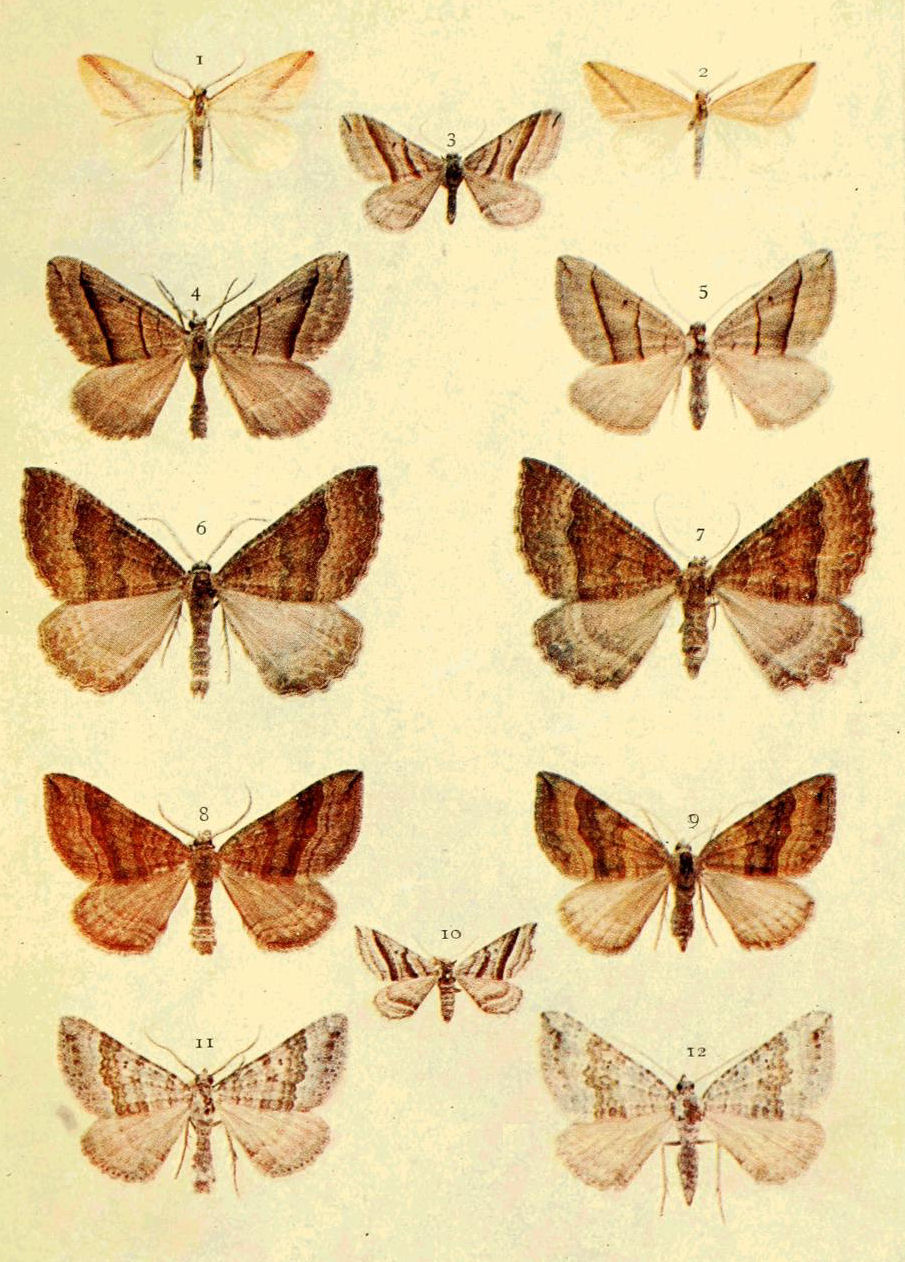
2 Pl. 54.
1, 2.The Vestal. 3, 10.Oblique-striped. 4, 5.Lead Belle.
6, 7.Mallow. 8, 9.Shaded Broad-bar. 11, 12.Chalk Carpet.
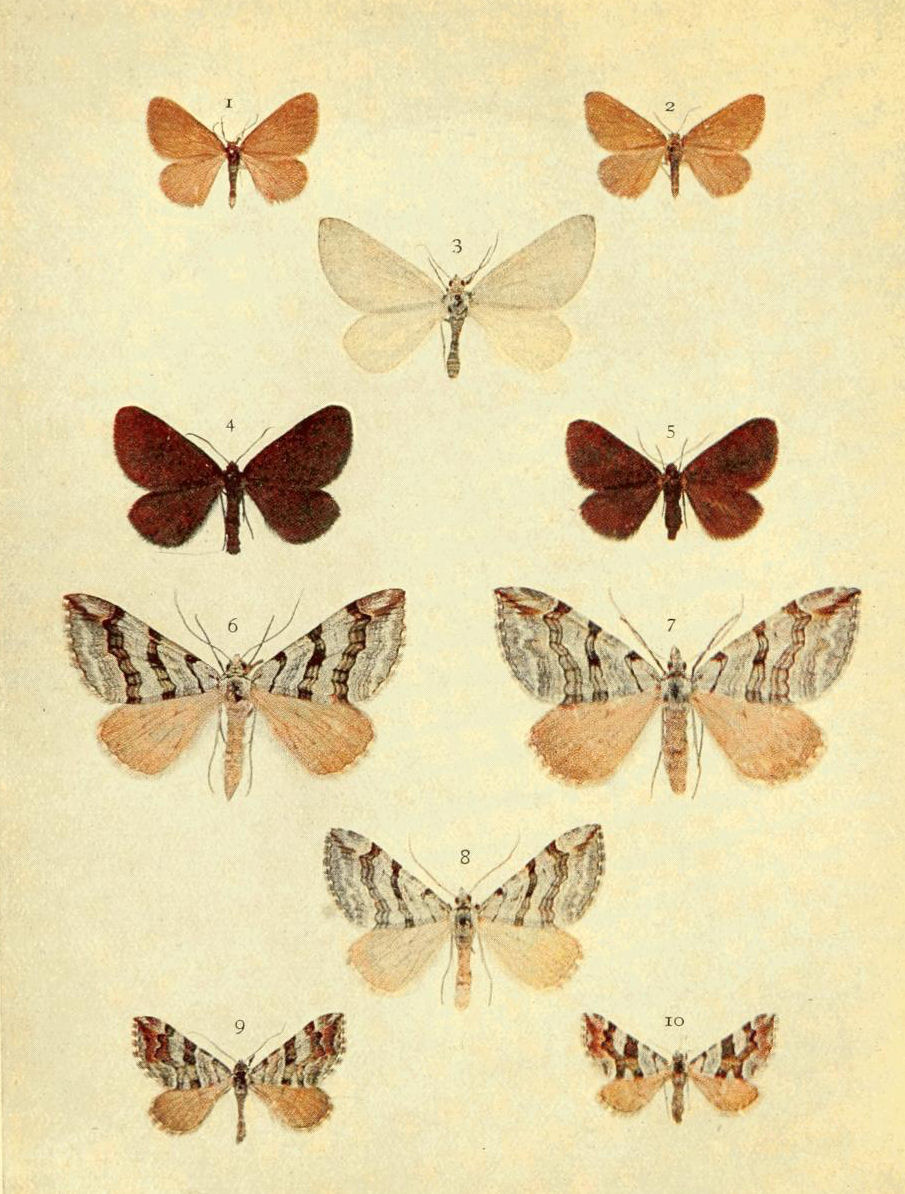
2 Pl. 55.
1, 2.Drab Looper. 3.Grey Carpet. 4, 5.Chimney Sweeper.
6-8.Treble-bar. 9, 10.Manchester Treble-bar.
The moth is out in July and August, and is often common in fields and grassy places, generally throughout the greater part of the British Isles. In ancient times it was dubbed the "Aurelian's Plague." The range abroad extends to Amurland.
Ortholitha moeniata.—Except that one specimen was said to have been taken near Baron Wood, Carlisle, some years prior to 1855; and another, in 1866, near York; there is no evidence that this species is an inhabitant of the British Isles.
Chalk Carpet (Ortholitha bipunctaria).
In this species (Plate 54, Figs. 11 and 12) the ground colour of the fore wings is white (inclining to bluish-white in some specimens), more or less stippled and scored with greyish brown; the cross band is darker grey brown, and there are two black dots placed :-wise (sometimes united) in the paler central space of the band. Hind wings, smoky grey, with a darker shade across the middle, and a pale one parallel with the outer margin. In some rare instances, the ground colour of the fore wings is entirely white, and the band exceedingly dark; but specimens with the general colour, slaty-black and the band and basal patch grey, are extremely rare; Barrett mentions one such example, from Box Hill, Surrey, in Mr. R. Adkin's collection.
The caterpillar is whity brown, more or less tinged with pink, dotted with black, and lined with grey along the back, the sides, and the under surface. It feeds, at night, on clover and trefoils, from September to June. (Plate 52, Fig. 3, after Hofmann.) The moth is out in July and August, and in suitable localities, such as chalk downs, lime-stone hills, etc., is generally plentiful throughout England and South Wales. It does not appear to have been noted in Ireland, or in Scotland, except that it has been recorded from the Isle of Arran.
Oblique Striped (Mesotype virgata).
The sexes of this species are shown on Plate 54, Figs. 3 ♂, 10 ♀. The fore wings are greyish, inclining to whitish or to brownish, with two white-edged oblique bands, which in the lighter coloured specimens are broad and show up conspicuously, but in the darker are narrower and much less distinct.
The caterpillar is brownish, but varies in tint, in some cases inclining to pink; there are three lines along the back, the central one dark green or brown, and the others more or less yellowish; a blackish or dark grey line low down along the sides. It feeds on yellow bedstraw (Galium verum), and may be reared on other kinds of Galium. There are two broods, one in May and June, and the other in August and September.
The moth, which frequents sand-hills and shelving banks by the seaside, is found resting upon its food plant or other vegetation around, in May and June, and again in July and August.
The species has a wide distribution, and occurs in suitable localities around the coasts of England (except the north-east), and on the west coast of Wales. It also inhabits the Breck sand district of Norfolk and Suffolk, and has been found on chalk downs and hills in the south of England, and in Cambridgeshire and Berkshire. In Ireland, it has been recorded from the counties of Down and Kerry.
Abroad, its distribution spreads to Eastern Siberia and Amurland.
Drab Looper (Minoa murinata).
The grey brown or ochreous brown wings of this delicate, but unattractive little moth (Plate 55, Figs. 1 and 2), are silky in texture. After it has flown for a time, the wings become paler, and lose most of their sheen.
The thick-set, roughish caterpillar is reddish brown, dotted with pale ochreous; there is a slender white line along the middle of the back, and black oblique streaks on the sides; a blackish wavy line along the area of the spiracles is bordered below with yellowish. It feeds on wood spurge (Euphorbia amygdaloides) and also, I have reason to believe, on petty spurge (E. peplus), a rather common weed in some gardens, from July to September. In forward seasons the moth, which flies in the sunshine, has been noted in late April, but May and June are the best months for it. In the New Forest, and elsewhere, it has occurred in August. On one occasion I remember that, in a garden at Brockenhurst, several specimens were taken in the autumn, and it was supposed that they resulted from eggs laid by a damaged female that had been captured in the woods and turned out into said garden. It has been taken at gas lamps, at Dorking among other places.
The species has been recorded from Pembrokeshire, Glamorganshire, and Monmouth, in South Wales; and it appears to be found in most of the counties of England southwards from Worcester, Hereford, Gloucester, Oxford, and Bucks. Except that it has been doubtfully recorded from Stowmarket, Suffolk, it does not seem to be found in the eastern counties; and I cannot find that it has been noted from Devon or Cornwall.
The range abroad extends to Amurland.
Chimney-sweeper (Odezia atrata).
This white-tipped but otherwise plain black moth (Plate 55, Figs. 4 ♂, 5 ♀) is very constant, and except that specimens after having been on the wing for a day or two become sooty brown, there is nothing much to note. It is the fringe at the tip of the fore wings rather than the tip itself that is white, and this sometimes extends for a short distance along the fringe of the outer margin. Haworth's English name for this insect (his chærophyllata) was "The Looping Chimney Sweeper" in reference to its caterpillar, and to distinguish it from his "Chimney Sweeper," "Chimney Sweeper's Boy," and other oddities in the vernacular among the Psychids.
The caterpillar, which feeds in the spring on flowers of the earth-nut (Conopodium denudatum, or Bunium flexuosum), is green, and paler on the sides than on the back; there are three darker green lines along the back, the central one merging into reddish on the last ring, and the others narrowly edged on each side with white; a whitish stripe runs below the red spiracles.
The moth is a sun lover, and flits about flowers growing among or near its food plant, in June and July.
The species is widely distributed over England, Wales, Ireland, and Scotland, but it does not appear to have been noted north of Moray in the last-named country. It is always very local, frequents moist fields, borders of woods, and even waysides.
The range abroad extends to Amurland.
The Grey Carpet (Lithostege griseata).
The more or less greyish moth, shown on Plate 55, Fig. 3, varies in tint, some specimens being decidedly more grey than others. At the apex of the fore wings is a short blackish dash, and from this a curved dusky line may be traced to the inner margin. The female has the wings rather shorter than those of the male.
The slender, dark-lined, greenish caterpillar feeds on the seed pods of flixweed (Sisymbrium), and treacle mustard (Erysimum), in July and August. When reared in captivity it will thrive on other kinds of Cruciferæ.
The moth is out in June, sometimes late May; it is exceedingly local in Britain, and only occurs in the Breck district, where it was first met with about fifty years ago. Tuddenham, in Suffolk, is a noted locality, as also is Thetford, in Norfolk.
The Treble-bar (Anaitis plagiata).
This is a greyish white species, of which specimens of both generations are shown on Plate 55, Figs. 6 ♂, 7 ♀ (1st generation), Fig. 8 ♂ (2nd generation). The chief variation is in the cross central bars of the fore wings, which are sometimes much widened, and occasionally joined from the middle to the inner margin; or the space between these two bars is more or less filled up with dark grey. On the other hand, the bars are sometimes very faint, but such aberrations are perhaps most frequent in the second generation, which consists of smaller specimens.
The long caterpillar is brown, inclining to reddish or to greenish, with several darker and paler lines on the back and a yellowish line low down along the sides. It feeds on St. John's wort (Hypericum) in June and July; the caterpillars, hatching in the autumn, are not mature until the following April.
Usually there are two generations of the moth, the first appearing in May and June, and the second in August and September. The species is pretty generally distributed over the British Isles, extending to the Hebrides and the Orkneys; and will probably be found in all localities where its food plant occurs freely. It affects cliffs and sandhills by the sea, rough places on chalk slopes, and sometimes the moths fly up in numbers as we walk over the herbage in such spots.
The range abroad extends to Western India and Japan.
Manchester Treble-bar (Carsia paludata).
In general character this species somewhat resembles that last considered. It is, however, much smaller, and there are reddish clouds on the outer marginal area.
This reddish shading is more or less absent in the type, which is otherwise less variegated than var. imbutata, the form to which our British specimens are almost entirely referable. (Plate 55, Figs. 9 and 10.)
The caterpillar is of somewhat stoutish build, and reddish brown in colour; three darker lines along the back, and yellow stripe low down along the sides, the latter edged above with black on the front three rings, and blotched with pinkish on the middle rings; the head is rather paler than the body, and the dots on the latter are yellow. It feeds on cowberry (Vaccinium vitis-idæa) and cranberry (V. oxycoccos), and seems to have a preference for the flowers of these plants: April to June.
The moth is out in July and August among the Vaccinium in its swampy haunts on the heaths and moors of the north of England, and Scotland, even to the Shetlands. McArthur took a specimen in the Isle of Lewis in 1901. It also occurs in Ireland. In England it does not seem to have been noted south of Staffordshire.
The range abroad extends to Eastern Siberia and Amurland.
The Streak (Chesias spartiata).
The most striking features of this shining brownish coloured species are the oval-shaped marks on the disk of the fore wings, and the long whitish streak running to the tips of the wings. (Plate 57, Figs. 3 ♂, 4 ♀.)
The long caterpillar (Plate 56, Fig. 2) is deep green, with a darker line along the middle of the back, and whitish lines along the sides and the under surface; the spiracles are reddish, encircled with black, and the head is flecked with brown. It feeds in the spring on broom (Cytisus scoparius).
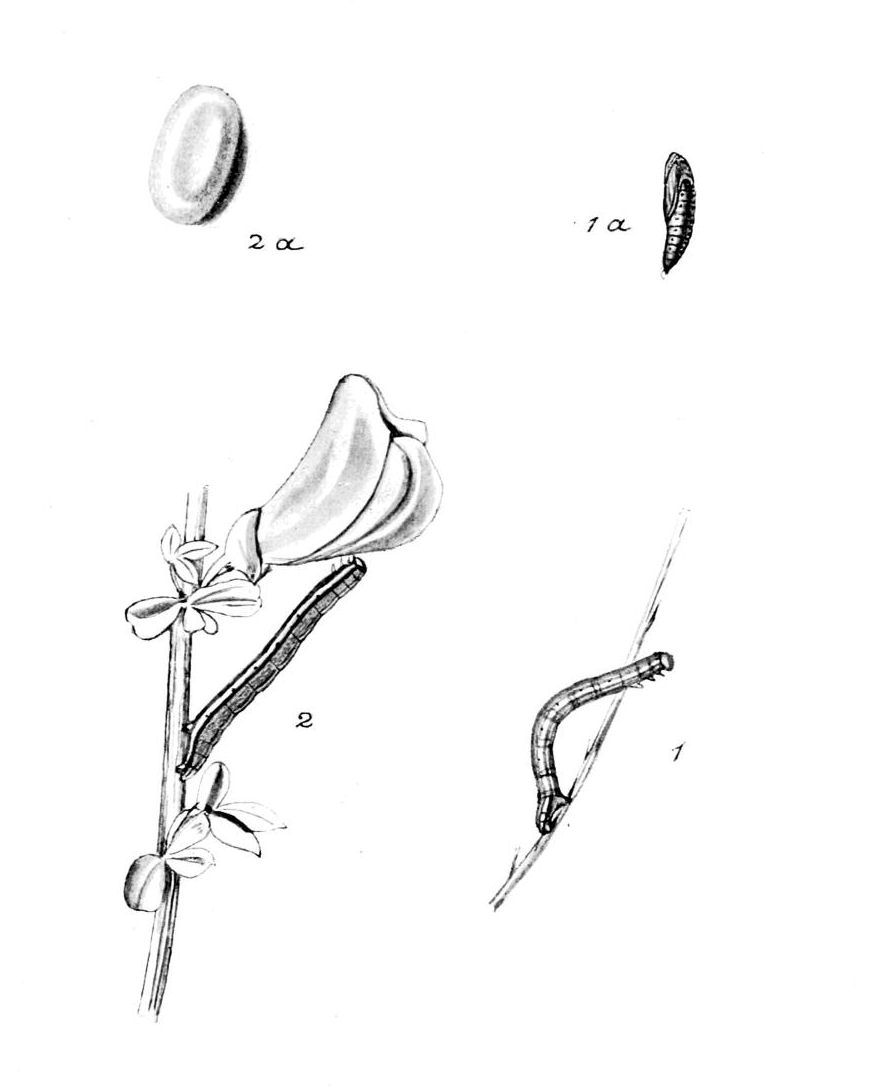
2 Pl. 56.
1, 1a.Broom-tip: caterpillar and chrysalis.
2, 2a.Streak: egg (enlarged) and caterpillar.
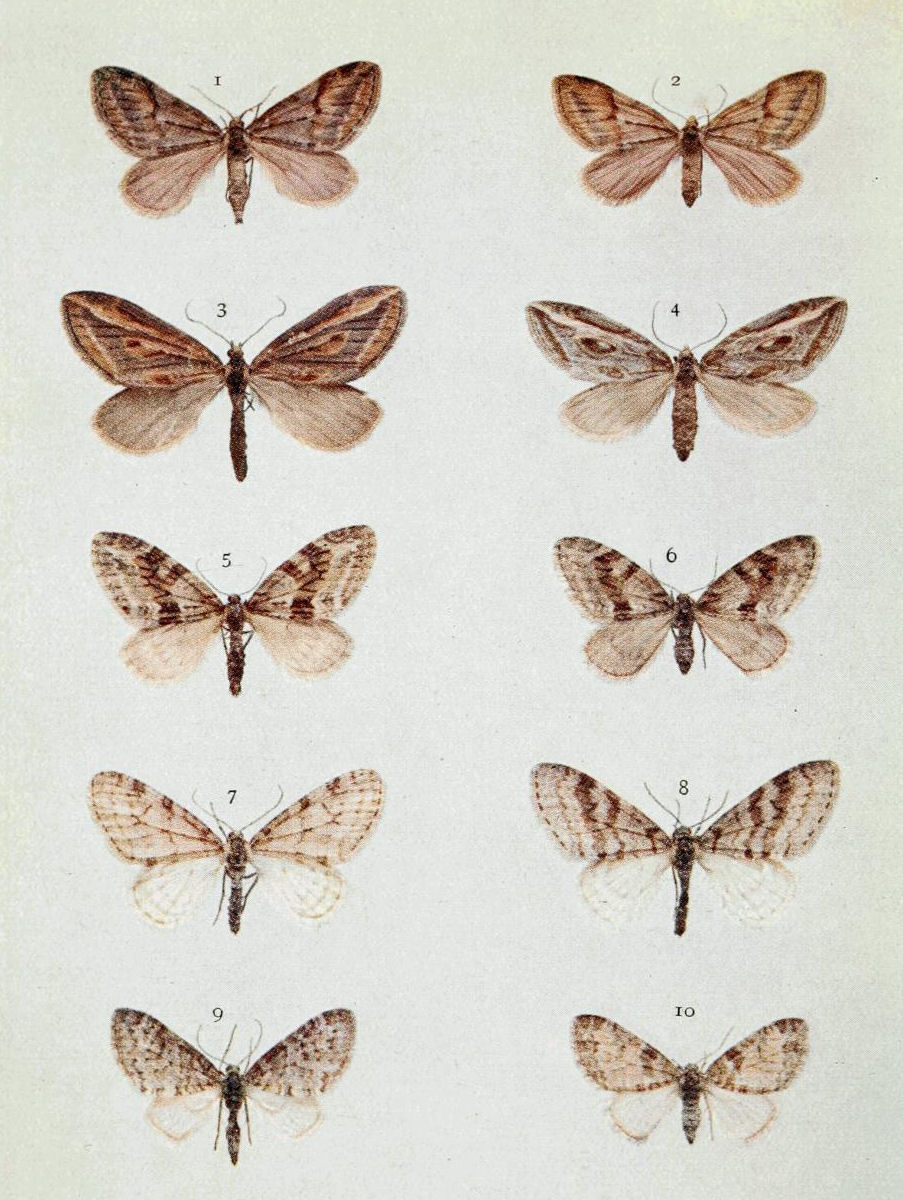
2 Pl. 57.
1, 2.The Broom-tip. 3, 4.The Streak. 5, 6.Barred Tooth-striped.
7, 8.Early Tooth-striped. 9, 10.The Seraphim.
The moth is out in September and October, and secretes itself during the day, but may be found at night flying about the broom bushes for a short time, and later on it sits upon the twigs. It occurs in almost every part of the British Isles where the food plant of the caterpillar is well established.
Broom-tip (Chesias rufata).
A noticeable character in this glossy, greyish moth (Plate 57, Figs. 1 ♂, 2 ♀) is the black mark on the upper part of the second cross line of the fore wings (which probably suggested the English name "Chevron" given to the species by Donovan); following the mark is a reddish or ochreous flush, extending to the tips of the wings.
The long, green caterpillar inclines to bluish above, and to paler green beneath; a darker line along the middle of the back, then a slender whitish line edged with darker green, and between this and the white spiracular line there is another slender whitish line. It feeds, in August and September, on broom; when full grown it enters the earth, and there turns to a reddish brown chrysalis, the wing cases of which are greenish. I am indebted to Mr. A. J. Scollick for the caterpillar and chrysalis figured on Plate 56, Figs. 1, 1a.
The moth emerges the following year, from May to July, but its time of appearance is uncertain, and it may come up in early spring or not until early autumn. Sometimes it will remain in the chrysalis for two winters.
In England the species occurs in the counties of Kent, Surrey, Sussex, Berks, Hants, Devon, Somerset, Hereford, Worcester, Stafford, Leicester, Cheshire (rare in the last five), Cumberland and Yorkshire (recorded once from each county), Norfolk, Suffolk; also Glamorgan, and other parts of South Wales. In Scotland it is found in the south, but is more frequent from Perthshire to Moray. Probably occurs in other British localities where there is plenty of broom.
The Barred Tooth-striped (Lobophora (Trichopteryx) polycommata).
The general colour of the species represented on Plate 57, Figs. 5 ♂, 6 ♀, is greyish, inclining to ochreous or to whitish; but occasionally it is clouded with dark greyish on the basal area, and there is a broad band of the same colour on the outer marginal area; in such specimens the central band becomes less conspicuous.
The caterpillar (Plate 59, Fig. 2) feeds in May and June, on privet, at first on the leaf buds, and afterwards on the expanded leaves. It will also eat ash and honeysuckle. In colour it is rather deep green, with three fine lines along the back, the central one darker than the ground colour, and the others whitish and irregular; a whitish stripe low down along the sides; two points on the last ring of the body. The chrysalis (Plate 59, Fig. 2a), which is enclosed in an oval earthen cocoon, is dark yellowish brown, inclining to blackish on the wing cases.
The moth may be found at night, in March and April, sitting on the privet hedge, and may then be easily boxed, as it seems very disinclined to fly at that time, but earlier in the evening it flits along the hedgerows, and is equally easy to net. When resting, however, one is able to select just the finest specimens.
The species appears to be very local in Britain, but it occurs in the Brighton, Lewes, and Emsworth districts of Sussex; Hants, Wilts (Salisbury), Somerset, Devon (Sidmouth), Gloucestershire, Herefordshire, Worcestershire (Malvern), North Lancashire, Cumberland, Northampton, Berks, Essex, and Kent. In Scotland it has been reported from Clydesdale and Arran, but has not been noted from Ireland.
The Early Tooth-striped (Lobophora (Trichopteryx) carpinata).
The whitish fore wings of this species are tinged with grey or greenish grey, the cross lines and bands vary in intensity, and, as a rule, are more distinct and complete in the female than in the male. A form of not infrequent occurrence in Scotland (ab. fasciata, Prout) has blackish bands, which show up in strong contrast with the general whitish colour of the wings. The ordinary form is represented on Plate 57, Fig. 7 ♂, and Fig. 8 on the same plate shows the named variety referred to.
The caterpillar is green, with rather darker lines along the back, and a yellow stripe low down along the sides; the two points on the last ring are also yellow. It feeds, in June and July, on honeysuckle, sallow, birch, and alder. The moth is out in April and May, and seems to be more or less common in woodlands throughout the greater part of the British Isles. In Scotland it appears to be most plentiful from Perthshire northwards to Sutherlandshire, but it has not been reported from the Orkneys, Shetlands, or Hebrides. (Early stages are shown on Plate 59, Figs. 3-3b.)