THE NATURALIST.
Reading edition
THE DODO.
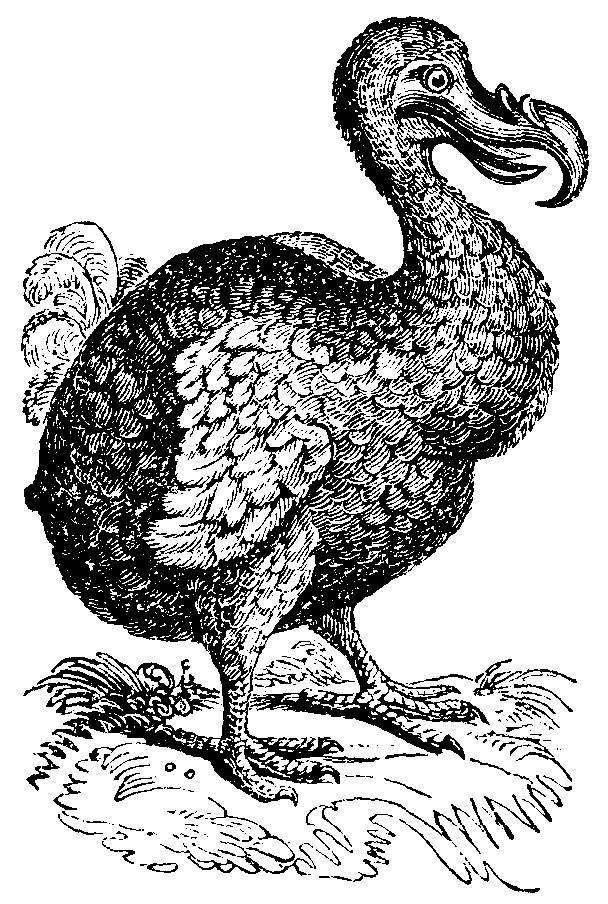
The Dodo.
"Of all the birds which inhabit this island, the most remarkable is that which has been called Solitaire (the solitary), because they are rarely seen in flocks, although there is abundance of them.
"The males have generally a greyish or brown plumage, the feet of the turkey-cock, as also the beak, but a little more hooked. They have hardly any tail, and their posterior, covered with feathers, is rounded like the croup of a horse. They stand higher than the turkey-cock, and have a straight neck, a little longer in proportion than it is in that bird when it raises its head. The eye is black and lively, and the head without any crest or tuft. They do not fly, their wings being too short to support the weight of their bodies; they only use them in beating their sides, and in whirling round; when they wish to call one another, they make, with rapidity, twenty or thirty rounds in the same direction, during the space of four or five minutes; the movement of their wings then makes a noise which approaches exceedingly that of a kestrel (Crécerelle), and which is heard at more than 200 paces distant. The bone of the false pinion is enlarged at its extremity, and forms, under the feathers, a little round mass like a musket-bullet; this and their beak form the principal defence of this bird. It is extremely difficult to catch them in the woods; but as a man runs swifter than they, in the more open spots it is not very difficult to take them; sometimes they may even be approached very easily. From the month of March until September, they are extremely fat, and of most excellent flavour, especially when young. The males may be found up to the weight of 45 lb.; Herbert even says 50 lb.
"The female is of admirable beauty. Some are of a blond, others of a brown, colour; I mean by blond the colour of flaxen hair. They have a kind of band, like the bandeau of widows, above the beak, which is of a tan colour. One feather does not pass another over all their body, because they take great care to adjust and polish them with their beak. The feathers which accompany the thighs are rounded into a shell-like form, and, as they are very dense at this place, produce a very agreeable effect. They have two elevations over the crop, of a somewhat whiter plumage than the rest, and which resemble wonderfully the fine breast of a woman. They walk with so much stateliness and grace combined, that it is impossible not to admire and love them; so much so, that their appearance has often saved their life.
"Although these birds approach, at times, very familiarly when they are not chased, they are incapable of being tamed; as soon as caught, they drop tears, without crying, and refuse obstinately all kind of nourishment, until at last they die. There is always found in their gizzard (as well as in that of the males) a brown stone, the size of a hen's egg; it is slightly tuberculated (raboteuse), flat on one side, and rounded on the other, very heavy and very hard. We imagined that this stone was born with them, because, however young they might be, they always had it, and never more than one; and besides this circumstance, the canal which passes from the crop to the gizzard, is by one-half too small to give passage to such a mass. We used them, in preference to any other stone, to sharpen our knives.
Mr. Thompson finds this evidence strengthened by the facts and statements of a paper by Mr. Duncan, in the Zoological Journal for January, 1828; and infers that a bird of corresponding size and character did actually exist, of which the only remains are a bill and foot in the Ashmolean Museum at Oxford, and a foot in the British Museum, all of which Mr. Thompson examined on his return from the Mauritius in 1816. The specimen, which in part remains at Oxford, was originally in the museum of Tradescant, at Lambeth, which was purchased and removed to Oxford by Dr. Ashmole; the entire bird is proved to have been in the Museum in 1700; and in a catalogue of the collection drawn up since 1755, the disappearance of all but the bill and foot of the Dodo is explained by an order of a meeting of the visitors in the last-named year. Tradescant, it will be recollected, was gardener to Charles the Second; and in the portrait of him still preserved is introduced a Dodo, which belonged to him when alive. Another painting of the bird, to be seen in the British Museum, is stated by Mr. Duncan, to have been executed from a living bird, sent from the Mauritius to Holland, the Dutch being the first colonists of that island; but, Mr. Thompson thinks, "to dissipate all doubts as to its accuracy, it should be collated with a description taken from the Ashmolean specimen, should such be found to exist."
Mr. Thompson is inclined to consider Leguat's natural history of the Dodo as "the only one that was ever penned under such favourable circumstances. No doubt this first colony, in so small an island, considerably reduced the number of the Dodo; but when they finally disappeared, does not seem to be anywhere recorded." The most interesting consideration connected with their disappearance is their being "the only vertebrated animals which we can make certain of having lost since the creation. If we seek to find out what link in the chain of Nature has been broken by the loss of this species, what others have lost their check, and what others necessarily followed the loss of those animals which alone contributed to their support," Mr. Thompson thinks "we may conclude that, the first being seen by the Omniscient Creator, at least no injury will be sustained by the rest of the creation; that man, its destroyer, was probably intended to supplant it, as a check; and that the only other animals which its destruction drew with it, were the intestinal worms and pediculi peculiar to the species."
Buffon, Latham, and Gmelin have three species of Dodo, while we find it difficult to establish the existence of one. Indeed, it is improbable that the three islands of the Mauritius group possessed each a distinct type of so singular and unique a bird.
MOUNT ARARAT.
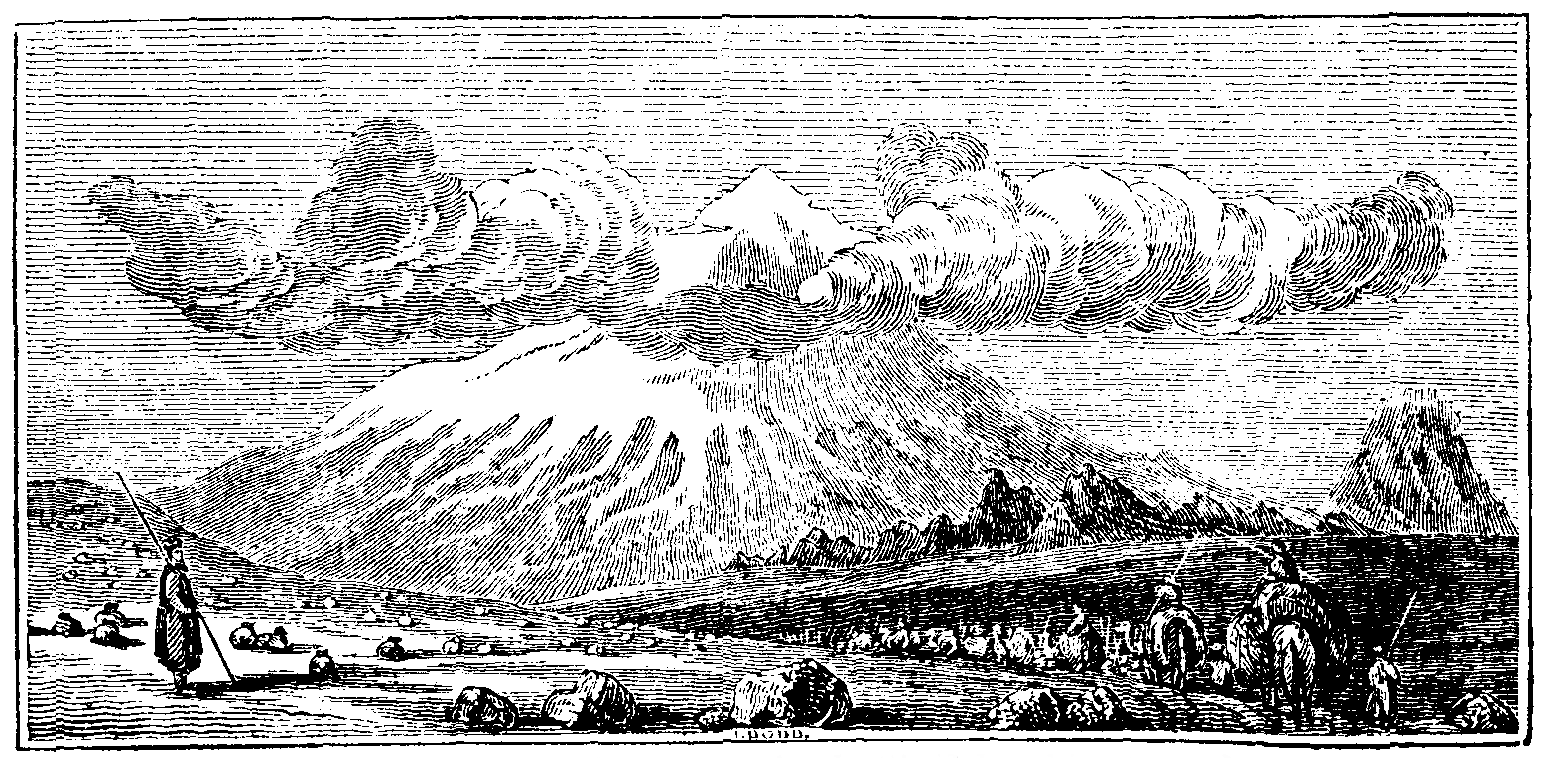
Mount Ararat, from a drawing, by Sir Robert Ker Porter.
Perhaps the most recent visit to this wonder of the East will be found described in Mr. J.H. Stocqueler's Journal of Fifteen Months' Pilgrimage through untrodden Tracts of Khuzistan and Persia, in 1831 and 1832:—
"We mounted our horses," says the enthusiastic traveller, "soon after sunrise, and had proceeded for about four hours over numerous acclivities, and through a territory of undulations resembling the waves of the sea deprived of motion, when the southern peak of Ararat (for there are two), snow-clad and 'cloud-clapt' suddenly burst upon my view! At first I scarcely dared venture to believe we were so near this celebrated mount, though its situation and the distance we had journeyed from Tabreez left no doubt of the fact. I even questioned the guide, and on his answering that it was the summit of Agri-Dagh (the name by which Ararat is called by the Turks), I involuntarily clasped my hands in ecstacy! Who can contemplate this superb elevation without a mixture of awe and admiration, or fail to recur to the page of sacred writ illustrative of Almighty wrath and the just man's recompense? Who can gaze upon the majesty of this mount, towering above the 'high places' and the hills, and turn without repining to the plains beneath, where puny man has pitched his tent and wars upon his fellow, mocking the sublimity of Nature with his paltry tyranny? I felt as if I lived in other times, and my eye eagerly but vainly sought for some traces of that 'ark' which furnished a refuge and a shelter to the creatures of God's mercy when the 'waters prevailed, and were increased greatly on the earth,' till 'all in whose nostrils was the breath of life, and all that was in the dry land, died!'
NUTRIA FUR.
(To the Editor.)
I read with much pleasure the article in your Number, 574, on Nutria Fur: it was, to me, particularly acceptable, as I have been connected for the last ten years with an establishment where, on an average, 150,000 Nutria Skins are annually manufactured, and the wool cut for the use of hatters. I have searched every book of travels in Brazil, &c., that I could procure, and the chief English works on zoology, without being able to gather any description of the scientific name or habits of the animal. All the information I could collect was from the captains of various vessels that had visited Buenos Ayres, and brought cargoes of skins; but their accounts were extremely vague and unsatisfactory.
I perceive, however, that you have overlooked a peculiarity generally attributed to the animal, which, if true, is, in my opinion, deserving notice: viz.—the position of the female's teats, which are not placed on the belly, as with most animals, but on the side, approaching to the back, by which means it is enabled to suckle its young on both sides at once, whilst swimming on the surface of the water; and it presents, I have understood, a singular group to the observant traveller.
I have sent the skin of a female Nutria herewith, for your inspection, as regards the teats, &c. (from which the fur has been cut by machinery,) with a small sample of the belly fur, prepared for the covering of a hat; the wholesale price of the latter is now three guineas per lb.: it is used as a substitute for beaver-wool on second-rate hats. Our French correspondents term the skins "Ratgondin."
BENJAMIN NORRIS, JUN.
Windsor Place, Southwark Bridge Road.
*** We thank our intelligent correspondent for this communication, as well as for the skin and fur. The skin is rather above the usual size: its length is 26 inches, the tail being cut off; as is always done before the skins are exported: the width of the skin is 15 inches; the teats, nine in number, are in two rows, each row being about 2-1/2 inches from the centre of the back, and about 5 inches from the centre of the belly; so that they are, as our correspondent observes, on the side, approaching to the back nearer by half than to the belly. This position of the teats appears to correspond with the animal's habit of suckling its young whilst swimming.