THE ISLE OF WIGHT.
Reading edition
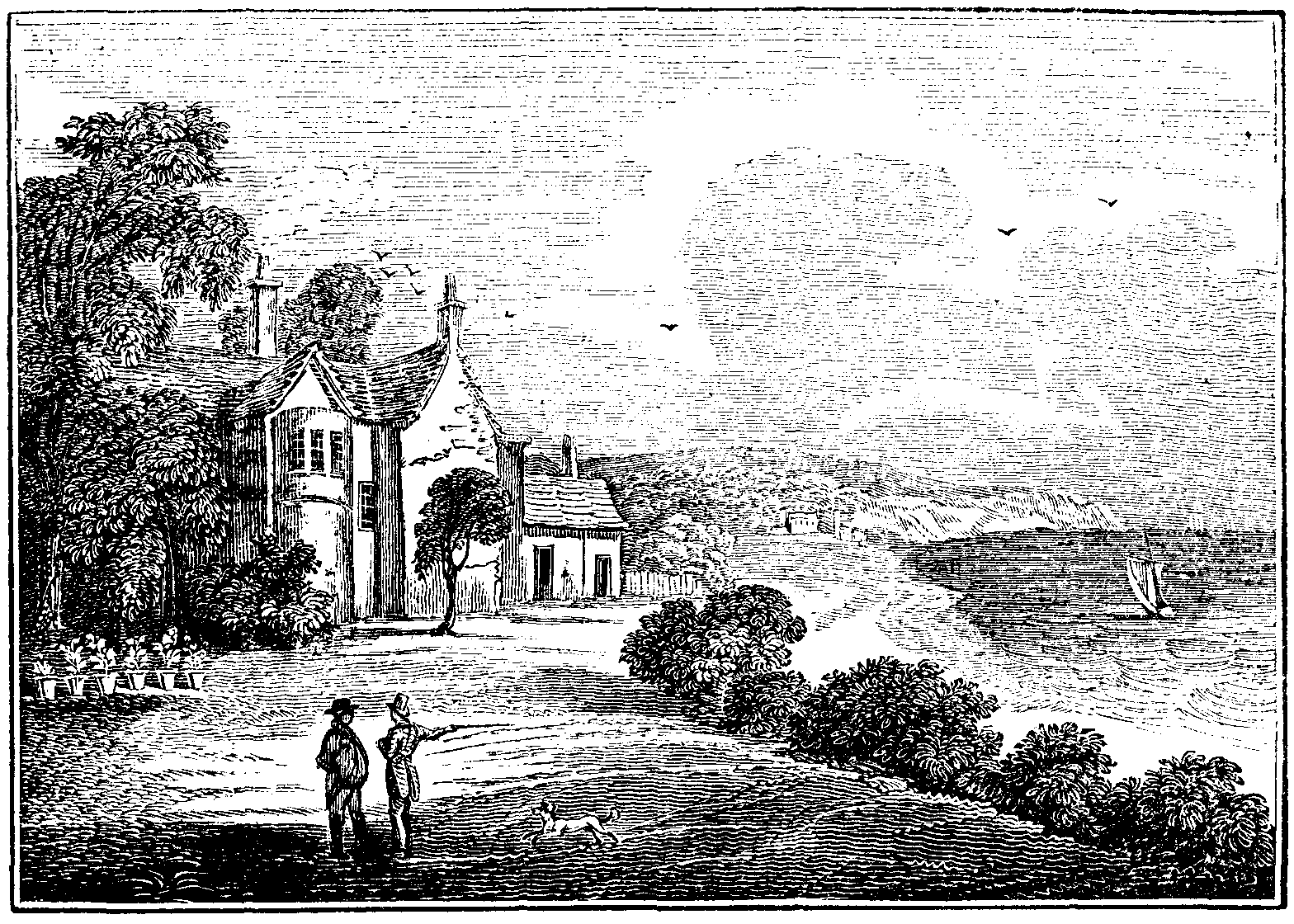
(Wilkes's Cottage.)
NOTES FROM A PEDESTRIAN EXCURSION IN THE ISLAND.
By a Correspondent.
Although the roads of the island have within the last twenty years been rendered passable for vehicles of all kinds, even to stage coaches, yet by far the best mode of inspecting this English Arcadia is to travel through it on foot, commencing at Ryde.
From this town a footpath leads across the park and grounds of St. John's into the high road which may be followed to Brading. About a mile from that place is Nunwell, the seat of Sir W. Oglander; and opposite is a delightful view of Bembridge (the birthplace of Madame de Feuchares) and Brading Harbour, which at high water presents to the eye a rich, deep, green colour, with an increased effect from being surveyed through the long line of tall elms on the road side. Brading boasts of a mayor and corporation, and formerly sent a member to parliament, which privilege was abolished by Queen Elizabeth. The town is of high antiquity, as is also the church, which tradition says was the first built in the island. It contains few monuments of interest or note, but the surrounding burial-ground can boast of a collection of epitaphs and inscriptions which are above mediocrity. The following to the memory of Miss Barry by the Rev. Mr. Gill has been rendered celebrated by the admirable music of Dr. Calcott:
Forgive, blest shade, the tributary tear, That mourns thy exit from a world like this; Forgive the wish that would have kept thee here, And stayed thy progress to the realms of bliss. No more confined to grov'ling scenes of night— No more a tenant pent in mortal clay; Now should we rather hail thy glorious flight, And trace thy journey to the realms of day.
On a rising ground at the end of the town is the Mall; at the entrance of which the earth reverberates to the tread of horses' feet in a manner similar to that produced by riding over a bridge or hollow. It is most probably occasioned by a natural cleft in the chalk beneath the gravel road. Here the tourist should rest to enjoy a scene of unrivalled beauty. On the left, below the road, lies the town of Brading, and more remote, St. Helen's Road, and the opposite coasts of Portsmouth and Southsea. In front, at the foot of the hill, are the rich levels, with the sinuous river Yar slowly winding towards the harbour, with the full broad front of Bembridge Down interrupting the marine view, which is again presented on the right from the village of Sandown to the extremity of Shanklin. At the foot of Brading Hill the road divides itself into two branches. The one to the right leads direct to Shanklin, over Morton Common: the other to the left lies through Yarbridge to Yaverland and Sandown. We recommend the latter, as the farm-house and church at Yaverland are worthy of notice. The former is a fine capacious stone building, of the time of James I., containing some well executed specimens of carved oak. The church is annexed to the house, and has a curious semicircular doorway. Culver Cliffs, about a mile and a half from Yaverland, may be approached by a footpath across the fields, which will also lead to Hermit's Hole, a cavern of great depth in the side of the cliff. These cliffs were much celebrated for a choice breed of falcons, which were esteemed so highly by Queen Elizabeth, that she procured the birds regularly from the Culver Cliffs, and they were trained with much care for her majesty's own use. On the shore beneath, but more towards Sandown, near what is called the Red Cliff, (from the colour of the soil,) many fossil remains have been lately discovered; some of animals of a gigantic size.
About half a mile from the Fort is Sandown Cottage, formerly the elegant retreat of the celebrated John Wilkes, the chief star in the political horizon, during the administration of the Earl of Bute. The cottage is situated as the Engraving shows, near the shore of Sandown Bay, which extends about six miles, the eastern extremity being terminated by the chalky cliffs of Culver, and the south-western by the craggy rocks of the mountainous part of Dunnose. The house is small, and has been elegantly fitted up; in the gardens were some detached and pleasant apartments, constructed with floorcloth of Kensington manufacture. But the labours of Wilkes's retirement have been swept away, and there is scarcely a relic
Where once the garden smiled.
Shanklin may be approached by the sea shore at low water or by Lake and Hillyards, if the high road be preferred. At this delightful village seem assembled all the charms of rural scenery, hill, wood, valley, corn field and water; aided by the wide extended ocean, reaching to the eastern horizon, with the majestic white cliffs of Culver at the extremity of the bay on the left, and the long range of cliffs of every hue and colour gradually declining in height as the eye glances along to the cottages of Sandown, and then again imperceptibly rising to their highest point of elevation.
The situation of the village of Shanklin is as romantic as any of the lovers of nature can desire. The salubrity of the atmosphere and the proximity of the village to the sea may account for the extraordinary growth of the myrtle-tree, which attains here an astonishing height. Virgil tells us this plant is best cultivated on the sea side; but every maritime situation is not congenial, unless a protection is afforded from the cold northerly winds.
The chief attraction of Shanklin is the Chine. This is a natural fissure or cleft in the earth, running from the village to the sea in a circuitous direction and increasing in width and depth as it approaches the shore. It was most probably formed by the long continued running of a stream of water from the adjoining hills; this now forms a cascade at the commencement of the path which has been formed in the side to facilitate strangers in exploring their way through the rocks and underwood. But the admirers of sublime nature will mourn the ruthless devastation that has thus been made, ostensibly for the public benefit, to serve private interest. In the Chine is a chalybeate spring, highly impregnated with iron and alum, and of course beneficial in cases of debility and nervous affections.
C.R.S.
LINES TO ----.
Life's earliest sweets are wasted, And time impatient flies; The flowers of youth are blasted, Their lingering beauty dies. Yet my bosom owns a pleasure, That no icy breath can chill;— 'Tis thy friendship, dearest treasure, For my hopes are with thee still. Though mine eye, by sorrow shaded, Drops the solitary tear, O'er remember'd joys, now faded, To young love and rapture dear. E'en the retrospective feeling, Leaves a momentary thrill; All the wounds of sorrow healing, For my hopes are with thee still. Though I've bid adieu to pleasure, With her giddy, fleeting train; And her song of joyous measure, I may never raise again. Yet the chilling gloom of sadness, Waving o'er me, brooding ill, Emits one ray of gladness, For my hopes are with thee still. When the reckless world is sleeping, And the star of eve shines gay; While the night winds softly creeping O'er the waters, die away; When the moonbeams softly playing, Silver o'er the glistening rill; 'Tis to thee my thoughts are straying, For my hopes are with thee still. When the fragrant breath of morning Wanders o'er the silent dews; And flowers the vale adorning, Do their balmy sweets diffuse. When the orb of day appearing, From behind the distant hill, Gilds the landscape bright and cheering, E'en my hopes are with thee still.
Leeds.
J.B. WALKER.
ANTIQUITY OF MALT LIQUOR.
Malt liquor appears to have had its origin in the attention paid by an eastern sovereign to the comfort and health of his soldiers; as we are informed by the historian Xenophon, that "the virtuous Cyrus" having observed the good effects that water in which parched barley had been steeped, produced, exhorted and commanded his troops to drink this liquor; the historian entitled it "Maza." It is highly probable that Cyrus adopted this drink to counteract the ill effects of impure and foul water (which had done lasting injury to other warriors of his time), which is so common in warm, sunny climates; as Pliny informs us, that if water be impure or corrupted, by putting fried barley into it, in less than two hours, it will be pure and sweet; that its bad effects will have evaporated, and that it then may be drunk with perfect safety; he further adds that, this is the reason why we are in the habit of "putting barley-meal into the 'wine-strainers' through which we pass our wines, that they may be refined, purified, and drawn the sooner." The information conveyed to our readers by Pliny, may be made of great practical use and benefit by mariners, to whom sweet water is such a desideratum; and is as important to those who traverse the arid deserts of Africa, where sweet water is so seldom found.
That the ancients used the "juice of the grape," and that almost as a common drink, has never been doubted by the most cursory reader of history; the knowledge of this liquor being nearly coeval with the first formation of society. In the Book of Genesis we read that Noah after the flood planted a vineyard, "manufactured" wine, and got intoxicated with this "nectar fit for gods." Beer can likewise boast of as great antiquity. Its use was not unknown by the Egyptians; as we are informed by Herodotus that the people of Egypt made use of a kind of wine made from dried barley, because no vines grew in that country. According to Tacitus, in his time beer was the common drink of the Germans, who drank it in preference to that more stimulating (if not more nutritious) liquor, wine. We are also informed by Pliny, that it was made and was in common use amongst the Gauls, and by many of their neighbours. The name he gave to this drink was "cerevisia" which evidently alludes to the article from which it was composed. Although these nations held this liquor in such estimation, there has been no record to inform us of their mode of preparing it.
Ale was introduced into our country centuries ago, by our Saxon ancestors, and it was not long ere it became the favourite and common drink of all classes of society. Their habit of drinking it out of skulls, at their feasts, is well known to the reader of romance. It was then, as it is now, commonly sold at houses of entertainment to the people. After the Norman Conquest, the vine was very extensively planted in England, but was drunk alone, as a chronicle of that time says, "by the wise and the learned;" the people did not lose their relish for the beverage of their forefathers, and wine was never held in much respect by them. Hops had hitherto not been used in the composition of beer; but about the fifteenth century they were introduced by the brewers of the Netherlands with great success; from them we adopted the practice, and they came into general use about two centuries afterwards. Some historians have affirmed that Henry VI. forbade the planting of hops; but it is certain that "bluff King Hal" ordered brewers to put neither hops nor sulphur into their ale. The taste of the nation in the reign of Henry VI. seems to have changed, as we find in the records of that time that extensive "privileges" (monopolies these enlightened times would have called them) were annexed to hop-grounds. In the reign of James I. the produce of hop-grounds were insufficient for the consumption, and a law was made against the introduction of "spoilt hops." Walter Blithe, in his Improver Improved, published in 1649, (3rd edit. 1653) has a chapter upon improvements by plantations of hops, which has this striking passage. He observes that "hops were then grown to be a national commodity; but that it was not many years since the famous city of London petitioned the Parliament of England against two nuisances; and these were, Newcastle coals, in regard to their stench, &c., and hops, in regard they would spoyl the taste of drink, and endanger the people: and, had the Parliament been no wiser than they, we had in a measure pined, and in a great measure starved; which is just answerable to the principles of those men who cry down all devices, or ingenious discoveries, as projects, and therefore stifle and choak improvements." According to a late writer, in the year 1830, there were 46,727 acres occupied in the cultivation of hops in Great Britain alone.
Thirty millions of bushels of barley are annually converted into malt by the breweries of Great Britain; and upwards of eight millions of barrels of beer (of which more than four-fifths are strong) are brewed annually. This enormous consumption attests the fondness of the people for the beverage of their forefathers.
E.J.H.
A PERSIAN FABLE.
Imitated from the Latin of Sir W. Jones.
Whoe'er his merit under-rates,
The worth which he disclaims, creates.
It chanc'd a single drop of rain
Slip'd from a cloud into the main:
Abash'd, dispirited, amaz'd,
At last her small, still voice she rais'd:
"Where, and what am I?—Woe is me!
What a mere drop in such a sea!"
An oyster, yawning where she fell,
Entrap'd the vagrant in his shell;
And there concocted in a trice,
Into an orient pearl of price.
Such is the best and brightest gem,
E.B.J.