ROMAN TOMBS.
Reading edition
Hominem mortuum in urbe ne sepelito, neve urito,
(neither bury nor burn a dead body in the city.) But this law must be understood with this limitation, that the Senate occasionally granted exemption from it, to distinguished individuals, though so rarely, that a tomb within the walls of Rome seems to have been considered a reward of the most pre-eminent virtue.
Antiquarian writers have carefully classified the Roman tombs. We have, however, only space to remark generally, that the sepulchres were either square, circular, or pyramidal buildings, and with one entrance only, which was invariably on the side farthest from the public road. They usually consisted of a vault in which the urns and sarcophagi were deposited, and a chamber above, in which the statues or effigies of the dead were placed, and the libations and obsequies performed. These sepulchres were usually places of family interment, but sometimes they were solitary tombs. Of the latter description is the Tomb of Caecilia Metella, which is generally acknowledged to be the most beautiful sepulchral monument in the world. It consists of a round tower formed of immense blocks of Tiburtine stone, fixed together without cement, and adorned with a Doric marble frieze, on which are sculptured rams' heads festooned with garlands of flowers. "That they are rams' heads, must be evident to any one who will take the trouble to examine them, though they are usually denominated the heads of oxen, because the tomb itself is vulgarly called Capo di Bove. But this name is obviously derived from an ox's head, (the arms of the Gaetani family, by whom it was converted into a fortress,) which was affixed many centuries ago on the side of the tower next the Appian Way, and still remains there; and, accordingly, the vulgar name is Capo di Bove, 'the head of the ox,' in the singular—not in the plural."
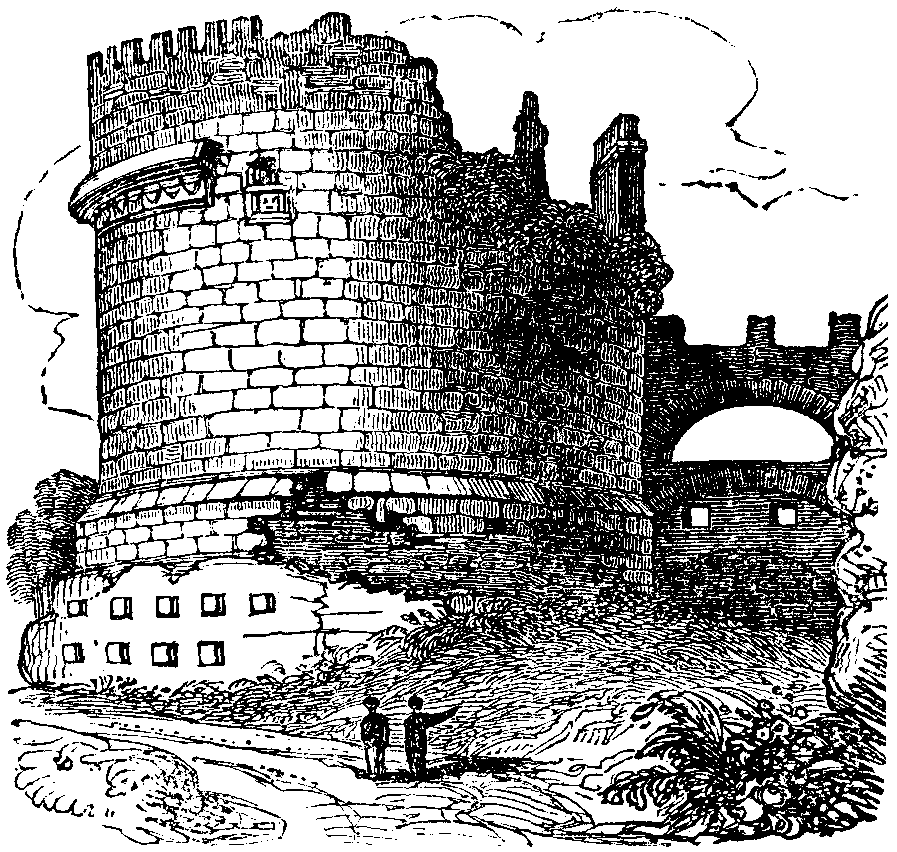
(Tomb of Caecilia Metella.)
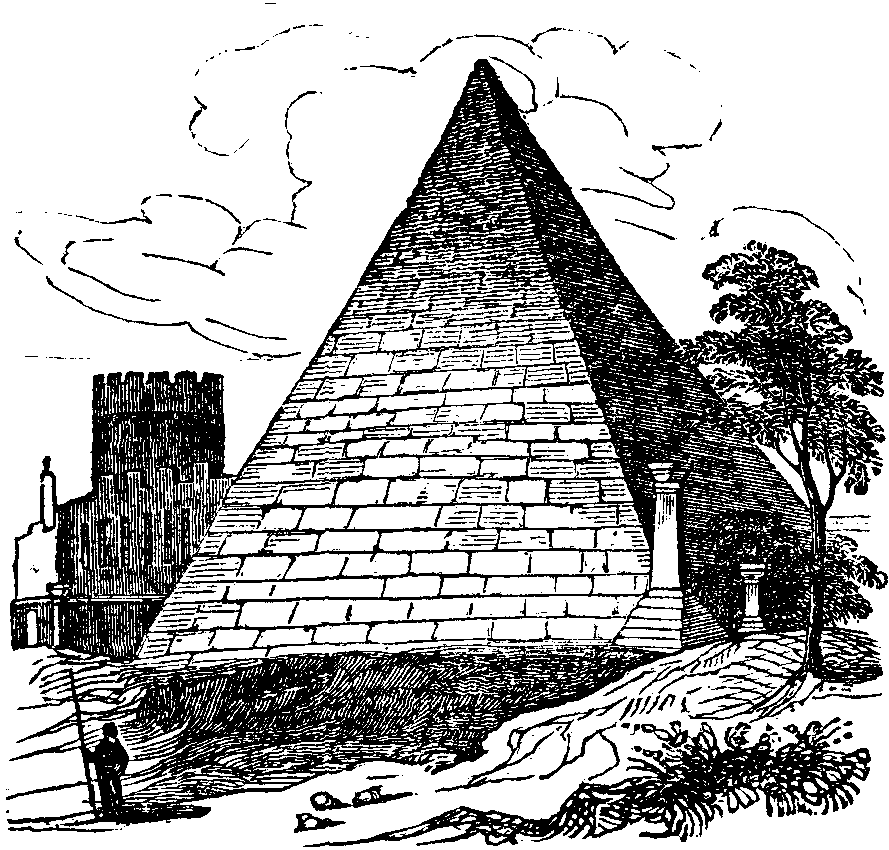
(Tomb of Caius Cestius.)
Time has changed the colour and defaced the polish of the marble pyramid. The grey lichen has crept over it, and wild evergreens hang from its crevices. But, what it has lost in splendour it has gained in picturesque beauty; and there are few remains of antiquity within the bounds of the Eternal City, that the eye rests upon with such unwearying admiration as this grey pyramid.
Lastly is the reputed Tomb of the Horatii and Curatii.
Its identity has been much controverted, and the Cut shows it to be a ruinous pile capped with luxuriant foliage. It will, nevertheless, serve to illustrate the stupendous character of the ancient Roman tombs.
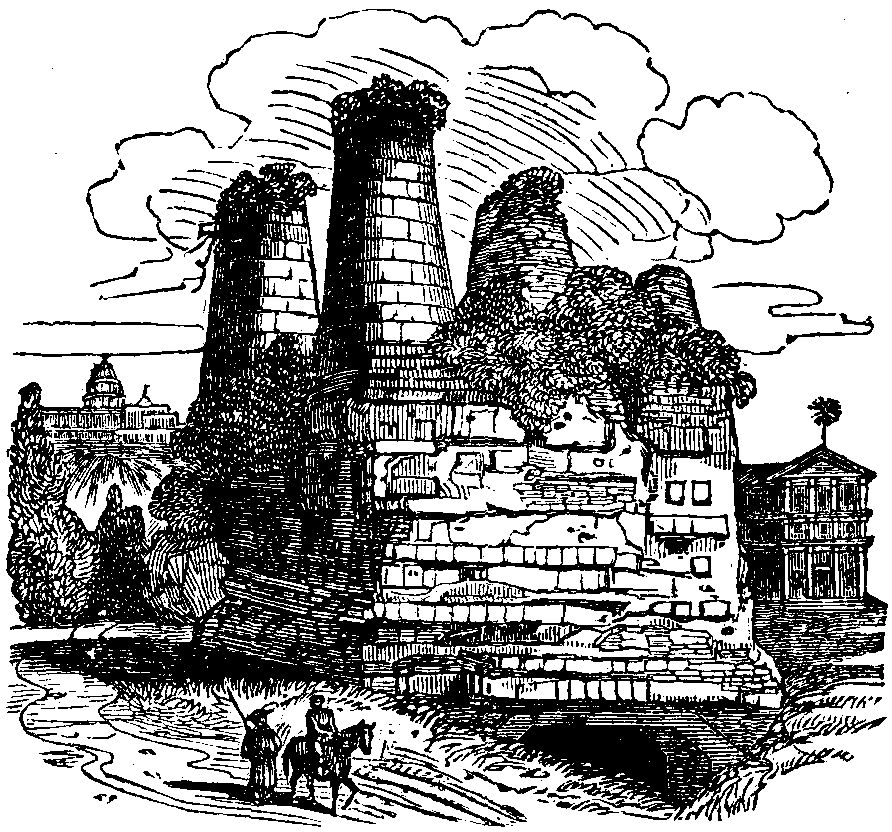
(Tomb of the Horatii and Curatii.)
The theatre of the celebrated combat between the Horatii and Curatii lies about five miles from the city of Rome. Several tombs stand on the side of the hillock that borders these fields, but no one in particular is there pointed out as belonging to the unhappy champions. The monuments, however, existed in Livy's time, and Eustace supposes that "as their forms and materials were probably very plain and very solid, they must have remained for many ages after, and may be some of the many mounds that still stand in clusters about the very place where they fell." This explanation will not, however, refer to the above engraving, as the buildings in the distance will show.