THE MIRROR OF LITERATURE, AMUSEMENT, AND INSTRUCTION.
Reading edition
Vol. 20. No. 568. SATURDAY, SEPTEMBER 29, 1832. [PRICE 2d.
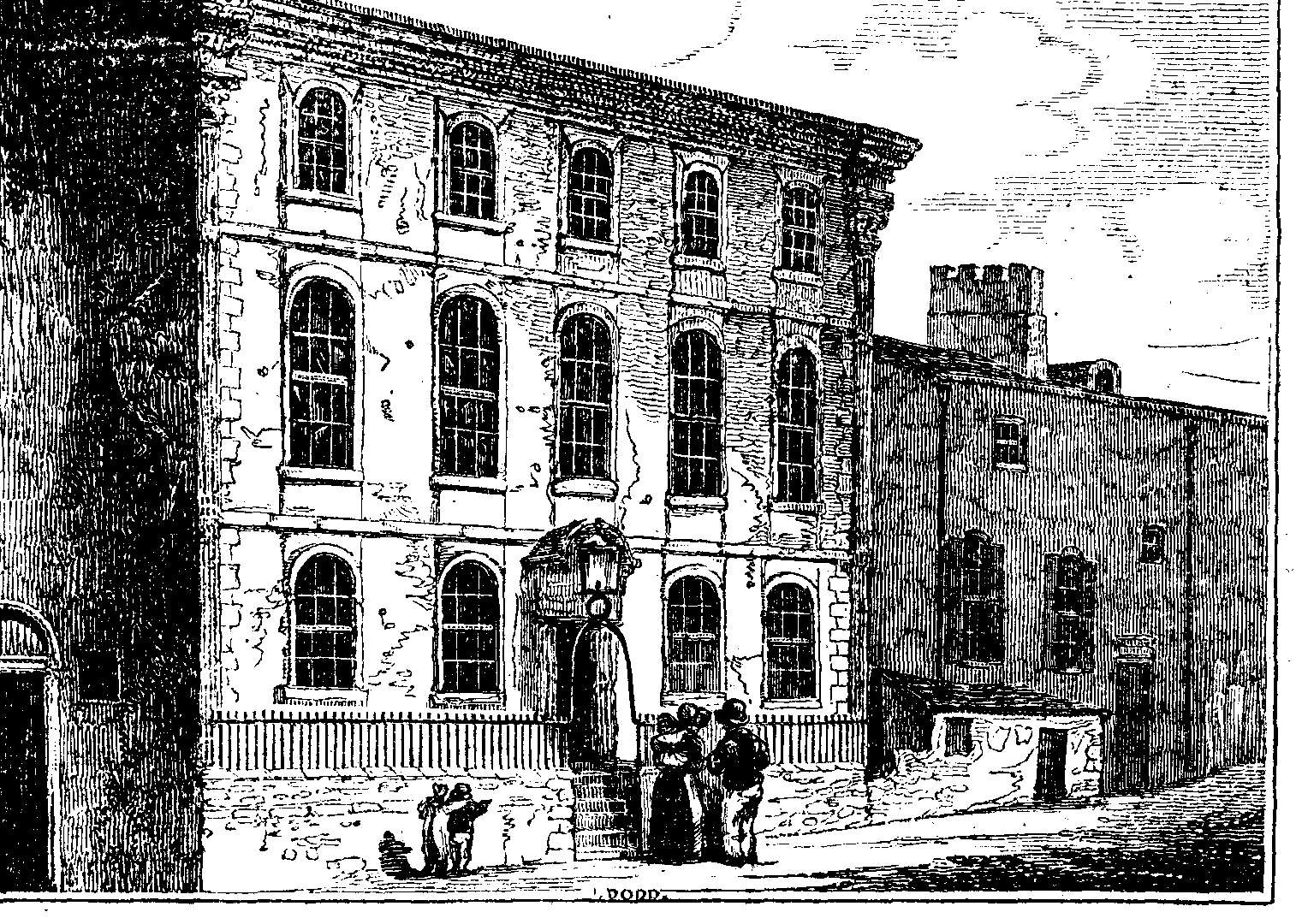
BIRTHPLACE OF THE EARL OF ELDON.
Little need be said, by way of explanation, for the addition of the present subject to our collection of the birthplaces of eminent men. It is something to know that John Scott was born at Newcastle-upon-Tyne, in the principal dwelling represented in the above Engraving, in the year 1751; that he received the rudiments of his education at the free grammar-school of the town; that he grew up "a man of safe discretion;" that he enjoyed the highest legal honours which his sovereign could bestow for a quarter of a century; and that he still lives, a venerable octogenarian, in the enjoyment of "glory from his conscience, and honour from men." The biography of so distinguished an individual must have innumerable good tendencies: it at once inculcates the wholesome truth that "every man is the architect of his own fortune;" and it presents us, moreover, with the encouraging picture of a well-regulated life, and its healthful energies so employed in the discharge of important duties as to entitle the subject to high rank among the worthies of his country.
In 1783; Mr. Scott obtained a silk gown; and, through Lord Weymouth's interest, he was introduced into parliament for the borough of Weobly. It is stated that on the latter occasion, he stipulated for the liberty of voting as he pleased. He took a decided part with the Pitt administration; and in 1788, he was appointed solicitor-general, and knighted; in 1793, he rose to be attorney-general, and in the following year he conducted the trial of Hardy, Tooke, and Thelwall, for treason. Erskine was opposed to him; and the prosecution failed, though the speech of the attorney-general occupied nine hours in the delivery.
In 1799, Sir John Scott was appointed to the chief justiceship of the Common Pleas, on the resignation of Chief Justice Eyre; and in the same year he was raised to the peerage by the title of Baron Eldon. In 1801, he was made Lord Chancellor, which high office he retained till the year 1827, with the exception of the short period during which the Whigs were in office, in 1806. His lordship was raised to the dignity of an earl at the coronation of George IV. in 1821.
The high character of the Earl of Eldon as Chancellor is thus lucidly drawn by Sir Egerton Brydges: "Of all who, in the long lapse of ages, have filled the sacred seat on which he now (1823) sits, none ever had purer hands, none ever had a conscientious desire of equity more ardent and more incessant than Lord Eldon. The amazing expanse of his views, the inexpressible niceness of his discrimination, his unrelaxing anxiety to do justice in every individual case, the kindness of his heart, and the ductility of his ideas, all ensure that attention to every suitor which must necessarily obtain the unbounded admiration and attachment of the virtuous and the wise. Lord Eldon's eloquence," continues Sir Egerton, "is rather adapted to cultivated and thinking minds than to a popular audience. It generally addresses the understanding rather than the fancy. It frequently wants fluency, but occasionally is tinged with a high degree of moral pathos."
Newcastle contains memorials of Lord Eldon which indicate that the inhabitants are proud of their distinguished fellow-freeman. A spacious range of elegant buildings is called Eldon Square: and in the Guildhall is a portrait of his lordship, opposite that of his brother, Lord Stowell.
THE WEARIED SOLDIER
.
"When silent time, wi' lightly foot, Had trod o'er thirty years, I sought again, my native land, Wi' many hopes and fears." MRS. HAMILTON. He came to the village, when the sun In the "golden west" was bright, When sounds were dying one by one, And the vesper star was shining down, With a soft and silvery light. A war-worn wanderer was he, And absent many a year From the cottage-home he fain would see, From that resting-place where he would be, The spot to memory dear. It rose at last upon his view, (Old times were thronging round him,) The lattice where the jasmine grew, The meadow where he brush'd the dew When youth's bright hopes were round him. But faces new, and sadly strange, Were in that cottage now; Cold eyes, that o'er his features range, For time had wrought a weary change Upon the soldier's brow. And some there were—the lov'd—the dead— Whom he no more could see, From this cold changing world were fled, And they had found a quiet bed Beneath the old yew tree. And thither too—the wanderer hied, Night-dews were falling fast, This is my "welcome home" he cried, And the chill breezes low replied In murmurs as they pass'd. They whispering said, or seem'd to say, No lasting joys to earth are given, No longer near these ashes stray, Go, mourner! hence, away! away! Thy lost ones are in heaven. Kirton, Lindsey. ANNE R.
RELIGIOUS FASTINGS.
From the remotest ages of antiquity most nations have practised fasting to keep the wrath of God from falling upon them for their sins. Some celebrated authors even affirm that fasting was originated by Adam after he had eaten of the forbidden fruit; but this obviously is carrying their arguments, in favour of fasting, too far, though it is as certain that the Jewish churches practised it from their first formation. The Egyptians, Phoenicians, and the Assyrians held the "solemn fast" in high favour. The Egyptians, according to Herodotus, before they offered in sacrifice the cow to Isis, to purify themselves from impurities, fasted and prayed. This custom he also ascribes to the Cyrenian women. Porphyry relates that the fasts of the Egyptians were sometimes continued for six weeks, and that the shortest ordained by their priests was seven days, during which they abstained from nearly all kinds of food. These rites they communicated to the Greeks, who observed these fasts more strictly, and with more outward show and solemnity. The Athenians likewise observed stated fasts, two of which were named "the Elusinian and Thesmoporian fasts;" the observation of these fasts was extremely rigid, especially amongst women, who, in mournful dresses, spent one whole day sitting on the ground (their sign of grief,) without taking the least food. The islanders of Crete, before sacrificing to Jupiter, had to abstain from food. A celebrated ancient author informs us, that those who wished to be initiated into the secrets of Cybele, fasted ten days before their initiation; and that, in short, the priests who gave the oracles, and those who came to consult them, had to perform this duty.
Amongst other Heathen nations, before they prepared for any important enterprise, the whole expedition fasted. The Lacedemonians having agreed to aid an ally, ordained a fast throughout their nation, and without even excepting their domestic animals. The Romans having besieged the city of Tarentum, and the city being hard pressed, the citizens demanded succour of their friends, the inhabitants of Rhegium; who, preparatory to granting assistance to the besieged, commanded that a fast should be held throughout their territories. Their aid having proved successful, the government of Tarentum to commemorate this important event, ordained a perpetual fast on the day of their deliverance.
Philosophers and certain religious people have for ages reckoned fasting as a service which led to important results, and a duty which could not be dispensed with without causing the wrath of God to fall upon the heads of the nation. At Rome it was practised even by the emperors. Amongst the most remarkable for keeping this institution were Numa Pompilius, Julius Caesar, Vespasian, &c. Julian, the apostate, was so exact in the performance of this ordinance, that the fasting of the philosophers and of the priests themselves, was as nothing compared with his abstinence. Pythagoras fasted sometimes as long as forty days; his disciples followed the example of their master; and after his death they kept a continual fast, in which they denounced the inhabitants of the deep as well as the creatures of the meadow. The eastern Brahmins are remarkable for their fasting; but as the people believe they regale themselves with the good things of this life, in secret, their example gains not many followers. That nation which reckons itself infinitely superior to us "poor barbarians," the Chinese, also observe stated seasons of fasting and prayer. The Mahomedans likewise strictly observe fasting and prayer, and the exactness with which the dervishes perform them, and the lengths of time of their fasts are very remarkable.
The Israelites were commanded by Jehovah himself to fast on the appearance of any plague, famine, war, &c.; and though they sadly neglected the commands of God in other particulars, yet they obeyed this command with great devotedness. The abstinence of the ancient Jews generally lasted from twenty-six to twenty-seven hours. On these days they wore sackcloth, laid themselves in ashes, and sprinkled them on their heads, in token of their great grief and penitence. Some spent the whole night in the synagogue; occasionally using with great effect a scourge as a penance for their sins, or as a stimulant to devout behaviour. We think it is not improbable that it is from the Jews that the Roman Catholics derived their scourging penance system.
In "happy smiling England," fasting was, and is, practised by the Catholics every Friday; it was also practised by the fathers of the church, and the primitive Protestants, at stated seasons. The custom is still observed amongst the methodists, who follow the example of their great leader, Wesley. The rust of time has, however, worn away the veneration for this "good old system," and it is totally disused by the general body of Protestants, except on great national occasions.
E.J.H.