Notes of a Reader.
Reading edition
ZOOLOGICAL GARDENS, REGENT'S PARK.
We recommend such of our London friends and visiters from the country as have not lately passed an hour or two in the Zoological Gardens, to do so without further delay. The present season is warm and genial, and the rejoicing rays of the morning and noontide sun enliven the tenants of this mimic world in a garden. As evening approaches the air becomes chill and misty, though
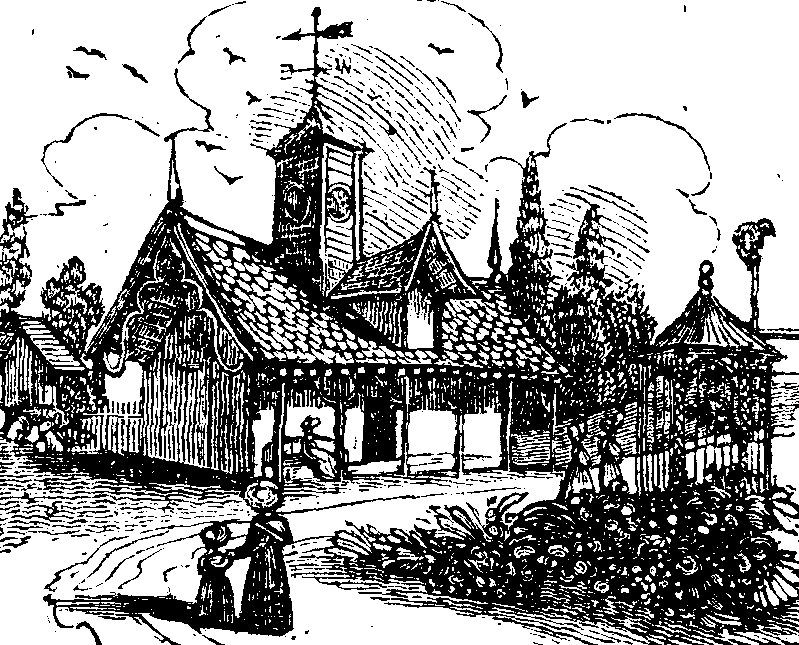
(Llama House.)
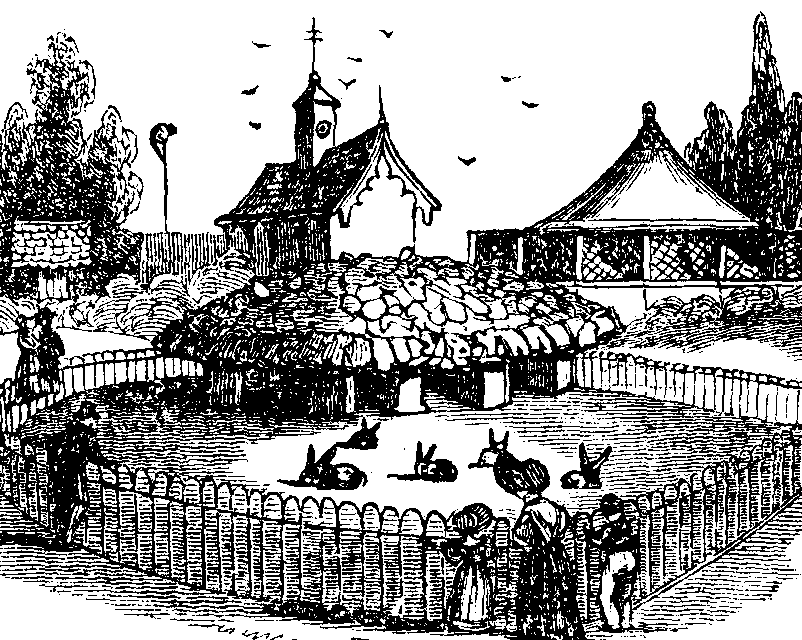
(Armadillos.)
The weary sun hath made a golden set, And, by the bright track of his fiery ear, Gives token of a goodly day to-morrow:
the several animals indicate their sense of the atmospheric changes by their decreased activity, reminding us of the comparative torpidity in which the majority of them will pass the coming winter.
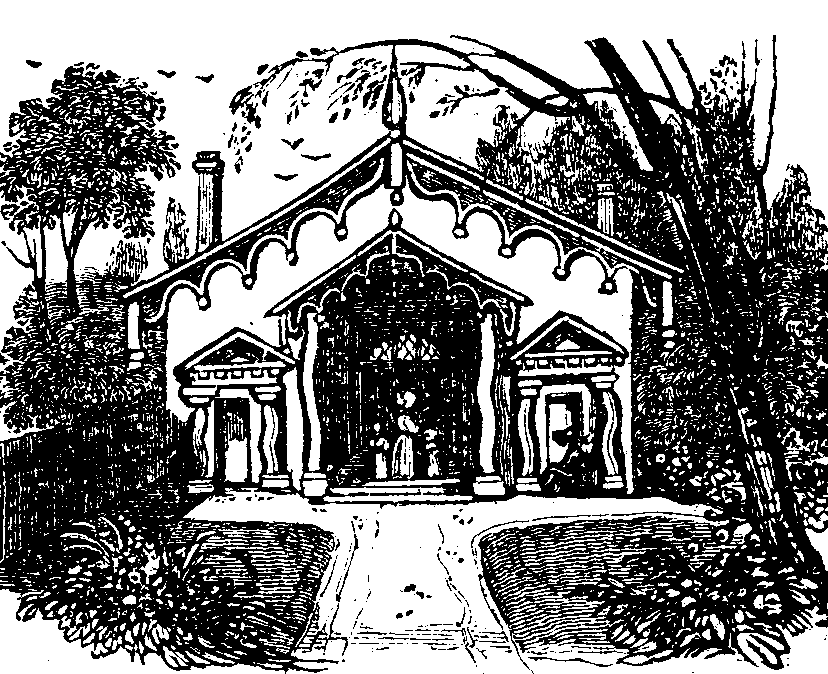
(The Repository.)
Opposite is the sloping gravel walk leading from the Terrace; and a large cage for Parrots, Parrakeets, Macaws, and Cockatoos, whose brilliant colours are here seen to advantage in the resplendent beams of a September sun. In the distance are the Bear Pole and Shed for Goats.
The next Cut includes the House and Enclosure for Armadillos, who are, in sunny weather, located here with a "select few" rabbits. The innocent gambols and restless run of the Armadillo over the turf are here seen to advantage. This house as the distance of the Cut shows, is not far from the Llama House and circular Aviary.
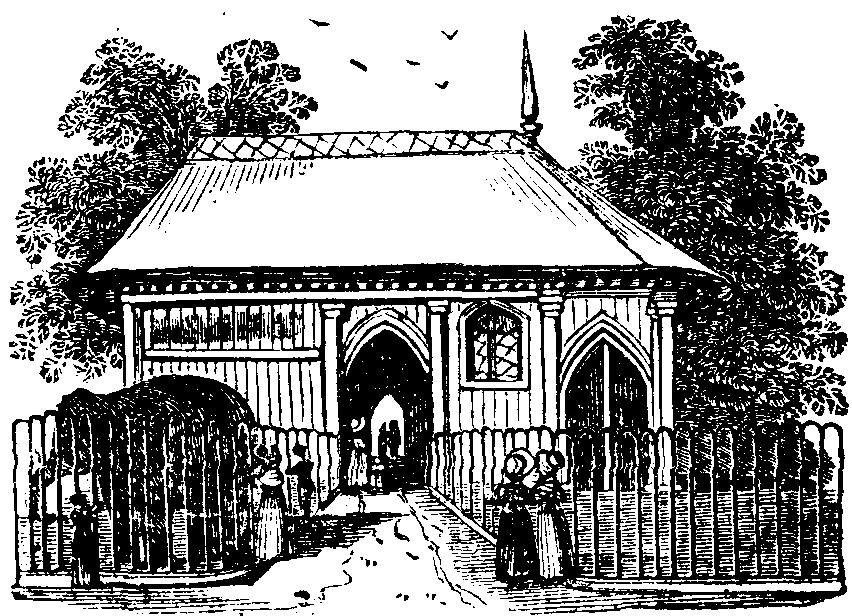
Thus far in the Southern Garden, whence we reach the Northern by the Tunnel beneath the Park-road, as figured in The Mirror, No. 535, opposite to the end of the tunnel is a large squirrel-cage, and at the extremity of the walk to the right is a spacious building, called the Repository "the inhabitants of which are continually being changed as variations in the weather, or any other cause may render convenient." We last saw there the noble Lions from the Tower, together with the Hyaena, Jackal, Ichneumons, Coatimondis, besides an assemblage of splendid tropical birds. The exterior of the building, especially the ornamented gable and doorways, is picturesque.
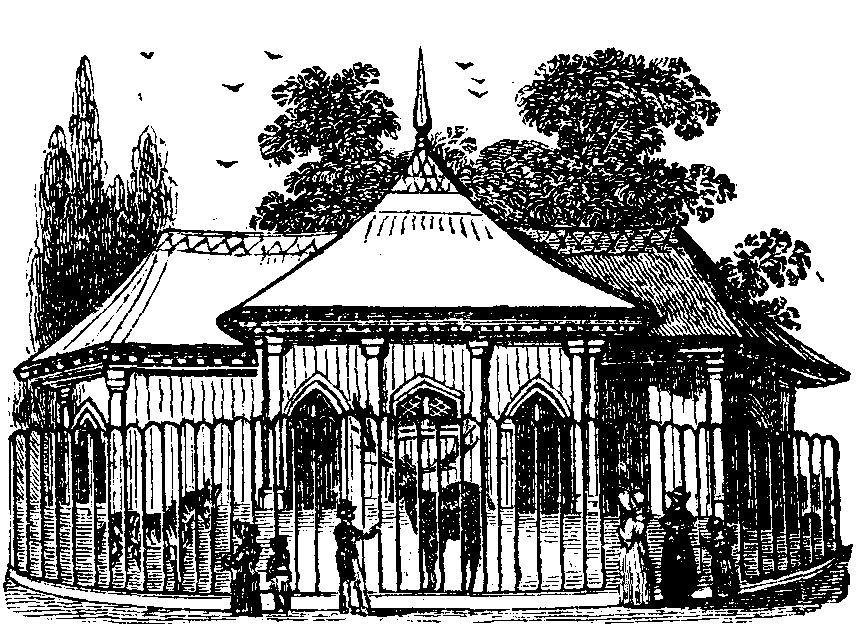
(Deer.)
(Elephants.)
Repassing the Squirrel Cage, the visiter must next proceed along the straight gravelled walk, which leads towards the western extremity of the North Garden. Here is a range of buildings, among which is the Stable and enclosed Yard for Deer; Among which are specimens of the Wapiti, remarkable for its size and the amplitude of its branching horns when full grown. Next is the Stable and Enclosure for Elephants, opposite the capacious Bath already represented in The Mirror, No. 560.
In a fortnight we may probably resume our graphic visit to this most interesting resort.
THE VOICE OF HUMANITY.
"The Association for promoting Rational Humanity towards the Animal Creation" exists—though, in one sense, as a blot upon the character of the age. They publish the above Journal quarterly, assembling acts of atrocity which make the blood curdle in our veins, and remind us that "all are not men that wear the human form." The funds of the society are not in a prosperous condition; the sand of their philanthropy is well nigh run out, and fresh appeals are to be made. Let us glance at the contents of, the Voice before us. The subject "Abattoirs contrasted with Slaughter-houses and Smithfield-market," is continued—a plan which we illustrated in The Mirror about five years since. True enough the Society write, but the people do not consider; they are so wedded to old prejudices and habits, and the mammon of money, that pestilential slaughter-houses are tolerated in the midst of a "city of the plague," notwithstanding a law exists for its prevention. Four hospitals are building in the metropolis—and markets are increasing for the sale of the necessaries and luxuries of life; the Haymarket has been removed from a fashionable quarter to the suburbs, that loaded carts may not obstruct carriages in their road to St. James's, the Houses of Parliament, and the Opera—yet, not a single, Abattoir—for the health of the people—exists near the metropolis. The King and the Court patronize and plan horse-racing, throwing the lasso, and, if recent report be true, hawking; the Parliament legislate, a bill is "ordered to be printed"—yet, the inconsistency and tardiness of these proceedings compel us to ask, where is the truth of the motto—Salus populi suprema lex. Convictions before magistrates for acts of cruelty are not uncommon; yet, it is in this, as in many other laws, the poor are caught, while the rich break through the meshes of the net. In the work before us are recorded Mr. Osbaldeston's matches, including "the cold-blooded cruelty towards the generous and heart-broken Rattler, in riding him thirty-four miles in the space of 2 hours, 18 min., and 56 sec." Next are four police cases of cruelties towards horses, bullocks, and cats, the persons convicted being "of low estate." Yet there follows the fact of a respectable woman boiling a cat to death! and next is this quotation from the Gentleman's Magazine for April, 1789:—
"Died, April 4, at Tottenham, John Ardesoif, Esq.; a young man of large fortune, and in the splendour of his carriages and horses rivalled by few country gentlemen. His table was that of hospitality, where it may be said he sacrificed too much to conviviality. Mr. Ardesoif was fond of cock-fighting, and he had a favourite cock upon which he had won many profitable matches. The last bet he made upon this cock he lost; which so enraged him, that he had the bird tied to a spit, and roasted alive before a large fire. The screams of the miserable animal were so affecting, that some gentlemen who were present attempted to interfere, which so exasperated Mr. Ardesoif, that he seized the poker; and, with the most furious vehemence, declared that he would kill the first man who interfered; but, in the midst of his passionate assertions, he fell down dead upon the spot!"
If we be asked whether it be proper to regard all such dispensations as judicial inflictions, we reply in the words of Cowper above:
"'Tis not for us, with rash surmise, To point the judgments of the skies, But judgments plain as this, That, sent for man's instruction, bring A written label on their wing, 'Tis hard to read amiss."
[A contribution full of touching simplicity follows:]
THE WORM.
Turn, turn, thy hasty foot aside Nor crush that helpless worm; The frame thy wayward looks deride, Required a God to form. The common Lord of all that move, From whom thy being flowed, A portion of his boundless love On that poor worm bestowed. The sun, the moon, the stars, he made To all his creatures free; And spread o'er earth the grassy blade For worms as well as thee. Let them enjoy their little day, Their lowly hiss receive; Oh! do not lightly take away The life thou canst not give.
Here we may remark, that much wanton cruelty has been abolished by the extended education of the people. Brutal sports among boys are much less indulged than formerly, and the worrying of domestic animals almost invariably denotes a bad boy, in the worst sense of the phrase, likely to make a bad man; "so true to nature is the admirable aphorism of Wordsworth:—
The boy's the father of the man."
But we do not so much complain of boyish as of adult cruelties; though, according to the above showing, such atrocities will be less rare in the next than in the present generation. To conclude, we hope that the present notice may awaken the sympathy of the reader towards the laudable objects of the Society, under whose guidance the Voice of Humanity is published. It is a difficult matter to point out "the uneducated," and writers of all grades are eternally babbling of our high state of civilization and refinement, yet, we repeat, the necessity of this association is an anomaly which amounts to a national disgrace.