NOTES
Reading edition
Abridged from the Magazine of Natural History.
(The Fern Owl, showing the greater length of the middle claw, and its provision for the peculiar posture of the bird.)
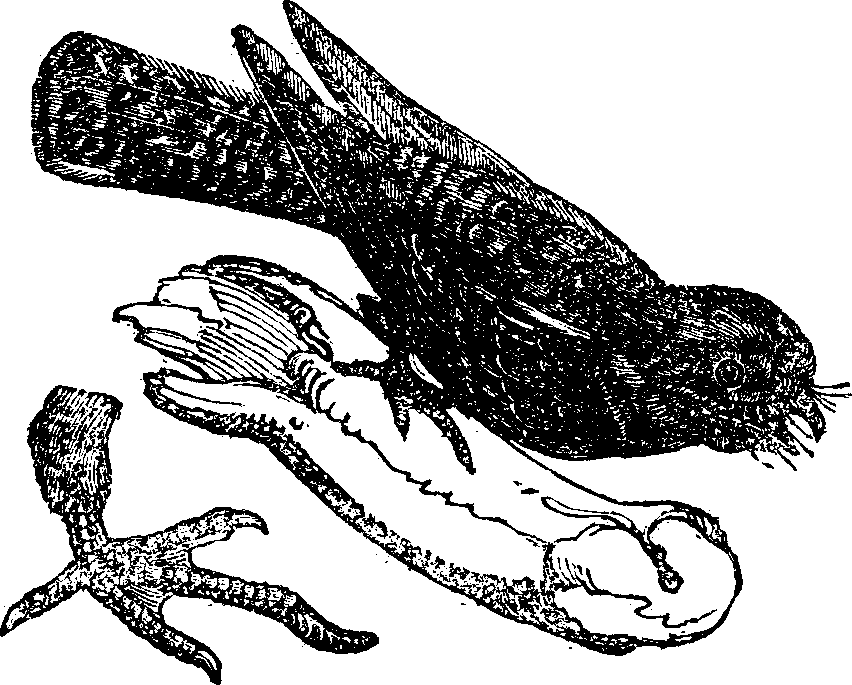
Habits of the Fern Owl, by Rusticus.—Beyond Godalming, on the Liphook road, is a great tract of barren heathy land: it stretches wide in every direction, and includes immense peat-bogs, and several large ponds. One particular district, called the Pudmores, is the favourite resort of the fern owl. In the daytime, while walking across the moor, you will every now and then put up one of these singular birds; their flight is perfectly without noise, and seldom far at a time: but of an evening it is far different; about twenty minutes after sunset, the whole moor is ringing with their cry, and you see them wheeling round you in all directions. They look like spectres; and, often coming close over you, assume an unnatural appearance of size against a clear evening sky. I believe its very peculiar note is uttered sitting, and never on the wing. I have seen it on a stack of turf with its throat nearly touching the turf, and its tail elevated, and have heard it in this situation utter its call, which resembles the birr of the mole-cricket, an insect very abundant in this neighbourhood. I have almost been induced to think this noise serves as a decoy to the male mole-cricket, this being occasionally found in the craw of these birds when shot. Those who may not be acquainted with the cry of the bird or the insect, may imagine the noise of an auger boring oak, or any hard wood, continued, and not broken off, as is the noise of the auger, from the constant changing of the hands. The eggs of the fern owl have frequently been brought me by boys: they are only two in number, greyish white, clouded and blotched with deeper shades of the same colour; the hen lays them on the soil, which is either peat, or a fine soft blue sand, in which she merely makes a slight concavity, but no nest whatever. The first cry of the fern owl is the signal for the night-flying moths to appear on the wing, or rather the signal for the entomologist expecting them.
The migratory periods of this bird are not well ascertained; but I have known one shot Nov. 27th, 1821, and they had arrived April 28th, 1830. As there is scarcely a British bird of which so little is known, the following notes may be interesting:—It has been seen perched on the bar of a gate, not across, but according to its length, with the tail elevated; uttering its peculiar sounds; but when perching, as it often does, on the summit of a twig of oaken copse, it fixes upright, with the feet grasping the twig, and not sitting; just as the swift perches against a wall. One was killed in broad daylight, perched on the upper side of a sloping branch of considerable size; the head was uppermost, and it rested on the feet and tarsi, the latter being bare on the under surface for that purpose. Its attitude in this situation much resembled that of a woodpecker. One that was kept alive with its wing broken sat across the finger, like another bird. When about to take flight it makes a cracking noise, as if the wings smote together, after the manner of a pigeon.
Harbingers of Spring.—One of the earliest intimations of approaching spring is the appearance of the Phalaena primaria, and of one or two other moths, floating with expanded wings on the surface of ponds and still water. A butterfly, Caltha palustris, is commonly drawn forth from its winter quarters by one of the first warm and sunny days that happen to occur in the month of March: hence it has been termed fallax veris indicium, (the deceitful token of spring.) In the Isle of Wight it has been seen on the wing the 8th of January, 1805.—Rev. W.T. Bree.
Ravages of the Beetle.—Mr. Bree describes the Scarabaeus horticola as "exceedingly destructive in gardens. Being on a visit in Staffordshire, in the month of June, I observed whole beds of strawberries (not hautboys) likely to prove nearly barren, though they had flowered copiously, and the season, was favourable for a crop. I was informed that the failure was owing to the fernshaws (the provincial name for the beetle), which are accused of eating the anthers and interior parts of the blossom. In the same garden my attention was also called to the ravages committed by this depredator on the apples, by gnawing holes in the young fruit; which consequently dies and falls of, or at least becomes much blemished. I was assured that the fernshaws had been detected in the fact; and I am rather disposed to think that the charge in both instances is well founded. I had long been aware of the insect's partiality for rosebuds and blossoms, which it greedily devours. In the north of England, where it is much used as a killing bait for trout, the insect is commonly known by the name of 'bracken-clock,' a name of the same import with the Staffordshire term 'fernshaw,' each signifying 'fern-beetle.'" Another correspondent says—Scarabaeus horticola, called "the chovy" in Norfolk, is there deemed very injurious to apple-trees, and other trees and plants, as it feeds both on leaves and all the parts of the flower. Chovies were abundant at Thetford, Norfolk, about ten years ago; but, as far as my experience has reached, always rare about Bury St. Edmunds. On the 9th of June, 1829, I saw one in the botanic garden of the last-named town, flitting about a flowering bush of the Provence rose.
Ink of the Cuttle-fish.—[By way of addenda if not corrigenda to our description of the Cuttle-fish, at page 104 of the present volume, we quote the following observations.]
"When in danger, cuttle-fish are said to eject a copious black liquor through their funnel or excrementary canal, as a means of obscuring the circumfluent water, and concealing themselves from all foes:—
"Long as the craftie cuttle lieth sure
LUXURIANCE OF NATURE.
Upper Louisiana (we are told) has all the trees known in Europe, besides others that are here unknown. The cedars are remarkably fine; the cotton trees grow to such a size, that the Indians make canoes out of their trunks; hemp grows naturally; tar is made from the pines on the sea coast; and the country affords every material for ship-building. Beans grow to a large size without culture; peach trees are heavily laden with fruit; and the forests are full of mulberry and plum trees. Pomegranates and chestnut trees are covered with vines, whose grapes are very large and sweet. There are three or four crops of Indian corn in the year; as there is no other winter besides some rains. The grass grows to a great height, and towards the end of September is set on fire, and in eight or ten days after, the young grass shoots up half a foot high.