THE MIRROR OF LITERATURE, AMUSEMENT, AND INSTRUCTION.
Reading edition
Vol. 20. No. 563.] SATURDAY, AUGUST 25, 1832 [PRICE 2d.
ANTIQUITIES OF THE PEAK.
Crosses
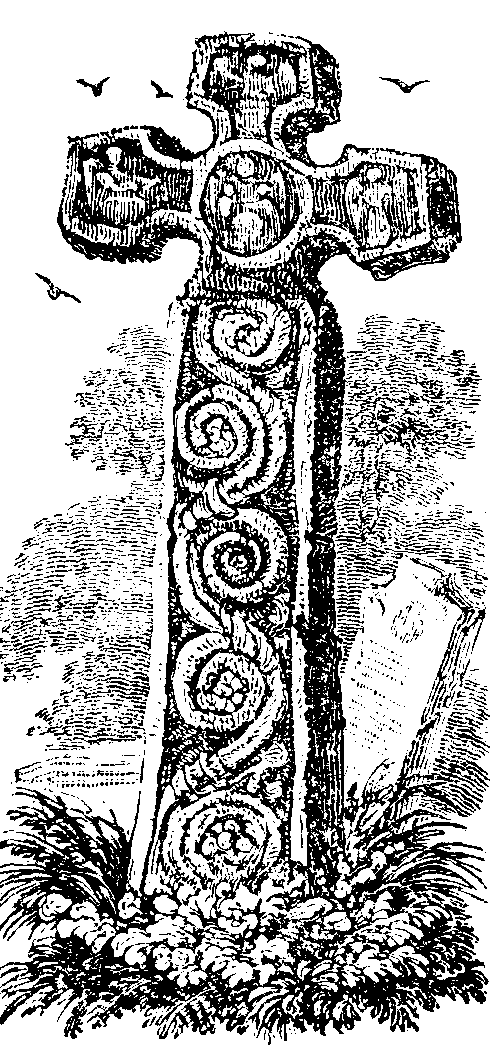
(At Eyam.)
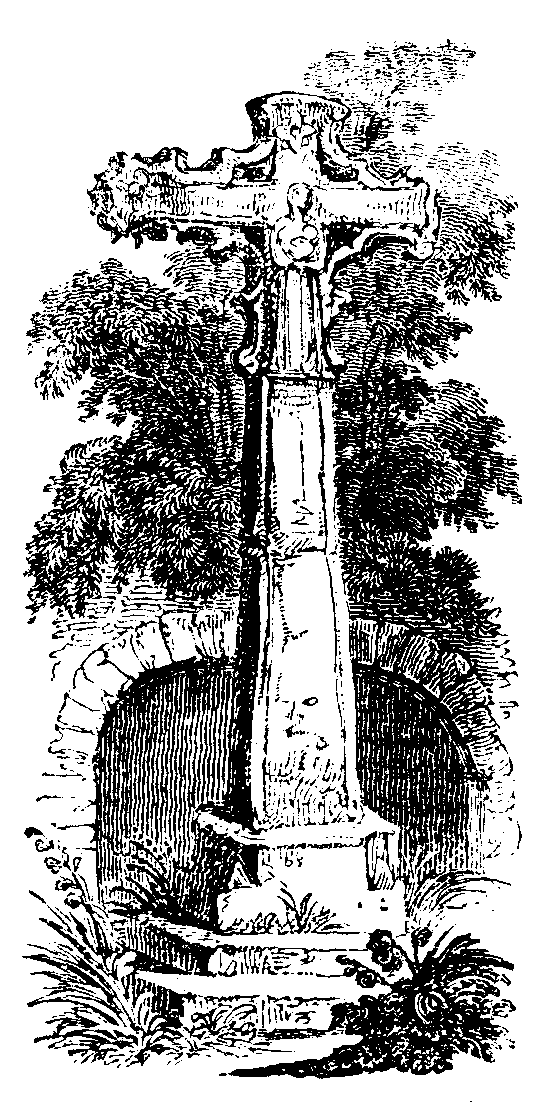
(At Wheston.)
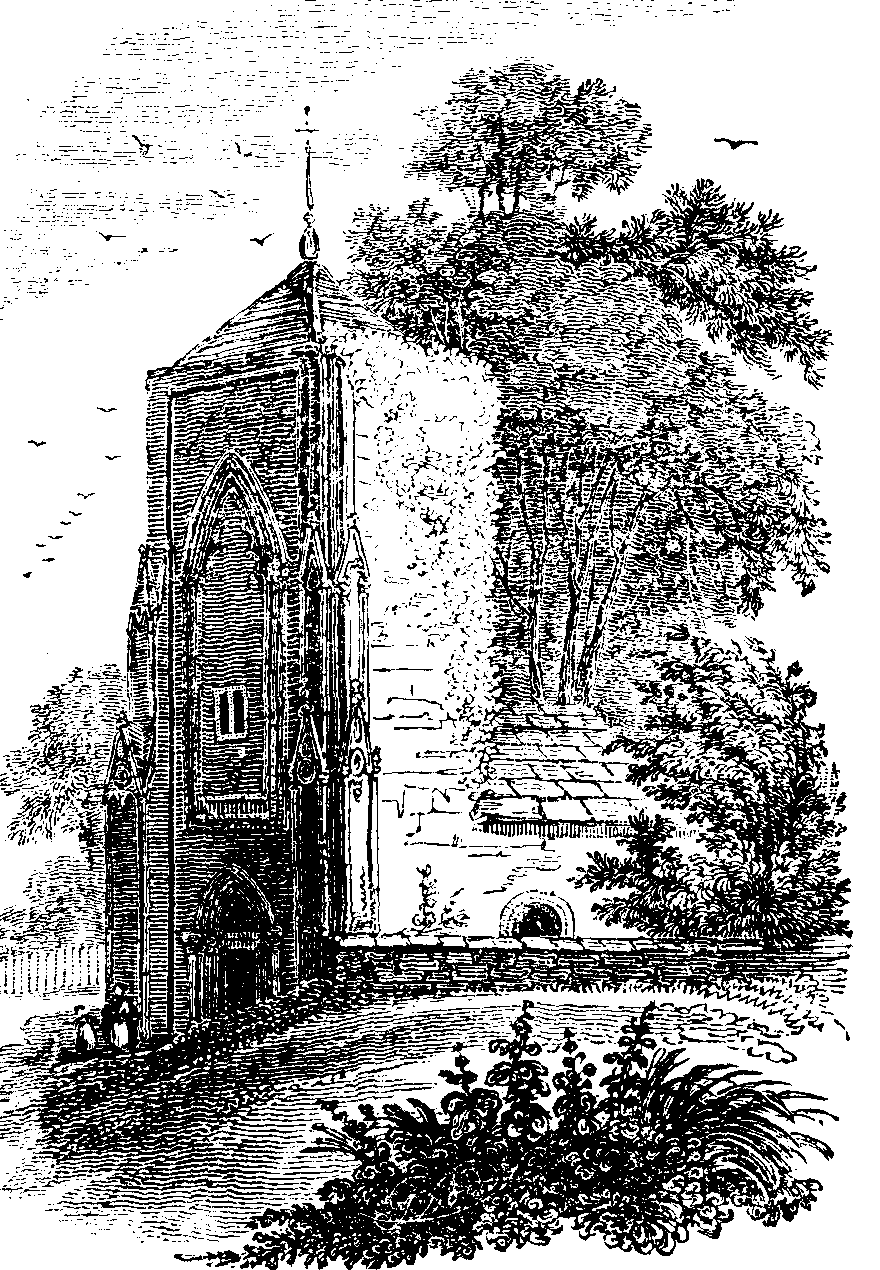
(Beauchief Abbey.)
Mr. Rhodes, the elegant topographer of the Peak, observes, "there are but few individuals in this country, possessing the means and the opportunities of travel, who have not, either from curiosity or some other motive, visited the Peak of Derbyshire." This remark is correct; and to it we may add, that the "few" who have not personally visited the Peak, have become familiar with its wonders through the pencils of artists, or the graphic pens of accomplished tourists. Yet their attractions are not of that general character which delights an untravelled eye: they belong rather to the wonderful than what is, in common parlance, the beautiful. Mr. Rhodes says, "Travellers accustomed to well-wooded and highly-cultivated scenes only, have frequently expressed a feeling bordering on disgust, at the bleak and barren appearance of the mountains in the Peak of Derbyshire; but to the man whose taste is unsophisticated by a fondness for artificial adornments, they possess superior interest, and impart more pleasing sensations. Remotely seen, they are often beautiful; many of their forms, even when near, are decidedly good; and in distance, the features of rudeness, by which they are occasionally marked, are softened down into general and sometimes harmonious masses. The graceful and long-continued outline which they present, the breadth of light and shadow that spreads over their extended surfaces, and the delightful colouring with which they are often invested, never fail to attract the attention of the picturesque traveller."
Our present road, however, lies through the dales rather than the mountainous portion of this district. To enjoy the picturesque variety of the former we must leave the cloud-capped peaks, and ramble with the reader through "cultivated meadows, luxuriant foliage, steep heathy hills, and craggy rocks, while the eye is enchanted with brilliant streams." Such indeed is the character of the dales, especially those through which the Derwent, the Dove, and the Wye meander. Hitherto we have but adverted to the natural beauties of the country; although they are checkered with many mouldering relics of "hoar antiquity"—many crumbling memorials of ages long past, reminding us of the nothingness of man's labours, yet harmonizing most happily with the feelings inspired by the natural sublimities of the scene. By such associations, the decaying glories of art lend even a charm to ever flourishing nature!
The walls of Beauchief Abbey, with the exception of the west end, represented in the Cut, have long since either been removed, or have mouldered into dust. Parochial service is still performed in the remains; but the whole of the original form of the once extensive pile of building cannot now be traced.
The exterior architecture of the chapel is almost destitute of ornament; if we except the reeded windows, and the double buttresses at the angles of the tower, which is stated to be short of its original height. On the east side, two angular lines mark the connexion which the chapel had with the other buildings, and a part of the ground plan may be traced by an adjoining wall, in which are the remains of two circular arches, comparatively little impaired. Mr. Rhodes observes "a wreath of ivy which falls from the top of the tower, and nearly invests one side of it, breaks the dull monotony of its outline, and produces a tolerably good effect: in other respects it is not strikingly attractive as a picturesque object. The Abbey of Bello-Capite will ever be dear to the antiquary who will visit it with veneration and delight; nor will the artist pass it by unnoticed. The magnificent woods, and the beautiful hills that environ the Abbey of Beauchief, amply compensate for any deficiency of grandeur in the subordinate adornments of so rich a scene."
Beauchief Abbey, though once a considerable structure, was never proportionally wealthy. At the time of its dissolution, (Henry VIII.) the whole of its revenues were estimated but at 157l; and with the materials furnished by its demolition was built Beauchief House upon the same estate, granted by Henry VIII. to Sir William Shelly. The mansion is still tenanted.
CROSSES.
So sad, so tender and so true.
Among the verdant mountains of the Peak There lies a quiet hamlet, where the slope Of pleasant uplands wards the north-wind's bleak; Below wild dells romantic pathways ope; Around, above it, spreads a shadowy cope Of forest trees: flower, foliage, and clear rill Wave from the cliffs, or down ravines elope; It seems a place charmed from the power of ill By sainted words of old: so lovely, lone, and still. And many are the pilgrim's feet which tread Its rocky steps, which thither yearly go; Yet, less by love of Nature's wonders led, Than by the memory of a mighty woe, Which smote, like blasting thunder, long ago, The peopled hills. There stands a sacred tomb, Where tears have rained, nor yet shall cease to flow; Recording days of death's sublimest gloom; Mompesson's power and pain,—his beauteous Catherine's doom.
Near the cross at Eyam, and in the distance of the Cut, is the tomb of Mrs. Mompesson, on one end of which is an hour-glass with two expanded wings; and underneath on an oblong tablet is inscribed CAVETE; (beware,) and nearer the base, the words Nescitis Horam (ye know not the hour). On the other end of the tomb is a death's head resting on a plain, projecting tablet; and below the words Mihi lucrum (mine is the gain).
Several crosses have been found in this part of Derbyshire, but only a few have escaped the dilapidations of age; the others have been, we had almost said sacrilegiously, destroyed as objects of no value. Mr. Rhodes tells us that "in one place the shaft of a cross, originally of no mean workmanship, has been converted into a gate-post; at another, one has been scooped and hollowed out, and made into a blacksmith's trough. I have seen one, which is richly sculptured on the three remaining sides, with figures and a variety of ornaments, all well executed, that was long applied to this humble purpose." The Cut shows that a portion of the cross at Wheston has been broken off; Mr. Rhodes saw the fragment as a common piece of stone, built and cemented into an adjoining wall; and he judiciously adds, "where so little interest has been felt in the preservation of these relics, it is only surprising that so many of them yet remain in different parts of the kingdom." Among all acts of wanton license, the destruction of a cross is to us the most unaccountable. We can readily refer the defacement of imperial insignia and the spoliation of royal houses to political turbulence engendered by acts of tyrannical misrule; but the mutilation of the cross—the universal Christian emblem—remains to be explained, unless we attribute it to the brutal ignorance of the spoilers. Its religious universality ought consistently to protect it from intolerance.
We must not bring this paper to a close without explaining that the preceding Engravings have been copied from the first of Mr. Rhodes's excursions of seventeen miles, viz. from Sheffield to Tideswell. The Abbey and the two Crosses therefore occur in that district. The original plates are effectively engraved by W. and W.B. Cook, from drawings by Mr. Chantrey, R.A., who presented to Mr. Rhodes a series of drawings for his work, "as a token of his friendship, and a mark of his attachment to his native country."