THE SELECTOR; AND LITERARY NOTICES OF NEW WORKS.
Reading edition
LANDERS' DISCOVERY OF THE TERMINATION OF THE NIGER.
We continue our extracts from this very entertaining work, the following being from the second volume.
At Boossà, the travellers receive a visit from "the noted widow Zuma." She must be an Amazonian lady, for, having quarrelled with her prince, the ruler of Wowow, she was obliged to fly, and actually to climb over the city wall in the night, and travel on foot to Boossà. Female politicians in Africa are not so safe as in the coteries of civilized Europe: they have to fight their own battles, and we conclude, to raise their own supplies: "the widow complained sadly of poverty and the hardness of the times; she had fought with the Yarribeans against Alòrie; but instead of receiving a recompense for her bravery, she had lost half her slaves in an engagement, which so disgusted her with the military profession, that she immediately abandoned it and returned home. Yet, in spite of all her losses and misfortunes, she has gained so much in corpulency, that it was with the utmost difficulty, she could squeeze herself into the doorway of our hut, although it is by no means small. The widow Zuma is a very good-looking, elderly person of matronly appearance. Her skin is of a light copper colour." Should this meet the eye of any soldier of fortune, &c.
At Boossà, they hear some tidings of
Mungo Park.
"Our visiters remained with us a considerable time, and in the course of conversation, one of them observed that they had in their possession a tobe, which belonged to a white man who came from the north many years ago, and from whom it had been purchased by the king's father. We expressed great curiosity to see this tobe, and it was sent us as a present a short time after their departure. Contrary to our expectations, we found it to be made of rich crimson damask, and very heavy from the immense quantity of gold embroidery with which it was covered. As the time when the late king was said to have purchased this tobe corresponds very nearly to the supposed period of Mr. Park's death, and as we never heard of any other white man having come from the north so far south as Boossà, we are inclined to believe it to be part of the spoil obtained from the canoe of that ill-fated traveller. Whether Mr. Park wore the tobe himself, which is scarcely probable on account of its weight, or whether he intended it as a present to a native chief, we are at a loss to determine. At all events, the article is a curiosity in itself; and if we should live to return to England, we shall easily learn whether it was made there or not. The chief himself has never worn the tobe, nor did his predecessor, from a superstitious feeling; 'besides,' observed the king, 'it might excite the cupidity of the neighbouring powers.'
"Sunday, June 20th.—The king sent a messenger this morning, to inform us that he was a tailor, and that he would thank us for some thread and a few needles for his own private use. By this man he likewise sent a musket for us to repair; but as it is Sunday, we have declined doing it till to-morrow. Eager as we are to obtain even the slightest information relative to the unhappy fate of Mr. Park and his companions, as well as to ascertain if any of their books or papers are now in existence at this place, we had almost made up our minds to refrain from asking any questions on the subject, because we were apprehensive that it might be displeasing to the king, and involve us in many perplexities. Familiarity, however, having in some measure worn off this impression, and the king being an affable, obliging, and good-natured person, we were emboldened to send Paskoe to him this morning, with a message expressive of the interest we felt on the subject, in common with all our countrymen; and saying that, if any books or papers which belonged to Mr. Park were yet in his possession, he would do us a great service, by delivering them into our hands, or at least by granting us permission to see them. To this the king returned for answer, that when Mr. Park was lost in the Niger, he was a very little boy, and that he knew not what had become of his effects; that the deplorable event had occurred in the reign of the late king's predecessor, who died shortly after; and that all traces of the white man had been lost with him. This answer disappointed our hopes, for to us it appeared final and decisive. But in the evening they were again raised by a hint from our host, who is the king's drummer, and one of the principal men in the country: he assured us, that there was certainly one book at least saved from Mr. Park's canoe, which is now in the possession of a very poor man in the service of his master, to whom it had been entrusted by the late king during his last illness. He said moreover, that if but one application were made to the king, on any subject whatever, very little was thought of it; but if a second were made, the matter would be considered of sufficient importance to demand his whole attention,—such being the custom of the country. The drummer therefore recommended us to persevere in our inquiries, for he had no doubt that something to our satisfaction would be elicited. At his own request, we sent him to the king immediately, desiring him to repeat our former statement, and to assure the king, that should he be successful in recovering the book we wanted, our monarch would reward him handsomely. He desired the drummer to inform us, that he would use every exertion, and examine the man who was reported to have the white man's book in his possession, at an early hour to-morrow. Here the matter at present rests.
"In the afternoon, the king came to see us, followed by a man with a book under his arm, which was said to have been picked up in the Niger after the loss of our countryman. It was enveloped in a large cotton cloth, and our hearts beat high with expectation as the man was slowly unfolding it, for by its size we guessed it to be Mr. Park's journal; but our disappointment and chagrin were great, when, on opening the book, we discovered it to be an old nautical publication of the last century. The title-page was missing, but its contents were chiefly tables of logarithms. It was a thick royal quarto, which led us to conjecture that it was a journal; between the leaves we found a few loose papers of very little consequence indeed; one of them contained two or three observations on the height of the water in the Gambia; one was a tailor's bill on a Mr. Anderson; and another was addressed to Mr. Mungo Park, and contained an invitation to dinner,—the following is a copy of it:—
'Mr. and Mrs. Watson would be happy to have the pleasure of Mr. Park's company at dinner on Tuesday next, at half-past five o'clock. 'An answer is requested. 'Strand, 9th Nov. 1804.'
"The king, as well as the owner of the book, looked as greatly mortified as ourselves, when they were told that the one produced was not that of which we were in quest, because the reward promised would not of course be obtained. As soon as our curiosity had been fully satisfied, the papers were carefully collected and placed again between the leaves, and the book as carefully folded in its envelope as before, and taken away by its owner, who values it as much as a household god. Thus all our hopes of obtaining Mr. Park's journal or papers, in this city, are entirely defeated. The inquiry, on our part, has not been prosecuted without much trouble and anxiety, and some little personal sacrifices likewise, which, had they been ten times as great, we would gladly have made whilst a single hope remained of their being effectual."
After much ado at Boossà, owing to the canoe not being ready—the "King of the Canoe," a sort of Lord of the Admiralty, informing the travellers with the utmost unconcern that it was out of repair—they
Embark on the Niger.
"About mid-day the workmen having finished our canoe, the luggage was presently put into it, and between twelve and one we embarked with our people, and were launched out into the river. The direction of this branch was nearly east and west; and we proceeded some distance down the stream for the purpose of getting into the main branch of the Niger, where there is deeper water. This object was soon attained, and we found it flowing from north to south, through a rich and charming country, which seemed to improve in appearance the further we advanced. We were propelled at a good rate up a channel, which, from half a mile in breadth, gradually widened to rather better than a mile. Beautiful, spreading, and spiry trees adorned the country on each side of the river, like a park; corn, nearly ripe, waved over the water's edge; large, open villages appeared every half-hour; and herds of spotted cattle were observed grazing and enjoying the cool of the shade. The appearance of the river, for several miles, was no less enchanting than its borders; it was as smooth as a lake; canoes laden with sheep and goats, were paddled by women down its almost imperceptible current; swallows, and a variety of aquatic birds, were sporting over its glassy surface, which was ornamented by a number of pretty little islands.
"Friday, June 25th.—The most remarkable object which we saw on rising this morning, was a rugged and romantic range of hills, appearing to the eastward of our encampment; it is called Engarskie, from a country of the same name in which the hills are situated, and which was formerly an independent kingdom, but is now become a province of Yàoorie. At a little before seven, A.M., our canoe was pushed off the sandy beach on which it had been secured last evening, and propelled down a very narrow channel, between a large sand-bank and the shore. This conducted us into the main branch of the Niger, and we again admired its delightful and magnificent appearance.
"We had proceeded only a few hundred yards when the river gradually widened to two miles, and continued so as far as the eye could reach. It looked very much like an artificial canal; the banks having the appearance of a dwarf wall, with vegetation beyond. In most places the water was extremely shallow, but in others it was deep enough to float a frigate. During the first two hours of the day, the scenery was as interesting and picturesque as can be imagined. The banks were literally covered with hamlets and villages; fine trees, bending under the weight of their dark and impenetrable foliage, everywhere relieved the eye from the glare of the sun's rays, and, contrasted with the lively verdure of the little hills and plains, produced the most pleasing effect. Afterwards, however, there was a decided change; the banks, which before consisted of dark earth, clay, or sand, were now composed of black rugged rocks; large sand-banks and islands were scattered in the river, which diverted it into a variety of little channels, and effectually destroyed its appearance.
"We had heard so unfavourable an account of the state of the river at one particular place which we should have to pass, that our people were compelled to disembark and walk along the banks a considerable way till we had passed it, when we took them in again. We found the description to be in no wise exaggerated; it presented a most forbidding appearance, and yields only to the state of the Niger near Boossà in difficulty and danger. On our arrival at this formidable place, we discovered a range of black rocks running directly across the stream, and the water, finding only one narrow passage, rushed through it with great impetuosity, over-turning and carrying away everything in its course. Our boatmen, with the assistance of a number of the natives, who planted themselves on the rocks on each side of the only channel, and in the stream at the stern of the canoe, lifted it by main force into smoother and safer water. The last difficulty with respect to rocks and sand-banks was now overcome, and in a very little time we came to the termination of all the islands, after which, it is said, there is not a single dangerous place up the Niger. The river here presented its noblest appearance; not a single rock nor sand-bank was anywhere perceptible; its borders resumed their beauty, and a strong, refreshing breeze, which had blown during the whole of the morning, now gave it the motion of a slightly-agitated sea. In the course of the morning we passed two lovely little islands, clothed in verdure, which at a short distance looked as charming as the fabled gardens of Hesperia; indeed no spot on earth can excel them in beauty of appearance. These islands are inhabited by a few individuals."
Upon leaving Yàoorie, a venerable Arab chief pretended great regard for the travellers, though he used them deceitfully; they had, however, "enjoyed an innocent kind of revenge, in administering to him a powerful dose of medicine, which though harmless in its effects, had yet been very troublesome to him. Indeed, it was not till we had 'jalaped' the sultan, his sister, and all the royal family, that we were permitted to take our farewell of Yàoorie."
The incident of physicking the royal family at Yàoorie by way of leave-taking, is only equalled by the following oddity:—"The captain of the palm oil brig, Elizabeth, now in the Calabar river, actually white-washed his crew from head to foot, while they were sick with fever and unable to protect themselves; his cook suffered so much in the operation, that the lime totally deprived him of the sight of one of his eyes, and rendered the other of little service to him."
The account of the Travellers' visit to Fernando Po, in the third volume, will be read with interest, as indeed will every page of the whole narrative; and to this commendation of the Messrs. Landers' Journal of their past adventures we cheerfully add our best wishes for the success of their future enterprize.
SONGS OF THE GIPSIES.
Among the musical novelties of the day, we notice with much pleasure, a pretty volume of Lyrics, written by Mr. Moncrieff, the music by Mr. S. Nelson. The poetry is throughout sparkling and characteristic, and "an Historical Introduction on the origin and customs of Gipsies," prefixed to the Songs, is so attractive as to be likely to share the popularity of the piano-forte accompaniments. It is written with considerable care and neatness, and the peculiar tact requisite to produce an interesting paper on a dry subject.
We are only enabled to quote from the lyrics, an opening carol, as
Liberty, liberty! Search the world round, 'Tis with the Gipsy Alone thou art found. Then in the gay greenwood We worship thee now, The free, oh the free! Still live under the bough. Trarah! Trarah! Hark, the deep dingles ring, Free hearts, with the bird And the deer are on wing; Joy claims in the greenwood The Gipsy's glad vow, The blithe, oh the blithe! Still live under the bough.
And the first song entire.
THE GIPSY QUEEN.
Oh! 'tis I am the Gipsy Queen! And where is there queen like me, That can revel upon the green, In boundless liberty? What though my cheek be brown, And wild my raven hair, A red cloth hood my crown, And my sceptre the wand I bear! Yet, 'tis I am the Gipsy Queen! With my kingdom I'm well content, Though my realm's but the hawthorn glade; And my palace a tatter'd tent Beneath the willow's shade: Though my banquet I'm forc'd to make On haws and berries store, And the game that by chance we take From some neighbouring hind's barn door! Yet, 'tis I am the Gipsy Queen! 'Tis true I must ply my art, And share in my subjects' toils; But of all their gains I've part, I've the choice of all their spoils; And, by love and duty led, Ere from my jet black eye One sad tear should be shed, A thousand hearts would die! For, 'tis I am the Gipsy Queen!
A SONG OF PITCAIRN'S ISLAND.
Come, take our boy, and we will go Before our cabin door; The winds shall bring us, as they blow, The murmurs of the shore; And we will kiss his young blue eyes, And I will sing him as he lies, Songs that were made of yore: I'll sing, in his delighted ear, The island-lays thou lov'st to hear. And thou, while stammering I repeat, Thy country's tongue shalt teach; 'Tis not so soft, but far more sweet Than my own native speech; For thou no other tongue didst know, When, scarcely twenty moons ago, Upon Tahité's beach, Thou cam'st to woo me to be thine, With many a speaking look and sign. I knew thy meaning—thou didst praise My eyes, my locks of jet; Ah! well for me they won thy gaze— But thine were fairer yet! I'm glad to see my infant wear Thy soft blue eyes and sunny hair, And when my sight is met By his white brow and blooming cheek, I feel a joy I cannot speak. Come talk of Europe's maids with me, Whose necks and cheeks, they tell, Outshine the beauty of the sea, White foam and crimson shell. I'll shape like theirs my simple dress, And bind like them each jetty tress, A sight to please thee well; And for my dusky brow will braid A bonnet like an English maid. Come, for the soft, low sunlight calls— We lose the pleasant hours; 'Tis lovelier than these cottage walls— That seat among the flowers. And I will learn of thee a prayer To Him who gave a home so fair, A lot so blest as ours— The God who made for thee and me This sweet lone isle amid the sea.
From a volume of American Poetry, William Cullen Bryant.
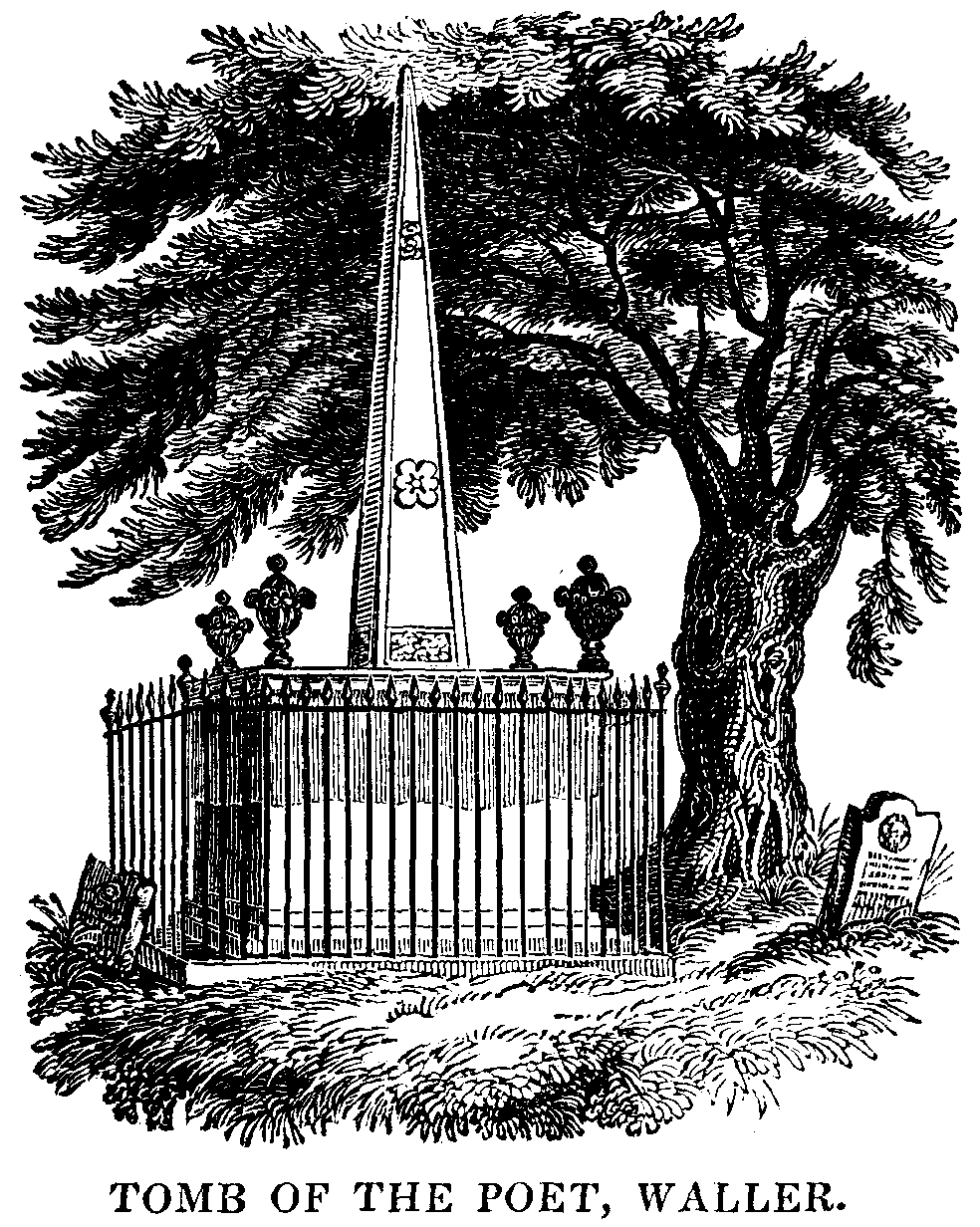
Waller was proprietor of the manor of Beaconsfield, and that of Hall Barn, in the vicinity, at which latter place he resided.
It is remarkable, that this great man, toward the decline of life bought a small house, with a little land, on his natal spot; observing, "that he should be glad to die like the stag, where he was roused." This, however, did not happen. "When he was at Beaconsfield," says Johnson, "he found his legs grow tumid: he went to Windsor, where Sir Charles Scarborough then attended the king, and requested him, as both a friend and physician, to tell him what that swelling meant. 'Sir,' answered Scarborough, 'your blood will run no longer.' Waller repeated some lines of Virgil, and went home to die. As the disease increased upon him, he composed himself for his departure; and calling upon Dr. Birch to give him the holy sacrament, he desired his children to take it with him, and made an earnest declaration of his faith in Christianity. It now appeared what part of his conversation with the great could be remembered with delight. He related, that being present when the Duke of Buckingham talked profanely before King Charles, he said to him, 'My lord, I am a great deal older than your Grace, and have, I believe, heard more arguments for atheism than ever your Grace did; but I have lived long enough to see there is nothing in them, and so I hope your Grace will."