The Naturalist.
Reading edition
LENGTH AND FINENESS OF THE SILKWORM'S WEB, &c.
Baker in The Microscope made Easy, says, "A silkworm's web being examined, appeared perfectly smooth and shining, every where equal, and much finer than any thread the best spinster in the world can make, as the smallest twine is finer than the thickest cable. A pod of this silk being wound off, was found to contain 930 yards; but it is proper to take notice, that as two threads are glewed together by the worm through its whole length, it makes double the above number, or 1,860 yards; which being weighed with the utmost exactness, were found no heavier than two grains and a half. What an exquisite fineness is here! and yet, this is nothing when compared with the web of a small spider, or even with the silk that issued from the mouth of this very worm, when but newly hatched from the egg."
Under the article Silk, in Rees's Cyclopaedia, the writer says, "that those who have examined it attentively, think they speak within compass, when they affirm that each ball contains silk enough to reach the length of six English miles."
Baker tells us, "not to neglect the skins these animals cast off three times before they begin to spin; for the eyes, mouth, teeth, ornaments of the head, and many other parts may be discovered better in the cast-off skins than in the real animal."
P.T.W.
CUCKOO
Mr. Jerdan, editor of the Literary Gazette, in a letter to Mr. Loudon, says, "about fifteen years ago I obtained a cuckoo from the nest of (I think) a hedge sparrow, at Old Brompton, where I then resided. It was rather curious, as being within ten yards of my house, Cromwell Cottage, and in a narrow and much frequented lane, leading from near Gloucester Lodge to Kensington. This bird I reared and kept alive till late in January; when it fell suddenly from its perch, while feeding on a rather large dew worm. It was buried: but I had, long afterwards, strange misgivings, that my poor feathered favourite was only choked by his food, or in a fit of some kind—his apparent death was so extremely unexpected from his health and liveliness at the time. I assure you that I regretted my loss much, my bird being in full plumage and a very handsome creature. He was quite tame, for in autumn I used to set him on a branch of a tree in the garden, while I dug worms for him to dine upon, and he never attempted more than a short friendly flight. During the coldest weather, and it was rather a sharp winter, my only precaution was, nearly to cover his cage with flannel; and when I used to take it off, more or less, on coming into my breakfast room in the morning, I was recognised by him with certainly not all the cry "unpleasant to a married ear," but with its full half "Cuck! Cuck!"—the only sounds or notes I ever heard from my bird. Though trifling, these facts may be so far curious as illustrating the natural history of a remarkable genus, and I have great pleasure in offering them for your excellent Journal." Mag. Nat. Hist.
MUSICAL SNAILS.
As I was sitting in my room, on the first floor, about nine P.M. (4th of October last), I was surprised with what I supposed to be the notes of a bird, under or upon the sill of a window. My impression was, that they somewhat resembled the notes of a wild duck in its nocturnal flight, and, at times, the twitter of a redbreast, in quick succession. To be satisfied on the subject, I carefully removed the shutter, and, to my surprise, found it was a garden snail, which, in drawing itself along the glass, had produced sounds similar to those elicited from the musical glasses.—Ibid.
BEWICK.
In the museum at Newcastle are many of the identical specimens from which the illustrious townsman Bewick drew his figures for the wood-cuts which embellish his unique and celebrated work. This truly amiable man, and, beyond all comparison, greatest genius Newcastle has ever produced, died on the 8th of November last, in the 76th year of his age. He continued to the last in the enjoyment of all his faculties; his single-heartedness and enthusiasm not a jot abated, and his wonder-working pencil still engaged in tracing, with his wonted felicity and fidelity, those objects which had all his life afforded him such delight, and which have charmed, and must continue to charm, all those who have any relish for the pure and simple beauties of nature.—Ibid.
The Argonaut, Or Paper Nautilus.
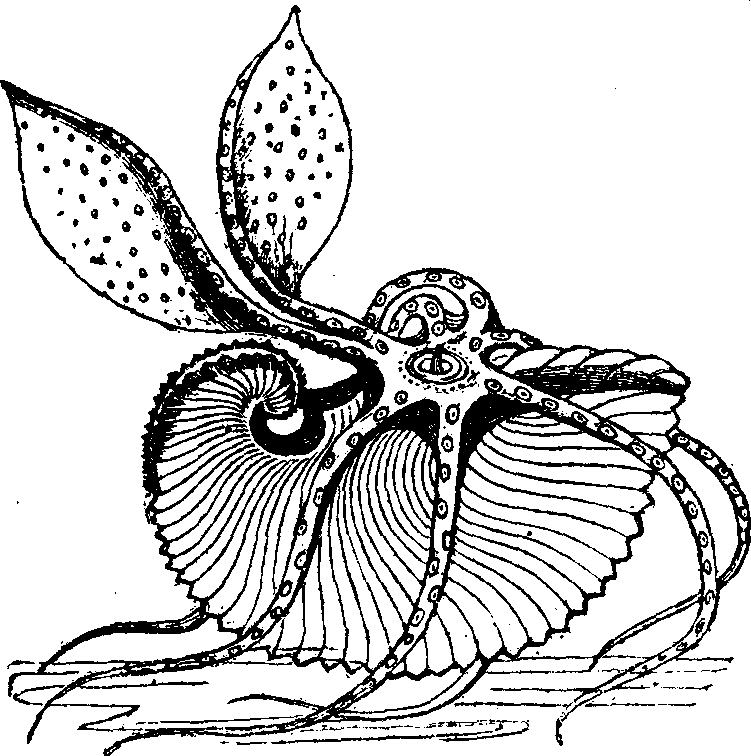
Learn of the little Nautilus to sail, Spread the thin oar, and catch the driving gale.
This species of shell-fish, (see the cut,) is named from Argonautes, the companions of Jason, in the celebrated ship, Argo, and from the Latin naus, a ship; the shells of all the Nautili having the appearance of a ship with a very high poop. The shell of this interesting creature is no thicker than paper, and divided into forty compartments or chambers, through every one of which a portion of its body passes, connected as it were, by a thread. In the cut it is represented as sailing, when it expands two of its arms on high, and between these supports a membrane which serves as a sail, hanging the two other arms out of its shell, to serve as oars, the office of steerage being generally served by the tail.
When the sea is calm, whole fleets of these Nautili may be seen diverting themselves; but when a storm rises, or they are disturbed, they draw in their legs, take in as much water as makes them specifically heavier, than that in which they float, and then sink to the bottom. When they rise again they void this water by numerous holes, of which their legs are full. The other species of Nautilus, whose shell is thick, never quits that habitation. The shells of both varieties are exceedingly beautiful when polished, and produce high prices among Conchologists.
It is easy to conceive that the ingenious habits of this wonderful creature may have suggested to man the power of sailing upon the sea, and of the various apparatus by which he effects that object. The whole creation abounds with similar instances of Nature ministering to the proud purposes of art: one of them, the origin of the Gothic Arch from the "high o'erarching groves," is mentioned by Warburton, in his Divine Legation, and is a sublime lesson for besotted man.